We didn t find any results for "diego rivera"
Get notified when items are added to this search
Recent Sales
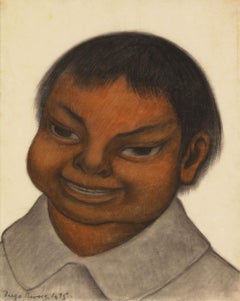
Niño by Diego Rivera
By Diego Rivera
Located in New Orleans, LA
Diego Rivera
1886-1957 Mexican
Niño
Signed and dated “Diego Rivera 1935” (lower left)
Charcoal and sanguine on rice paper
A rebel against the traditional school of painting, Diego Rivera is revered as one of the greatest and most influential artists of the 20th century. Niño, completed by Rivera in 1935, represents a masterwork within an important part of the artist’s output — his portraits of children. It is a touching work paying homage to both childhood innocence and the cultural identity of the Mexican people...
Category
20th Century Post-Impressionist Portrait Drawings and Watercolors
Materials
Charcoal, Rice Paper

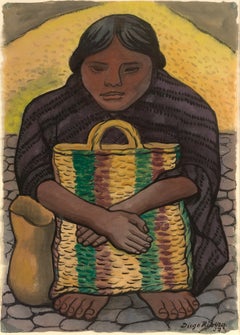
Vendedora By Diego Rivera
By Diego Rivera
Located in New Orleans, LA
Diego Rivera
1886-1957 Mexican
Vendedora
(Vendor)
Signed and dated (lower right)
Watercolor on rice paper
Diego Rivera stands among the most important artists of the 20th century...
Category
20th Century Post-Impressionist Figurative Drawings and Watercolors
Materials
Watercolor, Rice Paper
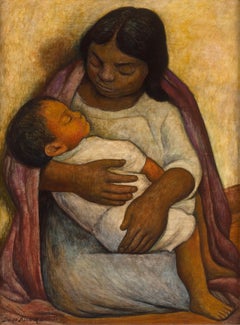
Delfina y Dimas by Diego Rivera
By Diego Rivera
Located in New Orleans, LA
Diego Rivera
1886-1957 Mexican
Delfina y Dimas
Signed and dated 1935
Tempera on masonite
In the intimate masterwork Delfina y Dimas, the great Diego Rivera illustrates all of his...
Category
20th Century Modern Figurative Paintings
Materials
Masonite, Tempera
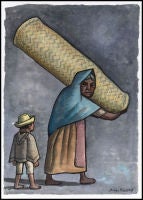
Mujer con Nino by Diego Rivera
By Diego Rivera
Located in New Orleans, LA
Diego Rivera
1886-1957 • Mexican
Mujer con Niño
Signed “Diego Rivera” (lower right)
Watercolor on paper
Brilliant colors and cultural subject matter characterize this o...
Category
1930s Portrait Drawings and Watercolors
Materials
Watercolor, Paper
Tehuana con Batea by Diego Rivera
By Diego Rivera
Located in New Orleans, LA
Diego Rivera
1886-1957 Mexican
Tehuana con batea
Signed “D Rivera” (lower right)
Graphite on cream wove paper
A rebel against the traditional school of painting, Diego Rivera is revered as one of the greatest and most influential artists of the 20th century. Tehuana con batea, completed by Rivera in 1922, represents a glimpse into the artist’s process through a powerful graphite-on-paper sketch. Rivera’s thoughtful marks outline a Tehuana — a woman from the isthmus of Tehuantepec and likely a descendant of the Zapotec indigenous peoples. The woman is rendered with a kind of totemic solidity, accented by the block-like forms of her clothing and the strength of her stance. Her arms reach upwards as she carries a basket atop her head. Although highly stylized, the work retains a narrative element that was important to the artist’s output — telling the stories of the native peoples of Mexico.
Composed in 1922, this drawing dates from a pivotal moment in the artist’s career. It marked the painting of his first significant mural, Creation, in the Bolívar Auditorium of the National Preparatory School in Mexico City, the first of many government-sponsored murals he would undertake over the next three decades. Later in the year, Rivera founded the Revolutionary Union of Technical Workers, Painters and Sculptors, and joined the Mexican Communist Party. The public mural projects reflected his communist politics in historical contexts. Aside from the often-controversial reactions they received, these works focused on the working-class “everyman” of Mexico and reflected the folk ideals that were familiar and respected within the native community.
In addition to the rarity of this plaque due to its unique perspective, Tehuana con batea has a notable provenance, having been owned by celebrated Museum of Modern Art staff member Patricia Dowd Whitman. Remembered fondly for building relationships with donors and artists including Dorothea Rockburne and Tom Otterness over her thirty-three years at the institution, she served as Director of the Contemporary Arts Council at MoMA from 1990 until her retirement in 2007. A remarkable drawing with provenance, Tehuana con batea is one-of-a-kind.
Born in Guanajuato City, Mexico in 1886, Diego Rivera showed a talent for drawing at a very young age. He began his formal art education at the Academy of San Carlos in Mexico. When he moved to Paris in 1907 to live and work with the great gathering of artists in Montparnasse, he was exposed to the burgeoning of Cubism, and fully embraced this new school of thought. His works attracted the attention of the world’s most prestigious art patrons, including Nelson Rockefeller, for whom he painted a controversial mural in 1934. While both his personal and artistic lives were at times tumultuous, it is his artistic vision and compassion for his homeland and people that have formed the legacy of this incredible figure.
Created 1922
Paper: 12 7/8" high x 8 3/8" wide
Frame: 20 1/2" high x 15 3/8" wide x 1 3/8" deep
Provenance:
Mary-Anne Martin Fine...
Category
20th Century Post-Impressionist Figurative Drawings and Watercolors
Materials
Paper, Graphite

Niño Indígena Con Pelota By Diego Rivera
By Diego Rivera
Located in New Orleans, LA
Diego Rivera
1886-1957 Mexican
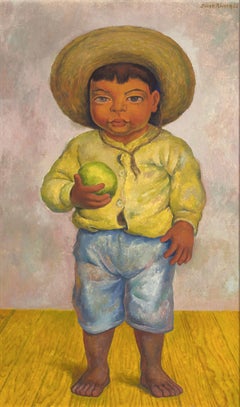
Niño Indígena con Pelota
(Indigenous Boy with a Ball)
Signed and dated
Oil on board
A rebel against the traditional school of painting, Diego River...
Category
20th Century Post-Impressionist Figurative Paintings
Materials
Oil, Board
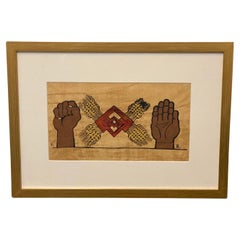
"Struggle and Fraternity" Symbolic Lithograph by Diego Rivera
By Diego Rivera
Located in Pasadena, CA
Diego Rivera (1886–1957) was one of the founders of the Mexican muralist movement. After an extended stay in Europe, he returned to Mexico in 1921 and took on a full involvement in t...
Category
Mid-20th Century Symbolist Figurative Paintings
Materials
Lithograph
$1,200
H 19.5 in W 13.88 in D 0.66 in
Vintage 1948 Limited Edition (of 200) Lithograph by Mexican Master Diego Rivera
By Diego Rivera
Located in Surfside, FL
These are not individually hand signed or numbered. The stated edition on the justification page is 200.
They are signed in the plate. The last two images of the title sheet and justification sheet are not included in this sale. just the one lithograph.
Diego María de la Concepción Juan Nepomuceno Estanislao de la Rivera y Barrientos Acosta y Rodríguez, known as Diego Rivera (1886–1957), was a prominent Mexican painter. His large frescoes helped establish the mural movement in Mexican and international art.
Between 1922 and 1953, Rivera painted murals in, among other places, Mexico City, Chapingo, and Cuernavaca, Mexico; and San Francisco, Detroit, and New York City, United States. In 1931, a retrospective exhibition of his works was held at the Museum of Modern Art in New York; this was before he completed his 27-mural series known as Detroit Industry Murals.
Rivera had numerous marriages and children, including at least one natural daughter. His first child and only son died at the age of two. His third wife was fellow Mexican artist Frida Kahlo, with whom he had a volatile relationship that continued until her death. He was married a fifth time, to his agent.
Due to his importance in the country’s art history, the government of Mexico declared Rivera's works as "monumentos historicos". As of 2018, Rivera holds the record for highest price at auction for a work of Latin American art. The 1931 painting The Rivals, part of the record setting Collection of Peggy Rockefeller and David Rockefeller, sold for US$9.76 million.
His mother María del Pilar Barrientos was said to have Converso ancestry (Spanish ancestors who were forced to convert from Judaism to Catholicism in the 15th and 16th centuries). Rivera wrote in 1935: "My Jewishness is the dominant element in my life," despite never being raised practicing any Jewish faith, Rivera felt his Jewish ancestry informed his art and gave him "sympathy with the downtrodden masses". Diego was of Mexican, Spanish, Indian, African, Italian, Jewish, Russian, and Portuguese descent.
From the age of ten, Rivera studied art at the Academy of San Carlos in Mexico City. He was sponsored to continue study in Europe by Teodoro A. Dehesa Méndez, the governor of the State of Veracruz. After arriving in Europe in 1907, Rivera first went to Madrid, Spain to study with Eduardo Chicharro.
From there he went to Paris, France, a destination for young European and American artists and writers, who settled in inexpensive flats in Montparnasse. His circle frequented La Ruche, where his Italian friend Amedeo Modigliani painted his portrait in 1914. His circle of close friends included School of Paris artists Ilya Ehrenburg, Chaim Soutine, Modigliani and his wife Jeanne Hébuterne, Max Jacob, gallery owner Léopold Zborowski, and Moise Kisling. Rivera's former lover Marie Vorobieff-Stebelska (Marevna) honored the circle in her painting Homage to Friends from Montparnasse (1962). In those years, some prominent young painters were experimenting with an art form that would later be known as Cubism, a movement led by Pablo Picasso and Georges Braque. From 1913 to 1917, Rivera enthusiastically embraced this new art style.[ Around 1917, inspired by Paul Cezanne paintings, Rivera shifted toward Post-Impressionism, using simple forms and large patches of vivid colors. His paintings began to attract attention, and he was able to display them at several exhibitions.
In his later years Rivera lived in the United States and Mexico.
In 1920, urged by Alberto J. Pani, the Mexican ambassador to France, Rivera left France and traveled through Italy studying its art, including Renaissance frescoes. In 1921 to become involved in the government sponsored Mexican mural program. The program included such Mexican artists as José Clemente Orozco, David Alfaro Siqueiros, and Rufino Tamayo, and the French artist Jean Charlot. In January 1922, he painted – experimentally in encaustic – his first significant mural Creation in the Bolívar Auditorium of the National Preparatory School in Mexico City while guarding himself with a pistol against right-wing students. In the autumn of 1922, Rivera participated in the founding of the Revolutionary Union of Technical Workers, Painters and Sculptors, and later that year he joined the Mexican Communist Party (including its Central Committee). His murals, subsequently painted in fresco only, dealt with Mexican society and reflected the country's 1910 Revolution. Rivera developed his own native style based on large, simplified figures and bold colors with an Aztec influence. The mural En el Arsenal (In the Arsenal) shows on the right-hand side Tina Modotti holding an ammunition belt and facing Julio...
Category
1940s Modern Figurative Prints
Materials
Lithograph
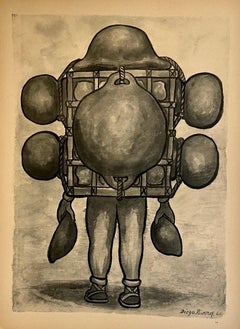
Vintage 1948 Limited Edition (of 200) Lithograph by Mexican Master Diego Rivera
By Diego Rivera
Located in Surfside, FL
These are not individually hand signed or numbered. The stated edition on the justification page is 200.
They are signed in the plate. The last two images of the title sheet and justification sheet are not included in this sale. just the one lithograph.
Diego María de la Concepción Juan Nepomuceno Estanislao de la Rivera y Barrientos Acosta y Rodríguez, known as Diego Rivera (1886–1957), was a prominent Mexican painter. His large frescoes helped establish the mural movement in Mexican and international art.
Between 1922 and 1953, Rivera painted murals in, among other places, Mexico City, Chapingo, and Cuernavaca, Mexico; and San Francisco, Detroit, and New York City, United States. In 1931, a retrospective exhibition of his works was held at the Museum of Modern Art in New York; this was before he completed his 27-mural series known as Detroit Industry Murals.
Rivera had numerous marriages and children, including at least one natural daughter. His first child and only son died at the age of two. His third wife was fellow Mexican artist Frida Kahlo, with whom he had a volatile relationship that continued until her death. He was married a fifth time, to his agent.
Due to his importance in the country’s art history, the government of Mexico declared Rivera's works as "monumentos historicos". As of 2018, Rivera holds the record for highest price at auction for a work of Latin American art. The 1931 painting The Rivals, part of the record setting Collection of Peggy Rockefeller and David Rockefeller, sold for US$9.76 million.
His mother María del Pilar Barrientos was said to have Converso ancestry (Spanish ancestors who were forced to convert from Judaism to Catholicism in the 15th and 16th centuries). Rivera wrote in 1935: "My Jewishness is the dominant element in my life," despite never being raised practicing any Jewish faith, Rivera felt his Jewish ancestry informed his art and gave him "sympathy with the downtrodden masses". Diego was of Mexican, Spanish, Indian, African, Italian, Jewish, Russian, and Portuguese descent.
From the age of ten, Rivera studied art at the Academy of San Carlos in Mexico City. He was sponsored to continue study in Europe by Teodoro A. Dehesa Méndez, the governor of the State of Veracruz. After arriving in Europe in 1907, Rivera first went to Madrid, Spain to study with Eduardo Chicharro.
From there he went to Paris, France, a destination for young European and American artists and writers, who settled in inexpensive flats in Montparnasse. His circle frequented La Ruche, where his Italian friend Amedeo Modigliani painted his portrait in 1914. His circle of close friends included School of Paris artists Ilya Ehrenburg, Chaim Soutine, Modigliani and his wife Jeanne Hébuterne, Max Jacob, gallery owner Léopold Zborowski, and Moise Kisling. Rivera's former lover Marie Vorobieff-Stebelska (Marevna) honored the circle in her painting Homage to Friends from Montparnasse (1962). In those years, some prominent young painters were experimenting with an art form that would later be known as Cubism, a movement led by Pablo Picasso and Georges Braque. From 1913 to 1917, Rivera enthusiastically embraced this new art style.[ Around 1917, inspired by Paul Cezanne paintings, Rivera shifted toward Post-Impressionism, using simple forms and large patches of vivid colors. His paintings began to attract attention, and he was able to display them at several exhibitions.
In his later years Rivera lived in the United States and Mexico.
In 1920, urged by Alberto J. Pani, the Mexican ambassador to France, Rivera left France and traveled through Italy studying its art, including Renaissance frescoes. In 1921 to become involved in the government sponsored Mexican mural program. The program included such Mexican artists as José Clemente Orozco, David Alfaro Siqueiros, and Rufino Tamayo, and the French artist Jean Charlot. In January 1922, he painted – experimentally in encaustic – his first significant mural Creation in the Bolívar Auditorium of the National Preparatory School in Mexico City while guarding himself with a pistol against right-wing students. In the autumn of 1922, Rivera participated in the founding of the Revolutionary Union of Technical Workers, Painters and Sculptors, and later that year he joined the Mexican Communist Party (including its Central Committee). His murals, subsequently painted in fresco only, dealt with Mexican society and reflected the country's 1910 Revolution. Rivera developed his own native style based on large, simplified figures and bold colors with an Aztec influence. The mural En el Arsenal (In the Arsenal) shows on the right-hand side Tina Modotti holding an ammunition belt and facing Julio...
Category
1940s Modern Figurative Prints
Materials
Lithograph
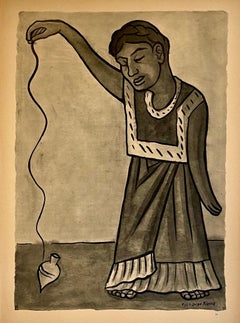
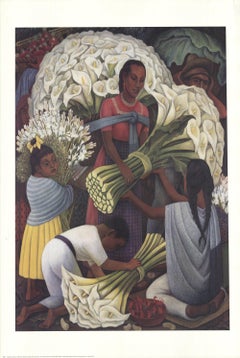
2001 Diego Rivera
Flower Vendor
Modernism USA Offset Lithograph
By Diego Rivera
Located in Brooklyn, NY
Paper Size: 30 x 24 inches ( 76.2 x 60.96 cm )
Image Size: 25.5 x 21 inches ( 64.77 x 53.34 cm )
Framed: No
Condition: A-: Near Mint, very light signs of handling
Additional De...
Category
Early 2000s Prints and Multiples
Materials
Offset
$75
H 30 in W 24 in D 0.1 in
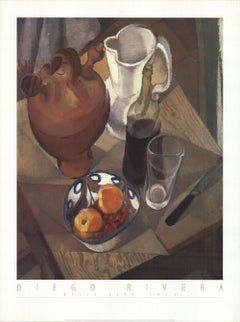
1998 Diego Rivera
Still Life, 1913
Switzerland Offset Lithograph
By Diego Rivera
Located in Brooklyn, NY
Paper Size: 31.5 x 23.75 inches ( 80.01 x 60.325 cm )
Image Size: 25.5 x 20.25 inches ( 64.77 x 51.435 cm )
Framed: No
Condition: A-: Near Mint, very light signs of handling
...
Category
1990s Prints and Multiples
Materials
Offset
$75
H 31.5 in W 23.75 in D 0.1 in
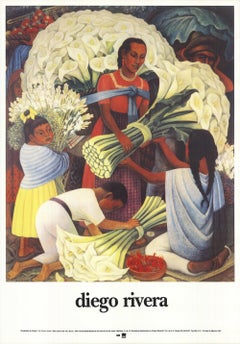
1997 Diego Rivera
The Flower Vendor
Modernism USA Offset Lithograph
By Diego Rivera
Located in Brooklyn, NY
Paper Size: 35.75 x 25 inches ( 90.805 x 63.5 cm )
Image Size: 28.75 x 24 inches ( 73.025 x 60.96 cm )
Framed: No
Condition: A-: Near Mint, very light signs of handling
Shipp...
Category
1990s Prints and Multiples
Materials
Offset
$75
H 35.75 in W 25 in D 0.1 in