527 results for "donald judd"

to
71
378
137
305
246
222
140
70
47
34
30
28
24
6
1
1
1
1
117
36
33
25
22
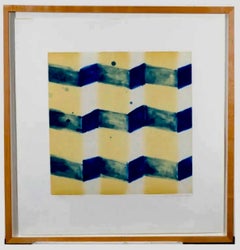
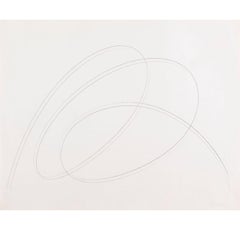
Abstract Aquatint Etching Ross Bleckner Zig Zag lines New York Artist D Loop
By Ross Bleckner
Located in Surfside, FL
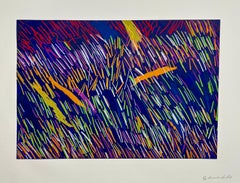
ROSS BLECKNER (American, b. 1949) "D Loop," 2002 Limited Edition Print : Color Aquatint With Spit Bite Aquatint And Gampi Chine-Collé on Somerset Paper Approximate dimensions - Frame 29.5 X 28,.5 inches, sheet 27 x 26 inches. Edition lower left: 2/20, Hand signed lower right. Publishers blind stamp lower right margin: Paulson Press. Ross Bleckner draws inspiration from science, psychology, and his own personal experience. The title of this print, D Loop, refers to molecular biology and DNA repair abstracted in vivid blue and yellow. Ross Bleckner (born May 12, 1949) is an American artist. He currently lives and works in New York City. His artistic focus is on painting, and he held his first solo exhibition in 1975. Bleckner grew up in Brooklyn, New York and he grew up Jewish. In an interview, Bleckner commented that he was fortunate to have supportive parents. In 1961, Bleckner and his family moved to a more affluent town in Hewlett Harbor, New York, where he attended George W. Hewlett High School. In 1965, Bleckner saw his first art exhibition, The Responsive Eye, at the Museum of Modern Art, which went on to have a huge impact on his artwork. Eventually, this was a time when he realized that he wanted to become an artist. Bleckner went on to study at New York University, where he studied alongside fellow artist Sol LeWitt and Chuck Close. During college, Bleckner worked in an art supply store and drove a taxi. He received his Bachelor of Fine Arts (B.F.A) from New York University (1971), and later received his Master of Fine Arts (M.F.A) at California Institute of the Arts. In 1974, when Bleckner moved back to New York, he moved into a Tribeca loft building. Three of the floors were rented to the painter Julian Schnabel and from 1977 to 1983 the Mudd Club, a nightclub frequented by musicians and artists, was in the same building. In 2004 Bleckner sold the building. He held his first solo exhibition in 1975 at Cunningham Ward Gallery in New York. Then In 1979 he began what was to become a long association with Mary Boone Gallery in New York. In 1981 Bleckner met Thomas Ammann, who was an influential Swiss art dealer who went on to collect Bleckner's work. Early 1990s, Bleckner did his first abstract painting called Cell painting which showed an example of human body cell diseases. Since either the 1980s or 1990s as an openly gay artist, his art has been largely an investigation of change, loss, and memory, often addressing the subject of AIDS. Bleckner uses symbolic modernist imagery rather than direct representation, and his work is visually elusive, with forms that constantly change focus. While much of Bleckner's work can be divided into distinct groups or series with motifs repeated from painting to painting, he is also in the habit of redeploying and combining old motifs. Bleckner has posited that a painting is never finished, provided it is still in his studio, because it can always be improved. In 2009, Bleckner published a book of his theoretical art statements entitled Examined Life: Writings, 1972-2007 that was published by Edgewise Press. In 1995, the Solomon R. Guggenheim Museum had a major retrospective exhibition of his works from the last two decades of exhibitions at acclaimed institutions such as San Francisco Museum of Modern Art, Moderna Museet in Stockholm, and the Carnegie Museum of Art. He was one of the youngest artists to be featured at the Guggenheim. Bleckner's works are held in collections around the world including Museum of Modern Art, New York, (he was included in the show Contemporary Works from the Collection, MoMA along with Carl Andre, Richard Artschwager, Marcel Broodthaers, Jim Dine, Howard Hodgkin, Jasper Johns, Donald Judd, Anish Kapoor, Ellsworth Kelly, Robert Mangold...
Category

Early 2000s Abstract Prints

Materials

Etching, Aquatint

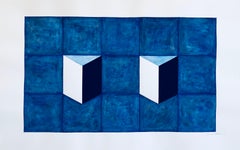
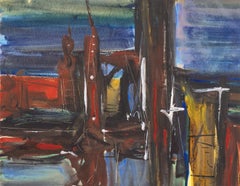
Korean Abstract Minimalist Gouache Painting LA Woman Artist MInimalism
By Jae Hahn
Located in Surfside, FL
Jae Hahn is a Korean-born artist living in Los Angeles. Known for abstraction and minimalism. She graduated with a Bachelors of Arts degree majoring in painting at UCLA in 1977. She spent her first 20 formative years in Korea, and the following 30 years in Los Angeles. Hahn’s search to find her own identity and cultural heritage resulted in studying Oriental philosophy, but more specifically, Taoism and Zen Buddhism. She later focused on figure painting, consolidating what she learned from all schools of masters. The first was about structure from cubism. Next were the dynamic color studies of Matisse, and third, the freedom of spontaneous gestural strokes found in Abstract Expressionism. During the late 1990’s, Hahn experienced her own Renaissance. Her paintings took on a new life, with more activity and interlocking positive and negative space, and varying textures (“folding”) and irregular shapes. This resulted in the Unfoldings series, which encompasses Hahn’s artistic attributes of color and form, surface layered depth of field, sculpture, geometry and structure. Jae's paintings are painted in varied tones of a single colour, and usually appear in the form of diptych, triptych or polyptych. The contents are patterns formed by lines such as a triangle, a diagonal, a cross or simply a horizontal line. Simplicity is indeed a quality that the artist intends to convey through her art. Following in the tradition of Donald Judd, John McCracken, Agnes Martin, Dan Flavin and Robert Morris, Her work tends towards a luminous minimalist style. She has showed at Kelley Roy gallery alongside John Henry, Dolly Moreno and Sebastian Spreng. She has also shown at Seth Jason Beitler Gallery in Miami. Selected Individual Exhibitions Millenia Fine Arts, Orlando, FL Lois Neiter Fine Arts, Sherman Oaks, CA Gallery Seohwa, Seoul, Korea Rule Modern and Contemporary Gallery, Denver, CO Lois Neiter Fine Arts, Malibu Beach, CA Grey McGear Modern, Santa Monica, CA T. Curtsnoc Fine Arts, Miami, FL Rule Modern and Contemporary Gallery, Denver, CO University of Wyoming Art Museum, Laramie, Wyoming T. Curtsnoc Fine Arts, Miami, FL Boritzer/Gray/Hamano Gallery, Santa Monica, CA The Seoul Club Exhibition, Seoul, Korea Claremont Graduate School - West Gallery, Claremont, CA Byucksan Museum, Seoul, Korea Boritzer/Gray Gallery, Santa Monica, CA Indeco Gallery, Seoul, Korea Brand Library Art Galleries, Glendale, CA Selected Group Exhibitions "Zen Summer”, Thomas Lavin, West Hollywood, CA The Fall Show, Susan Street Fine Art, Solano Beach, CA "Faces and Figures", Lois Neiter Fine Arts, Malibu, CA Jae Hahn, Kathleen Keifer, Caroyl La Barge, Maggie Lowe Tennessen Los Angeles County Museum of Art, Las Angeles, CA "Surface, Color, Light", Lois Neiter Fine Arts, Sherman Oaks, CA Miami Art Fair, T. Curtsnoc Fine Arts, Miami, FL London Art Fair 2002, Mark Jason Gallery, London, England "Abstractly", Rio Hondo College, Whittier, CA "Spring", LewAllen Contemporary, Santa Fe, NM "Contemporary Art Without A Mouse", LewAllen Contemporary, Santa Fe, NM "California Asian Women In Art", Fresh Paint Art, Culver City, CA "Summer Exhibition", Gallery Seohwa, Seoul, Korea "Update 2000", Fresh Paint Art, Culver City, CA Pasadena Historical Architecture Showcase, Pasadena, CA "Korean Contemporary Art," University of Wyoming Art Museum, Laramie, Wyoming Five Persons' Show, Cline LewAllen Contemporary, Santa Fe, NM "Korean Contemporary Art," Edwin Ulrich Art Museum, Wichita, Kan "Fall Exhibit" Lois Neiter Fine Arts, Sherman Oaks, CA "Paradise Lost-Abstraction after Modernism" Grey McGear Modern, Santa Monica, CA "Summer Exhibit" J.J. Brookings Gallery, San Francisco, CA "Korean Contemporary Art" The Cerrillos Cultural Center, Cerrillos, NM. "Essence in Purity" The Luckman Fine Arts Gallery, California State University, Los Angeles, CA. "Collector's Choice" Center for the Arts, Vero Beach, FL "Of Paint and Metal", Ken Elias Gallery, West Palm Beach, FL "Boom," T. Curtsnoc Fine Arts, Miami, FL "New Beginnings Old Friends," Fresh Paint Fine Arts, Culver City, CA Triton Contemporary Art Fair, San Francisco, CA Cerrillos Cultural Center, Cerrillos, NM "Inauguration Opening Exhibition", View gallery, New York, NY "Abstraction and Essence", Susan Street Fine Art Gallery, Solana Beach "Simply Small", Susan Street Fine Art Gallery, Solona Beach, CA "Idea House" Project, Pacific Design Center, Los Angeles, CA Works on Paper L.A. 1995 Art Fair, Santa Monica, CA USART, Ft. Mason, San Francisco, CA The 9th International Contemporary Art Fair, Los Angeles, CA "Big Littles", Boritzer/Gray/Hamano Gallery, Los Angeles, CA Jae H. Hahn and Julia N. Chu, Pierce College Art Gallery, Woodland Hills, CA The 7th International Contemporary Art Fair, Los Angeles, CA Neo-Modernism by Five American Artists, Markant Gallery, Langelo, Holland Summer Group Show, Janus Gallery...
Category

Late 20th Century Minimalist Abstract Paintings

Materials

Gouache, Archival Paper

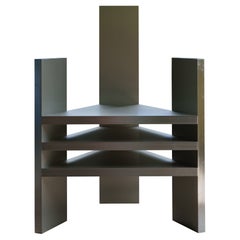
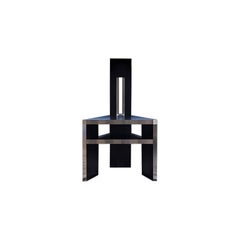
Aluminum Triangle Chair designed by Tadashi Murase Made in Japan
By Gerrit Rietveld, Donald Judd
Located in Kyoto, JP
Designed by Tadashi Murase, the Aluminum Triangle Chair is a sculptural seating object that explores structural minimalism, balance, and negative space. Constructed from aluminum hon...
Category

2010s Japanese Minimalist Chairs

Materials

Aluminum, Other

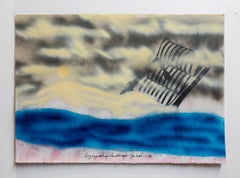
Iain Baxter "Regurgitating Landscape" Conceptual Monoprint Painting
By Iain Baxter
Located in Surfside, FL
Landscape with beach chair or lawn chair in bright vibrant colors. Iain Baxter& (the artist recently added the ampersand to his name) is recognized as Canada’s pioneering conceptual artist. For over forty years, Baxter& has continually produced works that question the role of art as commodity and as a medium for cultural commentary. Among his many innovations, Baxter& was the first artist to adopt a corporate persona: in 1966, he formed the N.E. Thing Company. NETCO output ranged from conceptual, satirical, vacuum-formed still lives to post-modern appropriations of famous artworks. His recent work includes neon signs, ‘animal preserves’, a grocery cart of ‘GMO’s’ (genetically modified organisms) and installations using obsolete technology.) He is a painter, photographer, sculptor, mixed media artist, installationist, film & video maker, interventionist & performance artist who has been a forerunner of conceptual art in Canada. BAXTER& has been considered the Marshall McLuhan of Visual Arts in Canada. Continuous themes in his work include information technology, landscape, art as commodity, & environmental & ecological concerns. These prominent themes throughout BAXTER&‘s work are often met with wit, parody, satire & word-play. Through his art, teaching, and mentorship, BAXTER& has widely influenced Canadian art, creating new movements such as the Vancouver School of Photo-conceptualism and blurring the lines between private and public through his N.E. Thing Co. among many other impactful projects. He has also directly influenced major Canadian artists, including Stan Douglas, Ian Wallace, Jeff Wall, Roy Arden, Ken Lum and Rodney Graham. BAXTER& has exhibited throughout Canada and internationally in the United States, China, Korea, Japan, and Europe including at the Guggenheim New York, The National Gallery of Canada & the Canadian Cultural Center in Paris, France, Los Angeles Museum of Contemporary Art, Museum of Modern Art, New York & the Tate Modern, London. In 2011, BAXTER&’s work was compiled into a major retrospective IAIN BAXTER&: 1958--‐2011, organized by the Art Gallery of Ontario & The Museum of Contemporary Art Chicago. His work can be found in collections including the National Gallery of Canada, the Art Gallery of Ontario, The Museum of Modern Art, New York, The Vancouver Art Gallery, the F.R.A.C Art Museum in Bretagne, France, the Gemeentemuseum in The Hague, The Netherlands, the Los Angeles County Museum of Art, & the Tate Modern, London. He is a Member of the Royal Canadian Academy. His work was included in the seminal Made of Plastic show that included Abe Ajay...
Category

20th Century Conceptual Mixed Media

Materials

Mixed Media, Monoprint, Monotype

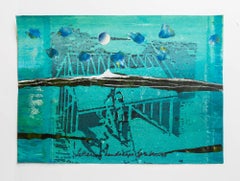
Iain Baxter "Lettering Landscape" Conceptual Monoprint Painting
By Iain Baxter
Located in Surfside, FL
Landscape with framed house in bright vibrant colors. Iain Baxter& (the artist recently added the ampersand to his name) is recognized as Canada’s pioneering conceptual artist. For over forty years, Baxter& has continually produced works that question the role of art as commodity and as a medium for cultural commentary. Among his many innovations, Baxter& was the first artist to adopt a corporate persona: in 1966, he formed the N.E. Thing Company. NETCO output ranged from conceptual, satirical, vacuum-formed still lives to post-modern appropriations of famous artworks. His recent work includes neon signs, ‘animal preserves’, a grocery cart of ‘GMO’s’ (genetically modified organisms) and installations using obsolete technology.) He is a painter, photographer, sculptor, mixed media artist, installationist, film & video maker, interventionist & performance artist who has been a forerunner of conceptual art in Canada. BAXTER& has been considered the Marshall McLuhan of Visual Arts in Canada. Continuous themes in his work include information technology, landscape, art as commodity, & environmental & ecological concerns. These prominent themes throughout BAXTER&‘s work are often met with wit, parody, satire & word-play. Through his art, teaching, and mentorship, BAXTER& has widely influenced Canadian art, creating new movements such as the Vancouver School of Photo-conceptualism and blurring the lines between private and public through his N.E. Thing Co. among many other impactful projects. He has also directly influenced major Canadian artists, including Stan Douglas, Ian Wallace, Jeff Wall, Roy Arden, Ken Lum and Rodney Graham. BAXTER& has exhibited throughout Canada and internationally in the United States, China, Korea, Japan, and Europe including at the Guggenheim New York, The National Gallery of Canada & the Canadian Cultural Center in Paris, France, Los Angeles Museum of Contemporary Art, Museum of Modern Art, New York & the Tate Modern, London. In 2011, BAXTER&’s work was compiled into a major retrospective IAIN BAXTER&: 1958--‐2011, organized by the Art Gallery of Ontario & The Museum of Contemporary Art Chicago. His work can be found in collections including the National Gallery of Canada, the Art Gallery of Ontario, The Museum of Modern Art, New York, The Vancouver Art Gallery, the F.R.A.C Art Museum in Bretagne, France, the Gemeentemuseum in The Hague, The Netherlands, the Los Angeles County Museum of Art, & the Tate Modern, London. He is a Member of the Royal Canadian Academy. His work was included in the seminal Made of Plastic show that included Abe Ajay...
Category

20th Century Conceptual Mixed Media

Materials

Mixed Media, Monoprint, Monotype

Original Rollage Michelangelo Sculpture, Bruegel Painting, Jiri Kolar Collage
By Jiri Kolar
Located in Surfside, FL
UNTITLED (ROLLAGE) Jiri Kolar Mixed Media, 1967 Rollage of a sculpture by Michelangelo and a painting by Bruegel Medium: Mixed Media, Collage Surface: Photographic Paper Country: Cz...
Category

20th Century Contemporary Mixed Media

Materials

Mixed Media

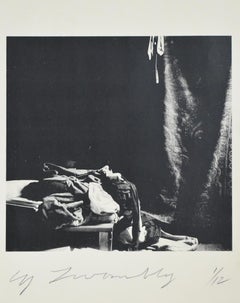
CY TWOMBLY BLACK WHITE PHOTO PHOTOGRAPHY MID CENTURY 1 OF 12
By Cy Twombly
Located in San Antonio, TX
Cy Twombly (1928-2011) Virginia/ New York / Italy Image Size: 16 x 11 Visible inside matboard is 12 x 11 Frame Size: 21.5 x 19 Medium: Photograph Edition 1/12 Signed with the edition number "Black and White" 1954 This is an original. The same photo in the Twombly book is a dry point on cardboard but is unsigned by hand. Cy Twombly (1928-2011) Following is the obituary of the artist by Randy Kennedy, The New York Times, July 5, 2011 Cy Twombly, whose spare, childlike scribbles and poetic engagement with antiquity left him stubbornly out of step with the movements of postwar American art even as he became one of the era's most important painters, died on Tuesday in Rome. He was 83. His death was announced by the Gagosian Gallery, which represents his work. Mr. Twombly had battled cancer for several years. In a career that slyly subverted Abstract Expressionism, toyed briefly with Minimalism, seemed barely to acknowledge Pop art and anticipated some of the concerns of Conceptualism, Mr. Twombly was a divisive artist almost from the start. The curator Kirk Varnedoe, on the occasion of a 1994 retrospective at the Museum of Modern Art, wrote that his work was "influential among artists, discomfiting to many critics and truculently difficult not just for a broad public, but for sophisticated initiates of postwar art as well." The critic Robert Hughes called him "the Third Man, a shadowy figure, beside that vivid duumvirate of his friends Jasper Johns and Robert Rauschenberg." Mr. Twombly's decision to settle permanently in southern Italy in 1957 as the art world shifted decisively in the other direction, from Europe to New York, was only the most symbolic of his idiosyncrasies. He avoided publicity throughout his life and mostly ignored his critics, who questioned constantly whether his work deserved a place at the forefront of 20th century abstraction, though he lived long enough to see it arrive there. It didn't help that his paintings, because of their surface complexity and whirlwinds of tiny detail — scratches, erasures, drips, penciled fragments of Italian and classical verse amid scrawled phalluses and buttocks — lost much of their power in reproduction. But Mr. Twombly, a tall, rangy Virginian who once practiced drawing in the dark to make his lines less purposeful, steadfastly followed his own program and looked to his own muses — often literary ones, like Catullus, Rumi, Pound and Rilke. He seemed to welcome the privacy that came with unpopularity. "I had my freedom and that was nice," he said in a rare interview, with Nicholas Serota, the director of the Tate, before a 2008 survey of his career at the Tate Modern. The critical low point probably came after a widely panned 1964 exhibition at the Leo Castelli Gallery in New York. The artist and writer Donald Judd, who was hostile toward painting in general, was especially damning, calling the show a fiasco. "There are a few drips and splatters and an occasional pencil line," he wrote in a review. "There isn't anything to these paintings." But by the 1980s, with the rise of neo-Expressionism, a generation of younger artists like Jean-Michel Basquiat found inspiration in Mr. Twombly's skittery bathroom-graffiti scrawl. Coupled with rising interest in European artists whose work shared unexpected ground with Twombly's, like Joseph Beuys, the newfound attention brought him a kind of critical favor he had never enjoyed before. And by the next decade, he was highly sought after not only by European museums and collectors, who had discovered his work early on, but also by those back in his homeland who had not known what to make of him two decades before. In 1989, the Philadelphia Museum of Art opened permanent rooms dedicated to his monumental 10-painting cycle, Fifty Days at Iliam, based on Alexander Pope's translation of The Iliad. (Mr. Twombly said that he purposely misspelled Ilium, a Latin name for Troy, with an "a," to refer to Achilles.) That same year, Mr. Twombly's work passed the million dollar mark at auction. In 1995, the Menil Collection in Houston opened a new gallery dedicated to his work, designed by Renzo Piano after a plan by Mr. Twombly himself. Despite this growing acceptance, Mr. Varnedoe still felt it necessary to include an essay in the Modern's newsletter at the time of the retrospective, titled "Your Kid Could Not Do This, and Other Reflections on Cy Twombly." In the only written statement Mr. Twombly ever made about his work, a short essay in an Italian art journal in 1957, he tried to make clear that his intentions were not subversive but elementally human. Each line he made, he said, was "the actual experience" of making the line, adding: "It does not illustrate. It is the sensation of its own realization." Years later, he described this more plainly. "It's more like I'm having an experience than making a picture," he said. The process stood in stark contrast to the detached, effete image that often clung to Mr. Twombly. After completing a work, in a kind of ecstatic state, it was as if the painting existed but he himself barely did anymore: "I usually have to go to bed for a couple of days," he said. Edwin Parker Twombly Jr., was born in Lexington, Va., on April 25, 1928, to parents who had moved to the South from New England. His father, a talented athlete who pitched a summer for the Chicago White Sox and went on to become a revered college swimming coach, was nicknamed Cy, after Cy Young, the Hall of Fame pitcher. The younger Mr. Twombly (pronounced TWAHM-blee) inherited the name, though he was much more bookish than athletic as a child, with stooped shoulders and a high ponderous forehead. He read avidly and, discovering his calling early, he worked from art kits he ordered from the Sears Roebuck catalog. As a teenager, he studied with the Spanish painter Pierre Daura, who had left Europe after the Spanish Civil War and settled in Lexington. Daura's wife, Louise Blair, studied cave paintings and may have sparked Mr. Twombly's early interest in Paleolithic art. In 1947 he attended the Boston Museum School, where German Expressionism was the rage, but Mr. Twombly gravitated to his own interests, like Dada and Kurt Schwitters and particularly to Jean Dubuffet and Alberto Giacometti, two important early influences. He moved back to Lexington in 1949 and studied art at Washington and Lee University, where his talent impressed teachers. By 1950, he was in New York, the recipient of a scholarship to the Art Students League. Later in his life, he cited visiting Willem de Kooning's studio and seeing an Arshile Gorky retrospective at the Whitney Museum of American Art as important moments in his young painting life. But he also came to New York at the heyday of the New York School and was exposed to the work of almost all its giants in the city's galleries. He turned down an offer for a solo show of his paintings at the Art Students League in 1950, saying that he felt it was too early for him. He met Rauschenberg, a fellow student at the league, during his second semester, and Rauschenberg later persuaded Mr. Twombly to enroll at Black Mountain College in North Carolina, which had become a crucible for the American avant-garde, with John Cage, Merce Cunningham, Ray Johnson, Dorothea Rockburne and John Chamberlain among its faculty and students. Mr. Twombly, who studied with Ben Shahn, stayed at the college only briefly and was a bit of an outsider even then. As he told Mr. Serota: "I was always doing my own thing. I always wondered why there are books with photographs of all the artists of that period and I was only in one! I thought: 'Where was I?' " In the summer of 1952, after receiving a grant from the Virginia Museum of Fine Arts, Mr. Twombly traveled to Europe for the first time and met up with Rauschenberg. The two wandered through Italy, North Africa and Spain, an experience that later yielded some of the first paintings to be considered a part of Mr. Twombly's mature work. "Tiznit," made with white enamel house paint and pencil and crayon, with gouges and scratches in the surface, was named for a town in Morocco that he had visited, and the painting's primitivist shapes were inspired by tribal pieces he saw at the ethnographic museum in Rome, as well as by artists like Dubuffet, de Kooning and Franz Kline. The painting, along with another based on tribal motifs, was exhibited in 1953 at Eleanor Ward's Stable Gallery on West 58th Street along with monochromatic paintings by Rauschenberg. The show was generally savaged. (Early this year, the Museum of Modern Art acquired "Tiznit," along with another early work, which Mr. Twombly had kept in his personal collection.) Mr. Twombly was drafted and spent more than a year in the Army, where he was assigned to cryptography work in Washington. On weekends and leaves, he continued to paint and draw, sometimes at night with the lights out to try to lose techniques he had learned in art classes and to express himself more instinctively. After receiving a medical discharge and teaching for a time in Virginia, Mr. Twombly returned to New York and worked in a studio on William Street, near both Rauschenberg and Johns, who helped choose titles for his paintings during this period. Mr. Twombly tried without success for several months to get a grant to go back to Europe and in 1957, with Ward's help, he spent several months in Italy, where he met Tatiana Franchetti...
Category

1950s Modern Black and White Photography

Materials

Drypoint

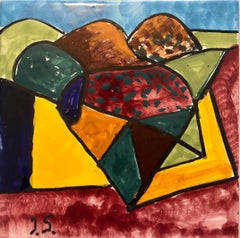
Abstract Painted Ceramic Tile Pop Art Painting Italian Neo Figurative Painting
By Italo Scanga
Located in Surfside, FL
This painted ceramic tile by Italo Scanga, epitomizes the characteristics of his oeuvre. Polychrome and vibrant art from the Memphis Milano era. This is signed with his initials. This is reminiscent of the mid century work of Jean Lurcat and Jean Picart le Doux. Italo Scanga (June 6, 1932 - July 7, 2001), an Italian-born American artist, was known for his sculptures, prints and, paintings, mostly created from found objects. In his youth in Calabria, Italy he worked as a cabinetmaker's apprentice and studies sculpture with a man who carved statues of saints. Italo Scanga was an innovative neo Dada, neo-Expressionist, and neo-Cubist multimedia artist who made assemblage, collage, sculptures of ordinary objects and created prints, glass, and ceramic works. Modern Italian abstract geometric folk art. Scanga's materials included natural objects like branches and seashells, as well as kitsch figurines, castoff musical instruments and decorative trinkets salvaged from flea markets and thrift shops. He combined these ingredients into free-standing assemblages, which he then painted. Although visually ebullient, the results sometimes referred to gruesome episodes from Greek mythology or the lives and deaths of martyred saints. He considered his artistic influences to be sweepingly pan-cultural, from African sculpture to Giorgio de Chirico. He often collaborated with the sculptor Dale Chihuly, who was a close friend. Constructed of wood and glass, found objects or fabric, his ensembles reflect a trio of activities—working, eating, and praying. These activities dominate the lives of those who live close to the land, but they are also activities that are idealized by many who contemplate, romantically, a simpler, bucolic life. Italo graduated from Michigan State University where he befriended fellow artists Richard Merkin and David Pease. He studied under Lindsey Decker who introduces him to welding and sculpture after his initial interest in photography. Also studies with Charles Pollock, the brother of Abstract Expressionist Jackson Pollock. His first teaching job was at University of Wisconsin (through 1964). where he met Harvey Littleton, a fellow instructor. He later moves to Providence, Rhode Island,I to teach at Rhode Island School of Design (RISD). Is colleagues with artists Richard Merkin and Hardu Keck. Starts a correspondence with HC Westermann. Spends summers teaching at Brown University; colleague of Hugh Townley. Moves to State College, PA, and teaches at Pennsylvania State University for one year. Meets artists Juris Ubans, Harry Anderson, Richard Frankel, and Richard Calabro, who remain friends throughout his career. 1967: David Pease helps him get a tenure track position at Tyler School of Art in Philadelphia, PA, . Artists he works closely with include Ernest Silva, Lee Jaffe, Donald Gill, and William Schwedler. Meets graduate student Dale Chihuly while lecturing at RISD and develops a lifelong friendship. 1969: One person exhibition, Baylor Art Gallery, Baylor University, Waco, TX. Works very closely with students Larry Becker and Heidi Nivling (who later run a gallery in Philadelphia, PA), and Harry Anderson. Welcomes many artists into his home including Donald Judd, Dan Flavin, Bruce Nauman (a former student), Vito Acconci, Ree Morton and Rafael Ferrer. 1973: "Saints Glass" at 112 Greene Street Gallery, NYC. Installation at the Institute of Contemporary Art at University of Pennsylvania, Philadelphia, PA. Meets Gordon Matta Clark and contributes to an artist cookbook. Goes to Pilchuck Glass School, Stanwood, WA, founded by Dale Chihuly, as a visiting artist. He continues to work there annually through 2001. Works over the years with Pilchuck artists Richard Royal, Seaver Leslie, Jamie Carpenter, Joey Kirkpatrick, Flora Mace, Robbie Miller, Billy Morris, Buster Simpson...
Category

1980s Neo-Expressionist Abstract Sculptures

Materials

Enamel

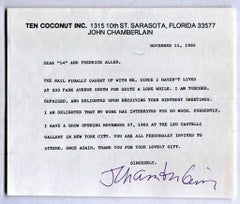
John Chamberlain, Signed Western Union cable re: sculpture show at Leo Castelli
By John Chamberlain
Located in New York, NY
John Chamberlain Hand Signed Letter re: Leo Castelli Exhibition, 1982 Typewriter on paper (hand signed) 6 1/2 × 8 1/2 inches Hand-signed by artist, Signed in purple felt tip marker Hand signed telegraph/letter refers to Chamberlain's exhibition at the legendary Leo Castell Gallery. A piece of history! John Chamberlain Biography John Chamberlain (1927 – 2011) was a quintessentially American artist, channeling the innovative power of the postwar years into a relentlessly inventive practice spanning six decades. He first achieved renown for sculptures made in the late 1950s through 1960s from automobile parts—these were path-breaking works that effectively transformed the gestural energy of Abstract Expressionist painting into three dimensions. Ranging in scale from miniature to monumental, Chamberlain’s compositions of twisted, crushed, and forged metal also bridged the divide between Process Art and Minimalism, drawing tenets of both into a new kinship. These singular works established him as one of the first American artists to determine color as a natural component of abstract sculpture. From the late 1960s until the end of his life, Chamberlain harnessed the expressive potential of an astonishing array of materials, which varied from Plexiglas, resin, and paint, to foam, aluminum foil, and paper bags. After spending three years in the United States Navy during World War II, Chamberlain enrolled in the Art Institute of Chicago and Black Mountain College, where he developed the critical underpinnings of his work. Chamberlain lived and worked in many parts of the United States, moving between New York City, Long Island, Los Angeles, Santa Fe, Connecticut, and Sarasota, before finally settling on Shelter Island. In many ways, each location provoked a distinct material sensibility, often defined by the availability of that material or the limitations of physical space. In New York City, Chamberlain pulled scrap metal and twelve-inch acoustic tiles from the ceiling of his studio apartment. He chose urethane in Los Angeles in 1965 (a material he had been considering for many years), and film in Mexico in 1968. He eventually returned to metal in 1972, and, in Sarasota, he expanded the scale of his works to make his iconic Gondolas (1981 – 1982). The movement of the artist and the subsequent evolution of the work is indicative not only of a kind of American restlessness but also of Chamberlain’s own personal evolution: he sometimes described his use of automobile materials as sculptural self-portraits, infused with balance and rhythm characteristic of the artist himself. Chamberlain refused to separate color from his practice, saying, ‘I never thought of sculpture without color. Do you see anything around that has no color? Do you live in a world with no color?’. He both honored and assigned value to color in his practice—in his early sculptures color was not added, but composed from the preexisting palette of his chosen automobile parts. Chamberlain later began adding color to metal in 1974, dripping and spraying—and sometimes sandblasting—paint and lacquer onto his metal components prior to their integration. With his polyurethane foam works, color was a variable of light: ultraviolet rays or sunlight turned the material from white to amber. It was this profound visual effect that brought the artist’s personal Abstract Expressionist hand into industrial three-dimensional sculpture. Chamberlain moved seamlessly through scale and volume, creating material explorations in monumental, heavy-gauge painted aluminum foil in the 1970s, and later in the 1980s and 1990s, miniatures in colorful aluminum foil and chromium painted steel. Central to Chamberlain’s works is the notion that sculpture denotes a great deal of weight and physicality, disrupting whatever space it occupies. In the Barges series (1971 – 1983) he made immense foam couches, inviting spectators to lounge upon the cushioned landscape. At the end of his career, Chamberlain shifted his practice outdoors, and through a series of determined experiments, finally created brilliant, candy-colored sculptures in twisted aluminum foil. In 2012, four of these sculptures were shown outside the Seagram Building in New York, accompanied by playful titles such as ‘PINEAPPLESURPRISE’ (2010) and ‘MERMAIDSMISCHIEF’ (2009). These final works exemplify Chamberlain’s lifelong dedication to change—of his materials, of his practice, and, consequently, of American Art. Chamberlain has been the subject of numerous solo exhibitions, including two major Retrospectives at the Solomon R. Guggenheim Museum in New York NY in 2012 and 1971; ‘John Chamberlain, Squeezed and Tied. Foam and Paper Sculptures 1969-70,’ Dan Flavin Art Institute, Dia Center for the Arts, Bridgehampton NY (2007); ‘John Chamberlain. Foam Sculptures 1966–1981, Photographs 1989–2004,’ Chinati Foundation, Marfa TX (2005); ‘John Chamberlain. Current Work and Fond Memories, Sculptures and Photographs 1967–1995,’ Stedelijk Museum, Amsterdam, Netherlands (Traveling Exhibition) (1996); and ‘John Chamberlain. Sculpture, 1954–1985,’ Museum of Contemporary Art, Los Angeles CA (1986). Chamberlain’s sculptures are part of permanent exhibitions at the Chinati Foundation in Marfa TX and at Dia:Beacon in upstate New York. In 1964, Chamberlain represented the United States in the American Pavilion at the 32nd International Exhibition of the Venice Biennale. He received many awards during his life, including a Doctor of Fine Arts, honoris causa, from the College for Creative Studies, Detroit (2010); the Distinction in Sculpture Honor from the Sculpture Center, New York (1999); the Gold Medal from The National Arts Club Award, New York (1997); the Lifetime Achievement Award in Contemporary Sculpture by the International Sculpture Center, Washington D.C. (1993); and the Skowhegan Medal for Sculpture, New York NY (1993). -Courtesy Hauser & Wirth Leo Castelli Leo Castelli was born in 1907 in Trieste, a city on the Adriatic sea, which, at the time, was the main port of the Austro-Hungarian Empire. Leo’s father, Ernest Kraus, was the regional director for Austria-Hungary’s largest bank, the Kreditandstalt; his mother, Bianca Castelli, was the daughter of a Triesten coffee merchant. With the outbreak of World War I in 1914 the Kraus family relocated to Vienna where Leo continued his education. A particularly memorable moment for Leo during this period of his life was the funeral of Emperor Francis Joseph which he witnessed in November of 1916. Leo and his family returned to Trieste when the war ended in 1918. With the fall of the Austro-Hungarian Empire Trieste embraced its new Italian identity. Motivated by this shift Ernest decided to adopt his wife's more Italian-sounding maiden name, Castelli, which his children also assumed. In many ways the Castelli’s return Trieste after the war marked an optimistic new beginning for the family. Ernest was made director of the Banca Commerciale Italiana, which had replaced the Kreditandstalt as the top bank in Trieste. This elevated position allowed Ernest and Bianca to cultivate a cosmopolitan life-style. Together they hosted frequent parties which brought them in contact with a spectrum of political, financial, and cultural luminaries. Growing up in such an environment fostered in Leo and his two siblings, Silvia and Giorgio, a strong appreciation of high culture. During this time Leo developed a passion for Modern literature and perfected his fluency in German, French, Italian, and English. After earning his law degree at the University of Milan in 1932, Leo began his adult life as an insurance agent in Bucharest. Although Leo found the job unfulfilling and tedious, the people he met in Bucharest made up for this deficiency. Among the most significant of Leo’s acquaintances during this time was the eminent businessman, Mihail Shapira. Leo eventually became friendly with the rest of the Shapira family and in 1933 he married Mihail's youngest daughter, Ileana. In 1934 Leo and Ileana moved to Paris where, thanks to his step-father’s influence, Leo was able to get a job in the Paris branch of the Banca d'Italia. In the same year, Leo met the interior designer René Drouin, who became his close friend. In the spring of 1938, while walking through the Place Vendôme, Leo and René came across a storefront for rent between the Ritz hotel and a Schiaparelli boutique. The space immediately impressed them as an ideal location for an art gallery, a plan which became reality the following spring in 1939. The Drouin Gallery opened with an exhibition featuring painting and furniture by Surrealist artists including Léonor Fini, Augene Berman, Meret Oppenheim, Max Ernst, and Salvador Dali. Despite the success of this initial exhibition, the gallery proved short-lived. Germany invaded Poland on September 1, 1939 marking the start of World War II and consequently the temporary end of the Drouin gallery. René was called to serve in the French army, while Leo, Ileana, and their three-year-old daughter Nina moved to the relative safety of Cannes, where Ileana’s family owned a summer house. As the war escalated, it became evident that Europe was no longer safe for the Castelli family—Leo and Ileana were both Jewish. In March of 1941, Leo, Ileana and Nina fled to New York bringing with them Nina’s nurse Frances and their dog, Noodle. After a year of moving around the city, the family took up permanent residence at 4 East 77 Street in a townhouse Mihail had bought. Nine months after his arrival in New York, in December of 1943, Leo volunteered for the US army, expediting his naturalization as a US citizen. Owing to his facility with languages, Leo was assigned to serve in the U.S. Army Intelligence Corp, a position which he held for two years, until February 1946. While on military leave in 1945 Leo visited Paris and stopped by Place Vendôme gallery where René had once more set up business selling work by European avant-garde artists such as Jean Dubuffet and Jean Fautrier. The meeting not only rekindled René and Leo’s friendship but also the latter’s interest in art dealing, a pursuit which Leo began to view as more than a mere hobby but as a potential career. After reconnecting, the two friends decided to go back into partnership with Leo acting as the New York representative for the Drouin Gallery. Working in this capacity, Leo began to form relationships with some of the New York art world’s most influential figures, including Peggy Guggenhiem, Sydney Janis, Willem De Kooning, and Jackson Pollock. By the late 40s Leo’s ties with René Drouin had begun to slacken, while his alliance with the dealer Sydney Janis became closer. Janis opened his New York gallery in 1948 and in 1950 invited Leo to curate an exhibition of contemporary French and American artists. The show drew a significant connection between the venerable tradition of European Modernism and the emerging artists of the New York School. Not long after this, in 1951, Leo was asked by these same New York School artists to organize the groundbreaking Ninth Street Show. This exhibition was instrumental in establishing Abstract Expressionism as the preeminent art movement of the post-war era. Leo founded his own gallery in 1957, transforming the living room on the fourth floor of the 77th Street townhouse into an exhibition space. Perhaps the most critical moment of Leo’s career occurred later that year, when he first visited the studios of Robert Rauschenberg and Jasper Johns. In 1958 Leo gave Johns and Rauschenberg solo shows, in January and March respectively. For Johns, this was the first solo show of his career. These exhibitions received wide critical acclaim, solidifying Leo’s reputation not only as a dealer but as the arbiter of a new and important art movement. Over the course of the 1960s Leo played a formative role in launching the careers of many of the most significant artists of the twentieth century including Roy Lichtenstein, Andy Warhol, Claes Oldenberg, Cy Twombly, Donald Judd, Dan Flavin, Robert Morris, Bruce Nauman, Richard Serra, Joseph Kosuth and Lawrence Weiner. Through his support of these artists Leo likewise helped cultivate and define the movements of Pop, Minimalism, Conceptual Art, and Post-Minimalism. As business expanded over the course of the 60s and artistic trends shifted in favor of larger artworks, Leo realized that his townhouse gallery was not sufficient to meet these new demands. Indicative of the trend toward maximal art...
Category

1980s Abstract Expressionist Abstract Prints

Materials

Ink, Lithograph, Offset

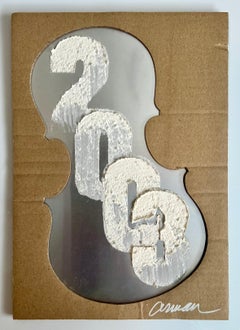
Violin Concerto Hand Signed Mixed media Arman Assemblage Collage New Years Card
By Arman
Located in Surfside, FL
Arman, French/American (1928-2005) 2003 mixed media paint on found metal in a cardboard cut out of a violin inscribed to interior signed lower right and signed to the interior 'Arman...
Category

Early 2000s Abstract Mixed Media

Materials

Metal

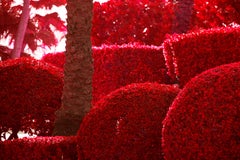
Hedge Fun - South Beach - Miami Beach
By Robert Funk
Located in Miami, FL
The true color is most accurate in the 1st image when you expand it to the larger size. Hedge Fun is a series that celebrates the landscaping commissioned b...
Category

2010s Abstract Geometric Landscape Photography

Materials

Inkjet

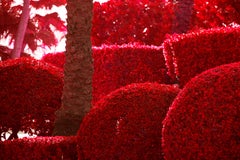
Hedge Fun - South Beach - Miami Beach
By Robert Funk
Located in Miami, FL
The true color is most accurate in the 1st image when you expand it to the larger size. Hedge Fun is a series that celebrates the landscaping commissioned b...
Category

2010s Abstract Geometric Landscape Photography

Materials

Inkjet

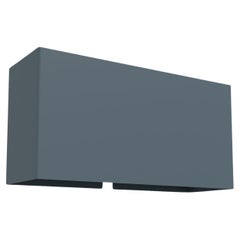
6135PM Grey Wall Lamp by Disderot
Located in Geneve, CH
6135PM Grey Wall Lamp by Disderot Limited Edition. Designed by Pierre Paulin. Dimensions: D 7,74 x W 18 x H 9 cm. Materials: Lacquered metal and chrome. Delivered with authenticati...
Category

2010s French Post-Modern Wall Lights and Sconces

Materials

Metal, Chrome

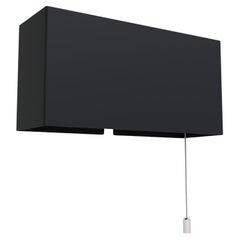
6135PM Black With Mini Pull Switch Wall Lamp by Disderot
Located in Geneve, CH
6135PM Black With Mini Pull Switch Wall Lamp by Disderot Limited Edition. Designed by Pierre Paulin. Dimensions: D 7,74 x W 18 x H 9 cm. Materials: Lacquered metal and chrome. Deli...
Category

2010s French Post-Modern Wall Lights and Sconces

Materials

Metal, Chrome

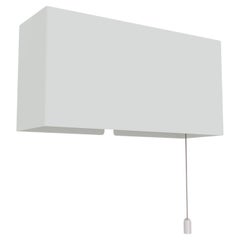
6135PM White With Mini Pull Switch Wall Lamp by Disderot
Located in Geneve, CH
6135PM White With Mini Pull Switch Wall Lamp by Disderot Limited Edition. Designed by Pierre Paulin. Dimensions: D 7,74 x W 18 x H 9 cm. Materials: Lacquered metal and chrome. Deli...
Category

2010s French Post-Modern Wall Lights and Sconces

Materials

Metal, Chrome

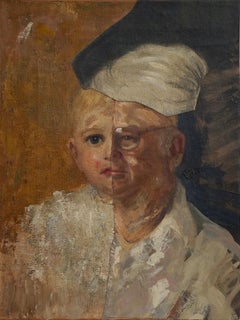
"I’ve Known Him for a Long Time", Contemporary Portrait, Collage, Acrylic Paint
By John Baker
Located in Franklin, MA
John Baker’s “I’ve Known Him for a Long Time” is an acrylic painting on canvas with collage 16 x 12 inches in beige, ochre and dark grey. The two halves represent not so much a perso...
Category

2010s Contemporary Portrait Paintings

Materials

Canvas, Mixed Media, Acrylic

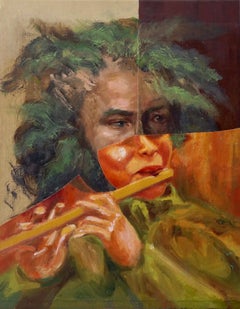
"Flute Player", Contemporary Portrait, Orange, Green, Collage, Acrylic Painting
By John Baker
Located in Franklin, MA
John Baker’s “Flute Player” is a contemporary acrylic painting on canvas with collage. The portrait is 20 x 16 x 1.5 inches in flesh tones, oranges, greens and browns. The detail and...
Category

2010s Contemporary Mixed Media

Materials

Canvas, Mixed Media, Acrylic

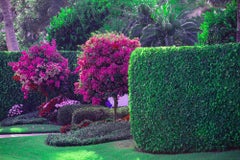
How The Rich do Street Art - Sunset Island, Miami Beach - Red Bushes
By Robert Funk
Located in Miami, FL
Robert Funk’s photographs of elaborate landscaping redefine what Street Art is. Hedge Fun is a series that celebrates the landscaping commissioned by well-heeled homeowners, high-e...
Category

2010s Abstract Geometric Color Photography

Materials

Archival Paper, Inkjet, Archival Pigment
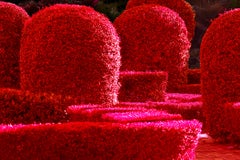
How the Rich Make Street Art - Palm Beach 5
By Robert Funk
Located in Miami, FL
Robert Funk’s photographs of elaborate landscaping redefine what Street Art is. Landscaping art aesthetically is the opposite of the generally accepted meaning of Graffiti Street Art...
Category

2010s Conceptual Landscape Photography

Materials

Archival Ink, Archival Paper, Archival Pigment
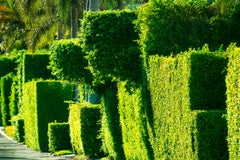
Hedge Fun, How the Rich Do Street Art - Palm Island
By Robert Funk
Located in Miami, FL
Robert Funk’s photographs of elaborate landscaping redefine what Street Art is. Landscaping art aesthetically is the opposite of the generally accepted meaning of Graffiti Street Ar...
Category

2010s Post-Impressionist Landscape Photography

Materials

Archival Ink, Archival Paper, Archival Pigment
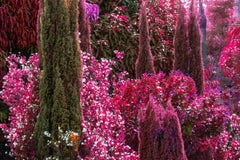
Hedge Fun - Old Naples - How the Rich make Street Art
By Robert Funk
Located in Miami, FL
Robert Funk’s photographs of elaborate landscaping redefine what Street Art is. Street Art from the Rich is found on every corner in Naples. It's a city with perhaps more flowers ...
Category

2010s Post-Impressionist Landscape Photography

Materials

Archival Ink, Archival Paper, Inkjet

Hedge Fun - Naples - Street Art by the Wealthy
By Robert Funk
Located in Miami, FL
Robert Funk’s photographs of elaborate landscaping redefine what Street Art is. In Naples, Florida Street Art abounds. It's a city with perhaps more flowers than weeds. Hedge Fun ...
Category

2010s Post-Modern Landscape Photography

Materials

Archival Ink, Archival Pigment

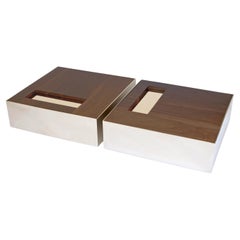
Set Of 2 Walnut Ballot Coffee Tables by Phase Design
Located in Geneve, CH
Set Of 2 Walnut Ballot Coffee Tables by Phase Design Dimensions: D 76,2 x W 76,2 x H 25,4 cm. Materials: Walnut and white powder-coated metal. Steel coffee table with solid wood top...
Category

2010s American Modern Coffee and Cocktail Tables

Materials

Metal

How the Rich do Street Art - Naples Arch
By Robert Funk
Located in Miami, FL
Robert Funk’s photographs of elaborate landscaping redefine what Street Art is. Street Art from the rich is to be found on every corner in Naples. It's a city with perhaps more flowers than weeds. Hedge Fun is a series that celebrates the landscaping commissioned by well-heeled homeowners, high-end condos and ritzy commercial establishments. Shrubs, bushes, and trees are transformed from organic shapes into man-made graphics. They become stripped of surrounding detail to the point that they become abstract in their impact. On any given day in South Florida, there is an army of landscaping trucks with gardeners and groundsmen working meticulously to beautify the street scape...
Category

2010s Contemporary Abstract Photography

Materials

Archival Paper, Inkjet, Archival Pigment
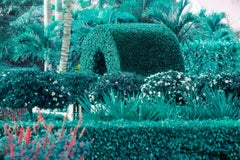
Hedge Fun - Naples Arch - How the Rich do Street Art
By Robert Funk
Located in Miami, FL
Robert Funk’s photographs of elaborate landscaping redefine what Street Art is. Street Art from the rich is to be found on every corner in Naples. It's a city with perhaps more flow...
Category

2010s Contemporary Abstract Photography

Materials

Archival Paper, Inkjet, Archival Pigment
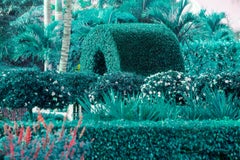
HegdeFun - The Five Trees - Street Art made by the Rich
By Robert Funk
Located in Miami, FL
Robert Funk’s photographs of elaborate landscaping redefine what Street Art is. Street Art created by the Rich with the help of Landscapers and Gardeners. This type of street art...
Category

2010s Hard-Edge Landscape Photography

Materials

Archival Ink, Archival Paper, Inkjet, Archival Pigment
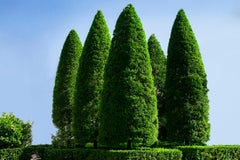
Hedge Fun - Naples Arch - How the Rich do Street Art
By Robert Funk
Located in Miami, FL
Robert Funk’s photographs of elaborate landscaping redefine what Street Art is. Street Art from the rich is to be found on every corner in Naples. It's a city with perhaps more flo...
Category

2010s Contemporary Abstract Photography

Materials

Archival Paper, Inkjet, Archival Pigment
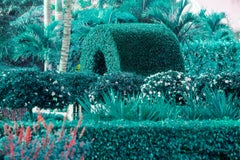
Hedge Fun - How the Rich do Street Art - Naples #4
By Robert Funk
Located in Miami, FL
Robert Funk’s photographs of elaborate landscaping redefine what Street Art is. Street Art from the rich is to be found on every corner in Naples. It's a city with perhaps more flo...
Category

2010s Contemporary Landscape Photography

Materials

Archival Paper, Inkjet, Archival Pigment
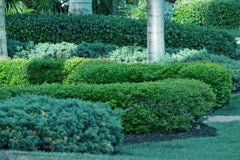
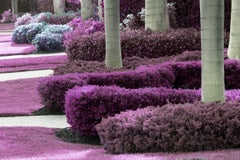
Hedge Fun - Flamingo Park Miami Beach - Violet Purple
By Robert Funk
Located in Miami, FL
Robert Funk’s photographs of elaborate landscaping redefine what Street Art is. The natural phenomena of trees and shrubs is augmented by the added illumination effects of violet and purple. Nature provide the basics and then man manipulates them. The result is "Hedge Fun - Flamingo Park...
Category

2010s Abstract Expressionist Abstract Photography

Materials

Archival Paper, Inkjet, Archival Pigment
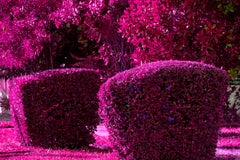
Hedge Fun - Hibiscus Island - Miami Beach - Street Art from the Wealthy. Red
By Robert Funk
Located in Miami, FL
Robert Funk’s photographs of elaborate landscaping redefine what Street Art is. On ultra-exclusive Hibiscus Island, Street Art made the Rich abounds. It's an unspoken requirement t...
Category

2010s American Modern Color Photography

Materials

Inkjet, Archival Ink, Archival Paper, Archival Pigment
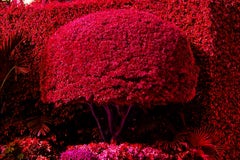
Alexander Calder, Yellow Face, from Derriere le miroir, 1976
By Alexander Calder
Located in Southampton, NY
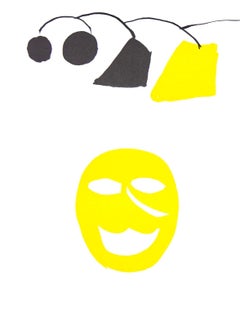
This exquisite lithograph by Alexander Calder (1898–1976), titled Visage Jaune (Yellow Face), from the folio Derriere le miroir, No. 221, originates from the 1976 edition published b...
Category

1970s Modern Abstract Prints

Materials

Lithograph

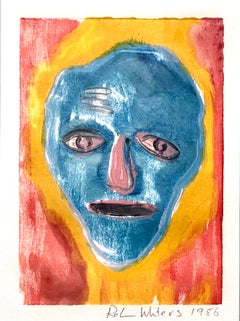
Conceptual Pop Art Color Oil Monotype Painting Abstract Figure Robin Winters
By Robin Winters
Located in Surfside, FL
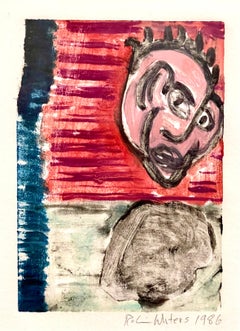
Robin Winters (American, born 1950), Untitled (Red Face) from "Cherry Block Series" 1986, monotype, pencil signed and dated lower right, plate: 6"h x 8.5"w, overall (with frame): 22.25"h x 18.25"w. Provenance: Property from a Private Collection, San Francisco. Winters was invited to make monotypes at Experimental Workshop in San Francisco, (they printed Richard Bosman, Sam Francis, Claire Falkenstein, Deborah Oropallo and Kenneth Noland and many more greats). Winters chose to paint on wood blocks rather than the more usual metal plates in order to capture the organic quality of the natural material. He exploited a salient characteristic of the monoprint in Ghost Story by adding new painted elements onto the increasingly faint ghost images that result from successive impressions from a single block. In so doing he achieved the effect of transparent layers of color and shadow imagery. Winters's brightly-colored monotypes portray an array of figures and landscapes (and an occasional still-life) that, although can be seen in the context of a general trend away from abstraction that has marked the 1980s, defy strict stylistic categorization. They are neither realistic nor abstract, psychological self-examinations nor narrative fictions, but they contain elements of all of these approaches. Like Jonathan Borofsky, Winters derives much of his subject matter from dreams, believing that through his private fears and obsessions he can touch similar emotions in others. Although at first glance Winters's images look as if they could have been made by a child, closer attention reveals sly art historical references to Jackson Pollock and Pattern Painting (the drip and splatter backgrounds), Mark Rothko (the three-part horizontal compositions) and Minimalism (the gridded Cherry Block Series: Bread Beat). Robin Winters (born 1950 in Benicia, California) is an American conceptual, multi-disciplinary, artist and teacher based in New York. Winters is known for creating solo exhibitions containing an interactive durational performance component to his installations, sometimes lasting up to two months. Winters first emerged in the burgeoning Soho NYC art scene of the 1970s. An early practitioner of the Relational Aesthetics (social interaction as an art medium) Winters also created in works through sculpture, installation, performance, painting, drawing and prints. His art maintains a whimsical spirit, and he often returns to ongoing themes involving faces, boats, cars, bottles, hats and jesters or fools. Winters has incorporated such devices as blind dates, double dates, dinners, fortune telling, and free consultation in his performances. Throughout his career he has engaged in a wide variety of media, such as performance art, film, video, writing prose and poetry, photography, installation art, printmaking, drawing, painting, ceramic sculpture, bronze sculpture, and glassblowing. Winters was born in Benicia, California in 1950 to lawyer parents. As a child his hobby was collecting glass bottles found on the beach and under old buildings, which would later influence him as an artist. In 1968, Winters had his first durational performance, entitled Norman Thomas Travelling Museum. The artist drove a Volkswagen bus decorated in collage, many of the images relating to current events and politics. Inside was what the artist described as a “reliquary” containing many objects, including a bottle collection. Winters took the van to shopping centers and even as far as Mexico. That same year, Winters opted not to register for the military draft. Although he was deemed fit to serve, Winters refused. In 1975 the resulting legal proceedings finally came to a close after it was proven that the artist had been harassed by the local draft board. In his teens and early twenties, Winters became acquainted with several local artists who helped shape his aesthetic, most notably Manuel Neri and Robert Arneson. By the early 1970s, Winters was studying at the San Francisco Art Institute (SFAI) and had relocated to San Francisco. At this time Winters became friends with the Bay Area conceptual artists Terry Fox and Howard Fried, and participated in several of Fried's performance works. In 1972 Winters was accepted into the Whitney Independent Study Program in New York City. After coming to New York City, Winters helped support himself by working for various artists, among them the performance artist Joan...
Category

1980s Pop Art Figurative Paintings

Materials

Monoprint, Monotype

Neue Nationalgalerie (Compositions I) Poster /// Pop Art Roy Lichtenstein Museum
By Roy Lichtenstein
Located in Saint Augustine, FL
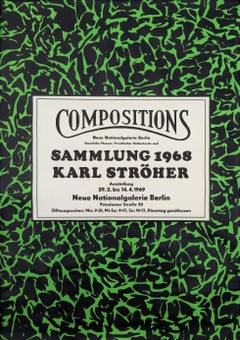
Artist: (after) Roy Lichtenstein (American, 1923-1997) Title: "Neue Nationalgalerie (Compositions I)" Year: 1969 Medium: Original Linocut, Exhibition Poster on light wove paper Limited edition: Unknown Printer: likely Linol-Druck Berek, Berlin, Germany Publisher: Neue Nationalgalerie, Berlin, Germany Framing: Recently framed in a contemporary dark brown wood moulding Framed size: 34.25" x 24.75" Sheet size: 33.07" x 23.5" Condition: Some light edge wear with a few minor tears at upper right edge. Some light foxmarks visible in white center. In otherwise very good condition with strong colors and full margins. As one of our gallery specialties, this is the rarest original vintage Lichtenstein poster we have ever acquired in nearly 50 years. Extremely rare. An important poster of Pop Art history Notes: Provenance: private collection - San Francisco, CA. Printed in two colors: green and black. Poster produced for a special exhibition of various artists' work "Sammlung 1968 Karl Ströher" at the Neue Nationalgalerie, Berlin, Germany from February 29 - April 14, 1969. The image featured on this poster is a variation with added green color of Lichtenstein's 1964, 68.13" x 56.25", magna on canvas painting "Compositions I". This painting "Compositions I" was part of Karl Ströher's collection exhibited at the show. Within a sleeve lower center on verso, this artwork comes with its rare original accompanying exhibition catalog: over 200 pages with pictures of all of the 176 works of art exhibited at the show including "Compositions I", (No. 32). This monumental exhibition included the work by such artists as Jean Dubuffet, Yves Klein, Morris Louis, Piero Manzoni, Robert Matta...
Category

1960s Pop Art Abstract Prints

Materials

Linocut

Lyrical Abstraction Screenprint Serigraph Ronnie Landfield Color Field Abstract
By Ronnie Landfield
Located in Surfside, FL
Ronnie Landfield (1947- American) 1969 Hand signed, numbered, and dated in pencil Serigraph on handmade paper. With the blindstamp of the Tanglewood Press. From the portfolio Various Artists that Included works by Alan Cote, David Diao, Ronnie Landfield, Lee Lozano, Brice Marden, William Pettet, Alan Shields, Kenneth Showell, Lawrence Stafford, and Peter Young. co-printed by Bank Street Atelier, Chiron Press, Fine Creations, Inc., Tom Gormley, Maurel Studios and S.D. Scott & Co., New York and published by Tanglewood Press, Inc., New York. Ronnie Landfield (American, 1947-) is an abstract painter. During his early career from the mid-1960s through the 1970s his paintings were associated with Lyrical Abstraction (related to Postminimalism, Color Field painting, and Abstract expressionism), and he was represented by the David Whitney Gallery and the André Emmerich Gallery. Landfield is best known for his abstract landscape paintings, and has held more than seventy solo exhibitions and more than two hundred group exhibitions. Born and raised in Pelham Parkway in the Bronx, Landfield first exhibited his paintings in Manhattan in 1962. He continued his study of painting by visiting major museum and gallery exhibitions in New York during the early sixties and by taking painting and drawing classes at the Art Students League of New York and in Woodstock, New York. He graduated from the High School of Art and Design in June 1963. He briefly attending the Kansas City Art Institute before returning to New York in November 1963. At sixteen Landfield rented his first loft at 6 Bleecker Street near The Bowery (sublet with a friend from the figurative painter Leland Bell), during a period when his abstract expressionist oil paintings took on hard-edged and large painterly shapes. In February 1964, Landfield traveled to Los Angeles; and in March he began living in Berkeley where he began painting Hard-edge abstractions primarily painted with acrylic. He briefly attended the University of California, Berkeley and the San Francisco Art Institute before returning to New York in July 1965. From 1964 to 1966 he experimented with minimal art, sculpture, hard-edge geometric painting, found objects, and finally began a series of 15 - 9' x 6' mystical "border paintings". After a serious setback in February 1966 when his loft at 496 Broadway burned down, he returned to painting in April 1966 by sharing a loft with his friend Dan Christensen at 4 Great Jones Street. The Border Painting series was completed in July 1966, and soon after architect Philip Johnson acquired Tan Painting for the permanent collection of The Sheldon Memorial Art Gallery in Lincoln, Nebraska. In late 1966 through 1968 he began exhibiting his paintings and works on paper (painting, lithograph and silkscreen) in leading galleries and museums. Landfield moved into his loft at 94 Bowery in July 1967; there, he continued to experiment with rollers, staining, hard-edge borders, and painted unstretched canvases on the floor for the first time. Briefly in 1967-1968 he worked part-time for Dick Higgins and the Something Else Press. Landfield was part of a large circle of young artists who had come to Manhattan during the 1960s. Peter Young, Dan Christensen, Peter Reginato, Eva Hesse, Carlos Villa, William Pettet, David R. Prentice, Kenneth Showell, David Novros, Joan Jonas, Michael Steiner, Frosty Myers, Tex Wray, Larry Zox, Larry Poons, Robert Povlich, Neil Williams, Carl Gliko, Billy Hoffman, Lee Lozano, Pat Lipsky, John Griefen, Brice Marden, James Monte, John Chamberlain, Donald Judd, Frank Stella, Carl Andre, Dan Graham, Robert Smithson, Robert Rauschenberg, Andy Warhol, Kenneth Noland, Clement Greenberg, Bob Neuwirth, Joseph Kosuth, Mark di Suvero, Brigid Berlin, Lawrence Weiner, Rosemarie Castoro, Marjorie Strider, Dorothea Rockburne, Leo Valledor, Peter Forakis...
Category

1960s Abstract Expressionist Abstract Prints

Materials

Screen

The Green Leaves of Palm Beach - Street Art by the Rich
By Robert Funk
Located in Miami, FL
The street view of Palm Beach is defined by its meticulous greenery. Robert Funk’s photographs of elaborate landscaping redefines what Street Art is. Landscaping art aesthetically i...
Category

2010s Post-Impressionist Abstract Photography

Materials

Archival Ink, Archival Paper, Archival Pigment
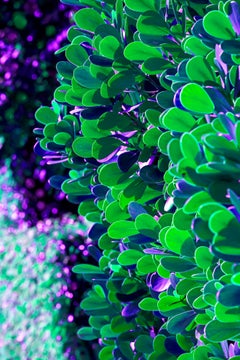
HegdeFun - The Five Trees - Street Art made by the Rich
By Robert Funk
Located in Miami, FL
Robert Funk’s photographs of elaborate landscaping redefine what Street Art is. Street Art created by the Rich with the help of Landscapers and Gardeners. This type of street art m...
Category

2010s Hard-Edge Landscape Photography

Materials

Archival Ink, Archival Paper, Inkjet, Archival Pigment
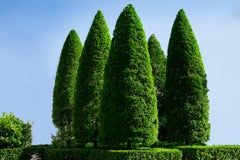
Street Art from the Rich - Palm Beach in Magenta and Orange with Lizard
By Robert Funk
Located in Miami, FL
Robert Funk’s photographs of elaborate landscaping redefine what Street Art is. This image is somewhat reminiscent of Monet's Haystacks in shape and use of backlighting. Use the 1st image for more accurate color. Palm Beach is Hedge Heaven with some of the most beautifully manicured streets in the United States. Hedge Fun - Palm Beach - Captures what Slim Arrons...
Category

2010s Abstract Geometric Landscape Photography

Materials

Archival Ink, Inkjet, Archival Pigment
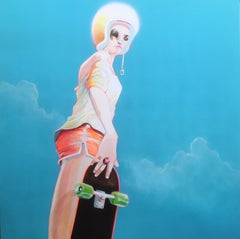
Pro Skater
By Joe Currie
Located in New York, NY
Figurative acrylic on canvas. Portrait of female skateboarder. Has abstract quality. Almost dreamlike. Vibrant colors. About the Artist: "Growing up in England during the 80s, the influence and love of American sub cultures through TV, and being surrounded by large non-spaces of US air bases around East Anglia, gave me a slightly odd and romantic view of America. I finished the Masters Degree bronze-casting course at the Royal College of Art in 1999 and have pursued my passion for Art ever since. I have built up a body of work that follows the theme of a journey into abstraction, inspired by Robert Smithson, Donald Judd, Fiona Banner, Cornelia Parker...
Category

2010s Contemporary Figurative Paintings

Materials

Acrylic

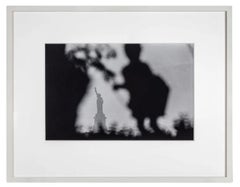
Cuban American Julio Mitchel Statue of Liberty Photograph Silver Gelatin Photo
Located in Surfside, FL
Julio Mitchell (Cuban, b. 1942) 'Statue of Liberty' 'Statue of Liberty from Brooklyn Dated 1998 Dedicated to Chara Schreyer and Natalie for her Bat Mitzvah Fine Print 16in. x 10 1/2i...
Category

20th Century Black and White Photography

Materials

Silver Gelatin

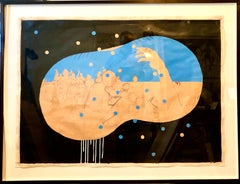
Scoli Acosta Large Contemporary Mixed Media Painting LA Art Red Planet Collage
By Scoli Acosta
Located in Surfside, FL
Shadow of Opportunity on Red Planet Mixed media Framed 39.3 X 50 sheet 32.4 X 42.3 Hand signed, dated and titled by artist. (with a location of LA noted) This came with a group of 4...
Category

Early 2000s Contemporary Abstract Paintings

Materials

Adhesive, Mixed Media, Acrylic, Gouache, Color Pencil, Graphite, Photogram
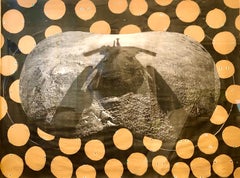
Scoli Acosta Large Contemporary Mixed Media Painting LA Artist Dakota Nightshade
By Scoli Acosta
Located in Surfside, FL
Dakota Nightshade (Native American, Indian piece) Mixed media (ink, paint etc. red thread stitching) Framed 43 X 57 sheet 36 X 49 Hand signed, dated and titled by artist. (with a l...
Category

Early 2000s Contemporary Abstract Paintings

Materials

Thread, Ink, Mixed Media, Acrylic

Conceptual Pop Art Color Oil Monotype Painting Abstract Figure Robin Winters
By Robin Winters
Located in Surfside, FL
Robin Winters (American, born 1950), Untitled (Red Face) from "Cherry Block Series" 1986, monotype, pencil signed and dated lower right, plate: 6"h x 8.5"w, overall (with frame): 22.25"h x 18.25"w. Provenance: Property from a Private Collection, San Francisco. Winters was invited to make monotypes at Experimental Workshop in San Francisco, (they printed Richard Bosman, Sam Francis, Claire Falkenstein, Deborah Oropallo and Kenneth Noland and many more greats). Winters chose to paint on wood blocks rather than the more usual metal plates in order to capture the organic quality of the natural material. He exploited a salient characteristic of the monoprint in Ghost Story by adding new painted elements onto the increasingly faint ghost images that result from successive impressions from a single block. In so doing he achieved the effect of transparent layers of color and shadow imagery. Winters's brightly-colored monotypes portray an array of figures and landscapes (and an occasional still-life) that, although can be seen in the context of a general trend away from abstraction that has marked the 1980s, defy strict stylistic categorization. They are neither realistic nor abstract, psychological self-examinations nor narrative fictions, but they contain elements of all of these approaches. Like Jonathan Borofsky, Winters derives much of his subject matter from dreams, believing that through his private fears and obsessions he can touch similar emotions in others. Although at first glance Winters's images look as if they could have been made by a child, closer attention reveals sly art historical references to Jackson Pollock and Pattern Painting (the drip and splatter backgrounds), Mark Rothko (the three-part horizontal compositions) and Minimalism (the gridded Cherry Block Series: Bread Beat). Robin Winters (born 1950 in Benicia, California) is an American conceptual, multi-disciplinary, artist and teacher based in New York. Winters is known for creating solo exhibitions containing an interactive durational performance component to his installations, sometimes lasting up to two months. Winters first emerged in the burgeoning Soho NYC art scene of the 1970s. An early practitioner of the Relational Aesthetics (social interaction as an art medium) Winters also created in works through sculpture, installation, performance, painting, drawing and prints. His art maintains a whimsical spirit, and he often returns to ongoing themes involving faces, boats, cars, bottles, hats and jesters or fools. Winters has incorporated such devices as blind dates, double dates, dinners, fortune telling, and free consultation in his performances. Throughout his career he has engaged in a wide variety of media, such as performance art, film, video, writing prose and poetry, photography, installation art, printmaking, drawing, painting, ceramic sculpture, bronze sculpture, and glassblowing. Winters was born in Benicia, California in 1950 to lawyer parents. As a child his hobby was collecting glass bottles found on the beach and under old buildings, which would later influence him as an artist. In 1968, Winters had his first durational performance, entitled Norman Thomas Travelling Museum. The artist drove a Volkswagen bus decorated in collage, many of the images relating to current events and politics. Inside was what the artist described as a “reliquary” containing many objects, including a bottle collection. Winters took the van to shopping centers and even as far as Mexico. That same year, Winters opted not to register for the military draft. Although he was deemed fit to serve, Winters refused. In 1975 the resulting legal proceedings finally came to a close after it was proven that the artist had been harassed by the local draft board. In his teens and early twenties, Winters became acquainted with several local artists who helped shape his aesthetic, most notably Manuel Neri and Robert Arneson. By the early 1970s, Winters was studying at the San Francisco Art Institute (SFAI) and had relocated to San Francisco. At this time Winters became friends with the Bay Area conceptual artists Terry Fox and Howard Fried, and participated in several of Fried's performance works. In 1972 Winters was accepted into the Whitney Independent Study Program in New York City. After coming to New York City, Winters helped support himself by working for various artists, among them the performance artist Joan...
Category

1980s Pop Art Figurative Paintings

Materials

Monoprint, Monotype

Abstract, Red and Blue , National Gallery of Canada, NYMoMA, Paris, Chaumière
Located in Santa Cruz, CA
Signed lower left, 'A. McKay' for Arthur "Art" Fortescue McKay (Canadian, 1926-2000) and painted circa 1975. An important Canadian painter, draftsman, printmaker and an influential ...
Category

1970s Abstract Drawings and Watercolors

Materials

Paper, Gouache

Aluminum Triangle Chair Hollow Black designed by Tadashi Murase Made in Japan
By Gerrit Rietveld, Donald Judd
Located in Kyoto, JP
Designed by Tadashi Murase, the Aluminum Triangle Chair is a sculptural seating object that explores structural minimalism, balance, and negative space. Constructed from aluminum hon...
Category

2010s Japanese Minimalist Chairs

Materials

Aluminum, Other

Conceptual Pop Art Color Mixed Media Painting "Home" Brooke Alexander Gallery
By Robin Winters
Located in Surfside, FL
Robin Winters (b. 1950) hand signed; 1986. Acrylic, rhoplex and powdered pigment on screenprint Dimensions: 36”h, 32”w Title: "Home" Provenance: Brooke Alexander Gallery, New York, New York. Gallery label verso. Robin Winters is known for his conceptual works in a wide variety of two- and three-dimensional media and performance/durational art. The reliquary and other recurring themes that appear in his works can be seen in the collection of sculptures and paintings offered in this sale (lots 170, 171, 173, 393, 396). Gallery label to reverse: Brooke Alexander Gallery, New York, New York. Provenance: Brooke Alexander Gallery, New York, New York. Robin Winters (born 1950 in Benicia, California) is an American conceptual, multi-disciplinary, artist and teacher based in New York. Winters is known for creating solo exhibitions containing an interactive durational performance component to his installations, sometimes lasting up to two months. Winters first emerged in the burgeoning Soho NYC art scene of the 1970s. An early practitioner of the Relational Aesthetics (social interaction as an art medium) Winters also created in works through sculpture, installation, performance, painting, drawing and prints. His art maintains a whimsical spirit, and he often returns to ongoing themes involving faces, boats, cars, bottles, hats and jesters or fools. Winters has incorporated such devices as blind dates, double dates, dinners, fortune telling, and free consultation in his performances. Throughout his career he has engaged in a wide variety of media, such as performance art, film, video, writing prose and poetry, photography, installation art, printmaking, drawing, painting, ceramic sculpture, bronze sculpture, and glassblowing. Winters was born in Benicia, California in 1950 to lawyer parents. As a child his hobby was collecting glass bottles found on the beach and under old buildings, which would later influence him as an artist. In 1968, Winters had his first durational performance, entitled Norman Thomas Travelling Museum. The artist drove a Volkswagen bus decorated in collage, many of the images relating to current events and politics. Inside was what the artist described as a “reliquary” containing many objects, including a bottle collection. Winters took the van to shopping centers and even as far as Mexico. That same year, Winters opted not to register for the military draft. Although he was deemed fit to serve, Winters refused. In 1975 the resulting legal proceedings finally came to a close after it was proven that the artist had been harassed by the local draft board. In his teens and early twenties, Winters became acquainted with several local artists who helped shape his aesthetic, most notably Manuel Neri and Robert Arneson. By the early 1970s, Winters was studying at the San Francisco Art Institute (SFAI) and had relocated to San Francisco. At this time Winters became friends with the Bay Area conceptual artists Terry Fox and Howard Fried, and participated in several of Fried's performance works. In 1972 Winters was accepted into the Whitney Independent Study Program in New York City. After coming to New York City, Winters helped support himself by working for various artists, among them the performance artist Joan Jonas and sculptor Donald Judd. In 1974, Winters performed The Secret Life of Bob-E or Bob-E Behind the Veil eight hours a day, five days a week for a month in his studio apartment. Behind a one-way mirror the audience could watch Winters play the character of Bob-E, whose goal was to make a monument for everyone in the world in the form of blue and yellow rubber top hats. By the end of the month the artist had constructed 262 hats. The following year, Winters was invited to take part in the Whitney Museum's 1975 Biennial Exhibition. Entitled W.B. Bearman Bags a Job or Diary of a Dreamer. These meetings led to the formation of the Group Collaborative Projects, or Colab, of which Winters is a founding member. Also in 1976, Winters formed the partnership “X&Y” with fellow artist Coleen Fitzgibbon that would last two years. Together they performed a series of shows in the Netherlands, most notably a show entitled Take the Money and Run. Performed at De Appel in Amsterdam, the show involved the artists robbing their audience. The following day the audience was given an apology, as well as the opportunity to retrieve any valuables and participate in a lottery to win the artists’ services. They also made a Super 8 film in NY called Rich-Poor, in which they asked people on the streets their thoughts on the rich and poor. In 1980 Winters participated in The Real Estate Show and in Absurdities at ABC No Rio. That same year he and artists Peter Fend, Coleen Fitzgibbon, Peter Nadin, Jenny Holzer, and Richard Prince also formed The Offices of Fend, Fitzgibbon, Holzer, Nadin, Prince & Winters. This short-lived collective was based out of an office on lower Broadway and offered “Practical Esthetic Services Adaptable to Client Situation”, as stated on their business card. Their goal was to offer their art as “socially helpful work for hire”. In June of that year Winters participated in The Times Square Show, Colab's most well-known exhibition. The month-long show took place in a four floor building on West 41st Street and was densely packed with art. To cap off a busy year, Winters also became one of the first artists to join the Mary Boone Gallery, showing a successful solo exhibition in 1981. His work was shown in the New York/New Wave show in 1981 at MoMA PS1 along with Jean-Michel Basquiat, Roberta Bayley, William S. Burroughs, David Byrne, Sarah Charlesworth, Larry Clark, Crash (John Matos), Ronnie Cutrone, Brian Eno, Peter Fend, Nan Goldin, Keith Haring, Ray Johnson, Joseph Kosuth, Marcus Leatherdale, Christopher Makos, Robert Mapplethorpe, Elaine Mayes, Frank Moore, Kenny Scharf and others. In 1982, Winters had his first solo exhibition in Los Angeles at the Richard Kuhlenschmidt Gallery. At the Mo David Gallery in 1984, Winters created an installation piece that consisted of a floor of plaster tiles. Underneath each tile, hidden from view, was a drawing. He designed the stage sets for the musician Nico, and assisted French artist Orlan, American artist Stuart Sherman, and American poet Gregory Corso. Two years later Winters was invited to take part in Chambres d’Amis (In Ghent there is Always a Free Room for Albrecht Durer) in Ghent, Belgium. In it, 51 artists created installations in 50 different sites, mostly private homes. Winters chose the home of a local art historian. The artist made 90 drawings based on images found in the large collection of art books in the home's library. He made two copies of each drawing and placed the originals in the books themselves. One set of copies was exhibited in the sponsoring museum, Museum van Hedendaagse, as "The Ghent Drawings". The drawings were also on display at Winters’ solo exhibition at Luhring Augustine & Hodes Gallery in New York City in 1987. In 1986, Winters had a solo exhibition at Maurice Keitelman Gallery in Brussels, Belgium, and the following year a solo exhibition at the Centre Régional d'Art Contemporain Midi-Pyrénées in Toulouse, France. Also in 1986, Winters' Playroom was held at the Institute for Contemporary Art in Boston, Massachusetts. The exhibition was part of Think Tank, a retrospective of Winters' work which traveled to the Stedelijk Museum in the Netherlands, the Centre Regional d’Art Contemporain in France, and the Contemporary Arts Center in Ohio. Winters spent a month in 1989 working with students at the San Francisco Art Institute. Never having worked with ceramics, he spent the month making numerous ceramic pieces, which were then shown in the aptly named One Month in San Francisco. Other components of the piece included Winters’ childhood bottle collection and a video showing each piece in the show filmed briefly next to a ruler.[ Also that year, Robin served as a visiting artist at the Pilchuck Glass School, where he met artist John Drury, who was then working as the school's artist liaison. In the summer of 1990, Winters interviewed fellow artist Kiki Smith for her eponymous book, which was published later that year. That same year (1990), Winters was invited by the Val Saint Lambert glass factory in Belgium to create glassworks in their facility. Winters, artists John Drury and Tracy Glover traveled to Liege from the US, and the three in combination with two of the factories master glassblowers, realized Mr. Winters' work over six weeks time. A portion of the works, a group of glass heads and hats that the artist had produced at the factory, were exhibited in 1990 at the Centre d’Art Contemporain Geneve in Geneva, Switzerland. Later in the year they were included in his solo exhibition at Brooke Alexander Gallery in New York City. They were also shown at Facts and Rumours, an exhibition at the Witte de With Center for Contemporary Art in Rotterdam, the Netherlands in 1991. Winters had a solo exhibition at Van Esch Galerie in Eindhoven, the Netherlands called I am not Indifferent in 1991. The show consisted of paintings, glass heads, and bronze sculpture. Two years later he had another solo exhibition at the Renaissance Society at the University of Chicago, entitled Human Nature. Several hundred heads, made of glass and ceramic, lined the walls and were arranged in rings on the floor. Also on display were various paintings and bronzes. In 1994 Winters had a show at the Michael Klein Gallery in New York City entitled Notes from the Finishing Room, a solo exhibition of paintings. The artist also collaborated with fellow Benicia natives and glass artists Leroy Champagne and Michael Nourot...
Category

1980s Pop Art Figurative Paintings

Materials

Mixed Media, Acrylic, Pigment, Screen
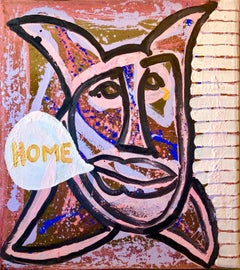
137, Pencil Drawing by Richard Lin, 1960
By Richard Lin
Located in Kingsclere, GB
137, Pencil Drawing by Richard Lin 1933-2011, 1960 Additional information: Medium: Pencil 30 1/4 x 35 1/8 in 77 x 89 cm signed, dated and titled Executed in pencil against stark wh...
Category

20th Century Abstract Drawings and Watercolors

Materials

Pencil

144, Pencil Drawing by Richard Lin, 1960
By Richard Lin
Located in Kingsclere, GB
144, Pencil Drawing by Richard Lin 1933-2011, 1960 Additional information: Medium: Pencil 29 7/8 x 33 7/8 in 76 x 86 cm signed, dated and titled Emanating minimalist purity and cha...
Category

20th Century Abstract Drawings and Watercolors

Materials

Pencil

Still Thinking About These?

All Recently Viewed