139 results for ""blade runner""
to
1
106
20
115
79
25
24
19
10
7
4
1
1
1
50
36
8
8
5
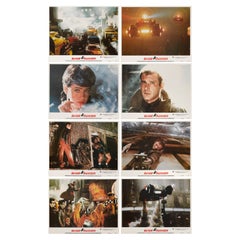
Blade Runner
Located in London, GB
Original US set of 8 lobby card for Ridley Scott's 1980s sci-fi film has become a true cult classic. Thirty-five years on a sequel (Blade Runner 2049...
Category
Vintage 1980s American Photography
Materials
Paper

$1,304 / set
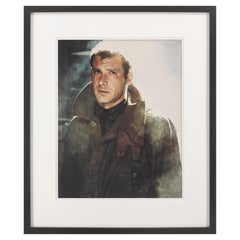
Blade Runner
Located in London, GB
Original US large colour still for Ridley Scott's 1980s sci-fi film has become a true cult classic. Thirty-five years on a sequel (Blade Runner 2049) was ...
Category
Vintage 1980s American Photography
Materials
Paper
$480
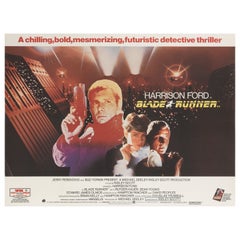
Blade Runner
Located in London, GB
Original British film poster for the cult 1982 science fiction film
starringHarrison Ford, Rutger Hauer and Sean Young. The film was directed by Ridley Scott.
This poster is conserva...
Category
Vintage 1980s British Posters
Materials
Paper
$1,578
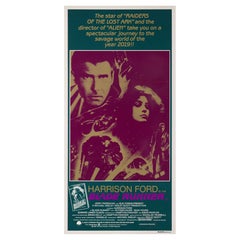
Blade Runner
Located in London, GB
Original Australian film poster for the cult 1982 science fiction film
starringHarrison Ford, Rutger Hauer and Sean Young. The film was directed by Ridley Scott.
This poster is conse...
Category
Vintage 1980s Australian Posters
Materials
Paper
$551
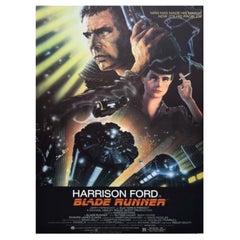
1982 Blade Runner Original Vintage Poster
By John Alvin
Located in Winchester, GB
An all-time classic, Ridley Scott's landmark Sci-Fi "Blade Runner" was released in 1982. Although initial reception was mixed, the film has become regarde...
Category
Vintage 1980s American Posters
Materials
Paper
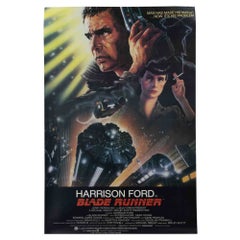
Blade Runner (1982, USA)
Located in Roma, IT
Original vintage poster.
U.S. One-Sheet (27 × 41 in.), Warner Bros.
Directed by Ridley Scott, starring Harrison Ford, Rutger Hauer, Sean Young, Edward James Olmos. Iconic futuristic...
Category
Vintage 1980s Italian Posters
Materials
Paper
$1,667 / item
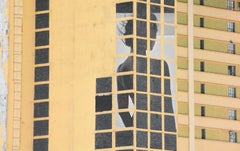
Blade Runner. From The Billboard series
Located in Miami Beach, FL
The Billboard series by photographer Eduardo Rezende unfolds as a visual dialogue between art and urban architecture — a fusion that challenges the monotony of metropolitan life. Kno...
Category
2010s Modern Color Photography
Materials
Paper, Archival Pigment
1982 Blade Runner (French) Original Vintage Poster
Located in Winchester, GB
An all-time classic, Ridley Scott's landmark Sci-Fi "Blade Runner" was released in 1982. Although initial reception was mixed, the film has become regarded as one of the most influen...
Category
Vintage 1980s French Posters
Materials
Paper
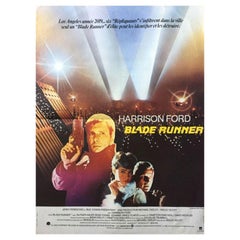
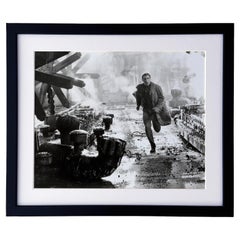
Blade runner 1982 Publicity Film Movie Press Still Framed
Located in Bath, Somerset
Original 8x10 inches Publicity Film Still for Blade runner (1982) starring Harrison Ford and directed by Ridley Scott.
Publicity (film/production) stills were created to help studio...
Category
20th Century American Posters
Materials
Paper
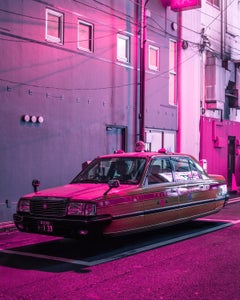
Nihon Noir Tokyo Blade Runner Limited Edition Photograph by TOM BLACHFORD
By Tom Blachford
Located in Brooklyn, NY
'Nihon Noir arose from my fascination with Japan and my desire to translate the feeling that struck me on my first visit, that somehow you have been transported to a parallel future ...
Category
2010s Modern Landscape Photography
Materials
Archival Ink, Archival Paper, Photographic Paper, Color, Archival Pigment
Cibi Set of 2 Double Old Fashion Glasses by Cini Boeri
By Arnolfo di Cambio
Located in Milan, IT
Elegant and unique, this set of two double old-fashion glasses is part of the CIBI Collection by Cini Boeri designed in 1973 whose post-modern silhouette was featured in the 1981 cul...
Category
2010s Italian Glass
Materials
Crystal

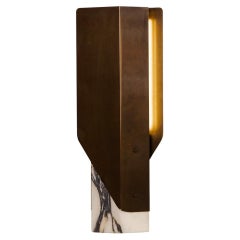
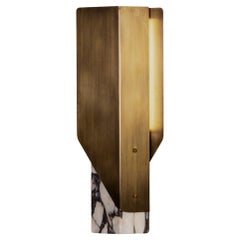
Fold Table Lamp, Led Sculptural Modern Light, Bronze patina / Calacatta Viola
By Jonathan Ben-Tovim
Located in Broadmeadows, Victoria
Inspired by the angular architecture and dark moods of Ridley Scott’s 1982 masterpiece Blade Runner, the Fold Table Lamp deploys folded aluminum fins to reflect an ambient glow forwa...
Category
2010s Australian Modern Table Lamps
Materials
Marble, Brass
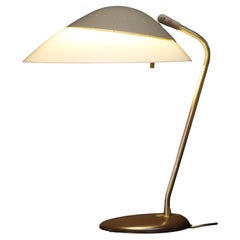
Gerald Thurston for Lightolier Taupe Cap, Restored
By Gerald Thurston
Located in Clifton Springs, NY
Restored Gerald Thurston for Lightolier Taupe Cap.
This is not just a beautiful design but also an iconic item, making appearance in the original Blade Runner.
It is seating on sideboard beside Deckard’s sofa in his ‘conapt’.
Original socket was not functioning and was replaced with a new one, together with new modern wiring. The knob is original and Lightolier logo is clearly visible.
Brass was polished and took a light coat of specialty lacquer. Metal base, sanded down, rust removed and refinished in matching color acrylic lacquer.
Taupe on this model usually has flaking finish and needs sanding and re-coating. Color-matched acrylic was used.
Diffuser has some heat damage which for Taupe lamp...
Category
Vintage 1950s American Mid-Century Modern Table Lamps
Materials
Brass
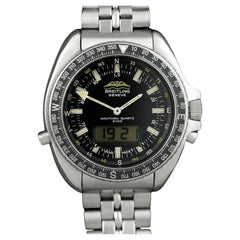
BREITLING "Harrison Ford" PLUTON Navitimer 2100 Multifunction Military Pilots
By Breitling
Located in Suwanee, GA
NAMED ONE OF WATCHPRO MAGAZINE’S “HOT 100” - THE TOP 100 INFLUENCERS OF THE U.S. WATCH INDUSTRY. HOW CAN WE SERVE YOU?
We’re new to offering our carefully curated collection on 1stD...
Category
Late 20th Century Swiss Wrist Watches
Materials
Stainless Steel
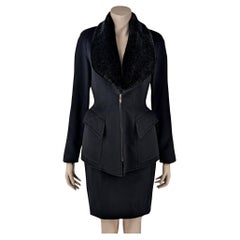
Mugler Faux Fur Collar Skirt Suit
By Mugler
Located in GOUVIEUX, FR
SOIR
Panier
Passer aux informations produits
Mugler "Blade Runner" Black Wool Fur Collar Suit
Mugler "Blade Runner" Black Wool Fur Collar Suit
Mugler "Blade Runner" Bla...
Category
1990s Italian Skirt Suits
Antique World War 2 Flare Gun Model M8
By Mark Indursky
Located in Stamford, CT
Antique World War 2 flare gun model M-8. Untouched original surface. Looks like something out of Blade Runner or Star Wars. Tiny chip at top of one grip.
Category
Vintage 1940s American Machine Age Mounted Objects
Materials
Steel

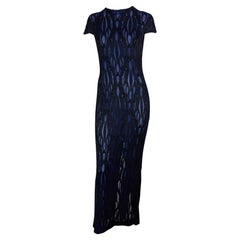
F/W 1998 Givenchy by Alexander McQueen Runway Sheer Black Lace Blue Stretch Gown
By Alexander McQueen, Givenchy
Located in West Hollywood, CA
From Alexander McQueen's Fall/Winter 1998 "Blade Runner" collection for Givenchy, this sheer black lace gown features striking a blue underlay. Inspired by the retro-futuristic costu...
Category
1990s French Evening Dresses and Gowns
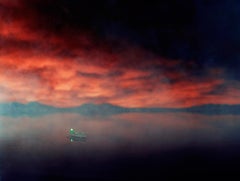
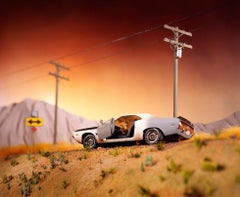
Red Sky
By Lori Nix and Kathleen Gerber
Located in New York, NY
Archival pigment print
Signed and numbered, verso
20 x 24 inches
30 x 40 inches
40 x 53 inches
(Total edition of 15)
This artwork is offered by ClampArt, located in New York City.
Please note that prices increase as editions sell.
In 1999, Lori Nix and Kathleen Gerber transplanted themselves to New York City, bringing an urban feel to their photos. In the series, "Some Other Place" (2000-2002), neighborhood sidewalks, city parks, and forays into the wilderness were reconstructed, but with a darker sensibility than their earlier series. Nix and Gerber’s subdued color palette and increasingly complex compositions also reflect this change.
Lori Nix and Kathleen Gerber have been making art collaboratively for over sixteen years. Originally from the American Midwest, now based in Brooklyn, they construct meticulously detailed model environments and photograph the results. For the last decade they have found inspiration in their urban surroundings, imagining a future mysteriously devoid of mankind. Their miniature fake landscapes and interiors reflect a love of science fiction and dystopian entertainment (think “Blade Runner,” “Planet of the Apes,” “Logan’s Run...
Category
Early 2000s Contemporary Landscape Photography
Materials
Archival Pigment
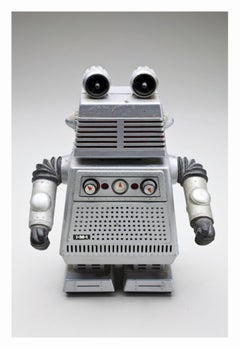
Untitled (from ROBOTNICS Series)
By Christian Rothmann
Located in Kansas City, MO
Christian Rothmann
ROBOTNICS Series
C-Print
2019
Edition S (Edition of 10)
12 x 8.3 inches (30.5 x 21 cm)
Signed, dated and numbered verso
Other Edition Sizes available:
- Edition ...
Category
2010s Street Art Photography
Materials
C Print
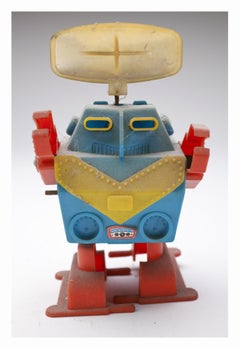
Untitled (from ROBOTNICS Series)
By Christian Rothmann
Located in Kansas City, MO
Christian Rothmann
ROBOTNICS Series
C-Print
2019
Edition S (Edition of 10)
12 x 8.3 inches (30.5 x 21 cm)
Signed, dated and numbered verso
Other Edition Sizes available:
- Edition M (Edition of 6) 35.4 x 23.6 inches (90 x 60 cm)
- Edition L (Edition of 6) 47.2 x 31.5 inches (120 x 80 cm)
- Edition XL (Edition of 3) 88.8 x 58.8 inches (225 x 150 cm)
PUR - Price Upon Request
--------------
Since 1979 Christian Rothmann had more than 40 solo and 80 group exhibitions worldwide.
Christian Rothmann had guest lectures, residencies, art fairs and biennials in Europe, Japan, USA, Australia and Korea.
Christian Rothmann (born 1954 in Kędzierzyn, Poland ) is a painter, photographer, and graphic artist.
In 1976 he first studied at the “Hochschule für Gestaltung” in Offenbach, Germany and moved to Berlin in 1977, where he graduated in 1983 at the “Hochschule der Künste”. From 1983 to 1995 he taught at the university as a lecturer and as an artist with a focus on screenprinting and American art history. To date, a versatile body of work has been created, which includes not only paintings but also long-standing photo projects, videos, and public art.
Guest lectures, teaching assignments, scholarships and exhibitions regularly lead Rothmann to travel home and abroad.
------------------------
Rothmann's Robots
These creatures date back to another era, and they connect the past and the future. They were found by Christian Rothmann, a Berlin artist, collector and traveler through time and the world: In shops in Germany and Japan, Israel and America, his keen eye picks out objects cast aside by previous generations, but which lend themselves to his own work. In a similar way, he came across a stash of historic toy robots of varied provenance collected by a Berlin gallery owner many years ago. Most of them were screwed and riveted together in the 1960s and 70s by Metal House, a Japanese company that still exists today. In systematically photographing these humanoids made of tin - and later plastic - Rothmann is paraphrasing the idea of appropriation art. Unknown names designed and made the toys, which some five decades on, Rothmann depicts and emblematizes in his extensive photo sequence.
In their photographs of Selim Varol's vast toy collection, his German colleagues Daniel and Geo Fuchs captured both the stereotypical and individual in plastic figures that imitate superheroes which were and still are generally manufactured somewhere in Asia. Christian Rothmann looks his robots deep in their artificially stylized, painted or corrugated eyes - or more aptly, their eye slits - and although each has a certain degree of individuality, the little figures remain unknown to us; they project nothing and are not alter egos. Rothmann trains his lens on their faces and expressions, and thus, his portraits are born. Up extremely close, dust, dents, and rust become visible. In other words, what we see is time-traces of time that has passed since the figures were made, or during their period in a Berlin attic, and - considering that he robots date back to Rothmann's childhood - time lived by the photographer and recipients of his pictures. But unlike dolls, these mechanical robots bear no reference to the ideal of beauty at the time of their manufacture, and their features are in no way modeled on a concrete child's face.
In this art project the robots appear as figures without a context, photographed face-on, cropped in front of a neutral background and reduced to their qualities of form. But beyond the reproduction and documentation a game with surfaces is going on; our view lingers on the outer skin of the object, or on the layer over it. The inside - which can be found beneath - is to an extent metaphysical, occurring inside the observer's mind. Only rarely is there anything to see behind the robot's helmet. When an occasional human face does peer out, it turns the figure into a robot-like protective casing for an astronaut of the future.
If we really stop and think about modern toys, let's say those produced from the mid 20th century, when Disney and Marvel films were already stimulating a massive appetite for merchandising, the question must be: do such fantasy and hybrid creatures belong, does something like artificial intelligence already belong to the broader community of humans and animals? It is already a decade or two since the wave of Tamagotchis washed in from Japan, moved children to feed and entertain their newly born electronic chicks in the way they would a real pet, or to run the risk of seeing them die. It was a new form of artificial life, but the relationship between people and machines becomes problematic when the machines or humanoid robots have excellent fine motor skills and artificial intelligence and sensitivity on a par with, or even greater than that of humans. Luckily we have not reached that point yet, even if Hollywood adaptations would have us believe we are not far away.
Rothmann's robots are initially sweet toys, and each toy is known to have a different effect on children and adults. They are conceived by (adult) designers as a means of translating or retelling history or reality through miniature animals, knights, and soldiers. In the case of monsters, mythical creatures, and robots, it is more about creating visions of the future and parallel worlds. Certainly, since the success of fantasy books and films such as Lord of the Rings or The Hobbit, we see the potential for vast enthusiasm for such parallel worlds. Successful computer and online games such as World
of Warcraft...
Category
2010s Pop Art Photography
Materials
C Print
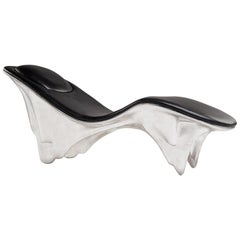
MAD Martian Chaise Lounge by Ma Yansong MAD Architects Aluminum and Leather
By Ma Yansong
Located in Beverly Hills, CA
The MAD Martian collection began with a question: What would the Chinese colonization of a Martian planet look like? This naturally led to more questions such as at what point does survival stop and architecture begin? Once survival is assured, what memory of Earth or love for their new home would these interplanetary colonizers recreate first? The MAD Martian collection is the result of Ma Yansong’s meditation on these issues.
Ma is famed for his design philosophy of ‘Shanshui City’, which integrates elements of traditional Chinese landscape design and painting into large-scale urban architecture. The resulting forms are closely tied to elements of the natural environment, conveying both elegant and gnarly lines. With this collection, M continues to employ the Shanshui City design philosophy, putting the contours of the natural environment front and center of the design language, but transplanting it into a science fiction narrative.
Ma conceived of the collection as being Noah Beyond The Ark. Timber, used to build the ark, saved the great Old Testament patriarch from the deluge. In MAD Martian, Ma reasoned that in the future, highly advanced materials will catapult those few lucky chosen ones into safe extra-terrestrial environments, beyond the apocalypse. To convey this idea, the first seven pieces in the collection were made using a combination of old and new techniques: advanced machining with hand-finishing and cutting-edge form making finished with artisanal detailing.
The MAD Martian collection employs the design language of science fiction, established during the mid-20th century. Traces of the 1960s Space Race aesthetic are visible in the suspension lights, whereas the candelabras and the fish tank take their cue in part from later masterworks such as Alien and Blade Runner.
This collection is the result of a two-year research and design development process. It started with a conversation between Yu Wang, co-founder and Director of Gallery ALL, and Ma about the theme of MAD Martian, and what a furniture collection of Chinese interplanetary pioneers would look like. On agreeing to produce the collection, the focus quickly turned to researching the history and current material language of science fiction movies, with specific reference to colonization of other planets and the ‘Space Odyssey,’ generally.
Numerous discussions were had between the creative team at Gallery ALL, MAD architects...
Category
21st Century and Contemporary Chinese Chaise Longues
Materials
Leather
Untitled (from ROBOTNICS Series)
By Christian Rothmann
Located in Kansas City, MO
Christian Rothmann
ROBOTNICS Series
C-Print
2019
Edition S (Edition of 10)
12 x 8.3 inches (30.5 x 21 cm)
Signed, dated and numbered verso
Other Edition Sizes available:
- Edition ...
Category
2010s Outsider Art Photography
Materials
C Print
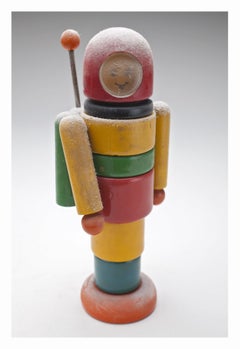
Untitled (from ROBOTNICS Series)
By Christian Rothmann
Located in Kansas City, MO
Christian Rothmann
ROBOTNICS Series
C-Print
2019
Edition S (Edition of 10)
12 x 8.3 inches (30.5 x 21 cm)
Signed, dated and numbered verso
Other Edition Sizes available:
- Edition ...
Category
2010s Contemporary Photography
Materials
C Print
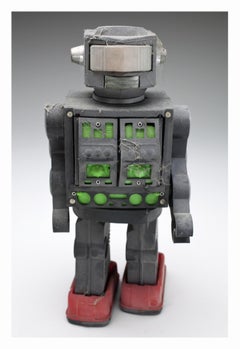
Untitled (from ROBOTNICS Series)
By Christian Rothmann
Located in Kansas City, MO
Christian Rothmann
ROBOTNICS Series
C-Print
2019
Edition S (Edition of 10)
12 x 8.3 inches (30.5 x 21 cm)
Signed, dated and numbered verso
Other Edition Sizes available:
- Edition ...
Category
2010s Street Art Photography
Materials
C Print
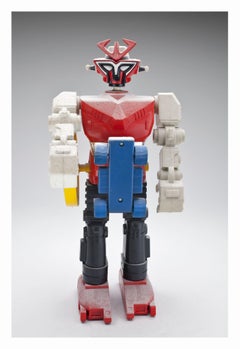
Untitled (from ROBOTNICS Series)
By Christian Rothmann
Located in Kansas City, MO
Christian Rothmann
ROBOTNICS Series
C-Print
2019
Edition S (Edition of 10)
12 x 8.3 inches (30.5 x 21 cm)
Signed, dated and numbered verso
Other Edition Sizes available:
- Edition ...
Category
2010s Pop Art Photography
Materials
C Print
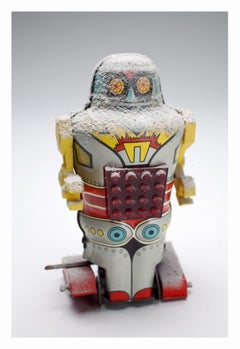
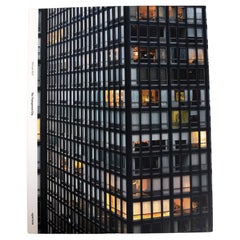
Michael Wolf The Transparent City by Geoff Manaugh
Natasha Egan, Stated 1st Ed
Located in valatie, NY
Michael Wolf The Transparent City by Geoff Manaugh & Natasha Egan. Published by Aperture, New York, 2008. Stated 1st Ed hardcover with dust jacket. "Chicago, like many urban centers ...
Category
21st Century and Contemporary American Books
Materials
Paper
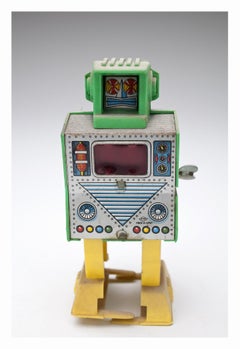
Untitled (from ROBOTNICS Series)
By Christian Rothmann
Located in Kansas City, MO
Christian Rothmann
ROBOTNICS Series
C-Print
2019
Edition S (Edition of 10)
12 x 8.3 inches (30.5 x 21 cm)
Signed, dated and numbered verso
Other Edition Sizes available:
- Edition ...
Category
2010s Outsider Art Photography
Materials
C Print
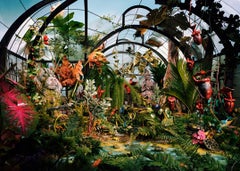
Botanical Garden
By Lori Nix and Kathleen Gerber
Located in New York, NY
Archival pigment print
Signed and numbered, verso
40 x 52 inches
48 x 65 inches
(Total edition of 15)
This artwork is offered by ClampArt, located in New York City.
Please note tha...
Category
Early 2000s Contemporary Color Photography
Materials
Archival Pigment
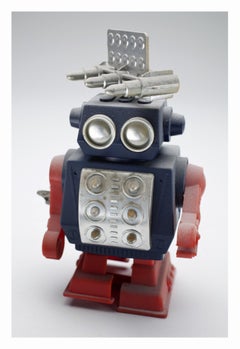
Untitled (from ROBOTNICS Series)
By Christian Rothmann
Located in Kansas City, MO
Christian Rothmann
ROBOTNICS Series
C-Print
2019
Edition S (Edition of 10)
12 x 8.3 inches (30.5 x 21 cm)
Signed, dated and numbered verso
Other Edition Sizes available:
- Edition M (Edition of 6) 35.4 x 23.6 inches (90 x 60 cm)
- Edition L (Edition of 6) 47.2 x 31.5 inches (120 x 80 cm)
- Edition XL (Edition of 3) 88.8 x 58.8 inches (225 x 150 cm)
PUR - Price Upon Request
--------------
Since 1979 Christian Rothmann had more than 40 solo and 80 group exhibitions worldwide.
Christian Rothmann had guest lectures, residencies, art fairs and biennials in Europe, Japan, USA, Australia and Korea.
Christian Rothmann (born 1954 in Kędzierzyn, Poland ) is a painter, photographer, and graphic artist.
In 1976 he first studied at the “Hochschule für Gestaltung” in Offenbach, Germany and moved to Berlin in 1977, where he graduated in 1983 at the “Hochschule der Künste”. From 1983 to 1995 he taught at the university as a lecturer and as an artist with a focus on screenprinting and American art history. To date, a versatile body of work has been created, which includes not only paintings but also long-standing photo projects, videos, and public art.
Guest lectures, teaching assignments, scholarships and exhibitions regularly lead Rothmann to travel home and abroad.
------------------------
Rothmann's Robots
These creatures date back to another era, and they connect the past and the future. They were found by Christian Rothmann, a Berlin artist, collector and traveler through time and the world: In shops in Germany and Japan, Israel and America, his keen eye picks out objects cast aside by previous generations, but which lend themselves to his own work. In a similar way, he came across a stash of historic toy robots of varied provenance collected by a Berlin gallery owner many years ago. Most of them were screwed and riveted together in the 1960s and 70s by Metal House, a Japanese company that still exists today. In systematically photographing these humanoids made of tin - and later plastic - Rothmann is paraphrasing the idea of appropriation art. Unknown names designed and made the toys, which some five decades on, Rothmann depicts and emblematizes in his extensive photo sequence.
In their photographs of Selim Varol's vast toy collection, his German colleagues Daniel and Geo Fuchs captured both the stereotypical and individual in plastic figures that imitate superheroes which were and still are generally manufactured somewhere in Asia. Christian Rothmann looks his robots deep in their artificially stylized, painted or corrugated eyes - or more aptly, their eye slits - and although each has a certain degree of individuality, the little figures remain unknown to us; they project nothing and are not alter egos. Rothmann trains his lens on their faces and expressions, and thus, his portraits are born. Up extremely close, dust, dents, and rust become visible. In other words, what we see is time-traces of time that has passed since the figures were made, or during their period in a Berlin attic, and - considering that he robots date back to Rothmann's childhood - time lived by the photographer and recipients of his pictures. But unlike dolls, these mechanical robots bear no reference to the ideal of beauty at the time of their manufacture, and their features are in no way modeled on a concrete child's face.
In this art project the robots appear as figures without a context, photographed face-on, cropped in front of a neutral background and reduced to their qualities of form. But beyond the reproduction and documentation a game with surfaces is going on; our view lingers on the outer skin of the object, or on the layer over it. The inside - which can be found beneath - is to an extent metaphysical, occurring inside the observer's mind. Only rarely is there anything to see behind the robot's helmet. When an occasional human face does peer out, it turns the figure into a robot-like protective casing for an astronaut of the future.
If we really stop and think about modern toys, let's say those produced from the mid 20th century, when Disney and Marvel films were already stimulating a massive appetite for merchandising, the question must be: do such fantasy and hybrid creatures belong, does something like artificial intelligence already belong to the broader community of humans and animals? It is already a decade or two since the wave of Tamagotchis washed in from Japan, moved children to feed and entertain their newly born electronic chicks in the way they would a real pet, or to run the risk of seeing them die. It was a new form of artificial life, but the relationship between people and machines becomes problematic when the machines or humanoid robots have excellent fine motor skills and artificial intelligence and sensitivity on a par with, or even greater than that of humans. Luckily we have not reached that point yet, even if Hollywood adaptations would have us believe we are not far away.
Rothmann's robots are initially sweet toys, and each toy is known to have a different effect on children and adults. They are conceived by (adult) designers as a means of translating or retelling history or reality through miniature animals, knights, and soldiers. In the case of monsters, mythical creatures, and robots, it is more about creating visions of the future and parallel worlds. Certainly, since the success of fantasy books and films such as Lord of the Rings or The Hobbit, we see the potential for vast enthusiasm for such parallel worlds. Successful computer and online games such as World
of Warcraft...
Category
2010s Modern Photography
Materials
C Print
Untitled (from ROBOTNICS Series)
By Christian Rothmann
Located in Kansas City, MO
Christian Rothmann
ROBOTNICS Series
C-Print
2019
Edition S (Edition of 10)
12 x 8.3 inches (30.5 x 21 cm)
Signed, dated and numbered verso
Other Edition Sizes available:
- Edition M (Edition of 6) 35.4 x 23.6 inches (90 x 60 cm)
- Edition L (Edition of 6) 47.2 x 31.5 inches (120 x 80 cm)
- Edition XL (Edition of 3) 88.8 x 58.8 inches (225 x 150 cm)
PUR - Price Upon Request
--------------
Since 1979 Christian Rothmann had more than 40 solo and 80 group exhibitions worldwide.
Christian Rothmann had guest lectures, residencies, art fairs and biennials in Europe, Japan, USA, Australia and Korea.
Christian Rothmann (born 1954 in Kędzierzyn, Poland ) is a painter, photographer, and graphic artist.
In 1976 he first studied at the “Hochschule für Gestaltung” in Offenbach, Germany and moved to Berlin in 1977, where he graduated in 1983 at the “Hochschule der Künste”. From 1983 to 1995 he taught at the university as a lecturer and as an artist with a focus on screenprinting and American art history. To date, a versatile body of work has been created, which includes not only paintings but also long-standing photo projects, videos, and public art.
Guest lectures, teaching assignments, scholarships and exhibitions regularly lead Rothmann to travel home and abroad.
------------------------------------------------------
Rothmann's Robots
These creatures date back to another era, and they connect the past and the future. They were found by Christian Rothmann, a Berlin artist, collector and traveller through time and the world: In shops in Germany and Japan, Israel and America, his keen eye picks out objects cast aside by previous generations , but which lend themselves to his own work. In a similar way he came across a stash of historic toy robots of varied provenance collected by a Berlin gallery owner many years ago. Most of them were screwed and riveted together in the 1960s and 70s by Metal House, a Japanese company that still exists today. In systematically photographing these humanoids made of tin - and later plastic - Rothmann is paraphrasing the idea of appropriation art. Unknown names designed and made the toys, which some five decades on, Rothmann depicts and emblematizes in his extensive photo sequence.
In their photographs of Selim Varol's vast toy collection, his German colleagues Daniel and Geo Fuchs captured both the stereotypcal and individual in plastic figures that imitate superheroes which were and still are generally manufactured somewhere in Asia. Christian Rothmann looks his robots deep in their artificially stylised, painted or corrugated eyes - or more aptly, their eye slits - and although each has a certain degree of individuality, the little figures remain unknown to us; they project nothing, and are not alter egos. Rothmann trains his lens on their faces and expressions, and thus, his portraits are born. Up extremely close, dust, dents and rust become visible. In other words, what we see is time-traces of time that has passed since the figures were made, or during their period in a Berlin attic, and - considering that he robots date back to Rothmann's childhood - time lived by the photographer and recipients of his pictures. But unlike dolls, these mechanical robots bear no reference to the ideal of beauty at the time of their
manufacture, and their features are in no way modelled on a concrete child's face.
In this art project the robots appear as figures without a context, photographed face-on, cropped in front of a neutral background and reduced to their qualities of form. But beyond the reproduction and documentation a game with surfaces is going on; our view lingers on the outer skin of the object, or on
the layer over it. The inside - which can be found beneath - is to an extent metaphysical, occurring inside the observer's mind. Only rarely is there anything to see behind the robot's helmet. When an occasional human face does peer out, it turns the figure into a robot-like protective casing for an astronaut of the future.
If we really stop and think about modern toys, let's say those produced from the mid 20th century, when Disney and Marvel films were already stimulating a massive appetite for merchandising, the question must be: do such fantasy and hybrid creatures belong, does something like artificial intelligence already belong to the broader community of humans and animals? It is already a decade or two since the wave of Tamagotchis washed in from Japan, moved children to feed and entertain their newly born electronic chicks in the way they would a real pet, or to run the risk of seeing them die. It was a new form of artificial life, but the relationship between people and machines becomes problematic when the machines or humanoid robots have excellent fine motor skills and artificial intelligence and sensitivity on a par with, or even greater than that of humans. Luckily we have not reached that point yet, even if Hollywood adaptations would have us believe we are not far away.
Rothmann's robots are initially sweet toys; and each toy is known to have a different effect on children and adults. They are conceived by (adult) designers as a means of translating or retelling history or reality through miniature animals, knights and soldiers. In the case of monsters, mythical creatures and robots, it is more about creating visions of the future and parallel worlds. Certainly since the success of fantasy books and films such as Lord of the Rings or The Hobbit, we see the potential for vast enthusiasm for such parallel worlds. Successful computer and online games such as World
of Warcraft, or the creation of avatars are also interesting worldwide phenomena of virtual realities that are not only relevant for children and teens.
So when a middle-aged Berlin photographic artist (like Christian Rothmann) chooses to study 120 toy robots with great difference in form, it represents a journey back to his own childhood - even if at the time, he played with a steam engine rather than a robot. Once batteries had been inserted, some of
the largely male or gender neutral robots, could flash, shoot, turn around and even do more complicated things. Some can even still do it today - albeit clumsily. This of course can only be seen on film, but the artist intends to document that as well; to feature the robots in filmic works of art.
The positioning of the figures in the studio is the same as the tableau of pictures in the exhibition room. In this way, one could say Rothmann deploys one robot after the other. This systematic approach enables a comparative view; the extreme enlargement of what are actually small and manageable figures is like the macro vision of insects whose fascinating, sometimes monster-like appearance only becomes visible when they are blown up a hundredfold. The same thing goes for the robots; in miniature form they seem harmless and cute, but if they were larger than humans and made noises to match, they
would seem more threatening.
Some of the tin figures...
Category
2010s Contemporary Photography
Materials
C Print
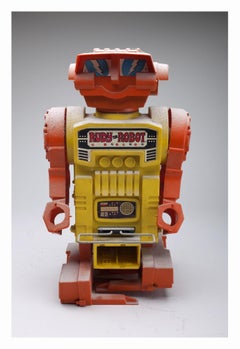
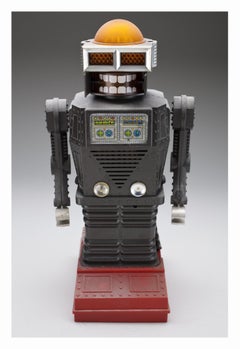
Untitled (from ROBOTNICS Series)
By Christian Rothmann
Located in Kansas City, MO
Christian Rothmann
ROBOTNICS Series
C-Print
2019
Edition S (Edition of 10)
12 x 8.3 inches (30.5 x 21 cm)
Signed, dated and numbered verso
Other Edition Sizes available:
- Edition M (Edition of 6) 35.4 x 23.6 inches (90 x 60 cm)
- Edition L (Edition of 6) 47.2 x 31.5 inches (120 x 80 cm)
- Edition XL (Edition of 3) 88.8 x 58.8 inches (225 x 150 cm)
PUR - Price Upon Request
--------------
Since 1979 Christian Rothmann had more than 40 solo and 80 group exhibitions worldwide.
Christian Rothmann had guest lectures, residencies, art fairs and biennials in Europe, Japan, USA, Australia and Korea.
Christian Rothmann (born 1954 in Kędzierzyn, Poland ) is a painter, photographer, and graphic artist.
In 1976 he first studied at the “Hochschule für Gestaltung” in Offenbach, Germany and moved to Berlin in 1977, where he graduated in 1983 at the “Hochschule der Künste”. From 1983 to 1995 he taught at the university as a lecturer and as an artist with a focus on screenprinting and American art history. To date, a versatile body of work has been created, which includes not only paintings but also long-standing photo projects, videos, and public art.
Guest lectures, teaching assignments, scholarships and exhibitions regularly lead Rothmann to travel home and abroad.
------------------------
Rothmann's Robots
These creatures date back to another era, and they connect the past and the future. They were found by Christian Rothmann, a Berlin artist, collector and traveler through time and the world: In shops in Germany and Japan, Israel and America, his keen eye picks out objects cast aside by previous generations, but which lend themselves to his own work. In a similar way, he came across a stash of historic toy robots of varied provenance collected by a Berlin gallery owner many years ago. Most of them were screwed and riveted together in the 1960s and 70s by Metal House, a Japanese company that still exists today. In systematically photographing these humanoids made of tin - and later plastic - Rothmann is paraphrasing the idea of appropriation art. Unknown names designed and made the toys, which some five decades on, Rothmann depicts and emblematizes in his extensive photo sequence.
In their photographs of Selim Varol's vast toy collection, his German colleagues Daniel and Geo Fuchs captured both the stereotypical and individual in plastic figures that imitate superheroes which were and still are generally manufactured somewhere in Asia. Christian Rothmann looks his robots deep in their artificially stylized, painted or corrugated eyes - or more aptly, their eye slits - and although each has a certain degree of individuality, the little figures remain unknown to us; they project nothing and are not alter egos. Rothmann trains his lens on their faces and expressions, and thus, his portraits are born. Up extremely close, dust, dents, and rust become visible. In other words, what we see is time-traces of time that has passed since the figures were made, or during their period in a Berlin attic, and - considering that he robots date back to Rothmann's childhood - time lived by the photographer and recipients of his pictures. But unlike dolls, these mechanical robots bear no reference to the ideal of beauty at the time of their manufacture, and their features are in no way modeled on a concrete child's face.
In this art project the robots appear as figures without a context, photographed face-on, cropped in front of a neutral background and reduced to their qualities of form. But beyond the reproduction and documentation a game with surfaces is going on; our view lingers on the outer skin of the object, or on the layer over it. The inside - which can be found beneath - is to an extent metaphysical, occurring inside the observer's mind. Only rarely is there anything to see behind the robot's helmet. When an occasional human face does peer out, it turns the figure into a robot-like protective casing for an astronaut of the future.
If we really stop and think about modern toys, let's say those produced from the mid 20th century, when Disney and Marvel films were already stimulating a massive appetite for merchandising, the question must be: do such fantasy and hybrid creatures belong, does something like artificial intelligence already belong to the broader community of humans and animals? It is already a decade or two since the wave of Tamagotchis washed in from Japan, moved children to feed and entertain their newly born electronic chicks in the way they would a real pet, or to run the risk of seeing them die. It was a new form of artificial life, but the relationship between people and machines becomes problematic when the machines or humanoid robots have excellent fine motor skills and artificial intelligence and sensitivity on a par with, or even greater than that of humans. Luckily we have not reached that point yet, even if Hollywood adaptations would have us believe we are not far away.
Rothmann's robots are initially sweet toys, and each toy is known to have a different effect on children and adults. They are conceived by (adult) designers as a means of translating or retelling history or reality through miniature animals, knights, and soldiers. In the case of monsters, mythical creatures, and robots, it is more about creating visions of the future and parallel worlds. Certainly, since the success of fantasy books and films such as Lord of the Rings or The Hobbit, we see the potential for vast enthusiasm for such parallel worlds. Successful computer and online games such as World
of Warcraft...
Category
2010s Modern Photography
Materials
C Print
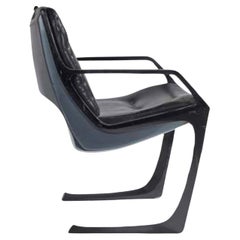
Jorge Zalszupin for L
atelier, "Commander" Armchair, 1973
By Jorge Zalszupin
Located in PARIS, FR
Dating back to 1973, this "Commander" armchair surprises connoisseurs of Brazilian designer Jorge Zalszupin, best known for his creations in rosewood, veneered or thermoformed, such ...
Category
Mid-20th Century Brazilian Mid-Century Modern Armchairs
Materials
Aluminum
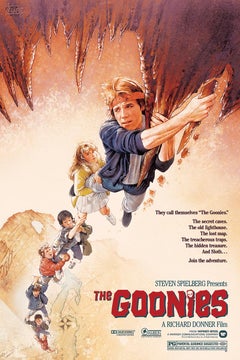
Drew Struzan - The Goonies - Contemporary Cinema Movie Film Posters
Located in Asheville, NC
The Goonies:
The Goonies is a 1985 American adventure comedy film co-produced and directed by Richard Donner from a screenplay by Chris Columbus, based on a story by executive producer Steven Spielberg. In the film, a band of kids who live in the "Goon Docks" neighborhood of Astoria, Oregon, attempt to save their homes from foreclosure and, in doing so, they discover an old treasure map that takes them on an adventure to unearth the long-lost fortune of One-Eyed Willy, a legendary 17th-century pirate. During the adventure, they are chased by a family of criminals who want the treasure for themselves.
Artist:
Struzan, Drew
Edition Details:
Year: 2020
Class: Cinema
Status: Official
Released: 10/08/20
Run: 725
Technique: Screen Print
Size: 24 X 36
Markings: Signed & Numbered
About Artist:
Drew Struzan is an American artist, illustrator, and cover designer known for his more than 150 movie posters, which include The Shawshank Redemption...
Category
2010s Contemporary Prints and Multiples
Materials
Archival Paper, Color, Digital, Laser, Giclée, Pigment, Archival Pigment...
Nevada
By Lori Nix and Kathleen Gerber
Located in New York, NY
Archival pigment print
Signed and numbered, verso
20 x 24 inches
30 x 40 inches
40 x 53 inches
48 x 65 inches
(Total edition of 15)
This artwork is offered by ClampArt, located in ...
Category
Early 2000s Contemporary Still-life Photography
Materials
Archival Pigment
Jorge Zalszupin, "Commander" Armchair, 1973 - 68 x 63 x 77 cm
By L
Atelier San Paulo, Jorge Zalszupin
Located in PARIS, FR
Jorge Zalszupin (1922–2020)
"Commander" Armchair, 1973
Designed in 1973, the "Commander" armchair marks a bold departure from Jorge Zalszupin’s signature use of rosewood and richly g...
Category
Mid-20th Century Brazilian Mid-Century Modern Armchairs
Materials
Aluminum

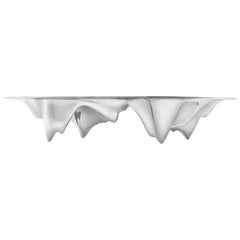
MAD Martian Long Dining Table Polished Stainless Steel by MAD Architects
By Ma Yansong
Located in Beverly Hills, CA
An inverted mountain range the dining table places the peaks of the Martian landscape at the centre of the communal domestic experience of the small colony. This epically large piece is made from CNC’d aluminum, a sophisticated manufacturing process that melds the exceptional digital modelling capabilities of MAD Architects...
Category
21st Century and Contemporary Chinese Dining Room Tables
Materials
Aluminum
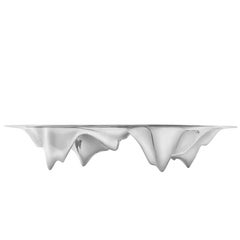
MAD Martian Long Dining Table Polished Stainless Steel by MAD Architects
By Ma Yansong
Located in Beverly Hills, CA
An inverted mountain range the dining table places the peaks of the Martian landscape at the centre of the communal domestic experience of the small colony. This epically large piece is made from CNC’d aluminum, a sophisticated manufacturing process that melds the exceptional digital modelling capabilities of MAD Architects...
Category
21st Century and Contemporary Chinese Dining Room Tables
Materials
Aluminum
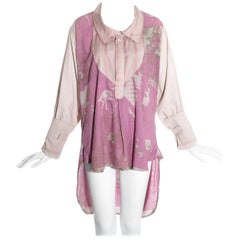
Worlds End pink cotton
Punkature
oversized blouse, ss 1983
By Vivienne Westwood
Located in London, GB
Worlds End by Vivienne Westwood and Malcolm McLaren. Pink cotton oversized blouse. Oversized turn up cuffs with Velcro fastening, signature using Bla...
Category
1980s British Blouses
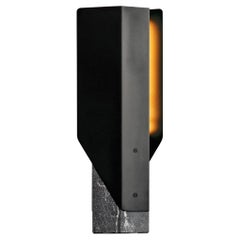
Fold Table Lamp, LED Sculptural Modern Light, Deep Sea/ Hermes Grey Marble
By Jonathan Ben-Tovim
Located in Broadmeadows, Victoria
Inspired by the angular architecture and dark moods of Ridley Scott’s 1982 masterpiece Blade Runner, the Fold Table Lamp deploys folded aluminum fins t...
Category
2010s Australian Modern Table Lamps
Materials
Granite, Aluminum
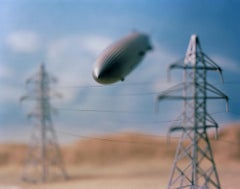
Blimp
By Lori Nix and Kathleen Gerber
Located in New York, NY
Archival pigment print
Signed and numbered, verso
16 x 20 inches
(Edition of 7)
20 x 24 inches
(Edition of 7)
30 x 40 inches
(Edition of 7)
This artwork is offered by ClampArt, l...
Category
1990s Contemporary Landscape Photography
Materials
Archival Pigment
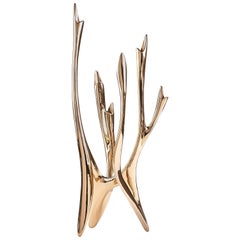
MAD Martian Candelabra No.1 Polished Bronze
By Ma Yansong
Located in Beverly Hills, CA
The MAD Martian collection began with a question: What would the Chinese colonization of a Martian planet look like? This naturally led to more questions s...
Category
21st Century and Contemporary Chinese Candelabras
Materials
Bronze
$7,500 / item
MAD Martian Candelabra No.1 Polished Bronze
By Ma Yansong
Located in Beverly Hills, CA
The MAD Martian collection began with a question: What would the Chinese colonization of a Martian planet look like? This naturally led to more questions s...
Category
21st Century and Contemporary Chinese Candelabras
Materials
Bronze
$7,500 / item
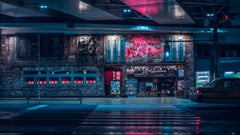
Nihon Noir Tokyo - Deckard
s Grill, Tom Blachford
By Tom Blachford
Located in Brooklyn, NY
'Nihon Noir arose from my fascination with Japan and my desire to translate the feeling that struck me on my first visit, that somehow you have been transported to a parallel future ...
Category
2010s Modern Landscape Photography
Materials
Archival Ink, Archival Paper, Photographic Paper, Color, Archival Pigment
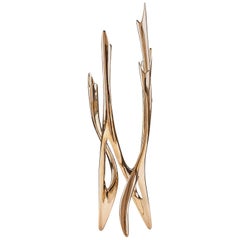
MAD Martian Candelabra No.2 Polished Bronze
By Ma Yansong
Located in Beverly Hills, CA
The MAD Martian collection began with a question: What would the Chinese colonization of a Martian planet look like? This naturally led to more questions s...
Category
21st Century and Contemporary Chinese Candelabras
Materials
Bronze
$7,500 / item
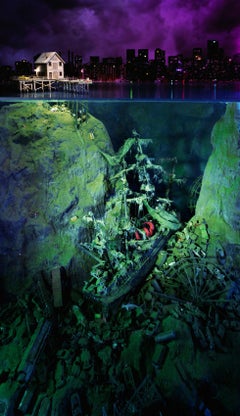
Bounty
By Lori Nix and Kathleen Gerber
Located in New York, NY
Archival pigment print
Signed and numbered, verso
42 x 25 inches
50 x 32 inches
70 x 40 inches
84 x 48 inches
(Total edition of 15)
This artwork is offered by ClampArt, located in New York City.
Please note that prices increase as editions sell.
With the series, "Lost" (2003-2004), Nix and Gerber continue their investigation of the constructed landscape, this time examining feelings of isolation and loneliness. Like much of their previous work, this group of photographs...
Category
Early 2000s Contemporary Landscape Photography
Materials
Archival Pigment
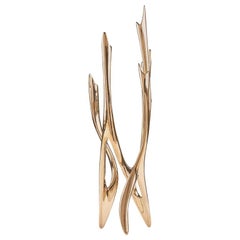
MAD Martian Candelabra No.2 Polished Bronze
By Ma Yansong
Located in Beverly Hills, CA
The MAD Martian collection began with a question: What would the Chinese colonization of a Martian planet look like? This naturally led to more questions s...
Category
21st Century and Contemporary Chinese Candelabras
Materials
Bronze
$7,500 / item
Untitled (from ROBOTNICS Series)
By Christian Rothmann
Located in Kansas City, MO
Christian Rothmann
ROBOTNICS Series
C-Print
2019
Edition S (Edition of 10)
12 x 8.3 inches (30.5 x 21 cm)
Signed, dated and numbered verso
Other Edition Sizes available:
- Edition ...
Category
2010s Outsider Art Photography
Materials
C Print

Fold Table Lamp, Led Sculptural Modern Light, Aged Brass / Calacatta Viola
By Jonathan Ben-Tovim
Located in Broadmeadows, Victoria
Inspired by the angular architecture and dark moods of Ridley Scott’s 1982 masterpiece Blade Runner, the Fold Table Lamp deploys folded aluminum fins to reflect an ambient glow forwa...
Category
2010s Australian Modern Table Lamps
Materials
Marble, Brass
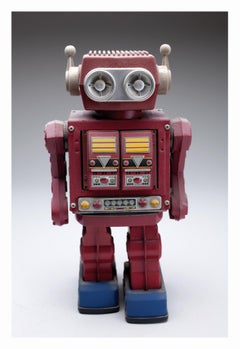
Untitled (from ROBOTNICS Series)
By Christian Rothmann
Located in Kansas City, MO
Christian Rothmann
ROBOTNICS Series
C-Print
2019
Edition S (Edition of 10)
12 x 8.3 inches (30.5 x 21 cm)
Signed, dated and numbered verso
Other Edition Sizes available:
- Edition ...
Category
2010s Outsider Art Photography
Materials
C Print
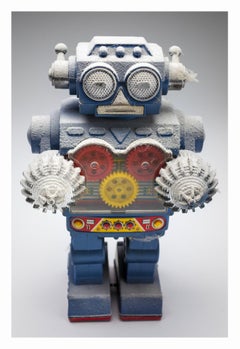
Untitled (from ROBOTNICS Series)
By Christian Rothmann
Located in Kansas City, MO
Christian Rothmann
ROBOTNICS Series
C-Print
2019
Edition S (Edition of 10)
12 x 8.3 inches (30.5 x 21 cm)
Signed, dated and numbered verso
Other Edition Sizes available:
- Edition M (Edition of 6) 35.4 x 23.6 inches (90 x 60 cm)
- Edition L (Edition of 6) 47.2 x 31.5 inches (120 x 80 cm)
- Edition XL (Edition of 3) 88.8 x 58.8 inches (225 x 150 cm)
PUR - Price Upon Request
--------------
Since 1979 Christian Rothmann had more than 40 solo and 80 group exhibitions worldwide.
Christian Rothmann had guest lectures, residencies, art fairs and biennials in Europe, Japan, USA, Australia and Korea.
Christian Rothmann (born 1954 in Kędzierzyn, Poland ) is a painter, photographer, and graphic artist.
In 1976 he first studied at the “Hochschule für Gestaltung” in Offenbach, Germany and moved to Berlin in 1977, where he graduated in 1983 at the “Hochschule der Künste”. From 1983 to 1995 he taught at the university as a lecturer and as an artist with a focus on screenprinting and American art history. To date, a versatile body of work has been created, which includes not only paintings but also long-standing photo projects, videos, and public art.
Guest lectures, teaching assignments, scholarships and exhibitions regularly lead Rothmann to travel home and abroad.
------------------------
Rothmann's Robots
These creatures date back to another era, and they connect the past and the future. They were found by Christian Rothmann, a Berlin artist, collector and traveler through time and the world: In shops in Germany and Japan, Israel and America, his keen eye picks out objects cast aside by previous generations, but which lend themselves to his own work. In a similar way, he came across a stash of historic toy robots of varied provenance collected by a Berlin gallery owner many years ago. Most of them were screwed and riveted together in the 1960s and 70s by Metal House, a Japanese company that still exists today. In systematically photographing these humanoids made of tin - and later plastic - Rothmann is paraphrasing the idea of appropriation art. Unknown names designed and made the toys, which some five decades on, Rothmann depicts and emblematizes in his extensive photo sequence.
In their photographs of Selim Varol's vast toy collection, his German colleagues Daniel and Geo Fuchs captured both the stereotypical and individual in plastic figures that imitate superheroes which were and still are generally manufactured somewhere in Asia. Christian Rothmann looks his robots deep in their artificially stylized, painted or corrugated eyes - or more aptly, their eye slits - and although each has a certain degree of individuality, the little figures remain unknown to us; they project nothing and are not alter egos. Rothmann trains his lens on their faces and expressions, and thus, his portraits are born. Up extremely close, dust, dents, and rust become visible. In other words, what we see is time-traces of time that has passed since the figures were made, or during their period in a Berlin attic, and - considering that he robots date back to Rothmann's childhood - time lived by the photographer and recipients of his pictures. But unlike dolls, these mechanical robots bear no reference to the ideal of beauty at the time of their manufacture, and their features are in no way modeled on a concrete child's face.
In this art project the robots appear as figures without a context, photographed face-on, cropped in front of a neutral background and reduced to their qualities of form. But beyond the reproduction and documentation a game with surfaces is going on; our view lingers on the outer skin of the object, or on the layer over it. The inside - which can be found beneath - is to an extent metaphysical, occurring inside the observer's mind. Only rarely is there anything to see behind the robot's helmet. When an occasional human face does peer out, it turns the figure into a robot-like protective casing for an astronaut of the future.
If we really stop and think about modern toys, let's say those produced from the mid 20th century, when Disney and Marvel films were already stimulating a massive appetite for merchandising, the question must be: do such fantasy and hybrid creatures belong, does something like artificial intelligence already belong to the broader community of humans and animals? It is already a decade or two since the wave of Tamagotchis washed in from Japan, moved children to feed and entertain their newly born electronic chicks in the way they would a real pet, or to run the risk of seeing them die. It was a new form of artificial life, but the relationship between people and machines becomes problematic when the machines or humanoid robots have excellent fine motor skills and artificial intelligence and sensitivity on a par with, or even greater than that of humans. Luckily we have not reached that point yet, even if Hollywood adaptations would have us believe we are not far away.
Rothmann's robots are initially sweet toys, and each toy is known to have a different effect on children and adults. They are conceived by (adult) designers as a means of translating or retelling history or reality through miniature animals, knights, and soldiers. In the case of monsters, mythical creatures, and robots, it is more about creating visions of the future and parallel worlds. Certainly, since the success of fantasy books and films such as Lord of the Rings or The Hobbit, we see the potential for vast enthusiasm for such parallel worlds. Successful computer and online games such as World
of Warcraft, or the creation of avatars are also interesting worldwide phenomena of virtual realities that are not only relevant for children and teens.
So when a middle-aged Berlin photographic artist (like Christian Rothmann) chooses to study 120 toy robots with great difference in form, it represents a journey back to his own childhood - even if at the time, he played with a steam engine rather than a robot. Once batteries had been inserted, some of the largely male or gender-neutral robots, could flash, shoot, turn around and even do more complicated things. Some can even still do it today - albeit clumsily. This, of course, can only be seen on film, but the artist intends to document that as well; to feature the robots in filmic works of art.
The positioning of the figures in the studio is the same as the tableau of pictures in the exhibition room. In this way, one could say Rothmann deploys one robot after the other. This systematic approach enables a comparative view; the extreme enlargement of what are actually small and manageable figures is like the macro vision of insects whose fascinating, sometimes monster-like appearance only becomes visible when they are blown up a hundredfold. The same thing goes for the robots; in miniature form, they seem harmless and cute, but if they were larger than humans and made noises to match, they would seem more threatening.
Some of the tin figures...
Category
2010s Street Art Photography
Materials
C Print
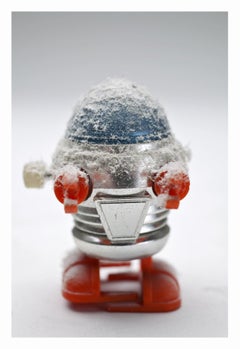
Untitled (from ROBOTNICS Series)
By Christian Rothmann
Located in Kansas City, MO
Christian Rothmann
ROBOTNICS Series
C-Print
2019
Edition S (Edition of 10)
12 x 8.3 inches (30.5 x 21 cm)
Signed, dated and numbered verso
Other Edition Sizes available:
- Edition ...
Category
2010s Modern Photography
Materials
C Print
Untitled (from ROBOTNICS Series)
By Christian Rothmann
Located in Kansas City, MO
Christian Rothmann
ROBOTNICS Series
C-Print
2019
Edition S (Edition of 10)
12 x 8.3 inches (30.5 x 21 cm)
Signed, dated and numbered verso
Other Edition Sizes available:
- Edition ...
Category
2010s Contemporary Photography
Materials
C Print
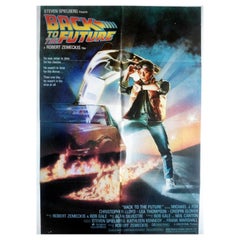
1985 Back to the Future Original Vintage Poster
By Drew Struzan
Located in Winchester, GB
The Robert Zemeckis directed Back to the Future came flying into cinemas at 88mph in 1985. The time travelling tale that made Michael J. Fox a superstar and the DeLorean the must-hav...
Category
Vintage 1980s American Posters
Materials
Paper
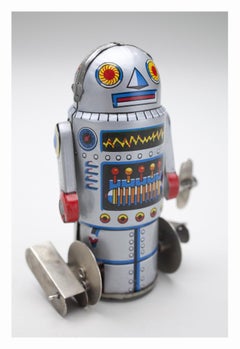
Untitled (from ROBOTNICS Series)
By Christian Rothmann
Located in Kansas City, MO
Christian Rothmann
ROBOTNICS Series
C-Print
2019
Edition S (Edition of 10)
12 x 8.3 inches (30.5 x 21 cm)
Signed, dated and numbered verso
Other Edition Sizes available:
- Edition M (Edition of 6) 35.4 x 23.6 inches (90 x 60 cm)
- Edition L (Edition of 6) 47.2 x 31.5 inches (120 x 80 cm)
- Edition XL (Edition of 3) 88.8 x 58.8 inches (225 x 150 cm)
PUR - Price Upon Request
--------------
Since 1979 Christian Rothmann had more than 40 solo and 80 group exhibitions worldwide.
Christian Rothmann had guest lectures, residencies, art fairs and biennials in Europe, Japan, USA, Australia and Korea.
Christian Rothmann (born 1954 in Kędzierzyn, Poland ) is a painter, photographer, and graphic artist.
In 1976 he first studied at the “Hochschule für Gestaltung” in Offenbach, Germany and moved to Berlin in 1977, where he graduated in 1983 at the “Hochschule der Künste”. From 1983 to 1995 he taught at the university as a lecturer and as an artist with a focus on screenprinting and American art history. To date, a versatile body of work has been created, which includes not only paintings but also long-standing photo projects, videos, and public art.
Guest lectures, teaching assignments, scholarships and exhibitions regularly lead Rothmann to travel home and abroad.
------------------------
Rothmann's Robots
These creatures date back to another era, and they connect the past and the future. They were found by Christian Rothmann, a Berlin artist, collector and traveler through time and the world: In shops in Germany and Japan, Israel and America, his keen eye picks out objects cast aside by previous generations, but which lend themselves to his own work. In a similar way, he came across a stash of historic toy robots of varied provenance collected by a Berlin gallery owner many years ago. Most of them were screwed and riveted together in the 1960s and 70s by Metal House, a Japanese company that still exists today. In systematically photographing these humanoids made of tin - and later plastic - Rothmann is paraphrasing the idea of appropriation art. Unknown names designed and made the toys, which some five decades on, Rothmann depicts and emblematizes in his extensive photo sequence.
In their photographs of Selim Varol's vast toy collection, his German colleagues Daniel and Geo Fuchs captured both the stereotypical and individual in plastic figures that imitate superheroes which were and still are generally manufactured somewhere in Asia. Christian Rothmann looks his robots deep in their artificially stylized, painted or corrugated eyes - or more aptly, their eye slits - and although each has a certain degree of individuality, the little figures remain unknown to us; they project nothing and are not alter egos. Rothmann trains his lens on their faces and expressions, and thus, his portraits are born. Up extremely close, dust, dents, and rust become visible. In other words, what we see is time-traces of time that has passed since the figures were made, or during their period in a Berlin attic, and - considering that he robots date back to Rothmann's childhood - time lived by the photographer and recipients of his pictures. But unlike dolls, these mechanical robots bear no reference to the ideal of beauty at the time of their manufacture, and their features are in no way modeled on a concrete child's face.
In this art project the robots appear as figures without a context, photographed face-on, cropped in front of a neutral background and reduced to their qualities of form. But beyond the reproduction and documentation a game with surfaces is going on; our view lingers on the outer skin of the object, or on the layer over it. The inside - which can be found beneath - is to an extent metaphysical, occurring inside the observer's mind. Only rarely is there anything to see behind the robot's helmet. When an occasional human face does peer out, it turns the figure into a robot-like protective casing for an astronaut of the future.
If we really stop and think about modern toys, let's say those produced from the mid 20th century, when Disney and Marvel films were already stimulating a massive appetite for merchandising, the question must be: do such fantasy and hybrid creatures belong, does something like artificial intelligence already belong to the broader community of humans and animals? It is already a decade or two since the wave of Tamagotchis washed in from Japan, moved children to feed and entertain their newly born electronic chicks in the way they would a real pet, or to run the risk of seeing them die. It was a new form of artificial life, but the relationship between people and machines becomes problematic when the machines or humanoid robots have excellent fine motor skills and artificial intelligence and sensitivity on a par with, or even greater than that of humans. Luckily we have not reached that point yet, even if Hollywood adaptations would have us believe we are not far away.
Rothmann's robots are initially sweet toys, and each toy is known to have a different effect on children and adults. They are conceived by (adult) designers as a means of translating or retelling history or reality through miniature animals, knights, and soldiers. In the case of monsters, mythical creatures, and robots, it is more about creating visions of the future and parallel worlds. Certainly, since the success of fantasy books and films such as Lord of the Rings or The Hobbit, we see the potential for vast enthusiasm for such parallel worlds. Successful computer and online games such as World
of Warcraft, or the creation of avatars are also interesting worldwide phenomena of virtual realities that are not only relevant for children and teens.
So when a middle-aged Berlin photographic artist (like Christian Rothmann) chooses to study 120 toy robots with great difference in form, it represents a journey back to his own childhood - even if at the time, he played with a steam engine rather than a robot. Once batteries had been inserted, some of the largely male or gender-neutral robots, could flash, shoot, turn around and even do more complicated things. Some can even still do it today - albeit clumsily. This, of course, can only be seen on film, but the artist intends to document that as well; to feature the robots in filmic works of art.
The positioning of the figures in the studio is the same as the tableau of pictures in the exhibition room. In this way, one could say Rothmann deploys one robot after the other. This systematic approach enables a comparative view; the extreme enlargement of what are actually small and manageable figures is like the macro vision of insects whose fascinating, sometimes monster-like appearance only becomes visible when they are blown up a hundredfold. The same thing goes for the robots; in miniature form, they seem harmless and cute, but if they were larger than humans and made noises to match, they would seem more threatening.
Some of the tin figures...
Category
2010s Contemporary Photography
Materials
C Print
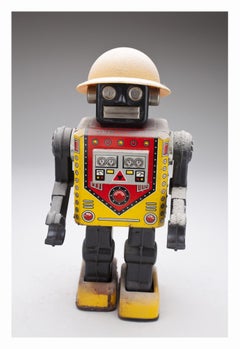
Untitled (from ROBOTNICS Series)
By Christian Rothmann
Located in Kansas City, MO
Christian Rothmann
ROBOTNICS Series
C-Print
2019
Edition S (Edition of 10)
12 x 8.3 inches (30.5 x 21 cm)
Signed, dated and numbered verso
Other Edition Sizes available:
- Edition M (Edition of 6) 35.4 x 23.6 inches (90 x 60 cm)
- Edition L (Edition of 6) 47.2 x 31.5 inches (120 x 80 cm)
- Edition XL (Edition of 3) 88.8 x 58.8 inches (225 x 150 cm)
PUR - Price Upon Request
--------------
Since 1979 Christian Rothmann had more than 40 solo and 80 group exhibitions worldwide.
Christian Rothmann had guest lectures, residencies, art fairs and biennials in Europe, Japan, USA, Australia and Korea.
Christian Rothmann (born 1954 in Kędzierzyn, Poland ) is a painter, photographer, and graphic artist.
In 1976 he first studied at the “Hochschule für Gestaltung” in Offenbach, Germany and moved to Berlin in 1977, where he graduated in 1983 at the “Hochschule der Künste”. From 1983 to 1995 he taught at the university as a lecturer and as an artist with a focus on screenprinting and American art history. To date, a versatile body of work has been created, which includes not only paintings but also long-standing photo projects, videos, and public art.
Guest lectures, teaching assignments, scholarships and exhibitions regularly lead Rothmann to travel home and abroad.
------------------------
Rothmann's Robots
These creatures date back to another era, and they connect the past and the future. They were found by Christian Rothmann, a Berlin artist, collector and traveler through time and the world: In shops in Germany and Japan, Israel and America, his keen eye picks out objects cast aside by previous generations, but which lend themselves to his own work. In a similar way, he came across a stash of historic toy robots of varied provenance collected by a Berlin gallery owner many years ago. Most of them were screwed and riveted together in the 1960s and 70s by Metal House, a Japanese company that still exists today. In systematically photographing these humanoids made of tin - and later plastic - Rothmann is paraphrasing the idea of appropriation art. Unknown names designed and made the toys, which some five decades on, Rothmann depicts and emblematizes in his extensive photo sequence.
In their photographs of Selim Varol's vast toy collection, his German colleagues Daniel and Geo Fuchs captured both the stereotypical and individual in plastic figures that imitate superheroes which were and still are generally manufactured somewhere in Asia. Christian Rothmann looks his robots deep in their artificially stylized, painted or corrugated eyes - or more aptly, their eye slits - and although each has a certain degree of individuality, the little figures remain unknown to us; they project nothing and are not alter egos. Rothmann trains his lens on their faces and expressions, and thus, his portraits are born. Up extremely close, dust, dents, and rust become visible. In other words, what we see is time-traces of time that has passed since the figures were made, or during their period in a Berlin attic, and - considering that he robots date back to Rothmann's childhood - time lived by the photographer and recipients of his pictures. But unlike dolls, these mechanical robots bear no reference to the ideal of beauty at the time of their manufacture, and their features are in no way modeled on a concrete child's face.
In this art project the robots appear as figures without a context, photographed face-on, cropped in front of a neutral background and reduced to their qualities of form. But beyond the reproduction and documentation a game with surfaces is going on; our view lingers on the outer skin of the object, or on the layer over it. The inside - which can be found beneath - is to an extent metaphysical, occurring inside the observer's mind. Only rarely is there anything to see behind the robot's helmet. When an occasional human face does peer out, it turns the figure into a robot-like protective casing for an astronaut of the future.
If we really stop and think about modern toys, let's say those produced from the mid 20th century, when Disney and Marvel films were already stimulating a massive appetite for merchandising, the question must be: do such fantasy and hybrid creatures belong, does something like artificial intelligence already belong to the broader community of humans and animals? It is already a decade or two since the wave of Tamagotchis washed in from Japan, moved children to feed and entertain their newly born electronic chicks in the way they would a real pet, or to run the risk of seeing them die. It was a new form of artificial life, but the relationship between people and machines becomes problematic when the machines or humanoid robots have excellent fine motor skills and artificial intelligence and sensitivity on a par with, or even greater than that of humans. Luckily we have not reached that point yet, even if Hollywood adaptations would have us believe we are not far away.
Rothmann's robots are initially sweet toys, and each toy is known to have a different effect on children and adults. They are conceived by (adult) designers as a means of translating or retelling history or reality through miniature animals, knights, and soldiers. In the case of monsters, mythical creatures, and robots, it is more about creating visions of the future and parallel worlds. Certainly, since the success of fantasy books and films such as Lord of the Rings or The Hobbit, we see the potential for vast enthusiasm for such parallel worlds. Successful computer and online games such as World
of Warcraft...
Category
2010s Pop Art Photography
Materials
C Print
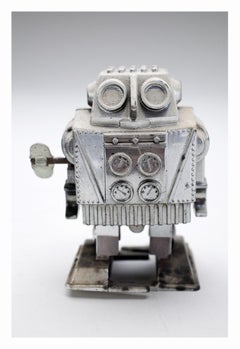
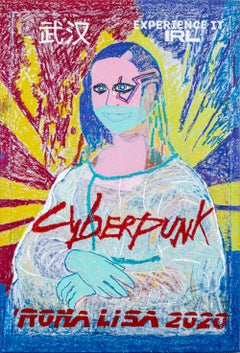
Rona Lisa - Cyberpunk Edition,
Paint and Oil Stick on Canvas by XVALA
By XVALA
Located in Oklahoma City, OK
From the Pandemic Collection: Series #3
This painting by XVALA is a futuristic and dystopian twist on the classic masterpiece, Mona Lisa, with his take on what da Vinci's mind might...
Category
2010s Pop Art Mixed Media
Materials
Oil Crayon, Acrylic
$4,800 Sale Price
20% Off
Untitled (from ROBOTNICS Series)
By Christian Rothmann
Located in Kansas City, MO
Christian Rothmann
ROBOTNICS Series
C-Print
2019
Edition S (Edition of 10)
12 x 8.3 inches (30.5 x 21 cm)
Signed, dated and numbered verso
Other Edition Sizes available:
- Edition ...
Category
2010s Pop Art Photography
Materials
C Print
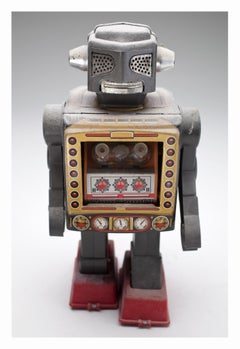
Tornado
By Lori Nix and Kathleen Gerber
Located in New York, NY
Archival pigment print
Signed and numbered, verso
16 x 20 inches
(Edition of 7)
20 x 24 inches
(Edition of 7)
30 x 40 inches
(Edition of 7)
This artwork is offered by ClampArt, l...
Category
1990s Contemporary Still-life Photography
Materials
Archival Pigment
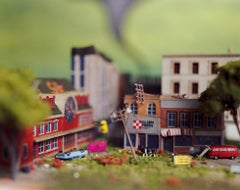
Untitled (from ROBOTNICS Series)
By Christian Rothmann
Located in Kansas City, MO
Christian Rothmann
ROBOTNICS Series
C-Print
2019
Edition S (Edition of 10)
12 x 8.3 inches (30.5 x 21 cm)
Signed, dated and numbered verso
Other Edition Sizes available:
- Edition ...
Category
2010s Modern Photography
Materials
C Print
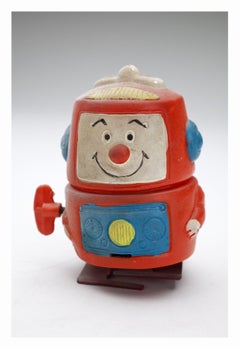
Untitled (from ROBOTNICS Series)
By Christian Rothmann
Located in Kansas City, MO
Christian Rothmann
ROBOTNICS Series
C-Print
2019
Edition S (Edition of 10)
12 x 8.3 inches (30.5 x 21 cm)
Signed, dated and numbered verso
Other Edition Sizes available:
- Edition M (Edition of 6) 35.4 x 23.6 inches (90 x 60 cm)
- Edition L (Edition of 6) 47.2 x 31.5 inches (120 x 80 cm)
- Edition XL (Edition of 3) 88.8 x 58.8 inches (225 x 150 cm)
PUR - Price Upon Request
--------------
Since 1979 Christian Rothmann had more than 40 solo and 80 group exhibitions worldwide.
Christian Rothmann had guest lectures, residencies, art fairs and biennials in Europe, Japan, USA, Australia and Korea.
Christian Rothmann (born 1954 in Kędzierzyn, Poland ) is a painter, photographer, and graphic artist.
In 1976 he first studied at the “Hochschule für Gestaltung” in Offenbach, Germany and moved to Berlin in 1977, where he graduated in 1983 at the “Hochschule der Künste”. From 1983 to 1995 he taught at the university as a lecturer and as an artist with a focus on screenprinting and American art history. To date, a versatile body of work has been created, which includes not only paintings but also long-standing photo projects, videos, and public art.
Guest lectures, teaching assignments, scholarships and exhibitions regularly lead Rothmann to travel home and abroad.
------------------------
Rothmann's Robots
These creatures date back to another era, and they connect the past and the future. They were found by Christian Rothmann, a Berlin artist, collector and traveler through time and the world: In shops in Germany and Japan, Israel and America, his keen eye picks out objects cast aside by previous generations, but which lend themselves to his own work. In a similar way, he came across a stash of historic toy robots of varied provenance collected by a Berlin gallery owner many years ago. Most of them were screwed and riveted together in the 1960s and 70s by Metal House, a Japanese company that still exists today. In systematically photographing these humanoids made of tin - and later plastic - Rothmann is paraphrasing the idea of appropriation art. Unknown names designed and made the toys, which some five decades on, Rothmann depicts and emblematizes in his extensive photo sequence.
In their photographs of Selim Varol's vast toy collection, his German colleagues Daniel and Geo Fuchs captured both the stereotypical and individual in plastic figures that imitate superheroes which were and still are generally manufactured somewhere in Asia. Christian Rothmann looks his robots deep in their artificially stylized, painted or corrugated eyes - or more aptly, their eye slits - and although each has a certain degree of individuality, the little figures remain unknown to us; they project nothing and are not alter egos. Rothmann trains his lens on their faces and expressions, and thus, his portraits are born. Up extremely close, dust, dents, and rust become visible. In other words, what we see is time-traces of time that has passed since the figures were made, or during their period in a Berlin attic, and - considering that he robots date back to Rothmann's childhood - time lived by the photographer and recipients of his pictures. But unlike dolls, these mechanical robots bear no reference to the ideal of beauty at the time of their manufacture, and their features are in no way modeled on a concrete child's face.
In this art project the robots appear as figures without a context, photographed face-on, cropped in front of a neutral background and reduced to their qualities of form. But beyond the reproduction and documentation a game with surfaces is going on; our view lingers on the outer skin of the object, or on the layer over it. The inside - which can be found beneath - is to an extent metaphysical, occurring inside the observer's mind. Only rarely is there anything to see behind the robot's helmet. When an occasional human face does peer out, it turns the figure into a robot-like protective casing for an astronaut of the future.
If we really stop and think about modern toys, let's say those produced from the mid 20th century, when Disney and Marvel films were already stimulating a massive appetite for merchandising, the question must be: do such fantasy and hybrid creatures belong, does something like artificial intelligence already belong to the broader community of humans and animals? It is already a decade or two since the wave of Tamagotchis washed in from Japan, moved children to feed and entertain their newly born electronic chicks in the way they would a real pet, or to run the risk of seeing them die. It was a new form of artificial life, but the relationship between people and machines becomes problematic when the machines or humanoid robots have excellent fine motor skills and artificial intelligence and sensitivity on a par with, or even greater than that of humans. Luckily we have not reached that point yet, even if Hollywood adaptations would have us believe we are not far away.
Rothmann's robots are initially sweet toys, and each toy is known to have a different effect on children and adults. They are conceived by (adult) designers as a means of translating or retelling history or reality through miniature animals, knights, and soldiers. In the case of monsters, mythical creatures, and robots, it is more about creating visions of the future and parallel worlds. Certainly, since the success of fantasy books and films such as Lord of the Rings or The Hobbit, we see the potential for vast enthusiasm for such parallel worlds. Successful computer and online games such as World
of Warcraft...
Category
2010s Street Art Photography
Materials
C Print