399 results for ""frida kahlo""

to
51
169
93
47
43
47
Overall Width
to
Overall Height
to
4
158
237
2
28
21
6
6
25
14
5
117
100
34
20
19
7
6
3
2
249
102
35
200
142
91
54
46
41
38
38
31
29
28
16
15
13
12
11
10
9
9
8
155
99
92
92
65
35
34
28
28
24
87
72
314
58
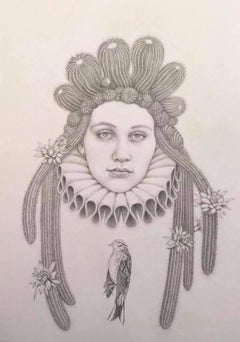
Infanta de la Verdad
By Chikako Okada
Located in Burlingame, CA
'Infanta de la Verdad' features the face of a young woman with cactus surrounding her head and a bird and flowering cactus (bottom) representing life, death and the struggles in betw...
Category

21st Century and Contemporary Realist Portrait Drawings and Watercolors

Materials

Paper, Pencil, Graphite

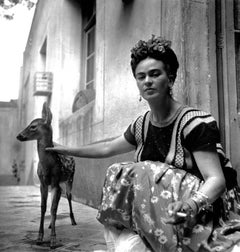
Frida with Granizo by Nickolas Muray, 1939, Silver Gelatin Print, Photography
By Nickolas Muray
Located in Denton, TX
Frida with Granizo by Nickolas Muray is a portrait of Frida Kahlo with her pet deer, Granizo. She places her hand lovingly on the deer while looking towards the viewer, with a cigare...
Category

20th Century Modern Portrait Photography

Materials

Silver Gelatin

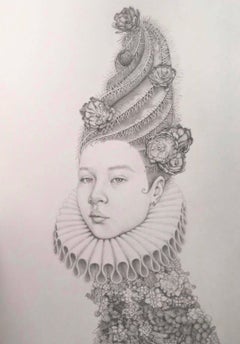
Infanta Primavera, 2019
By Chikako Okada
Located in Burlingame, CA
'Infanta Primavera' features the face of a young woman's head with a flowering cactus in an intricately patterned and a succulent coated body. It is complex graphite drawing on Kent ...
Category

21st Century and Contemporary Realist Portrait Drawings and Watercolors

Materials

Paper, Pencil, Graphite

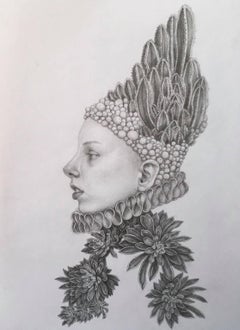
Infanta Dolor - graphite pencil drawing - woman with cactus and succulents
By Chikako Okada
Located in Burlingame, CA
'Infanta Dolor' features the face of a young woman with succulents and cactus in an intricately patterned and complex graphite drawing on Kent paper. from Japanese artist Chikako Oka...
Category

21st Century and Contemporary Realist Portrait Drawings and Watercolors

Materials

Paper, Pencil, Graphite

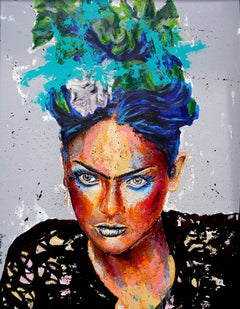
French School - Portrait 22 PS 19 Frida on Fire (Large) Oil Impressionist
Located in Zofingen, AG
Portrait 22 PS 19 Frida on Fire Portrait of the artist Frida Kahlo with Blue Hair Technique: oil, acrylic, and ballpoint pen on paper mounted on wood 64 x 49cm (25,2x19,3 inch) wit...
Category

21st Century and Contemporary Impressionist Portrait Paintings

Materials

Ink, Oil, Acrylic

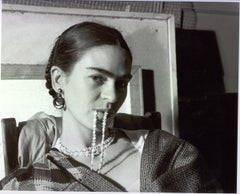
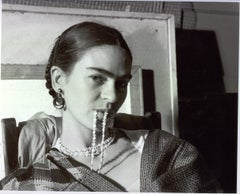
Frida Biting Her Necklace by Lucienne Bloch, 1933, Silver Gelatin Print
By Lucienne Bloch
Located in Denton, TX
Frida Biting Her Necklace by Lucienne Bloch is a 8 1/4 x 10 1/4 inch silver gelatin print. This photograph is mounted on a 16 x 20 inch mount board with a window mat. It is signed on print recto by artist in pen and has a signature label on mount verso with title, date, artist name and copyright information. Frida Biting Her Necklace features a portrait of Frida Kahlo sitting in a chair while biting her necklace. Her head is slightly turned as she stares at the viewer. Lucienne Bloch was a prolific artist. Born in Switzerland, she soon moved with her family to American in mist of the growing tensions of war and anti-Semitism. At the young age of 15 years old, she attended The Cleveland Institute of Art and later in life enrolled in the Ecole National et Superier des Beaux Arts in Paris. Exceeding in her artistic endeavors, she worked for a number of established artist such as sculptor, Anotine Boudelle, and architecture Frank Lloyd Wright. However, it was her encounter with Mexican Muralist, Diego Rivera, and painter Frida Kahlo that solidified Bloch artistic style. Bloch became a closed friend of the couple, as well as, the chief photographer of the Rockefeller Center mural Diego Rivera was working on in New York before it was destroyed. In addition to her photographs, Bloch was a Fresco muralist for the Federal Arts Project of the Works Progress...
Category

20th Century Modern Portrait Photography

Materials

Silver Gelatin

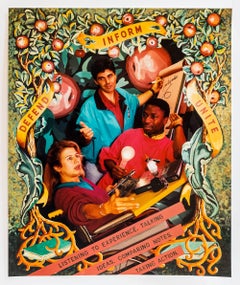
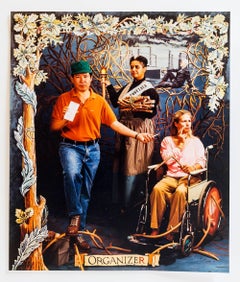
Conceptual Contemporary Art Color Photograph, Social Commentary
By Carole Conde Karl Beveridge
Located in Surfside, FL
Provenance: Deaccessioned from a New York University. Condé + Beveridge Carole Condé and Karl Beveridge Condé born in Hamilton in 1940. Beveridge born in Ottawa in 1945. Both live an...
Category

Late 20th Century Conceptual Color Photography

Materials

C Print, Color

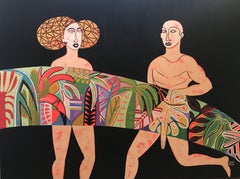
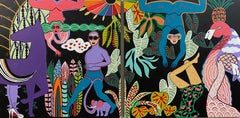
Jungle culture # 3, Painting, Acrylic on Canvas
By Diana Rosa
Located in Yardley, PA
In a stylistic amalgam of Pop and folk, abstract and figurative, I take inspiration from an alternative upbringing where I closely connected with the natural landscape around me. Bor...
Category

21st Century and Contemporary Contemporary Paintings

Materials

Acrylic

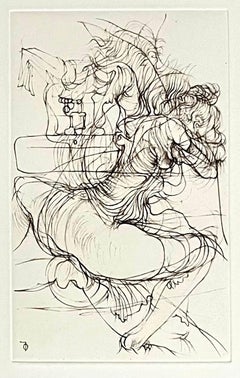
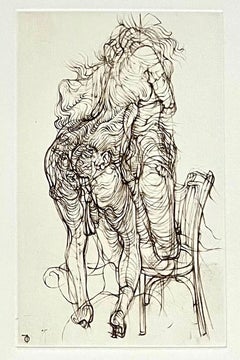
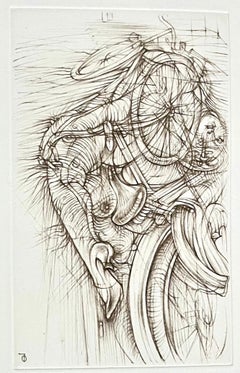
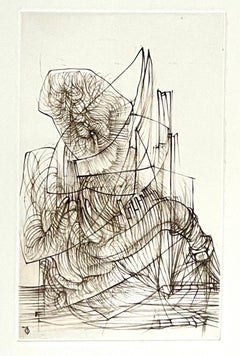
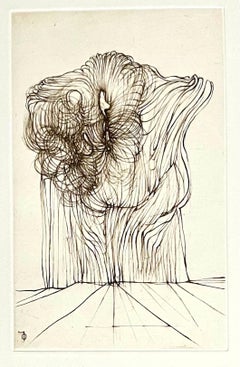
German Surrealist Hans Bellmer Etching Engraving Print Cecile Reims Surrealism
By Hans Bellmer
Located in Surfside, FL
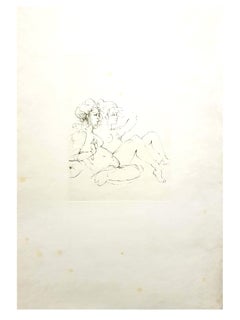
After Hans Bellmer (German, 1902-1975) Surrealist engraving, etching after drawings from a 1942 notebook, engraved in 1974-75 by Cecile Reims Printed by L'Atelier de Chalcographie du Louvre, Paris, Having printed monogram lower left in plate, pencil notations and #7/10 and 'Musee du Louvre' blindstamp verso Dimensions: Sheet 11 X 7.5, Plate size 6.5 X 4 Hans Bellmer ( 1902 – 1975) was a Polish born German artist, best known for his drawings, etchings that illustrates the 1940 edition of Histoire de l’œil, and the life-sized female sculpture mannequin dolls he produced in the mid-1930s. Historians of art and photography also consider him a Surrealist photographer. Bellmer was born in the city of Kattowitz, then part of the German Empire (now Katowice, Poland). Up until 1926, he worked as a draftsman for his own advertising company. Bellmer is most famous for the creation of a series of dolls as well as photographs of them. He was influenced in his choice of art form in part by reading the published letters of Oskar Kokoschka (Der Fetisch, 1925) and Surrealism. Bellmer's puppet doll project is also said to have been catalysed by a series of events in his personal life. Hans Bellmer takes credit for provoking a physical crisis in his father and brings his own artistic creativity into association with childhood insubordination and resentment toward a severe and humorless paternal authority. Perhaps this is one reason for the nearly universal, unquestioning acceptance in the literature of Bellmer's promotion of his art as a struggle against his father, the police, and ultimately, fascism and the state. Events of his personal life also including meeting a beautiful teenage cousin in 1932 (and perhaps other unattainable beauties), attending a performance of Jacques Offenbach's Tales of Hoffmann (in which a man falls tragically in love with an automaton), and receiving a box of his old toys. After these events, he began to actually construct his first dolls. In his works, Bellmer explicitly sexualized the doll as a young girl (his work bears connection to the works of Bathus). Hirschfeld has claimed (without further argumentation) that Bellmer initiated his doll project to oppose the fascism of the Nazi Party by declaring that he would make no work that would support the new German state. Represented by mutated forms and unconventional poses, his dolls (according to this view) were directed specifically at the cult of the perfect body then prominent in Germany. He visited Paris in 1935 and made contacts there, such as Paul Éluard, but returned to Berlin because his wife Margarete was dying of tuberculosis. He was part of the circle of Surrealist luminaries such as Man Ray, Marcel Duchamp, Max Ernst, Joan Miro, André Masson, René Magritte, Alberto Giacometti and Salvador Dali as well as women artists—such as Frida Kahlo, Dorothea Tanning and Leonora Carrington. Bellmer produced the first doll in Berlin in 1933. Long since lost, the assemblage can nevertheless be correctly described thanks to approximately two dozen photographs Bellmer took at the time of its construction. Standing about fifty-six inches tall, the doll consisted of a modeled torso made of flax fiber, glue, and plaster; a mask-like head of the same material with glass eyes and a long, unkempt wig; and a pair of legs made from broomsticks or dowel rods. One of these legs terminated in a wooden, club-like foot; the other was encased in a more naturalistic plaster shell, jointed at the knee and ankle. As the project progressed, Bellmer made a second set of hollow plaster legs, with wooden ball joints for the doll's hips and knees. There were no arms to the first sculpture, but Bellmer did fashion or find a single wooden hand, which appears among the assortment of doll parts the artist documented in an untitled photograph of 1934, as well as in several photographs of later work. Bellmer's 1934 anonymous book, The Doll (Die Puppe), produced and published privately in Germany, contains 10 black-and-white photographs of Bellmer's first doll arranged in a series of "tableaux vivants" (living pictures). The book was not credited to him, as he worked in isolation, and his photographs remained almost unknown in Germany. Yet Bellmer's work was eventually declared "degenerate" (entartete kunst) by the Nazi Party, and he was forced to flee Germany to France in 1938, where Bellmer's work was welcomed by the Surrealists around Andre Breton. He aided the French Resistance during the war by making fake passports. He was imprisoned in the Camp des Milles prison at Aix-en-Provence, a brickworks camp for German nationals, from September 1939 until the end of the Phoney War in May 1940. After the war, Bellmer lived the rest of his life in Paris. Bellmer gave up doll-making and spent the following decades creating erotic drawings, etchings, sexually explicit photographs, paintings, and prints of pubescent girls. In 1954, he met Unica Zürn...
Category

20th Century Abstract Prints

Materials

Etching

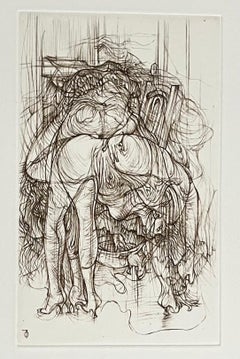
German Surrealist Hans Bellmer Etching Engraving Print Cecile Reims Surrealism
By Hans Bellmer
Located in Surfside, FL
After Hans Bellmer (German, 1902-1975) Surrealist engraving, etching after drawings from a 1942 notebook, engraved in 1974-75 by Cecile Reims Printed by L'Atelier de Chalcographie du Louvre, Paris, Having printed monogram lower left in plate, pencil notations and #7/10 and 'Musee du Louvre' blindstamp verso Dimensions: Sheet 11 X 7.5, Plate size 6.5 X 4 Hans Bellmer ( 1902 – 1975) was a Polish born German artist, best known for his drawings, etchings that illustrates the 1940 edition of Histoire de l’œil, and the life-sized female sculpture mannequin dolls he produced in the mid-1930s. Historians of art and photography also consider him a Surrealist photographer. Bellmer was born in the city of Kattowitz, then part of the German Empire (now Katowice, Poland). Up until 1926, he worked as a draftsman for his own advertising company. Bellmer is most famous for the creation of a series of dolls as well as photographs of them. He was influenced in his choice of art form in part by reading the published letters of Oskar Kokoschka (Der Fetisch, 1925) and Surrealism. Bellmer's puppet doll project is also said to have been catalysed by a series of events in his personal life. Hans Bellmer takes credit for provoking a physical crisis in his father and brings his own artistic creativity into association with childhood insubordination and resentment toward a severe and humorless paternal authority. Perhaps this is one reason for the nearly universal, unquestioning acceptance in the literature of Bellmer's promotion of his art as a struggle against his father, the police, and ultimately, fascism and the state. Events of his personal life also including meeting a beautiful teenage cousin in 1932 (and perhaps other unattainable beauties), attending a performance of Jacques Offenbach's Tales of Hoffmann (in which a man falls tragically in love with an automaton), and receiving a box of his old toys. After these events, he began to actually construct his first dolls. In his works, Bellmer explicitly sexualized the doll as a young girl (his work bears connection to the works of Bathus). Hirschfeld has claimed (without further argumentation) that Bellmer initiated his doll project to oppose the fascism of the Nazi Party by declaring that he would make no work that would support the new German state. Represented by mutated forms and unconventional poses, his dolls (according to this view) were directed specifically at the cult of the perfect body then prominent in Germany. He visited Paris in 1935 and made contacts there, such as Paul Éluard, but returned to Berlin because his wife Margarete was dying of tuberculosis. He was part of the circle of Surrealist luminaries such as Man Ray, Marcel Duchamp, Max Ernst, Joan Miro, André Masson, René Magritte, Alberto Giacometti and Salvador Dali as well as women artists—such as Frida Kahlo, Dorothea Tanning and Leonora Carrington. Bellmer produced the first doll in Berlin in 1933. Long since lost, the assemblage can nevertheless be correctly described thanks to approximately two dozen photographs Bellmer took at the time of its construction. Standing about fifty-six inches tall, the doll consisted of a modeled torso made of flax fiber, glue, and plaster; a mask-like head of the same material with glass eyes and a long, unkempt wig; and a pair of legs made from broomsticks or dowel rods. One of these legs terminated in a wooden, club-like foot; the other was encased in a more naturalistic plaster shell, jointed at the knee and ankle. As the project progressed, Bellmer made a second set of hollow plaster legs, with wooden ball joints for the doll's hips and knees. There were no arms to the first sculpture, but Bellmer did fashion or find a single wooden hand, which appears among the assortment of doll parts the artist documented in an untitled photograph of 1934, as well as in several photographs of later work. Bellmer's 1934 anonymous book, The Doll (Die Puppe), produced and published privately in Germany, contains 10 black-and-white photographs of Bellmer's first doll arranged in a series of "tableaux vivants" (living pictures). The book was not credited to him, as he worked in isolation, and his photographs remained almost unknown in Germany. Yet Bellmer's work was eventually declared "degenerate" (entartete kunst) by the Nazi Party, and he was forced to flee Germany to France in 1938, where Bellmer's work was welcomed by the Surrealists around Andre Breton. He aided the French Resistance during the war by making fake passports. He was imprisoned in the Camp des Milles prison at Aix-en-Provence, a brickworks camp for German nationals, from September 1939 until the end of the Phoney War in May 1940. After the war, Bellmer lived the rest of his life in Paris. Bellmer gave up doll-making and spent the following decades creating erotic drawings, etchings, sexually explicit photographs, paintings, and prints of pubescent girls. In 1954, he met Unica Zürn...
Category

20th Century Abstract Prints

Materials

Etching

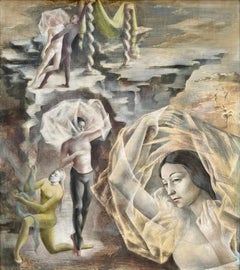
Surreal Dancers Magic Realism - Ballet Mirage
By Hazel Janicki
Located in Miami, FL
Dazed dancers are seen twirling languidly on primal rock formations. The rocks, eroded by the sands of time, are shown as cutaways and serve as a platform or outdoor stage for the d...
Category

1940s Surrealist Figurative Paintings

Materials

Mixed Media, Oil, Wood Panel

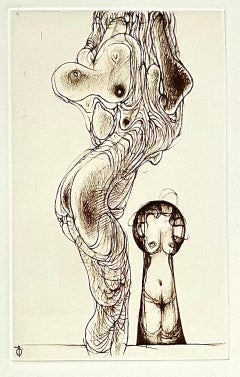
German Surrealist Hans Bellmer Etching Engraving Print Cecile Reims Surrealism
By Hans Bellmer
Located in Surfside, FL
After Hans Bellmer (German, 1902-1975) Surrealist engraving, etching after drawings from a 1942 notebook, engraved in 1974-75 by Cecile Reims Printed by L'Atelier de Chalcographie du Louvre, Paris, Having printed monogram lower left in plate, pencil notations verso Editioned from a very small edition of #7/10 'Musee du Louvre' blindstamp. Dimensions: Sheet 11 X 7.5, Plate size 6.5 X 4 Hans Bellmer ( 1902 – 1975) was a Polish born German artist, best known for his drawings, etchings that illustrates the 1940 edition of Histoire de l’œil, and the life-sized female sculpture mannequin dolls he produced in the mid-1930s. Historians of art and photography also consider him a Surrealist photographer. Bellmer was born in the city of Kattowitz, then part of the German Empire (now Katowice, Poland). Up until 1926, he worked as a draftsman for his own advertising company. Bellmer is most famous for the creation of a series of dolls as well as photographs of them. He was influenced in his choice of art form in part by reading the published letters of Oskar Kokoschka (Der Fetisch, 1925) and Surrealism. Bellmer's puppet doll project is also said to have been catalysed by a series of events in his personal life. Hans Bellmer takes credit for provoking a physical crisis in his father and brings his own artistic creativity into association with childhood insubordination and resentment toward a severe and humorless paternal authority. Perhaps this is one reason for the nearly universal, unquestioning acceptance in the literature of Bellmer's promotion of his art as a struggle against his father, the police, and ultimately, fascism and the state. Events of his personal life also including meeting a beautiful teenage cousin in 1932 (and perhaps other unattainable beauties), attending a performance of Jacques Offenbach's Tales of Hoffmann (in which a man falls tragically in love with an automaton), and receiving a box of his old toys. After these events, he began to actually construct his first dolls. In his works, Bellmer explicitly sexualized the doll as a young girl (his work bears connection to the works of Bathus). Hirschfeld has claimed (without further argumentation) that Bellmer initiated his doll project to oppose the fascism of the Nazi Party by declaring that he would make no work that would support the new German state. Represented by mutated forms and unconventional poses, his dolls (according to this view) were directed specifically at the cult of the perfect body then prominent in Germany. He visited Paris in 1935 and made contacts there, such as Paul Éluard, but returned to Berlin because his wife Margarete was dying of tuberculosis. He was part of the circle of Surrealist luminaries such as Man Ray, Marcel Duchamp, Max Ernst, Joan Miro, André Masson, René Magritte, Alberto Giacometti and Salvador Dali as well as women artists—such as Frida Kahlo, Dorothea Tanning and Leonora Carrington. Bellmer produced the first doll in Berlin in 1933. Long since lost, the assemblage can nevertheless be correctly described thanks to approximately two dozen photographs Bellmer took at the time of its construction. Standing about fifty-six inches tall, the doll consisted of a modeled torso made of flax fiber, glue, and plaster; a mask-like head of the same material with glass eyes and a long, unkempt wig; and a pair of legs made from broomsticks or dowel rods. One of these legs terminated in a wooden, club-like foot; the other was encased in a more naturalistic plaster shell, jointed at the knee and ankle. As the project progressed, Bellmer made a second set of hollow plaster legs, with wooden ball joints for the doll's hips and knees. There were no arms to the first sculpture, but Bellmer did fashion or find a single wooden hand, which appears among the assortment of doll parts the artist documented in an untitled photograph of 1934, as well as in several photographs of later work. Bellmer's 1934 anonymous book, The Doll (Die Puppe), produced and published privately in Germany, contains 10 black-and-white photographs of Bellmer's first doll arranged in a series of "tableaux vivants" (living pictures). The book was not credited to him, as he worked in isolation, and his photographs remained almost unknown in Germany. Yet Bellmer's work was eventually declared "degenerate" (entartete kunst) by the Nazi Party, and he was forced to flee Germany to France in 1938, where Bellmer's work was welcomed by the Surrealists around Andre Breton. He aided the French Resistance during the war by making fake passports. He was imprisoned in the Camp des Milles prison at Aix-en-Provence, a brickworks camp for German nationals, from September 1939 until the end of the Phoney War in May 1940. After the war, Bellmer lived the rest of his life in Paris. Bellmer gave up doll-making and spent the following decades creating erotic drawings, etchings, sexually explicit photographs, paintings, and prints of pubescent girls. In 1954, he met Unica Zürn...
Category

20th Century Abstract Prints

Materials

Etching

German Surrealist Hans Bellmer Etching Engraving Print Cecile Reims Surrealism
By Hans Bellmer
Located in Surfside, FL
After Hans Bellmer (German, 1902-1975) Surrealist engraving, etching after drawings from a 1942 notebook, engraved in 1974-75 by Cecile Reims Printed by L'Atelier de Chalcographie du Louvre, Paris, Having printed monogram lower left in plate, pencil notations and #7/10 and 'Musee du Louvre' blindstamp verso Dimensions: Sheet 11 X 7.5, Plate size 6.5 X 4 Hans Bellmer ( 1902 – 1975) was a Polish born German artist, best known for his drawings, etchings that illustrates the 1940 edition of Histoire de l’œil, and the life-sized female sculpture mannequin dolls he produced in the mid-1930s. Historians of art and photography also consider him a Surrealist photographer. Bellmer was born in the city of Kattowitz, then part of the German Empire (now Katowice, Poland). Up until 1926, he worked as a draftsman for his own advertising company. Bellmer is most famous for the creation of a series of dolls as well as photographs of them. He was influenced in his choice of art form in part by reading the published letters of Oskar Kokoschka (Der Fetisch, 1925) and Surrealism. Bellmer's puppet doll project is also said to have been catalysed by a series of events in his personal life. Hans Bellmer takes credit for provoking a physical crisis in his father and brings his own artistic creativity into association with childhood insubordination and resentment toward a severe and humorless paternal authority. Perhaps this is one reason for the nearly universal, unquestioning acceptance in the literature of Bellmer's promotion of his art as a struggle against his father, the police, and ultimately, fascism and the state. Events of his personal life also including meeting a beautiful teenage cousin in 1932 (and perhaps other unattainable beauties), attending a performance of Jacques Offenbach's Tales of Hoffmann (in which a man falls tragically in love with an automaton), and receiving a box of his old toys. After these events, he began to actually construct his first dolls. In his works, Bellmer explicitly sexualized the doll as a young girl (his work bears connection to the works of Bathus). Hirschfeld has claimed (without further argumentation) that Bellmer initiated his doll project to oppose the fascism of the Nazi Party by declaring that he would make no work that would support the new German state. Represented by mutated forms and unconventional poses, his dolls (according to this view) were directed specifically at the cult of the perfect body then prominent in Germany. He visited Paris in 1935 and made contacts there, such as Paul Éluard, but returned to Berlin because his wife Margarete was dying of tuberculosis. He was part of the circle of Surrealist luminaries such as Man Ray, Marcel Duchamp, Max Ernst, Joan Miro, André Masson, René Magritte, Alberto Giacometti and Salvador Dali as well as women artists—such as Frida Kahlo, Dorothea Tanning and Leonora Carrington. Bellmer produced the first doll in Berlin in 1933. Long since lost, the assemblage can nevertheless be correctly described thanks to approximately two dozen photographs Bellmer took at the time of its construction. Standing about fifty-six inches tall, the doll consisted of a modeled torso made of flax fiber, glue, and plaster; a mask-like head of the same material with glass eyes and a long, unkempt wig; and a pair of legs made from broomsticks or dowel rods. One of these legs terminated in a wooden, club-like foot; the other was encased in a more naturalistic plaster shell, jointed at the knee and ankle. As the project progressed, Bellmer made a second set of hollow plaster legs, with wooden ball joints for the doll's hips and knees. There were no arms to the first sculpture, but Bellmer did fashion or find a single wooden hand, which appears among the assortment of doll parts the artist documented in an untitled photograph of 1934, as well as in several photographs of later work. Bellmer's 1934 anonymous book, The Doll (Die Puppe), produced and published privately in Germany, contains 10 black-and-white photographs of Bellmer's first doll arranged in a series of "tableaux vivants" (living pictures). The book was not credited to him, as he worked in isolation, and his photographs remained almost unknown in Germany. Yet Bellmer's work was eventually declared "degenerate" (entartete kunst) by the Nazi Party, and he was forced to flee Germany to France in 1938, where Bellmer's work was welcomed by the Surrealists around Andre Breton. He aided the French Resistance during the war by making fake passports. He was imprisoned in the Camp des Milles prison at Aix-en-Provence, a brickworks camp for German nationals, from September 1939 until the end of the Phoney War in May 1940. After the war, Bellmer lived the rest of his life in Paris. Bellmer gave up doll-making and spent the following decades creating erotic drawings, etchings, sexually explicit photographs, paintings, and prints of pubescent girls. In 1954, he met Unica Zürn...
Category

20th Century Abstract Prints

Materials

Etching

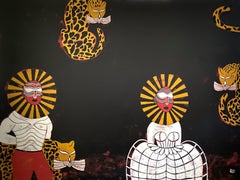
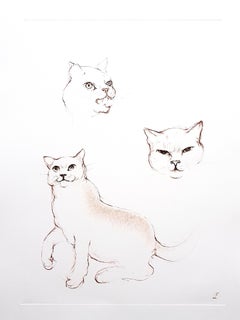
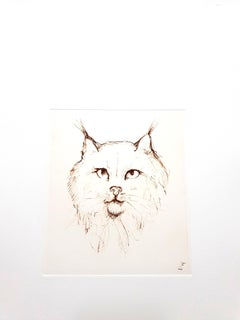
Leonor Fini - Cats - Original Etching
By Leonor Fini
Located in Collonge Bellerive, Geneve, CH
Leonor Fini - Cats - Original Engraving Mme.Helvetius' Cats Original etching created in 1985, Printed Signature (LF). Conditions: excellent Edition: 100 Support: Arches paper. Dimensions: Paper dimensions: 44 x 28 cm Editions: Moret, Paris. Leonor Fini is considered one of the most important women artists of the mid-twentieth century, along with Leonora Carrington, Frida Kahlo, Meret Oppenheim, Remedios Varo, and Dorothea Tanning – most of whom Fini knew well. Her career, which spanned some six decades, included painting, graphic design, book illustration, product design (the renowned torso-shaped perfume bottle for Schiaparelli’s Shocking), and set and costume design for theatre, ballet, opera, and film. In this compellingly readable, exhaustively researched account, author Peter Webb brings Fini’s provocative art and unconventional personal life, as well as the vibrant avant-garde world in which she revolved, vividly in life. Born in Buenos Aires in 1907 (August 30 – January 18, 1996, Paris) to Italian and Argentine parents, Leonor grew up in Trieste, Italy, raised by her strong-willed, independent mother, Malvina. She was a virtually self-taught artist, learing anatomy directly from studying cadavers in the local morgue and absorbing composition and technique from the Old Masters through books and visits to museums. Fini’s fledging attempts at painting in Trieste let her to Milan, where she participated in her first group exhibition in 1929, and then to Paris in 1931. Her vivacious personality and flamboyant attire instantly garnered her a spotlight in the Parisian art world and she soon developed close relationships with the leading surrealist writers and painters, including Paul Eluard, Salvador Dali, Man Ray, and Max Ernst, who became her lover for a time. The only surrealist she could not abide because of his misogyny was André Breton. Although she repeatedly exhibited with them, she never considered herself a surrealist. The American dealer Julien Levy, very much impressed by Fini’s painting and smitten by her eccentric charms, invited her to New York in 1936, where she took part in a joint gallery exhibition with Max Ernst and met many American surrealists, including Joseph Cornell and Pavel Tchelitchew. Her work was included in MoMA’s pivotal Fantastic Art, Dada and Surrealism exhibition, along with De Chirico, Dali, Ernst, and Yves Tanguy. In 1939 in Paris she curated an exhibition of surrealist furniture for her childhood friend Leo Castelli for the opening of his first gallery. Introductions to her exhibition catalogues were written by De Chirico, Ernst, and Jean Cocteau. A predominant theme of Fini’s art is the complex relationship between the sexes, primarily the interplay between the dominant female and the passive, androgynous male. In many of her most powerful works, the female takes the form of a sphinx, often with the face of the artist. Fini was also an accomplished portraitist; among her subjects were Stanislao Lepri...
Category

1980s Modern Animal Prints

Materials

Etching

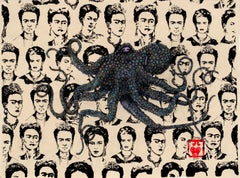
Frida Kahlopus: Gloomy Gus- Gyotaku Style Sumi Ink Painting of an Octopus
By Jeff Conroy
Located in Chicago, IL
A small octopus is inked in the Japanese style of Gyo-Taku print making over a playful background of black and white images of Frida Kahlo. Using sumi ink to "print" the octopus, th...
Category

21st Century and Contemporary Contemporary Animal Drawings and Watercolors

Materials

Sumi Ink, Watercolor, Mulberry Paper, Color Pencil
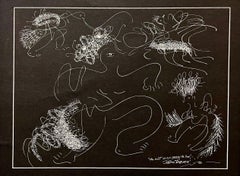
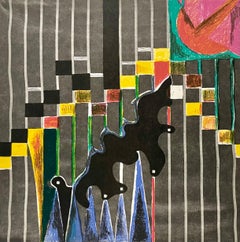
Irene Rice Pereira Modernist Gouache Drawing Painting Abstract Expressionist Art
By Irene Rice Pereira
Located in Surfside, FL
Irene Rice Pereira, Mixed Media on Paper (American, 1902-1971) Titled "The East Wind Carries the Seed" Hand signed l.r. "I. Rice Pereira". Paper: 14.1/8"h x 18.25"w Irene Rice Pe...
Category

Mid-20th Century Abstract Expressionist Abstract Paintings

Materials

Paper, Gouache

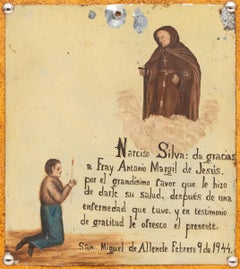
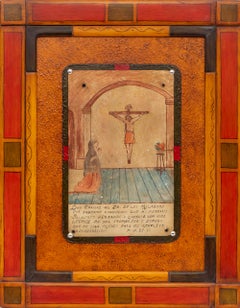
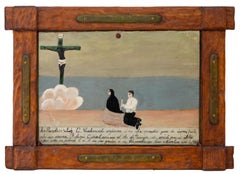
Mexican Ex-Voto “Holy Tribute for Health” 1944 Oil on Tin Folk Art Painting
Located in Denver, CO
This striking 1944 Ex-Voto, “Holy Tribute for the Return of Good Health,” is an original oil and ink on tin by an anonymous Mexican artist. Created in San Miguel de Allende, this dev...
Category

1940s Folk Art Figurative Paintings

Materials

Metal

Conceptual Contemporary Art Color Photograph, Social Commentary
By Carole Conde Karl Beveridge
Located in Surfside, FL
Referencing immigrants and the disabled. Social commentary conceptual artwork. Provenance: Deaccessioned from a New York University. Condé + Beveridg...
Category

Late 20th Century Conceptual Color Photography

Materials

C Print, Color

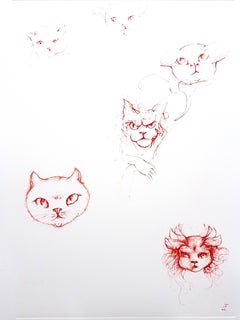
Leonor Fini - Red Cats - Original Etching
By Leonor Fini
Located in Collonge Bellerive, Geneve, CH
Leonor Fini - Cats - Original Engraving Mme.Helvetius' Cats Original etching created in 1985, Printed Signature (LF). Conditions: excellent Edition: 100 Support: Arches paper. Dimensions: Paper dimensions: 44 x 28 cm Editions: Moret, Paris. Leonor Fini is considered one of the most important women artists of the mid-twentieth century, along with Leonora Carrington, Frida Kahlo, Meret Oppenheim, Remedios Varo, and Dorothea Tanning – most of whom Fini knew well. Her career, which spanned some six decades, included painting, graphic design, book illustration, product design (the renowned torso-shaped perfume bottle for Schiaparelli’s Shocking), and set and costume design for theatre, ballet, opera, and film. In this compellingly readable, exhaustively researched account, author Peter Webb brings Fini’s provocative art and unconventional personal life, as well as the vibrant avant-garde world in which she revolved, vividly in life. Born in Buenos Aires in 1907 (August 30 – January 18, 1996, Paris) to Italian and Argentine parents, Leonor grew up in Trieste, Italy, raised by her strong-willed, independent mother, Malvina. She was a virtually self-taught artist, learing anatomy directly from studying cadavers in the local morgue and absorbing composition and technique from the Old Masters through books and visits to museums. Fini’s fledging attempts at painting in Trieste let her to Milan, where she participated in her first group exhibition in 1929, and then to Paris in 1931. Her vivacious personality and flamboyant attire instantly garnered her a spotlight in the Parisian art world and she soon developed close relationships with the leading surrealist writers and painters, including Paul Eluard, Salvador Dali, Man Ray, and Max Ernst, who became her lover for a time. The only surrealist she could not abide because of his misogyny was André Breton. Although she repeatedly exhibited with them, she never considered herself a surrealist. The American dealer Julien Levy, very much impressed by Fini’s painting and smitten by her eccentric charms, invited her to New York in 1936, where she took part in a joint gallery exhibition with Max Ernst and met many American surrealists, including Joseph Cornell and Pavel Tchelitchew. Her work was included in MoMA’s pivotal Fantastic Art, Dada and Surrealism exhibition, along with De Chirico, Dali, Ernst, and Yves Tanguy. In 1939 in Paris she curated an exhibition of surrealist furniture...
Category

1980s Modern Animal Prints

Materials

Etching

What happens in the jungle stays in the jungle, Painting, Acrylic on Canvas
By Diana Rosa
Located in Yardley, PA
In a stylistic amalgam of Pop and folk, abstract and figurative, Diana Rosa takes inspirations from an alternative upbringing where she closely connected with the natural landscape a...
Category

21st Century and Contemporary Contemporary Paintings

Materials

Acrylic

German Surrealist Hans Bellmer Etching Engraving Print Cecile Reims Surrealism
By Hans Bellmer
Located in Surfside, FL
After Hans Bellmer (German, 1902-1975) Surrealist engraving, etching after drawings from a 1942 notebook, engraved in 1974-75 by Cecile Reims Printed by L'Atelier de Chalcographie du Louvre, Paris, Having printed monogram lower left in plate, pencil notations verso Editioned from a very small edition of #7/10 'Musee du Louvre' blindstamp. Dimensions: Sheet 11 X 7.5, Plate size 6.5 X 4 Hans Bellmer ( 1902 – 1975) was a Polish born German artist, best known for his drawings, etchings that illustrates the 1940 edition of Histoire de l’œil, and the life-sized female sculpture mannequin dolls he produced in the mid-1930s. Historians of art and photography also consider him a Surrealist photographer. Bellmer was born in the city of Kattowitz, then part of the German Empire (now Katowice, Poland). Up until 1926, he worked as a draftsman for his own advertising company. Bellmer is most famous for the creation of a series of dolls as well as photographs of them. He was influenced in his choice of art form in part by reading the published letters of Oskar Kokoschka (Der Fetisch, 1925) and Surrealism. Bellmer's puppet doll project is also said to have been catalysed by a series of events in his personal life. Hans Bellmer takes credit for provoking a physical crisis in his father and brings his own artistic creativity into association with childhood insubordination and resentment toward a severe and humorless paternal authority. Perhaps this is one reason for the nearly universal, unquestioning acceptance in the literature of Bellmer's promotion of his art as a struggle against his father, the police, and ultimately, fascism and the state. Events of his personal life also including meeting a beautiful teenage cousin in 1932 (and perhaps other unattainable beauties), attending a performance of Jacques Offenbach's Tales of Hoffmann (in which a man falls tragically in love with an automaton), and receiving a box of his old toys. After these events, he began to actually construct his first dolls. In his works, Bellmer explicitly sexualized the doll as a young girl (his work bears connection to the works of Bathus). Hirschfeld has claimed (without further argumentation) that Bellmer initiated his doll project to oppose the fascism of the Nazi Party by declaring that he would make no work that would support the new German state. Represented by mutated forms and unconventional poses, his dolls (according to this view) were directed specifically at the cult of the perfect body then prominent in Germany. He visited Paris in 1935 and made contacts there, such as Paul Éluard, but returned to Berlin because his wife Margarete was dying of tuberculosis. He was part of the circle of Surrealist luminaries such as Man Ray, Marcel Duchamp, Max Ernst, Joan Miro, André Masson, René Magritte, Alberto Giacometti and Salvador Dali as well as women artists—such as Frida Kahlo, Dorothea Tanning and Leonora Carrington. Bellmer produced the first doll in Berlin in 1933. Long since lost, the assemblage can nevertheless be correctly described thanks to approximately two dozen photographs Bellmer took at the time of its construction. Standing about fifty-six inches tall, the doll consisted of a modeled torso made of flax fiber, glue, and plaster; a mask-like head of the same material with glass eyes and a long, unkempt wig; and a pair of legs made from broomsticks or dowel rods. One of these legs terminated in a wooden, club-like foot; the other was encased in a more naturalistic plaster shell, jointed at the knee and ankle. As the project progressed, Bellmer made a second set of hollow plaster legs, with wooden ball joints for the doll's hips and knees. There were no arms to the first sculpture, but Bellmer did fashion or find a single wooden hand, which appears among the assortment of doll parts the artist documented in an untitled photograph of 1934, as well as in several photographs of later work. Bellmer's 1934 anonymous book, The Doll (Die Puppe), produced and published privately in Germany, contains 10 black-and-white photographs of Bellmer's first doll arranged in a series of "tableaux vivants" (living pictures). The book was not credited to him, as he worked in isolation, and his photographs remained almost unknown in Germany. Yet Bellmer's work was eventually declared "degenerate" (entartete kunst) by the Nazi Party, and he was forced to flee Germany to France in 1938, where Bellmer's work was welcomed by the Surrealists around Andre Breton. He aided the French Resistance during the war by making fake passports. He was imprisoned in the Camp des Milles prison at Aix-en-Provence, a brickworks camp for German nationals, from September 1939 until the end of the Phoney War in May 1940. After the war, Bellmer lived the rest of his life in Paris. Bellmer gave up doll-making and spent the following decades creating erotic drawings, etchings, sexually explicit photographs, paintings, and prints of pubescent girls. In 1954, he met Unica Zürn...
Category

20th Century Abstract Prints

Materials

Etching

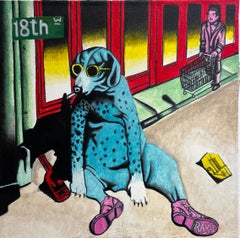
Dog Years - Brightly Colored Self Portrait of Artist as a Aqua Colored Dog
By Marcos Raya
Located in Chicago, IL
***This artwork is currently on exhibit at the Instituto Cervantes, Chicago until September 2025. If purchased this artwork will be available to ship after September 1, 2025. Contact the gallery with questions. Raya, like every productive artist, is a collection of actions, utopias and talents. He is an acrylic painter and a muralist; an installation artist and a practitioner of the theory of the fragment as a synthesis of the whole; he is Chicano but his work has no passport; he is an obsessive self-portraitist (I, as the multiplicity locked within the I) and his an advocate of his community (in the fullest sense of the world); his is from Chicago and - being a nation onto himself - is a native of his art education; his yearns for the Tijuana of tomorrow while being a full-fledged inhabitant of the Tijuana of half a century back; he admires high-tech while being a fan of Frida Kahlo. --Carlos Monsivais Marcos Raya Dog Years oil on canvas 17h x 17w in 43.18h x 43.18w cm MSR054 Marcos Raya brings together old and new works in a variety of media that mostly explores the sociological impact of technological change. His paintings, collages and installations present an idiosyncratic hybrid of Mexican folklore...
Category

2010s Contemporary Figurative Paintings

Materials

Canvas, Acrylic

Leonor Fini - Surrealist Portraits - Handsigned Original Lithograph
By Leonor Fini
Located in Collonge Bellerive, Geneve, CH
Leonor Fini - Surrealist Portraits Original Lithograph Handsigned Dimensions: 38 x 28 cm Leonor Fini is considered one of the most important women artists of the mid-twentieth century, along with Leonora Carrington, Frida Kahlo, Meret Oppenheim, Remedios Varo, and Dorothea Tanning – most of whom Fini knew well. Her career, which spanned some six decades, included painting, graphic design, book illustration, product design (the renowned torso-shaped perfume bottle for Schiaparelli’s Shocking), and set and costume design for theatre, ballet, opera, and film. In this compellingly readable, exhaustively researched account, author Peter Webb brings Fini’s provocative art and unconventional personal life, as well as the vibrant avant-garde world in which she revolved, vividly in life. Born in Buenos Aires in 1907 (August 30 – January 18, 1996, Paris) to Italian and Argentine parents, Leonor grew up in Trieste, Italy, raised by her strong-willed, independent mother, Malvina. She was a virtually self-taught artist, learing anatomy directly from studying cadavers in the local morgue and absorbing composition and technique from the Old Masters through books and visits to museums. Fini’s fledging attempts at painting in Trieste let her to Milan, where she participated in her first group exhibition in 1929, and then to Paris in 1931. Her vivacious personality and flamboyant attire instantly garnered her a spotlight in the Parisian art world and she soon developed close relationships with the leading surrealist writers and painters, including Paul Eluard, Salvador Dali, Man Ray, and Max Ernst, who became her lover for a time. The only surrealist she could not abide because of his misogyny was André Breton. Although she repeatedly exhibited with them, she never considered herself a surrealist. The American dealer Julien Levy, very much impressed by Fini’s painting and smitten by her eccentric charms, invited her to New York in 1936, where she took part in a joint gallery exhibition with Max Ernst and met many American surrealists, including Joseph Cornell and Pavel Tchelitchew. Her work was included in MoMA’s pivotal Fantastic Art, Dada and Surrealism exhibition, along with De Chirico, Dali, Ernst, and Yves Tanguy. In 1939 in Paris she curated an exhibition of surrealist furniture...
Category

1970s Modern Portrait Prints

Materials

Lithograph

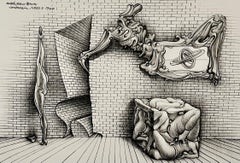
German Surrealism Abstract Surrealist Lithograph Hans Bellmer
By Hans Bellmer
Located in Surfside, FL
Hans Bellmer German (1902–1975) Abstract Surrealist Lithograph Souterrain No. 13 8 1944 Musée Jean Brun Date: circa 1965 Hand signed and numbered in pencil Edition of 100 Size: 19.5 x 26.5 in. Hans Bellmer ( 1902 – 1975) was a Polish born German artist, best known for his drawings, etchings that illustrates the 1940 edition of Histoire de l’œil, and the life-sized female sculpture mannequin dolls he produced in the mid-1930s. Historians of art and photography also consider him a Surrealist photographer. Bellmer was born in the city of Kattowitz, then part of the German Empire (now Katowice, Poland). Up until 1926, he worked as a draftsman for his own advertising company. Bellmer is most famous for the creation of a series of dolls as well as photographs of them. He was influenced in his choice of art form in part by reading the published letters of Oskar Kokoschka (Der Fetisch, 1925) and Surrealism. Bellmer's puppet doll project is also said to have been catalysed by a series of events in his personal life. Hans Bellmer takes credit for provoking a physical crisis in his father and brings his own artistic creativity into association with childhood insubordination and resentment toward a severe and humorless paternal authority. Perhaps this is one reason for the nearly universal, unquestioning acceptance in the literature of Bellmer's promotion of his art as a struggle against his father, the police, and ultimately, fascism and the state. Events of his personal life also including meeting a beautiful teenage cousin in 1932 (and perhaps other unattainable beauties), attending a performance of Jacques Offenbach's Tales of Hoffmann (in which a man falls tragically in love with an automaton), and receiving a box of his old toys. After these events, he began to actually construct his first dolls. In his works, Bellmer explicitly sexualized the doll as a young girl (his work bears connection to the works of Bathus). Hirschfeld has claimed (without further argumentation) that Bellmer initiated his doll project to oppose the fascism of the Nazi Party by declaring that he would make no work that would support the new German state. Represented by mutated forms and unconventional poses, his dolls (according to this view) were directed specifically at the cult of the perfect body then prominent in Germany. He visited Paris in 1935 and made contacts there, such as Paul Éluard, but returned to Berlin because his wife Margarete was dying of tuberculosis. He was part of the circle of Surrealist luminaries such as Man Ray, Marcel Duchamp, Max Ernst, Joan Miro, André Masson, René Magritte, Alberto Giacometti and Salvador Dali as well as women artists—such as Frida Kahlo, Dorothea Tanning and Leonora Carrington. Bellmer produced the first doll in Berlin in 1933. Long since lost, the assemblage can nevertheless be correctly described thanks to approximately two dozen photographs Bellmer took at the time of its construction. Standing about fifty-six inches tall, the doll consisted of a modeled torso made of flax fiber, glue, and plaster; a mask-like head of the same material with glass eyes and a long, unkempt wig; and a pair of legs made from broomsticks or dowel rods. One of these legs terminated in a wooden, club-like foot; the other was encased in a more naturalistic plaster shell, jointed at the knee and ankle. As the project progressed, Bellmer made a second set of hollow plaster legs, with wooden ball joints for the doll's hips and knees. There were no arms to the first sculpture, but Bellmer did fashion or find a single wooden hand, which appears among the assortment of doll parts the artist documented in an untitled photograph of 1934, as well as in several photographs of later work. Bellmer's 1934 anonymous book, The Doll (Die Puppe), produced and published privately in Germany, contains 10 black-and-white photographs of Bellmer's first doll arranged in a series of "tableaux vivants" (living pictures). The book was not credited to him, as he worked in isolation, and his photographs remained almost unknown in Germany. Yet Bellmer's work was eventually declared "degenerate" (entartete kunst) by the Nazi Party, and he was forced to flee Germany to France in 1938, where Bellmer's work was welcomed by the Surrealists around Andre Breton. He aided the French Resistance during the war by making fake passports. He was imprisoned in the Camp des Milles prison at Aix-en-Provence, a brickworks camp for German nationals, from September 1939 until the end of the Phoney War in May 1940. After the war, Bellmer lived the rest of his life in Paris. Bellmer gave up doll-making and spent the following decades creating erotic drawings, etchings, sexually explicit photographs, paintings, and prints of pubescent girls. In 1954, he met Unica Zürn, who became his companion until her suicide in 1970. He continued working into the 1960s Cécile Reims (1927) has been drawing the world that surrounds her since her childhood in Lithuania, and subsequently in Paris, Jerusalem, and Barcelona. As a Jew, she had to go into hiding during World War II, and found herself at death’s door when she contracted tubercu- losis. Recovering from the disease, she felt she had to give meaning to her life as a survivor and she experienced a “conversion to art” as one is converted to a religion. Her encounter with the engraver Joseph Hecht in 1945 introduced her to the burin, an unforgiving tool which became her medium of choice. In her early years as an artist, she produced the mysterious Visages d’Espagne, Metamorphoses and Bestiaire de la mort series. But in order to support her work as an artist and to help Fred Deux (1924), whom she married in 1952, she suddenly gave a new twist to her career by turning to the interpretation of others’ work and engraving the drawings made by other artists. Cécile Reims filled this role with good humour and immense talent, as well as secretly collaborating with numerous artists working in the surrealist mode, such as Hans Bellmer, from 1966 to 1975, Salvador Dalí, from 1969 to 1988, Fred Deux, from 1970 to 2008, and Leonor Fini, from 1972 to 1995. In 2004, the Bibiothèque Nationale de France held an important retrospective devoted to Cécile Reims, suddenly putting into the limelight a figure who had long been kept in the shadows. At that point it became essential to produce a catalogue raisonné of her miniature engravings...
Category

20th Century Abstract Abstract Prints

Materials

Lithograph

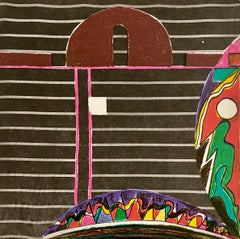
Feminist Surrealist French Abstract Colorful Lithograph Print Myriam Bat Yosef
Located in Surfside, FL
Myriam Bat-Yosef Surrealist abstract lithograph print in colorful abstract shapes and shades Hand signed and dated 1971. sheet measures 9.25 X 9.25 inches The envelope and the Peter Buch poster is just for provenance and is not included in this sale. Myriam Bat-Yosef, whose real name is Marion Hellerman, born on January 31, 1931 in Berlin, Germany to a Jewish family from Lithuania, she is an Israeli-Icelandic artist who paints on papers, paintings, fabrics, objects and human beings for performances. Myriam Bat-Yosef currently lives and works in Paris. In 1933, her family fleeing the Nazi Holocaust, Miriam Bat-Yosef emigrates to Palestine and settles in Jaffa. In 1936, she suffers a family tragedy, her father, militant Zionist, is called to fight, still recovering from an operation of appendicitis. The incision will become infected, antibiotics did not exist yet, and her father will die in the hospital after 9 months of suffering. Myriam and her mother leave Palestine to live in Paris for three years. French is Myriam's first school language. In 1939, still fleeing Nazism, she returned to Palestine, leaving France by the last boat from Marseille. She moved to Tel Aviv with her mother, aunt and maternal grandmother. In 1940, she began attending the Academy of Fine Arts in Tel Aviv and took her name as an artist, Bat-Yosef, which means Joseph's daughter in Hebrew, as a tribute to her father. In 1946, Myriam graduated as a kindergarten teacher but wanted to be an artist. Her mother enrolled her in an evening school to prepare a diploma of art teacher. At 19, she performs two years of military service in Israel. In 1952, with a pension of $50 a month that her mother allocated, she went to study at the Beaux-Arts in Paris. To survive, she has several activities while studying. In 1955, she had her first solo exhibition, at the Israeli Club on Wagram Avenue in Paris. Many artists, such as Yaacov Agam, Yehuda Neiman Avigdor Arikha, Raffi Kaiser, Dani Karavan and sculptors Achiam and Shlomo Selinger attended the opening . In 1956, she enrolled at the School of Fine Arts in Florence. This is where she meets the painter Errô. They share an icy studio in winter. Myriam moves to Milan with friends. She organizes a joint exhibition with Erro, one room each, at the Montenapoleone gallery. Her works are admired by the sculptor Marino Marini and the painters Renato Birolli and Enrico Prampolini. Myriam and Erro exhibit in Rome, Milan, Florence and meet many personalities: Alain Jouffroy and his wife, the painter Manina, Roberto Matta and his wife Malitte, textile artist who was one of the founders of the Pompidou Center. Back in Paris, Myriam and Erro get married, which allows Myriam to avoid being called into the Israeli army during the Suez Canal War. In 1957, Myriam and her husband went to Iceland. Myriam works in a chocolate factory. Having enough money, she starts producing art again. She exhibited in Reykjavik's first art gallery. She meets the artist Sigridur Bjornsdottir, married to the Swiss painter Dieter Roth . In 1958, Myriam and her husband leave for Israel. They exhibit in Germany, then in Israel. Back in Paris, the couple became friends with artists of the surrealist movement, such as Victor Brauner, Hans Bellmer, the sculptor Philippe Hiquily, Liliane Lijn, future wife of Takis and photographer Nathalie Waag. Erro and Myriam have a daughter on March 15, 1960, named Tura, after the painter Cosmè Tura, but also close to the Icelandic Thora or the Hebrew Torah. Bat-Yosef’s complex trajectory throughout the 20th century is linked as much to the transnational history of what was for a time called the School of Paris as it is to a certain legacy of Surrealism. Her work features the same idea of resolving antinomies that also defined the spirit of surrealism, and is enhanced with her readings of the Kabbalah and her spiritual grounding in Taoism. However, while there are reasons for her approach to be associated with the process of the ready-made, it is important to consider the immediate intrication of these works with her practice of performance, during which the body itself is also painted – a feminist response to Yves Klein’s Anthropometries (1960) and an echo of the happenings which Jean-Jacques Lebel organised at the time in Paris. In 1963, Erró told Myriam that if she wants to be a painter, she can not be his wife. Myriam chose to be a painter and the couple divorced in 1964. Since that time, Myriam Bat-Yosef has exhibited in many countries: Europe, United States, Japan, etc. Although long in the shadows, the work of Myriam Bat-Yosef has been greeted by many artists and personalities: Anaïs Nin, Nancy Huston, André Pieyre of Mandiargues, José Pierre, René de Solier , Jacques Lacarrière, Alain Bosquet, Pierre Restany, Sarane Alexandrian and Surrealist André Breton who, after a visit to her studio, confided to having been intrigued by its phantasmagorical dimension. She was included in the book Pop Art and Beyond: Gender, Race, and Class in the Global Sixties by Mona Hadler and Kalliopi Minioudaki. Extract "World Citizen, Artist of the Pop Era Sarah Wilson; Why do we know so little of Myriam Bat-Yosef, the most important female Israeli artist of the Pop era? Issues of identity and sexuality feature constantly in her work. She exhibited internationally from Reykjavik to Tokyo; she had two shows at Arturo Schwarz’s famous Dada/surrealist gallery in Milan; she participated in feminist art events in Los Angeles. Above all, in 1971, she conceived Total Art, a Pop Gesamtkunstwerk inside and outside the Israel Museum, Jerusalem. Painter, performer, and installation artist, she was also a lover, wife, and mother. Of Lithuanian-Jewish descent, she was close to the family of philosopher Emmanuel Levinas. An émigré in Paris she would repudiate a national passport, participating in Garry Davis’s short-lived “World Citizens” movement. She continues the lineage of women surrealist artists: Valentine Hugo, Leonor Fini, Dorothea Tanning, Leonora Carrington, Unica Zürn, Jane Graverol, Toyen, Alice Rahon...
Category

1970s Surrealist Abstract Prints

Materials

Lithograph

Feminist Surrealist French Abstract Colorful Lithograph Print Myriam Bat Yosef
Located in Surfside, FL
Myriam Bat-Yosef Surrealist abstract lithograph print in colorful abstract shapes and shades Hand signed and dated 1971. sheet measures 9.25 X 9.25 inches ...
Category

1970s Surrealist Abstract Prints

Materials

Lithograph

German Surrealist Hans Bellmer Etching Engraving Print Cecile Reims Surrealism
By Hans Bellmer
Located in Surfside, FL
After Hans Bellmer (German, 1902-1975) Surrealist engraving, etching after drawings from a 1942 notebook, engraved in 1974-75 by Cecile Reims Printed by L'Atelier de Chalcographie du Louvre, Paris, Having printed monogram lower left in plate, pencil notations and #7/10 and 'Musee du Louvre' blindstamp verso Dimensions: Sheet 11 X 7.5, Plate size 6.5 X 4 Hans Bellmer ( 1902 – 1975) was a Polish born German artist, best known for his drawings, etchings that illustrates the 1940 edition of Histoire de l’œil, and the life-sized female sculpture mannequin dolls he produced in the mid-1930s. Historians of art and photography also consider him a Surrealist photographer. Bellmer was born in the city of Kattowitz, then part of the German Empire (now Katowice, Poland). Up until 1926, he worked as a draftsman for his own advertising company. Bellmer is most famous for the creation of a series of dolls as well as photographs of them. He was influenced in his choice of art form in part by reading the published letters of Oskar Kokoschka (Der Fetisch, 1925) and Surrealism. Bellmer's puppet doll project is also said to have been catalysed by a series of events in his personal life. Hans Bellmer takes credit for provoking a physical crisis in his father and brings his own artistic creativity into association with childhood insubordination and resentment toward a severe and humorless paternal authority. Perhaps this is one reason for the nearly universal, unquestioning acceptance in the literature of Bellmer's promotion of his art as a struggle against his father, the police, and ultimately, fascism and the state. Events of his personal life also including meeting a beautiful teenage cousin in 1932 (and perhaps other unattainable beauties), attending a performance of Jacques Offenbach's Tales of Hoffmann (in which a man falls tragically in love with an automaton), and receiving a box of his old toys. After these events, he began to actually construct his first dolls. In his works, Bellmer explicitly sexualized the doll as a young girl (his work bears connection to the works of Bathus). Hirschfeld has claimed (without further argumentation) that Bellmer initiated his doll project to oppose the fascism of the Nazi Party by declaring that he would make no work that would support the new German state. Represented by mutated forms and unconventional poses, his dolls (according to this view) were directed specifically at the cult of the perfect body then prominent in Germany. He visited Paris in 1935 and made contacts there, such as Paul Éluard, but returned to Berlin because his wife Margarete was dying of tuberculosis. He was part of the circle of Surrealist luminaries such as Man Ray, Marcel Duchamp, Max Ernst, Joan Miro, André Masson, René Magritte, Alberto Giacometti and Salvador Dali as well as women artists—such as Frida Kahlo, Dorothea Tanning and Leonora Carrington. Bellmer produced the first doll in Berlin in 1933. Long since lost, the assemblage can nevertheless be correctly described thanks to approximately two dozen photographs Bellmer took at the time of its construction. Standing about fifty-six inches tall, the doll consisted of a modeled torso made of flax fiber, glue, and plaster; a mask-like head of the same material with glass eyes and a long, unkempt wig; and a pair of legs made from broomsticks or dowel rods. One of these legs terminated in a wooden, club-like foot; the other was encased in a more naturalistic plaster shell, jointed at the knee and ankle. As the project progressed, Bellmer made a second set of hollow plaster legs, with wooden ball joints for the doll's hips and knees. There were no arms to the first sculpture, but Bellmer did fashion or find a single wooden hand, which appears among the assortment of doll parts the artist documented in an untitled photograph of 1934, as well as in several photographs of later work. Bellmer's 1934 anonymous book, The Doll (Die Puppe), produced and published privately in Germany, contains 10 black-and-white photographs of Bellmer's first doll arranged in a series of "tableaux vivants" (living pictures). The book was not credited to him, as he worked in isolation, and his photographs remained almost unknown in Germany. Yet Bellmer's work was eventually declared "degenerate" (entartete kunst) by the Nazi Party, and he was forced to flee Germany to France in 1938, where Bellmer's work was welcomed by the Surrealists around Andre Breton. He aided the French Resistance during the war by making fake passports. He was imprisoned in the Camp des Milles prison at Aix-en-Provence, a brickworks camp for German nationals, from September 1939 until the end of the Phoney War in May 1940. After the war, Bellmer lived the rest of his life in Paris. Bellmer gave up doll-making and spent the following decades creating erotic drawings, etchings, sexually explicit photographs, paintings, and prints of pubescent girls. In 1954, he met Unica Zürn...
Category

20th Century Abstract Prints

Materials

Etching

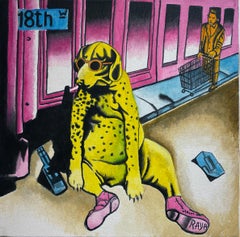
Dog Years - Brightly Colored Self Portrait of Artist as a Yellow Colored Dog
By Marcos Raya
Located in Chicago, IL
***This artwork is currently on exhibit at the Instituto Cervantes, Chicago until September 2025. If purchased this artwork will be available to ship after September 1, 2025. Contact the gallery with questions. Raya, like every productive artist, is a collection of actions, utopias and talents. He is an acrylic painter and a muralist; an installation artist and a practitioner of the theory of the fragment as a synthesis of the whole; he is Chicano but his work has no passport; he is an obsessive self-portraitist (I, as the multiplicity locked within the I) and his an advocate of his community (in the fullest sense of the world); his is from Chicago and - being a nation onto himself - is a native of his art education; his yearns for the Tijuana of tomorrow while being a full-fledged inhabitant of the Tijuana of half a century back; he admires high-tech while being a fan of Frida Kahlo. --Carlos Monsivais...
Category

2010s Contemporary Figurative Paintings

Materials

Canvas, Acrylic

Mexican Ex-Voto “Holy Tribute for Saving a Brother” c.1925 Oil on Tin Folk Art
Located in Denver, CO
This rare circa 1925 Ex-Voto, “Holy Tribute for Saving a Brother,” is an original oil and ink on tin by an anonymous Mexican artist, presented in a contemporary hand-carved frame by ...
Category

1920s Folk Art Interior Paintings

Materials

Metal

Journey into the Jungle, Painting, Acrylic on Canvas
By Diana Rosa
Located in Yardley, PA
In a stylistic amalgam of Pop and folk, abstract and figurative, Diana Rosa takes inspirations from an alternative upbringing where she closely connected with the natural landscape a...
Category

21st Century and Contemporary Contemporary Paintings

Materials

Acrylic

German Surrealist Hans Bellmer Etching Engraving Print Cecile Reims Surrealism
By Hans Bellmer
Located in Surfside, FL
After Hans Bellmer (German, 1902-1975) Surrealist engraving, etching after drawings from a 1942 notebook, engraved in 1974-75 by Cecile Reims Printed by L'Atelier de Chalcographie du Louvre, Paris, Having printed monogram lower left in plate, pencil notations verso Editioned from a very small edition of #7/10 'Musee du Louvre' blindstamp. Dimensions: Sheet 11 X 7.5, Plate size 6.5 X 4 Hans Bellmer ( 1902 – 1975) was a Polish born German artist, best known for his drawings, etchings that illustrates the 1940 edition of Histoire de l’œil, and the life-sized female sculpture mannequin dolls he produced in the mid-1930s. Historians of art and photography also consider him a Surrealist photographer. Bellmer was born in the city of Kattowitz, then part of the German Empire (now Katowice, Poland). Up until 1926, he worked as a draftsman for his own advertising company. Bellmer is most famous for the creation of a series of dolls as well as photographs of them. He was influenced in his choice of art form in part by reading the published letters of Oskar Kokoschka (Der Fetisch, 1925) and Surrealism. Bellmer's puppet doll project is also said to have been catalysed by a series of events in his personal life. Hans Bellmer takes credit for provoking a physical crisis in his father and brings his own artistic creativity into association with childhood insubordination and resentment toward a severe and humorless paternal authority. Perhaps this is one reason for the nearly universal, unquestioning acceptance in the literature of Bellmer's promotion of his art as a struggle against his father, the police, and ultimately, fascism and the state. Events of his personal life also including meeting a beautiful teenage cousin in 1932 (and perhaps other unattainable beauties), attending a performance of Jacques Offenbach's Tales of Hoffmann (in which a man falls tragically in love with an automaton), and receiving a box of his old toys. After these events, he began to actually construct his first dolls. In his works, Bellmer explicitly sexualized the doll as a young girl (his work bears connection to the works of Bathus). Hirschfeld has claimed (without further argumentation) that Bellmer initiated his doll project to oppose the fascism of the Nazi Party by declaring that he would make no work that would support the new German state. Represented by mutated forms and unconventional poses, his dolls (according to this view) were directed specifically at the cult of the perfect body then prominent in Germany. He visited Paris in 1935 and made contacts there, such as Paul Éluard, but returned to Berlin because his wife Margarete was dying of tuberculosis. He was part of the circle of Surrealist luminaries such as Man Ray, Marcel Duchamp, Max Ernst, Joan Miro, André Masson, René Magritte, Alberto Giacometti and Salvador Dali as well as women artists—such as Frida Kahlo, Dorothea Tanning and Leonora Carrington. Bellmer produced the first doll in Berlin in 1933. Long since lost, the assemblage can nevertheless be correctly described thanks to approximately two dozen photographs Bellmer took at the time of its construction. Standing about fifty-six inches tall, the doll consisted of a modeled torso made of flax fiber, glue, and plaster; a mask-like head of the same material with glass eyes and a long, unkempt wig; and a pair of legs made from broomsticks or dowel rods. One of these legs terminated in a wooden, club-like foot; the other was encased in a more naturalistic plaster shell, jointed at the knee and ankle. As the project progressed, Bellmer made a second set of hollow plaster legs, with wooden ball joints for the doll's hips and knees. There were no arms to the first sculpture, but Bellmer did fashion or find a single wooden hand, which appears among the assortment of doll parts the artist documented in an untitled photograph of 1934, as well as in several photographs of later work. Bellmer's 1934 anonymous book, The Doll (Die Puppe), produced and published privately in Germany, contains 10 black-and-white photographs of Bellmer's first doll arranged in a series of "tableaux vivants" (living pictures). The book was not credited to him, as he worked in isolation, and his photographs remained almost unknown in Germany. Yet Bellmer's work was eventually declared "degenerate" (entartete kunst) by the Nazi Party, and he was forced to flee Germany to France in 1938, where Bellmer's work was welcomed by the Surrealists around Andre Breton. He aided the French Resistance during the war by making fake passports. He was imprisoned in the Camp des Milles prison at Aix-en-Provence, a brickworks camp for German nationals, from September 1939 until the end of the Phoney War in May 1940. After the war, Bellmer lived the rest of his life in Paris. Bellmer gave up doll-making and spent the following decades creating erotic drawings, etchings, sexually explicit photographs, paintings, and prints of pubescent girls. In 1954, he met Unica Zürn...
Category

20th Century Abstract Prints

Materials

Etching

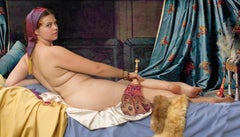
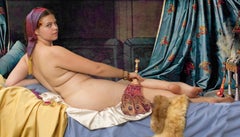
Ode to Ingres Grand Odalisque
By E2 - Kleinveld Julien
Located in New Orleans, LA
13.75 x 24 inches - Edition 1 of 5 with 2 APs JONATHAN FERRARA GALLERY proudly presents The Changing Face of Portraiture, the premier solo exhibition of photography by artistic duo ...
Category

21st Century and Contemporary Contemporary Color Photography

Materials

Archival Pigment

"Asian Woman I" American Modernist Figurative Painting Académie Julian
By Jack Hooper
Located in Arp, TX
Jack Hooper "Asian Woman I" 10-1990 Acrylic and conte crayon on rag paper 28"x42.25 unframed Signed and dated in pencil lower right Jack Meredith Hooper (August 26, 1928 - January ...
Category

1990s American Modern Figurative Paintings

Materials

Acrylic, Rag Paper, Conté

Frida Biting Her Necklace by Lucienne Bloch, 1933, Silver Gelatin Print
By Lucienne Bloch
Located in Denton, TX
Frida Biting Her Necklace by Lucienne Bloch is a black and white portrait of Mexican painter Frida Kahlo. Frida playfully bites her necklace as she poses for her portrait. Gelatin ...
Category

20th Century Modern Portrait Photography

Materials

Silver Gelatin

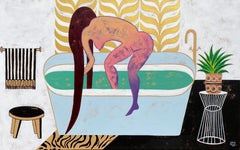
She baths, Painting, Acrylic on Canvas
By Diana Rosa
Located in Yardley, PA
In a stylistic amalgam of Pop and folk, abstract and figurative, I take inspiration from an alternative upbringing where I closely connected with the natural landscape around me. Born and raised in Cuba shaped my perspective on nature and how humans interact with land, animals and each other. I employ a Naïve Folk-Art style to explore questions of identity, love, relationship and environment in our society. My paintings often had strong autobiographical elements and mixed realism with fantasy. I make personal women’s experiences serious subjects for art, with intense emotional content, powerful and intimate narratives. Greatly influenced by modern masters from Cezanne, Henri Matisse to Frida Kahlo...
Category

21st Century and Contemporary Contemporary Paintings

Materials

Acrylic

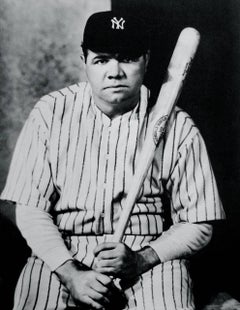
Babe Ruth - Baseball, Sports, Athlete, MLB, New York Yankees, Portrait
By Nickolas Muray
Located in Denton, TX
Babe Ruth by Nickolas Muray is a black and white portrait of the iconic baseball player. Considered one of the greatest baseball players of all time, Babe Ruth played for the Atlanta...
Category

Mid-20th Century Modern Portrait Photography

Materials

Platinum

"Las Metas Pequeńas" (FRAMED) Painting 21" x 20.5" inch by Antonio Pelayo
By Antonio Pelayo
Located in Culver City, CA
"Las Metas Pequeńas" (FRAMED) Painting 21" x 20.5" inch by Antonio Pelayo Medium: Pencil on Paper. Acrylic Ink & Paint on Animation Acetate Image size: 15" x 15" inch Size framed...
Category

21st Century and Contemporary Contemporary Figurative Drawings and Water...

Materials

Ink, Acrylic

1866 Mexican Ex-Voto Retablo Giving Thanks for Healing, Oil on Tin
Located in Denver, CO
This evocative 19th-century Mexican ex-voto retablo, titled Giving Thanks for Saving Her Son, is a powerful example of devotional folk art created circa 1866. Painted in oil on tin b...
Category

1860s Folk Art Animal Paintings

Materials

Metal

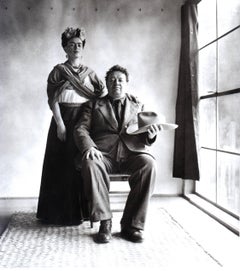
Frida and Diego with Hat - Limited Edition Black and White Photograph, Portrait
By Nickolas Muray
Located in Denton, TX
Frida and Diego with Hat is a limited edition black and white portrait of Mexican painters Frida Kahlo and Diego Rivera. Diego sits on a chair, holding a hat while Frida stands behin...
Category

20th Century Modern Portrait Photography

Materials

Platinum

"Igualdad" (FRAMED) Painting 14.5" x 20" inch by Antonio Pelayo
By Antonio Pelayo
Located in Culver City, CA
"Igualdad" (FRAMED) Painting 14.5" x 20" inch by Antonio Pelayo Medium: Pencil on Paper, Acrylic Ink Paint on Animation Acetate Size: 12" x 17" inch Size framed: 14.5" x 20" ...
Category

21st Century and Contemporary Contemporary Figurative Paintings

Materials

Paper, Ink, Acrylic, Pencil

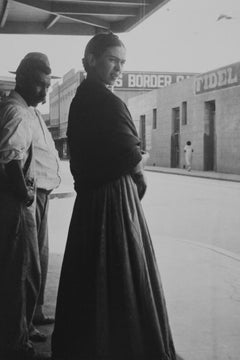
Frida at the Border - Black and White Photograph, Portrait, Woman Artist
By Lucienne Bloch
Located in Denton, TX
Frida at the Border by Lucienne Bloch is a black and white photograph of Mexican painter Frida Kahlo standing amongst others in a city street scene. Mount size: 20 x 16 in. Image s...
Category

1930s Modern Black and White Photography

Materials

Silver Gelatin

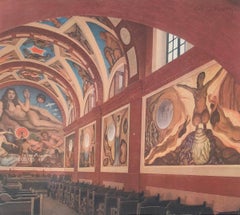
Chapel, Agriculture School, Chapingo
By (after) Diego Rivera
Located in Missouri, MO
(after) Diego Rivera "Chapel, Agriculture School, Chapingo" 1933 from the portfolio "Frescoes of Diego Rivera" Published by the Museum of Modern Art, NY Approx. 18.5 x 13.5 with Matting Hand-Signed by the Artist Diego Rivera was born on December 13, 1886 in the mountain town of Guanajuato in Mexico. His mother was an ardent Catholic and his father was a rich and aristocratic revolutionary fighter and an atheist. Little Diego decided in favor of atheism. He swore his family had to leave Guanajuato when he was six because of his diatribes against the Church. When he was eleven he attended the San Carlos Academy of Fine Arts; his real teacher was Jose Posada...
Category

1930s Modern Interior Prints

Materials

Lithograph

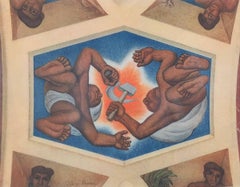
Chapel of the Agricultural School, Chapingo (Ceiling Detail, Workers)
By (after) Diego Rivera
Located in Missouri, MO
(after) Diego Rivera "Chapel of the Agricultural School, Chapingo" (Ceiling Detail, Workers) 1933 from the portfolio "Frescoes of Diego Rivera" Published by the Museum of Modern Art, NY Size with the Matt: 18.5 x 13.5 inches Hand-Signed by the Artist Diego Rivera was born on December 13, 1886 in the mountain town of Guanajuato in Mexico. His mother was an ardent Catholic and his father was a rich and aristocratic revolutionary fighter and an atheist. Little Diego decided in favor of atheism. He swore his family had to leave Guanajuato when he was six because of his diatribes against the Church. When he was eleven he attended the San Carlos Academy of Fine Arts; his real teacher was Jose Posada...
Category

1930s Modern Figurative Prints

Materials

Lithograph

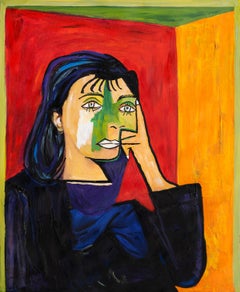
Ode to Picasso s Portrait of Dora Maar
By E2 - Kleinveld Julien
Located in New Orleans, LA
Inspired by Pablo Picasso's "Portrait of Dora Maar", 1937 Edition 1 of 3 with 2 APs “Ode to Picasso’s 'Dora Maar’' is a self-portrait of E2 arti...
Category

21st Century and Contemporary Contemporary Figurative Photography

Materials

Archival Pigment

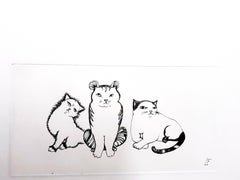
Leonor Fini - Cats Trio - Original Hand-Signed Etching
By Leonor Fini
Located in Collonge Bellerive, Geneve, CH
Leonor Fini - Cats - Original Engraving Mme.Helvetius' Cats Original etching created in 1985 Hand-Signed Conditions: excellent Edition: 71/100 Support: Arches paper. Dimensions: Pape...
Category

1980s Modern Animal Prints

Materials

Etching

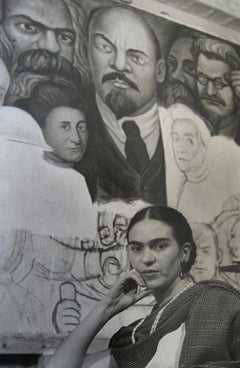
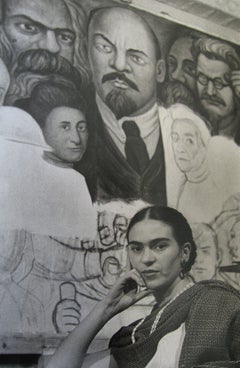
Frida in front of the Unfinished Unity Panel, New Workers School, NY
By Lucienne Bloch
Located in Denton, TX
This photograph is a black and white portrait of Frida Kahlo in front of the Unfinished Unity Panel at the New Yorkers School in New York, taken by Lucienne Bloch. The medium of this...
Category

20th Century Modern Portrait Photography

Materials

Silver Gelatin

Frida in front of the Unfinished Unity Panel, New Workers School, NY
By Lucienne Bloch
Located in Denton, TX
Frida in front of the Unfinished Unity Panel by Lucienne Bloch is a black a white portrait of Mexican painter Frida Kahlo, posing in front of Diego Rivera's half painted mural. Ima...
Category

20th Century Modern Portrait Photography

Materials

Silver Gelatin

"Los Huevos" (FRAMED) Painting 21" x 20.5" inch by Antonio Pelayo
By Antonio Pelayo
Located in Culver City, CA
"Los Huevos" (FRAMED) Painting 21" x 20.5" inch by Antonio Pelayo Medium: Pencil on Paper. Acrylic Ink & Paint on Animation Acetate Image size: 15" x...
Category

21st Century and Contemporary Contemporary Figurative Drawings and Water...

Materials

Ink, Acrylic

"El Toro" (FRAMED) Painting 14.5" x 20" inch by Antonio Pelayo
By Antonio Pelayo
Located in Culver City, CA
"El Toro" (FRAMED) Painting 14.5" x 20" inch by Antonio Pelayo Medium: Pencil on Paper, Acrylic Ink Paint on Animation Acetate Size: 12" x 17" inch Size framed: 14.5" x 20" i...
Category

21st Century and Contemporary Contemporary Figurative Paintings

Materials

Paper, Ink, Acrylic, Pencil

"I DO IT MYSELF" (FRAMED) Portrait Painting 30" x 24" inch by Antonio Pelayo
By Antonio Pelayo
Located in Culver City, CA
"I DO IT MYSELF" (FRAMED) Portrait Painting 30" x 24" inch by Antonio Pelayo Medium: Marker on paper Size: 30" x 24" inch Size framed: 34" x 27.5" inch From Pelayo VS Pelayo exhib...
Category

21st Century and Contemporary Contemporary Figurative Paintings

Materials

Paper, Ink, Acrylic, Pencil

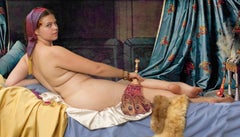
Ode to Ingres Grand Odalisque
By E2 - Kleinveld Julien
Located in New Orleans, LA
9.25 x 16 inches - Edition 1 of 7 with 2 APs JONATHAN FERRARA GALLERY proudly presents The Changing Face of Portraiture, the premier solo exhibition of photography by artistic duo E...
Category

21st Century and Contemporary Contemporary Color Photography

Materials

Archival Pigment

Leonor Fini - Cat - Original Etching
By Leonor Fini
Located in Collonge Bellerive, Geneve, CH
Leonor Fini - Cats - Original Engraving Mme.Helvetius' Cats Original etching created in 1985, Printed Signature (LF). Conditions: excellent Edition: 100 Support: Arches paper. Dimensions: Paper dimensions: 44 x 28 cm Editions: Moret, Paris. Leonor Fini is considered one of the most important women artists of the mid-twentieth century, along with Leonora Carrington, Frida Kahlo, Meret Oppenheim, Remedios Varo, and Dorothea Tanning – most of whom Fini knew well. Her career, which spanned some six decades, included painting, graphic design, book illustration, product design (the renowned torso-shaped perfume bottle for Schiaparelli’s Shocking), and set and costume design for theatre, ballet, opera, and film. In this compellingly readable, exhaustively researched account, author Peter Webb brings Fini’s provocative art and unconventional personal life, as well as the vibrant avant-garde world in which she revolved, vividly in life. Born in Buenos Aires in 1907 (August 30 – January 18, 1996, Paris) to Italian and Argentine parents, Leonor grew up in Trieste, Italy, raised by her strong-willed, independent mother, Malvina. She was a virtually self-taught artist, learing anatomy directly from studying cadavers in the local morgue and absorbing composition and technique from the Old Masters through books and visits to museums. Fini’s fledging attempts at painting in Trieste let her to Milan, where she participated in her first group exhibition in 1929, and then to Paris in 1931. Her vivacious personality and flamboyant attire instantly garnered her a spotlight in the Parisian art world and she soon developed close relationships with the leading surrealist writers and painters, including Paul Eluard, Salvador Dali, Man Ray, and Max Ernst, who became her lover for a time. The only surrealist she could not abide because of his misogyny was André Breton. Although she repeatedly exhibited with them, she never considered herself a surrealist. The American dealer Julien Levy, very much impressed by Fini’s painting and smitten by her eccentric charms, invited her to New York in 1936, where she took part in a joint gallery exhibition with Max Ernst and met many American surrealists, including Joseph Cornell and Pavel Tchelitchew. Her work was included in MoMA’s pivotal Fantastic Art, Dada and Surrealism exhibition, along with De Chirico, Dali, Ernst, and Yves Tanguy. In 1939 in Paris she curated an exhibition of surrealist furniture...
Category

1980s Modern Animal Prints

Materials

Etching

Ode to Ingres Grand Odalisque
By E2 - Kleinveld Julien
Located in New Orleans, LA
20.5 x 36 inches - Edition 1 of 3 with 2 APs JONATHAN FERRARA GALLERY proudly presents The Changing Face of Portraiture, the premier solo exhibition of photography by artistic duo E...
Category

21st Century and Contemporary Contemporary Color Photography

Materials

Archival Pigment

Ode to Munch s The Scream
By E2 - Kleinveld Julien
Located in New Orleans, LA
Inspired by Edvard Munch's "The Scream", 1893 Edition 1 of 7 and 2APs “Ode to Munch’s ‘The Scream’” depicts a non-binary subject trapped in an infinite scream against a New Orleans backdrop. This piece represents the silent pain of gender dysphoria constantly experienced by non-binary people as they traverse a binary world that would rather ignore their existence entirely. The artists say of their work... "Everything Changes, the latest phase of our ongoing series In Empathy We Trust, presents odes to iconic images from the Modern and Contemporary art periods. Our artistic process during Everything Changes was heavily influenced by the COVID-19 pandemic and the inescapable upheaval brought about by this once-in-a-lifetime event. This major societal shift alongside ongoing social unrest compelled us to further explore the distorted realities permeating American culture and, consequently, veiling oppression of marginalized communities. With lockdown restrictions disrupting our usual process of gathering for photoshoots, we also began playing with new approaches for our work. As a result, our latest iteration marks a new technique exploration, with completely over-painting atop of select prints, adding an additional layer of distortion to an already-altered reality. The title for this show takes inspiration from one of our favorite Frida Kahlo quotes: “Nothing is absolute. Everything changes, everything moves, everything revolves, everything flies and goes away.” The pandemic fostered a collective understanding of just how malleable and fragile our reality is. Our perceptions, our personal routines, and our culture as a whole – these realities are never guaranteed stasis, and the only way to move forward is to evolve, both as artists and individuals. The pieces in this show invite viewers to embrace the inevitability of change and the natural discomfort of re-examining their expectations of how a work of art – and by extension, a culture – should look. The process of creating an e2 image has always involved intense collaboration, and the images here would not be possible without stellar teamwork. We would especially like to thank Cameron Wood for his extensive digital post-production and our wonderful models." ⎯⎯⎯⎯⎯ As the photographic duo E2, New Orleans natives Elizabeth Kleinveld and Epaul Julien...
Category

21st Century and Contemporary Contemporary Figurative Photography

Materials

Archival Pigment

Wifredo Lam - Original Handsigned Lithograph -El ultimo viaje del buque fantasma
By Wifredo Lam
Located in Collonge Bellerive, Geneve, CH
Original lithograph, hand-signed and hand-numbered in pencil by the artist. Edition: 56/99 Excellent Conditions Dimensions: 76 x 56 cm Reference : Catalogue raisonné Tonneau-Ryckely...
Category

1970s Post-Modern Figurative Prints

Materials

Lithograph

"La Vaca" (FRAMED) Painting 14.5" x 20" inch by Antonio Pelayo
By Antonio Pelayo
Located in Culver City, CA
"La Vaca" (FRAMED) Painting 14.5" x 20" inch by Antonio Pelayo Medium: Pencil on Paper, Acrylic Ink Paint on Animation Acetate Size: 12" x 17" inch Size framed: 14.5" x 20" i...
Category

21st Century and Contemporary Contemporary Figurative Paintings

Materials

Paper, Ink, Acrylic, Pencil

"Conejo" (FRAMED) Painting 14.5" x 20" inch by Antonio Pelayo
By Antonio Pelayo
Located in Culver City, CA
"Conejo" (FRAMED) Painting 14.5" x 20" inch by Antonio Pelayo Medium: Pencil on Paper, Acrylic Ink Paint on Animation Acetate Size: 12" x 17" inch Size framed: 14.5" x 20" in...
Category

21st Century and Contemporary Contemporary Figurative Paintings

Materials

Paper, Ink, Acrylic, Pencil

"El Fud" (FRAMED) Painting 14.5" x 20" inch by Antonio Pelayo
By Antonio Pelayo
Located in Culver City, CA
"El Fud" (FRAMED) Painting 14.5" x 20" inch by Antonio Pelayo Medium: Pencil on Paper, Acrylic Ink Paint on Animation Acetate Size: 12" x 17" inch Size framed: 14.5" x 20" in...
Category

21st Century and Contemporary Contemporary Figurative Paintings

Materials

Paper, Ink, Acrylic, Pencil

"Untitled 27" (FRAMED) Pencil Drawing 21" x 18" inch by Antonio Pelayo
By Antonio Pelayo
Located in Culver City, CA
"Untitled 27" (FRAMED) Pencil Drawing 21" x 18" inch by Antonio Pelayo Medium: Pencil on Paper Artist Antonio Pelayo, born in Glendale, California, and yet raised for most of his c...
Category

21st Century and Contemporary Contemporary Figurative Drawings and Water...

Materials

Paper, Pencil

"Memorias" (FRAMED) Painting 34" x 28" inch by Antonio Pelayo
By Antonio Pelayo
Located in Culver City, CA
"Memorias" Painting 34" x 28" inch by Antonio Pelayo Medium: Acrylic Ink Paint on Animation Acetate Image size: 25" x 19" inch Size framed: 34" ...
Category

21st Century and Contemporary Contemporary Figurative Paintings

Materials

Ink, Acrylic