42 results for ""central park""

to
1
21
15
2
2
2
Overall Width
to
Overall Height
to
33
9
1
1
3
5
2
3
2
4
6
11
9
8
3
1
1
22
20
19
7
7
6
6
5
4
4
4
4
3
3
3
3
3
2
2
2
2
2
18
18
18
13
11
2
2
2
2
2
13
13
42
"Central Park" Leon Dolice, New York Central Park Scene, Mid-Century
By Leon Dolice
Located in New York, NY
Leon Dolice Central Park Signed lower left Watercolor on paper 12 x 19 inches The romantic backdrop of Vienna at the turn of the century had a life-long influence upon the young ma...
Category

1930s American Modern Figurative Drawings and Watercolors

Materials

Paper, Pastel

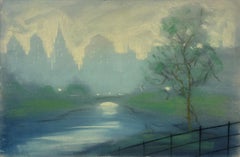
Lisa Breslow "Central Park Blues 1"
By Lisa Breslow
Located in New York, NY
Lisa Breslow Central Park Blues 1, 2018 monotype 18 x 44 in. paper size: 24 x 50 in. This original monotype by Lisa Breslow depicts a dreamy cityscape / waterscape in subtle, painte...
Category

2010s Impressionist Landscape Drawings and Watercolors

Materials

Monotype

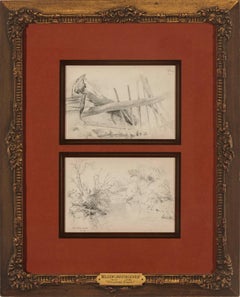
"Central Park"
By William Langson Lathrop
Located in Lambertville, NJ
Jim’s of Lambertville is proud to offer this artwork. Signed. Complemented by a hand carved and gilt frame. William L. Lathrop (1859-1938) Deemed “Father of the New Hope Art Colony”, William Langson Lathrop was born in Warren, Illinois. He was largely self-taught, having only studied briefly with William Merritt Chase in 1887, at the Art Students League. Lathrop first moved east in the early 1880s, and took a job at the Photoengraving Company in New York City. While there, he befriended a fellow employee, Henry B. Snell. The two men became lifelong friends and ultimately, both would be considered central figures among the New Hope Art Colony. Lathrop's early years as an artist were ones of continuing struggle. His efforts to break through in the New York art scene seemed futile, so he scraped enough money together to travel to Europe with Henry Snell in1888. There he met and married an English girl, Annie Burt. Upon returning to New York, he tried his hand at etching, making tools from old saw blades. Even though his prints were extremely beautiful, he still was impoverished. Lathrop would return to his family in Ohio, before once again attempting the New York art scene. In 1899, with great trepidation, he submitted five small watercolors to an exhibit at the New York Watercolor Club. He won the Evans Prize, the only award given, and four of the five paintings were sold the opening night. At age forty Lathrop’s career would finally take off and he became an “overnight success Lathrop came to Phillips Mill for the first time in1898, to visit his boyhood friend, Dr. George Marshall. Shortly after, he and his family purchased the old miller’s house from Dr. Marshall. The Lathrop’s home became a social and artistic center for the growing New Hope colony. Tea and fascinating conversation was the “order of the day” every Sunday. This was a scene fondly recalled by many younger art students that Lathrop taught privately at Phillips Mill. It was common to see groups of his students painting and sketching along the banks of the canal or aboard his canal boat. He had previously taught in the Poconos and at the Lyme, Connecticut Summer School in1907, but Phillips Mill always remained Lathrop’s permanent address. In 1928, a committee headed by Lathrop was formed to purchase the old Phillips Mill building as a place to hold community gatherings and art exhibitions. The committee had success and in 1929 the Phillips Mill Community Association was formed. This became the center of the New Hope Art Colony holding annual exhibitions and still operating today. In 1930, Lathrop had built a sailboat he named the “Widge”. For eight consecutive seasons he sailed it along the coast of Long Island...
Category

Early 20th Century American Impressionist Landscape Drawings and Waterco...

Materials

Paper, Graphite

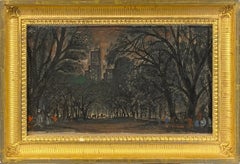
Central Park, Evening
By Simka Simkhovitch
Located in New York, NY
Estate stamped on verso paper of backing board size 9 x 14 3/4 inches As we travel back in American art, Central Park is one of the subjects, while done - is hard to come by and very...
Category

1920s American Impressionist Landscape Drawings and Watercolors

Materials

Mixed Media, Board

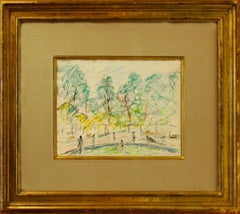
"Central Park"
By Gershon Benjamin
Located in Lambertville, NJ
Jim’s of Lambertville is proud to offer this artwork by: Gershon Benjamin (1899-1985) An American Modernist of portraits, landscapes, still lives, and the urban scene, Gershon Ben...
Category

1960s Modern Landscape Drawings and Watercolors

Materials

Paper, Pastel

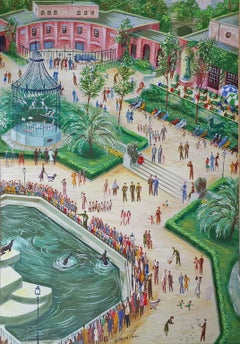
Central Park Zoo with Sea Lions and Animals
By Constantin Alajalov
Located in Miami, FL
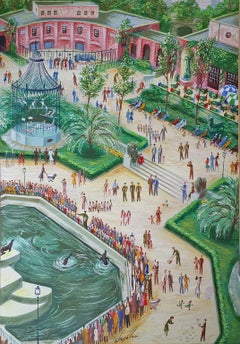
A charming and stylized depiction of a day at the Central Park Zoo. with World War Two uniformed visitors front and center. Sea lions put on a show in front of a packed audience. The...
Category

1940s Impressionist Landscape Paintings

Materials

Gouache

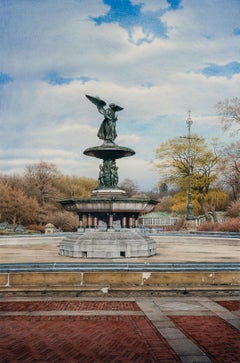
Bethesda Fountain, Central Park 2003
By Frederick Brosen
Located in New York, NY
A native New Yorker, Brosen has spent a lifetime wandering its streets, discovering its long history and witnessing its constant metamorphosis. The city is his muse and his primary s...
Category

Early 2000s Contemporary Landscape Drawings and Watercolors

Materials

Paper, Watercolor, Graphite

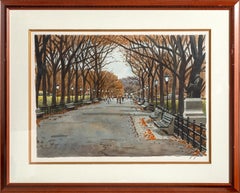
Central Park in Fall, Framed Photorealist Watercolor Painting
Located in Long Island City, NY
Artist: Unknown Title: Central Park in Fall Medium: Watercolor on paper, signed lower right Image Size: 17.5 x 25 inches Frame Size: 28 x 35 inches Watercolor of The Mall in Centra...
Category

1980s American Modern Landscape Drawings and Watercolors

Materials

Watercolor

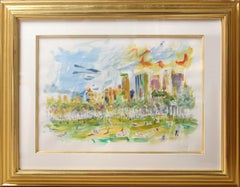
Central Park, Impressionist Watercolor on Paper by Wayne Ensrud
By Wayne Ensrud
Located in Long Island City, NY
Wayne Ensrud, American (1934 - ) - Central Park, Year: circa 1975, Medium: Watercolor on Paper, Signed in Pencil, Size: 22 in. x 28 in. (55.88 cm x 71.12 cm), Frame Size: 32.5 x ...
Category

1970s Impressionist Landscape Drawings and Watercolors

Materials

Watercolor

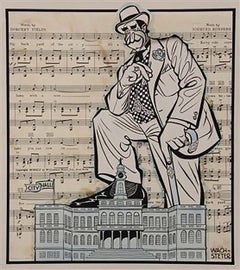
1945 Broadway Musical, "Up in Central Park"
By George Wachsteter
Located in Fort Washington, PA
Medium: Pen & Ink, Pasted on Sheet Music on Board. The illustration is pasted on a sheet music background, blue indicating halftone. Signature: Signed Lower Right The piece is on 15.50" x 20.00" illustration board with an image that measures to 12.50" x 11.00." Includes clipping. Caricature by George Wachsteter (1911-2004) for 1945 Broadway Musical...
Category

1940s Figurative Drawings and Watercolors

Materials

Paper, Ink, Board, Pen

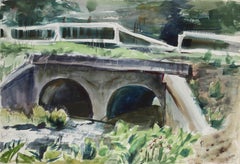
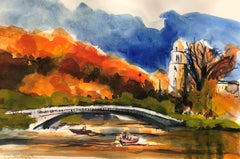
Bridge in Central Park, Impressionist Watercolor by Eve Nethercott
By Eve Nethercott
Located in Long Island City, NY
Eve Nethercott, American (1925 - 2015) - Bridge in Central Park (70), Year: 1958, Medium: Watercolor, Size: 15 in. x 22 in. (38.1 cm x 55.88 cm), Description: A unique watercol...
Category

1950s Impressionist Landscape Drawings and Watercolors

Materials

Watercolor

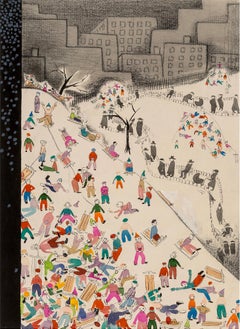
Children Snow Sledding in Central Park - New Yorker Cover Study
Located in Miami, FL
Hungarian/American artist/illustrator depicts a charming scene of sledding in the snow in Central Park. The work is abstract in its design as it's functional in its narrative - Unpublished New Yorker...
Category

1940s Modern Figurative Drawings and Watercolors

Materials

Charcoal, Ink, Watercolor, Gouache, Pencil
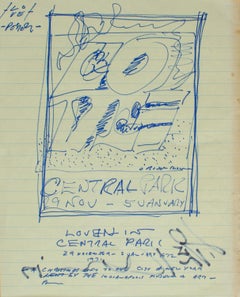
"Love in Central Park" Robert Indiana, Pop Art Drawing, American, Typography
By Robert Indiana
Located in New York, NY
Robert Indiana Love in Central Park, 1971-1972 Signed, titled and dated lower center Pen on ruled paper 10 x 8 inches Provenance Gifted by the artist, Vinalhaven, Maine Private coll...
Category

1970s Pop Art Abstract Drawings and Watercolors

Materials

Paper, Pen

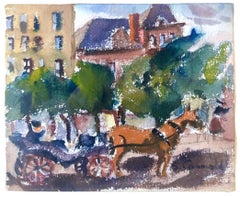
1940 s American WPA Modernist New York Watercolor Painting 59th st Central Park
By Samuel Grunvald
Located in Surfside, FL
Horse and Buggy 59th st. Manhattan (fauvist painting of NYC outside central park) 1940's. image is 6.25 X 7.5 inches. Hand signed lower right Provenance: Greenwich Gallery (Greenwich...
Category

20th Century Modern Figurative Drawings and Watercolors

Materials

Watercolor

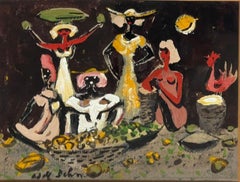
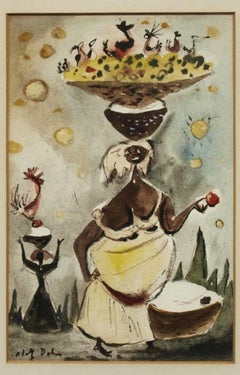
Adolf Dehn, Haitian Scene A, signed painting, Associated American Artists, 1950s
By Adolf Arthur Dehn
Located in New York, NY
Adolf Arthur Dehn Haitian Scene A, ca. 1951 Watercolor gouache on board Signed on the front Frame included: held in vintage modern frame Measurements: Framed: 11 inches vertical by 13 inches horizontal by .75 Painting 4.5 inches by 6 inches Watercolor gouache, hand signed; framed with AAA Gallery label verso Signed on the front bearing the original label on the verso of Dehn's longtime gallery, the prestigious Associated American Artists Gallery, New York City. Provenance Associated American Artists Frame included: held in vintage frame with original label as provenance Dehn, an influential artist and teacher (and author of the definitive textbook of his era on watercolor painting) joined Associated American Artists gallery in 1941. Although this painting is undated, it is likely circa early 1950s, as in 1951 Dehn won a Guggenheim Fellowship, which enabled him to travel to Haiti -- the subject of this work. It was part of a series inspired by Dehn's visit to Haiti. Dehn, an influential artist and teacher (and author of the definitive textbook of his era on watercolor painting) joined Associated American Artists gallery in 1941. Although this painting is undated, it is likely circa early 1950s, as in 1951 Dehn won a Guggenheim Fellowship, which enabled him to travel to Haiti. ADLOF DEHN Adolf Dehn, American Watercolorist and Printmaker, 1895-1968 Adolf Dehn was an artist who achieved extraordinary artistic heights, but in a very particular artistic sphere - not so much in oil painting as in watercolor and lithography. Long recognized as a master by serious print collectors, he is gradually gaining recognition as a notable and influential figure in the overall history of American art. In the 19th century, with the invention of the rotary press, which made possible enormous print runs, and the development of the popular, mass-market magazines, newspaper and magazine illustration developed into an artistic realm of its own, often surprisingly divorced from the world of museums and art exhibitions, and today remains surprisingly overlooked by most art historians. Dehn in many regards was an outgrowth of this world, although in an unusual way, since as a young man he produced most of his illustrative work not for popular magazines, such as The Saturday Evening Post, but rather for radical journals, such as The Masses or The Liberator, or artistic "little magazines" such as The Dial. This background established the foundation of his outlook, and led later to his unique and distinctive contribution to American graphic art. If there’s a distinctive quality to his work, it was his skill in introducing unusual tonal and textural effects into his work, particularly in printmaking but also in watercolor. Jackson Pollock seems to have been one of many notable artists who were influenced by his techniques. Early Years, 1895 - 1922 For an artist largely remembered for scenes of Vienna and Paris, Adolf Dehn’s background was a surprising one. Born in Waterville, Minnesota, on November 22, 1895, Dehn was the descendent of farmers who had emigrated from Germany and homesteaded in the region, initially in a one-room log cabin with a dirt floor. Adolf’s father, Arthur Clark Dehn, was a hunter and trapper who took pride that he had no boss but himself, and who had little use for art. Indeed, during Adolf’s boyhood the walls of his bedroom and the space under his bed were filled with the pelts of mink, muskrats and skunks that his father had killed, skinned and stretched on drying boards. It was Adolf’s mother, Emilie Haas Dehn, a faithful member of the German Lutheran Evangelical Church, who encouraged his interest in art, which became apparent early in childhood. Both parents were ardent socialists, and supporters of Eugene Debs...
Category

1950s Modern Figurative Drawings and Watercolors

Materials

Watercolor, Gouache, Board

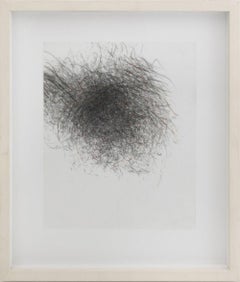
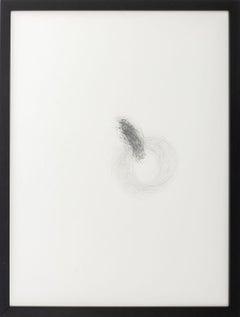
Abstract Composition, PUFF Series
By Jaanika Peerna
Located in Astoria, NY
Jaanika Peerna (Estonian, 1971), Puff Series, Graphite and Colored Pencil on Mylar, 2013, signed, titled, and dated to the verso, painted white wood frame. Image: 10.75" H x 8.75" W;...
Category

2010s Abstract Abstract Drawings and Watercolors

Materials

Mylar, Color Pencil, Graphite

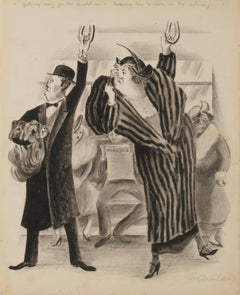
Getting Ready for the Revolution - Learning How to Ride in the Subway
By Adolf Arthur Dehn
Located in Fairlawn, OH
Getting Ready for the Revolution - Learning How to Ride in the Subway Litho crayons on illustrator’s board, c. 1932 Signed: Adolf Dehn (VED) lower right corner (signed by Virginia Dehn, the artist’s widow) Tilted along the upper edge of the recto in pencil by the artist Verso inscriptions: “VF 3168.D” in a circle, also annotated in red pencil “32” in a circle and “699 Provenance: Mary Ryan Gallery, exhibition entitled Adolf Dehn Lithographs, 1927-1940, Nov. 16 to Dec. 12, 1982. The original exhibition notice us affixed to the backing board of the frame Note: A drawing intended or used in the publication Vanity Fair, for whom Dehn worked in the mid 1920’s to the 1930’s. Adolf Dehn, American Watercolorist and Printmaker, 1895-1968 Adolf Dehn was an artist who achieved extraordinary artistic heights, but in a very particular artistic sphere—not so much in oil painting as in watercolor and lithography. Long recognized as a master by serious print collectors, he is gradually gaining recognition as a notable and influential figure in the overall history of American art. In the 19th century, with the invention of the rotary press, which made possible enormous print runs, and the development of the popular, mass-market magazines, newspaper and magazine illustration developed into an artistic realm of its own, often surprisingly divorced from the world of museums and art exhibitions, and today remains surprisingly overlooked by most art historians. Dehn in many regards was an outgrowth of this world, although in an unusual way, since as a young man he produced most of his illustrative work not for popular magazines, such as The Saturday Evening Post, but rather for radical journals, such as The Masses or The Liberator, or artistic “little magazines” such as The Dial. This background established the foundation of his outlook, and led later to his unique and distinctive contribution to American graphic art. If there’s a distinctive quality to his work, it was his skill in introducing unusual tonal and textural effects into his work, particularly in printmaking but also in watercolor. Jackson Pollock seems to have been one of many notable artists who were influenced by his techniques. Early Years, 1895-1922 For an artist largely remembered for scenes of Vienna and Paris, Adolf Dehn’s background was a surprising one. Born in Waterville, Minnesota, on November 22, 1895, Dehn was the descendent of farmers who had emigrated from Germany and homesteaded in the region, initially in a one-room log cabin with a dirt floor. Adolf’s father, Arthur Clark Dehn, was a hunter and trapper who took pride that he had no boss but himself, and who had little use for art. Indeed, during Adolf’s boyhood the walls of his bedroom and the space under his bed were filled with the pelts of mink, muskrats and skunks that his father had killed, skinned and stretched on drying boards. It was Adolf’s mother, Emilie Haas Dehn, a faithful member of the German Lutheran Evangelical Church, who encouraged his interest in art, which became apparent early in childhood. Both parents were ardent socialists, and supporters of Eugene Debs...
Category

1930s American Modern Figurative Drawings and Watercolors

Materials

Oil Crayon

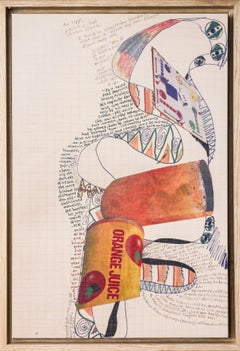
Illustration Framed on Canvas: Minute Maid
Located in New York, NY
The murder of John Lennon. The birth of my children. Nixon’s resignation. Brain surgery. Driven by the desire to express myself, and leave a physical record of my life and times, I’v...
Category

1980s Contemporary Still-life Drawings and Watercolors

Materials

Canvas, Wood, Color Pencil, Mixed Media
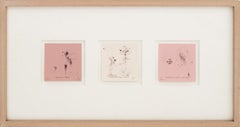
Paul Henry Ramirez Paint Chip Drawing Ballpoint, 3
By Paul Henry Ramirez
Located in Astoria, NY
Paul Henry Ramirez (American, b. 1963), Three Paint Chip Drawings, Ballpoint Pen on Paper, 2008, signed and dated to the verso, framed together in white wood frame. Overall image: 7....
Category

Early 2000s Still-life Drawings and Watercolors

Materials

Paper, Ballpoint Pen

"Entered O Cast-In"
By Alan Saret
Located in Astoria, NY
Alan Saret (American, b. 1944), "Entered O Cast-In", Graphite on Paper, 1983, signed, titled, dated, and numbered "23/50" to the verso, ebonized wood frame. Image: 22" H x 29.75" W; ...
Category

1980s Post-Minimalist Abstract Drawings and Watercolors

Materials

Paper, Graphite

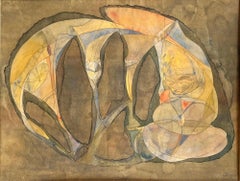
Pre-War Abstraction - Modernism - Tan Bronze Tope - Nonrepresentational
By Elsie Driggs
Located in Miami, FL
Pioneering female abstract artist Elsie Driggs paints stylized abstract organic forms in a warm palette of orange browns and tope. She merges abstraction with some figuration. A structured face composed of lines and tone emerges from an orange background. It's 1939, and even though Driggs is not well known, she is preceding many of the marquee names of abstraction by a decade. Although under the radar, this is a major work and is titled on the back stretcher is " Egyptian Gothic." It features the artist's inventiveness with her fine pencil lines incorporated in flat washes of color and collage elements. Signed lower right and inscribed on frame verso with title, artist and the date of 1939. Provenance, Christie's, Freemans. Framed under glass.. Elsie Driggs (1898 – July 12, 1992 in New York City) was an American painter known for her contributions to Precisionism, America's one indigenous modern-art movement before Abstract Expressionism, and for her later floral and figurative watercolors, pastels, and oils. She was the only female participant in the Precisionist movement, which in the 1920s and 1930s took a Cubist-inspired approach to painting the skyscrapers and factories that had come to define the new American landscape. Her works are in the collection of the Whitney Museum of American Art, the Houston Museum of the Fine Arts, the Fine Arts Museums of San Francisco, the James A. Michener Art Museum in Pennsylvania, and the Columbus Museum of Art, among others. She was married to the American abstract artist Lee Gatch. Career Born in Hartford, Connecticut, Driggs grew up in New Rochelle, a suburb of New York City, in a family that was supportive of her artistic interests. After a summer spent painting with her sister in New Mexico in her late teens, she felt she had found her life's calling. At twenty, she enrolled in classes at the Art Students League of New York, where she studied under George Luks and Maurice Sterne, both of whom were charismatic, inspirational figures in her early life. She also attended the evening criticism classes held at the home of painter John Sloan. Driggs spent fourteen months in Europe from late 1922 to early 1924, drawing and studying Italian art. There she met Leo Stein, first in Paris and later in Florence, who became an important intellectual influence, and who urged her to study Cézanne. He also introduced her to the works of Piero della Francesca, the Renaissance artist for whom she felt throughout her life the greatest admiration.[1] Driggs eventually settled in New York City, where she found representation with the progressive Charles Daniel Gallery.[2] (Advised that the old-fashioned and misogynistic Daniel would be unlikely to take on a woman artist, she signed the works she left for his consideration simply "Driggs" and waited to meet him in person until he had expressed his eagerness to include her in his gallery.)[3] In sympathy with those artists Daniel represented who were part of the burgeoning Precisionist movement, such as Charles Demuth, Charles Sheeler, George Ault, Niles Spencer, and Preston Dickinson, she too painted "the modern landscape of factories, bridges, and skyscrapers with geometric precision and almost abstract spareness."Impressionism and academic or Ashcan realism represented the past, in Driggs' view, and she intended to be resolutely modern. She was an attractive and engaging woman, but her demeanor belied a strong ambition and a clear sense of what it would take to make her mark in the New York art world. Driggs was part of the pre-eminent first group of Precisionist painters, including Demuth and Sheeler, who exhibited at the Daniel Gallery in the 1920s. Although a later group of Precisionist painters, including Louis Lozowick, Ralston Crawford and others, came on the American Art scene during the 1930s, Driggs felt that the style came to an end with the 1929 stock market crash.[5] In 1926 she painted her most famous work, Pittsburgh, a dark and brooding picture now in the permanent collection of the Whitney Museum of American Art, which depicts the gargantuan smokestacks of the Jones & Laughlin steel mills in Pittsburgh. Its focus is an overpowering mass of black and gray smokestacks, thick piping, and crisscrossing wires with only clouds of smoke to relieve the severity of the image, yet it was an image in which she found an ironic beauty. She called the picture "my El Greco" and expressed surprise that viewers in later years interpreted the painting as a work of social criticism. Like the other Precisionists (e.g., Demuth, Charles Sheeler, Louis Lozowick, Stefan Hirsch), she was concerned with applying modernist techniques to renderings of the new industrial and urban landscape, not in commenting on potential dangers the overly mechanized modern world of 1920s America might present. If anything, Precisionism, like Futurism, was a celebration of man-made energy and technology. One year later, she painted Blast Furnaces, in a similar vein. As noted above, Piero della Francesca's mural depicting "The Story of the True Cross" in Arezzo, with its tubular, static and frozen forms was the major influence on Driggs' "Pittsburgh" (it may have been the major influence for "Blast Furnaces" as well).[7] After Pittsburgh, Driggs' most acclaimed work was probably Queensborough Bridge...
Category

1930s Mixed Media

Materials

Paper, Watercolor, Pencil

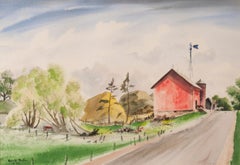
Horses Leaving the Barn
By Adolf Dehn
Located in Fairlawn, OH
Horses Leaving the Barn Watercolor on paper, 1940 Signed and dated lower left corner (see photo) Condition: Excellent Image: 14 1/2 x 21” Frame: 25” x 31” Provenance; Associated American Artists, New York (see photo of label) Mamdouha and Elmer Holmes Bobst Displayed in an original wormy chestnut frame with OP3 Acrylic. Most probably from the AAA Dehn watercolor exhibition of 1940. Vintage original framing chosen by the artist. Note: Elmer Holmes Bobst (1884–1978) was an American businessman and philanthropist who worked in the pharmaceutical industry. His wife, Mamdouha, was also well known philanthropist. Bobst was born in Lititz, Pennsylvania. He aspired to become a doctor, but instead, he taught himself pharmacology. After his wife Ethel composed his interview letter, he became manager and treasurer of the Hoffman-LaRoche Chemical Works by 1920. When Bobst retired from the company in 1944, he was one of the nation's highest paid corporate executives. In 1945 he took charge of the ailing William Warner Company (later Warner–Lambert) and he remained board chairman until his retirement. Bobst had close connections to President Dwight Eisenhower, but was also a close friend of President Richard Nixon. Note: In 1940, the year of this watercolor, Dehn and Elizabeth Timmerman visited Waterville, MN on their way to Colorado Sprint, Colorado where Dehn was to teach lithography and watercolor. This watercolor is obviously a view of the area around Waterville. Adolf Dehn, American Watercolorist and Printmaker, 1895-1968 Adolf Dehn was an artist who achieved extraordinary artistic heights, but in a very particular artistic sphere—not so much in oil painting as in watercolor and lithography. Long recognized as a master by serious print collectors, he is gradually gaining recognition as a notable and influential figure in the overall history of American art. In the 19th century, with the invention of the rotary press, which made possible enormous print runs, and the development of the popular, mass-market magazines, newspaper and magazine illustration developed into an artistic realm of its own, often surprisingly divorced from the world of museums and art exhibitions, and today remains surprisingly overlooked by most art historians. Dehn in many regards was an outgrowth of this world, although in an unusual way, since as a young man he produced most of his illustrative work not for popular magazines, such as The Saturday Evening Post, but rather for radical journals, such as The Masses or The Liberator, or artistic “little magazines” such as The Dial. This background established the foundation of his outlook, and led later to his unique and distinctive contribution to American graphic art. If there’s a distinctive quality to his work, it was his skill in introducing unusual tonal and textural effects into his work, particularly in printmaking but also in watercolor. Jackson Pollock seems to have been one of many notable artists who were influenced by his techniques. Early Years, 1895-1922 For an artist largely remembered for scenes of Vienna and Paris, Adolf Dehn’s background was a surprising one. Born in Waterville, Minnesota, on November 22, 1895, Dehn was the descendent of farmers who had emigrated from Germany and homesteaded in the region, initially in a one-room log cabin with a dirt floor. Adolf’s father, Arthur Clark Dehn, was a hunter and trapper who took pride that he had no boss but himself, and who had little use for art. Indeed, during Adolf’s boyhood the walls of his bedroom and the space under his bed were filled with the pelts of mink, muskrats and skunks that his father had killed, skinned and stretched on drying boards. It was Adolf’s mother, Emilie Haas Dehn, a faithful member of the German Lutheran Evangelical Church, who encouraged his interest in art, which became apparent early in childhood. Both parents were ardent socialists, and supporters of Eugene Debs...
Category

1940s American Realist Landscape Drawings and Watercolors

Materials

Watercolor

Haitian Scene #7 Signed Mid Century modern painting, Associated American Artists
By Adolf Dehn
Located in New York, NY
Adolf Arthur Dehn Haitian Scene #7, ca. 1951 Watercolor gouache, hand signed; framed with AAA Gallery label verso Signed on the front bearing the original label on the verso of Dehn'...
Category

Mid-20th Century Modern Figurative Paintings

Materials

Mixed Media, Watercolor, Gouache

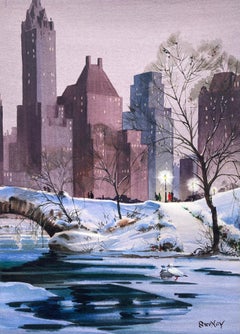
“Winter Evening”
Located in Southampton, NY
Original watercolor and gouache on archival Molvin arches paper by the well known American illustrator Fred Sweney. The scene depicts Central Park in New York City in a winter landscape with figures in conversation under an illuminated lamp post. Signed lower right. Titled verso in pencil with American Scene magazine #32 and page 30...
Category

1960s American Realist Figurative Drawings and Watercolors

Materials

Watercolor, Gouache, Illustration Board
Landscape
By Merton Clivette
Located in San Francisco, CA
Artist: Merton Clivette (American, 1868-1931) Title: Landscape Year: Circa 1925 Medium: Gouache Paper: Heavy Bristol type Size image: 22.75 x 28 inches Paper size: 22.75 x 28 inches Signature: Signed lower left by the artist Condition: Excellent Frame: Unframed About the artist. Clivette was born in Portage, Wisconsin, in 1868 as Merton Clive Cook, the youngest of five (four sons and one daughter). His father was a retired British sea captain, and his mother was an American of French, Scottish and Iroquois Indian stock. He stayed with a circus for about five years, traveling all over the Western United States, Canada and Mexico. They did shows for the army forts, for railroad workers and on Indian Reservations. Clivette settled in San Francisco in 1886, when he was offered a job as a reporter and theatrical writer for the San Francisco Call. He met Frederic Remington during this period. He was the first serious artist Clivette had met and he was an inspiration to him. Clivette had done some drawing and painting on the road during his vaudeville years, he had a natural facility for it, and he had had some formal art training as well. He had had some training in Europe and was aware of the modern art movement in Europe. Later in New York he participated in symposiums and workshops at the Art Students League. Around 1910 he gave up his stage career and began to paint full time. He was about 40 years old and was to continue to paint vigorously and prolifically for the remaining 22 years of his life, His style can be identified with the Expressionist Movement, His subjects include portraits (some quite realistic, others more generalized) Indians and horsemen, laborers, gentlemen and vamps, jungle animals and birds, fish, seascapes and landscapes. He was an active participant in the art world of New York. He was a member of the Society of Independent Artists. In 1923 he showed at the Ainslee Art Gallery at 677 Fifth Ave., in 1925 at the Spanish Society in Brooklyn and in 1927 he had a solo show at the New Gallery, 600 Madison Ave. That same year there was also a solo show of his work in Paris at the Bernheim-Jeune Gallery, which included a catalogue. In 1929 he exhibited at the Art Center of the Roerich Museum in a group show of work from the collection of George Hellman. In 1930 he was in a show at the Museum of Modern Art in New York, "Painting and Sculpture by Living Americans" which also included the work of Stuart Davis, Arthur Dove, William Glackens, Marsden Hartley, Childe Hassam, George Luks and Mark Tobey and sculptors Gaston Lachaise and William Zorach among others. A description and critical analysis of his work in included in the book by Henry Rankin Poore...
Category

Early 20th Century Abstract Impressionist Landscape Drawings and Waterco...

Materials

Gouache

Landscape #II
By Merton Clivette
Located in San Francisco, CA
Artist: Merton Clivette (American, 1868-1931) Title: Landscape II Year: Circa 1925 Medium: Gouache Paper: Watercolor Size image: 17.35 x 22.65 inches Size paper: 17.35 x 22.65 inches Signature: Signed lower left by the artist Condition: Excellent Frame: Unframed About the artist. Clivette was born in Portage, Wisconsin, in 1868 as Merton Clive Cook, the youngest of five (four sons and one daughter). His father was a retired British sea captain, and his mother was an American of French, Scottish and Iroquois Indian stock. He stayed with a circus for about five years, traveling all over the Western United States, Canada and Mexico. They did shows for the army forts, for railroad workers and on Indian Reservations. Clivette settled in San Francisco in 1886, when he was offered a job as a reporter and theatrical writer for the San Francisco Call. He met Frederic Remington during this period. He was the first serious artist Clivette had met and he was an inspiration to him. Clivette had done some drawing and painting on the road during his vaudeville years, he had a natural facility for it, and he had had some formal art training as well. He had had some training in Europe and was aware of the modern art movement in Europe. Later in New York he participated in symposiums and workshops at the Art Students League. Around 1910 he gave up his stage career and began to paint full time. He was about 40 years old and was to continue to paint vigorously and prolifically for the remaining 22 years of his life, His style can be identified with the Expressionist Movement, His subjects include portraits (some quite realistic, others more generalized) Indians and horsemen, laborers, gentlemen and vamps, jungle animals and birds, fish, seascapes and landscapes. He was an active participant in the art world of New York. He was a member of the Society of Independent Artists. In 1923 he showed at the Ainslee Art Gallery at 677 Fifth Ave., in 1925 at the Spanish Society in Brooklyn and in 1927 he had a solo show at the New Gallery, 600 Madison Ave. That same year there was also a solo show of his work in Paris at the Bernheim-Jeune Gallery, which included a catalogue. In 1929 he exhibited at the Art Center of the Roerich Museum in a group show of work from the collection of George Hellman. In 1930 he was in a show at the Museum of Modern Art in New York, "Painting and Sculpture by Living Americans" which also included the work of Stuart Davis, Arthur Dove, William Glackens, Marsden Hartley, Childe Hassam, George Luks and Mark Tobey and sculptors Gaston Lachaise and William Zorach among others. A description and critical analysis of his work in included in the book by Henry Rankin Poore...
Category

Early 20th Century Abstract Impressionist Landscape Drawings and Waterco...

Materials

Gouache

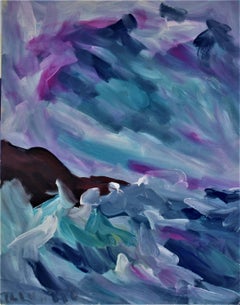
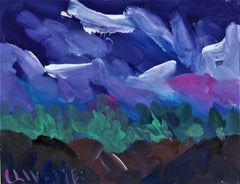
Autumn Rhythms New York, Painting, Watercolor on Watercolor Paper
By Daniel Clarke
Located in Yardley, PA
I sit in a shady place upon a hill lingers my gaze two children putting up a race a gloomy smile adorns my face the darkness of my room at home envelopes my ...
Category

2010s Impressionist Drawings and Watercolor Paintings

Materials

Watercolor

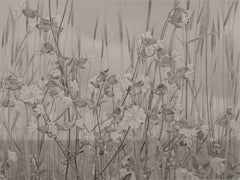
Wildflowers and Sky, Vermont Landscape Black White Graphite Drawing
By Mary Reilly
Located in New York, NY
This drawing reveals the artist's mastery of the medium and her connection to her subjects. In this one, we peek at a soft horizon line as we gaze though a patch of wildflowers near ...
Category

2010s American Realist Landscape Drawings and Watercolors

Materials

Paper, Graphite

Seashells 6, Beach-strewn seashells from Sanibel Island, Graphite on Paper
By Mary Reilly
Located in New York, NY
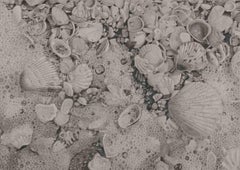
This drawing reveals the artist's mastery of the medium and her connection to her subjects. In this one, we peek beach-strewn seashells from her travels to Sanibel Island boast bubbl...
Category

2010s American Realist Landscape Drawings and Watercolors

Materials

Paper, Graphite

Zoo New York City with Sea Lions
By Constantin Alajalov
Located in Miami, FL
A charming and stylized depiction of a day at the Central Park Zoo. with World War Two uniformed visitors front and center. Sea lions put on a show in front o...
Category

1940s Impressionist Landscape Paintings

Materials

Gouache

Illustration Framed on Canvas: It s A Long Tail
Located in New York, NY
The murder of John Lennon. The birth of my children. Nixon’s resignation. Brain surgery. Driven by the desire to express myself, and leave a physical record of my life and times, I’v...
Category

Early 2000s Contemporary Animal Drawings and Watercolors

Materials

Canvas, Wood, Color Pencil

Illustration Framed on Canvas: Cecily s Cloche
Located in New York, NY
The murder of John Lennon. The birth of my children. Nixon’s resignation. Brain surgery. Driven by the desire to express myself, and leave a physical record of my life and times, I’v...
Category

1980s Contemporary Figurative Drawings and Watercolors

Materials

Canvas, Wood, Color Pencil

Illustration Framed on Canvas: December Bride
Located in New York, NY
The murder of John Lennon. The birth of my children. Nixon’s resignation. Brain surgery. Driven by the desire to express myself, and leave a physical record of my life and times, I’v...
Category

1990s Contemporary Portrait Drawings and Watercolors

Materials

Canvas, Wood, Color Pencil

Illustration Framed on Canvas: Mr February
Located in New York, NY
The murder of John Lennon. The birth of my children. Nixon’s resignation. Brain surgery. Driven by the desire to express myself, and leave a physical record of my life and times, I’v...
Category

1990s Contemporary Figurative Drawings and Watercolors

Materials

Canvas, Wood, Color Pencil

Illustration Framed on Canvas: Pilgrim s Progress
Located in New York, NY
The murder of John Lennon. The birth of my children. Nixon’s resignation. Brain surgery. Driven by the desire to express myself, and leave a physical record of my life and times, I’v...
Category

1990s Contemporary Figurative Drawings and Watercolors

Materials

Canvas, Wood, Color Pencil

"In der Loge" [In the Lodge]
By George Grosz
Located in Astoria, NY
George Grosz (German, 1893-1959), "In der Loge" [In the Lodge], Pen and Ink on Paper, circa 1913, signed in pencil "Grosz" and titled lower lower left, Achim Moeller, Ltd. label to v...
Category

1910s Expressionist Figurative Drawings and Watercolors

Materials

Paper, Ink, Pen

1930 s Tremont Temple, Judaica Watercolor, Bronx New York City
By Ben Ganz
Located in Surfside, FL
Signed Judaic synagogue watercolor by Jewish American artist Ben Ganz. He depicts the front gates of the Tremont Temple, Bronx New York from 1939. The artist uses local colors and g...
Category

20th Century Modern Landscape Drawings and Watercolors

Materials

Watercolor

Illustration Framed on Canvas: Profile of a Lady
Located in New York, NY
The murder of John Lennon. The birth of my children. Nixon’s resignation. Brain surgery. Driven by the desire to express myself, and leave a physical record of my life and times, I’v...
Category

1990s Contemporary Portrait Drawings and Watercolors

Materials

Canvas, Wood, Color Pencil

Illustration Framed on Canvas: She Nailed It!
Located in New York, NY
The murder of John Lennon. The birth of my children. Nixon’s resignation. Brain surgery. Driven by the desire to express myself, and leave a physical record of my life and times, I’v...
Category

1990s Contemporary Figurative Drawings and Watercolors

Materials

Canvas, Wood, Color Pencil

Illustration Framed on Canvas: Wide-Eyed Babe
Located in New York, NY
The murder of John Lennon. The birth of my children. Nixon’s resignation. Brain surgery. Driven by the desire to express myself, and leave a physical record of my life and times, I’v...
Category

Early 2000s Contemporary Portrait Drawings and Watercolors

Materials

Canvas, Color Pencil

Illustration Framed on Canvas: Glass Menagerie
Located in New York, NY
The murder of John Lennon. The birth of my children. Nixon’s resignation. Brain surgery. Driven by the desire to express myself, and leave a physical record of my life and times, I’v...
Category

1990s Contemporary Figurative Drawings and Watercolors

Materials

Canvas, Wood, Color Pencil

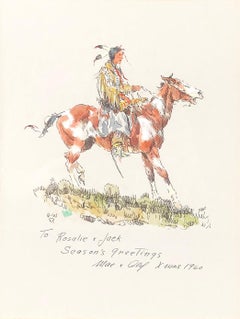
Season s Greetings 1960 (Brave on Horseback)
By Olaf Wieghorst
Located in Missouri, MO
Olaf Wieghorst (American, 1899-1988) "Season's Greetings" (Brave on Horseback) 1960 Watercolor/Gouache on Paper Initialed and Monogramed and Dated Dedicated: "To Rosalie & Jack, Season's Greetings, Mae & Olaf Xmas 1960" Site Size: 12 x 9 inches Framed Size: approx. 22.5 x 18.5 inches Born in Viborg, Denmark, Olaf Wieghorst was a child acrobatic performer from the age of nine when he began appearances at Tivoli Theater in Copenhagen and later toured Europe. He also learned horseback riding working on a stock farm, and horses became a major focus of his admiration and later his painting. In 1918, he arrived in the United States, having worked as a cabin boy on a steamer. He served in the 5th U.S. Cavalry on the Mexican border in the days of Pancho Villa...
Category

1960s American Realist Figurative Drawings and Watercolors

Materials

Paper, Watercolor, Gouache

Still Thinking About These?

All Recently Viewed