508 results for "motherwell"

to
130
68
79
112
84
165
Overall Width
to
Overall Height
to
266
242
3
6
13
103
49
34
13
246
78
48
37
25
9
6
5
3
1
1
208
201
94
14
8
7
6
6
5
5
5
4
3
3
3
3
3
3
2
2
1
1
1
476
251
248
244
242
60
46
44
43
37
138
39
434
69
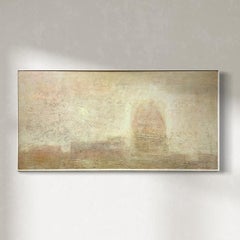
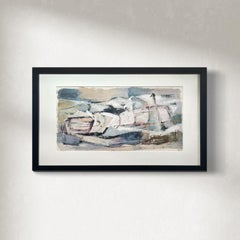
"Cathedral, " 1960s Modern Abstract Painting
By Stanley Bate
Located in Westport, CT
This Modern abstract painting by Stanley Bate has a light beige, creme, and warm sepia palette. The textured painting has darker shapes that run the length of the bottom of the compo...
Category

1960s Modern Abstract Paintings

Materials

Canvas, Oil

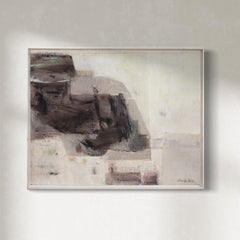
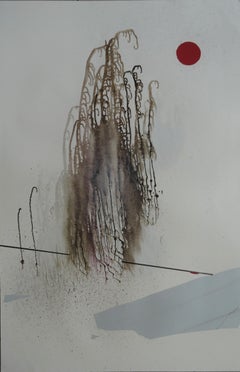
"Storm King, " 1960s Modern Abstract Painting
By Stanley Bate
Located in Westport, CT
"Storm King" by Modernist artist Stanley Bate is a moderately sized oil painting on canvas. The predominantly greyscale painting features a warm off-white w...
Category

1960s Modern Abstract Paintings

Materials

Canvas, Oil

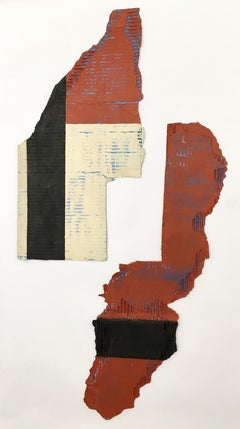
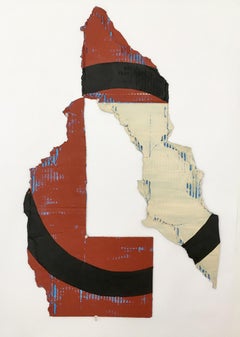
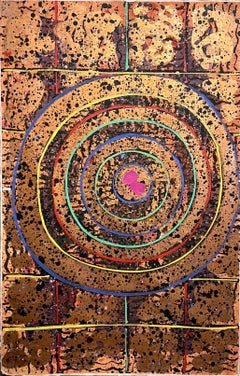
Black on Rust, Buff and Blue 2, 2017, acrylic, found cardboard, 39 x 19 inches
By Diane Englander
Located in Darien, CT
Diane Englander uses formal means to create a place between discord and tranquility, a zone with a charged harmony that energizes as it also provides refuge. That often requires tha...
Category

2010s Abstract Geometric Abstract Paintings

Materials

Acrylic, Cardboard

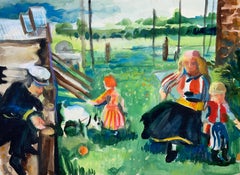
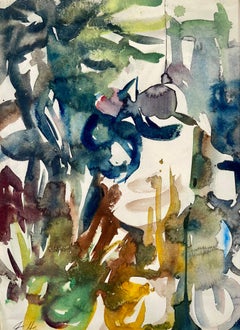
Untitled (Neo-Impressionist Figures in Landscape)
By Ian Hornak
Located in Fairfield, CT
Artist: Ian Hornak (1944-2002) Title: Untitled (Neo-Impressionist Figures in Landscape) Year: 1963 Medium: Watercolor on heavy archival paper Size: 29.5 x 21 inches Condition: Good P...
Category

1960s Impressionist Figurative Paintings

Materials

Watercolor

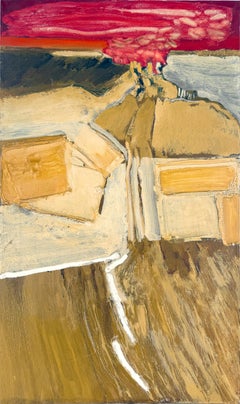
"February 21st - Red" Abstract Expressionist Landscape by William Morehouse
Located in Soquel, CA
"February 21st - Red" Abstract Expressionist Landscape by William Morehouse The image shows an abstract landscape painting by William Paul Morehouse (American, 1929-1993), titled "February 21st - Red". The painting has a textured application of impasto, in oil on canvas, with dominant earth tones and a contrasting red section at the top. The composition is divided into geometric shapes and lines, suggesting a stylized representation of a landscape. The colors and textures evoke a sense of the Northern California coastal prairie, a recurring theme in Morehouse's work. The painting is signed, titled, and dated 1960 on the reverse., and WM '60 center bottom of painting. Image, 34"H x 20"W x .5"D Signed center at bottom, Signed and dated on verso, with exhibition label and title. Post War California artist, William Paul Morehouse studied at the California School of Fine Arts (1947-1950) receiving his BFA. Not long after graduation from the CSFA he joined the Army during the Korean War. He became a Master Sergeant and was released with a Purple Heart in 1953, at which point he enrolled in courses at the California College of Arts and Crafts (now the California College of the Arts). A transfer to the San Francisco Art Institute the following year led to his Bachelors in Fine Arts, and in 1954 he enrolled at San Francisco State University where in under two years he earned his MFA. He traveled to New York that same year to participate in the Young American Painters exhibition at the Guggenheim, along with Diebenkorn, deKooning, Motherwell, and Jackson Pollock. He soon began dividing his time between the two coasts. Morehouse eventually settled in Bodega Bay permanently, where he continued to paint as part of the group the "Sonoma Four" Selected Group Exhibitions: Pennsylvania Academy of Fine Arts; University of Illinois; Fort Worth Museum; Los Angeles County Museum; National Academy; Oakland Art Museum; Rotunda Gallery, San Francisco; Denver Art Museum; Fourth Annual Exhibition of Contemporary Painting, California Palace of The Legion of Honor 1951; First Pacific Coast Biennial Exhibition, Santa Barbara Museum of Art & California Palace of the Legion of Honor, San Francisco 1955; PACIFIC COAST ART...
Category

1960s Modern Abstract Paintings

Materials

Canvas, Oil, Stretcher Bars

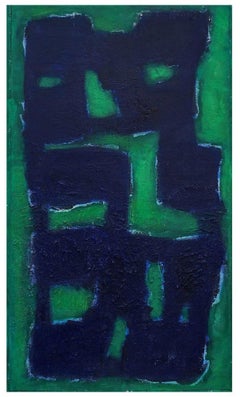
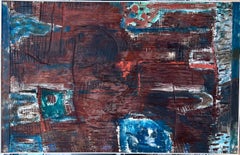
Abstract Expression - Oil Painting 2005 by Giorgio Lo Fermo
By Giorgio Lo Fermo
Located in Roma, IT
Abstract Expressionism is an original artwork realized by Giorgio Lo Fermo in 2005. Oil on canvas. Frame included. Perfect conditions. The artwork shows an interesting abstract geometrical composition. The main colors are deep blue and emerald green. The blue shape in the foreground presents some white contour lines. The title of the artwork recalls and pays homage to one of the most important American art movements of XX century: Abstract Expressionism, personified by artists such as Jackson Pollock, Marc Rothko...
Category

2010s Abstract Abstract Paintings

Materials

Oil

"Cronus Asleep in the Cave" David Hare, Mythological Surrealist Composition
By David Hare
Located in New York, NY
David Hare Cronus Asleep in the Cave, 1971 Acrylic on board 27 1/2 x 38 1/4 inches “Freedom is what we want,” David Hare boldly stated in 1965, but then he added the caveat, “and what we are most afraid of.” No one could accuse David Hare of possessing such fear. Blithely unconcerned with the critics’ judgments, Hare flitted through most of the major art developments of the mid-twentieth century in the United States. He changed mediums several times; just when his fame as a sculptor had reached its apogee about 1960, he switched over to painting. Yet he remained attached to surrealism long after it had fallen out of official favor. “I can’t change what I do in order to fit what would make me popular,” he said. “Not because of moral reasons, but just because I can’t do it; I’m not interested in it.” Hare was born in New York City in 1917; his family was both wealthy and familiar with the world of modern art. Meredith (1870-1932), his father, was a prominent corporate attorney. His mother, Elizabeth Sage Goodwin (1878-1948) was an art collector, a financial backer of the 1913 Armory Show, and a friend of artists such as Constantin Brancusi, Walt Kuhn, and Marcel Duchamp. In the 1920s, the entire family moved to Santa Fe, New Mexico and later to Colorado Springs, in the hope that the change in altitude and climate would help to heal Meredith’s tuberculosis. In Colorado Springs, Elizabeth founded the Fountain Valley School where David attended high school after his father died in 1932. In the western United States, Hare developed a fascination for kachina dolls and other aspects of Native American culture that would become a recurring source of inspiration in his career. After high school, Hare briefly attended Bard College (1936-37) in Annandale-on-Hudson. At a loss as to what to do next, he parlayed his mother’s contacts into opening a commercial photography studio and began dabbling in color photography, still a rarity at the time [Kodachrome was introduced in 1935]. At age 22, Hare had his first solo exhibition at Walker Gallery in New York City; his 30 color photographs included one of President Franklin Roosevelt. As a photographer, Hare experimented with an automatist technique called “heatage” (or “melted negatives”) in which he heated the negative in order to distort the image. Hare described them as “antagonisms of matter.” The final products were usually abstractions tending towards surrealism and similar to processes used by Man Ray, Raoul Ubac, and Wolfgang Paalen. In 1940, Hare moved to Roxbury, CT, where he fraternized with neighboring artists such as Alexander Calder and Arshile Gorky, as well as Yves Tanguy who was married to Hare’s cousin Kay Sage, and the art dealer Julian Levy. The same year, Hare received a commission from the American Museum of Natural History to document the Pueblo Indians. He traveled to Santa Fe and, for several months, he took portrait photographs of members of the Hopi, Navajo, and Zuni tribes that were published in book form in 1941. World War II turned Hare’s life upside down. He became a conduit in the exchange of artistic and intellectual ideas between U.S. artists and the surrealist émigrés fleeing Europe. In 1942, Hare befriended Andre Breton, the principal theorist of surrealism. When Breton wanted to publish a magazine to promote the movement in the United States, he could not serve as an editor because he was a foreign national. Instead, Breton selected Hare to edit the journal, entitled VVV [shorth for “Victory, Victory, Victory”], which ran for four issues (the second and third issues were printed as a single volume) from June 1942 to February 1944. Each edition of VVV focused on “poetry, plastic arts, anthropology, sociology, (and) psychology,” and was extensively illustrated by surrealist artists including Giorgio de Chirico, Roberto Matta, and Yves Tanguy; Max Ernst and Marcel Duchamp served as editorial advisors. At the suggestion of Jacqueline Lamba...
Category

1970s Abstract Abstract Paintings

Materials

Acrylic

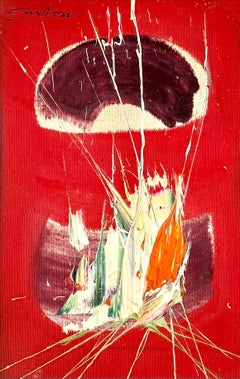
"Rites of Spring, " 1970s Modern Abstract Painting
By Stanley Bate
Located in Westport, CT
"Rites of Spring" by Modernist painter Stanley Bate is a large-scale, textured oil painting on canvas. The deep grey and maroon colors serve as a backdrop to a burst of geometric sha...
Category

1970s Modern Abstract Paintings

Materials

Canvas, Oil

"Northeaster, " 1960s Modern Abstract Painting
By Stanley Bate
Located in Westport, CT
This Modern Abstract Expressionist painting by Stanley Bate is made with gouache on paper and features a cool, muted palette and light texture. The painting itself is 13" x 22" and measures 21.25" x 29.25" x 1" framed. It is signed by the artist in the lower left-hand corner of the painting and is framed in a black frame with an acid-free mat. It is ready to hang. Stanley Bate was born on March 26, 1903 in Nashville, Tennessee. The Bates were an established Tennessee family, in fact, Henry’s brother William Bate was the governor of Tennessee from 1883-1887 and a United States Senator from 1887-1905. Stanley studied art at the Watkins Institute in Nashville. In the 1920’s Bate moved to New York City to study at the Art Students League under Frederick Bridgman. He soon landed a job with Encyclopedia Britannica, and from 1927-1929 served as art editor. From 1929 until his death in 1972, Stanley was a self-employed artist. He taught art classes at both the Art Students League and the Albany Institute of History and Art and brought in extra income by making illustrations for magazines such as “Outdoor Life” and “Popular Science”. On January 27, 1934 Stanley married Emilie Rossel. Emilie had emigrated from Switzerland to New York in 1923. She found work as a governess to Alfred Vanderbilt and later as an executive secretary for Wall Street investment brokers Kahn, Loeb and Co. Emilie met Stanley in New York in the early 1930’s when she attended one of his art exhibitions with a friend. The couple, who had no children, lived on 34th Street in Manhattan. During this period, Bate was producing and exhibiting his art and joined several artists groups. Stanley and Emilie became part of the New York art scene, dining weekly at the Society of Illustrators Clubhouse. Stanley Bate’s time in New York was pivotal in the formation of his painting style. He lived in New York during the inception of one of the most important Modern Art movements, one that helped New York replace Paris as the center of avant-garde art. This movement, which was called the New York School of artists, was later known as Abstract Expressionism. It was comprised of a loosely associated group of vanguard artists working in New York City during the 1940s and 1950s. The New York School was not defined by a specific style, but instead reflected a fusion of European Modernism and American social relevancy that was depicted in many individual styles. Influences of Surrealism, Cubism, and Modernism can be found in their work, along with an interest in experimenting with non-traditional materials and methods. American art was in the forefront of international avant-garde for the first time. Stanley Bate was undoubtedly exposed to the varied styles and techniques that were emerging during the formative years of the New York School. Mark Rothko and Robert Motherwell were formulating their versions of color field paintings. Joseph Cornell was experimenting with assemblages, collage and the use of different types of textured paints. Jackson Pollock was adhering objects such as buttons and coins into his early works, while Louise Nevelson was using found objects. Helen Frankenthaler added sand to her early paintings. The New York School artists were undermining traditional fine art by using mixed media and non-traditional methods. Stanley Bate absorbed these varied influences and soon his early realistic landscapes and still-lifes were replaced with something entirely new. The influence of Cubism, notably the flat shallow space of the picture plane, is obvious in many of Bate’s paintings. Surrealism is evident in Bate’s use of subjects from myth, primitive art and antiquity, along with the Automatism-like line work in his more linear images. The unfettered experimentation of the New York School is everywhere in Stanley Bate’s work. We see nods to color field, collage, the mixing of textures into paint, mixed media, the inclusion of found objects and thick, luscious impasto. Bate was prolific and experimented in various media including oil, watercolor, lithography, silk screen, wood cut, drawing, collage, ceramics and sculpture. Bate is considered a true Modernist. His work is largely abstract, but sometimes figures and buildings are discernable. He frequently mixed paint, sand and glue together to achieve a textured surface, and then scraped and scratched through this layer to expose some of the underpainting below. His sculpture, which is often whimsical, also reflects the non-traditional methods of the New York School. Bate pioneered the use of enamel and copper in his work. The sculptures are not carved or modeled as was done in the past, but instead are built using mixed media and new materials. In addition to the New York School influence, many of Bate’s works exhibit a strong connection to the Spanish school, especially the work of Antonio Tapies and Modesto Cuixart. These artists were both part of an avant-garde group known as Art Informel, the Spanish equivalent of Abstract Expressionism. These artists likewise worked in mixed media and introduced objects and texture into their work. Many of Bate’s subjects and titles relate to Spanish locations and words. It is likely that Stanley spent time in Spain and found inspiration there. By the early 1940s, Stanley and Emilie had started spending weekends in a barn they purchased in Craryville, New York, a few hours north of Manhattan. The barn had no electricity or plumbing, but when the Bates eventually decided to leave New York and live full time in Craryville, they remodeled the barn, putting a gallery downstairs and a studio and living quarters upstairs. Although the Bates moved out of New York City, Stanley remained part of the New York art scene, exhibiting in New York and elsewhere throughout the 50s and 60s. During his lifetime he was represented by the New York galleries Knoedler and Company, Kennedy Galleries, Rose Fried Gallery and Key Gallery, along with Tyringham Gallery located in Tyringham, Massachusetts. Craryville was Stanley’s home until his death on August 21, 1972. Emilie died 1984...
Category

1960s Modern Abstract Paintings

Materials

Paper, Gouache

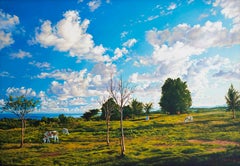
Looking Toward Oyster Pond, Montauk, Ian Hornak
By Ian Hornak
Located in Fairfield, CT
Artist: Ian Hornak (1944-2002) Title: Looking Toward Oyster Pond, Montauk Year: 1983-2001 Medium: Acrylic on Canvas Size: 42 x 60 inches Condition: Excellent Inscription: Signed rect...
Category

1980s Photorealist Landscape Paintings

Materials

Canvas, Acrylic

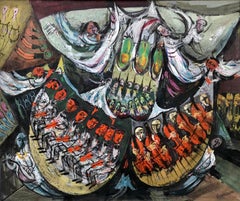
Modernist Orchestra Musical Gouache Painting Boston Expressionist
By David Aronson
Located in Surfside, FL
Very vibrant, dynamic orchestra scene reminiscent of the work of Mopp (Max Oppenheim) David Aronson, (1923-2015) son of a rabbi, was born in Lithuania in 1923 and immigrated to America at the age of five. He settled in Boston, Massachusetts where he studied at the school of the Museum of Fine Arts under Karl Zerbe, a German painter well known in the early 1900s. Aronson later taught at the school of the Museum of Fine Arts for fourteen years and founded the School of Fine Art at Boston University where he is today a professor emeritus. An internationally renowned sculptor & painter, Aronson has won acclaim for his interpretation of themes from the Hebrew Talmud and Kabala. His best known works include bronze castings, encaustic paintings, and pastels. His work is included in many important public and private collections, and has been shown in several museum retrospectives around the country. He is considered to be one of the most important 20th century American artists. At twenty-two David Aronson had his first one-man show at New York's Niveau Gallery. The next year, six of his Christological paintings were included in the Fourteen Americans exhibition at Manhattan's Museum of Modern Art where Aronson’s work was included alongside abstract expressionists Arshile Gorky, Robert Motherwell and Isamu Noguchi. In the 1950s, Aronson turned more toward his Jewish heritage for the inspiration for his art. Folklore as well as Kabalistic and other transcendental writings influenced his work greatly. The Golem (a legendary figure, brought to life by the Maharal of Prague out of clay to protect the Jewish community during times of persecution) and the Dybbuk (an evil spirit that lodges itself in the soul of a living person until exorcised) frequently appear in his work. In the sixties, Aronson turned to sculpture. His work during this period is best exemplified by a magnificent 8’ x 4’ bronze door which now stands at the entrance to Frank Lloyd Wright's Johnson Foundation Conference Center for the Arts in Racine, Wisconsin. In the seventies and eighties, Aronson continued his work in pastel drawings, paintings, and sculptures, often exploring religion and the frailties of man's nature. During this time, in addition to a traveling retrospective exhibition and many one-man shows in New York, Los Angeles, Chicago, and Boston at the Pucker-Safrai Gallery on Newbury Street, Aronson won many awards and became a member of the National Academy of Design in New York. Two years ago he retired from teaching to work full-time in his studio in Sudbury, Massachusetts. included in the catalog Contemporary Religious Imagery in American Art Catalog for an exhibition held at the Ringling Museum of Art, March 1-31, 1974. Artists represented: David Aronson, Leonard Baskin, Max Beckmann, Hyman Bloom, Fernando Botero, Paul Cadmus, Marvin Cherney, Arthur G. Dove, Philip Evergood, Adolph Gottlieb, Jonah Kinigstein, Rico Lebrun, Jack Levine, Louise Nevelson, Barnett Newman, Abraham Rattner, Ben Shahn, Mark Tobey, Max Weber, William Zorach and others. Selected Awards 1990, Certificate of Merit, National Academy of Design 1976, Purchase Prize, National Academy of Design 1976, Joseph Isidore Gold Medal, National Academy of Design 1976, Purchase Prize in Drawing, Albrecht Art Museum 1975, Isaac N. Maynard Prize for Painting, National Academy of Design 1973, Samuel F. B. Morse Gold Medal, National Academy of Design 1967, Purchase Prize, National Academy of Fine Arts 1967, Adolph and Clara Obrig Prize, National Academy of Design 1963, Gold Medal, Art Directors Club of Philadelphia 1961, 62, 63, Purchase Prize, National Institute of Arts and Letters 1960, John Siimon Guggenheim Fellowship 1958, Grant in Art, National Institute of Arts and Letters 1954, First Prize, Tupperware Annual Art Fund Award 1954, Grand Prize, Third Annual Boston Arts Festival 1953, Second Prize, Second Annual Boston Arts Festival 1952, Grand Prize, First Annual Boston Arts Festival 1946, Traveling Fellowship, School of the Museum of Fine Arts 1946, Purchase Prize, Virginia Museum of Fine Arts 1944, First Popular Prize, Institute of Contemporary Art 1944, First Judge's Prize, Institute of Contemporary Art Selected Public Collections Art Institute of Chicago Virginia Museum of Fine Arts Bryn Mawr College Brandeis University Tupperware Museum, Orlando, Florida DeCordova Museum Museum of Modern Art Print Collection, New York Atlanta University Atlanta Art...
Category

20th Century Expressionist Figurative Paintings

Materials

Gouache, Board

Untitled - Abstract Expression - Oil Painting 2017
By Giorgio Lo Fermo
Located in Roma, IT
Untitled - Abstract Expression is an original artwork realized by Giorgio Lo Fermo in 2017. Oil on canvas applied on plywood. Perfect conditions. ...
Category

2010s Abstract Expressionist Abstract Paintings

Materials

Oil

Black on Buff, Rust and Blue 1 2017, 33 x 32 inches, acrylic, reused cardboard
By Diane Englander
Located in Darien, CT
Diane Englander uses formal means to create a place between discord and tranquility, a zone with a charged harmony that energizes as it also provides refuge. That often requires tha...
Category

2010s Abstract Geometric Abstract Paintings

Materials

Acrylic, Cardboard

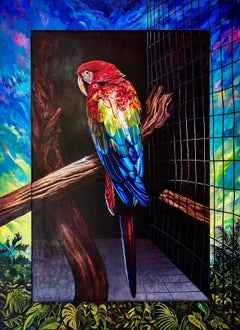
Scarlet Blue Macaw, Ian Hornak
By Ian Hornak
Located in Fairfield, CT
Artist: Ian Hornak (1944-2002) Title: Scarlet Blue Macaw Year: 1992 Medium: Acrylic on Panel with artist painted frame Size: 58.5 x 42.2 inches Condition: E...
Category

1990s Photorealist Landscape Paintings

Materials

Acrylic, Wood Panel

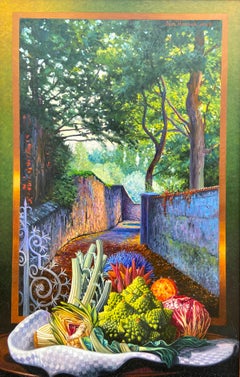
Still Life with Baroque Cauliflower, Artichokes and Radishes
By Ian Hornak
Located in Fairfield, CT
Artist: Ian Hornak (1944-2002) Title: Still Life with Baroque Cauliflower, Artichokes and Radishes Year: 2002 Medium: Oil on Panel with artist painted frame Size: 42 x 31.5 inches Co...
Category

Early 2000s Photorealist Landscape Paintings

Materials

Acrylic, Wood Panel

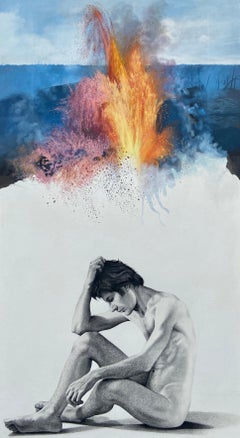
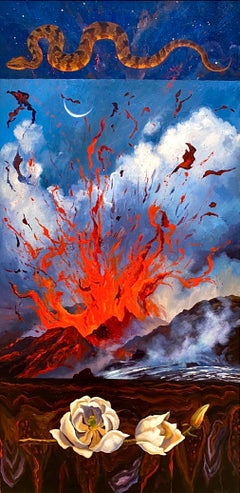
Figure, Volcano
By Ian Hornak
Located in Fairfield, CT
Artist: Ian Hornak (1944-2002) Title: Figure, Volcano (John Huszar) Year: June 1971 Medium: Acrylic, Pen & Ink on Canvas Size: 72 x 48 inches Condition: Ex...
Category

1970s Photorealist Landscape Paintings

Materials

Canvas, Acrylic

Figure, Volcano
Figure, Volcano
$70,400 Sale Price
20% Off
Untitled - Abstract Expression - Oil Painting 2004
By Giorgio Lo Fermo
Located in Roma, IT
Untitled - Abstract Expression is an original artwork realized by Giorgio Lo Fermo in 2004. Oil on canvas; hand signed and dated by the artist on t...
Category

Early 2000s Abstract Expressionist Abstract Paintings

Materials

Oil

The Fall of Eden (Garden of Eden)—Untitled
By Ian Hornak
Located in Fairfield, CT
Artist: Ian Hornak (1944-2002) Title: The Fall of Eden (Garden of Eden)—Untitled Year: 1985 Medium: Acrylic on Canvas Size: 48 x 24 inches Condition: Excellent Inscription: Signed, ...
Category

1980s Photorealist Landscape Paintings

Materials

Acrylic

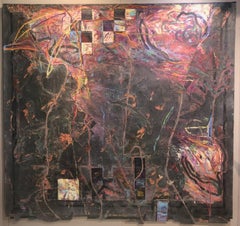
Winter Kill Five Paths Large Abstract Mixed Media
By Terence La Noue
Located in Lake Worth Beach, FL
Winter Killed Five Paths, 1983 Mixed Media Abstract, signed and title on revers. No frame needed for this work at the top is attached to plank of wood and ready to be hang, it will be rolled up for shipping. Terence La Noue was born in Hammond, Indiana in 1941. He received a Bachelor of Fine Arts from Ohio Wesleyan University in 1964. After going to Berlin as a Fulbright Meister Student at Hochscule fur Bildende Kunste in 1964-65 he went on to receive a Master of Fine Arts degree from Cornell University. In addition to the Fulbright Foundation fellowship, La Noue has twice received grants from the National Endowment for the Arts and the Guggenheim Foundation. He has had extensive teaching experience at Trinity College 1967-72, the City University of New York 1972-85 and at New York University in 1987. He lives between Arizona, Paris, France and Vermont. Terence La Noue, who has created powerful, compelling paintings for the last four decades, is considered one of the outstanding talents of 20th century American abstract art. Layering canvas, fabric, gauze, acrylic paint and cast elements forming a lively melding of many different materials, symbols and colors to create tapestry-like paintings, he conjures up colorfully rich abstractions that reveal a sense of myth, magic and mystery. His extensive world travels serve as inspiration for works that are abstract mixtures of Western and non-Western traditions and histories. India, South America, Morocco, Mexico and Nepal have been favorite destinations. Terence La Noue’s unique approach to painting and printmaking has achieved worldwide recognition. Beginning in Berlin in 1965 he has had over a hundred and thirty acclaimed solo exhibitions in London, Paris, Tehran, Stockholm, Hamburg, Dusseldorf, Cologne, New York, Washington, DC, Los Angeles, Houston, Chicago, Palm Beach, Dallas, Atlanta, Tucson and Scottsdale. His work is represented in the permanent collections of major museums including: The Museum of Modern Art in New York, The Metropolitan Museum of Art, The Whitney Museum of Art, The Corcoran Gallery, The Guggenheim Museum, The Brooklyn Museum, Brooklyn, New York, The Tate Modern in London in Japan, Singapore, France and Australia including the Center for Contemporary Art, Kitakyushu, Japan, the Power Institute of Fine Arts, Sydney, Australia, The Musee d'Art et Archeologie, Paris, France. Walker Art Center, Minneapolis, Minnesota, United States Carnegie Institute, Pittsburgh, Pennsylvania, United States Corcoran Gallery of Art, Washington D.C., United States Albright-Knox Art Gallery, Buffalo, New York, United States National Gallery of Australia, Sidney, Australia Addison Gallery of American Art, Phillips Academy, Andover, Massachusetts United States Embassy, Beijing, China His work is also included in numerous university and city art museums throughout the US as well as major corporate collections. Terence la Noue worked extensively at Tyler Graphics from 1987 to 1993 and is represented in the National Gallery’s Kenneth Tyler Collection by a large body of work made in 1987 and 1991. La Noue’s work is characterized by an intensive layering process, which was well accommodated by the Tyler workshop. The artist found that through collaboration with Ken Tyler...
Category

1980s Abstract Abstract Paintings

Materials

Canvas, Cord, Acrylic, Mixed Media

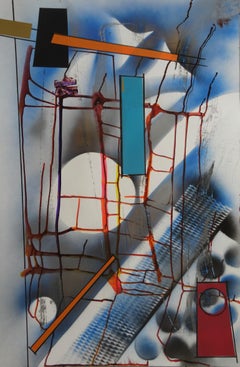
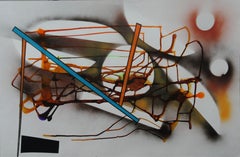
Ladder. 2020. Paper, mixed media, 94x63 cm
Located in Riga, LV
The abstract series of sizable works done in a mixed-media technique pays homage to the great modernists and abstract expressionists such as Mondrian, Kandinsky, Still and Motherwell...
Category

2010s Contemporary Abstract Paintings

Materials

Paper, Acrylic, Felt Pen, Stencil

Sunset. 2020. Paper, mixed media, 63x94 cm
Located in Riga, LV
The abstract series of sizable works done in a mixed-media technique pays homage to the great modernists and abstract expressionists such as Mondrian, Kandinsky, Still and Motherwell...
Category

2010s Contemporary Abstract Paintings

Materials

Paper, Acrylic, Felt Pen, Stencil

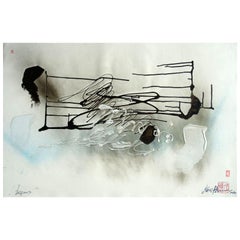
Chinese American Abstract Expressionist Zen Space Painting WangMing Color School
Located in Surfside, FL
Wang Ming "Enter the World of Infinity" Acrylic paint on Japon paper mounted on canvas Dimensions: H: 39 inches: W: 25 inches WANG MING WANG Artist Ming Wang, born November 4, 1921, died peacefully on Sunday, June 26, 2016 in Bethesda. Ming Wang was born in Tianjin, China and was a pilot in Chinese Nationalist Air Force during WWII. Artist Wang Ming's journey began in the 1940s. As he worked as an air traffic controller in Taiwan, he became interested in the beauty of the sky. He was a young man then, having fled from Japanese-occupied China in 1939 at age 18. He came to the US for further military training where he met his first wife, the late Suen Chin. In 1949, Wang went Taiwan to escape the Communist takeover of China. He rejoined his wife and young son in Washington DC in 1951. To support a growing family, Wang founded the National Art and Frame shop in Washington DC. He studied art independently and developed his unique artistic style melding modern art with traditional Chinese calligraphy. His paintings, done with a mixture of inks and acrylics on fine paper, are a happy marriage of traditional Chinese disciplines with Western art as it has been handled by Joan Miro and Paul Klee. His works are minimalist and abstract, marked with good design and extremely sensitive use of color. The influence of 1950s American art and abstract expressionism is also clear in his work, and he exhibited with such Washington Color School luminaries as Kenneth Noland and Gene Davis in the 1960s. He later taught calligraphy at George Washington University. Years before the Hubble Telescope began broadcasting images of rainbow clouds and blood red stars, Ming used art to convey what he imagined space to be. His work captured the attention of James Dean, the National Air and Space Museum's first art collector, who purchased two of his pieces. In the 1960's and 1970's, Wang was represented by the Franz Bader Gallery in Washington DC. 1980: Brooklyn Museum, Brooklyn, New York American Drawing in Black & White: 1970-1980, by curator Gene Baro. “The visitors are invited to enjoy the rich variety of marks and means used in attacking subjects that range from meticulous representational rendering to extemporaneous gesture.” Included among many other artists, were Anni Albers, Jasper Johns, Willem De Kooning, Robert Rauschenberg, Jack Tworkov, Robert Motherwell and Andy Warhol. 1982: The Washington Post, by Jo Ann Lewis “His show at the Marvin Center at George Washington University, where he teaches calligraphy, should help clarify the unique nature of his art . ... ‘Independent Reality,’ in which dramatic curves dance across an opened scroll, taking on a life of their own-in any language. The show is filled with the artist’s very special of visual poetry.” He was included in the exhibition American Drawing in Black & White: 1970-1980, by curator Gene Baro at the Brooklyn Museum, Brooklyn, New York. Included among many other artists, were Anni Albers, Jasper Johns, Willem De Kooning, Robert Rauschenberg, Jack Tworkov, Robert Motherwell and Andy Warhol. Wang Ming was also included in the show Asian Traditions/Modern Expressions Asian American Artists and Abstraction, 1945 – 1970 at the Jane Voorhees Zimmerli Art Museum Rutgers, The State University of New Jersey New Brunswick. The senior curator Jeffrey Wechsler reviewed each artist for this traveling group exhibition, including C. C. Wang, Chen chi...
Category

1980s Abstract Expressionist Abstract Paintings

Materials

Linen, Acrylic, Archival Paper

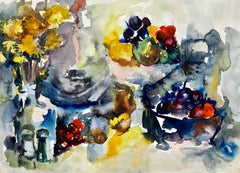
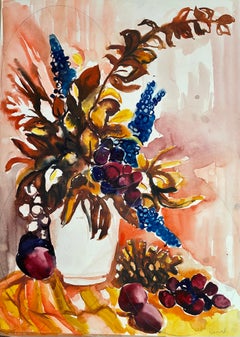
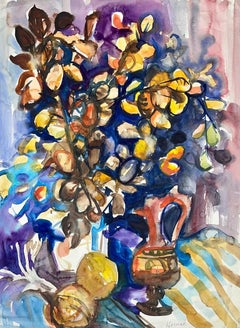
Untitled (Abstract Still Life with Flowers and Fruit)
By Ian Hornak
Located in Fairfield, CT
Artist: Ian Hornak (1944-2002) Title: Untitled (Abstract Still Life with Flowers and Fruit) Year: 1963 Medium: Watercolor on heavy archival paper Size: 29.5 x 21 inches Condition: Go...
Category

1960s Impressionist Interior Paintings

Materials

Watercolor

Untitled (Abstract Still Life with Flowers and Fruit)
By Ian Hornak
Located in Fairfield, CT
Artist: Ian Hornak (1944-2002) Title: Untitled (Abstract Still Life with Flowers and Fruit) Year: 1963 Medium: Watercolor on heavy archival paper Size: 29.5 x 21 inches Condition: Go...
Category

1960s Impressionist Interior Paintings

Materials

Watercolor

American Vivid Abstract Expressionist Art Oil Painting Norman Carton, WPA Artist
By Norman Carton
Located in Surfside, FL
Norman Carton (1908 – 1980) was an American artist and educator known for abstract expressionist art. He was born in the Ukraine region of Imperial Russia and moved to the United States in 1922 where he spent most of his adult life. A classically trained portrait and landscape artist, Carton also worked as a drafter, newspaper illustrator, muralist, theater set designer, photographer, and fabric designer and spent most of his mature life as an art educator. Carton showed in and continues to be shown in many solo and group exhibitions. His work is included in numerous museums and private collections throughout the world. Norman Carton was born in the Dnieper Ukraine territory of the Russian Empire in 1908. Escaping the turbulence of civil war massacres, he settled in Philadelphia in 1922 after years of constant flight. While attending the Pennsylvania Museum School of Industrial Art, Carton worked as a newspaper artist for the Philadelphia Record from 1928 to 1930 in the company of other illustrator/artists who had founded the Ashcan School, the beginnings of modern American art. From 1930 to 1935, he studied at the Pennsylvania Academy of Fine Arts under Henry McCarter, who was a pupil of Toulouse-Lautrec, Puvis de Chavanne, and Thomas Eakins. Arthur Carles, especially with his sense of color, and the architect John Harbison also provided tutelage and inspiration. Following his time at the Pennsylvania Academy of Fine Arts, Carton studied at the Barnes Foundation from 1935 to 1936 where he was influenced by an intellectual climate led by visiting lecturers John Dewey and Bertrand Russell as well as daily access to Albert C. Barnes and his art collection. Carton was awarded the Cresson Traveling Scholarship in 1934 which allowed him to travel through Europe and study in Paris. There he expanded his artistic horizons with influences stemming from Henri Matisse, Pablo Picasso, Chaim Soutine, and Wassily Kandinsky. While at the Pennsylvania Academy of Fine Arts, Carton was also awarded the Toppan Prize for figure painting as well as the Thouron Composition Prize. He received numerous commissions as a portrait artist, social realist, sculptor, and theatrical stage designer as well as academic scholarships. During this time, Carton worked as a scenery designer at Sparks Scenic Studios, a drafter at the Philadelphia Enameling Works, and a fine art lithographer. From 1939 to 1942, the Works Progress Administration (WPA) Federal Art Project employed Carton as a muralist and easel artist. He collaborated with architect George Howe. The WPA commissioned Carton to paint major murals at the Helen Fleischer Vocational School for Girls in Philadelphia, the Officers’ Club at Camp Meade Army Base in Maryland, and in the city of Hidalgo, Mexico. Throughout the 1940s, Carton exhibited and won prizes for his semi-abstract Expressionist and Surrealist paintings. He socialized with and was inspired by Émile Gauguin and Fernand Leger. During World War II, Carton was a naval structural designer and draftsman at the Cramps Shipbuilding Corporation in Camden, New Jersey. Here, he created non-objective sculpture with metal. After the war, Carton co-founded a fabric design plant in Philadelphia. He produced hand-printed fabrics for interiors and fashion that were featured in Harper’s Bazaar, Vogue and Women’s Wear Daily. Original fabric designs were commissioned by notable clients including Lord & Taylor, Gimbels, and Nina Ricci. Some of these designs are at the Metropolitan Museum of Art. Carton traded his partnership in the fabric design company in 1949 to focus full-time on painting. Carton had his first solo exhibition in 1949 at the Philadelphia Art Alliance. This show was followed closely by solo exhibitions at the Laurel Gallery (New York City) and Dubin Gallery (Philadelphia). At this time, his exhibited work was Abstract impressionism. In addition to painting, he taught classes at the Philadelphia Museum of Art and was the Founder and first President of the Philadelphia chapter of Artist’s Equity Association. The Philadelphia Museum of Art and the organization of the National Museums of France commissioned Carton to travel to Europe, mainly France, in 1950 for a color photography study of continental masterpieces. He was granted access to study the restoration of the Mona Lisa and was one of the very few to be given permission to remove the painting from its frame. During his three year stay in Paris, he had solo exhibits at La Sorbonne and Gallery Rene Breteau and was in 15 group shows in Paris salons including Les Sur Independants, Salon d’Automne, and Realities Nouvelles. He also exhibited at the Musee d’Art Juif where he won the Prix d’Art. The Cercle Paul Valery twice sponsored Carton to present lectures at the Sorbonne. He conducted seminars at the Louvre for the Cercle Esthetique Internationale and taught classes in and directed stage and costume design for the Theatre de Recherche at the Paris Opera. Among his Paris artist colleagues were Chana Orloff, Earl Kerkam, Sam Francis, Claire Falkenstein, Lawrence...
Category

Mid-20th Century Abstract Expressionist Landscape Paintings

Materials

Canvas, Oil

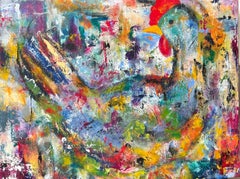
Chicken, lyrical wild bright humorous colorful abstract gesture
Located in Brooklyn, NY
Bold combination of abstract and gestural styles by NYC based designer/artist Fredda Tone Reminiscent of Clifford Stills, Robert Motherwell style
Category

2010s Abstract Expressionist Abstract Paintings

Materials

Canvas, Acrylic

American Vivid Abstract Expressionist Art Oil Painting Norman Carton, WPA Artist
By Norman Carton
Located in Surfside, FL
Norman Carton (1908 – 1980) was an American artist and educator known for abstract expressionist art. He was born in the Ukraine region of Imperial Russi...
Category

Mid-20th Century Abstract Expressionist Landscape Paintings

Materials

Canvas, Oil

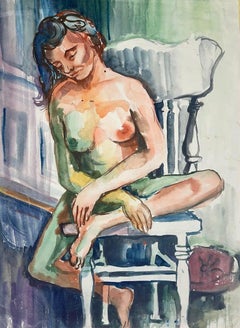
Untitled (Abstract Female Nude), 1963, Ian Hornak — Painting
By Ian Hornak
Located in Fairfield, CT
Artist: Ian Hornak (1944-2002) Title: Untitled (Abstract Female Nude) Year: 1963 Medium: Acrylic on illustration board Size: 29.5 x 21 inches Condition: Good Provenance: Estate of Ia...
Category

1960s Photorealist Nude Drawings and Watercolors

Materials

Watercolor, Archival Paper

Sunrise. 2020. Paper, mixed media, 94x63 cm
Located in Riga, LV
The abstract series of sizable works done in a mixed-media technique pays homage to the great modernists and abstract expressionists such as Mondrian, Kandinsky, Still and Motherwell...
Category

2010s Contemporary Abstract Paintings

Materials

Paper, Acrylic, Felt Pen, Stencil

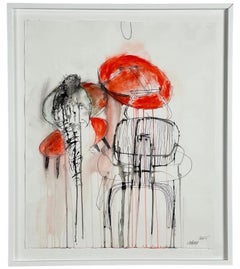
Abstract Expressionist Contemporary Modernist South African Painting Lorna Marsh
Located in Surfside, FL
Lorna Marsh (1949-2022) Acrylic on Paper (mixed media) Hand signed and dated Chairs, Table, and Figure 2015 Original masterpiece by Lorna Marsh. Created with acrylic and ink wash on...
Category

2010s Contemporary Figurative Paintings

Materials

Paper, Acrylic

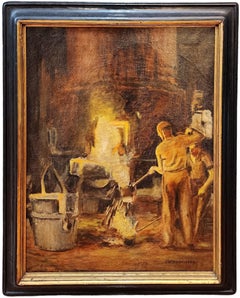
Steelworkers, Men Working, American Work Force, Jazz Enthusiast
Located in Grand Rapids, MI
John Hermansader (American, 1915 - 2005) Signed: J. Hermansader (Lower, Right) Steelworkers, c. 1940s Oil on Canvas 30" x 24" Housed in a 3" Frame Overall Size: 35 1/2" x 29 1/4" Craquelure throughout. In otherwise good condition. Biography: John Hermansader (1915–2005) was an American painter, graphic designer, and jazz fan. He is remembered for his iconic designs of Blue Note record covers. John Bancroft Hermansader was born on November 1, 1915 near Reading, Pennsylvania. In the 1930s, he studied at the Memphis Academy of Art in Tennessee and the New Bauhaus in Chicago, Illinois. In New York City he studied with Robert Motherwell at the New School of Social Research. In 1939, he and his wife Rosemary were founders of the Hot Club of Newark, New Jersey, a significant group of jazz enthusiasts. John became the first president. In 1951, when Blue Note Records began issuing 10 inch records, Hermansader was one of their first designers, along with Paul Bacon and Gil Melle. Looking back at this era, Michael Cuscuna of Mosaic Records said, “ What John Hermansader and Paul Bacon really did was evoke the feeling of the music. They used everything from Bauhaus designs to things that were really otherworldly.” Angelynn Grant adds, “When people think of Blue Note covers they think of Frank Wolff”s photography and Reid Miles design. But John Hermansader laid the groundwork that got them going along that path.” Richard Cook, who wrote Blue Note Records: The Biography states, “Hermansader in particular balanced the twin issues of photography and type in a way that would mirror the concerns of the Blue Note of the years ahead.” “John Hermansader was passionate about oil painting, “beautiful lyrical abstractions, full of color and movement.” He was an abstract expressionist painter who drew inspiration for his work from listening to jazz.” - (Obituary, Pilot, Redding Conn., July 14, 2005, p. 32A) His exhibitions included and the Gallery of Contemporary Art at Sunken Meadow, Long Island, 1951–58, Panoras Gallery 1956...
Category

Mid-20th Century Paintings

Materials

Canvas, Oil

Dream. 2020. Paper, mixed media, 63x94 cm
Located in Riga, LV
The abstract series of sizable works done in a mixed-media technique pays homage to the great modernists and abstract expressionists such as Mondrian, Kandinsky, Still and Motherwell...
Category

2010s Contemporary Abstract Paintings

Materials

Paper, Acrylic, Felt Pen, Stencil

American Modernist Abstract Expressionist Oil Painting Carving William Pellicone
Located in Surfside, FL
William Pellicone (American 1915-2004) Mixed media, pyrography, oil on wood carving painting. Dated 1958 Title - Enthymeme #14. Oil painting on carved and burnt distressed wood panel. Inscribed verso Enthymeme Wm. Pellicone #14, 9-4-58. Label on reverse with a typed definition for Enthymeme. Dimensions: 27 inches high, 42.5 inches wide. Metal wrap frame. Provenance: from a Shelter Island NY home that was designed by architect Henry J. Gazon - A.I.A. built in 1959. William Pellicone (1915-2004) was an American painter known for his abstract compositions and use of vibrant colors. He was born in New York City and studied at the Art Students League and the Brooklyn Museum Art School. Pellicone's early work was influenced by the Social Realist movement of the 1930s and 1940s, with his paintings often featuring realistic depictions of urban scenes and working-class people. However, in the 1950s he shifted towards abstraction, exploring the interplay of color and form. Pellicone's mature style was characterized by his use of vibrant, saturated colors, often applied in thick layers of paint. His paintings often featured geometric shapes and organic forms, with a strong sense of movement and energy. In addition to his painting, Pellicone was also a respected teacher and arts administrator. He taught at the New York Institute of Technology and the State University of New York, and served as the director of the Islip Art Museum on Long Island. Pellicone's artwork was exhibited widely during his lifetime, and he was the recipient of numerous awards and honors, including a National Endowment for the Arts grant in 1977. Today, his paintings can be found in the collections of museums and galleries around the world, including the Smithsonian American Art Museum in Washington, D.C. and the Metropolitan Museum of Art in New York. William Pellicone (Born 1915) is active/lives in New York. William Pellicone is known for Abstract expressionist, landscape and non-objective art. An American artist, sculptor, architect. He exhibited at Pennsylvania Academy Fine Arts...
Category

1950s Abstract Expressionist Abstract Paintings

Materials

Wood, Oil

Sage (Geometric Abstraction, Minimalism, Josef Albers, Hard Edge)
By Susan Kiefer
Located in Kansas City, MO
Artist : Susan Kiefer Title : Sage Materials : oil on canvas Date : March 2020 Dimensions : 18" x 24" x 1.5" Description : Tangents from three intersecting circles in shades of cadm...
Category

2010s Contemporary Paintings

Materials

Canvas, Paint, Oil

Shine a Light on It
By Katherine Bello
Located in Kansas City, MO
Katherine Bello Title: Shine a Light on It Oil on board Year: 2021 Dimensions: 12"x12"x1" Signed by hand Framed in a white floater frame COA provid...
Category

2010s Contemporary Abstract Paintings

Materials

Oil, Board

Defining Moments
By Katherine Bello
Located in Kansas City, MO
Katherine Bello Title: Defining Moments Medium: oil on canvas Year: 2020 Size: 40" x 30" x 1.5" Signed, dated and inscribed by hand COA provided (issued by representing gallery) Katherine Bello's aim as an artist is to capture a sense of place, a moment of time, or a feeling - to evoke a sense of wonder. Bello loves paint and paint brushes; bold, gestural mark-making and the interplay of color. She is influenced by light and landscape, poetry, history and science. Formerly educated in Chemical Engineering and Interior Design, Bello is drawn to the process of creating Something out of Nothing. Abstract, sbstract art...
Category

2010s Contemporary Paintings

Materials

Canvas, Oil

Colorado Woman Abstract Expressionist Oil Painting Modernist Still Life, Fruit
By Ruth Todd
Located in Surfside, FL
Ruth Todd (1909-2006, American Woman Artist) one of Colorado’s most prominent avant-garde artists and played a significant role in Colorado’s art history. Known for painting and collage. Still life with lemon and banana on kitchen table. Ruth Thomas Todd was born in 1909 in Sanford, North Carolina. She arrived in New York City in the 1930s where she began her career as a fashion model supporting herself as she attended classes at the Art Students League. For reasons of health she moved to Colorado Springs to treat her condition. During her recuperation she started to draw and studied under famous American abstract painter Robert Motherwell, who was teaching at the Colorado Springs Fine Arts Center at the time. By the 1950s, her career as an abstract expressionist painter was blooming. She was one of Colorado’s most visible and avant-garde artists. Ruth married Littleton Todd, a poet and a woodworker. In 1953, Todd traveled to Europe (Paris, France) to study art and to paint. Littleton Todd opened a design studio in Denver where he manufactured and sold modern furniture. She would incorporate sawdust and other found materials from the workshop imbued with oil paint into her abstract work to create unique topographies and patterns. She showed at numerous Gilpin County Art Exhibitions, the Denver Art Museum, the Colorado Springs Fine Arts Center, Colorado Women’s College, the University of Colorado, Boulder, the Colorado State Fair, and the Jewish Community Center. Among the Colorado Modernists that she exhibited with were Vance Kirkland, Frank Vavra, Martha Epp, Ardis Sturdy...
Category

1950s Modern Still-life Paintings

Materials

Oil, Board

Untitled (Abstract Still Life with Flowers and Fruit)
By Ian Hornak
Located in Fairfield, CT
Artist: Ian Hornak (1944-2002) Title: Untitled (Abstract Still Life with Flowers and Fruit) Year: 1963 Medium: Watercolor on heavy archival paper Size: 29.5 x 21 inches Condition: Go...
Category

1960s Impressionist Interior Paintings

Materials

Watercolor

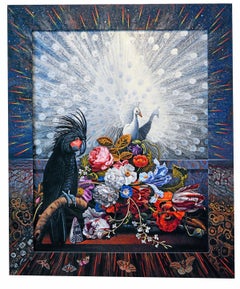
Nocturne I: White Peacock, Black Cockatoo
By Ian Hornak
Located in Fairfield, CT
Artist: Ian Hornak (1944-2002) Title: Nocturne I: White Peacock, Black Cockatoo Year: 1990 Medium: Acrylic on Panel, with Artist Painted Frame Size: 58 x...
Category

1990s Photorealist Still-life Paintings

Materials

Acrylic

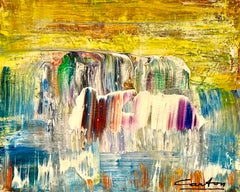
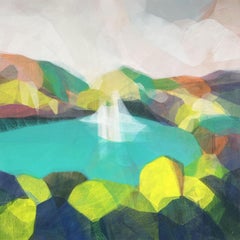
"(uhuru) waterfall at road to hana no. 3" - abstract landscape, colorful, water
By Katherine Sandoz
Located in Atlanta, GA
This painting is an abstract landscape on canvas featuring vibrant layers of bright yellow green, purple, orange and blue. Katherine Sandoz is inspired by the work of Helen Frankent...
Category

2010s Abstract Abstract Paintings

Materials

Canvas, Acrylic

Unfinished Melody, lyrical atmospheric colorful abstract gesture
Located in Brooklyn, NY
Bold combination of geometric and gestural styles of abstraction by NYC based designer/artist Fredda Tone Reminiscent of Clifford Stills, Robert Motherwell ...
Category

2010s Abstract Expressionist Abstract Paintings

Materials

Canvas, Acrylic

Watercolor Leftovers
By Kory Twaddle
Located in Kansas City, MO
Kory Twaddle "Watercolor Leftovers" Watercolor on paper Year: 2015 Size: 10 x 12 inches COA provided "I hope to use all the materials in my studio and waste nothing, so emptying out...
Category

2010s Abstract Mixed Media

Materials

Paint, Paper, Acrylic, Tempera, Watercolor, Graphite
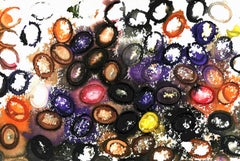
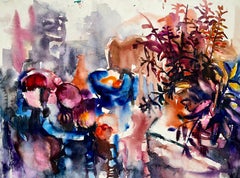
Untitled (Abstract Still Life with Flowers and Fruit)
By Ian Hornak
Located in Fairfield, CT
Artist: Ian Hornak (1944-2002) Title: Untitled (Abstract Still Life with Flowers and Fruit) Year: 1963 Medium: Watercolor on heavy archival paper Size: 11.5 x 15 inches Condition: Go...
Category

1960s Impressionist Interior Paintings

Materials

Watercolor

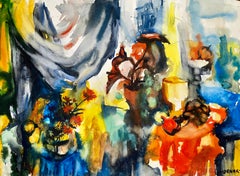
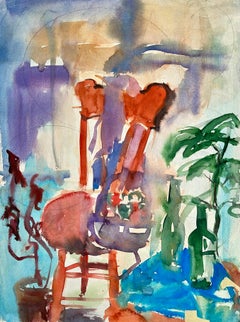
Untitled (Abstract Still Life with Chair, Flowers and Bottles), Ian Hornak
By Ian Hornak
Located in Fairfield, CT
Artist: Ian Hornak (1944-2002) Title: Untitled Untitled (Abstract Still Life with Chair, Flowers and Bottles) Year: 1963 Medium: Watercolor on heavy archival paper Size: 29.5 x 21 in...
Category

1960s Impressionist Interior Paintings

Materials

Watercolor

Lace. 2021. Paper, mixed media, 63x94 cm
Located in Riga, LV
The abstract series of sizable works done in a mixed-media technique pays homage to the great modernists and abstract expressionists such as Mondrian, Kandinsky, Still and Motherwell...
Category

2010s Contemporary Abstract Paintings

Materials

Paper, Acrylic, Felt Pen, Stencil

Untitled. 2020. Paper, mixed media, 63x94 cm
Located in Riga, LV
The abstract series of sizable works done in a mixed-media technique pays homage to the great modernists and abstract expressionists such as Mondrian, Kandinsky, Still and Motherwell...
Category

2010s Contemporary Abstract Paintings

Materials

Paper, Acrylic, Felt Pen, Stencil

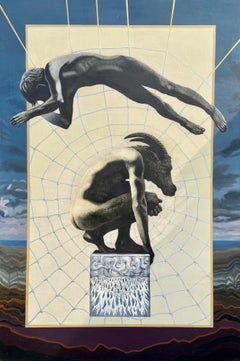
Sorcerer Series: Beast Head, Spider Web
By Ian Hornak
Located in Fairfield, CT
Artist: Ian Hornak (1944-2002) Title: Sorcerer Series: Beast Head, Spiderweb Year: February 1969 Medium: Acrylic on Canvas Size: 72 x 48 inches Condition: Excellent Inscription: Sign...
Category

1960s Photorealist Landscape Paintings

Materials

Canvas, Acrylic

American Abstract Expressionist Flowers Oil Painting Norman Carton WPA Artist
By Norman Carton
Located in Surfside, FL
Norman Carton (1908 – 1980) was an American artist and educator known for abstract expressionist art. He was born in the Ukraine region of Imperial Russia and moved to the United States in 1922 where he spent most of his adult life. A classically trained portrait and landscape artist, Carton also worked as a drafter, newspaper illustrator, muralist, theater set designer, photographer, and fabric designer and spent most of his mature life as an art educator. Carton showed in and continues to be shown in many solo and group exhibitions. His work is included in numerous museums and private collections throughout the world. Norman Carton was born in the Dnieper Ukraine territory of the Russian Empire in 1908. Escaping the turbulence of civil war massacres, he settled in Philadelphia in 1922 after years of constant flight. While attending the Pennsylvania Museum School of Industrial Art, Carton worked as a newspaper artist for the Philadelphia Record from 1928 to 1930 in the company of other illustrator/artists who had founded the Ashcan School, the beginnings of modern American art. From 1930 to 1935, he studied at the Pennsylvania Academy of Fine Arts under Henry McCarter, who was a pupil of Toulouse-Lautrec, Puvis de Chavanne, and Thomas Eakins. Arthur Carles, especially with his sense of color, and the architect John Harbison also provided tutelage and inspiration. Following his time at the Pennsylvania Academy of Fine Arts, Carton studied at the Barnes Foundation from 1935 to 1936 where he was influenced by an intellectual climate led by visiting lecturers John Dewey and Bertrand Russell as well as daily access to Albert C. Barnes and his art collection. Carton was awarded the Cresson Traveling Scholarship in 1934 which allowed him to travel through Europe and study in Paris. There he expanded his artistic horizons with influences stemming from Henri Matisse, Pablo Picasso, Chaim Soutine, and Wassily Kandinsky. While at the Pennsylvania Academy of Fine Arts, Carton was also awarded the Toppan Prize for figure painting as well as the Thouron Composition Prize. He received numerous commissions as a portrait artist, social realist, sculptor, and theatrical stage designer as well as academic scholarships. During this time, Carton worked as a scenery designer at Sparks Scenic Studios, a drafter at the Philadelphia Enameling Works, and a fine art lithographer. From 1939 to 1942, the Works Progress Administration (WPA) Federal Art Project employed Carton as a muralist and easel artist. He collaborated with architect George Howe. The WPA commissioned Carton to paint major murals at the Helen Fleischer Vocational School for Girls in Philadelphia, the Officers’ Club at Camp Meade Army Base in Maryland, and in the city of Hidalgo, Mexico. Throughout the 1940s, Carton exhibited and won prizes for his semi-abstract Expressionist and Surrealist paintings. He socialized with and was inspired by Émile Gauguin and Fernand Leger. During World War II, Carton was a naval structural designer and draftsman at the Cramps...
Category

Mid-20th Century Abstract Expressionist Still-life Paintings

Materials

Oil, Board

"Blue Fossil" Gerome Kamrowski, Abstract Surrealist, Biomorphic Expressionism
By Gerome Kamrowski
Located in New York, NY
Gerome Kamrowski Blue Fossil, 1960 Acrylic and styrofoam on board 17 x 46 inches Gerome Kamrowski was born in Warren, Minnesota, on January 19, 1914. In 1932 he enrolled in the Saint Paul School of Art (now Minnesota Museum of American Art - MMAA), where he studied with Leroy Turner...
Category

1960s Surrealist Abstract Paintings

Materials

Foam, Mixed Media, Acrylic, Board

Untitled (Abstract Garden Still Life with Flowers, Plants and Pumpkins)
By Ian Hornak
Located in Fairfield, CT
Artist: Ian Hornak (1944-2002) Title: Untitled (Abstract Garden Still Life with Flowers, Plants and Pumpkins) Year: 1963 Medium: Watercolor on heavy archival paper Size: 29.5 x 21 in...
Category

1960s Impressionist Landscape Paintings

Materials

Watercolor

American Vivid Abstract Expressionist Art Oil Painting Norman Carton, WPA Artist
By Norman Carton
Located in Surfside, FL
Norman Carton (1908 – 1980) was an American artist and educator known for abstract expressionist art. He was born in the Ukraine region of Imperial Russia and moved to the United States in 1922 where he spent most of his adult life. A classically trained portrait and landscape artist, Carton also worked as a drafter, newspaper illustrator, muralist, theater set designer, photographer, and fabric designer and spent most of his mature life as an art educator. Carton showed in and continues to be shown in many solo and group exhibitions. His work is included in numerous museums and private collections throughout the world. Norman Carton was born in the Dnieper Ukraine territory of the Russian Empire in 1908. Escaping the turbulence of civil war massacres, he settled in Philadelphia in 1922 after years of constant flight. While attending the Pennsylvania Museum School of Industrial Art, Carton worked as a newspaper artist for the Philadelphia Record from 1928 to 1930 in the company of other illustrator/artists who had founded the Ashcan School, the beginnings of modern American art. From 1930 to 1935, he studied at the Pennsylvania Academy of Fine Arts under Henry McCarter, who was a pupil of Toulouse-Lautrec, Puvis de Chavanne, and Thomas Eakins. Arthur Carles, especially with his sense of color, and the architect John Harbison also provided tutelage and inspiration. Following his time at the Pennsylvania Academy of Fine Arts, Carton studied at the Barnes Foundation from 1935 to 1936 where he was influenced by an intellectual climate led by visiting lecturers John Dewey and Bertrand Russell as well as daily access to Albert C. Barnes and his art collection. Carton was awarded the Cresson Traveling Scholarship in 1934 which allowed him to travel through Europe and study in Paris. There he expanded his artistic horizons with influences stemming from Henri Matisse, Pablo Picasso, Chaim Soutine, and Wassily Kandinsky. While at the Pennsylvania Academy of Fine Arts, Carton was also awarded the Toppan Prize for figure painting as well as the Thouron Composition Prize. He received numerous commissions as a portrait artist, social realist, sculptor, and theatrical stage designer as well as academic scholarships. During this time, Carton worked as a scenery designer at Sparks Scenic Studios, a drafter at the Philadelphia Enameling Works, and a fine art lithographer. From 1939 to 1942, the Works Progress Administration (WPA) Federal Art Project employed Carton as a muralist and easel artist. He collaborated with architect George Howe. The WPA commissioned Carton to paint major murals at the Helen Fleischer Vocational School for Girls in Philadelphia, the Officers’ Club at Camp Meade Army Base in Maryland, and in the city of Hidalgo, Mexico. Throughout the 1940s, Carton exhibited and won prizes for his semi-abstract Expressionist and Surrealist paintings. He socialized with and was inspired by Émile Gauguin and Fernand Leger. During World War II, Carton was a naval structural designer and draftsman at the Cramps...
Category

Mid-20th Century Abstract Expressionist Landscape Paintings

Materials

Canvas, Oil

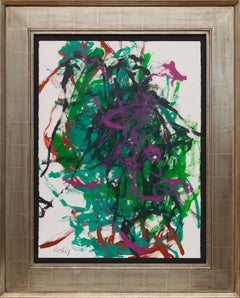
abstract modern expressionist in Green and Purple
By Jack Roth
Located in New York, NY
A striking and lively work by Roth that would be an exciting addition to any interior and is of high market value. Great frame of high quality - modernist flat panel frame with exceptional 24 karat silvered leafing. Large scale work by a highly collected American abstractionist. Born in Brockway, Pennsylvania in 1927 Jack Roth began his studies in chemistry at Pennsylvania State University in 1943 and, though his tenure there was interrupted by service in World War II, he would go on to earn a Bachelors degree in Chemistry, a Masters in Fine Arts, and a PhD in mathematics. At the California School of Fine Arts he studies under Mark Rothko, Clyfford Still, Richard Diebenkorn, David Park and Elmer Bischoff, mentors who would soon become colleagues. Painting from a studio in New York City’s lower East Side, Roth attracted the attention of James Johnson Sweeney, Director of the Guggenheim Museum of Art, who selected Roth for the museum’s traveling exhibition Younger American Painters, a multi-venue exhibition which included work by Baziotes, Diebenkorn, Gottlieb, Guston, Kline, de Kooning, Motherwell, Pollock among others. In 1963 Museum of Modern Art curators Dorothy Miller and William Lieberman recommended that the periodical Art in America name Roth the new talent graphic artist and had themselves purchased several works for the museum’s permanent collection. He was then selected for a national traveling exhibition at the University of Kentucky, Graphics 63, which was circulated by the Smithsonian Institution. That same year he was included in a New Acquisitions exhibition at the Museum of Modern Art. From 1963 to 1966 Roth taught at the University of Southern Florida in Tampa before moving to Montclair, New Jersey, where he was worked as chairman of the Mathematics department at Upsala College and concurrently as a mathematics professor and paintings professor at Ramapo College in 1971 where he was given a large studio, space enough to work with larger canvases developing as an Abstract Expressionist Color field painter. In 1978 the acclaimed gallery, Knoedler Co. in New York City began their representation of Jack Roth’s work. At this time Knoedler Co. represented Alexander Calder, Adolf Gottlieb...
Category

1980s Abstract Abstract Paintings

Materials

Acrylic, Archival Paper

Untitled (Abstract Still Life with Flowers), 1963, Ian Hornak — Painting
By Ian Hornak
Located in Fairfield, CT
Artist: Ian Hornak (1944-2002) Title: Untitled (Abstract Still Life with Flowers) Year: circa 1963 Medium: Acrylic on double layered Masonite Size: 29.5 x 21 inches Condition: Good P...
Category

1960s Photorealist Interior Drawings and Watercolors

Materials

Watercolor, Archival Paper

Untitled (Abstract Still Life with Table, Flowers and Fruit)
By Ian Hornak
Located in Fairfield, CT
Artist: Ian Hornak (1944-2002) Title: Untitled (Abstract Still Life with Table, Flowers and Fruit) Year: 1963 Medium: Watercolor on heavy archival paper Size: 29.5 x 21 inches Condit...
Category

1960s Impressionist Interior Paintings

Materials

Watercolor

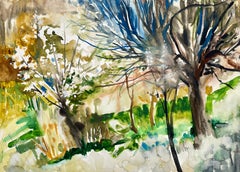
Untitled (Abstract Landscape with Flowering Tree)
By Ian Hornak
Located in Fairfield, CT
Artist: Ian Hornak (1944-2002) Title: Untitled (Abstract Landscape with Flowering Tree) Year: 1963 Medium: Watercolor on heavy archival paper Size: 29.5 x 21 inches Condition: Good P...
Category

1960s Impressionist Figurative Paintings

Materials

Watercolor

Untitled (Abstract Still Life with Flowers and Fruit), Ian Hornak
By Ian Hornak
Located in Fairfield, CT
Artist: Ian Hornak (1944-2002) Title: Untitled (Abstract Still Life with Flowers and Fruit) Year: 1963 Medium: Watercolor on heavy archival paper Size: 29.5 x 21 inches Condition: Go...
Category

1960s Impressionist Interior Paintings

Materials

Watercolor

Untitled (Abstract Still Life with Flowers, Plants and Peppers)
By Ian Hornak
Located in Fairfield, CT
Artist: Ian Hornak (1944-2002) Title: Untitled (Abstract Still Life with Flowers, Plants and Peppers) Year: 1963 Medium: Watercolor on heavy archival paper Size: 29.5 x 21 inches Con...
Category

1960s Impressionist Interior Paintings

Materials

Watercolor

Untitled (Abstract Summer Still Life with Plants and Peppers), Ian Hornak
By Ian Hornak
Located in Fairfield, CT
Artist: Ian Hornak (1944-2002) Title: Untitled (Abstract Summer Still Life with Flowers and Plants) Year: 1963 Medium: Watercolor on heavy archival paper Size: 29.5 x 21 inches Condi...
Category

1960s Impressionist Interior Paintings

Materials

Watercolor

Untitled (Abstract Still Life with Flowers and Fruit)
By Ian Hornak
Located in Fairfield, CT
Artist: Ian Hornak (1944-2002) Title: Untitled (Abstract Still Life with Flowers and Fruit) Year: 1963 Medium: Watercolor on heavy archival paper Size: 11.5 x 15 inches Condition: Go...
Category

1960s Impressionist Interior Paintings

Materials

Watercolor

Untitled (Abstract Still Life with Flowers and Fruit)
By Ian Hornak
Located in Fairfield, CT
Artist: Ian Hornak (1944-2002) Title: Untitled (Abstract Still Life with Flowers and Fruit) Year: 1963 Medium: Watercolor on heavy archival paper Size: 29.5 x 21 inches Condition: Go...
Category

1960s Impressionist Interior Paintings

Materials

Watercolor

Read More