18,219 results for "american "

to
2,361
6,068
4,499
1,895
2,182
3,570
Overall Width
to
Overall Height
to
6
66
7,852
10,279
2
5
40
93
202
1,241
1,423
1,405
1,087
1,026
5
8,931
3,392
1,348
528
431
203
152
145
64
58
45
22
10
8,459
6,615
3,060
8,351
3,901
3,706
3,025
2,734
2,421
2,277
2,078
1,275
1,044
920
896
870
738
728
696
691
678
652
618
7,149
6,380
6,096
5,105
4,234
1,714
1,647
1,121
883
604
1,646
5,343
14,444
3,255
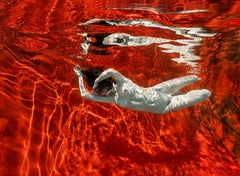
The Lust - underwater nude photograph - archival pigment print 43" x 58"
By Alex Sher
Located in Beverly Hills, CA
Underwater nude photograph of a young woman on red background. Original gallery quality archival pigment print on archival paper signed by the artist, furnished with certificate of ...
Category

2010s Contemporary Figurative Photography

Materials

Archival Paper, Archival Pigment

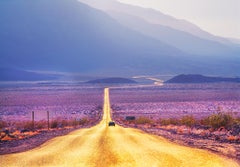
Golden Dessert Road to Infinity in the American West
By Mitchell Funk
Located in Miami, FL
An endless road is pictured in a timeless landscape. As the road winds through the vast expanse of the American West, the grandeur of the surrounding landscape minimizes a solitary c...
Category

1980s Contemporary Landscape Photography

Materials

Archival Ink, Archival Paper, Archival Pigment

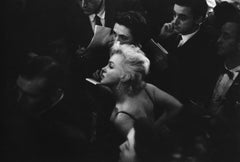
Eve Arnold - Marilyn Monroe in the Waldorf Astoria Ballroom, 1956, Printed After
By Eve Arnold
Located in Stamford, CT
Marilyn Monroe in the Waldorf Astoria Ballroom in New York City, 1956. All available sizes and editions: 20" x 24", Edition of 25 + 3 Artist Proofs 24" x 34", Edition of 25 + 3 Arti...
Category

1960s Contemporary Black and White Photography

Materials

Cotton, Paper

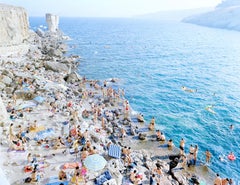
Porto Miggiano (framed) - large scale photograph of Italian Mediterranean beach
By Massimo Vitali
Located in San Francisco, CA
large scale photograph of iconic summer beach scene in Southern Italy's Puglia by Italian photographer Massimo Vitali, renowned for his grand s...
Category

21st Century and Contemporary Contemporary Color Photography

Materials

Plexiglass, Wood, Photographic Film, Archival Paper, Photographic Paper,...

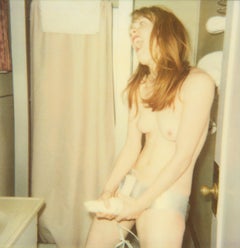
Wild Things (Till Death do us Part) - Contemporary, 21st Century, Polaroid
By Stefanie Schneider
Located in Morongo Valley, CA
Wild Things (Till Death Do Us Part) - 2005, 20x20cm, Edition of 10, plus 2 Artist Proofs. Archival C-Print, based on the Polaroid. Certificate and Signature label. Artist Inven...
Category

Early 2000s Contemporary Color Photography

Materials

Archival Paper, Photographic Paper, C Print, Color, Polaroid

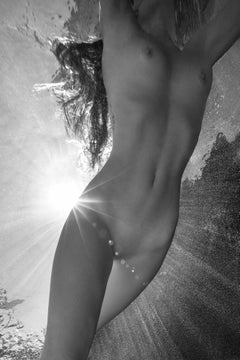
Sunbeams - underwater black white nude photograph - archival pigment 65x43"
By Alex Sher
Located in Beverly Hills, CA
Underwater black and white photograph of a young naked woman wrapped in air bubbles and sunbeams. There were five grand-pianos at her house, a pool on the third floor, and a sad man...
Category

2010s Contemporary Black and White Photography

Materials

Archival Paper, Archival Pigment

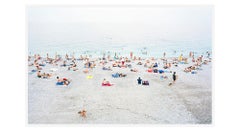
Nizza - framed large photograph of summer beach scene in South of France
By Frank Schott
Located in San Francisco, CA
observation of a Mediterranean beach scene in Nice, France, on a hazy summer day Nizza by Frank Schott white wood gallery frame ( 1 inch face 2 1/2 inch deep ) 27 x 41 inches (68....
Category

21st Century and Contemporary Contemporary Color Photography

Materials

Archival Ink, Archival Paper, Photographic Paper, Giclée, Archival Pigme...

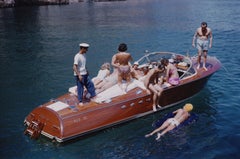
Holiday in Capri, July 1958 - Motorboats and Swimming in Water off Island Capri
By Slim Aarons
Located in Brighton, GB
Holiday in Capri - Motorboats and Swimming in Water off Island Capri by Slim Aarons 16" x 20" print. Limited Edition Estate Stamped Print. Edition of 150. Printed Later. 'Holiday i...
Category

20th Century American Modern Nude Photography

Materials

C Print, Photographic Paper, Color, Digital

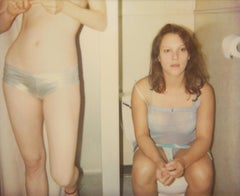
Taking Turns (Till Death Do Us Part) - 21st Century, Polaroid, Nude Photography
By Stefanie Schneider
Located in Morongo Valley, CA
Taking Turns (Till Death Do Us Part) - 2006 40x48cm,. Edition of 10, plus 2 Artist Proofs. Archival C-Print print, based on the Polaroid. Certificate and Signature label. Artist ...
Category

Early 2000s Contemporary Color Photography

Materials

Photographic Paper, C Print, Color, Polaroid, Archival Paper

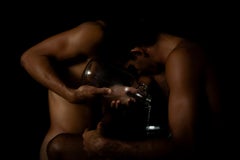
Rios. Figurative Limited Edition Color Photograph
By Ricky Cohete
Located in Miami Beach, FL
Exploring color in the darkness, inspired by the Italian and Dutch renaissance. He brings hints of the fauna of his native South American vibrant and passionate colors. Bringing them...
Category

2010s Contemporary Nude Photography

Materials

Archival Pigment

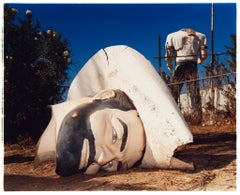
American Cowboy Head and Torso, Salton Sea, California - American Color Photo
By Richard Heeps
Located in Cambridge, GB
A classic American icon, the roadside giant Cowboy "Muffler Man", captured on Richard Heeps' road trip between Mecca and the Salton Sea. Part of a series of pictures by Richard Heeps...
Category

Early 2000s Contemporary Color Photography

Materials

Photographic Paper, C Print, Color, Silver Gelatin

Golden Gate Bridge ( 58 x 110" )
By Frank Schott
Located in San Francisco, CA
GOLDEN GATE by Frank Schott an epic scale photograph of iconic Golden Gate Bridge and San Francisco skyline in Northern California's atmospheric morning light 58 x 110 inches ( 147 ...
Category

21st Century and Contemporary Contemporary Color Photography

Materials

Photographic Paper, Archival Pigment, Archival Paper, Giclée

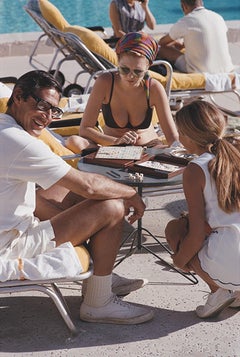
Scrabble in Palm Springs - Playing Scrabble by Swimming Pool in Tennis Whites
By Slim Aarons
Located in Brighton, GB
Scrabble in Palm Springs - Playing Scrabble by Swimming Pool in Tennis Whites by Slim Aarons 16" x 20" print. Limited Edition Estate Stamped Print. Edition of 150. Printed Later. '...
Category

20th Century American Modern Landscape Photography

Materials

C Print, Photographic Paper, Color, Digital

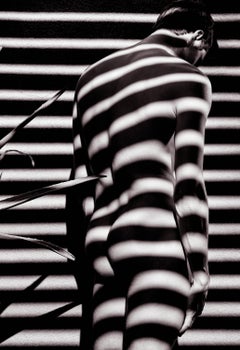
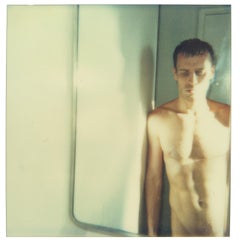
Frederick Collier, 21st Century, Contemporary, Celebrity, Photography
By Greg Gorman
Located in München, BY
Edition 25 A nude male model is standing in in the shade of a blind. From personality portraits and advertising campaigns to magazine layouts and fine art work, Greg Gorman has dev...
Category

21st Century and Contemporary Contemporary Nude Photography

Materials

Archival Pigment

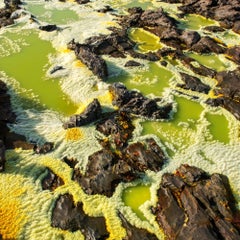
Afar III by Luca Marziale - Abstract fine art photography, green, nature, rocks
By Luca Marziale
Located in Paris, FR
Afar III is a limited-edition photograph by contemporary artist Luca Marziale. This photograph is sold unframed as a print only. It is available in 2 dimensions: *76.2 × 76.2 cm (3...
Category

2010s Contemporary Landscape Photography

Materials

C Print

Living in a Dream (Till Death do us Part) - Contemporary, Polaroid, Women
By Stefanie Schneider
Located in Morongo Valley, CA
Living in a Dream (Till Death do us Part) - 2005 20x20cm, Edition of 10, Archival C-Print print, based on the Polaroid. Certificate and Signature label, artist Inventory No. 9781. Not mounted. on offer is a piece from the movie "Till Death do us Part" Stefanie Schneider’s Till Death Do Us Part or “There is Only the Desert for You.” BY DREW HAMMOND Stefanie Schneider’s Til Death to Us Part is a love narrative that comprises three elements: 1. A montage of still images shot and elaborated by means of her signature technique of using Polaroid formats with outdated and degraded film stock in natural light, with the resulting im ages rephotographed (by other means) enlarged and printed in such a way as to generate further distortions of the image. 2. Dated Super 8 film footage without a sound track and developed by the artist. 3. Recorded off-screen narration of texts written by the actors or photographic subjects, and selected by the artist. At the outset, this method presupposes a tension between still and moving image; between the conventions about the juxtaposition of such images in a moving image presentation; and, and a further tension between the work’s juxtaposition of sound and image, and the conventional relationship between sound and image that occurs in the majority of films. But Till Death Do Us Part also conduces to an implied synthesis of still and moving image by the manner in which the artist edits or cuts the work. First, she imposes a rigorous criterion of selection, whether to render a section as a still or moving image. The predominance of still images is neither an arbitrary residue of her background as a still photographer—in fact she has years of background in film projects; nor is it a capricious reaction against moving picture convention that demands more moving images than stills. Instead, the number of still images has a direct thematic relation to the fabric of the love story in the following sense. Stills, by definition, have a very different relationship to time than do moving images. The unedited moving shot occurs in real time, and the edited moving shot, despite its artificial rendering of time, all too 2009often affords the viewer an even greater illusion of experiencing reality as it unfolds. It is self-evident that moving images overtly mimic the temporal dynamic of reality. Frozen in time—at least overtly—still photographic images pose a radical tension with real time. This tension is all the more heightened by their “real” content, by the recording aspect of their constitution. But precisely because they seem to suspend time, they more naturally evoke a sense of the past and of its inherent nostalgia. In this way, they are often more readily evocative of other states of experience of the real, if we properly include in the real our own experience of the past through memory, and its inherent emotions. This attribute of stills is the real criterion of their selection in Til Death Do Us Part where consistently, the artist associates them with desire, dream, memory, passion, and the ensemble of mental states that accompany a love relationship in its nascent, mature, and declining aspects. A SYNTHESIS OF MOVING AND STILL IMAGES BOTH FORMAL AND CONCEPTUAL It is noteworthy that, after a transition from a still image to a moving image, as soon as the viewer expects the movement to continue, there is a “logical” cut that we expect to result in another moving image, not only because of its mise en scène, but also because of its implicit respect of traditional rules of film editing, its planarity, its sight line, its treatment of 3D space—all these lead us to expect that the successive shot, as it is revealed, is bound to be another moving image. But contrary to our expectation, and in delayed reaction, we are startled to find that it is another still image. One effect of this technique is to reinforce the tension between still and moving image by means of surprise. But in another sense, the technique reminds us that, in film, the moving image is also a succession of stills that only generate an illusion of movement. Although it is a fact that here the artist employs Super 8 footage, in principle, even were the moving images shot with video, the fact would remain since video images are all reducible to a series of discrete still images no matter how “seamless” the transitions between them. Yet a third effect of the technique has to do with its temporal implication. Often art aspires to conflate or otherwise distort time. Here, instead, the juxtaposition poses a tension between two times: the “real time” of the moving image that is by definition associated with reality in its temporal aspect; and the “frozen time” of the still image associated with an altered sense of time in memory and fantasy of the object of desire—not to mention the unreal time of the sense of the monopolization of the gaze conventionally attributed to the photographic medium, but which here is associated as much with the yearning narrator as it is with the viewer. In this way, the work establishes and juxtaposes two times for two levels of consciousness, both for the narrator of the story and, implicitly, for the viewer: A) the immediate experience of reality, and B) the background of reflective effects of reality, such as dream, memory, fantasy, and their inherent compounding of past and present emotions. In addition, the piece advances in the direction of a Gesammtkunstwerk, but in a way that reconsiders this synaesthesia as a unified complex of genres—not only because it uses new media that did not exist when the idea was first enunciated in Wagner’s time, but also because it comprises elements that are not entirely of one artist’s making, but which are subsumed by the work overall. The totality remains the vision of one artist. In this sense, Till Death Do Us Part reveals a further tension between the central intelligence of the artist and the products of other individual participants. This tension is compounded to the degree that the characters’ attributes and narrated statements are part fiction and part reality, part themselves, and part their characters. But Stefanie Schneider is the one who assembles, organizes, and selects them all. THE RELATIONSHIP BETWEEN THIS IDEA (above) AND PHOTOGRAPHY This selective aspect of the work is an expansion of idea of the act of photography in which the artistic photographer selects that which is already there, and then, by distortion, definition or delimitation, compositional and lighting emphasis, and by a host of other techniques, subsumes that which is already there to transform it into an image of the artist’s contrivance, one that is no less of the artist’s making than a work in any other medium, but which is distinct from many traditional media (such as painting) in that it retains an evocation of the tension between what is already there and what is of the artist’s making. Should it fail to achieve this, it remains, to that degree, mere illustration to which aesthetic technique has been applied with greater or lesser skill. The way Til Death Do Us Part expands this basic principle of the photographic act, is to apply it to further existing elements, and, similarly, to transform them. These additional existing elements include written or improvised pieces narrated by their authors in a way that shifts between their own identities and the identities of fictional characters. Such characters derive partially from their own identities by making use of real or imagined memories, dreams, fears of the future, genuine impressions, and emotional responses to unexpected or even banal events. There is also music, with voice and instrumental accompaniment. The music slips between integration with the narrative voices and disjunction, between consistency and tension. At times it would direct the mood, and at other times it would disrupt. Despite that much of this material is made by others, it becomes, like the reality that is the raw material of an art photo, subsumed and transformed by the overall aesthetic act of the manner of its selection, distortion, organization, duration, and emotional effect. * * * David Lean was fond of saying that a love story is most effective in a squalid visual environment. In Til Death Do Us Part, the squalor of the American desert...
Category

Early 2000s Contemporary Color Photography

Materials

Archival Paper, Photographic Paper, C Print, Color, Polaroid

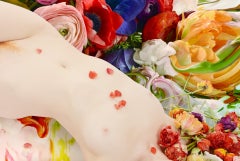
Flora 01 - Floral Nude Portrait Interior Design Photography Trompe L Oeil
By Tortora Travezan
Located in Brighton, GB
Flora 01 is a vibrant Digital C-Type print in an Edition of 15 in this size by contemporary photographer duo Tortora & Travezan. The trompe l'oeil effect of the printed floral backd...
Category

2010s Contemporary Nude Photography

Materials

Photographic Paper, C Print, Digital, Color

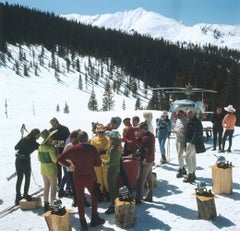
Snowmass Picnic, 1967 - Aspen Skiing Colorado Apres Ski American Snow Sports
By Slim Aarons
Located in Brighton, GB
Snowmass Picnic, 1967 - Aspen Skiing Colorado Apres Ski American Snow Sports by Slim Aarons 16" x 16" print on 16" x 20" paper. Limited Edition Estate Stamped Print. Edition of 150....
Category

20th Century American Modern Portrait Photography

Materials

C Print, Photographic Paper, Color, Digital

Andromeda - underwater black&white nude photograph - archival print 23.5x17"
By Alex Sher
Located in Beverly Hills, CA
Andromeda, in Greek mythology, beautiful daughter of King Cepheus and Queen Cassiope. Cassiope offended the Nereids by boasting that Andromeda was more beautiful than they, so in rev...
Category

2010s Contemporary Black and White Photography

Materials

Archival Paper, Archival Pigment

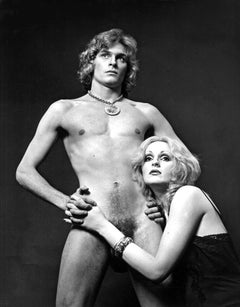
Warhol Superstars Candy Darling Dorian Gray nude, signed by Jack Mitchell
By Jack Mitchell
Located in Senoia, GA
11 x 14" vintage silver gelatin photograph of Warhol Superstars Candy Darling and Dorian Gray (nude) for 'After Dark' magazine, 1971 Signed by Jack Mitchell on the print verso. Comes...
Category

1960s Pop Art Black and White Photography

Materials

Silver Gelatin

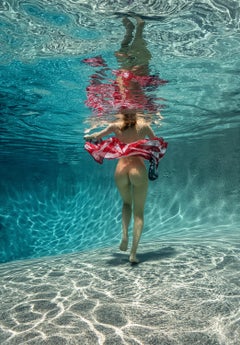
Independence II - underwater nude photograph - archival pigment print 23x16
By Alex Sher
Located in Beverly Hills, CA
An underwater photograph of a young naked woman dancing in a pool with American flag. Original gallery quality archival pigment print signed by the author. Limited edition of 24...
Category

2010s Contemporary Figurative Photography

Materials

Archival Paper, Archival Pigment

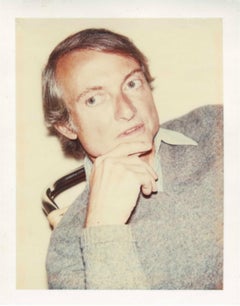
Unique portrait of Roy Lichtenstein, Authenticated by the Andy Warhol Foundation
By Andy Warhol
Located in New York, NY
Andy Warhol Portrait of Roy Lichtenstein, 1975 Polaroid dye-diffusion print Authenticated by the Andy Warhol Foundation for the Visual Arts, bears the Foundation stamp verso Frame included: Framed in white wood frame with UV plexiglass; with die-cut window in the back to show official Warhol Foundation authentication stamp and text Measurements: 9 9/16 x 8 9/16 x 9/16 inches (frame) 3 1/2 x 2 3/4 inches (window) 4.16 x 3.15 inches (Artwork) Authenticated and stamped by the Estate of Andy Warhol/Warhol Foundation for the Visual Arts An impressive piece of Pop Art history! A must-have for fans and collectors of both Andy Warhol and Roy Lichtenstein: This is a unique, authenticated color Polaroid taken by one Pop Art legend, Andy Warhol, of his most formidable contemporary and, in many respects, rival, Roy Lichtenstein. One of only a few portraits Andy Warhol took of Roy Lichtenstein, during one tense photo shoot. Both iconic artists, colleagues and, perhaps lesser known to the public, rivals, would be represented at the time by the renowned Leo Castelli Gallery. The truth is - they were really more rivals than friends. (the rivalry intensified when Warhol, who was working with Walt Disney, discovered that Lichtenstein painted Mickey Mouse before he did!!) Leo Castelli was committed to Roy Lichtenstein, and, it's easy to forget today, wasn't that interested in Warhol as he considered Lichtenstein the greater talent and he could relate better with Roy on a personal level. However, Ivan Karp, who worked at Castelli, was very interested in Warhol, as were some powerful European dealers, as well as many wealthy and influential American and European collectors. That was the start of Warhol's bypassing the traditional gallery model - so that dealers like Castelli could re-discover him after everybody else had. Warhol is known to have taken hundreds of self-portrait polaroid photographs - shoe boxes full - and he took many dozens of images of celebrities like Blondie and Farrah Fawcett. But only a small number of photographic portraits of fellow Pop Art legend Roy Lichtenstein -- each unique,- are known to have appeared on the market over the past half a century - all from the same photo session. This is one of them. There is another Polaroid - from this same (and only) sitting, in the permanent collection of the Getty Museum in California. There really weren't any other collaborations between these two titans, making the resulting portrait from this photo session extraordinary. It is fascinating to study Roy Lichtenstein's face and demeanor in this photograph, in the context of the great sense of competition, but perhaps even greater, albeit uneasy respect, these two larger than life Pop art titans had for each other: Like Leo Castelli, Roy Lichtenstein was Jewish of European descent; whereas Warhol was Catholic and quintessentially American, though also of European (Polish) descent. They were never going to be good friends, but this portrait, perhaps even arranged by Leo Castelli, represents an uneasy acknowledgement there would be room at the top for both of them. Floated, framed with die cut back revealing authentication details, and ready to hang. Measurements: 9 9/16 x 8 9/16 x 9/16 inches (frame) 3 1/2 x 2 3/4 inches (window) 4.16 x 3.15 inches (sheet) Authenticated by the Estate of Andy Warhol/The Andy Warhol Foundation for the Visual Arts. Estate Stamped: Stamped with the Andy Warhol Estate, Warhol Foundation for the Visual Arts stamp, numbered "B 512536P", with the Estate of Andy Warhol stamp and inscribed UP on the reverse. Bears the Warhol Foundation unique inventory number. Roy Lichtenstein Biography Roy Lichtenstein was one of the most influential and innovative artists of the second half of the twentieth century. He is preeminently identified with Pop Art, a movement he helped originate, and his first fully achieved paintings were based on imagery from comic strips and advertisements and rendered in a style mimicking the crude printing processes of newspaper reproduction. These paintings reinvigorated the American art scene and altered the history of modern art. Lichtenstein’s success was matched by his focus and energy, and after his initial triumph in the early 1960s, he went on to create an oeuvre of more than 5,000 paintings, prints, drawings, sculptures, murals and other objects celebrated for their wit and invention. Roy Fox Lichtenstein was born on October 27, 1923, in New York City, the first of two children born to Milton and Beatrice Werner Lichtenstein. Milton Lichtenstein (1893–1946) was a successful real estate broker, and Beatrice Lichtenstein (1896–1991), a homemaker, had trained as a pianist, and she exposed Roy and his sister Rénee to museums, concerts and other aspects of New York culture. Roy showed artistic and musical ability early on: he drew, painted and sculpted as a teenager, and spent many hours in the American Museum of Natural History and the Museum of Modern Art. He played piano and clarinet, and developed an enduring love of jazz, frequenting the nightspots in Midtown to hear it. Lichtenstein attended the Franklin School for Boys, a private junior high and high school, and was graduated in 1940. That summer he studied painting and drawing from the model at the Art Students League of New York with Reginald Marsh. In September he entered Ohio State University (OSU) in Columbus in the College of Education. His early artistic idols were Rembrandt, Daumier and Picasso, and he often said that Guernica (1937; Museo Reina Sofía, Madrid), then on long-term loan to the Museum of Modern Art, was his favorite painting. Even as an undergraduate, Lichtenstein objected to the notion that one set of lines (one person’s drawings) “was considered brilliant, and somebody’s else’s, that may have looked better to you, was considered nothing by almost everyone.”i Lichtenstein’s questioning of accepted canons of taste was encouraged by Hoyt L. Sherman, a teacher whom he maintained was the person who showed him how to see and whose perception-based approach to art shaped his own. In February 1943, Lichtenstein was drafted, and he was sent to Europe in 1945. As part of the infantry, he saw action in France, Belgium and Germany. He made sketches throughout his time in Europe and, after peace was declared there, he intended to study at the Sorbonne. Lichtenstein arrived in Paris in October 1945 and enrolled in classes in French language and civilization, but soon learned that his father was gravely ill. He returned to New York in January 1946, a few weeks before Milton Lichtenstein died. In the spring of that year, Lichtenstein went back to OSU to complete his BFA and in the fall he was invited to join the faculty as an instructor. In June 1949, he married Isabel Wilson Sarisky (1921–80), who worked in a cooperative art gallery in Cleveland where Lichtenstein had exhibited his work. While he was teaching, Lichtenstein worked on his master’s degree, which he received in 1949. During his second stint at OSU, Lichtenstein became closer to Sherman, and began teaching his method on how to organize and unify a composition. Lichtenstein remained appreciative of Sherman’s impact on him. He gave his first son the middle name of “Hoyt,” and in 1994 he donated funds to endow the Hoyt L. Sherman Studio Art Center at OSU. In the late 1940s and early 1950s, Lichtenstein began working in series and his iconography was drawn from printed images. His first sustained theme, intimate paintings and prints in the vein of Paul Klee that poked lyrical fun at medieval knights, castles and maidens, may well have been inspired by a book about the Bayeux Tapestry. Lichtenstein then took an ironic look at nineteenth-century American genre paintings he saw in history books, creating Cubist interpretations of cowboys and Indians spiked with a faux-primitive whimsy. As with his most celebrated Pop paintings of the 1960s, Lichtenstein gravitated toward what he would characterize as the “dumbest” or “worst” visual item he could find and then went on to alter or improve it. In the 1960s, commercial art was considered beneath contempt by the art world; in the early 1950s, with the rise of Abstract Expressionism, nineteenth-century American narrative and genre paintings were at the nadir of their reputation among critics and collectors. Paraphrasing, particularly the paraphrasing of despised images, became a paramount feature of Lichtenstein’s art. Well before finding his signature mode of expression in 1961, Lichtenstein called attention to the artifice of conventions and taste that permeated art and society. What others dismissed as trivial fascinated him as classic and idealized—in his words, “a purely American mythological subject matter.”ii Lichtenstein’s teaching contract at OSU was not renewed for the 1951–52 academic year, and in the autumn of 1951 he and Isabel moved to Cleveland. Isabel Lichtenstein became an interior decorator specializing in modern design, with a clientele drawn from wealthy Cleveland families. Whereas her career blossomed, Lichtenstein did not continue to teach at the university level. He had a series of part-time jobs, including industrial draftsman, furniture designer, window dresser and rendering mechanical dials for an electrical instrument company. In response to these experiences, he introduced quirkily rendered motors, valves and other mechanical elements into his paintings and prints. In 1954, the Lichtensteins’ first son, David, was born; two years later, their second child, Mitchell, followed. Despite the relative lack of interest in his work in Cleveland, Lichtenstein did place his work with New York dealers, which always mattered immensely to him. He had his first solo show at the Carlebach Gallery in New York in 1951, followed by representation with the John Heller Gallery from 1952 to 1957. To reclaim his academic career and get closer to New York, Lichtenstein accepted a position as an assistant professor at the State University of New York at Oswego, in the northern reaches of the state. He was hired to teach industrial design, beginning in September 1957. Oswego turned out to be more geographically and aesthetically isolated than Cleveland ever was, but the move was propitious, for both his art and his career. Lichtenstein broke away from representation to a fully abstract style, applying broad swaths of pigment to the canvas by dragging the paint across its surface with a rag wrapped around his arm. At the same time, Lichtenstein was embedding comic-book characters figures such as Mickey Mouse and Donald Duck in brushy, expressionistic backgrounds. None of the proto-cartoon paintings from this period survive, but several pencil and pastel studies from that time, which he kept, document his intentions. Finally, when he was in Oswego, Lichtenstein met Reginald Neal, the new head of the art department at Douglass College, the women’s college of Rutgers University, in New Brunswick, New Jersey. The school was strengthening and expanding its studio art program, and when Neal needed to add a faculty member to his department, Lichtenstein was invited to apply for the job. Lichtenstein was offered the position of assistant professor, and he began teaching at Douglass in September 1960. At Douglass, Lichtenstein was thrown into a maelstrom of artistic ferment. With New York museums and galleries an hour away, and colleagues Geoffrey Hendricks and Robert Watts at Douglass and Allan Kaprow and George Segal at Rutgers, the environment could not help but galvanize him. In June 1961, Lichtenstein returned to the idea he had fooled around with in Oswego, which was to combine cartoon characters from comic books with abstract backgrounds. But, as Lichtenstein said, “[I]t occurred to me to do it by mimicking the cartoon style without the paint texture, calligraphic line, modulation—all the things involved in expressionism.”iii Most famously, Lichtenstein appropriated the Benday dots, the minute mechanical patterning used in commercial engraving, to convey texture and gradations of color—a stylistic language synonymous with his subject matter. The dots became a trademark device forever identified with Lichtenstein and Pop Art. Lichtenstein may not have calibrated the depth of his breakthrough immediately but he did realize that the flat affect and deadpan presentation of the comic-strip panel blown up and reorganized in the Sherman-inflected way “was just so much more compelling”iv than the gestural abstraction he had been practicing. Among the first extant paintings in this new mode—based on comic strips and illustrations from advertisements—were Popeye and Look Mickey, which were swiftly followed by The Engagement Ring, Girl with Ball and Step-on Can with Leg. Kaprow recognized the energy and radicalism of these canvases and arranged for Lichtenstein to show them to Ivan Karp, director of the Leo Castelli Gallery. Castelli was New York’s leading dealer in contemporary art, and he had staged landmark exhibitions of Jasper Johns and Robert Rauschenberg in 1958 and Frank Stella in 1960. Karp was immediately attracted to Lichtenstein’s paintings, but Castelli was slower to make a decision, partly on account of the paintings’ plebeian roots in commercial art, but also because, unknown to Lichtenstein, two other artists had recently come to his attention—Andy Warhol and James Rosenquist—and Castelli was only ready for one of them. After some deliberation, Castelli chose to represent Lichtenstein, and the first exhibition of the comic-book paintings was held at the gallery from February 10 to March 3, 1962. The show sold out and made Lichtenstein notorious. By the time of Lichtenstein’s second solo exhibition at Castelli in September 1963, his work had been showcased in museums and galleries around the country. He was usually grouped with Johns, Rauschenberg, Warhol, Rosenquist, Segal, Jim Dine, Claes Oldenburg, Robert Indiana and Tom Wesselmann. Taken together, their work was viewed as a slap in the face to Abstract Expressionism and, indeed, the Pop artists shifted attention away from many members of the New York School. With the advent of critical and commercial success, Lichtenstein made significant changes in his life and continued to investigate new possibilities in his art. After separating from his wife, he moved from New Jersey to Manhattan in 1963; in 1964, he resigned from his teaching position at Douglass to concentrate exclusively on his work. The artist also ventured beyond comic book subjects, essaying paintings based on oils by Cézanne, Mondrian and Picasso, as well as still lifes and landscapes. Lichtenstein became a prolific printmaker and expanded into sculpture, which he had not attempted since the mid-1950s, and in both two- and three-dimensional pieces, he employed a host of industrial or “non-art” materials, and designed mass-produced editioned objects that were less expensive than traditional paintings and sculpture. Participating in one such project—the American Supermarket show in 1964 at the Paul Bianchini Gallery, for which he designed a shopping bag—Lichtenstein met Dorothy Herzka (b. 1939), a gallery employee, whom he married in 1968. The late 1960s also saw Lichtenstein’s first museum surveys: in 1967 the Pasadena Art Museum initiated a traveling retrospective, in 1968 the Stedelijk Musem in Amsterdam presented his first European retrospective, and in 1969 he had his first New York retrospective, at the Solomon R. Guggenheim Museum. Wanting to grow, Lichtenstein turned away from the comic book subjects that had brought him prominence. In the late 1960s his work became less narrative and more abstract, as he continued to meditate on the nature of the art enterprise itself. He began to explore and deconstruct the notion of brushstrokes—the building blocks of Western painting. Brushstrokes are conventionally conceived as vehicles of expression, but Lichtenstein made them into a subject. Modern artists have typically maintained that the subject of a painting is painting itself. Lichtenstein took this idea one imaginative step further: a compositional element could serve as the subject matter of a work and make that bromide ring true. The search for new forms and sources was even more emphatic after 1970, when Roy and Dorothy Lichtenstein bought property in Southampton, New York, and made it their primary residence. During the fertile decade of the 1970s, Lichtenstein probed an aspect of perception that had steadily preoccupied him: how easily the unreal is validated as the real because viewers have accepted so many visual conceptions that they don’t analyze what they see. In the Mirror series, he dealt with light and shadow upon glass, and in the Entablature series, he considered the same phenomena by abstracting such Beaux-Art architectural elements as cornices, dentils, capitals and columns. Similarly, Lichtenstein created pioneering painted bronze sculpture that subverted the medium’s conventional three-dimensionality and permanence. The bronze forms were as flat and thin as possible, more related to line than volume, and they portrayed the most fugitive sensations—curls of steam, rays of light and reflections on glass. The steam, the reflections and the shadow were signs for themselves that would immediately be recognized as such by any viewer. Another entire panoply of works produced during the 1970s were complex encounters with Cubism, Futurism, Purism, Surrealism and Expressionism. Lichtenstein expanded his palette beyond red, blue, yellow, black, white and green, and invented and combined forms. He was not merely isolating found images, but juxtaposing, overlapping, fragmenting and recomposing them. In the words of art historian Jack Cowart, Lichtenstein’s virtuosic compositions were “a rich dialogue of forms—all intuitively modified and released from their nominal sources.”v In the early 1980s, which coincided with re-establishing a studio in New York City, Lichtenstein was also at the apex of a busy mural career. In the 1960s and 1970s, he had completed four murals; between 1983 and 1990, he created five. He also completed major commissions for public sculptures in Miami Beach, Columbus, Minneapolis, Paris, Barcelona and Singapore. Lichtenstein created three major series in the 1990s, each emblematic of his ongoing interest in solving pictorial problems. The Interiors, mural-sized canvases inspired by a miniscule advertisement in an Italian telephone...
Category

1970s Pop Art Portrait Photography

Materials

Polaroid

Utulei Bay, American Samoa
By Anna Tas
Located in Philadelphia, PA
Please note: Artwork will be on display through February 25, 2024 and will be shipped to collectors within two weeks following the closing of the exhibition. "Utulei Bay, American Samoa" is an original artwork by Anna Tas...
Category

21st Century and Contemporary Contemporary Color Photography

Materials

Lenticular, Archival Pigment

The High Chair - American Desert Landscape Circus Lifestyle Photography
By Morgan Silk
Located in Brighton, GB
'The High Chair' is an Archival Inkjet Print by contemporary photographer Morgan Silk. The High Chair by Morgan Silk is available in this size of 16" x 20" in an edition of 25. In...
Category

21st Century and Contemporary American Modern Still-life Photography

Materials

Archival Ink, Photographic Paper, Color

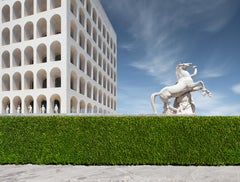
Colosseo Quadrato - iconic neoclassical architectural elements in Rome
By Frank Schott
Located in San Francisco, CA
Colosseo Quadrato by Frank Schott, from a series of photographic observances capturing urban textures and color palettes of Roman architecture 30 x ...
Category

21st Century and Contemporary Contemporary Color Photography

Materials

Archival Ink, Archival Paper, Photographic Paper, Giclée, Archival Pigment

American Contemporary Photo by M.K. Yamaoka - Dove, San Luis Obispo
Located in Paris, IDF
Digital Photograph from Film Original ed. 2 of 9 HP Premium Satin Photo Paper with archival inks Born in Japan in 1940 and educated at The Art Center College of Design in California...
Category

Late 20th Century Contemporary Color Photography

Materials

Ink, Photographic Paper, Digital

GTO - Ford Pontiac GTO American Muscle Car Urban Landscape Photography
By Morgan Silk
Located in Brighton, GB
'GTO' is an Archival Inkjet Print by contemporary photographer Morgan Silk. GTO by Morgan Silk is available in this size of 17" x 24" in an edition of 25. The iconic Ford Pontiac ...
Category

21st Century and Contemporary American Modern Still-life Photography

Materials

Archival Ink, Photographic Paper, Color

Male Nude V from the 29 Palms, CA series - Polaroid, 20th Century, Color
By Stefanie Schneider
Located in Morongo Valley, CA
Male Nude V (29 Palms, CA) - 1999, 20x20cm, sold out Edition of 10, this is Artist Proof 1/2. Archival C-Print, based on the original Polaroid. Certificate and Signature label....
Category

1990s Contemporary Nude Photography

Materials

Archival Paper, Photographic Paper, C Print, Color, Polaroid

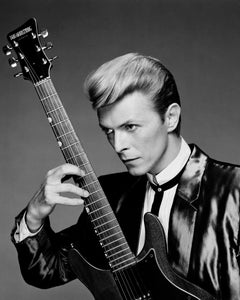
David Bowie, New York, 20th Century, Contemporary, Celebrity, Photography
By Greg Gorman
Located in München, BY
Edition 10 Also available in 40 x 50 cm / 16 x 20 inch, Edition 25 Signed on a label and a certificate of authenticity Black and white portrait of Singer and Songwriter David Bowie...
Category

1980s Contemporary Black and White Photography

Materials

Archival Pigment

Warhol Superstar Candy Darling star of Vain Victory , Color 17 x 22"
By Jack Mitchell
Located in Senoia, GA
Warhol superstar Candy Darling photographed as 'Donna Bella Beads' in the hit play "Vain Victory: the Vicissitudes of the Damned" in 1971. One of Mitchell'...
Category

1970s Pop Art Color Photography

Materials

Archival Pigment

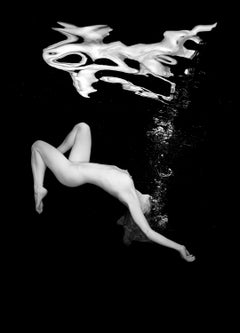
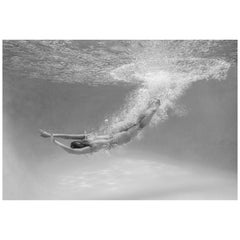
Under - underwater black white nude photograph - archival pigment print 43x63"
By Alex Sher
Located in Beverly Hills, CA
An underwater black and white photograph of a young naked woman in a pool. Original gallery quality archival pigment print signed by the author. Limited edition of 24 Paper size...
Category

2010s Contemporary Black and White Photography

Materials

Archival Paper, Archival Pigment

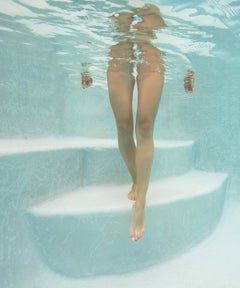
Steps - underwater photograph - archival pigment print 53"x43"
By Alex Sher
Located in Beverly Hills, CA
This ethereal underwater fine art photograph captures a figure suspended above submerged pool steps, rendered in soft aquamarine and pearl tones. The crystalline water creates a drea...
Category

2010s Contemporary Figurative Photography

Materials

Archival Paper, Archival Pigment

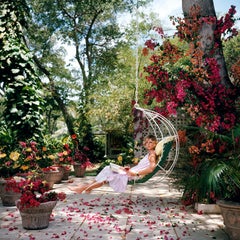
Barbados Bliss - Ava Marshall American Socialite Barbados Portrait Bougainvillea
By Slim Aarons
Located in Brighton, GB
Barbados Bliss - Ava Marshall American Socialite Barbados Portrait Bougainvillea by Slim Aarons 16 x 20" print. Limited Edition Estate Stamped C-Print. Edition of 150. Printed Later...
Category

20th Century American Modern Landscape Photography

Materials

Photographic Paper, C Print, Color, Digital

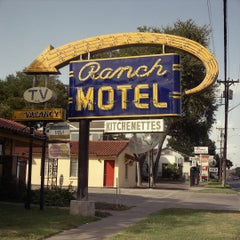
San Antonio, Texas, September, 1985
By Steve Fitch
Located in Sante Fe, NM
In American Motel Signs Steve Fitch crisscrossed the United States documenting the colorful dynamic, advertisements inviting weary traveler to ...
Category

1980s Contemporary Color Photography

Materials

Archival Pigment

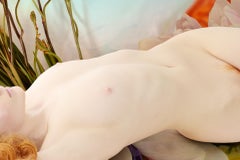
Flora 04 - Flora Nude Female Floral Photography Botticelli Venus Aphrodite
By Tortora Travezan
Located in Brighton, GB
Flora 04 is a vibrant Digital C-Type print in a Limited Edition of 15 in this size by contemporary photographer duo Tortora & Travezan. Like Aphrodite rising from the waves, or a Bo...
Category

2010s Contemporary Nude Photography

Materials

Photographic Paper, C Print, Digital, Color

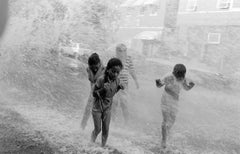
Kids under Water Hydrant - Black and White Monochrome Photographic Print
By Michael Ormerod
Located in Brighton, GB
'Kids under Water Hydrant' is a black and white photographic print on Hahnemuhle paper in a limited edition of 10 by Michael Ormerod. Featured in the 2024 posthumous solo exhibitio...
Category

20th Century American Realist Black and White Photography

Materials

Black and White

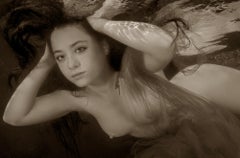
Little Mermaid - underwater nude photograph - archival pigment print
By Alex Sher
Located in Beverly Hills, CA
An underwater photograph of a young naked model wrapped in tulle. One of her charming breasts escaped the cover. The photograph is made in warm sepia tone. Original gallery quali...
Category

2010s Contemporary Abstract Photography

Materials

Archival Pigment

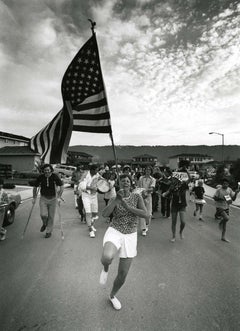
Parade Woman Holding American Flag, from Suburbia
By Bill Owens
Located in Denton, TX
Edition of 15 Signed, dated and numbered. Series: Suburbia Bill Owens was born and raised in California. After volunteering in the Peace Corps he picked up photography and began his...
Category

1970s Modern Black and White Photography

Materials

Silver Gelatin

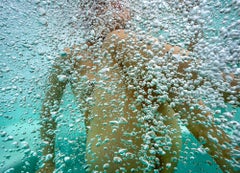
Hot Champagne - underwater nude photograph - archival pigment print 43x59"
By Alex Sher
Located in Beverly Hills, CA
An underwater photograph of a naked young woman wrapped in bubbles. This is a bright high resolution photograph with rich green and golden tones migrating onto blue and orange. Ori...
Category

2010s Contemporary Figurative Photography

Materials

Archival Ink, Archival Pigment

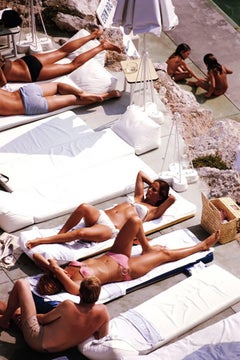
Slim Aarons Sunbathers at Eden Roc
By Slim Aarons
Located in New York, NY
Sunbathers at the Hotel du Cap Eden-Roc, Antibes, France, August 1969, printer later Sunbathers at Eden Roc Chromogenic lambda print Estate stamped and numbered edition of 150 Slim...
Category

21st Century and Contemporary American Modern Color Photography

Materials

Lambda

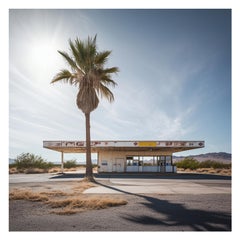
Cali 180722-277 (Americana, California, Desert, Palm Tree, Gas Station, 40% OFF)
Located in Kansas City, MO
Lord Fauntleroy Cali 180722-277 Pigment Print Year: 2018 Visible Size: 13 x 13 inches Framed: 20.5 x 20.5 inches Signed: On Label Edition: 7 COA provided *White frame with standard ...
Category

2010s American Modern Landscape Photography

Materials

Pigment

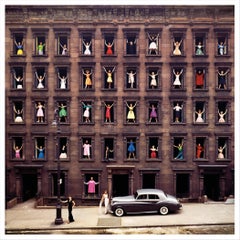
Ormond Gigli Girls in the Windows
By Ormond Gigli
Located in New York, NY
Ormond Gigli Girls in the Window, 1960 (printed later) Color coupler print 16 x 16 inches Signed, dated and numbered edition of 100 Ormond Gigli: The Visionary Behind the "Girls in...
Category

1960s Modern Color Photography

Materials

C Print

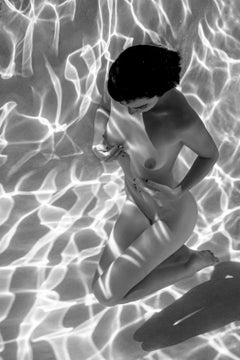
Wavering - underwater nude black white photograph - archival pigment 24x18"
By Alex Sher
Located in Beverly Hills, CA
An underwater black and white photograph of a beautiful naked model on her knees at the bottom of the pool. Original gallery quality archival pigment print on paper signed by the ar...
Category

2010s Contemporary Black and White Photography

Materials

Archival Pigment, Archival Paper

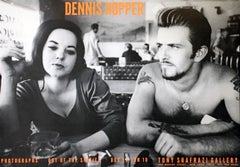
Dennis Hopper Out of the Sixties exhibit poster (Dennis Hopper Biker Couple)
By Dennis Hopper
Located in NEW YORK, NY
Dennis Hopper, Out of the Sixties 1986 exhibit poster published Tony Shafrazi Gallery, New York 1986 Image: Dennis Hopper's Biker Couple' (1961) Off-set lithograph. 17 x 24 inche...
Category

1960s American Modern Photography

Materials

Offset

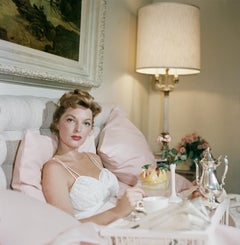
Julie London - Portrait Julie London Jazz Singer Beverly Hills Hotel Hollywood
By Slim Aarons
Located in Brighton, GB
Julie London - Portrait Julie London Jazz Singer Beverly Hills Hotel Hollywood by Slim Aarons 16 x 20" print. Limited Edition Estate Stamped Print. Edition of 150. Printed Later. J...
Category

20th Century American Modern Landscape Photography

Materials

Photographic Paper, C Print, Color, Digital

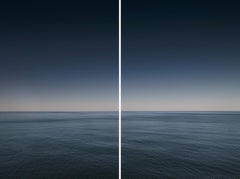
Seascape I Diptych (framed) - abstract photograph of water color cloud horizon
By Frank Schott
Located in San Francisco, CA
SEASCAPE I Diptych ( framed ) by Frank Schott from a series of photographic works capturing the sea blue color palette of the ocean 2 Panels 86.75 x 58 inches / 220.35cm x 147.3cm ...
Category

21st Century and Contemporary Contemporary Landscape Photography

Materials

Photographic Paper, Archival Pigment, Plexiglass, Archival Paper, Giclée

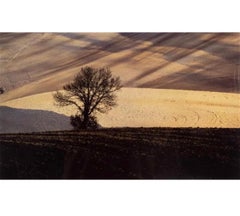
Italian Vintage Dye Transfer Photograph Franco Fontana Color Landscape Photo
By Franco Fontana
Located in Surfside, FL
Franco Fontana (Italian, born 1933) Title: Landscape 1987 Edition 6/15 Medium: dye-transfer Dimensions: Frame 21.5 x 27.5. Sight 12 x 20. Provenance: Monique Goldstrom Gallery Franco Fontana (Italian, 1933) is an Italian photographer. He is best known for his Minimalist abstract colour landscapes. He was influenced by Minimalism and Abstract Expressionism. Franco Fontana was born in 1933 in Modena. He started taking photographs in the 1950s when he was working as a decorator in a furniture showroom. In 1961 he joined a local amateur club in Modena. The experience would be a turning point in his career, and Fontana went on to have his first solo exhibition in 1965 at the Società Fotografica Subalpina, Turin and at the Galleria della Sala di Cultura in Modena in 1968. Since then he has participated in more than 400 group and solo exhibitions including the exhibit Lines, Spheres and Glyphs at Robert Klein Gallery with works by photographers: Franco Fontana, Mario Giacomelli, Ernst Haas, Gyorgy Kepes and Aaron Siskind. Franco Fontana is considered one of the most relevant photographers of our time, In 1963 he exhibited his work at the Biennale of Color in Vienna, and in 1968 he held his first solo exhibition in Modena. Fontana often pares landscapes down to their essential elements, producing flat, geometric compositions reminiscent of the color field abstract expressionist paintings of Mark Rothko Ad Reinhardt and Barnett Newman, by underexposing his transparencies. Contrasting blue skies with green or yellow grass and the rigid lines of buildings with the softness of puffy clouds, he makes color and texture his primary subjects. He has also shot in Polaroid film, Cibachrome, C Print and chromogenic prints. His art has been acquired by some of the most important museums worldwide, including the Maison Européenne de la Photographie in Paris, MoMA in New York, Museum Ludwig in Cologne, Museum of Modern Art in Norman, Oklahoma, National Gallery in Beijing, Australian National Gallery in Melbourne, University of Texas in Austin, Stedelijk Museum in Amsterdam, Tokyo Metropolitan Museum, Israel Museum in Jerusalem, and Musée d’Art Moderne de la Ville in Paris. Fontana has photographed for advertising campaigns for brands such as Fiat, Volkswagen, Ferrovie dello Stato Italiane, Snam, Sony, Volvo, Versace, Canon, Kodak, Robe di Kappa, Swissair, and has been a magazine photographer for publications including Time, Life, Vogue (USA and France), Venerdì di Repubblica, Panorama, and with the Frankfurter Allgemeine Zeitung and The New York Times. Fontana's first book, Skyline, was published in 1978 in France by Contrejour and in Italy by Punto e Virgola with a text by Helmut Gernsheim. Fontana is the art director of the Toscana Foto Festival. He has received numerous awards, such as the 1989 Tokyo Photographer Society of Japan - The 150 Years of Photography - Photographer Award. Fontana is especially interested in the interplay of colours. His early innovations in colour photography in the 1960s were stylistically disruptive. According to art critic Giuliana Scimé, Fontana "destroyed all the structures, practices, and technical choices within the Italian tradition." Fontana uses 35mm cameras, and as noted by Iwan Zahar, deploys distant viewpoints with telephoto lenses to flatten contours in a landscape of crops and fields into bands of intense, saturated colour. This is an effect that Franco Lefèvre has described as 'dialectical landscapism'. Of his use of colour in his 2019 retrospective exhibition Sintesi ('Synthesis') at Fondazione Modena Arti Visive, curator Diana Baldon has observed; “His bold geometric compositions are characterised by shimmering colours, level perspectives and a geometric-formalist and minimal language, By adopting this approach during the 1960s, Fontana injected a new vitality into the field of creative colour photography for then multicolour was not in fashion in art photography., The way Fontana shoots, dematerializes the objects photographed, which loose three-dimensionality and realism to become part of an abstract drawing”. Aside from the rural landscape Fontana has applied his graphic sensibility to other subjects: city architecture, portraiture, fashion, still-life and the nude. He was included in the exhibition of the Helmut Newton Collection along with Brassaï, Diane Arbus, Franco Fontana, Horst P. Horst, Irving Penn, June Newton, Just Loomis, Man Ray, Mark Arbeit...
Category

1980s Abstract Abstract Photography

Materials

Dye Transfer

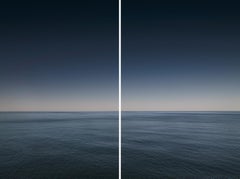
Seascape I Diptych - abstract photograph of water color cloud horizon
By Frank Schott
Located in San Francisco, CA
large format abstract photograph of water color clouds and horizon from a series of photographic works capturing the sea blue color palette of the ocean SEASCAPE I Diptych by Frank...
Category

21st Century and Contemporary Contemporary Color Photography

Materials

Archival Paper, Photographic Paper, Giclée, Archival Pigment

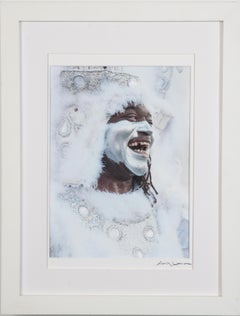
SMILING MAN, MARDI GRAS - Portrait Photograph, New Orleans, Signed Limited Ed.
Located in Signal Mountain, TN
A Mardi Gras Indian known as Spoons during Super Sunday 2007, in which Mardi Gras Indians parade down from the Bayou St. John in New Orleans. Photograph Print is 12 x 9 inches, Frame is approximately 19.5 x 15 inches. Statement: "My mission is to capture the vitality of human experience and to present it on paper in a visually compelling manner. I work with daily life, ritual and celebration within which I look for moments of insight. From Coney Island, to New Orleans, Cuba, Haiti, Colombia and India I use my camera as a tool for understanding and mutual respect between cultures!" Andy...
Category

Early 2000s Contemporary Portrait Photography

Materials

Photographic Paper

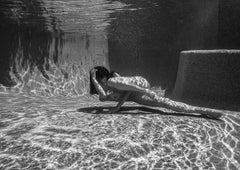
Hot Wire - underwater nude photograph - archival pigment print 25" x 35"
By Alex Sher
Located in Beverly Hills, CA
This contemplative monochromatic underwater nude photograph captures a naked female figure on the pool floor, surrounded by dramatic caustic light patterns. The high-contrast black a...
Category

2010s Contemporary Black and White Photography

Materials

Archival Ink, Archival Paper, Archival Pigment

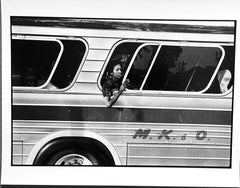
African-American Civil Rights Photography, Washington Protest, Woman on Bus
By Leonard Freed
Located in New york, NY
Woman on Bus, from the March on Washington, 1963 (printed later) by Leonard Freed, is a 11" x 14" gelatin silver print, signed and stamped on verso (back of photo) by the estate, Brigitte Freed (wife of the photographer). The photo is from Leonard Freed's series This Is the Day: The March on Washington and is on p. 81 of the book (Getty Museum, 2013). American photographer Leonard Freed enjoyed documentary storytelling and was a "concerned photographer" whose work demonstrated humanitarian concerns. Provenance: Freed archive. *** Artist’s Bio: Leonard Freed (1929-2006) was an American photographer from Brooklyn, New York. His "Black in White America" series made him known as a documentarian, a social documentary photographer. Freed worked as a freelance photographer from 1961 onwards and as a Magnum photographer Freed traveled widely abroad and, in the US, photographing African Americans (1964-65), events in Israel (1967-68, 1973), and the New York City police department (1972-79). Freed's coverage of the American civil rights...
Category

1960s Contemporary Black and White Photography

Materials

Photographic Paper, Silver Gelatin

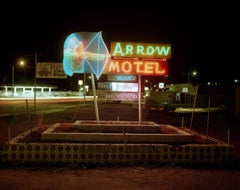
Arrow Motel, Highway 84, Espanola, New Mexico, March 23, 1982
By Steve Fitch
Located in Sante Fe, NM
From the Vanishing Vernacular series. Vanishing Vernacular features a selection of color works by photographer Steve Fitch focusing primarily on the distinctive, idiosyncratic, and ...
Category

Late 20th Century Contemporary Color Photography

Materials

Archival Pigment

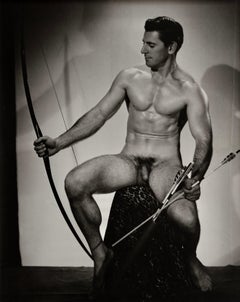
DOUGLAS JULEFF Vintage 1940s Photograph of "Beefcake" model MIKE DUBEL #4
Located in Glenford, NY
Rare 1940s Original Vintage Gelatin Silver Photograph by DOUGLAS JULEFF - also known as DOUG OF DETROIT - of bodybuilder and Mr. America contender MIKE DUBEL. Dubel competed in the 1...
Category

1940s Post-War Nude Photography

Materials

Silver Gelatin

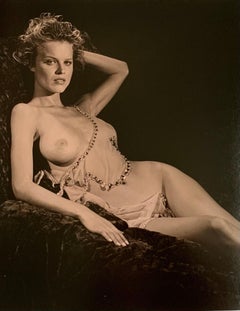
Eva Herzigová - Model, Nude in sheer dress, Pirelli session, Photographic Print
By Bruce Weber
Located in London, GB
The 1998 Pirelli Calendar was photographed in Miami by Bruce Weber and titled "Women that men live for; Men that women live for." Eva Herzigivá was among the many iconic models photo...
Category

1990s Contemporary Nude Photography

Materials

Archival Ink, Archival Paper, Photographic Paper, Aquatint, Archival Pig...

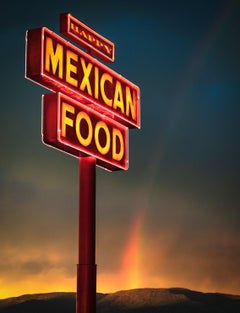
The Happy Mexican by Barry Cawston 120 x 96cm C-Type Print w/Acrylic Face Mount
By Barry Cawston
Located in Coltishall, GB
With immigration comes culture and culinary delights to light up the American skyline – Cawston’s eye for colour, structure and the beauty of the mundane finds a world-in-waiting as ...
Category

21st Century and Contemporary Other Art Style Color Photography

Materials

Photographic Paper, C Print

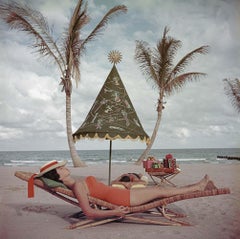
Palm Beach Idyll , Estate Edition, Christmas Beach
By Slim Aarons
Located in Los Angeles, CA
This classic Slim Aarons photograph depicts a couple basking under the sun at the renowned Palm Beach, Florida, circa 1955. The woman in the forefront sports a vintage orange swimsui...
Category

1950s American Realist Figurative Photography

Materials

Lambda

Flora 03 - Pre-Raphaelite Redhead Female Portrait Photography Floral Design
By Tortora Travezan
Located in Brighton, GB
Flora 03 is a vibrant Digital C-Type print in a Limited Edition of 15 in this size by contemporary photographer duo Tortora & Travezan. A rich and flaming torrent of red hair falls ...
Category

2010s Contemporary Nude Photography

Materials

Photographic Paper, C Print, Digital, Color

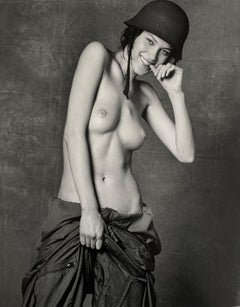
Shalom Harlow; Topless in army outfit - Pirelli session (1997) for 1998
By Bruce Weber
Located in London, GB
The 1998 Pirelli Calendar was photographed in Miami by Bruce Weber. Shalom Harlow was among the many iconic models photographed. “Bruce Weber is a photographer and filmmaker best kn...
Category

1990s Contemporary Nude Photography

Materials

Photographic Film, Photographic Paper, Black and White, Digital Pigment

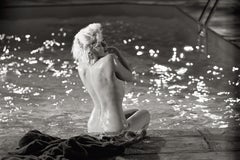
Marilyn Monroe nude in pool, 1962 by Lawrence Schiller
By Lawrence Schiller
Located in Chicago, IL
When Lawrence Schiller got the assignment from the French magazine Paris Match to photograph Marilyn Monroe on the 20th century Fox set of Something’s Got To Give, he thought nothing of it. It wasn’t to be a private, studio shoot. He wasn’t going to set up lights, create backgrounds, use a tripod. Just another assignment, he figured. Monroe by then was firmly established as a figment in the imagination of most young men. The orphan Norma Jean had recreated herself as the blonde bombshell Marilyn Monroe. She’d appeared in twenty-nine films by the time Schiller photographed her in black and white and color in May 1962. The world was unprepared for the moment when Marilyn jumped in the swimming pool in a flesh-colored bikini and came up out of the water au natural. She was all smiles and in her element: the sex goddess...
Category

21st Century and Contemporary Contemporary Black and White Photography

Materials

Silver Gelatin

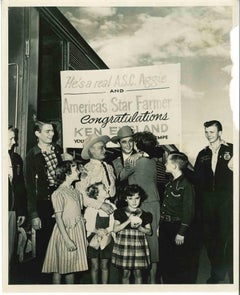
American Farmers - American Vintage Photograph - Mid 20th Century
Located in Roma, IT
American Farmers - American Vintage Photograph is an original black and white photograph realized in the U.S in the mid-20th Century in a series of American life in the 20th Century....
Category

Mid-20th Century Modern Figurative Photography

Materials

Photographic Paper