263 results for "judaica"

to
20
123
58
69
13
Overall Width
to
Overall Height
to
98
34
26
15
5
3
2
38
27
11
10
10
1
247
15
4
6
1
19
14
18
7
172
83
8
20
10
10
7
7
7
7
3
2
2
2
2
2
1
1
1
1
1
1
1
164
47
39
31
21
2
15
263
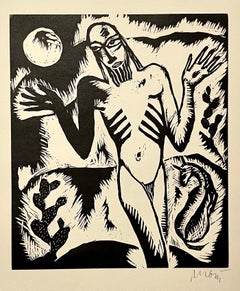
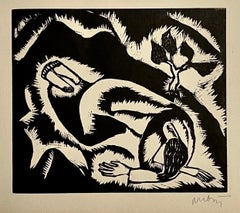
Rare 1923 Cubist Reuven Rubin Woodcut Woodblock Kabbalah Print Israeli Judaica
By Reuven Rubin
Located in Surfside, FL
This is from the original first edition 1923 printing. there was a much later edition done after these originals. These are individually hand signed in pencil by artist as issued. This listing is for the one print. the other documentation is included here for provenance and is not included in this listing. The various images inspired by the Jewish Mysticism and rabbis and mystics of jerusalem and Kabbalah is holy, dramatic and optimistic Rubin succeeded to evoke the spirit of life in Israel in those early days. They are done in a modern art style influenced by German Expressionism, particularly, Ernst Barlach, Ernst Ludwig Kirchner, and Franz Marc, as introduced to Israel by Jakob Steinhardt, Hermann Struck and Joseph Budko. Reuven Rubin 1893 -1974 was a Romanian-born Israeli painter and Israel's first ambassador to Romania. Rubin Zelicovich (later Reuven Rubin) was born in Galati to a poor Romanian Jewish Hasidic family. He was the eighth of 13 children. In 1912, he left for Ottoman-ruled Palestine to study art at Bezalel Academy of Art and Design in Jerusalem. Finding himself at odds with the artistic views of the Academy's teachers, he left for Paris, France, in 1913 to pursue his studies at the École Nationale Supérieure des Beaux-Arts. He was of the well known Jewish artists in Paris along with Marc Chagall and Chaim Soutine, At the outbreak of World War I, he was returned to Romania, where he spent the war years. In 1921, he traveled to the United States with his friend and fellow artist, Arthur Kolnik. In New York City, the two met artist Alfred Stieglitz, who was instrumental in organizing their first American show at the Anderson Gallery. Following the exhibition, in 1922, they both returned to Europe. In 1923, Rubin emigrated to Mandate Palestine. Rubin met his wife, Esther, in 1928, aboard a passenger ship to Palestine on his return from a show in New York. She was a Bronx girl who had won a trip to Palestine in a Young Judaea competition. He died in 1974. Part of the early generation of artists in Israel, Joseph Zaritsky, Arieh Lubin, Reuven Rubin, Sionah Tagger, Pinchas Litvinovsky, Mordecai Ardon, Yitzhak Katz, and Baruch Agadati; These painters depicted the country’s landscapes in the 1920s rebelled against the Bezalel school of Boris Schatz. They sought current styles in Europe that would help portray their own country’s landscape, in keeping with the spirit of the time. Rubin’s Cezannesque landscapes from the 1920s were defined by both a modern and a naive style, portraying the landscape and inhabitants of Israel in a sensitive fashion. His landscape paintings in particular paid special detail to a spiritual, translucent light. His early work bore the influences of Futurism, Vorticism, Cubism and Surrealism. In Palestine, he became one of the founders of the new Eretz-Yisrael style. Recurring themes in his work were the bible, the prophet, the biblical landscape, folklore and folk art, people, including Yemenite, Hasidic Jews and Arabs. Many of his paintings are sun-bathed depictions of Jerusalem and the Galilee. Rubin might have been influenced by the work of Henri Rousseau whose naice style combined with Eastern nuances, as well as with the neo-Byzantine art to which Rubin had been exposed in his native Romania. In accordance with his integrative style, he signed his works with his first name in Hebrew and his surname in Roman letters. In 1924, he was the first artist to hold a solo exhibition at the Tower of David, in Jerusalem (later exhibited in Tel Aviv at Gymnasia Herzliya). That year he was elected chairman of the Association of Painters and Sculptors of Palestine. From the 1930s onwards, Rubin designed backdrops for Habima Theater, the Ohel Theater and other theaters. His biography, published in 1969, is titled My Life - My Art. He died in Tel Aviv in October 1974, after having bequeathed his home on 14 Bialik Street and a core collection of his paintings to the city of Tel Aviv. The Rubin Museum opened in 1983. The director and curator of the museum is his daughter-in-law, Carmela Rubin. Rubin's paintings are now increasingly sought after. At a Sotheby's auction in New York in 2007, his work accounted for six of the ten top lots. Along with Yaacov Agam and Menashe Kadishman he is among Israel's best known artists internationally. Education 1912 Bezalel Academy of Arts and Design, Jerusalem 1913-14 École des Beaux Arts, Paris and Académie Colarossi, Paris Select Group Exhibitions Eged - Palestine Painters Group Eged - Palestine Painters Group, Allenby Street, Tel Aviv 1929 Artists: Chana Orloff, Abraham Melnikoff, Rubin, Reuven Nahum Gutman, Sionah Tagger,Arieh Allweil, Jewish Artists Association, Levant Fair, Tel Aviv, 1929 Artists: Ludwig Blum,Eliyahu Sigad, Shmuel Ovadyahu, Itzhak Frenel Frenkel,Ozer Shabat, Menahem Shemi...
Category

1920s Abstract Figurative Prints

Materials

Woodcut

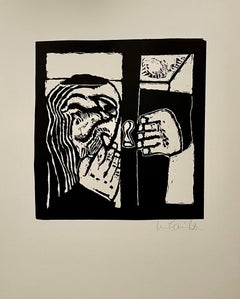
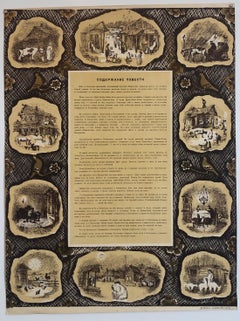
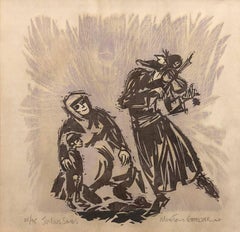
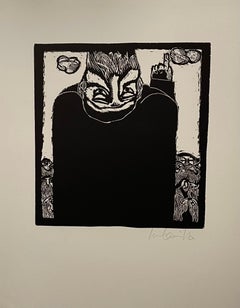
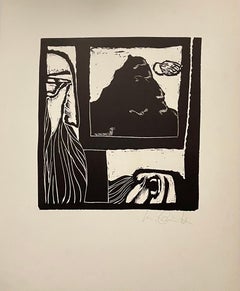
Latin American Judaica Conceptual Chassidic Art Modern Woodcut Luis Camnitzer
By Luis Camnitzer
Located in Surfside, FL
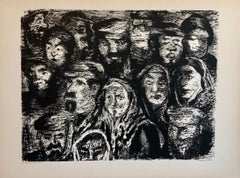
Luis Camnitzer and Martin Buber (1878-1965), New York: JMB Publishers Ltd, 1970. Printed at The New York Graphic Workshop. Hand signed on Arches paper. (Edition 24/100, numbered on Justification page) Woodblock prints based on folktales from the Hasidic Jewish tradition in Eastern Europe, selected by Camnitzer from the early masters section of Buber’s Die chassidischen Bücher as translated by Olga Marx. German Expressionist style Jewish woodcuts...
Category

1970s Expressionist Figurative Prints

Materials

Woodcut

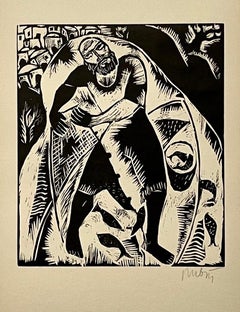
Rare 1923 Cubist Reuven Rubin Woodcut Woodblock Fisherman Print Israeli Judaica
By Reuven Rubin
Located in Surfside, FL
This is from the original first edition 1923 printing. there was a much later edition done after these originals. These are individually hand signed in pencil by artist as issued. This listing is for the one print. the other documentation is included here for provenance and is not included in this listing. The various images inspired by the Jewish Mysticism and rabbis and mystics of jerusalem and Kabbalah is holy, dramatic and optimistic Rubin succeeded to evoke the spirit of life in Israel in those early days. They are done in a modern art style influenced by German Expressionism, particularly, Ernst Barlach, Ernst Ludwig Kirchner, and Franz Marc, as introduced to Israel by Jakob Steinhardt, Hermann Struck and Joseph Budko. Reuven Rubin 1893 -1974 was a Romanian-born Israeli painter and Israel's first ambassador to Romania. Rubin Zelicovich (later Reuven Rubin) was born in Galati to a poor Romanian Jewish Hasidic family. He was the eighth of 13 children. In 1912, he left for Ottoman-ruled Palestine to study art at Bezalel Academy of Art and Design in Jerusalem. Finding himself at odds with the artistic views of the Academy's teachers, he left for Paris, France, in 1913 to pursue his studies at the École Nationale Supérieure des Beaux-Arts. He was of the well known Jewish artists in Paris along with Marc Chagall and Chaim Soutine, At the outbreak of World War I, he was returned to Romania, where he spent the war years. In 1921, he traveled to the United States with his friend and fellow artist, Arthur Kolnik. In New York City, the two met artist Alfred Stieglitz, who was instrumental in organizing their first American show at the Anderson Gallery. Following the exhibition, in 1922, they both returned to Europe. In 1923, Rubin emigrated to Mandate Palestine. Rubin met his wife, Esther, in 1928, aboard a passenger ship to Palestine on his return from a show in New York. She was a Bronx girl who had won a trip to Palestine in a Young Judaea competition. He died in 1974. Part of the early generation of artists in Israel, Joseph Zaritsky, Arieh Lubin, Reuven Rubin, Sionah Tagger, Pinchas Litvinovsky, Mordecai Ardon, Yitzhak Katz, and Baruch Agadati; These painters depicted the country’s landscapes in the 1920s rebelled against the Bezalel school of Boris Schatz. They sought current styles in Europe that would help portray their own country’s landscape, in keeping with the spirit of the time. Rubin’s Cezannesque landscapes from the 1920s were defined by both a modern and a naive style, portraying the landscape and inhabitants of Israel in a sensitive fashion. His landscape paintings in particular paid special detail to a spiritual, translucent light. His early work bore the influences of Futurism, Vorticism, Cubism and Surrealism. In Palestine, he became one of the founders of the new Eretz-Yisrael style. Recurring themes in his work were the bible, the prophet, the biblical landscape, folklore and folk art, people, including Yemenite, Hasidic Jews and Arabs. Many of his paintings are sun-bathed depictions of Jerusalem and the Galilee. Rubin might have been influenced by the work of Henri Rousseau whose naice style combined with Eastern nuances, as well as with the neo-Byzantine art to which Rubin had been exposed in his native Romania. In accordance with his integrative style, he signed his works with his first name in Hebrew and his surname in Roman letters. In 1924, he was the first artist to hold a solo exhibition at the Tower of David, in Jerusalem (later exhibited in Tel Aviv at Gymnasia Herzliya). That year he was elected chairman of the Association of Painters and Sculptors of Palestine. From the 1930s onwards, Rubin designed backdrops for Habima Theater, the Ohel Theater and other theaters. His biography, published in 1969, is titled My Life - My Art. He died in Tel Aviv in October 1974, after having bequeathed his home on 14 Bialik Street and a core collection of his paintings to the city of Tel Aviv. The Rubin Museum opened in 1983. The director and curator of the museum is his daughter-in-law, Carmela Rubin. Rubin's paintings are now increasingly sought after. At a Sotheby's auction in New York in 2007, his work accounted for six of the ten top lots. Along with Yaacov Agam and Menashe Kadishman he is among Israel's best known artists internationally. Education 1912 Bezalel Academy of Arts and Design, Jerusalem 1913-14 École des Beaux Arts, Paris and Académie Colarossi, Paris Select Group Exhibitions Eged - Palestine Painters Group Eged - Palestine Painters Group, Allenby Street, Tel Aviv 1929 Artists: Chana Orloff, Abraham Melnikoff, Rubin, Reuven Nahum Gutman, Sionah Tagger,Arieh Allweil, Jewish Artists Association, Levant Fair, Tel Aviv, 1929 Artists: Ludwig Blum,Eliyahu Sigad, Shmuel Ovadyahu, Itzhak Frenel Frenkel,Ozer Shabat, Menahem Shemi, First Exhibition of ''Hever Omanim'' First Exhibition of ''Hever Omanim'' Steimatzky Gallery, Jerusalem 1936 Artists: Gutman, Nachum Holzman, Shimshon Mokady, Moshe Sima, Miron Rubin, Reuven Steinhardt, Jakob Ben Zvi, Zeev Ziffer, Moshe Allweil, Arieh Group Exhibition Group Exhibition Katz Art Gallery, Tel Aviv 1939 Artists: Avni, Aharon Holzman, Shimshon Gliksberg, Haim Gutman, Nachum Ovadyahu, Shmuel Shorr, Zvi Schwartz, Chaya Streichman, Yehezkel Tagger, Sionah Rubin, Reuven A Collection of Works by Artists of the Land of Israel A Collection of Works by Artists of the Land of Israel The Bezalel National Museum, Jerusalem 1940 Artists: Shemi, Menahem Rubin, Reuven Avni, Aharon Mokady, Moshe Jonas, Ludwig Steinhardt, Jakob Ticho, Anna Krakauer, Leopold Gutman, Nachum Budko, Joseph Ardon, Mordecai Sima, Miron Castel, Moshe Pann, Abel Struck, Hermann Gur Arie, Meir Ben Zvi, Zeev Litvinovsky, Pinchas Artists in Israel for the Defense, Tel Aviv Museum of Art, Helena Rubinstein Pavilion, Tel Aviv 1967 Artists: Avraham Binder, Motke Blum, (Mordechai) Samuel Bak, Yosl Bergner, Nahum Gilboa, Jean David, Marcel Janco, Lea Nikel, Jacob Pins, Esther Peretz...
Category

1920s Abstract Figurative Prints

Materials

Woodcut

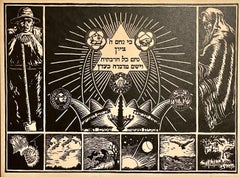
Rare 1922 German Jewish Judaica Zion Woodcut Woodblock Print Hermann Fechenbach
By Hermann Israel Fechenbach
Located in Surfside, FL
Title: Zion Subject: Various biblical images depicting Creation and prayer 1922 Medium: woodcut Frame: 14" x 18" Image: 12.5" x 16.75" Provenance: owned and signed verso by Peter Keil. Central panel shows the Jewish star over a crown, with inscription in Hebrew: "When God comforts Zion, He will comfort all its ruins and make its deserts look like Eden," and "You have sanctified the seventh day, the goal of creation of Heaven and Earth." This is flanked by a Palestinian farmer pioneer on the left and a Jew praying on the right. The lower tier shows six vignettes of the days of creation from Genesis. Hermann Fechenbach was born in 1897 in Württemberg, Germany. He grew up in Bad Mergentheim where his parents had an inn, which served as a meeting place for the local Jewish community. He left school early and through family connections with clothing retailers received training in window dressing. His skill with brush writing was quickly recognised by a big firm in Dortmund where he was responsible for the displays in 10 large windows. He received his conscription papers in 1916 and recalls “being as patriotic as any other fool”. In August 1917 he was involved in a grenade attack in which he was the sole survivor. With serious injuries to both legs he struggled to safety and was eventually transported to a front line “slaughterhouse” where the first of a series of amputations was performed which led to the loss of his left leg. As a result of his injuries his father dropped his opposition to him becoming an artist. His formal art education started in 1918 with training at a Stuttgart handcraft school for invalids. He attended the Academies in Stuttgart and Munich to learn painting and restoration for 3 years. He was influenced at this time by Max Liebermann. He has been compared to Kathe Kollwitz and was a contemporary of Jakob Steinhardt and hermann Struck. In 1923 he went to Florence for a year. While in Florence he started to produce a series of miniature wood engravings to illustrate the stories of Genesis. This was followed by periods in Pisa, Venice, Vienna and Amsterdam. In 1924 he returned to Stuttgart to paint in the contemporary style “Die Neue Sachlichkeit”. (The New Objectivity was a movement in German art that arose during the 1920s Weimar republic as a reaction against expressionism. The term was coined by Gustav Friedrich Hartlaub, the director of the Kunsthalle in Mannheim, who used it as the title of an art exhibition staged in 1925 to showcase artists who were working in a post-expressionist spirit. These artists—who included Max Beckmann, Otto Dix, George Grosz, Christian Schad, Rudolf Schlichter and Jeanne Mammen) Every spring and autumn he exhibited at the “Kunstgebit” which served as the showcase for all serious artists of the period. His professional status “Kunstmaler und Grafiker” was recognised by Berlin in 1926. Practically all his work from this period was sold following exhibition. In 1926 he collaborated with an architect friend to build a bungalow in Hohenheim, a non-Jewish area and a suburb of Stuttgart. Hermann alternately lived in his country bungalow and his town studio, producing portraits for sale or barter and wood engravings for his own pleasure. In 1930 he married a non-Jewish professional photographer – Greta Batze. They had a studio in Stuttgart, which was used to teach art to a group of 12 students. In 1933 the Nazi influence removed his name from the official state register together with the right to exhibit. By spending most of his time in his bungalow out of the Jewish quarter the Fechenbachs escaped being registered by the Nazis for some years. They were ostracised and abused by their non-Jewish neighbours. Hermann made weekly visits to friends in town to teach them the practical skills they would need assuming they were to escape from Germany. His energies were directed towards protection and survival. Ultimately the Nazi persecution forced the Fechenbachs to flee their homeland. They moved to Palestine for 3 months in 1938, but found the political and physical environment unsustainable. Greta arrived in England penniless in January 1939 to work as a domestic servant and to find a guarantor for her husband. Hermann arrived in May 1939. They moved to Blackheath a few months later. Hermann resumed his painting and engraving as a means of earning a living. He raised enough money to get his parents out of Germany to join his brothers in Argentina but was unable to save his twin sister Rosa who died in a Nazi concentration camp. In 1940 Hermann was interned in Bury as a suspect alien. He protested about his treatment by starting a hunger strike. Because of his persistence he was moved to a prison in Liverpool. From Liverpool he was moved to the Hutchinson Camp in the Isle of Man with fellow artist Kurt Schwitters. Arrangements were made for Greta to be accommodated near by. While interned he commenced work on “Refugee Impressions”, a series of linocut prints (no wood was available). In 1941 when released from internment the Fechenbachs came under the sponsorship of Dr. Bela Horovitz, the Austrian art publisher who in turn made an introduction to Professor Tancred Borenius. They were offered lodgings with a family in Oxford. Hermann had his first public exhibition for many years in a small gallery in Oxford in 1942. A second exhibition of oils, pencil drawings, coloured linocut and woodblock prints held later in the year was opened by the mayor of Oxford and critically acclaimed. In 1944 the first London exhibition took place at the Anglo-Palestinian club in Piccadilly. There were two exhibitions at the Ben Uri Art gallery during this period. In 1948 a second exhibition at the Anglo Palestinian club was inaugurated by a member of the Rothschild family and several members of Parliament. This was a great success. In 1944 the Fechenbachs moved to a top floor studio flat in Colet Gardens. Open exhibitions were held each Spring at the Embankment from 1946 to 1951. Movietone News produced a short feature on the artist, which was shown in cinemas in England and Germany. In 1969 he published the Genesis story in a hard back volume containing 137 prints. He started to research the fate of the entire Jewish community of Bad Mergentheim during the period of the second world war, liaising with historian Dr. Paul Sauer and Professor Max Miller, historian and theologian. In 1972 Kohlhammer published his partly autobiographical book “The last Jews of Mergentheim”. He exhibited at the Anglo-Palestinian Club & the Ben Uri Gallery in the 1940s. His works only came to prominence during the last year of his life when he exhibited at Blond Fine Art. Peter Keil part of the Junge Wilde. In 1978, the Junge Wilde painting style arose in the German-speaking world in opposition to established avant garde, minimal art and conceptual art. It was linked to the similar Transavanguardia movement in Italy, USA (neo-expressionism) and France (Figuration Libre). They were also known as the Neue Wilde. Artists included; Austria: Siegfried Anzinger, Erwin Bohatsch, Herbert Brandl, Gunter Damisch, Hubert Scheibl, Hubert Schmalix...
Category

1980s Impressionist Figurative Prints

Materials

Woodcut

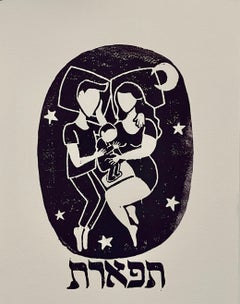
Feminist Judaica Linocut Relief Print Basya Wuensch Kabbalah Sefirot Hebrew Art
Located in Surfside, FL
Basya Wuensch Sefirot, Tiferet (beauty in harmony) Family, 2023 Hand printed color linocut on cold pressed watercolor paper Hand signed and numbered 12 ...
Category

21st Century and Contemporary Contemporary Figurative Prints

Materials

Linocut

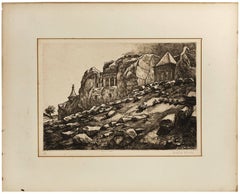
Outside Jerusalem, Tomb of Ashalom, Judaica Print
Located in Surfside, FL
Picturesque depiction of Jerusalem mountainside landscape with Tomb of Ashalom.
Category

20th Century Landscape Prints

Materials

Paper

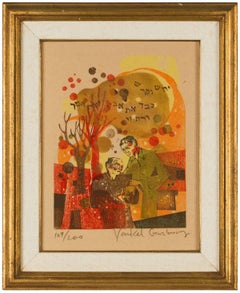
Lithograph "Honor Thy parents" Judaica Hebrew Print
By Yankel Ginzburg
Located in Surfside, FL
Yankel Ginzburg, Kazakastani/American (1945 - ) Genre: Modern Subject: People Medium: Lithograph Surface: Paper Dimensions w/Frame: 19 1/2" x 16" Yankel Ginzburg Yankel Ginzburg was born Yuri Zhukov in 1945 in Alma-Ata, capital of the Kazakhstan Republic near the Chinese border. His parents were both Russian Army...
Category

20th Century Contemporary Figurative Prints

Materials

Lithograph

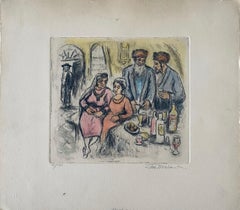
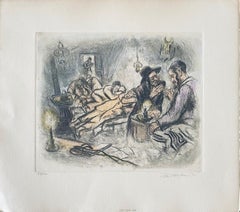
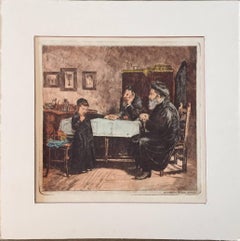
Judaica interior scene etching with hand coloring
By Ira Moskowitz
Located in Surfside, FL
I believe the scene is of a wedding engagement. etching with extensive hand coloring (making it a unique original work of art) Ira Moskowitz (1912-2001), descendant of a long rabbin...
Category

20th Century Post-Impressionist Interior Prints

Materials

Lithograph

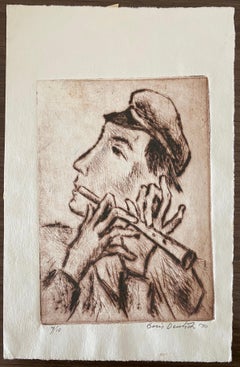
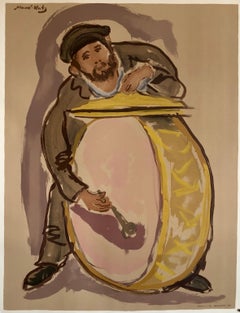
Shtetl Village Doodka Player Judaica Jewish California Modernist Artist Etching
By Boris Deutsch
Located in Surfside, FL
Boris deutsch was born in krasnagorka lithuania june 4 1892 died in los angeles 1978.Entered the polytechnic school in riga 1905.School of applied arts berlin 1912. Settled in l.A. 1...
Category

20th Century Modern Figurative Prints

Materials

Mixed Media, Watercolor

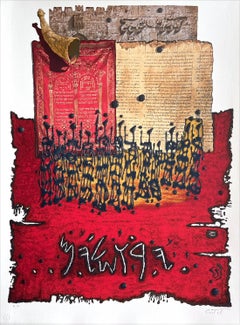
SHOFAR AT LIONS GATE Signed Lithograph, Jerusalem, Judaica, Red, Gold, Black
By Moshe Castel
Located in Union City, NJ
SHOFAR AT LIONS GATE by the Israeli artist Moshe Castel (1909-1991) is a limited edition lithograph printed in 13 colors using traditional lithographic tech...
Category

1980s Contemporary Portrait Prints

Materials

Lithograph

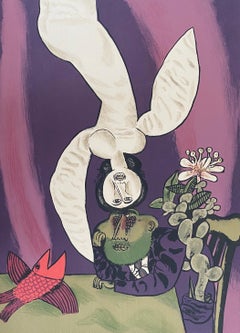
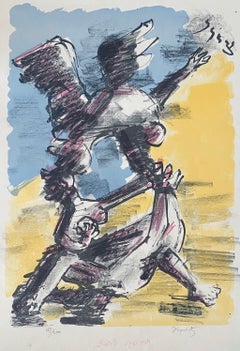
Israeli Surrealist Judaica Abstract Lithograph Naftali Bezem
By Naftali Bezem
Located in Surfside, FL
Naftali Bezem (Hebrew: נפתלי בזם‎‎; born November 27, 1924) is an Israeli painter, muralist, and sculptor. Bezem was born in Essen, Germany, in 1924. His early adolescence was spent...
Category

20th Century Modern Prints and Multiples

Materials

Lithograph

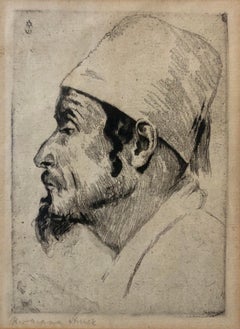
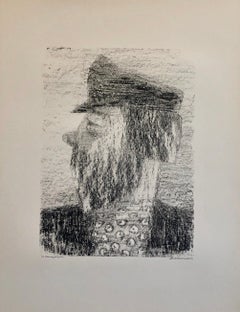
German Artist Impressionist Etching Judaica Jewish Sephardic Jewish Bezalel Era
By Hermann Struck
Located in Surfside, FL
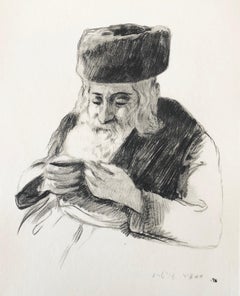
Yemenite or Moroccan Sefardic rabbi portrait. Framed 11 X 9 sight 6 X 4.5 Hermann Struck (6 March 1876 – 11 January 1944) was a German Jewish artist known for his etchings. Hermann...
Category

Early 20th Century Impressionist Figurative Prints

Materials

Etching

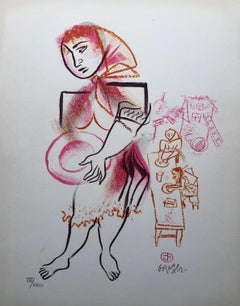
Women, Dishes, Shtetl Americana Judaica Lithograph WPA Social Realist Artist
By William Gropper
Located in Surfside, FL
Hand signed in pencil and numbered with Roman numerals 8/24. A very small edition. Old Lower East Side of New York or East European Shtetl. Orthodox Jewish Rabbi having a glass of t...
Category

Mid-20th Century Modern Figurative Prints

Materials

Lithograph

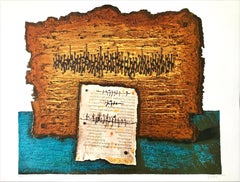
STONE AND SCRIPT Signed Lithograph, Golden Yellow Tablet Ancient Hebrew, Judaica
By Moshe Castel
Located in Union City, NJ
STONE AND SCRIPT by the Israeli artist Moshe Castel (1909-1991) is a limited edition lithograph printed in 12 colors using traditional lithographic techniques on archival Somerset paper 100% acid free. In Stone and Script, a three dimensional relief effect is visible in the black writings and stone tablet achieved by using shades of gray and black with predominate colors of warm golden yellow and turquoise blue. Castel creates a very aesthetically appealing and captivating contemporary arrangement of ancient...
Category

1980s Contemporary Abstract Prints

Materials

Lithograph

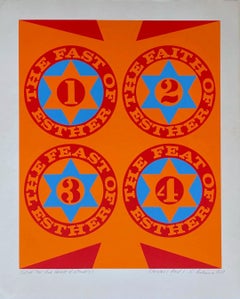
The Four Facets of Esther (I) Silkscreen Rare signed Printers Proof, Judaica
By Robert Indiana
Located in New York, NY
Robert Indiana Purim: The Four Facets of Esther (I) Sheehan, 36, 1966 Color silkscreen on off white wove paper Printed by Stephen Poleskie, Chiro...
Category

1960s Pop Art Abstract Prints

Materials

Screen

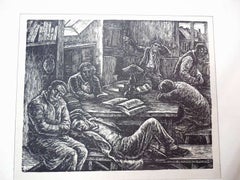
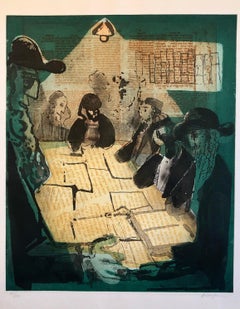
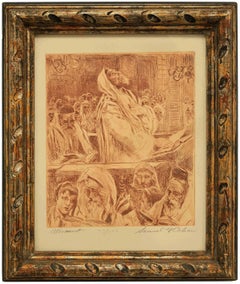
Rare Judaica Shtetl Synagogue interior Study House
By Albert Abramovitz
Located in Surfside, FL
original limited edition woodcut woodblock print great depression era. signed in plate with his monogram and cipher mark. from the 1930s. Rare Judaic image. the Jewish Study House. ...
Category

1930s Interior Prints

Materials

Woodcut

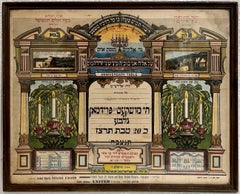
Rare Palestine Antique Hebrew Judaica Yahrzeit Synagogue Sign Memorial Plaque
Located in Surfside, FL
Circa 1890-1920. This Neoclassical, Judaic, Egyptian revival, Orientalist Mizrach sign, was produced in British Mandate Palestine by the chromolithograph process at the beginning of the 20th century. It pictures vignettes of holy places. with a hand written memorial. It was for the Tzedakah charity fund for the century-old institutions in Jerusalem: The great "Torah Center Etz Chaim"; a Free Kitchen for poor children and orphans; the famous Bikur Cholim Hospital with its dispensaries and clinics and the only Home for Incurable Invalids in Eretz Israel. They also worked with Arthur Szyk and Alfred Salzmann.. The A.L. Monsohn Lithographic Press (Monzon Press, Monson Press, דפוס אבן א"ל מאנזאהן, דפוס מונזון) was established in Jerusalem in 1892 by Abraham-Leib (or Avrom-Leyb) Monsohn II (Jerusalem, c.1871-1930) and his brother Moshe-Mordechai (Meyshe-Mordkhe). Sponsored by members of the Hamburger family, the brothers had been sent to Frankfurt, Germany in 1890 to study lithography. Upon returning to Jerusalem in 1892 with a hand press, they established the A.L. Monsohn Lithographic Press in the Old City of Jerusalem. According to the Information Center for Israeli Art A.L. Monsohn "created complex decorations for documents and oriental calendars that combined the tradition of Jewish art with modern printing techniques such as photographic lithography, raised printing and gilding." The founders of the Monsohn press produced Jewish-themed color postcards, greeting cards, Jewish National Fund stamps, and maps documenting the evolution of the Jewish settlement in Eretz Israel in the nineteenth-twentieth centuries; religious material such as decorative plaques for synagogues, portraits of Old Yishuv rabbis such as Shmuel Salant, Mizrah posters indicating the direction of prayer for synagogues, memorial posters, and posters for Sukkot booths; color frontispieces for books such as Pentateuch volumes and the early song collections of Abraham Zvi Idelsohn (e.g., Shire Zion, Jerusalem 1908); artistic wedding invitations; and labels, packaging and advertisements for the pioneering entrepreneurs of Eretz Israel. The texts appearing in the Monsohn products were in several languages: Hebrew, Arabic, Yiddish, English, German (e.g., a c1920 trilingual Hebrew-English-Arabic "Malaria Danger" broadside warning the public of mosquitoes spreading malaria). Many of the brilliantly colored postcards and maps can be seen online as can the artistic invitations to his children's weddings which Monsohn published in the Jerusalem Hebrew press. For years, the Monsohn (later, Monson/Monzon) Press was considered the best and most innovative in the country—pioneering in such techniques as gold-embossing and offset printing, among others. Early items for tourists included collections of Flowers of the Holy Land (c. 1910–1918)—pressed local flowers accompanied by scenes from the Eretz Israel countryside and relevant verses from the Bible, edited by Jsac Chagise (or Itzhak Haggis), an immigrant from Vitebsk, and bound in carved olive wood boards. Shortly after World War I Monsohn (now spelled מונזון) used zincography to produce the prints included in the Hebrew Gannenu educational booklets for young children illustrated by Ze'ev Raban of the Bezalel Academy of Art and Design and printed in Jerusalem by Hayim Refael Hakohen (vol. 1, 1919; vols. 2–3, 1920). In 1934 Monsohn moved into the new, western part of Jerusalem, in a shop with four presses and 30 workers, including Abraham-Leib's sons, David, Yosef, Moshe and Shimon, and his daughter Raytse's husband, Abraham Barmacz. The concern did business with all sectors of the city's population, including Arabs, for whom they printed in Arabic. Among their clients were members of the Ginio, Havilio, and Elite families, and Shemen, Dubek, and other renowned national brands, manufacturing products such as wine, candies, oil, and cigarettes. They also printed movie and travel posters, and government posters, postcards and documents, hotel luggage labels...
Category

Early 20th Century Aesthetic Movement More Art

Materials

Lithograph

Judaica interior scene etching with hand coloring
By Ira Moskowitz
Located in Surfside, FL
Etching with extensive hand coloring (making it a unique original work of art) Ira Moskowitz (1912-2001), descendant of a long rabbinical line, was born in Galicia Poland and went w...
Category

20th Century Post-Impressionist Interior Prints

Materials

Etching

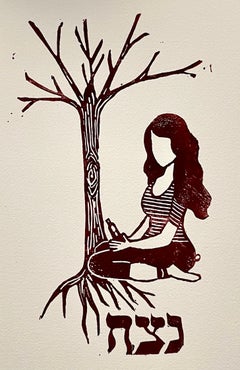
Feminist Judaica Linocut Relief Print Basya Wuensch Kabbalah Sefirot Hebrew Art
Located in Surfside, FL
Basya Wuensch Sefirot, Netzach (victory, endurance, eternity) Woman with Tree 2023 Hand printed color linocut on cold pressed watercolor paper Hand signe...
Category

21st Century and Contemporary Contemporary Figurative Prints

Materials

Linocut

Rare Israeli Surrealist Judaica Abstract Lithograph Naftali Bezem
By Naftali Bezem
Located in Surfside, FL
Fine lithograph on deckle edged French Arches paper. Pencil signed and numbered from edition of 150. A Surrealist Judaica scene of a bearded man (Rabbi) in a boat with Shabbat candlesticks. with blindstamp from Editions Empreinte in Paris, France. (They published, Jean Michel Folon, Sempe, Raoul Ubac, Raymond Savignac, Cesar, Bengt Lindstrom , Paul Aizpiri and many other modern masters. Naftali Bezem (Hebrew: נפתלי בזם‎‎; born November 27, 1924) is an Israeli painter, muralist, and sculptor. Bezem was born in Essen, Germany, in 1924. His early adolescence was spent under Nazi oppression, in constant fear for the safety of his parents, who perished in the Holocaust in the Polish Auschwitz concentration camp. Naftali emigrated to Mandate Palestine in 1939, at the age of fourteen with a Youth Aliyah group. From 1943 to 1946, he studied art at the Bezalel Academy of Art and Design in Jerusalem with Israeli painter Mordecai Ardon. He then spent three years studying in Paris.His most famous public works include a wall relief at Yad Vashem in Jerusalem and the ceiling mural in the main reception room at the President's Residence, Jerusalem.In 1957, Bezem was a co-recipient of the Dizengoff Prize for Painting. Group Exhibitions Orit Art Gallery, Tel Aviv Artists: Yosef Zaritsky, Marcel Janco, Lea Nikel, Robert Baser, Bezem, Michael Druks, Israeli Painting (Watercolors and Gouache) Artists: Pinchas Abramovich, Bezem, Naftali Nachum Gutman, Haim Gliksberg, Mordechai Levanon, Avigdor Stematsky, Avshalom Okashi, Yehiel Krize...
Category

20th Century Modern Figurative Prints

Materials

Lithograph

Israeli Surrealist Judaica Abstract Lithograph Naftali Bezem
By Naftali Bezem
Located in Surfside, FL
Naftali Bezem (Hebrew: נפתלי בזם‎‎; born November 27, 1924) is an Israeli painter, muralist, and sculptor. Bezem was born in Essen, Germany, in 1924. His early adolescence was spent...
Category

20th Century Modern Prints and Multiples

Materials

Lithograph

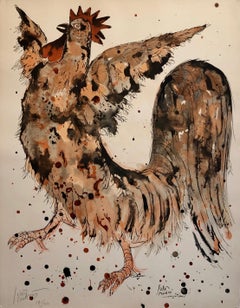
Modern Israeli Lithograph Reuven Rubin Views Of Israel Judaica Crowing Rooster
By Reuven Rubin
Located in Surfside, FL
Lithograph printed by Chez Daniel Jacomet, Paris, France 1960 offset lithograph in colors on Arches, signed in crayon on the justification sheet (this auction is just for the one lithograph pictured as the 1st photo, the justification sheet with the original drawing is just included for provenance and is not part of this sale), on Arches deckle edged paper. limited edition of 250. plate signed and hand signed in pencil. Israeli views Lithograph by Israeli Master. Reuven Rubin 1893 -1974 was a Romanian-born Israeli painter and Israel's first ambassador to Romania. Rubin Zelicovici (later Reuven Rubin) was born in Gala?i to a poor Romanian Jewish Hasidic family. He was the eighth of 13 children. In 1912, he left for Ottoman-ruled Palestine to study art at Bezalel Academy of Art and Design in Jerusalem. Finding himself at odds with the artistic views of the Academy's teachers, he left for Paris, France, in 1913 to pursue his studies at the École Nationale Supérieure des Beaux-Arts. At the outbreak of World War I, he was returned to Romania, where he spent the war years. In 1921, he traveled to the United States with his friend and fellow artist, Arthur Kolnik, with whom he had shared a studio in Cernovitzu. In New York City, the two met artist Alfred Stieglitz, who was instrumental in organizing their first American show at the Anderson Gallery.Following the exhibition, in 1922, they both returned to Europe. In 1923, Rubin emigrated to Mandate Palestine. Rubin met his wife, Esther, in 1928, aboard a passenger ship to Palestine on his return from a show in New York. She was a Bronx girl who had won a trip to Palestine in a Young Judea competition. He died in 1974 Artistic career Joseph Zaritsky...
Category

1960s Modern Figurative Prints

Materials

Lithograph, Offset

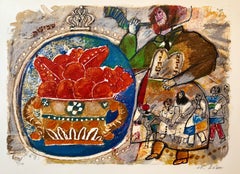
Large French Judaica Lithograph Carborundum Etching Jewish Hebrew Embossing
By Théo Tobiasse
Located in Surfside, FL
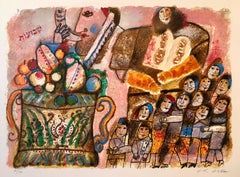
Theo Tobiasse Suite: Shavuot Festival Year: 1984 Medium: Original carborundum embossed etching lithograph in colors on Arches paper (deckle edged paper) Signature: Hand signed by the artist Publisher Nahan Gallery, New Orleans Theo Tobiasse, born Tobias Eidesas, 1927 in Jaffa then in British Mandate Palestine, died 2012 in Cagnes-sur-Mer in France. Well known painter, engraver, draftsman and sculptor. French Jewish artist. The youngest son of Chaim (Charles) Eidesas and Brocha (Berthe) Slonimsky from Kaunas, Lithuania, Théo Tobiasse was born in Mandatory Palestine in 1927, where his Jewish parents lived since 1925, far from the threat of pogroms and upheavals of East European policies. The family encountered material difficulties and decided to return to Lithuania, ultimately leaving for Paris in 1931 where his father typographer finds work in a Russian printing press. Theodore Tobiasse...
Category

1970s Modern Figurative Prints

Materials

Etching, Lithograph

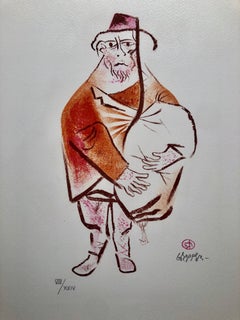
Sephardic Jew Fez Hat Jewish Shtetl Americana Judaica Lithograph WPA Yiddish Art
By William Gropper
Located in Surfside, FL
Hand signed in pencil and numbered with Roman numerals 8/24. A very small edition. Old Lower East Side of New York or East European Shtetl. Yenta gossips in the kitchen peeling. hum...
Category

Mid-20th Century Modern Figurative Prints

Materials

Lithograph

Vintage Russian Shtetl, Scene Judaica Lithograph Jewish Portrait
By Anatoli Lvovich Kaplan
Located in Surfside, FL
Pencil signed and dated, Judaica Lithograph. Anatoli Lwowitch Kaplan was a Russian painter, sculptor and printmaker, whose works often reflect his Jewish origins. His father was a b...
Category

Mid-20th Century Modern More Prints

Materials

Lithograph

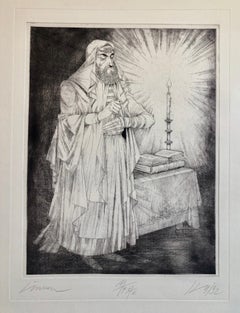
Judaica Jewish Rabbi Etching Hasidic Rebbe Admur Shlita Vintage Chassidic Print
By Paul Jeffay
Located in Surfside, FL
"Sabbat." Sabbath. the piece is marked in the plate Admur Shlita (this might be the Munkatcher Rebbe or the Belzer Rebbe from before the war) Chassidic Rebbe, with open book. Judai...
Category

20th Century Expressionist Portrait Prints

Materials

Etching

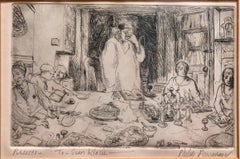
Judaica Etching Passover Seder Scene WPA Artist
By Philip Reisman
Located in Surfside, FL
Philip Reisman, a Social Realist painter and printmaker known for his views of New York City street life. Fourteen of Mr. Reisman's etchings of New York life were in the show Works o...
Category

Mid-20th Century American Modern Figurative Prints

Materials

Etching

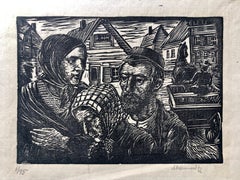
Jewish Shtetl Couple Judaica Woodblock c.1930s WPA Woodcut Print Hand Signed
By Albert Abramovitz
Located in Surfside, FL
Some of his prints were published by the WPA. it is a wood engraving signed in pencil. From a small edition. Albert Abramovitz (1879-1963), born in Riga, Latvia, on January 24, 187...
Category

1930s American Impressionist Figurative Prints

Materials

Woodcut

Colorful Russian French Judaica Jewish Shtetl Wedding Lithograph Mourlot Paris
By Mane Katz
Located in Surfside, FL
Mane-Katz (1894-1962) Original Lithograph published by Andre Sauret, Monte Carlo, 1966, printed in France, by Mourlot. The ouvrage sheet is not included. this is from a limited editi...
Category

1960s Modern Figurative Prints

Materials

Lithograph

Large French Judaica Lithograph Carborundum Etching Jewish Hebrew Embossing
By Théo Tobiasse
Located in Surfside, FL
Theo Tobiasse Suite: Shavuot Festival Year: 1984 Medium: Original carborundum embossed etching lithograph in colors on Arches paper (deckle edged paper) Signature: Hand signed by the artist Publisher Nahan Gallery, New Orleans Theo Tobiasse, born Tobias Eidesas, 1927 in Jaffa then in British Mandate Palestine, died 2012 in Cagnes-sur-Mer in France. Well known painter, engraver, draftsman and sculptor. French Jewish artist. The youngest son of Chaim (Charles) Eidesas and Brocha (Berthe) Slonimsky from Kaunas, Lithuania, Théo Tobiasse was born in Mandatory Palestine in 1927, where his Jewish parents lived since 1925, far from the threat of pogroms and upheavals of East European policies. The family encountered material difficulties and decided to return to Lithuania, ultimately leaving for Paris in 1931 where his father typographer finds work in a Russian printing press. Theodore Tobiasse...
Category

1970s Modern Figurative Prints

Materials

Etching, Lithograph

Columbus, Ohio State Artist Judaica Wedding Engagement Lithograph
By Sid Chafetz
Located in Surfside, FL
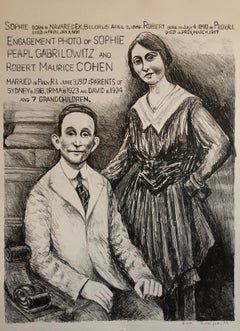
Description: Medium: Lithograph. Hand signed Print Image Size: 23 3/8 x 18 1/8 inches. Print Edition: no edition. this is marked B.A.T. Alternate Medium: Lithograph. Ink(s): black. Support: grey wove paper. Double portrait of the artist's aunt and uncle at their engagement, with Sophie standing next to a seated Robert Cohen. Text at the top reads "Sophie, born in Navaredek, Belarus, April 5, 1899, died in Providence, Jan 3, 1991. Robert, born in July 4, 1890 in Providence, R.I., Died in Providence, March, 1987. Engagement photo of Sophie Pearl Gabrilowitz and Robert Maurice Cohen...
Category

1990s Modern Figurative Prints

Materials

Archival Paper, Lithograph

Judaica Jewish Shtetl Etching Hasidic Rabbi "Difficult Problem" Chassidic Print
By Paul Jeffay
Located in Surfside, FL
"Probleme ardu." Chassidic boy, Yeshiva student with open book. Judaica, Jewish scenes from a ghetto. Saul Yaffie, a.k.a. Paul Jeffay, (1898–1957) was a Scottish Jewish artist. Know...
Category

20th Century Expressionist Figurative Prints

Materials

Etching

Vintage Russian Ukrainian Shtetl Scene Judaica Lithograph Jewish Portrait
By Anatoli Lvovich Kaplan
Located in Surfside, FL
Pencil signed and dated, Judaica Lithograph. Anatoli Lwowitch Kaplan was a Russian painter, sculptor and printmaker, whose works often reflect his Jewish origins. His father was a b...
Category

Mid-20th Century Modern More Prints

Materials

Lithograph

Large French Judaica Lithograph Carborundum Etching Jewish Hebrew Embossing
By Théo Tobiasse
Located in Surfside, FL
Theo Tobiasse Suite: Shavuot Festival Year: 1984 Medium: Original carborundum embossed etching lithograph in colors on Arches paper (deckle edged paper) Signature: Hand signed by the artist Publisher Nahan Gallery, New Orleans Theo Tobiasse, born Tobias Eidesas, 1927 in Jaffa then in British Mandate Palestine, died 2012 in Cagnes-sur-Mer in France. Well known painter, engraver, draftsman and sculptor. French Jewish artist. The youngest son of Chaim (Charles) Eidesas and Brocha (Berthe) Slonimsky from Kaunas, Lithuania, Théo Tobiasse was born in Mandatory Palestine in 1927, where his Jewish parents lived since 1925, far from the threat of pogroms and upheavals of East European policies. The family encountered material difficulties and decided to return to Lithuania, ultimately leaving for Paris in 1931 where his father typographer finds work in a Russian printing press. Theodore Tobiasse...
Category

1970s Modern Figurative Prints

Materials

Etching, Lithograph

The Scribe, Rabbi Writing A Torah, Judaica Artists Proof
By Emanuel Schary
Located in Surfside, FL
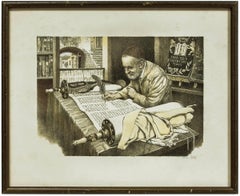
EMANUEL SCHARY Israel, b. 1924, d. 1994 A lively affection for humanity characterizes the work of the Israeli-American artist Emanuel Schary (1924-1994). Working in a range of media,...
Category

20th Century Modern Figurative Prints

Materials

Lithograph

A DOLLAR ON NUMBER SEVEN? (JUDAICA ART)
Located in Aventura, FL
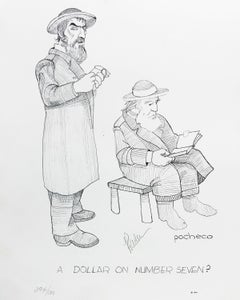
Offset lithograph in colors on paper. Hand signed and numbered by the artist. From the edition of 500. Artwork is in excellent condition. Certificate of authenticity included. Al...
Category

Late 20th Century Contemporary Figurative Prints

Materials

Paper, Lithograph

Vintage Russian Ukrainian Shtetl Scene Judaica Lithograph Jewish Portrait
By Anatoli Lvovich Kaplan
Located in Surfside, FL
Pencil signed and dated, Judaica Lithograph. Anatoli Lwowitch Kaplan was a Russian painter, sculptor and printmaker, whose works often reflect his Jewish origins. His father was a b...
Category

Mid-20th Century Modern More Prints

Materials

Lithograph

Vintage Russian Ukrainian Shtetl Scene Judaica Lithograph Jewish Portrait
By Anatoli Lvovich Kaplan
Located in Surfside, FL
Pencil signed and dated, Judaica Lithograph. Anatoli Lwowitch Kaplan was a Russian painter, sculptor and printmaker, whose works often reflect his Jewish origins. His father was a b...
Category

Mid-20th Century Modern Figurative Prints

Materials

Lithograph

Vintage Russian Ukrainian Shtetl Scene Judaica Lithograph Jewish City Faces
By Anatoli Lvovich Kaplan
Located in Surfside, FL
Pencil signed and dated, Judaica Lithograph. Anatoli Lwowitch Kaplan was a Russian painter, sculptor and printmaker, whose works often reflect his Jewish origins. His father was a b...
Category

Mid-20th Century Modern Figurative Prints

Materials

Lithograph

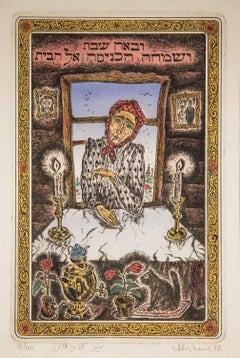
"Shabbat Comes and Joy Fills the House" Post Soviet Judaica Etching Hand Colored
By Eugene Abeshaus
Located in Surfside, FL
Hand-Colored Etching Ed. 19/110, signed l.r. in Hebrew, l.l. in English. EUGENE ABESHAUS Leningrad, Russia, b. 1939, d. 2008 Eugene Abeshaus (also spelled Evgeny Abezgauz, Евгений ...
Category

20th Century Modern Figurative Prints

Materials

Archival Paper, Etching

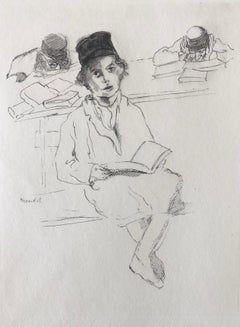
Judaica Jewish Shtetl Etching Hasidic Yeshiva Student Chassidic Print
By Paul Jeffay
Located in Surfside, FL
"Mendel" Chassidic boy, Yeshiva student with open book. Judaica, Jewish scenes from a ghetto. Saul Yaffie, a.k.a. Paul Jeffay, (1898–1957) was a Scottish Jewish artist. Known for...
Category

20th Century Expressionist Figurative Prints

Materials

Etching

Vintage Russian Ukrainian Shtetl Scene Judaica Lithograph Jewish Portrait
By Anatoli Lvovich Kaplan
Located in Surfside, FL
Pencil signed and dated, Judaica Lithograph. Anatoli Lwowitch Kaplan was a Russian painter, sculptor and printmaker, whose works often reflect his Jewish origins. His father was a b...
Category

Mid-20th Century Modern More Prints

Materials

Lithograph

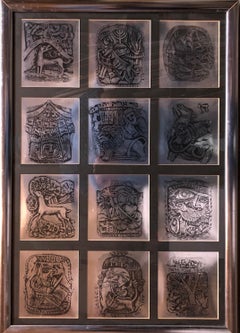
Mod 1970s Israeli Judaica Foil Print 12 Tribes of Israel Zodiac Signs Hebrew
Located in Surfside, FL
Genre: Israeli Batia Adith Subject: Biblical Medium: Print Surface: Paper Dimensions w/Frame: 30 1/2" x 21 1/2"
Category

1970s Modern Figurative Prints

Materials

Foil

Vintage Russian Ukrainian Shtetl Scene Judaica Lithograph Jewish Portrait
By Anatoli Lvovich Kaplan
Located in Surfside, FL
Pencil signed and dated, Judaica Lithograph. Anatoli Lwowitch Kaplan was a Russian painter, sculptor and printmaker, whose works often reflect his Jewish origins. His father was a b...
Category

Mid-20th Century Modern Figurative Prints

Materials

Lithograph

Rare 1923 Cubist Reuven Rubin Woodcut Woodblock Print Israeli Hasidic Judaica
By Reuven Rubin
Located in Surfside, FL
This is from the original first edition 1923 printing. there was a much later edition done after these originals. These are individually hand signed in pencil by artist as issued. This listing is for the one print. the other documentation is included here for provenance and is not included in this listing. The various images inspired by the Jewish Mysticism and rabbis and mystics of jerusalem and Kabbalah is holy, dramatic and optimistic Rubin succeeded to evoke the spirit of life in Israel in those early days. They are done in a modern art style influenced by German Expressionism, particularly, Ernst Barlach, Ernst Ludwig Kirchner, and Franz Marc, as introduced to Israel by Jakob Steinhardt, Hermann Struck and Joseph Budko. Reuven Rubin 1893 -1974 was a Romanian-born Israeli painter and Israel's first ambassador to Romania. Rubin Zelicovich (later Reuven Rubin) was born in Galati to a poor Romanian Jewish Hasidic family. He was the eighth of 13 children. In 1912, he left for Ottoman-ruled Palestine to study art at Bezalel Academy of Art and Design in Jerusalem. Finding himself at odds with the artistic views of the Academy's teachers, he left for Paris, France, in 1913 to pursue his studies at the École Nationale Supérieure des Beaux-Arts. He was of the well known Jewish artists in Paris along with Marc Chagall and Chaim Soutine, At the outbreak of World War I, he was returned to Romania, where he spent the war years. In 1921, he traveled to the United States with his friend and fellow artist, Arthur Kolnik. In New York City, the two met artist Alfred Stieglitz, who was instrumental in organizing their first American show at the Anderson Gallery. Following the exhibition, in 1922, they both returned to Europe. In 1923, Rubin emigrated to Mandate Palestine. Rubin met his wife, Esther, in 1928, aboard a passenger ship to Palestine on his return from a show in New York. She was a Bronx girl who had won a trip to Palestine in a Young Judaea competition. He died in 1974. Part of the early generation of artists in Israel, Joseph Zaritsky, Arieh Lubin, Reuven Rubin, Sionah Tagger, Pinchas Litvinovsky, Mordecai Ardon, Yitzhak Katz, and Baruch Agadati; These painters depicted the country’s landscapes in the 1920s rebelled against the Bezalel school of Boris Schatz. They sought current styles in Europe that would help portray their own country’s landscape, in keeping with the spirit of the time. Rubin’s Cezannesque landscapes from the 1920s were defined by both a modern and a naive style, portraying the landscape and inhabitants of Israel in a sensitive fashion. His landscape paintings in particular paid special detail to a spiritual, translucent light. His early work bore the influences of Futurism, Vorticism, Cubism and Surrealism. In Palestine, he became one of the founders of the new Eretz-Yisrael style. Recurring themes in his work were the bible, the prophet, the biblical landscape, folklore and folk art, people, including Yemenite, Hasidic Jews and Arabs. Many of his paintings are sun-bathed depictions of Jerusalem and the Galilee. Rubin might have been influenced by the work of Henri Rousseau whose naice style combined with Eastern nuances, as well as with the neo-Byzantine art to which Rubin had been exposed in his native Romania. In accordance with his integrative style, he signed his works with his first name in Hebrew and his surname in Roman letters. In 1924, he was the first artist to hold a solo exhibition at the Tower of David, in Jerusalem (later exhibited in Tel Aviv at Gymnasia Herzliya). That year he was elected chairman of the Association of Painters and Sculptors of Palestine. From the 1930s onwards, Rubin designed backdrops for Habima Theater, the Ohel Theater and other theaters. His biography, published in 1969, is titled My Life - My Art. He died in Tel Aviv in October 1974, after having bequeathed his home on 14 Bialik Street and a core collection of his paintings to the city of Tel Aviv. The Rubin Museum opened in 1983. The director and curator of the museum is his daughter-in-law, Carmela Rubin. Rubin's paintings are now increasingly sought after. At a Sotheby's auction in New York in 2007, his work accounted for six of the ten top lots. Along with Yaacov Agam and Menashe Kadishman he is among Israel's best known artists internationally. Education 1912 Bezalel Academy of Arts and Design, Jerusalem 1913-14 École des Beaux Arts, Paris and Académie Colarossi, Paris Select Group Exhibitions Eged - Palestine Painters Group Eged - Palestine Painters Group, Allenby Street, Tel Aviv 1929 Artists: Chana Orloff, Abraham Melnikoff, Rubin, Reuven Nahum Gutman, Sionah Tagger,Arieh Allweil, Jewish Artists Association, Levant Fair, Tel Aviv, 1929 Artists: Ludwig Blum,Eliyahu Sigad, Shmuel Ovadyahu, Itzhak Frenel Frenkel,Ozer Shabat, Menahem Shemi, First Exhibition of ''Hever Omanim'' First Exhibition of ''Hever Omanim'' Steimatzky Gallery, Jerusalem 1936 Artists: Gutman, Nachum Holzman, Shimshon Mokady, Moshe Sima, Miron Rubin, Reuven Steinhardt, Jakob Ben Zvi, Zeev Ziffer, Moshe Allweil, Arieh Group Exhibition Group Exhibition Katz Art Gallery, Tel Aviv 1939 Artists: Avni, Aharon Holzman, Shimshon Gliksberg, Haim Gutman, Nachum Ovadyahu, Shmuel Shorr, Zvi Schwartz, Chaya Streichman, Yehezkel Tagger, Sionah Rubin, Reuven A Collection of Works by Artists of the Land of Israel A Collection of Works by Artists of the Land of Israel The Bezalel National Museum, Jerusalem 1940 Artists: Shemi, Menahem Rubin, Reuven Avni, Aharon Mokady, Moshe Jonas, Ludwig Steinhardt, Jakob Ticho, Anna Krakauer, Leopold Gutman, Nachum Budko, Joseph Ardon, Mordecai Sima, Miron Castel, Moshe Pann, Abel Struck, Hermann Gur Arie, Meir Ben Zvi, Zeev Litvinovsky, Pinchas Artists in Israel for the Defense, Tel Aviv Museum of Art, Helena Rubinstein Pavilion, Tel Aviv 1967 Artists: Avraham Binder, Motke Blum, (Mordechai) Samuel Bak, Yosl Bergner, Nahum Gilboa, Jean David, Marcel Janco, Lea Nikel, Jacob Pins, Esther Peretz...
Category

1920s Abstract Figurative Prints

Materials

Woodcut

Judaica Jewish Shtetl Wedding Klezmer Musician Lithograph Mourlot Paris
By Mane Katz
Located in Surfside, FL
Mane-Katz (1894-1962) Original Lithograph published by Andre Sauret, Monte Carlo, 1966, printed in France, by Mourlot. The ouvrage sheet is not included. this is from a limited editi...
Category

1960s Modern Figurative Prints

Materials

Lithograph

Colorful Russian French Judaica Jewish Shtetl Wedding Lithograph Mourlot Paris
By Mane Katz
Located in Surfside, FL
Mane-Katz (1894-1962) Original Lithograph published by Andre Sauret, Monte Carlo, 1966, printed in France, by Mourlot. The ouvrage sheet is not included. this is from a limited editi...
Category

1960s Modern Figurative Prints

Materials

Lithograph

Zohar Kabbalah Portrait French Jewish Surrealist Aquatint Etching Hebrew Judaica
By Zvi Milshtein
Located in Surfside, FL
Etching and Aquatint with embossing, Zwy Milshtein (Zvi Tzvi Milstein) BIOGRAPHY 1934 Born in Kishinev (Bessarabia) Russian, Romanian region. 1948 Arrived in Israel via Cyprus, wher...
Category

20th Century Expressionist Portrait Prints

Materials

Etching, Aquatint

Russian French Judaica Jewish Bride Shtetl Wedding Lithograph Mourlot Paris
By Mane Katz
Located in Surfside, FL
Mane-Katz (1894-1962) Original Lithograph published by Andre Sauret, Monte Carlo, 1966, printed in France, by Mourlot. The ouvrage sheet is not included. this is from a limited editi...
Category

1960s Modern Figurative Prints

Materials

Lithograph

Original Judaica Woodcut Print Joyous Songs Dancing Jewish Couple
By Morton Garchik
Located in Surfside, FL
Original pencil signed Judaic woodcut on mulberry paper. MORTON GARCHIK (1929-2009) Jewish American artist painter, printmaker, illustrator, woodcut artist and author. Garchik was ...
Category

20th Century Folk Art Figurative Prints

Materials

Woodcut

Jacques Lipchitz French Cubist Modernist Lithograph Hebrew Judaica ZIon
By Jacques Lipchitz
Located in Surfside, FL
Hand signed and numbered. with Hebrew calligraphy "Zion" Chaim Jacob Lipchitz, 1891-1973, was born in Lithuania and came of age in Paris during the early 20th century, where he was...
Category

1960s Modern Figurative Prints

Materials

Lithograph

Rare Judaica Cheder Test Hand Colored Etching after Kaufmann
Located in Surfside, FL
This is an etching with hand painted watercolor applied After Isidor Kaufmann (1853-1921) was an Austro-Hungarian painter of Jewish themes. Having devoted his career to genre painti...
Category

20th Century Figurative Prints

Materials

Etching

Modernist Judaica Art Aquatint Etching Jewish Rabbi at Prayer Jerusalem Memories
By Lennart Rosensohn
Located in Surfside, FL
on Hahnemuhle paper, hand signed and numbered. poster is not included. These depict synagogue interiors, Rabbis at prayer etc. Judaic religious events. Mauritz Lennart Rosensohn , bo...
Category

20th Century Modern Figurative Prints

Materials

Etching, Aquatint

Hungarian Modernist Judaica Etching Print Teffilin, Jewish Rabbi in Prayer
By Janos Kass
Located in Surfside, FL
From very small edition of 15 on handmade mould made paper, with Jewish star Magen David watermark. From the deluxe boxed portfolio edition. Hand signed in pencil. János Kass (December 26, 1927 – March 29, 2010) was a Hungarian illustrator, printmaker, graphic designer, postage stamp designer, animated film director and teacher. Hungary's foremost graphic artist and book illustrator. Born in Szeged, he was the storyboard artist for the first fully digital animated film. This is done in a manner reminiscent of Saul Raskin, Tully Filmus and William Gropper, this is a modern take on a classic judaic subject matter, similar in style and tone to Abram Krol, Jakob Steinhardt, Josef Budko and Hermann Struck. Beginning his artistic studies at the Applied Art Academy, Kass finished in 1951 at the Academy of Fine Arts, a student of Gyula Hincz, György Kádár and György Konecsni. From 1956 to 1959 he held the Derkovits scholarship. From 1961 to 1962, he was assistant professor at the Book-Art Academy in Leipzig, Germany. Kass regularly took part in every major national exhibition at home and abroad. He had one-man shows in Italy (1963), Australia (1970) and Switzerland (1976). He participated in the Venice Biennial (1960), the Youth Biennial in Paris (1961), and Biennials in Lugano, Tokyo, Ljubljana, São Paulo and Buenos Aires, along with "Intergrafik" exhibitions in Berlin. He made many friends within the British graphic art fraternity while spending some months in London during 1980, working on one of the earliest, fully digitized computer-animated films, Dilemma, with John Halas. He had already won recognition with his illustrations and book designs. At the 1973 Leipzig book fair, his work was awarded the title of best illustrated book at the fair. This accolade was repeated at the Frankfurt fair in 1999. The 11-minute Dilemma was nominated at that year's Cannes Film Festival for the Golden Palm for Best Short Film, and is considered the first fully digital animated film. Kass was also a background artist for the "So Beautiful and So Dangerous" segment of Ivan Reitman Productions' 1981 animated feature film Heavy Metal. Kass' drawings, etchings and silk-screen prints were exhibited in the Fitzwilliam Museum in Cambridge in 1989 and in 1990 at London Olympia. He later held a one-man show in Edinburgh. He illustrated something like 400 books, classical novels and children's stories, among them an elegant edition of Imre Madách's 19th-century drama The Tragedy of Man, published in Iain MacLeod's translation by Edinburgh's Canongate press in 1993. He won Hungary's highest artistic award, the Kossuth prize, and was an elected member of the Széchenyi academy. János Kass’ s numerous works can be found in the Hungarian National Gallery. Since 1985, the János Kass Gallery...
Category

1990s Expressionist Figurative Prints

Materials

Etching

BAR MITZVAH AT THE WESTERN WALL (JUDAICA ART)
By Amram Ebgi
Located in Aventura, FL
Lithograph with foil stamping and embossing on paper. Hand signed and numbered by the artist. From the edition of 200. Artwork is in excellent condition. Certificate of authenticit...
Category

Late 20th Century Contemporary Figurative Prints

Materials

Foil

A Fine Judaica Etching "Atonement" Yom Kippur in the Synagogue
By Samuel George Cahan
Located in Surfside, FL
In this copper plate etching, Cahan captures the religious ardor and penitent sentiment shared by the figures in the artwork. The piece is number seventy-six in a series of one-hundr...
Category

Mid-20th Century Figurative Prints

Materials

Etching

Latin American Judaica Conceptual Chassidic Art Modern Woodcut Luis Camnitzer
By Luis Camnitzer
Located in Surfside, FL
Luis Camnitzer and Martin Buber (1878-1965), New York: JMB Publishers Ltd, 1970. Printed at The New York Graphic Workshop. Hand signed on Arches paper. (Edition 24/100, numbered on Justification page) Woodblock prints based on folktales from the Hasidic Jewish tradition in Eastern Europe, selected by Camnitzer from the early masters section of Buber’s Die chassidischen Bücher as translated by Olga Marx. German Expressionist style Jewish woodcuts...
Category

1970s Expressionist Figurative Prints

Materials

Woodcut

Colorful Russian French Judaica Jewish Shtetl Wedding Lithograph Mourlot Paris
By Mane Katz
Located in Surfside, FL
Mane-Katz (1894-1962) Original Lithograph published by Andre Sauret, Monte Carlo, 1966, printed in France, by Mourlot. The ouvrage sheet is not included. this is from a limited editi...
Category

1960s Modern Figurative Prints

Materials

Lithograph

Latin American Judaica Conceptual Chassidic Art Modern Woodcut Luis Camnitzer
By Luis Camnitzer
Located in Surfside, FL
Luis Camnitzer and Martin Buber (1878-1965), New York: JMB Publishers Ltd, 1970. Printed at The New York Graphic Workshop. Hand signed on Arches paper. (Edition 24/100, numbered on Justification page) Woodblock prints based on folktales from the Hasidic Jewish tradition in Eastern Europe, selected by Camnitzer from the early masters section of Buber’s Die chassidischen Bücher as translated by Olga Marx. German Expressionist style Jewish woodcuts...
Category

1970s Expressionist Figurative Prints

Materials

Woodcut

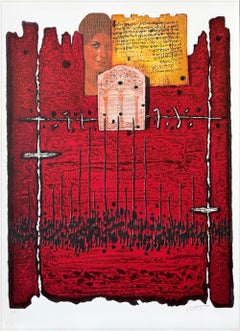
ABOVE JERUSALEM, Signed Lithograph, Collage Portrait, Sephardic Woman, Judaica
By Moshe Castel
Located in Union City, NJ
ABOVE JERUSALEM by the Israeli artist Moshe Castel (1909-1991) is a limited edition lithograph printed in 12 colors using traditional lithographic techniques on archival Somerset pap...
Category

1980s Contemporary Portrait Prints

Materials

Lithograph