2,645 results for "surrealism"

to
1,195
1,257
696
394
212
86
Overall Width
to
Overall Height
to
958
553
308
269
172
50
47
8
5
3
3
3
198
151
140
136
75
11
2,261
373
3
2
61
48
69
348
635
560
213
29
1,960
603
56
1,033
666
493
399
314
250
250
193
119
72
71
70
59
59
57
53
40
39
37
37
1,635
400
394
168
138
331
371
1,898
672
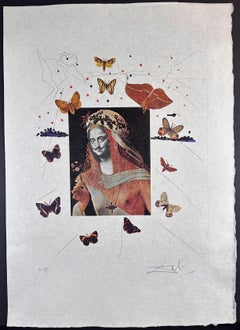
Memories of Surrealism Surrealist Portrait of Dali Surrounded by Butterflies
By Salvador Dalí­
Located in Hollywood, FL
ARTIST: Salvador Dali TITLE: Memories of Surrealism Surrealist Portrait of Dali Surrounded by Butterflies MEDIUM: Etching on Japon Paper SIGNED: Hand Signed by Salvador Dali EDIT...
Category

1970s Surrealist More Prints

Materials

Etching

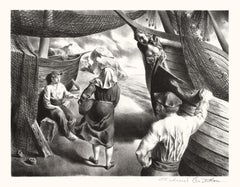
By the Arks — Mid-20th Century Surrealism
By Federico Castellon
Located in Myrtle Beach, SC
Federico Castellon, 'By the Arks', 1941, lithograph, edition 250, Freundlich 10D. Signed in pencil. Signed in the stone, lower left. A fine, atmospheric impression on cream, wove pap...
Category

1940s Surrealist Figurative Prints

Materials

Lithograph

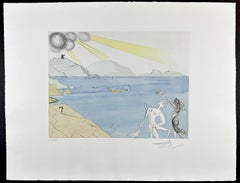
After 50 Years of Surrealism The Laurels of Happiness
By Salvador Dalí­
Located in Hollywood, FL
ARTIST: Salvador Dali TITLE: After 50 Years of Surrealism The Laurels of Happiness MEDIUM: Etching SIGNED: Hand Signed PUBLISHER: Transworld Art, NY EDITION NUMBER: F 84/195 M...
Category

1970s Surrealist Figurative Prints

Materials

Etching

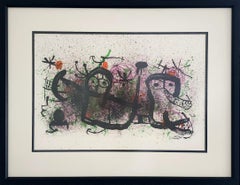
Ma de Proverbs (Abstract, Modern, Surrealism, Colorful, FRAMED, ~24% OFF)
By Joan Miró
Located in Kansas City, MO
Joan Miro Ma de Proverbs (Abstract, Modern, Surrealism, Colorful, Iconic) 1970 Color lithograph on Arches paper Visible: 14.25 x 20.5 inches Framed: 22.125 x 28.75 x 1 inches Signed...
Category

1970s Abstract Abstract Prints

Materials

Lithograph

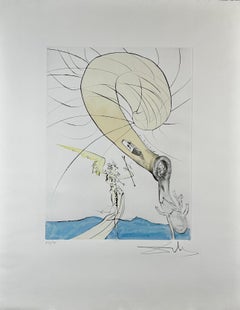
After 50 Years of Surrealism Freud with Snail Head
By Salvador Dalí­
Located in Hollywood, FL
ARTIST: Salvador Dali TITLE: After 50 Years of Surrealism Freud with Snail Head MEDIUM: Etching SIGNED: Hand Signed EDITION NUMBER: F 59/195 MEASUREMENTS: 19.75" x 26" YEAR: 1...
Category

1970s Surrealist Figurative Prints

Materials

Etching

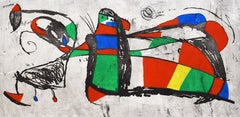
Three Juans - Spanish Surrealism
By Joan Miró
Located in London, GB
This original etching and aquatint on arches. It is hand signed in pencil by the artist "Miró" in the lower right image. It is also hand numbered in pencil with Roman numerals XIII o...
Category

1970s Abstract Prints

Materials

Etching, Aquatint

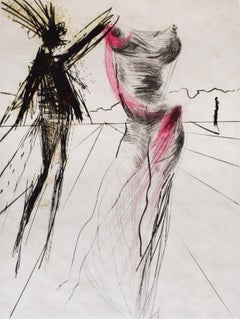
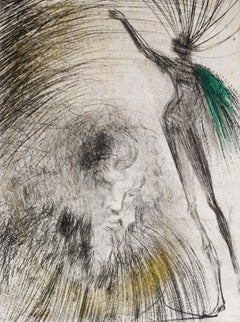
The Sculpture, from: Faust (Walpurgis Night) - Spanish Surrealism
By Salvador Dalí­
Located in London, GB
This original hand-coloured etching is hand signed in pencil by the artist "Dalí" at the lower right margin. It is also all hand numbered in pencil, edition 116 of 145, with Roman nu...
Category

1960s Surrealist Figurative Prints

Materials

Etching

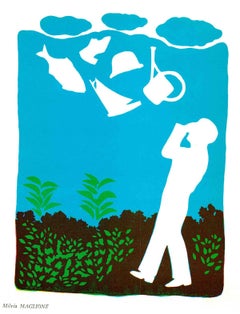
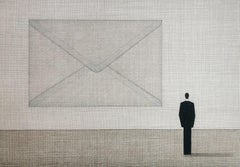
A Day Out Lithograph Print, Contemporary Surrealism, 1960s, Unframed
Located in Brooklyn, NY
Milvia Maglione's A Day Out is a compelling print that reflects her unique blend of Surrealism and Pop Art sensibilities. The composition features a solitary man standing amidst lush...
Category

1960s Contemporary Prints and Multiples

Materials

Lithograph

Going My Way? — Mid-century American Surrealism
By Robert Vale Faro
Located in Myrtle Beach, SC
Robert Vale Faro, 'Going My Way?', lithograph, 1946, edition 14. Signed in pen, recto. Titled, numbered '#118 14/14' and dated '5/5/46' in pen, verso. A fine, richly-inked impression, on heavy, off-white wove paper, with full margins (1 5/8 to 2 15/16 inches), in excellent condition. Image size 13 1/8 x 7 3/8 inches; sheet size 17 x 12 3/8 inches. Scarce. Matted to museum standards, unframed. An impression of this work is in the permanent collection of the National Gallery of Art. ABOUT THE ARTIST Robert Vale Faro (1902-1988) was a modernist architect and artist associated with the Chicago Bauhaus. He received his degree in architecture and design from the Armour Institute in Chicago and worked at L'Ecole des Beaux-Arts, Paris, from 1924-27, where he was influenced by Harry Kurt Bieg and Le Corbusier. Upon his return to Chicago, Faro worked with the important modernist Chicago architects George and William Keck under Louis Sullivan. Faro founded the avant-garde printmaking group Vanguard in 1945. The group counted Atelier 17 artists Stanley William Hayter, Sue Fuller...
Category

1940s American Modern Abstract Prints

Materials

Lithograph

Trace on Water - Surrealism Spanish Abstract Water
By Joan Miró
Located in London, GB
This original aquatint is hand signed in pencil by the artist "Miró" at the lower right margin. It is also hand numbered 30 in pencil from the edition of 100, at the lower left marg...
Category

1960s Surrealist Abstract Prints

Materials

Aquatint

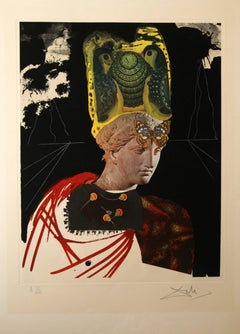
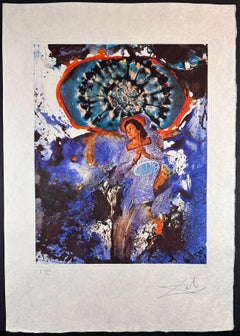
Crazy, Crazy, Crazy Minerva Salvador Dali Memories of Surrealism suite
By Salvador Dalí­
Located in Paonia, CO
Crazy, Crazy, Crazy Minerva by Salvador Dali is from the Memories Of Surrealism suite which consists of 12 hand-signed lithographs with etching p...
Category

1970s Surrealist Figurative Prints

Materials

Etching

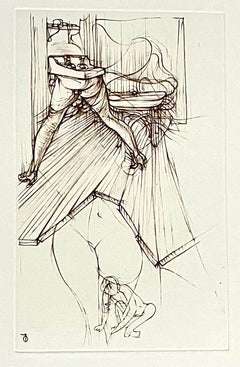
German Surrealist Hans Bellmer Etching Engraving Print Cecile Reims Surrealism
By Hans Bellmer
Located in Surfside, FL
After Hans Bellmer (German, 1902-1975) Surrealist engraving, etching after drawings from a 1942 notebook, engraved in 1974-75 by Cecile Reims Printed by L'Atelier de Chalcographie du Louvre, Paris, Having printed monogram lower left in plate, pencil notations verso Editioned from a very small edition of #7/10 'Musee du Louvre' blindstamp. Dimensions: Sheet 11 X 7.5, Plate size 6.5 X 4 Hans Bellmer ( 1902 – 1975) was a Polish born German artist, best known for his drawings, etchings that illustrates the 1940 edition of Histoire de l’œil, and the life-sized female sculpture mannequin dolls he produced in the mid-1930s. Historians of art and photography also consider him a Surrealist photographer. Bellmer was born in the city of Kattowitz, then part of the German Empire (now Katowice, Poland). Up until 1926, he worked as a draftsman for his own advertising company. Bellmer is most famous for the creation of a series of dolls as well as photographs of them. He was influenced in his choice of art form in part by reading the published letters of Oskar Kokoschka (Der Fetisch, 1925) and Surrealism. Bellmer's puppet doll project is also said to have been catalysed by a series of events in his personal life. Hans Bellmer takes credit for provoking a physical crisis in his father and brings his own artistic creativity into association with childhood insubordination and resentment toward a severe and humorless paternal authority. Perhaps this is one reason for the nearly universal, unquestioning acceptance in the literature of Bellmer's promotion of his art as a struggle against his father, the police, and ultimately, fascism and the state. Events of his personal life also including meeting a beautiful teenage cousin in 1932 (and perhaps other unattainable beauties), attending a performance of Jacques Offenbach's Tales of Hoffmann (in which a man falls tragically in love with an automaton), and receiving a box of his old toys. After these events, he began to actually construct his first dolls. In his works, Bellmer explicitly sexualized the doll as a young girl (his work bears connection to the works of Bathus). Hirschfeld has claimed (without further argumentation) that Bellmer initiated his doll project to oppose the fascism of the Nazi Party by declaring that he would make no work that would support the new German state. Represented by mutated forms and unconventional poses, his dolls (according to this view) were directed specifically at the cult of the perfect body then prominent in Germany. He visited Paris in 1935 and made contacts there, such as Paul Éluard, but returned to Berlin because his wife Margarete was dying of tuberculosis. He was part of the circle of Surrealist luminaries such as Man Ray, Marcel Duchamp, Max Ernst, Joan Miro, André Masson, René Magritte, Alberto Giacometti and Salvador Dali as well as women artists—such as Frida Kahlo, Dorothea Tanning and Leonora Carrington. Bellmer produced the first doll in Berlin in 1933. Long since lost, the assemblage can nevertheless be correctly described thanks to approximately two dozen photographs Bellmer took at the time of its construction. Standing about fifty-six inches tall, the doll consisted of a modeled torso made of flax fiber, glue, and plaster; a mask-like head of the same material with glass eyes and a long, unkempt wig; and a pair of legs made from broomsticks or dowel rods. One of these legs terminated in a wooden, club-like foot; the other was encased in a more naturalistic plaster shell, jointed at the knee and ankle. As the project progressed, Bellmer made a second set of hollow plaster legs, with wooden ball joints for the doll's hips and knees. There were no arms to the first sculpture, but Bellmer did fashion or find a single wooden hand, which appears among the assortment of doll parts the artist documented in an untitled photograph of 1934, as well as in several photographs of later work. Bellmer's 1934 anonymous book, The Doll (Die Puppe), produced and published privately in Germany, contains 10 black-and-white photographs of Bellmer's first doll arranged in a series of "tableaux vivants" (living pictures). The book was not credited to him, as he worked in isolation, and his photographs remained almost unknown in Germany. Yet Bellmer's work was eventually declared "degenerate" (entartete kunst) by the Nazi Party, and he was forced to flee Germany to France in 1938, where Bellmer's work was welcomed by the Surrealists around Andre Breton. He aided the French Resistance during the war by making fake passports. He was imprisoned in the Camp des Milles prison at Aix-en-Provence, a brickworks camp for German nationals, from September 1939 until the end of the Phoney War in May 1940. After the war, Bellmer lived the rest of his life in Paris. Bellmer gave up doll-making and spent the following decades creating erotic drawings, etchings, sexually explicit photographs, paintings, and prints of pubescent girls. In 1954, he met Unica Zürn...
Category

20th Century Abstract Prints

Materials

Etching

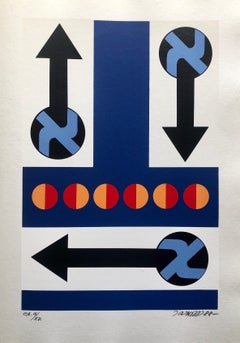
Hungarian Surrealism Pop Art Hebrew Silkscreen Judaica Print Jewish Serigraph
By Jozsef Jakovits
Located in Surfside, FL
Abstract Hebrew Prints on heavy mould made paper from small edition of 15. there is a facing page of text in Hungarian folded over. Hard edged geometric abstract prints in color base...
Category

1980s Pop Art Abstract Prints

Materials

Archival Paper, Screen

Eyes for the Night — Mid-century American Surrealism
By Benton Murdoch Spruance
Located in Myrtle Beach, SC
Benton Spruance, 'Eyes for the Night', lithograph, 1947, edition 35, Fine and Looney 260. Signed, dated, titled, and annotated 'Ed 35' in pencil. A fine impression, on heavy, cream ...
Category

1940s American Modern Figurative Prints

Materials

Lithograph

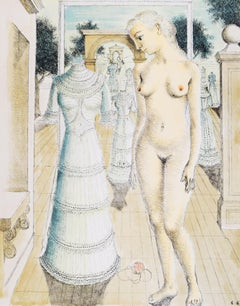
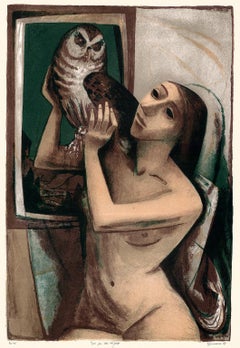
Sunday Dress - Surrealism Belgian Nude
By Paul Delvaux
Located in London, GB
This original lithograph in colours is hand signed by the artist in pencil "P. Delvaux" at the lower right margin. It is also hand inscribed in pencil HC, at the lower left margin. T...
Category

1960s Surrealist Nude Prints

Materials

Lithograph

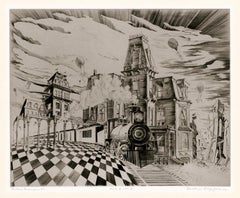
Fantasia Americana, 1880 — Mid-Century American Surrealism
By Lawrence Kupferman
Located in Myrtle Beach, SC
Lawrence Kupferman, 'Fantasia Americana – 1880', drypoint etching with sandground, 1943. Signed, titled, and annotated 'Series A, 1971 2/6' in pencil. A superb, richly-inked impression, on heavy, cream wove paper, with full margins (2 1/2 to 3 1/2 inches); the paper slightly lightened within the original mat opening, otherwise in excellent condition. One of only 6 impressions printed in 1971, with the added sandground grey background tint. Archivally matted to museum standards, unframed. Image size 11 13/16 x 14 3/4 inches; sheet size 18 x 20 1/4 inches. Collections: National Gallery of Art, Zimmerli Art Museum (Rutgers University). ABOUT THE ARTIST Lawrence Kupferman (1909 - 1982) was born in the Dorchester neighborhood of Boston and grew up in a working-class family. He attended the Boston Latin School and participated in the high school art program at the Museum of Fine Arts, Boston. In the late 1920s, he studied drawing under Philip Leslie Hale at the Museum School—an experience he called 'stultifying and repressive'. In 1932 he transferred to the Massachusetts College of Art, where he first met his wife, the artist Ruth Cobb. He returned briefly to the Museum School in 1946 to study with the influential expressionist German-American painter Karl Zerbe. Kupferman held various jobs while pursuing his artistic career, including two years as a security guard at the Museum of Fine Arts, Boston. During the 1930s he worked as a drypoint etcher for the Federal Art Project, creating architectural drawings in a formally realistic style—these works are held in the collections of the Fogg Museum and the Smithsonian American Art Museum. In the 1940s he began incorporating more expressionistic forms into his paintings as he became progressively more concerned with abstraction. In 1946 he began spending summers in Provincetown, Massachusetts, where he met and was influenced by Mark Rothko, Hans Hofmann, Jackson Pollock, and other abstract painters. At about the same time he began exhibiting his work at the Boris Mirski Gallery in Boston. In 1948, Kupferman was at the center of a controversy involving hundreds of Boston-area artists. In February of that year, the Boston Institute of Modern Art issued a manifesto titled 'Modern Art and the American Public' decrying 'the excesses of modern art,' and announced that it was changing its name to the Institute of Contemporary Art (ICA). The poorly conceived statement, intended to distinguish Boston's art scene from that of New York, was widely perceived as an attack on modernism. In protest, Boston artists such as Karl Zerbe, Jack Levine, and David Aronson formed the 'Modern Artists Group' and organized a mass meeting. On March 21, 300 artists, students, and other supporters met at the Old South Meeting House and demanded that the ICA retract its statement. Kupferman chaired the meeting and read this statement to the press: “The recent manifesto of the Institute is a fatuous declaration which misinforms and misleads the public concerning the integrity and intention of the modern artist. By arrogating to itself the privilege of telling the artists what art should be, the Institute runs counter to the original purposes of this organization whose function was to encourage and to assimilate contemporary innovation.” The other speakers were Karl Knaths...
Category

1940s Surrealist Figurative Prints

Materials

Drypoint, Etching

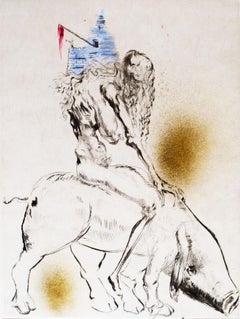
Woman with Pig, from: Faust (Walpurgis Night) - Spanish Surrealism
By Salvador Dalí­
Located in London, GB
This original hand-coloured etching is hand signed in pencil by the artist "Dalí" at the lower right margin. It is also all hand numbered in pencil from the edition of 145, with Roma...
Category

1960s Surrealist Figurative Prints

Materials

Etching

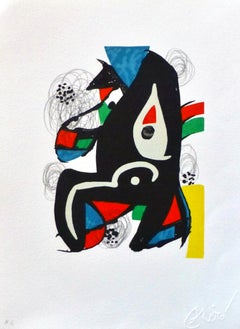
La Mélodie Acide - 10 (Surrealism, Colorful, Modern, ~26% OFF LIMITED TIME ONLY)
By Joan Miró
Located in Kansas City, MO
Joan Miró La Mélodie Acide - 10 Color lithograph Year: 1980 Edition: 1500 Artist Dry Stamp lower right, Annotated "H.C" (hors commerce) in pencil lower left Size: 8.2 × 6.6 on 12.9...
Category

1980s Modern Prints and Multiples

Materials

Lithograph

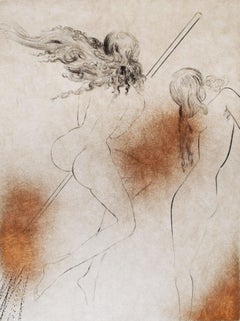
Witches with Broom, from: Faust (Walpurgis Night) - Spanish Surrealism
By Salvador Dalí­
Located in London, GB
This original hand-coloured etching is hand signed in pencil by the artist "Dalí" at the lower right margin. It is also all hand numbered in pencil from the edition of 145, with Roma...
Category

1960s Surrealist Figurative Prints

Materials

Etching

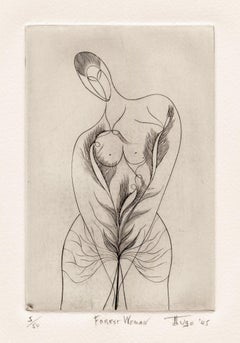
Forest Woman — Mid-Century Surrealism, Atelier 17
Located in Myrtle Beach, SC
Ian Hugo, 'Forest Woman', engraving, 1945, edition 50. Signed, dated, titled, and numbered '5/50' in pencil. With the blind stamp 'madeleine-claude jobrack E...
Category

1940s Surrealist Figurative Prints

Materials

Engraving

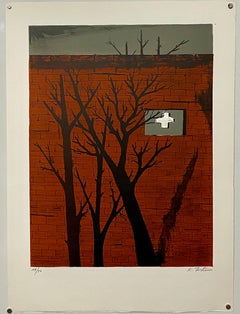
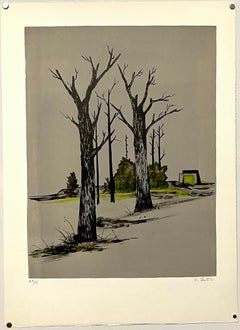
Lithograph Belgian American Surrealism WPA Modernist Karl Fortess Surrealist Art
Located in Surfside, FL
Karl Eugene Fortess (1907-1993) Original color lithographs on BFK Rives paper, 1966, Hand signed and numbered 29/36 in pencil, Sheet size 20.5 x 15 inches. Karl E. Fortess (1907-1993) was a painter, printmaker and teacher, of Boston, Massachusetts and Woodstock, N.Y. Fortess was born in Antwerp, Belgium on October 13, 1907, and became an American citizen in 1923. He studied at the Art Institute of Chicago, the Art Students League in New York, and the Woodstock School of Painting with Yasuo Kuniyoshi. In 1937 the Works Progress Administration sent him and several other artists to Alaska to document the towns, villages, and remote wilderness landscapes (Pemberton, “Alaska art museum collects WPA’s Depression works from the territory,” Columbia Daily Tribune, November 9, 2003). Trains, trucks, and industrial buildings were what Karl Fortess envisioned when the Public Works of Art Project suggested that he depict “the American Scene.” His work bears the influence of Surrealism, Russsian Constructivist art and Cubism. He was part of a circle of left leaning artists loosley involved with the WPA which included Sol Wilson, Isaac Soyer, Louis Lozowick, Abraham Harriton, Ben Shahn, William Gropper, Nahum Tschacbasov, Morris Shulman, Yasuo Kuniyoshi, Louis Slobodkin, Adolf Dehn, Le Corbusier and Louis Schanker. Karl Fortress taught at the Art Students League, Brooklyn Museum Art School, Louisiana State University, Fort Wright College, and Boston University School of Fine and Applied Arts. He was a member of the Artists Equity Association, Society of American Graphic Artists, American Association of University Professors, and the British Film Institute. He was awarded the Guggenheim Fellowship in 1946, was named an Associate of the National Academy of Design in 1960 and elected to full Academician in 1971. Fortess taught at many different schools, including Boston University School of Fine Art, where he also created an archive of interviews with more than two hundred and fifty contemporary American painters, sculptors, and graphic artists including many with with artists associated with the Woodstock, N.Y. art community. Among the interviewees are Kenneth Armitage, Will Barnet, Romare Bearden, George Biddle, James Brooks, Adolph Dehn, Jane Freilicher, Julian Levi, Alice Neel, Larry Rivers, Moses Soyer, Dorothy Varian...
Category

Mid-20th Century Surrealist Landscape Prints

Materials

Lithograph

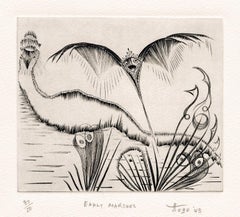
Early Marshes — Mid-Century Surrealism, Atelier 17
Located in Myrtle Beach, SC
Ian Hugo, 'Early Marshes', from the portfolio 'Ten Engravings'. engraving, 1943, edition 50. Signed, dated, titled, and numbered '37/50' in pencil. A fine impression, with delicate overall plate tone, on cream wove paper, the full sheet with margins (2 5/8 to 7 inches), in excellent condition. With the blind stamp 'madeleine-claude jobrack EDITIONS', in the bottom right margin. Matted to museum standards, unframed. Image size 5 x 5 7/8 inches (127 x 149 mm); sheet size 15 x 11 inches (381 x 279 mm). Ian Hugo originally created "Ten Engravings" in 1945 and the portfolio included a foreword by his partner and collaborator, Anais Nin. In 1978, Hugo republished the portfolio with Madeleine-Claude Jobrack, an American master printmaker who studied under Stanley William Hayter at Atelier 17, Paris, and with Johnny Friedlaender. When Jobrack returned to the States she managed the Robert Blackburn Printmaking Studio in New York before opening her own printing studio, Madeleine-Claude Jobrak Editions. “The sign of the true artist is one who creates a complete universe, invents new plants, new animals, new figures to transfer to us a new vision of the universe in which dream and reality fuse. Ian Hugo's plants have eyes, the birds have the delicacy of dragonflies, their feathers have the shape of fans. Humor is apparent in every gesture. He uses a fine spider web to give a feeling of flight, speed, lightness. The body of a woman reveals the structure of a leaf, a plant. Wings are moving in a world unified by mythological themes. This is an animated world, humorous and levitating, elusive and decorative, which by its unique forms and shapes gives us the sensation of a rebirth, a liberation from the usual, the familiar, a visit to a new planet.” —Anais Nin, from the forward to the portfolio ‘Ten Engravings’ ABOUT THE ARTIST Ian Hugo was born Hugh Parker Guiler in Boston, Massachusetts, on February 15, 1898. His childhood was spent in Puerto Rico—a "tropical paradise," the memory of which stayed with him and surfaced in both his engravings and his films. He attended school in Scotland and graduated from Columbia University where he studied economics and literature. Hugo was working with the National City Bank when he met and married author Anais Nin in 1923. The couple moved to Paris the following year, where Nin's diary and Guiler's artistic aspirations flowered. Guiler feared his business associates would not understand his interests in art and music, let alone those of his wife, so he began a second, creative life as Ian Hugo. Ian and Anais moved to New York in 1939. The following year he took up engraving and etching, working at Stanley William Hayter’s experimental printmaking workshop Atelier 17, established at the New School for Social Research. Hugo began producing surreal images often used to illustrate Nin's books. For Nin, his unwavering love and financial support were indispensable—Hugo was the "fixed center, core... my home, my refuge" (Sept. 16, 1937, Nearer the Moon, The Unexpurgated Diary of Anais Nin, 1937-!939). Fictionalized portraits of Higo and Nin appear in Philip Kaufman's 1990 film drama of a literary love triangle, Henry & June. Inspired by comments that viewers saw motion in his engravings, Hugo took up filmmaking. He asked the avant-garde filmmaker Sasha Hammid for instruction but was told, "Use the camera yourself, make your own mistakes, make your own style." Hugo embarked on an exploration of the film medium as a vehicle to delve into his dreams, his unconscious, and his memories. Without a specific plan, He would collect resonant images, then reorder or superimpose them, seeking a sense of self-connection through the poetic juxtapositions he created. These intuitive explorations resembled the mystical evocations of his engravings, which he described in 1946 as "hieroglyphs of a language in which our unconscious is trying to convey important, urgent messages." In the underwater world of his film ‘Bells of Atlantis,’ the light originates from the world above the surface; it is otherworldly, out of place, yet essential. In ‘Jazz of Lights,’ the street lights of Times Square become in Nin's words, "an ephemeral flow of sensations." This flow that she also calls "phantasmagorical" had a crucial impact on Stan Brakhage, who said that without Jazz of Lights (1954), "there would have been no Anticipation of the Night" his autobiographical film which ushered in a new era of experimental modernist filmmaking. Hugo lived the last two decades of his life in a New York apartment high above street level. In the evenings, surrounded by an electrically illuminated man...
Category

1940s Surrealist Figurative Prints

Materials

Engraving

Lithograph Belgian American Surrealism WPA Modernist Karl Fortess Surrealist Art
Located in Surfside, FL
Karl Eugene Fortess (1907-1993) Original color lithographs on BFK Rives paper, 1966, Hand signed and numbered 29/36 in pencil, Sheet size 20.5 x 15 inches. Karl E. Fortess (1907-1993) was a painter, printmaker and teacher, of Boston, Massachusetts and Woodstock, N.Y. Fortess was born in Antwerp, Belgium on October 13, 1907, and became an American citizen in 1923. He studied at the Art Institute of Chicago, the Art Students League in New York, and the Woodstock School of Painting with Yasuo Kuniyoshi. In 1937 the Works Progress Administration sent him and several other artists to Alaska to document the towns, villages, and remote wilderness landscapes (Pemberton, “Alaska art museum collects WPA’s Depression works from the territory,” Columbia Daily Tribune, November 9, 2003). Trains, trucks, and industrial buildings were what Karl Fortess envisioned when the Public Works of Art Project suggested that he depict “the American Scene.” His work bears the influence of Surrealism, Russsian Constructivist art and Cubism. He was part of a circle of left leaning artists loosley involved with the WPA which included Sol Wilson, Isaac Soyer, Louis Lozowick, Abraham Harriton, Ben Shahn, William Gropper, Nahum Tschacbasov, Morris Shulman, Yasuo Kuniyoshi, Louis Slobodkin, Adolf Dehn, Le Corbusier and Louis Schanker. Karl Fortress taught at the Art Students League, Brooklyn Museum Art School, Louisiana State University, Fort Wright College, and Boston University School of Fine and Applied Arts. He was a member of the Artists Equity Association, Society of American Graphic Artists, American Association of University Professors, and the British Film Institute. He was awarded the Guggenheim Fellowship in 1946, was named an Associate of the National Academy of Design in 1960 and elected to full Academician in 1971. Fortess taught at many different schools, including Boston University School of Fine Art, where he also created an archive of interviews with more than two hundred and fifty contemporary American painters, sculptors, and graphic artists including many with with artists associated with the Woodstock, N.Y. art community. Among the interviewees are Kenneth Armitage, Will Barnet, Romare Bearden, George Biddle, James Brooks, Adolph Dehn, Jane Freilicher, Julian Levi, Alice Neel, Larry Rivers, Moses Soyer, Dorothy Varian...
Category

Mid-20th Century Surrealist Landscape Prints

Materials

Lithograph

Composition II, from: Boxes Cartones - Spanish Surrealism Boxes Abstract
By Joan Miró
Located in London, GB
This original lithograph in colours is hand signed in pencil by the artist "Miró" at the lower right corner. It is also hand numbered in pencil from the deluxe edition of 75 numbered...
Category

1960s Abstract Abstract Prints

Materials

Lithograph

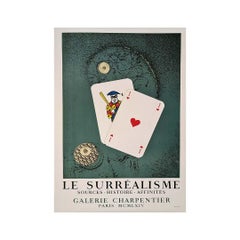
1964 Original poster of Max Ernst for an exhibition on surrealism
By Max Ernst
Located in PARIS, FR
Beautiful poster of Max Ernst printed by Mourlot in 1964 for an exhibition on surrealism. A prolific artist, Ernst is one of the pioneers of the Dada movement...
Category

1960s Surrealist Prints and Multiples

Materials

Paper, Lithograph

Eyes for the Night — Mid-Century American Surrealism
By Benton Murdoch Spruance
Located in Myrtle Beach, SC
Benton Spruance, 'Eyes for the Night', color lithograph, 1948, edition 35, Fine and Looney 261. Signed, dated, and titled, and annotated 'Ed 35' in pencil. A fine impression with fresh colors, on cream wove paper; the full sheet with margins (1 to 1 3/8 inches), in excellent condition. Printed by master lithographer Theodore Cuno. Archivally matted to museum standards, unframed. Image size 19 x 13 inches; sheet size 21 1/8 x 15 1/4 inches. Selected by the artist for his retrospective exhibition 'Benton Spruance: Lithographs...
Category

1940s American Modern Figurative Prints

Materials

Lithograph

Old Faust, from: Faust (Walpurgis Night) - Spanish Surrealism
By Salvador Dalí­
Located in London, GB
This original hand-coloured etching is hand signed in pencil by the artist "Dalí" at the lower right margin. It is also all hand numbered in pencil 116 from the edition of 145, with ...
Category

1960s Surrealist Portrait Prints

Materials

Etching

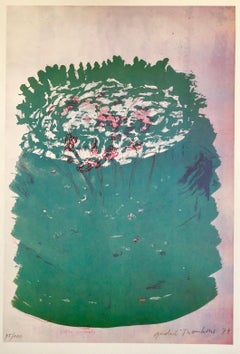
1970s Modernist Swiss Colorful Surrealism Signed Dada Lithograph Andre Thomkins
By André Thomkins
Located in Surfside, FL
This one is titled "Little Animals" and depicts drawings of small animals over an abstract forest background in green, red and tan with a quali...
Category

1970s Surrealist Figurative Prints

Materials

Lithograph, Offset

Bullfight — Mid-century American Surrealism, Chicago Avant-garde
By Robert Vale Faro
Located in Myrtle Beach, SC
Robert Vale Faro, 'Bullfight', wood engraving, 1945, edition 15. Signed, dated, titled, and numbered '105' (the artist's inventory number) and '13/15' in pencil. A fine, richly-inked impression, on cream wove paper, with full margins (1 1/16 to 2 3/8 inches), in excellent condition. Scarce. Matted to museum standards, unframed. Image size 5 1/16 x 4 1/16 inches (129 x 103 mm); sheet size 8 9/16 x 6 5/16 inches (217 x 160 mm). An impression of this work is included in the museum collection of the National Gallery of Art. ABOUT THE ARTIST Robert Vale Faro (1902-1988) was a well-known modernist architect and artist associated with the Chicago Bauhaus. He received his degree in architecture and design from the Armour Institute in Chicago and worked at L'Ecole des Beaux-Arts, Paris, from 1924-27, where he was influenced by Harry Kurt Bieg and Le Corbusier. Upon his return to Chicago, Faro worked with the important modernist Chicago architects George and William Keck under Louis Sullivan. Faro founded the avant-garde printmaking group Vanguard in 1945. The group counted Atelier 17 artists Stanley William Hayter, Sue Fuller, and Anne Ryan as New York members and Francine Felsenthal...
Category

1940s Surrealist Abstract Prints

Materials

Woodcut

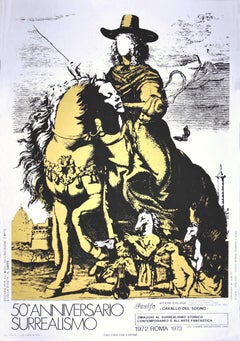
50° Surrealism Anniversary - Vintage Offset Poster - 1972
By Guelfo Bianchini
Located in Roma, IT
50° Surrealism Anniversary is an original serigraph realized by Guelfo Bianchini in 1972 The artwork is the affiche realized in the occasion of the exhibiton 50° Anniversario Surrea...
Category

1970s Contemporary Figurative Prints

Materials

Offset

Lithograph Belgian American Surrealism WPA Modernist Karl Fortess Surrealist Art
Located in Surfside, FL
Karl Eugene Fortess (1907-1993) Original color lithographs on BFK Rives paper, 1966, Hand signed and numbered 29/36 in pencil, Sheet size 20.5 x 15 inches. Karl E. Fortess (1907-1993) was a painter, printmaker and teacher, of Boston, Massachusetts and Woodstock, N.Y. Fortess was born in Antwerp, Belgium on October 13, 1907, and became an American citizen in 1923. He studied at the Art Institute of Chicago, the Art Students League in New York, and the Woodstock School of Painting with Yasuo Kuniyoshi. In 1937 the Works Progress Administration sent him and several other artists to Alaska to document the towns, villages, and remote wilderness landscapes (Pemberton, “Alaska art museum collects WPA’s Depression works from the territory,” Columbia Daily Tribune, November 9, 2003). Trains, trucks, and industrial buildings were what Karl Fortess envisioned when the Public Works of Art Project suggested that he depict “the American Scene.” His work bears the influence of Surrealism, Russsian Constructivist art and Cubism. He was part of a circle of left leaning artists loosley involved with the WPA which included Sol Wilson, Isaac Soyer, Louis Lozowick, Abraham Harriton, Ben Shahn, William Gropper, Nahum Tschacbasov, Morris Shulman, Yasuo Kuniyoshi, Louis Slobodkin, Adolf Dehn, Le Corbusier and Louis Schanker. Karl Fortress taught at the Art Students League, Brooklyn Museum Art School, Louisiana State University, Fort Wright College, and Boston University School of Fine and Applied Arts. He was a member of the Artists Equity Association, Society of American Graphic Artists, American Association of University Professors, and the British Film Institute. He was awarded the Guggenheim Fellowship in 1946, was named an Associate of the National Academy of Design in 1960 and elected to full Academician in 1971. Fortess taught at many different schools, including Boston University School of Fine Art, where he also created an archive of interviews with more than two hundred and fifty contemporary American painters, sculptors, and graphic artists including many with with artists associated with the Woodstock, N.Y. art community. Among the interviewees are Kenneth Armitage, Will Barnet, Romare Bearden, George Biddle, James Brooks, Adolph Dehn, Jane Freilicher, Julian Levi, Alice Neel, Larry Rivers, Moses Soyer, Dorothy Varian...
Category

Mid-20th Century Surrealist Landscape Prints

Materials

Lithograph

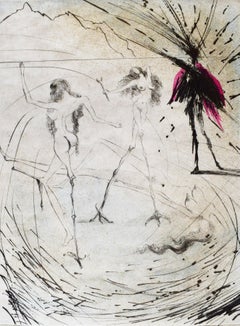
Bird Women, from: Faust (Walpurgis Night) - Spanish Surrealism
By Salvador Dalí­
Located in London, GB
This original hand-coloured etching is hand signed in pencil by the artist "Dalí" at the lower right margin. It is also all hand numbered in pencil 116 from the edition of 145, with ...
Category

1960s Surrealist Figurative Prints

Materials

Etching

Romantic letter - Figurative print, Symbolic Surrealism, Polish art
By Joanna Wiszniewska-Domanska
Located in Warsaw, PL
Print is singed, dated and numered. It comes from limited edition of 50 copies JOANNA WISZNIEWSKA DOMAŃSKA (born in 1946) graduated from the Academy of Fine Arts, Faculty of Graphic Arts in 1972 at the atelier of professor Stanisław Fijałkowski. She works in the techniques of aquafort and aquatint. Her etchings are to be found in the collections of Museum of Contemporary Art in Lodz (the oldest contemporary art museum worldwide), Museum in Walbrzych and Museum of Couvin (Belgium), Miejska Galeria Sztuki in Łódź, National Library of Poland in Warsaw, Eugenio Granell...
Category

Early 2000s Contemporary Figurative Prints

Materials

Paper, Color

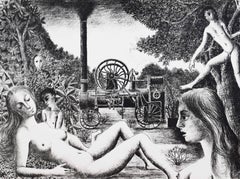
Locomobile - Surrealism Belgian Industrial Nudes
By Paul Delvaux
Located in London, GB
This original lithograph is hand signed by the artist in pencil "P. Delvaux" at the lower right margin. It is also hand inscribed in pencil EA, at the lower left margin. This is one ...
Category

1970s Surrealist Nude Prints

Materials

Lithograph

Alain Le Yaouanc-Study on Calamine-Surrealism
Located in Brooklyn, NY
First edition lithograph on page 2 of Derriere le Miroir (DLM) No.176.
Category

20th Century Contemporary Prints and Multiples

Materials

Lithograph

1967 Martin Engelman Thoughts Surrealism Multicolor Lithograph
Located in Brooklyn, NY
Paper Size: 10.75 x 8.5 inches ( 27.305 x 21.59 cm ) Image Size: 10.75 x 8.5 inches ( 27.305 x 21.59 cm ) Framed: No Condition: A: Mint Additional Details: Derives from a publi...
Category

1960s Prints and Multiples

Materials

Lithograph

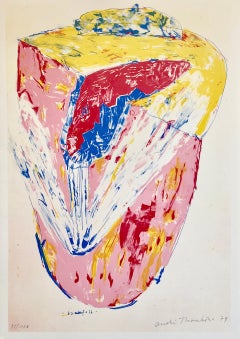
1970s Modernist Swiss Colorful Surrealism Signed Dada Lithograph Andre Thomkins
By André Thomkins
Located in Surfside, FL
This one is titled "Backfall" It depicts what looks like an abstract Chihuly sculpture or lithograph in pink, blue, red and yellow colors. Published by Edition Hansjörg Mayer, Stuttgart They published concrete poetry and art books by Mark Boyle, Richard Hamilton, Dorothy Iannone, John Latham, Tom Phillips, Dieter Roth, André Thompkins and Emmett Williams, to name just a few. André Thomkins (1930 - 1985) was a Swiss painter, illustrator, and poet. He attended art-school, taught by Max von Moos, 1947 – 1949 and the Académie de la Grande Chaumière, Paris, France, 1950. From 1952, he lived in Germany and taught at the Kunstakademie Düsseldorf between 1971 and 1973. Thomkins painted and drew ironic and fantastic pictures influenced by surrealism and dadaism. Together with Dieter Roth and Daniel Spoerri he prepared works of Eat Art. He also was a writer of palindromes. His friends and collaborators included Daniel Spoerri, Dieter Roth, George Brecht, Richard Hamilton and Karl Gerstner, Thomkins gained a reputation as an ‘artist’s artist’, and is considered one of the most important Swiss artists of the second half of the twentieth century.He died in 1985. His work is currently represented by Hauser & Wirth Zurich, Switzerland. Select group exhibitions: 2018 Kunsthalle Krems, 'Pablo Picasso. Arshile Gorky, Andy Warhol. Sculptures and Works on Paper. Hubert Looser Collection', Krems, Austria 2017 Kunsthandel Wolfgang Werner, 'Martin Barré, Karl Otto Götz, Ernst Wilhelm Nay, André Thomkins', Berlin, Germany 2013 Fabian & Claude Walter Galerie, 'Schweizer Avantgarde Kunst nach 1940', Zurich, Switzerland 2009 The Modern Institute, 'Thomas Houseago, Dieter Roth, Andre Thomkins', Glasgow, England Museum of Modern Art, 'Compass in Hand: Selections from the Judith Rothschild Collection', NYC 2004 Kunsthandel Wolfgang Werner, 'Arman, Baumeister, Götz, Graubner, Tàpies, Thomkins', Berlin, Germany 1994 Kunstmuseum Solothurn, 'Eine Schenkung. Grafik von Eduardo Chillida, Antoni Tàpies, Alexander Calder, Jean Dubuffet, Ben Nicholson, Giacometti, Tinguely, Thomkins', Solothurn, Switzerland 1992 Galerie Littmann, Tinguely zu Ehren. A Tribute to Jean Tinguely. Hommage à Tinguely, Basel, 1988 Museum Ludwig, 'Uebrigens sterben immer die anderen. Marcel Duchamp und die Avantgarde seit 1950', Cologne, Germany 1987 Aargauer Kunsthaus, 'Otto Grimm. Marc-Antoine Fehr. Christoph Gredinger', Aarau, Switzerland Cercle Municipal, 'Art contemporain suisse. Collection de la Banque du Gothard', Luxembourg, 1985 Centre national d'art et de culture Georges Pompidou, 'Livres d'artistes', Paris, France Rathaus, 'Claude Sandoz – Hans Schärer...
Category

1970s Dada Figurative Prints

Materials

Lithograph, Offset

Memories of Surrealism Ultra Surrealist Corpuscular Galutska
By Salvador Dalí­
Located in Hollywood, FL
ARTIST: Salvador Dali TITLE: Memories of Surrealism Ultra Surrealist Corpuscular Galutska MEDIUM: Etching on Japon Paper SIGNED: Hand Signed by Salvador Dali EDITION NUMBER: A XX...
Category

1970s Surrealist More Prints

Materials

Etching

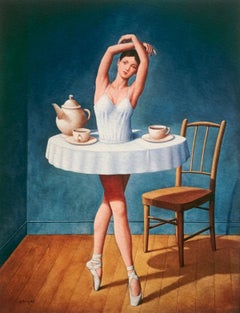
A ballerina. Limited edition print, Surrealism, Established Polish artist
By Rafał Olbiński
Located in Warsaw, PL
Contemporary colorful figurative surrealistic print on paper by Polish artist Rafal Olbinski. This print shows woman ballerina dancer with skirt shaped like a tabletop with teapot an...
Category

2010s Surrealist Figurative Prints

Materials

Paper, Color

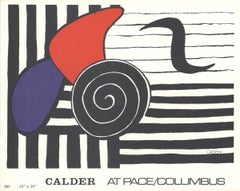
1982 After Alexander Calder Deck of 100 cards Helisse Surrealism Black White
By Alexander Calder
Located in Brooklyn, NY
Paper Size: 5.75 x 7.25 inches ( 14.605 x 18.415 cm ) Image Size: 5.75 x 7.25 inches ( 14.605 x 18.415 cm ) Framed: No Condition: A: Mint Additional Details: Vintage first edit...
Category

1980s Prints and Multiples

Materials

Postcard

Jorge Castillo - MARIENZA EN DOMINGO Etching Spanish Surrealism Feminine
By Jorge Castillo
Located in Madrid, Madrid
Jorge Castillo - MARIENZA EN DOMINGO Date of creation: 1972 Medium: Etching on paper Edition: 150 + H.C. Size: 56 x 70 cm Condition: In perfect conditions and never framed Observatio...
Category

1970s Surrealist Figurative Prints

Materials

Paper, Engraving, Etching

Analphabetogramme - Signatur Objekt Nr. 23 (Collages, Assemblages, Surrealism)
By Jiri Kolar
Located in Kansas City, MO
Jiri Kolar (Jiří Kolář) Analphabetogramme - Signatur Objekt Nr. 23 (Collages, Assemblages, Poetry, Surrealism) Analphabétogramme (hand-pressed copper print) with matte Year: 1995 Size: 12×11.6×0.6in Edition: 756 of 990 Signed, numbered by hand Publisher: First Edition, Verlag Rommerskirchen, Rolandseck - Germany COA provided Ref.: 924802-1933 White original cardboard in a Plexiglas slipcase, signed and numbered, number 756 of 990. 28 pages in block book form, texts and colored illustrations of collaged sculpture photographs, 1 loosely enclosed hand-signed original hand-pressed copper print ("Analphabétograms") under passepartout. The cardboard cover is cut out like a passe-partout so that the title illustration is visible when the book is hung on the wall as an art object using the acrylic glass frame provided. Tags: Czech artist,Poet,Visual artist,Political activist,Collages,Assemblages,Poetry,Surrealism,Dada...
Category

1990s Surrealist Prints and Multiples

Materials

Copper

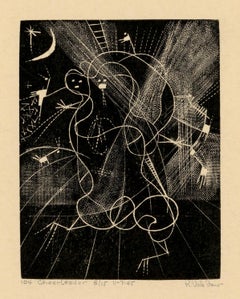
Cheerleader — Mid-century American Surrealism, Chicago Avant-garde
By Robert Vale Faro
Located in Myrtle Beach, SC
Robert Vale Faro, 'Cheerleader', wood engraving, 1945, edition 15. Signed, dated, titled, and numbered '104' (the artist's inventory number) and '8/15' in pencil. A fine, black impression, with full margins (1 1/2 inches), on heavy, cream wove paper, in excellent condition. Scarce. Matted to museum standards, unframed. ABOUT THE ARTIST Robert Vale Faro (1902-1988) was a well-known modernist architect and artist associated with the Chicago Bauhaus...
Category

1940s Surrealist Abstract Prints

Materials

Woodcut

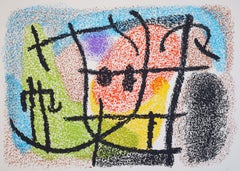
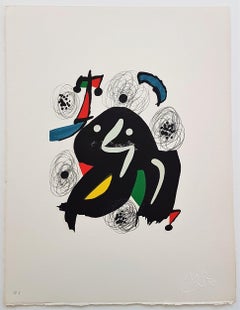
La Mélodie Acide - 4 (Surrealism, Colorful, Vibrant, Modern)
By Joan Miró
Located in Kansas City, MO
Joan Miró La Mélodie Acide - 4 Color lithograph Year: 1980 Edition: 1500 Artist Dry Stamp lower right, Annotated "H.C" (hors commerce) in pencil lower left Size: 8.2 × 6.6 on 12.9 ...
Category

1980s Abstract Expressionist Prints and Multiples

Materials

Lithograph

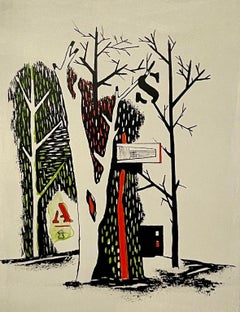
Kindergarten — Mid-century American Surrealism, Chicago Avant-garde
By Robert Vale Faro
Located in Myrtle Beach, SC
Robert Vale Faro, 'Kindergarten', color lithograph, 1945, edition 12. Signed, dated, titled, and numbered '99' and '5/12' in pen. A fine, richly-inked impression, with fresh colors, on heavy, coated off-white wove paper; the full sheet with margins (1/2 to 1 1/2 inch), in excellent condition. Scarce. Matted to museum standards, unframed. Image size 13 1/2 x 7 9/16 inches (343 x 192 mm); sheet size 17 x 12 1/4 inches (432 x 311 mm). ABOUT THE ARTIST Robert Vale Faro (1902-1988) was a well-known modernist architect and artist associated with the Chicago Bauhaus. He received his degree in architecture and design from the Armour Institute in Chicago and worked at L'Ecole des Beaux-Arts, Paris, from 1924-27, where he was influenced by Harry Kurt Bieg and Le Corbusier. Upon his return to Chicago, Faro worked with the important modernist Chicago architects George and William Keck under Louis Sullivan. Faro founded the avant-garde printmaking group Vanguard in 1945. The group counted Atelier 17 artists Stanley William Hayter, Sue Fuller, and Anne Ryan as New York members and Francine Felsenthal of Chicago. The Brooklyn Museum mounted a show of Vanguard artists' work in 1946, which subsequently toured several other institutions in the United States. Faro's visionary graphics from the 1940s are a sophisticated blend of Abstract Expressionism, Surrealism, and Indian Space...
Category

1940s Surrealist Abstract Prints

Materials

Lithograph

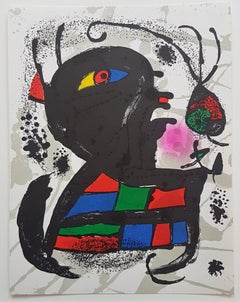
Lithographie Originale V (Abstract, Modern, Surrealism, Colorful, ~22% OFF)
By Joan Miró
Located in Kansas City, MO
Joan Miró Lithographie Originale V Color Lithograph Year: 1977 Size: 12.5 × 9.6 inches Catalogue Raisonné: Teixidor, Miro Lithographe III, 1964-1969 Publisher: Maeght Editeur, Paris, France Verso: Typographically annotated: 'Joan Miro - Lithographie originale V' Unsigned, Unknown Edition Size COA provided --------------------------------------- Joan Miró i Ferrà was a Spanish painter, sculptor, and ceramicist born in Barcelona. A museum dedicated to his work, the Fundació Joan Miró, was established in his native city of Barcelona in 1975, and another, the Fundació Pilar i Joan Miró, was established in his adoptive city of Palma de Mallorca in 1981 Surrealism, Fauvism, Cubism, Abstract expressionism, Naive art, Expressionism, Suprematism Pablo Picasso, André Breton, Hans Arp, André Masson, Hieronymus Bosch, Tristan Tzara, Modest Urgell
Category

1970s Surrealist Abstract Prints

Materials

Lithograph

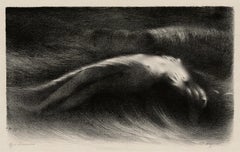
Vague Lumineuse (Luminescent Wave) — Late 19th Century Surrealism
Located in Myrtle Beach, SC
Théophile Pierre Wagner, 'Vague Lumineuse' (Luminescent Wave), lithograph, edition not stated but small, c. 1895. Signed and titled in pencil. Initialed in the stone, lower left. A f...
Category

1890s Surrealist Nude Prints

Materials

Lithograph

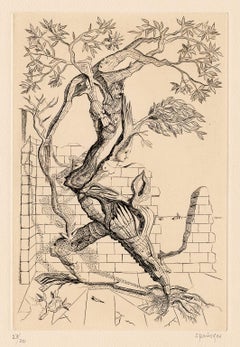
Arbre-Homme (Tree-Man) —Mid-Century European Surrealism
By Ferdinand Springer
Located in Myrtle Beach, SC
Ferdinand Springer, 'Arbre-Homme', engraving, 1945, edition 23. Signed and numbered '23/20' in pencil. A fine, richly-inked impression, on heavy, b...
Category

1940s Surrealist Figurative Prints

Materials

Engraving

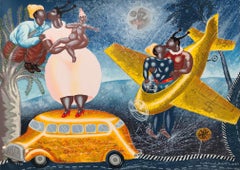
Maximino Javier Mexican artist original hand signed silkscreen surrealism
By Maximino Javier
Located in Miami, FL
Maximino Javier (Mexico, 1948) 'Bajada de emergencia (serie Tamayo Total)', 2023 silkscreen on paper Canson 320 g. 20.3 x 28.2 in. (51.5 x 71.5 cm.) Edition of 100 Unframed ID: JAV-1...
Category

2010s Surrealist Figurative Prints

Materials

Cotton, Paper, Screen

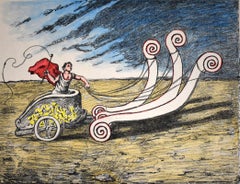
The Invincible Chariot La biga invincibile - Hand Coloured Italian Surrealism
By Giorgio De Chirico
Located in London, GB
GIORGIO DE CHIRICO 1888-1978 Vólos, Greece 1888 - 1978 Rome (Italian) Title: The Invincible Chariot La biga invincibile, 1969 Technique: Original Hand Signed and Numbered Lithogr...
Category

1960s Figurative Prints

Materials

Lithograph

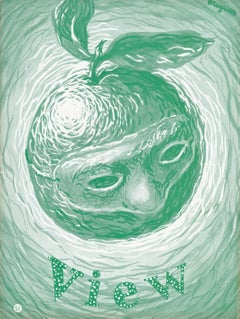
Magritte, Sans titre, View, Surrealism in Belgium (after)
By René Magritte
Located in Southampton, NY
Lithograph on vélin paper. Paper Size: 12 x 9 inches. Inscription: Signed in the plate and unnumbered, as issued. Notes: From the album, View, Surrealism in Belgium, vol. VII, n°2, D...
Category

1940s Surrealist Figurative Prints

Materials

Lithograph

Man in rain. Figurative print, Symbolic Surrealism, Polish art
By Joanna Wiszniewska-Domanska
Located in Warsaw, PL
Surrealistic figurative print by Polish artist Joanna Wiszniewska-Domanska. Artwork depictics a man dressed in black visible from the back. THe is standing in a bathtube or a bowl, h...
Category

Early 2000s Contemporary Figurative Prints

Materials

Paper, Color

Jorge Castillo - EROTIC COMPOSITION Etching on paper Spanish Surrealism
By Jorge Castillo
Located in Madrid, Madrid
Jorge Castillo - COMPOSICIÓN ERÓTICA (Erotic Composition) Date of creation: 1977 Medium: Etching on paper Edition: 75 + 20 E.A. Size: 50 x 65,5 cm Condition: In perfect conditions an...
Category

1970s Surrealist Figurative Prints

Materials

Engraving, Etching

German Surrealism Abstract Surrealist Lithograph Hans Bellmer
By Hans Bellmer
Located in Surfside, FL
Hans Bellmer German (1902–1975) Abstract Surrealist Lithograph Souterrain No. 13 8 1944 Musée Jean Brun Date: circa 1965 Hand signed and numbered in pencil Edition of 100 Size: 19.5 x 26.5 in. Hans Bellmer ( 1902 – 1975) was a Polish born German artist, best known for his drawings, etchings that illustrates the 1940 edition of Histoire de l’œil, and the life-sized female sculpture mannequin dolls he produced in the mid-1930s. Historians of art and photography also consider him a Surrealist photographer. Bellmer was born in the city of Kattowitz, then part of the German Empire (now Katowice, Poland). Up until 1926, he worked as a draftsman for his own advertising company. Bellmer is most famous for the creation of a series of dolls as well as photographs of them. He was influenced in his choice of art form in part by reading the published letters of Oskar Kokoschka (Der Fetisch, 1925) and Surrealism. Bellmer's puppet doll project is also said to have been catalysed by a series of events in his personal life. Hans Bellmer takes credit for provoking a physical crisis in his father and brings his own artistic creativity into association with childhood insubordination and resentment toward a severe and humorless paternal authority. Perhaps this is one reason for the nearly universal, unquestioning acceptance in the literature of Bellmer's promotion of his art as a struggle against his father, the police, and ultimately, fascism and the state. Events of his personal life also including meeting a beautiful teenage cousin in 1932 (and perhaps other unattainable beauties), attending a performance of Jacques Offenbach's Tales of Hoffmann (in which a man falls tragically in love with an automaton), and receiving a box of his old toys. After these events, he began to actually construct his first dolls. In his works, Bellmer explicitly sexualized the doll as a young girl (his work bears connection to the works of Bathus). Hirschfeld has claimed (without further argumentation) that Bellmer initiated his doll project to oppose the fascism of the Nazi Party by declaring that he would make no work that would support the new German state. Represented by mutated forms and unconventional poses, his dolls (according to this view) were directed specifically at the cult of the perfect body then prominent in Germany. He visited Paris in 1935 and made contacts there, such as Paul Éluard, but returned to Berlin because his wife Margarete was dying of tuberculosis. He was part of the circle of Surrealist luminaries such as Man Ray, Marcel Duchamp, Max Ernst, Joan Miro, André Masson, René Magritte, Alberto Giacometti and Salvador Dali as well as women artists—such as Frida Kahlo, Dorothea Tanning and Leonora Carrington. Bellmer produced the first doll in Berlin in 1933. Long since lost, the assemblage can nevertheless be correctly described thanks to approximately two dozen photographs Bellmer took at the time of its construction. Standing about fifty-six inches tall, the doll consisted of a modeled torso made of flax fiber, glue, and plaster; a mask-like head of the same material with glass eyes and a long, unkempt wig; and a pair of legs made from broomsticks or dowel rods. One of these legs terminated in a wooden, club-like foot; the other was encased in a more naturalistic plaster shell, jointed at the knee and ankle. As the project progressed, Bellmer made a second set of hollow plaster legs, with wooden ball joints for the doll's hips and knees. There were no arms to the first sculpture, but Bellmer did fashion or find a single wooden hand, which appears among the assortment of doll parts the artist documented in an untitled photograph of 1934, as well as in several photographs of later work. Bellmer's 1934 anonymous book, The Doll (Die Puppe), produced and published privately in Germany, contains 10 black-and-white photographs of Bellmer's first doll arranged in a series of "tableaux vivants" (living pictures). The book was not credited to him, as he worked in isolation, and his photographs remained almost unknown in Germany. Yet Bellmer's work was eventually declared "degenerate" (entartete kunst) by the Nazi Party, and he was forced to flee Germany to France in 1938, where Bellmer's work was welcomed by the Surrealists around Andre Breton. He aided the French Resistance during the war by making fake passports. He was imprisoned in the Camp des Milles prison at Aix-en-Provence, a brickworks camp for German nationals, from September 1939 until the end of the Phoney War in May 1940. After the war, Bellmer lived the rest of his life in Paris. Bellmer gave up doll-making and spent the following decades creating erotic drawings, etchings, sexually explicit photographs, paintings, and prints of pubescent girls. In 1954, he met Unica Zürn, who became his companion until her suicide in 1970. He continued working into the 1960s Cécile Reims (1927) has been drawing the world that surrounds her since her childhood in Lithuania, and subsequently in Paris, Jerusalem, and Barcelona. As a Jew, she had to go into hiding during World War II, and found herself at death’s door when she contracted tubercu- losis. Recovering from the disease, she felt she had to give meaning to her life as a survivor and she experienced a “conversion to art” as one is converted to a religion. Her encounter with the engraver Joseph Hecht in 1945 introduced her to the burin, an unforgiving tool which became her medium of choice. In her early years as an artist, she produced the mysterious Visages d’Espagne, Metamorphoses and Bestiaire de la mort series. But in order to support her work as an artist and to help Fred Deux (1924), whom she married in 1952, she suddenly gave a new twist to her career by turning to the interpretation of others’ work and engraving the drawings made by other artists. Cécile Reims filled this role with good humour and immense talent, as well as secretly collaborating with numerous artists working in the surrealist mode, such as Hans Bellmer, from 1966 to 1975, Salvador Dalí, from 1969 to 1988, Fred Deux, from 1970 to 2008, and Leonor Fini, from 1972 to 1995. In 2004, the Bibiothèque Nationale de France held an important retrospective devoted to Cécile Reims, suddenly putting into the limelight a figure who had long been kept in the shadows. At that point it became essential to produce a catalogue raisonné of her miniature engravings...
Category

20th Century Abstract Abstract Prints

Materials

Lithograph

Don t be afraid - XX Century figurative etching print, Black white, Surrealism
By Jacek Sroka
Located in Warsaw, PL
ZBIGNIEW LUTOMSKI He was born in 1934 in Grodno. Polish graphic designer, painter and teacher. He studied at the Academy of Fine Arts in Krakow, where in 1960 he obtained a diploma. ...
Category

21st Century and Contemporary Contemporary Figurative Prints

Materials

Paper, Etching

Unité, Planche 16 (Set of 2) /// Surrealism Modern Art Le Corbusier Abstract
By Le Corbusier
Located in Saint Augustine, FL
Artist: Le Corbusier (Charles-Édouard Jeanneret) (Swiss-French, 1887-1965) Title: "Unité, Planche 16" (Set of 2) Portfolio: Unité *Signed by Le Corbusier in pencil lower right. It is...
Category

1960s Surrealist Abstract Prints

Materials

Etching, Aquatint, Intaglio

1967 Guido Biasi Envisioning Surrealism Green, Black Lithograph
Located in Brooklyn, NY
Paper Size: 10.75 x 8.5 inches ( 27.305 x 21.59 cm ) Image Size: 10.75 x 8.5 inches ( 27.305 x 21.59 cm ) Framed: No Condition: A: Mint Additional Details: Derives from a publi...
Category

1960s Prints and Multiples

Materials

Lithograph

Woman with Clown, from: Faust (Walpurgis Night) - Spanish Surrealism
By Salvador Dalí­
Located in London, GB
This original hand-coloured etching is hand signed in pencil by the artist "Dalí" at the lower right margin. It is also all hand numbered in pencil from the edition of 145, with Roma...
Category

1960s Surrealist Figurative Prints

Materials

Etching

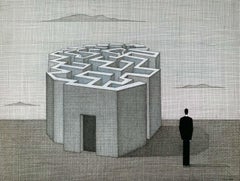
Dream about escaping a maze - Figurative print, Surrealism, Minimalism
By Joanna Wiszniewska-Domanska
Located in Warsaw, PL
Print is singed, dated and numered. It comes from limited edition of 50 copies JOANNA WISZNIEWSKA DOMAŃSKA (born in 1946) graduated from the Academy of Fine Arts, Faculty of Graphic...
Category

2010s Contemporary Figurative Prints

Materials

Paper, Watercolor, Color

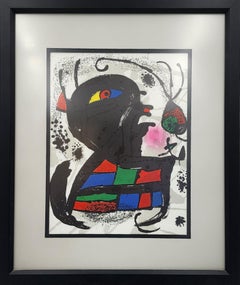
Lithographie Originale V (Abstract, Modern, Surrealism, FRAMED, ~20% OFF)
By Joan Miró
Located in Kansas City, MO
Joan Miro Lithographie Originale V (Abstract, Modern, Surrealism, Colorful, Iconic) Color Lithograph Year: 1977 Size: 12.5 × 9.6 inches Framed: 18.25 x 15.5 x 1 inches Catalogue Rais...
Category

1970s Surrealist Abstract Prints

Materials

Lithograph