1,780 results for "cubist"

to
899
901
340
329
123
51
Overall Width
to
Overall Height
to
655
81
78
53
44
25
14
14
11
112
80
71
64
42
1
6
1,714
59
6
37
107
153
80
391
417
211
110
47
1
1,179
535
23
778
459
380
322
297
265
172
154
83
59
57
55
53
41
40
33
33
31
29
28
1,272
246
163
120
63
200
295
1,306
382
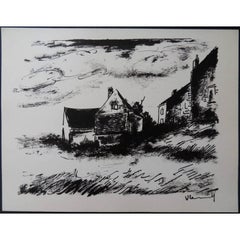
Maurice de Vlaminck - House in Rueil - Original Lithograph
By Maurice de Vlaminck
Located in Collonge Bellerive, Geneve, CH
Maurice de Vlaminck Original Lithograph Signed in the plate 1958 Title: House in Beauce Dimensions: 22 x 27 cm Reference: Catalogue raisonné Walterskirchen 275 Condition : Excellent Maurice de Vlaminck (1876 - 1958) Maurice was three years old when his family moved from Paris to Vésinet. He first pursued the same musical career as his parents, who were both musicians, leaving his home as a trained double-bass player in 1892 to move to Chatou near Versailles. After absolving his military service in Vitré Maurice Vlaminck worked as a musician until he accidentally met André Derain in 1900. It was Derain who kindled Vlaminck's artistic ambitions. He decided to become a painter and rented an old hut in which he and Derain shared a studio. A crucial turning point in Vlaminck's artistic development was a visit to a van Gogh exhibition...
Category

1950s Impressionist Landscape Prints

Materials

Lithograph

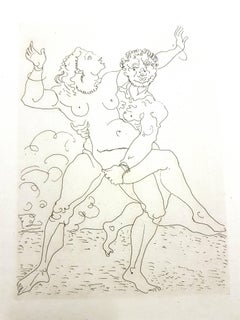
André Derain - Ovid s Heroides - Original Etching
By André Derain
Located in Collonge Bellerive, Geneve, CH
André Derain - Ovid's Heroides Original Etching Edition of 134 Dimensions: 32 x 25 cm Ovide [Marcel Prevost], Héroïdes, Paris, Société des Cent-une, 1938 Andre Derain was born in 1880 in Chatou, an artist colony outside Paris. In 1898, he enrolled in the Academie Carriere in Paris where he met Matisse. He attended art school and in 1900, set up a studio with Maurice deVlaminck. After his military service from 1900-1904, Derain exhibited his work at the Salon des Independants and then at the Salon d'Automne with Matisse, Vlaminck and others, thus creating the movement of Fauvism.He worked with Henri Matisse in 1905 at Collioure, and participated in the 1905 Salon d’Automne with Matisse, Vlaminck, and Braque, the exhibition in which this group was labeled as Fauves, or Wild Beasts. Along with Vlaminck, Derain was one of the first artists to collect the tribal art of Africa which was influential to many of the artists of the early 20th century. In 1906, Derain met Picasso and his dealer, who purchased Derain's entire studio, creating newfound financial success. During this time, he was hired for the illustrations for works by Guillaume Apollinaire and Andre Breton. After World War I, his friend's Cubism movement affected his art, along with influence from Classicism and African Art. Derain stayed in Paris during most of the Occupation, where he was esteemed by the Nazis because of his artistic integrity. Hitler's Foreign Minister commissioned him to paint a family portrait, but he politely refused. His popularity began to decline after the war because of disagreement over new artistic movements. He later lost most of his eyesight due to illness, which may have been the reason he was hit by a truck in 1954, dying from shock at the age of 74. Derain’s Fauve paintings are typically bright with intense color. Influenced by the work of Cézanne as well as the early Cubist paintings of Picasso and Braque’s, Derain’s style changed and by 1912, the paintings became more traditional and structured. For the remainder of his career, he continued to investigate different compositional methods including the perspective of Cézanne and the pointillism of Seurat. He also designed ballet sets and made a number of sculptures. At the turn of the century, Andre Derain exhibited at the radical Fauve Salon d’Automne (1905) and was one of the founding members of the Fauvist movement together with his life-long friends Matisse and Vlaminck. The works he produced in this period, often under the guidance of Matisse, have been counted among the masterpieces of Fauvism. From around 1918, Derain turned his back on the avant-garde and had begun to explore some of the more traditional genres of Western art, including landscapes. His main source of inspiration once the Fauves group had dispersed was found in the Louvre, where he admired the early Renaissance works in particular. Talking of his frequent visits there, he once said, ‘That seemed to me then, the true, pure absolute painting.’ His work evolved through many styles and, most significantly, turned back to the past, particularly after 1922 when Lenin had publicly pronounced his disdain for abstract art. Derain built up an immense and fascinating collection of paintings, sculpture and objets d’art throughout his life which aided his experimentation and was reflected in his work between 1930 and 1945. During these years, his painting technique displayed the most avenues of invention, using a repertoire of primitivist motifs. His eclectic collection was constantly changing. In 1930 he sold his African collection in exchange for bronzes of antiquity and the Renaissance which indicated a real change of interest in the objects, as did his later pursuit of Greek ceramic painting and his enthusiasm for grand cycles of literary and antique themes...
Category

1930s Modern Nude Prints

Materials

Etching

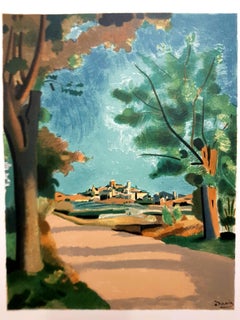
Provence Village - Lithograph
By André Derain
Located in Collonge Bellerive, Geneve, CH
Title: Provence Village lithograph in colors after a painting by the artist Dimensions: 38 x 28 cm from the edition of 250 as issued in Warnod, Andre...
Category

1960s Modern Portrait Prints

Materials

Lithograph

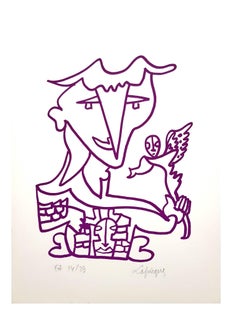
Charles Lapicque - Original Handsigned Lithograph - Ecole de Paris
By Charles Lapicque
Located in Collonge Bellerive, Geneve, CH
Charles Lapicque Original Handsigned Lithograph Dimensions: 40 x 30 cm Edition: EA 14/29 HandSigned and Numbered Charles Lapicque was one of the great painters of the “Ecole de Par...
Category

1960s Abstract Expressionist Landscape Prints

Materials

Lithograph

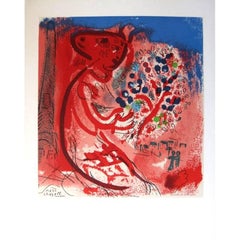
Femme au bouquet de fleurs (Lady with Flower Bouquet)
By (after) Marc Chagall
Located in Collonge Bellerive, Geneve, CH
This vintage color lithograph on paper is after a watercolor by Marc Chagall titled Femme au bouquet de fleurs (Lady with Flower Bouquet). Signed on ...
Category

1960s Surrealist Portrait Prints

Materials

Lithograph

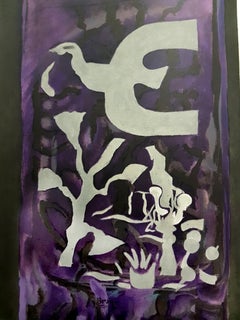
Lithograph after Georges Braque
Located in Collonge Bellerive, Geneve, CH
Lithograph after Georges Braque From the deluxe art review, Derrière le Mirroir 1964 Printed signature Dimensions: 38 x 28 cm DLM No. 148, 1964 Edition: Foundation Maeght at Saint P...
Category

1960s Modern Figurative Prints

Materials

Lithograph

The Bird - Lithograph
By (after) Georges Braque
Located in Collonge Bellerive, Geneve, CH
Title: The Bird Printed signature Dimensions: 38 x 28 cm from the edition of 250 as issued in Warnod, Andre, "Les Peintres mes amis" (Paris: Les Heures Claires, 1965) The father of ...
Category

1960s Modern Portrait Prints

Materials

Lithograph

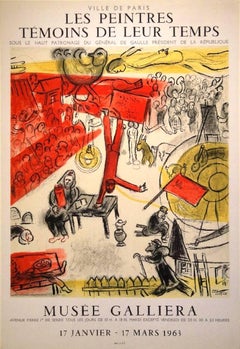
Marc Chagall - Revolution - Original 1960s Poster for Galiera Museum
By Marc Chagall
Located in Collonge Bellerive, Geneve, CH
after Marc CHAGALL (1887 - 1985) Poster for "Les peintres témoins de leur temps Musée Galiera" 1963 Created by Charles Sorlier after Chagall's 1937 painting...
Category

1960s Modern Figurative Prints

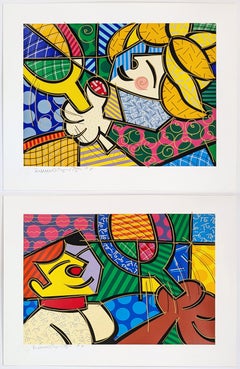
TENNIS SUITE
By Romero Britto
Located in Aventura, FL
Hand embellished with gold pen/marker screen print on paper. Hand signed and inscribed "AP" lower front by Romero Britto on each screen print. Each print is 23 x 29 inches. Artw...
Category

1990s Pop Art Portrait Prints

Materials

Screen, Paper

TENNIS SUITE
TENNIS SUITE
$2,250 Sale Price
25% Off
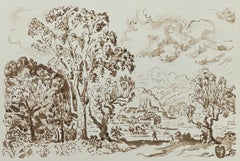
Signac, Antibes. L eucalyptus, Signac Dessins (after)
By Paul Signac
Located in Fairfield, CT
Medium: Lithograph on vélin de Lana paper Year: 1950 Paper Size: 9.75 x 12.5 inches Inscription: Unsigned and unnumbered, as issued Notes: From the album, Signac Dessins, 1950. Publi...
Category

1950s Post-Impressionist Landscape Prints

Materials

Lithograph

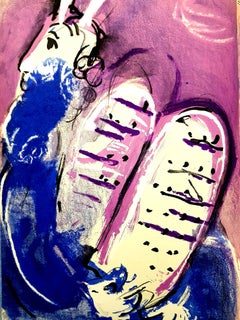
Marc Chagall - Moses with Tablets of Stone - Original Lithograph
By Marc Chagall
Located in Collonge Bellerive, Geneve, CH
Marc Chagall, Original Lithograph depicting an instant of the Bible. Technique: Original lithograph in colours Year: 1956 Sizes: 35,5 x 26 cm / 14" x 10.2" (sheet) Published by: Éditions de la Revue Verve, Tériade, Paris Printed by: Atelier Mourlot, Paris Documentation / References: Mourlot, F., Chagall Lithograph [II] 1957-1962, A. Sauret, Monte Carlo 1963, nos. 234 and 257 Marc Chagall (born in 1887) Marc Chagall was born in Belarus in 1887 and developed an early interest in art. After studying painting, in 1907 he left Russia for Paris, where he lived in an artist colony on the city’s outskirts. Fusing his own personal, dreamlike imagery with hints of the fauvism and cubism popular in France at the time, Chagall created his most lasting work—including I and the Village (1911)—some of which would be featured in the Salon des Indépendants exhibitions. After returning to Vitebsk for a visit in 1914, the outbreak of WWI trapped Chagall in Russia. He returned to France in 1923 but was forced to flee the country and Nazi persecution during WWII. Finding asylum in the U.S., Chagall became involved in set and costume design before returning to France in 1948. In his later years, he experimented with new art forms and was commissioned to produce numerous large-scale works. Chagall died in St.-Paul-de-Vence in 1985. The Village Marc Chagall was born in a small Hassidic community on the outskirts of Vitebsk, Belarus, on July 7, 1887. His father was a fishmonger, and his mother ran a small sundries shop in the village. As a child, Chagall attended the Jewish elementary school, where he studied Hebrew and the Bible, before later attending the Russian public school. He began to learn the fundamentals of drawing during this time, but perhaps more importantly, he absorbed the world around him, storing away the imagery and themes that would feature largely in most of his later work. At age 19 Chagall enrolled at a private, all-Jewish art school and began his formal education in painting, studying briefly with portrait artist Yehuda Pen. However, he left the school after several months, moving to St. Petersburg in 1907 to study at the Imperial Society for the Protection of Fine Arts. The following year, he enrolled at the Svanseva School, studying with set designer Léon Bakst, whose work had been featured in Sergei Diaghilev's Ballets Russes. This early experience would prove important to Chagall’s later career as well. Despite this formal instruction, and the widespread popularity of realism in Russia at the time, Chagall was already establishing his own personal style, which featured a more dreamlike unreality and the people, places and imagery that were close to his heart. Some examples from this period are his Window Vitebsk (1908) and My Fianceé with Black Gloves (1909), which pictured Bella Rosenfeld, to whom he had recently become engaged. The Beehive Despite his romance with Bella, in 1911 an allowance from Russian parliament member and art patron Maxim Binaver enabled Chagall to move to Paris, France. After settling briefly in the Montparnasse neighborhood, Chagall moved further afield to an artist colony known as La Ruche (“The Beehive”), where he began to work side by side with abstract painters such as Amedeo Modigliani and Fernand Léger as well as the avant-garde poet Guillaume Apollinaire. At their urging, and under the influence of the wildly popular fauvism and cubism, Chagall lightened his palette and pushed his style ever further from reality. I and the Village (1911) and Homage to Apollinaire (1912) are among his early Parisian works, widely considered to be his most successful and representative period. Though his work stood stylistically apart from his cubist contemporaries, from 1912 to 1914 Chagall exhibited several paintings at the annual Salon des Indépendants exhibition, where works by the likes of Juan Gris, Marcel Duchamp and Robert Delaunay were causing a stir in the Paris art world. Chagall’s popularity began to spread beyond La Ruche, and in May 1914 he traveled to Berlin to help organize his first solo exhibition, at Der Sturm Gallery. Chagall remained in the city until the highly acclaimed show opened that June. He then returned to Vitebsk, unaware of the fateful events to come. War, Peace and Revolution In August 1914 the outbreak of World War I precluded Chagall’s plans to return to Paris. The conflict did little to stem the flow of his creative output, however, instead merely giving him direct access to the childhood scenes so essential to his work, as seen in paintings such as Jew in Green (1914) and Over Vitebsk (1914). His paintings from this period also occasionally featured images of the war’s impact on the region, as with Wounded Soldier (1914) and Marching (1915). But despite the hardships of life during wartime, this would also prove to be a joyful period for Chagall. In July 1915 he married Bella, and she gave birth to a daughter, Ida, the following year. Their appearance in works such as Birthday (1915), Bella and Ida by the Window (1917) and several of his “Lovers” paintings give a glimpse of the island of domestic bliss that was Chagall’s amidst the chaos. To avoid military service and stay with his new family, Chagall took a position as a clerk in the Ministry of War Economy in St. Petersburg. While there he began work on his autobiography and also immersed himself in the local art scene, befriending novelist Boris Pasternak, among others. He also exhibited his work in the city and soon gained considerable recognition. That notoriety would prove important in the aftermath of the 1917 Russian Revolution when he was appointed as the Commissar of Fine Arts in Vitebsk. In his new post, Chagall undertook various projects in the region, including the 1919 founding of the Academy of the Arts. Despite these endeavors, differences among his colleagues eventually disillusioned Chagall. In 1920 he relinquished his position and moved his family to Moscow, the post-revolution capital of Russia. In Moscow, Chagall was soon commissioned to create sets and costumes for various productions at the Moscow State Yiddish...
Category

1950s Modern Figurative Prints

Materials

Lithograph

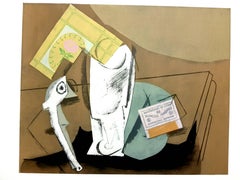
After Pablo Picasso - Nature Morte à la Pipe - Pochoir
By (after) Pablo Picasso
Located in Collonge Bellerive, Geneve, CH
After Pablo Picasso - Cubist Still Life - Pochoir Dimensions: 48.5 x 36 cm 1962 Edition of 260 Daniel Jacomet, LEDA, Editions d'Art Pablo Picasso Picasso is not just a man and his ...
Category

1960s Modern Figurative Prints

Materials

Lithograph

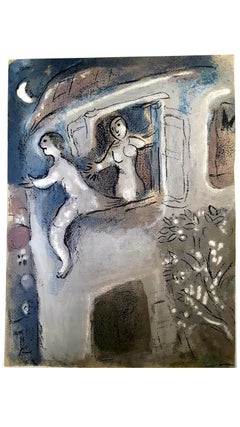
Marc Chagall - The Bible - David saved by Michal - from VERVE
By Marc Chagall
Located in Collonge Bellerive, Geneve, CH
Marc Chagall, Lithograph from Verve depicting an instant of the Bible. Technique: Lithograph in colours (Mourlot no. 234) On the reverse: another black and white original lithograph ...
Category

1960s Modern Figurative Prints

Materials

Lithograph

Marc Chagall - The Bible - Original Lithograph
By Marc Chagall
Located in Collonge Bellerive, Geneve, CH
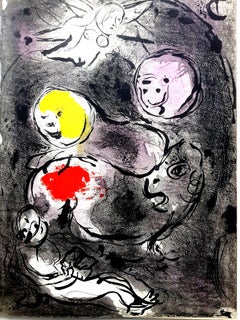
Marc Chagall, Original Lithograph depicting an instant of the Bible. Technique: Original lithograph in colours Year: 1956 Sizes: 35,5 x 26 cm / 14" x 10.2" (sheet) Published by: Éditions de la Revue Verve, Tériade, Paris Printed by: Atelier Mourlot, Paris Documentation / References: Mourlot, F., Chagall Lithograph [II] 1957-1962, A. Sauret, Monte Carlo 1963, nos. 234 and 257 Marc Chagall (born in 1887) Marc Chagall was born in Belarus in 1887 and developed an early interest in art. After studying painting, in 1907 he left Russia for Paris, where he lived in an artist colony on the city’s outskirts. Fusing his own personal, dreamlike imagery with hints of the fauvism and cubism popular in France at the time, Chagall created his most lasting work—including I and the Village (1911)—some of which would be featured in the Salon des Indépendants exhibitions. After returning to Vitebsk for a visit in 1914, the outbreak of WWI trapped Chagall in Russia. He returned to France in 1923 but was forced to flee the country and Nazi persecution during WWII. Finding asylum in the U.S., Chagall became involved in set and costume design before returning to France in 1948. In his later years, he experimented with new art forms and was commissioned to produce numerous large-scale works. Chagall died in St.-Paul-de-Vence in 1985. The Village Marc Chagall was born in a small Hassidic community on the outskirts of Vitebsk, Belarus, on July 7, 1887. His father was a fishmonger, and his mother ran a small sundries shop in the village. As a child, Chagall attended the Jewish elementary school, where he studied Hebrew and the Bible, before later attending the Russian public school. He began to learn the fundamentals of drawing during this time, but perhaps more importantly, he absorbed the world around him, storing away the imagery and themes that would feature largely in most of his later work. At age 19 Chagall enrolled at a private, all-Jewish art school and began his formal education in painting, studying briefly with portrait artist Yehuda Pen. However, he left the school after several months, moving to St. Petersburg in 1907 to study at the Imperial Society for the Protection of Fine Arts. The following year, he enrolled at the Svanseva School, studying with set designer Léon Bakst, whose work had been featured in Sergei Diaghilev's Ballets Russes. This early experience would prove important to Chagall’s later career as well. Despite this formal instruction, and the widespread popularity of realism in Russia at the time, Chagall was already establishing his own personal style, which featured a more dreamlike unreality and the people, places and imagery that were close to his heart. Some examples from this period are his Window Vitebsk (1908) and My Fianceé with Black Gloves (1909), which pictured Bella Rosenfeld, to whom he had recently become engaged. The Beehive Despite his romance with Bella, in 1911 an allowance from Russian parliament member and art patron Maxim Binaver enabled Chagall to move to Paris, France. After settling briefly in the Montparnasse neighborhood, Chagall moved further afield to an artist colony known as La Ruche (“The Beehive”), where he began to work side by side with abstract painters such as Amedeo Modigliani and Fernand Léger as well as the avant-garde poet Guillaume Apollinaire. At their urging, and under the influence of the wildly popular fauvism and cubism, Chagall lightened his palette and pushed his style ever further from reality. I and the Village (1911) and Homage to Apollinaire (1912) are among his early Parisian works, widely considered to be his most successful and representative period. Though his work stood stylistically apart from his cubist contemporaries, from 1912 to 1914 Chagall exhibited several paintings at the annual Salon des Indépendants exhibition, where works by the likes of Juan Gris, Marcel Duchamp and Robert Delaunay were causing a stir in the Paris art world. Chagall’s popularity began to spread beyond La Ruche, and in May 1914 he traveled to Berlin to help organize his first solo exhibition, at Der Sturm Gallery. Chagall remained in the city until the highly acclaimed show opened that June. He then returned to Vitebsk, unaware of the fateful events to come. War, Peace and Revolution In August 1914 the outbreak of World War I precluded Chagall’s plans to return to Paris. The conflict did little to stem the flow of his creative output, however, instead merely giving him direct access to the childhood scenes so essential to his work, as seen in paintings such as Jew in Green (1914) and Over Vitebsk (1914). His paintings from this period also occasionally featured images of the war’s impact on the region, as with Wounded Soldier (1914) and Marching (1915). But despite the hardships of life during wartime, this would also prove to be a joyful period for Chagall. In July 1915 he married Bella, and she gave birth to a daughter, Ida, the following year. Their appearance in works such as Birthday (1915), Bella and Ida by the Window (1917) and several of his “Lovers” paintings give a glimpse of the island of domestic bliss that was Chagall’s amidst the chaos. To avoid military service and stay with his new family, Chagall took a position as a clerk in the Ministry of War Economy in St. Petersburg. While there he began work on his autobiography and also immersed himself in the local art scene, befriending novelist Boris Pasternak, among others. He also exhibited his work in the city and soon gained considerable recognition. That notoriety would prove important in the aftermath of the 1917 Russian Revolution when he was appointed as the Commissar of Fine Arts in Vitebsk. In his new post, Chagall undertook various projects in the region, including the 1919 founding of the Academy of the Arts. Despite these endeavors, differences among his colleagues eventually disillusioned Chagall. In 1920 he relinquished his position and moved his family to Moscow, the post-revolution capital of Russia. In Moscow, Chagall was soon commissioned to create sets and costumes for various productions at the Moscow State Yiddish Theater, where he would paint a series of murals titled Introduction to the Jewish Theater as well. In 1921, Chagall also found work as a teacher at a school for war orphans. By 1922, however, Chagall found that his art had fallen out of favor, and seeking new horizons he left Russia for good. Flight After a brief stay in Berlin, where he unsuccessfully sought to recover the work exhibited at Der Sturm before the war, Chagall moved his family to Paris in September 1923. Shortly after their arrival, he was commissioned by art dealer and publisher Ambroise Vollard to produce a series of etchings for a new edition of Nikolai Gogol's 1842 novel Dead Souls. Two years later Chagall began work on an illustrated edition of Jean de la Fontaine’s Fables, and in 1930 he created etchings for an illustrated edition of the Old Testament, for which he traveled to Palestine to conduct research. Chagall’s work during this period brought him new success as an artist and enabled him to travel throughout Europe in the 1930s. He also published his autobiography, My Life (1931), and in 1933 received a retrospective at the Kunsthalle in Basel, Switzerland. But at the same time that Chagall’s popularity was spreading, so, too, was the threat of Fascism and Nazism. Singled out during the cultural "cleansing" undertaken by the Nazis in Germany, Chagall’s work was ordered removed from museums throughout the country. Several pieces were subsequently burned, and others were featured in a 1937 exhibition of “degenerate art” held in Munich. Chagall’s angst regarding these troubling events and the persecution of Jews in general can be seen in his 1938 painting White Crucifixion. With the eruption of World War II, Chagall and his family moved to the Loire region before moving farther south to Marseilles following the invasion of France. They found a more certain refuge when, in 1941, Chagall’s name was added by the director of the Museum of Modern Art (MOMA) in New York City to a list of artists and intellectuals deemed most at risk from the Nazis’ anti-Jewish campaign. Chagall and his family would be among the more than 2,000 who received visas and escaped this way. Haunted Harbors Arriving in New York City in June 1941, Chagall discovered that he was already a well-known artist there and, despite a language barrier, soon became a part of the exiled European artist community. The following year he was commissioned by choreographer Léonide Massine to design sets and costumes for the ballet Aleko, based on Alexander Pushkin’s “The Gypsies” and set to the music of Pyotr Ilyich Tchaikovsky. But even as he settled into the safety of his temporary home, Chagall’s thoughts were frequently consumed by the fate befalling the Jews of Europe and the destruction of Russia, as paintings such as The Yellow Crucifixion...
Category

1950s Modern Figurative Prints

Materials

Lithograph

Marc Chagall - Inspiration - Original Lithograph from "Chagall Lithographe" v. 2
By Marc Chagall
Located in Collonge Bellerive, Geneve, CH
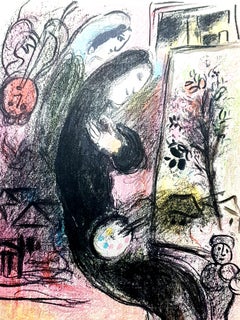
Marc Chagall Original Lithograph from Chagall Lithographe 1957-1962. VOLUME II. 1963 Dimensions: 32 x 24 cm From the unsigned edition of 10000 copies without margins Reference: Mourlot 398 Condition : Excellent Marc Chagall (born in 1887) Marc Chagall was born in Belarus in 1887 and developed an early interest in art. After studying painting, in 1907 he left Russia for Paris, where he lived in an artist colony on the city’s outskirts. Fusing his own personal, dreamlike imagery with hints of the fauvism and cubism popular in France at the time, Chagall created his most lasting work—including I and the Village (1911)—some of which would be featured in the Salon des Indépendants exhibitions. After returning to Vitebsk for a visit in 1914, the outbreak of WWI trapped Chagall in Russia. He returned to France in 1923 but was forced to flee the country and Nazi persecution during WWII. Finding asylum in the U.S., Chagall became involved in set and costume design before returning to France in 1948. In his later years, he experimented with new art forms and was commissioned to produce numerous large-scale works. Chagall died in St.-Paul-de-Vence in 1985. The Village Marc Chagall was born in a small Hassidic community on the outskirts of Vitebsk, Belarus, on July 7, 1887. His father was a fishmonger, and his mother ran a small sundries shop in the village. As a child, Chagall attended the Jewish elementary school, where he studied Hebrew and the Bible, before later attending the Russian public school. He began to learn the fundamentals of drawing during this time, but perhaps more importantly, he absorbed the world around him, storing away the imagery and themes that would feature largely in most of his later work. At age 19 Chagall enrolled at a private, all-Jewish art school and began his formal education in painting, studying briefly with portrait artist Yehuda Pen. However, he left the school after several months, moving to St. Petersburg in 1907 to study at the Imperial Society for the Protection of Fine Arts. The following year, he enrolled at the Svanseva School, studying with set designer Léon Bakst, whose work had been featured in Sergei Diaghilev's Ballets Russes. This early experience would prove important to Chagall’s later career as well. Despite this formal instruction, and the widespread popularity of realism in Russia at the time, Chagall was already establishing his own personal style, which featured a more dreamlike unreality and the people, places and imagery that were close to his heart. Some examples from this period are his Window Vitebsk (1908) and My Fianceé with Black Gloves (1909), which pictured Bella Rosenfeld, to whom he had recently become engaged. The Beehive Despite his romance with Bella, in 1911 an allowance from Russian parliament member and art patron Maxim Binaver enabled Chagall to move to Paris, France. After settling briefly in the Montparnasse neighborhood, Chagall moved further afield to an artist colony known as La Ruche (“The Beehive”), where he began to work side by side with abstract painters such as Amedeo Modigliani and Fernand Léger as well as the avant-garde poet Guillaume Apollinaire. At their urging, and under the influence of the wildly popular fauvism and cubism, Chagall lightened his palette and pushed his style ever further from reality. I and the Village (1911) and Homage to Apollinaire (1912) are among his early Parisian works, widely considered to be his most successful and representative period. Though his work stood stylistically apart from his cubist contemporaries, from 1912 to 1914 Chagall exhibited several paintings at the annual Salon des Indépendants exhibition, where works by the likes of Juan Gris, Marcel Duchamp and Robert Delaunay were causing a stir in the Paris art world. Chagall’s popularity began to spread beyond La Ruche, and in May 1914 he traveled to Berlin to help organize his first solo exhibition, at Der Sturm Gallery. Chagall remained in the city until the highly acclaimed show opened that June. He then returned to Vitebsk, unaware of the fateful events to come. War, Peace and Revolution In August 1914 the outbreak of World War I precluded Chagall’s plans to return to Paris. The conflict did little to stem the flow of his creative output, however, instead merely giving him direct access to the childhood scenes so essential to his work, as seen in paintings such as Jew in Green (1914) and Over Vitebsk (1914). His paintings from this period also occasionally featured images of the war’s impact on the region, as with Wounded Soldier (1914) and Marching (1915). But despite the hardships of life during wartime, this would also prove to be a joyful period for Chagall. In July 1915 he married Bella, and she gave birth to a daughter, Ida, the following year. Their appearance in works such as Birthday (1915), Bella and Ida by the Window (1917) and several of his “Lovers” paintings give a glimpse of the island of domestic bliss that was Chagall’s amidst the chaos. To avoid military service and stay with his new family, Chagall took a position as a clerk in the Ministry of War Economy in St. Petersburg. While there he began work on his autobiography and also immersed himself in the local art scene, befriending novelist Boris Pasternak, among others. He also exhibited his work in the city and soon gained considerable recognition. That notoriety would prove important in the aftermath of the 1917 Russian Revolution when he was appointed as the Commissar of Fine Arts in Vitebsk. In his new post, Chagall undertook various projects in the region, including the 1919 founding of the Academy of the Arts. Despite these endeavors, differences among his colleagues eventually disillusioned Chagall. In 1920 he relinquished his position and moved his family to Moscow, the post-revolution capital of Russia. In Moscow, Chagall was soon commissioned to create sets and costumes for various productions at the Moscow State Yiddish Theater...
Category

1960s Surrealist Figurative Prints

Materials

Lithograph

Marc Chagall - The Bible - Original Lithograph
By Marc Chagall
Located in Collonge Bellerive, Geneve, CH
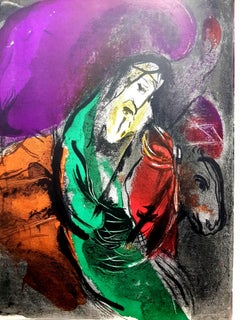
Marc Chagall, Original Lithograph depicting an instant of the Bible. Technique: Original lithograph in colours Year: 1956 Sizes: 35,5 x 26 cm / 14" x 10.2" (sheet) Published by: Édit...
Category

1950s Modern Figurative Prints

Materials

Lithograph

Marc Chagall - The Bible - Ruth at the feet of Boaz - Original Lithograph
By Marc Chagall
Located in Collonge Bellerive, Geneve, CH
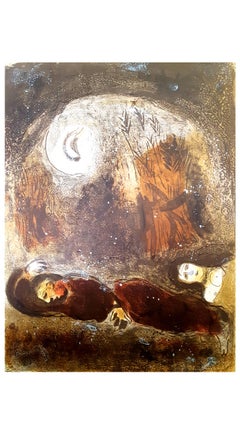
Marc Chagall, Original Lithograh depicting an instant of the Bible. Technique: Original lithograph in colours (Mourlot no. 234) On the reverse: another black and white original litho...
Category

1960s Modern Figurative Prints

Materials

Lithograph

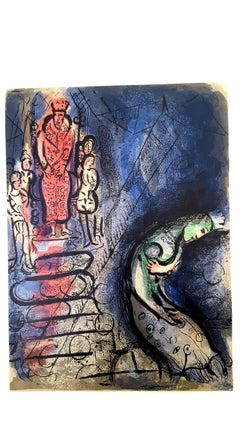
Marc Chagall - The Bible - Ahasuerus Sends Vasthi Away - Original Lithograph
By Marc Chagall
Located in Collonge Bellerive, Geneve, CH
Marc Chagall, Original Lithograh depicting an instant of the Bible. Technique: Original lithograph in colours (Mourlot no. 234) On the reverse: another black and white original litho...
Category

1960s Modern Figurative Prints

Materials

Lithograph

Marc Chagall (after) - Lettre à mon peintre Raoul Dufy
By (after) Marc Chagall
Located in Collonge Bellerive, Geneve, CH
(after) Marc Chagall Lithograph after a watercolor, published in the book "Lettre à mon peintre Raoul Dufy." Paris, Librairie Académique Perrin, 1965. Printed signature Dimensions:...
Category

1960s Surrealist Animal Prints

Materials

Lithograph

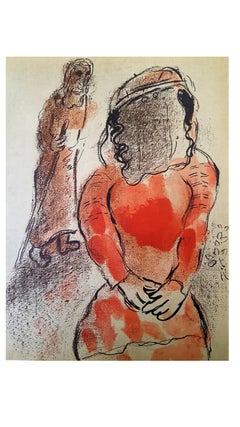
Marc Chagall - The Bible - Tamar - Original Lithograph
By Marc Chagall
Located in Collonge Bellerive, Geneve, CH
Marc Chagall, Original Lithograh depicting an instant of the Bible. Technique: Original lithograph in colours (Mourlot no. 234) On the reverse: another black and white original litho...
Category

1960s Modern Figurative Prints

Materials

Lithograph

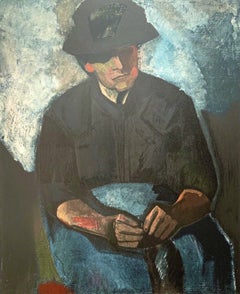
Dufresne, Femme au Tablier Bleu, Collection Pierre Lévy (after)
By Charles Dufresne
Located in Fairfield, CT
Medium: Lithograph on vélin d'Arches paper Year: 1971 Paper Size: 26 x 20 inches Inscription: Unsigned and unnumbered, as issued Notes: From the folio, Dufresne, VI, Collection Pierr...
Category

1970s Post-Impressionist Figurative Prints

Materials

Lithograph

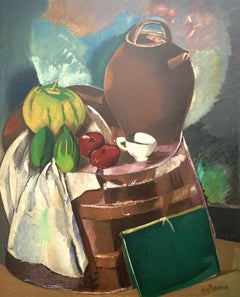
Dufresne, Nature Morte a la Nappe de Couleur, Collection Pierre Lévy (after)
By Charles Dufresne
Located in Fairfield, CT
Medium: Lithograph on vélin d'Arches paper Year: 1971 Paper Size: 26 x 20 inches Inscription: Signed in the plate and unnumbered, as issued Notes: From the folio, Dufresne, VI, Colle...
Category

1970s Post-Impressionist Landscape Prints

Materials

Lithograph

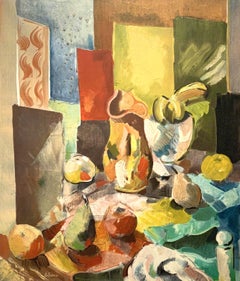
Dufresne, Nature morte, Dufresne, Collection Pierre Lévy (after)
By Charles Dufresne
Located in Fairfield, CT
Medium: Lithograph on vélin d'Arches paper Year: 1971 Paper Size: 26 x 20 inches Inscription: Signed in the plate and unnumbered, as issued Notes: From the folio, Dufresne, VI, Colle...
Category

1970s Post-Impressionist Landscape Prints

Materials

Lithograph

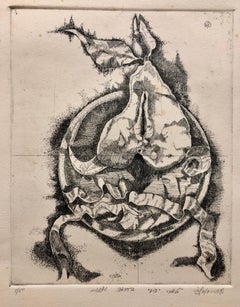
Israeli Modernist Surrealist Etching Cut Pear
By Shlomo Zafrir
Located in Surfside, FL
20.75x14.5 sheet size. 9.5x7.75 image size Shlomo Zafrir is active/lives in Israel, France. Shlomo Zafrir is known for cubist painting. Shlomo Zafrir is a painter and, at the same t...
Category

20th Century Surrealist Still-life Prints

Materials

Etching

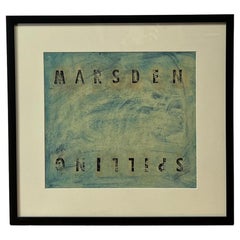
"Marsden Spilling" Modern Acrylic Painting after Hartley s "Smelt Brook Falls
By Marsden Hartley
Located in Pasadena, CA
The contemporary artwork titled "Marsden Spilling " (October 1969), attributed to an artist with an unfortunately illegible signature, serves as a homage to Marsden Hartley's 1937 pa...
Category

Late 20th Century Post-Modern Figurative Prints

Materials

Acrylic

Pichet et Oiseau (Pitcher and the Bird)
By Georges Braque
Located in Palo Alto, CA
Expressing the talent and skill of Braque’s graphic works, this piece illustrates the artist’s remarkable ability to create imaginative abstract still lives. In this sense, Braque ha...
Category

1950s Modern Still-life Prints

Materials

Etching, Aquatint

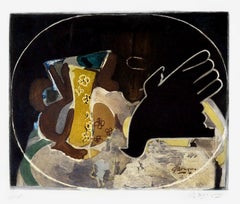
Georges Braque - Original Lithograph
By Georges Braque
Located in Collonge Bellerive, Geneve, CH
Georges Braque - Original Lithograph 1963 Dimensions: 32 x 24 cm Andre Sauret, Monte Carlo The father of Cubism Three Cubist that distinguishes art historian periods were initiated and developed by Georges Braque: The Cubist Cézanne (1907-1909), Executive (1909-1912) and synthetic (1912-1922). Post-Impressionist and fawn, Braque no longer adheres to the contingency of a decorative way or the other. Cézanne’s paintings exhibited at the Grand Palais during the retrospective of 1907 are a revelation: Cézanne sought and invented a pictorial language. In his footsteps, Braque went to the South with the reasons of the Master. He returned with Estaque landscapes and surprising Ciotat it keeps Cezanne geometric model and retains the “passages” continuity from one surface to another to create the sensation of “turning around” of the object represented. But he wants to go after the consequences of the vision of Cezanne. In his paintings Houses in L’Estaque (1908) it simplifies the volumes of houses, neglects detail by removing doors and windows: the plastic rhythm that builds the table. Large Nude , a masterpiece of the period, can be considered the first work of Cézanne cubism . Systematizing and deepening Braque discoveries open the door analytical cubism. In 1909, his painting became more cerebral than sensual. The pattern is recreated in the two-dimensionality of the canvas, leaving aside any illusionistic perspective. In Still Life with Violin, objects are analyzed facets according to their characteristic elements, each facet referring to a particular view of the object. There are so many facets of points selected view: Table reflects the knowledge of the object and the ubiquity of the eye. Moreover, Braque is looking for the essence of the objects in the world rather than their contingency, which explains the absence of light source and use of muted colors (gray, ocher), contingent aspects of the object . But formal logic has stepped facets, erased any anecdote to the object and ultimately led to his painting a hermetic more marked on the edge of abstraction (see the series of Castle Roche-Guyon ). Braque, anxious to keep the concrete and refusing at all costs that the logic of Cubism takes the paintings to abstract, reintroduced signs of reality in his paintings in 1912 marks the beginning of Synthetic Cubism. Historians speak of “signs of real” rather than reality because what interests Braque, this is not to put reality into a table, but to create a painting which, by its language, refers to the real. To do this, he invented two major techniques XX th century inclusions and contributions. The inclusions consist of painting objects that have no real depth, materials (wallpaper in Nature morte aux playing cards faux wood is a pictorial inclusion) or letters (calligraphic inclusion in Portuguese ), made first brush and a few months later stencil. Contributions are defined in contrast with the collage on canvas of foreign materials: glued or sand paper, sawdust, etc.. Regarding the collages, Braque used for the first time in September 1912 a piece of adhesive paper imitating faux wood Compote and Glass , then the packet envelope of tobacco Bock in 1912-1913, or an advertisement in Damier , 1913). Inputs and inclusions refer to an external object in the table, without “emulate” this object. Away from their appearances, objects are represented in closest essence of the objects in the real world sense. This is also the time of Synthetic Cubism that Braque invented paper sculpture. There are, unfortunately, and no one is living proof of a photograph makes it possible to realize: Paper and paperboard. Métamorphoses period(1961-1963). In 1961, Georges Braque worked on a Greek head for the Louvre, which obsesses him, and he wishes to free his mind. He tried several times to bring out the paint and the result was unsatisfactory. He thinks the ultimate metamorphosis its Greek head projected in three dimensions. He calls in his studio of Baron Heger Loewenfeld, master lapidary, and he communicates his enthusiasm during the “fateful encounter.” Nine months later, in honor of the eighty years of Georges Braque, Heger Loewenfeld offers the Master of the ring Circe: the famous Greek head finally exorcised, carved in an onyx. Braque Loewenfeld then asked to identify other issues that haunt him. From dated and signed by Georges Braque, Heger gouaches Loewenfeld shapes works in the fields of jewelery, lapidary art...
Category

1960s Modern Figurative Prints

Materials

Lithograph

Pablo Picasso Estate Hand Signed Fauvist Lithograph Woman Portrait Marie Therese
By Pablo Picasso
Located in Surfside, FL
Pablo Picasso (after) "Portrait de Marie Therese" limited edition print on Arches paper, Hand signed by Marina Picasso lower right and numbered 274/500 lower left From the estate of...
Category

20th Century Modern Abstract Prints

Materials

Lithograph

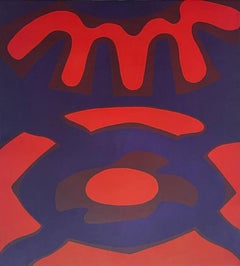
George Sugarman, Red and Purple (estate of Gene Baro), unique signed 1960s print
By George Sugarman
Located in New York, NY
George Sugarman Red and Purple (from the estate of Gene Baro), 1965 Lithograph on wove paper Pencil signed, dated and annotated "Trial Proof" on the back; bears Tamarind Inc. blind s...
Category

1960s Abstract Expressionist Abstract Prints

Materials

Lithograph

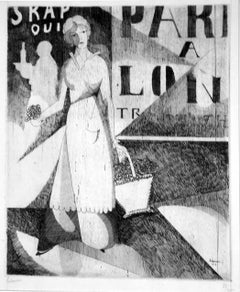
La Marchande de Violettes
By Jean-Emile Laboureur
Located in New York, NY
Jean-Emile Laboureur (1877-1943), La Marchande de Violettes, etching, 1914, signed in pencil lower left and numbered (33/35) lower right [also signed and dated in the plate lower rig...
Category

1910s Cubist Figurative Prints

Materials

Etching

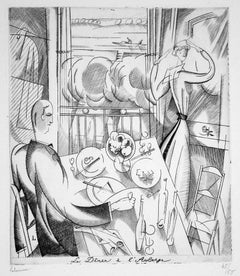
Le Diner a L’Auberge
By Jean-Emile Laboureur
Located in New York, NY
Jean-Emile Laboureur (1877-1943), Le Diner a L’Auberge, 1917-1922), engraving, signed in pencil lower left and numbered (45/55) lower right. Reference: Sylvain Laboureur 173, second ...
Category

1910s Cubist Figurative Prints

Materials

Engraving

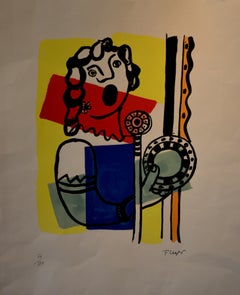
La Chanteuse de la Radio
By Fernand Léger
Located in West Hollywood, CA
Presenting a sheet after French artist Fernand Leger. Originally acquired at an Los Angeles gallery exhibition of Leger's lithography in 1961, this is the first time it has been available to sale since originally purchased. The original poster from this Leger exhibition...
Category

1950s Cubist Figurative Prints

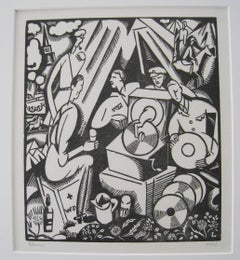
Le Gramophone
By Jean-Emile Laboureur
Located in New York, NY
LABOURER, Jean Emile. Le Gramophone. Woodcut on cream laid paper, 1918-21. full margins. Signed and numbered 41/45 in pencil, lower margin. A very goo...
Category

1910s Cubist Figurative Prints

Materials

Woodcut

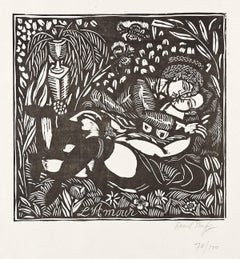
L Amour
By Raoul Dufy
Located in New York, NY
RAOUL DUFY (1877-1953) L’Amour, woodcut, 1910, signed and numbered 78/100 in pencil, lower right, from the first edition of 100, in good condition, full margins, 210×255 mm; 8 1/2×10...
Category

2010s Cubist Figurative Prints

Materials

Woodcut

L
Amour
Price Upon Request
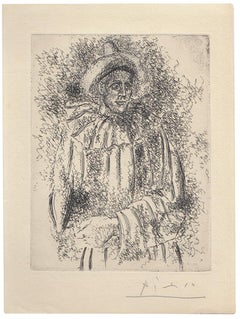
Pierrot (Massine en Pierrot)
By Pablo Picasso
Located in London, GB
Signed in pencil, from the edition of 20 to 25 that accompanied Max Jacob's 'Le Phanérogame' in December 1918. With wide margins (the version issued with the...
Category

1910s Cubist Portrait Prints

Materials

Etching

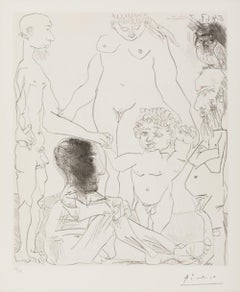
Reflexion du Peintre sur la Vie (Reflection of the Painter on Life)
By Pablo Picasso
Located in Laguna Beach, CA
Drypoint, 1967. 350x300 mm; 13 5/8x11 5/8 inches, full margins. With the artist's ink stamp signature, lower right, and numbered 38/50 in pencil, lower left. A very good impression. ...
Category

1960s Cubist Nude Prints

Materials

Drypoint

Nature Morte, Compotier - Etching and Drypoint by Pablo Picasso - 1909
By Pablo Picasso
Located in Roma, IT
Nature Morte, Compotier is a rare black and white drypoint on laid ivory-colored paper, realized by Pablo Picasso in 1909. Edition of 100. Hand-signed in pencil on the lower right m...
Category

Early 1900s Cubist Figurative Prints

Materials

Etching, Drypoint

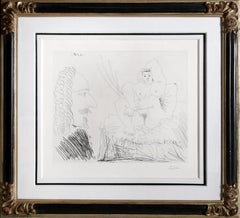
Courtisane au lit avec un visiteur (Bloch 1553), Modern Etching by Pablo Picasso
By Pablo Picasso
Located in Long Island City, NY
This captivating portrait by Pablo Picasso features an artist in the foreground rendered in profile while a nude model reclines against a bed with her leg crossed over her knee and h...
Category

1960s Modern Nude Prints

Materials

Etching

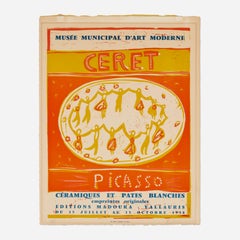
Musée Municipal D’Art Moderne Céret
By Pablo Picasso
Located in Laguna Beach, CA
Signed and numbered to lower margin ‘46/125 Picasso’. This work is number 46 from the edition of 125 printed by Arnéra, Vallauris and published by Musée Municipal d'Art Moderne, Cére...
Category

Mid-20th Century Figurative Prints

Materials

Linocut

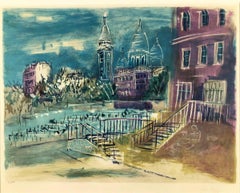
Montmartre at Sacre Coeur
By Jean Dufy
Located in Missouri, MO
Jean Dufy "Montmartre et La Basilique du Sacre Coeur" c. 1950s Color Lithograph Signed in Pencil Lower Right Numbered 78/250 Lower Left Image Size: approx...
Category

1950s Impressionist Landscape Prints

Materials

Lithograph

Still Thinking About These?

All Recently Viewed