2,642 results for "cubism"

to
1,717
1,561
662
268
95
38
Overall Width
to
Overall Height
to
1,017
486
274
155
122
50
24
17
15
13
2
265
236
70
70
51
8
2,529
105
4
20
102
178
131
636
782
365
138
26
1,840
696
80
990
556
518
421
370
291
233
221
116
64
59
58
58
57
56
54
52
44
39
34
2,104
209
181
175
84
164
362
2,100
488
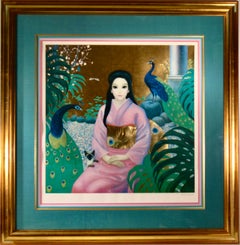
Madame Butterfly
By Margaret Keane
Located in San Francisco, CA
This artwork titled "Madame Butterfly" 1986, is an original color serigraph with gold addition by noted American artist Margaret Keane, 1927-2022. It is hand signed and numbered HH 109/150 in pencil by the artist. The image size is 24 x 24 inches, framed size is 39.5 x 38.5 inches. Custom framed in a wooden gold frame, with green fabric matting, gold color bevel and three different colors fillet. It is in excellent condition, the frame have some minor restorations, barely visible. About the artist. Margaret D. H. Keane was born 1927 in Tennessee, and attributes her deep respect for the Bible and inspirations of her artwork to the relationship with her grandmother. She later became one of Jehovah's Witnesses, which she said changed her life for the better. In the 1960s, Margaret Keane's artwork was sold under the name of her husband, Walter Keane. He locked her in a room and forced her to paint,while taking credit for her work. Conflict over that issue was cited as one of the reasons they divorced. Neither wanting to relinquish rights to the artwork, Walter and Margaret's divorce proceedings went all the way to federal court. At the hearing, Margaret created a painting in front of the judge to prove that she was the artist. Walter declined to paint before the court, citing a sore shoulder. In 1986, the courts sided with her, enabling her to paint under her own name. Her works while living in her husband's shadow tended to depict sad children in a dark setting, but after divorcing, moving to Hawaii, and becoming one of Jehovah's Witnesses, her paintings took on a happier, brighter style. Keane is a fixture in popular culture. Some of her well-known fans over the years have included actresses Joan Crawford and Natalie Wood, whom she painted portraits of; filmmaker Tim Burton, who commissioned Keane to paint Lisa Marie; and animator Craig McCracken, whose characters the Powerpuff Girls are based on Keane's 'waifs'; additionally the Girls' schoolteacher is named "Ms. Keane". Cultural references • The American television comedy show Saturday Night Live once had a skit that featured her work, during the time when it was thought to be by her husband, as a parody of the reaction against modern art (e.g., Cubism or the New York Armory Show). "People don't look like that!" one comedian shrieks, before the picture in question was shown to the camera and audience as the punch line. • In Woody Allen's 1973 comedy Sleeper, the people of the future consider Keane to be one of the greatest artists in history, one of many references mocking the popular culture of the seventies. • Late Night with Conan O'Brien has "bumper" art in her style depicting a glum Conan O'Brien at his desk, next to a dog. • Weird Al Yankovic's song Velvet Elvis, in which the narrator says he needs "no pictures of Mexican kids with those really big eyes or dogs playing poker". • In season 3, episode 20 of 90210 (Women on the Verge), Annie is described as looking "like a Keane painting...
Category

Late 20th Century American Realist Figurative Prints

Materials

Screen

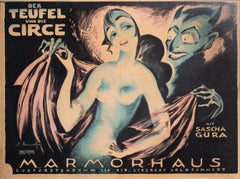
Art Nouveau Poster "Marmorhouse (Der Teufel und Die Circe) by Josef Fenneker
By Josef Fenneker
Located in Palm Beach, FL
The painter, graphic artist, production and set designer, Josef Fenneker, is one of the most important representatives of artistic film posters of the 1910s and 1920s. He was commissioned primarily by Berlin’s Marmorhaus cinema, which was located on Kurfürstendamm and known for its first releases, as well as by Berlin film production...
Category

1920s Expressionist Figurative Prints

Materials

Lithograph

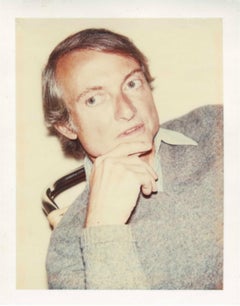
Unique portrait of Roy Lichtenstein, Authenticated by the Andy Warhol Foundation
By Andy Warhol
Located in New York, NY
Andy Warhol Portrait of Roy Lichtenstein, 1975 Polaroid dye-diffusion print Authenticated by the Andy Warhol Foundation for the Visual Arts, bears the Foundation stamp verso Frame included: Framed in white wood frame with UV plexiglass; with die-cut window in the back to show official Warhol Foundation authentication stamp and text Measurements: 9 9/16 x 8 9/16 x 9/16 inches (frame) 3 1/2 x 2 3/4 inches (window) 4.16 x 3.15 inches (Artwork) Authenticated and stamped by the Estate of Andy Warhol/Warhol Foundation for the Visual Arts An impressive piece of Pop Art history! A must-have for fans and collectors of both Andy Warhol and Roy Lichtenstein: This is a unique, authenticated color Polaroid taken by one Pop Art legend, Andy Warhol, of his most formidable contemporary and, in many respects, rival, Roy Lichtenstein. One of only a few portraits Andy Warhol took of Roy Lichtenstein, during one tense photo shoot. Both iconic artists, colleagues and, perhaps lesser known to the public, rivals, would be represented at the time by the renowned Leo Castelli Gallery. The truth is - they were really more rivals than friends. (the rivalry intensified when Warhol, who was working with Walt Disney, discovered that Lichtenstein painted Mickey Mouse before he did!!) Leo Castelli was committed to Roy Lichtenstein, and, it's easy to forget today, wasn't that interested in Warhol as he considered Lichtenstein the greater talent and he could relate better with Roy on a personal level. However, Ivan Karp, who worked at Castelli, was very interested in Warhol, as were some powerful European dealers, as well as many wealthy and influential American and European collectors. That was the start of Warhol's bypassing the traditional gallery model - so that dealers like Castelli could re-discover him after everybody else had. Warhol is known to have taken hundreds of self-portrait polaroid photographs - shoe boxes full - and he took many dozens of images of celebrities like Blondie and Farrah Fawcett. But only a small number of photographic portraits of fellow Pop Art legend Roy Lichtenstein -- each unique,- are known to have appeared on the market over the past half a century - all from the same photo session. This is one of them. There is another Polaroid - from this same (and only) sitting, in the permanent collection of the Getty Museum in California. There really weren't any other collaborations between these two titans, making the resulting portrait from this photo session extraordinary. It is fascinating to study Roy Lichtenstein's face and demeanor in this photograph, in the context of the great sense of competition, but perhaps even greater, albeit uneasy respect, these two larger than life Pop art titans had for each other: Like Leo Castelli, Roy Lichtenstein was Jewish of European descent; whereas Warhol was Catholic and quintessentially American, though also of European (Polish) descent. They were never going to be good friends, but this portrait, perhaps even arranged by Leo Castelli, represents an uneasy acknowledgement there would be room at the top for both of them. Floated, framed with die cut back revealing authentication details, and ready to hang. Measurements: 9 9/16 x 8 9/16 x 9/16 inches (frame) 3 1/2 x 2 3/4 inches (window) 4.16 x 3.15 inches (sheet) Authenticated by the Estate of Andy Warhol/The Andy Warhol Foundation for the Visual Arts. Estate Stamped: Stamped with the Andy Warhol Estate, Warhol Foundation for the Visual Arts stamp, numbered "B 512536P", with the Estate of Andy Warhol stamp and inscribed UP on the reverse. Bears the Warhol Foundation unique inventory number. Roy Lichtenstein Biography Roy Lichtenstein was one of the most influential and innovative artists of the second half of the twentieth century. He is preeminently identified with Pop Art, a movement he helped originate, and his first fully achieved paintings were based on imagery from comic strips and advertisements and rendered in a style mimicking the crude printing processes of newspaper reproduction. These paintings reinvigorated the American art scene and altered the history of modern art. Lichtenstein’s success was matched by his focus and energy, and after his initial triumph in the early 1960s, he went on to create an oeuvre of more than 5,000 paintings, prints, drawings, sculptures, murals and other objects celebrated for their wit and invention. Roy Fox Lichtenstein was born on October 27, 1923, in New York City, the first of two children born to Milton and Beatrice Werner Lichtenstein. Milton Lichtenstein (1893–1946) was a successful real estate broker, and Beatrice Lichtenstein (1896–1991), a homemaker, had trained as a pianist, and she exposed Roy and his sister Rénee to museums, concerts and other aspects of New York culture. Roy showed artistic and musical ability early on: he drew, painted and sculpted as a teenager, and spent many hours in the American Museum of Natural History and the Museum of Modern Art. He played piano and clarinet, and developed an enduring love of jazz, frequenting the nightspots in Midtown to hear it. Lichtenstein attended the Franklin School for Boys, a private junior high and high school, and was graduated in 1940. That summer he studied painting and drawing from the model at the Art Students League of New York with Reginald Marsh. In September he entered Ohio State University (OSU) in Columbus in the College of Education. His early artistic idols were Rembrandt, Daumier and Picasso, and he often said that Guernica (1937; Museo Reina Sofía, Madrid), then on long-term loan to the Museum of Modern Art, was his favorite painting. Even as an undergraduate, Lichtenstein objected to the notion that one set of lines (one person’s drawings) “was considered brilliant, and somebody’s else’s, that may have looked better to you, was considered nothing by almost everyone.”i Lichtenstein’s questioning of accepted canons of taste was encouraged by Hoyt L. Sherman, a teacher whom he maintained was the person who showed him how to see and whose perception-based approach to art shaped his own. In February 1943, Lichtenstein was drafted, and he was sent to Europe in 1945. As part of the infantry, he saw action in France, Belgium and Germany. He made sketches throughout his time in Europe and, after peace was declared there, he intended to study at the Sorbonne. Lichtenstein arrived in Paris in October 1945 and enrolled in classes in French language and civilization, but soon learned that his father was gravely ill. He returned to New York in January 1946, a few weeks before Milton Lichtenstein died. In the spring of that year, Lichtenstein went back to OSU to complete his BFA and in the fall he was invited to join the faculty as an instructor. In June 1949, he married Isabel Wilson Sarisky (1921–80), who worked in a cooperative art gallery in Cleveland where Lichtenstein had exhibited his work. While he was teaching, Lichtenstein worked on his master’s degree, which he received in 1949. During his second stint at OSU, Lichtenstein became closer to Sherman, and began teaching his method on how to organize and unify a composition. Lichtenstein remained appreciative of Sherman’s impact on him. He gave his first son the middle name of “Hoyt,” and in 1994 he donated funds to endow the Hoyt L. Sherman Studio Art Center at OSU. In the late 1940s and early 1950s, Lichtenstein began working in series and his iconography was drawn from printed images. His first sustained theme, intimate paintings and prints in the vein of Paul Klee that poked lyrical fun at medieval knights, castles and maidens, may well have been inspired by a book about the Bayeux Tapestry. Lichtenstein then took an ironic look at nineteenth-century American genre paintings he saw in history books, creating Cubist interpretations of cowboys and Indians spiked with a faux-primitive whimsy. As with his most celebrated Pop paintings of the 1960s, Lichtenstein gravitated toward what he would characterize as the “dumbest” or “worst” visual item he could find and then went on to alter or improve it. In the 1960s, commercial art was considered beneath contempt by the art world; in the early 1950s, with the rise of Abstract Expressionism, nineteenth-century American narrative and genre paintings were at the nadir of their reputation among critics and collectors. Paraphrasing, particularly the paraphrasing of despised images, became a paramount feature of Lichtenstein’s art. Well before finding his signature mode of expression in 1961, Lichtenstein called attention to the artifice of conventions and taste that permeated art and society. What others dismissed as trivial fascinated him as classic and idealized—in his words, “a purely American mythological subject matter.”ii Lichtenstein’s teaching contract at OSU was not renewed for the 1951–52 academic year, and in the autumn of 1951 he and Isabel moved to Cleveland. Isabel Lichtenstein became an interior decorator specializing in modern design, with a clientele drawn from wealthy Cleveland families. Whereas her career blossomed, Lichtenstein did not continue to teach at the university level. He had a series of part-time jobs, including industrial draftsman, furniture designer, window dresser and rendering mechanical dials for an electrical instrument company. In response to these experiences, he introduced quirkily rendered motors, valves and other mechanical elements into his paintings and prints. In 1954, the Lichtensteins’ first son, David, was born; two years later, their second child, Mitchell, followed. Despite the relative lack of interest in his work in Cleveland, Lichtenstein did place his work with New York dealers, which always mattered immensely to him. He had his first solo show at the Carlebach Gallery in New York in 1951, followed by representation with the John Heller Gallery from 1952 to 1957. To reclaim his academic career and get closer to New York, Lichtenstein accepted a position as an assistant professor at the State University of New York at Oswego, in the northern reaches of the state. He was hired to teach industrial design, beginning in September 1957. Oswego turned out to be more geographically and aesthetically isolated than Cleveland ever was, but the move was propitious, for both his art and his career. Lichtenstein broke away from representation to a fully abstract style, applying broad swaths of pigment to the canvas by dragging the paint across its surface with a rag wrapped around his arm. At the same time, Lichtenstein was embedding comic-book characters figures such as Mickey Mouse and Donald Duck in brushy, expressionistic backgrounds. None of the proto-cartoon paintings from this period survive, but several pencil and pastel studies from that time, which he kept, document his intentions. Finally, when he was in Oswego, Lichtenstein met Reginald Neal, the new head of the art department at Douglass College, the women’s college of Rutgers University, in New Brunswick, New Jersey. The school was strengthening and expanding its studio art program, and when Neal needed to add a faculty member to his department, Lichtenstein was invited to apply for the job. Lichtenstein was offered the position of assistant professor, and he began teaching at Douglass in September 1960. At Douglass, Lichtenstein was thrown into a maelstrom of artistic ferment. With New York museums and galleries an hour away, and colleagues Geoffrey Hendricks and Robert Watts at Douglass and Allan Kaprow and George Segal at Rutgers, the environment could not help but galvanize him. In June 1961, Lichtenstein returned to the idea he had fooled around with in Oswego, which was to combine cartoon characters from comic books with abstract backgrounds. But, as Lichtenstein said, “[I]t occurred to me to do it by mimicking the cartoon style without the paint texture, calligraphic line, modulation—all the things involved in expressionism.”iii Most famously, Lichtenstein appropriated the Benday dots, the minute mechanical patterning used in commercial engraving, to convey texture and gradations of color—a stylistic language synonymous with his subject matter. The dots became a trademark device forever identified with Lichtenstein and Pop Art. Lichtenstein may not have calibrated the depth of his breakthrough immediately but he did realize that the flat affect and deadpan presentation of the comic-strip panel blown up and reorganized in the Sherman-inflected way “was just so much more compelling”iv than the gestural abstraction he had been practicing. Among the first extant paintings in this new mode—based on comic strips and illustrations from advertisements—were Popeye and Look Mickey, which were swiftly followed by The Engagement Ring, Girl with Ball and Step-on Can with Leg. Kaprow recognized the energy and radicalism of these canvases and arranged for Lichtenstein to show them to Ivan Karp, director of the Leo Castelli Gallery. Castelli was New York’s leading dealer in contemporary art, and he had staged landmark exhibitions of Jasper Johns and Robert Rauschenberg in 1958 and Frank Stella in 1960. Karp was immediately attracted to Lichtenstein’s paintings, but Castelli was slower to make a decision, partly on account of the paintings’ plebeian roots in commercial art, but also because, unknown to Lichtenstein, two other artists had recently come to his attention—Andy Warhol and James Rosenquist—and Castelli was only ready for one of them. After some deliberation, Castelli chose to represent Lichtenstein, and the first exhibition of the comic-book paintings was held at the gallery from February 10 to March 3, 1962. The show sold out and made Lichtenstein notorious. By the time of Lichtenstein’s second solo exhibition at Castelli in September 1963, his work had been showcased in museums and galleries around the country. He was usually grouped with Johns, Rauschenberg, Warhol, Rosenquist, Segal, Jim Dine, Claes Oldenburg, Robert Indiana and Tom Wesselmann. Taken together, their work was viewed as a slap in the face to Abstract Expressionism and, indeed, the Pop artists shifted attention away from many members of the New York School. With the advent of critical and commercial success, Lichtenstein made significant changes in his life and continued to investigate new possibilities in his art. After separating from his wife, he moved from New Jersey to Manhattan in 1963; in 1964, he resigned from his teaching position at Douglass to concentrate exclusively on his work. The artist also ventured beyond comic book subjects, essaying paintings based on oils by Cézanne, Mondrian and Picasso, as well as still lifes and landscapes. Lichtenstein became a prolific printmaker and expanded into sculpture, which he had not attempted since the mid-1950s, and in both two- and three-dimensional pieces, he employed a host of industrial or “non-art” materials, and designed mass-produced editioned objects that were less expensive than traditional paintings and sculpture. Participating in one such project—the American Supermarket show in 1964 at the Paul Bianchini Gallery, for which he designed a shopping bag—Lichtenstein met Dorothy Herzka (b. 1939), a gallery employee, whom he married in 1968. The late 1960s also saw Lichtenstein’s first museum surveys: in 1967 the Pasadena Art Museum initiated a traveling retrospective, in 1968 the Stedelijk Musem in Amsterdam presented his first European retrospective, and in 1969 he had his first New York retrospective, at the Solomon R. Guggenheim Museum. Wanting to grow, Lichtenstein turned away from the comic book subjects that had brought him prominence. In the late 1960s his work became less narrative and more abstract, as he continued to meditate on the nature of the art enterprise itself. He began to explore and deconstruct the notion of brushstrokes—the building blocks of Western painting. Brushstrokes are conventionally conceived as vehicles of expression, but Lichtenstein made them into a subject. Modern artists have typically maintained that the subject of a painting is painting itself. Lichtenstein took this idea one imaginative step further: a compositional element could serve as the subject matter of a work and make that bromide ring true. The search for new forms and sources was even more emphatic after 1970, when Roy and Dorothy Lichtenstein bought property in Southampton, New York, and made it their primary residence. During the fertile decade of the 1970s, Lichtenstein probed an aspect of perception that had steadily preoccupied him: how easily the unreal is validated as the real because viewers have accepted so many visual conceptions that they don’t analyze what they see. In the Mirror series, he dealt with light and shadow upon glass, and in the Entablature series, he considered the same phenomena by abstracting such Beaux-Art architectural elements as cornices, dentils, capitals and columns. Similarly, Lichtenstein created pioneering painted bronze sculpture that subverted the medium’s conventional three-dimensionality and permanence. The bronze forms were as flat and thin as possible, more related to line than volume, and they portrayed the most fugitive sensations—curls of steam, rays of light and reflections on glass. The steam, the reflections and the shadow were signs for themselves that would immediately be recognized as such by any viewer. Another entire panoply of works produced during the 1970s were complex encounters with Cubism, Futurism, Purism, Surrealism and Expressionism. Lichtenstein expanded his palette beyond red, blue, yellow, black, white and green, and invented and combined forms. He was not merely isolating found images, but juxtaposing, overlapping, fragmenting and recomposing them. In the words of art historian Jack Cowart, Lichtenstein’s virtuosic compositions were “a rich dialogue of forms—all intuitively modified and released from their nominal sources.”v In the early 1980s, which coincided with re-establishing a studio in New York City, Lichtenstein was also at the apex of a busy mural career. In the 1960s and 1970s, he had completed four murals; between 1983 and 1990, he created five. He also completed major commissions for public sculptures in Miami Beach, Columbus, Minneapolis, Paris, Barcelona and Singapore. Lichtenstein created three major series in the 1990s, each emblematic of his ongoing interest in solving pictorial problems. The Interiors, mural-sized canvases inspired by a miniscule advertisement in an Italian telephone...
Category

1970s Pop Art Portrait Photography

Materials

Polaroid

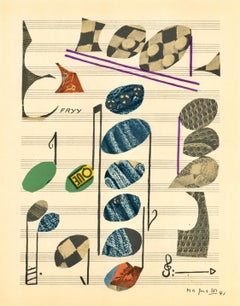
Alberto Magnelli, Music, from XXe Siecle, 1971
By Alberto Magnelli
Located in Southampton, NY
This exquisite lithograph by Alberto Magnelli (1888–1971), titled Musique (Music), from the album XXe Siecle, Nouvelle serie, XXXIIIe Annee, No. 37, Decembre 1971, originates from th...
Category

1970s Modern Abstract Prints

Materials

Lithograph

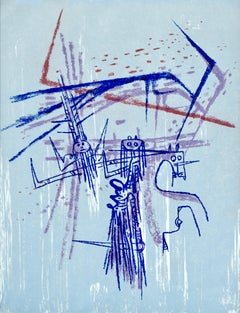
Wifredo Lam, Figures in the Night, from XXe Siecle, 1963
By Wifredo Lam
Located in Southampton, NY
This exquisite lithograph by Wifredo Lam (1902–1982), titled Personnages dans la nuit (Figures in the Night), from the album XXe Siecle, Nouvelle serie, XXVe Annee N°22, Noel 1963, o...
Category

1960s Modern Abstract Prints

Materials

Lithograph

Marc Chagall, The Lovers, from Color of Love, 1958 (after)
By Marc Chagall
Located in Southampton, NY
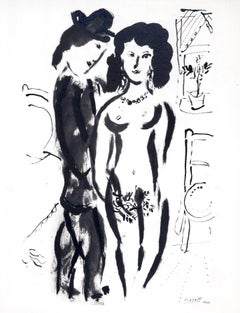
This exquisite lithograph and pochoir after Marc Chagall (1887–1985), titled Les Amoureux (The Lovers), from the folio Couleur amour, 13 Aquarelles, Gouaches, Lavis (Color of Love, 1...
Category

1950s Modern Figurative Prints

Materials

Lithograph, Stencil

Marc Chagall, Eve Cursed by God, from Drawings for the Bible, 1956
By Marc Chagall
Located in Southampton, NY
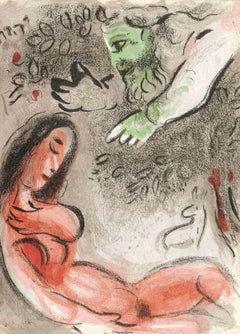
This exquisite lithograph by Marc Chagall (1887–1985), titled Eve maudite par Dieu (Eve Cursed by God), from Marc Chagall, Dessins Pour La Bible (Drawings for the Bible), Verve: Revue Artistique et Litteraire, Vol. VIII, No. 33–34, originates from the September 1956 issue published by Editions de la revue Verve, Paris, under the direction of Teriade, Editeur, Paris, and printed by Mourlot Freres, Paris, 1956. This emotionally charged composition depicts the moment of divine judgment following the fall of man, capturing both the sorrow and the spiritual gravity of Eve’s curse. Through his luminous lines and expressive symbolism, Chagall transforms this ancient scene into a universal meditation on loss, forgiveness, and the eternal bond between humanity and the divine. The work exemplifies Chagall’s mastery of merging sacred narrative and human emotion, rendered with poetic tenderness and transcendent light. The piece forms part of Chagall’s celebrated series of lithographs and drawings created for Dessins Pour La Bible, a monumental project uniting art, scripture, and mysticism in one of the artist’s most important achievements. Executed as a lithograph on velin du Marais paper, this work measures 14 x 10.5 inches (35.56 x 26.67 cm). Unsigned and unnumbered as issued. The edition exemplifies the superb craftsmanship of the Mourlot Freres atelier, renowned for its collaborations with the greatest modern masters of the 20th century. Artwork Details: Artist: Marc Chagall (1887–1985) Title: Eve maudite par Dieu (Eve Cursed by God), from Marc Chagall, Dessins Pour La Bible (Drawings for the Bible), Verve: Revue Artistique et Litteraire, Vol. VIII, No. 33–34, September 1956 Medium: Lithograph on velin du Marais paper Dimensions: 14 x 10.5 inches (35.56 x 26.67 cm) Inscription: Unsigned and unnumbered as issued Date: 1956 Publisher: Editions de la revue Verve, Paris, under the direction of Teriade, Editeur, Paris Printer: Mourlot Freres, Paris Catalogue raisonne references: Cain, Julien, and Fernand Mourlot. Chagall Lithographe. Andre Sauret, Editeur, 1960, illustrations 117–46. Cramer, Patrick, and Meret Meyer. Marc Chagall: Catalogue Raisonne Des Livres Illustrés. P. Cramer ed., 1995, illustration 25. Condition: Well preserved, consistent with age and medium Provenance: From Marc Chagall, Dessins Pour La Bible (Drawings for the Bible), Verve: Revue Artistique et Litteraire, Vol. VIII, No. 33–34, published by Editions de la revue Verve, Paris, 1956 Notes: Excerpted from the album (translated from French), This double issue of Verve is dedicated to the full reproduction in heliogravure of the one hundred-five plates etched by Marc Chagall, between 1930 and 1955, for the illustration of the Bible. The artist composed especially for the present work, sixteen lithographs in color and twelve in black, as well as the cover and the title page. This volume was completed and printed on September 10, 1956, by the Master Printers Draeger Freres for heliogravure, and by Mourlot Freres for lithography. About the Publication: Marc Chagall, Dessins Pour La Bible (Drawings for the Bible), published as Verve Vol. VIII, No. 33–34 in September 1956, represents one of the crowning achievements of Chagall’s lifelong dialogue with the sacred. Conceived and directed by the visionary publisher Teriade and printed by the master lithographers Mourlot Freres, the issue features thirty-four color lithographs and numerous black-and-white drawings inspired by biblical figures and stories. Chagall’s works for this edition unite text and image in a luminous meditation on divine creation, moral struggle, and spiritual renewal, imbued with his signature dreamlike symbolism and radiant color. Produced in postwar Paris, this landmark publication reaffirmed the enduring union of art and faith, establishing Dessins Pour La Bible as one of the most important illustrated works of the 20th century. About the Artist: Marc Chagall (1887–1985) was a Belarus-born French painter, printmaker, and designer whose visionary imagination, radiant color, and deeply poetic symbolism made him one of the most beloved and influential artists of the 20th century. Rooted in the imagery of his Jewish heritage and the memories of his childhood in Vitebsk, Chagall’s art wove together themes of faith, love, folklore, and fantasy with a dreamlike modern sensibility. His unique style—merging elements of Cubism, Fauvism, Expressionism, and Surrealism—defied categorization, transforming ordinary scenes into lyrical meditations on memory and emotion. Influenced by Russian icon painting, medieval religious art, and the modern innovations of artists such as Pablo Picasso, Henri Matisse, and Georges Braque, Chagall developed a profoundly personal visual language filled with floating figures, vibrant animals, musicians, and lovers that symbolized the transcendent power of imagination and love. During his early years in Paris, he became an integral part of the Ecole de Paris circle, forming friendships with Amedeo Modigliani, Fernand Leger, and Sonia Delaunay, and his creative spirit resonated with that of his peers and successors—Alexander Calder, Alberto Giacometti, Salvador Dali, Joan Miro, Wassily Kandinsky, Marcel Duchamp, and Man Ray—artists who, like Chagall, sought to push the boundaries of perception, emotion, and form. Over a prolific career that spanned painting, printmaking, stained glass, ceramics, and stage design, Chagall brought an unparalleled poetic sensibility to modern art, infusing even the most abstract subjects with human warmth and spiritual depth. His works are held in the most prestigious museums around the world, including the Museum of Modern Art, the Centre Pompidou, the Tate, and the Guggenheim, where they continue to inspire generations of artists and collectors. The highest price ever paid for a Marc Chagall artwork is approximately $28.5 million USD, achieved in 2017 at Sotheby’s New York for Les Amoureux (1928). Marc Chagall Eve...
Category

1950s Expressionist Figurative Prints

Materials

Lithograph

Pablo Picasso Estate Hand Signed Cubist Lithograph Abstract Girl Portrait Tete
By Pablo Picasso
Located in Surfside, FL
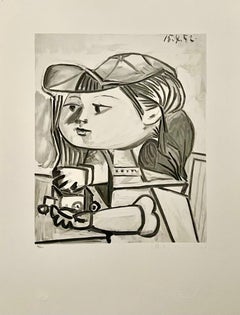
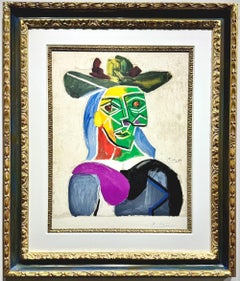
Pablo Picasso (after) "Buste de Petite Fille" limited edition print on Arches paper, Hand signed by Marina Picasso lower right and numbered 144/500 lower left From the estate of Pa...
Category

20th Century Modern Abstract Prints

Materials

Lithograph

L aquarium sur la caisse, Une Aventure méthodique, Georges Braque
By Georges Braque
Located in Southampton, NY
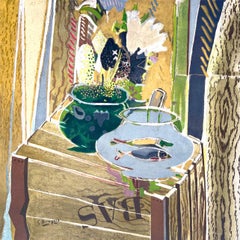
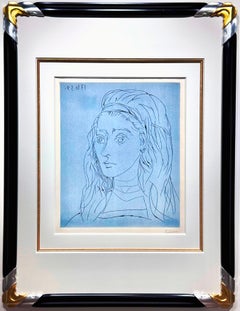
Lithograph on vélin d'Arches paper. Inscription: Unsigned and unnumbered. Good condition. Notes: From the folio, Une Aventure méthodique, 1950; published by Fernand Mourlot, Paris, a...
Category

1950s Modern Abstract Prints

Materials

Lithograph

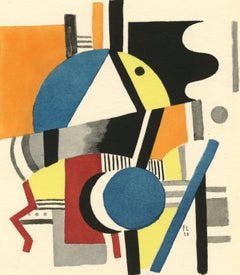
Fernand Leger, Mechanical Elements, 1929 (after)
By Fernand Léger
Located in Southampton, NY
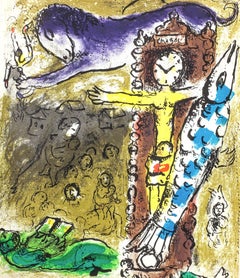
This exquisite lithograph and pochoir after Fernand Leger (1881–1955), titled Elements mecaniques (Mechanical Elements), from the album L'Art Cubiste, Theories et Realisations, Etude...
Category

1920s Cubist Still-life Prints

Materials

Lithograph, Stencil

Marc Chagall, Untitled, from The Lithographs of Chagall, 1969
By Marc Chagall
Located in Southampton, NY
This exquisite lithograph by Marc Chagall (1887–1985), titled Sans titre (Untitled), from the album The Lithographs of Chagall, Volume III, originates from the 1969 edition published...
Category

1960s Expressionist Figurative Prints

Materials

Lithograph

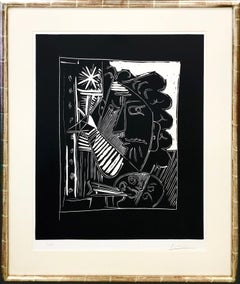
LE PEINTRE A LA PALETTE (BLOCH 1153)
By Pablo Picasso
Located in Aventura, FL
Linocut on Arches wove paper. Hand signed and numbered by the artist in pencil. Image size 25 x 20.75 inches. Sheet size 29.6 x 24.5 inches. Frame size approx 34.5 x 29.5 inches. Pri...
Category

1960s Cubist Animal Prints

Materials

Paper, Linocut

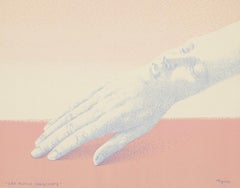
Rene Magritte, The Indiscreet Jewels, from XXe Siecle, 1963
By René Magritte
Located in Southampton, NY
This exquisite lithograph by Rene Magritte (1898–1967), titled Les Bijoux indiscrets (The Indiscreet Jewels), from the album XXe Siecle, Nouvelle serie, XXVe Annee N°22, Noel 1963, o...
Category

1960s Surrealist Figurative Prints

Materials

Lithograph

Braque, Paysage a L estaque, Fauves, Collection Pierre Lévy (after)
By Georges Braque
Located in Fairfield, CT
Medium: Lithograph on vélin d'Arches paper Year: 1972 Paper Size: 20 x 26 inches Inscription: Signed in the plate and unnumbered, as issued Notes: From the folio, Fauves, VII, Collec...
Category

1970s Fauvist Landscape Prints

Materials

Lithograph

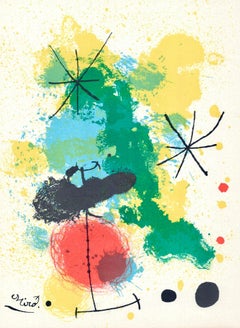
"Original Lithograph XI" from Miro Lithographs II, Maeght Publisher by Joan Miró
By Joan Miró
Located in Milwaukee, WI
"Original Lithograph XI" is an original color lithograph by Joan Miro, published in "Miro Lithographs II, Maeght Publisher" in 1975. It depicts Miro's signature biomorphic abstract s...
Category

1970s Abstract Abstract Prints

Materials

Lithograph

Joan Miro, Lithograph II, from Lithographs III, 1977
By Joan Miró
Located in Southampton, NY
This exquisite lithograph by Joan Miro (1893–1983), titled Lithograph II, from the album Joan Miro Lithographs, Volume III 1964–1969, originates from the 1977 edition published by Maeght Editeur, Paris, and printed by Mourlot Freres, Paris, April 15, 1977. Lithograph II reflects Miros poetic mastery of line, movement, and color, capturing his lifelong pursuit of visual rhythm and lyrical abstraction. Combining spontaneity and control, this composition embodies Miros signature balance of playful geometry and poetic energy—translating instinct and imagination into a harmonious field of motion and light. Executed as a lithograph on velin paper, this work measures 12.5 x 9.625 inches. Unsigned and unnumbered as issued. The edition exemplifies the refined craftsmanship and technical mastery of Mourlot Freres, Paris, one of the foremost printmaking ateliers of the 20th century. Artwork Details: Artist: Joan Miro (1893–1983) Title: Lithograph II, from the album Joan Miro Lithographs, Volume III 1964–1969, 1977 Medium: Lithograph on velin paper Dimensions: 12.5 x 9.625 inches (31.8 x 24.4 cm) Inscription: Unsigned and unnumbered as issued Date: 1977 Publisher: Maeght Editeur, Paris Printer: Mourlot Freres, Paris Catalogue raisonne references: Cramer, Patrick, and Joan Miro. Joan Miro, Catalogue Raisonne Des Livres Illustres. P. Cramer, 1989, illustration 230. Miro, Joan, and Patrick Cramer: Volume VI 1976–1981. Maeght, 1992, illustration 1114. Condition: Well preserved, consistent with age and medium Provenance: From the album Joan Miro Lithographs, Volume III 1964–1969, published by Maeght Editeur, Paris; printed by Mourlot Freres, Paris, April 15, 1977 Notes: Excerpted from the album, Final printing in Paris on 15th April 1977 at Arte Adrien Maeght press. The wide margin lithographs as well as the supplementary lithographs were printed by the Mourlot press. V̅ examples of this English language edition, numbered I-V̅, have been printed. A deluxe edition of CL examples, numbered 1-CL, with II additional original lithographs signed by Joan Miro, and LXXX suites, numbered I-LXXX, containing the VIII original lithographs on velin with wide margins and with each lithograph signed by the artist, have also been printed. About the Publication: Joan Miro Lithographs, Volume III 1964–1969, published in 1977 by Maeght Editeur, Paris, represents the third installment in the definitive four-volume series documenting Miros original lithographic oeuvre. Printed by Mourlot Freres and completed on April 15, 1977, the album chronicles a pivotal decade in Miros artistic evolution—one marked by the synthesis of lyrical abstraction, calligraphic gesture, and radiant color that defined his mature style. The volume includes eight original lithographs, each printed under Miros supervision, demonstrating the technical excellence and chromatic brilliance characteristic of his late work. With essays, documentation, and scholarly commentary, the album stands as both a visual and historical testament to the collaboration between Miro, Maeght Editeur, and Mourlot Freres, whose joint contributions elevated fine art lithography to an unparalleled standard of creativity and craftsmanship. As part of the celebrated Maeght archive of artist albums, Volume III captures the enduring vitality of Miros vision and the timeless spirit of his contribution to modern art. About the Artist: Joan Miro (1893–1983) was a Catalan painter, sculptor, printmaker, and ceramicist whose visionary imagination and lyrical abstraction made him one of the most influential and beloved artists of the 20th century. Born in Barcelona, Miro drew inspiration from Catalan folk art, Romanesque frescoes, and the luminous landscapes of Mont-roig del Camp, developing a deep connection to nature that infused his work with vitality and symbolism. After formal training at the Escola d'Art in Barcelona, he absorbed the lessons of Post-Impressionism and Cubism before moving to Paris in the early 1920s, where he became a leading figure in the Surrealist movement. There, Miro forged a personal visual language of biomorphic shapes, floating symbols, and radiant color harmonies that reflected both spontaneity and spiritual depth. In creative dialogue with peers such as Alexander Calder, Alberto Giacometti, Salvador Dali, Wassily Kandinsky, Marcel Duchamp, and Man Ray, he helped revolutionize modern art by dissolving the boundaries between abstraction and dream imagery. Miros inventive approach extended far beyond painting, embracing sculpture, ceramics, and monumental public commissions that redefined how art could interact with space and emotion. His expressive freedom and gestural abstraction profoundly influenced later artists including Jackson Pollock, Mark Rothko, Alexander Calder, Jean Dubuffet, Antoni Tapies, and Joan Mitchell, inspiring generations who sought to merge instinct, color, and imagination. Today, Miros work remains a cornerstone of modernism, prized by collectors and celebrated in major museums worldwide. His highest auction record was achieved by Peinture (Etoile Bleue) (1927), which sold for 23,561,250 GBP (approximately 37 million USD) at Sotheby's, London, on June 19, 2012. Joan Miro Lithograph II...
Category

1970s Surrealist Abstract Prints

Materials

Lithograph

Sur la plage II (trois nus), 1921
By Pablo Picasso
Located in New York, NY
Pablo Picasso may be best known for pioneering Cubism and fracturing the two-dimensional picture plane in order to convey three-dimensional space. Inspired by African and Iberian art...
Category

1920s Cubist Nude Prints

Materials

Paper, Lithograph

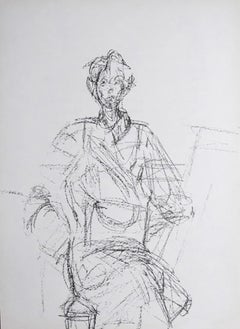
Alberto Giacometti Nu Assis original lithograph, 1961
By Alberto Giacometti
Located in Pembroke Pines, FL
Artist: Alberto Giacometti Title: 'Nu Assis' Year: 1961 Medium: Original Lithograph on vélin paper Dimensions: 15in. by 11in. Edition: From the rare limited edition Reference : Lust,...
Category

1960s Contemporary Prints and Multiples

Materials

Lithograph

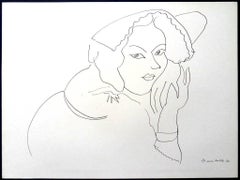
Henri Matisse (After) - Lithograph - Flowers
By (after) Henri Matisse
Located in Collonge Bellerive, Geneve, CH
after Henri MATISSE (1869-1954) Lithograph Signed in the plate Vélin Paper Dimensions: 32 x 24 cm (12 x 9") This lithograph is one of a rare edition made during the Second World War ...
Category

1940s Modern Figurative Prints

Materials

Lithograph

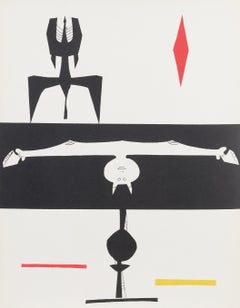
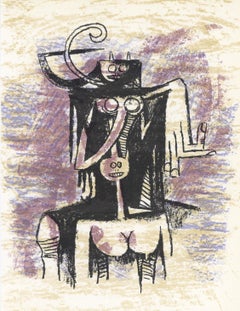
Wifredo Lam, Winged Figure, from Derriere le miroir, 1953
By Wifredo Lam
Located in Southampton, NY
This exquisite lithograph by Wifredo Lam (1902–1982), titled Figure Ailee (Winged Figure), from the folio Derriere le miroir, No. 55-56, originates from the 1953 edition published by...
Category

1950s Modern Abstract Prints

Materials

Lithograph

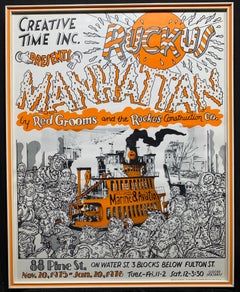
Creative Time Inc. Red Grooms exhibition poster
By Red Grooms
Located in Wilton Manors, FL
Original exhibition poster for Ruckus Manhattan by Red Grooms and the Ruckus Construction Company, 1975. Presented by Creative Time, Inc. Lithograph with offset lithographic photo elements, sheet measures 23 x 29 inches; 24 x 30 inches framed. Design by M. Samuels. Produced by Polychrome Lithography Co., Inc, NYC. Condition is outstanding with no damage or conservation. No creasing, staining, toning or fading. A rare poster from an early show produced by Creative Time Inc. while only in their 2nd season. A lovely document of NYC art history. Ruckus Manhattan was a multimedia, three-dimensional representation of Manhattan on display on the ground level of 88 Pine Street. The out-of-scale model, constructed of papier-mâché, wood, plastic, fiberglass, and vinyl, was designed to conform to Manhattan’s psychic dimensions, rather than its physical ones, and included such landmarks as the Apollo Theatre, the Brooklyn Bridge, Central Park, the Chrysler Building, the Stock Exchange floor, Trinity Church, and the World Trade Center. Finding inspiration in sources as diverse as cubism and newspaper comics, Red and Mimi Gross Grooms...
Category

1970s Pop Art More Prints

Materials

Printer s Ink, Offset

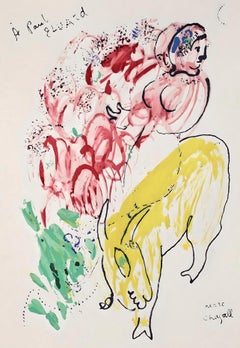
Marc Chagall "Untitled (from Le Cirque)" lithograph
By Marc Chagall
Located in Boston, MA
Artist: Chagall, Marc Title: Untitled (from Le Cirque) Series: Le Cirque Date: 1967 Medium: Lithograph in colors on Arches Unframed Dimensions: 16.625" x 12.625" Framed Dimensi...
Category

1960s Modern Prints and Multiples

Materials

Lithograph

Pierre Soulages, Plate No. 4, from Painters of Today, 1962 (after)
By Pierre Soulages
Located in Southampton, NY
This exquisite heliogravure after Pierre Soulages (1919–2022), titled Planche No. 4 (Plate No. 4), from the folio Pierre Soulages, Peintres d'aujourd'hui (Pierre Soulages, Painters o...
Category

1960s Modern Abstract Prints

Materials

Lithograph

Marc Chagall, The Dance, from Derriere le miroir, 1964
By Marc Chagall
Located in Southampton, NY
This exquisite lithograph by Marc Chagall (1887–1985), titled La Danse (The Dance), from the folio Derriere le miroir, No. 147, originates from the 1964 edition published by Maeght E...
Category

1960s Expressionist Figurative Prints

Materials

Lithograph

Untitled
By Afro Basaldella
Located in Wilton Manors, FL
Untitled, ca. 1960. Lithograph on paper, sheet measuring 18.5 x 26.5 inches Measuring 27 x 35 inches in original mid-century beveled oak frame. Signed and numbered in pencil by ...
Category

Mid-20th Century Abstract Expressionist Abstract Prints

Materials

Lithograph

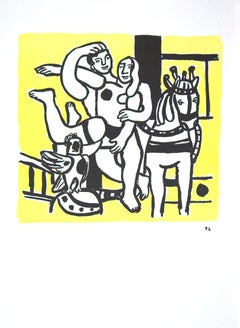
Fernand Leger-Le Jeu (The Game)
By Fernand Léger
Located in Brooklyn, NY
This reproduction lithograph, titled Le Jeu by Fernand Léger, is a beautifully crafted piece printed on high-quality ARCHES paper. Originally created in 1948, this lithograph capture...
Category

20th Century Modern Prints and Multiples

Materials

Lithograph

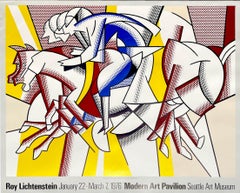
The Red Horsemen Modern Art Pavilion Lt Ed Seattle Art Museum print
By Roy Lichtenstein
Located in New York, NY
Roy Lichtenstein at Modern Art Pavilion, Seattle Art Museum Limited Edition poster, 1976 Offset lithograph Limited Edition of 1000 22 1/2 × 28 inches Unframed, unsigned Publisher Se...
Category

1970s Pop Art Abstract Prints

Materials

Offset

Picasso, Composition (Cramer 88), Dans l Atelier de Picasso (after)
By Pablo Picasso
Located in Southampton, NY
Lithograph on vélin d'Arches à la forme savoir paper. Unsigned and unnumbered, as issued. Good condition, with centerfold, as issued. Notes: From the volume, Dans l'Atelier de Picass...
Category

1950s Modern Landscape Prints

Materials

Lithograph

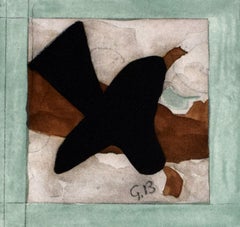
Georges Braque, The Black Bird on Brown Background, 1965 (after)
By Georges Braque
Located in Southampton, NY
This exquisite lithograph after Georges Braque (1882–1963), titled L’Oiseau Noir sur Fond Brun (The Black Bird on Brown Background), from the folio Les Peintres mes amis (The Painter...
Category

1960s Modern Landscape Prints

Materials

Lithograph

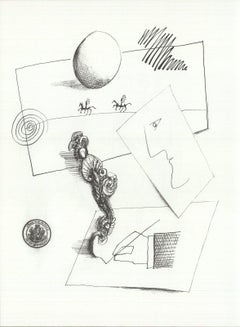
Steinberg, Illustration, Derrière le miroir (after)
By Saul Steinberg
Located in Southampton, NY
Lithograph on vélin paper. Inscription: Unsigned and unnumbered, as issued. Good condition. Notes: From Derrière le miroir, N° 157, 1966. Published by Aimé Maeght, Éditeur, Paris; pr...
Category

1960s Post-War Abstract Prints

Materials

Lithograph

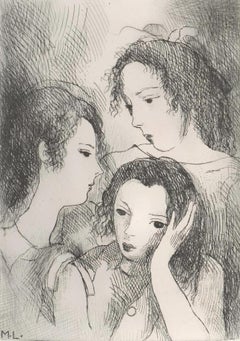
Marie Laurencin, Three Young Girls, from Antares, 1944
By Marie Laurencin
Located in Southampton, NY
This exquisite etching by Marie Laurencin (1883–1956), titled Trois jeunes filles (Three Young Girls), from the album Antares, eaux-fortes originales de Marie Laurencin (Antares, Ori...
Category

1940s Modern Figurative Prints

Materials

Etching

Wifredo Lam, Figure, from XXe siecle, 1974
By Wifredo Lam
Located in Southampton, NY
This exquisite lithograph by Wifredo Lam (1902–1982), titled Personnage (Figure), from the album XXe siecle, Nouvelle serie, XXXVIe Annee, No. 42, originat...
Category

1970s Modern Abstract Prints

Materials

Lithograph

Chagall, Composition, Le Dur Désir de Durer (after)
By Marc Chagall
Located in Southampton, NY
Lithograph on vélin bouffant d'Alfa paper. Inscription: unsigned and unnumbered, as issued. Good condition. Notes: From the volume, Le Dur Désir de Durer, illustré par Marc Chagall, ...
Category

1950s Expressionist Figurative Prints

Materials

Lithograph

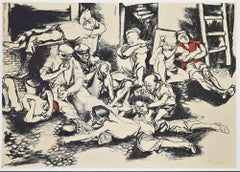
Bricklayers at Rest - Offset after Renato Guttuso - 1945
By Renato Guttuso
Located in Roma, IT
Bricklayers at Rest is an artwork realized after the Italian artist  Renato Guttuso  (Bagheria, 1911 – Rome, 1987) in 1945. Phototype print. Good ...
Category

1940s Contemporary Still-life Prints

Materials

Offset

Pablo Picasso "Grand Tête" (Portrait de Jacqueline aux Cheveux lisses)
By Pablo Picasso
Located in Los Angeles, CA
PABLO PICASSO (1881-1973) Grand Tête (Portrait de Jacqueline aux Cheveux lisses) linocut in colors, on Arches paper, 1962, signed in pencil, numbered 12/50, with full margins, pale ...
Category

20th Century Cubist Figurative Prints

Materials

Linocut

After PABLO PICASSO "Tête de Femme au Chapeau"
By Pablo Picasso
Located in Los Angeles, CA
PABLO PICASSO (AFTER) Tête de Femme au Chapeau. Color lithograph 1956 Sheet size 650x540 mm; 25⅝x21¼ inches, full margins. Proof before letters, aside from the published poster e...
Category

1950s Cubist Prints and Multiples

Materials

Lithograph

Pablo Picasso "Portrait de Jacqueline"
By Pablo Picasso
Located in Los Angeles, CA
Pablo Picasso (1881-1973) "Portrait de Jacqueline" 1959 (Baer 1245; Bloch 923) ...
Category

1950s Surrealist Portrait Prints

Materials

Linocut

Marc Chagall, The Christ at the Clock, from Chagall, 1957
By Marc Chagall
Located in Southampton, NY
This exquisite lithograph by Marc Chagall (1887–1985), titled Le Christ a l’Horloge (The Christ at the Clock), from the album Chagall, originates from the 1957 edition published by M...
Category

1950s Expressionist Figurative Prints

Materials

Lithograph

Joan Miro, Untitled, from Prints from the Mourlot Press, 1964
By Joan Miró
Located in Southampton, NY
This exquisite lithograph by Joan Miro (1893–1983), titled Sans titre (Untitled), from the album Prints from the Mourlot Press, exhibition sponsored by the French Embassy, circulated...
Category

1960s Surrealist Abstract Prints

Materials

Lithograph

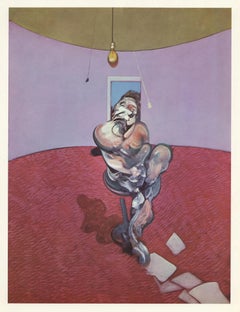
Francis Bacon, Portrait of George Dyer Talking color lithograph, 1966 (After)
By (after) Francis Bacon
Located in Pembroke Pines, FL
Lithograph on vélin paper. Inscription: Unsigned and unnumbered. Good condition. Notes: From Derrière le miroir, N° 162. Published by Aimé Maeght, Éditeur, Paris; printed by Éditions...
Category

1960s Contemporary Prints and Multiples

Materials

Lithograph

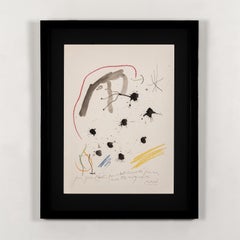
Quelques Fleurs #6
By Joan Miró
Located in Toronto, Ontario
Joan Miró is one of the greatest artists of the 20th century. He is renowned internationally as a painter, sculptor, printmaker, and ceramicist. Miró’s works, which were at the in...
Category

1960s Abstract Expressionist Prints and Multiples

Materials

Lithograph

Filius Prodigus - Lithograph - 1964
By Salvador Dalí­
Located in Roma, IT
Filius Prodigus is a Color lithograph on heavy rag paper realized in 1964. It is part of Biblia Sacra vulgatæ edition is published by Rizzoli-Mediolani between 1967 and 1969. Signed...
Category

1960s Surrealist More Prints

Materials

Lithograph

Ad Reinhardt, Untitled, from Ten Works by Ten Painters, 1964
By Ad Reinhardt
Located in Southampton, NY
This exquisite silkscreen by Ad Reinhardt (1913–1967), titled Untitled, originates from the landmark 1964 folio X + X (Ten Works by Ten Painters). Published by the Wadsworth Atheneum...
Category

1960s Abstract Expressionist Landscape Prints

Materials

Screen

Pablo Picasso, Faun and Nude Woman, from The Double Flute, 1967 (after)
By Pablo Picasso
Located in Southampton, NY
This exquisite lithograph and pochoir after Pablo Picasso (1881–1973), titled Faune et femme nue (Faun and Nude Woman), from the folio Picasso, La flute double, 16 Dessins, Aquarelle...
Category

1960s Cubist Figurative Prints

Materials

Lithograph, Stencil

Wifredo Lam, The Veiled Birds, from Derriere le miroir, 1953
By Wifredo Lam
Located in Southampton, NY
This exquisite lithograph by Wifredo Lam (1902–1982), titled Les Oiseaux Voiles (The Veiled Birds), from the folio Derriere le miroir, No. 55-56, originates from the 1953 edition pub...
Category

1950s Modern Abstract Prints

Materials

Lithograph

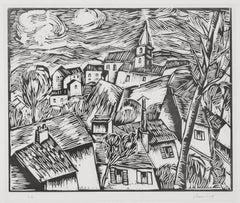
Bougival
By Maurice de Vlaminck
Located in Fairlawn, OH
Bougival Woodcut, 1914 Signed and numbered in pencil Edition 30, this numberd 22 Printed on laid Van Gelder Zonen paper Published by Henri Kanweiler, Paris Printed by Paul Birault, P...
Category

1910s Fauvist Landscape Prints

Materials

Woodcut

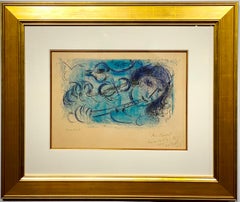
MARC CHAGALL "Le joueur de flûte"
By Marc Chagall
Located in Los Angeles, CA
MARC CHAGALL 1887 - 1985 "Le joueur de flûte" 1958 Colour lithograph 25.5x44 cm, illustration; 38.3x57.3 cm, sheet size Signed lower right by the artist in ink "Marc Chagall" and dedicated "Pour Ursula et Gerd Hatje / "merci" / Marc Chagall / 1958". Inscribed lower left by the artist "Epreuve d'artiste". This is an artist’s proof, aside from the edition of 90. Catalogue Raisonné : Mourlot 197 Gerd Hatje (14 April 1915 – 24 July 2007) was a German publisher. The publishing house that he founded in 1945, named the Humanitas Verlag, renamed in 1947 as Verlag Gerd Hatje, is internationally known for contemporary art, photography and architecture. It merged in to Hatje Cantz in 1999. In the 1950s and 1960s, Hatje changed the focus to art, photography, and architecture.[1] He had contact with and was a friend of contemporary artists such as Hans Arp, Willi Baumeister, Joseph Beuys, Max Bill, Georges Braque, Marcel Breuer, Marc Chagall, Christo, Le Corbusier, Max Ernst, Alberto Giacometti, Walter Gropius, Joan Miró, Pablo Picasso, Ludwig Mies van der Rohe, and James Stirling...
Category

Mid-19th Century Impressionist Figurative Prints

Materials

Paper, Lithograph

Andre Derain, Still Life, 1970 (after)
By André Derain
Located in Southampton, NY
This exquisite lithograph after Andre Derain (1880–1954), titled Nature Morte (Still Life), from the folio Andre Derain entre 1935 et 1949, V (Andre Derain between 1935 and 1949, V),...
Category

1970s Fauvist Still-life Prints

Materials

Lithograph

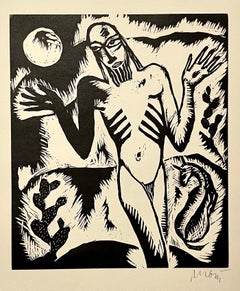
Rare 1923 Cubist Reuven Rubin Woodcut Woodblock Kabbalah Print Israeli Judaica
By Reuven Rubin
Located in Surfside, FL
This is from the original first edition 1923 printing. there was a much later edition done after these originals. These are individually hand signed in pencil by artist as issued. This listing is for the one print. the other documentation is included here for provenance and is not included in this listing. The various images inspired by the Jewish Mysticism and rabbis and mystics of jerusalem and Kabbalah is holy, dramatic and optimistic Rubin succeeded to evoke the spirit of life in Israel in those early days. They are done in a modern art style influenced by German Expressionism, particularly, Ernst Barlach, Ernst Ludwig Kirchner, and Franz Marc, as introduced to Israel by Jakob Steinhardt, Hermann Struck and Joseph Budko. Reuven Rubin 1893 -1974 was a Romanian-born Israeli painter and Israel's first ambassador to Romania. Rubin Zelicovich (later Reuven Rubin) was born in Galati to a poor Romanian Jewish Hasidic family. He was the eighth of 13 children. In 1912, he left for Ottoman-ruled Palestine to study art at Bezalel Academy of Art and Design in Jerusalem. Finding himself at odds with the artistic views of the Academy's teachers, he left for Paris, France, in 1913 to pursue his studies at the École Nationale Supérieure des Beaux-Arts. He was of the well known Jewish artists in Paris along with Marc Chagall and Chaim Soutine, At the outbreak of World War I, he was returned to Romania, where he spent the war years. In 1921, he traveled to the United States with his friend and fellow artist, Arthur Kolnik. In New York City, the two met artist Alfred Stieglitz, who was instrumental in organizing their first American show at the Anderson Gallery. Following the exhibition, in 1922, they both returned to Europe. In 1923, Rubin emigrated to Mandate Palestine. Rubin met his wife, Esther, in 1928, aboard a passenger ship to Palestine on his return from a show in New York. She was a Bronx girl who had won a trip to Palestine in a Young Judaea competition. He died in 1974. Part of the early generation of artists in Israel, Joseph Zaritsky, Arieh Lubin, Reuven Rubin, Sionah Tagger, Pinchas Litvinovsky, Mordecai Ardon, Yitzhak Katz, and Baruch Agadati; These painters depicted the country’s landscapes in the 1920s rebelled against the Bezalel school of Boris Schatz. They sought current styles in Europe that would help portray their own country’s landscape, in keeping with the spirit of the time. Rubin’s Cezannesque landscapes from the 1920s were defined by both a modern and a naive style, portraying the landscape and inhabitants of Israel in a sensitive fashion. His landscape paintings in particular paid special detail to a spiritual, translucent light. His early work bore the influences of Futurism, Vorticism, Cubism and Surrealism. In Palestine, he became one of the founders of the new Eretz-Yisrael style. Recurring themes in his work were the bible, the prophet, the biblical landscape, folklore and folk art, people, including Yemenite, Hasidic Jews and Arabs. Many of his paintings are sun-bathed depictions of Jerusalem and the Galilee. Rubin might have been influenced by the work of Henri Rousseau whose naice style combined with Eastern nuances, as well as with the neo-Byzantine art to which Rubin had been exposed in his native Romania. In accordance with his integrative style, he signed his works with his first name in Hebrew and his surname in Roman letters. In 1924, he was the first artist to hold a solo exhibition at the Tower of David, in Jerusalem (later exhibited in Tel Aviv at Gymnasia Herzliya). That year he was elected chairman of the Association of Painters and Sculptors of Palestine. From the 1930s onwards, Rubin designed backdrops for Habima Theater, the Ohel Theater and other theaters. His biography, published in 1969, is titled My Life - My Art. He died in Tel Aviv in October 1974, after having bequeathed his home on 14 Bialik Street and a core collection of his paintings to the city of Tel Aviv. The Rubin Museum opened in 1983. The director and curator of the museum is his daughter-in-law, Carmela Rubin. Rubin's paintings are now increasingly sought after. At a Sotheby's auction in New York in 2007, his work accounted for six of the ten top lots. Along with Yaacov Agam and Menashe Kadishman he is among Israel's best known artists internationally. Education 1912 Bezalel Academy of Arts and Design, Jerusalem 1913-14 École des Beaux Arts, Paris and Académie Colarossi, Paris Select Group Exhibitions Eged - Palestine Painters Group Eged - Palestine Painters Group, Allenby Street, Tel Aviv 1929 Artists: Chana Orloff, Abraham Melnikoff, Rubin, Reuven Nahum Gutman, Sionah Tagger,Arieh Allweil, Jewish Artists Association, Levant Fair, Tel Aviv, 1929 Artists: Ludwig Blum,Eliyahu Sigad, Shmuel Ovadyahu, Itzhak Frenel Frenkel,Ozer Shabat, Menahem Shemi...
Category

1920s Abstract Figurative Prints

Materials

Woodcut

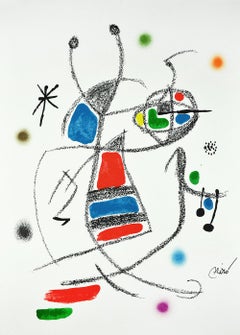
Joan Miró - MARAVILLAS CON VARIACIONES... Lithograph Contemporary Art Abstract
By Joan Miró
Located in Madrid, Madrid
Joan Miró - Maravillas con variaciones acrósticas en el jardín de Miró VIII Date of creation: 1975 Medium: Lithograph on Gvarro paper Edition: 1500 Size: 49,5 x 35,5 cm Condition: In...
Category

1970s Abstract Abstract Prints

Materials

Paper, Lithograph

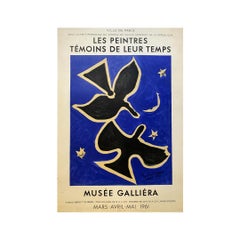
1961 original exhibition poster of Georges Braque at the Musée Galliéra
By Georges Braque
Located in PARIS, FR
This sublime poster was made by Georges Braque 🇫🇷 (1882-1963) for his 1961 exhibition at the Galliera Museum (Fashion Museum of the City of Paris). The Salon des Peintres témoins de leur temps is a show that was held every year between 1951 and 1983, first at the Museum of Modern Art of the city of Paris and then in the Palais Galliera. Initiated by the painter Isis Kischka, the salon des peintres témoins de leurs temps is one of the most visited salons of the time, bringing together a hundred artists per edition while organizing around various themes over the years. Braque is a major figure of modern art in the world. Along with Pablo Picasso, he was one of the initiators of Cubism, a pictorial movement based on the decomposition and geometrisation of forms. In 1917, he created a series of breathtaking paintings. His paintings are divided into a series of themes: the figure, the still life and the studio. It was in 1953, when he was at the peak of his career, that he completed "The Birds", this magnificent work which is featured on the poster. This work, composed of three canvases...
Category

1960s Prints and Multiples

Materials

Paper, Lithograph

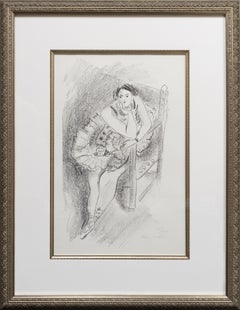
Henri Matisse - Dancer on Wooden Armchair (Danseuse au Fauteuil en Bois), 1927
By Henri Matisse
Located in Hinsdale, IL
Duthuit-Garnaud 483 From the Portfolio of Ten Lithographs: “Dix Danseuses (ten dancers)” Lithograph on wove paper, c. 1927 Hand-signed and numbered in pencil in lower margin Impressi...
Category

1920s Fauvist Prints and Multiples

Materials

Lithograph

Fernand Leger, Objects in Space, from Cahiers d Art, 1928 (after)
By Fernand Léger
Located in Southampton, NY
This exquisite lithograph and pochoir after Fernand Leger (1881–1955), titled Objets dans l’espace (Objects in Space), from the album Fernand Leger (Fernand Leger), originates from t...
Category

1920s Modern Landscape Prints

Materials

Lithograph

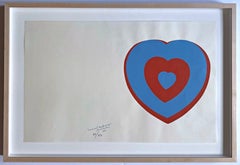
Coeurs Volants (Fluttering Hearts) Schwartz 446C, historic hand signed edition
By Marcel Duchamp
Located in New York, NY
Marcel Duchamp Coeurs Volants (Fluttering Hearts) (Schwartz 446C), 1961 Silkscreen in colors Hand signed in ball-point pen by Marcel Duchamp and annotated with the dateline "Stockhol...
Category

1960s Dada Abstract Prints

Materials

Screen, Pencil

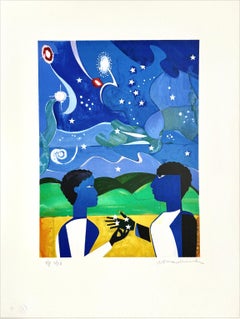
TWO WORLDS, FACES OF THE FUTURE Signed Lithograph, Figurative Collage Night Sky
By Romare Bearden
Located in Union City, NJ
TWO WORLDS, FACES OF THE FUTURE is a hand drawn, limited edition color lithograph by the renowned American artist Romare Bearden, printed using hand lithography techniques on archival Arches printmaking paper, 100% acid free. TWO WORLDS, FACES OF THE FUTURE is a multicolored collage landscape portraying a mysterious, jigsaw-shaped starry night sky in shades of deep blue, hues of bright green, golden yellow, and touches of red. In the foreground of TWO WORLDS, FACES OF THE FUTURE two human figures stand face to face exchanging stars beneath a celestial blue sky showered with twinkling lights. Bearden created this image bearing in mind the importance of advancement through education. This very unique Romare Bearden lithograph...
Category

1980s Contemporary Portrait Prints

Materials

Lithograph

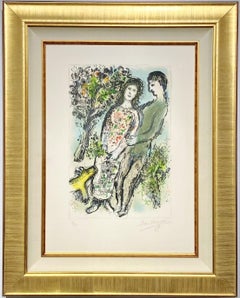
Marc Chagall ”L’Oranger”
By Marc Chagall
Located in Los Angeles, CA
Marc Chagall (Russia/France 1887‑1985). ”L’Oranger”. Year 1975 Signed and numbered Marc Chagall 8/50. Colour lithograph printed on Arches. Framed 35.5H x 28W x 2D Inches Illustr...
Category

1970s Modern Figurative Prints

Materials

Lithograph

Marc Chagall, The Flute Player, from Chagall, 1957
By Marc Chagall
Located in Southampton, NY
This exquisite lithograph by Marc Chagall (1887–1985), titled Le Joueur de Flute (The Flute Player), from the album Chagall, originates from the 195...
Category

1950s Expressionist Figurative Prints

Materials

Lithograph

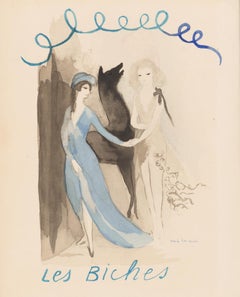
Marie Laurencin, Untitled, from Les Biches, 1924
By Marie Laurencin
Located in Southampton, NY
This exquisite lithograph and pochoir by Marie Laurencin (1883–1956), titled Sans titre (Untitled), from the album Les Biches (The Does), originates from the 1924 edition published b...
Category

1920s Modern Landscape Prints

Materials

Lithograph, Stencil

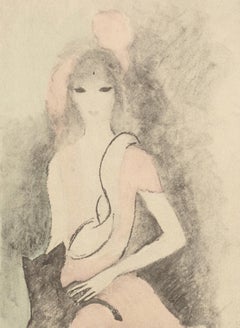
Marie Laurencin, Untitled, from Les Biches, 1924
By Marie Laurencin
Located in Southampton, NY
This exquisite lithograph and pochoir by Marie Laurencin (1883–1956), titled Sans titre (Untitled), from the album Les Biches (The Does), originates from the 1924 edition published b...
Category

1920s Modern Landscape Prints

Materials

Lithograph, Stencil

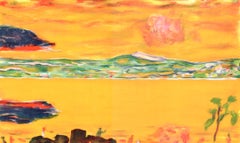
Pierre Bonnard, Sunset Over the Mediterranean, Verve, Revue Artistique, 1940
By Pierre Bonnard
Located in Southampton, NY
This exquisite lithograph by Pierre Bonnard (1867–1947), titled Coucher De Soleil Sur La Mediterranee (Sunset Over the Mediterranean), from Verve, Revue Artistique et Litteraire, Vol...
Category

1940s Post-Impressionist Landscape Prints

Materials

Lithograph

Still Thinking About These?

All Recently Viewed