868 results for "dada"

to
280
307
235
182
90
54
Overall Width
to
Overall Height
to
168
154
112
106
106
61
14
12
2
155
68
61
28
26
1
4
659
204
1
59
22
11
40
107
241
111
11
607
130
126
306
150
145
139
131
66
63
55
52
44
35
28
26
23
21
20
19
18
18
18
423
246
140
108
84
96
238
456
262
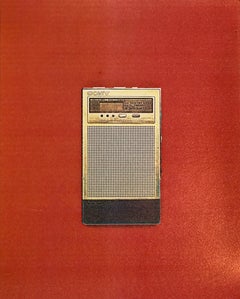
Seasons 1981 Photo Color Copier Print Photograph Museum Collected Art Xerography
By Leslie Schiff
Located in Surfside, FL
SEASONS (1981) This is for the single print listed here. (not the outside folder or title sheet) Title: Sony Walkman Radio. This one is hand signed and dated verso. Seasons explores the seasons of Man, Woman, Child, Civilization, Nature and Technology. First digital artwork purchased by the Metropolitan Museum. Date: 1980-1981 Medium: vintage color photocopy print. “I worked at The Metropolitan Museum in 1981, when they acquired [Lesley’s] SEASONS portfolio. We knew we wanted it, even though we didn’t have a category for it.” David Kiehl, Curator of Prints and Special Collections The Whitney Museum of American Art, New York City. Lesley Schiff (born 1951) is an American fine artist. Schiff studied painting at the Art Institute Chicago before developing her signature practice using color laser printers to create images. Her work is included in the collections of the Whitney Museum of American Art, the Mead Art Museum and the Metropolitan Museum of Art and other major museums, corporate and private collections globally. Lesley Schiff revolutionized the photocopier from being an office tool to just another instrument in the artist's arsenal. Rather than addressing the tool in her work, Schiff instead uses the photocopier like a paintbrush to realize her vision. Once a painter, Schiff says: “I never intended to stop painting. I just decided to start painting with a modern tool. Working with the color laser printer keeps you in your culture. It's like America. Plugged in. Electronic. Direct." Painting with light, Schiff's body of work outlines a cycle of life: man, woman, child, civilization, nature, technology. More recent works challenge the viewer to understand the concept of eye-levels and perspectives, reinventing the way we see. Schiff's work was the Metropolitan Museum of Art's first digital acquisition, and most recently, was featured at the Whitney Museum of American Art in "Experiments in Electrostatics". She uses a color laser printer “like a paintbrush” to create her art. She has said about her work and her tool: “I never intended to stop painting. I just decided to start painting with a modern tool. Working with the color laser printer keeps you in your culture. It's like America. Plugged in. Electronic. Direct—but no matter how hi-tech my tools become, I’m a painter, but instead of painting with oils, I paint with light. The Whitney Museum will show Lesley Schiff's pioneering SEASONS portfolio in its entirety. Many prominent collections acquired SEASONS as their first digital artwork. She participated in the Punk Art show in the 1970's. Her work kind of relates to Fluxus and Dada. Leslie Schiff moved from Chicago to New York in the early 1970s. Much of her art involves collage and the Xerox photocopy machine. Her images are rooted in her personal psyche and have an intuitive meaning that is not always easily understood. In exhibitions, Xerox sheets are combined and displayed decoratively on the wall. Schiff has also created books; and made video and sound tapes. She was included in the seminal New York/New Wave 1981 exhibition show at MoMA PS1 along with Jean-Michel Basquiat, William S.Burroughs, David Byrne, Larry Clark, Crash (John Matos), Ronnie Cutrone, Brian Eno, Nan Goldin, Keith Haring, Ray Johnson, Joseph Kosuth, Robert Mapplethorpe, Kenny Scharf, Steven Sprouse, Andy Warhol and Lawrence Weiner. She did a “visual biography,” comprised of portraits of Bob Dylan—depicted at different ages, from his 20s to his 60s—illustrations of his lyrics, and images of iconic objects like his sunglasses and harmonica. Schiff collaborated with Matthew Carter...
Category

1980s Contemporary Color Photography

Materials

Color

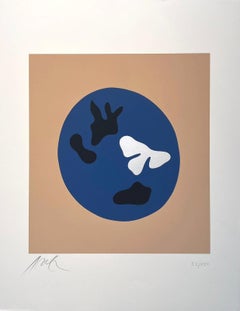
Untitled
By Hans Arp
Located in Paris, FR
Silkscreen, 1964 Edition : 52/150 Publisher : Hochschule St. Gallen (St. Gallen) Printer : Wifredo Arcay (Paris) 65.00 cm. x 50.00 cm. 25.59 in. x 19.69 in. (paper) 41.50 cm. x 37.5...
Category

1960s Abstract Abstract Prints

Materials

Silk

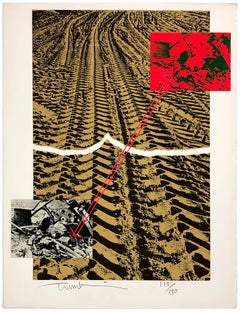
Untitled (from Ten Painters on War and Peace), hand signed lithograph
Located in Aventura, FL
Lithograph in colors on arches paper. Hand signed and numbered by Ygael Tumarkin. Edition 115/190. From the "Ten Painters on War and Peace" portfolio. Printed on May 10, 1978 to...
Category

1970s Contemporary Abstract Prints

Materials

Paper, Lithograph

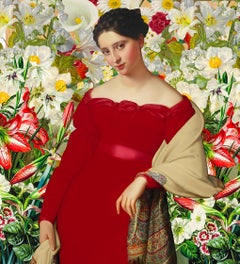
Beauté du XVIIIe Siècle 3
By Agent X
Located in Kansas City, MO
Agent X Beauté du XVIIIe Siècle 3 Archival Pigment Inks on 310 gsm hahnemühle paper Year: 2022 Size: 34x26in Edition: 50 Signed, dated and numbered by ha...
Category

2010s Baroque Prints and Multiples

Materials

Archival Paper, Digital

Large George Grosz 1923 Lithograph Die Rauber German Expressionism WPA Realism
By George Grosz
Located in Surfside, FL
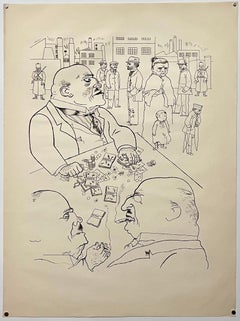
From The robbers. lithographs by George Grosz for the drama of the same name. photolithography on watermarked paper. 19 X 25.5 inches (sheet size). This is not hand signed or numbe...
Category

1930s American Modern Figurative Prints

Materials

Lithograph

Nijū BY AGENT X, Street Art, Graffiti Art, Banksy-Esque Art, Limited Edition Art
By Agent X
Located in Deddington, GB
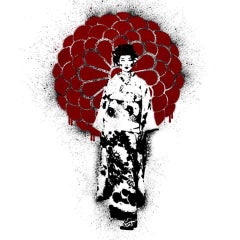
Agent X Nijū Limited Edition of 125 Mixed Media on Paper Sold Unframed Paper Size: 76 cm x 76 cm x 1cm Please note that in situ images are purely an indication of how a piece may loo...
Category

21st Century and Contemporary Interior Prints

Materials

Paper, Mixed Media

Korean Contemporary Art by Anna Song - Sun, Moon and Five Peaks
Located in Paris, IDF
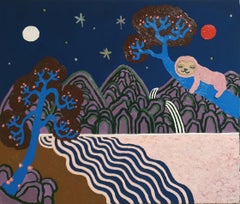
Oil on canvas Anna Song is Korean artist & picture book author born in 1984 who lives and works in Seoul, South Korea. In 2007, she won the Korean Andersen Award for Excellence in P...
Category

2010s Contemporary Figurative Prints

Materials

Canvas, Oil

Silkscreen Oiran Day Glo Fluorescent 1960 s Japanese Pop Art Print Geisha Kimono
By Ushio Shinohara
Located in Surfside, FL
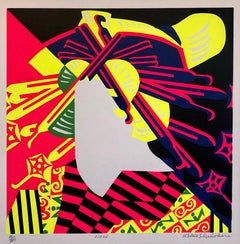
Ushio Shinohara (born 1932, Tokyo), nicknamed “Gyu-chan”, is a Japanese Neo-Dadaist artist. His bright, large work has been exhibited internationally at institutions including the Hara Museum of Contemporary Art, Centre Georges Pompidou, the Guggenheim Museum SoHo, National Museum of Modern Art, Tokyo, Leo Castelli Gallery, New York, Museum of Contemporary Art, Los Angeles and The Metropolitan Museum of Art, Seoul and others. Shinohara and his wife, Noriko, are the subjects of a documentary film by Zachary Heinzerling called Cutie and the Boxer (2013). Shinohara's parents instilled in him a love for painters such as Paul Cézanne, Vincent Van Gogh and Paul Gauguin. His father was a tanka poet who was taught by Wakayama Bokusui. Shinohara’s mother was a painter who went to the Woman’s Art University (Joshibijutsu Daigaku) in Tokyo. In 1952 Shinohara entered the Tokyo Art University (later renamed to Tokyo University of the Arts), majoring in oil painting, however he left before graduation in 1957. In 1960 Shinohara participated in a group called "Neo-Dada Organizers". (Masunobu Yoshimura, Genpei Akasegawa, Shusaku Arakawa, Ushio Shinohara, Sho Kazakura, Tomio Miki, Tetsumi Kudo...
Category

1960s Pop Art Abstract Prints

Materials

Screen

Agent X, One Queen (4)White, Contemporary Art, Floral Art, Affordable Art
By Agent X
Located in Deddington, GB
Agent X One Queen (4)White Limited Edition of 100 Mixed Media on Paper Sold Unframed Paper Size: 71 cm x 50 cm x 1cm Please note that in situ images are purely an indication of how a...
Category

21st Century and Contemporary Contemporary Portrait Prints

Materials

Giclée

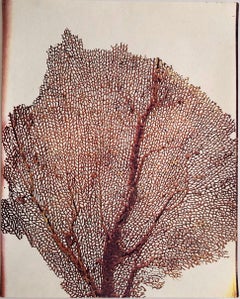
Seasons 1981 Photo Color Copier Print Photograph Museum Collected Art Xerography
By Leslie Schiff
Located in Surfside, FL
SEASONS (1981) This is for the single print listed here. (not the outside folder or title sheet) Title: Sea Fan. This one is hand signed and dated verso. Seasons explores the seasons of Man, Woman, Child, Civilization, Nature and Technology. First digital artwork purchased by the Metropolitan Museum. Date: 1980-1981 Medium: vintage color photocopy print. “I worked at The Metropolitan Museum in 1981, when they acquired [Lesley’s] SEASONS portfolio. We knew we wanted it, even though we didn’t have a category for it.” David Kiehl, Curator of Prints and Special Collections The Whitney Museum of American Art, New York City. Lesley Schiff (born 1951) is an American fine artist. Schiff studied painting at the Art Institute Chicago before developing her signature practice using color laser printers to create images. Her work is included in the collections of the Whitney Museum of American Art, the Mead Art Museum and the Metropolitan Museum of Art and other major museums, corporate and private collections globally. Lesley Schiff revolutionized the photocopier from being an office tool to just another instrument in the artist's arsenal. Rather than addressing the tool in her work, Schiff instead uses the photocopier like a paintbrush to realize her vision. Once a painter, Schiff says: “I never intended to stop painting. I just decided to start painting with a modern tool. Working with the color laser printer keeps you in your culture. It's like America. Plugged in. Electronic. Direct." Painting with light, Schiff's body of work outlines a cycle of life: man, woman, child, civilization, nature, technology. More recent works challenge the viewer to understand the concept of eye-levels and perspectives, reinventing the way we see. Schiff's work was the Metropolitan Museum of Art's first digital acquisition, and most recently, was featured at the Whitney Museum of American Art in "Experiments in Electrostatics". She uses a color laser printer “like a paintbrush” to create her art. She has said about her work and her tool: “I never intended to stop painting. I just decided to start painting with a modern tool. Working with the color laser printer keeps you in your culture. It's like America. Plugged in. Electronic. Direct—but no matter how hi-tech my tools become, I’m a painter, but instead of painting with oils, I paint with light. The Whitney Museum will show Lesley Schiff's pioneering SEASONS portfolio in its entirety. Many prominent collections acquired SEASONS as their first digital artwork. She participated in the Punk Art show in the 1970's. Her work kind of relates to Fluxus and Dada. Leslie Schiff moved from Chicago to New York in the early 1970s. Much of her art involves collage and the Xerox photocopy machine. Her images are rooted in her personal psyche and have an intuitive meaning that is not always easily understood. In exhibitions, Xerox sheets are combined and displayed decoratively on the wall. Schiff has also created books; and made video and sound tapes. She was included in the seminal New York/New Wave 1981 exhibition show at MoMA PS1 along with Jean-Michel Basquiat, William S.Burroughs, David Byrne, Larry Clark, Crash (John Matos), Ronnie Cutrone, Brian Eno, Nan Goldin, Keith Haring, Ray Johnson, Joseph Kosuth, Robert Mapplethorpe, Kenny Scharf, Steven Sprouse, Andy Warhol and Lawrence Weiner. She did a “visual biography,” comprised of portraits of Bob Dylan—depicted at different ages, from his 20s to his 60s—illustrations of his lyrics, and images of iconic objects like his sunglasses and harmonica. Schiff collaborated with Matthew Carter...
Category

1980s Contemporary Color Photography

Materials

Color

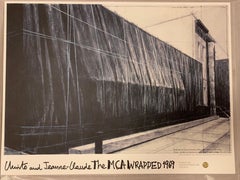
The MCA "Wrapped" 1969 Christo Jeanne-Claude Exhibition Poster Contemporary
By Christo and Jeanne-Claude
Located in Draper, UT
Own a piece of history with this rare and limited edition poster from the MCA! Commemorating Christo's iconic exhibition "Wrap In Wrap Out," this poster is a true collector's item. T...
Category

1960s Contemporary More Art

Materials

Gold Leaf

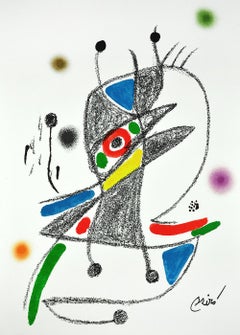
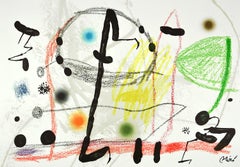
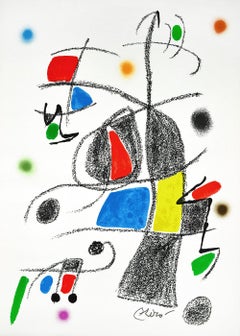
Joan Miró - MARAVILLAS CON VARIACIONES... Lithograph Contemporary Art Abstract
By Joan Miró
Located in Madrid, Madrid
Joan Miró - Maravillas con variaciones acrósticas en el jardín de Miró II Date of creation: 1975 Medium: Lithograph on Gvarro paper Edition: 1500 Size: 49,5 x 35,5 cm Condition: In v...
Category

1970s Abstract Abstract Prints

Materials

Paper, Lithograph

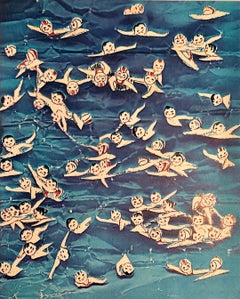
Seasons 1981 Photo Color Copier Print Photograph Museum Collected Art Xerography
By Leslie Schiff
Located in Surfside, FL
SEASONS (1981) This is for the single print listed here. (not the outside folder or title sheet) Children in water. This one is not hand signed although the rest in the portfolio wer...
Category

1980s Contemporary Color Photography

Materials

Color

Adoration of the Magi / - The Rider of the Sun -
Located in Berlin, DE
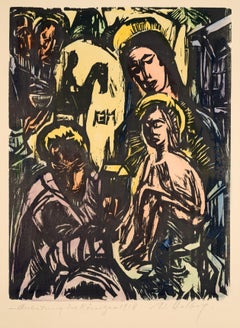
Walter Helbig (1878 Falkenstein - 1968 Ascona), Adoration of the Magi, 1918. Hand-colored linocut, 30 cm x 22.5 cm (depiction), 50 cm x 35 cm (sheet size), signed “W.[alter] Helbig” in pencil lower right, inscribed “Adoration of the Magi” lower left and dated “1918”. Below this a handwritten dedication “with heartfelt Christmas greetings”. - Paper somewhat darkened and with slight creases, thumbtack holes in the corners - The Rider of the Sun - The 'apocalypse' of World War I brought about a return to sacred art. Walter Helbig belonged to the circle of the 'Brücke' and the 'Blauer Reiter'. With his reinterpretation of religious themes in an expressionist formal language, Helbig shaped an avant-garde neo-sacred art. This is symbolically expressed in the silhouette of the rider against the sun-like yellow background. It refers to the awakening initiated by the Blue Riding, which is now linked back to the sacred. The rider and horse "look" at Mary and the Christ Child, who occupy the entire field. Opposite them are the three kings, the eldest of whom kneels before Christ and offers him a gold-filled casket. The expressionist lines give rise to a tower that rises into the "sun", so that the gift has become a Gothic church, expressing the hope that the fallen world will be resurrected in the name of Christ. This dimension of meaning is emphasized by the magical effect of the color scheme. About the artist In 1895, Walter Helbig began studying at the Dresden Academy of Art, where he became friends with the future Brücke artist Otto Müller, with whom he lived in Dresden from 1903 to 1905. While studying in Italy from 1897 to 1899, he met Arnold Böcklin and Adolf von Hildebrand. After completing his studies, he first worked for Otto Gussmann, painting churches. From 1905 to 1909 he worked as a freelance painter in Hamburg. In 1909, through the mediation of Otto Müller, Helbig made the acquaintance of artists from the 'Brücke'. In 1910 he exhibited at the founding exhibition of the Berlin 'Neue Sezession'. In the same year, he moved to Switzerland, where, together with Hans Arp and Oscar Lüthy, he founded the 'Moderne Bund' in Weggis, to which Cuno Amiet and Giovanni Giacometti also belonged. At the second exhibition of the 'Moderne Bund' in Zurich in 1911, Henri Matisse and Robert Delaunay were represented alongside artists from the 'Blauer Reiter'. In 1913, Helbig traveled to Paris with Arp and Lüthy. After the dissolution of the 'Moderne Bund', Helbig was represented at the first Dada exhibition in Zurich in 1914. In 1919, he joined the Berlin 'Novembergruppe'. After the devastation of World War I, Helbig turned increasingly to religious themes in his work. In 1924, like many other artists of his time, he moved to Ascona for financial reasons, where he became a naturalized citizen in 1938. There he founded the artists' association "The Great Bear", to which Marianne von Werefkin...
Category

1910s Expressionist Figurative Prints

Materials

Paper

R.B. Kitaj "The Jerwish Question"
By Ronald Brooks Kitaj
Located in Surfside, FL
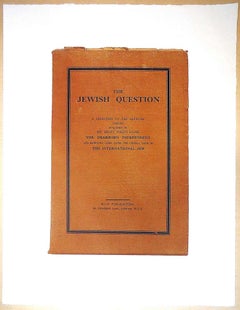
Initialled signed in pencil From R. B. Kitaj, In Our Time: Covers for a Small Library After the Life for the Most Part, screenprint 1969 edition of 150 photo screenprint. A cover of ...
Category

1960s Pop Art Still-life Prints

Materials

Screen

Horst Janssen Hand-Signed Poster München Original Zinc Etching, 1967 — Framed
By Horst Janssen
Located in Barcelona, ES
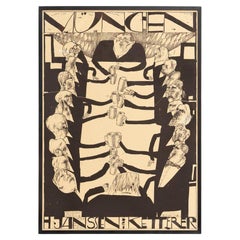
Horst Janssen — Hand-Signed Poster “München (Galerie Wolfgang Ketterer, Villa Stuck)”, Original Zinc Etching, 1966–67 — Framed Powerful hand-signed exhibition poster by Horst Jansse...
Category

1960s Abstract More Prints

Materials

Paper

Hungarian Surrealist Abstract Hebrew Silkscreen Judaica Print Jewish Serigraph
By Jozsef Jakovits
Located in Surfside, FL
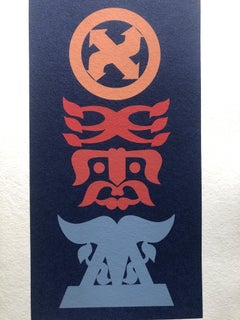
Abstract Hebrew Prints on heavy mould made paper from small edition of 15. there is a facing page of text in Hungarian folded over. Hard edged geometric abstract prints in color base...
Category

1980s Abstract Geometric Abstract Prints

Materials

Archival Paper, Screen

Feminist Surrealist French Abstract Colorful Lithograph Print Myriam Bat Yosef
Located in Surfside, FL
Myriam Bat-Yosef Surrealist abstract lithograph print in colorful abstract shapes and shades Hand signed and dated 1971. sheet measures 9.25 X 9.25 inches The envelope and the Peter Buch poster is just for provenance and is not included in this sale. Myriam Bat-Yosef, whose real name is Marion Hellerman, born on January 31, 1931 in Berlin, Germany to a Jewish family from Lithuania, she is an Israeli-Icelandic artist who paints on papers, paintings, fabrics, objects and human beings for performances. Myriam Bat-Yosef currently lives and works in Paris. In 1933, her family fleeing the Nazi Holocaust, Miriam Bat-Yosef emigrates to Palestine and settles in Jaffa. In 1936, she suffers a family tragedy, her father, militant Zionist, is called to fight, still recovering from an operation of appendicitis. The incision will become infected, antibiotics did not exist yet, and her father will die in the hospital after 9 months of suffering. Myriam and her mother leave Palestine to live in Paris for three years. French is Myriam's first school language. In 1939, still fleeing Nazism, she returned to Palestine, leaving France by the last boat from Marseille. She moved to Tel Aviv with her mother, aunt and maternal grandmother. In 1940, she began attending the Academy of Fine Arts in Tel Aviv and took her name as an artist, Bat-Yosef, which means Joseph's daughter in Hebrew, as a tribute to her father. In 1946, Myriam graduated as a kindergarten teacher but wanted to be an artist. Her mother enrolled her in an evening school to prepare a diploma of art teacher. At 19, she performs two years of military service in Israel. In 1952, with a pension of $50 a month that her mother allocated, she went to study at the Beaux-Arts in Paris. To survive, she has several activities while studying. In 1955, she had her first solo exhibition, at the Israeli Club on Wagram Avenue in Paris. Many artists, such as Yaacov Agam, Yehuda Neiman Avigdor Arikha, Raffi Kaiser, Dani Karavan and sculptors Achiam and Shlomo Selinger attended the opening . In 1956, she enrolled at the School of Fine Arts in Florence. This is where she meets the painter Errô. They share an icy studio in winter. Myriam moves to Milan with friends. She organizes a joint exhibition with Erro, one room each, at the Montenapoleone gallery. Her works are admired by the sculptor Marino Marini and the painters Renato Birolli and Enrico Prampolini. Myriam and Erro exhibit in Rome, Milan, Florence and meet many personalities: Alain Jouffroy and his wife, the painter Manina, Roberto Matta and his wife Malitte, textile artist who was one of the founders of the Pompidou Center. Back in Paris, Myriam and Erro get married, which allows Myriam to avoid being called into the Israeli army during the Suez Canal War. In 1957, Myriam and her husband went to Iceland. Myriam works in a chocolate factory. Having enough money, she starts producing art again. She exhibited in Reykjavik's first art gallery. She meets the artist Sigridur Bjornsdottir, married to the Swiss painter Dieter Roth . In 1958, Myriam and her husband leave for Israel. They exhibit in Germany, then in Israel. Back in Paris, the couple became friends with artists of the surrealist movement, such as Victor Brauner, Hans Bellmer, the sculptor Philippe Hiquily, Liliane Lijn, future wife of Takis and photographer Nathalie Waag. Erro and Myriam have a daughter on March 15, 1960, named Tura, after the painter Cosmè Tura, but also close to the Icelandic Thora or the Hebrew Torah. Bat-Yosef’s complex trajectory throughout the 20th century is linked as much to the transnational history of what was for a time called the School of Paris as it is to a certain legacy of Surrealism. Her work features the same idea of resolving antinomies that also defined the spirit of surrealism, and is enhanced with her readings of the Kabbalah and her spiritual grounding in Taoism. However, while there are reasons for her approach to be associated with the process of the ready-made, it is important to consider the immediate intrication of these works with her practice of performance, during which the body itself is also painted – a feminist response to Yves Klein’s Anthropometries (1960) and an echo of the happenings which Jean-Jacques Lebel organised at the time in Paris. In 1963, Erró told Myriam that if she wants to be a painter, she can not be his wife. Myriam chose to be a painter and the couple divorced in 1964. Since that time, Myriam Bat-Yosef has exhibited in many countries: Europe, United States, Japan, etc. Although long in the shadows, the work of Myriam Bat-Yosef has been greeted by many artists and personalities: Anaïs Nin, Nancy Huston, André Pieyre of Mandiargues, José Pierre, René de Solier , Jacques Lacarrière, Alain Bosquet, Pierre Restany, Sarane Alexandrian and Surrealist André Breton who, after a visit to her studio, confided to having been intrigued by its phantasmagorical dimension. She was included in the book Pop Art and Beyond: Gender, Race, and Class in the Global Sixties by Mona Hadler and Kalliopi Minioudaki. Extract "World Citizen, Artist of the Pop Era Sarah Wilson; Why do we know so little of Myriam Bat-Yosef, the most important female Israeli artist of the Pop era? Issues of identity and sexuality feature constantly in her work. She exhibited internationally from Reykjavik to Tokyo; she had two shows at Arturo Schwarz’s famous Dada/surrealist gallery in Milan; she participated in feminist art events in Los Angeles. Above all, in 1971, she conceived Total Art, a Pop Gesamtkunstwerk inside and outside the Israel Museum, Jerusalem. Painter, performer, and installation artist, she was also a lover, wife, and mother. Of Lithuanian-Jewish descent, she was close to the family of philosopher Emmanuel Levinas. An émigré in Paris she would repudiate a national passport, participating in Garry Davis’s short-lived “World Citizens” movement. She continues the lineage of women surrealist artists: Valentine Hugo, Leonor Fini, Dorothea Tanning, Leonora Carrington, Unica Zürn, Jane Graverol, Toyen, Alice Rahon...
Category

1970s Surrealist Abstract Prints

Materials

Lithograph

Carl Andre “Untitled”, 1972 — NYCLU Ticket, Signed Conceptual Art
By Carl Andre
Located in Barcelona, ES
Carl Andre “Untitled”, 1972 — NYCLU Ticket, Signed Conceptual Art Own a rare and historically significant work by Carl Andre, a pioneer of minimalist and conceptual art. “Untitled” ...
Category

1970s Abstract Abstract Prints

Materials

Paper

Joan Miró - MARAVILLAS CON VARIACIONES... Lithograph Contemporary Art Abstract
By Joan Miró
Located in Madrid, Madrid
Joan Miró - Maravillas con variaciones acrósticas en el jardín de Miró X Date of creation: 1975 Medium: Lithograph on Gvarro paper Edition: 1500 Size: 49,5 x 35,5 cm Condition: In ve...
Category

1970s Abstract Abstract Prints

Materials

Paper, Lithograph

Rainbow Quilt Heart Pop Art Vintage Offset Lithograph Poster Jim Dine, Maeght
By Jim Dine
Located in Surfside, FL
Jim Dine, Monotypes et Gravures, Galerie Maeght, Paris, 1983. Vintage Offset Lithograph Poster American contemporary pop art. A colorful heart quilt in a rainbow of colors. Jim Dine...
Category

1980s Pop Art More Prints

Materials

Lithograph, Offset

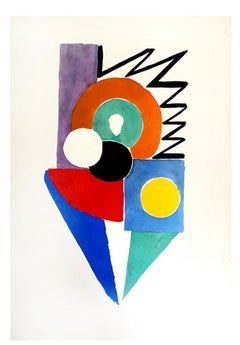
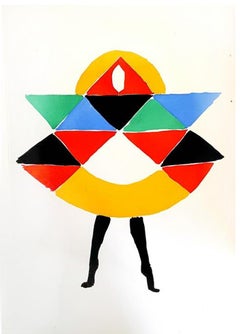
Living Painting - Colour Pochoir
By (after) Sonia Delaunay
Located in Collonge Bellerive, Geneve, CH
Full-page, colour pochoir after costume designs by Sonia Delaunay. Edition 331/500 copies on Velin Aussedat Dimensions: 28.5 x 19.5 cm. From 27 Living Paintings. [Milano, Edizioni d...
Category

1960s Abstract Geometric Figurative Prints
Feminist Surrealist French Abstract Colorful Lithograph Print Myriam Bat Yosef
Located in Surfside, FL
Myriam Bat-Yosef Surrealist abstract lithograph print in colorful abstract shapes and shades Hand signed and dated 1971. sheet measures 9.25 X 9.25 inches The envelope and the Peter Buch poster is just for provenance and is not included in this sale. Myriam Bat-Yosef, whose real name is Marion Hellerman, born on January 31, 1931 in Berlin, Germany to a Jewish family from Lithuania, she is an Israeli-Icelandic artist who paints on papers, paintings, fabrics, objects and human beings for performances. Myriam Bat-Yosef currently lives and works in Paris. In 1933, her family fleeing the Nazi Holocaust, Miriam Bat-Yosef emigrates to Palestine and settles in Jaffa. In 1936, she suffers a family tragedy, her father, militant Zionist, is called to fight, still recovering from an operation of appendicitis. The incision will become infected, antibiotics did not exist yet, and her father will die in the hospital after 9 months of suffering. Myriam and her mother leave Palestine to live in Paris for three years. French is Myriam's first school language. In 1939, still fleeing Nazism, she returned to Palestine, leaving France by the last boat from Marseille. She moved to Tel Aviv with her mother, aunt and maternal grandmother. In 1940, she began attending the Academy of Fine Arts in Tel Aviv and took her name as an artist, Bat-Yosef, which means Joseph's daughter in Hebrew, as a tribute to her father. In 1946, Myriam graduated as a kindergarten teacher but wanted to be an artist. Her mother enrolled her in an evening school to prepare a diploma of art teacher. At 19, she performs two years of military service in Israel. In 1952, with a pension of $50 a month that her mother allocated, she went to study at the Beaux-Arts in Paris. To survive, she has several activities while studying. In 1955, she had her first solo exhibition, at the Israeli Club on Wagram Avenue in Paris. Many artists, such as Yaacov Agam, Yehuda Neiman Avigdor Arikha, Raffi Kaiser, Dani Karavan and sculptors Achiam and Shlomo Selinger attended the opening . In 1956, she enrolled at the School of Fine Arts in Florence. This is where she meets the painter Errô. They share an icy studio in winter. Myriam moves to Milan with friends. She organizes a joint exhibition with Erro, one room each, at the Montenapoleone gallery. Her works are admired by the sculptor Marino Marini and the painters Renato Birolli and Enrico Prampolini. Myriam and Erro exhibit in Rome, Milan, Florence and meet many personalities: Alain Jouffroy and his wife, the painter Manina, Roberto Matta and his wife Malitte, textile artist who was one of the founders of the Pompidou Center. Back in Paris, Myriam and Erro get married, which allows Myriam to avoid being called into the Israeli army during the Suez Canal War. In 1957, Myriam and her husband went to Iceland. Myriam works in a chocolate factory. Having enough money, she starts producing art again. She exhibited in Reykjavik's first art gallery. She meets the artist Sigridur Bjornsdottir, married to the Swiss painter Dieter Roth . In 1958, Myriam and her husband leave for Israel. They exhibit in Germany, then in Israel. Back in Paris, the couple became friends with artists of the surrealist movement, such as Victor Brauner, Hans Bellmer, the sculptor Philippe Hiquily, Liliane Lijn, future wife of Takis and photographer Nathalie Waag. Erro and Myriam have a daughter on March 15, 1960, named Tura, after the painter Cosmè Tura, but also close to the Icelandic Thora or the Hebrew Torah. Bat-Yosef’s complex trajectory throughout the 20th century is linked as much to the transnational history of what was for a time called the School of Paris as it is to a certain legacy of Surrealism. Her work features the same idea of resolving antinomies that also defined the spirit of surrealism, and is enhanced with her readings of the Kabbalah and her spiritual grounding in Taoism. However, while there are reasons for her approach to be associated with the process of the ready-made, it is important to consider the immediate intrication of these works with her practice of performance, during which the body itself is also painted – a feminist response to Yves Klein’s Anthropometries (1960) and an echo of the happenings which Jean-Jacques Lebel organised at the time in Paris. In 1963, Erró told Myriam that if she wants to be a painter, she can not be his wife. Myriam chose to be a painter and the couple divorced in 1964. Since that time, Myriam Bat-Yosef has exhibited in many countries: Europe, United States, Japan, etc. Although long in the shadows, the work of Myriam Bat-Yosef has been greeted by many artists and personalities: Anaïs Nin, Nancy Huston, André Pieyre of Mandiargues, José Pierre, René de Solier , Jacques Lacarrière, Alain Bosquet, Pierre Restany, Sarane Alexandrian and Surrealist André Breton who, after a visit to her studio, confided to having been intrigued by its phantasmagorical dimension. She was included in the book Pop Art and Beyond: Gender, Race, and Class in the Global Sixties by Mona Hadler and Kalliopi Minioudaki. Extract "World Citizen, Artist of the Pop Era Sarah Wilson; Why do we know so little of Myriam Bat-Yosef, the most important female Israeli artist of the Pop era? Issues of identity and sexuality feature constantly in her work. She exhibited internationally from Reykjavik to Tokyo; she had two shows at Arturo Schwarz’s famous Dada/surrealist gallery in Milan; she participated in feminist art events in Los Angeles. Above all, in 1971, she conceived Total Art, a Pop Gesamtkunstwerk inside and outside the Israel Museum, Jerusalem. Painter, performer, and installation artist, she was also a lover, wife, and mother. Of Lithuanian-Jewish descent, she was close to the family of philosopher Emmanuel Levinas. An émigré in Paris she would repudiate a national passport, participating in Garry Davis’s short-lived “World Citizens” movement. She continues the lineage of women surrealist artists: Valentine Hugo, Leonor Fini, Dorothea Tanning, Leonora Carrington, Unica Zürn, Jane Graverol, Toyen, Alice Rahon...
Category

1970s Surrealist Abstract Prints

Materials

Lithograph

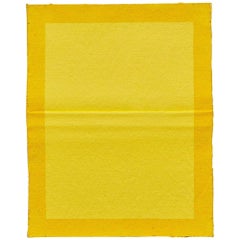
Hans Jean Arp, Yellow, from Derriere le miroir, 1950
Located in Southampton, NY
This exquisite woodcut by Hans Jean Arp (1886–1966), titled Jaune (Yellow), from the folio Derriere le miroir, No. 33, originates from the 1950 edition published by Maeght Editeur, P...
Category

1950s Modern Abstract Prints

Materials

Woodcut

1980s Keith Haring announcement
By Keith Haring
Located in NEW YORK, NY
Keith Haring, Julian Schnabel, & Robert Rauschenberg & more: ART/New York 1983: Rare historical 1980s announcement card published on the occasion of Videotapes of the 1982-83 Art Season ART/New York. Featuring a who’s who list in New York artists including, Keith Haring, Julian Schnabel, Robert Rauschenberg, Brice Marden and Nam June Paik. Medium: Offset printed folded announcement. Dimensions: Approximately 10 x 12.25 inches. (unfolded) Fold-line in center as originally issued; good to very good overall vintage condition. Unsigned from an edition of unknown. --- Keith Haring rose to prominence in 1980s New York within the East Village art scene alongside Jean-Michel Basquiat, Kenny Scharf, and Jenny Holzer. He bridged the gap between the art world and the street, graffiting city subways and sidewalks before committing to a studio practice. Haring united the appeal of cartoons with the raw energy of Art Brut artists such as Jean DuBuffet as he developed a distinct pop-graffiti aesthetic that comprised energetic, boldly outlined figures against solid or patterned backdrops. His major themes included exploitation, subjugation, drug abuse, and the threat of nuclear holocaust; Haring boldly engaged with social issues, especially after receiving an AIDS diagnosis in 1987. Today, his work sells for seven figures at auction and has been the subject of solo shows at the Brooklyn Museum, the San Francisco Museum of Modern Art, The Broad Museum Los Angeles and the Albertina Museum in Vienna, among other key institutions. Julian Schnabel (America, b.1951) is an artist, filmmaker, musician, and writer, best known in the art community for his hasty rise to fame after the exhibition of his famous Plate Paintings at Mary Boone Gallery in 1979. Encouraged to draw by his mother during his childhood in Brooklyn, Schnabel’s artistic interest piqued as a teenager when he encountered the art of the Mexican muralists. After earning his BFA at Houston University in 1973, Schnabel enrolled in the very prestigious Independent Study Program at the Whitney Museum, and began his career as an artist. Rapidly achieving notoriety in the late 1970s, Schnabel became the infamous star of the internationalist Neo-Expressionist movement in the 1980s, with his works on unusual materials such as velvet, and garnering as much attention through his brash remarks and self-aggrandization as through his art. Along with fellow Neo-Expressionists David Salle (American, b.1952), Eric Fischl (American, b.1948), and Sigmar Polke (German, 1941–2010), Schnabel’s art can be seen as a reaction against the cool compositions of Minimalism and Conceptualism, in its rough texture and violently expressive return to addressing the human condition in painting. In 1996, he began a career as a filmmaker with Basquiat and his movie The Diving Bell and the Butterfly based on the novel by Jean-Dominique Bauby had a great success. Since 2010, a selection of his Polaroids taken since 2002 has been held in London, Milan and Paris, which are repainted to underline the highlights of the pictures. He still lives and works in New York. Robert Rauschenberg was a prominent member of the American Post-War avant-garde. The artist’s sculpture-painting hybrids, known as Combines, broke through the two dimensionality of the canvas at a time when Abstract Expressionism dominated the scene. His seminal Neo-Dada work, Erased de Kooning (1953), consisted of ritualistically wiping out an original drawing he purchased from the famed painter. “I don't really trust ideas, especially good ones,” he once said. “Rather I put my trust in the materials that confront me, because they put me in touch with the unknown.” Born Milton Ernest Rauschenberg on October 22, 1925 in Port Arthur, TX, he was drafted into the Navy during World War II where he served as medical technician in San Diego. After the war, he traveled to Paris to study at the Académie Julian on the GI bill, where he met his future wife, Susan Weil. The pair went on to attend the Black Mountain College in North Carolina alongside John Cage and Merce Cunningham. After settling in New York in 1949, Rauschenberg began questioning the nature of painting through works such as Bed (1955) and Monogram (1955–1959), which utilized commercial imagery and mass produced objects. Many of the artist’s ideas foresaw the emergence of Andy Warhol and Pop Art in the 1960s. The artist died on May 12, 2008 in Captiva, FL. Rauschenberg’s works are held in the collections of the Tate Gallery in London, The Museum of Modern Art in New York, the Walker Art Center in Minneapolis, and the Kunstmuseum Basel, among others. Brice Marden is a contemporary American painter known for his subtle explorations of color and gestural lines. Like Robert Ryman, Robert Mangold, and Agnes Martin, Marden’s canvases are the product of an ongoing investigation into the nature of abstraction and the medium of painting itself. “A painting, you know, it's all dirty material. But it's about transformation,” the artist mused. “Taking that earth, that heavy earthen kind of thing, turning it into air and light.” Born on October 15, 1938 in Bronxville, NY, Marden received his BFA from Boston University in 1961 and his MFA from Yale University in 1963, where he was taught by both Alex Katz and Jon Schueler...
Category

1980s Pop Art More Art

Materials

Offset

Jasper Johns, Sans titre, In Memory of My Feelings (after)
By Jasper Johns
Located in Southampton, NY
Lithograph on vélin Mohawk Superfine Smooth paper. Paper Size: 11.937 x 8.96 inches. Inscription: Unsigned and unnumbered, as issued. Notes: From the folio, In Memory of My Feelings,...
Category

1960s Abstract Expressionist Abstract Prints

Materials

Lithograph

Ángela De La Cruz Pinch Yellow Contemporary Artwork, 2015
Located in Barcelona, ES
“Pinch” was produced in 2015 by Spanish-born, London-based artist Ángela de la Cruz (b. 1965), one of the most influential figures in European contemporary art.. Executed in acrylic ...
Category

2010s Abstract Abstract Prints

Materials

Acrylic

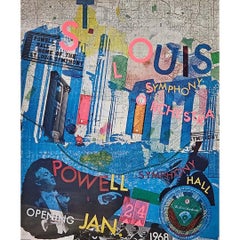
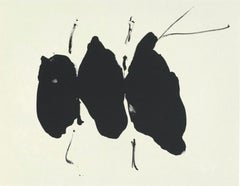
1968 Original poster by Robert Rauschenberg - St Louis Symphony orchestra
By Robert Rauschenberg
Located in PARIS, FR
Renowned American artist Robert Rauschenberg left an indelible mark on the art world, not only through his groundbreaking works but also through a distinctive poster created for the St. Louis Symphony Orchestra in 1968. Born on October 22, 1925, Rauschenberg was a pivotal figure in the transition from Abstract Expressionism to Pop Art. His interdisciplinary approach to art, incorporating elements of painting, sculpture, and graphic design, set him apart. The St. Louis Symphony Orchestra poster...
Category

1960s Pop Art Prints and Multiples

Materials

Paper

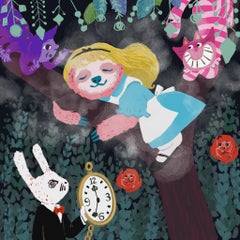
Korean Contemporary Art by Anna Song - Wake up!
Located in Paris, IDF
Digital Print Anna Song is Korean artist & picture book author born in 1984 who lives and works in Seoul, South Korea. In 2007, she won the Korean Andersen Award for Excellence in P...
Category

2010s Contemporary Figurative Prints

Materials

Digital

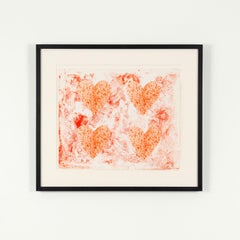
Dutch Hearts
By Jim Dine
Located in Toronto, Ontario
Jim Dine was one of the key artists who defined American Pop Art in the 1960s. Like Jasper Johns and Andy Warhol, Dine appropriated quintessential American images and icons. He used ubiquitous and familiar forms, like tools, food, and stylized clothing, as the basis for bold and colorful compositions inspired by Dada assemblage, Abstract Expressionism, and collage techniques. The "Heart" is the most celebrated icon in Dine's oeuvre. He uses its motif to explore pattern, color, and texture across mediums. This classic and iconic example of Jim Dine's hearts from his most sought-after period. Four coral hearts, adorned with flecks of blood orange, hover in the center of the work. The background features tactile grapefruit splotches that dance across the sheet to reveal and accentuate stretches of negative space. The result is a striking illusion of depth that simultaneously camouflages the hearts and accelerates them to the foreground of the work. Questions about this piece? Contact us. or visit our Toronto gallery on Thursdays or by appointment. "Dutch Hearts...
Category

1970s Pop Art Prints and Multiples

Materials

Lithograph

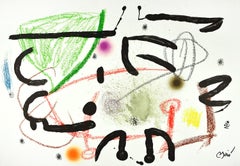
Joan Miró - MARAVILLAS CON VARIACIONES.. Lithograph Contemporary Art Abstraction
By Joan Miró
Located in Madrid, Madrid
Joan Miró - Maravillas con variaciones acrósticas en el jardín de Miró XIII Date of creation: 1975 Medium: Lithograph on Gvarro paper Edition: 1500 Size: 49,5 x 71 cm Condition: In v...
Category

1970s Abstract Abstract Prints

Materials

Paper, Lithograph

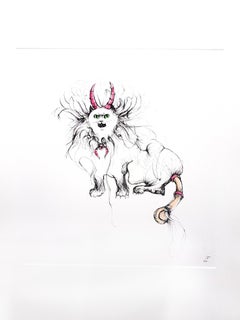
Leonor Fini - Magical Cat - Original Etching
By Leonor Fini
Located in Collonge Bellerive, Geneve, CH
Leonor Fini - Cats - Original Engraving Mme.Helvetius' Cats Original etching created in 1985, Printed Signature (LF). Conditions: excellent Edition: 100 Support: Arches paper. Dimensions: Paper dimensions: 44 x 28 cm Editions: Moret, Paris. Leonor Fini is considered one of the most important women artists of the mid-twentieth century, along with Leonora Carrington, Frida Kahlo, Meret Oppenheim, Remedios Varo, and Dorothea Tanning – most of whom Fini knew well. Her career, which spanned some six decades, included painting, graphic design, book illustration, product design (the renowned torso-shaped perfume bottle for Schiaparelli’s Shocking), and set and costume design for theatre, ballet, opera, and film. In this compellingly readable, exhaustively researched account, author Peter Webb brings Fini’s provocative art and unconventional personal life, as well as the vibrant avant-garde world in which she revolved, vividly in life. Born in Buenos Aires in 1907 (August 30 – January 18, 1996, Paris) to Italian and Argentine parents, Leonor grew up in Trieste, Italy, raised by her strong-willed, independent mother, Malvina. She was a virtually self-taught artist, learing anatomy directly from studying cadavers in the local morgue and absorbing composition and technique from the Old Masters through books and visits to museums. Fini’s fledging attempts at painting in Trieste let her to Milan, where she participated in her first group exhibition in 1929, and then to Paris in 1931. Her vivacious personality and flamboyant attire instantly garnered her a spotlight in the Parisian art world and she soon developed close relationships with the leading surrealist writers and painters, including Paul Eluard, Salvador Dali, Man Ray, and Max Ernst, who became her lover for a time. The only surrealist she could not abide because of his misogyny was André Breton. Although she repeatedly exhibited with them, she never considered herself a surrealist. The American dealer Julien Levy, very much impressed by Fini’s painting and smitten by her eccentric charms, invited her to New York in 1936, where she took part in a joint gallery exhibition with Max Ernst and met many American surrealists, including Joseph Cornell and Pavel Tchelitchew. Her work was included in MoMA’s pivotal Fantastic Art, Dada and Surrealism exhibition, along with De Chirico, Dali, Ernst, and Yves Tanguy. In 1939 in Paris she curated an exhibition of surrealist furniture for her childhood friend Leo Castelli for the opening of his first gallery. Introductions to her exhibition catalogues were written by De Chirico, Ernst, and Jean Cocteau. A predominant theme of Fini’s art is the complex relationship between the sexes, primarily the interplay between the dominant female and the passive, androgynous male. In many of her most powerful works, the female takes the form of a sphinx, often with the face of the artist. Fini was also an accomplished portraitist; among her subjects were Stanislao Lepri...
Category

1980s Modern Animal Prints

Materials

Etching

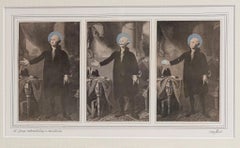
"Saint George Contemplating Mustache" Comical Collage USA President Washington
Located in Austin, TX
Artist: Yan Macs (Latvian, 1933 - 1993) Size: 8 x 13 in. Framed: 17.5 x 22 in. Mixed media: found lithographs and blue paint. This triptych, titled "St. George Contemplating a Mous...
Category

20th Century Dada Portrait Prints

Materials

Paper, Acrylic, Lithograph

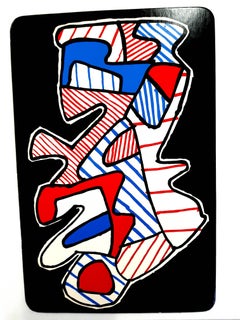
Jean Dubuffet - Le Hochet - Original Screenprint
By Jean Dubuffet
Located in Collonge Bellerive, Geneve, CH
Jean Dubuffet Banque de L'Hourloupe Original Card with a title card Original edition of 350 numbered sets with 30 hors commerce Dimensions: 25 x 16 cm Screen printed by Kelpra Studios, London Editions Alecto, London 1967 Jean Dubuffet (1901 - 1985) Jean Dubuffet was born on July 31, 1901, in Le Havre, France. He attended art classes in his youth and in 1918 moved to Paris to study at the Académie Julian, which he left after six months. During this time, Dubuffet met Raoul Dufy, Max Jacob, Fernand Léger, and Suzanne Valadon and became fascinated with Hans Prinzhorn's book on psychopathic art. He traveled to Italy in 1923 and South America in 1924. Then Dubuffet gave up painting for about ten years, working as an industrial draftsman and later in the family wine business. He committed himself to becoming an artist in 1942. Dubuffet's first solo exhibition was held at the Galerie René Drouin, Paris, in 1944; the Pierre Matisse Gallery gave him his first solo show in New York in 1947. During the 1940s, the artist associated with André Breton, Georges Limbour, Jean Paulhan, and Charles Ratton...
Category

1960s Abstract Impressionist Abstract Prints

Materials

Screen

Joan Miró - MARAVILLAS CON VARIACIONES... Lithograph Contemporary Art Abstract
By Joan Miró
Located in Madrid, Madrid
Joan Miró - Maravillas con variaciones acrósticas en el jardín de Miró XVII Date of creation: 1975 Medium: Lithograph on Gvarro paper Edition: 1500 Size: 49,5 x 35,5 cm Observations:...
Category

1970s Abstract Abstract Prints

Materials

Lithograph

Joan Miró - MARAVILLAS CON VARIACIONES... Lithograph Contemporary Art Abstract
By Joan Miró
Located in Madrid, Madrid
Joan Miró - Maravillas con variaciones acrósticas en el jardín de Miró XV Date of creation: 1975 Medium: Lithograph on Gvarro paper Edition: 1500 Size: 49,5 x 71 cm Condition: In ver...
Category

1970s Abstract Abstract Prints

Materials

Lithograph

Mexican Elegy (Belknap 354-380; Engberg/Banach 415-441), Three Poems
By Robert Motherwell
Located in Southampton, NY
Lithograph on Japon à la main, attached with chine appliqué to vélin d’Arches paper. Paper Size: 21.5 x 17.875 inches. Inscription: Unsigned and unnumbered, as issued. Notes: From th...
Category

1980s Abstract Expressionist Abstract Prints

Materials

Lithograph

Living Painting - Colour Pochoir
By (after) Sonia Delaunay
Located in Collonge Bellerive, Geneve, CH
Full-page, colour pochoir after a costume design by Sonia Delaunay Edition 331/500 copies on Velin Aussedat Dimensions: 28.5 x 19.5 cm. From 27 Living Paintings. [Milano, Edizioni del Naviglio, 1969]. Jacques Damase. Robes Poèmes, Introduction. Text by Guillaume Apollinaire and Blaise Cendrars. Sonia Delaunay was known for her vivid use of color and her bold, abstract patterns, breaking down traditional distinctions between the fine and applied arts as an artist, designer and printmaker. Born Sarah Stern on November 14, 1885 in Gradizhsk, Ukraine, she was adopted in 1890 by her maternal uncle, Henri Terk, a lawyer in St. Petersburg, where she grew up, exposed to music and art, and learning several foreign languages. In 1903, she moved to Germany to study drawing with Ludwig Schmidt-Reutler (1863–1909) at the Karlsruhe academy of fine arts; Arnold Schoenberg (1874–1951), composer-to-be, was among her classmates there. In 1905, she traveled to Paris where she attended art classes at the Académie de la Palette, learned printmaking from Rudolf Grossman (1889–1941), and met Amédée Ozenfant (1886–1966), André Dunoyer de Segonzac (1884–1974), and Jean-Louis Boussingault (1883–1943). Sonia spent much of her time at exhibitions and galleries in Paris, which showed works by Paul Cézanne, Vincent Van Gogh, Pierre Bonnard, and Edouard Vuillard, as well as Les Fauves, Henri Matisse and André Derain. She did, however, maintain contact with Germany, exhibiting at the Galerie Der Sturm, Berlin, in 1913, 1920 and 1921. During her first year in Paris, Sonia met the German collector and art-dealer, Wilhelm Uhde (1874–1947), whom she married on December 5, 1908, and whose Montparnasse gallery, the Galerie Notre-Dame des Champs, showed her first solo exhibition. Through Uhde, Sonia encountered many painters, including Pablo Picasso, Georges Braque, Maurice de Vlaminck, and Robert Delaunay (1885–1941). In 1910, Sonia divorced Uhde by mutual agreement, married Delaunay that same year, and gave birth to their son, Charles, in January 1911. Together Sonia and Robert Delaunay pursued the study of color, influenced by theories of Michel-Eugène Chevreul (1786–1889). Sonia’s interest in simultaneous contrast, as evidenced in her early collages, book bindings, small painted boxes...
Category

1960s Abstract Geometric Abstract Prints
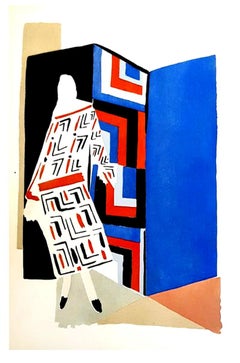
Living Painting - Colour Pochoir
By (after) Sonia Delaunay
Located in Collonge Bellerive, Geneve, CH
Sonia Delaunay Full-page, colour pochoir after costume designs by Sonia Delaunay Edition 331/500 copies on Velin Aussedat Dimensions: 28.5 x 19.5 cm. From 27 Living Paintings. [Milano, Edizioni del Naviglio, 1969]. Jacques Damase. Robes Poèmes, Introduction. Text by Guillaume Apollinaire and Blaise Cendrars. Sonia Delaunay was known for her vivid use of color and her bold, abstract patterns, breaking down traditional distinctions between the fine and applied arts as an artist, designer and printmaker. Born Sarah Stern on November 14, 1885 in Gradizhsk, Ukraine, she was adopted in 1890 by her maternal uncle, Henri Terk, a lawyer in St. Petersburg, where she grew up, exposed to music and art, and learning several foreign languages. In 1903, she moved to Germany to study drawing with Ludwig Schmidt-Reutler (1863–1909) at the Karlsruhe academy of fine arts; Arnold Schoenberg (1874–1951), composer-to-be, was among her classmates there. In 1905, she traveled to Paris where she attended art classes at the Académie de la Palette, learned printmaking from Rudolf Grossman (1889–1941), and met Amédée Ozenfant (1886–1966), André Dunoyer de Segonzac (1884–1974), and Jean-Louis Boussingault (1883–1943). Sonia spent much of her time at exhibitions and galleries in Paris, which showed works by Paul Cézanne, Vincent Van Gogh, Pierre Bonnard, and Edouard Vuillard, as well as Les Fauves, Henri Matisse and André Derain. She did, however, maintain contact with Germany, exhibiting at the Galerie Der Sturm, Berlin, in 1913, 1920 and 1921. During her first year in Paris, Sonia met the German collector and art-dealer, Wilhelm Uhde (1874–1947), whom she married on December 5, 1908, and whose Montparnasse gallery, the Galerie Notre-Dame des Champs, showed her first solo exhibition. Through Uhde, Sonia encountered many painters, including Pablo Picasso, Georges Braque, Maurice de Vlaminck, and Robert Delaunay (1885–1941). In 1910, Sonia divorced Uhde by mutual agreement, married Delaunay that same year, and gave birth to their son, Charles, in January 1911. Together Sonia and Robert Delaunay pursued the study of color, influenced by theories of Michel-Eugène Chevreul (1786–1889). Sonia’s interest in simultaneous contrast, as evidenced in her early collages, book bindings, small painted boxes...
Category

1960s Abstract Geometric Abstract Prints

Materials

Vellum

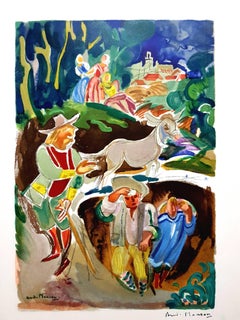
André Planson - French Province - Handsigned Original Lithograph
By Andre Planson
Located in Collonge Bellerive, Geneve, CH
André Planson - French Province Original Lithograph Handsigned Dimensions: 38 x 28 cm Leonor Fini is considered one of the most important women artists of the mid-twentieth century, along with Leonora Carrington, Frida Kahlo, Meret Oppenheim, Remedios Varo, and Dorothea Tanning – most of whom Fini knew well. Her career, which spanned some six decades, included painting, graphic design, book illustration, product design (the renowned torso-shaped perfume bottle for Schiaparelli’s Shocking), and set and costume design for theatre, ballet, opera, and film. In this compellingly readable, exhaustively researched account, author Peter Webb brings Fini’s provocative art and unconventional personal life, as well as the vibrant avant-garde world in which she revolved, vividly in life. Born in Buenos Aires in 1907 (August 30 – January 18, 1996, Paris) to Italian and Argentine parents, Leonor grew up in Trieste, Italy, raised by her strong-willed, independent mother, Malvina. She was a virtually self-taught artist, learing anatomy directly from studying cadavers in the local morgue and absorbing composition and technique from the Old Masters through books and visits to museums. Fini’s fledging attempts at painting in Trieste let her to Milan, where she participated in her first group exhibition in 1929, and then to Paris in 1931. Her vivacious personality and flamboyant attire instantly garnered her a spotlight in the Parisian art world and she soon developed close relationships with the leading surrealist writers and painters, including Paul Eluard, Salvador Dali, Man Ray, and Max Ernst, who became her lover for a time. The only surrealist she could not abide because of his misogyny was André Breton. Although she repeatedly exhibited with them, she never considered herself a surrealist. The American dealer Julien Levy, very much impressed by Fini’s painting and smitten by her eccentric charms, invited her to New York in 1936, where she took part in a joint gallery exhibition with Max Ernst and met many American surrealists, including Joseph Cornell and Pavel Tchelitchew. Her work was included in MoMA’s pivotal Fantastic Art, Dada and Surrealism exhibition, along with De Chirico, Dali, Ernst, and Yves Tanguy. In 1939 in Paris she curated an exhibition of surrealist furniture...
Category

1970s Modern Portrait Prints

Materials

Lithograph

27 Living Paintings - Colour Pochoir
By (after) Sonia Delaunay
Located in Collonge Bellerive, Geneve, CH
Full-page, colour pochoir of costume designs after Sonia Delaunay's watercolors Edition 331/500 copies on Velin Aussedat Dimensions: 28.5 x 19.5 cm. From 27 Living Paintings. [Milano, Edizioni del Naviglio, 1969]. Jacques Damase. Robes Poèmes, Introduction. Text by Guillaume Apollinaire and Blaise Cendrars. Sonia Delaunay was known for her vivid use of color and her bold, abstract patterns, breaking down traditional distinctions between the fine and applied arts as an artist, designer and printmaker. Born Sarah Stern on November 14, 1885 in Gradizhsk, Ukraine, she was adopted in 1890 by her maternal uncle, Henri Terk, a lawyer in St. Petersburg, where she grew up, exposed to music and art, and learning several foreign languages. In 1903, she moved to Germany to study drawing with Ludwig Schmidt-Reutler (1863–1909) at the Karlsruhe academy of fine arts; Arnold Schoenberg (1874–1951), composer-to-be, was among her classmates there. In 1905, she traveled to Paris where she attended art classes at the Académie de la Palette, learned printmaking from Rudolf Grossman (1889–1941), and met Amédée Ozenfant (1886–1966), André Dunoyer de Segonzac (1884–1974), and Jean-Louis Boussingault (1883–1943). Sonia spent much of her time at exhibitions and galleries in Paris, which showed works by Paul Cézanne, Vincent Van Gogh, Pierre Bonnard, and Edouard Vuillard, as well as Les Fauves, Henri Matisse and André Derain. She did, however, maintain contact with Germany, exhibiting at the Galerie Der Sturm, Berlin, in 1913, 1920 and 1921. During her first year in Paris, Sonia met the German collector and art-dealer, Wilhelm Uhde (1874–1947), whom she married on December 5, 1908, and whose Montparnasse gallery, the Galerie Notre-Dame des Champs, showed her first solo exhibition. Through Uhde, Sonia encountered many painters, including Pablo Picasso, Georges Braque, Maurice de Vlaminck, and Robert Delaunay (1885–1941). In 1910, Sonia divorced Uhde by mutual agreement, married Delaunay that same year, and gave birth to their son, Charles, in January 1911. Together Sonia and Robert Delaunay pursued the study of color, influenced by theories of Michel-Eugène Chevreul (1786–1889). Sonia’s interest in simultaneous contrast, as evidenced in her early collages, book bindings, small painted boxes...
Category

1960s Abstract Geometric Portrait Prints
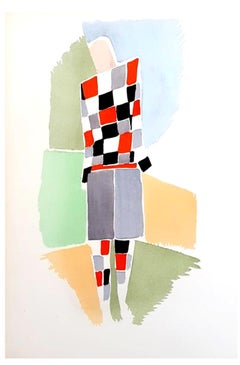
Sonia Delaunay - Living Painting - Colour Pochoir
By (after) Sonia Delaunay
Located in Collonge Bellerive, Geneve, CH
Full-page, colour pochoir of costume designs after Sonia Delaunay-Terk's original drawings. Edition 331/500 copies on Velin Aussedat Dimensions: 28.5 x 19.5 cm. From 27 Living Paint...
Category

1960s Abstract Geometric Figurative Prints
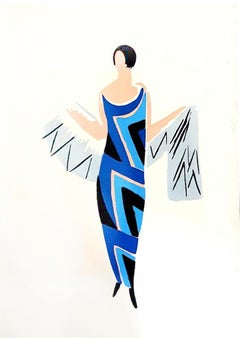
Living Painting - Colour Pochoir
By (after) Sonia Delaunay
Located in Collonge Bellerive, Geneve, CH
Full-page, colour pochoir of costume designs by Sonia Delaunay Edition 331/500 copies on Velin Aussedat Dimensions: 28.5 x 19.5 cm. From 27 Living Paintings. [Milano, Edizioni del Naviglio, 1969]. Jacques Damase. Robes Poèmes, Introduction. Text by Guillaume Apollinaire and Blaise Cendrars. Sonia Delaunay was known for her vivid use of color and her bold, abstract patterns, breaking down traditional distinctions between the fine and applied arts as an artist, designer and printmaker. Born Sarah Stern on November 14, 1885 in Gradizhsk, Ukraine, she was adopted in 1890 by her maternal uncle, Henri Terk, a lawyer in St. Petersburg, where she grew up, exposed to music and art, and learning several foreign languages. In 1903, she moved to Germany to study drawing with Ludwig Schmidt-Reutler (1863–1909) at the Karlsruhe academy of fine arts; Arnold Schoenberg (1874–1951), composer-to-be, was among her classmates there. In 1905, she traveled to Paris where she attended art classes at the Académie de la Palette, learned printmaking from Rudolf Grossman (1889–1941), and met Amédée Ozenfant (1886–1966), André Dunoyer de Segonzac (1884–1974), and Jean-Louis Boussingault (1883–1943). Sonia spent much of her time at exhibitions and galleries in Paris, which showed works by Paul Cézanne, Vincent Van Gogh, Pierre Bonnard, and Edouard Vuillard, as well as Les Fauves, Henri Matisse and André Derain. She did, however, maintain contact with Germany, exhibiting at the Galerie Der Sturm, Berlin, in 1913, 1920 and 1921. During her first year in Paris, Sonia met the German collector and art-dealer, Wilhelm Uhde (1874–1947), whom she married on December 5, 1908, and whose Montparnasse gallery, the Galerie Notre-Dame des Champs, showed her first solo exhibition. Through Uhde, Sonia encountered many painters, including Pablo Picasso, Georges Braque, Maurice de Vlaminck, and Robert Delaunay (1885–1941). In 1910, Sonia divorced Uhde by mutual agreement, married Delaunay that same year, and gave birth to their son, Charles, in January 1911. Together Sonia and Robert Delaunay pursued the study of color, influenced by theories of Michel-Eugène Chevreul (1786–1889). Sonia’s interest in simultaneous contrast, as evidenced in her early collages, book bindings, small painted boxes...
Category

1960s Abstract Geometric Figurative Prints
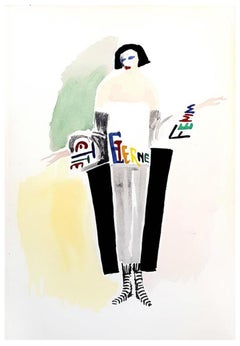
Souvenir I
By Jasper Johns
Located in Missouri, MO
Jasper Johns (American, b. 1930) Souvenir I, 1972 Lithograph in Colors on Angoumois a la Main Paper Hand-signed Lower Right Numbered 20/63 and Stamped Lower Left 38.5 x 29.5 inches 3...
Category

1970s Pop Art Abstract Prints

Materials

Paper, Lithograph

Feminist Surrealist French Abstract Colorful Lithograph Print Myriam Bat Yosef
Located in Surfside, FL
Myriam Bat-Yosef Surrealist abstract lithograph print in colorful abstract shapes and shades Hand signed and dated 1971. sheet measures 9.25 X 9.25 inches ...
Category

1970s Surrealist Abstract Prints

Materials

Lithograph

Invasion de l Espace - Lithograph by Man Ray - 1975
By Man Ray
Located in Roma, IT
Invasion de l'espace  is a color lithograph by the American artist and exponent of Dadaism and Surrealism Man Ray  (Philadelphia, 1890 - Paris, 1976). The workr was edited by the Fr...
Category

1970s Surrealist More Prints

Materials

Lithograph

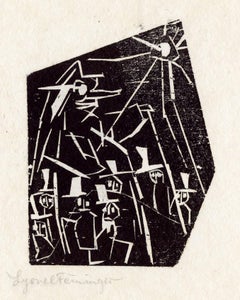
Da - Da I — German Expressionism, Rare
By Lyonel Feininger
Located in Myrtle Beach, SC
Lyonel Feininger, 'Da-Da I' also titled by the artist 'Der Abgott' (The Idol), woodcut, 1918, a proof impression. Prasse W91. Signed in pencil and annotated '1876', the artist’s inv...
Category

1920s Bauhaus Abstract Prints

Materials

Woodcut

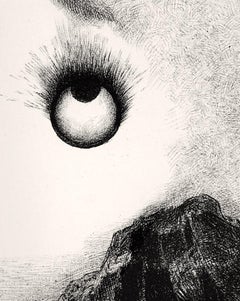
Partout des Prunelles Flamboient - Lithograph by O. Redon - 1888
By Odilon Redon
Located in Roma, IT
Everywhere Eyeballs Are Ablaze is an original lithograph on Chine collé, realized by Odilon Redon in 1888, plate 7 “Les tentations de St.Antoine”(1ère série), unique state, 1st edition printed...
Category

1880s Symbolist Figurative Prints

Materials

Etching

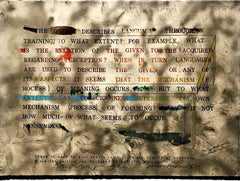
"No!" Says the Signified" Silkscreen Lithograph, Signed proof, Gagosian artist
By Shusaku Arakawa
Located in New York, NY
Shusaku Arakawa Untitled 3 from "No!" Says the Signified, 1973 Lithograph and Silkscreen on Arches Paper with Deckled Edges Hand signed and dated on the lower right front Artist's Pr...
Category

1970s Abstract Abstract Prints

Materials

Lithograph, Screen

The Rain, Abstract in Ruby and Jade , sosaku-hanga, NMAO, Tokyo, LACMA, Benezit
By Hiroyuki Tajima
Located in Santa Cruz, CA
Signed lower right outside of block, 'Hiroyuki Tajima' (Japanese, 1911-1984) and dated 1973 with limitation and number, '50-4', lower center and titled lower left, 'The Rain'. Paper dimensions: 19.75 x 12.5 inches An elegant abstract comprising overlapping forms in deep ruby, coral and jade. Engraver and printmaker, Hiroyuki Tajima was born in Tokyo in 1911 and graduated from Nihon University in 1932. In 1934, he graduated from the Tokyo School of Arts with a specialization in western-style painting. Tajima later studied fabric dyeing under Hirokawa Matsugoro (1889-1952) and woodblock printing with the Sosaku-Hanga artist, Nagase Yoshiro (1891-1978), a founder of the Japan Print Association (Hanga Kyokai). In 1946, inspired by Dada and Surrealism, Tajima joined Bijutsu Bunka Kyokai, a group dedicated to exploring and reviving the abstract and surrealist painting ideals that had been suppressed during WWII. Tajima exhibited widely and with success, including with Tokyo's Modern Art Association ( Prix du Nouveau Venu, 1962), the Japanese Engraving Association, the Contemporary Japanese Art Exhibition in Tokyo (1962), the Northwest International Print Exhibition (1962-1964) and the Tokyo International Print Biennale (1964). His work is held in the permanent collections of museums worldwide including the Portland Art Museum (Oregon), the Cleveland Museum of Art, the Los Angeles County Museum of Art (LACMA), the Fine Arts Museums of San Francisco, the Art Gallery of Greater Victoria (British Columbia), the Art Gallery of New South Wales (Australia), the Carnegie Museum of Art, the National Museum of Art, Osaka (NMAO) and the British Museum in London. In describing Tajima's work, Frances Blakemore...
Category

1970s Abstract Prints

Materials

Paper, Woodcut

Analphabetogramme - Signatur Objekt Nr. 23 (Collages, Assemblages, Surrealism)
By Jiri Kolar
Located in Kansas City, MO
Jiri Kolar (Jiří Kolář) Analphabetogramme - Signatur Objekt Nr. 23 (Collages, Assemblages, Poetry, Surrealism) Analphabétogramme (hand-pressed copper print) with matte Year: 1995 Size: 12×11.6×0.6in Edition: 756 of 990 Signed, numbered by hand Publisher: First Edition, Verlag Rommerskirchen, Rolandseck - Germany COA provided Ref.: 924802-1933 White original cardboard in a Plexiglas slipcase, signed and numbered, number 756 of 990. 28 pages in block book form, texts and colored illustrations of collaged sculpture photographs, 1 loosely enclosed hand-signed original hand-pressed copper print ("Analphabétograms") under passepartout. The cardboard cover is cut out like a passe-partout so that the title illustration is visible when the book is hung on the wall as an art object using the acrylic glass frame provided. Tags: Czech artist,Poet,Visual artist,Political activist,Collages,Assemblages,Poetry,Surrealism,Dada...
Category

1990s Surrealist Prints and Multiples

Materials

Copper

Max Ernst, Portrait of an Insect, from Cahiers d Art, 1949 (after)
By Max Ernst
Located in Southampton, NY
This exquisite lithograph and pochoir after Max Ernst (1891–1976), titled Portrait dinsecte (Portrait of an Insect), from the album Cahiers dArt No. 24, 1949, originates from the 194...
Category

1940s Surrealist Figurative Prints

Materials

Lithograph

Personatge I Estels II, 1979
By Joan Miró
Located in Beachwood, OH
Joan Miró (Spanish, 1893-1983) "Personatge I Estels II," 1979 Etching, aquatint in colors with embossing on Arches wove paper Signed in pencil lower right, numbered 26/50 lower left ...
Category

1970s Abstract Abstract Prints

Materials

Etching, Aquatint

Saul Steinberg, Cat, L édition de tête (after)
By Saul Steinberg
Located in Southampton, NY
Lithograph on vélin de Lana paper. Inscription: Unsigned and unnumbered, as issued. Good condition. Notes: From the folio, tête edition, Consacré a Steinberg, Derrière le miroir, N° ...
Category

1960s Modern Landscape Prints

Materials

Lithograph

Two Figures: One Leaping, One Reacting
By John Baldessari
Located in Miami, FL
John Baldessari (June 17, 1931 - January 2, 2020, American) Two Figures: One Leaping, One Reacting 2005 Photolithograph and lithograph with embossing and debossing on wove paper 22 1...
Category

Early 2000s Contemporary Figurative Prints

Materials

Mixed Media, Lithograph

La Femme 100 Têtes - Rare Book Illustrated by Max Ernst - 1929
By Max Ernst
Located in Roma, IT
La Femme 100 Têtes is an original modern rare book illustrated by Max Ernst (1891 - 1976) in 1929, and extraordinary first example of conceptual art Original first edition. Publish...
Category

1920s Surrealist Figurative Prints

Materials

Paper, Mixed Media

Joan Miró - MARAVILLAS CON VARIACIONES... Lithograph Contemporary Art Abstract
By Joan Miró
Located in Madrid, Madrid
Joan Miró - Maravillas con variaciones acrósticas en el jardín de Miró VI Date of creation: 1975 Medium: Lithograph on Gvarro paper Edition: 1500 Size: 49,5 x 35,5 cm Observations: L...
Category

1970s Abstract Abstract Prints

Materials

Lithograph

Françoise Gilot, Portraits of a Woman, 1951, Limited Editon Framed Lithography
By Françoise Gilot
Located in Barcelona, ES
Françoise Gilot original lithograph from 'Portraits of a Woman' series. from the poetry book "Pages d'Amour" by André VERDET, editions Raison d'être, 1951, printed by Mourlot in limi...
Category

1950s Abstract Abstract Prints

Materials

Paper

M Loves M (Pop Art, Street Art, Urban Art, Disney, Mickey)
By Agent X
Located in Kansas City, MO
Agent X M Loves M (Pop Art, Street Art, Urban Art, Disney, Mickey) Digital Print on Archival Paper Year: 2021 Edition: 125 Size: 30 x 30 in - 78 x 78 cm Signed COA provided (gallery ...
Category

2010s Street Art Prints and Multiples

Materials

Archival Paper, Digital

Italian Surrealist Aquatint Etching Enrico Baj Pop Art with Watercolor Painting
By Enrico Baj
Located in Surfside, FL
Enrico Baj (1924-2003) Italian, limited edition print. Hand signed and numbered in pencil from limited edition of 100 Aquatint etching with the addition of hand watercolor painting ...
Category

20th Century Surrealist Figurative Prints

Materials

Watercolor, Etching, Aquatint

Still Thinking About These?

All Recently Viewed