661 results for "roy lichtenstein"

to
195
148
127
181
105
100
Overall Width
to
Overall Height
to
395
62
44
36
28
5
4
1
1
1
103
29
23
18
16
3
1
570
87
6
6
13
26
141
115
130
91
395
214
37
162
81
75
68
53
51
50
47
41
35
31
30
26
18
17
16
14
14
13
13
301
196
154
91
38
148
109
558
83
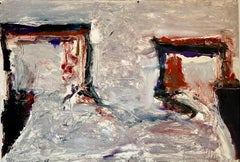
Large Abstract Expressionist Color Monotype, Oil Painting Tom Lieber
By Tom Lieber
Located in Surfside, FL
Tom Alan Lieber, (American, born 1949), GTW #11 -7, 1986, Oil and mixed media on paper, 30.25 x 44 inches, Hand signed and dated lower right Provenance: Garner Tullis Workshop, ...
Category

1980s Abstract Expressionist Abstract Paintings

Materials

Mixed Media, Oil, Monotype

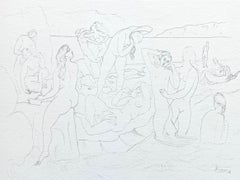
Pablo Picasso, Bathers, from Fifteen Drawings, 1946 (after)
By Pablo Picasso
Located in Southampton, NY
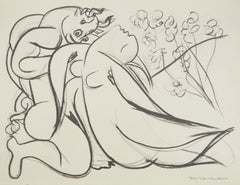
This exquisite lithograph and pochoir after Pablo Picasso (1881–1973), titled Bathers, from the folio Picasso, Fifteen Drawings, 1946, originates from the 1946 edition published by Pantheon Books, Inc., New York, and rendered and printed by Albert Carman, City Island, New York, 1946. Bathers reflects Picassos fascination with the human form and the sensual rhythm of nature, capturing the vitality, balance, and movement of figures intertwined with their environment. With an economy of line and expressive gesture, the composition distills the timeless harmony between form and flow, celebrating the unity of humanity and nature through a lyrical vision of grace and energy. Executed as a lithograph and pochoir on velin paper, this work measures 12.63 x 18.75 inches. Signed in the plate and unnumbered as issued. The edition exemplifies the exemplary standards and artistic integrity of the fine art publishing and printmaking of Pantheon Books, Inc., and Albert Carman whose next collaborative project following this edition was with Marc Chagall in the creation of his monumental suite, Four Tales from the Arabian Nights in 1948. Artwork Details: Artist: After Pablo Picasso (1881–1973) Title: Bathers, from the folio Picasso, Fifteen Drawings, 1946 Medium: Lithograph and pochoir on velin paper Dimensions: 12.63 x 18.75 inches (32.1 x 47.6 cm) Inscription: Signed in the plate and unnumbered as issued Date: 1946 Edition: D, primary edition; L, out of commerce, hand signed by Pablo Picasso Publisher: Pantheon Books, Inc., New York Printer: Albert Carman, City Island, New York Catalogue raisonne reference: Orozco, Miguel. Picasso Interpretation Prints II - Etchings, Pochoirs Woodcuts. Catalogue Raisonne. 2023, illustration 388–402 Condition: Well preserved, consistent with age and medium Provenance: From the folio Picasso, Fifteen Drawings, 1946, published by Pantheon Books, Inc., New York; printed by Albert Carman, City Island, New York, 1946 About the Publication: Picasso, Fifteen Drawings (1946) was one of the earliest fine art portfolios issued in the United States to feature the work of Pablo Picasso in the mediums of lithography and pochoir. Published by Pantheon Books, Inc., New York—a press renowned for its pioneering role in introducing European modernism to American audiences—the portfolio marked an important cultural bridge between postwar Paris and the emerging art scene in New York. The suite comprised fifteen images selected from Picassos prolific oeuvre, including depictions of mythological figures, musicians, and introspective portraits. Each work was rendered using a combination of lithography and pochoir, printed by Albert Carman at his atelier in City Island, New York, whose craftsmanship ensured a remarkable fidelity to the tonal and chromatic nuances of Picassos originals. The portfolio was produced in an edition of D, primary edition; L, out of commerce, hand signed by Pablo Picasso, issued unbound within a printed paper folder, and distributed primarily through Pantheons art book division under the direction of Kurt Wolff and Monroe Wheeler—key figures in shaping the intellectual reception of modern art in the United States. Picasso, Fifteen Drawings helped establish the artists postwar reputation among American collectors, scholars, and institutions, introducing a generation of viewers to the expressive immediacy and psychological depth of his draftsmanship. The publication also exemplified Pantheons broader mission to make modern European art accessible to an American audience, alongside their landmark editions devoted to Henri Matisse, Georges Rouault, and Marc Chagall. Technically refined and historically significant, the portfolio stands as a testament to the transatlantic exchange of modernist aesthetics during the mid-20th century and remains one of the most sought-after Picasso print editions issued in the United States before 1950. About the Artist: Pablo Picasso (1881–1973) was a Spanish painter, sculptor, printmaker, and ceramicist whose extraordinary vision revolutionized modern art and defined the visual language of the 20th century. A child prodigy from Malaga, Spain, Picassos career spanned more than seven decades and encompassed an astonishing range of styles and innovations—from the melancholic Blue and romantic Rose periods to his pioneering invention of Cubism with Georges Braque, which shattered conventional notions of perspective and form. Influenced by the bold expressiveness of El Greco, the structure of Cezanne, and the vitality of African and Iberian sculpture, Picasso became a central figure of the Paris avant-garde, working in creative dialogue with contemporaries such as Henri Matisse, Alexander Calder, Alberto Giacometti, Salvador Dali, Joan Miro, Wassily Kandinsky, Marcel Duchamp, and Man Ray. His insatiable experimentation extended across painting, drawing, printmaking, ceramics, and sculpture, forever expanding the boundaries of artistic expression. A master of reinvention, Picasso profoundly shaped generations of artists who followed—from Andy Warhol, Roy Lichtenstein, David Hockney, and Jean-Michel Basquiat to Jeff Koons and Banksy—cementing his status as a timeless cultural icon whose works remain among the most sought after worldwide. His landmark painting Les Femmes d'Alger (Version O) achieved a record-breaking sale of 179,365,000 USD at Christie's, New York, on May 11, 2015, affirming Picassos enduring legacy as one of the most influential and valuable artists in history. Pablo Picasso Bathers, Picasso Fifteen Drawings 1946, Picasso Pantheon Books, Picasso Carman lithograph, Picasso pochoir...
Category

1940s Modern Abstract Prints

Materials

Lithograph, Stencil

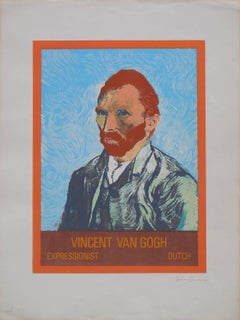
Pop Art Vincent Van Gogh Serigraph
By John Brower
Located in Surfside, FL
This is for a Silkscreen it is Titled Vincent Van Gogh, Expressionist, Dutch. John Brower worked in Chicago as a billboard designer for 12 years. He taught art at Alverno College of...
Category

1960s Pop Art Figurative Prints

Materials

Screen

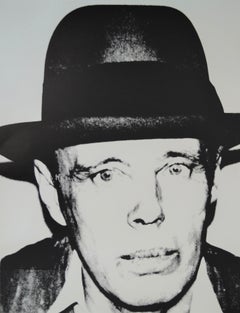
Joseph Beuys
By Andy Warhol
Located in Indianapolis, IN
Andy Warhol (1928-1987) Joseph Beuys (1980) Screenprint and diamond dust on museum board 40 x 32 in (101.6 x 81.3 cm) Unsigned Authenticated by the Authentication Board of Andy War...
Category

1980s Pop Art Portrait Prints

Materials

Mixed Media, Board, Screen

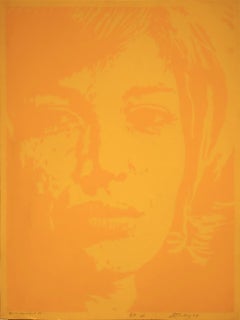
"MONICA VITTI"
Located in New York, US
Signed by artist, Artist's Proof VIII, signature "For the beautiful M" Bob Stanley (b. 1932 - d. 1997 New York, United States), an American painter renowned for his gritty depiction...
Category

1960s Pop Art More Prints

Materials

Paper

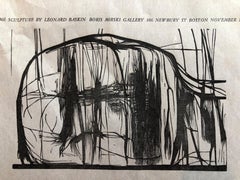
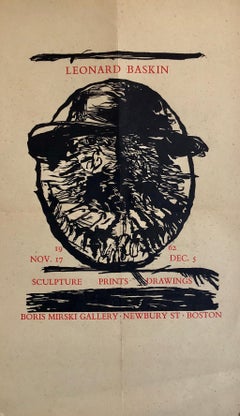
Leonard Baskin Woodblock Broadside Print Woodcut Vintage Poster in Red and Black
By Leonard Baskin
Located in Surfside, FL
This is an original gallery show poster the Boris Mirsky Gallery, Newbury St. Boston. titled Sculpture Prints Drawings. It is dated 1962. it is in red and black. Leonard Baskin (August 15, 1922 – June 3, 2000) was an American sculptor, illustrator, wood-engraver, printmaker, graphic artist, writer and teacher. Baskin was born in New Brunswick, New Jersey. While he was a student at Yale University, he founded Gehenna Press, a small private press specializing in fine book production. From 1953 until 1974, he taught printmaking and sculpture at Smith College in Northampton, Massachusetts. Subsequently Baskin also taught at Hampshire College in Amherst, Massachusetts. He lived most of his life in the U.S., but spent nine years in Devon at Lurley Manor, Lurley, near Tiverton, close to his friend Ted Hughes, for whom he illustrated Crow. Sylvia Plath dedicated Sculpto to Leonard Baskin in her famous work, The Colossus and Other Poems (1960). The Funeral Contege (1997) bronze, Franklin Delano Roosevelt Memorial, Washington, D.C. His public commissions include a bas relief for the Franklin Delano Roosevelt Memorial and a bronze statue of a seated figure, erected in 1994 for the Holocaust Memorial in Ann Arbor, Michigan. His works are owned by many major museums including the Metropolitan Museum of Art, the Museum of Fine Arts, Boston, the Museum of Modern Art, the Art Institute of Chicago, the Boca Raton Museum of Art, the British Museum, the Honolulu Museum of Art, the Udinotti Museum of Figurative Art and the Vatican Museums. The archive of his work at the Gehenna Press was acquired by the Bodleian Library at Oxford, England, in 2009. The McMaster Museum of Art in Hamilton, Ontario owns over 200 of his works (some religious and biblical), most of which were donated by his brother Rabbi Bernard Baskin. In 1955, he was one of eleven New York artists featured in the opening exhibition at the Terrain Gallery, they showed many great artists, Chaim Koppelman, for many years, headed the gallery's Print Division; printmakers such as Will Barnet, Leonard Baskin, Robert Conover...
Category

1960s Modern Portrait Prints

Materials

Woodcut

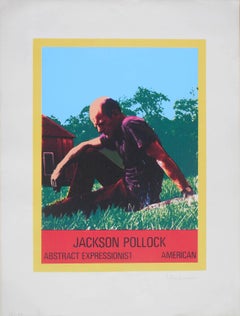
Pop Art Jackson Pollock Serigraph, 1968
By John Brower
Located in Surfside, FL
This is a Silkscreen it is Titled Jackson Pollock, Abstract Expressionist, American. John Brower worked in Chicago as a billboard designer for 12 years. He taught art at Alverno Col...
Category

1960s Pop Art Figurative Prints

Materials

Screen

Blue Suds
By Ed Ruscha
Located in Toronto, Ontario
Ed Ruscha (b. 1937) is known internationally for his blending of conceptual approaches with pop sensibilities. Today he is firmly established as a leading figure in American 20th cen...
Category

1970s Pop Art Abstract Prints

Materials

Screen

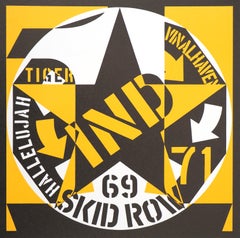
Robert Indiana, Self Portrait 69, from XXe Siecle, 1973
By Robert Indiana
Located in Southampton, NY
This exquisite lithograph by Robert Indiana (1928–2018), titled Autoportrait 69 (Self Portrait 69), from the album XXe Siecle, Annee No. 41, Decembre 1973, originates from the 1973 e...
Category

1970s Pop Art Abstract Prints

Materials

Lithograph

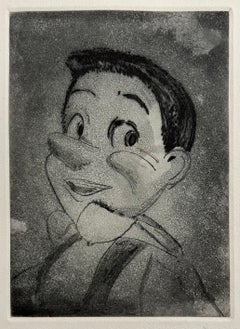
Small Pinocchio Aquatint Etching Jim Dine Pop Art Print
By Jim Dine
Located in Surfside, FL
Jim Dine (American, b. 1935) Etching depicting Pinocchio Published by Enitharmon Press for Whitman College, London 1999 Hand signed in pencil lower right. Measures 9" x 7" sheet siz...
Category

1990s Pop Art More Prints

Materials

Drypoint, Etching

"Dusk in August" from the Portfolio of Nine
By Louise Nevelson
Located in Hinsdale, IL
NEVELSON, LOUISE (1899-1988) "Dusk in August" Lithograph in colors, 1967 Signed, dated, titled, and numbered in pencil lower margin This impression is XVIII/XX Sheet Size: 17” x 22” Published by Hollander’s Workshop with their blindstamp This lithograph by Louise Nevelson was made in collaboration with eight other artists in 1967. The other artists included in this portfolio collaboration are Roy Lichtenstein, Louise Nevelson, Willem de Kooning, Robert Motherwell, Henry Pearson, Sam Francis, Richard Lindner, and Saul Steinberg. Louise Nevelson is one of American’s foremost artists, Nevelson’s sculpted wood assemblages transcended space and transformed the viewer’s perception of art. She was an American sculptor best known for her monochromatic wooden assemblages. During the 1950s, she began to create unique arrangements contained in wooden frames amassed from a range of found objects—usually woodcuts or bits of furniture—that were then painted a uniform black, white, or gold, as seen in her seminal work Royal Tide I (1960). Louise Nevelson emerged in the art world amidst the dominance of the Abstract Expressionist movement. In her most iconic works, she utilized wooden objects that she gathered from urban debris piles to create her monumental installations - a process clearly influenced by the precedent of Marcel Duchamp's found object sculptures and "readymades." Nevelson’s prints share with her sculpture an interest in silhouetted forms and the layering of elements, but distinguish themselves by their vivid color, depth and movement.. Louise Nevelson experimented in several different print mediums. A 1963 Ford Foundation grant enabled June Wayne of the Tamarind Lithography Workshop, Los Angeles, to extend an invitation to Nevelson. This initial collaboration led to twenty six lithographs, mostly black with dark blue or red, which combined hand-drawn elements with printed lace. Nevelson returned to Tamarind in 1967 to complete sixteen large scale lithographs know as Double Imagery. In these lithographs Nevelson played with landscapes of shadows and reflections using irregular shaped papers and a limited palette of black, red, grey and blue. For her brilliant compositions in varied mediums critics hailed her as the leading sculptor of the twentieth century. A pioneering grand dame of the art works, Nevelson’s iconic persona was characterized by her skilled mixing and matching of ethnic clothing...
Category

1960s Abstract Expressionist Abstract Prints

Materials

Lithograph

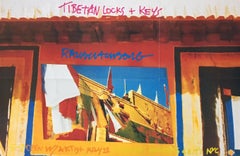
Vintage Robert Rauschenberg poster (Rauschenberg prints)
By Robert Rauschenberg
Located in NEW YORK, NY
Robert Rauschenberg Leo Castelli Gallery 1986: Vintage Robert Rauschenberg exhibition poster published by Castelli Graphics in conjunction with the exhibition, Robert Rauschenberg: Tibetan Keys and Locks, May 21-June 18, 1986 at Leo Castelli New York. A unique vintage Rauschenberg collectible featuring the artist's signature collage style. Well-sized and suitable for framing. Off-set lithograph 1986. 20 x 29.75 inches. Double-quattro fold-lines as originally issued; minor edge wear to one fold-line; otherwise very good condition (no rips, tears, stains, etc.) Scarce form an edition of unknown; unsigned. First edition, 1st printing; postmarked 1986 on the verso. Artist biography Robert Rauschenberg’s enthusiasm for popular culture and, with his contemporary Jasper Johns, his rejection of the angst and seriousness of the Abstract Expressionists led him to search for a new way of painting. A prolific innovator of techniques and mediums, he used unconventional art materials ranging from dirt and house paint to umbrellas and car tires. In the early 1950s, Rauschenberg was already gaining a reputation as a true art world rebel rouser...
Category

1970s Pop Art Prints and Multiples

Materials

Lithograph, Offset

Pablo Picasso, Minotaur, from The Double Flute, 1967 (after)
By Pablo Picasso
Located in Southampton, NY
This exquisite lithograph and pochoir after Pablo Picasso (1881–1973), titled Minotaure (Minotaur), from the folio Picasso, La flute double, 16 Dessins, Aquarelles Lavis (The Double ...
Category

1960s Cubist Figurative Prints

Materials

Lithograph, Stencil

"Lips Pin, " Original Serigraph on Plexiglass with Metal Back by Joseph Rozman
By Joseph Rozman
Located in Milwaukee, WI
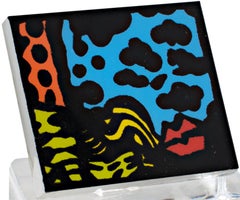
"Lips Pin" is a limited edition pin, made by printing a serigraph onto plexiglass. The backing is metal and has a locking bar to fix it to the fabric of your c...
Category

1970s Pop Art Prints and Multiples

Materials

Plexiglass, Screen

Fernand Leger, Composition with Three Keys, Derriere le miroir, 1955 (after)
By Fernand Léger
Located in Southampton, NY
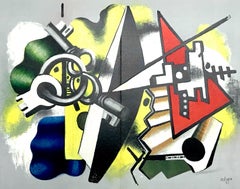
This exquisite lithograph after Fernand Leger (1881–1955), titled Composition aux trois cles (Composition with Three Keys), from the folio Derriere le miroir, No. 79-81, originates from the 1955 edition published by Maeght Editeur, Paris, and printed by Mourlot Freres, Paris, 1955. This composition exemplifies Leger’s rhythmic balance of color, form, and movement, translating the mechanical vitality of modern life into a harmonious, humanized geometry. Executed as a lithograph on velin paper, this work measures 15 x 22 inches, with centerfold as issued. Signed in the plate and unnumbered as issued. The edition exemplifies the superb craftsmanship of Mourlot Freres, Paris. Artwork Details: Artist: After Fernand Leger (1881–1955) Title: Composition aux trois cles (Composition with Three Keys), from the folio Derriere le miroir, No. 79-81 Medium: Lithograph on velin paper Dimensions: 15 x 22 inches (38.1 x 55.88 cm), with centerfold as issued Inscription: Signed in the plate and unnumbered as issued Date: 1955 Publisher: Maeght Editeur, Paris Printer: Mourlot Freres, Paris Condition: Well preserved, consistent with age and medium Provenance: From the folio Derriere le miroir, No. 79-81, published by Maeght Editeur, Paris; printed by Mourlot Freres, Paris, 1955 About the Publication: Derriere le miroir (Behind the Mirror) was one of the most important art publications of the 20th century, created and published by Maeght Editeur in Paris from 1946 to 1982. Founded by the visionary art dealer and publisher Aime Maeght, the series served as both an exhibition catalogue and a work of art in its own right, uniting original lithographs by leading modern and contemporary artists with critical essays, poetry, and design of the highest quality. Printed by master lithographers such as Mourlot Freres and Arte, Derriere le miroir became synonymous with the artistic vanguard of postwar Europe. Each issue was devoted to a single artist or theme and published to accompany exhibitions at the Galerie Maeght in Paris, featuring works by Pablo Picasso, Henri Matisse, Georges Braque, Joan Miro, Marc Chagall, Alexander Calder, Fernand Leger, and Alberto Giacometti, among others. The publication reflected Maeght's belief that art should be both accessible and elevated—an ideal realized through its luxurious production values, meticulous printing, and collaboration with the greatest creative minds of its time. About the Artist: Fernand Leger (1881–1955) was a visionary French painter, sculptor, designer, and filmmaker whose groundbreaking fusion of modern industry, vivid color, and geometric form transformed the course of 20th-century art. Born in Argentan, Normandy, Leger began as an architectural draftsman before studying at the Academie Julian and the Ecole des Beaux-Arts in Paris, where he absorbed the lessons of Paul Cezanne’s structural rigor and the revolutionary ideas of Cubism. Alongside Pablo Picasso and Georges Braque, he became one of the leading innovators of the avant-garde, yet his work stood apart through its embrace of mechanical rhythm, bold contrasts, and industrial modernity—earning him the title “the painter of the machine age.” His art celebrated the beauty of technology, urban life, and the human form rendered in dynamic, interlocking cylinders and planes, evoking the pulse of the modern world. Immersed in the vibrant Parisian art scene, Leger worked in dialogue with peers and contemporaries such as Alexander Calder, Alberto Giacometti, Salvador Dali, Joan Miro, Wassily Kandinsky, Marcel Duchamp, and Man Ray, all of whom shared his commitment to innovation and the reimagining of artistic expression. Beyond painting, Leger’s creative reach extended into film, design, and monumental public art—his 1924 collaboration on Ballet Mecanique with Dudley Murphy and Man Ray remains a landmark of avant-garde cinema. His later works evolved toward greater clarity and monumentality, celebrating the unity of form, color, and humanity through large-scale murals and mosaics that bridged fine art and architecture. Leger’s synthesis of Cubism, Futurism, and abstraction paved the way for movements such as Pop Art and influenced generations of artists including Roy Lichtenstein, Ellsworth Kelly, Robert Indiana, and Alexander Calder, who admired his fusion of structure, energy, and optimism. Today, his works are prized by major museums and collectors worldwide for their bold visual power and enduring modernity. His highest auction record was achieved by La femme en rouge et vert (1914), which sold for 39,241,000 USD at Sotheby’s, New York, on May 7, 2008. After Fernand Leger Composition aux trois cles 1955, Leger Derriere le miroir No. 79-81, Leger Mourlot...
Category

1950s Cubist Still-life Prints

Materials

Lithograph

"Love Letter, After Kunimasa" original lithograph signed romantic pop art lovely
By Michael Knigin
Located in Milwaukee, WI
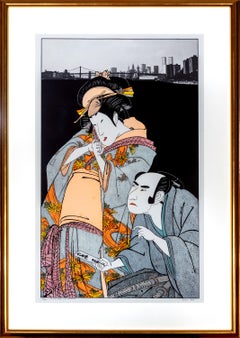
"Love Letter, After Kunimasa" is a hand-painted lithograph by Michael Knigin. It is signed in the lower right and is edition 16/200. This print is inspired by the Ukiyo-e prints of U...
Category

1970s Contemporary Portrait Prints

Materials

Lithograph, Ink

Pablo Picasso, Family at Supper, from Fifteen Drawings, 1946 (after)
By Pablo Picasso
Located in Southampton, NY
This exquisite lithograph and pochoir after Pablo Picasso (1881–1973), titled Family at Supper, from the folio Picasso, Fifteen Drawings, 1946, originates from the 1946 edition publi...
Category

1940s Modern Abstract Prints

Materials

Lithograph, Stencil

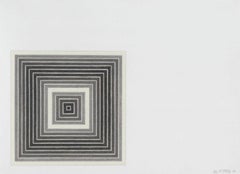
Frank Stella, Sharpesville from Multicolored Squares I (Axsom 79) Lithograph S/N
By Frank Stella
Located in New York, NY
Frank Stella Sharpesville, from Multicolored Squares I (Axsom 79), 1972 Lithograph on J. Green mould-made paper Signed in graphite pencil, dated and numbered 31/100 (there were also ...
Category

1970s Abstract Geometric Abstract Prints

Materials

Lithograph

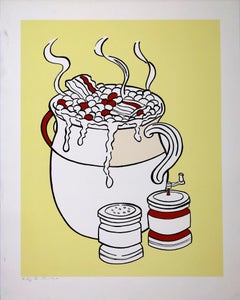
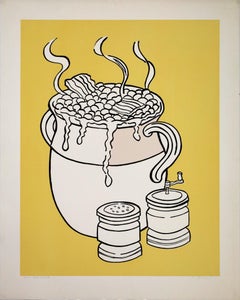
"BOSTON BEANS"
Located in New York, US
Signed by artist, Artist's Proof, stamped Silkscreen print on paper Bob Stanley (b. 1932 - d. 1997 New York, United States), an American painter renowned for his gritty depictions o...
Category

1980s Pop Art More Prints

Materials

Paper

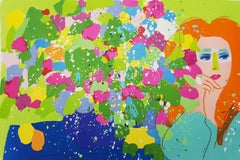
Lady with Flowers /// Pop Art Walasse Ting Colorful Girl Abstract Lithograph Art
By Walasse Ting
Located in Saint Augustine, FL
Artist: Walasse Ting (Chinese-American, 1929-2010) Title: "Lady with Flowers" *Signed and numbered by Ting in pencil lower left Year: 1979 Medium: Original Lithograph on Somerset pap...
Category

1970s Pop Art Figurative Prints

Materials

Lithograph

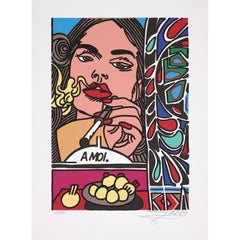
La femme fatale (à moi)
By Erró
Located in Malmo, SE
Publisher GKM. Edition of 200 ex. Unframed. Signed, dated and numbered. Free shipment worldwide. “I paint because painting is a private Utopia,” Erró writes of his art. The landscapes in Erró’s work are a constantly changing kaleidoscope of images, multivalent and mysterious, not infrequently controversial, bursting with life – and titillating, too! There is room in his pictures for both paradise and visions of fear. Erró is the alias of Gudmundur Gudmundsson, born on 19 July 1932 in Olafsvik, in north-western Iceland. Since Gudmundur first became enthralled by pictures of works of art in a catalogue from the Museum of Modern Art in New York at the tender age of ten, painting has been his passion and his mission in life. He was accepted into art school in Reykjavik as a 19-year old, subsequently complementing what he had learned there with further studies in Oslo. Erró travelled extensively in Spain, Italy, France and Germany in the 1950s, studying at the Florence Academy of Art in 1954 and at the School of Byzantine Mosaic Art in Ravenna in 1955. It was around this time that he began to exhibit his works, first and foremost in Paris, where he chose to make his home in 1958. During the 1960s he established contact with the Swedish museum director Pontus Hultén, who encouraged him and took him under his wing. Over the years Erró has taken part in hundreds of exhibitions and today his works are on show in museums all over the world, including the Centre Pompidou in Paris. Erró’s pictorial world is peopled by comic-strip characters and autocratic despots alike. Donald Duck with his Daisy, Chip & Dale, and other Walt Disney creations are unselfconsciously juxtaposed with Greek gods and madonnas. Elsewhere the German dictator Adolf Hitler stands shoulder to shoulder with his Iraqi counterpart Saddam Hussein...
Category

1990s Pop Art Figurative Prints

Materials

Screen

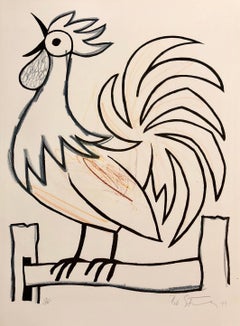
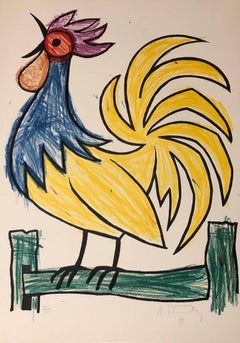
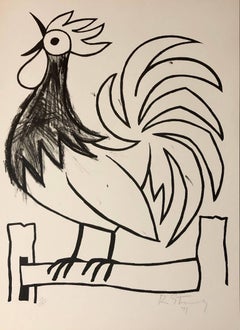
Mod Rooster Drawing 1970s Pop Art Lithograph Hand Signed
By Bob Stanley
Located in Surfside, FL
This listing is for just the one print in the photo here. there are three states of the same image image each with Progressively increasing detail and color. the edition size is 175. Hand signed, numbered and dated. on hand made French Arches paper. Bob (Robert) Stanley (1932-1997) was a painter, photographer and printmaker whose early work was figurative painting about contemporary American life. In the 1960s and early 1970s, he based his paintings on photographs, which he manipulated from black and white or silkscreen colored shapes. In the early 1960's, he began to base his paintings on images clipped from newspapers and magazines, following the example of Pop artists like Andy Warhol and Roy Lichtenstein, who would become his brother-in-law. Enlarged and often simplified to two vibrant saturated colors Stanley's images could be reduced to the abstract or be powerfully explicit. His preferred subjects, including rock stars, athletes and pornography, always seemed to grate against the pretenses of high art. Similar in bold use of color to Malcolm Morley. In the late 1960's Mr. Stanley started using his own photographs, basing paintings on images of tree branches or the ground, and also using pictures of life-drawing models at the School of Visual Arts. EDUCATION The Brooklyn Museum of Art School, Brooklyn, NY Columbia University, New York, NY The High Museum Art School, Atlanta, GA Columbia University, New York, NY Oglethorpe University, Atlanta, GA B.A. 1953 Max Beckmann Scholarship Award for Painting and Sculpture, The Brooklyn Museum of Art School, Brooklyn, NY TEACHING School of Visual Arts, New York, NY, Instructor: Painting and Drawing The New Arts Program, Kutztown, PA, Visiting Artist Princeton University, Princeton, NJ, Visiting Artist School of Visual Arts, New York, NY, Instructor: Painting and Drawing SELECT INDIVIDUAL EXHIBITIONS Figureworks, Brooklyn, NY, Celebrating the Erotic Work of Pop-Artist Bob Stanley The Mayor Gallery, London, England, “Bob Stanley – Works from the Sixties” Beatrice Conde Gallery, New York, NY, Late Paintings Mitchell Algus Gallery, New York, NY, Paintings: 1963-1967 Gallerie Georges Lavrov, (Paris), Die International Kunstmesse, Art Basel, Switzerland Galerie Georges Lavrov, Paris, France, Catalog text by Richard Artschwager The Paul Bianchini Gallery, New York, NY Galerie Ricke, Kassel, Germany Bianchini-Birillo Gallery, New York, NY SELECTED GROUP EXHIBITIONS Mitchell Algus Gallery, New York, NY, Exquisite Corpe – Cadavre Exquis Karolyn Sherwood Gallery, “Up Close and Personal: A Collection of Minimalist and Figurative Drawings” Steven Vail Gallery, “Paintings and Drawings” 2 person exhibition with Jan Frank Newhouse Center for Contemporary Art, Snug Harbor Cultural Center, SI, NY, “The Figure: Another Side of Modernism” Contemporary Arts Center, Cincinnati, OH, travels to 10 other institutions; “It’s Only Rock and Roll”, Catalog essay by David S. Rubin, Curator of 20th Century Art, Phoenix Art Museum Beatrice Conde Gallery, New York, NY, “Paintings, Drawings, Photographs” The Painted Bride Art Center, Philadelphia, PA, 2 person exhibition with Patricia McCabe Centro Cultural La General, Granada, Spain, “Honenaje a Federico García Lorca White Columns, New York, NY, “Overtalk: Bob Stanley, Öyvind Fahlström, Peter Nagy Lyman Allyn Museum, New London, CT, “The Pop Decade: The Bianchini Gallery in the Sixties”; Exhibition monograph by Barbara Zabel Fuji Television Gallery, Tokyo, Japan, “Contemporary Graphics: NYC” The Art Museum, Princeton University, Princeton, NJ, “A Decade of Visual Arts at Princeton: Faculty 1975-1985”’ Catalog text by Allen Rosenbaum and James Seawright Centro Studi Pietro Mancini, Cosenza, Italy, “Progetto su Pace, Guerra e Altro” The Fort Worth Art Museum, Fort Worth, TX, “The Pop Art Print” The Madison Art Center, Madison, Wisconsin, “Recent Acquisitions” Harcus Gallery, Boston, MA, “Artist/Poet’s Books” The American Academy and Institute of Arts and Letters New York, NY, “Paintings and Sculpture: 1982 Art...
Category

1970s Pop Art Animal Prints

Materials

Lithograph, Screen

Fernand Leger, Water, from Verve, Revue Artistique, 1937
By Fernand Léger
Located in Southampton, NY
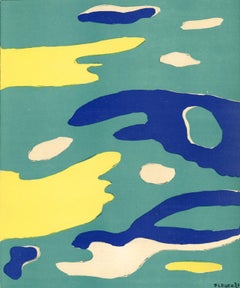
This exquisite lithograph by Fernand Leger (1881–1955), titled L’Eau (Water), from Verve, Revue Artistique et Litteraire, Vol. I, No. 1, originates from the 1937 issue published by Editions de la revue Verve, Paris, under the direction of Teriade, Editeur, Paris, and printed by Mourlot Freres, Paris, 1937. This vibrant composition embodies Leger’s fascination with the elemental forces of nature reinterpreted through the lens of modernity. L’Eau reflects his ongoing exploration of the harmony between mechanical precision and organic movement, transforming the natural motif of flowing water into an abstract symphony of curves, color, and rhythm. Through its interplay of form and line, the work reveals Leger’s mastery of balance and visual dynamism—an artistic celebration of motion and modern life. Executed as a lithograph on velin du Marais paper, this work measures 14 x 10.5 inches (35.56 x 26.67 cm). Signed in the plate and unnumbered as issued. The edition reflects the superior craftsmanship of the Mourlot Freres atelier, celebrated for its collaborations with the leading modern artists of the 20th century. Artwork Details: Artist: Fernand Leger (1881–1955) Title: L’Eau (Water), from Verve, Revue Artistique et Litteraire, Vol. I, No. 1, 1937 Medium: Lithograph on velin du Marais paper Dimensions: 14 x 10.5 inches (35.56 x 26.67 cm) Inscription: Signed in the plate and unnumbered as issued Date: 1937 Publisher: Editions de la revue Verve, Paris, under the direction of Teriade, Editeur, Paris Printer: Mourlot Freres, Paris Condition: Well preserved, consistent with age and medium Provenance: From Verve, Revue Artistique et Litteraire, Vol. I, No. 1, published by Editions de la revue Verve, Paris, 1937 About the Publication: Verve, Revue Artistique et Litteraire was one of the most influential art periodicals of the 20th century, founded in Paris in 1937 by the visionary Greek-born publisher Teriade (Stratis Eleftheriades). Designed as a meeting point of art, poetry, and philosophy, Verve united the era’s greatest modern artists—including Henri Matisse, Pablo Picasso, Marc Chagall, Georges Braque, Joan Miro, and Fernand Leger—with leading intellectuals such as Paul Eluard and Albert Camus. Printed by the master lithographers Mourlot Freres, each issue was a masterpiece of craftsmanship, presenting original lithographs alongside literary works in a richly designed format. The inaugural issue, Vol. I, No. 1, published in 1937, marked a defining moment in the history of modern art publishing—introducing the vision of Verve as a beacon of artistic collaboration and aesthetic excellence that would shape the visual culture of the 20th century. About the Artist: Fernand Leger (1881–1955) was a visionary French painter, sculptor, designer, and filmmaker whose groundbreaking fusion of modern industry, vivid color, and geometric form transformed the course of 20th-century art. Born in Argentan, Normandy, Leger began as an architectural draftsman before studying at the Academie Julian and the Ecole des Beaux-Arts in Paris, where he absorbed the lessons of Paul Cezanne’s structural rigor and the revolutionary ideas of Cubism. Alongside Pablo Picasso and Georges Braque, he became one of the leading innovators of the avant-garde, yet his work stood apart through its embrace of mechanical rhythm, bold contrasts, and industrial modernity—earning him the title “the painter of the machine age.” His art celebrated the beauty of technology, urban life, and the human form rendered in dynamic, interlocking cylinders and planes, evoking the pulse of the modern world. Immersed in the vibrant Parisian art scene, Leger worked in dialogue with peers and contemporaries such as Alexander Calder, Alberto Giacometti, Salvador Dali, Joan Miro, Wassily Kandinsky, Marcel Duchamp, and Man Ray, all of whom shared his commitment to innovation and the reimagining of artistic expression. Beyond painting, Leger’s creative reach extended into film, design, and monumental public art—his 1924 collaboration on Ballet Mecanique with Dudley Murphy and Man Ray remains a landmark of avant-garde cinema. His later works evolved toward greater clarity and monumentality, celebrating the unity of form, color, and humanity through large-scale murals and mosaics that bridged fine art and architecture. Leger’s synthesis of Cubism, Futurism, and abstraction paved the way for movements such as Pop Art and influenced generations of artists including Roy Lichtenstein, Ellsworth Kelly, Robert Indiana, and Alexander Calder, who admired his fusion of structure, energy, and optimism. Today, his works are prized by major museums and collectors worldwide for their bold visual power and enduring modernity. His highest auction record was achieved by La femme en rouge et vert (1914), which sold for $39,241,000 at Sotheby’s, New York, on May 7, 2008. Fernand Leger L’Eau, Leger Verve, Leger Mourlot...
Category

1930s Cubist Abstract Prints

Materials

Lithograph

"BOSTON BEANS"
Located in New York, US
Silkscreen print on paper Signed by artist, Artist's Proof, stamped Bob Stanley (b. 1932 - d. 1997 New York, United States), an American painter renowned for his gritty depictions o...
Category

1980s Pop Art More Prints

Materials

Paper

Dario Villalba UNTITLED 3 Limited Conceptualism Spanish Contemporary Grey Woman
By Dario Villalba
Located in Madrid, Madrid
Dario Villalba - UNTITLED 3 Date of creation: 1975 Medium: Lithograph and photolithograph on Paper Edition: 75 Size: 95 x 68 cm Condition: In mint conditions and never framed Observa...
Category

1970s Conceptual Abstract Prints

Materials

Lithograph

Vintage 1960s Andy Warhol Photo Silkscreen Serigraph Pop Art
By John Brower
Located in Surfside, FL
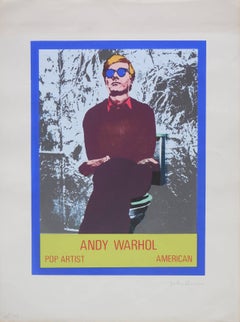
This is for a Photo Silkscreen Serigraph it is Titled Andy Warhol :Pop Artist American. light creasing to paper outside of image John Brower worked in Chicago as a billboard designer for 12 years. He taught art at Alverno College of Milwaukee, Wright Junior College in Chicago, the University of Illinois, and the University of Kentucky. A Pop Artist. In John Browers' work two important things come forward: the design and the image. In the painting Indian...
Category

1960s Pop Art Figurative Prints

Materials

Screen

Rooster Pop Art Triptych Lithograph Suite Hand Signed
By Bob Stanley
Located in Surfside, FL
there are three states of the same image image each with Progressively increasing detail and color. the edition size is 175. Hand signed, numbered and dated. on hand made French Arches paper. Bob (Robert) Stanley (1932-1997) was a painter, photographer and printmaker whose early work was figurative painting about contemporary American life. In the 1960s and early 1970s, he based his paintings on photographs, which he manipulated from black and white or silkscreen colored shapes. In the early 1960's, he began to base his paintings on images clipped from newspapers and magazines, following the example of Pop artists like Andy Warhol and Roy Lichtenstein, who would become his brother-in-law. Enlarged and often simplified to two vibrant saturated colors Stanley's images could be reduced to the abstract or be powerfully explicit. His preferred subjects, including rock stars, athletes and pornography, always seemed to grate against the pretenses of high art. Similar in bold use of color to Malcolm Morley. In the late 1960's Mr. Stanley started using his own photographs, basing paintings on images of tree branches or the ground, and also using pictures of life-drawing models at the School of Visual Arts. EDUCATION The Brooklyn Museum of Art School, Brooklyn, NY Columbia University, New York, NY The High Museum Art School, Atlanta, GA Columbia University, New York, NY Oglethorpe University, Atlanta, GA B.A. 1953 Max Beckmann Scholarship Award for Painting and Sculpture, The Brooklyn Museum of Art School, Brooklyn, NY TEACHING School of Visual Arts, New York, NY, Instructor: Painting and Drawing The New Arts Program, Kutztown, PA, Visiting Artist Princeton University, Princeton, NJ, Visiting Artist School of Visual Arts, New York, NY, Instructor: Painting and Drawing SELECT INDIVIDUAL EXHIBITIONS Figureworks, Brooklyn, NY, Celebrating the Erotic Work of Pop-Artist Bob Stanley The Mayor Gallery, London, England, “Bob Stanley – Works from the Sixties” Beatrice Conde Gallery, New York, NY, Late Paintings Mitchell Algus Gallery, New York, NY, Paintings: 1963-1967 Gallerie Georges Lavrov, (Paris), Die International Kunstmesse, Art Basel, Switzerland Galerie Georges Lavrov, Paris, France, Catalog text by Richard Artschwager The Paul Bianchini Gallery, New York, NY Galerie Ricke, Kassel, Germany Bianchini-Birillo Gallery, New York, NY SELECTED GROUP EXHIBITIONS Mitchell Algus Gallery, New York, NY, Exquisite Corpe – Cadavre Exquis Karolyn Sherwood Gallery, “Up Close and Personal: A Collection of Minimalist and Figurative Drawings” Steven Vail Gallery, “Paintings and Drawings” 2 person exhibition with Jan Frank...
Category

1970s Pop Art Animal Prints

Materials

Lithograph, Screen

Mod Rooster Drawing 1970s Pop Art Lithograph Hand Signed
By Bob Stanley
Located in Surfside, FL
This listing is for just the one print in the photo here. there are three states of the same image image each with Progressively increasing detail and color. the edition size is 175. Hand signed, numbered and dated. on hand made French Arches paper. Bob (Robert) Stanley (1932-1997) was a painter, photographer and printmaker whose early work was figurative painting about contemporary American life. In the 1960s and early 1970s, he based his paintings on photographs, which he manipulated from black and white or silkscreen colored shapes. In the early 1960's, he began to base his paintings on images clipped from newspapers and magazines, following the example of Pop artists like Andy Warhol and Roy Lichtenstein, who would become his brother-in-law. Enlarged and often simplified to two vibrant saturated colors Stanley's images could be reduced to the abstract or be powerfully explicit. His preferred subjects, including rock stars, athletes and pornography, always seemed to grate against the pretenses of high art. Similar in bold use of color to Malcolm Morley. In the late 1960's Mr. Stanley started using his own photographs, basing paintings on images of tree branches or the ground, and also using pictures of life-drawing models at the School of Visual Arts. EDUCATION The Brooklyn Museum of Art School, Brooklyn, NY Columbia University, New York, NY The High Museum Art School, Atlanta, GA Columbia University, New York, NY Oglethorpe University, Atlanta, GA B.A. 1953 Max Beckmann Scholarship Award for Painting and Sculpture, The Brooklyn Museum of Art School, Brooklyn, NY TEACHING School of Visual Arts, New York, NY, Instructor: Painting and Drawing The New Arts Program, Kutztown, PA, Visiting Artist Princeton University, Princeton, NJ, Visiting Artist School of Visual Arts, New York, NY, Instructor: Painting and Drawing SELECT INDIVIDUAL EXHIBITIONS Figureworks, Brooklyn, NY, Celebrating the Erotic Work of Pop-Artist Bob Stanley The Mayor Gallery, London, England, “Bob Stanley – Works from the Sixties” Beatrice Conde Gallery, New York, NY, Late Paintings Mitchell Algus Gallery, New York, NY, Paintings: 1963-1967 Gallerie Georges Lavrov, (Paris), Die International Kunstmesse, Art Basel, Switzerland Galerie Georges Lavrov, Paris, France, Catalog text by Richard Artschwager The Paul Bianchini Gallery, New York, NY Galerie Ricke, Kassel, Germany Bianchini-Birillo Gallery, New York, NY SELECTED GROUP EXHIBITIONS Mitchell Algus Gallery, New York, NY, Exquisite Corpe – Cadavre Exquis Karolyn Sherwood Gallery, “Up Close and Personal: A Collection of Minimalist and Figurative Drawings” Steven Vail Gallery, “Paintings and Drawings” 2 person exhibition with Jan Frank...
Category

1970s Pop Art Animal Prints

Materials

Lithograph, Screen

2779494: The Olympic Runner (Limited Ed. Hand Signed with Olympic Committee COA)
By Jonathan Borofsky
Located in New York, NY
Jonathan Borofsky 2779494: The Olympic Runner Los Angeles 1984 Olympic Games (Hand Signed with Olympic Committee COA), 1982 Offset Lithograph on Parson'...
Category

1980s Contemporary Figurative Prints

Materials

Lithograph, Offset

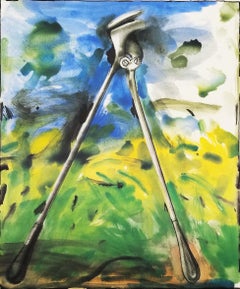
The Astra Tool /// Contemporary Pop Art Jim Dine Wrench Lithograph Colorful NY
By Jim Dine
Located in Saint Augustine, FL
Artist: Jim Dine (American, 1935-) Title: "The Astra Tool" Portfolio: The Astra Set *Numbered, signed, and dated by Dine in pencil lower right Year: 1985 Medium: Original Lithograph with Relief Printing on Rives BFK paper Limited edition: 185/400, (there were also 50 artist's proofs) Printer: Hansjörg Mayer of Staib Mayer, Stuttgart, Germany Publisher: AB Astra and the artist Dine himself in association with Waddington Graphics, London, UK and Pace Editions, Inc., New York, NY Reference: "The Astra-Dine Collaboration" - Wright No. 5, page 56-57; "I print. Catalogue Raisonné of Prints, 2001-2020" - Burg No. 81, page 54 (see comments) Framing: Recently framed in a contemporary oak moulding with a 100% cotton rag mat Framed size: 36.63" x 30.63" Sheet size: 35.13" x 25" Image size: 23.82" x 19.88" Condition: Light UV stain to sheet. In excellent condition with strong colors Notes: Provenance: private collection - Norwich, UK. Comes from Dine's 1985-1986 "The Astra Set" portfolio of five lithographs with relief printing from hand-drawn mylar overlays. The five works include "The Mighty Robe I", "The Confetti Heart...
Category

1980s Pop Art Still-life Prints

Materials

Lithograph

"ROMAN PASSES"
Located in New York, US
Pencil on paper Stamped Bob Stanley (b. 1932 - d. 1997 New York, United States), an American painter renowned for his gritty depictions on canvas, which ingeniously incorporated pho...
Category

1960s Pop Art Portrait Prints

Materials

Paper

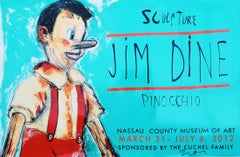
Nassau County Museum of Art (Sculpture/Jim Dine/Pinocchio) Poster (Signed)
By Jim Dine
Located in Saint Augustine, FL
Artist: (after) Jim Dine (American, 1935-) Title: "Nassau County Museum of Art (Sculpture/Jim Dine/Pinocchio)" *Signed by Dine in black marker lower right Year: 2012 Medium: Original...
Category

2010s Pop Art Figurative Prints

Materials

Permanent Marker, Lithograph, Offset

Mod Rooster Drawing 1970s Pop Art Lithograph Hand Signed
By Bob Stanley
Located in Surfside, FL
This listing is for just the one print in the photo here. there are three states of the same image image each with Progressively increasing detail and color. the edition size is 175. Hand signed, numbered and dated. on hand made French Arches paper. Bob (Robert) Stanley (1932-1997) was a painter, photographer and printmaker whose early work was figurative painting about contemporary American life. In the 1960s and early 1970s, he based his paintings on photographs, which he manipulated from black and white or silkscreen colored shapes. In the early 1960's, he began to base his paintings on images clipped from newspapers and magazines, following the example of Pop artists like Andy Warhol and Roy Lichtenstein, who would become his brother-in-law. Enlarged and often simplified to two vibrant saturated colors Stanley's images could be reduced to the abstract or be powerfully explicit. His preferred subjects, including rock stars, athletes and pornography, always seemed to grate against the pretenses of high art. Similar in bold use of color to Malcolm Morley. In the late 1960's Mr. Stanley started using his own photographs, basing paintings on images of tree branches or the ground, and also using pictures of life-drawing models at the School of Visual Arts. EDUCATION The Brooklyn Museum of Art School, Brooklyn, NY Columbia University, New York, NY The High Museum Art School, Atlanta, GA Columbia University, New York, NY Oglethorpe University, Atlanta, GA B.A. 1953 Max Beckmann Scholarship Award for Painting and Sculpture, The Brooklyn Museum of Art School, Brooklyn, NY TEACHING School of Visual Arts, New York, NY, Instructor: Painting and Drawing The New Arts Program, Kutztown, PA, Visiting Artist Princeton University, Princeton, NJ, Visiting Artist School of Visual Arts, New York, NY, Instructor: Painting and Drawing SELECT INDIVIDUAL EXHIBITIONS Figureworks, Brooklyn, NY, Celebrating the Erotic Work of Pop-Artist Bob Stanley The Mayor Gallery, London, England, “Bob Stanley – Works from the Sixties” Beatrice Conde Gallery, New York, NY, Late Paintings Mitchell Algus Gallery, New York, NY, Paintings: 1963-1967 Gallerie Georges Lavrov, (Paris), Die International Kunstmesse, Art Basel, Switzerland Galerie Georges Lavrov, Paris, France, Catalog text by Richard Artschwager The Paul Bianchini Gallery, New York, NY Galerie Ricke, Kassel, Germany Bianchini-Birillo Gallery, New York, NY SELECTED GROUP EXHIBITIONS Mitchell Algus Gallery, New York, NY, Exquisite Corpe – Cadavre Exquis Karolyn Sherwood Gallery, “Up Close and Personal: A Collection of Minimalist and Figurative Drawings” Steven Vail Gallery, “Paintings and Drawings” 2 person exhibition with Jan Frank Newhouse Center for Contemporary Art, Snug Harbor Cultural Center, SI, NY, “The Figure: Another Side of Modernism” Contemporary Arts Center, Cincinnati, OH, travels to 10 other institutions; “It’s Only Rock and Roll”, Catalog essay by David S. Rubin, Curator of 20th Century Art, Phoenix Art Museum Beatrice Conde Gallery, New York, NY, “Paintings, Drawings, Photographs” The Painted Bride Art Center, Philadelphia, PA, 2 person exhibition with Patricia McCabe Centro Cultural La General, Granada, Spain, “Honenaje a Federico García Lorca White Columns, New York, NY, “Overtalk: Bob Stanley, Öyvind Fahlström, Peter Nagy Lyman Allyn Museum, New London, CT, “The Pop Decade: The Bianchini Gallery in the Sixties”; Exhibition monograph by Barbara Zabel Fuji Television Gallery, Tokyo, Japan, “Contemporary Graphics: NYC” The Art Museum, Princeton University, Princeton, NJ, “A Decade of Visual Arts at Princeton: Faculty 1975-1985”’ Catalog text by Allen Rosenbaum and James Seawright Centro Studi Pietro Mancini, Cosenza, Italy, “Progetto su Pace, Guerra e Altro” The Fort Worth Art Museum, Fort Worth, TX, “The Pop Art Print” The Madison Art Center, Madison, Wisconsin, “Recent Acquisitions” Harcus Gallery, Boston, MA, “Artist/Poet’s Books” The American Academy and Institute of Arts and Letters New York, NY, “Paintings and Sculpture: 1982 Art...
Category

1970s Pop Art Animal Prints

Materials

Lithograph, Screen

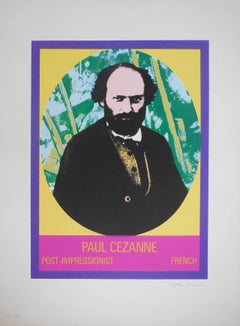
Pop Art Paul Cezanne Serigraph, 1968
By John Brower
Located in Surfside, FL
This is a Silkscreen it is Titled Paul Cezanne, Post Impressionist, French. John Brower worked in Chicago as a billboard designer for 12 years. He taught art at Alverno College of M...
Category

1960s Pop Art Figurative Prints

Materials

Screen

1969-71 Abstract Minimalist Color Silkscreen Print Charles Hinman On The Bowery
By Charles Hinman
Located in Surfside, FL
Charles Hinman On the Bowery, 1969 - 1971 silkscreen on Schoeller's Parole Paper, edition of 100 + 20 A.P. 25.5 x 25.5 inches, signed, numbered 21/100 Screenprint in color on wove p...
Category

1960s Pop Art Abstract Prints

Materials

Lithograph, Screen

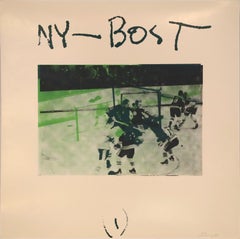
"NY-BOST"
Located in New York, US
Signed by artist Photo print on cardboard Bob Stanley (b. 1932 - d. 1997 New York, United States), an American painter renowned for his gritty depictions on canvas, which ingeniousl...
Category

1960s Pop Art More Prints

Materials

Paper

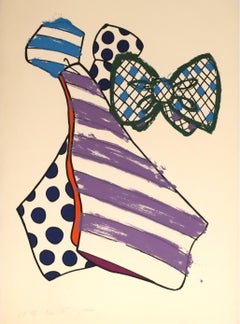
"NECKTIES"
Located in New York, US
Edition 1/20 Signed by artist, Artist's Proof, stamped Bob Stanley (b. 1932 - d. 1997 New York, United States), an American painter renowned for his gritty depictions on canvas, whi...
Category

1880s Pop Art Prints and Multiples

Materials

Screen

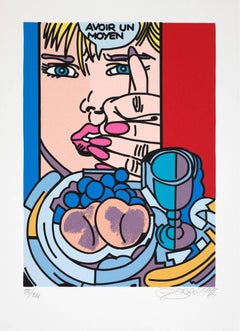
Avoir un moyen
By Erró
Located in Malmo, SE
Publisher GKM. Edition of 200 ex. Unframed. Signed, dated and numbered. Free shipment worldwide. “I paint because painting is a private Utopia,” Erró writes of his art. The landsc...
Category

1990s Pop Art Figurative Prints

Materials

Screen

"ECSTASY HEDY LAMAR"
Located in New York, US
Edition 23/195 Signet by artist Bob Stanley (b. 1932 - d. 1997 New York, United States), an American painter renowned for his gritty depictions on canvas, which ingeniously incorp...
Category

1960s Pop Art More Prints

Materials

Paper

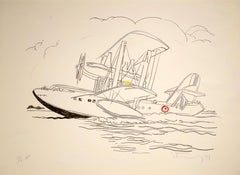
"A VERY LARGE FLYING BOAT TAKING OFF"
Located in New York, US
Signed by artist, Artist's Proof Lithograph print and color pencil on paper Bob Stanley (b. 1932 - d. 1997 New York, United States), an American painter renowned for his gritty depi...
Category

1970s Pop Art More Prints

Materials

Paper

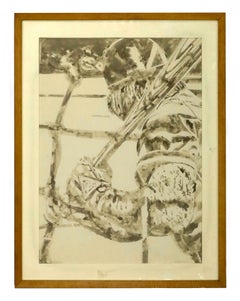
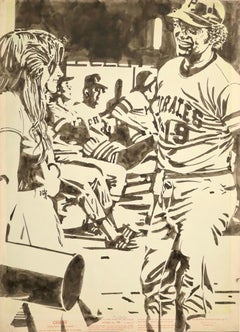
"PETE ROSE IN PRACTICE BATTING LEFTY"
Located in New York, US
Watercolor print and pencil on paper Signed by artist Bob Stanley (b. 1932 - d. 1997 New York, United States), an American painter renowned for his gritty depictions on canvas, whic...
Category

1970s Pop Art Portrait Prints

Materials

Paper

"Conversation at the stadium"
Located in New York, US
Signed by artist Watercolor paint on paper Bob Stanley (b. 1932 - d. 1997 New York, United States), an American painter renowned for his gritty depictions on canvas, which ingenious...
Category

1970s Pop Art Portrait Prints

Materials

Paper

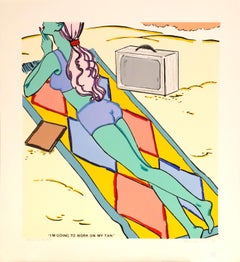
Robert Bob Stanley "I M GOING TO WORK ON MY TAN" 1978
Located in New York, US
Lithograph print + artist's hand additions, Signet by artist, Working Proof, stamp Bob Stanley (b. 1932 - d. 1997 New York, United States), an American painter renowned for his grit...
Category

1970s Pop Art Prints and Multiples

Materials

Lithograph

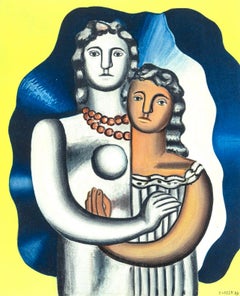
Fernand Leger, The Two Figures, from Derriere le miroir, 1955 (after)
By Fernand Léger
Located in Southampton, NY
This exquisite lithograph after Fernand Leger (1881–1955), titled Le deux figures (The Two Figures), from the folio Derriere le miroir, No. 79-81, originates from the 1955 edition published by Maeght Editeur, Paris, and printed by Mourlot Freres, Paris, 1955. This composition exemplifies Leger’s rhythmic balance of color, form, and movement, translating the mechanical vitality of modern life into a harmonious, humanized geometry. Executed as a lithograph on velin paper, this work measures 15 x 11 inches. Signed in the plate and unnumbered as issued. The edition exemplifies the superb craftsmanship of Mourlot Freres, Paris. Artwork Details: Artist: After Fernand Leger (1881–1955) Title: Le deux figures (The Two Figures), from the folio Derriere le miroir, No. 79-81 Medium: Lithograph on velin paper Dimensions: 15 x 11 inches (38.1 x 27.94 cm) Inscription: Signed in the plate and unnumbered as issued Date: 1955 Publisher: Maeght Editeur, Paris Printer: Mourlot Freres, Paris Condition: Well preserved, consistent with age and medium Provenance: From the folio Derriere le miroir, No. 79-81, published by Maeght Editeur, Paris; printed by Mourlot Freres, Paris, 1955 About the Publication: Derriere le miroir (Behind the Mirror) was one of the most important art publications of the 20th century, created and published by Maeght Editeur in Paris from 1946 to 1982. Founded by the visionary art dealer and publisher Aime Maeght, the series served as both an exhibition catalogue and a work of art in its own right, uniting original lithographs by leading modern and contemporary artists with critical essays, poetry, and design of the highest quality. Printed by master lithographers such as Mourlot Freres and Arte, Derriere le miroir became synonymous with the artistic vanguard of postwar Europe. Each issue was devoted to a single artist or theme and published to accompany exhibitions at the Galerie Maeght in Paris, featuring works by Pablo Picasso, Henri Matisse, Georges Braque, Joan Miro, Marc Chagall, Alexander Calder, Fernand Leger, and Alberto Giacometti, among others. The publication reflected Maeght's belief that art should be both accessible and elevated—an ideal realized through its luxurious production values, meticulous printing, and collaboration with the greatest creative minds of its time. About the Artist: Fernand Leger (1881–1955) was a visionary French painter, sculptor, designer, and filmmaker whose groundbreaking fusion of modern industry, vivid color, and geometric form transformed the course of 20th-century art. Born in Argentan, Normandy, Leger began as an architectural draftsman before studying at the Academie Julian and the Ecole des Beaux-Arts in Paris, where he absorbed the lessons of Paul Cezanne’s structural rigor and the revolutionary ideas of Cubism. Alongside Pablo Picasso and Georges Braque, he became one of the leading innovators of the avant-garde, yet his work stood apart through its embrace of mechanical rhythm, bold contrasts, and industrial modernity—earning him the title “the painter of the machine age.” His art celebrated the beauty of technology, urban life, and the human form rendered in dynamic, interlocking cylinders and planes, evoking the pulse of the modern world. Immersed in the vibrant Parisian art scene, Leger worked in dialogue with peers and contemporaries such as Alexander Calder, Alberto Giacometti, Salvador Dali, Joan Miro, Wassily Kandinsky, Marcel Duchamp, and Man Ray, all of whom shared his commitment to innovation and the reimagining of artistic expression. Beyond painting, Leger’s creative reach extended into film, design, and monumental public art—his 1924 collaboration on Ballet Mecanique with Dudley Murphy and Man Ray remains a landmark of avant-garde cinema. His later works evolved toward greater clarity and monumentality, celebrating the unity of form, color, and humanity through large-scale murals and mosaics that bridged fine art and architecture. Leger’s synthesis of Cubism, Futurism, and abstraction paved the way for movements such as Pop Art and influenced generations of artists including Roy Lichtenstein, Ellsworth Kelly, Robert Indiana, and Alexander Calder, who admired his fusion of structure, energy, and optimism. Today, his works are prized by major museums and collectors worldwide for their bold visual power and enduring modernity. His highest auction record was achieved by La femme en rouge et vert (1914), which sold for 39,241,000 USD at Sotheby’s, New York, on May 7, 2008. After Fernand Leger Le deux figures 1955, Leger Derriere le miroir No. 79-81, Leger Mourlot...
Category

1950s Cubist Still-life Prints

Materials

Lithograph

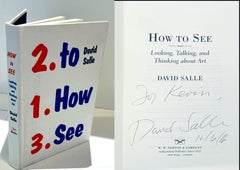
HOW TO SEE Looking, Talking and Thinking about Art (hand signed by David Salle)
By David Salle
Located in New York, NY
David Salle HOW TO SEE Looking, Talking and Thinking about Art (hand signed, dated and inscribed), 2016 Hardback monograph with dust jacket (hand signed and inscribed to Kevin) Hand ...
Category

2010s Contemporary Figurative Prints

Materials

Paper, Ink, Mixed Media, Lithograph, Offset
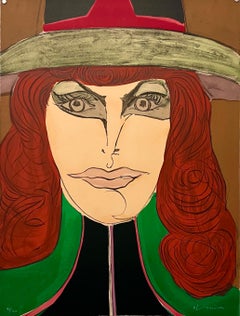
1971 Modernist Lithograph Redhead Pop Art Mod Fashionable Woman Richard Lindner
By Richard Lindner
Located in Surfside, FL
RICHARD LINDNER (American. 1901-1978) Hand Signed limited edition lithograph with blindstamp Publisher: Shorewood-Bank Street Atelier for the Skowhegan School of Painting and Sculpt...
Category

1970s Pop Art Abstract Prints

Materials

Lithograph

Rene Magritte, Untitled, from Poems 1923-1958, 1959 (after)
By René Magritte
Located in Southampton, NY
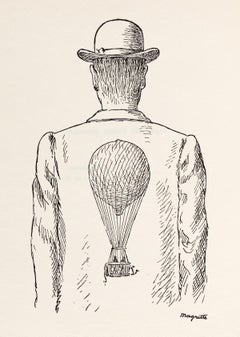
This exquisite lithograph after Rene Magritte (1898–1967), titled Sans titre (Untitled), from the album Poems 1923-1958, Dix dessins de Rene Magritte (Ten Drawings by Rene Magritte),...
Category

1950s Surrealist Figurative Prints

Materials

Lithograph

Danish exhibition poster for "Photographs by Jim Dine" (hand signed by Jim Dine)
By Jim Dine
Located in New York, NY
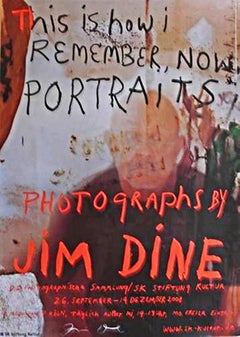
JIM DINE This is How I Remember Now (Hand Signed), 2008 Offset Lithograph Poster for exhibition of photographs by Jim Dine 32 × 24 inches Signed boldly in white marker by Jim Dine on the front Unframed Published by: Det Kongelige Bibliotek, Denmark Provenance: Jim Dine personally signed it for the present owner in 2012 at a special poetry reading that the artist gave at the Dia Art Foundation. Extremely rare when hand signed! Accompanied by gallery issued Certificate of Guarantee This poster was produced in conjunction with a 2008 German exhibition of Jim Dine's photographs. Jim Dine personally signed it for the present owner in 2012 at a poetry reading that the artist gave at the Dia Art Foundation, so provenance is direct and impeccable. The text on the poster reads "This Is How I Remember Now Portraits", with a portrait of the artist juxtaposed in the background - and is perhaps as a commentary on the elusiveness of memory in life, art and photography. The poster is accompanied by a copy of the flyer publicizing the event where Jim Dine signed...
Category

Early 2000s Pop Art Abstract Prints

Materials

Offset, Lithograph, Permanent Marker

"Sunglass Lens - Landing Net - Triangle" by James Rosenquist
By James Rosenquist
Located in Hinsdale, IL
JAMES ROSENQUIST (B. 1933) Sunglass Lens-Landing Net-Triangle Original etching, 1974 Catalog #80 Sheet size: 19 1/2” x 35 1/4” Edition number 11 of 80 Signed, numbered, and date...
Category

1970s Pop Art Abstract Prints

Materials

Etching

Untitled (Fresh Air School) /// Contemporary Abstract Expressionist Walasse Ting
By Walasse Ting
Located in Saint Augustine, FL
Artist: Walasse Ting (Chinese-American, 1929-2010) Title: "Untitled (Fresh Air School)" Portfolio: Fresh Air School *Unsigned edition Year: 1972 Medium: Original Lithograph on white ...
Category

1970s Abstract Expressionist Abstract Prints

Materials

Lithograph

Le Fil d Ariane (Ariadne s Clew) /// Modern Surrealism Surrelist Andre Masson
By André Masson
Located in Saint Augustine, FL
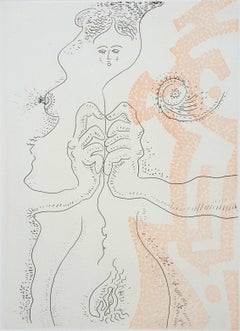
Artist: André Masson (French, 1896-1987) Title: "Le Fil d'Ariane (Ariadne's Clew)" Portfolio: For Meyer Schapiro *Signed by Masson in pencil lower right Year: 1973 Medium: Original E...
Category

1970s Surrealist Nude Prints

Materials

Etching, Aquatint, Intaglio

Untitled (signed screen print on aluminum)
By John Crash Matos
Located in Aventura, FL
Screen print on aluminum. Hand signed and dated lower front by John 'Crash' Matos. Hand numbered 2/5 on verso. Artwork size: 40 x 40 x 2 inches. Artwork is in excellent condition...
Category

1990s Street Art Abstract Prints

Materials

Metal

Rene Magritte, Untitled, from Poems 1923-1958, 1959 (after)
By René Magritte
Located in Southampton, NY
This exquisite lithograph after Rene Magritte (1898–1967), titled Sans titre (Untitled), from the album Poems 1923-1958, Dix dessins de Rene Magritte (Ten Drawings by Rene Magritte),...
Category

1950s Surrealist Figurative Prints

Materials

Lithograph

Fernand Leger, Still Life, from Derriere le miroir, 1955 (after)
By Fernand Léger
Located in Southampton, NY
This exquisite lithograph after Fernand Leger (1881–1955), titled Nature morte (Still Life), from the folio Derriere le miroir, No. 79-81, originates from the 1955 edition published by Maeght Editeur, Paris, and printed by Mourlot Freres, Paris, 1955. This composition exemplifies Leger’s rhythmic balance of color, form, and movement, translating the mechanical vitality of modern life into a harmonious, humanized geometry. Executed as a lithograph on velin paper, this work measures 15 x 11 inches. Signed in the plate and unnumbered as issued. The edition exemplifies the superb craftsmanship of Mourlot Freres, Paris. Artwork Details: Artist: After Fernand Leger (1881–1955) Title: Nature morte (Still Life), from the folio Derriere le miroir, No. 79-81 Medium: Lithograph on velin paper Dimensions: 15 x 11 inches (38.1 x 27.94 cm) Inscription: Signed in the plate and unnumbered as issued Date: 1955 Publisher: Maeght Editeur, Paris Printer: Mourlot Freres, Paris Condition: Well preserved, consistent with age and medium Provenance: From the folio Derriere le miroir, No. 79-81, published by Maeght Editeur, Paris; printed by Mourlot Freres, Paris, 1955 About the Publication: Derriere le miroir (Behind the Mirror) was one of the most important art publications of the 20th century, created and published by Maeght Editeur in Paris from 1946 to 1982. Founded by the visionary art dealer and publisher Aime Maeght, the series served as both an exhibition catalogue and a work of art in its own right, uniting original lithographs by leading modern and contemporary artists with critical essays, poetry, and design of the highest quality. Printed by master lithographers such as Mourlot Freres and Arte, Derriere le miroir became synonymous with the artistic vanguard of postwar Europe. Each issue was devoted to a single artist or theme and published to accompany exhibitions at the Galerie Maeght in Paris, featuring works by Pablo Picasso, Henri Matisse, Georges Braque, Joan Miro, Marc Chagall, Alexander Calder, Fernand Leger, and Alberto Giacometti, among others. The publication reflected Maeght's belief that art should be both accessible and elevated—an ideal realized through its luxurious production values, meticulous printing, and collaboration with the greatest creative minds of its time. About the Artist: Fernand Leger (1881–1955) was a visionary French painter, sculptor, designer, and filmmaker whose groundbreaking fusion of modern industry, vivid color, and geometric form transformed the course of 20th-century art. Born in Argentan, Normandy, Leger began as an architectural draftsman before studying at the Academie Julian and the Ecole des Beaux-Arts in Paris, where he absorbed the lessons of Paul Cezanne’s structural rigor and the revolutionary ideas of Cubism. Alongside Pablo Picasso and Georges Braque, he became one of the leading innovators of the avant-garde, yet his work stood apart through its embrace of mechanical rhythm, bold contrasts, and industrial modernity—earning him the title “the painter of the machine age.” His art celebrated the beauty of technology, urban life, and the human form rendered in dynamic, interlocking cylinders and planes, evoking the pulse of the modern world. Immersed in the vibrant Parisian art scene, Leger worked in dialogue with peers and contemporaries such as Alexander Calder, Alberto Giacometti, Salvador Dali, Joan Miro, Wassily Kandinsky, Marcel Duchamp, and Man Ray, all of whom shared his commitment to innovation and the reimagining of artistic expression. Beyond painting, Leger’s creative reach extended into film, design, and monumental public art—his 1924 collaboration on Ballet Mecanique with Dudley Murphy and Man Ray remains a landmark of avant-garde cinema. His later works evolved toward greater clarity and monumentality, celebrating the unity of form, color, and humanity through large-scale murals and mosaics that bridged fine art and architecture. Leger’s synthesis of Cubism, Futurism, and abstraction paved the way for movements such as Pop Art and influenced generations of artists including Roy Lichtenstein, Ellsworth Kelly, Robert Indiana, and Alexander Calder, who admired his fusion of structure, energy, and optimism. Today, his works are prized by major museums and collectors worldwide for their bold visual power and enduring modernity. His highest auction record was achieved by La femme en rouge et vert (1914), which sold for 39,241,000 USD at Sotheby’s, New York, on May 7, 2008. After Fernand Leger Nature morte 1955, Leger Derriere le miroir No. 79-81, Leger Mourlot...
Category

1950s Cubist Still-life Prints

Materials

Lithograph

Fernand Leger, Head and Leaf, from Verve, Revue Artistique, 1939
By Fernand Léger
Located in Southampton, NY
This exquisite lithograph by Fernand Leger (1881–1955), titled Tete et Feuille (Head and Leaf), from Verve, Revue Artistique et Litteraire, Vol. II, No. 5–6, originates from the 1939 issue published by Editions de la revue Verve, Paris, under the direction of Teriade, Editeur, Paris, and printed by Mourlot Freres, Paris, 1939. This striking composition epitomizes Leger’s distinct synthesis of mechanical precision and organic vitality. Tete et Feuille demonstrates his fascination with the interplay between geometry and the human figure—translating natural forms into bold, dynamic arrangements of line and color. The juxtaposition of the stylized head and leaf form reveals Leger’s mastery in uniting abstraction with humanism, a hallmark of his mature modernist vision. Through rhythmic design and rich tonal contrast, the work captures the harmony between nature and the machine age that defined much of Leger’s career. Executed as a lithograph on velin du Marais paper, this work measures 14 x 10.5 inches (35.56 x 26.67 cm). Signed in the plate and unnumbered as issued. The edition reflects the exceptional quality of the Mourlot Freres atelier, renowned for its collaborations with the foremost modern masters of the 20th century. Artwork Details: Artist: Fernand Leger (1881–1955) Title: Tete et Feuille (Head and Leaf), from Verve, Revue Artistique et Litteraire, Vol. II, No. 5–6, 1939 Medium: Lithograph on velin du Marais paper Dimensions: 14 x 10.5 inches (35.56 x 26.67 cm) Inscription: Signed in the plate and unnumbered as issued Date: 1939 Publisher: Editions de la revue Verve, Paris, under the direction of Teriade, Editeur, Paris Printer: Mourlot Freres, Paris Condition: Well preserved, consistent with age and medium Provenance: From Verve, Revue Artistique et Litteraire, Vol. II, No. 5–6, published by Editions de la revue Verve, Paris, 1939 About the Publication: Verve, Revue Artistique et Litteraire was one of the most influential art periodicals of the 20th century, founded in Paris in 1937 by the visionary Greek-born publisher Teriade (Stratis Eleftheriades). Conceived as a union of art and literature, Verve featured original lithographs and writings by the foremost artists and thinkers of its time, including Henri Matisse, Pablo Picasso, Marc Chagall, Georges Braque, Joan Miro, and Fernand Leger. Each issue represented a collaboration between artists, poets, and master printers, notably Mourlot Freres, whose exceptional craftsmanship brought color lithography to new aesthetic heights. The 1939 double issue, Vol. II, No. 5–6, is among the most distinguished editions, reflecting both the intellectual vigor and artistic experimentation that defined the pre-war Parisian avant-garde. About the Artist: Fernand Leger (1881–1955) was a visionary French painter, sculptor, designer, and filmmaker whose groundbreaking fusion of modern industry, vivid color, and geometric form transformed the course of 20th-century art. Born in Argentan, Normandy, Leger began as an architectural draftsman before studying at the Academie Julian and the Ecole des Beaux-Arts in Paris, where he absorbed the lessons of Paul Cezanne’s structural rigor and the revolutionary ideas of Cubism. Alongside Pablo Picasso and Georges Braque, he became one of the leading innovators of the avant-garde, yet his work stood apart through its embrace of mechanical rhythm, bold contrasts, and industrial modernity—earning him the title “the painter of the machine age.” His art celebrated the beauty of technology, urban life, and the human form rendered in dynamic, interlocking cylinders and planes, evoking the pulse of the modern world. Immersed in the vibrant Parisian art scene, Leger worked in dialogue with peers and contemporaries such as Alexander Calder, Alberto Giacometti, Salvador Dali, Joan Miro, Wassily Kandinsky, Marcel Duchamp, and Man Ray, all of whom shared his commitment to innovation and the reimagining of artistic expression. Beyond painting, Leger’s creative reach extended into film, design, and monumental public art—his 1924 collaboration on Ballet Mecanique with Dudley Murphy and Man Ray remains a landmark of avant-garde cinema. His later works evolved toward greater clarity and monumentality, celebrating the unity of form, color, and humanity through large-scale murals and mosaics that bridged fine art and architecture. Leger’s synthesis of Cubism, Futurism, and abstraction paved the way for movements such as Pop Art and influenced generations of artists including Roy Lichtenstein, Ellsworth Kelly, Robert Indiana, and Alexander Calder, who admired his fusion of structure, energy, and optimism. Today, his works are prized by major museums and collectors worldwide for their bold visual power and enduring modernity. His highest auction record was achieved by La femme en rouge et vert (1914), which sold for $39,241,000 at Sotheby’s, New York, on May 7, 2008. Fernand Leger Tete et Feuille, Leger Verve, Leger Mourlot...
Category

1930s Fauvist Figurative Prints

Materials

Lithograph

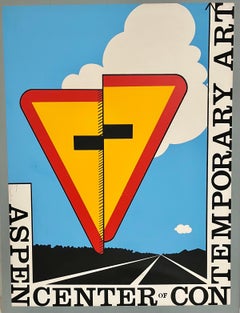
Pop Art Aspen Road Sign D arcangelo Silkscreen Chiron Press Vintage Art Poster
Located in Surfside, FL
Allan D'Arcangelo (American/New York, 1930-1998), "Aspen Center of Contemporary Art", 1967 silkscreen, hand signed in pencil, dated, numbered "45/200" and blind stamped "Chiron Press, New York, NY" 32 in. x 24 in. Allan D'Arcangelo (1930-1998) was an American artist and printmaker, best known for his paintings of highways and road signs that border on pop art and minimalism, precisionism, Abstract illusionism and hard-edge painting, and also surrealism. His subject matter is distinctly American and evokes, at times, a cautious outlook on the future of this country. Allan D'Arcangelo was the son of Italian immigrants. He studied at the University of Buffalo from 1948–1953, where he got his bachelor's degree in history. After college, he moved to Manhattan and picked up his studies again at the New School of Social Research and the City University of New York, City College. At this time, he encountered Abstract Expressionist painters who were in vogue at the moment. After joining the army in the mid 1950s, he used the GI Bill to study painting at Mexico City College from 1957–59, driving there over 12 days in an old bakery truck retrofitted as a camper. However, he returned to New York in 1959, in search of the unique American experience. It was at this time that his painting took on a cool sensibility reminiscent of Roy Lichtenstein and Andy Warhol. His interests engaged with the environment, anti-Vietnam War protests, and the commodification and objectification of female sexuality. D'Arcangelo first achieved recognition in 1962, when he was invited to contribute an etching to The International Anthology of Contemporary Engraving: America Discovered; his first solo exhibition came the next year, at the Thiebaud Gallery in New York City. In 1965 he contributed three screenprints to Original Edition's 11 Pop Artists portfolio. By the 1970s, D'Arcangelo had received significant recognition in the art world. He was well known for his paintings of quintessentially American highways and infrastructure, and in 1971 was commissioned by the Department of the Interior to paint the Grand Coulee Dam in Washington state. However, his sense of morality always trumped his interest in art world fame. In 1975, he decided to quit the gallery that had been representing him for years, Marlborough Gallery, because of the way they handled Mark Rothko legacy. D'Arcangelo rejected Abstract Expressionism, though his early work has a painterly and somewhat expressive feel. He quickly turned to a style of art that seemed to border on Pop Art and Minimalism, Precisionism and Hard-Edge painting. Evidently, he didn't fit neatly in the category of Pop Art, though he shared subjects (women, signs, Superman) and techniques (stencil, assemblage) with these artists.He turned to expansive, if detached scenes of the American highway. These paintings are reminiscent of Giorgio de Chirico-though perhaps not as interested in isolation-and Salvador Dali-though there is a stronger interest in the present and disinterest in the past. These paintings also have a sharp quality that is reminiscent of the precisionist style, or more specifically, Charles Sheeler. 1950s, Before D'Arcangelo returned to New York, his style was roughly figurative and reminiscent of folk art. During the early 1960s, Allan D'Arcangelo was linked with Pop Art. "Marilyn" (1962) depicts an illustrative head and shoulders on which the facial features are marked by lettered slits to be "fitted" with the eyebrows, eyes, nose and mouth which appear off to the right in the composition. In "Madonna and Child," (1963) the featureless faces of Jackie Kennedy and Caroline are ringed with haloes, enough to make their status as contemporary icons perfectly clear. Select Exhibitions: Fischbach Gallery, New York, Ileana Sonnabend Gallery, Paris, Gallery Müller, Stuttgart, Germany Hans Neuendorf Gallery, Hamburg, Germany Dwan Gallery...
Category

1960s Pop Art Abstract Prints

Materials

Lithograph, Screen

Large Abstract Expressionist Color Monotype Oil Painting Tom Lieber Mixed Media
By Tom Lieber
Located in Surfside, FL
Tom Alan Lieber, (American, born 1949), Oil and mixed media on paper, 30.25 x 44 inches, Hand signed and dated lower right Provenance: Garner Tullis Workshop, N.Y. A bold and be...
Category

1980s Abstract Expressionist Abstract Paintings

Materials

Mixed Media, Oil, Monotype

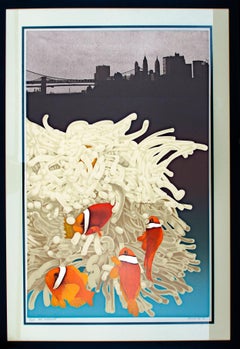
1978 Michael Knigin Manhattan Skyline Print
By Michael Knigin
Located in New York, NY
Michael Knigin (American, b. 1942) East Riverdance, 1978 Lithograph (?) Sight: 33 x 21 1/2 in. (image) Framed: 41 1/8 x 29 x 3/4 in. Signed, titled, dated, and numbered bottom Editio...
Category

1970s Post-Modern Figurative Prints

Materials

Lithograph

1981 American Post Minimalist Abstract Art Lithograph Neon Series Keith Sonnier
By Keith Sonnier
Located in Surfside, FL
Keith Sonnier, American (1941-2020) lithograph From Neon series circa 1980-1981 Bears the Waterstreet Press watermarks and Arches paper blind stamp to lower right corner. Pub. Edizioni Lucio Amelio Hand signed with initials in pencil Dimensions: 30 x 21 3/4 inches Post minimalist Abstract by Keith Sonnier Keith Sonnier (1941 – 2020) was a post minimalist sculptor, performance artist, video and light artist. Sonnier was one of the first artists to use light in sculpture in the 1960s. With his use of neon in combination with ephemeral materials he achieved international recognition. Sonnier was part of the Process Art movement. James Keith Sonnier was born July 31, 1941, in Mamou, Louisiana. His family was Cajun and Roman Catholic. His father was a hardware store owner, Joseph Sonnier, and his mother was a florist and singer, Mae Ledoux. He graduated in 1963 from Southwestern Louisiana Institute (now known as the University of Louisiana at Lafayette). In 1966, he graduated with his MFA degree from Rutgers University, where he studied under Allan Kaprow, Robert Watts, and Robert Morris. After graduation from Rutgers, he moved to New York City with Jackie Winsor and some of his former classmates. Sonnier died in Southampton, NY on July 18, 2020. Sonnier began experimenting with neon in 1968. Neon lights became a signature material used in his sculptural works. The common materials Sonnier employed included neon and fluorescent lights; reflective materials; aluminum and copper; and glass and wires. Of the generation of James Turrell and Dan Flavin, He was also associated with the Light and Space movement, a loosely affiliated art movement related to op art, minimalism and geometric abstraction originating in Southern California in the 1960s and influenced by John McLaughlin. It is characterized by a focus on perceptual phenomena, such as light, volume and scale, and the use of materials such as glass, neon, fluorescent lights, resin and cast acrylic, often forming installations conditioned by the work's surroundings. Artists included Ron Cooper...
Category

1980s Post-Minimalist Abstract Prints

Materials

Paper, Lithograph

Leonard Baskin Woodblock Broadside Print Woodcut Vintage Poster in Red and Black
By Leonard Baskin
Located in Surfside, FL
This is an original gallery show poster the Boris Mirsky Gallery, Newbury St. Boston. titled Sculpture Prints Drawings. It is dated 1962. it is in red and black. Leonard Baskin (August 15, 1922 – June 3, 2000) was an American sculptor, illustrator, wood-engraver, printmaker, graphic artist, writer and teacher. Baskin was born in New Brunswick, New Jersey. While he was a student at Yale University, he founded Gehenna Press, a small private press specializing in fine book production. From 1953 until 1974, he taught printmaking and sculpture at Smith College in Northampton, Massachusetts. Subsequently Baskin also taught at Hampshire College in Amherst, Massachusetts. He lived most of his life in the U.S., but spent nine years in Devon at Lurley Manor, Lurley, near Tiverton, close to his friend Ted Hughes, for whom he illustrated Crow. Sylvia Plath dedicated Sculpto to Leonard Baskin in her famous work, The Colossus and Other Poems (1960). The Funeral Contege (1997) bronze, Franklin Delano Roosevelt Memorial, Washington, D.C. His public commissions include a bas relief for the Franklin Delano Roosevelt Memorial and a bronze statue of a seated figure, erected in 1994 for the Holocaust Memorial in Ann Arbor, Michigan. His works are owned by many major museums including the Metropolitan Museum of Art, the Museum of Fine Arts, Boston, the Museum of Modern Art, the Art Institute of Chicago, the Boca Raton Museum of Art, the British Museum, the Honolulu Museum of Art, the Udinotti Museum of Figurative Art and the Vatican Museums. The archive of his work at the Gehenna Press was acquired by the Bodleian Library at Oxford, England, in 2009. The McMaster Museum of Art in Hamilton, Ontario owns over 200 of his works (some religious and biblical), most of which were donated by his brother Rabbi Bernard Baskin. In 1955, he was one of eleven New York artists featured in the opening exhibition at the Terrain Gallery, they showed many great artists, Chaim Koppelman, for many years, headed the gallery's Print Division; printmakers such as Will Barnet, Leonard Baskin, Robert Conover...
Category

1960s Modern Portrait Prints

Materials

Woodcut