64 results for ""constantin brancusi""

to
1
33
16
9
2
4
Overall Width
to
Overall Height
to
50
14
1
1
4
6
2
8
3
6
19
10
9
1
1
1
14
13
12
8
7
6
5
4
4
4
4
3
3
3
2
2
2
2
2
1
40
30
20
10
8
13
9
8
6
5
47
17
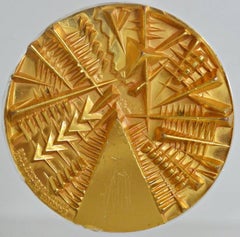
Double Sided Gold Plated Medallion (Limited Edition; Signed and Stamped)
By Arnaldo Pomodoro
Located in New York, NY
ARNALDO POMODORO Double Sided Gold Plated Medallion, 1985 Bronze with Gold Patina 2 7/10 × 2 7/10 × 3/10 inches Limited Edition of 500 Signed by artist with incised signature; Stampe...
Category

1980s Abstract Geometric Abstract Sculptures

Materials

Gold, Bronze

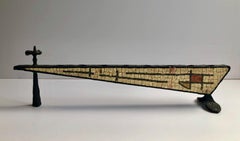
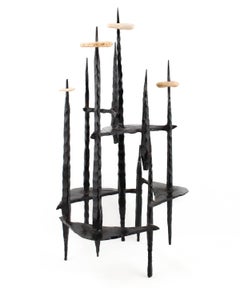
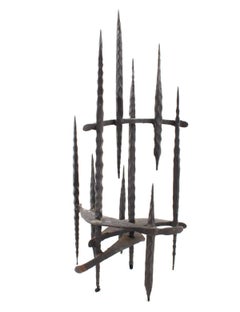
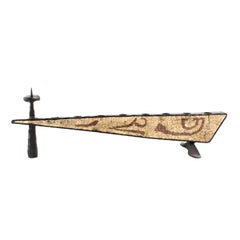
Brutalist Hand Forged Iron Mosaic Sculpture Menorah Israeli David Palombo
By David Palombo
Located in Surfside, FL
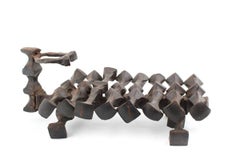
Hand Forged Iron Stone Mosaic Hanukah Menorah Candelabra David Palombo was an Israeli sculptor and painter. He was born in Turkey to a traditional family and immigrated to the Land of Israel with his parents in 1923. They lived in the Nahalat Shiva neighborhood of Jerusalem. In 1940 he began his studies at Bezalel Academy of Arts and Design, and from 1942 was a student of sculptor Ze’ev Ben-Zvi. For a period of time, Palombo was an assistant at Ben-Zvi’s studio and also taught at Bezalel. During this period he was also a member of the “Histadrut HaNoar HaOved VeHaLomed” (The General Federation of Students and Young Workers in Israel). In the 1940s he took art lessons at night. In 1948 he went to Paris, where he visited the studio of the sculptor Constantin Brancusi whose work influenced him. Around 1958 he married the artist Shulamit Sirota. In 1960 he quit his job to devote himself to art. In 1964 he married for the second time to the artist Yona Palombo. The two of them went to live in an abandoned home on Mount Zion in Jerusalem. In 1966 he was killed when the motorcycle on which he was riding ran into a chain stretched across the street to prevent the desecration of Shabbat. His widow opened a museum in their home that was active until the year 2000. Work by Palombo is included in the Judaic collection of the Jewish Museum (a well known Hanukkah menora). Palombo executed the impressive metal gates of the Tent of Remembrance at the Yad Vashem, the memorial to the martyrs of the holocaust, as well as the gates to the Knesset Building the United Nations Educational Scientific and Cultural Organization (Unesco award) awarded him a scholarship for study in Japan. He worked in marble, granite, bronze, iron and steel. as well as with glass mosaic tiles. Palombo’s early works, in the 1950s, were influenced by modernist sculptors such as Brancusi. These works were composed of abstract images from nature and were carved out of stone or wood. At the end of the 1950s he began making metal sculptors, using the technique of welding. His work took on a more abstract and expressive character. Education 1940 Painting with Isidor Ascheim, New Bezalel School for Arts and Crafts, Jerusalem 1942 Sculpture with Zeev Ben Zvi, Jerusalem 1956 Mosaic, Ravenna, Italy 1958 Welding Course Awards And Prizes 1966 UNESCO Award Exhibitions: Sculpture in Israel, 1948-1958 Mishkan Museum of Art, Kibbutz Ein Harod Artists: Zvi Aldouby, Yitzhak Danziger, Arieh Merzer, Dov Feigin, Aaron Priver, David Palumbo, Menashe Kadishman, Kosso Eloul, Yehiel Shemi, Zahara Schatz. The Spring Exhibition of Jerusalem Artists, Artists' House, Jerusalem Artists: Palombo, David Bezalel Schatz, Mordechai Levanon, Fima, Ludwig Blum 12 Artists, The Bezalel National Museum, Jerusalem Avraham Ofek, Aviva Uri, Avigdor Arikha, Yosl Bergner, Lea Nikel, Palombo, Ruth Zarfati...
Category

Mid-20th Century Arte Povera Abstract Sculptures

Materials

Stone, Iron

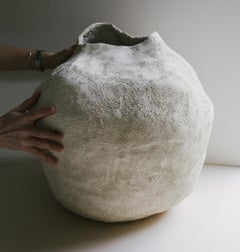
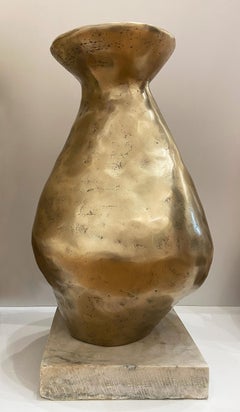
"Large Vessel" - abstract sculpture - Barbara Hepworth
By Susan Hable
Located in Atlanta, GA
Susan Hable is inspired by the work of David Hockney, Milton Avery, Henri Matisse, Alex Katz, Howard Hodgkins, Hilma af Klint, Georgia O'Keeffe, Barbara Hepworth and Constantin Brâncuși. With humor and a bit of mischief, Susan Hable’s “Don't Pick The Flowers!” is a body of work that is at once a refuge and a playground. Inspired by her sumptuous garden just outside of her Athens studio, Susan flows from one medium to the next from painting to collage to sculpture. Susan sees her garden as a place for adventure and daydreaming, challenging her perceptions of what her Art can be. Even a weedy ground cover has caught Susan’s eye, an overlooked invasive is seen in a new light becoming a dreamlike fairytale path. Her work asks us to engage in life, go for a walk and play. Susan Hable Smith is the artist and designer behind the boldly colored and hand drawn patterns of Hable Construction...
Category

2010s Abstract Abstract Sculptures

Materials

Stoneware

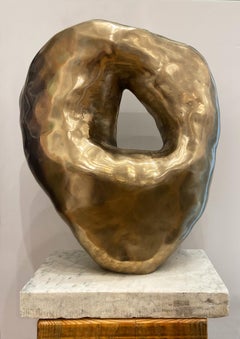
"Nimbus" - abstract sculpture - Barbara Hepworth
By Susan Hable
Located in Atlanta, GA
Susan Hable is inspired by the work of David Hockney, Milton Avery, Henri Matisse, Alex Katz, Howard Hodgkins, Hilma af Klint, Georgia O'Keeffe, Barbara Hepworth and Constantin Brâncuși. With humor and a bit of mischief, Susan Hable’s “Don't Pick The Flowers!” is a body of work that is at once a refuge and a playground. Inspired by her sumptuous garden just outside of her Athens studio, Susan flows from one medium to the next from painting to collage to sculpture. Susan sees her garden as a place for adventure and daydreaming, challenging her perceptions of what her Art can be. Even a weedy ground cover has caught Susan’s eye, an overlooked invasive is seen in a new light becoming a dreamlike fairytale path. Her work asks us to engage in life, go for a walk and play. Susan Hable Smith is the artist and designer behind the boldly colored and hand drawn patterns of Hable Construction...
Category

2010s Abstract Abstract Sculptures

Materials

Marble, Bronze

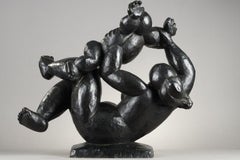
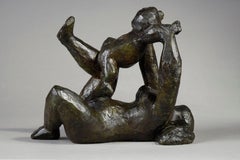
Mother and Child, with a base
By Baltasar Lobo
Located in PARIS, FR
Mother and Child, with a base by Baltasar LOBO (1910-1993) A bronze group with a dark brownish green patina Signed on the base " Lobo " Cast by " Susse Fondeur Paris " (with the fou...
Category

Mid-20th Century French School Figurative Sculptures

Materials

Bronze

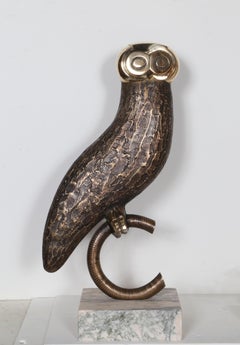
Owl on Perch, Modern Bronze by Antonovici 1949
By Constantin Antonovici
Located in Long Island City, NY
Antonovici was born in Neamt, Romania on February 18, 1911, and graduated from the Fine Arts Academy in Iasi, Romania, in 1939. In 1940, Antonovici studied in Zagreb with the famous ...
Category

1940s Modern Figurative Sculptures

Materials

Bronze

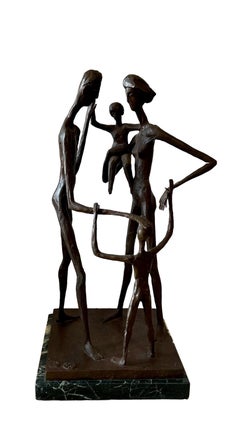
Large Modernist Bronze Abstract Figural Sculpture "Family" Wolfgang Behl
Located in Surfside, FL
This is a mid 20th century mod abstract large bronze sculpture by Wolfgang Behl (German/American, 1918-1994). The sculptural group titled "The Family" features a mother and father with two children. Numbered 20/20. Signed. 21" H x 10 1/4" x 10 1/4 Wolfgang (Johann Wolfgang) Behl (1918 - 1994) was active/lived in Connecticut, Illinois / Germany. Known for Sculpture and as an architectural carver. A carver,designer, and teacher, Wolfgang Behl was born in Berlin, Germany where he studied at the Berlin Academy of Fine Arts. His teacher was otto Hitzberger, sculptor and architecture carver. I have seen some his work, particularly in carved wood compared to Constantin Brancusi although this one seems way more reminiscent of Alberto Giacometti. In 1939, Behl came to the United States and taught briefly in Pennsylvania at the Perkiomen School and in Rhode Island at the Rhode Island School of Design. There in 1943, he won the Joseph N. Eisendrath prize for sculpture. He also became a friend of Louis Mayer, sculptor from Milwaukee. In 1944, Behl took a job as Art Director at the Lake Forest Academy in Lake Forest, Illinois, and he also began a one-year teaching assignment at the Layton School of Art in Milwaukee. The last years of his life until his death were in Hartford, Connecticut. Source: Peter C. Merrill, "German-Immigrant Artists in Early Milwaukee" Originally from Berlin, Germany, Mr. Behl immigrated to the United States in 1939 and became a citizen in 1947. He studied with Waldemar Raemisch at the Academy of Fine Arts in Berlin, and later at the Rhode Island School of Design. He began teaching at the Hartford Art School in 1955, retiring in 1983 to devote his time to sculpting. Mr. Behl had exhibitions throughout the United States and Germany. Some of his solo exhibitions include the Arts Exclusive in Simsbury from 1976 to 1981, and the Bertha Schaefer Gallery in New York City from 1950 to 1973. He showed at the New Britain Museum of American Art, in New Britain, Connecticut in 1969. He also had several retrospectives, including one at the Greater Hartford Jewish Community Center in West Hartford until the end of this month. His works in bronze have a German Expressionist quality to them a pathos found in the works of Kathe Kollwitz and the Expressionist movement. He was known for his classically inspired, but often surrealist sculpture. Among his most-well known pieces are a series of sculptures done for the University of Connecticut Health Center. Several examples of Behl’s work are found on the campus of the University of Hartford. He was included in the show Monumentality in Modern Sculpture at the Contemporary Arts Museum Houston, Texas, 1957. Artists featured in the exhibition: Kenneth Armitage, Hans Arp, Ernst Barlach, Wolfgang Behl, Dorothy Dehner, Edgar Degas, José de Rivera, Max Ernst, Alberto Giacometti, Joseph Glasco, Julio González, Paul Granlund...
Category

20th Century Expressionist Figurative Sculptures

Materials

Marble, Bronze

Eduardo Paolozzi: Fist plaster sculpture
By Sir Eduardo Paolozzi
Located in London, GB
To see our other Modern British Art, scroll down to "More from this Seller" and below it click on "See all from this Seller" - or send us a message if you cannot find the artist you ...
Category

1990s Modern Figurative Sculptures

Materials

Plaster

Untitled
By Antoine Poncet
Located in Columbia, MO
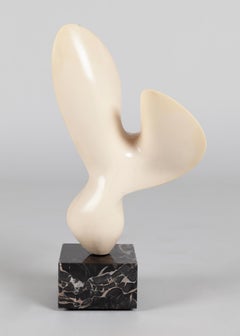
Antoine Poncet (French‑Swiss, 1928 - 2022) was a sculptor whose work belongs to the lineage of modern abstraction shaped by Jean Arp and Constantin Brâncuşi. Born in Paris into an ar...
Category

1960s Contemporary Abstract Sculptures

Materials

Alabaster, Marble

Vegetative Form / - Grown Art -
Located in Berlin, DE
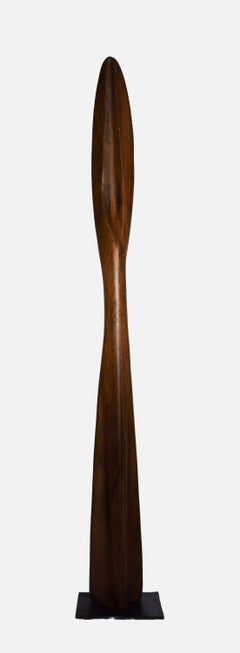
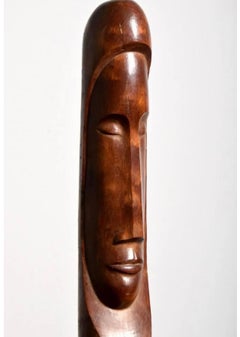
Paul Dierkes (1907 Cloppenburg - 1968 Berlin), Vegetative Form. Mahogany, 1958. 142 x 16 x 10 cm (sculpture), 21 x 17.5 cm (base), monogrammed "PD" on the reverse. - Grown Art - ...
Category

1950s Post-War Abstract Sculptures

Materials

Mahogany

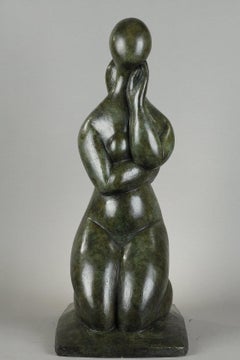
Pensive à genoux
By Baltasar Lobo
Located in PARIS, FR
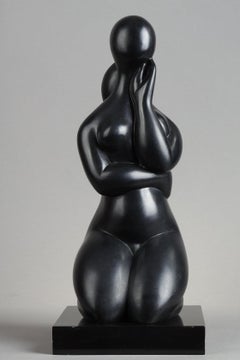
Baltasar LOBO (1910-1993) Pensive on her knees A bronze sculpture with a black patina Signed on the side " Lobo " Cast by " Susse Fondeur Paris " (with the foundry mark) Numbered " ...
Category

1970s French School Figurative Sculptures

Materials

Bronze

Alembic Cube (Study 1)
By Jonathan Prince
Located in Boca Raton, FL
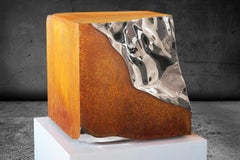
Jonathan Prince shapes stone and steel into elegant, expressive, abstract sculptures, drawing inspiration from the Modernist emphasis on materiality, form, and precision, and influen...
Category

21st Century and Contemporary Abstract Sculptures

Materials

Steel

Argentine Modernist Brutalist Abstract Bronze Sculpture Jewish Latin American
By Naum Knop
Located in Surfside, FL
Naum Knop (Ukrainian-Argentinean, 1917-1993) Modernist Brutalist bronze figural sculpture with heavy verdigris green finish. Melted forms in the shape of an abstract pretzel like twist. Affixed to white stone plinth. Artist signature, "NK" side of base. Good condition, shows rich green patina and aged oxidation. Measures approximately 17.5 in. x 19.5 in. x 6.5 in. Naum Knop, Argentine sculptor, was born in 1917 in Buenos Aires, into a Jewish family of Russian origin from Ukraine. His childhood was spent in the neighborhood of La Paternal where his father had a carpentry workshop, a space in which he made contact for the first time with the technique of wood carving. After finishing elementary school, he worked with the teacher Luis Fernández and soon after he dedicated himself to furniture design. Around 1935, he entered the Manuel Belgrano School of Fine Arts . Between 1941 and 1942 he attended the course for graduates taught by Alberto Lagos and Alfredo Bigatti at the National School of Fine Arts and continued his training between 1942-1945 at the Ernesto de la Cárcova High School with Soto Avedaño, Carlos de la Cárcova and José Fioravanti. At this time he put his works in dialogue with other young artists such as Libero Badii and Aurelio Macchi . Around 1947 he made his study trip abroad. He goes to California, United States, where he enters the Art Institute of Los Angeles. At the same time visit museums and galleries. In January 1948 he organized his first exhibition abroad, held at the Hall of Arts in Beverly Hills in Los Angeles. During this period he toured Chicago and then New York. That year he traveled to Europe; his itinerary includes France, Italy, Switzerland and England. As a result, he came into contact with the work of Henry Moore, Hans Jean Arp, Jacques Lipchitz, Constantin Brancusi, Umberto Boccioni, Henry Laurens, Ossip Zadkine. Artists who have an impact on the young Knop and whom he honors in his subsequent production. He returned to Argentina in 1949 and installed his workshop where he worked on ornamental carving and on pieces in which he oscillated between a synthetic figuration and abstraction. In 1956 he began his successful participation in salons , obtaining numerous awards at the national and municipal level. In 1959 he participated in the shipment to the 5th São Paulo Biennial and since then, to the success achieved at the local level, the multiple exhibitions carried out in the international field have been added. The exhibitions in Tel Aviv , Jerusalem and Rome (1966) stand out; Dusseldorf (1977); Los Angeles and Palm Spring (1981); New York (1986), San Pablo and Los Angeles(1989). During this period, his work matured, while he began to experiment with the direct wax technique, obtaining textured surfaces similar to welds that gave it a strong abstract expressionist feature. In parallel to his personal production and to the small models, the artist receives private and public commissions for which he works on large-scale sculptures and murals. Around 1967, the architect Mario R. Álvarez summons him to participate in a closed competition for the creation of a work to be located in the General San Martín Cultural Center . Libero Badii and Enio Iommi participate with the artist ; the bronze Reclining Figure Knop is chosen. Among the large-scale monuments it is worth remembering the piece Los tres soles temporarily located in Recoleta in 1984 and later installed in Maryland, United States; as well as Seated Figure (Reminiscence of Michelangelo) located in the shield of a private building in 1970. To these are added the numerous murals in which he experiments with various materials and techniques such as casting in bronze, openwork and reliefs in wood and work in cement. He was included in the The 1962 International Prize for Sculpture the jury included Argan, Romero Brest and James Johnson Sweeney the former director of the Solomon R. Guggenheim Museum in New York. The participants included Louise Nevelson and John Chamberlain for the United States; Lygia Clark for Brazil; Pietro Consagra, Lucio Fontana, Nino Franchina, and Gió Pomodoro for Italy; Pablo Serrano for Spain; and Eduardo Paolozzi, William Turnbull, and Kenneth Armitage for England. Gyula Kosice, Noemí Gerstein, Julio Gero, Naum Knop, Aldo Paparella, Enrique Romano, Eduardo Sabelli, and Luis Alberto...
Category

Mid-20th Century Abstract Abstract Sculptures

Materials

Stone, Bronze

Motherhood
By Baltasar Lobo
Located in PARIS, FR
Motherhood by Baltasar LOBO (1910-1993) A bronze group with a nuanced greenish dark brown patina Signed " Lobo " Cast by " Susse Fondeur Paris " (with the foundry mark) Artist's cas...
Category

1940s French School Nude Sculptures

Materials

Bronze

Pensive à genoux
By Baltasar Lobo
Located in PARIS, FR
"Pensive à genoux, 2nd état" by Baltasar LOBO (1910-1993) A bronze sculpture with a brownish green patina Signed on the base " Lobo " Cast by " Susse Fondeur Paris " (with the found...
Category

20th Century French School Figurative Sculptures

Materials

Bronze

Mid Century Brutalist Iron, Stone Sculpture, Israeli Master David Palombo
By David Palombo
Located in Surfside, FL
Hand Forged Iron and Drilled Stone Candelabra Holocaust Memorial Judaic Menorah Sculpture David Palombo was an Israeli sculptor and painter. He was born in Turkey to a traditional family and immigrated to the Land of Israel with his parents in 1923. They lived in the Nahalat Shiva neighborhood of Jerusalem. In 1940 he began his studies at Bezalel Academy of Arts and Design, and from 1942 was a student of sculptor Ze’ev Ben-Zvi. For a period of time, Palombo was an assistant at Ben-Zvi’s studio and also taught at Bezalel. During this period he was also a member of the “Histadrut HaNoar HaOved VeHaLomed” (The General Federation of Students and Young Workers in Israel). In the 1940s he took art lessons at night. In 1948 he went to Paris, where he visited the studio of the sculptor Constantin Brancusi whose work influenced him. Around 1958 he married the artist Shulamit Sirota. In 1960 he quit his job to devote himself to art. In 1964 he married for the second time to the artist Yona Palombo. The two of them went to live in an abandoned home on Mount Zion in Jerusalem. In 1966 he was killed when the motorcycle on which he was riding ran into a chain stretched across the street to prevent the desecration of Shabbat. His widow opened a museum in their home that was active until the year 2000. Work by Palombo is included in the Judaic collection of the Jewish Museum (a well known Hanukkah menora). Palombo executed the impressive metal gates of the Tent of Remembrance at the Yad Vashem, the memorial to the martyrs of the holocaust, as well as the gates to the Knesset Building the United Nations Educational Scientific and Cultural Organization (Unesco award) awarded him a scholarship for study in Japan. He worked in marble, granite, bronze, iron and steel. as well as with glass mosaic tiles. Palombo’s early works, in the 1950s, were influenced by modernist sculptors such as Brancusi. These works were composed of abstract images from nature and were carved out of stone or wood. At the end of the 1950s he began making metal sculptors, using the technique of welding. His work took on a more abstract and expressive character. Education 1940 Painting with Isidor Ascheim, New Bezalel School for Arts and Crafts, Jerusalem 1942 Sculpture with Zeev Ben Zvi, Jerusalem 1956 Mosaic, Ravenna, Italy 1958 Welding Course Awards And Prizes 1966 UNESCO Award Exhibitions: Sculpture in Israel, 1948-1958 Mishkan Museum of Art, Kibbutz Ein Harod Artists: Zvi Aldouby, Yitzhak Danziger, Arieh Merzer, Dov Feigin, Aaron Priver, David Palumbo, Menashe Kadishman, Kosso Eloul, Yehiel Shemi, Zahara Schatz. The Spring Exhibition of Jerusalem Artists, Artists' House, Jerusalem Artists: Palombo, David Bezalel Schatz, Mordechai Levanon, Fima, Ludwig Blum 12 Artists, The Bezalel National Museum, Jerusalem Avraham Ofek, Aviva Uri, Avigdor Arikha, Yosl Bergner, Lea Nikel, Palombo, Ruth Zarfati, General Exhibition, Art in Israel 1960 Tel Aviv Museum of Art Artists: Naftali Bezem, Nachum Gutman, Shraga Weil, Shraga, Marcel Janco, Ruth Schloss
Category

Mid-20th Century Arte Povera Abstract Sculptures

Materials

Stone, Iron

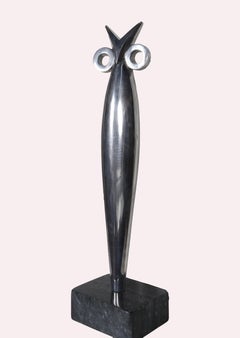
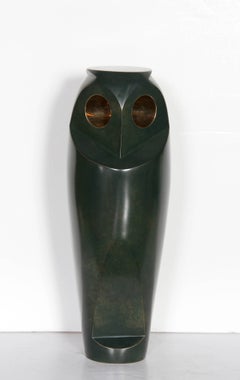
Owl, Modern Aluminum Sculpture by Antonovici 1958
By Constantin Antonovici
Located in Long Island City, NY
An original bronze sculpture by Constantin Antonovici from his Owl Series. Referenced in "Constantin Antonovici: Sculptor of Owls", pg 50. Antonovici was born in Neamt, Romania on February 18, 1911, and graduated from the Fine Arts Academy in Iasi, Romania, in 1939. In 1940, Antonovici studied in Zagreb with the famous Croatian sculptor Ivan Mestrovici, until his arrest by Italian fascists. Antonovici himself survived imprisonment in Germany for his refusal to fight on the side of the Nazis. After the war, he continued his studies in Vienna, under the tutelage of Professor Fritz Behn...
Category

1950s Modern Figurative Sculptures

Materials

Metal

Cuban Master Florencio Gelabert Sculpture Large Wood Carving Bust Man Portrait
Located in Surfside, FL
Florencio Gelabert Y Perez (Cuban, 1904-1995) Hand carved, signed; 1979 Materials: Cuban wood (mahogany?) Dimensions 23 X 4 X 4 inches Label affixed to underside: National Registry of Cultural Assets of the Republic of Cuba Ministry of Culture. Provenance: Art Master Collection, Miami, Florida. Florencio Gelabert, with a style reminiscent of Art Deco and Art Nouveau in a Latin American Expressionist stylization. Carved wood sculpture. Depicts a modernist stylized form of a man in a streamline moderne style. José Florencio Gelabert Pérez (Caibarien, 1904 - Havana, 1995) Cuban musician, sculptor, draftsman and teacher. He graduated from the San Alejandro National Academy of Fine Arts in 1934. He received numerous awards, mentions and recognitions in Fine Arts Halls and Circles. His works are in the permanent collection of the National Museum of Fine Arts. Florencio Gelabert is a renowned sculptor, who made more than twenty solo exhibitions beginning in 1929, several in the National Museum of Fine Arts, and participated in more than thirty collectives in Cuba, Spain and Brazil, the latter in the Sao Paulo Biennial. he traveled from Caibarién to Santa Clara in 1928 to audition to enter the famous San Alejandro Fine Arts School in Havana. He obtained one of the five vacancies. Already in the Cuban capital, he combined fine arts and music. When he graduated, he became a professor in San Alejandro and the academy’s principal in 1960. With a calling common to wood sculptors –which began with his primary school carving carpentry classes and the active life of his home town’s shipyards, his chisels and gouges feverishly turned mahogany, “ácana” and ebony into female heads with black African features dating back to 1930. In 1938 he used his savings to explore Europe: France (Paris, Marseilles), Italy (Naples, Rome, Florence, and Venice), Belgium (Malina). His encounter with the works by Aristide Maillol, Auguste Rodin, Ossip Zadkine, Constantin Brancusi and even with Wifredo Lam, who was also born in another Cuban coastal area, Sagua la Grande, and his encounter with the nude marble David sculpture...
Category

1970s Art Deco Figurative Sculptures

Materials

Wood

Modernist Hand Forged Iron Mosaic Sculpture Animal Ram Israeli David Palombo
By David Palombo
Located in Surfside, FL
Heavy Hand Forged Brutalist Iron Ram or Goat Sculpture David Palombo was an Israeli sculptor and painter. He was born in Turkey to a traditional family and immigrated to the Land of Israel with his parents in 1923. They lived in the Nahalat Shiva neighborhood of Jerusalem. In 1940 he began his studies at Bezalel Academy of Arts and Design, and from 1942 was a student of sculptor Ze’ev Ben-Zvi. For a period of time, Palombo was an assistant at Ben-Zvi’s studio and also taught at Bezalel. During this period he was also a member of the “Histadrut HaNoar HaOved VeHaLomed” (The General Federation of Students and Young Workers in Israel). In the 1940s he took art lessons at night. In 1948 he went to Paris, where he visited the studio of the sculptor Constantin Brancusi whose work influenced him. Around 1958 he married the artist Shulamit Sirota. In 1960 he quit his job to devote himself to art. In 1964 he married for the second time to the artist Yona Palombo. The two of them went to live in an abandoned home on Mount Zion in Jerusalem. In 1966 he was killed when the motorcycle on which he was riding ran into a chain stretched across the street to prevent the desecration of Shabbat. His widow opened a museum in their home that was active until the year 2000. Work by Palombo is included in the Judaic collection of the Jewish Museum (a well known Hanukkah menora). Palombo executed the impressive metal gates of the Tent of Remembrance at the Yad Vashem, the memorial to the martyrs of the holocaust, as well as the gates to the Knesset Building the United Nations Educational Scientific and Cultural Organization (Unesco award) awarded him a scholarship for study in Japan. He worked in marble, granite, bronze, iron and steel. as well as with glass mosaic tiles. Palombo’s early works, in the 1950s, were influenced by modernist sculptors such as Brancusi. These works were composed of abstract images from nature and were carved out of stone or wood. At the end of the 1950s he began making metal sculptors, using the technique of welding. His work took on a more abstract and expressive character. Education 1940 Painting with Isidor Ascheim, New Bezalel School for Arts and Crafts, Jerusalem 1942 Sculpture with Zeev Ben Zvi, Jerusalem 1956 Mosaic, Ravenna, Italy 1958 Welding Course Awards And Prizes 1966 UNESCO Award Exhibitions: Sculpture in Israel, 1948-1958 Mishkan Museum of Art, Kibbutz Ein Harod Artists: Zvi Aldouby, Yitzhak Danziger, Arieh Merzer, Dov Feigin, Aaron Priver, David Palumbo, Menashe Kadishman, Kosso Eloul, Yehiel Shemi, Zahara Schatz. The Spring Exhibition of Jerusalem Artists, Artists' House, Jerusalem Artists: Palombo, David Bezalel Schatz, Mordechai Levanon, Fima, Ludwig Blum 12 Artists, The Bezalel National Museum, Jerusalem Avraham Ofek, Aviva Uri, Avigdor Arikha, Yosl Bergner, Lea Nikel, Palombo, Ruth Zarfati, General Exhibition, Art in Israel 1960 Tel Aviv Museum of Art Artists: Naftali Bezem, Nachum Gutman, Shraga Weil, Shraga, Marcel Janco, Ruth Schloss
Category

Mid-20th Century Arte Povera Abstract Sculptures

Materials

Iron

Small Bronze Sculpture Cast Head After Rodin "Petite tete au nez retrousse"
By Auguste Rodin
Located in Surfside, FL
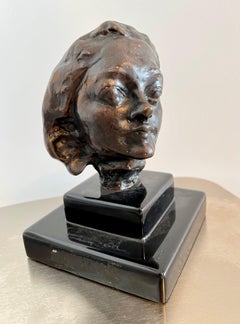
(after) Auguste Rodin Posthumous cast "Petite tete au nez retroussé" Featuring a bust of a woman. Limited edition bronze is mounted on a marble base and is signed on the lower right. Great detail. Dimensions: approx. 7-1/4" tall x 5" across x 5" deep with base Foundry mark on the reverse, #13 of 299 produced. François Auguste René Rodin (1840 – 1917) was a French sculptor generally considered the founder of modern sculpture. Rodin possessed a unique ability to model a complex, turbulent, and deeply pocketed surface in clay. He is known for such sculptures as The Thinker, Monument to Balzac, The Kiss, The Burghers of Calais, and The Gates of Hell. He modeled the human body with naturalism, and his sculptures celebrate individual character and physicality. Although Rodin was sensitive to the controversy surrounding his work, he refused to change his style, and his continued output brought increasing favor from the government and the artistic community. Rodin became the preeminent French sculptor of his time. By 1900, he was a world-renowned artist. Wealthy private clients sought Rodin's work after his World's Fair exhibit, and he kept company with a variety of high-profile intellectuals and artists. His student, Camille Claudel, became his associate, lover, and creative rival. Rodin's other students included Antoine Bourdelle, Constantin Brancusi, and Charles Despiau. Rodin entered the studio of Albert-Ernest Carrier-Belleuse, a successful mass producer of objets d'art. Rodin worked as Carrier-Belleuse' chief assistant until 1870, designing roof decorations and staircase and doorway embellishments. With the arrival of the Franco-Prussian War, Rodin was called to serve in the French National Guard, but his service was brief due to his near-sightedness. Rodin took classes with animal sculptor Antoine-Louis Barye. The teacher's attention to detail and his finely rendered musculature of animals in motion significantly influenced Rodin. Rodin won the 1880 commission to create a portal for a planned museum of decorative arts. Rodin dedicated much of the next four decades to his elaborate Gates of Hell, an unfinished portal for a museum that was never built. Many of the portal's figures became sculptures in themselves, including Rodin's most famous, The Thinker and The Kiss. With the museum commission came a free studio, granting Rodin a new level of artistic freedom. By 1900, Rodin's artistic reputation was established. Gaining exposure from a pavilion of his artwork set up near the 1900 World's Fair (Exposition Universelle) in Paris, he received requests to make busts of prominent people internationally, As Rodin's fame grew, he attracted many followers, including the German poet Rainer Maria Rilke, and authors Octave Mirbeau, Joris-Karl Huysmans, and Oscar Wilde. Rodin and Beuret's modest country estate in Meudon, purchased in 1897, was a host to such guests as King Edward, dancer Isadora Duncan, and harpsichordist Wanda Landowska. He left Beuret in Meudon and began an affair with the American-born Duchesse de Choiseul. From 1910, he mentored the Russian sculptor, Moissey Kogan...
Category

20th Century Modern Figurative Sculptures

Materials

Bronze

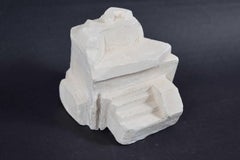
Eduardo Paolozzi: Steps plaster sculpture
By Sir Eduardo Paolozzi
Located in London, GB
To see our other Modern British Art, scroll down to "More from this Seller" and below it click on "See all from this Seller" - or send us a message if you cannot find the artist you ...
Category

1990s Modern Figurative Sculptures

Materials

Plaster

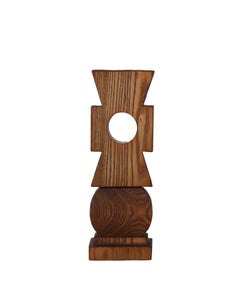
Mid Century Brutalist Iron Sculpture, Israeli Master David Palombo
By David Palombo
Located in Surfside, FL
Hand Forged Iron Candelabra Holocaust Memorial Judaic Menorah Sculpture David Palombo was an Israeli sculptor and painter. He was born in Turkey to a traditional family and immigrated to the Land of Israel with his parents in 1923. They lived in the Nahalat Shiva neighborhood of Jerusalem. In 1940 he began his studies at Bezalel Academy of Arts and Design, and from 1942 was a student of sculptor Ze’ev Ben-Zvi. For a period of time, Palombo was an assistant at Ben-Zvi’s studio and also taught at Bezalel. During this period he was also a member of the “Histadrut HaNoar HaOved VeHaLomed” (The General Federation of Students and Young Workers in Israel). In the 1940s he took art lessons at night. In 1948 he went to Paris, where he visited the studio of the sculptor Constantin Brancusi whose work influenced him. Around 1958 he married the artist Shulamit Sirota. In 1960 he quit his job to devote himself to art. In 1964 he married for the second time to the artist Yona Palombo. The two of them went to live in an abandoned home on Mount Zion in Jerusalem. In 1966 he was killed when the motorcycle on which he was riding ran into a chain stretched across the street to prevent the desecration of Shabbat. His widow opened a museum in their home that was active until the year 2000. Work by Palombo is included in the Judaic collection of the Jewish Museum (a well known Hanukkah menora). Palombo executed the impressive metal gates of the Tent of Remembrance at the Yad Vashem, the memorial to the martyrs of the holocaust, as well as the gates to the Knesset Building the United Nations Educational Scientific and Cultural Organization (Unesco award) awarded him a scholarship for study in Japan. He worked in marble, granite, bronze, iron and steel. as well as with glass mosaic tiles. Palombo’s early works, in the 1950s, were influenced by modernist sculptors such as Brancusi. These works were composed of abstract images from nature and were carved out of stone or wood. At the end of the 1950s he began making metal sculptors, using the technique of welding. His work took on a more abstract and expressive character. Education 1940 Painting with Isidor Ascheim, New Bezalel School for Arts and Crafts, Jerusalem 1942 Sculpture with Zeev Ben Zvi, Jerusalem 1956 Mosaic, Ravenna, Italy 1958 Welding Course Awards And Prizes 1966 UNESCO Award Exhibitions: Sculpture in Israel, 1948-1958 Mishkan Museum of Art, Kibbutz Ein Harod Artists: Zvi Aldouby, Yitzhak Danziger, Arieh Merzer, Dov Feigin, Aaron Priver, David Palumbo, Menashe Kadishman, Kosso Eloul, Yehiel Shemi, Zahara Schatz. The Spring Exhibition of Jerusalem Artists, Artists' House, Jerusalem Artists: Palombo, David Bezalel Schatz, Mordechai Levanon, Fima, Ludwig Blum 12 Artists, The Bezalel National Museum, Jerusalem Avraham Ofek, Aviva Uri, Avigdor Arikha, Yosl Bergner, Lea Nikel, Palombo, Ruth Zarfati, General Exhibition, Art in Israel 1960 Tel Aviv Museum of Art Artists: Naftali Bezem, Nachum Gutman, Shraga Weil, Shraga, Marcel Janco, Ruth Schloss
Category

Mid-20th Century Arte Povera Abstract Sculptures

Materials

Iron

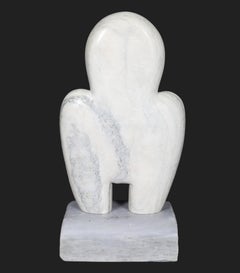
Girl Torso, Modern Marble Sculpture by Antonovici
By Constantin Antonovici
Located in Long Island City, NY
An original carved marble sculpture by Constantin Antonovici from his Torso Series. Referenced in "Constantin Antonovici: Sculptor of Owls", pg 79 Antonovici was born in Neamt, Romania on February 18, 1911, and graduated from the Fine Arts Academy in Iasi, Romania, in 1939. In 1940, Antonovici studied in Zagreb with the famous Croatian sculptor Ivan Mestrovici, until his arrest by Italian fascists. Antonovici himself survived imprisonment in Germany for his refusal to fight on the side of the Nazis. After the war, he continued his studies in Vienna, under the tutelage of Professor Fritz Behn...
Category

1950s Modern Figurative Sculptures

Materials

Marble

Owl III, Patinated Bronze Sculpture by Antonovici
By Constantin Antonovici
Located in Long Island City, NY
Antonovici was born in Neamt, Romania on February 18, 1911, and graduated from the Fine Arts Academy in Iasi, Romania, in 1939. In 1940, Antonovici studied in Zagreb with the famous Croatian sculptor Ivan Mestrovici, until his arrest by Italian fascists...
Category

1940s Modern Figurative Sculptures

Materials

Bronze

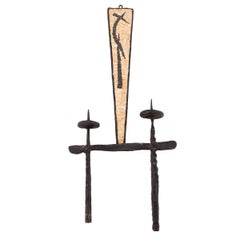
Brutalist Hand Forged Iron Mosaic Sculpture Wall Sconce Israeli David Palombo
By David Palombo
Located in Surfside, FL
Hand Forged Iron Stone Mosaic Pricket Sconce Candelabra Holocaust Memorial Judaic Wall Sconce Sculpture David Palombo was an Israeli sculptor and painter. He was born in Turkey to a traditional family and immigrated to the Land of Israel with his parents in 1923. They lived in the Nahalat Shiva neighborhood of Jerusalem. In 1940 he began his studies at Bezalel Academy of Arts and Design, and from 1942 was a student of sculptor Ze’ev Ben-Zvi. For a period of time, Palombo was an assistant at Ben-Zvi’s studio and also taught at Bezalel. During this period he was also a member of the “Histadrut HaNoar HaOved VeHaLomed” (The General Federation of Students and Young Workers in Israel). In the 1940s he took art lessons at night. In 1948 he went to Paris, where he visited the studio of the sculptor Constantin Brancusi whose work influenced him. Around 1958 he married the artist Shulamit Sirota. In 1960 he quit his job to devote himself to art. In 1964 he married for the second time to the artist Yona Palombo. The two of them went to live in an abandoned home on Mount Zion in Jerusalem. In 1966 he was killed when the motorcycle on which he was riding ran into a chain stretched across the street to prevent the desecration of Shabbat. His widow opened a museum in their home that was active until the year 2000. Work by Palombo is included in the Judaic collection of the Jewish Museum (a well known Hanukkah menora). Palombo executed the impressive metal gates of the Tent of Remembrance at the Yad Vashem, the memorial to the martyrs of the holocaust, as well as the gates to the Knesset Building the United Nations Educational Scientific and Cultural Organization (Unesco award) awarded him a scholarship for study in Japan. He worked in marble, granite, bronze, iron and steel. as well as with glass mosaic tiles. Palombo’s early works, in the 1950s, were influenced by modernist sculptors such as Brancusi. These works were composed of abstract images from nature and were carved out of stone or wood. At the end of the 1950s he began making metal sculptors, using the technique of welding. His work took on a more abstract and expressive character. Education 1940 Painting with Isidor Ascheim, New Bezalel School for Arts and Crafts, Jerusalem 1942 Sculpture with Zeev Ben Zvi, Jerusalem 1956 Mosaic, Ravenna, Italy 1958 Welding Course Awards And Prizes 1966 UNESCO Award Exhibitions: Sculpture in Israel, 1948-1958 Mishkan Museum of Art, Kibbutz Ein Harod Artists: Zvi Aldouby, Yitzhak Danziger, Arieh Merzer, Dov Feigin, Aaron Priver, David Palumbo, Menashe Kadishman, Kosso Eloul, Yehiel Shemi, Zahara Schatz. The Spring Exhibition of Jerusalem Artists, Artists' House, Jerusalem Artists: Palombo, David Bezalel Schatz, Mordechai Levanon, Fima, Ludwig Blum 12 Artists, The Bezalel National Museum, Jerusalem Avraham Ofek, Aviva Uri, Avigdor Arikha, Yosl Bergner, Lea Nikel, Palombo, Ruth Zarfati, General Exhibition, Art in Israel 1960 Tel Aviv Museum of Art Artists: Naftali Bezem, Nachum Gutman, Shraga Weil, Shraga, Marcel Janco, Ruth Schloss
Category

Mid-20th Century Arte Povera Abstract Sculptures

Materials

Iron

Modern Cross, Hand-Carved Wooden Sculpture by Antonovici c1950
By Constantin Antonovici
Located in Long Island City, NY
Romania-born Antonovici is best-known as Constantin Brancusi’s protege. He worked closely with the master sculptor in his studio until he emigrated to the USA in 1953. Modern Cross,...
Category

Mid-20th Century Modern Abstract Sculptures

Materials

Wood

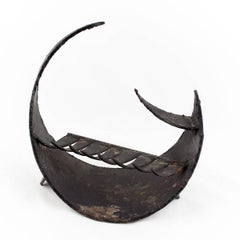
Brutalist Forged Iron Circular Menorah Sculpture Israeli Master David Palombo
By David Palombo
Located in Surfside, FL
Hand Forged Iron Candelabra Holocaust Memorial Judaic Menorah Sculpture David Palombo was an Israeli sculptor and painter. He was born in Turkey to a traditional family and immigrated to the Land of Israel with his parents in 1923. They lived in the Nahalat Shiva neighborhood of Jerusalem. In 1940 he began his studies at Bezalel Academy of Arts and Design, and from 1942 was a student of sculptor Ze’ev Ben-Zvi. For a period of time, Palombo was an assistant at Ben-Zvi’s studio and also taught at Bezalel. During this period he was also a member of the “Histadrut HaNoar HaOved VeHaLomed” (The General Federation of Students and Young Workers in Israel). In the 1940s he took art lessons at night. In 1948 he went to Paris, where he visited the studio of the sculptor Constantin Brancusi whose work influenced him. Around 1958 he married the artist Shulamit Sirota. In 1960 he quit his job to devote himself to art. In 1964 he married for the second time to the artist Yona Palombo. The two of them went to live in an abandoned home on Mount Zion in Jerusalem. In 1966 he was killed when the motorcycle on which he was riding ran into a chain stretched across the street to prevent the desecration of Shabbat. His widow opened a museum in their home that was active until the year 2000. Work by Palombo is included in the Judaic collection of the Jewish Museum (a well known Hanukkah menora). Palombo executed the impressive metal gates of the Tent of Remembrance at the Yad Vashem, the memorial to the martyrs of the holocaust, as well as the gates to the Knesset Building the United Nations Educational Scientific and Cultural Organization (Unesco award) awarded him a scholarship for study in Japan. He worked in marble, granite, bronze, iron and steel. as well as with glass mosaic tiles. Palombo’s early works, in the 1950s, were influenced by modernist sculptors such as Brancusi. These works were composed of abstract images from nature and were carved out of stone or wood. At the end of the 1950s he began making metal sculptors, using the technique of welding. His work took on a more abstract and expressive character. Education 1940 Painting with Isidor Ascheim, New Bezalel School for Arts and Crafts, Jerusalem 1942 Sculpture with Zeev Ben Zvi, Jerusalem 1956 Mosaic, Ravenna, Italy 1958 Welding Course Awards And Prizes 1966 UNESCO Award Exhibitions: Sculpture in Israel, 1948-1958 Mishkan Museum of Art, Kibbutz Ein Harod Artists: Zvi Aldouby, Yitzhak Danziger, Arieh Merzer, Dov Feigin, Aaron Priver, David Palumbo, Menashe Kadishman, Kosso Eloul, Yehiel Shemi, Zahara Schatz. The Spring Exhibition of Jerusalem Artists, Artists' House, Jerusalem Artists: Palombo, David Bezalel Schatz, Mordechai Levanon, Fima, Ludwig Blum 12 Artists, The Bezalel National Museum, Jerusalem Avraham Ofek, Aviva Uri, Avigdor Arikha, Yosl Bergner, Lea Nikel, Palombo, Ruth Zarfati, General Exhibition, Art in Israel 1960 Tel Aviv Museum of Art Artists: Naftali Bezem, Nachum Gutman, Shraga Weil, Shraga, Marcel Janco, Ruth Schloss
Category

Mid-20th Century Arte Povera Abstract Sculptures

Materials

Iron

Girl Seated a la Japonaise Bronze Sculpture Morris Singer Foundry.
By Helaine Blumenfeld
Located in Surfside, FL
Girl Seated a la Japonaise, 1964, polished bronze. It was exhibited at The Chapman Gallery NYC in 1968. Cast at Morris Singer Foundry and numbered 4/6 signed with the artists monogram. Helaine Blumenfeld OBE (born, New York 1942) is an American Sculptor working in Britain and Italy, best known as an artist who has pioneered new methods of carving in stone and for her semi-abstract marble, granite and bronze sculptures which are located around the world as Public art. Her forms are often abstractions of human forms and of elements in nature. She is widely recognized as the most significant sculptor of her generation and "the heir apparent to HenryMoore and Barbara Hepworth." In 1973, Blumenfeld, who had recently moved to England, exhibited at Kettle's Yard in Cambridge England. These early sculptures, which were mostly cast in bronze were largely figurative work in the tradition of sculptors such as Constantin Brâncuși, Jacob Epstein, Jean Arp, Henri Gaudier-Brzeska, Henry Moore and of course her one time teacher Ossip Zadkine. In 1985, the Alex Rosenberg Gallery in New York showed her sculpture in dialogue with Henry Moore In 1978, Blumenfeld's first visit to Pietrasanta in Italy marked a turning point in her work as she started carving in marble, mostly at Studio Sem, founded in the 1950s by Sem Ghelardini (1927-1997) who gained international notoriety producing the large scale works of Henry Moore, César Baldaccini, Emile Gilioli, Joan Mirò, Georges Adam and many other celebrated sculptors during the first wave of modern abstract sculpture in the 1960s. Throughout the 1980s and 1990s Blumenfeld's sculpture, now less clearly figurative but still often of portraying couples and family units in multiple configurations, was exhibited at the Bonino Gallery in New York and in solo and group shows around the world. A member of the Visual Arts Panel of the Arts Council of Great Britain between 1981 and 1988, Blumenfeld was elected a member of the Royal British Society of Sculptors in 1993. Blumenfeld has created over 80 large scale sculptures in bronze, granite, marble and steel in Europe and the United States for private and public clients, including the British Petroleum headquarters in London, the Lincoln Center in New York the Cass Sculpture Foundation at Goodwood and Family (Blumenfeld) at the Henry Reuss Plaza in Milwaukee and The Lancasters at Lancaster Gate in London. At Cambridge University, her sculpture has been commissioned by Clare Hall (Flame, 2004) and Newnham College (Esprit, 2004) as well as public sites around the city, such as at the corner of Brookland’s Avenue and Hills Road (Chauvinist) and at Vision Park, Histon (Shadow Figures.) In 2012 her work was exhibited by the Fitzwilliam Museum along with work by Peter Randall-Page and Kan Yasuda...
Category

1960s Abstract Sculptures

Materials

Bronze

Brutalist Hand Forged Iron Mosaic Sculpture Menorah Israeli David Palombo
By David Palombo
Located in Surfside, FL
Hand Forged Iron Stone Mosaic Hanukah Menorah Candelabra David Palombo was an Israeli sculptor and painter. He was born in Turkey to a traditional family and immigrated to the Land of Israel with his parents in 1923. They lived in the Nahalat Shiva neighborhood of Jerusalem. In 1940 he began his studies at Bezalel Academy of Arts and Design, and from 1942 was a student of sculptor Ze’ev Ben-Zvi. For a period of time, Palombo was an assistant at Ben-Zvi’s studio and also taught at Bezalel. During this period he was also a member of the “Histadrut HaNoar HaOved VeHaLomed” (The General Federation of Students and Young Workers in Israel). In the 1940s he took art lessons at night. In 1948 he went to Paris, where he visited the studio of the sculptor Constantin Brancusi whose work influenced him. Around 1958 he married the artist Shulamit Sirota. In 1960 he quit his job to devote himself to art. In 1964 he married for the second time to the artist Yona Palombo. The two of them went to live in an abandoned home on Mount Zion in Jerusalem. In 1966 he was killed when the motorcycle on which he was riding ran into a chain stretched across the street to prevent the desecration of Shabbat. His widow opened a museum in their home that was active until the year 2000. Work by Palombo is included in the Judaic collection of the Jewish Museum (a well known Hanukkah menora). Palombo executed the impressive metal gates of the Tent of Remembrance at the Yad Vashem, the memorial to the martyrs of the holocaust, as well as the gates to the Knesset Building the United Nations Educational Scientific and Cultural Organization (Unesco award) awarded him a scholarship for study in Japan. He worked in marble, granite, bronze, iron and steel. as well as with glass mosaic tiles. Palombo’s early works, in the 1950s, were influenced by modernist sculptors such as Brancusi. These works were composed of abstract images from nature and were carved out of stone or wood. At the end of the 1950s he began making metal sculptors, using the technique of welding. His work took on a more abstract and expressive character. Education 1940 Painting with Isidor Ascheim, New Bezalel School for Arts and Crafts, Jerusalem 1942 Sculpture with Zeev Ben Zvi, Jerusalem 1956 Mosaic, Ravenna, Italy 1958 Welding Course Awards And Prizes 1966 UNESCO Award Exhibitions: Sculpture in Israel, 1948-1958 Mishkan Museum of Art, Kibbutz Ein Harod Artists: Zvi Aldouby, Yitzhak Danziger, Arieh Merzer, Dov Feigin, Aaron Priver, David Palumbo, Menashe Kadishman, Kosso Eloul, Yehiel Shemi, Zahara Schatz. The Spring Exhibition of Jerusalem Artists, Artists' House, Jerusalem Artists: Palombo, David Bezalel Schatz, Mordechai Levanon, Fima, Ludwig Blum 12 Artists, The Bezalel National Museum, Jerusalem Avraham Ofek, Aviva Uri, Avigdor Arikha, Yosl Bergner, Lea Nikel, Palombo, Ruth Zarfati, General Exhibition, Art in Israel 1960 Tel Aviv Museum of Art Artists: Naftali Bezem, Nachum Gutman, Shraga Weil...
Category

Mid-20th Century Arte Povera Abstract Sculptures

Materials

Iron

“Mother and Child” Biomorphic Modern Abstract Sculpture of Embracing Figures
Located in Houston, TX
Biomorphic abstract sculpture by Canadian artist John McKinnon. The work features a mother figure holding her child in a loving embrace. Inspired by other modern artists such as Henr...
Category

1980s Abstract Figurative Sculptures

Materials

Marble, Alabaster

Queen of Owls, Modern Marble Sculpture by Antonovici
By Constantin Antonovici
Located in Long Island City, NY
An original carved marble sculpture by Constantin Antonovici from his Owl Series. Referenced in "Constantin Antonovici: Sculptor of Owls", pg 51. signature and date inscribed verso. ...
Category

1970s Modern Figurative Sculptures

Materials

Marble

Itzik Benshalom Israeli Bronze Sculpture Homage to Henry Moore Couple of Lovers
By Itzik Ben Shalom
Located in Surfside, FL
Itzik Benshalom (Israeli, 1945-2018) Lovers Mounted on black plinth base This is not hand signed or numbered and might be a maquette for a larger work. Material is bronze or brass Dimensions: 14"h x 11.5"w x 5"d Provenance: Newel Antiques...
Category

20th Century Figurative Sculptures

Materials

Bronze

Eduardo Paolozzi: Construction plaster sculpture
By Sir Eduardo Paolozzi
Located in London, GB
To see our other Modern British Art, scroll down to "More from this Seller" and below it click on "See all from this Seller" - or send us a message if you cannot find the artist you ...
Category

1990s Modern Figurative Sculptures

Materials

Plaster

Hippie, Modern Bronze by Antonovici 1971
By Constantin Antonovici
Located in Long Island City, NY
Artist: Constantin Antonovici, Romanian (1911 - 2002) Title: Hippie - Woman Medium: Bronze Sculpture, signature, date inscribed Size: 21 x 11 x 1.25 in. (53.34 x 27.94 x 3.18 cm) Marble Base: 2.5 x 9.5 x 6 inches An original bronze sculpture by Constantin Antonovici from his Portrait Series. Referenced in "Constantin Antonovici: Sculptor of Owls", pg 69 Antonovici was born in Neamt, Romania on February 18, 1911, and graduated from the Fine Arts Academy in Iasi, Romania, in 1939. In 1940, Antonovici studied in Zagreb with the famous Croatian sculptor Ivan Mestrovici, until his arrest by Italian fascists. Antonovici himself survived imprisonment in Germany for his refusal to fight on the side of the Nazis. After the war, he continued his studies in Vienna, under the tutelage of Professor Fritz Behn...
Category

1970s Modern Figurative Sculptures

Materials

Bronze

Mephistopheles, Modern Bronze by Antonovici 1949
By Constantin Antonovici
Located in Long Island City, NY
An original bronze sculpture by Constantin Antonovici from his portrait series. Referenced in "Antonovici" by Uricariu & Bulat, pg 328 Antonovici was born in Neamt, Romania on February 18, 1911, and graduated from the Fine Arts Academy in Iasi, Romania, in 1939. In 1940, Antonovici studied in Zagreb with the famous Croatian sculptor Ivan Mestrovici, until his arrest by Italian fascists. Antonovici himself survived imprisonment in Germany for his refusal to fight on the side of the Nazis. After the war, he continued his studies in Vienna, under the tutelage of Professor Fritz Behn...
Category

1940s Modern Figurative Sculptures

Materials

Bronze

Landing Dove original opal serpentine Shona sculpture signed by Joel Nhete
By Joel Nhete
Located in Milwaukee, WI
'Landing Dove' is an original opal serpentine stone sculpture signed by the contemporary Zimbabwean artist Joel Nhete. The artist presents in this sculpture a highly abstracted figur...
Category

Early 2000s Contemporary Figurative Sculptures

Materials

Stone

Pony Tail Girl, Modern Bronze by Antonovici 1976
By Constantin Antonovici
Located in Long Island City, NY
An original bronze sculpture by Constantin Antonovici from his portrait series. Referenced in "Antonovici" by Uricariu & Bulat, pg 334. Antonovici was born in Neamt, Romania on February 18, 1911, and graduated from the Fine Arts Academy in Iasi, Romania, in 1939. In 1940, Antonovici studied in Zagreb with the famous Croatian sculptor Ivan Mestrovici, until his arrest by Italian fascists. Antonovici himself survived imprisonment in Germany for his refusal to fight on the side of the Nazis. After the war, he continued his studies in Vienna, under the tutelage of Professor Fritz Behn...
Category

1970s Modern Figurative Sculptures

Materials

Bronze

Owl Perched on Ball, Modern Bronze by Antonovici 1957
By Constantin Antonovici
Located in Long Island City, NY
An original bronze sculpture by Constantin Antonovici from his Owl Series. Referenced in "Constantin Antonovici: Sculptor of Owls", pg 43 Antonovici was born in Neamt, Romania on February 18, 1911, and graduated from the Fine Arts Academy in Iasi, Romania, in 1939. In 1940, Antonovici studied in Zagreb with the famous Croatian sculptor Ivan Mestrovici, until his arrest by Italian fascists. Antonovici himself survived imprisonment in Germany for his refusal to fight on the side of the Nazis. After the war, he continued his studies in Vienna, under the tutelage of Professor Fritz Behn...
Category

1950s Modern Figurative Sculptures

Materials

Bronze

Large Modernist Alexander Liberman Contemporary Mixed Media Painting Svet III
By Alexander Liberman
Located in Surfside, FL
Alexander Liberman (1912-1999): Svet III Mixed media on board, 1984, signed 'Alexander Liberman' and dated at bottom= Hand signed, titled and dat...
Category

1980s Abstract Abstract Paintings

Materials

Masonite, Mixed Media

Eduardo Paolozzi: Amphitheatre plaster sculpture
By Sir Eduardo Paolozzi
Located in London, GB
To see our other Modern British Art, scroll down to "More from this Seller" and below it click on "See all from this Seller" - or send us a message if you cannot find the artist you ...
Category

1990s Figurative Sculptures

Materials

Plaster

Theseus and the Minotaur
By Baltasar Lobo
Located in PARIS, FR
Theseus and the Minotaur by Baltasar LOBO (1910-1993) A bronze group with a greenish dark brown patina Signed at the lower backside " Lobo " Cast by " Susse Fondeur Paris " (with th...
Category

1970s French School Figurative Sculptures

Materials

Bronze

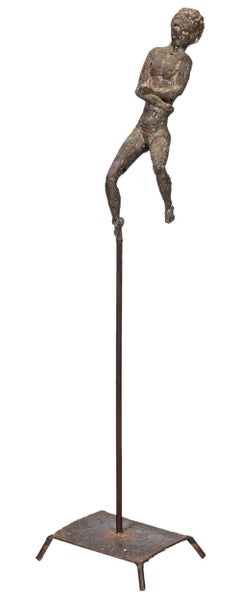
"Dancer" David Hare, Male Nude, Figurative Sculpture, Mid-Century Surrealist
By David Hare
Located in New York, NY
David Hare Dancer, circa 1955 Bronze with integral stand 68 high x 17 wide x 13 1/2 deep inches “Freedom is what we want,” David Hare boldly stated in 1965, but then he added the caveat, “and what we are most afraid of.” No one could accuse David Hare of possessing such fear. Blithely unconcerned with the critics’ judgments, Hare flitted through most of the major art developments of the mid-twentieth century in the United States. He changed mediums several times; just when his fame as a sculptor had reached its apogee about 1960, he switched over to painting. Yet he remained attached to surrealism long after it had fallen out of official favor. “I can’t change what I do in order to fit what would make me popular,” he said. “Not because of moral reasons, but just because I can’t do it; I’m not interested in it.” Hare was born in New York City in 1917; his family was both wealthy and familiar with the world of modern art. Meredith (1870-1932), his father, was a prominent corporate attorney. His mother, Elizabeth Sage Goodwin (1878-1948) was an art collector, a financial backer of the 1913 Armory Show, and a friend of artists such as Constantin Brancusi, Walt Kuhn, and Marcel Duchamp. In the 1920s, the entire family moved to Santa Fe, New Mexico and later to Colorado Springs, in the hope that the change in altitude and climate would help to heal Meredith’s tuberculosis. In Colorado Springs, Elizabeth founded the Fountain Valley School where David attended high school after his father died in 1932. In the western United States, Hare developed a fascination for kachina dolls and other aspects of Native American culture that would become a recurring source of inspiration in his career. After high school, Hare briefly attended Bard College (1936-37) in Annandale-on-Hudson. At a loss as to what to do next, he parlayed his mother’s contacts into opening a commercial photography studio and began dabbling in color photography, still a rarity at the time [Kodachrome was introduced in 1935]. At age 22, Hare had his first solo exhibition at Walker Gallery in New York City; his 30 color photographs included one of President Franklin Roosevelt. As a photographer, Hare experimented with an automatist technique called “heatage” (or “melted negatives”) in which he heated the negative in order to distort the image. Hare described them as “antagonisms of matter.” The final products were usually abstractions tending towards surrealism and similar to processes used by Man Ray, Raoul Ubac, and Wolfgang Paalen. In 1940, Hare moved to Roxbury, CT, where he fraternized with neighboring artists such as Alexander Calder and Arshile Gorky, as well as Yves Tanguy who was married to Hare’s cousin Kay Sage, and the art dealer Julian Levy. The same year, Hare received a commission from the American Museum of Natural History to document the Pueblo Indians. He traveled to Santa Fe and, for several months, he took portrait photographs of members of the Hopi, Navajo, and Zuni tribes that were published in book form in 1941. World War II turned Hare’s life upside down. He became a conduit in the exchange of artistic and intellectual ideas between U.S. artists and the surrealist émigrés fleeing Europe. In 1942, Hare befriended Andre Breton, the principal theorist of surrealism. When Breton wanted to publish a magazine to promote the movement in the United States, he could not serve as an editor because he was a foreign national. Instead, Breton selected Hare to edit the journal, entitled VVV [shorth for “Victory, Victory, Victory”], which ran for four issues (the second and third issues were printed as a single volume) from June 1942 to February 1944. Each edition of VVV focused on “poetry, plastic arts, anthropology, sociology, (and) psychology,” and was extensively illustrated by surrealist artists including Giorgio de Chirico, Roberto Matta, and Yves Tanguy; Max Ernst and Marcel Duchamp served as editorial advisors. At the suggestion of Jacqueline Lamba...
Category

1950s Abstract Figurative Sculptures

Materials

Bronze

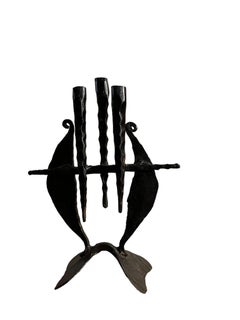
Brutalist Hand Forged Iron Sculpture Candelabra Candle Stick Israeli Art Palombo
By David Palombo
Located in Surfside, FL
Hand Forged Iron Sconce Candelabra Holocaust Memorial Judaic table Sconce Sculpture David Palombo was an Israeli sculptor and painter. He was born in Turkey to a traditional family and immigrated to the Land of Israel with his parents in 1923. They lived in the Nahalat Shiva neighborhood of Jerusalem. In 1940 he began his studies at Bezalel Academy of Arts and Design, and from 1942 was a student of sculptor Ze’ev Ben-Zvi. For a period of time, Palombo was an assistant at Ben-Zvi’s studio and also taught at Bezalel. During this period he was also a member of the “Histadrut HaNoar HaOved VeHaLomed” (The General Federation of Students and Young Workers in Israel). In the 1940s he took art lessons at night. In 1948 he went to Paris, where he visited the studio of the sculptor Constantin Brancusi whose work influenced him. Around 1958 he married the artist Shulamit Sirota. In 1960 he quit his job to devote himself to art. In 1964 he married for the second time to the artist Yona Palombo. The two of them went to live in an abandoned home on Mount Zion in Jerusalem. In 1966 he was killed when the motorcycle on which he was riding ran into a chain stretched across the street to prevent the desecration of Shabbat. His widow opened a museum in their home that was active until the year 2000. Work by Palombo is included in the Judaic collection of the Jewish Museum (a well known Hanukkah menorah). Palombo executed the impressive metal gates of the Tent of Remembrance at the Yad Vashem, the memorial to the martyrs of the holocaust, as well as the gates to the Knesset Building the United Nations Educational Scientific and Cultural Organization (Unesco award) awarded him a scholarship for study in Japan. He worked in marble, granite, bronze, iron and steel. as well as with glass mosaic tiles. Palombo’s early works, in the 1950s, were influenced by modernist sculptors such as Brancusi. These works were composed of abstract images from nature and were carved out of stone or wood. At the end of the 1950s he began making metal sculptors, using the technique of welding. His work took on a more abstract and expressive character. Education 1940 Painting with Isidor Ascheim, New Bezalel School for Arts and Crafts, Jerusalem 1942 Sculpture with Zeev Ben Zvi, Jerusalem 1956 Mosaic, Ravenna, Italy 1958 Welding Course Awards And Prizes 1966 UNESCO Award Exhibitions: Sculpture in Israel, 1948-1958 Mishkan Museum of Art, Kibbutz Ein Harod Artists: Zvi Aldouby, Yitzhak Danziger, Arieh Merzer, Dov Feigin, Aaron Priver, David Palumbo, Menashe Kadishman, Kosso Eloul, Yehiel Shemi, Zahara Schatz. The Spring Exhibition of Jerusalem Artists, Artists' House, Jerusalem Artists: Palombo, David Bezalel Schatz, Mordechai Levanon, Fima, Ludwig Blum 12 Artists, The Bezalel National Museum, Jerusalem Avraham Ofek, Aviva Uri, Avigdor Arikha, Yosl Bergner, Lea Nikel, Palombo, Ruth Zarfati...
Category

Mid-20th Century Arte Povera Abstract Sculptures

Materials

Iron

"Honey Pot" - abstract sculpture - Barbara Hepworth
By Susan Hable
Located in Atlanta, GA
Susan Hable is inspired by the work of David Hockney, Milton Avery, Henri Matisse, Alex Katz, Howard Hodgkins, Hilma af Klint, Georgia O'Keeffe, Barbara Hepworth and Constantin Brâncuși. With humor and a bit of mischief, Susan Hable’s “Don't Pick The Flowers!” is a body of work that is at once a refuge and a playground. Inspired by her sumptuous garden just outside of her Athens studio, Susan flows from one medium to the next from painting to collage to sculpture. Susan sees her garden as a place for adventure and daydreaming, challenging her perceptions of what her Art can be. Even a weedy ground cover has caught Susan’s eye, an overlooked invasive is seen in a new light becoming a dreamlike fairytale path. Her work asks us to engage in life, go for a walk and play. Susan Hable Smith is the artist and designer behind the boldly colored and hand drawn patterns of Hable Construction...
Category

2010s Abstract Abstract Sculptures

Materials

Marble, Bronze

Eduardo Paolozzi: Triangular Construction plaster sculpture
By Sir Eduardo Paolozzi
Located in London, GB
To see our other Modern British Art, scroll down to "More from this Seller" and below it click on "See all from this Seller" - or send us a message if you cannot find the artist you ...
Category

1990s Modern Figurative Sculptures

Materials

Plaster

Owl original opal serpentine Shona sculpture signed by Joel Nhete
By Joel Nhete
Located in Milwaukee, WI
'Owl' is an original opal serpentine stone sculpture signed by the contemporary Zimbabwean artist Joel Nhete. The artist presents in this sculpture a highly abstracted figure of a wi...
Category

Early 2000s Contemporary Figurative Sculptures

Materials

Stone

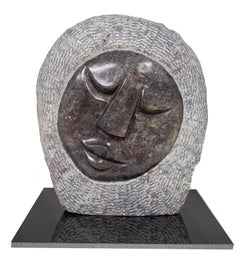
Face original signed cobalt stone Shona sculpture by Obert Mukumbi
By Obert Mukumbi
Located in Milwaukee, WI
'Face' is an original cobalt sculpture by the Zimbabwean artist Obert Mukumbi. This sculpture demonstrates the artist's influence from the great Shona...
Category

Early 2000s Contemporary Figurative Sculptures

Materials

Stone

Eduardo Paolozzi: Striated Construction plaster sculpture
By Sir Eduardo Paolozzi
Located in London, GB
To see our other Modern British Art, scroll down to "More from this Seller" and below it click on "See all from this Seller" - or send us a message if you cannot find the artist you ...
Category

1990s Modern Figurative Sculptures

Materials

Plaster

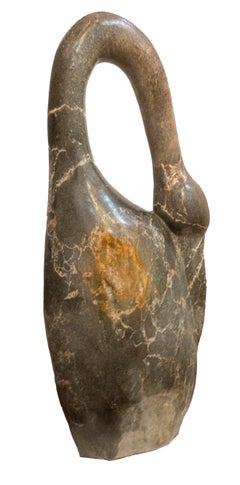
Bird original stone Shona sculpture by Samuel Tichafa Masakwa
Located in Milwaukee, WI
'Bird' is an original opal serpentine sculpture by the Zimbabwean artist Samuel Tichafa Masakwa. Trained in the Shona stone carving tradition, the artists here presents an elegantly abstracted water fowl: above the egg-shaped form of the body, the bird's long neck curls outward forming a loop. Such abstracted forms recall traditional African sculpture as well as the work of modern masters like Constantin Brancusi who looked to non-Western sources for inspiration. opal serpentine stone 31.5 x 12 x 11 inches not signed 140 lbs Overall good condition; some scratching Samuel Tichafa Masakwa was born in 1971 on the 15th of September, the first born of nine siblings. He was educated at Zengeza No. Five Primary School and later, Zengeza Four High School. Out of keen interest, he started sculpting at a tender age of fourteen. His cousins were accomplished sculptors, Nicholas Mukomberanwa and Albert Nathan Mambura whose brotherly love nurtured the interest in him to greater heights. During Samuel's school holidays, Albert Mamvura shaped his pending career as an artist by engaging him as his assistant. In 1991 he completed his 'O' levels and began sculpting full-time at Albert's workshop. As an apprentice he learned how to carve Shona abstracts, figures and heads. While he was working with Nicholas Mukomberanwa he had the chance to learn how to clean hidden angles on hard stones like springstone, cobalt, serpentine and the original green opal. In 1996 his cousins advised him to be independent in order to explore the new avenues he was bringing into the field. He discovered he did not have his own trade mark so he went to yet another accomplished artist, Joe Mutasa...
Category

Early 2000s Contemporary Figurative Sculptures

Materials

Stone

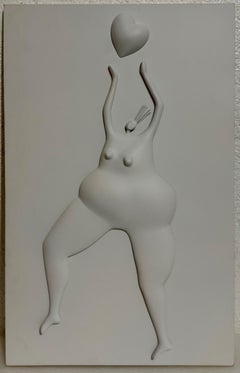
Latin American Master Abigail Varela Sculpture Relief Plaque Woman with Heart
By Abigail Varela
Located in Surfside, FL
Abigail Varela (1948-) Atrapando un corazón 2008 Madera, resina y acrílico Catching a Heart Wood, Resin and Acrylic Hand signed verso with initials and...
Category

Early 2000s Post-Modern Nude Sculptures

Materials

Resin, Wood, Acrylic

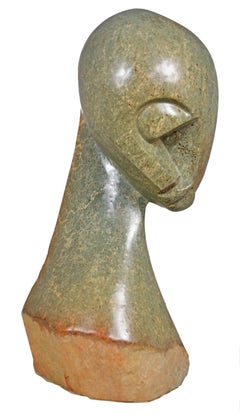
Eye Witness original Shona stone sculpture signed by Josphat Makenzi
Located in Milwaukee, WI
'Eye Witness' is an original opal serpentine sculpture signed by the Zimbabwean artist Josphat Makenzi. Makenzi was trained in the contemporary Shona stone carving tradition, and thus his works take on themes from African as well as from European art history. His sculptures of the human face have the abstracted qualities of traditional African sculptures and masks...
Category

Early 2000s Contemporary Figurative Sculptures

Materials

Stone

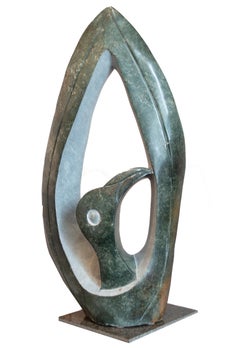
Stork Bird original opal serpentine Shona sculpture signed by Jonathan Nhete
Located in Milwaukee, WI
'Stork Bird' is an original opal serpentine stone sculpture signed by the contemporary Zimbabwean artist Jonathan Nhete. The artist presents in this sculpture a highly abstracted figure of a bird, the long beak and eye of which emerges shining and polished from within a heroic almond-shaped loop formed by the bird's wings. Such abstracted forms recall traditional African sculpture as well as the work of modern masters like Constantin Brancusi who looked to non-Western sources for inspiration. The sculpture's surface is brought to a beautiful polish, allowing the green of the serpentine to create a glittering depth as immense as a lake or river. opal serpentine 32 x 19 x 6 1/2 inches, sculpture 2.75 x 12 x 12 inches, concrete and marble base (included at request of buyer) 34 .75 x 19 x 12 inches, overall 85 lbs signed "Nhete Jonathan" along bottom edge on reverse with hole drilled in foot to accommodate 0.5-inch steel support rod overall good condition; brown stain at base of bird neck; some minor scratches Jonathan Nhete was born on November 16, 1972 into a family of 5 boys. He decided to explore in the art industry and was fascinated by the works made by a local artist Dudzai Mushawepwere...
Category

Early 2000s Contemporary Figurative Sculptures

Materials

Stone

"Lucky Number" - abstract sculpture - Barbara Hepworth
By Susan Hable
Located in Atlanta, GA
Susan Hable is inspired by the work of David Hockney, Milton Avery, Henri Matisse, Alex Katz, Howard Hodgkins, Hilma af Klint, Georgia O'Keeffe, Barbara Hepworth and Constantin Brâncuși. With humor and a bit of mischief, Susan Hable’s “Don't Pick The Flowers!” is a body of work that is at once a refuge and a playground. Inspired by her sumptuous garden just outside of her Athens studio, Susan flows from one medium to the next from painting to collage to sculpture. Susan sees her garden as a place for adventure and daydreaming, challenging her perceptions of what her Art can be. Even a weedy ground cover has caught Susan’s eye, an overlooked invasive is seen in a new light becoming a dreamlike fairytale path. Her work asks us to engage in life, go for a walk and play. Susan Hable Smith is the artist and designer behind the boldly colored and hand drawn patterns of Hable Construction...
Category

2010s Abstract Abstract Sculptures

Materials

Marble, Bronze

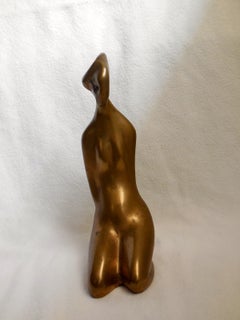
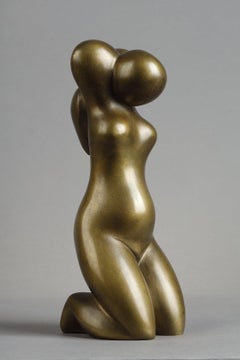
Nude kneeling
By Baltasar Lobo
Located in PARIS, FR
Nude kneeling by Baltasar LOBO (1910-1993) A bronze sculpture with an old gilded patina Signed on the lower side " Lobo " Cast by " Susse Fondeur Paris " (with the foundry mark) Art...
Category

Mid-20th Century French School Nude Sculptures

Materials

Bronze

"Guardian" - abstract sculpture - Barbara Hepworth
By Susan Hable
Located in Atlanta, GA
Susan Hable is inspired by the work of David Hockney, Milton Avery, Henri Matisse, Alex Katz, Howard Hodgkins, Hilma af Klint, Georgia O'Keeffe, Barbara Hepworth and Constantin Brâncuși. With humor and a bit of mischief, Susan Hable’s “Don't Pick The Flowers!” is a body of work that is at once a refuge and a playground. Inspired by her sumptuous garden just outside of her Athens studio, Susan flows from one medium to the next from painting to collage to sculpture. Susan sees her garden as a place for adventure and daydreaming, challenging her perceptions of what her Art can be. Even a weedy ground cover has caught Susan’s eye, an overlooked invasive is seen in a new light becoming a dreamlike fairytale path. Her work asks us to engage in life, go for a walk and play. Susan Hable Smith is the artist and designer behind the boldly colored and hand drawn patterns of Hable Construction...
Category

2010s Abstract Abstract Sculptures

Materials

Marble, Bronze

Winking Owl, Modern Bronze by Antonovici 1957
By Constantin Antonovici
Located in Long Island City, NY
An original bronze sculpture by Constantin Antonovici from his Owl Series. Referenced in "Constantin Antonovici: Sculptor of Owls", pg 43. Antonovici was born in Neamt, Romania on February 18, 1911, and graduated from the Fine Arts Academy in Iasi, Romania, in 1939. In 1940, Antonovici studied in Zagreb with the famous Croatian sculptor Ivan Mestrovici, until his arrest by Italian fascists. Antonovici himself survived imprisonment in Germany for his refusal to fight on the side of the Nazis. After the war, he continued his studies in Vienna, under the tutelage of Professor Fritz Behn...
Category

1950s Modern Figurative Sculptures

Materials

Bronze

Hippie, Modern Bronze by Antonovici 1970
By Constantin Antonovici
Located in Long Island City, NY
Artist: Constantin Antonovici, Romanian (1911 - 2002) Title: Hippie - Man Medium: Bronze Sculpture, signature, date inscribed Size: 23.5 x 11.5 x 1 in. (59.69 x 29.21 x 2.54 cm) Marble Base: 3 x 10 x 8.5 inches An original bronze sculpture by Constantin Antonovici from his Portrait Series. Referenced in "Constantin Antonovici: Sculptor of Owls", pg 69 Antonovici was born in Neamt, Romania on February 18, 1911, and graduated from the Fine Arts Academy in Iasi, Romania, in 1939. In 1940, Antonovici studied in Zagreb with the famous Croatian sculptor Ivan Mestrovici, until his arrest by Italian fascists. Antonovici himself survived imprisonment in Germany for his refusal to fight on the side of the Nazis. After the war, he continued his studies in Vienna, under the tutelage of Professor Fritz Behn...
Category

1970s Modern Figurative Sculptures

Materials

Bronze

Two Ducks, Modern Marble Sculpture by Antonovici
By Constantin Antonovici
Located in Long Island City, NY
An original carved marble sculpture by Constantin Antonovici from his "Bird and Animal Series". Referenced in "Constantin Antonovici: Sculptor of Owls", pg 83 Antonovici was born in...
Category

1970s Modern Figurative Sculptures

Materials

Marble

Motherhood
By Baltasar Lobo
Located in PARIS, FR
Motherhood by Baltasar Lobo (1910-1993) A bronze group with a nuanced greenish dark brown patina Signed at the lower backside " Lobo " Cast by " Susse Fondeur Paris " (with the foun...
Category

Mid-20th Century French School Figurative Sculptures

Materials

Bronze

The Cradle
By Baltasar Lobo
Located in PARIS, FR
Le Berceau (The Cradle) by Baltasar LOBO (1910-1993) A bronze group with a brownish green patina Signed at the lower backside " Lobo " Cast by " Susse Fondeur Paris " (with the foun...
Category

Mid-20th Century French School Figurative Sculptures

Materials

Bronze

Read More

At Hosfelt Gallery, Bertoia Masterworks Complement Dynamic Contemporary Art

For nearly three decades, San Francisco–based Todd Hosfelt has curated against the grain — with a show on the legendary modernist Harry Bertoia the latest case in point.

This Weathered-Steel Sculpture Distills a Form of Protest into a Minimalist Monument

Part of Alejandro Vega Beuvrin’s “Barricada” series, the work is a subversive tribute to the street smarts of citizen activists.

How the Chunky, Funky Ceramics of 5 Mid-Century American Artists Balanced Out Slick Modernism

Get to know the innovators behind the pottery countercultural revolution.

Art Brings the Drama in These Intriguing 1stDibs 50 Spaces

The world’s top designers explain how they display art to elicit the natural (and supernatural) energy of home interiors.

Chryssa’s 1962 Neon Sculpture Was Way ahead of the Art-World Curve

By working with lettering, neon and Pop imagery, Chryssa pioneered several postmodern themes at a time when most male artists detested commercial mediums.

How to Spot a Fake KAWS Figure

KAWS art toys have developed an avid audience in recent decades, and as in any robust collectible market, counterfeiters have followed the mania. Of course, you don’t have to worry about that on 1stDibs, where all our sellers are highly vetted.

A Giant Wedding Cake Has Us Looking at Portuguese Tiles in a New Light

At Waddesdon Manor, artist Joana Vasconcelos has installed a three-tiered patisserie inspired by the narrative tile work of her homeland. We take a look at the cake sculpture and how Portuguese tiles have been used in architecture from the 17th century to today.

These Soft Sculptures Are Childhood Imaginary Friends Come to Life

Miami artist and designer Gabriela Noelle’s fantastical creations appeal to the Peter Pan in all of us.

Still Thinking About These?

All Recently Viewed