142 results for "estrid ericson"
to
8
122
20
140
2
68
48
23
140
2
16
123
7
15
9
17
2
90
49
48
33
22
139
124
90
34
4
142
142
142
48
41
18
7
7
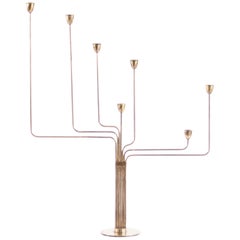
Piet Hein "Ursa Major" Seven Arm Candelabrum in Solid Brass, Denmark 1953
By Piet Hein
Located in Copenhagen, DK
PIET HEIN - SCANDINAVIAN MODERN
First edition of the beautiful candelabrum by the Danish modernist and designer, poet, mathematician and architect Piet Hein.
The candelabrum h...
Category
Mid-20th Century European Scandinavian Modern Candelabras
Materials
Brass
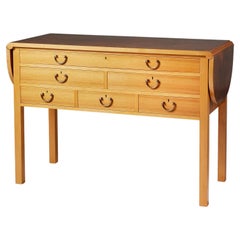
Sideboard Model 1148 Designed by Josef Frank for Svenskt Tenn, Sweden, 1950s
By Josef Frank
Located in Stockholm, SE
Sideboard model 1148 designed by Josef Frank for Svenskt Tenn,
Sweden, 1950s.
Walnut and alder root veneer.
This sideboard model 1148 with two clever extension flaps was designed b...
Category
Mid-20th Century Swedish Mid-Century Modern Sideboards
Materials
Walnut
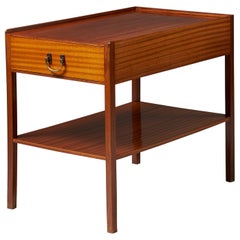
Bedside Table Model 914 Designed by Josef Frank for Svenskt Tenn, Sweden, 1950s
By Josef Frank
Located in Stockholm, SE
Bedside table model 914 designed by Josef Frank for Svenskt Tenn,
Sweden, 1950s.
Mahogany veneer and brass handle.
Josef Frank’s elegant bedside table model 914 with sophisticated brass handles is one of Svenskt Tenn’s timeless classics. It works very well combined with modern or antique pieces. The overall simplicity of form and use of luxurious wood are characteristic of Josef Frank.
L: 65 cm
W: 40 cm
H: 55 cm
Josef Frank was a true European, he was also a pioneer of what would become classic 20th century Swedish design and the “Scandinavian Design Style”.
Austrian- born Frank started his design career as an architect after having trained at the Technische Hochschule in Vienna between 1903 and 1910. After his training he went on to teach at Kunstgewerbeschule (The Viennese School of Arts and crafts) where he developed and espoused the new school of modernist thinking towards Architecture and Design that was coming to fruition in Vienna at the time. He also went on to lead the Vienna Werkbund throughout the 1920s. This was a truly progressive group of Architects and Designers who set about improving the daily lives of Austrian people through modernist design and architecture in partnership with Arts and Crafts ideals and construction. Frank’s leadership of the Werkbund had already cemented his place at the forefront of European design.
Frank’s time in Vienna was typified by his design for the “Die Wohnung” exhibition of the Deutscher Werkbund in Stuttgart, 1927 where he exhibited along side his contemporaries at the forefront of design, such as the likes of Le Corbusier and Walter Gropius. Here he showed a specially designed pair of flat-roofed reinforced concrete houses in what is now seen as a typical modernist style.
What separated Frank’s house from the other 32 houses of the exhibition was the interior and furniture inside the building. It was described as “Neo-Classical” and filled with an eclectic mix of period pieces, modern design and pieces designed by Frank himself that seemed to cross the two worlds. This was a complete opposite direction to that which his fellow Architects were travelling in with their pared back and angular aesthetics. Frank said of his own work: “The house is not a work of art, simply a place where one lives,” and by this reasoning Frank rejected the regimental mechanisation of the living space that his contemporaries believed in, instead he set about creating congenial and spontaneous interiors. Frank’s practice saw him placing the bright colours and the soft forms of nature back into the furnishings and interiors that he thought modernism sorely mist.
Frank, along with Oskar Walch set up Haus und Garten in Vienna in 1925. This was Frank’s first commercial foray into furniture and home furnishings and the company went on to become the most influential furnishing house in Vienna with a riotous depth of colour and interesting shapes becoming the trademark of their design. However this success was to come to an end with rise of Nazism in Vienna in the early 1930’s. Frank was Jewish, and he and his wife Anna decided they would leave Vienna for her motherland: Sweden, in 1933. Frank continued to design for Haus and Garten, visiting Vienna occasionally and designing the pieces that would continue to be the company’s best...
Category
Vintage 1950s Swedish Mid-Century Modern Side Tables
Materials
Brass
Unique Svenskt Tenn 1930
s lacquered self Art Deco elegant.
By Svenskt Tenn
Located in Forest, BE
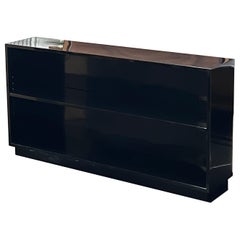
Unique, minimal and elegant lacquered shelve from the 1930's. One shelf that can be adjusted in height at 7 different positions. We have it completely restored but it still shows som...
Category
Vintage 1920s Swedish Art Deco Shelves
Materials
Pine
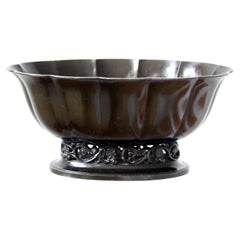
Large Just Andersen Jardinière Model 164, Denmark, 1920s
By Just Andersen
Located in Copenhagen, DK
Just Andersen - Scandinavian Art Deco
A beautiful large jardinière / flower pot, early model, Dessin 164 in discometal, by Just Andersen. Disko metal is an alloy of different metals...
Category
Early 20th Century Danish Art Deco Planters, Cachepots and Jardinières
Materials
Pewter
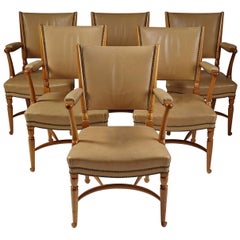
Set of Six Chairs Designed by Josef Frank for Svensk Tenn, Model 725, Sweden
By Josef Frank, Svenskt Tenn
Located in Stockholm, SE
Set of six chairs designed by Josef Frank for Svensk Tenn, Model 725.
Sweden. 1938.
Mahogany and original leather.
Literature: Kristina Wängberg Eriksson, Jan Christer Eriksson, "Josef Frank Möbelformgivaren", Carlsson Bokförlag, Stockholm 2014, p. K 18
H: 90 cm
W: 58 cm
D: 63 cm
SH: 43 cm
Armrest height: 69 cm (at the highest point)
Josef Frank was a true European, he was also a pioneer of what would become classic 20th century Swedish design and the “Scandinavian Design Style”.
Austrian- born Frank started his design career as an architect after having trained at the Technische Hochschule in Vienna between 1903 and 1910. After his training he went on to teach at Kunstgewerbeschule (The Viennese School of Arts and crafts) where he developed and espoused the new school of modernist thinking towards Architecture and Design that was coming to fruition in Vienna at the time. He also went on to lead the Vienna Werkbund throughout the 1920s. This was a truly progressive group of Architects and Designers who set about improving the daily lives of Austrian people through modernist design and architecture in partnership with Arts and Crafts ideals and construction. Frank’s leadership of the Werkbund had already cemented his place at the forefront of European design.
Frank’s time in Vienna was typified by his design for the “Die Wohnung” exhibition of the Deutscher Werkbund in Stuttgart, 1927 where he exhibited along side his contemporaries at the forefront of design, such as the likes of Le Corbusier and Walter Gropius. Here he showed a specially designed pair of flat-roofed reinforced concrete houses in what is now seen as a typical modernist style.
What separated Frank’s house from the other 32 houses of the exhibition was the interior and furniture inside the building. It was described as “Neo-Classical” and filled with an eclectic mix of period pieces, modern design and pieces designed by Frank himself that seemed to cross the two worlds. This was a complete opposite direction to that which his fellow Architects were travelling in with their pared back and angular aesthetics. Frank said of his own work: “The house is not a work of art, simply a place where one lives,” and by this reasoning Frank rejected the regimental mechanisation of the living space that his contemporaries believed in, instead he set about creating congenial and spontaneous interiors. Frank’s practice saw him placing the bright colours and the soft forms of nature back into the furnishings and interiors that he thought modernism sorely mist.
Frank, along with Oskar Walch set up Haus und Garten in Vienna in 1925. This was Frank’s first commercial foray into furniture and home furnishings and the company went on to become the most influential furnishing house in Vienna with a riotous depth of colour and interesting shapes becoming the trademark of their design. However this success was to come to an end with rise of Nazism in Vienna in the early 1930’s. Frank was Jewish, and he and his wife Anna decided they would leave Vienna for her motherland: Sweden, in 1933. Frank continued to design for Haus and Garten, visiting Vienna occasionally and designing the pieces that would continue to be the company’s best...
Category
Vintage 1930s Swedish Scandinavian Modern Chairs
Materials
Leather, Mahogany
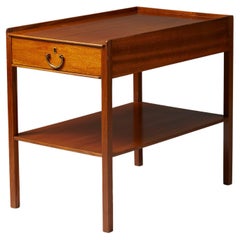
Bedside Table Model ‘914’ Designed by Josef Frank for Svenskt Tenn, Sweden
By Josef Frank
Located in Stockholm, SE
Bedside table model 914 designed by Josef Frank for Svenskt Tenn,
Sweden, 1950s.
Mahogany veneer and brass handle.
Josef Frank’s elegant bedside table model 914 with sophisticated ...
Category
Mid-20th Century Swedish Mid-Century Modern Side Tables
Materials
Brass
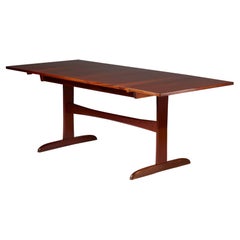
Dining Table Model 1197 Designed by Josef Frank for Svenskt Tenn, Sweden, 1940s
By Josef Frank
Located in Stockholm, SE
Dining table model 1197 designed by Josef Frank for Svenskt Tenn,
Sweden, 1940s.
Mahogany.
This simple yet elegant dining table is an excellent example of how Josef Frank combined...
Category
Mid-20th Century Swedish Mid-Century Modern Dining Room Tables
Materials
Mahogany
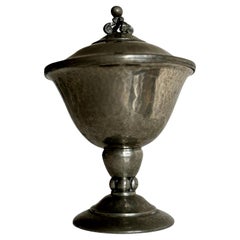
1920s Art Deco Lidded Tin Bowl, Denmark
By Just Andersen, Svenskt Tenn, Estrid Ericson, Mogens Ballin, Georg Jensen
Located in Copenhagen, DK
Antique 1920s Art Deco WG Tin pedestal bowl with hammered surface and lid with crown decor. Sphere details on top and foot. Marked "Dansk Haandarbejd WG Tin" under base. In the style...
Category
Early 20th Century Danish Art Deco Decorative Bowls
Materials
Tin, Pewter, Metal

$465 Sale Price
20% Off
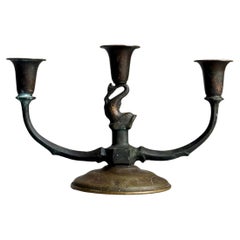
Art Deco Bronze Fish Candelabra, Denmark, circa 1920s
By Josef Frank, Svenskt Tenn, GAB, Estrid Ericson, Mogens Ballin
Located in Copenhagen, DK
Elegant Danish Art Deco solid bronze candelabra handmade circa 1920s. The slender arms extend gracefully from the center that features a beautifully detailed fish. Brown and green pa...
Category
Early 20th Century Danish Art Deco Candelabras
Materials
Bronze
$712 Sale Price
20% Off
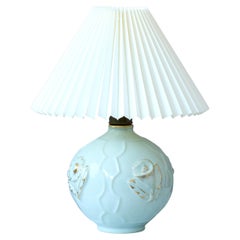
Blue Art Deco Table Lamp by Tyra Lundgren for ALP, Sweden, 1920s. Swedish Grace.
By Tyra Lundgren Carolina, Arabia, ALP Lidköping 1, Arabia of Finland
Located in Malmö, SE
A stunning stoneware Swedish Grace / Art Deco table lamp. Amazing relief decor with hand-painted details in gold.
Attributed to Tyra Lundgren. This model was produced in the 1920s b...
Category
Mid-20th Century Swedish Art Deco Table Lamps
Materials
Ceramic, Stoneware
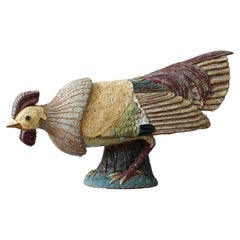
Large and Unique Stoneware Rooster by Tyra Lundgren. Sweden, 1955.
By Tyra Lundgren Carolina
Located in Malmö, SE
A stunning and unique stoneware rooster sculpture with amazing glaze.
Made by Tyra Lundgren. Executed in her own studio in Sweden, 1955.
Great condition, but with a couple of chips to the base (pictured).
Signed by the artist in two places, and dated 1955-06-20.
Provenance: bought from the estate of the artist in 1979.
Tyra Lundgren (1897-1979) was one of the most multifaceted artists and modernists of the twentieth century. She was a painter, drawer, sculptor, ceramist, glass- and textile designer, as well as an author and an art critic. She was the first woman who designed glass for Paolo Venini at Murano in Venice and she also served as the artistic leader at Arabia in Helsinki at a time when men tended to hold those kinds of positions.
Tyra Lundgren grew up in Djursholm, near Stockholm. Her parents were John Petter Lundgren, professor at Veterinärinstitutet (institute of veterinary sciences) in Stockholm, and Edith Lundgren née Åberg, who was a housewife and raised their six children. The bourgeois home also comprised a nanny and a female cook. The family were very socially active, travelled often, and enjoyed the outdoor lifestyle. Tyra Lundgren’s schooling began at Djursholm coeducational school, where her teachers included Natanael and Elsa Beskow and Alice Tegnér. Her school friends included Greta Knutson-Tzara, Stellan Mörner, and Ingrid Rydbeck-Zuhr.
Tyra Lundgren knew from the time she was five years old that she wanted to be an artist. She first became aware of the profession through Axel Fahlcrantz, who rented a studio on the plot of land where she lived with her family. In 1913 she began to attend Högre konstindustriella skolan (HKS, now known as Konstfack, college of arts, crafts and design) where she studied decorative art as well as handicrafts in various forms until 1917. One of her fellow students and friends there was Estrid Ericson, who later founded Svenskt Tenn AB in 1924. Whilst attending HKS Tyra Lundgren also took painting lessons at the Althin school of painting. In 1917 she was accepted as a candidate at the Royal Swedish Academy of Fine Arts where, apart from breaks during which she undertook studies abroad, she remained until 1922. She spent a couple of months taking lessons from Anton Hanak in Vienna and from 1920–1923 she was a student of André Lhote in Paris.
Tyra Lundgren was primarily active in four countries: Sweden, Finland, France, and Italy. She spent much of her professional life travelling and considered herself to be a European. Greece and Mexico also formed important centres in her artistic life, as did the USA. She had an extensive social network which included focal individuals within twentieth century-European and American artistic and cultural circles.
Tyra Lundgren’s main artistic motifs were birds, fish, and people which she depicted through different techniques and materials. Her artistic expression involved a variety of different directions and styles. She was a pioneer of the 1920s Swedish Grace style, the name of which had been coined by the art critic Morton Shand at the Stockholm Exhibition of 1930. This was a Swedish Art Deco style, characterised by elegance and traditional art which contrasted with the current artistic ideals of functionalism.
Tyra Lundgren made her debut at a group exhibition held at Kungliga Akademien för de fria konsterna in 1921. She went on to show her work at various exhibitions throughout the 1920s. After that period she only very rarely exhibited her paintings.
Tyra Lundgren’s painted output can be divided into different periods or stylistic directions. The first of these, and the most extensive, was her post-Cubist period which began in 1920 on her arrival in Paris. Her paintings from this time and right up to the mid-1930s typically comprise portraits, self-portraits, live-model painting, still-lifes, interiors, and landscapes in the Cubist style. Many of the great number of self-portraits she painted were produced in the New Objective style, displaying broad variation in terms of clothes, poses and techniques. Two of these – Huvud med vit duk and Självporträtt both from 1921 – can be seen at Moderna Museet in Stockholm, although the majority of these works are at Gotlands Museum.
Tyra Lundgren’s second artistic period comprises the years of 1927 to 1929 and is characterised by the New Objective style inspired by medieval techniques and materials (Giotto, Piero della Francesca). Her motifs were still-lifes and landscapes. At this point she was living in Rome and was close to the circle involved in the Valori plastici: rivista d’arte art journal. This period saw a breakthrough in her development as a painter. From the 1950s through the 1970s her work can almost be described as belonging to the Concrete style. Using light pastel colours her paintings sought light in a sometimes non-figurative expression, but often depicting abstract bird-shapes or other nature-inspired imagery. Her paintings from this period are outsized and display powerful colours, in yellows, reds, and blues.
Tyra Lundgren maintained a constant production of drawings, both in terms of individual artworks and sketches for patterns and designs. She also produced the illustrations for her book Fagert i Fide. Årstiderna på en gammal gotlandsgård, published in 1961. During her early years she also produced advertising illustrations. She spent the final years of her life primarily working with lithographs which were printed at Galleri Prisma and depicted images of doves, swallows, magpies and crows.
Tyra Lundgren is meanwhile best known for her work as a ceramist and in this sphere she was one of Sweden’s leading exponents. She worked in the porcelain industry as a designer and as an artisan and ceramic sculptor. Her first job was at St Eriks Lervarufabrik in Uppsala from 1922–1924, she then worked at Arabia from 1924–1937, and at Rörstrand and Lidköping Porslinsfabrik. She was the artistic leader at Arabia ahead of the 1930 Stockholm Exhibition and she exhibited her work at the World’s Fairs. During the 1934–1938 period she was connected to the Manufacture nationale de Sèvres porcelain factory in Paris.
Tyra Lundgren was a pioneer when it came to giving ceramic art a public space in Sweden. She produced around 20 outsized reliefs in stoneware, so-called monumental reliefs. One of these is Märkeskvinnor, from 1947, for the former girls’ school at Bohusgatan in Stockholm. From the 1940s onwards Tyra Lundgren produced sculptural objects in Chamotte clay and stoneware, with various glazings. Her small birds are well-known and popular with many. When her ceramic efforts became too much for her during the 1970s she then produced models for sculptures in bronze. There are six of these in various places around the globe, including Solfågel in Almedalen, Visby.
Tyra Lundgren began to work as a glassware designer at Moser in Karlsbad in 1922 where she designed new table services and modernised older ones. She also worked freelance for Riihimäki factory in Finland during the 1924–1929 period. From 1934 to 1938 she was employed by Kosta glass factory where she mainly designed thick-walled bowls and vases, engraved with classical motifs. She was introduced to the glassmaker Paolo Venini at Murano during the Triennale di Milano of 1936 and they began a collaboration that lasted into the 1950s. As part of this collaboration Tyra Lundgren became the first woman to design glassware and, in conjunction with the glassblower Arturo Biasutto, she developed new techniques of glass production. Her motifs at this point were birds, fish, snail-shaped designs and leaf-patterned bowls using traditional techniques as well as in new designs. It was during this time that she created the so-called tissue-shaped bowls and it remains unclear as to who specifically came up with the design but Tyra Lundgren claimed it was of her making.
Tyra Lundgren was active as textile designer for Licium (now HV Licium), the sacred textiles...
Category
Mid-20th Century Swedish Scandinavian Modern Animal Sculptures
Materials
Ceramic, Stoneware
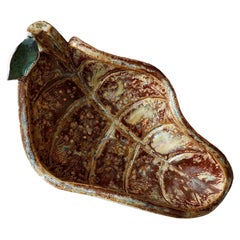
Stoneware Leaf by Tyra Lundgren. Manufacture nationale de Sèvres, 1930s.
By Manufacture Nationale de Sèvres, Tyra Lundgren Carolina
Located in Malmö, SE
A beautiful stoneware bowl with amazing glaze.
Made by Tyra Lundgren. Executed during the artist's time spent at Sèvres, between 1934-1939.
Excellent condition.
Impressed with artist's name and maker's marks.
Tyra Lundgren (1897-1979) was one of the most multifaceted artists and modernists of the twentieth century. She was a painter, drawer, sculptor, ceramist, glass- and textile designer, as well as an author and an art critic. She was the first woman who designed glass for Paolo Venini at Murano in Venice and she also served as the artistic leader at Arabia in Helsinki at a time when men tended to hold those kinds of positions.
Tyra Lundgren grew up in Djursholm, near Stockholm. Her parents were John Petter Lundgren, professor at Veterinärinstitutet (institute of veterinary sciences) in Stockholm, and Edith Lundgren née Åberg, who was a housewife and raised their six children. The bourgeois home also comprised a nanny and a female cook. The family were very socially active, travelled often, and enjoyed the outdoor lifestyle. Tyra Lundgren’s schooling began at Djursholm coeducational school, where her teachers included Natanael and Elsa Beskow and Alice Tegnér. Her school friends included Greta Knutson-Tzara, Stellan Mörner, and Ingrid Rydbeck-Zuhr.
Tyra Lundgren knew from the time she was five years old that she wanted to be an artist. She first became aware of the profession through Axel Fahlcrantz, who rented a studio on the plot of land where she lived with her family. In 1913 she began to attend Högre konstindustriella skolan (HKS, now known as Konstfack, college of arts, crafts and design) where she studied decorative art as well as handicrafts in various forms until 1917. One of her fellow students and friends there was Estrid Ericson, who later founded Svenskt Tenn AB in 1924. Whilst attending HKS Tyra Lundgren also took painting lessons at the Althin school of painting. In 1917 she was accepted as a candidate at the Royal Swedish Academy of Fine Arts where, apart from breaks during which she undertook studies abroad, she remained until 1922. She spent a couple of months taking lessons from Anton Hanak in Vienna and from 1920–1923 she was a student of André Lhote in Paris.
Tyra Lundgren was primarily active in four countries: Sweden, Finland, France, and Italy. She spent much of her professional life travelling and considered herself to be a European. Greece and Mexico also formed important centres in her artistic life, as did the USA. She had an extensive social network which included focal individuals within twentieth century-European and American artistic and cultural circles.
Tyra Lundgren’s main artistic motifs were birds, fish, and people which she depicted through different techniques and materials. Her artistic expression involved a variety of different directions and styles. She was a pioneer of the 1920s Swedish Grace style, the name of which had been coined by the art critic Morton Shand at the Stockholm Exhibition of 1930. This was a Swedish Art Deco style, characterised by elegance and traditional art which contrasted with the current artistic ideals of functionalism.
Tyra Lundgren made her debut at a group exhibition held at Kungliga Akademien för de fria konsterna in 1921. She went on to show her work at various exhibitions throughout the 1920s. After that period she only very rarely exhibited her paintings.
Tyra Lundgren’s painted output can be divided into different periods or stylistic directions. The first of these, and the most extensive, was her post-Cubist period which began in 1920 on her arrival in Paris. Her paintings from this time and right up to the mid-1930s typically comprise portraits, self-portraits, live-model painting, still-lifes, interiors, and landscapes in the Cubist style. Many of the great number of self-portraits she painted were produced in the New Objective style, displaying broad variation in terms of clothes, poses and techniques. Two of these – Huvud med vit duk and Självporträtt both from 1921 – can be seen at Moderna Museet in Stockholm, although the majority of these works are at Gotlands Museum.
Tyra Lundgren’s second artistic period comprises the years of 1927 to 1929 and is characterised by the New Objective style inspired by medieval techniques and materials (Giotto, Piero della Francesca). Her motifs were still-lifes and landscapes. At this point she was living in Rome and was close to the circle involved in the Valori plastici: rivista d’arte art journal. This period saw a breakthrough in her development as a painter. From the 1950s through the 1970s her work can almost be described as belonging to the Concrete style. Using light pastel colours her paintings sought light in a sometimes non-figurative expression, but often depicting abstract bird-shapes or other nature-inspired imagery. Her paintings from this period are outsized and display powerful colours, in yellows, reds, and blues.
Tyra Lundgren maintained a constant production of drawings, both in terms of individual artworks and sketches for patterns and designs. She also produced the illustrations for her book Fagert i Fide. Årstiderna på en gammal gotlandsgård, published in 1961. During her early years she also produced advertising illustrations. She spent the final years of her life primarily working with lithographs which were printed at Galleri Prisma and depicted images of doves, swallows, magpies and crows.
Tyra Lundgren is meanwhile best known for her work as a ceramist and in this sphere she was one of Sweden’s leading exponents. She worked in the porcelain industry as a designer and as an artisan and ceramic sculptor. Her first job was at St Eriks Lervarufabrik in Uppsala from 1922–1924, she then worked at Arabia from 1924–1937, and at Rörstrand and Lidköping Porslinsfabrik. She was the artistic leader at Arabia ahead of the 1930 Stockholm Exhibition and she exhibited her work at the World’s Fairs. During the 1934–1938 period she was connected to the Manufacture nationale de Sèvres porcelain factory in Paris.
Tyra Lundgren was a pioneer when it came to giving ceramic art a public space in Sweden. She produced around 20 outsized reliefs in stoneware, so-called monumental reliefs. One of these is Märkeskvinnor, from 1947, for the former girls’ school at Bohusgatan in Stockholm. From the 1940s onwards Tyra Lundgren produced sculptural objects in Chamotte clay and stoneware, with various glazings. Her small birds are well-known and popular with many. When her ceramic efforts became too much for her during the 1970s she then produced models for sculptures in bronze. There are six of these in various places around the globe, including Solfågel in Almedalen, Visby.
Tyra Lundgren began to work as a glassware designer at Moser in Karlsbad in 1922 where she designed new table services and modernised older ones. She also worked freelance for Riihimäki factory in Finland during the 1924–1929 period. From 1934 to 1938 she was employed by Kosta glass factory where she mainly designed thick-walled bowls and vases, engraved with classical motifs. She was introduced to the glassmaker Paolo Venini at Murano during the Triennale di Milano of 1936 and they began a collaboration that lasted into the 1950s. As part of this collaboration Tyra Lundgren became the first woman to design glassware and, in conjunction with the glassblower Arturo Biasutto, she developed new techniques of glass production. Her motifs at this point were birds, fish, snail-shaped designs and leaf-patterned bowls using traditional techniques as well as in new designs. It was during this time that she created the so-called tissue-shaped bowls and it remains unclear as to who specifically came up with the design but Tyra Lundgren claimed it was of her making.
Tyra Lundgren was active as textile designer for Licium (now HV Licium), the sacred textiles...
Category
Mid-20th Century French Scandinavian Modern Decorative Bowls
Materials
Ceramic, Stoneware
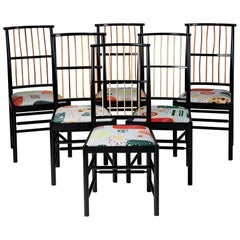
Set of Six Chairs Model 2025 Designed by Josef Frank for Svenskt Tenn
By Josef Frank
Located in Stockholm, SE
Set of six chairs model 2025 designed by Josef Frank for Svenskt Tenn,
Sweden, 1950s.
Lacquered wood frame and a fabric upholstered seat.
Marked.
Josef Frank designed this chair i...
Category
Mid-20th Century Swedish Mid-Century Modern Chairs
Materials
Fabric, Upholstery, Wood, Bentwood, Lacquer
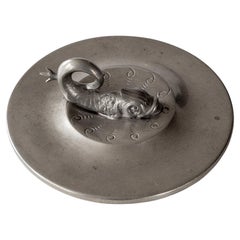
Art Deco Pewter Metal Hand Mirror with Koi Fish, 1920s, Swedish Grace
By Estrid Ericson, Svenskt Tenn, GAB Guldsmedsaktiebolaget, Sylvia Stave
Located in Stockholm, SE
This pewter hand mirror exemplifies the Swedish Grace movement, Sweden's distinctive interpretation of Art Deco that flourished during the 1920s. Known for combining classical restra...
Category
Vintage 1920s Swedish Art Deco Table Mirrors
Materials
Pewter
$667 Sale Price
25% Off
Table Lamp Model 2434 Designed by Josef Frank for Svenskt Tenn, Sweden, 1939
By Josef Frank
Located in Stockholm, SE
Table lamp model 2434 designed by Josef Frank for Svenskt Tenn,
Sweden, 1939.
Polished and lacquered brass with fabric shade.
Measures:
H: 58 cm
W: 50 cm
Josef Frank was a true E...
Category
Mid-20th Century Swedish Mid-Century Modern Table Lamps
Materials
Brass
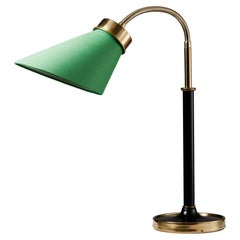
Table Lamp Model 2434 Designed by Josef Frank for Svenskt Tenn
By Frank Josef
Located in Stockholm, SE
Table lamp model 2434 designed by Josef Frank for Svenskt Tenn,
Sweden, 1939.
Polished and lacquered brass with fabric shade.
Dimensions:
H: 58.5 cm / 1' 11"
W: 18 cm / 7"
D: 52 cm...
Category
Vintage 1950s Swedish Mid-Century Modern Table Lamps
Materials
Brass
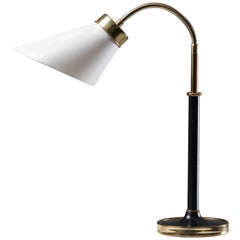
Table Lamp Model 2466 Designed by Josef Frank for Svenskt Tenn, Sweden, 1950s
By Josef Frank
Located in Stockholm, SE
Table lamp model 2466 designed by Josef Frank for Svenskt Tenn,
Sweden, 1950s.
Brass with fabric shade.
Stamped.
An understated and tim...
Category
Vintage 1950s Swedish Mid-Century Modern Table Lamps
Materials
Brass
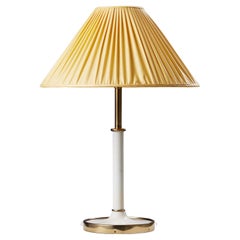
Occasional Table Designed by Josef Frank for Svenskt Tenn, Sweden, 1950s
By Josef Frank
Located in Stockholm, SE
Occasional table designed by Josef Frank for Svenskt Tenn,
Sweden, 1950s.
Mahogany.
Measurements:
H: 60 cm/ 23 1/2''
Length when extened: 104 cm/ 3' 5''
D: 54 cm/ 21 1/2''
Jose...
Category
Vintage 1950s Swedish Scandinavian Modern Side Tables
Materials
Mahogany
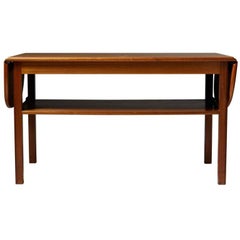
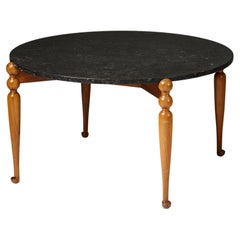
Occasional Table Model 2168 Designed by Josef Frank for Svenskt Tenn
By Josef Frank
Located in Stockholm, SE
Occasional table model 2168 designed by Josef Frank for Svenskt Tenn,
Sweden. 1950s.
Walnut and marble.
Josef Frank’s occasional table “model 2168” is one of his rarer models. Its beautifully carved, turned legs...
Category
Mid-20th Century Swedish Mid-Century Modern Tables
Materials
Marble
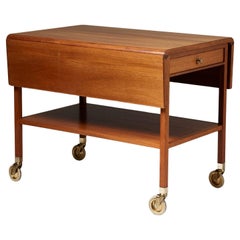
Walnut and Brass Serving Trolley Model 756 by Josef Frank for Svenskt Tenn 1940s
By Josef Frank
Located in Stockholm, SE
Serving trolley model 756 designed by Josef Frank for Svenskt Tenn,
Sweden, 1940s.
Veneered walnut and brass.
H: 65 cm
W: 53 cm
Width when fully extended: 89 cm
D: 80 cm
Josef Fr...
Category
Mid-20th Century Swedish Mid-Century Modern Carts and Bar Carts
Materials
Brass
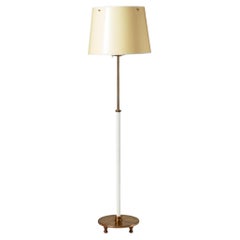
Floor Lamp Model 2564 Designed by Josef Frank for Svenskt Tenn, Sweden, 1950s
By Josef Frank
Located in Stockholm, SE
Floor lamp model 2564 designed by Josef Frank for Svenskt Tenn,
Sweden, 1950s.
White lacquered brass and Lacquered Paper.
Stamped.
This elegant brass floor lamp is adjustable in h...
Category
Mid-20th Century Swedish Mid-Century Modern Floor Lamps
Materials
Brass