1,477 results for "baroque"

to
237
834
591
1,450
14
13
Height
to
Width
to
890
26
14
14
12
11
6
4
3
2
1
1
1
1
838
351
261
27
87
78
56
20
4
21
6
3
18
14
14
3
6
466
452
388
305
288
1,264
398
274
112
106
1,477
1,469
1,473
26
20
7
6
5
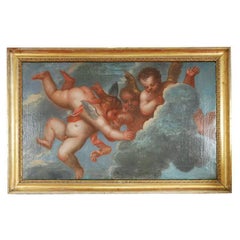
17th-18th Century Venetian Painting
Located in Pembroke, MA
Venetian School painting of four angels, allegorically depicting the variable winds of change and time. Unsigned, believed to be by a follower of Pietro Li...
Category

Antique 17th Century Italian Baroque Paintings

Materials

Giltwood, Canvas

17th-18th Century Venetian Painting
$9,500 Sale Price
39% Off
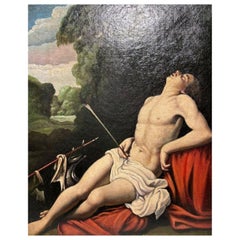
"Saint Sebastian" by Carlo Saraceni 19th Century Italian School with Video
Located in Madrid, ES
"Saint Sebastian" by Carlo Saraceni 19th Century Italian School with Video Oil painting on canvas, Italian school, 19th century, depicting Saint Sebastian in the style of Carlo Sara...
Category

Antique Late 19th Century Italian Baroque Paintings

Materials

Paint

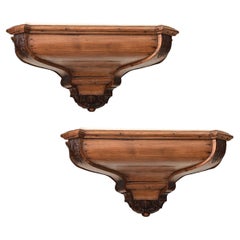
Portuguese Pair of 18th Century Pine Altar Consoles
Located in Baton Rouge, LA
A magnificent pair of 18th century Portuguese carved pine wall consoles, also called brackets, originally part of the architectural program of a cathedral altar. They have been updat...
Category

Antique 18th Century Portuguese Baroque Wall Brackets

Materials

Travertine

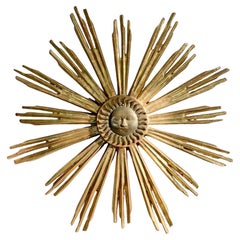
Decorative Giltwood Church Sunburst early 20th Century
Located in Hastings, GB
A circa 1920 highly decorative water gilded Italian sunburst, hand carved wooden rays with a brass sun face to the centre. Original hanging hook to the rear. Width 55cm, Depth 5cm.
Category

Vintage 1920s Italian Baroque Wall-mounted Sculptures

Materials

Brass

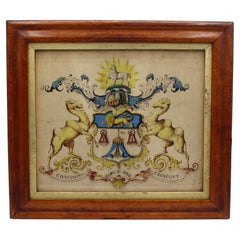
18th-19th Century Watercolor Coat of Arms of Company of Merchant Taylors
Located in Chapel Hill, NC
18th to 19th century framed watercolor Coat of Arms of the Company of Merchant Taylors of the City of York. A guild of freemen since 1273, Charles II granted them a royal charter Apr...
Category

Antique 19th Century English Baroque Paintings

Materials

Maple, Paint

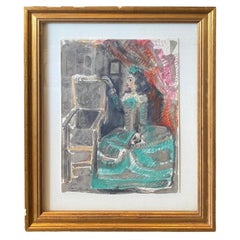
Pablo Picasso (After) Framed Lithograph Print Toros y Toreros 38
By (after) Pablo Picasso
Located in Studio City, CA
A wonderfully imagined, boldly colored lithograph by Spanish artist Pablo Picasso (1881-1973) features an ornately dressed Baroque woman, likely Spanish, with her hand on the back of...
Category

Vintage 1960s French Mid-Century Modern Prints

Materials

Wood, Paper

Period Giltwood Italian Salvator Rosa Frame
Located in Roma, IT
Italian Salvator Rosa last 17th century giltwood frame. Internal measurements cm 20 x 30 Pure example of Italian Salvator Rosa gild wood frame of 17th century. "Salvator Rosa" is th...
Category

Antique Late 17th Century Italian Baroque Decorative Art

Materials

Wood

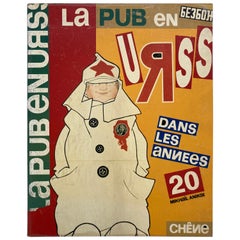
Advertising in the USSR in the 1920s, La Pub in URSS French Book
Located in Moreno Valley, CA
La Pub in URSS dans les annees 20 Anikst, Mikhail Published by Editions du Chene, 1987 This work describes the extraordinary emulation aroused in Russian a...
Category

20th Century European Baroque Books

Materials

Paper

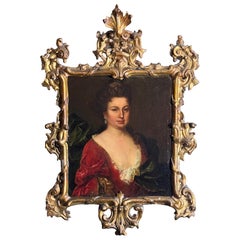
Important Portrait of the Princess of Ruspoli, 18th Century, Italian School
By Midcentury Italian school
Located in Madrid, ES
Important Portrait of the Princess of Ruspoli, began 18th Century, Italian School Began 18th-century oil on canvas depicting the Princess of Ruspoli, a member of one of the most in...
Category

Antique 18th Century Italian Baroque Paintings

Materials

Paint

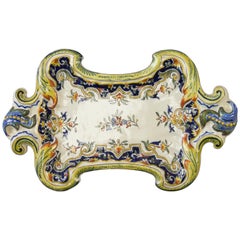
French Rouen Faience Hand Painted Decorative Wall Plate
By Rouen
Located in Barntrup, DE
French Rouen faience decorative wall plate, hand painted with blue, green and yellow decors. Dimensions: Length 32 cm / 12.59 in, height 22 cm / 8.66 in,...
Category

Mid-20th Century French Baroque Decorative Art

Materials

Ceramic, Faience

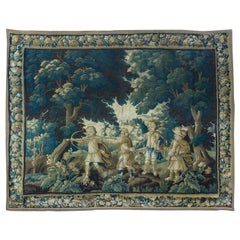
Large Antique 17th C Flemish Verdure Tapestry with Children (9.5 x 11.5 ft)
Located in New York, NY
This is a gorgeous antique 17th century Flemish Verdure Tapestry depicting the noble children playing in the woods. The p...
Category

Antique Late 17th Century Belgian Baroque Tapestries

Materials

Tapestry, Wool

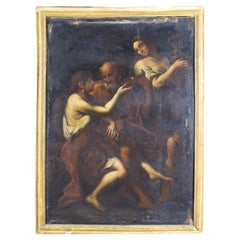
Italian 13th century oil on canvas painting "Lot and Daughters"
Located in Cesena, FC
Lot and his daughters, EMILIAN SCHOOL XVIIIth century Oil on canvas 175 x 126 cm Lot and his daughters is one of the themes most frequently encountered by seventeenth-century pain...
Category

Antique 18th Century Italian Baroque Paintings

Materials

Canvas, Paint

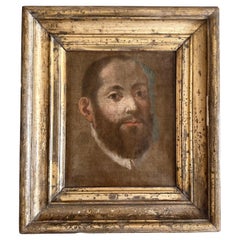
18th Century Italian Portrait of a Gentleman with Gilt “Berliner Leiste” Frame
Located in Hamburg, DE
This 18th-century Italian portrait depicts a distinguished gentleman in a loosely sketched, slightly misty style, giving the painting a soft, atmospheric quality. Although unsigned, ...
Category

Antique Early 18th Century Italian Baroque Paintings

Materials

Canvas, Wood

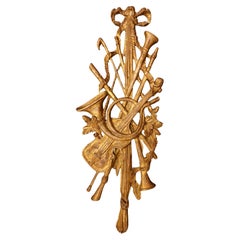
Giltwood Trophy Wall Applique
Located in Leesburg, VA
Giltwood Trophy Wall Applique Anonymous Probably French; ca. 1900 Giltwood Approximate size: 41 (h) x 16 (w) x 2.75 (d) in. This decorative architectural giltwood wall trophy fea...
Category

Antique Late 19th Century French Baroque Revival Wall-mounted Sculptures

Materials

Giltwood

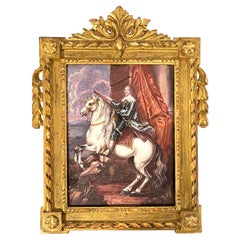
19th C Limoges Enamel of Thomas Francis, Prince of Carignano after van Dyck
By Anthony van Dyck
Located in West Palm Beach, FL
19th C Limoges Enamel of Thomas Francis, Prince of Carignano after van Dyck A exquisite large Limoges enamel of the portrait of Thomas Francis, Prince of Carignano by Anthony van Dyck, 1634. In a finely carved giltwood frame. Unsigned. The original work was created in 1634 painting by Anthony van Dyck, Known as one of the finest equestrian portraits, It depicts Thomas Francis, Prince of Carignano on a horse, as an allegory of his holding the reins of command even in difficult times. The prince is wearing the insignia and red sash of the Supreme Order of the Most Holy Annunciation, conferred on him in 1616 by his father Charles Emmanuel I, Duke of Savoy...
Category

Antique 19th Century French Baroque Paintings

Materials

Enamel

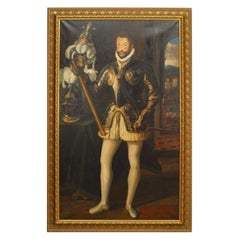
Emanuele Filiberto Portrait
Located in Queens, NY
Copy of a portrait of "Emanuele Filiberto", Italian military leader of the 1500's
Category

Late 20th Century Italian Baroque Paintings

Materials

Paint

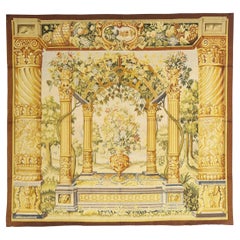
The Flemish Pergola: A Renaissance Garden Tapestry Inspired by Jacob Wauters
By Flemish, Mortlake
Located in Dallas, TX
73698 New Garden View Tapestry Inspired by Jacob Wauters, 05'03 x 05'07. Inspired by the majestic designs of Jacob Wauters and the distinguished Manufacture of Antwerp, this Garden V...
Category

21st Century and Contemporary Chinese Baroque Western European Rugs

Materials

Wool

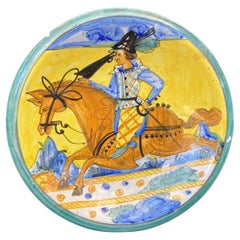
Vintage Italian Montelupo Maiolica Pottery Charger
Located in Bradenton, FL
This beautiful 11.5 pottery charger is from Montelupo, Italy and is boldly decorated with a soldier on horseback. Vividly painted in yellow, green, and blue. Condition is very good, ...
Category

Mid-20th Century Italian Baroque Decorative Art

Materials

Pottery

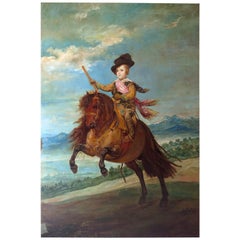
"Prince Balthazar Carlos on Horseback" Painting after Velasquez, Spain 1915
By Diego Velã¡zquez
Located in Isle Sur La Sorgue, Vaucluse
Well-executed oil on canvas painting after the original 1653 painting by Diego Velasquez, which hangs at the Prado Museum in Madrid. This one is slight...
Category

Early 20th Century Spanish Baroque Paintings

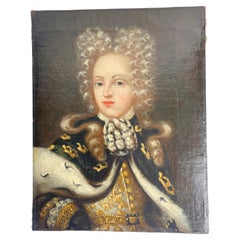
Charming child portrait of Swedish king Charles XI from the late 17th Century
By David Ehrensrahl
Located in Knivsta, SE
Extremly charming oil painting. Child portrait of the Swedish king Charles XI (1655-1697) from the late 17th Century in the circle of David Klöcker Ehrenstrahl (1628-1698). No frame....
Category

Antique Late 17th Century Swedish Baroque Paintings

Materials

Paint

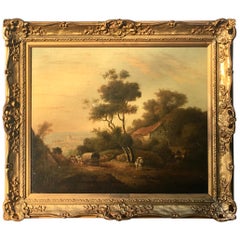
Julius Caesar Ibbetson 1759-1817 Old Master Painting English, 18th Century
Located in Vero Beach, FL
Julius Caesar Ibbetson 1759-1817 old master painting English, 18th century This English school painting by Julius Caesar Ibbetson (1759-1817) depicts a countryside farm house off of a road with a horse drawn wagon...
Category

Antique 18th Century English Baroque Paintings

Materials

Canvas, Giltwood

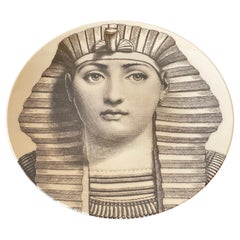
Fornasetti Wall Plate Tema E Variazioni N. 221
By Fornasetti, Jonathan Adler
Located in San Diego, CA
Beautiful wall plate with the interpretation of opera singer Lina Cavalieri’s face are the basis of the iconic Tema e Variazioni series by Fornasetti. Beautiful hand-decorated porce...
Category

20th Century Italian Baroque Revival Decorative Art

Materials

Porcelain

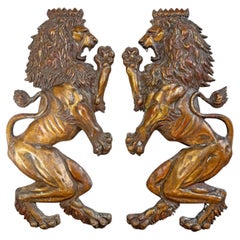
Pair of Vintage Lion Wall Plaques
Located in Hastings, GB
A wonderfully cast pair of vintage heraldic lions, beautifully detailed and of great size and scale. These were cast in Japan of aluminium, and each has an incredible bronzed gilt finish. Hanging hook to rear of each lion. Wear commensurate to the age of item. Priced as a pair. Pair of Vintage Lion Wall Plaques...
Category

Late 20th Century Japanese Baroque Wall-mounted Sculptures

Materials

Aluminum

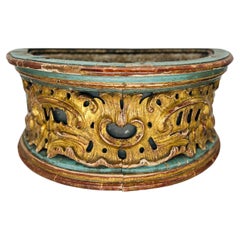
18th Century, Italian Giltwood Paint Decorated Planter - Mirrored Back
Located in Atlanta, GA
Italy, 18th century. This magnificent 18th-century Italian planter is a captivating example of Rococo Baroque craftsmanship, featuring an elegant French blue painted background that...
Category

Antique 18th Century Italian Baroque Paintings

Materials

Mirror, Giltwood, Paint

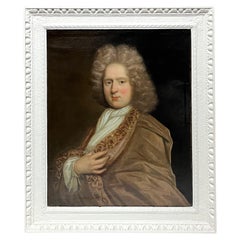
Portrait of Mr. Bell Attributed to Sir Godfrey Kneller, circa 1720
By Sir Godfrey Kneller
Located in Kinderhook, NY
An exquisite circa 1720 English George I period "Kit-kat" style portrait firmly attributed to royal court painter Sir Godfrey Kneller (8 August 1646 – ...
Category

Antique Early 18th Century English Baroque Paintings

Materials

Canvas, Wood, Paint

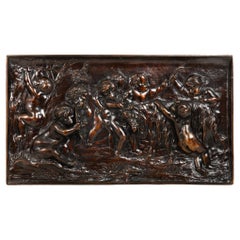
Rare 18th Century Bachanalia Plaque of Putti Tormenting Goat after Duquesnoy
Located in Shippensburg, PA
AFTER FRANÇOIS DUQUESNOY Flemish, 1594-1643 An exceedingly rare bas-relief of "Putti Tormenting a Goat" Probably Italian, circa 18th century Sand-cast bronze, chemical and lacquer ...
Category

Antique 18th Century European Baroque Wall-mounted Sculptures

Materials

Bronze

Portraits of the monarchs Louis XIII and Anne-Marie of Austria as hunters.
Located in Madrid, ES
Portraits of the monarchs Louis XIII and Anne-Marie of Austria as hunters. Oil on canvas. Possibly Madrid school, 17th century. Pair of full-length portraits showing the characters against natural backgrounds, with landscapes with mountains in the distance and trees. The male character, who looks directly at the viewer, has dark hair and a fine moustache, and is dressed in a ruff, a doublet, leather gloves, a blued breastplate with gold details, breeches, white silk stockings and cavalier boots. The lady, who modestly lowers her gaze, has her head partially covered with a hat decorated with a brooch and white feathers; she is dressed in a ruff and a dress with a wide-skirted doublet and skirt, wide-mouthed gloves and a short cloak with a decorated edge gathered around the left arm and placed over the right side of the skirt. Alongside these “hunting” dresses, they appear carrying firearms and accompanied by large dogs. The king's dog is standing alertly, turning his head to one side. The queen's dog is sitting looking at her, with a collar and a rope that she holds in her left hand. The male subject is clearly the French King Louis XIII (Fontainebleau, 1601-Saint-Germain-en-Laye, 1643), monarch of France and Navarre (1610-1643), son of Henry IV of France and Marie de Médicis and father of Louis XIV of France. Compare with other portraits: by Rubens, painted around 1622-1625 at the Norton Simon Museum (Pasadena, California, USA); by Philippe de Champaigne, painted in 1635 and kept at the Museo del Prado (Madrid, Spain); the painting by Frans Pourbus the Younger from the 1920s at the Musée des Beaux-Arts in Chambéry (France); etc. Louis XIII married Anne of Austria, daughter of Philip III of Spain, in 1615. This was brought about by the marriage agreement of Fountainebleau (1611), which stipulated the future wedding of the Prince of Asturias, Philip IV, with the French princess Isabella of Bourbon, and that of the French monarch with Anne. Anne Maria Mauricia of Austria and Austria-Styria (Valladolid, 1601-Paris, 1666) was an Infanta of Spain and Portugal as the daughter of Philip III of Spain and Margaret of...
Category

Antique 17th Century Spanish Baroque Paintings

Materials

Other

Death Comes to the Table Memento Mori by Giovanni Martinelli c. 1670
Located in Milano, MI
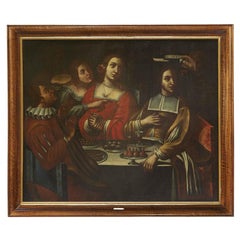
Italian painting from 1600 Banquet with Figures Memento Mori by Giovanni Martinelli, titled Death Comes to the Banquet Table, vanitas circa 1635. The oil-on-canvas painting is inspi...
Category

Antique Late 17th Century Italian Baroque Paintings

Materials

Canvas, Oak

Portrait of Isabella II of Spain, 19th Century
By Central School of Arts Crafts
Located in Madrid, ES
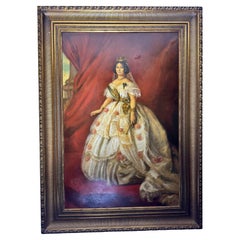
Portrait of Isabella II of Spain, 19th Century Magnificent large-format oil on canvas depicting Queen Isabella II of Spain in a solemn pose, dressed in a flowing white gown adorned w...
Category

Antique 19th Century Spanish Baroque Paintings

Materials

Paint

18th Century, Italian Oil on Canvas Still Life by Pietro Navarra
Located in IT
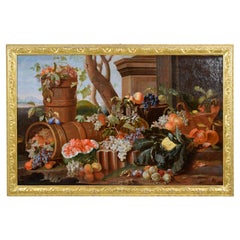
18th century, Italian oil on canvas still life by Pietro Navarra Oil on canvas, canvas measures: cm H 103 x W 164, framed measures...
Category

Antique 18th Century Italian Baroque Paintings

Materials

Canvas

Oil on canvas, Vase of Flowers by Francesco Caldei known as Francesco Mantovani
Located in Milan, IT
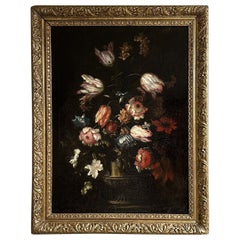
Oil on canvas, Vase of Flowers by Francesco Caldei, known as Francesco Mantovani, Mantua 1584-Venice 1674. This is a painting created around 1600 by Francesco Caldei, known as Franc...
Category

Antique Early 1600s Italian Baroque Paintings

Materials

Canvas

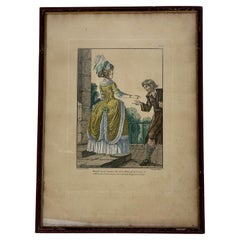
French Engraving Hand Colored Galerie des Modes Costumes Francais, 1779.
Located in Vero Beach, FL
French Engraving Hand Colored Galerie des Modes Costumes Francais, 1779. Rare antique French fashion print hand colored published first ...
Category

Early 20th Century French Baroque Prints

Materials

Paper

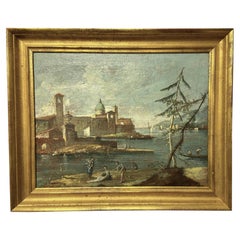
19th Century Italian Oil on Canvas Painting, Style of Guardi
By Francesco Guardi
Located in Bradenton, FL
A beautiful 19th century Italian oil painting on re-lined canvas presented in a gilded wooden frame. Done in Guardi style with gold frame. The...
Category

Antique 19th Century Italian Baroque Paintings

Materials

Paint

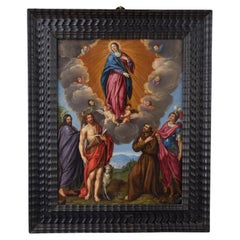
Assumption of the Virgin Mary, Circle of Van De Kasteele, Frans
By Francesco da Castello
Located in Madrid, ES
Circle of VAN DE KASTEELE, Frans (Brussels, c. 1541 – Italy, 1621). "Virgin with angels and saints". Oil on copper. Curly frame in ebony. Devotiona...
Category

Antique Early 17th Century Italian Baroque Paintings

Materials

Copper

Italian 20th C. Oil on Panel "Battipanni" The Carpet Beaters by Nino Caffè
By Nino Caffè
Located in Los Angeles, CA
A fine Italian Mid-20th century oil on panel "Battipanni" (The Carpet Beaters) by Nino Caffè (1908-1975) depicting a group of Cardinals playing around with ...
Category

20th Century Italian Baroque Revival Paintings

Materials

Hardwood, Paint

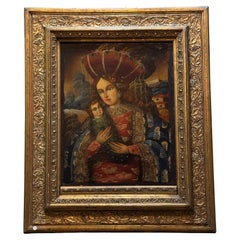
Virgin and Child, Cuzco School, oil on canvas, 18th century
By Central School of Arts Crafts
Located in Madrid, ES
Virgin and Child, Cuzco School, oil on canvas, 18th century Magnificent oil on canvas from the Cuzco School (Viceroyalty of Peru), dated to the 18th century. It depicts the Virgin h...
Category

Antique 18th Century Spanish Baroque Paintings

Materials

Paint

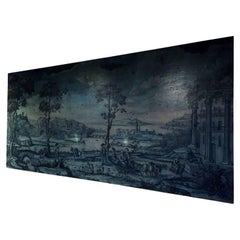
19th Century Panoramic French Pastoral Oil Painting
Located in Los Angeles, CA
A huge late 19th century oil on linen landscape painting of a French pastoral scene featuring hills, valleys, rivers, a castle, city, lake and peasants and nobility as well as animal...
Category

Antique 19th Century French Baroque Paintings

Materials

Canvas

Italian 17th Century Still Life Painting in Period Carved Gilt Frame
Located in Vero Beach, FL
Italian 17th century still life painting in period carved gilt frame Italian school still life painting from the workshop of a great master. The 17th century Baroque painting in oil...
Category

Antique 17th Century Italian Baroque Paintings

Materials

Canvas, Giltwood

Pair of 19th Century Teniers Style Porcelain Plaques by Feuillet of Paris
By Jean-Pierre Feuillet
Located in London, GB
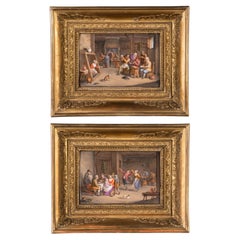
A Fine Pair of Framed Porcelain Plaques Of Tavern Scenes By Jean-Pierre Feuillet The hand-painted, glazed & fired pair of rectangular plaques of tavern genre scenes in the manner of...
Category

Antique 19th Century French Baroque Decorative Art

Materials

Porcelain, Giltwood

Antique French Tapestry Wool Silk Masque Vase Exotic Flowers 4x5 122x 142cm
Located in New York, NY
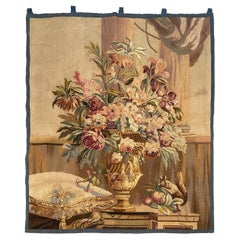
Antique French Tapestry Wool & Silk Masquerade Vase Exotic Flowers 4x5 1920 4' x 4'8" 122cm x 142cm "A magnificent antique French tapestry depicting an ornate vase full of flowers....
Category

Vintage 1920s French Baroque Tapestries

Materials

Wool, Silk

Grand Tour Pen Ink Wash Drawing Bearded Patriarch, After the Italian Baroque
Located in Atlanta, GA
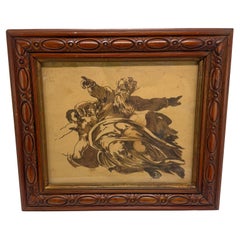
A spirited 19th-century Continental pen and ink wash drawing on laid paper, depicting a bearded patriarchal figure, his robes sweeping in dynamic folds as he gestures commandingly to...
Category

Antique 19th Century British Grand Tour Paintings

Materials

Wood, Paper

Late 17th Century Italian Heraldic Coat of Arms Tapestry, Lucca, circa 1690
Located in Encinitas, CA
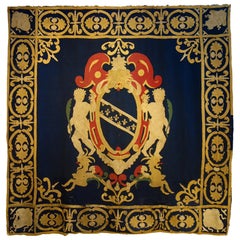
Aristocratic style is presented by this tapestry; a heraldic coat of arms formed by woolen cloth of different colors applied in collage on blue woolen cloth. Lucchese (Lucca) manufac...
Category

Antique Late 17th Century Italian Baroque Tapestries

Materials

Wool, Linen

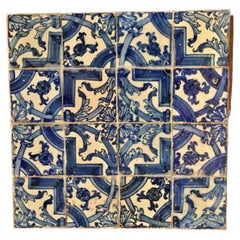
17th Century Portuguese Tile Panel
Located in Madrid, ES
Largest collection of Portuguese tiles in the world 17th Century Portuguese Tile Panel Restored 56cm x 56cm 14cm x 14cm tiles With certificate of authenticity and export issued by ...
Category

Antique 17th Century Portuguese Baroque Decorative Art

Materials

Porcelain

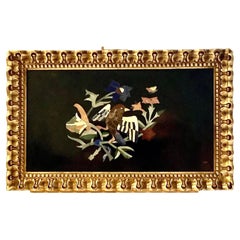
Vintage Italian Grand Tour Style Pietra Dura Mosaic Plaque, Framed 3
Located in Bradenton, FL
A beautiful Italian grand Tour Style Pietra Dura mosaic on marble Plaque with gilt framing. Picture is a bird on branch with leaves and flowers.
Category

Early 20th Century Italian Baroque Decorative Art

Materials

Marble

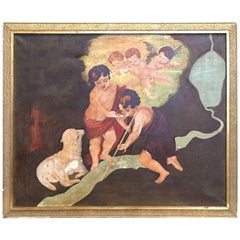
Large 1870 Original Religious Painting, Cherubs, Signed by S. Barber, Spain
Located in Miami, FL
1870 original religious painting. Cherubs Signed by S.Barber Interior measurements: 48.42in x 39.76in Frame: 2.75 in.
Category

Antique Late 18th Century Italian Baroque Religious Items

Materials

Paint

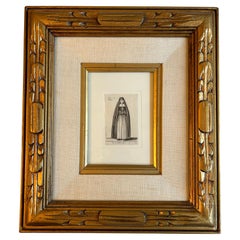
Three Etchings of Gentlewomen by Wensceslaus Hollar, 1607-1677
Located in Toronto, CA
A wonderful trio of etchings of gentlewomen by Wenceslau Hollar, who was born in Prague in 1607 and died in London in 1677. The largest, A Woman of Holland, is inscribed on the upper...
Category

Antique 17th Century English Baroque Prints

Materials

Paper

Tapestry Royal Manufacture of Aubusson, Louis XVI period 1738 at the Gobelins
By Aubusson Manufacture
Located in Madrid, ES
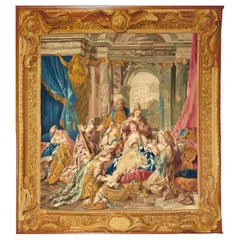
Tapestry from the Royal Manufacture of Aubusson, Louis XVI period , made in 1738 at the Gobelins One panel from a series of Gobelins tapestries depicting the History of Esther, illustrating Esther seated and attended by handmaidens, one washing her feet in golden basin, another fastening a bracelet, another offering a mirror, all observed by Mordecai, woven in the workshop of Michele Audran after a design by J. F. de Troy. The Toilet of Esther c.1778-85.Royal Collection Trust-Queens Audience Chamber Windsor Castle The Sketches for the Esther Cycle by Jean-François de Troy (1736) “and the maid was fair and beautiful; whom Mor’decai, ..., took for his own daughter.” (Est. 2:7) A supple and undulating genius, both a flattering portraitist and a prolix history painter, as well as a brilliant genre painter, in a gallant or worldly vein, Jean-François de Troy (Paris, 1679 – Rome, 1752), solicited, although he had passed the threshold of old age, a new royal commission up to his ambitions. To obtain it, he submitted – successfully - for the approval of the Bâtiments du roi (administration), seven modelli painted in 1736 with his usual alacrity. Inspired by one of the most novelistic texts of the Old Testament, the Book of Esther, these sketches in a rapid and virtuoso manner were transformed by the artist, between 1737 and 1740 into large cartoons intended to serve as models for the weavers of the Gobelins factory. Showing undeniable ease and skill in the composition in perfect harmony with the sensitivities of the times, the tapestry set met with great success. The Story of Esther perfectly corresponded to the plan of the Bâtiments du roi to renew the repertoire of tapestry models used for the weavers of the royal factories while it also conformed to the tastes of Louis XV’s subjects for a fantastical Orient, the set for a dramatic tale in which splendour, love and death were combined. Indeed, no tapestry set was woven in France during the 18th century as often as that of Esther. The series of modelli painted by de Troy during the year 1736 looks to the history of French painting and decoration under Louis XV as much as it does the history of the Gobelins. It probably counts among the most important rococo pictorial groups to have remained in private hands. First the Biblical source illustrated by De Troy which constitutes the base of one of the richest iconographical traditions of Western art will be considered. Then the circumstances and specific character of French civilisation during the reigns of Louis XIV and Louis XV which contributed to making the theme of Esther a relevant subject, both attractive to contemporaries and remarkably in line with the sensitivities of the time will be elucidated. An examination of the exceptional series of sketches united here, the cartoons and the tapestries that they anticipate as well as a study of their reception will close this essay. The Book of Esther: A scriptural source at the source of rich iconography. The origin of the Esther tapestry set by Jean-François de Troy – origin and creation of a masterpiece According to the evidence of one of the artist’s early biographers, the chevalier de Valory, author of a posthumous elegy of the master, read at the Académie royale de peinture et de sculpture on 6 February 1762, it was apparently due to early16 rivalry with François Lemoyne (1688-1737), his younger colleague who had precisely just been appointed First Painter to the King in 1736, that had encouraged François de Troy to seek a commission allowing him to show off his ease and his promptitude at the expense of a rival who was notoriously laborious: “M. De Troy, retaining some resentment of the kind of disadvantage which he believed to have suffered compared with his emulator looked to regain some territory by making use of the facility his rival did not possess. Lemoyne was excessively long in the creation of his works,and M. De Troy of a rare celerity: consequently, with this particular talent, the latter offered to the court to make paintings appropriate to be executed at the Gobelins Factory; and it is to this circumstance that we owe the beautiful series of the Story of Esther, which would be sufficient alone to give him a great reputation.”17 Beyond the suspicion inspired by the topos, which still constitutes, more or less, a tale of rivalries between artists in ancient literature, there is probably some truth in what Valory reports although A.-J. Dezalier d’Argenville (who indicates rather spitefully that de Troy did not hesitate to “cut prices” to impose himself, benefitting from the productivity assured by the unlikely rapidity of his brush)18 proves to be more evasive: “As he looked to busy himself, he had offered to make the paintings that serve as models for the King’s tapestries cheaply: which did not please his colleagues. He was given a choice of two tapestry series to be made and he took the Story of Esther and that of Jason”.19 Whether or not the choice was actually left to de Troy (which would appear rather casual on the royal administration’s part all the same), it seems likely that the artist, whose contemporaries extol his “fire”, as the faculty of invention was then called, must have ardently aspired to the possibility of using on a very large scale the “creative genius” with which Dezallier d’Argenville credits him. The decoration of the private apartments, the fashion for which Louis XV had promoted at Versailles and Fontainebleau, offered little opportunity to excel in this area. Other than painting for altarpieces, only tapestries could allow comparison with Lemoyne who had been granted – unfortunately for him – a major decoration: the enormous ceiling of the Hercules Room at Versailles. Favoured by the recent improvement in France’s financial situation, the revival of patronage offered de Troy a commission fitting for him, in a field in which, however, he had hardly any experience. Anxious to renew the repertoire of models available to the Gobelins factory, the Duc d’Antin, surintendant des Bâtiments du roi from 1708 to 1736 followed by his successor, Philibert Orry comte de Vignory, gave him the task of producing seven large cartoons inspired by the Book of Esther corresponding to the brilliant sketches or modelli which de Troy had produced in one go, or almost (very few preparatory drawings can in fact be linked to the Esther cycle and all seem to be at the execution stage of the cartoons).20 Subjected to the approval of the Administration des Bâtiments according to the procedure in use for projects being planned for the Gobelins, sketches made rapidly during 1736 were approved and the project launched immediately. Thereupon came the news of François Lemoyne’s death, who, ground down by work and a victim of his private torment, committed suicide on 4 June 1737. Against all expectations, de Troy did not replace his rival in the position of First Painter (which remained vacant until the appointment of Charles Coypel in January 1747), which would perhaps have made him too obviously the beneficiary of the drama. The awarding of the position of Director of the French Academy in Rome came to console him while he had already produced (or he was in the process of finishing), in Paris, three of the seven cartoons of the cycle (The Fainting of Esther finished in 1737 and the Toilet and Coronation of Esther, both finished in 1738). De Troy, we can see, did not follow the order of the narrative but began with the subjects which apparently offered the least difficulty because he had already depicted them, or because they fall into a strong pictorial tradition (such is the case especially for the Fainting of Esther). He had hardly settled at the Palazzo Mancini in August 1738, when his first task which awaited the new director of the French Academy naturally consisted of honouring the royal commission and finishing without delay the final cartoons of the Story of Esther after the sketches he must have taken with him. As prompt as ever, de Troy discharged himself of the execution of the four remaining cartoons in only two years, by beginning with the largest format which allowed him to strike the imagination and to impose himself as soon as he arrived on the Roman stage: the Triumph of Mor’decai which was finished in 1739 (like Esther’s Banquet). The following year, the Mor’decai's Disdain and The Sentencing of Haman were brought to an end in the same Neo-Venetian style, obviously tributary to Veronese with its choice of “open” monumental architecture which is characteristic of the entire cycle.21 The series, it should be noted, was almost augmented with some additional scenes in the mid 1740s. Indeed, the first tapestry set finished at the Gobelins in 1744 proved to be unsuitable for the arrangement of the Dauphine’s apartments at Versailles for which it had been intended to decorate the walls the following year (cf infra). Informed of this, de Troy, considering that the story of Esther offered “several good subjects,” immediately offered to illustrate one or new subject among those “which could appear to be the most interesting”. The directeur des Bâtiments Orry, who managed the State’s accounts, obviously judged it less costly to have one of the tapestries widened to fill in the end of the Dauphine’s bedroom,22 which has probably deprived us of very original compositions, because de Troy had already illustrated the most famous themes, those that benefitted from a strongly established iconographical tradition and from which it was not easy to deviate The Tapestry Set of the Story of Esther Placed on the tapestry looms of the Gobelins at the end of the 1730s in Michel Audran’s workshop, the cycle created by de Troy aroused true infatuation. The few hundred tapestries made between 1738 and 1797 – all in high-warp tapestry and woven in wool and silk except for four in low-warp made in Neilson’s workshop – show the impressive success of a tapestry set that was without any doubt the most frequently woven of the 18th century in France. 29 Only three cartoons had been delivered by de Troy in 1738 when the first tapestry set was begun by Audran under the expert eye of Jean-Baptiste Oudry to whom the Directeur général des bâtiments, Philibert Orry had assigned the (weekly) supervision of the weaving. During the summer of 1738, the piece of the Fainting of Esther, which Oudry judged to be admirable, was finished. During the winter of 1742, Oudry informed Orry that about two ells of the Triumph of Mor’decai had been made “with no faults”,that the Coronation of Esther was finished and that the Esther at her Toilet “a very gracious tapestry” was “a little over half” finished. Exhibited at Versailles in 1743, these two last pieces were admired by Louis XV and the Court. On 3 December 1744, the set of seven tapestries was finally delivered to the Garde Meuble. It was intended, the honour was not slight, to decorate the apartments of the Infanta Maria Teresa Rafaela of Spain whose marriage to the young Dauphin Louis-Ferdinand had been fixed for the following year (it took place on 23 February 1745). Apparently it was thought that the theme of Esther the biblical heroine and wife of a foreign sovereign was appropriate for the apartments of the Spanish Dauphine. As early as the month of March, the architect Ange-Jacques Gabriel informed de Troy that her grand cabinet was decorated with the “Esther tapestry set” specifying however that “for lack of two small or one large piece, we have not been able to decorate the end of the room”. This difficulty led immediately to the Banquet episode being woven a second time in two parts (they were delivered to the Garde-Meuble on 30 December 1746) to garnish the panels on each side of the bed of the Dauphine who would hardly enjoy them (she died on 22 July 1746 and the decoration was installed for the new Dauphine Maria Josepha of Saxony). The appearance of the set’s remarkable border, which imitated a richly sculpted wooden frame, should be mentioned. Conceived in 1738 by the ornamentalist Pierre Josse-Perrot and used in the later weavings until 1768, it tended to reinforce the resolutely painterly appearance of the tapestry set which, in this regard, pushed the art of tapestry as far as its ultimate mimetic possibilities. With the exception of Mor’decai's Disdain which had been removed earlier, the “editio princeps” of the story of Esther (from then on in nine pieces) remained at Versailles until the Revolution. Of the eight surviving tapestries, four are at the chateau of Compiègne and four belong today to the Mobilier National. No less than seven tapestry sets reputed to be complete (one of them in fact only had six tapestries) would be produced officially at the Gobelins up to 1772. Literature: 1- The Œuvres mêlées of an emulator of Racine, the Abbé Augustin NADAL thus include an Esther. Divertissement spiritual which is exactly contemporary with Jean François de Troy’s cycle since it was performed in 1735 and published in Paris three years later. 2-Le Siècle de Louis XIV, 1751, 1785 ed., p. 96-97 for French ed. 3- Lemoyne and de Troy had been obliged to share the First Prize in the competition organised in 1727 between the most prominent history painters of the Académie Royale. 4- Mémoires…, pub. L. DUSSIEUX et al., 1854, II, p.265. 5-The fact that de Troy, at the risk of falling out with his colleagues, did not hesitate to make use of prices in order to convince the new directeur des Bâtiments Philibert Orry, is confirmed by Mariette who adds tersely “it caused much shouting” (pub. 1851-1860, II, p. 103). 6- Abrégé de la vie des plus fameux peintres…, ed. 1762, IV, p. 368-369 20 Early comments on the painter are inclined to present him as a kind of “pure painter”, doing without the medium of drawing, a few intermediary studies between the Esther sketches and the large cartoons at the Louvre nevertheless show that de Troy used red chalk (see in the catalogue, the notice for the Meal of Esther and Ahasuerus under the entry drawing) to change one or other figure. 7-C. GASTINEL-COURAL (cat. exp. PARIS, 1985, p. 9-13) as well as the article by J. VITTET, exh. cat. LA ROCHE-GUYON, 2001, p. 51-55. 8-The Hermitage in St. Petersburg conserves five tapestries of these two royal gifts whose provenance still awaits elucidation (as far as we are aware). In 1766, the Grand Marshal of Russia, Count Razumovski (or Razamowski), acquired the Fainting and the Banquet extracted from the sixth weaving (J. VITTET, 2001, p. 53). 9- Lettres écrites de Suisse, d’Italie…,quoted by J. VITTET, op. cit., p. 54. 10-The tapestry set remained in the hands of a branch of the Hapsburg-Lorraine family until 1933 (ibid. P. 54). 11-Quoted by Chr. LERIBAULT, 2002, p. 97, note 269. 12-Y. CANTAREL-BESSON, 1992, p. 241. Catalogue The Esther at her Toilet Oil on canvas, 57 x 51 cm Provenance: Painted in 1736 at the same time as the six other modelli of the Story of Esther intended to be presented, for approval, to the direction des Bâtiments du Roi; perhaps identifiable among a lot of sketches by Jean-François de Troy in the post mortem inventory of the amateur, historian and critic Claude-Henri Watelet (1718-1786) drawn up on 13 January 1786 and following days (A.N. T 978, n° 30) then in the sale of the property of the deceased, Paris, 12 June 1786, n° 33; Paris, François Marcille Collection (who owned a series of six sketches from which the Triumph of Mor’decai was missing, see infra); Paris, Marcille Sale, Hôtel Drouot, 12-13 January 1857, n° 36; Asnières, Mme de Chavanne de Palmassy ( ?) collection; Paris, Galerie Cailleux; Paris, Humbert de Wendel collection (acquired from the Galerie Cailleux in 1928); by inheritance in the same family; Paris, Sotheby’s, 23 June 2011, n° 61. In order not to add unnecessarily to the technical commentary on each work, the catalogue raisonné by Chr. Leribault which contains a substantial bibliography on the series should be referred to. The other bibliographical references only concern the publications and exhibitions to have appeared and been presented more recently. Bibliography and Exhibitions: Chr. LERIBAULT, 2002, n° P. 247 (repr.); E. LIMARDO DATURI, 2004, p. 28; Exh. cat. NANTES, 2011, p. 138, n° 34, referred to in note 1; Sotheby’s catalogue, Tableaux anciens et du XIXe siècle, 23 June 2011, n° 61 (repr.). Related Works: Tapestry cartoon: The cartoon (oil on canvas, 329 x 320 cm), the third made by the artist in Paris after the sketches had been approved by the direction des Bâtiments, is in the Louvre (Inv. 8315). It previously bore the painter’s signature and the date 1738 (inscriptions which are found on the tapestries). The royal administration paid 1600 livres for it on 21 June 1738 and it was exhibited at the Salon in the year of its creation. Summary Biography 1679 (27 January): Baptism in Paris (Parish of St. Nicolas du Chardonnet) of Jean-François de Troy, son of the painter François de Troy and Jeanne Cotelle, sister of the painter Jean II Cotelle. 1696-1698: Studies (apparently rather turbulent) at the Académie royale de peinture et de sculpture. 1698-1708: First trip to Italy. Is obliged to leave Rome in January 1711 after a tempestuous affair (a duel?), de Troy extends the traditional Roman experience as a pensionnaire at the Académie de France by also visiting Tuscany where he stays for a long time, Venice (his art in face has a strongly Venetian character) and Genoa. 1708: De Troy (whose father had been elected Director of the Académie royale de peinture et de sculpture on 7 July) is agréé and immediately received at the Académie with Apollo and Diana Piercing with their Arrows the Children of Niobe (Montpellier, Musée Fabre) on 28 July. 1710: First royal commission, paid for on 10 May (a sketch representing “the Promotion of the Order of the Holy Spirit” for the tapestry series of the History of the King). 1716: Jean-François de Troy is elected Assistant Professor at the Academy. 1720: He is appointed Professor. 1723: The artist creates the double portrait of Louis XV...
Category

Antique Early 18th Century French Baroque Western European Rugs

Materials

Wool, Silk

19th C. Meissen Porcelain Plaque Depicting Rembrandt and Saskia in the Tavern
By Meissen Porcelain, Rembrandt van Rijn
Located in New York, NY
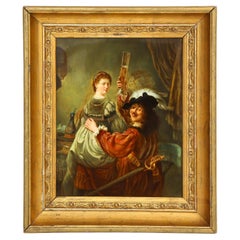
An incredible and very rare 19th Century Meissen porcelain plaque depicting Rembrandt and Saskia in the Tavern. Meissen plaques are incredibly rar...
Category

Antique 1860s German Baroque Porcelain

Materials

Porcelain

3 Antique Italian Views of Venice Drawings 1778
Located in Boca Raton, FL
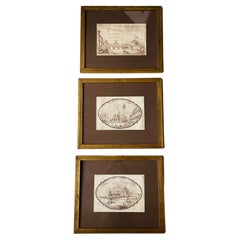
3 antique 18 th c Italian ink drawings on paper of views of Venice- Dougaba and Santa Maria church, Piazza San Marco with Campanile, Venice fort. framed later. Inscribed and dated.
Category

Antique 1770s Italian Baroque Drawings

Materials

Paper

Old Master Floral Still Life Painting
Located in Pasadena, CA
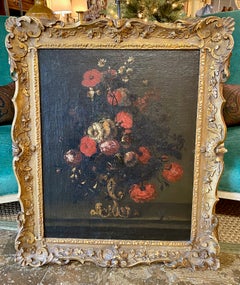
This is a classic Italian late 17th century floral still life. Although the painting is not signed, it has all of the hallmarks of being created by a master painter. The painting and...
Category

Antique Late 17th Century Italian Baroque Paintings

Materials

Gold Leaf

17th Century Oil-on-Canvas "The Archangel Raphael with Tobit"
Located in NICE, FR
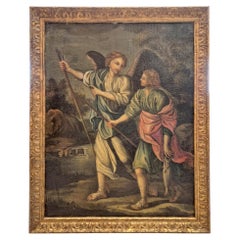
The Archangel Raphael and Tobias, 17th-Century School Oil on canvas This 17th-century painting depicts one of the most renowned episodes from the Book of Tobit: the young Tobias, ac...
Category

Antique Mid-17th Century Italian Baroque Paintings

Materials

Canvas

Antique 17th Century Green Flemish Verdure Landscape Tapestry with Birds
Located in New York, NY
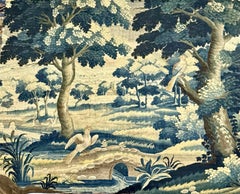
This is a gorgeous full color antique 17th century Flemish Verdure landscape tapestry depicting a beautiful and rich summer scene of a countryside with lush trees and vegetation, and...
Category

Antique 17th Century Belgian Baroque Tapestries

Materials

Wool

Antique sculpted oak frieze or wall ornament, France ca. 1900
Located in Meulebeke, BE
France / 1900 / sculpted frieze / oak / Antique / Baroque / Rococo A beautiful baroque style frieze or wall ornament in oak. Hand carved in France around 1900. A very decorative p...
Category

Antique Early 1900s French Baroque Wall-mounted Sculptures

Materials

Oak

19th C. Meissen Porcelain Plaque of the Banishment of Ishmael and Hager
By Adriaen van der Werff, Meissen Porcelain
Located in New York, NY
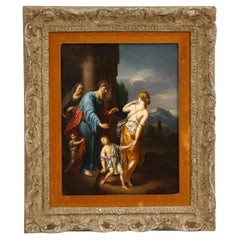
A 19th Century Meissen Porcelain Plaque of 'The Banishment of Ishmael and Hager', in its Original Frame. This fantastic Meissen porcelain plaque depicts...
Category

Antique 1870s German Baroque Paintings

Materials

Porcelain

18th Century Italian Gaming Board
Located in Greenwich, CT
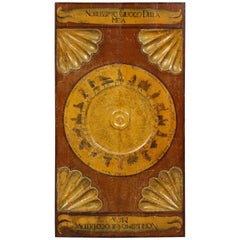
Rare 18th century Italian gaming board "Nobilissimo Giuoco Della Mea" Or "The Nobel Game of Chance" in original paint and decoupage, (lacca povera) depicting a game which appears to be a board version of "Put and Take" with different characters representing either plus or minus points. Four corners with scalloped carved coin wells, the centre slightly dished for either a top or ball to roll within. Characters include: Scimmia/Monkey - put 6, Re/King - take 1, Vople/Wolf take 3 , Pascia/Lord - take two and so on. Other characters include, Cinese/Chinese, Colombo/Pidgeon, Crepascolo/Twilight, Armigero/Knight?, Gezelia/Gazelle, Adone/Adonis, Gonhiere/Gondolier, Araba Fenice/Arab Phoenix?, Vecchio/Old Man, Leone/Lion. A very similar game board is in the collection of the Medici Villa...
Category

Antique Early 18th Century Italian Baroque Game Boards

Materials

Gesso, Poplar

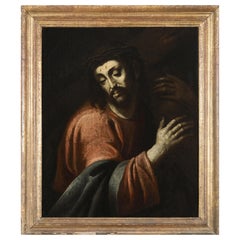
Important Spanish School of the 17th century "Christ Carrying the Cross"
Located in Madrid, ES
Important Spanish School of the 17th century "Christ Carrying the Cross" Oil on canvas 73 x 60 cm with frame: 78cm x 65cm The work is inspired by ancient models, in particular by t...
Category

Antique 17th Century Spanish Baroque Paintings

Materials

Paint

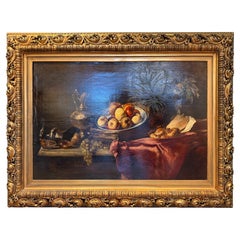
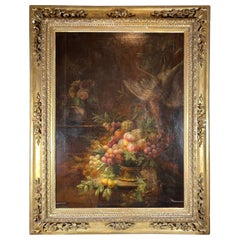
Rich Baroque Still Life with Fruit, Silverware Drapery (19th Century)
Located in Berlin, DE
This sumptuous still life is a wonderful celebration of abundance and artistry, painted in the grand Baroque tradition. Arranged upon a stone tabletop and a deep red drapery, the com...
Category

Antique 19th Century German Biedermeier Paintings

Materials

Wood

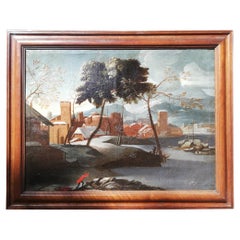
Flemish School "Landscape" 17th Century
By Flemish
Located in Madrid, ES
OIL ON CANVAS OF 17th Century LANDSCAPE OF WINTER OF THE NETHERLANDS. Good CONDITION. MEASURES WITH FRAME: 114X90 CM WITHOUT FRAME: 96X74 CM      
Category

Antique 17th Century Dutch Baroque Paintings

Materials

Paint

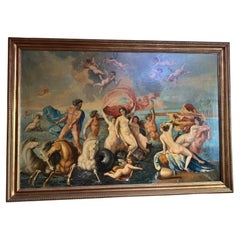
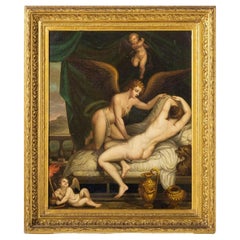
Large Mythological Painting of the Triumph of Venus, Circle of Nicolas Poussin
By Central School of Arts Crafts
Located in Madrid, ES
Large mythological oil painting of the Triumph of Venus, circle of Nicolas Poussin, 19th century Impressive large-format oil on canvas depicting the triumph of Venus in a marine cort...
Category

Antique 19th Century Spanish Baroque Paintings

Materials

Paint

Venus and Cupid 19th Century French School
Located in Madrid, ES
Venus and cupid 19th century. French school. oil on canvas. Dimension: 66 x 51 cm. Good conditions.
Category

Antique 19th Century French Baroque Paintings

Materials

Paint

Read More

Punk Rock and Rebellion Animate London’s Hit Yoshitomo Nara Show

The exhibition includes his portraits of wide-eyed kids with mayhem on their minds, as well as some of the artist’s personal belongings.

Whether Painted or Papered, Muraled Walls Make Bold Statements in the Home

The ancient practice of covering walls in artistic scenery is back.

In Francks Deceus’s ‘Mumbo Jumbo #5,’ the Black Experience Is . . . Complicated

Despite the obstacles, the piece’s protagonist navigates the chaos without losing his humanity.

12 Floral-Accented Rooms with a Handmade, Folkloric Feel

Who needs a flower garden? Just use your imagination — and some beautifully patterned wallpaper or fabric — to bring the outdoors in.

This Wolf Kahn Pastel Is the Epitome of Beauty at Its Most Essential

A longtime admirer of Kahn’s work, 1stDibs editorial director Anthony Barzilay Freund explores why it’s relevant now more than ever.

Why Jules Chéret Was the King of the Modern Poster

The streets of fin-de-siècle Paris were set aglow with colorful poster ads, thanks to the printing techniques invented by Jules Chéret. Now, the Milwaukee Art Museum is celebrating this undersung talent in America's first solo show dedicated his exuberant works.

Anna Condo’s Multifaceted Career Spans Film, Photography and NFTs

From her historic Manhattan townhouse, the talented creator and curator of 1stDibs' latest NFT exhibition tells us about the art in her home and how she got involved with cryptoart.

How Keith Rivers Went from NFL Linebacker to Blue-Chip Art Aficionado

The former football player is as serious about becoming a great contemporary-art patron as he once was about making tackles. Here, Rivers tells us how he got the collecting bug and how his tastes have evolved over the years.