18th Century and Earlier Figurative Drawings and Watercolors

to
37
184
44
14
3
Overall Width
to
Overall Height
to
1,596
10,414
4,178
228
274
408
697
612
840
895
1,006
558
411
172
103
26
142
99
3
182
123
88
54
43
40
34
20
17
11
11
9
7
7
6
6
6
5
5
5
108
104
101
97
44
16
7
4
4
4
116
52
179
48
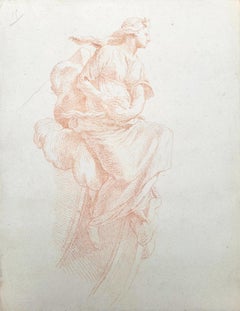
Period: 18th Century and Earlier
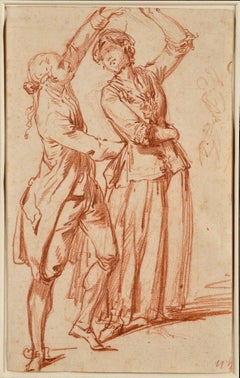
Le Menuet
Located in Paris, Île-de-France
Attributed to Gabriel-Jacques de Saint-Aubin (Paris, 1724 – 1780) Le Menuet, circa 1765–1770 Red chalk on paper 13 3/8 x 8 1/4 in (34 x 21 cm) Verso: black chalk and red chalk Unsi...
Category

Old Masters 18th Century and Earlier Figurative Drawings and Watercolors

Materials

Chalk, Laid Paper

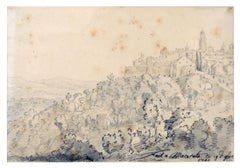
Vue de Macerata et de sa Campagne - drawing by J. P. Verdussen - 1742
Located in Roma, IT
China ink and watercolour on paper. Some foxing, otherwise very good condition. Titled and dated. Includes passepartout.
Category

18th Century and Earlier Figurative Drawings and Watercolors

Materials

Ink, Watercolor

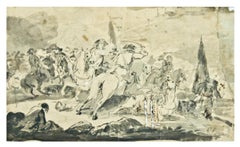
La Bataille - The Battle - Drawing by J. P. Verdussen - 1740s
Located in Roma, IT
China ink and watercolor on paper. Conditions: Two cuts on the centre of the paper. Three holes on centre-right, botton-left and top-left of the paper. Worn on the top left of the ...
Category

Old Masters 18th Century and Earlier Figurative Drawings and Watercolors

Materials

Ink, Watercolor

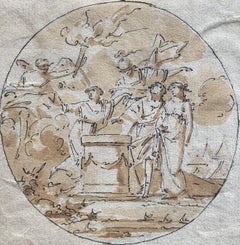
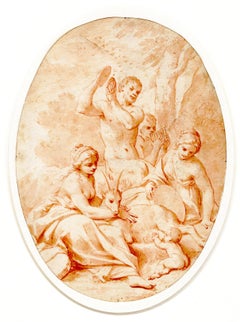
French school 18th Century, A mytholological scene with a couple, drawing
Located in Paris, FR
French school 18th Century, A mytholological scene with a couple, Pen and brown ink, brown ink wash on paper 11.5 x 11.5 cm, diameter of the main scene : 10,5 cm in a modern frame under glass : 33.5 x 33.5 cm This drawing by a particularly talented 18th-century artist - as yet unidentified - is notable for its mastery of pen and wash...
Category

Old Masters 18th Century and Earlier Figurative Drawings and Watercolors

Materials

Ink

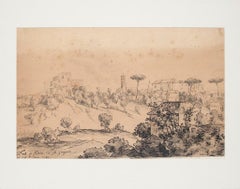
La Campagne de Rome - Roman Countryside - Drawing by J. P. Verdussen - 1740ca
Located in Roma, IT
China ink and watercolour on paper. Realized in 1740 ca. Very good conditions. Includes passepartout.
Category

Old Masters 18th Century and Earlier Figurative Drawings and Watercolors

Materials

Ink, Watercolor

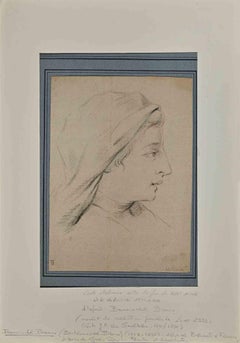
Portrait - Drawing after Baccio del Bianco - 17th Century
Located in Roma, IT
Portrait is a Pencil Drawing realized by an Italian artist of 17th and early 18th century, after Baccio del Bianco (1604-1656). Good condition on a yellowed paper included a blue an...
Category

Modern 18th Century and Earlier Figurative Drawings and Watercolors

Materials

Pencil

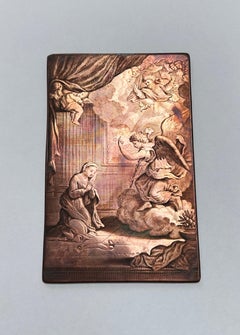
Annunciation Scene
Located in Paris, Île-de-France
Pierre-Mathieu Ogier (active between 1676 and 1709) Annunciation Scene Engraved copper plate, dated 1691 17.5 x 11.2 cm Provenance: Private collection, France This engraved copper...
Category

Old Masters 18th Century and Earlier Figurative Drawings and Watercolors

Materials

Copper

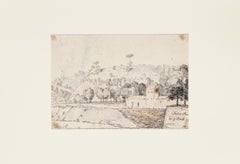
Rome/Tevere - Pencil and Watercolor Drawing - 1741
Located in Roma, IT
Rome is a beautiful artwork realized by Jan Peter Verdussen in 1741. In good condition except for some pencil marks and traces of sealing wax on the back and some diffused foxings. ...
Category

Old Masters 18th Century and Earlier Figurative Drawings and Watercolors

Materials

Watercolor, Pencil

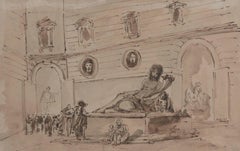
18th Century Roman School , A Palazzo with antiques, drawing
Located in Paris, FR
18th Century Roman School A Palazzo with antiques Brown ink and pen, brown ink wash on paper 12.5 x 20 cm Framed : 28,5 x 35.5 This nice drawing represents a genre scene, with a nobleman, priests, a mother and her children...
Category

Old Masters 18th Century and Earlier Figurative Drawings and Watercolors

Materials

Ink

St. Gregory in Rome - Ink and Watercolor by J. P. Verdussen - 1741
Located in Roma, IT
St. Gregory in Rome is a beautiful artwork realized by Jan Peter Verdussen in 1741. Ink and watercolour on brown paper. In very good codition. Dated on the lower margin. The origin...
Category

Modern 18th Century and Earlier Figurative Drawings and Watercolors

Materials

Ink, Watercolor

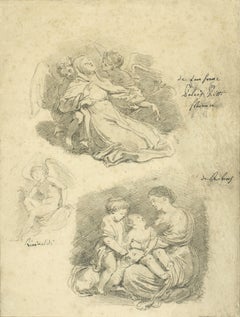
Three studies executed in the Pitti Palace in 1761 by Jean-Honoré Fragonard
Located in PARIS, FR
This brilliant study sheet, of which we present here a counterproof, is a souvenir of Fragonard's return journey from Italy. Between April and September 1761, he accompanied the abbot of Saint-Non on his way back to France. Three studies after the masters taken from the Pitti Palace’s gallery in Florence are gathered on this sheet. Although The Ecstasy of Saint Margaret...
Category

Old Masters 18th Century and Earlier Figurative Drawings and Watercolors

Materials

Carbon Pencil

Two Angels - Ink and Watercolor Drawing by A. Brustolon - Early 1700
By Andrea Brustolon
Located in Roma, IT
Due Angeli is an original artwork realized by Andrea Brustolon. Mixed media, ink and watercolor. The artwork rapresents two baroque angels, study realized by Brostolon for a sculpt...
Category

Baroque 18th Century and Earlier Figurative Drawings and Watercolors

Materials

Ink, Watercolor

The Infant Jupiter Nursing from the She-Goat Amaltheia (The Birth of Jupiter)
By Luigi Quaini
Located in Fairlawn, OH
The Infant Jupiter Nursing from the She-Goat Amaltheia (The Birth of Jupiter) Red chalk and wash on off-white paper, c. 1700 Unsigned Attribuuted to Quaini by Dwight Miller, the sch...
Category

Baroque 18th Century and Earlier Figurative Drawings and Watercolors

Materials

Chalk

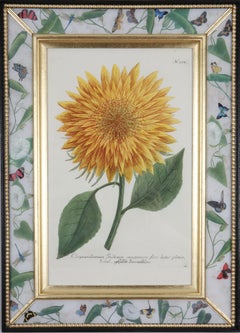
Johann Weinmann: 18th Century Engravings of Sunflowers, Set of 4, Framed
Located in Richmond, GB
A complete set of four hand-coloured mezzotint engravings of sunflowers from: "Phytanthoza Iconographia", c1739, presented in hand-made, parcel-gilt, ebonised and decalcomania frame...
Category

18th Century and Earlier Figurative Drawings and Watercolors

Materials

Watercolor, Mezzotint

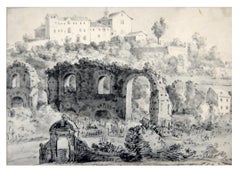
Louis Lesueur (1746-1803) Landscape with ruins, 1789, drawing signed and dated
Located in Paris, FR
Louis Lesueur (1746-1803) A Fantasy Landscape with ancient ruins, 1789, signed and dated "L Lesueur 1789" in the bottom centre Pen and ink and ink wash on paper 14.8 x 22 cm In goo...
Category

Old Masters 18th Century and Earlier Figurative Drawings and Watercolors

Materials

Ink

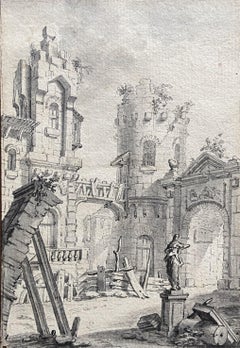
18th Century School, Courtyard of a palazzo, Architectural Capriccio, drawing
Located in Paris, FR
18th Century french School, Courtyard of a ruined palazzo, An Architectural Capriccio, Pen and black ink and black ink wash on paper 17 x 12 cm In good condition Framed : 32 x 26 c...
Category

Old Masters 18th Century and Earlier Figurative Drawings and Watercolors

Materials

Ink

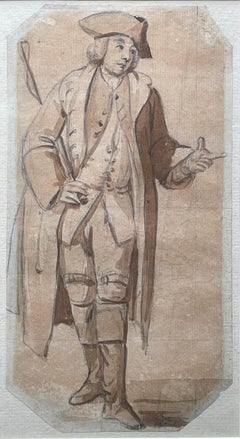
A Coachman - 18th Century British Figure watercolour drawing by Paul Sandby
Located in London, GB
PAUL SANDBY (1731-1809) Study of a Coachman Pencil and brown wash, shaped Framed 16.5 by 9 cm., 6 ½ by 3 ½ in. (frame size 32 by 22.5 cm., 12 ½ by 9 in.) Provenance: Iolo Williams; Private collection. Exhibited: Sudbury, Gainsborough House, 1979. Sandby was born in Nottingham and moved to London in 1745. He and his brother Thomas first worked in the military drawing department at the Tower of London, later working on a military survey of new roads and bridges in the Highlands. On leaving this post in 1751 he spent some time living with his brother who had been appointed Deputy Ranger of Windsor Great Park. There he assisted his brother, and made a series of drawings of the castle, town and neighbourhood. In 1760 he settled in London where he contributed to the first exhibition of the Society of Artists where he regularly exhibited until the foundation of the Royal Academy in 1768, becoming one of its founder members. In same year he was appointed chief drawing...
Category

Realist 18th Century and Earlier Figurative Drawings and Watercolors

Materials

Watercolor

Allegory of the Treaty of Angoulême, a drawing attributed to Donato Mascagni
Located in PARIS, FR
We would like to thank Mrs. Ursula Verena Fischer Pace for suggesting the attribution to Donato Arsenio Mascagni. We were immediately seduced by the rich tonalities of this allegory...
Category

Old Masters 18th Century and Earlier Figurative Drawings and Watercolors

Materials

Ink

Johann Weinmann: c18th Botanical Engravings in Decalcomania Frames, Set of 6
Located in Richmond, GB
A group of mezzotint engravings of flowers from: "Phytanthoza Iconographia", c1739, presented in hand-made parcel-gilt, ebonised and decalcomania frames. Johann Weinmann (1683-174...
Category

18th Century and Earlier Figurative Drawings and Watercolors

Materials

Watercolor, Mezzotint

France 18th Century, Pastorale (Arcadian Landscape), original drawing
Located in Paris, FR
France 18th Century, Pastorale (Arcadian Landscape) Black chalk and heightenings of white gouache on blue-grey paper 19 x 31 cm Framed : 34.5 x 46.5 cm The atmosphere and the subje...
Category

Old Masters 18th Century and Earlier Figurative Drawings and Watercolors

Materials

Chalk

La Porcellana (A Market Scene of Porcelain Vendors)
Located in New York, NY
An old master drawing that can live in a very contemporary environment! Remarkable use of line and expression - should be enjoyed in an important spot - can grace a kitchen or livin...
Category

Old Masters 18th Century and Earlier Figurative Drawings and Watercolors

Materials

Ink, Handmade Paper, Graphite

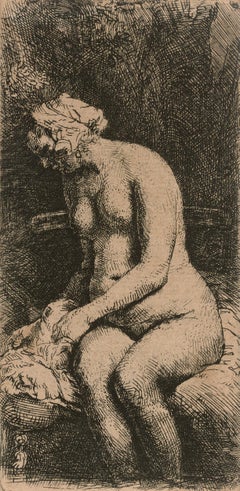
Woman Bathing Her Feet in a Brook by Rembrandt van Rijn
Located in New Orleans, LA
Rembrandt van Rijn 1606-1669 Dutch Woman Bathing Her Feet in a Brook Etching on paper New Hollstein's 309, second state of II Signed and dated "Rembrandt f. 1658" (upper left) Created from observations of a live model, this work started as a figure study before evolving into a more imaginative setting. It remains ambiguous whether the scene is set indoors, as suggested by the cushion the figure is seated on, or outdoors, indicated by the foliage in the background. The omission of her feet, suggesting they may be dangling in a brook, adds a charming touch to Rembrandt’s imaginative scene. The figure seems unaware of the viewer, presenting a dignified yet sensual demeanor. The son of a miller, Rembrandt van Rijn is believed to have been born in Leiden on July 15, 1606. He studied first at the Latin School and then was enrolled at the University of Leiden at the age of 14. He soon left to study art—first with a local master, Jacob van Swanenburch, and then, in Amsterdam, with Pieter Lastman...
Category

Old Masters 18th Century and Earlier Figurative Drawings and Watercolors

Materials

Etching, Paper

Fenzoni, Painting AND preparatorial Drawing, John the Baptist, Italy Renaissance
By Ferrau Fenzoni
Located in Greven, DE
The painting and the preparatory drawing are offered together. Provenance Private collection, Germany, Trier, c. 1980- 2013 Saint John the Baptist Brown ink and wash over red chalk on oatmeal paper 31 x 20.5 cm Inscribed: „Ferrau Fenzonio da Faenza invt. esque … imp. da Fran. Villamena …“. bears the collector's mark of Henry Scipio Reitlinger (1882-1950; Lugt 2274a) on a tiny label glued to the verso On the reverse is a partial drawing of a Pieta, pricked for transfer. Provenance New York, Doyle, 14. October 2015, No. 6 The painting and the preparatory drawing resemble the composition of an engraving after Ferraù Fenzoni by Francesco Villamena. Drawing, engraving and painting are almost identical, except for minor differences. Even the measurements nearly correspond: painting (32 x 25,5 cm), drawing (30 x 20,5 cm), engraving (31,1 x 23,5 cm). Dr. Guiseppe Scavizzi confirmed the attribution of the present panting to Fenzoni and he dates it to c. 1590. The inscription on the drawing reads “Ferrau Fenzonio da Faenza invt. esque. . . imp. da Fran: Villamena . . .”. The engraving’s inscription also lists place and date “Ferra Fensionius inventor/F. Villamoena sculpsit Rome/Aspectu fruitur… antra puer/cum Privilegio… 1613”. Interestingly, the engraving is not mirrored as it is in most printing processes. Painting, drawing and engraving are not reversed but the same. It is remarkable to note that there are further paintings by Fenzoni which were engraved in the same order and not reverted. They also show strong parallels regarding the compositions and the measurements (see for example “Deposition of Christ” ). Ferraù Fenzoni was an Italian painter mainly active in Todi. He is also called Il Faenzone after his birthplace (Faenza). He apprenticed in Rome during the papacy of Gregory XIII and contributed to numerous fresco cycles under pope Sixtus V, such as the Loggia della Benedizioni in the Lateran Palace, the frescoes on the walls and vaults of the Scala Santa of the adjacent Basilica of San Giovanni in Laterano, and the decoration in the Sistine library. His expressive canvases straddle the styles of Mannerism and Baroque. In 1594, he moved to Todi. A “Last Judgement” by him is housed in the cathedral of Todi. He returned to Faenza in 1599, where he decorated chapels in the cathedral from 1612 to 1616. In 1622, he completed a “Deposition”, now in the local Pinacoteca. In 1640, Fenzoni was named “cavaliere dello speron d’oro” by Cardinal Colonna and, on 25th April 1634, he was nominated vicar and “castellano of Granarolo”. Fenzoni‘s style is characterized by a mixture of the Mannerism of the Northern Netherlands and the Italian Baroque. Saint John the Baptist, Old Master, 17th Century, By Fenzoni, Religious Scene, Rome Art...
Category

Mannerist 18th Century and Earlier Figurative Drawings and Watercolors

Materials

Canvas, Oil, Handmade Paper

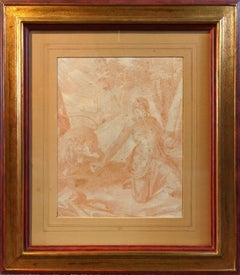
Saint Jerome in the Desert, Prague school sanguine drawing
Located in New York, NY
Saint Jerome in the Desert Prague school sanguine drawing.
Category

Old Masters 18th Century and Earlier Figurative Drawings and Watercolors

Materials

Paper, Chalk

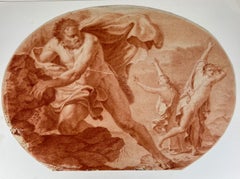
Polyphemus and Acis Red Chalk Drawing, Italian, 17th-18th Century
Located in Stockholm, SE
An Italian red chalk drawing depiction on paper, probably 17th or 18th century, illustrating the dramatic scene of Polyphemus hurling a boulder at Acis and Galatea. Attributed to an...
Category

Italian School 18th Century and Earlier Figurative Drawings and Watercolors

Materials

Paper, Chalk

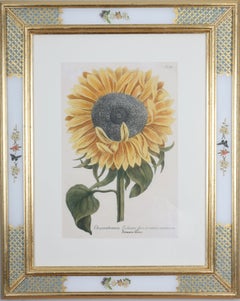
Johann Weinmann: c18th Botanical Engravings in Decalcomania Frames
Located in Richmond, GB
"Phytanthoza Iconographia", c1737-1745. A wonderful selection of yellow and blue flowers: hand-coloured mezzotint engravings from: ""Phytanthoza Iconographia"", presented in hand-m...
Category

18th Century and Earlier Figurative Drawings and Watercolors

Materials

Watercolor, Mezzotint

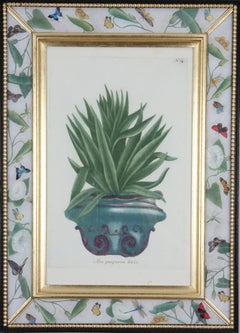
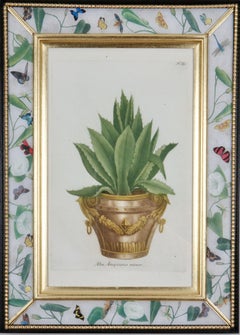
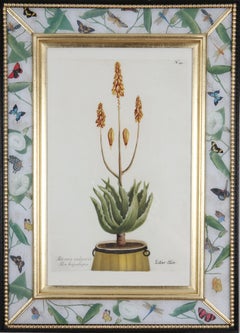
Johann Weinmann: 18th Century Engravings of an aloe in a decorative pot.
Located in Richmond, GB
Hand-coloured mezzotint engravings of decorative urns with aloes and cacti from: ""Phytanthoza Iconographia"", c1739, presented in hand- made, parcel-gilt, ebonised and decalcomania...
Category

18th Century and Earlier Figurative Drawings and Watercolors

Materials

Watercolor, Mezzotint

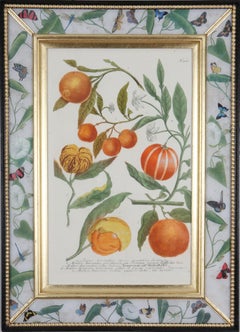
Johann Weinmann: c.18th Engravings of Fruit in Decalcomania Frames
Located in Richmond, GB
Hand-coloured mezzotint engravings from: ""Phytanthoza Iconographia"", c1739, presented in hand-made parcel-gilt, ebonised and decalcomania frames. Johann Weinmann (1683-1741), a G...
Category

18th Century and Earlier Figurative Drawings and Watercolors

Materials

Watercolor, Mezzotint

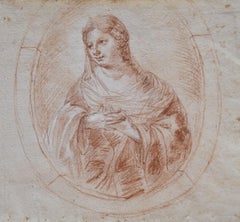
18th Century, Portrait of a Lady in a Tondo, red chalk drawing
Located in Paris, FR
French (?) school circa 1770 Portrait of a Lady in a Tondo, red chalk on paper 20 x 29 cm Numbered 25 on the upper left Little holes in the bottom (intended for binding) Not framed ...
Category

Baroque 18th Century and Earlier Figurative Drawings and Watercolors

Materials

Chalk

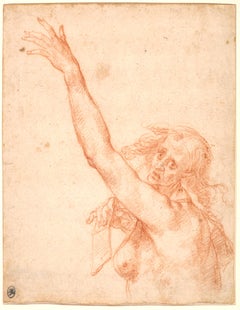
Study of a Fate at mid-body, a red chalk attributed to Giovanni da San Giovanni
Located in PARIS, FR
This spectacular red chalk drawing depicts an elderly woman, her eyes bulging, her hand stretched out towards the sky. This disturbing character, who seems close to dementia, and the elongation of her arm with its Mannerist overtones, plunge us into the Florentine artistic milieu of the first half of the 17th century. The proximity of this drawing to some characters in the fresco in the Pitti Palace representing The Muses, Poets and Philosophers chased from Parnassus, the last masterpiece of Giovanni da San Giovanni, leads us to propose an attribution to this artist and a dating of around 1635-1636. 1. Giovanni da San Giovanni, the painter of contradiction We take here the title of the monography dedicated to the artist by Anna Banti in 1977, which remains the reference book for this artist. The son of a notary, Giovanni Mannozzi, known as Giovanni da San Giovanni, abandoned his studies to go to Florence at the age of sixteen, where he entered the studio of Matteo Rosselli (1578 - 1650) around 1609 and enrolled in the Academy of Drawing Arts in 1612. Around 1615 he produced his first known works, mainly frescoes for the city's tabernacles. He became famous in Florence for his originality, combining an obsessive application to the study of drawing and the reading of poetry and history with a disheveled appearance. Between 1619 and 1620 he decorated the facade of the Antella Palace in Piazza Santa Croce, a decoration that still partly survives today. The death of Cosimo II in 1621 put an end to the Florentine building activity and Giovanni da San Giovanni left for Rome to find other sponsors with the painter Francesco Furini...
Category

Old Masters 18th Century and Earlier Figurative Drawings and Watercolors

Materials

Chalk

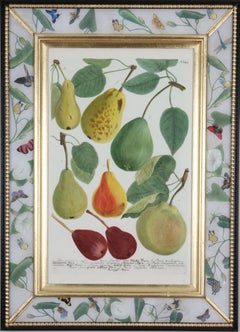
Johann Weinmann: c.18th Engravings of Fruit in Decalcomania Frames
Located in Richmond, GB
Hand-coloured mezzotint engravings from: ""Phytanthoza Iconographia"", c1739, presented in hand-made parcel-gilt, ebonised and decalcomania frames. Johann Weinmann (1683-1741), a G...
Category

18th Century and Earlier Figurative Drawings and Watercolors

Materials

Watercolor, Mezzotint

Johann Weinmann: 18th Century Engraving of an aloe in a decorative pot.
Located in Richmond, GB
Hand-coloured mezzotint engravings of decorative urns with aloes and cacti from: ""Phytanthoza Iconographia"", c1739, presented in hand- made, parcel-gilt, ebonised and decalcomania...
Category

18th Century and Earlier Figurative Drawings and Watercolors

Materials

Watercolor, Mezzotint

Due ritratti figurativi aristocratici pastelli su pergamena primi del XIX secolo
Located in Florence, IT
Sul cartoncino applicato nella cornice è riportata l'annotazione, a penna e in grafia Kurrent, "Urgroßvater Ludwig Fr(ei)h(e)r(r) von Keller" "Urgroßmutter ...
Category

Other Art Style 18th Century and Earlier Figurative Drawings and Watercolors

Materials

Parchment Paper, Pastel, Cardboard

Johann Weinmann: c.18th Engravings of Fruit in Decalcomania Frames
Located in Richmond, GB
Hand-coloured mezzotint engravings from: ""Phytanthoza Iconographia"", c1739, presented in hand-made parcel-gilt, ebonised and decalcomania frames. Johann Weinmann (1683-1741), a G...
Category

18th Century and Earlier Figurative Drawings and Watercolors

Materials

Watercolor, Mezzotint

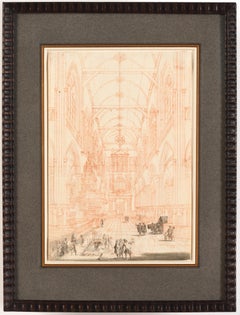
Interior of the Nieuwe Kerk, Amsterdam
Located in Paris, Île-de-France
Jan Goeree (Middelburg 1670 – Amsterdam 1731) Interior of the Nieuwe Kerk, Amsterdam (c. 1724) Red chalk for the architecture, pen and black ink, grey wash on paper Composition reversed in preparation for engraving 25 × 17.5 cm Watermark: Hunting horn, Churchill 318 (dated 1724) Unsigned Provenance Private collection, France Context & Attribution Trained in the studio of Gérard de Lairesse, Jan Goeree was among the finest Dutch engravers of the early eighteenth century, celebrated for his architectural views of Amsterdam. This drawing is a preparatory study for an engraving of the same subject now preserved in a major public collection. The final print—slightly larger—closely follows the reversed composition of this sheet. Subject In the center of the Gothic nave, five bearers carry a catafalque toward a freshly dug grave—a tribute to the naval heroes often buried in the Nieuwe Kerk. This funerary motif, familiar from Dutch painting (e.g. Emanuel de Witte, 1657), evokes the vanitas theme and the transience of earthly life. Technical Analysis Goeree’s use of red chalk for the architecture and ink for the figures reveals his working method: the chalk lines could be used to produce a counterproof restoring the correct orientation of the architecture, while the inked figures remained adjustable before the design was transferred to the copper plate. Place within the Oeuvre Drawings of church...
Category

Old Masters 18th Century and Earlier Figurative Drawings and Watercolors

Materials

Chalk, Ink

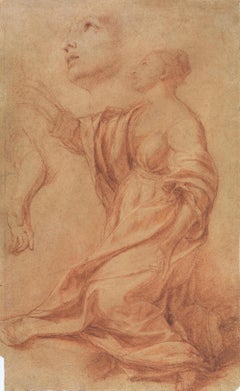
Studies of a kneeling female figure, an arm, a hand, and a head in profile
Located in Paris, Île-de-France
Studio of Carlo Maratti (or Maratta) Camerano 1625 – Rome 1713 Studies of a kneeling female figure, an arm, a hand, and a head in profile Red chalk on paper 43.4 x 26.6 cm Unsigne...
Category

Old Masters 18th Century and Earlier Figurative Drawings and Watercolors

Materials

Chalk

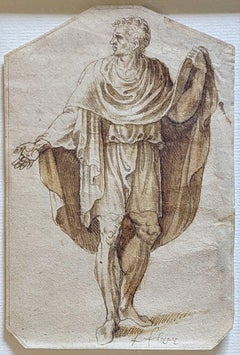
Study of a Man, Old Master Drawing, Figure, Roman Study, Lombard
Located in Greven, DE
Old Master Drawing by the Circle of Lambert Lombard. Drawing/ Study of a Man in Renaissance Style, later signed "F. Floris". Study of a Man Lombard li...
Category

Renaissance 18th Century and Earlier Figurative Drawings and Watercolors

Materials

Handmade Paper

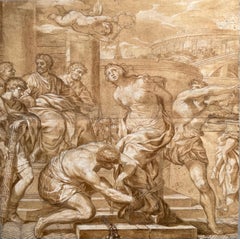
The Torture of Saint Concordia
By Domenico Piola the Elder
Located in Paris, Île-de-France
Circle of Domenico Piola (Genoa 1627 – 1703) The Torture of Saint Concordia Black chalk, brown ink and brown wash on two sheets of paper, 40.5 x 42 cm Unsigned Provenance: Estate...
Category

Old Masters 18th Century and Earlier Figurative Drawings and Watercolors

Materials

Ink

Ink and wash cartouche with a mirror, doves, and a drum
Located in Middletown, NY
A lovely and curious composition, circa 1780. Ink and wash on tissue thin Japon paper, adhered to period cream laid paper, 5 1/4 x 3 3/8 inches (132 x 84 mm), the full sheet. With ...
Category

French School 18th Century and Earlier Figurative Drawings and Watercolors

Materials

Ink, Handmade Paper, Watercolor

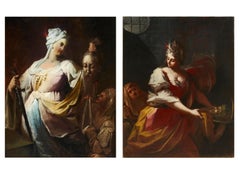
Judith and Salome, a pair of oil paintings on canvas by Francesco Conti
Located in PARIS, FR
This widely referenced pair of paintings is one of Francesco Conti’s most successful productions. Francesco Conti is one of the finest painters of 18th-century Florence. In the shimmering colors typical of his best work, he represents two opposite characters from the Bible: the virtuous Judith, whose courage saves her people by cutting off the head of the invader Holofernes, and the depraved Salome, who under the influence of her mother becomes responsible for the beheading of the prophet John the Baptist. The artist's talent lies in his ability to treat these two macabre subjects with a light touch, presenting us with two attractive women who seem to twirl with glee amidst the severed heads... 1. Francesco Conti, the “Florentine Tiepolo” Francesco Conti is a major painter of the Florentine school of the 18th century; he can even probably be considered, along with Giovanni Domenico Ferretti (1692-1768), as one of the two main painters of the second quarter of the Florentine 18th century. Born in Florence in 1682, Francesco Conti began his apprenticeship in the workshop of Simone Pignoni (1611 - 1698), a disciple of Francesco Furini; he was also influenced by the Venetian Sebastiano Ricci. A protégé of Marquis Riccardi, he accompanied him to Rome between 1699 and 1705, where he frequented Carlo Maratta's studio. He settled permanently in Florence in 1705. Painted exclusively on canvas, the majority of his work consists of religious subjects, altarpieces or private devotional works. It is likely that Conti himself was a devout churchgoer, as evidenced by his affiliation, in the third decade of the eighteenth century, to the Society of the Disciples of Saint-John-the-Baptist, and his entry, at the end of his life, into the fraternity of the Venerable Society of the Holy Trinity. In Florence, Conti worked for the Grand Duchy's major patrons, including the last Medici - in particular Giangastone and Annamaria Luisa, Electress Palatine - and confirmed his role as a reference painter under the Lorraine Regency, as master of the Public Drawing School, which was closely linked to the institute responsible for the manufacture of semi-precious stone mosaics, then located in the Uffizi complex. Matteo Marangoni, an art critic of the early 20th century, praised his "brushwork full of elegance and true spirit of the 18th century", pointing out that Conti was "probably one of the best colorists" of the Florentine school of his time. These two characteristics led the art historian Paolo dal Poggetto to nickname him the "Florentine Tiepolo". 2. Judith and Salome, two biblical characters opposing each other These two paintings form a pair presenting two biblical episodes, which have in common the depiction of a "heroine" carrying the severed head of a man. While the Salome episode might at first appear to be an echo of the Old Testament story of Judith, each character is the exact opposite of the other. Judith, whose story is told in the Book of Judith, is a beautiful young widow from Bethulia who, accompanied by her maid, went into the camp of the invading Assyrians and won the confidence of Holofernes, the general commanding the enemy army. Invited to a great feast on the fourth evening, she took advantage of Holofernes' drunkenness to cut off his head. “She went up to the bedpost near Holofernes’ head, and took down his sword that hung there. She came close to his bed, took hold of the hair of his head, and said, “Give me strength today, O Lord God of Israel!” Then she struck his neck twice with all her might, and cut off his head. Next she rolled his body off the bed and pulled down the canopy from the posts. Soon afterward she went out and gave Holofernes’ head to her maid, who placed it in her food bag...
Category

Old Masters 18th Century and Earlier Figurative Drawings and Watercolors

Materials

Canvas, Oil

Study for a Hunting Scene, a red chalk sketch attributed to Karel du Jardin
Located in PARIS, FR
We would like to thank Carolina Trupiano Kowalczyk for suggesting this attribution to Karel du Jardin after direct examination of the artwork. Her study of the drawing (in Italian), ...
Category

Old Masters 18th Century and Earlier Figurative Drawings and Watercolors

Materials

Chalk, Ink, Laid Paper

16th Century by Andrea Boscoli The payment of the duty Pen and ink on paper
Located in Milano, Lombardia
Andrea Boscoli (Florence, Italy, 1564 – Rome, Italy, 1608) Title: 𝘛𝘩𝘦 𝘱𝘢𝘺𝘮𝘦𝘯𝘵 𝘰𝘧 𝘵𝘩𝘦 𝘥𝘶𝘵𝘺, 𝘧𝘳𝘰𝘮 𝘗𝘰𝘭𝘪𝘥𝘰𝘳𝘰 𝘥𝘢 𝘊𝘢𝘳𝘢𝘷𝘢𝘨𝘨𝘪𝘰 Medium: Pen and brow...
Category

Old Masters 18th Century and Earlier Figurative Drawings and Watercolors

Materials

Paper, Ink, Cardboard, Pen

Johann Weinmann: 18th Century Engraving of an aloe in a decorative pot.
Located in Richmond, GB
Hand-coloured mezzotint engravings of decorative urns with aloes and cacti from: ""Phytanthoza Iconographia"", c1739, presented in hand- made, parcel-gilt, ebonised and decalcomania...
Category

18th Century and Earlier Figurative Drawings and Watercolors

Materials

Watercolor, Mezzotint

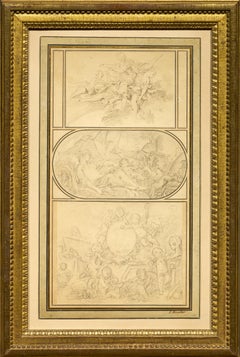
Three drawings by François Boucher in a mounting by Jean-Baptiste Glomy
Located in PARIS, FR
We would like to thank Juliette Parmentier-Courreau of the Custodia Foundation for her welcome and support during the consultation of Glomy’s Journal des Ouvrages. This spectacularly large "feuille de desseins ajustés" commissioned by François Boucher from Jean-Baptiste Glomy is emblematic of the painter's art and mastery of rocaille. It is also fully representative of the taste of this period in the field of decorative arts. The largest of these three drawings, placed at the bottom of the composition, is particularly interesting: dating from around 1756, it constitutes a modello (apparently unpublished) for the frontispiece of the "Catalogue des tableaux de Monsieur de Julienne"), preserved in the Morgan Library in New York. 1. François Boucher, the master of French rocaille The extraordinary career of Francois Boucher was unmatched by his contemporaries in versatility, consistency and output. For many, particularly the writers and collectors who led the revival of interest in the French rococo during the last century, his sensuous beauties and plump cupids represent the French eighteenth century at its most typical. His facility with the brush, even when betraying the occasional superficiality of his art, enabled him to master every aspect of painting – history and mythology, portraiture, landscape, ordinary life and, as part of larger compositions, even still life. He had been trained as an engraver, and the skills of a draftsman, which he imbued in the studio of Jean-Francois Cars (1661 – 1738), stood him in good stead throughout his career; his delightful drawings are one of the most sought-after aspects of his oeuvre. As a student of Francois Lemoyne (1688 - 1737), he mastered the art of composition. The four years he spent in Italy, from 1727-1731, educated him in the works of the masters, classics and history, that his modest upbringing had denied him. On his return to Paris in 1734, he gained full membership of the Royal Academy of Painting and Sculpture with his splendid Rinaldo and Armida (Paris, Musée du Louvre). Although, throughout his career, he occasionally painted subjects taken from the Bible, and would always have considered himself first as a history painter, his own repertoire of heroines, seductresses, flirtatious peasant girls and erotic beauties was better suited to a lighter, more decorative subject matter. His mastery of technique and composition enabled him to move from large scale tapestry...
Category

Old Masters 18th Century and Earlier Figurative Drawings and Watercolors

Materials

Chalk, Ink

Eighteenth century Old Master drawing - St Jerome
Located in London, GB
Pen, ink and wash Framed dimensions: 9 ½ x 11 ¼ inches Drawn c. 1763 This small, powerful study shows St Jerome contemplating the bible with a cross and sk...
Category

Old Masters 18th Century and Earlier Figurative Drawings and Watercolors

Materials

Ink, Pen

Studio di volto (Study of a boy s face, 2 views) Florentine School 18th century
Located in Middletown, NY
An 18th century Florentine study of a head, circa 1700 Red crayon on light-weight laid paper with a partial Pro Patria watermark with Hollandia and a rampant lion, 5 5/8 x 7 1/2 inc...
Category

Italian School 18th Century and Earlier Figurative Drawings and Watercolors

Materials

Laid Paper, Crayon

Draped Woman Holding A Branch
Located in Paris, Île-de-France
CARLO URBINO (Crema 1525 - after 1585) Draped Woman Holding a Branch Pencil and brown ink on laid paper 13.6 x 7.7 cm Unsigned 16th century Mounted on 20th-century paper Handwrit...
Category

Old Masters 18th Century and Earlier Figurative Drawings and Watercolors

Materials

Ink

Johann Weinmann: c.18th Engravings of Fruit in Decalcomania Frames
Located in Richmond, GB
Hand-coloured mezzotint engravings from: ""Phytanthoza Iconographia"", c1739, presented in hand-made parcel-gilt, ebonised and decalcomania frames. Johann Weinmann (1683-1741), a G...
Category

18th Century and Earlier Figurative Drawings and Watercolors

Materials

Watercolor, Mezzotint

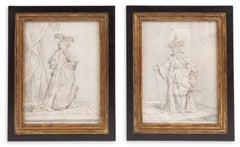
Costume drawings for ‘Ambassadeur de Siam’ and ‘La Sultana Reine’
Located in Amsterdam, NL
Joseph-Marie Vien (1716-1809) ‘Ambassadeur de Siam’ and ‘La Sultana Reine’ Both titled lower centre, the drawing of the ambassador inscribed with colours intended for the prints, e...
Category

Old Masters 18th Century and Earlier Figurative Drawings and Watercolors

Materials

Paper, Pencil

Johann Weinmann: 18th Century Engraving of an aloe in a decorative pot.
Located in Richmond, GB
Hand-coloured mezzotint engravings of decorative urns with aloes and cacti from: ""Phytanthoza Iconographia"", c1739, presented in hand- made, parcel-gilt, ebonised and decalcomania...
Category

18th Century and Earlier Figurative Drawings and Watercolors

Materials

Watercolor, Mezzotint

Johann Weinmann: 18th Century Engravings of an aloe in a decorative pot.
Located in Richmond, GB
Hand-coloured mezzotint engravings of decorative urns with aloes and cacti from: ""Phytanthoza Iconographia"", c1739, presented in hand- made, parcel-gilt, ebonised and decalcomania...
Category

18th Century and Earlier Figurative Drawings and Watercolors

Materials

Watercolor, Mezzotint

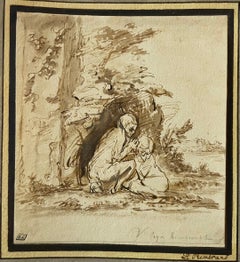
17th C Dutch Old Master Ink Wash Painting Biblical Figures Rembrandt Pupil
Located in Cirencester, Gloucestershire
Figure being Comforted (Job?) circle of Willem Drost (Dutch 1633-1659) *See notes below ink and wash drawing on paper (Arms of Amsterdam watermarked) Dutc...
Category

Old Masters 18th Century and Earlier Figurative Drawings and Watercolors

Materials

Ink, Watercolor

La Femme Muse /// Allegorical Symbolism Romantic Old Masters European Drawing
Located in Saint Augustine, FL
Artist: Unknown (Likely French, 18th Century) Title: "La Femme Muse" *No signature found Circa: 1780 Medium: Original Pastel Drawing on heavy laid paper Framing: Recently beautifully...
Category

Old Masters 18th Century and Earlier Figurative Drawings and Watercolors

Materials

Pastel, Laid Paper

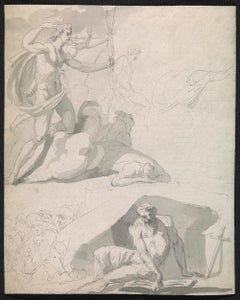
Eighteenth century Old Master drawing - Apollo destroying Niobe s children
Located in London, GB
Pen, ink and wash Framed dimensions: 13 x 11 ¼ inches Drawn c.1765 Verso: a study of a hanged man Mortimer has filled this small sheet with action, depicting in the top right, Apollo and Artemis...
Category

Old Masters 18th Century and Earlier Figurative Drawings and Watercolors

Materials

Ink, Pen

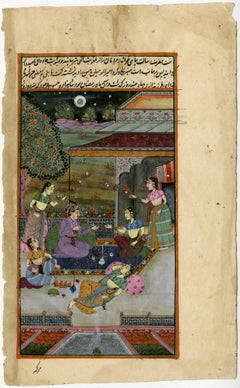
Mughal School, 18th century Emperor Jahangir taking tea in his harem
Located in Middletown, NY
An illuminated page from a book likely in reference to palace life during Emperor Jahangir's reign over the Mughal Empire. circa 1750. Gouache and ink with heightening in gold on li...
Category

Rajput 18th Century and Earlier Figurative Drawings and Watercolors

Materials

Gold

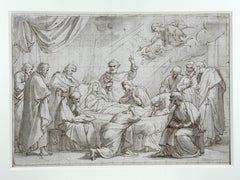
Death of the Virgin (Old Master drawing)
Located in Wilton Manors, FL
Old Master drawing, Death of the Virgin Surrounded by Apostles, ca. 17th century. Ink pen and wash on paper. Sheet measuring 11 x 15.5 inches. Framed measurement: 18.5 x 23.5 inches...
Category

Old Masters 18th Century and Earlier Figurative Drawings and Watercolors

Materials

Ink

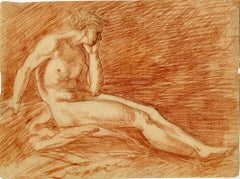
Life study of a male nude in repose - European School, late 18th Century
Located in Middletown, NY
European School, late 18th century. Red chalk with primo pensiero in graphite on cream laid paper, 8 1/2 x 11 1/2 inches (215 x 293 mm). Scattered light handling wear and multiple s...
Category

Naturalistic 18th Century and Earlier Figurative Drawings and Watercolors

Materials

Chalk, Laid Paper, Pencil, Graphite

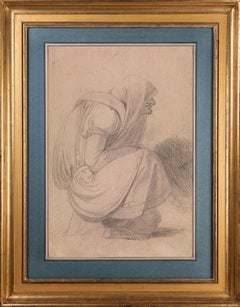
Drawing of a captive woman
Located in London, GB
Collections: Sir Thomas Lawrence, who acquired the contents of Fuseli’s studio; Susan, Countess of Guilford, née Coutts (1771-1837), acquired from the Lawrence estate; Susan, Baroness North (1797-1884), daughter of the above; Mrs A. M. Jaffé, acquired in France, c. 1950 to 2016. Black chalks, on buff-coloured paper Stamped verso: ‘Baroness Norths Collection / of Drawings by H Fuseli Esq.’ Framed dimensions: 26.38 x 20.63 inches This boldly drawn sheet depicting a seated figure was made by Fuseli at an important and highly productive moment in his career. The monumental drawing is closely related to another sheet by Fuseli in the British Museum which Schiff published as subject unknown. Both drawings were made when Fuseli was designing his most important sequence of historical works, including scenes from Shakespeare and Milton, The Nightmare and The Death of Dido which was exhibited at the Royal Academy to great critical acclaim in 1781. The present drawing does not relate directly to any of Fuseli’s finished historical paintings of the period, but evidently the image of a slightly menacing, seated and covered old woman was precisely the sort of motif he was playing with. It is notable that the same figure reappears later in Fuseli’s work as the witch from Ben Jonson’s Witch’s Song which Fuseli produced as both a painting and engraving in 1812. Fuseli returned to London in 1779 from a highly creative and productive period in Rome and established himself as one of the leading history painters of the period. Fuseli re-established contact with his old mentor Sir Joshua Reynolds, becoming a regular guest at his dinner table and visitor to his studio. The earliest and most striking manifestation of this strategy was Fuseli's Death of Dido, exhibited in 1781 at the Royal Academy. Executed on the same scale as Reynolds's version (Royal Collection), Fuseli's vertically oriented picture was hung directly opposite Reynolds's with its horizontal orientation, inevitably inviting comparison between the two works and garnering Fuseli much publicity and favourable reviews in the newspapers. The present, previously unpublished sheet, relates closely to a drawing now in the British Museum. That sheet shows the same seated old woman, drawn on a smaller scale and more schematic in design, seated next to an anatomical drawing of a man. The pose of this figure is related to the pose of Dido in his Death of Dido; the foreshortened torso, arrangement of head, oblique view of Dido’s features and arms all suggest that the study can be viewed as an initial thought for the composition. Fuseli may have initially thought of including the figure of the hunched and covered old woman. Drawn on identical paper to the British Museum sheet, our study is an enlarged depiction of the same figure, more elaborately delineated and developed. The presence of a chain to the right of the figure, suggests that the iconography was related in some way to a scene of imprisonment. Fuseli had first explored the motif of the hooded old woman in an early Roman drawing, 'The Venus Seller'. The idea of a grotesque old woman, hooded and with angular nose and projecting chin seen in profile was most spectacularly used by Fuseli in his sequence of paintings depicting The Three Witches from Macbeth. Fuseli seems to have kept the present sheet and may have returned to it when preparing a painting of The Witch and the Mandrake from Ben Jonson’s Witch’s Song from his Masque of Queens in 1812. Here the same seated figure looks out from under her hood and picks a mandrake by moonlight. Jonson’s drama had been performed at the court of James I in 1609, inspired the subject. To throw the nobility of the queens into relief, the poet added a coven of witches, one of whom declares: ‘I last night lay all alone, On the ground, to hear the mandrake groan; And plucked him up, though he grew full low, And, as I had done, the cock did crow.’ The figure was reversed in the associated etching which was published in 1812. It seems likely that the present drawing remained as part of Fuseli’s working archive of figure studies. The present drawing was presumably purchased with the bulk of Fuseli’s drawings after the artist’s death by Sir Thomas Lawrence. Lawrence’s large group of Fuseli drawings were then acquired by Susan, Countess of Guildford (1771-1837). Lady Guildford was the eldest daughter of the banker Thomas Coutts (1735-1822), who himself had supported Fuseli’s journey to Rome in the 1770s and had remained one of the artist’s key...
Category

Old Masters 18th Century and Earlier Figurative Drawings and Watercolors

Materials

Chalk

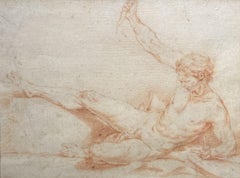
The Death of Attis, 18th Century French Red Chalk Drawing, Greek Mythology
Located in London, GB
Red chalk on paper Image size: 9 x 7 inches (23 x 17.75 cm) Acid free mount The Greek god Attis was the spouse of Cybele, the fertility goddess.  He was from Phrygia, a kingdom in c...
Category

French School 18th Century and Earlier Figurative Drawings and Watercolors

Materials

Chalk

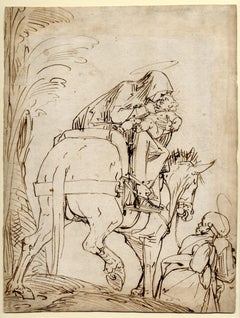
The Flight into Egypt
Located in New York, NY
Inscribed: 3. una Madonna che va in Egitto, verso, and Madonna che va in Egitto, recto Provenance: Private Collection, UK, since 1999 This expressive and boldly executed drawing is the work of Luca...
Category

Old Masters 18th Century and Earlier Figurative Drawings and Watercolors

Materials

Chalk, Ink, Pen, Paper

Still Thinking About These?

All Recently Viewed