18th Century Figurative Drawings and Watercolors

to
18
127
37
7
3
Overall Width
to
Overall Height
to
250
1,596
10,439
4,183
229
274
407
709
631
841
897
1,004
556
410
61
24
98
73
2
127
79
57
37
37
27
26
13
9
8
7
6
6
5
5
5
5
5
5
4
83
81
77
67
30
16
4
4
4
2
87
40
126
31
Period: 18th Century
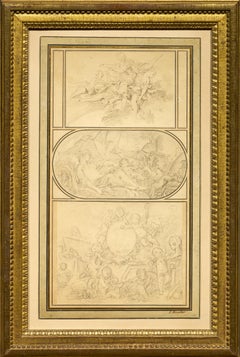
Three drawings by François Boucher in a mounting by Jean-Baptiste Glomy
Located in PARIS, FR
We would like to thank Juliette Parmentier-Courreau of the Custodia Foundation for her welcome and support during the consultation of Glomy’s Journal des Ouvrages. This spectacularly large "feuille de desseins ajustés" commissioned by François Boucher from Jean-Baptiste Glomy is emblematic of the painter's art and mastery of rocaille. It is also fully representative of the taste of this period in the field of decorative arts. The largest of these three drawings, placed at the bottom of the composition, is particularly interesting: dating from around 1756, it constitutes a modello (apparently unpublished) for the frontispiece of the "Catalogue des tableaux de Monsieur de Julienne"), preserved in the Morgan Library in New York. 1. François Boucher, the master of French rocaille The extraordinary career of Francois Boucher was unmatched by his contemporaries in versatility, consistency and output. For many, particularly the writers and collectors who led the revival of interest in the French rococo during the last century, his sensuous beauties and plump cupids represent the French eighteenth century at its most typical. His facility with the brush, even when betraying the occasional superficiality of his art, enabled him to master every aspect of painting – history and mythology, portraiture, landscape, ordinary life and, as part of larger compositions, even still life. He had been trained as an engraver, and the skills of a draftsman, which he imbued in the studio of Jean-Francois Cars (1661 – 1738), stood him in good stead throughout his career; his delightful drawings are one of the most sought-after aspects of his oeuvre. As a student of Francois Lemoyne (1688 - 1737), he mastered the art of composition. The four years he spent in Italy, from 1727-1731, educated him in the works of the masters, classics and history, that his modest upbringing had denied him. On his return to Paris in 1734, he gained full membership of the Royal Academy of Painting and Sculpture with his splendid Rinaldo and Armida (Paris, Musée du Louvre). Although, throughout his career, he occasionally painted subjects taken from the Bible, and would always have considered himself first as a history painter, his own repertoire of heroines, seductresses, flirtatious peasant girls and erotic beauties was better suited to a lighter, more decorative subject matter. His mastery of technique and composition enabled him to move from large scale tapestry...
Category

Old Masters 18th Century Figurative Drawings and Watercolors

Materials

Chalk, Ink

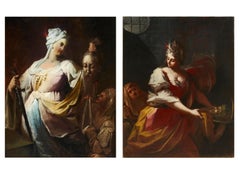
Judith and Salome, a pair of oil paintings on canvas by Francesco Conti
Located in PARIS, FR
This widely referenced pair of paintings is one of Francesco Conti’s most successful productions. Francesco Conti is one of the finest painters of 18th-century Florence. In the shimmering colors typical of his best work, he represents two opposite characters from the Bible: the virtuous Judith, whose courage saves her people by cutting off the head of the invader Holofernes, and the depraved Salome, who under the influence of her mother becomes responsible for the beheading of the prophet John the Baptist. The artist's talent lies in his ability to treat these two macabre subjects with a light touch, presenting us with two attractive women who seem to twirl with glee amidst the severed heads... 1. Francesco Conti, the “Florentine Tiepolo” Francesco Conti is a major painter of the Florentine school of the 18th century; he can even probably be considered, along with Giovanni Domenico Ferretti (1692-1768), as one of the two main painters of the second quarter of the Florentine 18th century. Born in Florence in 1682, Francesco Conti began his apprenticeship in the workshop of Simone Pignoni (1611 - 1698), a disciple of Francesco Furini; he was also influenced by the Venetian Sebastiano Ricci. A protégé of Marquis Riccardi, he accompanied him to Rome between 1699 and 1705, where he frequented Carlo Maratta's studio. He settled permanently in Florence in 1705. Painted exclusively on canvas, the majority of his work consists of religious subjects, altarpieces or private devotional works. It is likely that Conti himself was a devout churchgoer, as evidenced by his affiliation, in the third decade of the eighteenth century, to the Society of the Disciples of Saint-John-the-Baptist, and his entry, at the end of his life, into the fraternity of the Venerable Society of the Holy Trinity. In Florence, Conti worked for the Grand Duchy's major patrons, including the last Medici - in particular Giangastone and Annamaria Luisa, Electress Palatine - and confirmed his role as a reference painter under the Lorraine Regency, as master of the Public Drawing School, which was closely linked to the institute responsible for the manufacture of semi-precious stone mosaics, then located in the Uffizi complex. Matteo Marangoni, an art critic of the early 20th century, praised his "brushwork full of elegance and true spirit of the 18th century", pointing out that Conti was "probably one of the best colorists" of the Florentine school of his time. These two characteristics led the art historian Paolo dal Poggetto to nickname him the "Florentine Tiepolo". 2. Judith and Salome, two biblical characters opposing each other These two paintings form a pair presenting two biblical episodes, which have in common the depiction of a "heroine" carrying the severed head of a man. While the Salome episode might at first appear to be an echo of the Old Testament story of Judith, each character is the exact opposite of the other. Judith, whose story is told in the Book of Judith, is a beautiful young widow from Bethulia who, accompanied by her maid, went into the camp of the invading Assyrians and won the confidence of Holofernes, the general commanding the enemy army. Invited to a great feast on the fourth evening, she took advantage of Holofernes' drunkenness to cut off his head. “She went up to the bedpost near Holofernes’ head, and took down his sword that hung there. She came close to his bed, took hold of the hair of his head, and said, “Give me strength today, O Lord God of Israel!” Then she struck his neck twice with all her might, and cut off his head. Next she rolled his body off the bed and pulled down the canopy from the posts. Soon afterward she went out and gave Holofernes’ head to her maid, who placed it in her food bag...
Category

Old Masters 18th Century Figurative Drawings and Watercolors

Materials

Canvas, Oil

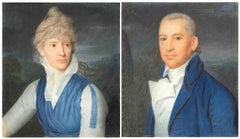
Due ritratti figurativi aristocratici pastelli su pergamena primi del XIX secolo
Located in Florence, IT
Sul cartoncino applicato nella cornice è riportata l'annotazione, a penna e in grafia Kurrent, "Urgroßvater Ludwig Fr(ei)h(e)r(r) von Keller" "Urgroßmutter ...
Category

Other Art Style 18th Century Figurative Drawings and Watercolors

Materials

Parchment Paper, Pastel, Cardboard

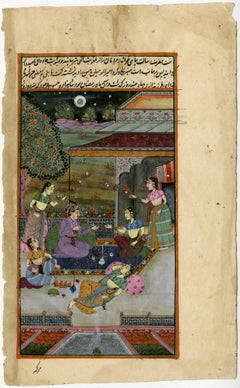
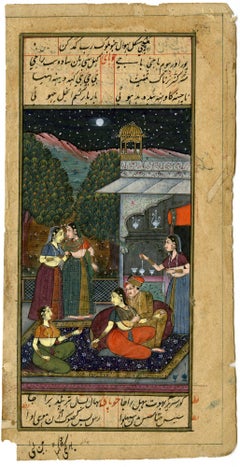
Mughal School, 18th century Emperor Jahangir taking tea in his harem
Located in Middletown, NY
An illuminated page from a book likely in reference to palace life during Emperor Jahangir's reign over the Mughal Empire. circa 1750. Gouache and ink with heightening in gold on li...
Category

Rajput 18th Century Figurative Drawings and Watercolors

Materials

Gold

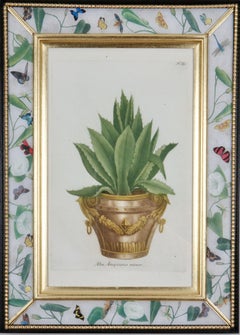
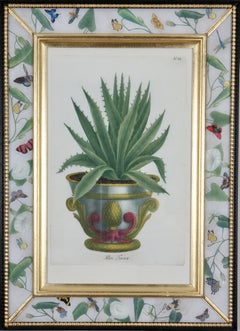
Johann Weinmann: 18th Century Engraving of an aloe in a decorative pot.
Located in Richmond, GB
Hand-coloured mezzotint engravings of decorative urns with aloes and cacti from: ""Phytanthoza Iconographia"", c1739, presented in hand- made, parcel-gilt, ebonised and decalcomania...
Category

18th Century Figurative Drawings and Watercolors

Materials

Watercolor, Mezzotint

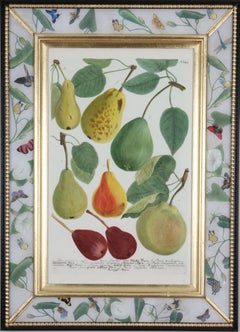
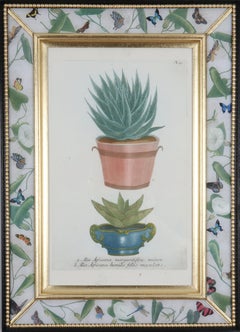
Johann Weinmann: c.18th Engravings of Fruit in Decalcomania Frames
Located in Richmond, GB
Hand-coloured mezzotint engravings from: ""Phytanthoza Iconographia"", c1739, presented in hand-made parcel-gilt, ebonised and decalcomania frames. Johann Weinmann (1683-1741), a G...
Category

18th Century Figurative Drawings and Watercolors

Materials

Watercolor, Mezzotint

Mughal School, 17th century – Emperor Jahangir reclining in his harem
Located in Middletown, NY
An illuminated page from a book likely in reference to palace life during Emperor Jahangir's reign over the Mughal Empire. Circa 1690. Gouache and ink with gold heightening on light...
Category

Rajput 18th Century Figurative Drawings and Watercolors

Materials

Gold

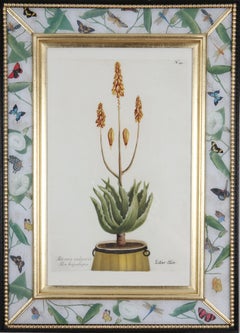
Johann Weinmann: 18th Century Engraving of an aloe in a decorative pot.
Located in Richmond, GB
Hand-coloured mezzotint engravings of decorative urns with aloes and cacti from: ""Phytanthoza Iconographia"", c1739, presented in hand- made, parcel-gilt, ebonised and decalcomania...
Category

18th Century Figurative Drawings and Watercolors

Materials

Watercolor, Mezzotint

Johann Weinmann: 18th Century Engravings of an aloe in a decorative pot.
Located in Richmond, GB
Hand-coloured mezzotint engravings of decorative urns with aloes and cacti from: ""Phytanthoza Iconographia"", c1739, presented in hand- made, parcel-gilt, ebonised and decalcomania...
Category

18th Century Figurative Drawings and Watercolors

Materials

Watercolor, Mezzotint

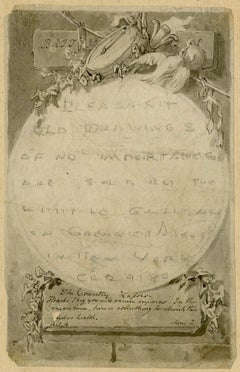
Ink and wash cartouche with a mirror, doves, and a drum
Located in Middletown, NY
A lovely and curious composition, circa 1780. Ink and wash on tissue thin Japon paper, adhered to period cream laid paper, 5 1/4 x 3 3/8 inches (132 x 84 mm), the full sheet. With ...
Category

French School 18th Century Figurative Drawings and Watercolors

Materials

Ink, Handmade Paper, Watercolor

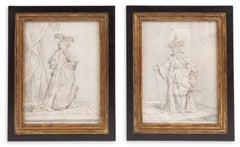
Costume drawings for ‘Ambassadeur de Siam’ and ‘La Sultana Reine’
Located in Amsterdam, NL
Joseph-Marie Vien (1716-1809) ‘Ambassadeur de Siam’ and ‘La Sultana Reine’ Both titled lower centre, the drawing of the ambassador inscribed with colours intended for the prints, e...
Category

Old Masters 18th Century Figurative Drawings and Watercolors

Materials

Paper, Pencil

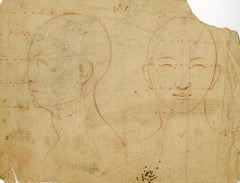
Studio di volto (Study of a boy s face, 2 views) Florentine School 18th century
Located in Middletown, NY
An 18th century Florentine study of a head, circa 1700 Red crayon on light-weight laid paper with a partial Pro Patria watermark with Hollandia and a rampant lion, 5 5/8 x 7 1/2 inc...
Category

Italian School 18th Century Figurative Drawings and Watercolors

Materials

Laid Paper, Crayon

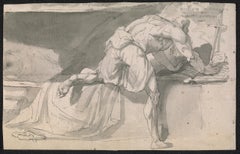
Eighteenth century Old Master drawing - St Jerome
Located in London, GB
Pen, ink and wash Framed dimensions: 9 ½ x 11 ¼ inches Drawn c. 1763 This small, powerful study shows St Jerome contemplating the bible with a cross and sk...
Category

Old Masters 18th Century Figurative Drawings and Watercolors

Materials

Ink, Pen

18th-century French school Study of a man seen from behind, drawing
Located in Paris, FR
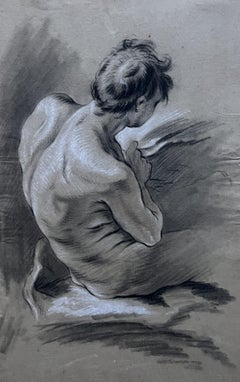
18th-century French school Study of a man seen from behind, Charcoal and white chalk on brown paper 46 x 29 cm Framed under glass : 60 x 43 cm This beautiful study of a naked man...
Category

Old Masters 18th Century Figurative Drawings and Watercolors

Materials

Charcoal, Chalk

Eighteenth century Old Master drawing - Apollo destroying Niobe s children
Located in London, GB
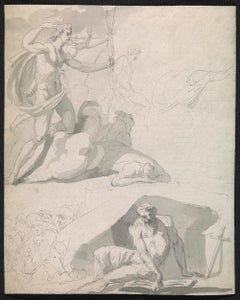
Pen, ink and wash Framed dimensions: 13 x 11 ¼ inches Drawn c.1765 Verso: a study of a hanged man Mortimer has filled this small sheet with action, depicting in the top right, Apollo and Artemis...
Category

Old Masters 18th Century Figurative Drawings and Watercolors

Materials

Ink, Pen

The Death of Attis, 18th Century French Red Chalk Drawing, Greek Mythology
Located in London, GB
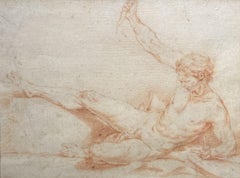
Red chalk on paper Image size: 9 x 7 inches (23 x 17.75 cm) Acid free mount The Greek god Attis was the spouse of Cybele, the fertility goddess.  He was from Phrygia, a kingdom in c...
Category

French School 18th Century Figurative Drawings and Watercolors

Materials

Chalk

Drawing of a captive woman
Located in London, GB
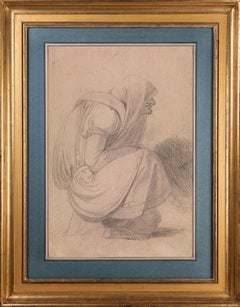
Collections: Sir Thomas Lawrence, who acquired the contents of Fuseli’s studio; Susan, Countess of Guilford, née Coutts (1771-1837), acquired from the Lawrence estate; Susan, Baroness North (1797-1884), daughter of the above; Mrs A. M. Jaffé, acquired in France, c. 1950 to 2016. Black chalks, on buff-coloured paper Stamped verso: ‘Baroness Norths Collection / of Drawings by H Fuseli Esq.’ Framed dimensions: 26.38 x 20.63 inches This boldly drawn sheet depicting a seated figure was made by Fuseli at an important and highly productive moment in his career. The monumental drawing is closely related to another sheet by Fuseli in the British Museum which Schiff published as subject unknown. Both drawings were made when Fuseli was designing his most important sequence of historical works, including scenes from Shakespeare and Milton, The Nightmare and The Death of Dido which was exhibited at the Royal Academy to great critical acclaim in 1781. The present drawing does not relate directly to any of Fuseli’s finished historical paintings of the period, but evidently the image of a slightly menacing, seated and covered old woman was precisely the sort of motif he was playing with. It is notable that the same figure reappears later in Fuseli’s work as the witch from Ben Jonson’s Witch’s Song which Fuseli produced as both a painting and engraving in 1812. Fuseli returned to London in 1779 from a highly creative and productive period in Rome and established himself as one of the leading history painters of the period. Fuseli re-established contact with his old mentor Sir Joshua Reynolds, becoming a regular guest at his dinner table and visitor to his studio. The earliest and most striking manifestation of this strategy was Fuseli's Death of Dido, exhibited in 1781 at the Royal Academy. Executed on the same scale as Reynolds's version (Royal Collection), Fuseli's vertically oriented picture was hung directly opposite Reynolds's with its horizontal orientation, inevitably inviting comparison between the two works and garnering Fuseli much publicity and favourable reviews in the newspapers. The present, previously unpublished sheet, relates closely to a drawing now in the British Museum. That sheet shows the same seated old woman, drawn on a smaller scale and more schematic in design, seated next to an anatomical drawing of a man. The pose of this figure is related to the pose of Dido in his Death of Dido; the foreshortened torso, arrangement of head, oblique view of Dido’s features and arms all suggest that the study can be viewed as an initial thought for the composition. Fuseli may have initially thought of including the figure of the hunched and covered old woman. Drawn on identical paper to the British Museum sheet, our study is an enlarged depiction of the same figure, more elaborately delineated and developed. The presence of a chain to the right of the figure, suggests that the iconography was related in some way to a scene of imprisonment. Fuseli had first explored the motif of the hooded old woman in an early Roman drawing, 'The Venus Seller'. The idea of a grotesque old woman, hooded and with angular nose and projecting chin seen in profile was most spectacularly used by Fuseli in his sequence of paintings depicting The Three Witches from Macbeth. Fuseli seems to have kept the present sheet and may have returned to it when preparing a painting of The Witch and the Mandrake from Ben Jonson’s Witch’s Song from his Masque of Queens in 1812. Here the same seated figure looks out from under her hood and picks a mandrake by moonlight. Jonson’s drama had been performed at the court of James I in 1609, inspired the subject. To throw the nobility of the queens into relief, the poet added a coven of witches, one of whom declares: ‘I last night lay all alone, On the ground, to hear the mandrake groan; And plucked him up, though he grew full low, And, as I had done, the cock did crow.’ The figure was reversed in the associated etching which was published in 1812. It seems likely that the present drawing remained as part of Fuseli’s working archive of figure studies. The present drawing was presumably purchased with the bulk of Fuseli’s drawings after the artist’s death by Sir Thomas Lawrence. Lawrence’s large group of Fuseli drawings were then acquired by Susan, Countess of Guildford (1771-1837). Lady Guildford was the eldest daughter of the banker Thomas Coutts (1735-1822), who himself had supported Fuseli’s journey to Rome in the 1770s and had remained one of the artist’s key...
Category

Old Masters 18th Century Figurative Drawings and Watercolors

Materials

Chalk

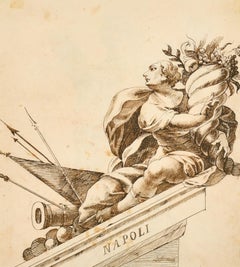
Fine 1700 s Italian Old Master Ink Wash Drawing Roman Allegorical Napoli
Located in Cirencester, Gloucestershire
'Napoli' Italian School, 18th century ink and wash drawing on paper, framed within a light oak wood frame (behind glass) image size: 10.5 x 7 inches overall framed: 17 x 13 inches co...
Category

Old Masters 18th Century Figurative Drawings and Watercolors

Materials

Ink, Watercolor, Archival Paper

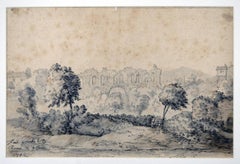
The Gardens of Rome - Ink and Watercolor by J. P. Verdussen - 1742
Located in Roma, IT
China ink and watercolor on paper realized by Jan Peter Verdussen in 1742. Hand dated. Conditions: five holes on top margin and on the bottom right of the paper. Foxing on the top ...
Category

18th Century Figurative Drawings and Watercolors

Materials

Ink, Watercolor

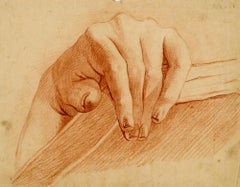
Studio di mano (study of hand) – Florentine School 18th century
Located in Middletown, NY
Red chalk on cream laid paper, 7 1/4 x 9 3/8 inches (182 x 236 mm), the full sheet. In very good condition with minor toning and two small nicks in the top sheet edge. Some modern no...
Category

Italian School 18th Century Figurative Drawings and Watercolors

Materials

Crayon, Laid Paper

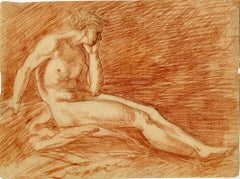
Life study of a male nude in repose - European School, late 18th Century
Located in Middletown, NY
European School, late 18th century. Red chalk with primo pensiero in graphite on cream laid paper, 8 1/2 x 11 1/2 inches (215 x 293 mm). Scattered light handling wear and multiple s...
Category

Naturalistic 18th Century Figurative Drawings and Watercolors

Materials

Chalk, Laid Paper, Pencil, Graphite

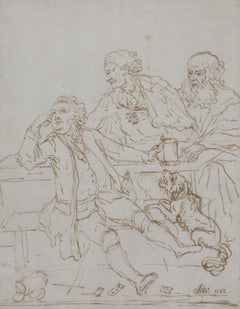
An Eighteenth Century Drawing of a Tavern Scene by a German Artist
Located in Philadelphia, PA
Joseph Georg Winter (German, 1751-1789) Tavern Scene Ink on paper, 10 x 7 3/4 inches FRAMED: 17 x 14.75 inches (approx.) Signed and dated at lower right: "JGW. 1782"
Category

Realist 18th Century Figurative Drawings and Watercolors

Materials

Paper, Ink

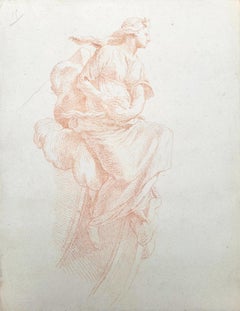
La Femme Muse /// Allegorical Symbolism Romantic Old Masters European Drawing
Located in Saint Augustine, FL
Artist: Unknown (Likely French, 18th Century) Title: "La Femme Muse" *No signature found Circa: 1780 Medium: Original Pastel Drawing on heavy laid paper Framing: Recently beautifully...
Category

Old Masters 18th Century Figurative Drawings and Watercolors

Materials

Pastel, Laid Paper

Johann Weinmann: 18th Century Engraving. Aloe in a Decorative pot.
Located in Richmond, GB
PRICE IS FOR EACH FRAMED PRINT. Hand-coloured mezzotint engravings of decorative urns with aloes and cacti from: ""Phytanthoza Iconographia"", c1739, presented in hand- made, parce...
Category

18th Century Figurative Drawings and Watercolors

Materials

Watercolor, Mezzotint

Johann Weinmann: 18th Century Engraving of an aloe in a decorative pot.
Located in Richmond, GB
PRICE IS FOR EACH FRAMED ITEM. MORE EXAMPLES AVAILABLE Hand-coloured mezzotint engravings of decorative urns with aloes and cacti from: ""Phytanthoza Iconographia"", c1739, present...
Category

18th Century Figurative Drawings and Watercolors

Materials

Watercolor, Mezzotint

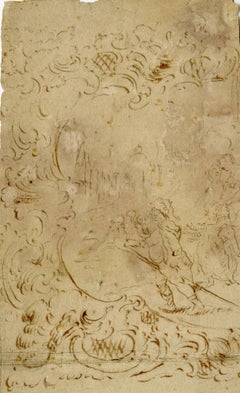
Design for a theatre fresco with fancy plasterwork - early 18th century French S
Located in Middletown, NY
Pen and sepia ink on cream laid paper, 8 3/4 x 5 3/8 inches (222 x 136 mm). Scattered paper tape repairs on the verso in the area of the upper left corner, and along the right sheet...
Category

French School 18th Century Figurative Drawings and Watercolors

Materials

Ink, Laid Paper

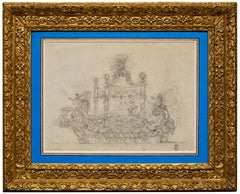
A dazzling Venetian Regatta Boat Study attributed to Alessandra Mauro
Located in PARIS, FR
This stunning Baroque study depicts a regatta boat, a type of vessel developed in eighteenth-century Venice for the regattas organized by the Serenissima during visits by royalty and princes. We propose to link this drawing to the work of Alessandro Mauro, an artist who specialized in this type of composition, as illustrated by a drawing from him at the Metropolitan Museum. 1. Description of the boat The greatest decorative fantasy reigns in this preparatory study, which blends mythological and exotic elements with references to ancient Egypt. Our drawing is probably an initial thought, destined to be refined and clarified later in pen and ink (as evidenced by the ink stain in the lower right). A quadriga of seahorses guided by Neptune stands at the stern of the boat, shown well above the waterline (perhaps to outline its empty volume). One of the seahorses is ridden by a newt, while Amphitrite lies at the feet of the sea god. The center of the boat is occupied by a vast baldachin resting on four atlantes and surmounted by a figure riding an animal (a dragon?). Three figures sit beneath the canopy, one of them on a griffin-shaped seat. This allusion to Egyptian antiquity echoes the winged sun (sometimes a symbol of the god Horus, as in the temple of Edfu in Egypt) that adorns the sides of the promontory on which this baldachin rests. Another flag-bearer figure crouches at the stern of the boat on a raised seat, on the reverse of which is a crowned mermaid whose arm, extended backwards, rests on a mascaron decorated with a radiant face (Helios?) and whose torso surmounts an elephant's head. The heads of the rowers and their oars are sketched all along the boat, whose sides are embellished with elongated naiads. 2. The Venetian regatta boats An exhibition held in 2013 at the Ca' Rezzonico (the Venetian eighteenth-century museum) paid tribute to these regatta boats through studies and prints depicting them. The regattas organized by the Serenissima in honor of visiting princes and sovereigns were among the most spectacular ceremonies in Venice. Some important artists of the 18th century contributed to the creation of these extravagant boats which were given exotic names such as bissona, malgarota or peota. The specialists in this field were Andrea Urbani and the brothers Alessandro and Romualdo Mauro. They were born into a family of theater decorators in Piedmont, but little is known about their detailed biography. Alessandro was the architect of the Dresden opera house and of the St. Samuel Theater in Venice (in collaboration with his brother Romualdo), but also worked as stagehand and set designer in Vienna, Rome and Turin. A drawing produced around 1737 from the Metropolitan Museum (7th photo in the gallery) bears witness to his activity as a regatta boat designer. This drawing is a much more elaborate version than the one presented here, having been entirely reworked in brown ink. However, a figure at the bow of the boat, executed solely in black chalk, still bears witness to a technique similar to that of our drawing. It is difficult to know whether the boat depicted in our drawing was a project for an actual boat or whether it remained in the planning stage, but the front of our boat (Neptune and the quadriga of seahorses ridden by a newt) bears several similarities to that of a parade boat depicted in the print published by Michele Marieschi entitled Regatta on the Grand Canal, between the Foscari and Balbi Palaces (last photo in the gallery). This print is dated 1741, which could confirm that our work dates from around 1740. The area between Neptune and the quadriga that precedes him on this strange paddle-boat appears to be partially submerged, confirming that the waterline of our boat was probably intended to be much lower than the one shown in our drawing. The Correr Museum’s collection holds one of the most important collection of engravings and drawings devoted to these specifically Venetian Baroque productions. These boats were intended to last the duration of a festival. Today, they are only documented by preparatory drawings or prints that testify to the sumptuousness of their decoration. This taste for regatta boats lasted throughout the Venetian eighteenth century, and the conception of regatta boats also attracted great masters such as Giambattista Tiepolo, Francesco Guardi or Giambattista Piranesi...
Category

Old Masters 18th Century Figurative Drawings and Watercolors

Materials

Chalk

Pair of 18th Century watercolour drawings by Old Master Carle Vernet
Located in Petworth, West Sussex
Carle Vernet (French, 1758 – 1836) ‘La Marchande de Coco’; and ‘La Tour de Babbe d’un Charbonnier’ Ink, watercolour on paper Both signed C Vernet and Carle Vernet (lower left and lower right respectively) 12.1/4 x 9 in. (31 x 22.8 cm.) A pair Vernet was born in Bordeaux. At the age of five, he showed an extraordinary passion for drawing horses, but went through the regular academical course as a pupil of his father and of Nicolas-Bernard Lépicié. Strangely, after winning the grand prix (1782), he seemed to lose interest in the profession, and his father had to recall him back from Rome to France to prevent him from entering a monastery. In his Triumph of Aemilius Paulus, he broke with tradition and drew the horse with the forms he had learnt from nature in stables and riding-schools. His hunting-pieces, races, landscapes, and work as a lithographer were also very popular. Carle's sister was executed by the guillotine during the Revolution. After this, he gave up art. When he again began to produce under the French Directory (1795–1799), his style had changed radically. He started drawing in minute detail battles and campaigns to glorify Napoleon. His drawings of Napoleon...
Category

Old Masters 18th Century Figurative Drawings and Watercolors

Materials

Paper, Ink, Watercolor

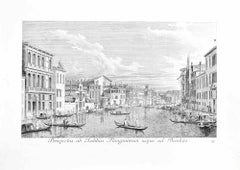
Prospectus ab Aedibus Flanginorum usque ad Bembos by Antonio Visentini-1742
Located in Roma, IT
Etching and burin. Image dimension: 27.4x432 cm. Sheet dimension: 39x53.7 cm. From Urbis Venetiarum Prospectus Celebriores, ex Antonii Canal Tabulis XXXVIII. Aere expressi ab Anto...
Category

Modern 18th Century Figurative Drawings and Watercolors

Materials

Etching

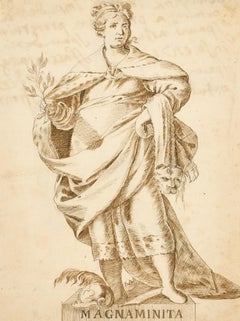
Fine 1700 s Italian Old Master Ink Wash Drawing Roman Allegorical Magnaminita
Located in Cirencester, Gloucestershire
'Mgnaminia' Italian School, 18th century ink and wash drawing on paper, framed within a light oak wood frame (behind glass) image size: 10.5 x 7 inches overall framed: 17 x 13 inches...
Category

Old Masters 18th Century Figurative Drawings and Watercolors

Materials

Ink, Watercolor, Archival Paper

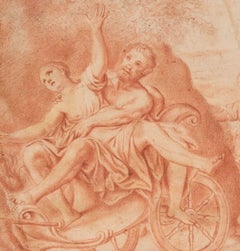
Rape of the Sabines - Sanguine Drawing End of 18th Century
Located in Roma, IT
Rat of Sabinesis an original sanguine drawing on thick cream-colored paper, realized by an anonymous French artist of the end of XVIII century. A superb original drawing with skille...
Category

18th Century Figurative Drawings and Watercolors

Materials

Pastel

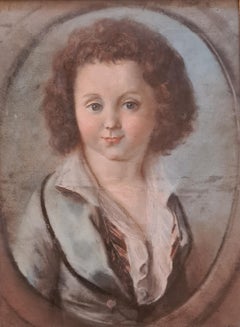
French 18th Century Pastel Portrait of a Young Lady in Period Costume.
Located in Cotignac, FR
Late 18th Century French pastel portrait on paper of a young lady in period dress in a 'feigned oval'. In gilt wood frame presented under glass. Very much of its period and similar ...
Category

Realist 18th Century Figurative Drawings and Watercolors

Materials

Paper, Crayon, Pastel

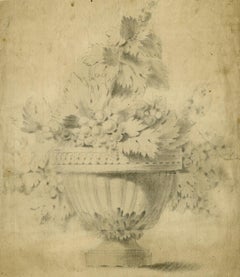
Still life with ornamental urn, grapes and flora - French School 17 Cent.
Located in Middletown, NY
Pencil on cream laid paper, 10 x 8 3/4 inches (254 x 222 mm). Uniform age tone, scattered surface soiling, and handling wear. One pea-sized area of skinning in the top-center sheet ...
Category

French School 18th Century Figurative Drawings and Watercolors

Materials

Laid Paper, Pencil

The Introduction, French School, 18th century
Located in Middletown, NY
In this charming scene a maid appears bashful as she is introduced by her mother to the shepherd’s son. Ink and wash on hand made, cool-toned cream laid paper, 6 3/4 x 8 7/8 inches...
Category

French School 18th Century Figurative Drawings and Watercolors

Materials

Ink, Watercolor, Handmade Paper, Laid Paper
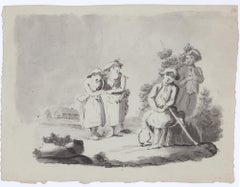
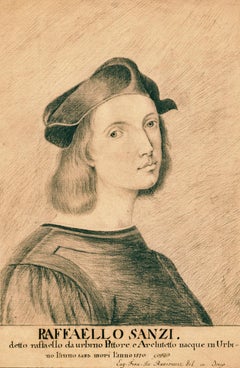
Portrait of Raffaello / Italian School
Located in Middletown, NY
Graphite and ink on handmade, watermarked C & I Honig laid paper, 8 15/16 x 6 3/4 inches (226 x 170 mm). Signed illegibly in ink, lower margin. Scattered light creasing and surface...
Category

Italian School 18th Century Figurative Drawings and Watercolors

Materials

Ink, Handmade Paper, Graphite

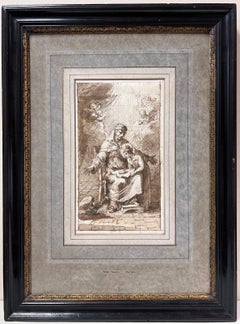
Italian Old Master Ink Wash Drawing St. Anne The Virgin Mary with Cherubs
Located in Cirencester, Gloucestershire
Pietro Fancelli (Italian 1764 - 1850) bio details attached to the frame 'St. Anne & The Virgin' ink with watercolor wash on paper, framed framed: 22 x 16 inches image: 11 x 6.5 inche...
Category

Old Masters 18th Century Figurative Drawings and Watercolors

Materials

Ink, Watercolor

Landscape - Pencil Drawing by J. P. Verdussen - Mid-18th Century
Located in Roma, IT
Landscape is an original drawing in pencil on ivory-colored paper realized by Jan Peter Verdussen. The artwork has some folds rips and foxings and is repaired on the middle line. T...
Category

Modern 18th Century Figurative Drawings and Watercolors

Materials

Pencil

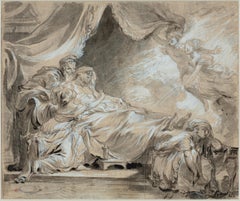
The Death of Coresus
By Jean-Baptiste Greuze
Located in Paris, Île-de-France
JEAN-BAPTISTE GREUZE (Tournus 1725 - 1805 Paris) The Death of Coresus, circa 1750 Pen and brown ink, black ink tips, gray wash on black chalk, 455 x 385 cm Bears on the reverse in ...
Category

Old Masters 18th Century Figurative Drawings and Watercolors

Materials

Ink, Watercolor

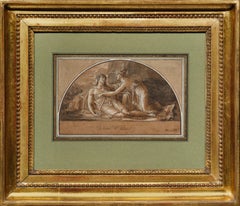
Circle of Angelika Kauffmann, Venus and Amor, Arrow and Spindle, Oval Drawing
Located in Greven, DE
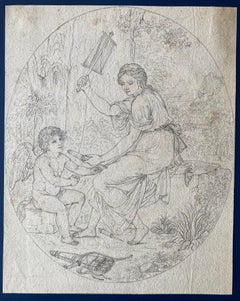
Fine drawing in pencil, oval format. Circle of Angelika Kauffmann. The subject is not clear. It is Amor with his arrows and perhaps Venus with a sp...
Category

Romantic 18th Century Figurative Drawings and Watercolors

Materials

Crayon, Handmade Paper

Landscape - Watercolor and Pencil by Jan Peter Verdussen - 18th Century
Located in Roma, IT
Landscape is a beautiful dranwing in watercolor and pencil on ivory-colored paper realized by Jan Peter Verdussen. In good condition; only a sma...
Category

Old Masters 18th Century Figurative Drawings and Watercolors

Materials

Watercolor, Pencil

Ancient Ruins - Watercolor by Abraham Rademaker - 18th Century
Located in Roma, IT
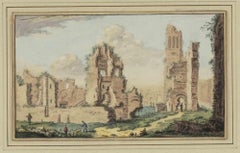
Ancient Ruins is an original old master artwork realized by Abraham Rademaker (1677-1735) in 18th Century Wonderful watercolor on paper by the famous 18t...
Category

Modern 18th Century Figurative Drawings and Watercolors

Materials

Paper, Watercolor

Attrib. Prospero Fontana (1512-1597) - Bolognese School Ink Drawing, Two Cherubs
By Prospero Fontana
Located in Corsham, GB
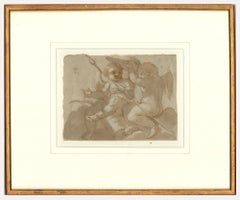
This fine renaissance study, attributed to Bolognese painter Prospero Fontana (1512-1597), depicts two cherubs seated in clouds, playing with the arms of Mars. Elegantly mastered in ...
Category

18th Century Figurative Drawings and Watercolors

Materials

Pen

Portrait of a Young Man, Figurative, Pencil on Paper by Atul Bose "In Stock"
Located in Kolkata, West Bengal
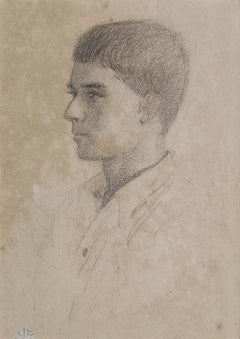
Atul Bose - Portrait of a Young Man Pencil on Paper 8 x 6 inches, 1935 (Unframed & Delivered) In this delicate pencil portrait, Atul renders the profile of a young man with remarkab...
Category

Modern 18th Century Figurative Drawings and Watercolors

Materials

Paper, Ink, Pen, Pencil

The Fish - Pencil on Paper by J. P. Verdussen - 1775 ca.
Located in Roma, IT
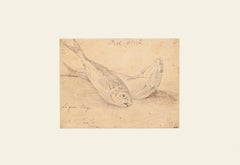
The Fish is a beautiful drawing in pencil on paper realized by Jan Peter Verdussen in 1755 ca. Hand-signed and dated on the lower in pencil. In good condition, and aged. The artwo...
Category

Modern 18th Century Figurative Drawings and Watercolors

Materials

Pencil

Chinese School 18th Century Watercolour - In the Garden
Located in Corsham, GB
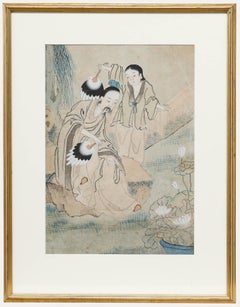
This eighteenth-century (Qing Dynasty) Chinese watercolour depicts a man and woman with fans in a garden setting, carefully tending to a lotus plant. Well presented in a gilt-effect ...
Category

18th Century Figurative Drawings and Watercolors

Materials

Watercolor

Drawing pencil carbon Sketch Religious Saints miniaturist German baroque 18th
Located in PARIS, FR
Johan Jacob HOCH Mainz, 1750 - Mainz, 1829 Pencil drawing on paper 34 x 22 cm (50 x 41 cm with frame) Signed and dated lower left "Johann Jacob Hoch / July 1778" Pitch pine frame wit...
Category

Baroque 18th Century Figurative Drawings and Watercolors

Materials

Carbon Pencil

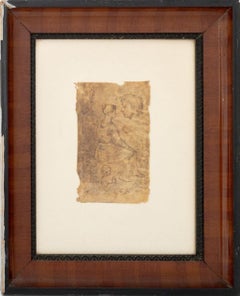
Old Master Figure Sketch Pencil on Vellum
Located in Astoria, NY
Old Master, Figure Sketch, Pencil on Vellum, 18th century, inscribed "G.26" lower right, wood frame. Image: 5.5" H x 3.5" W; frame: 13.75" H x 11" W x 1.25" D. Provenance: From a New...
Category

Old Masters 18th Century Figurative Drawings and Watercolors

Materials

Vellum, Pencil

Figure of Breton Woman - Drawing by J. P. Verdussen - End of 18th Century
Located in Roma, IT
Figure of Breton Woman is a beautiful ink and watercolor original drawing on wire rod and watermarked paper realized at the middle of XVIII century by Jan Peter Verdussen. This ori...
Category

Old Masters 18th Century Figurative Drawings and Watercolors

Materials

Paper

Woman - Drawing on Paper - 18th Century
Located in Roma, IT
Woman is an original drawing, realized by Anonymous artists of the XVIII century. The state of preservation of the artwork is good, but with extensive foxing. The artwork represent...
Category

18th Century Figurative Drawings and Watercolors

Materials

Pencil

The Death of Adonis, a neoclassical drawing by Jean-Guillaume Moitte (ca. 1785)
Located in PARIS, FR
This elegant composition, whose curved shape suggests that it was intended for some decorative project, illustrates Moitte's shift around 1780 towards the neoclassical movement, insp...
Category

Old Masters 18th Century Figurative Drawings and Watercolors

Materials

Paper, Ink, Gouache, Pen

La Bataille - The Battle - Drawing by J. P. Verdussen - 1740s
Located in Roma, IT
China ink and watercolor on paper. Conditions: Two cuts on the centre of the paper. Three holes on centre-right, botton-left and top-left of the paper. Worn on the top left of the ...
Category

Old Masters 18th Century Figurative Drawings and Watercolors

Materials

Ink, Watercolor

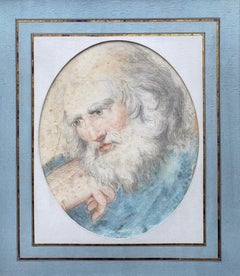
“Portrait of a Head”
Located in Southampton, NY
Late 18th century mixed media portrait of the head of an old man, perhaps the biblical figure Moses. Italian school . Composed of graphite, colored chalk, watercolor and gouache on ...
Category

Academic 18th Century Figurative Drawings and Watercolors

Materials

Chalk, Graphite, Paper, Watercolor, Gouache
“Portrait of a Head”
$1,440 Sale Price
20% Off
Landscape - Pencil Drawing by J. P. Verdussen - Mid-18th Century
Located in Roma, IT
Landscape is a beautiful drawing in pencil on ivory-colored paper realized by Jan Peter Verdussen. Not signed. The artwork has some folds and foxings. The artwork represents a landsc...
Category

Modern 18th Century Figurative Drawings and Watercolors

Materials

Pencil, Paper

La Campagne de Rome - Roman Countryside - Drawing by J. P. Verdussen - 1740ca
Located in Roma, IT
China ink and watercolour on paper. Realized in 1740 ca. Very good conditions. Includes passepartout.
Category

Old Masters 18th Century Figurative Drawings and Watercolors

Materials

Ink, Watercolor

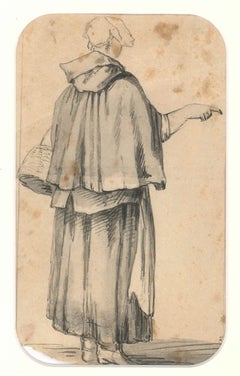
Figure of Woman - Original Ink Drawing - 18th Century
Located in Roma, IT
Figure is an original drawing in china ink on paper. Good Conditions. Applied on a Passepartout. The artwork represents a figure of a woman through deft and smooth strokes, delica...
Category

Modern 18th Century Figurative Drawings and Watercolors

Materials

Ink

Girl - Ink and Watercolor by J. P. Verdussen - 18th Century
Located in Roma, IT
Girl is a china ink drawing realized b Jan Peter Verdussen in the mid-18th Century. Good condition except for some missing parts in the lower left and right edges.
Category

18th Century Figurative Drawings and Watercolors

Materials

Ink

Landscape - Pencil on Paper by J. P. Verdussen - 18th Century
Located in Roma, IT
Landscape is an original drawing in pencil on ivory-colored paper realized by Jan Peter Verdussen. Not signed. The artwork has some folds and foxing and is repair on the middle line....
Category

Modern 18th Century Figurative Drawings and Watercolors

Materials

Pencil

The Gardens in Rome - Drawing by J. P. Verdussen - 1741
Located in Roma, IT
China ink and watercolour on paper. Hand dated. Good condition except for some foxing.
Category

18th Century Figurative Drawings and Watercolors

Materials

Ink, Watercolor

Ruines Romanes - Roman Ruins - Ink and Watercolor by J. P. Verdussen - 1742
Located in Roma, IT
China ink and watercolor on paper. Hand dated. Conditions: Foxing on the top right of the paper
Category

Old Masters 18th Century Figurative Drawings and Watercolors

Materials

Ink, Watercolor

Figure of Man - Original Pencil Drawing by Augustin de Saint-Aubin- 19th Century
Located in Roma, IT
Figure of Man is an Original Pencil Drawing realized by Augustin de Saint-Aubin (1736-1807). Good condition included a green and white cardboard passpartout (65x48 cm). No signatur...
Category

Modern 18th Century Figurative Drawings and Watercolors

Materials

Pencil