Expressionist Landscape Drawings and Watercolors

EXPRESSIONIST STYLE

While “expressionist” is used to describe any art that avoids naturalism and instead employs a bold use of flattened forms and intense brushwork, Expressionist art formally describes early-20th-century work from Europe that drew on Symbolism and confronted issues such as urbanization and capitalism. Expressionist artists experimented in paintings and prints with skewed perspectives, abstraction and unconventional, bright colors to portray how isolating and anxious the world felt rather than how it appeared. 

Between 1905 and 1920, Austrian and German artists, in particular, were inspired by Postimpressionists such as Paul Gauguin and Vincent van Gogh in their efforts to strive for a new authenticity in their work. In its geometric patterns and decorative details, Expressionist art was also marked by eclectic sources like German and Russian folk art as well as tribal art from Africa and Oceania, which the movement’s practitioners witnessed at museums and world’s fairs.

Groups of artists came together to share and promote the themes now associated with Expressionism, such as Die Brücke (The Bridge) in Dresden, which included Erich Heckel, Ernst Ludwig Kirchner and Karl Schmidt-Rottluff and investigated alienation and the dissolution of society in vivid color. In Munich, Der Blaue Reiter (The Blue Rider), a group led by Wassily Kandinsky and Franz Marc, instilled Expressionism with a search for spiritual truths. In his iconic painting The Scream, prolific Norwegian painter Edvard Munch conveyed emotional turmoil through his depiction of environmental elements, such as the threatening sky.

Expressionism shifted around the outbreak of World War I, with artists using more elements of the grotesque in reaction to the escalation of unrest and violence. Printmaking was especially popular, as it allowed artists to widely disseminate works that grappled with social and political issues amid this time of upheaval. Although the art movement ended with the rise of Nazi Germany, where Expressionist creators were labeled “degenerate,” the radical ideas of these artists would influence Neo-Expressionism that emerged in the late 1970s with painters like Jean-Michel Basquiat and Francesco Clemente.

​​Find a collection of authentic Expressionist paintings, sculptures, prints and more art on 1stDibs.

to
11
54
13
26
28
7
Overall Width
to
Overall Height
to
69
59
9
4
7
3
6
4
3
5
1,740
1,309
1,096
585
349
77
55
49
34
22
9
7
1
86
41
1
37
31
23
9
8
8
7
7
7
6
6
5
5
4
3
3
3
2
2
2
83
59
53
40
27
14
9
4
4
3
49
6
76
52
Style: Expressionist
Corner of 9th and de Chirico surreal urban landscape warm black Grey and red
Located in Brooklyn, NY
Soft pastel on Grey toned archival paper signed and dated. This is a large pastel painting suitable for framing under glass. The artist is reminded of the great Italian painter after...
Category

2010s Expressionist Landscape Drawings and Watercolors

Materials

Charcoal, Pastel, Archival Paper

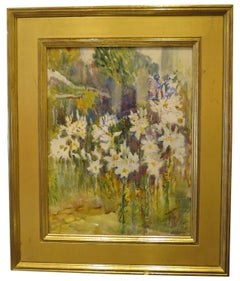
"Lillies in Bloom"
Located in Lambertville, NJ
One of several prominent women associated with the artistic life of Cincinnati at the turn of the century, Annie G. Sykes was recognized for her colorful, Impressionist-inspired watercolors. Throughout her long and successful career, she explored a variety of themes ranging from landscapes, flowers and the figure to the picturesque scenery of New England, Europe and Bermuda. Sykes was born Annie Sullings Gooding in Brookline, Massachusetts. Her father, Josiah Gooding, was a silversmith and engraver, and her mother, Ann, was a gifted needle-worker. Stimulated by the example of her parents, Sykes developed an interest in art during her childhood, honing her skills as a draftsman in art classes at school by drawing flowers, trees and other natural forms. She initiated her formal studies at the Lowell Institute in Boston in 1875, attending drawing classes there until 1878, when she enrolled at the school of the Museum of Fine Arts. Sykes is believed to have studied at the museum school until her marriage to Gerritt Sykes in 1882. Following her nuptials, Sykes and her husband moved to Cincinnati, at that time a flourishing cultural center dubbed the "Queen City of the West." While Gerritt and a friend established the Franklin School for boys, Sykes continued to follow her artistic inclinations. Desirous of refining her skills, she enrolled at the Cincinnati Art Academy in 1884. Throughout the next ten years, she continued her training under such noted American painters as Frank Duveneck and Thomas Satterwhite Noble. Although she occasionally worked in oil, watercolor became Sykes' favorite medium of expression. Despite the birth of two children--Milly in 1885 and Anne in 1888--Sykes successfully balanced the demands of home and family with her professional aspirations. She began contributing to the annual exhibitions of the Boston Art Club in 1890 and the New York Watercolor Club the following year. In 1892, she became a charter member of the Woman's Art Club of Cincinnati, where she would exhibit regularly until 1923. In 1895, Sykes had her first solo show at the Traxel & Maas Gallery in Cincinnati, exhibiting a group of her watercolors. Local critics praised her fresh, vibrant colors and her spontaneous technique, and in a review in the Cincinnati Enquirer she was identified as representing "the new school of impressionism." Sykes's longstanding relationship with the Cincinnati Art Museum began that same year, when she first participated in that institution's annual shows. Indeed, between 1895 and 1926, she would exhibit there on forty-two occasions. Sykes also had a show (with Emma Mendenhall) at the Cinncinati Art Museum in 1908, and a three-person exhibition (with Emma Mendenhall and Dixie Selden) two years later. Sykes's work was also featured in the annual watercolor shows at the Art Institute of Chicago, the Philadelphia Water Color Club and the Ohio Water Color Society. Her numerous professional affiliations included the National Association of Women Painters and Sculptors in New York and the Cincinnati Museum Association. Her standing among her peers was such that she was often invited to serve juries of selection, along with such eminent painters as Duveneck, Noble, Maurice Prendergast and Edward Redfield. Prior to 1900, Sykes' was active in and around Boston, Cincinnati, and in Nonquitt, Massachusetts, where her family had a summer home. After the turn of the century, she spent many summers in Cape Porpoise...
Category

20th Century Expressionist Landscape Drawings and Watercolors

Materials

Watercolor

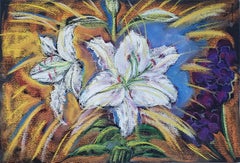
Secret Garden, White Lilies, colorful pastel painting on toned paper
Located in Brooklyn, NY
Pastel on black paper. Ms. Morgan says: During 2020 we discovered a small garden next to a church in our neighborhood in Brooklyn that was well taken care of and always open. We brought our ground...
Category

2010s Expressionist Landscape Drawings and Watercolors

Materials

Pastel, Archival Paper

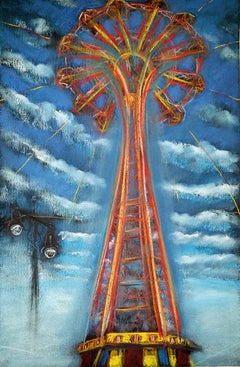
The Day I met a Man Named Precise under the Parachute Jump, Coney Island
Located in Brooklyn, NY
Pastel on black paper. Ms. Morgan says: When I finally started riding the subway again during Covid isolation - going down to the ocean was a real treat. The collection of fisherma...
Category

2010s Expressionist Landscape Drawings and Watercolors

Materials

Pastel, Archival Paper

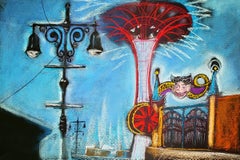
Lights, Parachute Jump and Smile, Coney Island, colorful historic amusement park
Located in Brooklyn, NY
Pastel on black paper. Ms. Morgan says: When I finally started riding the subway again during Covid isolation - going down to the ocean was a real treat. The collection of fisherma...
Category

2010s Expressionist Landscape Drawings and Watercolors

Materials

Pastel, Archival Paper

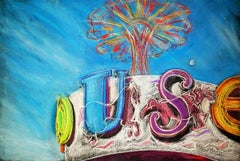
Lights, Parachute Jump and Smile, Coney Island, colorful, text
Located in Brooklyn, NY
Pastel on black paper. Ms. Morgan says: When I finally started riding the subway again during Covid isolation - going down to the ocean was a real treat. The collection of fisherma...
Category

2010s Expressionist Landscape Drawings and Watercolors

Materials

Pastel, Archival Paper

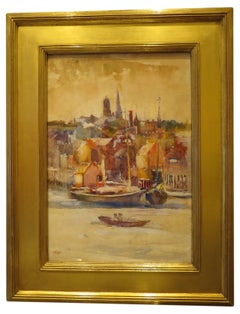
"Seaside Village"
Located in Lambertville, NJ
One of several prominent women associated with the artistic life of Cincinnati at the turn of the century, Annie G. Sykes was recognized for her colorful, Impressionist-inspired watercolors. Throughout her long and successful career, she explored a variety of themes ranging from landscapes, flowers and the figure to the picturesque scenery of New England, Europe and Bermuda. Sykes was born Annie Sullings Gooding in Brookline, Massachusetts. Her father, Josiah Gooding, was a silversmith and engraver, and her mother, Ann, was a gifted needle-worker. Stimulated by the example of her parents, Sykes developed an interest in art during her childhood, honing her skills as a draftsman in art classes at school by drawing flowers, trees and other natural forms. She initiated her formal studies at the Lowell Institute in Boston in 1875, attending drawing classes there until 1878, when she enrolled at the school of the Museum of Fine Arts. Sykes is believed to have studied at the museum school until her marriage to Gerritt Sykes in 1882. Following her nuptials, Sykes and her husband moved to Cincinnati, at that time a flourishing cultural center dubbed the "Queen City of the West." While Gerritt and a friend established the Franklin School for boys, Sykes continued to follow her artistic inclinations. Desirous of refining her skills, she enrolled at the Cincinnati Art Academy in 1884. Throughout the next ten years, she continued her training under such noted American painters as Frank Duveneck and Thomas Satterwhite Noble. Although she occasionally worked in oil, watercolor became Sykes' favorite medium of expression. Despite the birth of two children--Milly in 1885 and Anne in 1888--Sykes successfully balanced the demands of home and family with her professional aspirations. She began contributing to the annual exhibitions of the Boston Art Club in 1890 and the New York Watercolor Club the following year. In 1892, she became a charter member of the Woman's Art Club of Cincinnati, where she would exhibit regularly until 1923. In 1895, Sykes had her first solo show at the Traxel & Maas Gallery in Cincinnati, exhibiting a group of her watercolors. Local critics praised her fresh, vibrant colors and her spontaneous technique, and in a review in the Cincinnati Enquirer she was identified as representing "the new school of impressionism." Sykes's longstanding relationship with the Cincinnati Art Museum began that same year, when she first participated in that institution's annual shows. Indeed, between 1895 and 1926, she would exhibit there on forty-two occasions. Sykes also had a show (with Emma Mendenhall) at the Cinncinati Art Museum in 1908, and a three-person exhibition (with Emma Mendenhall and Dixie Selden) two years later. Sykes's work was also featured in the annual watercolor shows at the Art Institute of Chicago, the Philadelphia Water Color Club and the Ohio Water Color Society. Her numerous professional affiliations included the National Association of Women Painters and Sculptors in New York and the Cincinnati Museum Association. Her standing among her peers was such that she was often invited to serve juries of selection, along with such eminent painters as Duveneck, Noble, Maurice Prendergast and Edward Redfield. Prior to 1900, Sykes' was active in and around Boston, Cincinnati, and in Nonquitt, Massachusetts, where her family had a summer home. After the turn of the century, she spent many summers in Cape Porpoise...
Category

20th Century Expressionist Landscape Drawings and Watercolors

Materials

Watercolor

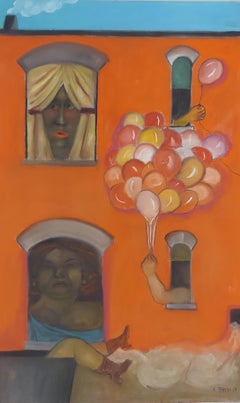
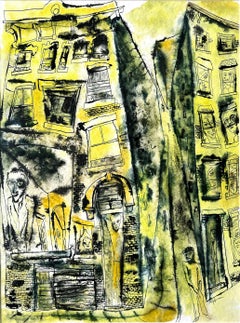
Street Life New York - Haunting Faces Windows Expressionism Mid-Century
Located in Miami, FL
Mid-century artist Lawrence Kupferman paints a madly eerie New York street scene. An exaggerated upward view of two 19th-century walk-ups is split by a forced perspective of a downwa...
Category

1940s Expressionist Landscape Drawings and Watercolors

Materials

Paper, Ink, Watercolor, Pen

Expressionist landscape drawings and watercolors for sale on 1stDibs.

Find a wide variety of authentic Expressionist landscape drawings and watercolors available for sale on 1stDibs. Works in this style were very popular during the 21st Century and Contemporary, but contemporary artists have continued to produce works inspired by this movement. If you’re looking to add landscape drawings and watercolors created in this style to introduce contrast in an otherwise neutral space in your home, the works available on 1stDibs include elements of blue, green and other colors. Many Pop art paintings were created by popular artists on 1stDibs, including Zsolt Berszán, Janet Morgan, David Barnett, and Lucien Génin. Frequently made by artists working with Paint, and Watercolor and other materials, all of these pieces for sale are unique and have attracted attention over the years. Not every interior allows for large Expressionist landscape drawings and watercolors, so small editions measuring 2.9 inches across are also available. Prices for landscape drawings and watercolors made by famous or emerging artists can differ depending on medium, time period and other attributes. On 1stDibs, the price for these items starts at $85 and tops out at $80,000, while the average work sells for $1,200.