Early 20th Century Animal Paintings
to
137
81
103
94
54
38
Overall Width
to
Overall Height
to
137
843
1,821
5,779
68
41
49
58
62
100
126
127
134
167
84
90
17
11
4
3
1
1
264
91
13
157
127
73
73
60
56
53
49
44
42
28
26
18
17
13
12
12
12
11
10
362
330
140
136
37
6
5
4
4
4
274
12
245
125
Period: Early 20th Century
Antique Orientalist Oil on Board
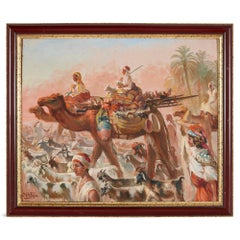
Desert Bedouin
, by José Benito Ortega
By José Benito Ortega
Located in London, GB
Antique Orientalist Oil on Board 'Desert Bedouin', by Spanish Artist Ortega
Spanish, early 20th Century
Frame: Height 51cm, width 59cm, depth 2cm
Board: Height 44cm, width 53cm, depth 0.5cm
Fluidly painted, this vibrant oil on board depicts a dusty Orientalist scene. Four Bedouin ride camels alongside a flurry of goats, carrying lambs and hens in saddlebags. Other figures clothed in Middle Eastern garments walk with them, and the busy scene fades into a dusty, evening landscape. The colour palette is vibrant and hued with dusky pinks and oranges, giving the impression that these Bedouin are returning back to camp. The cropped composition also gives a dynamic feel to the picture: a glance into early 20th Century desert life.
The present painting was created by Spanish artist José Benito Ortega...
Category
Early 20th Century Animal Paintings
Materials
Wood, Oil, Board
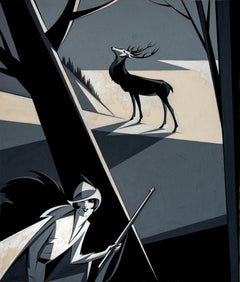
Female hunter stalks Stag, Art Deco Brooklyn Daily Eagle Sunday Magazine Cover
Located in Miami, FL
Post cubist work with the perfect balance of component parts. The work is rendered with meticulous precision. It's quite simply a masterful piece of graphic design.
Signed lower c...
Category
Art Deco Early 20th Century Animal Paintings
Materials
Gouache
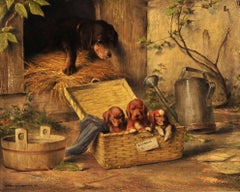
Three in Basket - A Mother Dog Looks at Her Puppies in a Basket
Located in Fort Washington, PA
A black dog looks down at a basket of brown puppies
Karl Lindner was a 19th-century Austrian artist
Date: 1907
Medium: Oil on Canvas
Dimensions: 10.00" x 12.00"
Signature: Signed U...
Category
Early 20th Century Animal Paintings
Materials
Canvas, Oil
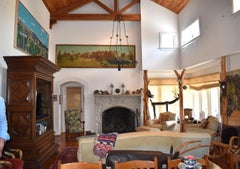
" The Littlefield Murals " 3 MURALS OF THE XIT RANCH IN TEXAS. PAINTED Ca. 1910
Located in San Antonio, TX
Major George Washington Littlefield died in 1920. He commissioned E. Martin Hennings around 1910 to do six large paintings of scenes from his 235,000-acre ( part of the XIT ) ranch to hang in his bank in Austin. I have included photos of the paintings hanging in the bank from the Littlefield Book.
I am not sure, but the bank possibly went under sometime in the 197s-1980s. All of the art and antiques were stored, and they had a sale. We have 3 of the six murals that were commissioned by Littlefield.
I have about 40 pages of info on Littlefield and the murals. Too much to enter now but I will be scanning that info later this week.
The Littlefield mansion is still in Downtown Austin. At one time he was the richest man in the state. He was UT's biggest donor for several years prior to his death.
The paintings are
34 x 130
35 x 144
35 x 119
Two are hanging in my friend's ranch house. The other is of a large herd of Hereford Cattle. It is actually pictured
on the cover of the Biography of George Washing Littlefield.
Littlefield, George Washington (1842–1920). George Washington Littlefield, cattleman, banker, and member of the Board of Regents of the University of Texas, son of Fleming and Mildred Terrell (Satterwhite) White Littlefield, was born in Panola County, Mississippi, on June 21, 1842. The family moved to Texas in 1850 after a confrontation between Fleming Littlefield and his wife's family. In marrying Fleming, her overseer, after the death of her first husband, Mildred in her family's eyes had married beneath her station, an action to which her family objected. George grew to young manhood on the family plantation near Belmont, Gonzales County, helping his mother to manage the place after Fleming's death in 1853. George received a basic education in Gonzales College and Baylor University, 1853–55 and 1857. With the outbreak of the Civil War in 1861 George enlisted in Company I, Eighth Texas Cavalry (Terry's Texas Rangers), which fought in the Army of Tennessee. Before his military career was ended at Mossy Creek, Tennessee, on December 26, 1863, by an exploding cannon shell, George rose to the rank of company commander, the youngest in his regiment, and fought at Shiloh, Perryville, and Chickamauga. At Mossy Creek he was promoted to major, a title by which he was addressed after the mid 1880s. Back in Texas after being discharged in 1864, he took control of a plantation belonging to himself and his brother, and "went to work to make the best, as he thought, of a miserable life, having to carry his crutches everywhere." During the war, on January 14, 1863, George married Alice Payne Tillar, with whom he had two children, both of whom died in infancy. In his business ventures thereafter, George Littlefield, who had a highly developed sense of family, utilized nephews and the husbands of nieces as managers.
George's first year's farming after the war ended in disaster caused by three years of worm infestation and flood. Even the road-side store he opened, which prospered because George accepted barter, in particular cattle, could not make up for the losses. In 1871 he gathered a herd of cattle, half of which were his and the rest belonging to his brother, bought more, and drove the herd to Abilene, Kansas, where he sold the animals for enough to discharge all of his debts and leave him with $3,600 "to begin business." Over the next several years entrepreneur Littlefield opened a dry goods store in partnership with J. C. Dilworth in Gonzales, bought and trailed cattle, bought ranches in Caldwell and Hays counties, and developed his plantations. In the trailing business, Littlefield commonly bought his cattle, rather than, as most trailing contractors did, trailing them for a fee. He took the greater risk but reaped the greater reward in their sale. In 1877 Littlefield bought water rights along the Canadian River near Tascosa and established the XIT Ranch which he sold in 1881 for $248,000. Littlefield rejoiced that he had obtained "far more money than he had ever expected to have" and thought of retiring at thirty-nine years of age. But he did not retire, as "he learned. . .that the more money a man makes, the more he has to make, that a man's world opens up a little bit wider with each deal and demands become heavier."
In 1882 Littlefield followed the advice of his principal ranch manager, half-nephew J. Phelps White, and purchased water interests sufficient to control some four million acres of land in New Mexico east of the Pecos River between Fort Sumner and Roswell, on which he established the Bosque Grande Ranch. In 1883 he bought the site of the first windmill on the New Mexico plains at the Four Lakes north of Tatum and developed the Four Lakes Ranch with windmills and barbed wire to control access to water and permit upgrading of stock. His cattle after 1882 carried his LFD brand on their right side. In 1887 Littlefield began acquiring land in Mason County, which soon spread over some 120,000 acres in adjacent Kimble and Menard counties, a ranch he put under management of half-nephew John Will White. In the 1890s Littlefield assembled acreage that came to be known as the LFD Farm in Roswell, New Mexico, on which he established an apple grove, grew forage for cattle, recruited his horses prior to the spring round-up, and maintained the pure-bred bulls that he used to upgrade his herds. Littlefield climaxed his ranching operation in 1901 with the purchase for two dollars per acre of 235,858 acres of the Yellow House (southern) Division of the XIT Ranch in Lamb and Hockley counties. To reach the prevailing wind above the escarpment at the ranch headquarters, Littlefield put up a windmill 130 feet tall to the top of the fan, claimed at the time to be the world's tallest windmill. In 1912 he established the Littlefield Lands Company under Arthur Pope...
Category
Impressionist Early 20th Century Animal Paintings
Materials
Oil
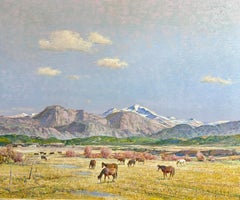
Winter Pasture
By Oscar Edmund Berninghaus
Located in Missouri, MO
Oscar E. Berninghaus (American, 1874-1952)
"Winter Pasture"
Oil on Canvas
Unframed: 20 x 24 inches
Framed: 25.5 x 29.5 inches
Provo: Noonan-Kocian Gallery, St. Louis, Missouri, Dec. 23, 1954 (Copy of Original Receipt Included)
* Will be included in Kodner Gallery's upcoming Oscar E. Berninghaus Research Project on the artist
We guarantee the authenticity of this painting and would be pleased to provide you with a formal, certified insurance appraisal. "Winter Pasture" was originally purchased from one of the Oscar E. Berninghaus' principal dealers, Noonan-Kocian in St. Louis, and the painting retains its original 1954 invoice along with a signed affidavit from the grandson of the original owner (see images).
As with many artists of the period, Berninghaus sometimes created works intended for reproduction in calendars, books, or advertising. He completed commissions for Brown & Bigelow, the prominent Minneapolis-based calendar and publishing company, which often requested that works remain unsigned for reproduction purposes. This practice explains the absence of a visible signature on certain compositions.
-------------------
A founder in 1898 of the Taos Society of Artists, Oscar Berninghaus excelled at drawing animals and figures in contemporary garb in Southwestern landscapes. Many of his early paintings were Impressionistic, "suffused with color and light". (Gerdts 254)
He was born in St. Louis, Missouri and developed an interest in art through his family's lithography business. He attended night classes at the St. Louis School of Fine Art. In 1898, he was on an illustration assignment for "McClure's" magazine, which took him for the first of many times into New Mexico and Arizona. He had heard of the special beauty of Taos and there met Bert Geer Phillips, who was already a resident, and Phillips invited him to return.
This visit began a tradition of spending the winter months in St. Louis and the summers in Taos. He remained active in both communities, and for many years designed the costumes and floats for the Veiled Prophet parade, a famous annual event in St. Louis.
He also did a series of western scenes commissioned by the Anheuser-Busch Brewing Association to promote a manly, ruggedness theme in their products and to enhance their image as good Americans, an image that was being attacked by suffragettes. In this capacity and without visiting the area, Berninghaus did a painting titled "Old Faithful, Yellowstone" in 1914, which was used as a calendar illustration in the series.
Berninghaus was a sketch artist for the Denver and Rio Grande Railroad to depict landscape of Colorado...
Category
Abstract Impressionist Early 20th Century Animal Paintings
Materials
Canvas, Oil

Price Upon Request
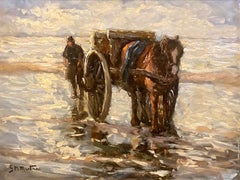
Where are the Clams?
By Gerhard Morgenstjerne Munthe
Located in Missouri, MO
Searching for Clams with the Horse Cart
By. Gerhard Munthe (German, 1875-1927)
Signed Lower Left
Unframed: 11" x 14"
Framed: 19" x 23"
Born in Dusseldo...
Category
Impressionist Early 20th Century Animal Paintings
Materials
Oil, Panel
Price Upon Request
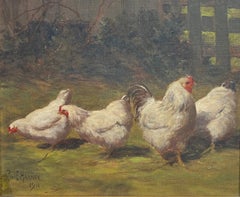
Four White Chickens
Located in Missouri, MO
Four White Chickens, 1911
By. Paul Harney (American, 1850-1915)
Signed and Dated Lower Left
Unframed: 10.25" x 12"
Framed: 17" x 19"
Paul Harney (1850-1915)
Born in New Orleans on ...
Category
American Realist Early 20th Century Animal Paintings
Materials
Canvas, Oil
Price Upon Request
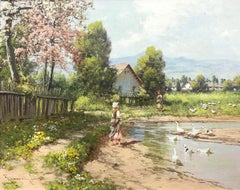
Tending the Flock
Located in Missouri, MO
Laszlo Neogrady (1896-1962)
"Tending the Flock" c. 1930
Oil on Canvas
approx 24 x 30
approx 30 x 36 framed
Laszlo Neogrady was born in Budapest, Hungary in 1896. He was the son of...
Category
Land Early 20th Century Animal Paintings
Materials
Canvas, Oil
Price Upon Request
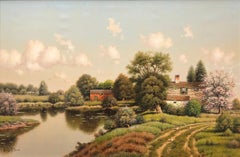
Springtime at the Farm
Located in Missouri, MO
George W. Drew (1875-1968)
"Springtime at the Farm"
Oil on Canvas
24 x 36 inches (site)
31.5 x 43.25 (framed)
George W. Drew was born 21 December 1875 in Massachusetts. He was a member of the Independent Artists Association. He exhibited at the National Academy of Design and they have him recorded as living at 745 Columbus Ave., N.Y. in the year 1898. He also exhibited at the Allied Artists of America, which was established in 1914, Salons of America, N.Y. State Fair, Newark State Fair, Newark Museum and New York Museum of Science & Industry.
Although there is little known about the personal life of George W. Drew, his paintings appear on the art market quite often. It is obvious that his work has always been well received because of the numerous exhibitions he has participated in. He is known for his rustic luminous depictions of the Nineteenth Century American Landscape. Like many of the Hudson River Painters...
Category
American Impressionist Early 20th Century Animal Paintings
Materials
Canvas, Oil
Price Upon Request
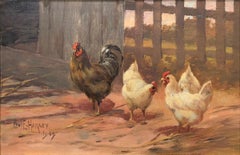
Feeding Time
Located in Missouri, MO
Paul E. Harney, Jr.
"Feeding Time" 1909
Oil on Wood Panel
Signed and Dated
Panel Size: approx 8 x 12 inches
Framed Size: approx. 16 x 19 inches
Paul Harney (1850-1915)
Born in New ...
Category
American Realist Early 20th Century Animal Paintings
Materials
Oil, Wood Panel
Price Upon Request
Still Thinking About These?
All Recently ViewedMore Ways To Browse
Alexander Koester
Beagle Portrait
Black Labrador Painting
Boston Terrier Painting
Canadian Goose Painting
Chihuahua Painting
Frances Mabel Hollams
Hunt Slonem Finches
Hunting Painting 1900
J Langlois
Joanne Bird
John Barber
Joseph Dixon
Josh Brown Giraffe
Jules Chardigny
Jumping Horse Painting
Lion Cub Painting
Louis Eugene Lambert