Burlap Figurative Paintings
to
2
3
1
Overall Width
to
Overall Height
to
6
6
7
6
6
6
1
19
6
5
2
2
6
Medium: Burlap
Artist: Jose Maria de Servin
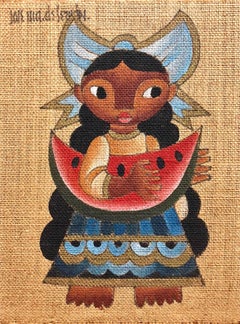
Folk Art Mexican Girl with Watermelon Oil Painting on Burlap
Located in Surfside, FL
The sweetness that characterizes the work of Mexican painter Jose Maria de Servin (1917-83) is a melancholy and placid one. While he worked in the most modern of styles, he adapted i...
Category
Mid-20th Century Folk Art Burlap Figurative Paintings
Materials
Burlap, Oil
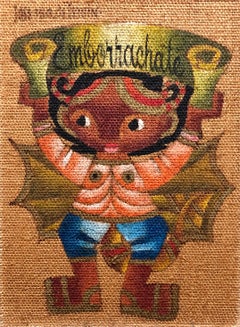
Folk Art Mexican Girl "Emborrachate" Oil Painting on Burlap
Located in Surfside, FL
The sweetness that characterizes the work of Mexican painter Jose Maria de Servin (1917-83) is a melancholy and placid one. While he worked in the most modern of styles, he adapted i...
Category
Mid-20th Century Folk Art Burlap Figurative Paintings
Materials
Burlap, Oil
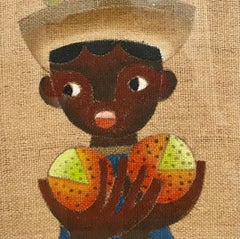
Folk Art Mexican Girl Oil Painting on Burlap Charming Naive African American Art
Located in Surfside, FL
Framed 29 X 23
Image 18 X 24
The sweetness that characterizes the work of Mexican painter Jose Maria de Servin (1917-83) is a melancholy and placid one. While he worked in the mo...
Category
Mid-20th Century Folk Art Burlap Figurative Paintings
Materials
Burlap, Oil

Folk Art Mexican Boy Oil Painting on Burlap Charming Naive African American Art
Located in Surfside, FL
Framed 29 X 23
Image 18 X 24
The sweetness that characterizes the work of Mexican painter Jose Maria de Servin (1917-83) is a melancholy and placid one. While he worked in the mo...
Category
Mid-20th Century Folk Art Burlap Figurative Paintings
Materials
Burlap, Oil
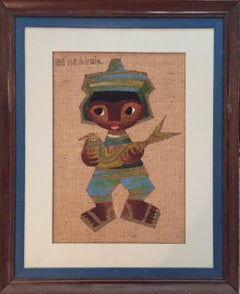
Mexican Boy with Bird
Located in Surfside, FL
The sweetness that characterizes the work of Mexican painter Jose Maria de Servin (1917-83) is a melancholy and placid one. While he worked in the most modern of styles, he adapted i...
Category
20th Century Burlap Figurative Paintings
Materials
Burlap, Oil
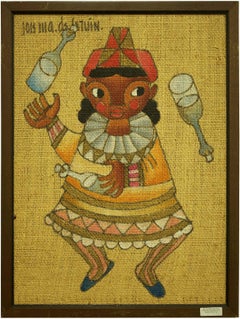
Folk Art Mexican Girl, Circus Clown Juggler
Located in Surfside, FL
The sweetness that characterizes the work of Mexican painter Jose Maria de Servin (1917-83) is a melancholy and placid one. While he worked in the most modern of styles, he adapted i...
Category
Mid-20th Century Folk Art Burlap Figurative Paintings
Materials
Burlap, Oil
Related Items
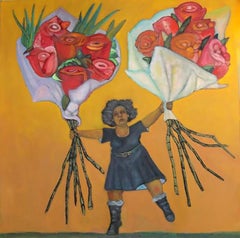
Balance, Whimsical female with flowers, roses, bright golden sky
Located in Brooklyn, NY
*ABOUT Stephen Basso
Stephen Basso's highly original pastels and oil paintings are romantic, yet thought provoking fantasies. His whimsical works are alive with boundless imagina...
Category
2010s Outsider Art Burlap Figurative Paintings
Materials
Canvas, Oil
$3,200
H 40 in W 40 in D 2 in
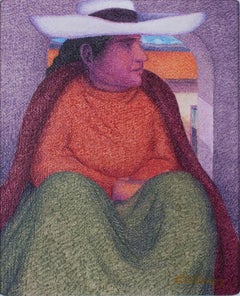
"Mujer de Cajamarca, " Oil Painting on Jute signed by Ernesto Gutierrez
Located in Milwaukee, WI
"Mujer de Cajamarca" is an original oil painting on jute by Ernesto Gutierrez. The artist signed the piece in the lower right. It depicts a woman seated in front of an archway.
16"...
Category
Early 2000s Contemporary Burlap Figurative Paintings
Materials
Jute, Oil
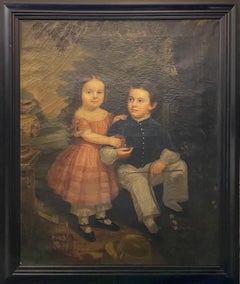
Portrait of Two Children
Located in Milford, NH
A wonderful early 19th century large oil on canvas naive portrait of two children, a boy and a girl, attributed to American artist Arthur Armstrong (1798-1851). Armstrong was born in...
Category
19th Century Folk Art Burlap Figurative Paintings
Materials
Canvas, Oil

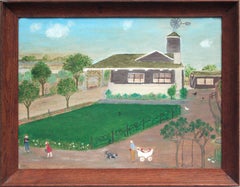
"Once Upon a Time" Mid Century Figurative Landscape
Located in Soquel, CA
Charming mid-century naive painting of small figures and chickens in a rural landscape by an unknown artist (American, 20th Century). Signed with the monogram "I. M. H." on lower lef...
Category
1960s Folk Art Burlap Figurative Paintings
Materials
Canvas, Oil, Cardboard
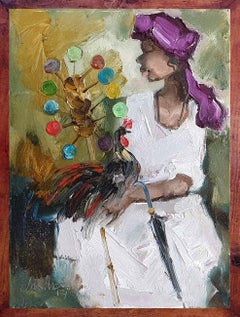
Badami People, Oil on Canvas, White Purple Green Color "In Stock"
By JMS Mani
Located in Kolkata, West Bengal
JMS Mani - Badami People
Oil on Canvas - 16 x 12 inches each (unframed size)
20 x 18 inches ( Framed )
Inclusive of packing .
The simple, rustic folk of the Deccan Plateau in Sout...
Category
2010s Folk Art Burlap Figurative Paintings
Materials
Oil, Canvas
$2,149
H 22 in W 18 in D 1 in
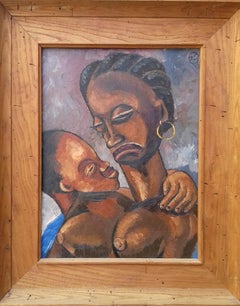
Early Haitian Picasso-like Modernist Mother and Child oil painting Haiti
Located in Norwich, GB
Mother and child/maternité: a gorgeous, almost Picasso-like early oil on canvas by Petion Savain, dating from 1953. The painting is monogrammed and dated...
Category
Mid-20th Century Outsider Art Burlap Figurative Paintings
Materials
Canvas, Oil
$2,400
H 21 in W 17 in D 1 in
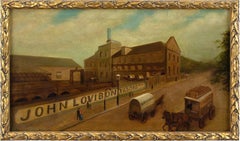
Early 20th-Century English School, John Lovibond
Sons, Cannon Brewery, Fulham
Located in Cheltenham, GB
This charming early 20th-century English School oil painting depicts the Cannon Brewery at North End, Fulham, owned by John Lovibond
Sons Ltd.
Founded in 1867, the brewery was...
Category
Early 1900s Folk Art Burlap Figurative Paintings
Materials
Canvas, Oil
Navigator, bright color oil painting of figure, boats, water
Located in Brooklyn, NY
*ABOUT Stephen Basso
Stephen Basso's highly original pastels and oil paintings are romantic, yet thought provoking fantasies. His whimsical works are alive with boundless imagina...
Category
2010s Outsider Art Burlap Figurative Paintings
Materials
Canvas, Oil
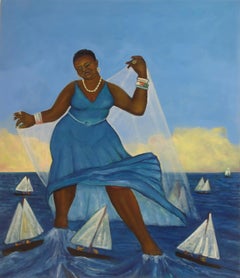
$4,500
H 60 in W 52 in D 1.5 in
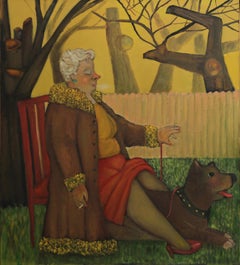
Lemon Winter, colorful humorous woman and dog
Located in Brooklyn, NY
oil on linen on mounted board
*ABOUT Stephen Basso
Stephen Basso's highly original pastels and oil paintings are romantic, yet thought provoking fantasies. His whimsical works a...
Category
2010s Outsider Art Burlap Figurative Paintings
Materials
Oil, Canvas
Rapunzel by the Sea, fairy tale narrative, colorful whimsical fantasy
Located in Brooklyn, NY
Rapunzel figure narrative, colorful
*ABOUT Stephen Basso
Stephen Basso's highly original pastels and oil paintings are romantic, yet thought provoking fantasies. His whimsical w...
Category
2010s Outsider Art Burlap Figurative Paintings
Materials
Canvas, Oil
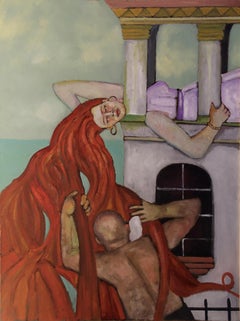
$2,000
H 40.01 in W 30.01 in D 0.99 in
Lover Boy, colorful humorous woman and Cat
Located in Brooklyn, NY
oil on linen on mounted board
*ABOUT Stephen Basso
Stephen Basso's highly original pastels and oil paintings are romantic, yet thought provoking fanta...
Category
2010s Outsider Art Burlap Figurative Paintings
Materials
Linen, Oil

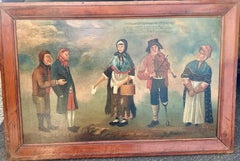
19th century British Folk Art, Singers singing about Napoleon in a landscape
Located in Woodbury, CT
Anonymous (English School)
The Ballad Singers, ca. 1820
Oil on canvas
Lively, theatrical, and brimming with charm, The Ballad Singers is a rare surviving example of early 19th-centu...
Category
1820s Folk Art Burlap Figurative Paintings
Materials
Canvas, Oil
Previously Available Items
Folk Art Mexican Girl, Circus Clown Juggler
Located in Surfside, FL
The sweetness that characterizes the work of Mexican painter Jose Maria de Servin (1917-83) is a melancholy and placid one. While he worked in the most modern of styles, he adapted i...
Category
Mid-20th Century Folk Art Burlap Figurative Paintings
Materials
Burlap, Oil
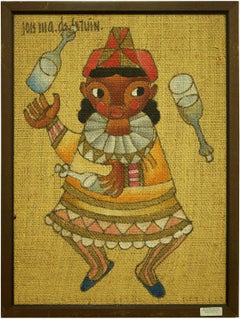
Folk Art Mexican Girl Oil Painting on Burlap Charming Naive African American Art
Located in Surfside, FL
Framed 29 X 23
Image 18 X 24
The sweetness that characterizes the work of Mexican painter Jose Maria de Servin (1917-83) is a melancholy and placid one. While he worked in the most modern of styles, he adapted it to an anecdotal folk-art approach distinctly his own.
When he was an infant, de Servin's family moved with him to Guadalajara. A city of history and culture, Guadalajara had a thriving artistic community with strong connections to Europe. His brothers Antonio and Miguel became artists as well, and in later years they worked collaboratively. As a teenager, de Servin studied at one of Mexico's Schools of Open-Air Painting, free art-teaching institutions sponsored by the government.
Later de Servin became a pupil of the painter Chucho Reyes, known for his improvisational watercolor variations on traditional Mexican themes. This interest in imagery particular to Mexico would be of great significance to de Servin. De Servin also studied under the more traditional painter Jose Vizcarra. In the early 1930s de Servin joined the Pintores Jovenes de Jalisco, or Young Painters of Jalisco.
An influence of critical importance to de Servin was Pablo Picasso. One of the originators of Cubism, the Spanish painter soon departed from its quasi-scientific and optical basis to create lively and humorous geometrical abstractions. It was this Cubism, personal and decorative, that de Servin adopted. His earliest Cubist works mimic Picasso, while during the second stage of his career, his works become smooth and polished, with an emphasis on gentle surface textures.
After these cautious years, however, a rough boldness enters along with dominating colors of earth and sand. Modernists like de Servin were interested in exploring what they considered primitive artmaking styles. The adoption of a native manner and native themes is in keeping with Modernist tenets, as is the use of nontraditional materials. De Servin's portraits of peasants, large-eyed and simply rendered, recall children's drawings. The rough burlap ground contrasts with the playful imagery and delicate range of color. The figures, all children or child-like adults, are all curves and simple shapes arranged harmoniously. De Servin's cubism is free from grotesquerie as it celebrates the simplicity of its subjects.
De Servin worked with the social-realist Jose Orozco on several large mural commissions in Guadalajara, including one at the Legislative Palace. While their styles were dissimilar, both made use of Mexican imagery to glorify the common people. A sought-after muralist in his own right, de Servin brought the rich colors and endearing characters of his panels to his larger-scale work.
For 15 years, de Servin taught summer art classes at the University of Arizona. His career was marked by many one-man shows, both in North America and Europe. In recent years, his striking style has attracted increased notice from critics and the public.
His style is a unique conglomerate of tradition, history, legends, heroes, old customs and folklore. It is a self-standing style, recognizable, cheerful, whimsical and a happy creation. Naïve art is any form of visual art that is created by a person who lacks the formal education and training that a professional artist undergoes (in anatomy, art history, technique, perspective, ways of seeing). Unlike folk art, naïve art does not necessarily evince a distinct cultural context or tradition. Naïve art is recognized, and often imitated, for its childlike simplicity and frankness. Paintings of this kind typically have a flat rendering style with a rudimentary expression of perspective.
One particularly influential painter of "naïve art" was Henri Rousseau (1844–1910), a French Post-Impressionist who was discovered by Pablo Picasso. Naïve art is often seen as outsider art that is by someone without formal (or little) training or degree. While this was true before the twentieth century, there are now academies for naïve art. Naïve art is now a fully recognized art genre, represented in art galleries worldwide.
Museums devoted to naïve art now exist in Kecskemét, Hungary; Riga, Latvia; Jaen, Spain; Rio de Janeiro, Brasil; Vicq France and Paris. "Primitive art" is another term often applied to art by those without formal training, but is historically more often applied to work from certain cultures that have been judged socially or technologically "primitive" by Western academia, such as Native American, sub saharan African or Pacific Island art (see Tribal art). This is distinguished from the self-conscious, "primitive" inspired movement primitivism. Another term related to (but not completely synonymous with) naïve art is folk art. There also exist the terms "naïvism" and "primitivism" which are usually applied to professional painters working in the style of naïve art (like Paul Gauguin, Mikhail Larionov, Paul Klee).
At all events, naive art can be regarded as having occupied an "official" position in the annals of twentieth-century art since - at the very latest - the publication of the Der Blaue Reiter, an almanac in 1912. Wassily Kandinsky and Franz Marc, who brought out the almanac, presented 6 reproductions of paintings by le Douanier' Rousseau (Henri Rousseau), comparing them with other pictorial examples. However, most experts agree that the year that naive art was "discovered" was 1885, when the painter Paul Signac became aware of the talents of Henri Rousseau and set about organizing exhibitions of his work in a number of prestigious galleries. The Earth Group (Grupa Zemlja) were Croatian artists, architects and intellectuals active in Zagreb from 1929 to 1935. The group included the painters Krsto Hegedušić, Edo Kovačević, Omer Mujadžić, Kamilo Ružička, Ivan Tabaković, and Oton Postružnik, the sculptors Antun Augustinčić, Frano Kršinić, and the architect Drago Ibler. A term applied to Yugoslav (Croatian) naive painters working in or around the village of Hlebine, near the Hungarian border, from about 1930. Some of the best known naive artists are Dragan Gaži, Ivan Generalić, Josip Generalić, Krsto Hegedušić, Mijo Kovačić, Ivan Lacković-Croata, Franjo Mraz, Ivan Večenaj and Mirko Virius. Camille Bombois (1883–1970) Ferdinand Cheval, known as 'le facteur Cheval' (1836–1924) Henry Darger (1892–1973) L. S. Lowry (1887–1976) Grandma Moses, Anna Mary Robertson (1860–1961) Nikifor (1895–1968) Poland, Horace Pippin (1888–1946) Jon Serl (1894-1993) United States Alfred Wallis (1855–1942) Scottie Wilson (1890–1972) Gesner Abelard...
Category
Mid-20th Century Folk Art Burlap Figurative Paintings
Materials
Burlap, Oil
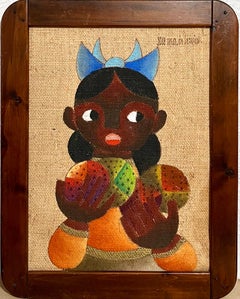
Folk Art Mexican Boy Oil Painting on Burlap Charming Naive African American Art
Located in Surfside, FL
Framed 29 X 23
Image 18 X 24
The sweetness that characterizes the work of Mexican painter Jose Maria de Servin (1917-83) is a melancholy and placid one. While he worked in the most modern of styles, he adapted it to an anecdotal folk-art approach distinctly his own.
When he was an infant, de Servin's family moved with him to Guadalajara. A city of history and culture, Guadalajara had a thriving artistic community with strong connections to Europe. His brothers Antonio and Miguel became artists as well, and in later years they worked collaboratively. As a teenager, de Servin studied at one of Mexico's Schools of Open-Air Painting, free art-teaching institutions sponsored by the government.
Later de Servin became a pupil of the painter Chucho Reyes, known for his improvisational watercolor variations on traditional Mexican themes. This interest in imagery particular to Mexico would be of great significance to de Servin. De Servin also studied under the more traditional painter Jose Vizcarra. In the early 1930s de Servin joined the Pintores Jovenes de Jalisco, or Young Painters of Jalisco.
An influence of critical importance to de Servin was Pablo Picasso. One of the originators of Cubism, the Spanish painter soon departed from its quasi-scientific and optical basis to create lively and humorous geometrical abstractions. It was this Cubism, personal and decorative, that de Servin adopted. His earliest Cubist works mimic Picasso, while during the second stage of his career, his works become smooth and polished, with an emphasis on gentle surface textures.
After these cautious years, however, a rough boldness enters along with dominating colors of earth and sand. Modernists like de Servin were interested in exploring what they considered primitive artmaking styles. The adoption of a native manner and native themes is in keeping with Modernist tenets, as is the use of nontraditional materials. De Servin's portraits of peasants, large-eyed and simply rendered, recall children's drawings. The rough burlap ground contrasts with the playful imagery and delicate range of color. The figures, all children or child-like adults, are all curves and simple shapes arranged harmoniously. De Servin's cubism is free from grotesquerie as it celebrates the simplicity of its subjects.
De Servin worked with the social-realist Jose Orozco on several large mural commissions in Guadalajara, including one at the Legislative Palace. While their styles were dissimilar, both made use of Mexican imagery to glorify the common people. A sought-after muralist in his own right, de Servin brought the rich colors and endearing characters of his panels to his larger-scale work.
For 15 years, de Servin taught summer art classes at the University of Arizona. His career was marked by many one-man shows, both in North America and Europe. In recent years, his striking style has attracted increased notice from critics and the public.
His style is a unique conglomerate of tradition, history, legends, heroes, old customs and folklore. It is a self-standing style, recognizable, cheerful, whimsical and a happy creation. Naïve art is any form of visual art that is created by a person who lacks the formal education and training that a professional artist undergoes (in anatomy, art history, technique, perspective, ways of seeing). Unlike folk art, naïve art does not necessarily evince a distinct cultural context or tradition. Naïve art is recognized, and often imitated, for its childlike simplicity and frankness. Paintings of this kind typically have a flat rendering style with a rudimentary expression of perspective.
One particularly influential painter of "naïve art" was Henri Rousseau (1844–1910), a French Post-Impressionist who was discovered by Pablo Picasso. Naïve art is often seen as outsider art that is by someone without formal (or little) training or degree. While this was true before the twentieth century, there are now academies for naïve art. Naïve art is now a fully recognized art genre, represented in art galleries worldwide.
Museums devoted to naïve art now exist in Kecskemét, Hungary; Riga, Latvia; Jaen, Spain; Rio de Janeiro, Brasil; Vicq France and Paris. "Primitive art" is another term often applied to art by those without formal training, but is historically more often applied to work from certain cultures that have been judged socially or technologically "primitive" by Western academia, such as Native American, sub saharan African or Pacific Island art (see Tribal art). This is distinguished from the self-conscious, "primitive" inspired movement primitivism. Another term related to (but not completely synonymous with) naïve art is folk art. There also exist the terms "naïvism" and "primitivism" which are usually applied to professional painters working in the style of naïve art (like Paul Gauguin, Mikhail Larionov, Paul Klee).
At all events, naive art can be regarded as having occupied an "official" position in the annals of twentieth-century art since - at the very latest - the publication of the Der Blaue Reiter, an almanac in 1912. Wassily Kandinsky and Franz Marc, who brought out the almanac, presented 6 reproductions of paintings by le Douanier' Rousseau (Henri Rousseau), comparing them with other pictorial examples. However, most experts agree that the year that naive art was "discovered" was 1885, when the painter Paul Signac became aware of the talents of Henri Rousseau and set about organizing exhibitions of his work in a number of prestigious galleries. The Earth Group (Grupa Zemlja) were Croatian artists, architects and intellectuals active in Zagreb from 1929 to 1935. The group included the painters Krsto Hegedušić, Edo Kovačević, Omer Mujadžić, Kamilo Ružička, Ivan Tabaković, and Oton Postružnik, the sculptors Antun Augustinčić, Frano Kršinić, and the architect Drago Ibler. A term applied to Yugoslav (Croatian) naive painters working in or around the village of Hlebine, near the Hungarian border, from about 1930. Some of the best known naive artists are Dragan Gaži, Ivan Generalić, Josip Generalić, Krsto Hegedušić, Mijo Kovačić, Ivan Lacković-Croata, Franjo Mraz, Ivan Večenaj and Mirko Virius. Camille Bombois (1883–1970) Ferdinand Cheval, known as 'le facteur Cheval' (1836–1924) Henry Darger (1892–1973) L. S. Lowry (1887–1976) Grandma Moses, Anna Mary Robertson (1860–1961) Nikifor (1895–1968) Poland, Horace Pippin (1888–1946) Jon Serl (1894-1993) United States Alfred Wallis (1855–1942) Scottie Wilson (1890–1972) Gesner Abelard...
Category
Mid-20th Century Folk Art Burlap Figurative Paintings
Materials
Burlap, Oil
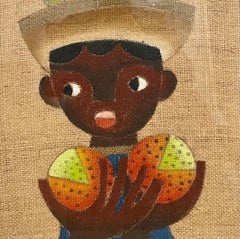
Mexican Boy with Bird
Located in Surfside, FL
The sweetness that characterizes the work of Mexican painter Jose Maria de Servin (1917-83) is a melancholy and placid one. While he worked in the most modern of styles, he adapted i...
Category
20th Century Burlap Figurative Paintings
Materials
Burlap, Oil
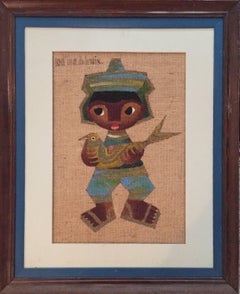
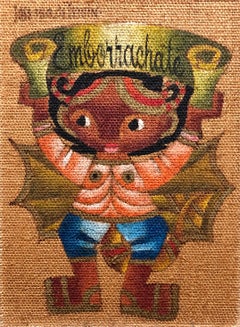
Folk Art Mexican Girl "Emborrachate" Oil Painting on Burlap
Located in Surfside, FL
The sweetness that characterizes the work of Mexican painter Jose Maria de Servin (1917-83) is a melancholy and placid one. While he worked in the most modern of styles, he adapted i...
Category
Mid-20th Century Folk Art Burlap Figurative Paintings
Materials
Burlap, Oil
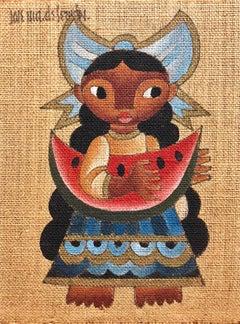
Folk Art Mexican Girl with Watermelon Oil Painting on Burlap
Located in Surfside, FL
The sweetness that characterizes the work of Mexican painter Jose Maria de Servin (1917-83) is a melancholy and placid one. While he worked in the most modern of styles, he adapted i...
Category
Mid-20th Century Folk Art Burlap Figurative Paintings
Materials
Burlap, Oil
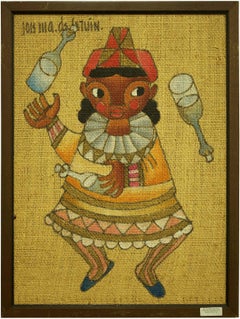
Folk Art Mexican Girl, Circus Clown Juggler
Located in Surfside, FL
The sweetness that characterizes the work of Mexican painter Jose Maria de Servin (1917-83) is a melancholy and placid one. While he worked in the most modern of styles, he adapted i...
Category
Mid-20th Century Folk Art Burlap Figurative Paintings
Materials
Burlap, Oil
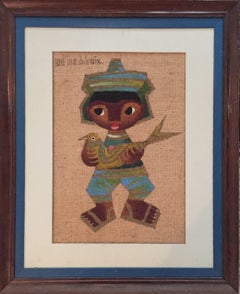
Mexican Boy with Bird
Located in Surfside, FL
The sweetness that characterizes the work of Mexican painter Jose Maria de Servin (1917-83) is a melancholy and placid one. While he worked in the most modern of styles, he adapted i...
Category
20th Century Burlap Figurative Paintings
Materials
Burlap, Oil
Burlap figurative paintings for sale on 1stDibs.
Find a wide variety of authentic Burlap figurative paintings available on 1stDibs. While artists have worked in this medium across a range of time periods, art made with this material during the 21st Century is especially popular. If you’re looking to add figurative paintings created with this material to introduce a provocative pop of color and texture to an otherwise neutral space in your home, the works available on 1stDibs include elements of purple, blue, red and other colors. There are many well-known artists whose body of work includes ceramic sculptures. Popular artists on 1stDibs associated with pieces like this include Ernesto Gutierrez (b.1941), Jose Maria de Servin, Peter Hoffer, and Edward Marecak. Frequently made by artists working in the Contemporary, Abstract, all of these pieces for sale are unique and many will draw the attention of guests in your home. Not every interior allows for large Burlap figurative paintings, so small editions measuring 0.1 inches across are also available