Wood Panel Interior Paintings
to
13
52
27
25
11
16
Overall Width
to
Overall Height
to
3
19
17
92
1
1
4
1
3
1
37
17
10
8
6
4
3
2
2
1
1
57
56
18
54
33
20
16
14
12
10
9
7
6
5
4
4
4
4
4
4
4
4
3
5,350
7,675
5,088
4,021
3,868
7
6
5
5
4
68
13
89
39
Medium: Wood Panel
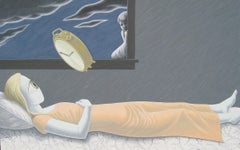
Watching, Original Contemporary Surrealist Gouache Painting on Wood Panel
By Megan Frazer
Located in Boston, MA
Watching, Original Contemporary Surrealist Painting, 2014
11.25" x 18" x 1.625" (HxWxD) Gouache on Wood Panel
This surreal gouache painting features a woman laying on top of her bed...
Category
21st Century and Contemporary Surrealist Wood Panel Interior Paintings
Materials
Gouache, Wood Panel
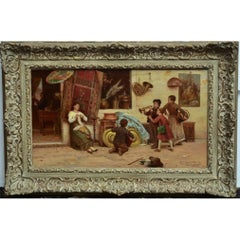
The Musical Performance oil on panel by Antonio Ermolao Paoletti
Located in New York, NY
The Musical Performance by Antonio Ermolao Paoletti
An italian genre painting showcasing two boys playing a trumpet and a guitar for their sist...
Category
19th Century Academic Wood Panel Interior Paintings
Materials
Oil, Wood Panel, Board
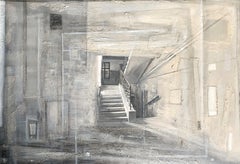
Interior - Stairs 1
Located in Milano, MI
Urbex is the English acronym for urban exploration and is an activity that consists of searching for and locating abandoned infrastructure with the goal of visiting, photographing an...
Category
2010s Contemporary Wood Panel Interior Paintings
Materials
Sandstone
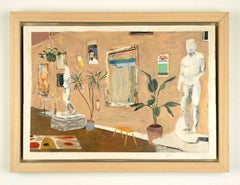
Interior Life (From Tokyo to Berlin) small interior painting Beige neutral
By Matthew Cole
Located in Cody, WY
This is a beautiful small painting on wood panel in artist frame. Cole’s work, From Tokyo to Berlin, is the culmination of three years of travel (from 2015 to 2018) both east and we...
Category
2010s Contemporary Wood Panel Interior Paintings
Materials
Acrylic, Wood Panel

$2,880 Sale Price
20% Off
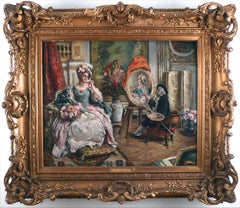
"The Painter and his Model", 19th C. Oil on Mahogany Wood Panel by E. L. Garrido
Located in Madrid, ES
EDUARDO LEÓN GARRIDO
Spanish, 1856- 1949
THE PAINTER AND HIS MODEL
signed "E. L Garrido" (lower right)
oil on mahogany wood panel
19-3/4 x 24-1/8 inches (50 x 61 cm.)
framed: 28-1/2 x 32-3/4 inches (72 x 83 cm.)
PROVENANCE
Private Spanish Collector
Eduardo León Garrido (Madrid, 1856 - Caen, 1949) was a Spanish painter. He began his training at the Higher School of Painting in Madrid and as a disciple in Vicente Palmaroli...
Category
Early 1900s Realist Wood Panel Interior Paintings
Materials
Oil, Wood Panel
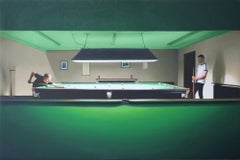
Color of Money
By Max Ferguson
Located in Greenwich, CT
Born in New York City in 1959, Max Ferguson started as a filmmaker, making
award-winning animated films as a teenager. But it was while he was a visiting
student at an art school in ...
Category
2010s Photorealist Wood Panel Interior Paintings
Materials
Oil, Wood Panel
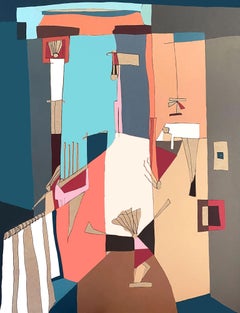
"Hide
Seek" Painting 53" x 39" inch by Tasneem El-Meshad
Located in Culver City, CA
"Hide
Seek" Painting 53" x 39" inch by Tasneem El-Meshad
Medium: acrylic on wood
Academy of Fine Arts Cairo graduate Tasneem El Meshad describes her art, as “a reflection of ...
Category
21st Century and Contemporary Cubist Wood Panel Interior Paintings
Materials
Oil, Acrylic, Wood Panel
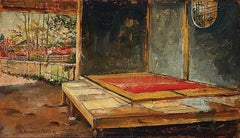
Interior of a Japanese House
Located in New York, NY
Harry Humphrey Moore led a cosmopolitan lifestyle, dividing his time between Europe, New York City, and California. This globe-trotting painter was also active in Morocco, and most importantly, he was among the first generation of American artists to live and work in Japan, where he depicted temples, tombs, gardens, merchants, children, and Geisha girls. Praised by fellow painters such as Thomas Eakins, John Singer Sargent, and Jean-Léon Gérôme, Moore’s fame was attributed to his exotic subject matter, as well as to the “brilliant coloring, delicate brush work [sic] and the always present depth of feeling” that characterized his work (Eugene A. Hajdel, Harry H. Moore, American 19th Century: Collection of Information on Harry Humphrey Moore, 19th Century Artist, Based on His Scrap Book and Other Data [Jersey City, New Jersey: privately published, 1950], p. 8).
Born in New York City, Moore was the son of Captain George Humphrey, an affluent shipbuilder, and a descendant of the English painter, Ozias Humphrey (1742–1810). He became deaf at age three, and later went to special schools where he learned lip-reading and sign language. After developing an interest in art as a young boy, Moore studied painting with the portraitist Samuel Waugh in Philadelphia, where he met and became friendly with Eakins. He also received instruction from the painter Louis Bail in New Haven, Connecticut. In 1864, Moore attended classes at the Mark Hopkins Institute in San Francisco, and until 1907, he would visit the “City by the Bay” regularly.
In 1865, Moore went to Europe, spending time in Munich before traveling to Paris, where, in October 1866, he resumed his formal training in Gérôme’s atelier, drawing inspiration from his teacher’s emphasis on authentic detail and his taste for picturesque genre subjects. There, Moore worked alongside Eakins, who had mastered sign language in order to communicate with his friend. In March 1867, Moore enrolled at the prestigious École des Beaux-Arts, honing his drawing skills under the tutelage of Adolphe Yvon, among other leading French painters.
In December 1869, Moore traveled around Spain with Eakins and the Philadelphia engraver, William Sartain. In 1870, he went to Madrid, where he met the Spanish painters Mariano Fortuny and Martin Rico y Ortega. When Eakins and Sartain returned to Paris, Moore remained in Spain, painting depictions of Moorish life in cities such as Segovia and Granada and fraternizing with upper-crust society. In 1872, he married Isabella de Cistue, the well-connected daughter of Colonel Cistue of Saragossa, who was related to the Queen of Spain. For the next two-and-a-half years, the couple lived in Morocco, where Moore painted portraits, interiors, and streetscapes, often accompanied by an armed guard (courtesy of the Grand Sharif) when painting outdoors. (For this aspect of Moore’s oeuvre, see Gerald M. Ackerman, American Orientalists [Courbevoie, France: ACR Édition, 1994], pp. 135–39.) In 1873, he went to Rome, spending two years studying with Fortuny, whose lively technique, bright palette, and penchant for small-format genre scenes made a lasting impression on him. By this point in his career, Moore had emerged as a “rapid workman” who could “finish a picture of given size and containing a given subject quicker than most painters whose style is more simple and less exacting” (New York Times, as quoted in Hajdel, p. 23).
In 1874, Moore settled in New York City, maintaining a studio on East 14th Street, where he would remain until 1880. During these years, he participated intermittently in the annuals of the National Academy of Design in New York and the Pennsylvania Academy of the Fine Arts in Philadelphia, exhibiting Moorish subjects and views of Spain. A well-known figure in Bay Area art circles, Moore had a one-man show at the Snow & May Gallery in San Francisco in 1877, and a solo exhibition at the Bohemian Club, also in San Francisco, in 1880. Indeed, Moore fraternized with many members of the city’s cultural elite, including Katherine Birdsall Johnson (1834–1893), a philanthropist and art collector who owned The Captive (current location unknown), one of his Orientalist subjects. (Johnson’s ownership of The Captive was reported in L. K., “A Popular Paris Artist,” New York Times, July 23, 1893.) According to one contemporary account, Johnson invited Moore and his wife to accompany her on a trip to Japan in 1880 and they readily accepted. (For Johnson’s connection to Moore’s visit to Japan, see Emma Willard and Her Pupils; or, Fifty Years of Troy Female Seminary [New York: Mrs. Russell Sage, 1898]. Johnson’s bond with the Moores was obviously strong, evidenced by the fact that she left them $25,000.00 in her will, which was published in the San Francisco Call on December 10, 1893.) That Moore would be receptive to making the arduous voyage across the Pacific is understandable in view of his penchant for foreign motifs. Having opened its doors to trade with the West in 1854, and in the wake of Japan’s presence at the Philadelphia Centennial Exposition of 1876, American artists were becoming increasingly fascinated by what one commentator referred to as that “ideal dreamland of the poet” (L. K., “A Popular Paris Artist”).
Moore, who was in Japan during 1880–81, became one of the first American artists to travel to the “land of the rising sun,” preceded only by the illustrator, William Heime, who went there in 1851 in conjunction with the Japanese expedition of Commodore Matthew C. Perry; Edward Kern, a topographical artist and explorer who mapped the Japanese coast in 1855; and the Boston landscapist, Winckleworth Allan Gay, a resident of Japan from 1877 to 1880. More specifically, as William H. Gerdts has pointed out, Moore was the “first American painter to seriously address the appearance and mores of the Japanese people” (William H. Gerdts, American Artists in Japan, 1859–1925, exhib. cat. [New York: Hollis Taggart Galleries, 1996], p. 5).
During his sojourn in Nippon (which means, “The Land of the Rising Sun”), Moore spent time in locales such as Tokyo, Yokohama, Kyoto, Nikko, and Osaka, carefully observing the local citizenry, their manners and mode of dress, and the country’s distinctive architecture. Working on easily portable panels, he created about sixty scenes of daily life, among them this depiction of an interior of a dwelling. The location of the view is unknown, but the presence of a rustic rail fence demarcating a yard bordering a distant house flanked by tall trees, shrubs and some blossoming fruit trees, suggests that the work likely portrays a building in a city suburb or a small village.
In his book, Japanese Homes and Their Surroundings, Edward S. Morse (an American zoologist, orientalist, and “japanophile” who taught at Tokyo Imperial University from 1877 to 1879, and visited Japan again in 1891 and 1882) noted the “openness and accessibility of the Japanese house...
Category
Late 19th Century Wood Panel Interior Paintings
Materials
Oil, Wood Panel
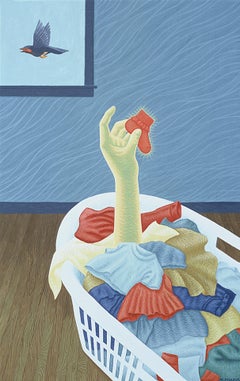
Found It, Original Signed Contemporary Satirical Surrealist Painting on Panel
By Megan Frazer
Located in Boston, MA
Found It, Original Signed Contemporary Satirical Surrealist Painting, 2014
18" x 11" x 1.625" Gouache on Wood Panel
Hand-signed by the artist.
When socks go missing, this disarticulated human arm can find them! In this dream-like surrealistic painting by artist Megan Frazer a laundry basket full of blue, red, and yellow clothing...
Category
21st Century and Contemporary Surrealist Wood Panel Interior Paintings
Materials
Gouache, Wood Panel
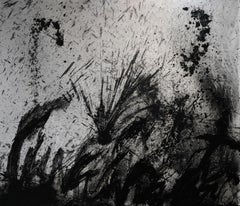
Subconscious N0796.17
Located in New York, NY
A black and white painting by ink ad Acrylic on wood panel
Known for his erratic and expressive abstract works, Daniel Diaz-Tai uses various mixed media including sumi ink and oil ...
Category
2010s Abstract Wood Panel Interior Paintings
Materials
Oil, Wood Panel, Ink, Sumi Ink, Acrylic
Price Upon Request
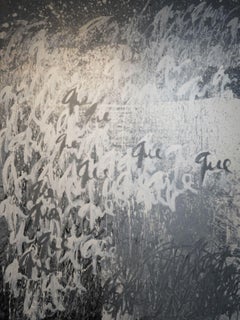
Subconscious N0507.16
Located in New York, NY
A painting on wood panel, 96x72".
Known for his erratic and expressive abstract works, Daniel Diaz-Tai uses various mixed media including sumi ink and...
Category
2010s Abstract Wood Panel Interior Paintings
Materials
Oil, Wood Panel, Ink, Sumi Ink
Price Upon Request
Wood Panel interior paintings for sale on 1stDibs.
Find a wide variety of authentic Wood Panel interior paintings available on 1stDibs. While artists have worked in this medium across a range of time periods, art made with this material during the 21st Century is especially popular. There are many well-known artists whose body of work includes ceramic sculptures. Popular artists on 1stDibs associated with pieces like this include James Zamora, Max Ferguson, and Barbara Vanhove. Frequently made by artists working in the Contemporary, Photorealist, all of these pieces for sale are unique and many will draw the attention of guests in your home. Not every interior allows for large Wood Panel interior paintings, so small editions measuring 6 inches across are also available Prices for interior paintings made by famous or emerging artists can differ depending on medium, time period and other attributes. On 1stDibs, the price for these items starts at $200 and tops out at $82,500, while the average work can sell for $3,775.