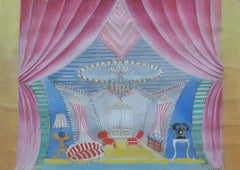
Late 19th Century Interior Paintings
to
34
40
27
44
22
20
Overall Width
to
Overall Height
to
78
369
2,043
5,422
41
44
64
110
91
109
151
151
137
110
42
18
3
3
1
1
1
88
64
1
108
81
39
38
24
13
11
10
8
7
7
7
7
6
6
6
6
6
6
5
152
144
65
64
19
2
2
1
1
1
119
8
98
55
Period: Late 19th Century
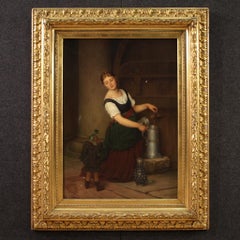
19th Century Oil on Canvas Signed G. Spangerberg Interior Scene Painting, 1886
Located in Vicoforte, IT
A refined 19th-century interior scene. Oil on canvas, first canvas, painting signed G. Spangerberg lower right and dated 1886, attributed to the German painter Gustav Adolf Spangenbe...
Category
Late 19th Century Interior Paintings
Materials
Canvas, Oil
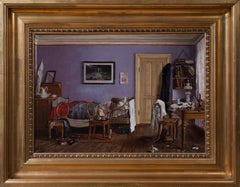
Interior with Reclining Reader, late 1800s
Located in Stockholm, SE
Rasmus Aagaard Christiansen was a Danish painter whose work spans genre scenes, interiors, portraits and cityscapes.He was academically trained at the Royal Danish Academy of Fine Ar...
Category
Realist Late 19th Century Interior Paintings
Materials
Canvas, Oil
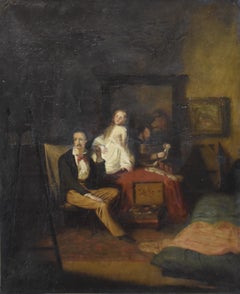
P Deltour (?), An artist and his models in the workshop, 1879, oil on canvas
Located in Paris, FR
P Deltour (?) French school of the 19th century
The artist with his model and friend in his workshop
Oil on canvas
Signed "P Deltour" (?) and dated 1879 on the lower, an indistinct i...
Category
Romantic Late 19th Century Interior Paintings
Materials
Oil

$1,044 Sale Price
30% Off
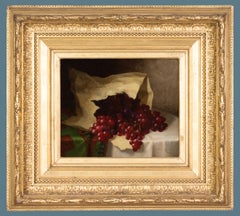
Still Life with Grapes
Located in Philadelphia, PA
Morston Constantine Ream
(American, 1840-1898)
Grapes
Oil on canvas, 10 x 12 inches
Framed: 22 x 24 inches (approx.)
Signed at lower right: “Morston Ream”
The still-life painter Mor...
Category
Realist Late 19th Century Interior Paintings
Materials
Canvas, Oil
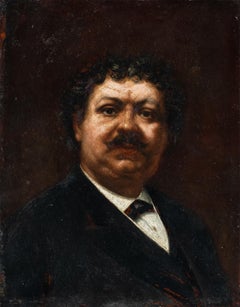
French painter - 19th century portrait of writer Alexandre Dumas
Located in Varmo, IT
French painter (19th century) - Portrait of Alexandre Dumas (Villers-Cotterêts 1802 - Neuville-lès-Dieppe 1870).
24.5 x 19 cm.
Oil on panel, unframed (not signed).
Condition repor...
Category
Realist Late 19th Century Interior Paintings
Materials
Canvas, Oil
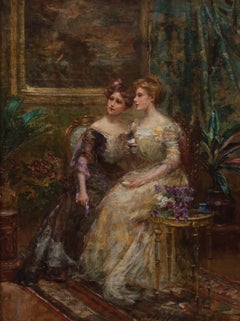
Victorian Ladies, by female artist Letitia Bonnet Hart
By Letitia Bonnet Hart
Located in Philadelphia, PA
Letitia Bonnet Hart
(American, 1867-1953)
Victorian Ladies
Oil on canvas, 21 x 16 1/4 inches
FRAMED: 28 x 23 inches (approx.)
Signed at lower right: "Letitia B. Hart"
Label on stretcher: "Marbella Gallery, New York"
Daughter of the Hudson River School painter James McDougal Hart, Letitia was born into an extended family of accomplished artists. After preliminary study with her father and mother, she attended the Brooklyn Academy of Design and the National Academy of Design. She began exhibiting at the age of eighteen, and continued to exhibit in Brooklyn, Philadelphia, Massachusetts, Louisiana Purchase Exhibition, and the 1893 World’s Columbian Exposition...
Category
Victorian Late 19th Century Interior Paintings
Materials
Canvas, Oil
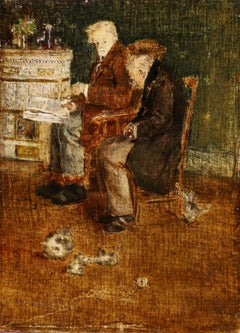
Deux vieillards aux chatons - Impressionist Figurative Oil by J F Raffaelli
Located in Marlow, Buckinghamshire
Signed figures in interior oil on panel by French impressionist painter Jean-Francois Raffaelli. The piece depicts two old men seated in an interior. One is reading his paper as the other naps and there are several kittens on the floor. Painted in the artist's distinctive style.
Signature:
Signed lower left
Dimensions:
Framed: 9.5"x8"
Unframed: 5.5"x4"
Provenance:
Brame & Lorenceau have confirmed the authenticity of this work and it will be included in the digital catalogue raisonne of the painter which is under preparation
A certificate of authenticity fromBrame & Lorenceau accompanies this painting
Private collection - United States
Original artists label verso
Jean-François Raffaëlli's father was a failed Italian businessman and Raffaëlli himself was, among other things, a church chorister, actor and theatre singer. He then studied under Gérôme at the École des Beaux-Arts in Paris. He travelled to Italy, Spain and Algeria and on his return to France settled in Asnières.
In 1876, on a trip to Brittany, he first saw the potential of realist subject matter, if treated seriously. He became involved in meetings of artists at the Café Guerbois, where the Impressionist painters used to gather. As a result, Degas, contrary to the advice of the group, introduced Raffaëlli to the Impressionist exhibitions - according to one uncertain source as early as the very first exhibition, at the home of Nadar, and certainly to those of 1880 and 1881.
In 1904, Raffaëlli founded the Society for Original Colour Engraving. He first exhibited at the Salon de Paris in 1870 and continued to exhibit there until he joined the Salon des Artistes Français in 1881, where he earned a commendation in 1885, was made Chevalier of the Légion d'Honneur in 1889 and in the same year was awarded a gold medal at the Exposition Universelle. In 1906 he was made Officier of the Légion d'Honneur. He was also a member of the Société Nationale des Beaux-Arts. In 1884, a private exhibition of his work cemented his reputation.
He contributed to several newspapers such as The Black Cat (Le Chat Noir) in 1885 and The French Mail (Le Courrier Français) in 1886 and 1887. He published a collection entitled Parisian Characters, which captured his favourite themes of the street, the neighbourhood and local people going about their lives. In 1880 he participated, with Forain, on the illustration of Joris Karl Huysmans' Parisian Sketches (Croquis Parisiens). He also illustrated Huysman's Works. As well as working as an illustrator, he also made etchings and coloured dry-points.
His early attempts at painting were genre scenes, but once he was settled in Asnières he started to paint picturesque views of Parisian suburbs. From 1879 onwards, his subject matter drew on the lives of local people. These popular themes, which he treated with humanity and a social conscience, brought him to the attention of the social realist writers of the time such as Émile Zola. In addition to his realist style, Raffaëlli's dark palette, which ran contrary to the Impressionist aesthethic, helped to explain the opposition of those painters to his participation in their exhibitions. More concerned with drawing than colour, he used black and white for most of his paintings. Towards the end of his life, he lightened his palette, but without adopting any other principles of the Impressionist technique.
After painting several portraits, including Edmond de Goncourt and Georges Clémenceau, he returned to genre painting, particularly scenes of bourgeois life. Later in his career, he painted mainly Breton-inspired sailors and views of Venice. His views of the Paris slums and the fortifications, sites which have almost completely disappeared, went some way towards establishing a genre in themselves and perpetuated the memory of the area: The Slums, Rag-and-Bone Man, Vagabond, Sandpit, In St-Denis, Area of Fortifications. His realistic and witty portrayal of typical Parisian townscapes accounts for his enduring appeal.
Born in Paris, he was of Tuscan descent through his paternal grandparents. He showed an interest in music and theatre before becoming a painter in 1870. One of his landscape paintings was accepted for exhibition at the Salon in that same year. In October 1871 he began three months of study under Jean-Léon Gérôme at the École des Beaux-Arts in Paris; he had no other formal training.
Raffaëlli produced primarily costume pictures until 1876, when he began to depict the people of his time—particularly peasants, workers, and ragpickers seen in the suburbs of Paris—in a realistic style. His new work was championed by influential critics such as J.-K. Huysmans, as well as by Edgar Degas.
The ragpicker became for Raffaëlli a symbol of the alienation of the individual in modern society. Art historian Barbara S. Fields has written of Raffaëlli's interest in the positivist philosophy of Hippolyte-Adolphe Taine, which led him to articulate a theory of realism that he christened caractérisme. He hoped to set himself apart from those unthinking, so-called realist artists whose art provided the viewer with only a literal depiction of nature. His careful observation of man in his milieu paralleled the anti-aesthetic, anti-romantic approach of the literary Naturalists, such as Zola and Huysmans.
Degas invited Raffaëlli to participate in the Impressionist exhibitions of 1880 and 1881, an action that bitterly divided the group; not only was Raffaëlli not an Impressionist, but he threatened to dominate the 1880 exhibition with his outsized display of 37 works. Monet, resentful of Degas's insistence on expanding the Impressionist exhibitions by including several realists, chose not to exhibit, complaining, "The little chapel has become a commonplace school which opens its doors to the first dauber to come along."An example of Raffaëlli's work from this period is Les buveurs d'absinthe (1881, in the California Palace of Legion of Honor Art Museum in San Francisco). Originally titled Les déclassés, the painting was widely praised at the 1881 exhibit.
After winning the Légion d'honneur in 1889, Raffaëlli shifted his attention from the suburbs of Paris to city itself, and the street scenes that resulted were well received by the public and the critics. He made a number of sculptures, but these are known today only through photographs.[2] His work was also part of the painting event in the art competition at the 1912 Summer Olympics. In the later years of his life, he concentrated on color printmaking. Raffaëlli died in Paris on February 11, 1924
Museum and Gallery Holdings:
Béziers: Peasants Going to Town
Bordeaux: Bohemians at a Café
Boston: Notre-Dame; Return from the Market
Brussels: Chevet of Notre-Dame; pastel
Bucharest (Muz. National de Arta al României): Market at Antibes; Pied-à-terre
Copenhagen: Fishermen on the Beach
Douai: Return from the Market; Blacksmiths
Liège: Absinthe Drinker...
Category
Impressionist Late 19th Century Interior Paintings
Materials
Oil, Panel
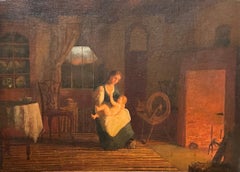
Interior scene - Woman and child
Located in PARIS, FR
François Bonvin (1817 - 1887)
Interior scene - Woman and child
1871
Signed, dated and located lower right (London)
Oil on canvas
48,2 x 33,2 cm (63 x 48 cm with frame)
Category
Late 19th Century Interior Paintings
Materials
Canvas, Oil
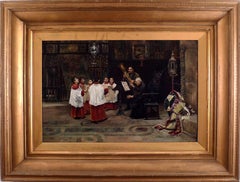
"Coro de monaguillos ensayando", 19th Century Oil on Wood Panel by José Gallegos
By José Gallegos y Arnosa
Located in Madrid, ES
JOSÉ GALLEGOS Y ARNOSA
Spanish, 1857 - 1917
CORO DE MONAGUILLOS ENSAYANDO
signed, located and dated "JGallegos / Roma 1883" (lower right)
oil on...
Category
Realist Late 19th Century Interior Paintings
Materials
Oil, Wood Panel
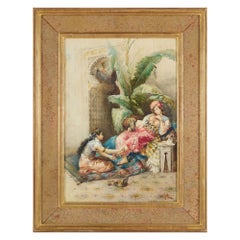
Orientalist Watercolour Woman Maid Interior Giovanni Raggi Italian 19th Century
Located in London, GB
Orientalist Watercolour Woman Maid Interior Giovanni Raggi Italian 19th Century
Italian, Late 19th Century
Paper: Height 55cm, width 37cm
Frame: Height 75cm, width 57.5cm, depth 3cm
...
Category
Late 19th Century Interior Paintings
Materials
Paper, Watercolor
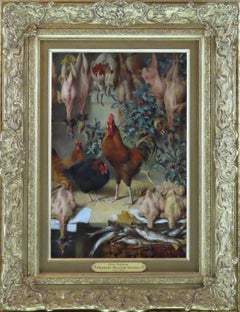
Original Oil on Board, Herbert William Weekes. "Eheu Fougaces"
Located in Mere, GB
Herbert William Weekes 1841 - 1919.
Animal painter from Pimlico in London, the son of the sculptor and Royal Academician Henry Weekes. He exhibited at the Royal Academy, Royal Societ...
Category
Late 19th Century Interior Paintings
Materials
Oil
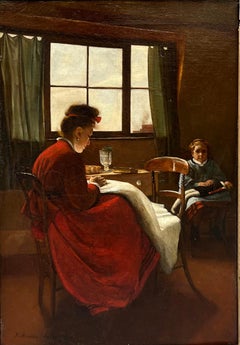
"A Quiet Afternoon" Enoch Wood Perry, Genre Scene Mother and Child Interior
By Enoch Wood Perry Jr.
Located in New York, NY
Enoch Wood Perry, Jr. (1831 - 1915)
A Quiet Afternoon, 1876
Oil on canvas
15 1/4 x 21 inches
Signed and dated lower right
Born in 1831 in Boston, Enoch Wood Perry, Jr, is internati...
Category
Hudson River School Late 19th Century Interior Paintings
Materials
Canvas, Oil
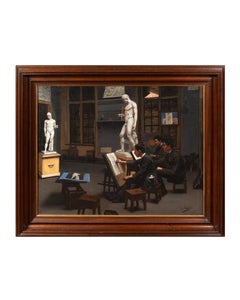
Drawing class at the Académie Julian
Located in PARIS, FR
Drawing class at the Académie Julian
1888
Oil on canvas
80 x 99.5 cm
(102.6 x 122 cm with frame)
Signed and dated lower right
Category
Late 19th Century Interior Paintings
Materials
Canvas, Oil
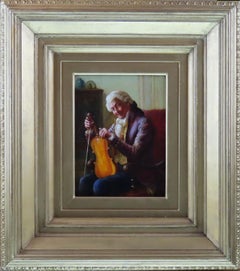
Original Oil on Panel. Alfred John Bouchette, "The Violinist"
Located in Mere, GB
Alfred John Bouchette, 1844 - 1893
A London painter of figurative subjects and portraits. He exhibited with the Royal Society of British Artists in London, the Manchester City Art Ga...
Category
Late 19th Century Interior Paintings
Materials
Oil
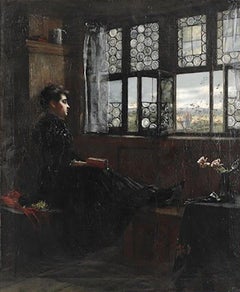
Interior Scene of a Woman in Black Gazing Out a Window
By William Verplank Birney
Located in Fort Washington, PA
An elegantly dressed woman sits gazing out of a window with a book on her lap. A fine example of the type of contemplative genre scenes for which Birney was well-known.
William Verp...
Category
Late 19th Century Interior Paintings
Materials
Canvas, Oil
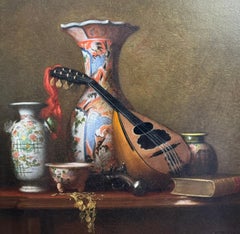
1879 MUSEUM EXHIBITED American CHINOSERIE Still Life w/ Asian Vases and Mandolin
Located in New York, NY
Robert Monell Pratt (1811-1880) was a Rare New
york Artist whose artworks were commissioned by
wealthy merchants and Exhibited in museums
The current work was deaccessioned from the...
Category
American Realist Late 19th Century Interior Paintings
Materials
Oil
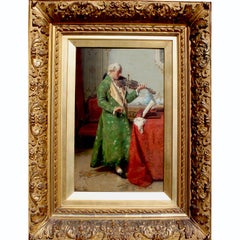
A Very Fine Italian Oil on Canvas Titled "The Solo Violinist or Violin Teacher "
Located in LA, CA
A very fine Italian oil on canvas titled "The Solo Violinist" by Luigi Da Rios (Italian, 1844-1892), depicting an interior 18th century room scene of a single violinist player; withi...
Category
Academic Late 19th Century Interior Paintings
Materials
Gesso, Canvas, Wood, Oil
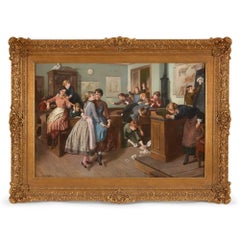
Austrian genre painting of children in a classroom by Rudolf Geyling
By Rudolf Geyling
Located in London, GB
Austrian genre painting of children in a classroom by Rudolf Geyling
Austrian, late 19th Century
Frame: Height 94cm, width 126cm, depth 8cm
Canvas: Height 75cm, width 101cm, depth 2c...
Category
Late 19th Century Interior Paintings
Materials
Canvas, Oil
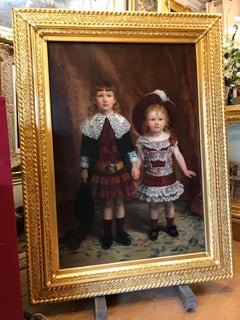
Edgard CUGNOTET - Painting 19th Century - Portrait of Two Children
By Edouard Ferdinand Ludovic Cugnotet
Located in Saint-Ouen, FR
CUGNOTET Edgard (19th Century)
Portrait of two Children
Oil on canvas signed low left and dated 1884
Frame gilded with leaves
Dim canvas : 138 X 100 cm
Dim Frame : 162 X 122 cm
CUGNOTET Edgard Ferdinand Ludovic (19th Century)
French painter 19th Century born in Dijon
Figures, Portraits, Landscapes
He was taught by François Édouard PICOT (1786-1868) royal Academy of Anvers.
He exhibited at the Salon de Paris between 1868 and 1884.
Museum : Langres « the hurdy gurdy...
Category
Academic Late 19th Century Interior Paintings
Materials
Oil
"Playing hide and seek", 19th Century Oil on Panel by Vicente Palmaroli, Spanish
Located in Madrid, ES
VICNTE PALMAROLI y GONZÁLEZ
Spanish, 1834 - 1896
PLAYING HIDE AND SEEK
signed "V. Palmaroli" (lower right)
oil on mahogany panel
17-3/4 x 13-1/2 inches (45 X 34 cm.)
framed: 25-1/4 X 21-1/4 inches (64 X 53.7 cm.)
PROVENANCE
Leslie Hindman Inc., Auctionners
Private Collector, Madrid
Oil on table by Vicente Palmaroli...
Category
Romantic Late 19th Century Interior Paintings
Materials
Oil, Wood Panel
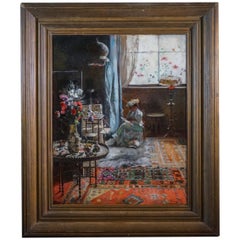
Lady in White Hat In A Moorish Japonais Interior Reading
By Friedrich Fehr
Located in New York, NY
Friedrich Fehr (1862-1927) Antique Impressionist Painting of a High Society Lady in White Hat, reading In a Moorish Japonais Interior. Painting is very well done with Persian carpets...
Category
Impressionist Late 19th Century Interior Paintings
Materials
Oil
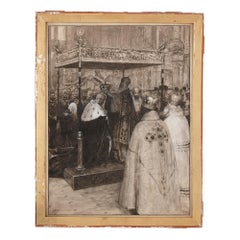
Russian watercolour of the coronation of a Tsar
Located in London, GB
Russian watercolour of the coronation of a Tsar
Russian, late 19th Century
Frame: Height 39cm, width 30cm, depth 0.5cm
Sheet: Height 36cm, width 2...
Category
Late 19th Century Interior Paintings
Materials
Watercolor
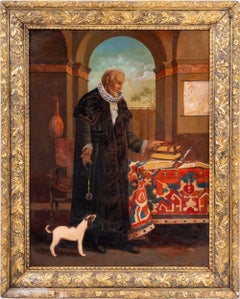
Italian School, "The Antiquarian"
Located in Astoria, NY
Italian School, "The Antiquarian", Oil on Canvas, late 19th century, depicting a gentleman standing at a table covered with a carpet, books, his dog and a small mouse underfoot, unsi...
Category
Italian School Late 19th Century Interior Paintings
Materials
Canvas, Oil
Reception at the Salon
Located in Saint-Ouen, FR
STEVENS Agapit (1848 – 1924)
Reception at the Salon
Oil on wood signed low left
New Golden Frame
Dim wood panel : 24 X 39 cm
Dim Frame : 49 X 63 cm
STEVENS Agapit (1848 – 1924)
Be...
Category
Academic Late 19th Century Interior Paintings
Materials
Oil
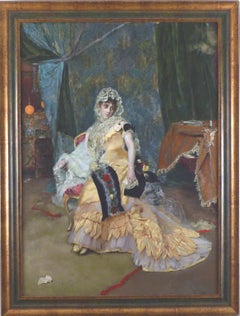
"Lady in yellow", 19th Century oil on panel by Rogelio de Egusquiza y Barrena
Located in Madrid, ES
ROGELIO DE EGUSQUIZA Y BARRENA
LADY IN YELLOW
signed "R. Egusquiza" (lower right)
oil on panel
28-5/8 X 20-3/4 inches (72.5 X 52.7 cm.)
framed: 32-5/8 X 24-3/4 inches (82.5 X 62.5 cm.)
Rogelio de Egusquiza y Barrena (1845 – 10 February 1915) was a Spanish painter, known for his friendship with the German composer Richard Wagner, whose works he helped make familiar in Spain
He was born in El Astillero, into a well-to-do family. He studied in Madrid and with Léon Bonnat at the École des Beaux-Arts in Paris. In 1868, after travelling and participating several times in the National Exhibition of Fine Arts, he returned to Paris and settled there. At first, he painted historical scenes, but later turned to genre scenes and portraits in the Academic style.
Following the death of Marià Fortuny, he moved to Rome at the invitation of the Madrazos, Raimundo and Ricardo, taking Fortuny's place at their studio through 1875 and attending classes at the Spanish Academy in Rome.
He heard Wagner's music for the first time in 1876, after returning to Paris. Three years later, he travelled to Munich to hear a performance of The Ring of the Nibelungen. His enthusiasm for what he heard led him to go to Bayreuth, where he introduced himself to Wagner and became his friend. In the following years, he and Wagner got together again several times; in Venice (1880), Berlín (1881) and Bayreuth (1882); where he was a guest at the premiere of Parsifal.
After his first meeting with Wagner, he decided to devote his career to doing works on Wagnerian themes; mostly portraits of the characters rather than specific scenes. During his visits to Germany, he also created portraits of Arthur Schopenhauer (posthumous) and King Ludwig II...
Category
Realist Late 19th Century Interior Paintings
Materials
Oil, Panel
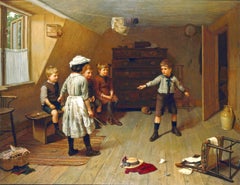
Pretending (The Great Performance)
Located in Mc Lean, VA
Signed and dated '1890' lower right
Category
Academic Late 19th Century Interior Paintings
Materials
Oil
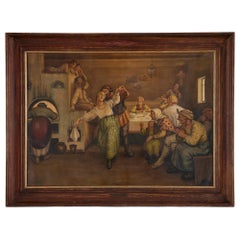
Watercolour painting of Russian peasants feasting by Teikh
Located in London, GB
Watercolour painting of Russian peasants feasting by Teikh
Russian, 1872
Frame: Height 92cm, width 122cm, depth 6cm
Sheet: Height 76cm, width 107cm
This fine watercolour painting is...
Category
Late 19th Century Interior Paintings
Materials
Watercolor
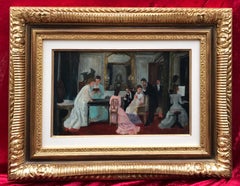
Portrait at the Painter
s workshop
Located in Saint-Ouen, FR
Francesco Brunery (1849–1926)
Portrait at the Artist's Workshop
Oil on wood panel
Old frame gilded with leaves
Dim panel : 30 X 24 cm
Dim frame : 54 X 46 cm
Francesco Brunery (1849...
Category
Academic Late 19th Century Interior Paintings
Materials
Oil
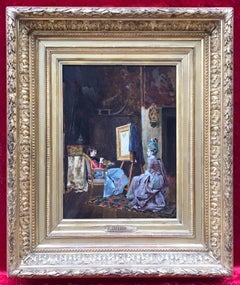
Interior of a Japanese House
Located in New York, NY
Harry Humphrey Moore led a cosmopolitan lifestyle, dividing his time between Europe, New York City, and California. This globe-trotting painter was also active in Morocco, and most importantly, he was among the first generation of American artists to live and work in Japan, where he depicted temples, tombs, gardens, merchants, children, and Geisha girls. Praised by fellow painters such as Thomas Eakins, John Singer Sargent, and Jean-Léon Gérôme, Moore’s fame was attributed to his exotic subject matter, as well as to the “brilliant coloring, delicate brush work [sic] and the always present depth of feeling” that characterized his work (Eugene A. Hajdel, Harry H. Moore, American 19th Century: Collection of Information on Harry Humphrey Moore, 19th Century Artist, Based on His Scrap Book and Other Data [Jersey City, New Jersey: privately published, 1950], p. 8).
Born in New York City, Moore was the son of Captain George Humphrey, an affluent shipbuilder, and a descendant of the English painter, Ozias Humphrey (1742–1810). He became deaf at age three, and later went to special schools where he learned lip-reading and sign language. After developing an interest in art as a young boy, Moore studied painting with the portraitist Samuel Waugh in Philadelphia, where he met and became friendly with Eakins. He also received instruction from the painter Louis Bail in New Haven, Connecticut. In 1864, Moore attended classes at the Mark Hopkins Institute in San Francisco, and until 1907, he would visit the “City by the Bay” regularly.
In 1865, Moore went to Europe, spending time in Munich before traveling to Paris, where, in October 1866, he resumed his formal training in Gérôme’s atelier, drawing inspiration from his teacher’s emphasis on authentic detail and his taste for picturesque genre subjects. There, Moore worked alongside Eakins, who had mastered sign language in order to communicate with his friend. In March 1867, Moore enrolled at the prestigious École des Beaux-Arts, honing his drawing skills under the tutelage of Adolphe Yvon, among other leading French painters.
In December 1869, Moore traveled around Spain with Eakins and the Philadelphia engraver, William Sartain. In 1870, he went to Madrid, where he met the Spanish painters Mariano Fortuny and Martin Rico y Ortega. When Eakins and Sartain returned to Paris, Moore remained in Spain, painting depictions of Moorish life in cities such as Segovia and Granada and fraternizing with upper-crust society. In 1872, he married Isabella de Cistue, the well-connected daughter of Colonel Cistue of Saragossa, who was related to the Queen of Spain. For the next two-and-a-half years, the couple lived in Morocco, where Moore painted portraits, interiors, and streetscapes, often accompanied by an armed guard (courtesy of the Grand Sharif) when painting outdoors. (For this aspect of Moore’s oeuvre, see Gerald M. Ackerman, American Orientalists [Courbevoie, France: ACR Édition, 1994], pp. 135–39.) In 1873, he went to Rome, spending two years studying with Fortuny, whose lively technique, bright palette, and penchant for small-format genre scenes made a lasting impression on him. By this point in his career, Moore had emerged as a “rapid workman” who could “finish a picture of given size and containing a given subject quicker than most painters whose style is more simple and less exacting” (New York Times, as quoted in Hajdel, p. 23).
In 1874, Moore settled in New York City, maintaining a studio on East 14th Street, where he would remain until 1880. During these years, he participated intermittently in the annuals of the National Academy of Design in New York and the Pennsylvania Academy of the Fine Arts in Philadelphia, exhibiting Moorish subjects and views of Spain. A well-known figure in Bay Area art circles, Moore had a one-man show at the Snow & May Gallery in San Francisco in 1877, and a solo exhibition at the Bohemian Club, also in San Francisco, in 1880. Indeed, Moore fraternized with many members of the city’s cultural elite, including Katherine Birdsall Johnson (1834–1893), a philanthropist and art collector who owned The Captive (current location unknown), one of his Orientalist subjects. (Johnson’s ownership of The Captive was reported in L. K., “A Popular Paris Artist,” New York Times, July 23, 1893.) According to one contemporary account, Johnson invited Moore and his wife to accompany her on a trip to Japan in 1880 and they readily accepted. (For Johnson’s connection to Moore’s visit to Japan, see Emma Willard and Her Pupils; or, Fifty Years of Troy Female Seminary [New York: Mrs. Russell Sage, 1898]. Johnson’s bond with the Moores was obviously strong, evidenced by the fact that she left them $25,000.00 in her will, which was published in the San Francisco Call on December 10, 1893.) That Moore would be receptive to making the arduous voyage across the Pacific is understandable in view of his penchant for foreign motifs. Having opened its doors to trade with the West in 1854, and in the wake of Japan’s presence at the Philadelphia Centennial Exposition of 1876, American artists were becoming increasingly fascinated by what one commentator referred to as that “ideal dreamland of the poet” (L. K., “A Popular Paris Artist”).
Moore, who was in Japan during 1880–81, became one of the first American artists to travel to the “land of the rising sun,” preceded only by the illustrator, William Heime, who went there in 1851 in conjunction with the Japanese expedition of Commodore Matthew C. Perry; Edward Kern, a topographical artist and explorer who mapped the Japanese coast in 1855; and the Boston landscapist, Winckleworth Allan Gay, a resident of Japan from 1877 to 1880. More specifically, as William H. Gerdts has pointed out, Moore was the “first American painter to seriously address the appearance and mores of the Japanese people” (William H. Gerdts, American Artists in Japan, 1859–1925, exhib. cat. [New York: Hollis Taggart Galleries, 1996], p. 5).
During his sojourn in Nippon (which means, “The Land of the Rising Sun”), Moore spent time in locales such as Tokyo, Yokohama, Kyoto, Nikko, and Osaka, carefully observing the local citizenry, their manners and mode of dress, and the country’s distinctive architecture. Working on easily portable panels, he created about sixty scenes of daily life, among them this depiction of an interior of a dwelling. The location of the view is unknown, but the presence of a rustic rail fence demarcating a yard bordering a distant house flanked by tall trees, shrubs and some blossoming fruit trees, suggests that the work likely portrays a building in a city suburb or a small village.
In his book, Japanese Homes and Their Surroundings, Edward S. Morse (an American zoologist, orientalist, and “japanophile” who taught at Tokyo Imperial University from 1877 to 1879, and visited Japan again in 1891 and 1882) noted the “openness and accessibility of the Japanese house...
Category
Late 19th Century Interior Paintings
Materials
Oil, Wood Panel
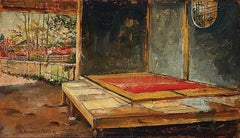
"The Mandolin Serenade", 19th Century Watercolour on Cardboard by Giménez Martín
Located in Madrid, ES
JUAN GIMÉNEZ MARTÍN
Spanish 1855 - 1901
THE MANDOLIN SERENADE
signed & located "Gimenez-Martin, Roma" lower left
watercolour on cardboard
21-1/4 x ...
Category
Realist Late 19th Century Interior Paintings
Materials
Watercolor, Cardboard
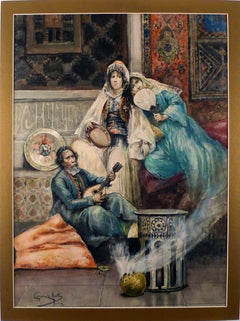
The Question to be Answered
Located in Saratoga Springs, NY
A beautiful 19th Century Northern European School genre, as a young gentleman poses a question to the young lady, as the father looks on. All is original and with the period frame. A...
Category
Realist Late 19th Century Interior Paintings
Materials
Canvas, Oil
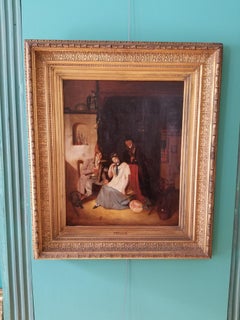
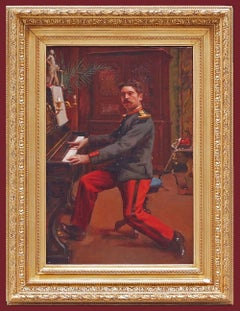
Jules TOULOT (1863-nc) Painting 19th century soldier uniform interior
By Toulot Jules
Located in Saint-Ouen, FR
Toulot Jules (1863-nc)
Pianist officer in the Second Empire period
Oil on canvas signed low right
Old frame regilded with gold leaves
Dim canvas : 65 X 43 cm
Dim frame : 90 X 67 cm
TOULOT Jules (1863-nc)
French painter 19th century
Born 11th November 1863 in Champeinx (Puy de Dôme...
Category
Academic Late 19th Century Interior Paintings
Materials
Oil
Theater Interior Design
Located in London, GB
SERGE FERAT 1881-1958
(Le Comte Sergueï Yastrebzov) Moscow 1881-1958 Paris (Russian/French)
Title: Theater Interior Design
Technique: Original Signed Gouache Painting on paper
siz...
Category
Cubist Late 19th Century Interior Paintings
Materials
Gouache