Masonite Paintings
to
1
6
7
Overall Width
to
Overall Height
to
14
1
9
1
14
11
3
8
6
6
2
2
1
1
1
1
1
1
16
16
14
14
1
16
43
36
24
19
14
Medium: Masonite
Artist: Michael Baxte
"Interior Scene with Figure" Expressionistic Style Oil Painting on Masonite
Located in New York, NY
A strong modernist oil painting depicted in 1969 by Russian painter Michael Baxte. Mostly known for his abstracted figures on canvas or street scenes, this piece is a wonderful representation of his bold still life paintings, with expressive use of color, shape, and form. Later in his career, Baxte explores Expressionism, infusing both European and North American stylistic trends. This piece is from later in his career, but we can feel this underlying style throughout.
Art measures 21.75 x 18 inches
Michael Posner Baxte was born in 1890 in the small town of Staroselje Belarus, Russia. For the first half of the 19th century it was a center of the Chabad movement of Hasidic Jews, but this group was gone by the middle of the 19th century. By the time the Baxte family immigrated to the United States at the beginning of the 20th century, the Jewish population numbered only on the hundreds. The native language of the Baxte family was Yiddish. It is likely that the death of Michael Baxte’s father triggered the family’s immigration. Three older brothers arrived in New York between 1903 and 1905. Michael and his mother, Rebecca, arrived in 1907. By 1910 Michael, his mother, and brother, Joseph, were living in New Orleans and may have spent some time on a Louisiana plantation. Around 1912, Michael Baxte returned to Europe to study the violin. In 1914 he, his mother, and Joseph moved to New York City.
Meanwhile, in Algeria, a talented young woman painter, Violette Mege, was making history. Since for the first time, a woman won the prestigious Beaux Art competition in Algeria. At first, the awards committee denied her the prize but, with French government intervention, Mege eventually prevailed. She won again 3 years later and, in 1916, used the scholarship to visit the United States of America. When Violette came to New York, she met Baxte, who was, by then, an accomplished violinist, teacher, and composer. Baxte’s compositions were performed at the Tokyo Imperial Theater, and in 1922 he was listed in the American Jewish Yearbook as one of the prominent members of the American Jewish community. As a music teacher he encouraged individual expression. Baxte stated, “No pupil should ever be forced into imitation of the teacher. Art is a personal experience, and the teacher’s truest aim must be to awaken this light of personality through the patient light of science.”
By 1920 Michael Baxte and Violette Mege were living together in Manhattan. Although they claimed to be living as husband and wife, it seems that their marriage did not become official until 1928. On their “unofficial” honeymoon around 1917, in Algiers, Baxte confided to her his ambition to paint. There and later in New Mexico where the wonderful steeped sunlight approximates the coloring of Algiers, she taught him his heart’s desire. He never had any other teacher. She never had any other pupil. For ten years she devoted all her time, energy, and ambition to teaching, encouraging, inspiring him. Then in 1928, their mutual strivings were rewarded, as his works were being chosen as one of the two winners in the Dudensing National Competition for American Painters. Out of 150 artists from across the country participated in the Dudensing, and Michael Posner Baxte and, Robert Fawcett...
Category
1960s Expressionist Masonite Paintings
Materials
Oil, Masonite
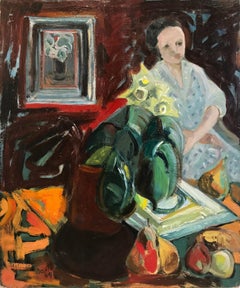
"Mexican Outdoor Scene with Figures" Expressionistic Style Oil Painting on Board
Located in New York, NY
A strong modernist oil painting depicted in the Mid Century by Russian painter Michael Baxte. Mostly known for his abstracted figures on canvas or street scenes, this piece is a wond...
Category
1960s Expressionist Masonite Paintings
Materials
Oil, Masonite
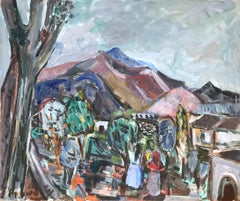
"Countryside Landscape Hills Scene with Path" Expressionistic Style Oil Painting
Located in New York, NY
A strong modernist oil painting depicted in the Mid Century by Russian painter Michael Baxte. Mostly known for his abstracted figures on canvas or street scenes, this piece is a wonderful representation of his landscapes with expressive use of color, shape, and form. Later in his career, Baxte explores Expressionism, infusing both European and North American stylistic trends.
Art measures 15 x 18 inches
Michael Posner Baxte was born in 1890 in the small town of Staroselje Belarus, Russia. For the first half of the 19th century, it was a center of the Chabad movement of Hasidic Jews, but this group was gone by the middle of the 19th century. By the time the Baxte family immigrated to the United States at the beginning of the 20th century, the Jewish population numbered only on the hundreds. The native language of the Baxte family was Yiddish. It is likely that the death of Michael Baxte’s father triggered the family’s immigration. Three older brothers arrived in New York between 1903 and 1905. Michael and his mother, Rebecca, arrived in 1907. By 1910 Michael, his mother, and brother, Joseph, were living in New Orleans and may have spent some time on a Louisiana plantation. Around 1912, Michael Baxte returned to Europe to study the violin. In 1914 he, his mother, and Joseph moved to New York City.
Meanwhile, in Algeria, a talented young woman painter, Violette Mege, was making history. For the first time, a woman won the prestigious Beaux Art competition in Algeria. At first, the awards committee denied her the prize but, with French government intervention, Mege eventually prevailed. She won again 3 years later and, in 1916, used the scholarship to visit the United States of America. When Violette came to New York, she met Baxte, who was, by then, an accomplished violinist, teacher, and composer. Baxte’s compositions were performed at the Tokyo Imperial Theater, and in 1922 he was listed in the American Jewish Yearbook as one of the prominent members of the American Jewish community. As a music teacher, he encouraged individual expression. Baxte stated, “No pupil should ever be forced into the imitation of the teacher. Art is a personal experience, and the teacher’s truest aim must be to awaken this light of personality through the patient's light of science.”
By 1920 Michael Baxte and Violette Mege were living together in Manhattan. Although they claimed to be living as husband and wife, it seems that their marriage did not become official until 1928. On their “unofficial” honeymoon around 1917, in Algiers, Baxte confided to her his ambition to paint. There and later in New Mexico where the wonderful steeped sunlight approximates the coloring of Algiers, she taught him his heart’s desire. He never had any other teacher. She never had any other pupil. For ten years she devoted all her time, energy, and ambition to teaching, encouraging, inspiring him. Then in 1928, their mutual strivings were rewarded, as his works were being chosen as one of the two winners in the Dudensing National Competition for American Painters. Out of 150 artists from across the country participated in the Dudensing, and Michael Posner Baxte and, Robert Fawcett...
Category
Mid-20th Century Expressionist Masonite Paintings
Materials
Oil, Masonite
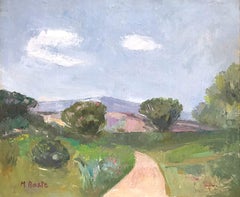
"Mexican Landscape Water Scene with Figures and Boat" Expressionistic Style
Located in New York, NY
A strong modernist oil painting depicted in the Mid Century by Russian painter Michael Baxte. Mostly known for his abstracted figures on canvas or street scenes, this piece is a wond...
Category
Mid-20th Century Expressionist Masonite Paintings
Materials
Oil, Masonite
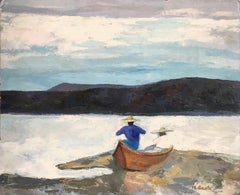
"Mexican Villagers Scene with Man on a Horse" Expressionistic Style Oil Painting
Located in New York, NY
A strong modernist oil painting depicted in the Mid Century by Russian painter Michael Baxte. Mostly known for his abstracted figures on canvas or street scenes, this piece is a wonderful representation of his portraits in village landscapes with expressive use of color, shape, and form. Later in his career, Baxte explores Expressionism, infusing both European and North American stylistic trends.
Art measures 25.5 x 21.25 inches
Michael Posner Baxte was born in 1890 in the small town of Staroselje Belarus, Russia. For the first half of the 19th century, it was a center of the Chabad movement of Hasidic Jews, but this group was gone by the middle of the 19th century. By the time the Baxte family immigrated to the United States at the beginning of the 20th century, the Jewish population numbered only on the hundreds. The native language of the Baxte family was Yiddish. It is likely that the death of Michael Baxte’s father triggered the family’s immigration. Three older brothers arrived in New York between 1903 and 1905. Michael and his mother, Rebecca, arrived in 1907. By 1910 Michael, his mother, and brother, Joseph, were living in New Orleans and may have spent some time on a Louisiana plantation. Around 1912, Michael Baxte returned to Europe to study the violin. In 1914 he, his mother, and Joseph moved to New York City.
Meanwhile, in Algeria, a talented young woman painter, Violette Mege, was making history. For the first time, a woman won the prestigious Beaux Art competition in Algeria. At first, the awards committee denied her the prize but, with French government intervention, Mege eventually prevailed. She won again 3 years later and, in 1916, used the scholarship to visit the United States of America. When Violette came to New York, she met Baxte, who was, by then, an accomplished violinist, teacher, and composer. Baxte’s compositions were performed at the Tokyo Imperial Theater, and in 1922 he was listed in the American Jewish Yearbook as one of the prominent members of the American Jewish community. As a music teacher, he encouraged individual expression. Baxte stated, “No pupil should ever be forced into the imitation of the teacher. Art is a personal experience, and the teacher’s truest aim must be to awaken this light of personality through the patient's light of science.”
By 1920 Michael Baxte and Violette Mege were living together in Manhattan. Although they claimed to be living as husband and wife, it seems that their marriage did not become official until 1928. On their “unofficial” honeymoon around 1917, in Algiers, Baxte confided to her his ambition to paint. There and later in New Mexico where the wonderful steeped sunlight approximates the coloring of Algiers, she taught him his heart’s desire. He never had any other teacher. She never had any other pupil. For ten years she devoted all her time, energy, and ambition to teaching, encouraging, inspiring him. Then in 1928, their mutual strivings were rewarded, as his works were being chosen as one of the two winners in the Dudensing National Competition for American Painters. Out of 150 artists from across the country participated in the Dudensing, and Michael Posner Baxte and, Robert Fawcett...
Category
Mid-20th Century Expressionist Masonite Paintings
Materials
Oil, Masonite

"Mexican Countryside Landscape Scene with Trees on Hills" Expressionistic Style
Located in New York, NY
A strong modernist oil painting depicted in 1963 by Russian painter Michael Baxte. Mostly known for his abstracted figures on canvas or street scenes, this piece is a wonderful repre...
Category
1960s Expressionist Masonite Paintings
Materials
Oil, Masonite
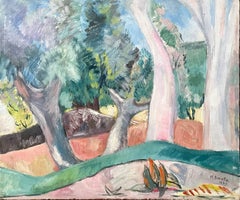
"Landscape of a Village Near Mountains" Expressionistic Oil Painting on Masonite
Located in New York, NY
A strong modernist oil painting depicted in 1969 by Russian painter Michael Baxte. Mostly known for his abstracted figures on canvas or street scenes, this piece is a wonderful representation of his bold still life paintings, with expressive use of color, shape, and form. Later in his career, Baxte explores Expressionism, infusing both European and North American stylistic trends. This piece is from later in his career, but we can feel this underlying style throughout.
Art measures 18 x 21.75 inches
Michael Posner Baxte was born in 1890 in the small town of Staroselje Belarus, Russia. For the first half of the 19th century it was a center of the Chabad movement of Hasidic Jews, but this group was gone by the middle of the 19th century. By the time the Baxte family immigrated to the United States at the beginning of the 20th century, the Jewish population numbered only on the hundreds. The native language of the Baxte family was Yiddish. It is likely that the death of Michael Baxte’s father triggered the family’s immigration. Three older brothers arrived in New York between 1903 and 1905. Michael and his mother, Rebecca, arrived in 1907. By 1910 Michael, his mother, and brother, Joseph, were living in New Orleans and may have spent some time on a Louisiana plantation. Around 1912, Michael Baxte returned to Europe to study the violin. In 1914 he, his mother, and Joseph moved to New York City.
Meanwhile, in Algeria, a talented young woman painter, Violette Mege, was making history. Since for the first time, a woman won the prestigious Beaux Art competition in Algeria. At first, the awards committee denied her the prize but, with French government intervention, Mege eventually prevailed. She won again 3 years later and, in 1916, used the scholarship to visit the United States of America. When Violette came to New York, she met Baxte, who was, by then, an accomplished violinist, teacher, and composer. Baxte’s compositions were performed at the Tokyo Imperial Theater, and in 1922 he was listed in the American Jewish Yearbook as one of the prominent members of the American Jewish community. As a music teacher he encouraged individual expression. Baxte stated, “No pupil should ever be forced into imitation of the teacher. Art is a personal experience, and the teacher’s truest aim must be to awaken this light of personality through the patient light of science.”
By 1920 Michael Baxte and Violette Mege were living together in Manhattan. Although they claimed to be living as husband and wife, it seems that their marriage did not become official until 1928. On their “unofficial” honeymoon around 1917, in Algiers, Baxte confided to her his ambition to paint. There and later in New Mexico where the wonderful steeped sunlight approximates the coloring of Algiers, she taught him his heart’s desire. He never had any other teacher. She never had any other pupil. For ten years she devoted all her time, energy, and ambition to teaching, encouraging, inspiring him. Then in 1928, their mutual strivings were rewarded, as his works were being chosen as one of the two winners in the Dudensing National Competition for American Painters. Out of 150 artists from across the country participated in the Dudensing, and Michael Posner Baxte and, Robert Fawcett, were the winners.
In his 1924 naturalization application, he indicated that he was sometimes known as “Michael Posner Baxte.” One of the witnesses to his application was Bernard Karfiol, a Jewish American artist. That’s when Michael may...
Category
1960s Expressionist Masonite Paintings
Materials
Oil, Masonite
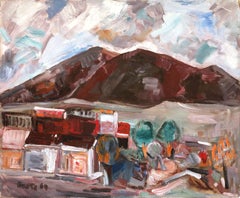
"Colorful Mexican Village Scene" Expressionistic Oil Painting on Masonite
Located in New York, NY
A strong modernist oil painting depicted Circa 1960 by Russian painter Michael Baxte. Mostly known for his abstracted figures on canvas or street scenes, this piece is a wonderful representation of his bold still life paintings, with expressive use of color, shape, and form. Later in his career, Baxte explores Expressionism, infusing both European and North American stylistic trends. This piece is from later in his career, but we can feel this underlying style throughout.
Art measures 18 x 21.75 inches
Michael Posner Baxte was born in 1890 in the small town of Staroselje Belarus, Russia. For the first half of the 19th century it was a center of the Chabad movement of Hasidic Jews, but this group was gone by the middle of the 19th century. By the time the Baxte family immigrated to the United States at the beginning of the 20th century, the Jewish population numbered only on the hundreds. The native language of the Baxte family was Yiddish. It is likely that the death of Michael Baxte’s father triggered the family’s immigration. Three older brothers arrived in New York between 1903 and 1905. Michael and his mother, Rebecca, arrived in 1907. By 1910 Michael, his mother, and brother, Joseph, were living in New Orleans and may have spent some time on a Louisiana plantation. Around 1912, Michael Baxte returned to Europe to study the violin. In 1914 he, his mother, and Joseph moved to New York City.
Meanwhile, in Algeria, a talented young woman painter, Violette Mege, was making history. Since for the first time, a woman won the prestigious Beaux Art competition in Algeria. At first, the awards committee denied her the prize but, with French government intervention, Mege eventually prevailed. She won again 3 years later and, in 1916, used the scholarship to visit the United States of America. When Violette came to New York, she met Baxte, who was, by then, an accomplished violinist, teacher, and composer. Baxte’s compositions were performed at the Tokyo Imperial Theater, and in 1922 he was listed in the American Jewish Yearbook as one of the prominent members of the American Jewish community. As a music teacher he encouraged individual expression. Baxte stated, “No pupil should ever be forced into imitation of the teacher. Art is a personal experience, and the teacher’s truest aim must be to awaken this light of personality through the patient light of science.”
By 1920 Michael Baxte and Violette Mege were living together in Manhattan. Although they claimed to be living as husband and wife, it seems that their marriage did not become official until 1928. On their “unofficial” honeymoon around 1917, in Algiers, Baxte confided to her his ambition to paint. There and later in New Mexico where the wonderful steeped sunlight approximates the coloring of Algiers, she taught him his heart’s desire. He never had any other teacher. She never had any other pupil. For ten years she devoted all her time, energy, and ambition to teaching, encouraging, inspiring him. Then in 1928, their mutual strivings were rewarded, as his works were being chosen as one of the two winners in the Dudensing National Competition for American Painters. Out of 150 artists from across the country participated in the Dudensing, and Michael Posner Baxte and, Robert Fawcett, were the winners.
In his 1924 naturalization application, he indicated that he was sometimes known as “Michael Posner Baxte.” One of the witnesses to his application was Bernard Karfiol, a Jewish American artist. That’s when Michael may...
Category
1960s Expressionist Masonite Paintings
Materials
Oil, Masonite
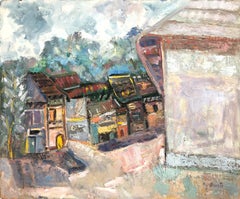
"Mexican Landscape Scene with Female Figures and Child" Expressionistic Style
Located in New York, NY
A strong modernist oil painting depicted in the Mid Century by Russian painter Michael Baxte. Mostly known for his abstracted figures on canvas or street scenes, this piece is a wond...
Category
1970s Expressionist Masonite Paintings
Materials
Oil, Masonite
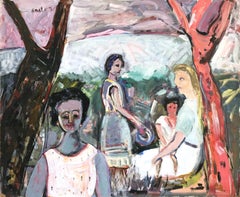
"Mexican Landscape Scene of Mother with Children" Expressionistic Style Painting
Located in New York, NY
A strong modernist oil painting depicted in 1962 by Russian painter Michael Baxte. Mostly known for his abstracted figures on canvas or street scenes, this piece is a wonderful representation of his portraits in countryside landscapes with expressive use of color, shape, and form. Later in his career, Baxte explores Expressionism, infusing both European and North American stylistic trends.
Art measures 21.25 x 25.5 inches
Michael Posner Baxte was born in 1890 in the small town of Staroselje Belarus, Russia. For the first half of the 19th century, it was a center of the Chabad movement of Hasidic Jews, but this group was gone by the middle of the 19th century. By the time the Baxte family immigrated to the United States at the beginning of the 20th century, the Jewish population numbered only on the hundreds. The native language of the Baxte family was Yiddish. It is likely that the death of Michael Baxte’s father triggered the family’s immigration. Three older brothers arrived in New York between 1903 and 1905. Michael and his mother, Rebecca, arrived in 1907. By 1910 Michael, his mother, and brother, Joseph, were living in New Orleans and may have spent some time on a Louisiana plantation. Around 1912, Michael Baxte returned to Europe to study the violin. In 1914 he, his mother, and Joseph moved to New York City.
Meanwhile, in Algeria, a talented young woman painter, Violette Mege, was making history. For the first time, a woman won the prestigious Beaux Art competition in Algeria. At first, the awards committee denied her the prize but, with French government intervention, Mege eventually prevailed. She won again 3 years later and, in 1916, used the scholarship to visit the United States of America. When Violette came to New York, she met Baxte, who was, by then, an accomplished violinist, teacher, and composer. Baxte’s compositions were performed at the Tokyo Imperial Theater, and in 1922 he was listed in the American Jewish Yearbook as one of the prominent members of the American Jewish community. As a music teacher, he encouraged individual expression. Baxte stated, “No pupil should ever be forced into the imitation of the teacher. Art is a personal experience, and the teacher’s truest aim must be to awaken this light of personality through the patient's light of science.”
By 1920 Michael Baxte and Violette Mege were living together in Manhattan. Although they claimed to be living as husband and wife, it seems that their marriage did not become official until 1928. On their “unofficial” honeymoon around 1917, in Algiers, Baxte confided to her his ambition to paint. There and later in New Mexico where the wonderful steeped sunlight approximates the coloring of Algiers, she taught him his heart’s desire. He never had any other teacher. She never had any other pupil. For ten years she devoted all her time, energy, and ambition to teaching, encouraging, inspiring him. Then in 1928, their mutual strivings were rewarded, as his works were being chosen as one of the two winners in the Dudensing National Competition for American Painters. Out of 150 artists from across the country participated in the Dudensing, and Michael Posner Baxte and, Robert Fawcett...
Category
1960s Expressionist Masonite Paintings
Materials
Oil, Masonite
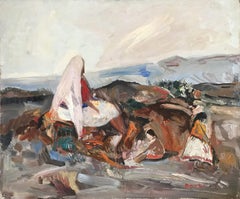
"Landscape Scene of Mexican Villagers" Expressionistic Oil Painting on Masonite
Located in New York, NY
A strong modernist oil painting depicted in 1971 by Russian painter Michael Baxte. Mostly known for his abstracted figures on canvas or street scenes, this piece is a wonderful representation of his landscape paintings, with expressive use of color, shape, and form. Later in his career, Baxte explores Expressionism, infusing both European and North American stylistic trends. This piece is from later in his career, but we can feel this underlying style throughout.
Art measures 18 x 21.75 inches
Michael Posner Baxte was born in 1890 in the small town of Staroselje Belarus, Russia. For the first half of the 19th century it was a center of the Chabad movement of Hasidic Jews, but this group was gone by the middle of the 19th century. By the time the Baxte family immigrated to the United States at the beginning of the 20th century, the Jewish population numbered only on the hundreds. The native language of the Baxte family was Yiddish. It is likely that the death of Michael Baxte’s father triggered the family’s immigration. Three older brothers arrived in New York between 1903 and 1905. Michael and his mother, Rebecca, arrived in 1907. By 1910 Michael, his mother, and brother, Joseph, were living in New Orleans and may have spent some time on a Louisiana plantation. Around 1912, Michael Baxte returned to Europe to study the violin. In 1914 he, his mother, and Joseph moved to New York City.
Meanwhile, in Algeria, a talented young woman painter, Violette Mege, was making history. Since for the first time, a woman won the prestigious Beaux Art competition in Algeria. At first, the awards committee denied her the prize but, with French government intervention, Mege eventually prevailed. She won again 3 years later and, in 1916, used the scholarship to visit the United States of America. When Violette came to New York, she met Baxte, who was, by then, an accomplished violinist, teacher, and composer. Baxte’s compositions were performed at the Tokyo Imperial Theater, and in 1922 he was listed in the American Jewish Yearbook as one of the prominent members of the American Jewish community. As a music teacher he encouraged individual expression. Baxte stated, “No pupil should ever be forced into imitation of the teacher. Art is a personal experience, and the teacher’s truest aim must be to awaken this light of personality through the patient light of science.”
By 1920 Michael Baxte and Violette Mege were living together in Manhattan. Although they claimed to be living as husband and wife, it seems that their marriage did not become official until 1928. On their “unofficial” honeymoon around 1917, in Algiers, Baxte confided to her his ambition to paint. There and later in New Mexico where the wonderful steeped sunlight approximates the coloring of Algiers, she taught him his heart’s desire. He never had any other teacher. She never had any other pupil. For ten years she devoted all her time, energy, and ambition to teaching, encouraging, inspiring him. Then in 1928, their mutual strivings were rewarded, as his works were being chosen as one of the two winners in the Dudensing National Competition for American Painters. Out of 150 artists from across the country participated in the Dudensing, and Michael Posner Baxte and, Robert Fawcett, were the winners.
In his 1924 naturalization application, he indicated that he was sometimes known as “Michael Posner Baxte.” One of the witnesses to his application was Bernard Karfiol, a Jewish American artist. That’s when Michael may...
Category
1960s Expressionist Masonite Paintings
Materials
Oil, Masonite
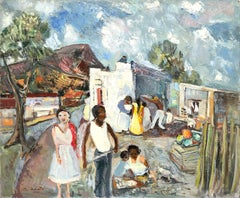
"Mexican Interior Scene Scene with Figures and Fish" Expressionistic Style
Located in New York, NY
A strong modernist oil painting depicted in the Mid Century by Russian painter Michael Baxte. Mostly known for his abstracted figures on canvas or street scenes, this piece is a wond...
Category
1950s Expressionist Masonite Paintings
Materials
Oil, Masonite
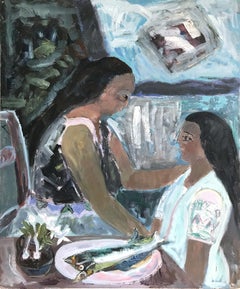
"Landscape Scene of Fisherman by Lake" Expressionistic Oil Painting on Masonite
Located in New York, NY
A strong modernist oil painting depicted in 1963 by Russian painter Michael Baxte. Mostly known for his abstracted figures on canvas or street scenes, this piece is a wonderful representation of his figures in water landscapes with expressive use of color, shape, and form. Later in his career, Baxte explores Expressionism, infusing both European and North American stylistic trends. This piece is from later in his career, but we can feel this underlying style throughout.
Art measures 18 x 21.75 inches
Michael Posner Baxte was born in 1890 in the small town of Staroselje Belarus, Russia. For the first half of the 19th century it was a center of the Chabad movement of Hasidic Jews, but this group was gone by the middle of the 19th century. By the time the Baxte family immigrated to the United States at the beginning of the 20th century, the Jewish population numbered only on the hundreds. The native language of the Baxte family was Yiddish. It is likely that the death of Michael Baxte’s father triggered the family’s immigration. Three older brothers arrived in New York between 1903 and 1905. Michael and his mother, Rebecca, arrived in 1907. By 1910 Michael, his mother, and brother, Joseph, were living in New Orleans and may have spent some time on a Louisiana plantation. Around 1912, Michael Baxte returned to Europe to study the violin. In 1914 he, his mother, and Joseph moved to New York City.
Meanwhile, in Algeria, a talented young woman painter, Violette Mege, was making history. Since for the first time, a woman won the prestigious Beaux Art competition in Algeria. At first, the awards committee denied her the prize but, with French government intervention, Mege eventually prevailed. She won again 3 years later and, in 1916, used the scholarship to visit the United States of America. When Violette came to New York, she met Baxte, who was, by then, an accomplished violinist, teacher, and composer. Baxte’s compositions were performed at the Tokyo Imperial Theater, and in 1922 he was listed in the American Jewish Yearbook as one of the prominent members of the American Jewish community. As a music teacher he encouraged individual expression. Baxte stated, “No pupil should ever be forced into imitation of the teacher. Art is a personal experience, and the teacher’s truest aim must be to awaken this light of personality through the patient light of science.”
By 1920 Michael Baxte and Violette Mege were living together in Manhattan. Although they claimed to be living as husband and wife, it seems that their marriage did not become official until 1928. On their “unofficial” honeymoon around 1917, in Algiers, Baxte confided to her his ambition to paint. There and later in New Mexico where the wonderful steeped sunlight approximates the coloring of Algiers, she taught him his heart’s desire. He never had any other teacher. She never had any other pupil. For ten years she devoted all her time, energy, and ambition to teaching, encouraging, inspiring him. Then in 1928, their mutual strivings were rewarded, as his works were being chosen as one of the two winners in the Dudensing National Competition for American Painters. Out of 150 artists from across the country participated in the Dudensing, and Michael Posner Baxte and, Robert Fawcett, were the winners.
In his 1924 naturalization application, he indicated that he was sometimes known as “Michael Posner Baxte.” One of the witnesses to his application was Bernard Karfiol, a Jewish American artist. That’s when Michael may...
Category
1960s Expressionist Masonite Paintings
Materials
Oil, Masonite
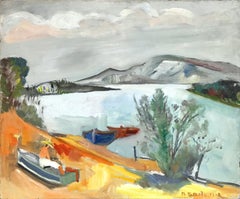
"Mexican Countryside Landscape Mountain Scene with Trees" Expressionistic Style
Located in New York, NY
A strong modernist oil painting depicted in 1962 by Russian painter Michael Baxte. Mostly known for his abstracted figures on canvas or street scenes, this piece is a wonderful repre...
Category
1960s Expressionist Masonite Paintings
Materials
Oil, Masonite
Related Items
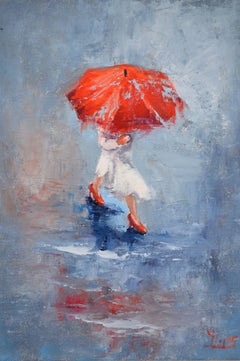
A Girl Running Through Puddles Original impasto Miniature oil painting
Located in Zofingen, AG
This original oil painting captures a girl running through puddles under a vibrant red umbrella. The artist's passion comes alive through bold strokes that create a beautiful contras...
Category
2010s Expressionist Masonite Paintings
Materials
Canvas, Oil, Cardboard

$939
H 11.82 in W 8.27 in D 0.12 in
No Ordinary Winter
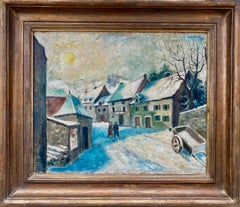
s Tale: Resilience, the War 1943, German Expressionist oil
Located in Norwich, GB
This is no ordinary winter scene. It is the story of prosecution and survival; of resolve and resilience during World War 2, as it was experienced by German Expressionist Heinz Lohma...
Category
1940s Expressionist Masonite Paintings
Materials
Oil, Board
$1,580
H 19.69 in W 22.84 in D 1.78 in
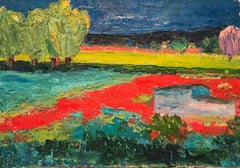
Provencal Landscape Poppy Fields Original Oil Painting
Located in Cirencester, Gloucestershire
Stunning mid 20th century French Expressionist oil painting on canvas. The work depicts this gloriously vibrant and colourful landscape in Provence - we are told by the former owner it represents the Luberon Valley region in Provence, in the fields around Cucuron.
We acquired the painting from a private collector in the heart of Provence who had owned the painting for many years. The work is unsigned but very, very close in every respect to the Corsican born artist PIERRE AMBROGIANI (1907-1985) and further research in this direction could be fruitful.
Condition and Size:
The painting is in good condition. The paint has begun to split in places as one would expect with such thickly applied oil paint.
The canvas, unframed is 38cm x 55cm.
Pierre Ambrogiani was born in Ajaccio, Corsica, although he was brought up in Marseille, where he continued to live and work for the rest of his life. He was an Expressionist painter of Provençal landscapes...
Category
Mid-20th Century Expressionist Masonite Paintings
Materials
Oil
$1,644 Sale Price
20% Off
H 13 in W 21.66 in D 1.19 in
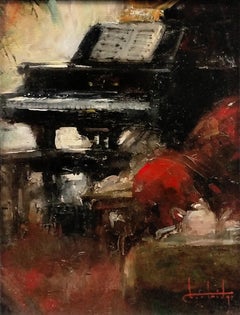
LOVELY MUSIC
Located in Aventura, FL
Original oil on canvas painting. Hand signed on front; signed and titled on verso by the artist. Canvas is stretched. Artwork is in excellent condition. Certificate of authenticity ...
Category
20th Century Expressionist Masonite Paintings
Materials
Canvas, Oil
Two Under the Rain Original impasto Miniature oil painting for living room
Located in Zofingen, AG
"Two Under the Rain" captures a profound connection amidst solitude. This original oil painting features two figures sharing an intimate moment under the rain. The artist's expressio...
Category
2010s Expressionist Masonite Paintings
Materials
Oil, Canvas, Cardboard

$939
H 8.27 in W 11.82 in D 0.12 in
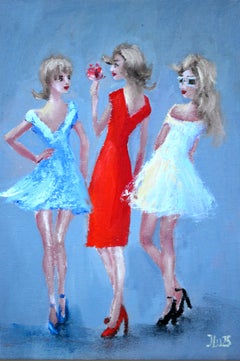
3 funny fashionistas. Original impasto Miniature Oil Gift Art.
Located in Zofingen, AG
This original oil painting captures the joyful spirit of three funny fashionistas. The artist's use of impasto creates a textured surface that brings these characters to life with pl...
Category
2010s Expressionist Masonite Paintings
Materials
Canvas, Oil, Cardboard
$464
H 11.82 in W 8.27 in D 0.12 in
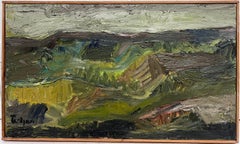
French Expressionist Sludgy Green
Brown Landscape Very Thick Oil Impasto
Located in Cirencester, Gloucestershire
Green Landscape
French artist, indistinctly signed, dated verso 1985
oil painting on canvas, in wooden frame
canvas: 10 x 17 inches
wooden frame: 9.5 x 16 inches
provenance: private ...
Category
Late 20th Century Expressionist Masonite Paintings
Materials
Oil, Canvas
$981 Sale Price
20% Off
H 10 in W 17 in
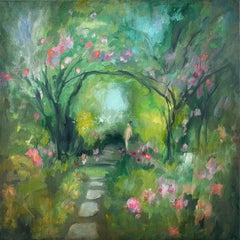
"Secret Garden" (2023) by Leigh Ann Van Fossan, Original Oil Painting
Located in Denver, CO
Leigh Ann Van Fossan's "Secret Garden" (2023) is an original, handmade oil painting that depicts a path surrounded by colorful flowers and trees arching over.
Van Fossan was born in...
Category
2010s Expressionist Masonite Paintings
Materials
Canvas, Oil
$630
H 12 in W 12 in D 2 in
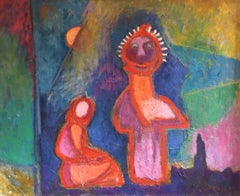
Colourful Abstract, Artisan Style, Expressionist Original Oil Painting
By Akos Biro
Located in Cirencester, Gloucestershire
AKOS BIRO (HUNGARIAN 1911-2002)
Oil painting on canvas, framed
Framed size: 26.5 x 33 inches
Beautifully colourful, original oil painting by the very popular and highly regarded Hun...
Category
Late 20th Century Expressionist Masonite Paintings
Materials
Oil
$1,809 Sale Price
20% Off
H 26.5 in W 33 in D 1 in
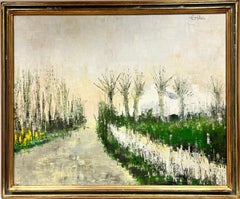
1970’s Huge French Expressionist Green Landscape Avenue of Trees, signed oil
Located in Cirencester, Gloucestershire
The Avenue of Trees
French Expressionist School, signed front and back
Dated 1974
oil on canvas, framed
framed: 37 x 44 inches
canvas: 32 x 39 inches
private collection, France
the p...
Category
Late 20th Century Expressionist Masonite Paintings
Materials
Canvas, Oil
$1,398 Sale Price
20% Off
H 37 in W 44 in D 1 in
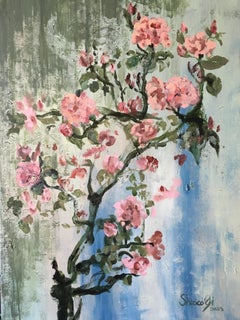
Do Not Go Gentle Into that GoodNight-Original-British Awarded Artist-EnglishRose
Located in London, GB
Taking on the inspiration of the legendary poet, Dylan Thomas, the poem, Do not go gentle into that good night, is a painting celebrates life in its ageing; as Rosa Albertine only flowers once in early Summer with the most festive blooms and heavenly scents, a symbol of a fully lived life.
Painted Plein Air, in Artist's own garden of her very own planted memorial roses.
This is Rosa Albertine, the first Old English variety Artist Shizico Yi planted in 2016 in her garden before her late dog died; Old English Roses...
Category
2010s Expressionist Masonite Paintings
Materials
Gesso, Canvas, Wood, Oil, Acrylic
$8,086
H 39.77 in W 29.93 in D 0.6 in
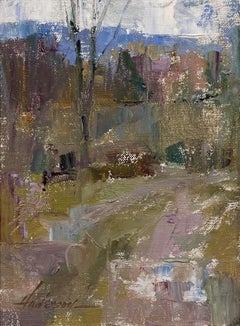
"Landscape Study" (2011), Original Expressionist Landscape Oil Painting
Located in Denver, CO
This piece measures at 8 x 6 in., and is framed at 11.50 x 9.50 in., ready to hang.
Artist Biography:
Carolyn Anderson, a nationally recognized artist, is an accomplished pastelist...
Category
2010s Expressionist Masonite Paintings
Materials
Oil
Previously Available Items
"Still Life with Flower Pot" Expressionistic Style Oil Painting on Masonite
Located in New York, NY
A strong modernist oil painting depicted in Circa 1960 by Russian painter Michael Baxte. Mostly known for his abstracted figures on canvas or street scenes, this piece is a wonderful representation of his bold still life paintings, with expressive use of color, shape, and form. Later in his career, Baxte explores Expressionism, infusing both European and North American stylistic trends. This piece is from later in his career, but we can feel this underlying style throughout.
Art measures 21.75 x 18 inches
Michael Posner Baxte was born in 1890 in the small town of Staroselje Belarus, Russia. For the first half of the 19th century it was a center of the Chabad movement of Hasidic Jews, but this group was gone by the middle of the 19th century. By the time the Baxte family immigrated to the United States at the beginning of the 20th century, the Jewish population numbered only on the hundreds. The native language of the Baxte family was Yiddish. It is likely that the death of Michael Baxte’s father triggered the family’s immigration. Three older brothers arrived in New York between 1903 and 1905. Michael and his mother, Rebecca, arrived in 1907. By 1910 Michael, his mother, and brother, Joseph, were living in New Orleans and may have spent some time on a Louisiana plantation. Around 1912, Michael Baxte returned to Europe to study the violin. In 1914 he, his mother, and Joseph moved to New York City.
Meanwhile, in Algeria, a talented young woman painter, Violette Mege, was making history. Since for the first time, a woman won the prestigious Beaux Art competition in Algeria. At first, the awards committee denied her the prize but, with French government intervention, Mege eventually prevailed. She won again 3 years later and, in 1916, used the scholarship to visit the United States of America. When Violette came to New York, she met Baxte, who was, by then, an accomplished violinist, teacher, and composer. Baxte’s compositions were performed at the Tokyo Imperial Theater, and in 1922 he was listed in the American Jewish Yearbook as one of the prominent members of the American Jewish community. As a music teacher he encouraged individual expression. Baxte stated, “No pupil should ever be forced into imitation of the teacher. Art is a personal experience, and the teacher’s truest aim must be to awaken this light of personality through the patient light of science.”
By 1920 Michael Baxte and Violette Mege were living together in Manhattan. Although they claimed to be living as husband and wife, it seems that their marriage did not become official until 1928. On their “unofficial” honeymoon around 1917, in Algiers, Baxte confided to her his ambition to paint. There and later in New Mexico where the wonderful steeped sunlight approximates the coloring of Algiers, she taught him his heart’s desire. He never had any other teacher. She never had any other pupil. For ten years she devoted all her time, energy, and ambition to teaching, encouraging, inspiring him. Then in 1928, their mutual strivings were rewarded, as his works were being chosen as one of the two winners in the Dudensing National Competition for American Painters. Out of 150 artists from across the country participated in the Dudensing, and Michael Posner Baxte and, Robert Fawcett...
Category
1960s Expressionist Masonite Paintings
Materials
Oil, Masonite
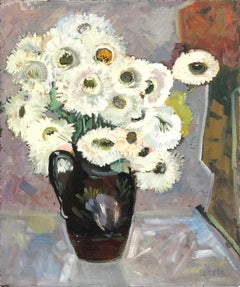
Michael Baxte"Still Life with Flower Pot" Expressionistic Style Oil Painting on Masonite, Circa 1960
H 21.75 in W 18 in D 0.25 in
Masonite paintings for sale on 1stDibs.
Find a wide variety of authentic Masonite paintings available on 1stDibs. While artists have worked in this medium across a range of time periods, art made with this material during the 21st Century is especially popular. If you’re looking to add paintings created with this material to introduce a provocative pop of color and texture to an otherwise neutral space in your home, the works available on 1stDibs include elements of blue, green, pink, purple and other colors. There are many well-known artists whose body of work includes ceramic sculptures. Popular artists on 1stDibs associated with pieces like this include Enzio Wenk, Mark Beard, Michael Baxte, and Helen Enoch Gleiforst. Frequently made by artists working in the Impressionist, Abstract, all of these pieces for sale are unique and many will draw the attention of guests in your home. Not every interior allows for large Masonite paintings, so small editions measuring 0.1 inches across are also available
More Ways To Browse
Bords De La Seine
Bright Day And Painting
Cornish Cottage
Dan Winters
Detroy Leon
Dionysus Painting
Dory Contemporary
Duane Albert Armstrong On Sale
Edmondson William
Eilean Donan Castle Painting
Elaine Rose
Ellie Blue
Figurative Art From Spain
Florida Seascape Painting
Gene Pompa
George Bruestle
George Tjungurrayi
Godwin Bennett