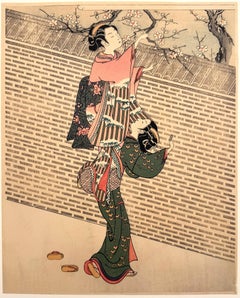
18th Century and Earlier Art
to
1,020
4,214
1,508
662
511
707
Overall Width
to
Overall Height
to
7,614
21,299
162,193
233,114
1,981
2,257
4,929
6,461
5,741
15,012
20,482
25,762
18,486
13,829
5,390
3,139
1,299
49
17
14
10
4
3
1
1
1
1
3,662
3,247
392
4,770
2,395
1,519
1,514
1,340
893
671
656
517
426
415
398
336
274
198
196
196
184
180
175
3,715
2,316
1,894
1,076
873
160
127
90
88
81
2,281
3,533
5,065
1,341
Period: 18th Century and Earlier
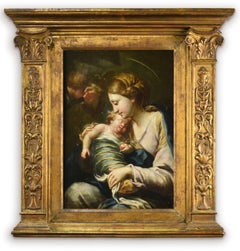
Italian Genovese Madonna. Beautiful frame.
Located in New York, NY
Italian Madonna, early 18th Century, probably Genovese. Beautiful color palette. Not signed.
Category
Baroque 18th Century and Earlier Art
Materials
Canvas, Oil
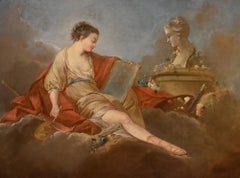
Allegory Painting Drawing Trémolières Paint 18th Century Oil on canvas France
Located in Riva del Garda, IT
Pierre Charles Trémolières (Cholet, 1703 - Paris, 1739)
Allegory of Painting and Drawing
Oil on canvas 86 x 112 cm In original lacquered frames 122 x 95 cm.
Work accompanied...
Category
Old Masters 18th Century and Earlier Art
Materials
Oil

$10,469 Sale Price
20% Off
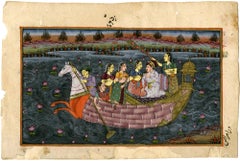
Mughal School, 18th century Emperor Jangahir on a pleasure boat with his harem a
Located in Middletown, NY
Emperor Jahangir depicted with his harem attendees aboard a pleasure cruise, the water filled with lotus blossoms; symbols of paradise itself.
Circa 1750. Gouache and ink with gold ...
Category
Rajput 18th Century and Earlier Art
Materials
Gold
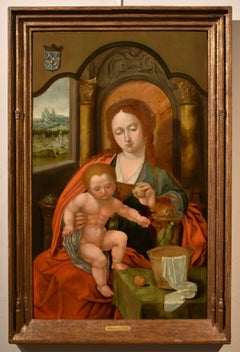
Madonna Parrot Paint Oil on table Old master Flemish Follower Master of Parrot
Located in Riva del Garda, IT
'Master of the parrot' (a painter active in Antwerp in the early 16th century, whose name refers to the parrot who always occurs in his paintings) - follower of
Madonna on the throne with child
(With the coat of arms of the client family in the upper part of the composition)
Oil on the table
101 x 62 cm. - In frame 114 x 76 cm.
The beautiful proposed work explains the typical iconographic characters of the painter called 'Master of the parrot', a conventional name used by critics to define an anonymous Dutch author of the 16th century.
More precisely, it is a painter of the southern Netherlands, active in Antwerp around 1530-50, so defined for the unmistakable parrot who often appears in his works of him. In religious iconography the parrot has often been used as a Marian symbol, as it was widespread that its most common verse was "Ave", that is, the greeting of the Archangel Gabriele to Mary at the time of the Annunciation.
Today the idea according to which the name 'master of the parrot' has not referred to a single painter, but rather a group that, based on the stylistic characters, carried out their training at the workshop of Pieter Coecke Van Aelst (Aalst (Aalst is widespread. 1502 - Brussels 1550), creating devotion paintings intended for a bourgeois client and concentrating their activity on a specific topic particularly requested by the contemporary market.
By way of example we can mention the Virgin with the San Diego Museum of Art child where the figures, like our own, are in line, With the mannerist taste for the elegant body proportions that exceed reality, with elements such as tapered finger, wide face and thin nose. These characters also betray the influence of active artists in the region such as Joos Van Cleve...
Category
Old Masters 18th Century and Earlier Art
Materials
Oil
$12,840 Sale Price
40% Off
Manner of Guido Reni (1575-1642) The Prophecy of Simeon Large Antique Painting
Located in Cirencester, Gloucestershire
Artist/ School: Manner of Guido Reni (1575-1642) Italian
Title: The Prophecy of Simeon
Medium: oil painting on canvas, unframed
Painting: 21.5 ...
Category
Old Masters 18th Century and Earlier Art
Materials
Oil

$2,616 Sale Price
20% Off
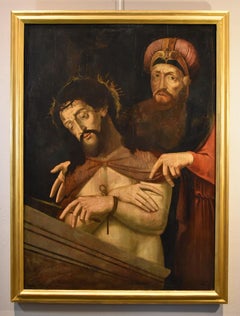
Ecce Homo Coxie Paint 16/17th Century Paint Oil on table Old master Flemish Art
Located in Riva del Garda, IT
Circle of Michael Coxie (Malines, 1499 - Malines, 1592)
Ecce Homo with Pontius Pilate
Oil on panel
Flemish school 16th-17th century
112 x 81 cm - framed 121 x 90 cm.
The proposed p...
Category
Old Masters 18th Century and Earlier Art
Materials
Oil
$8,375 Sale Price
20% Off
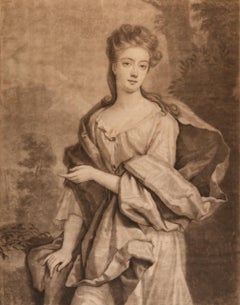
The Duchess of St. Albans: A 17th C. Portrait After a Kneller Painting
By (After) Sir Godfrey Kneller
Located in Alamo, CA
This is a 17th century engraved mezzotint portrait of the Duchess of St. Albans by John Smith, after a painting by Sir Godfrey Kneller. It was published in London by John Boydell in 1694.
The Duchess of St. Albans (1642-1712) was a woman named Diana de Vere. She was born in 1642, the daughter of Aubrey de Vere, the 20th Earl of Oxford. In 1662, she married Charles Beauclerk, the illegitimate son of King Charles II and his mistress, Nell Gwyn. As a result of her marriage, Diana became the Duchess of St. Albans, and she and Charles had several children together. Diana was known for her beauty and charm, and she was a prominent figure in the court of King Charles II. Despite her husband's illegitimate birth, Diana was highly respected in the royal court and was known for her intelligence and wit. She was a patron of the arts and supported many artists and writers of the time. Diana lived through a tumultuous period of English history, including the Great Fire of London and the Glorious Revolution, which saw King James II replaced by William of Orange. She died in 1712 at the age of 70 and was buried in Westminster Abbey. Descendants of Diana and her husband, who was an illegitimate son of King Charles II, include Diana, Princess of Wales and her son William, Duke of Cambridge.
An author wrote of her: "The line of Vere, so long renown’d in arms,
Concludes with luster in St. Albans’s charms;
Her conquering eyes have made their race complete,
It rose in valor, and in beauty set."
This striking mezzotint engraving depicts Diana, Duchess of St Albans in a three-quarter length pose, standing, wearing loose flowing dress and a wrap. She has a very serene, calm appearance as she is looking straight at the viewer. There is a landscape of trees in the background. The print is adhered in the corners to an archival backing, which is itself adhered in the upper corners to a larger backing. The print is trimmed to just beyond the plate mark. There are areas of discoloration in the margins and in the inscription area, but the print is otherwise in very good condition. The sheet measures 14.5" high and 10" wide. This mezzotint is held by multiple museums and institutions, including The British Museum, The National Portrait Gallery London, The Fine Arts Museum of Boston, The Lewis Walpole Library at Yale, The Yale Center for British Art, The Fitzwilliam Museum at Cambridge and The National Galleries of Scotland. The original Kneller painting is part of the British Royal Collection Trust and hangs in the King's Private Dining Room at Hampton Court Palace.
Sir Godfrey Kneller (1646-1723) was a leading portrait painter of his time, particularly renowned for his depictions of the British aristocracy and royalty. He was born in Lübeck, Germany, and trained in Amsterdam under the painter Ferdinand Bol...
Category
18th Century and Earlier Art
Materials
Mezzotint
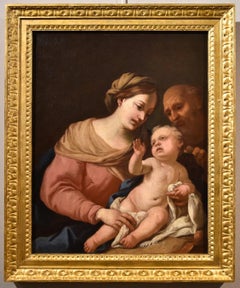
Holy Family Piola Paint Oil on canvas Old master 17th Century Maria Religious
Located in Riva del Garda, IT
Genoese school of the second half of the seventeenth century
Circle of Domenico Piola (Genoa 1627-1703)
The Holy Family
Oil painting on canvas
83 x 68 cm. - in an antique frame 99 x...
Category
Old Masters 18th Century and Earlier Art
Materials
Oil
$7,143 Sale Price
20% Off
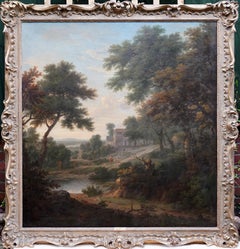
Manor House with Cottages - British 18thC Old Master art oil painting VG prov.
Located in Hagley, England
This stunning British Old Master landscape oil painting, with excellent provenance, is by George Lambert. Lambert was a pioneer of British landscape in art for its own sake. Painted in 1744, the painting is entitled View of a Manor House and Cottages in Elizabeth Einberg's 63rd volume of the Walpole Society 2001 and is described as follows: In the foreground a road emerges from a wood to cross a ford and then leads up the hill to the right, towards a manor house seemingly built into the remains of a medieval or Tudor edifice. The main track, crowded with sheep and rustic figures, passes the massive square gateposts lower down the hill on the left. Further to the left is a thatched cottage with smoke coming out the chimney. In the distance is a wide coastal view. The main buildings, which are in the dead centre of the composition, represent almost certainly an as yet unidentified English view.
The colouring and detail in the trees and foliage are superb. This is an excellent Old Master oil painting by one of the all time great British landscape artists with extensive provenance.
Signed and dated 1744 lower left on rock in black.
Provenance. Elizabeth Einberg, “Catalogue Raisonnè of the works of George Lambert” The Annual Volume of the Walpole Society, 2001 Vol. 63, page 149 no P1744, fig.71.
Antonacci Efrati Antichità Rome Gallery.
Burden sale, Parke Bernet, New York, 20-21, April 1938 (376 repr.)
Robert E. Peters, Sotheby Parke Bernet, New York, March 1975 (41 repr.)
Lit. Schnackenburg 1995, pp 83-84, cat. no.14 fig 13.
Condition. Oil on canvas, 54 inches by 52 inches and in good condition.
Frame. Housed in an ornate gilt frame, 64 inches by 62 inches and in good condition.
George Lambert (1700-1765) was an English landscape artist and theatre scene painter. With Richard Wilson he is recognised as a pioneer of British landscape in art, for its own sake. Lambert was born in Kent and studied art under Warner Hassells and John Wootton, soon attracting attention by the quality of his landscape painting. He painted many large and fine landscapes in the style of Gaspar Poussin and Salvator Rosa. Many of his landscapes were finely engraved by François Vivares, James Mason (1710–1785), and others, including a set of views of Plymouth and Mount Edgcumbe (painted conjointly with Samuel Scott), a view of Saltwood Castle in Kent, another of Dover, and a landscape presented to the Foundling Hospital in London. Lambert also obtained a great reputation as a scene-painter, working at first for the Lincoln's Inn Fields Theatre, in London, under John Rich. When Rich moved to Covent Garden Theatre, Lambert secured the assistance of Amigoni, and together they produced scenery of far higher quality than any previously executed. Lambert was a man of jovial temperament and shrewd wit, and frequently spent his evenings at work in his painting-loft at Covent Garden Theatre, to which men of note in the fashionable or theatrical world resorted to share his supper of a beef-steak, freshly cooked on the spot. Out of these meetings arose the well-known "Beefsteak Club" which long maintained a high social reputation. Most of Lambert's scene-paintings unfortunately perished when Covent Garden Theatre was destroyed by fire in 1808. Lambert was a friend of William Hogarth and a member of the jovial society that met at 'Old Slaughter's' Tavern in St Martin's Lane. In 1755 he was one of the committee of artists who proposed a royal academy of arts in London. He was a member of the Society of Artists of Great Britain, exhibited with them in 1761 and the three following years, and during the same period contributed to the Academy exhibitions. In 1765 he and other members seceded and formed the Incorporated Society of Artists of Great Britain, of which he was elected the first president. In conjunction with Samuel Scott, Lambert painted a series of Indian views for the old East India House in Leadenhall Street. He also etched two prints after Salvator Rosa. Lambert was associated in 1735 with George Vertue, Hogarth, and John Pine (engraver, 1660–1756) in obtaining a bill from parliament securing artists a copyright on their works. Lambert's portraits were painted by Thomas Hudson, John Vanderbank (engraved in mezzotint by John Faber the younger in 1727, and in line by H. Robinson and others), and Hogarth. Lambert's most famous painting is "A view of Box Hill, Surrey" (1733) which depicts a well-known beauty spot south of London. Hogarth considered Lambert a rival to the famous French landscape painter Claude Lorrain (1600–1682) with respect to his use of soft light to unify the scene in this painting. Though he never visited Italy he was inspired by the classical tradition of landscape painting. Lambert died on 30 November 1765 at his home on the Piazza in Covent Garden. His pupils included John Inigo Richards...
Category
Old Masters 18th Century and Earlier Art
Materials
Oil
$152,958 Sale Price
20% Off
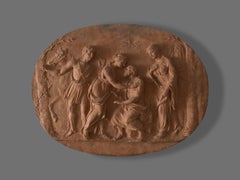
Oedipus before the Temple of the Furies at Colonus
Located in London, GB
Terracotta
19 x 25 ½ inches; 480 x 650 mm
Signed and dated: ‘W Tyler Excu. 1765’
Collections:
Cyril Humphris, London;
Humphris sale, Sotheby's, New York, 10-11 January 1995, lot 74...
Category
Old Masters 18th Century and Earlier Art
Materials
Terracotta
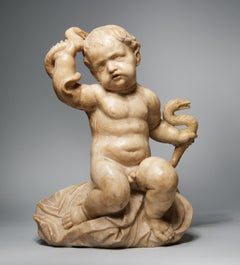
18th/19th C. Italian Alabaster Sculpture of Infant Hercules Wrestling a Snake
Located in Beachwood, OH
18th/19th Century Italian
Infant Hercules Wrestling a Snake
Alabaster
18 x 18 x 6 inches
40 lb.
In Greek mythology, the infant Hercules (Heracles) is famously depicted wrestling wit...
Category
Italian School 18th Century and Earlier Art
Materials
Alabaster
$3,840 Sale Price
20% Off
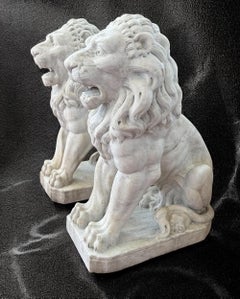
Exceptional Pair of Italian Neoclassical Leons Carrara Marble Statues
Located in Rome, IT
Outstanding pair Italian Neoclassical Leons Carrara Marble sculptures.
A timeless piece for your garden or interior decoration.
Good condition, with visible signs of wear and ...
Category
Academic 18th Century and Earlier Art
Materials
Marble
Guido Reni follower - 18/19th century figure painting - Virgin Child
By Guido Reni
Located in Varmo, IT
Guido Reni (Bologna 1575 - Bologna 1642), follower of - Madonna and Child.
91.5 x 108 cm unframed, 134.5 x 150.5 cm with frame.
Ancient oil painting on canvas, in a 19th-century ca...
Category
Baroque 18th Century and Earlier Art
Materials
Canvas, Oil

The Windmill
Located in San Francisco, CA
This artwork titled "The Windmill" 1641 is an etching on paper After Rembrandt Van Rijn, 1606-1669, plate engraved By French renown engraver Charles Armand Durand, 1831-1905. Signatu...
Category
Realist 18th Century and Earlier Art
Materials
Etching
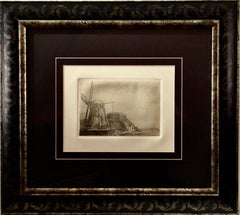
Shipping in Stormy Waters, Attributed to Italian Artist Francesco Guardi
By Francesco Guardi
Located in Stockholm, SE
The splendour of the tragic sea
Francesco Guardi and maritime painting in Venetian art
No Venetian painter was a stranger to the sea. After all, Venice was not only one of the most prominent ports of the Mediterranean, but indeed a city literally submerged in the ocean from time to time. Curiously however, the famous Venetian school of painting showed little interest in maritime motifs, favouring scenes from the iconic architecture of the city rather than seascapes. That is why this painting is a particularly interesting window into not only the painter Francesco Guardi himself – but to the significance of the element of water in art history, in absence as well as in the centre of attention.
Whether it be calm, sunny days with stunning views of the palaces alongside the canals of Venice or – more rarely – stormy shipwrecking tragedies at sea, water as a unifying element is integral to the works of painter Francesco Guardi (1712–1793). During his lifetime, Venetian art saw many of its greatest triumphs with names like Tiepolo or Canaletto gaining international recognition and firmly establishing Venice as one of the most vibrant artistic communities of Europe. While the city itself already in the 18th century was something of an early tourist spot where aristocrats and high society visited on their grand tour or travels, the artists too contributed to the fame and their work spread the image of Venice as the city of romance and leisure to an international audience, many of whom could never visit in person.
Still today, the iconic image of Venice with its whimsical array of palaces, churches and other historic buildings is much influenced by these artists, many of whom have stood the test of time like very well and remain some of the most beloved in all of art history. It was not primarily subtility, intellectual meanings or moral ideals that the Venetian art tried to capture; instead it was the sheer vibrancy of life and the fast-paced city with crumbling palaces and festive people that made this atmosphere so special. Of course, Venice could count painters in most genres among its residents, from portraiture to religious motifs, history painting and much else. Still, it is the Vedutas and views of the city that seems to have etched itself into our memory more than anything else, not least in the tradition of Canaletto who was perhaps the undisputed master of all Venetian painters.
Born into his profession, Francesco lived and breathed painting all his life. His father, the painter Domenico Guardi (1678–1716) died when Francesco was just a small child, yet both he and his brothers Niccolò and Gian Antonio continued in their fathers’ footsteps. The Guardi family belonged to the nobility and originated from the mountainous area of Trentino, not far from the Alps. The brothers worked together on more challenging commissions and supported each other in the manner typical of family workshops or networks of artists. Their sister Maria Cecilia married no other than the artist Giovanni Battista Tiepolo himself, linking the family to the most renowned Venetian name of the time. During almost a decade, Guardi worked in the studio of Michele Giovanni Marieschi, sometimes simply known as Michiel, a painted similar in both style and motif. Canaletto is, however, the artist Guardi is most often compared to since they shared a mutual fascination for depicting the architecture and cityscape of Venice.
During the course of his career, Guardi tried his hand in many different genres. He was as swift in painting landscapes, Vedutas of Venice, sacred motifs, interiors and architectural compositions as he was in a number of other motifs. His style is typical of the Venetian school but also distinct and personal once we look a little closer. There is an absolute certainty in the composition, the choice of which sometimes feels like that of a carefully calculated photograph – yet it is also very painterly, in the best sense of the word: fluid, bold, sensitive and full of character. The brushwork is rapid, intense, seemingly careless and extraordinarily minute at the same time; fresh and planned in a very enjoyable mixture. His interiors often capture the breath-taking spacious glamour of the palaces and all their exquisite decor. He usually constructed the motif through remarkably simple, almost spontaneous yet intuitively precise strokes and shapes. The result was a festive, high-spirited atmospheric quality, far away from the sterile and exact likeness that other painters fell victim to when trying to copy Canaletto.
The painting here has nothing of the city of Venice in it. On the contrary, we seem to be transported far away into the solitary ocean, with no architecture, nothing to hold on to – only the roaring sea and the dangerous cliffs upon which the ships are just moments away from being crushed upon. It is a maritime composition evoking both Flemish and Italian precursors, in the proud tradition of maritime painting that for centuries formed a crucial part of our visual culture.
This genre of painting is today curiously overlooked, compared to how esteemed and meaningful it was when our relationship to the sea was far more natural than it is today. When both people and goods travelled by water, and many nations and cities – Venice among them – depended entirely on sea fare, the existential connection to the ocean was much more natural and integrated into the imagination. The schools and traditions of maritime art are as manifold as there are countries connected to the sea, and all reflect the need to process the dangers and wonders of the ocean.
It could symbolize opportunity, the exciting prospects of a new countries and adventures, prospering trade, beautiful scenery as well as war and tragedy, loss of life, danger and doom. To say that water is ambivalent in nature is an understatement, and these many layers were something that artists explored in the most wondrous ways. Perhaps it takes a bit more time for the modern eye to identify the different nuances and qualities of historic maritime paintings, they may on first impression seem hard to differentiate from each other. But when allowing these motifs to unfold and tell stories of the sea in both fiction and reality – or somewhere in between – we are awarded with an understanding of how the oceans truly built our world.
In Guardi’s interpretation, we see an almost theatrically arranged shipwrecking scene. No less than five ships are depicted right in the moment of utter disaster. Caught in a violent storm, the waves have driven them to a shore of sharp cliffs and if not swallowed by the waves, crushing against the cliffs seems to be the only outcome. The large wooden ships are impressively decorated with elaborate sculpture, and in fact relics already during Guardi’s lifetime. They are in fact typical of Dutch and Flemish 17th century ships, giving us a clue to where he got the inspiration from. Guardi must have seen examples of Flemish maritime art, that made him curious about these particular motifs. One is reminded of Flemish painters like Willem van de Velde and Ludolf Backhuysen, and this very painting has indeed been mistakenly attributed to Matthieu van Plattenberg...
Category
Old Masters 18th Century and Earlier Art
Materials
Canvas, Oil
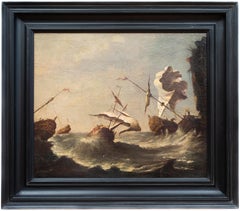
18th Century Oil - Praying to St Peter
Located in Corsham, GB
A captivating 18th-century oil painting portraying a gentleman in prayer before Saint Peter, who appears celestial in the clouds above. In the distance, a quaint church nestles withi...
Category
18th Century and Earlier Art
Materials
Oil
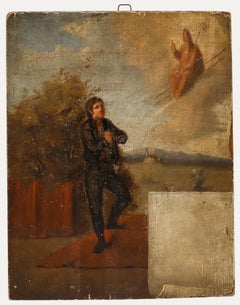
Antique Italian painter - 18th century figure painting
Located in Varmo, IT
Italian painter (18th century) - Chrono.
90.5 x 106 cm.
Antique oil painting on canvas, without frame (not signed).
Condition report: Lined canvas. Good state of conservation of t...
Category
Old Masters 18th Century and Earlier Art
Materials
Canvas, Oil
$4,737 Sale Price
20% Off
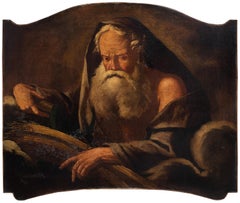
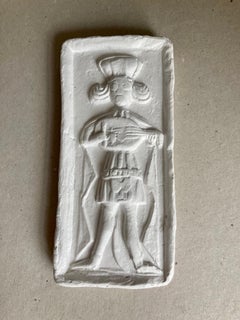
A Lute Player Medieval Tile Gypsum Cast
Located in Slovak Republic, SK
Gypsum cast-medieval tile, inspired from Central Europe. Could be also adjusted in a frame, ready to hang or install ( price will be different).
Category
Gothic 18th Century and Earlier Art
Materials
Gesso
$235 Sale Price
20% Off
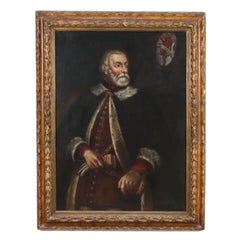
Portrait of a Noble 17th Century
Located in Milan, IT
Oil on Canvas.
Portrait of a nobleman, proud with his hand resting on the 'hilt of his sword and dressed in an ermine-edged cloak. On the upper right appears the coat of arms of his ...
Category
Other Art Style 18th Century and Earlier Art
Materials
Oil
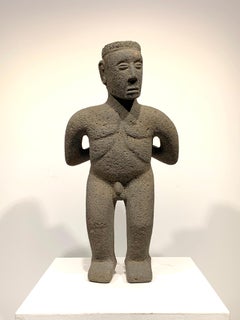
Costa Rican pre-Columbian sculptural figure ca. 1000-1500
Located in Wilton Manors, FL
Magnificent standing figure, Costa Rica, ca. 1000-1500. Carved volcanic stone. Measures 16.5 x 9 x 5.5 inches. Outstanding condition with no damage.
The figure represents a captured...
Category
18th Century and Earlier Art
Materials
Stone
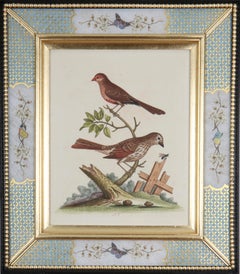
George Edwards: 18th Century Engravings of Birds
Located in Richmond, GB
George Edwards: ""A History of Uncommon Birds"", 1749-1761.
A prominent English naturalist and ornithologist, George Edwards (1694 -1773) is best known for his work, ""A Natural His...
Category
18th Century and Earlier Art
Materials
Watercolor, Engraving
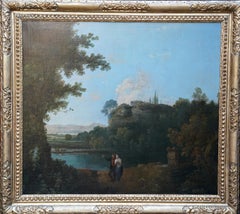
Lovers in Landscape - British 18th century Old Master pastoral art oil painting
Located in Hagley, England
This superb British 18th century Old Master oil painting is attributed to circle of noted landscape artist Richard Wilson. Painted circa 1750 it is a stunning lake landscape with a r...
Category
Old Masters 18th Century and Earlier Art
Materials
Oil
$17,481 Sale Price
20% Off
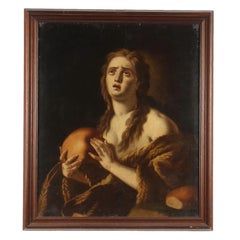
Painting Penitent Magdalene 17th century
Located in Milan, IT
Oil on canvas, applied to wooden plate.
The saint is depicted in the foreground, half-length: the naked torso of the body is partially covered by a fur falling from the shoulders, ov...
Category
Other Art Style 18th Century and Earlier Art
Materials
Oil
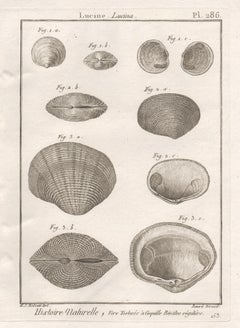
Shells, French 18th century natural history marine sea shell engraving
Located in Melbourne, Victoria
18th century natural history engraving depicting shells by Robert Benard after Henry Joseph Redoute.
Henry Redoute was the brother of the great botanical artist Pierre Joseph Redout...
Category
Victorian 18th Century and Earlier Art
Materials
Engraving
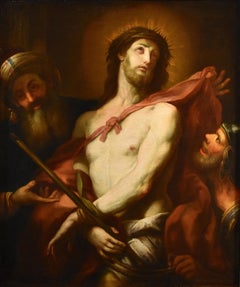
Ecce Homo Castello 17th Century Paint Oil on canvas Old master Genoese school
Located in Riva del Garda, IT
17th-century Genoese School
Workshop of Valerio Castello (Genoa, 1624 - Genoa, 1659)
Ecce homo
Oil on canvas
117 x 99 cm.
In frame 138 x 118 cm.
The Ecce Homo, the subject of our ...
Category
Old Masters 18th Century and Earlier Art
Materials
Oil
$14,780 Sale Price
20% Off
Painting Italian Classical Landscape 18th ruin forteress Signed
Located in PARIS, FR
French or Italian school of the 18th century
Animated landscape with a ruin
Oil on canvas 27 x 33 cm (34 x 40 cm with the frame)
Signed and dated lower right "1772 / Contencin? / fec...
Category
Italian School 18th Century and Earlier Art
Materials
Oil
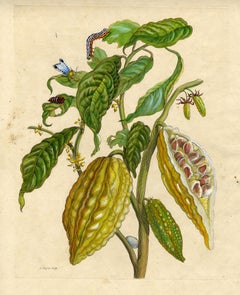
$1,099 Sale Price
53% Off
Cocoa plant, caterpillar, ..., Plate 26, Metamorphosis Insectorum Surinamensium
Located in Middletown, NY
Metamorphosis Insectorum Surinamensium, Plate No. 26; Cocoa plant, caterpillar, pupa, and butterflies. The Netherlands: 1705. En...
Category
Naturalistic 18th Century and Earlier Art
Materials
Watercolor, Engraving
A Late 18th-Century Rural Family Scene
Located in San Francisco, CA
No sentimentality on the loose here. Not with the expressions on the mother and her three children all engaged in various forms of 18th-century drudgery on this late summer’s eve. An...
Category
English School 18th Century and Earlier Art
Materials
Canvas, Oil
Johann Weinmann: c18th Botanical Engravings in Decalcomania Frames
Located in Richmond, GB
A wonderful selection of hand-coloured mezzotint engravings from: ""Phytanthoza Iconographia"", c1739, presented in hand- made parcel-gilt, ebonised and decalcomania frames.
Joha...
Category
18th Century and Earlier Art
Materials
Watercolor, Mezzotint
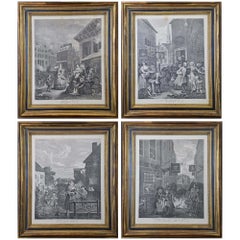
Four Framed Hogarth Engravings "Four Times of the Day"
Located in Alamo, CA
The four plates in this "Four Times of the Day" set were created utilizing both engraving and etching techniques by William Hogarth in 1738. Hogarth's original copper plates were refurbished where needed by James Heath and these engravings were republished in London in 1822 by Braddock, Cradock & Joy. This was the last time Hogarth's original copper plates were used for printing. Most were melted down during World War I for the construction of bombs. Printed upon early nineteenth century wove paper and with large, full margins as published by William Heath in 1822. The inscription below each print reads "Invented Painted & Engraved by Wm. Hogarth & Publish'd March 25. 1738 according to Act of Parliament".
These large folio sized "Four Times of the Day" engravings/etchings are presented in complex gold-colored wood frames with black bands and scalloped gold inner trim. A majority of each thick impressive frame is covered with glass applied near the outer edge. Each frame measures 25.75" high, 22.25" wide and 1.88" deep. There are a few small dents in the edge of these frames, which are otherwise in very good condition. "Morning" has two focal areas of discoloration in the upper margin and some discoloration in the right margin, a short tear in the left margin and a short tear or crease in the right margin. "Noon" has a spot in the upper margin that extends into the upper image, but it is otherwise in very good condition. "Evening" has a faint spot in the upper margin, but it is otherwise in very good condition. "Night" is in excellent condition.
The "Four Times of the Day" series is in the collection of many major museums, including: The British Museum, The Metropolitan Museum of Art, The Tate Museum, The Chicago Art Institute and The Victoria and Albert Museum.
Through this series Hogarth is portraying early 18th century London street life at "Four Times of the Day". His characters are exhibiting their personalities, quircks, strange activities, but he also wants to draw attention the disparities between the wealthy aristocracy and the common working class.
Plate 1, "Morning" depicts morning in Covent Garden in the winter in front of Tom King...
Category
Old Masters 18th Century and Earlier Art
Materials
Engraving, Etching
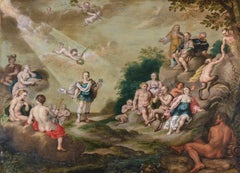
The Music Contest between Apollo and Pan
, Renaissance Mythology, Satyr, Hermes
Located in Santa Cruz, CA
An early 17th-century Flemish School oil on copper showing the mythological contest between Apollo and Pan in which the mountain god, Tmolus, gives judgement for Apollo. Unsigned. Pa...
Category
Northern Renaissance 18th Century and Earlier Art
Materials
Copper
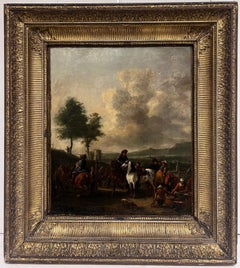
Fine 17th Century Dutch Old Master Oil Military Encampment Figures on Horseback
By Philips Wouwerman
Located in Cirencester, Gloucestershire
The Military Encampment
Dutch School, 17th century
circle of Philips Wouwermans (Dutch 1619-1668)
oil painting on canvas, in 18th century gilt frame
canvas measures: 19.5 x 17 inches...
Category
Old Masters 18th Century and Earlier Art
Materials
Oil, Canvas
$4,315 Sale Price
20% Off
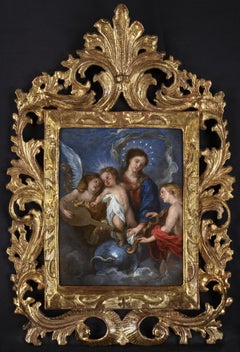
Virgin and Child with Music-Making Angels
Located in New York, NY
The Virgin and Child with two music-making angels, after Van Dyck; in clouds, the Virgin shown half-length supporting the infant Jesus on an orb, looking to right at an angel playing...
Category
Baroque 18th Century and Earlier Art
Materials
Copper
$25,600 Sale Price
20% Off
Paint Oil on canvas 17th Century Italy Mediterranean Landscapes Marina Flandre
Located in Riva del Garda, IT
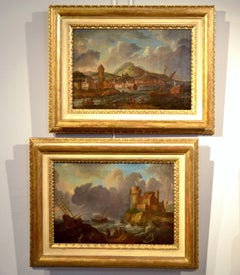
We present this pair of fascinating coastal views, the fruit of the author's imagination, executed with an elegant descriptive taste and conceived with the scenographic sensitivity typical of the Flemish landscape tradition of the late seventeenth century. The canvases, in particular, fully reflect the pictorial style of the Flemish Peter van den Velde the Elder (Antwerp 1634-1707), a famous painter specialized in marine views with port cities and fortresses.
Pair of paintings with fancy coastal views
Circle of Peter Van de Velde the Elder (Antwerp 1634 -1714)
Oil on canvas, cm. 43 x 64
With framens cm. 70 x 89
They respectively represent a port city and a fortress perched overlooking the sea, both animated small characters, which at first sight evoke the coasts of the Mediterranean, even if the mixes with Northern European elements are inevitable, including a small mill...
Category
Old Masters 18th Century and Earlier Art
Materials
Oil
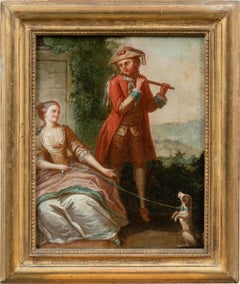
Rococò French painter - 18th century figure painting - Flute player dog
Located in Varmo, IT
French painter (18th century) - Flute player and dog.
43.5 x 35 cm without frame, 54 x 45 cm with frame.
Antique oil painting on canvas, in a carved and gilded wooden frame (not si...
Category
Rococo 18th Century and Earlier Art
Materials
Canvas, Oil
$1,776 Sale Price
40% Off
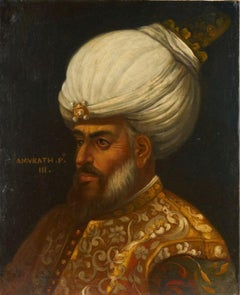
18th C Ottoman portrait of Sultan Murat, Venetian School
Located in brussel, BE
From the 16th to 19th C the production of decorative arts continued to flourish with the introduction of both rococo and baroque elements signaling an increasingly open attitude to a...
Category
18th Century and Earlier Art
Materials
Canvas, Oil
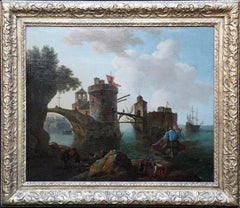
Dutch Marine Shipping Seascape - Golden Age art Old Master oil painting boats
Located in Hagley, England
This superb Dutch Old Master marine oil painting is attributed to the circle of Jacob de Heusch. Painted circa 1690 the setting is an Italian coast with fish...
Category
Old Masters 18th Century and Earlier Art
Materials
Oil
Painted Landscape with Scene of Preaching 18th century
Located in Milan, IT
Oil on Canvas. Venetian school of the 18th century.
The large northern landscape, with verdant mountain slopes in the midst of which a river flows, is inhabited by several figures in...
Category
Other Art Style 18th Century and Earlier Art
Materials
Oil
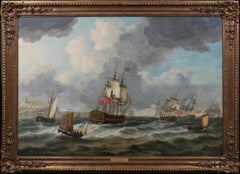
Large 18th Century Oil Painting Marine Seascape of British Navy Fleet off Dover
By Dominic Serres
Located in Gerrards Cross, GB
‘The British Fleet with a Vice-Admiral of the Red off Dover’ by Dominic Serres R.A. (1722-1793).
Academy Fine Paintings is fully conversant with the legal...
Category
English School 18th Century and Earlier Art
Materials
Oil
$30,676 Sale Price
25% Off
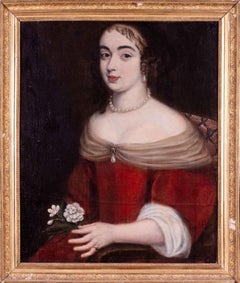
French School, 17th Century,
Portrait of the Marquise de Grugieres
, oil canvas
Located in Petworth, West Sussex
French school, 17th Century
Portrait of the Marquise de Grugieres
Oil on canvas
26.1/4 x 21.5/8 in. (66.7 x 54.8 cm.)
In a gilded composite frame, later production (possible early 1...
Category
Old Masters 18th Century and Earlier Art
Materials
Canvas, Oil
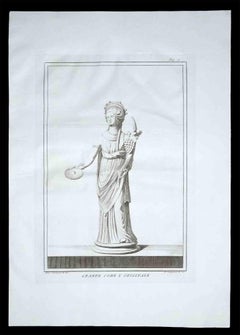
Ancient Roman Statue - Original Etching by Pietro Campana - 18th Century
Located in Roma, IT
Ancient Roman Statue, from the series "Antiquities of Herculaneum", is an original etching on paper realized by Pietro Campana.
Signed on plate on the ...
Category
Old Masters 18th Century and Earlier Art
Materials
Etching
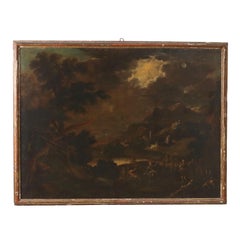
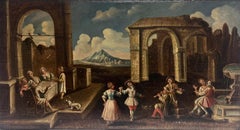
Figures Dancing Classical Ancient Ruins
Landscape Large Old Master Painting
Located in Cirencester, Gloucestershire
Revelry in a Classical Landscape
Italian School, early 18th century (circa 1700)
oil painting on canvas, laid on board, unframed
board: 20 x 36 inches
provenan...
Category
Old Masters 18th Century and Earlier Art
Materials
Oil
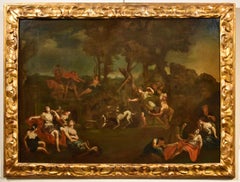
Diana Boullogne Mythological Paint Oil on canvas old master 17/18th Century
Located in Riva del Garda, IT
Bon Boullogne (Paris, 1649 - Paris, 1717) workshop of
Episodes from the myth of Diana
oil painting on canvas
Dimensions: 84 x 114 cm.
with antique frame 100 x 132 cm.
The beautiful painting proposed shows a series of episodes taken from the myth of the divinity Diana, the Roman divinity of hunting, forests and wild animals, masterfully captured in this valuable painting, which shows a luxuriant wood, a favorite place of the divinity, as a theater of his adventures.
The composition opens, on the left, with a sort of presentation of the divinity, portrayed as an attractive young girl, surrounded by her faithful Nymphs, one of whom holds her quiver with arrows, and by one of her beloved dogs. hunting her.
The 'story' continues in the central part where we can see the divinity during a wild boar hunt...
Category
Old Masters 18th Century and Earlier Art
Materials
Oil
$8,375 Sale Price
20% Off
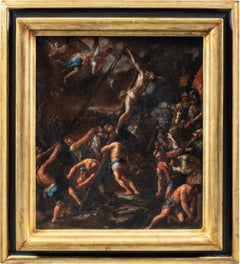
Baroque Florentine painter - 17th century figure painting - Crucifixion
Located in Varmo, IT
Tuscan Master (17th century) - Raising of the Cross.
52 x 45.5 cm without frame, 69 x 62.5 cm with frame.
Antique oil painting on panel, in a carved, gild...
Category
Baroque 18th Century and Earlier Art
Materials
Oil, Panel
$4,737 Sale Price
20% Off
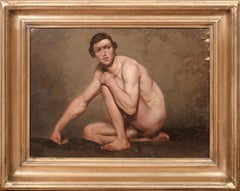
Portrait Of A Nude Male, 18th Century School of Jacques-Louis David (1748-1825)
Located in Blackwater, GB
Portrait Of A Nude Male, 18th Century
School of Jacques-Louis David (1748-1825)
18th Century French School portrait of a nude male, oil on paper laid to board. Excellent quality an...
Category
18th Century and Earlier Art
Materials
Paper, Oil
Martyrdom of Saint Stephen- Painting attr. to Vincent Adriaenssen- 17th Century
Located in Roma, IT
Landscape with martyrdom of Saint Stephen is an old master artwork realized in 17th century.
Mixed colored oil painting on canvas.
Includes coeval gilded frame cm. 148x196.
The artwork is attributed to Vincent Adriaenssen called il Manciola (Antwerp, 1595 - Roma, 1675)
Among the painters who worked in the first half of the seventeenth century it is possible to indicate only the Neapolitan Scipione Compagno (1624-1680) as the author of scenes of martyrs set within a landscape or a view such as, for example, the Martyrdom of Saint Stefano recently hesitated at the Ansorena in Madrid on June 16, 2021. It should be noted, however, that the landscape represented in the painting examined here, characterized by luxuriant vegetation, meticulously represented "in the Flemish style", shows differences with the typical settings of the paintings di Compagno, characterized above all by urban views, visionary architectures or rather arid vegetation. Even the refined figures, so elongated and lanky, represented in our painting, in particular the group of knights in the foreground on the right, are not reflected in the production of the Neapolitan painter. These elements, to which we add the depiction of the Eternal Father amidst the clouds and the detail of the dog in profile in the foreground, instead recall a painter mainly known as a battle soldier, but who was also the author of many works depicting episodes from ancient Rome set within luxuriant landscapes, or rather Vincent Adriaenssen known as Manciola, a painter from Antwerp whose figure has been shed light thanks to recent studies. The group of horsemen represented to the right of the examined painting is, in fact, comparable with other groups on horseback present in numerous works by Manciola such as, for example, in the Triumph of Caesar (Rome, Babuino, 23-03-2010; formerly Florence, Collection Privata, 2006), while similar elongated and somewhat lanky figures, dressed in red, yellow, blue and white, can be found in the three paintings conserved at the Cassa di Risparmio di Pesaro, which in the past were erroneously attributed to the Umbrian painter Francesco Allegrini...
Category
Old Masters 18th Century and Earlier Art
Materials
Oil
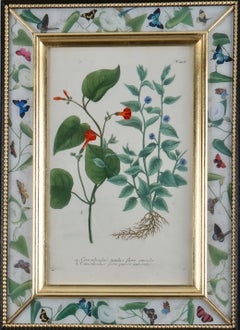
Framed eighteenth century botanical engraving in a decalcomania frame.
Located in Richmond, GB
From a wonderful selection of hand-coloured mezzotint engravings from: "Phytanthoza Iconographia", c1739, presented in a hand- made parcel-gilt, ebonised and decalcomania frame...
Category
18th Century and Earlier Art
Materials
Handmade Paper, Engraving, Mezzotint
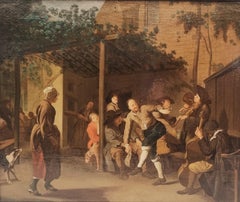
HOREMANS Younger Attributed Flemish painting Feast Musician Life Antwerp 18th
Located in PARIS, FR
Jan Josef Horemans II (Attributed to)
Antwerp, 1714 – Antwerp, 1792
Festive Scene in a Backyard
Oil on canvas 45 x 58.5 cm (59 x 66 cm with frame)
Fine black wood frame
Jan Josef Ho...
Category
Flemish School 18th Century and Earlier Art
Materials
Oil
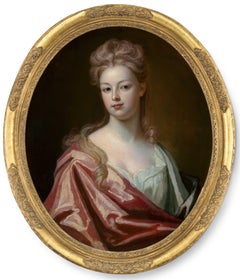
Portrait of a Lady, Mrs Wray in a Silk Dress
Pink Wrap c.1698, Oil on canvas
By Michael Dahl
Located in London, GB
Portrait of a Lady, Mrs Wray in a Silk Dress & Pink Wrap c.1698
Circle of Michael Dahl (1659-1743)
This delightful work, presented by Titan Fine Art, is a fine example of British po...
Category
Old Masters 18th Century and Earlier Art
Materials
Cotton Canvas, Oil
The Serving - British Old Master 18th century oil painting historical interior
By (Circle of) William Hogarth
Located in Hagley, England
A superb British Old Master oil painting which is attributed to circle of William Hogarth and was painted circa 1760. This fine oil painting is in ...
Category
Old Masters 18th Century and Earlier Art
Materials
Oil
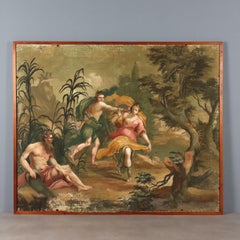
Apollo and Daphne painting 18th century
Located in Milan, IT
Oil on Canvas. Tuscan school of the 18th century.
The grand scene tells the tragic story of Apollo and Daphne, recounted in Ovid's Metamorphoses. According to the myth, the god Apoll...
Category
Other Art Style 18th Century and Earlier Art
Materials
Oil
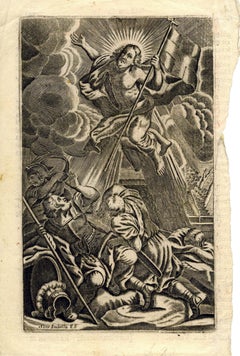
The Resurrection
Located in Middletown, NY
A rare and beautiful 18th century bible illustration by a female artist.
Engraving on cream laid paper with a "V" shaped watermark, 8 x 4 5/8 inch...
Category
Italian School 18th Century and Earlier Art
Materials
Laid Paper, Engraving
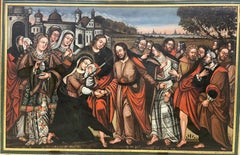
"Paesaggio classico con figure"
Located in Edinburgh, GB
16th-Century Flemish School – Biblical Scene
Medium: Oil on canvas
Dimensions: 135 x 208 cm (unframed), 150 x 220 cm (framed)
Provenance: Private collection
No signatured
Historica...
Category
Realist 18th Century and Earlier Art
Materials
Canvas, Oil
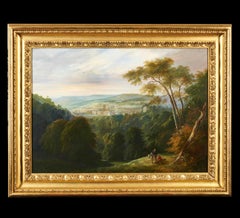
A view of Bath, England
Located in Stoke, Hampshire
Edmund Garvey (Kilkenny 1740-1813)
A view of Bath
Oil on canvas
Canvas Size 20 x 28 in
Framed Size 26 x 33 in
Edmund Garvey (1740 – 28 May 1813) was an Irish landscape painter whose...
Category
Old Masters 18th Century and Earlier Art
Materials
Oil
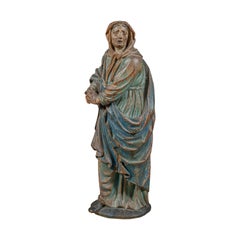
Baroque Italian master - 17/18th century figure sculpture - The Virgin
Located in Varmo, IT
Carved and painted wooden sculpture - Madonna in Prayer - Italy, 17th-18th century.
25 x 20 x 65 cm.
Made entirely of carved, lacquered, and painted wood. Some signs of wear and pa...
Category
Baroque 18th Century and Earlier Art
Materials
Wood, Paint
$2,368 Sale Price
33% Off
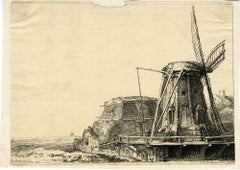
The Windmill by François Vivares, after Rembrandt
Located in Middletown, NY
Engraving on cream laid paper, 8 x 5 7/8 inches (202 x 149 mm), trimmed at the platemark. Adhered at each corner to a small sheet of archival laid paper. Horizontal edge loss at the ...
Category
Old Masters 18th Century and Earlier Art
Materials
Handmade Paper, Laid Paper, Etching
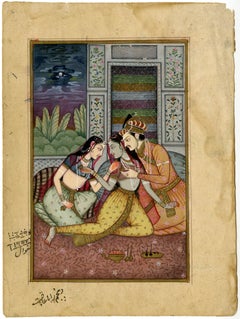
Mughal School, 18th century Emperor Jahangir with Empress Nur Jahan
concubine
Located in Middletown, NY
An illuminated page from a book likely in reference to palace life during Emperor Jahangir's reign over the Mughal Empire.
circa 1750. Gouache and ink with heightening in gold on li...
Category
Rajput 18th Century and Earlier Art
Materials
Gold
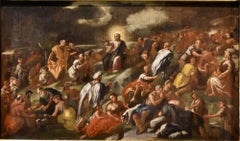
Multiplication Loaves Solimena Paint 17/8th Century Oil on canvas Old master Art
Located in Riva del Garda, IT
Angelo Solimena (Canale di Serino 1629 - Barra, 1716)
Multiplication of the Loaves and Fishes
Oil on canvas 60 x 102 cm Framed 76 x 116 cm
Work accompanied by an expert repo...
Category
Old Masters 18th Century and Earlier Art
Materials
Oil
$12,193 Sale Price
20% Off
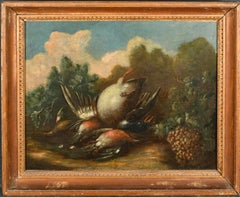
Fine 18th Century Old Master Oil Painting Dead Game in Landscape
Located in Cirencester, Gloucestershire
Still Life with Dead Birds
18th Century Italian School
oil painting on canvas, framed
framed: 17 x 21 inches
canvas: 14 x 18 inches
provenance: private collec...
Category
Old Masters 18th Century and Earlier Art
Materials
Oil
$2,021 Sale Price
20% Off
Plucking a Branch from a Neighbor
s Plum Tree
Located in Middletown, NY
A mischievous tableau with sexual overtones.
Tokyo: Shuei-Sha, 1768.
Woodblock print in colors printed on laid mulberry paper, 10 3/4 x 7 7/8 inches (273 x 200 mm), full margins. I...
Category
Edo 18th Century and Earlier Art
Materials
Watercolor, Handmade Paper, Woodcut