Woodcut Abstract Prints

to
93
218
87
88
59
64
Overall Width
to
Overall Height
to
169
127
124
14
7
7
7
2
2
1
1
30
13
11
11
11
358
158
10
11
13
14
52
49
33
39
39
332
146
25
3
1
1
1
1
1
1
1
1
4,895
7,677
3,946
3,610
2,675
67
127
378
115
Medium: Woodcut
Almanac E
Located in San Francisco, CA
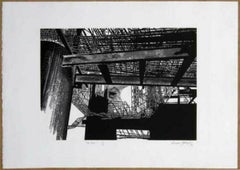
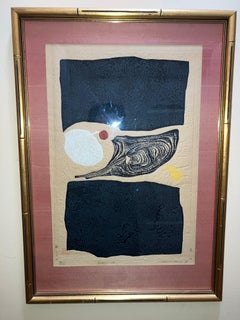
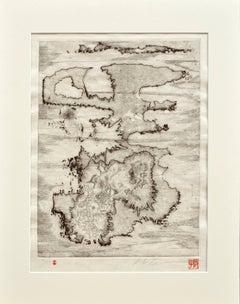
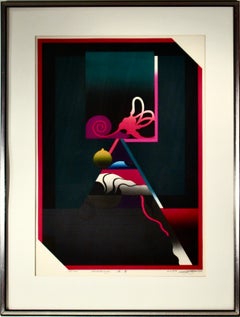
This Japanese woodblock print is by the noted sosaku hanga artist Hiroyuki Tajima (1911-1984). It measures 24 x 18 inches, (25 x 19.5 inches the sheet, 33.25 x 26.25 inches framed). ...
Category

1960s Abstract Woodcut Abstract Prints

Materials

Woodcut

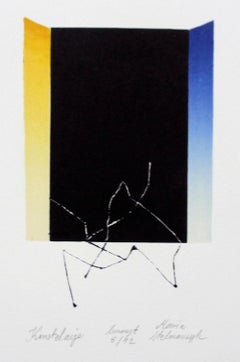
Constellation - XXI Century, Contemporary Linocut Woodcut Print, Abstract
Located in Warsaw, PL
MARIA STELMASZCZYK (born in 1983) Studies at the Faculty of Graphic Arts and Painting Laboratory of Woodcut Techniques and Artistic Book at the Academy of Fine Arts Władysław Strzemi...
Category

Early 2000s Contemporary Woodcut Abstract Prints

Materials

Paper, Linocut, Woodcut

Leonard Baskin Abstract Woodcut, Signed
Located in New York, NY
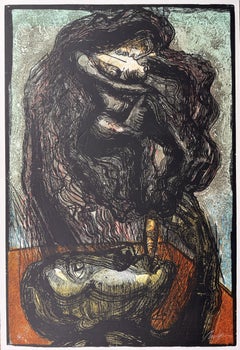
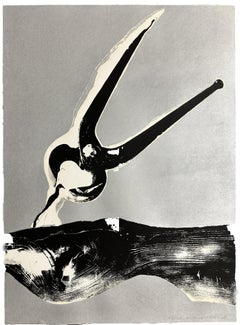
Leonard Baskin (1922-2000) Untitled, Late 20th Century Woodcut Framed: 32 x 24 1/4 x 1/4 in. Edition 26/50 Signed and numbered lower right A highly respected draftsman, printmaker, ...
Category

Late 20th Century Abstract Woodcut Abstract Prints

Materials

Woodcut

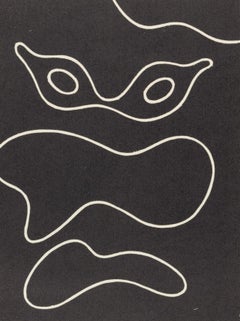
Composition (Arntz 148-175; Hagenbach A 25; Bolliger 54), Dreams and Projects
Located in Southampton, NY
Woodcut on vélin d’Arches paper. Inscription: Unsigned and unnumbered, as issued. Good condition. Notes: From the folio, Jean Arp, Dreams and Projects, 1951-1952. Published by Curt V...
Category

1950s Modern Woodcut Abstract Prints

Materials

Woodcut

Composition (Arntz 148-175; Hagenbach A 25; Bolliger 54), Dreams and Projects
Located in Southampton, NY
Woodcut on vélin d’Arches paper. Inscription: Unsigned and unnumbered, as issued. Good condition. Notes: From the folio, Jean Arp, Dreams and Projects,...
Category

1950s Modern Woodcut Abstract Prints

Materials

Woodcut

Untitled 2, Abstract Lithograph and Woodcut Print by Robert Kuszek
Located in Long Island City, NY
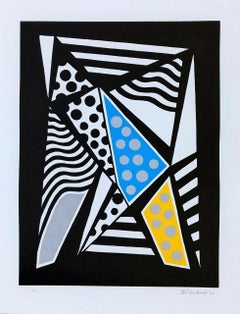
Artist: Robert Kuszek Title: Untitled 2 Year: circa 1990 Medium: Lithograph and Woodcut, Signed and numbered in Pencil Edition: 35 Paper Size:30 x 22 inches...
Category

1990s Abstract Woodcut Abstract Prints

Materials

Lithograph, Woodcut

Large Scale Abstract Figurative Landscape Woodcut, Signed Limited Edition 1/10
Located in Soquel, CA
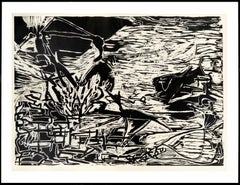
Large scale limited edition woodcut print of an an abstracted scene with landscape elements and rough figural forms including a dog, house and tree that emerge from chaotic linear ab...
Category

Late 20th Century Post-War Woodcut Abstract Prints

Materials

Paper, Woodcut, Ink

"Pills" - Outsider Pop Art - Woodblock on Paper (#5/5)
Located in Soquel, CA
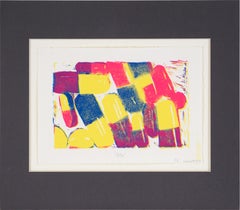
Vibrant multi-layer woodblock print by Robin Blake (American, 1955). Three layers of neon ink (yellow, magenta, and blue) form a zoomed-in composition of pills. The bright colors cre...
Category

2010s Outsider Art Woodcut Abstract Prints

Materials

Paper, Ink, Woodcut

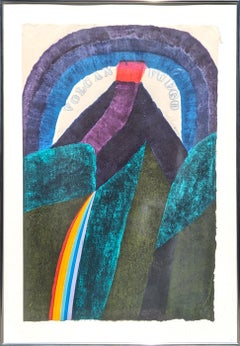
“Volcano Fuego” Modern Colorful Abstract Landscape Woodcut Print Ed. 74/75
Located in Houston, TX
Colorful abstract landscape woodcut print by modern artist Carol Summers. The work features a color blocked depiction of a volcano with a rainbow. Signed, titled, and editioned withi...
Category

1970s Contemporary Woodcut Abstract Prints

Materials

Woodcut

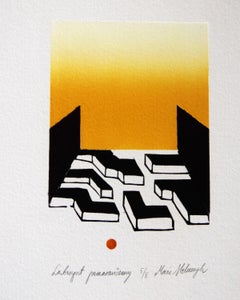
Orange labyrinth - XXI Century, Contemporary Linocut Woodcut Print, Abstract
Located in Warsaw, PL
MARIA STELMASZCZYK (born in 1983) Studies at the Faculty of Graphic Arts and Painting Laboratory of Woodcut Techniques and Artistic Book at the Academy of Fine Arts Władysław Strzemi...
Category

Early 2000s Contemporary Woodcut Abstract Prints

Materials

Paper, Linocut, Woodcut

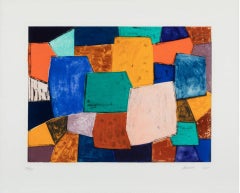
Charles Arnoldi Macchu Picchu 4 Limited Edition, Abstract Signed Print
Located in San Rafael, CA
Charles Arthur Arnoldi (b. 1946) Macchu Picchu 4, 2019 Woodcut in colors on wove paper Edition: 25/30 Signed, editioned, and dated in pencil along lower edge Printed by Peter Kosowicz, Thumbprint Editions, London Published by Harvey Bayer...
Category

21st Century and Contemporary Abstract Geometric Woodcut Abstract Prints

Materials

Woodcut

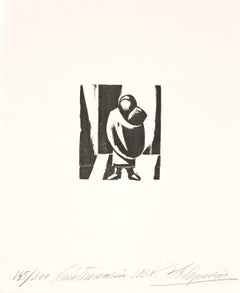
La Penitenciaria
Located in New York, NY
A very good impression of this early woodcut. Signed, titled, dated and numbered 145/300 in pencil by Siqueiros.
Category

1930s Realist Woodcut Abstract Prints

Materials

Woodcut

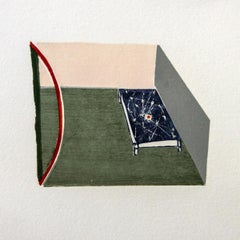
Room with a red arch - XXI Century, Contemporary Linocut Woodcut Print, Colorful
Located in Warsaw, PL
Maria Stelmaszczyk is a Polish artist born in 1983. PROVENANCE Exhibited at Katarzyna Napiorkowska Gallery. The Gallery is a primary representative for this artist. The Gallery o...
Category

Early 2000s Contemporary Woodcut Abstract Prints

Materials

Paper, Woodcut, Linocut

Bernard Lorjou "Pirouette au Galop" 1978 Expressionist Woodcut, Signed, H.C. Edn
Located in Miami, FL
BERNARD LORJOU – "PIROUETTE AU GALOP" ⚜ Woodcut ⚜ Hand Signed Lower Left ⚜ Numbered H.C. from the Edition of 80 ⚜ Conservation Frame ENERGY AND DRAMA FROM “LE CIRQUE” Created in 197...
Category

1970s Expressionist Woodcut Abstract Prints

Materials

Woodcut

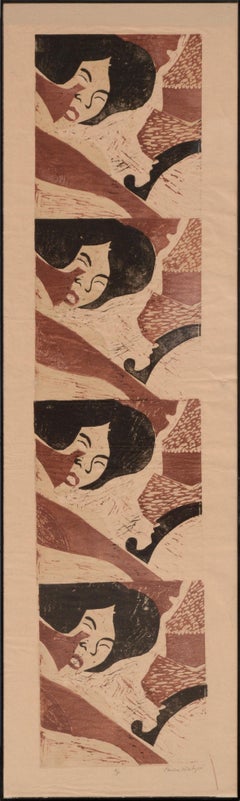
Face of a Woman, Figurative Abstract Pop Art Woodcut Portrait on Handmade Paper
Located in Soquel, CA
Face of a Woman, Figurative Abstract Pop Art Woodcut Portrait on Handmade Paper Bold pop art woodcut print on handmade paper of a woman's face in black and red, repeated in 4 vertical registers like a film strip, by Monterey Bay artist Paula Walzer...
Category

Late 20th Century Pop Art Woodcut Abstract Prints

Materials

Paper, Handmade Paper, Woodcut

Composition - Woodcut Print- Early 20th Century
Located in Roma, IT
Compositionl is an original Contemporary Artwork realized in the early 20th Century. Original B/W woodcut print on ivory-colored paper. The work is glued on cardboard. Total di...
Category

Early 20th Century Modern Woodcut Abstract Prints

Materials

Woodcut

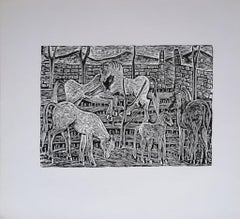
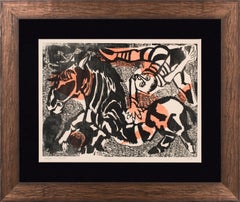
Free Horses - Woodcut Print by L. Spacal - 1940
Located in Roma, IT
Free Horses is an original Modern artwork realized by Luigi Spacal (Trieste, 1907 - Trieste, 2000) in the half of the 20th Century. Original B/W woodcut on cardboard. Excellent conditions. Lojze...
Category

1940s Woodcut Abstract Prints

Materials

Woodcut

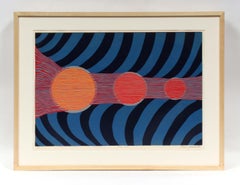
Mid Century 1960 s Original Colorful Abstract Woodblock Circles Geometric
Located in Buffalo, NY
An original Mid Century woodblock print titled "Three Suns" by American artist Toma Yovanovich. Hand signed in pencil and numbered 9 out o...
Category

1960s Abstract Geometric Woodcut Abstract Prints

Materials

Woodcut

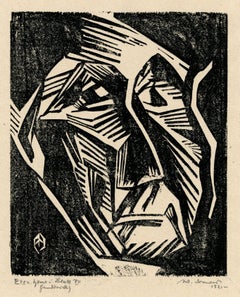
Ecce Homo VII
Located in Fairlawn, OH
Ecce Homo VII Woodcut, 1921 Signed, titled, and dated in pencil by the artist One of only three known impressions Created while the artist was studying at the Bauhaus in Weimar, Germany. Extreme rarity-One of three know impressions Note: In 1921 Drewes went to the Bauhaus in Weimar, where, after completing the compulsory preliminary course with Johannes Itten, he continued to study with Paul Klee, Oskar Schlemmer and Georg Muche and initially went to the wall painting workshop. He then traveled extensively through Europe, North America and Asia. After returning to Germany in 1927, he went back to the Bauhaus, this time to his new location in Dessau, where he studied in the classes of László Moholy-Nagy and Wassily Kandinsky. He was one of the first artists to introduce the groundbreaking concepts of the Bauhaus School in the United States through his painting, printmaking, and teaching. Condition: Excellent Missing small voids in the upper margin from removal of the original hinges. Image size: 9 7/8 x 8 3/16 inches Reference: Rose 30 Provenance: From the estate of Drewes's teacher at the Bauhaus. During the pasot WW2 the professor lived in East Germany. WERNER DREWES 1899-1985 Werner Drewes initially studied architecture before enrolling, in 1921-22, at the Bauhaus in Weimar under Klee, Kandinsky, Itten and Feininger. For four years - 1923 to 1927 - he travelled the world with his bride, before completing his Bauhaus training in Dessau in 1929. He immigrated to the United States in 1930, documenting that move to New York through series of woodcuts. In 1936/37 he was an active founder of the American Abstract Artists and participated in the Federal Arts Project in New York before moving on to a teaching career at Washington University in St. Louis. As an artist for over sixty five years, he employed various media from drawing and watercolor, through woodcut and etching, to painting and collage. Translating an early interest in subjective cubistic forms, his work evolved into nonobjective abstraction. He was creative until the day of his death. Courtesy: Toby C. Moss Werner Drewes (1899–1985) was a painter, printmaker, and art teacher. Considered to be one of the founding fathers of American abstraction, he was one of the first artists to introduce concepts of the Bauhaus school within the United States. His mature style encompassed both nonobjective and figurative work and the emotional content of this work was consistently more expressive than formal. Drewes was as highly regarded for his printmaking as for his painting. In his role as teacher as well as artist he was largely responsible for bringing the Bauhaus aesthetic to America. Early life and education Drewes was born in 1899 to Georg Drewes, a Lutheran pastor, and Martha Schaefer Drewes. The family lived in the village of Canig within Lower Lusatia, Germany. From age eight to eighteen he attended the Saldria Gymnasium, a boarding school in Brandenburg an der Havel. There, he showed talent both for painting and woodblock printing. Graduating from Saldria in 1917, he was drafted by the German army and served in France from then until the close of the war. About this period of his life he is reported to have said that the horrors of life at the front were only made tolerable by his sketchbook, a copy of Goethe's Faust and a volume of Nietzsche. For a decade following the close of the war he studied, made paintings and prints, and traveled widely. His friend, Herwarth Walden, helped shape his appreciation for expressionist literature and art. Walden produced the quarterly magazine, Der Sturm and ran a gallery of contemporary art, Galerie Der Sturm, from which, in 1919, Drewes purchased an expressionist painting by William Wauer titled Blutrausch (Bloodlust). In the same year he made the acquaintance of Heinrich Vogeler and participated in Vogeler's socialist utopian artists' commune, Barkenhoff, at Worpswede, Lower Saxony. In 1919 Drewes also enrolled at the Königlich Technischen Hochschule Charlottenburg to study architecture and the following year he studied the same subject at the Technischen Hochschule Stuttgart. Preferring art over architecture, he then enrolled in Stuttgart's school of applied arts (Kunstgewerbeschule) where he studied life drawing and learned to work with colored glass. At this time he joined a group of artists and architects associated with the newly formed Merz Akademie, a college of design, art, and media in Stuttgart. In 1921 his friendship with a French artist, Sébastien Laurent, led him to begin studies in Weimar at Bauhaus, then a new school which taught an integrated approach to the fine and applied arts. His instructors were Johannes Itten and Lyonel Feininger, whose paintings were expressionist and abstract, and Paul Klee, who taught bookbinding, stained glass, and murals. While at Bauhaus Drewes produced a portfolio of ten woodblock prints entitled "Ecce Homo." In 1923 and 1924 he studied art during travels throughout Italy, Spain, the United States, and Central America and in 1926 he traveled to San Francisco, Japan, and Korea, thence taking the Trans-Siberian railway to Manchuria, Moscow, and Warsaw. He later said the El Grecos he saw proved to be most influential in his work. While traveling, he exhibited: (1) etchings in Madrid (1923) and Montevideo (1924), oils and etchings in Buenos Aires and St. Louis (1925), and (3) etchings in San Francisco (1926). He paid his way by the sales these exhibits produced and by taking commissions to paint portraits. While in San Francisco he set up a shop from which he sold prints he had made in Spain and South America. After his return to Germany in 1927 he resumed study at Bauhaus, which had been forced to relocate in Dessau, Saxony-Anhalt. His instructors at that time were László Moholy-Nagy (metal work), Wassily Kandinsky, and (painting), and Lyonel Feininger (prints). At this time he also worked and exhibited in Frankfurt. With the rise of Nazism abstract artists found it increasingly difficult to sell their work and, in 1930, Drewes, finding the political pressure unbearable, emigrated to the United States. There, despite the world economic crisis, Drewes was able to earn a living as a professional artist. Mature style After Drewes moved to New York, Kandinsky, who was both friend and mentor, continued to exert a strong influence over his style. Later in life he said he had a hard time getting away from Kandinsky's influence as he developed his own style. In time he was able to bring a more emotional approach to his work and to base it, more than Kandinsky did, on natural forms. In 1930 Drewes had a solo exhibition at the 135th Street Branch of the New York Public Library and a two-person show at the S.P.R. Penthouse Gallery...
Category

1920s Expressionist Woodcut Abstract Prints

Materials

Woodcut

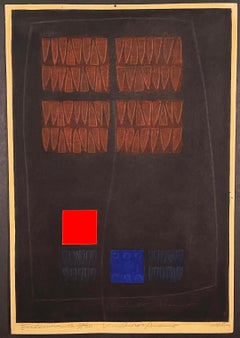
ENCLOSURE 12
By Kunihiro Amano
Located in Portland, ME
Amano, Kunihiro (Japanese, born 1929). ENCLOSURE 12. Color Woodblock, not dated. Edition of 30. Titled, Numbered 21/30, and signed in pencil. 18 x 13 1/2 inches. In excellent condit...
Category

Mid-20th Century Woodcut Abstract Prints

Materials

Woodcut

Keiji Shinohara, Accelerondo, Ukiyo-e woodcut print landscape, 2005
Located in New York, NY
Keiji Shinohara was born and raised in Osaka, Japan. After 10 years as an apprentice to the renowned Keiichiro Uesugi in Kyoto, he became a Master Printmaker and moved to the United ...
Category

21st Century and Contemporary Abstract Woodcut Abstract Prints

Materials

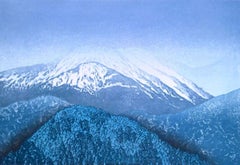
Paper, Woodcut

Blue, Ukiyo-e landscape woodcut print, 2014
Located in New York, NY
Keiji Shinohara was born and raised in Osaka, Japan. After 10 years as an apprentice to the renowned Keiichiro Uesugi in Kyoto, he became a Master Printmaker and moved to the United ...
Category

2010s Contemporary Woodcut Abstract Prints

Materials

Woodcut

Leonardo Gotleyb, ¨Ave fenix¨, 2004, Woodcut, 27.6x39 in
Located in Miami, FL
Leonardo Gotleyb (Argentina, 1958) 'Ave fenix', 2004 woodcut on paper Rives BFK 300 g. 27.6 x 39 in. (70 x 99 cm.) Edition of 15 ID: GOT-313 Hand-signed by author
Category

Early 2000s Contemporary Woodcut Abstract Prints

Materials

Paper, Screen, Woodcut

Hans Jean Arp, Yellow, from Derriere le miroir, 1950
Located in Southampton, NY
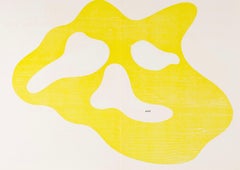
This exquisite woodcut by Hans Jean Arp (1886–1966), titled Jaune (Yellow), from the folio Derriere le miroir, No. 33, originates from the 1950 edition published by Maeght Editeur, P...
Category

1950s Modern Woodcut Abstract Prints

Materials

Woodcut

Bernardo Navarro Tomas, ¨Untitled¨, 2021, Woodcut, 27.8x21.5 in
Located in Miami, FL
Bernardo Navarro Tomas (Cuba, 1977) 'Untitled (circulos plateados)', 2021 woodcut, silkscreen on paper Guarro Biblos 250g. 27.8 x 21.5 in. (70.5 x 54.5 cm.) Edition of 20 ID: NAA-113...
Category

2010s Contemporary Woodcut Abstract Prints

Materials

Paper, Woodcut

Damien Hirst s Dog
Located in Deddington, GB
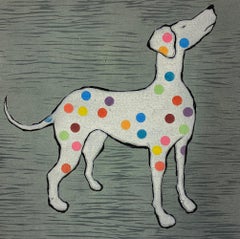
Damien Hirst’s Dog By Mychael Barratt [Mychael Barratt] limited_edition Woodcut Image size: H:50 cm x W:51 cm Complete Size of Unframed Work: H:63...
Category

21st Century and Contemporary Contemporary Woodcut Abstract Prints

Materials

Woodcut

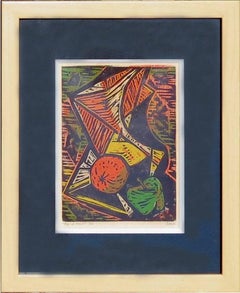
"Bag of Fruit"
Located in Lambertville, NJ
Signed Lower Right Edition # 9/18 Josef Zenk (1904 - 2000) Josef Zenk was born in New York City in 1904. After graduating from high school, he studied for three years at the Natio...
Category

20th Century Abstract Woodcut Abstract Prints

Materials

Color, Woodcut

Untitled - XX, Signed Abstract Monoprint by Charlie Hewitt
Located in Long Island City, NY
Artist: Charlie Hewitt, American (1946 - ) Title: Untitled - XX Year: circa 1995 Medium: Woodblock Monoprint, Signed in Pencil Edition: 1/1 Size: 20 x 24 in. (50.8 x 60.96 cm)
Category

1990s Abstract Woodcut Abstract Prints

Materials

Monoprint, Woodcut

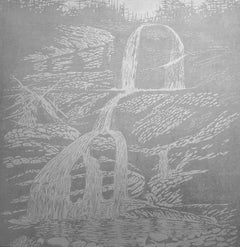
Falls Ten - Contemporary Waterfall Landscape Silver Pale Grey Blue Woodcut, 2022
Located in Kent, CT
A contemporary woodcut print of a waterfall in a forest in silver ink. The monotype brings to mind the tradition of Japanese printing while being distinctly contemporary. Edition 1...
Category

2010s Contemporary Woodcut Abstract Prints

Materials

Ink, Archival Paper, Woodcut

Untitled - G, Abstract Expressionist Woodcut by Charlie Hewitt
Located in Long Island City, NY
Artist: Charlie Hewitt, American (1946 - ) Title: Untitled Year: circa 1995 Medium: Woodblock, Signed and Numbered in Pencil Edition: 100 Image Size: 16 x 20 inches Size: 20 in. x 24...
Category

1990s Abstract Woodcut Abstract Prints

Materials

Woodcut

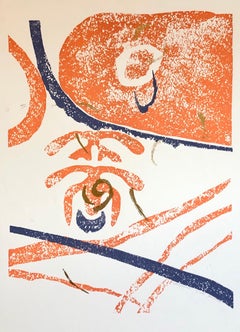
Motif, Gold Abstract African American Artist Viola Leak Woodcut Silkscreen Print
Located in Surfside, FL
Motif (Abstract) in orange, blue and gold abstract. From the small edition of 10. from 1982. I am not sure if this is a woodcut or woodblock print or a silkscreen screenprint or some combination. Viola Burley Leak, American (1944 - ) Viola Leak was born in Nashville, Tennessee, she received a B.A. in Art from Fisk University, a B.F.A. in Fashion Design from Pratt Institute, Brooklyn, an M.A. from Hunter College, NY and an M.F.A. in Media from Howard University, Washington, DC. Leak was an art consultant for both the New York State Board of Education and the Metropolitan Museum of Art's Print Department, in addition to working for the Experimental Gallery of Art at the Smithsonian Institute. Her mixed media work often references religious motifs and those of her African-American experience and heritage. She is a multimedia artist, her works include printmaking, textile designing, soft sculpture, appliqué tapestries, doll making, and multi-media. Viola has studied with many renowned artists such as Aaron Douglas, Romare Bearden, Robert Blackburn, and Charles White. Her works can be found in the collections of World Federation of United Nations, New York State Office Building, Manufacturers of Hanover Trust Company, Atlanta Life Insurance Company and many more organizations. Viola's exhibition experience is extensive - more than 100 showings over a decade, national and international. Her quilts exude a miraculous and magical presence. They have traveled in two international shows and three national quilt projects in the past three years. A proud moment for her was being featured in the December 20, 2000 of the Smithsonian magazine; the article praised her mural "Afro Dance Scan" as one of the outstanding artworks in the "When the Spirit Moves: African American Dance...
Category

1980s Contemporary Woodcut Abstract Prints

Materials

Screen, Woodcut

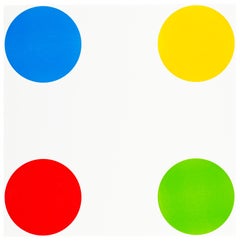
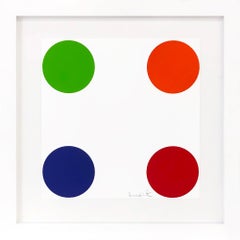
Norcamphor from “40 Woodcut Spots"
Located in Calabasas, CA
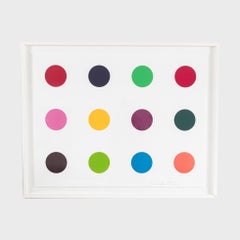
Artist: Damien Hirst Title: Norcamphor from “40 Woodcut Spots" Year: 2011 Medium: Woodcut on 410gsm Somerset White Paper Edition: 43/55; signed (recto) and numbered (verso) in penci...
Category

2010s Contemporary Woodcut Abstract Prints

Materials

Woodcut

Untiled - L, Colorful Abstract Woodblock Print by Charlie Hewitt
Located in Long Island City, NY
Artist: Charlie Hewitt, American (1946 - ) Title: Untitled - L Year: circa 1995 Medium: Woodblock, Signed and Numbered in Pencil Edition: 100 Image Size: 16 x 20 inches Size: 20 in. ...
Category

1990s Abstract Woodcut Abstract Prints

Materials

Woodcut

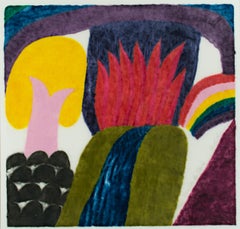
"Pura Vida" original color woodcut print signed by Carol Summers
Located in Milwaukee, WI
"Pura Vida" is an original color woodcut signed by Carol Summers. A multi-colored piece shows a waterfall with red flames behind it in the middle of the piece. On the left stands a tree with yellow leaves on a hill. To the right is a rainbow. This is an excellent example of Summer's printmaking, not just because of the technique and imagery, but because it numbered 1 of the edition of 125. In addition, it contains a personal inscription to the Milwaukee gallerist David Barnett, who has championed the work of Summers and produced catalogs of his work. Indeed, this print appears as no. 189 in the David Barnett Gallery's 1988 catalogue raisonné of Summer's woodcuts. Feel free to inquire if you would like to purchase a copy of the catalogue raisonné along with your Carol Summers print. Art: 24.25 x 24.75 in Frame: 36 x 35 in signed lower right titled and inscribed to David [Barnett] lower right edition (1/125) lower right Carol Summers (1925-2016) has worked as an artist throughout the second half of the 20th century and into the first years of the next, outliving most of his mid-century modernist peers. Initially trained as a painter, Summers was drawn to color woodcuts around 1950 and it became his specialty thereafter. Over the years he has developed a process and style that is both innovative and readily recognizable. His art is known for it’s large scale, saturated fields of bold color, semi-abstract treatment of landscapes from around the world and a luminescent quality achieved through a printmaking process he invented. In a career that has extended over half a century, Summers has hand-pulled approximately 245 woodcuts in editions that have typically run from 25 to 100 in number. His talent was both inherited and learned. Born in 1925 in Kingston, a small town in upstate New York, Summers was raised in nearby Woodstock with his older sister, Mary. His parents were both artists who had met in art school in St. Louis. During the Great Depression, when Carol was growing up, his father supported the family as a medical illustrator until he could return to painting. His mother was a watercolorist and also quite knowledgeable about the different kinds of papers used for various kinds of painting. Many years later, Summers would paint or print on thinly textured paper originally collected by his mother. From 1948 to 1951, Carol Summers trained in the classical fine and studio arts at Bard College and at the Art Students League of New York. He studied painting with Steven Hirsh and printmaking with Louis Schanker. He admired the shapes and colors favored by early modernists Paul Klee (Sw: 1879-1940) and Matt Phillips (Am: b.1927- ). After graduating, Summers quit working as a part-time carpenter and cabinetmaker (which had supported his schooling and living expenses) to focus fulltime on art. That same year, an early abstract, Bridge No. 1 was selected for a Purchase Prize in a competition sponsored by the Brooklyn Museum. In 1952, his work (Cathedral, Construction and Icarus) was shown the first time at the Museum of Modern Art in New York City in an exhibition of American woodcuts. In 1954, Summers received a grant from the Italian government to study for a year in Italy. Woodcuts completed soon after his arrival there were almost all editions of only 8 to 25 prints, small in size, architectural in content and black and white in color. The most well-known are Siennese Landscape and Little Landscape, which depicted the area near where he resided. Summers extended this trip three more years, a decision which would have significant impact on choices of subject matter and color in the coming decade. After returning from Europe, Summers’ images continued to feature historical landmarks and events from Italy as well as from France, Spain and Greece. However, as evidenced in Aetna’s Dream, Worldwind and Arch of Triumph, a new look prevailed. These woodcuts were larger in size and in color. Some incorporated metal leaf in the creation of a collage and Summers even experimented with silkscreening. Editions were now between 20 and 50 prints in number. Most importantly, Summers employed his rubbing technique for the first time in the creation of Fantastic Garden in late 1957. Dark Vision of Xerxes, a benchmark for Summers, was the first woodcut where Summers experimented using mineral spirits as part of his printmaking process. A Fulbright Grant as well as Fellowships from the Louis Comfort Tiffany Foundation and the Guggenheim Foundation followed soon thereafter, as did faculty positions at colleges and universities primarily in New York and Pennsylvania. During this period he married a dancer named Elaine Smithers with whom he had one son, Kyle. Around this same time, along with fellow artist Leonard Baskin, Summers pioneered what is now referred to as the “monumental” woodcut. This term was coined in the early 1960s to denote woodcuts that were dramatically bigger than those previously created in earlier years, ones that were limited in size mostly by the size of small hand-presses. While Baskin chose figurative subject matter, serious in nature and rendered with thick, striated lines, Summers rendered much less somber images preferring to emphasize shape and color; his subject matter approached abstraction but was always firmly rooted in the landscape. In addition to working in this new, larger scale, Summers simultaneously refined a printmaking process which would eventually be called the “Carol Summers Method” or the “ Carol Summers Technique”. Summers produces his woodcuts by hand, usually from one or more blocks of quarter-inch pine, using oil-based printing inks and porous mulberry papers. His woodcuts reveal a sensitivity to wood especially its absorptive qualities and the subtleties of the grain. In several of his woodcuts throughout his career he has used the undulating, grainy patterns of a large wood plank to portray a flowing river or tumbling waterfall. The best examples of this are Dream, done in 1965 and the later Flash Flood Escalante, in 2003. In the majority of his woodcuts, Summers makes the blocks slightly larger than the paper so the image and color will bleed off the edge. Before printing, he centers a dry sheet of paper over the top of the cut wood block or blocks, securing it with giant clips. Then he rolls the ink directly on the front of the sheet of paper and pressing down onto the dry wood block or reassembled group of blocks. Summers is technically very proficient; the inks are thoroughly saturated onto the surface of the paper but they do not run into each other. The precision of the color inking in Constantine’s Dream in 1969 and Rainbow Glacier in 1970 has been referred to in various studio handbooks. Summers refers to his own printing technique as “rubbing”. In traditional woodcut printing, including the Japanese method, the ink is applied directly onto the block. However, by following his own method, Summers has avoided the mirror-reversed image of a conventional print and it has given him the control over the precise amount of ink that he wants on the paper. After the ink is applied to the front of the paper, Summers sprays it with mineral spirits, which act as a thinning agent. The absorptive fibers of the paper draw the thinned ink away from the surface softening the shapes and diffusing and muting the colors. This produces a unique glow that is a hallmark of the Summers printmaking technique. Unlike the works of other color field artists or modernists of the time, this new technique made Summers’ extreme simplification and flat color areas anything but hard-edged or coldly impersonal. By the 1960s, Summers had developed a personal way of coloring and printing and was not afraid of hard work, doing the cutting, inking and pulling himself. In 1964, at the age of 38, Summers’ work was exhibited for a second time at the Museum of Modern Art. This time his work was featured in a one-man show and then as one of MOMA’s two-year traveling exhibitions which toured throughout the United States. In subsequent years, Summers’ works would be exhibited and acquired for the permanent collections of multiple museums throughout the United States, Europe and Asia. Summers’ familiarity with landscapes throughout the world is firsthand. As a navigator-bombardier in the Marines in World War II, he toured the South Pacific and Asia. Following college, travel in Europe and subsequent teaching positions, in 1972, after 47 years on the East Coast, Carol Summers moved permanently to Bonny Doon in the Santa Cruz Mountains in Northern California. There met his second wife, Joan Ward Toth, a textile artist who died in 1998; and it was here his second son, Ethan was born. During the years that followed this relocation, Summers’ choice of subject matter became more diverse although it retained the positive, mostly life-affirming quality that had existed from the beginning. Images now included moons, comets, both sunny and starry skies, hearts and flowers, all of which, in one way or another, remained tied to the landscape. In the 1980s, from his home and studio in the Santa Cruz mountains, Summers continued to work as an artist supplementing his income by conducting classes and workshops at universities in California and Oregon as well as throughout the Mid and Southwest. He also traveled extensively during this period hiking and camping, often for weeks at a time, throughout the western United States and Canada. Throughout the decade it was not unusual for Summers to backpack alone or with a fellow artist into mountains or back country for six weeks or more at a time. Not surprisingly, the artwork created during this period rarely departed from images of the land, sea and sky. Summers rendered these landscapes in a more representational style than before, however he always kept them somewhat abstract by mixing geometric shapes with organic shapes, irregular in outline. Some of his most critically acknowledged work was created during this period including First Rain, 1985 and The Rolling Sea, 1989. Summers received an honorary doctorate from his alma mater, Bard College in 1979 and was selected by the United States Information Agency to spend a year conducting painting and printmaking workshops at universities throughout India. Since that original sabbatical, he has returned every year, spending four to eight weeks traveling throughout that country. In the 1990s, interspersed with these journeys to India have been additional treks to the back roads and high country areas of Mexico, Central America, Nepal, China and Japan. Travel to these exotic and faraway places had a profound influence on Summers’ art. Subject matter became more worldly and nonwestern as with From Humla to Dolpo, 1991 or A Former Life of Budha, 1996, for example. Architectural images, such as The Pillars of Hercules, 1990 or The Raja’s Aviary, 1992 became more common. Still life images made a reappearance with Jungle Bouquet in 1997. This was also a period when Summers began using odd-sized paper to further the impact of an image. The 1996 Night, a view of the earth and horizon as it might be seen by an astronaut, is over six feet long and only slightly more than a foot-and-a-half high. From 1999, Revuelta A Vida (Spanish for “Return to Life”) is pie-shaped and covers nearly 18 cubic feet. It was also at this juncture that Summers began to experiment with a somewhat different palette although he retained his love of saturated colors. The 2003 Far Side of Time is a superb example of the new direction taken by this colorist. At the turn of the millennium in 1999, “Carol Summers Woodcuts...
Category

1980s Contemporary Woodcut Abstract Prints

Materials

Woodcut

Günther Förg, Untitled (Portfolio Pi) - Signed Woodcut Print, Abstract Art
Located in Hamburg, DE
Günther Förg (German, 1952-2013) Untitled (from Portfolio Pi), 1995 Medium: Woodcut on wove paper Dimensions: 80 x 60 cm Edition of 98: Hand-signed and numbered Condition: Excellent ...
Category

21st Century and Contemporary Abstract Woodcut Abstract Prints

Materials

Woodcut

"India, " Abstract Woodcut and Monotype signed by Carol Summers
Located in Milwaukee, WI
"India" is a woodcut and monotype signed by Carol Summers. Here, Summer's abstract language for landscape imagery is taken to its most extreme: The image offers a view of a highly stylized waterfall, with red water falling down behind green foliage below. A hint of light blue at the lower left suggests a continuation of the water's flow. Above, purples and yellows mist upward from the power of the water. The playfulness of the image is enhanced by Summers' signature printmaking technique, which allows the ink from the woodblock to seep through the paper, blurring the edges of each form. Summers' signature can be found in pencil at the bottom of the rightmost blue form, with the title and edition at the bottom of the leftmost blue form. A copy of this print can be found in the collection of the Fine Arts Museums of San Francisco. 37.25 x 24.88 inches, artwork 48.5 x 35.5 inches, frame Numbered 44 from the edition of 75 Carol Summers (1925-2016) has worked as an artist throughout the second half of the 20th century and into the first years of the next, outliving most of his mid-century modernist peers. Initially trained as a painter, Summers was drawn to color woodcuts around 1950 and it became his specialty thereafter. Over the years he has developed a process and style that is both innovative and readily recognizable. His art is known for it’s large scale, saturated fields of bold color, semi-abstract treatment of landscapes from around the world and a luminescent quality achieved through a printmaking process he invented. In a career that has extended over half a century, Summers has hand-pulled approximately 245 woodcuts in editions that have typically run from 25 to 100 in number. His talent was both inherited and learned. Born in 1925 in Kingston, a small town in upstate New York, Summers was raised in nearby Woodstock with his older sister, Mary. His parents were both artists who had met in art school in St. Louis. During the Great Depression, when Carol was growing up, his father supported the family as a medical illustrator until he could return to painting. His mother was a watercolorist and also quite knowledgeable about the different kinds of papers used for various kinds of painting. Many years later, Summers would paint or print on thinly textured paper originally collected by his mother. From 1948 to 1951, Carol Summers trained in the classical fine and studio arts at Bard College and at the Art Students League of New York. He studied painting with Steven Hirsh and printmaking with Louis Schanker. He admired the shapes and colors favored by early modernists Paul Klee (Sw: 1879-1940) and Matt Phillips (Am: b.1927- ). After graduating, Summers quit working as a part-time carpenter and cabinetmaker (which had supported his schooling and living expenses) to focus fulltime on art. That same year, an early abstract, Bridge No. 1 was selected for a Purchase Prize in a competition sponsored by the Brooklyn Museum. In 1952, his work (Cathedral, Construction and Icarus) was shown the first time at the Museum of Modern Art in New York City in an exhibition of American woodcuts. In 1954, Summers received a grant from the Italian government to study for a year in Italy. Woodcuts completed soon after his arrival there were almost all editions of only 8 to 25 prints, small in size, architectural in content and black and white in color. The most well-known are Siennese Landscape and Little Landscape, which depicted the area near where he resided. Summers extended this trip three more years, a decision which would have significant impact on choices of subject matter and color in the coming decade. After returning from Europe, Summers’ images continued to feature historical landmarks and events from Italy as well as from France, Spain and Greece. However, as evidenced in Aetna’s Dream, Worldwind and Arch of Triumph, a new look prevailed. These woodcuts were larger in size and in color. Some incorporated metal leaf in the creation of a collage and Summers even experimented with silkscreening. Editions were now between 20 and 50 prints in number. Most importantly, Summers employed his rubbing technique for the first time in the creation of Fantastic Garden in late 1957. Dark Vision of Xerxes, a benchmark for Summers, was the first woodcut where Summers experimented using mineral spirits as part of his printmaking process. A Fulbright Grant as well as Fellowships from the Louis Comfort Tiffany Foundation and the Guggenheim Foundation followed soon thereafter, as did faculty positions at colleges and universities primarily in New York and Pennsylvania. During this period he married a dancer named Elaine Smithers with whom he had one son, Kyle. Around this same time, along with fellow artist Leonard Baskin, Summers pioneered what is now referred to as the “monumental” woodcut. This term was coined in the early 1960s to denote woodcuts that were dramatically bigger than those previously created in earlier years, ones that were limited in size mostly by the size of small hand-presses. While Baskin chose figurative subject matter, serious in nature and rendered with thick, striated lines, Summers rendered much less somber images preferring to emphasize shape and color; his subject matter approached abstraction but was always firmly rooted in the landscape. In addition to working in this new, larger scale, Summers simultaneously refined a printmaking process which would eventually be called the “Carol Summers Method” or the “ Carol Summers Technique”. Summers produces his woodcuts by hand, usually from one or more blocks of quarter-inch pine, using oil-based printing inks and porous mulberry papers. His woodcuts reveal a sensitivity to wood especially its absorptive qualities and the subtleties of the grain. In several of his woodcuts throughout his career he has used the undulating, grainy patterns of a large wood plank to portray a flowing river or tumbling waterfall. The best examples of this are Dream, done in 1965 and the later Flash Flood Escalante, in 2003. In the majority of his woodcuts, Summers makes the blocks slightly larger than the paper so the image and color will bleed off the edge. Before printing, he centers a dry sheet of paper over the top of the cut wood block or blocks, securing it with giant clips. Then he rolls the ink directly on the front of the sheet of paper and pressing down onto the dry wood block or reassembled group of blocks. Summers is technically very proficient; the inks are thoroughly saturated onto the surface of the paper but they do not run into each other. The precision of the color inking in Constantine’s Dream in 1969 and Rainbow Glacier in 1970 has been referred to in various studio handbooks. Summers refers to his own printing technique as “rubbing”. In traditional woodcut printing, including the Japanese method, the ink is applied directly onto the block. However, by following his own method, Summers has avoided the mirror-reversed image of a conventional print and it has given him the control over the precise amount of ink that he wants on the paper. After the ink is applied to the front of the paper, Summers sprays it with mineral spirits, which act as a thinning agent. The absorptive fibers of the paper draw the thinned ink away from the surface softening the shapes and diffusing and muting the colors. This produces a unique glow that is a hallmark of the Summers printmaking technique. Unlike the works of other color field artists or modernists of the time, this new technique made Summers’ extreme simplification and flat color areas anything but hard-edged or coldly impersonal. By the 1960s, Summers had developed a personal way of coloring and printing and was not afraid of hard work, doing the cutting, inking and pulling himself. In 1964, at the age of 38, Summers’ work was exhibited for a second time at the Museum of Modern Art. This time his work was featured in a one-man show and then as one of MoMA’s two-year traveling exhibitions which toured throughout the United States. In subsequent years, Summers’ works would be exhibited and acquired for the permanent collections of multiple museums throughout the United States, Europe and Asia. Summers’ familiarity with landscapes throughout the world is firsthand. As a navigator-bombardier in the Marines in World War II, he toured the South Pacific and Asia. Following college, travel in Europe and subsequent teaching positions, in 1972, after 47 years on the East Coast, Carol Summers moved permanently to Bonny Doon in the Santa Cruz Mountains in Northern California. There met his second wife, Joan Ward Toth, a textile artist who died in 1998; and it was here his second son, Ethan was born. During the years that followed this relocation, Summers’ choice of subject matter became more diverse although it retained the positive, mostly life-affirming quality that had existed from the beginning. Images now included moons, comets, both sunny and starry skies, hearts and flowers, all of which, in one way or another, remained tied to the landscape. In the 1980s, from his home and studio in the Santa Cruz mountains, Summers continued to work as an artist supplementing his income by conducting classes and workshops at universities in California and Oregon as well as throughout the Mid and Southwest. He also traveled extensively during this period hiking and camping, often for weeks at a time, throughout the western United States and Canada. Throughout the decade it was not unusual for Summers to backpack alone or with a fellow artist into mountains or back country for six weeks or more at a time. Not surprisingly, the artwork created during this period rarely departed from images of the land, sea and sky. Summers rendered these landscapes in a more representational style than before, however he always kept them somewhat abstract by mixing geometric shapes with organic shapes, irregular in outline. Some of his most critically acknowledged work was created during this period including First Rain, 1985 and The Rolling Sea, 1989. Summers received an honorary doctorate from his alma mater, Bard College in 1979 and was selected by the United States Information Agency to spend a year conducting painting and printmaking workshops at universities throughout India. Since that original sabbatical, he has returned every year, spending four to eight weeks traveling throughout that country. In the 1990s, interspersed with these journeys to India have been additional treks to the back roads and high country areas of Mexico, Central America, Nepal, China and Japan. Travel to these exotic and faraway places had a profound influence on Summers’ art. Subject matter became more worldly and nonwestern as with From Humla to Dolpo, 1991 or A Former Life of Budha, 1996, for example. Architectural images, such as The Pillars of Hercules, 1990 or The Raja’s Aviary, 1992 became more common. Still life images made a reappearance with Jungle Bouquet in 1997. This was also a period when Summers began using odd-sized paper to further the impact of an image. The 1996 Night, a view of the earth and horizon as it might be seen by an astronaut, is over six feet long and only slightly more than a foot-and-a-half high. From 1999, Revuelta A Vida (Spanish for “Return to Life”) is pie-shaped and covers nearly 18 cubic feet. It was also at this juncture that Summers began to experiment with a somewhat different palette although he retained his love of saturated colors. The 2003 Far Side of Time is a superb example of the new direction taken by this colorist. At the turn of the millennium in 1999, “Carol Summers Woodcuts...
Category

1990s Contemporary Woodcut Abstract Prints

Materials

Monotype, Woodcut

Untitled
Located in New York, NY
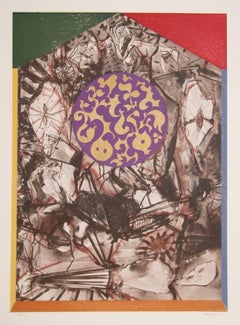
Kiki Smith 'Untitled,' 1995 Woodcut with color additions by hand 31 x 21 inches Edition 43 of 47 Signed In 1995 five well-known American artists - Donald Baechler, Julian Lethbridge...
Category

1990s Woodcut Abstract Prints

Materials

Woodcut

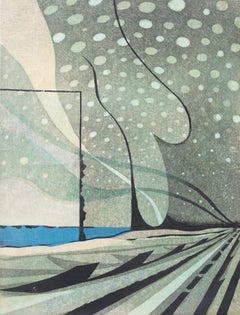
Letterio Calapai, (Sky Abstraction), 1957, mid-century wood engraving
Located in New York, NY
Letterio Calapai is widely recognized as a major American artist of the twentieth century. He is widely respected as a printmaker, especially for engravings and wood engravings, and ...
Category

1950s American Modern Woodcut Abstract Prints

Materials

Woodcut

Window by the Sea
Located in Austin, TX
By Rei Yuki Medium: Wood block print on paper Size: 27 x 21" Year: 1967 Framed
Category

1960s Woodcut Abstract Prints

Materials

Archival Paper, Woodcut

Imperfect Print for B.A.M.
Located in London, GB
Woodcut and screenprint in colours, 1987, on Arches wove paper, signed and dated in pencil from the edition of 75, published by Parasol Press, Ltd., New York, from The Brooklyn Acade...
Category

1980s Abstract Woodcut Abstract Prints

Materials

Color, Screen, Woodcut

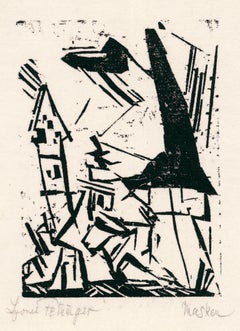
Masken (Masks) — German Expressionism, Bauhaus
Located in Myrtle Beach, SC
Lyonel Feininger, 'Masken (Masks)' also 'Carnival Masks', woodcut, 1920, proofs only. Prasse W193. Signed and titled in pencil. Annotated '1973', the artist’s inventory number. A fin...
Category

1920s Bauhaus Woodcut Abstract Prints

Materials

Woodcut

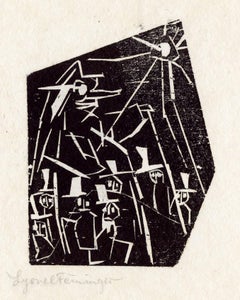
Da - Da I — German Expressionism, Rare
Located in Myrtle Beach, SC
Lyonel Feininger, 'Da-Da I' also titled by the artist 'Der Abgott' (The Idol), woodcut, 1918, a proof impression. Prasse W91. Signed in pencil and annotated '1876', the artist’s inv...
Category

1920s Bauhaus Woodcut Abstract Prints

Materials

Woodcut

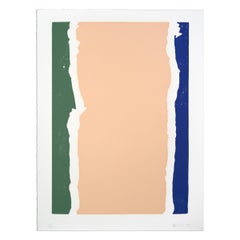
Jojoba Bean Oil (Rare Framed Woodcut)
Located in Aventura, FL
Color woodcut on 410 gsm somerset white paper. Hand signed lower right by Damien Hirst. Hand numbered 38/55 on verso. From the "40 Woodcut Spots" series published by Paragon Press...
Category

Early 2000s Pop Art Woodcut Abstract Prints

Materials

Woodcut

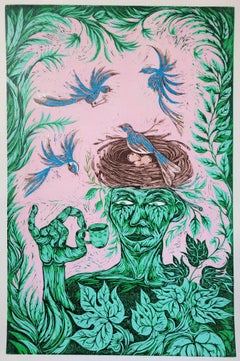
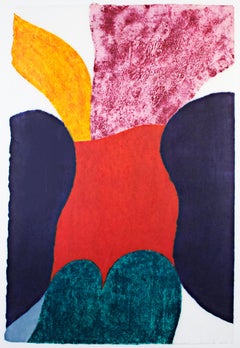
Surrealist Woodblock Print Royal College of Art LGBTQ+ Female Blue Green Birds
Located in Norfolk, GB
Isabel Rock is a creator of contemporary fairy tales. A graduate of the Royal College of Art in London, her work is an explosion of strange occurrences while a surreal narrative take...
Category

2010s Surrealist Woodcut Abstract Prints

Materials

Woodcut, Mixed Media

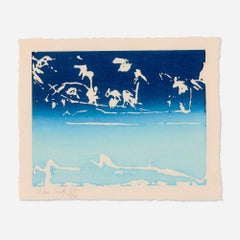
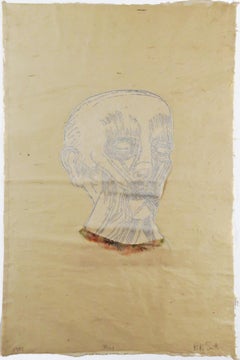
Coleman Pond III
Located in Miami, FL
Alex Katz (b. 1927) Coleman Pond III (Bauer 446) Heliorelief woodcut on tosa washi hanga natural paper Signed and numbered “Pres 1/6” in the lower margin. Printed by Tom Pruitt, G...
Category

21st Century and Contemporary Abstract Woodcut Abstract Prints

Materials

Etching, Woodcut

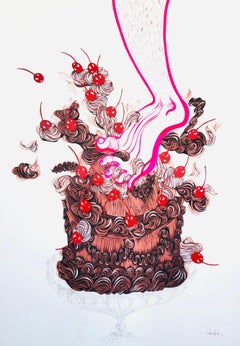
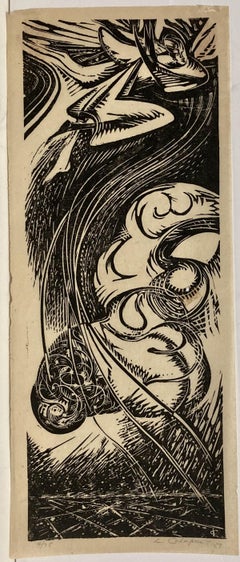
Surrealist Print Royal College of Art LGBTQ+ Female Celebration Cake Foot
Located in Norfolk, GB
Isabel Rock is a creator of contemporary fairy tales. A graduate of the Royal College of Art in London, her work is an explosion of strange occurrences while a surreal narrative take...
Category

2010s Surrealist Woodcut Abstract Prints

Materials

Mixed Media, Woodcut, Archival Ink, Archival Paper

Haku Maki Poem-12 Woodcut
Located in San Francisco, CA
Haku Maki: 1924-2000. Well, listed Japanese artist most notable for these incredible embossed woodcuts. They are titled after a series of poems. this one is titled Poem-12. It measur...
Category

1960s Abstract Woodcut Abstract Prints

Materials

Woodcut

Methionine, from 12 Woodcut Spots Damien Hirst Spot Print, YBA Abstract print
Located in Bristol, GB
Woodcut in colours on Somerset White paper Edition of 48 Signed on the front Artwork in mint condition. Artwork not inspected outside of frame. Minor scratches throughout frame Float...
Category

21st Century and Contemporary Contemporary Woodcut Abstract Prints

Materials

Woodcut

CALLED BY SAKE (C.70)
Located in Aventura, FL
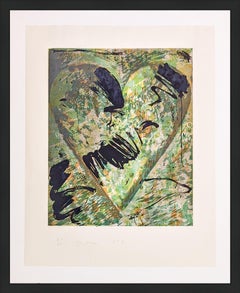
Woodcut, collagraph and photo-engraving in colors, on Rives Lightweight Cream paper, with full margins. Hand signed, dated and numbered lower front by Jim Dine. From the edition of...
Category

1990s Pop Art Woodcut Abstract Prints

Materials

Paper, Engraving, Woodcut

CALLED BY SAKE (C.70)
$7,960 Sale Price
20% Off
Blue Trees
Located in Bournemouth, Dorset
Martyn Brewster (b.1952) 'Blue Trees ' Carborundum & relief print 2025 Image 20.0 x20.0 cm Edition 60 Unframed Martyn Brewster’s abstract paintings are strongly linked to the Englis...
Category

2010s Abstract Woodcut Abstract Prints

Materials

Woodcut

Woman of the tobacco, 2012 original signed woodcut collagraph engraving 49x33 in
Located in Miami, FL
Nelson Dominguez (Cuban, 1947) 'La mujer del tabaco', 2012 Wood printing and collagraph 124.5 x 84.5 cm. (49 x 33.3 in.) Edition of 10 Unframed
Category

2010s Contemporary Woodcut Abstract Prints

Materials

Woodcut

Mid Century Islands Woodblock
Located in Soquel, CA
Abstract woodblock print, artist proof, by K. N. Tsukamoto. Presented in an archival mat. Image, 21.25"H x 16.75"W.
Category

1950s Abstract Woodcut Abstract Prints

Materials

Woodcut

Alex Katz, Night (from Northern Landscapes): Woodcut, Pop Art, Signed Print
Located in Hamburg, DE
Alex Katz (American, born 1927) Night (from Northern Landscapes), 1994 Medium: Woodcut in colors, on Japan paper Dimensions: 51 × 40.5 cm (20 1/10 × 15 9/10 in) Edition of 100: Hand-...
Category

20th Century Pop Art Woodcut Abstract Prints

Materials

Woodcut

Clench 1969 linocut screen print
Located in Rochester Hills, MI
Michael Rothenstein Clench – 1969 Print – Colour linocut, photo screenprint black 23” x 31.25” Edition: Signed in pencil and marked 44/125 Unframed in Good Condition. Condition no...
Category

1960s Modern Woodcut Abstract Prints

Materials

Woodcut

Albert Irvin - Nebraska I
Located in London, GB
Albert Irvin Nebraska I, 2008 screenprint and woodblock 58 x 56.5 cm - sheet 74.2 x 77.2 cm - mount Edition of 35 hand-signed, numbered, titled and dated on the front. publishers bl...
Category

Early 2000s Abstract Woodcut Abstract Prints

Materials

Screen, Woodcut

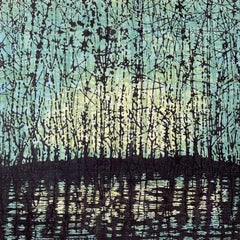
Stream 61, Forest, Stream, Light Teal Green, Yellow, Dark Eggplant Purple
Located in Kent, CT
This is a unique woodcut print of a forest and stream in dark eggplant purple offset by a minty light teal greenish blue and pale yellow background. The monotype brings to mind the t...
Category

2010s Abstract Woodcut Abstract Prints

Materials

Ink, Archival Paper, Woodcut

Large Abstract Woodblock Print American Woman Modernist
Located in Surfside, FL
Katherine Porter is an American artist born in Cedar Rapids, Iowa in 1941. She received her BA from Colorado College in 1963. Katherine Porter received an honorary doctorate from Col...
Category

20th Century Abstract Expressionist Woodcut Abstract Prints

Materials

Woodcut

"The Infinite Island" Artist Proof engraving abstract texture 42x71in (video)
Located in Miami, FL
"Carlos Garcia de la Nuez (Cuba, 1959) 'La Isla Infinita', 2014 P/A (Artist Proof) woodcut and collagraph on paper Velin Arches 300 g. 42.2 x 70.9 in. (107 x 180 cm.) Edition of 20 I...
Category

2010s Contemporary Woodcut Abstract Prints

Materials

Woodcut

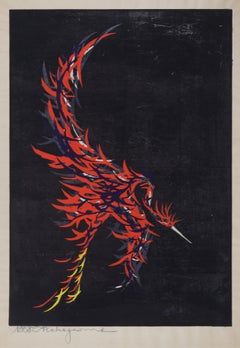
Keshin (Incarnation (Moku)
Located in Fairlawn, OH
Keshin (Incarnation (Moku) Color woodcut, 1958 Signed and dated lower left in pencil (see photo) An impression is in the collectionof the Asian Art Museum, No. 2012.93, which is not a richly inked s this impression. Another impression is in the National Museum of Art, Smithsonian, accession no. S2019.3.1297 A third impression is in the collectionof the Art Gallery of Greater Victoria This appears to be the best and most colorful impression of the museum holdings. The image is thought to depict a flying crame Condition: Wrinkles to large sheet of handmade paper. Not objectionable. Image size: 29 15/16 x 21 1/4 inches Sheet size: 37 3/8 x 27 1/4 inches Reference: Tadashi Nakiyama Life & Work, Plate F Tadashi Nakayama - Sosaku hanga artist Tadashi Nakayama initially studied oil painting at Tama Art College, but began creating woodblock prints in 1951. In the 1960s, he traveled to Turkey, Greece, England, and Italy, absorbing influences from Persian and Byzantine art and the renaissance master Paolo Ucello. Throughout his long career, his subjects have included flowers, butterflies, women, and perhaps most famously, horses...
Category

1950s Abstract Woodcut Abstract Prints

Materials

Woodcut

Anatomy
Located in San Francisco, CA
This artwork titled "Anatomy" 1993, is an original colors woodcut on paper by noted Japanese artist Akira Kurosaki, 1937-2019. It is hand signed, dated, titled and numbered 64/95 in ...
Category

Late 20th Century Abstract Woodcut Abstract Prints

Materials

Woodcut

Woodcut abstract prints for sale on 1stDibs.

Find a wide variety of authentic Woodcut abstract prints available on 1stDibs. While artists have worked in this medium across a range of time periods, art made with this material during the 21st Century is especially popular. If you’re looking to add Abstract prints created with this material to introduce a provocative pop of color and texture to an otherwise neutral space in your home, the works available on 1stDibs include elements of blue, orange, red, purple and other colors. There are many well-known artists whose body of work includes ceramic sculptures. Popular artists on 1stDibs associated with pieces like this include Eve Stockton, Manuel Amorim, Charlie Hewitt, and Carol Summers. Frequently made by artists working in the Contemporary, Abstract, all of these pieces for sale are unique and many will draw the attention of guests in your home. Not every interior allows for large Woodcut abstract prints, so small editions measuring 0.02 inches across are also available