1930s Animal Prints
to
17
142
12
7
5
2
Overall Width
to
Overall Height
to
79
37
9
4
1
1
31
8
5
3
3
709
1,435
2,634
1,851
31
29
67
169
102
136
246
605
363
333
678
128
39
73
53
41
39
37
25
24
19
15
15
11
11
11
6
5
5
5
4
4
4
113
23
15
12
11
11
2
65
29
Period: 1930s
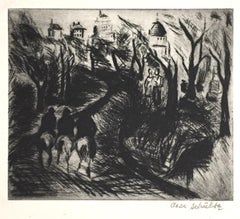
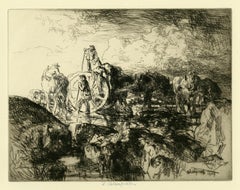
A. Schultz, Riders in Central Park (New York City)
Located in New York, NY
Such an innovative image on the classic 'Riders in the Park' theme! Further, the use of drypoint and the rather direct -- even aggressive -- drawing style, bring it into the German E...
Category
American Modern 1930s Animal Prints
Materials
Drypoint
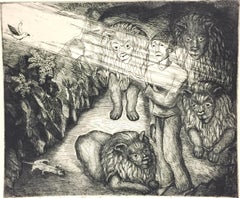
Daniel in the Lions
Den
Located in New York, NY
Ukrainian-born, lower East Side based, Sarah Berman was active on the NYC-WPA and in artists' circles. Daniel in the Lions' Den is an etching, signed and ...
Category
Ashcan School 1930s Animal Prints
Materials
Etching
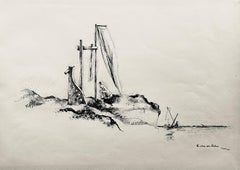
Jean Lurcat, The Raft of the Medusa, from Eight Drawings, 1933 (after)
By Jean Lurçat
Located in Southampton, NY
This exquisite heliogravure after Jean Lurcat (1892–1966), titled Le Radeau de la Meduse (The Raft of the Medusa), from the folio Jean Lurcat Huit Dessins (Jean Lurcat Eight Drawings...
Category
Surrealist 1930s Animal Prints
Materials
Lithograph

$716 Sale Price
20% Off
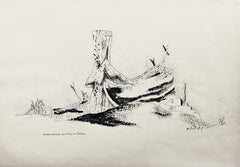
Jean Lurcat, Final Monuments to the Victims, from Eight Drawings, 1933 (after)
By Jean Lurçat
Located in Southampton, NY
This exquisite heliogravure after Jean Lurcat (1892–1966), titled Derniers Monuments aux Victimes (Final Monuments to the Victims), from the folio Jean Lurcat Huit Dessins (Jean Lurc...
Category
Surrealist 1930s Animal Prints
Materials
Lithograph
$716 Sale Price
20% Off
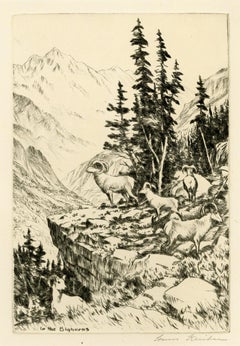
In th Bighorns (Wyoming)
Located in Fairlawn, OH
In th Bighorns (Wyoming)
Drypoint, c. 1930's
Signed in pencil lower right (see photo)
Titled in the plate lower left
Condition: Excellent
Image/Plate size: 6 3/8 x 4 3/8 inches
Hans Kleiber (1887-1967)
Hans Norbert Kleiber, painter, etcher, illustrator, and naturalist, was born in Cologne, Germany on August 24, 1887. He emigrated from Germany to the United States in 1900, settling in Massachusetts before moving to Wyoming. Kleiber first worked in lumber camps before working for the United States Forest Service from 1906 until 1924. One of his duties as a ranger was to monitor the logging camps in the Bighorn Mountains.
Kleiber was primarily self-taught as an artist and it was in the 1920s that he began devoting himself to art. It appears that he first began to work in watercolor and oil but was producing etchings and drypoints as early as 1924. He traversed the mountains of Wyoming, Montana, and Idaho, and his subjects are drawn from the pristine landscapes and wildlife.
Kleiber's first exhibition of his etchings was mounted in 1928 at Goodspeed's Book Shop in Boston. His etching, Crossing the Platte, was included in the 1939 New York World's Fair exhibition, American Art Today. There was an exhibition of fifty of his etchings at the National Museum in 1944, and an exhibition of his watercolors was mounted at the Grand Central Galleries in New York in 1950. Kleiber was a member of the Society of American Etchers and the California Society of Printmakers. He received a silver medal in 1931 from the Printmakers Society of California for his print, Leaving the High Country...
Category
American Realist 1930s Animal Prints
Materials
Drypoint
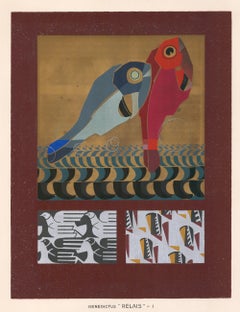
Goldfish Pochoir from Relais
Located in New York, NY
Benedictus, Edouard.
Relais.
Plate 1.
Paris, Éditions Vincent, Fréal et Cie, 1930.
Original pochoir, printed by J. Saudé.
Category
Art Deco 1930s Animal Prints
Materials
Paper
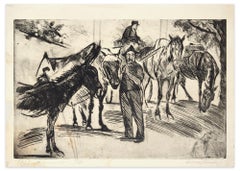
Il Barocciaio - Etching and Drypoint by A. Checchi - 1939
Located in Roma, IT
Il barrocciaio is a superb etching, drypoint and burin on an ivory-colored laid paper, realized in 1939 by the Italian artist Arturo Checchi (1886-1971)...
Category
1930s Animal Prints
Materials
Drypoint, Etching
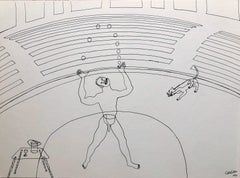
Alexander Calder Circus Reproduction Lithograph After a Drawing
Located in Surfside, FL
(after) Alexander Calder
"Calder's Circus" offset lithograph on wove paper after drawings by the artist
Published by Art in America and Perls gallery in 1964 (from drawings done in the 1930's)
these range slightly in size but they are all about 13 X 17 inches (with minor variations in size as issued.) These have never been framed. The outer folio is not included just the one lithograph.
James Sweeny from the introduction “The fame of Calder’s circus spread quickly between the years 1927 and 1930. All the Paris art world came to know it. It brought him his first great personal success. But what was more important, the circus also provided the first steps in Calder’s development as an original sculptor”
Clive Gray wrote ”A visit to the studio of Alexander Calder led to the chance discovery of some hundred masterful circus drawings completed over thirty years ago. We publish, for the first time, a choice of sixteen from that group.” With signed introduction by Miro.
These whimsical drawings, done in the style of wire sculpture, include acrobats, clowns, jugglers, trapeeze artists, an elephant, dog and lion. they are great.
Alexander Calder is widely considered to be one of the most important American sculptors of the 20th century. He is best known for his colorful, whimsical abstract public sculptures and his innovative mobiles, kinetic sculptures powered by motors or air currents, which embraced chance in their aesthetic. Born into a family of accomplished artists, Calder's work first gained attention in Paris in the 1930s and was soon championed by the Museum of Modern Art in New York, resulting in a retrospective exhibition in 1943. Major retrospectives were also held at the Solomon R. Guggenheim Museum (1964) and the Museum of Contemporary Art, Chicago (1974). Calder’s work is in many permanent collections, most notably in the Whitney Museum of American Art, but also the Guggenheim Museum; the Museum of Modern Art; the National Gallery of Art, Washington, D.C.; and the Centre Georges Pompidou. He produced many large public works, including .125 (at JFK Airport, 1957), Pittsburgh (Carnegie International prize winner 1958, Pittsburgh International Airport) Spirale (UNESCO in Paris, 1958), Flamingo and Universe (both in Chicago, 1974), and Mountains and Clouds (Hart Senate Office Building, Washington, D.C., 1976). Although primarily known for his sculpture, Calder was a prodigious artist with a restless creative spirit, whose diverse practice included painting and printmaking, miniatures (such as his famous Cirque Calder), children’s book illustrations, theater set design, jewelry design, tapestry and rug works, and political posters. Calder was honored by the US Postal Service with a set of five 32-cent stamps in 1998, and received the Presidential Medal of Freedom, posthumously in 1977, after refusing to receive it from Gerald Ford one year earlier in protest of the Vietnam War.
Calder moved to New York and enrolled at the Art Students League, studying briefly with Thomas Hart Benton, George Luks, Kenneth Hayes Miller, and John Sloan. While a student, he worked for the National Police Gazette where, in 1925, one of his assignments was sketching the Ringling Bros. and Barnum & Bailey Circus. Calder became fascinated with the action of the circus, a theme that would reappear in his later work.
In 1926, Calder moved to Paris, enrolled in the Académie de la Grande Chaumière, and established a studio at 22 rue Daguerre in the Montparnasse Quarter. In June 1929, while traveling by boat from Paris to New York, Calder met his future wife, Louisa James (1905-1996), grandniece of author Henry James and philosopher William James. They married in 1931. While in Paris, Calder met and became friends with a number of avant-garde artists, including Fernand Léger, Jean Arp, and Marcel Duchamp. Cirque Calder (on view at the Whitney Museum of American Art at present) became popular with the Parisian avant-garde. He also invented wire sculpture, or "drawing in space," and in 1929 he had his first solo show of these sculptures in Paris at Galerie Billiet. Hi! (Two Acrobats) in the collection of the Honolulu Museum of Art is an early example of the artist's wire sculpture. The painter Jules Pascin, a friend of Calder's from the cafes of Montparnasse, wrote the preface to the catalog. A visit to Piet Mondrian's studio in 1930, where he was impressed by the environment-as-installation, "shocked" him into fully embracing abstract art, toward which he had already been tending.
Dating from 1931, Calder’s sculptures of discrete movable parts powered by motors were christened “mobiles” by Marcel Duchamp, a French pun meaning both "motion" and "motive." At the same time, Calder was also experimenting with self-supporting, static, abstract sculptures, dubbed "stabiles" by Jean Arp in 1932 to differentiate them from mobiles.
Public commissions increasingly came his way in the 1960s. Notable examples are .125 for JFK Airport in 1957, Spirale for UNESCO in Paris 1958 and Trois disques, commissioned for Expo 67 in Montreal, Quebec, Canada. Calder's largest sculpture at 25.7 meters high was El Sol Rojo, constructed outside the Aztec Stadium for the 1968 Summer Olympics "Cultural Olympiad" events in Mexico City. Many of his public works were commissioned by renowned architects; I.M. Pei commissioned his La Grande Voile (1966), a 25-ton, 40-foot high stabile for the Massachusetts Institute of Technology.
Part of Calder's repertoire includes pivotal stage sets for more than a dozen theatrical productions, including Nucléa, Horizon, and most notably, Martha Graham’s Panorama (1935), a production of the Erik Satie symphonic drama Socrate (1936), and later, Works in Progress (1968).
In addition to sculptures, Calder painted throughout his career, beginning in the early 1920s. He picked up his study of printmaking in 1925, and continued to produce illustrations for books and journals.As Calder’s professional reputation expanded in the late 1940s and 1950s, so did his production of prints. Masses of lithographs based on his gouache paintings hit the market, and deluxe editions of plays, poems, and short stories illustrated with fine art prints by Calder became available for sale.
One of Calder's most celebrated and unconventional undertakings was a commission from Dallas-based Braniff International Airways to paint a full-size Douglas DC-8-62 four-engined jet as a "flying canvas."
Calder created over 2,000 pieces of jewelry over the course of his career, many of them as gifts for friends and relatives. For his lifelong friend Joan Miró, he set a shard of a broken porcelain vessel in a brass ring. Peggy Guggenheim received enormous silver mobile earrings and later commissioned a hammered silver headboard...
Category
American Modern 1930s Animal Prints
Materials
Lithograph
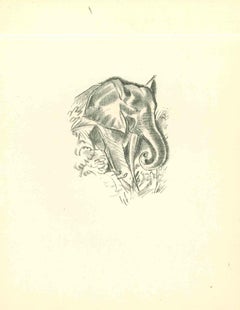
Elephant - Original Lithograph by Emmanuel Gondouin - 1930s
Located in Roma, IT
Elephant is an original lithograph realized in the early 1930s by Emmanuel Gondouin, (Versailles, 1883 - Parigi, 1934)
The artwork is depicted through strong strokes and is part of...
Category
Modern 1930s Animal Prints
Materials
Lithograph
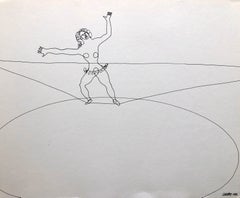
Alexander Calder Circus Reproduction Lithograph of a Drawing
Located in Surfside, FL
(after) Alexander Calder
"Calder's Circus" offset lithograph on wove paper a reproduction lithograph after the drawings by the artist
Published by Art in America and Perls gallery in 1964 (from drawings done in the 1930's)
these range slightly in size but they are all about 13 X 17 inches (with minor variations in size as issued.) These have never been framed. The outer folio is not included just the one lithograph.
James Sweeny from the introduction “The fame of Calder’s circus spread quickly between the years 1927 and 1930. All the Paris art world came to know it. It brought him his first great personal success. But what was more important, the circus also provided the first steps in Calder’s development as an original sculptor”
Clive Gray wrote ”A visit to the studio of Alexander Calder led to the chance discovery of some hundred masterful circus drawings completed over thirty years ago. We publish, for the first time, a choice of sixteen from that group.” With signed introduction by Miro.
These whimsical drawings, done in the style of wire sculpture, include acrobats, clowns, jugglers, trapeeze artists, an elephant, dog and lion. they are great.
Alexander Calder is widely considered to be one of the most important American sculptors of the 20th century. He is best known for his colorful, whimsical abstract public sculptures and his innovative mobiles, kinetic sculptures powered by motors or air currents, which embraced chance in their aesthetic. Born into a family of accomplished artists, Calder's work first gained attention in Paris in the 1930s and was soon championed by the Museum of Modern Art in New York, resulting in a retrospective exhibition in 1943. Major retrospectives were also held at the Solomon R. Guggenheim Museum (1964) and the Museum of Contemporary Art, Chicago (1974). Calder’s work is in many permanent collections, most notably in the Whitney Museum of American Art, but also the Guggenheim Museum; the Museum of Modern Art; the National Gallery of Art, Washington, D.C.; and the Centre Georges Pompidou. He produced many large public works, including .125 (at JFK Airport, 1957), Pittsburgh (Carnegie International prize winner 1958, Pittsburgh International Airport) Spirale (UNESCO in Paris, 1958), Flamingo and Universe (both in Chicago, 1974), and Mountains and Clouds (Hart Senate Office Building, Washington, D.C., 1976). Although primarily known for his sculpture, Calder was a prodigious artist with a restless creative spirit, whose diverse practice included painting and printmaking, miniatures (such as his famous Cirque Calder), children’s book illustrations, theater set design, jewelry design, tapestry and rug works, and political posters. Calder was honored by the US Postal Service with a set of five 32-cent stamps in 1998, and received the Presidential Medal of Freedom, posthumously in 1977, after refusing to receive it from Gerald Ford one year earlier in protest of the Vietnam War.
Calder moved to New York and enrolled at the Art Students League, studying briefly with Thomas Hart Benton, George Luks, Kenneth Hayes Miller, and John Sloan. While a student, he worked for the National Police Gazette where, in 1925, one of his assignments was sketching the Ringling Bros. and Barnum & Bailey Circus. Calder became fascinated with the action of the circus, a theme that would reappear in his later work.
In 1926, Calder moved to Paris, enrolled in the Académie de la Grande Chaumière, and established a studio at 22 rue Daguerre in the Montparnasse Quarter. In June 1929, while traveling by boat from Paris to New York, Calder met his future wife, Louisa James (1905-1996), grandniece of author Henry James and philosopher William James. They married in 1931. While in Paris, Calder met and became friends with a number of avant-garde artists, including Fernand Léger, Jean Arp, and Marcel Duchamp. Cirque Calder (on view at the Whitney Museum of American Art at present) became popular with the Parisian avant-garde. He also invented wire sculpture, or "drawing in space," and in 1929 he had his first solo show of these sculptures in Paris at Galerie Billiet. Hi! (Two Acrobats) in the collection of the Honolulu Museum of Art is an early example of the artist's wire sculpture. The painter Jules Pascin, a friend of Calder's from the cafes of Montparnasse, wrote the preface to the catalog. A visit to Piet Mondrian's studio in 1930, where he was impressed by the environment-as-installation, "shocked" him into fully embracing abstract art, toward which he had already been tending.
Dating from 1931, Calder’s sculptures of discrete movable parts powered by motors were christened “mobiles” by Marcel Duchamp, a French pun meaning both "motion" and "motive." At the same time, Calder was also experimenting with self-supporting, static, abstract sculptures, dubbed "stabiles" by Jean Arp in 1932 to differentiate them from mobiles.
Public commissions increasingly came his way in the 1960s. Notable examples are .125 for JFK Airport in 1957, Spirale for UNESCO in Paris 1958 and Trois disques, commissioned for Expo 67 in Montreal, Quebec, Canada. Calder's largest sculpture at 25.7 meters high was El Sol Rojo, constructed outside the Aztec Stadium for the 1968 Summer Olympics "Cultural Olympiad" events in Mexico City. Many of his public works were commissioned by renowned architects; I.M. Pei commissioned his La Grande Voile (1966), a 25-ton, 40-foot high stabile for the Massachusetts Institute of Technology.
Part of Calder's repertoire includes pivotal stage sets for more than a dozen theatrical productions, including Nucléa, Horizon, and most notably, Martha Graham’s Panorama (1935), a production of the Erik Satie symphonic drama Socrate (1936), and later, Works in Progress (1968).
In addition to sculptures, Calder painted throughout his career, beginning in the early 1920s. He picked up his study of printmaking in 1925, and continued to produce illustrations for books and journals.As Calder’s professional reputation expanded in the late 1940s and 1950s, so did his production of prints. Masses of lithographs based on his gouache paintings hit the market, and deluxe editions of plays, poems, and short stories illustrated with fine art prints by Calder became available for sale.
One of Calder's most celebrated and unconventional undertakings was a commission from Dallas-based Braniff International Airways to paint a full-size Douglas DC-8-62 four-engined jet as a "flying canvas."
Calder created over 2,000 pieces of jewelry over the course of his career, many of them as gifts for friends and relatives. For his lifelong friend Joan Miró, he set a shard of a broken porcelain vessel in a brass ring. Peggy Guggenheim received enormous silver mobile earrings and later commissioned a hammered silver headboard...
Category
American Modern 1930s Animal Prints
Materials
Lithograph
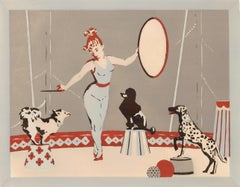
Dog Circus Print
Located in New York, NY
Color stencil print titled "Dog Circus" by Andrée Ruellan (1905-2006). New York, American Artists Group, Inc., circa 1936. Unsigned. Presented in an arc...
Category
1930s Animal Prints
Materials
Paper
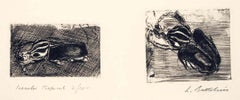
Scarabei Tropicali - Etching by Luigi Bartolini - 1930
Located in Roma, IT
Image dimensions: 6.5 x 11 - 8.5 x 10 cm.
Scarabei Tropicali (Tropical Beetles) is an original artwork realized by the great Italian engraver and poet Luigi Bartolini in 1930.
V...
Category
1930s Animal Prints
Materials
Etching
A Jersey Vraic Cart
Located in Fairlawn, OH
A Jersey Vraic Cart
Etching, 1939
Signed lower center margin (see photo)
Signed and dated in the plate (see photo)
Edition 250 plus 10 on J. Whatman laid paper
Printed by David Stran...
Category
English School 1930s Animal Prints
Materials
Etching
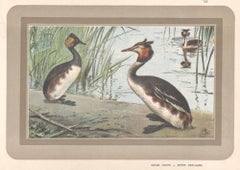
Great Crested Grebe, French antique natural history water bird art print
Located in Melbourne, Victoria
Grebe Huppe - Grebe Oreillard - Great Crested Grebe
French chromolithograph, published in 1931. Printed title lower right of sheet. Plate number top right. From a French series of i...
Category
Art Deco 1930s Animal Prints
Materials
Lithograph
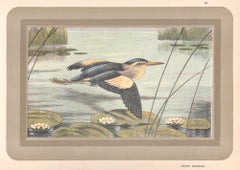
Little Bittern, French antique natural history water bird art print
Located in Melbourne, Victoria
Heron Blongios - Little Bittern
French chromolithograph, published in 1931. Printed title lower right of sheet. Plate number top right. From a French series of illustrations of bird...
Category
Art Deco 1930s Animal Prints
Materials
Lithograph
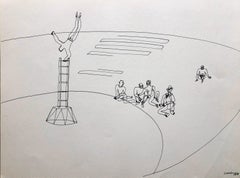
Alexander Calder Circus Reproduction Lithograph After a Drawing
Located in Surfside, FL
(after) Alexander Calder
"Calder's Circus" offset lithograph on wove paper after drawings by the artist
Published by Art in America and Perls gallery in 1964 (from drawings done in the 1930's)
these range slightly in size but they are all about 13 X 17 inches (with minor variations in size as issued.) These have never been framed. The outer folio is not included just the one lithograph.
James Sweeny from the introduction “The fame of Calder’s circus spread quickly between the years 1927 and 1930. All the Paris art world came to know it. It brought him his first great personal success. But what was more important, the circus also provided the first steps in Calder’s development as an original sculptor”
Clive Gray wrote ”A visit to the studio of Alexander Calder led to the chance discovery of some hundred masterful circus drawings completed over thirty years ago. We publish, for the first time, a choice of sixteen from that group.” With signed introduction by Miro.
These whimsical drawings, done in the style of wire sculpture, include acrobats, clowns, jugglers, trapeeze artists, an elephant, dog and lion. they are great.
Alexander Calder is widely considered to be one of the most important American sculptors of the 20th century. He is best known for his colorful, whimsical abstract public sculptures and his innovative mobiles, kinetic sculptures powered by motors or air currents, which embraced chance in their aesthetic. Born into a family of accomplished artists, Calder's work first gained attention in Paris in the 1930s and was soon championed by the Museum of Modern Art in New York, resulting in a retrospective exhibition in 1943. Major retrospectives were also held at the Solomon R. Guggenheim Museum (1964) and the Museum of Contemporary Art, Chicago (1974). Calder’s work is in many permanent collections, most notably in the Whitney Museum of American Art, but also the Guggenheim Museum; the Museum of Modern Art; the National Gallery of Art, Washington, D.C.; and the Centre Georges Pompidou. He produced many large public works, including .125 (at JFK Airport, 1957), Pittsburgh (Carnegie International prize winner 1958, Pittsburgh International Airport) Spirale (UNESCO in Paris, 1958), Flamingo and Universe (both in Chicago, 1974), and Mountains and Clouds (Hart Senate Office Building, Washington, D.C., 1976). Although primarily known for his sculpture, Calder was a prodigious artist with a restless creative spirit, whose diverse practice included painting and printmaking, miniatures (such as his famous Cirque Calder), children’s book illustrations, theater set design, jewelry design, tapestry and rug works, and political posters. Calder was honored by the US Postal Service with a set of five 32-cent stamps in 1998, and received the Presidential Medal of Freedom, posthumously in 1977, after refusing to receive it from Gerald Ford one year earlier in protest of the Vietnam War.
Calder moved to New York and enrolled at the Art Students League, studying briefly with Thomas Hart Benton, George Luks, Kenneth Hayes Miller, and John Sloan. While a student, he worked for the National Police Gazette where, in 1925, one of his assignments was sketching the Ringling Bros. and Barnum & Bailey Circus. Calder became fascinated with the action of the circus, a theme that would reappear in his later work.
In 1926, Calder moved to Paris, enrolled in the Académie de la Grande Chaumière, and established a studio at 22 rue Daguerre in the Montparnasse Quarter. In June 1929, while traveling by boat from Paris to New York, Calder met his future wife, Louisa James (1905-1996), grandniece of author Henry James and philosopher William James. They married in 1931. While in Paris, Calder met and became friends with a number of avant-garde artists, including Fernand Léger, Jean Arp, and Marcel Duchamp. Cirque Calder (on view at the Whitney Museum of American Art at present) became popular with the Parisian avant-garde. He also invented wire sculpture, or "drawing in space," and in 1929 he had his first solo show of these sculptures in Paris at Galerie Billiet. Hi! (Two Acrobats) in the collection of the Honolulu Museum of Art is an early example of the artist's wire sculpture. The painter Jules Pascin, a friend of Calder's from the cafes of Montparnasse, wrote the preface to the catalog. A visit to Piet Mondrian's studio in 1930, where he was impressed by the environment-as-installation, "shocked" him into fully embracing abstract art, toward which he had already been tending.
Dating from 1931, Calder’s sculptures of discrete movable parts powered by motors were christened “mobiles” by Marcel Duchamp, a French pun meaning both "motion" and "motive." At the same time, Calder was also experimenting with self-supporting, static, abstract sculptures, dubbed "stabiles" by Jean Arp in 1932 to differentiate them from mobiles.
Public commissions increasingly came his way in the 1960s. Notable examples are .125 for JFK Airport in 1957, Spirale for UNESCO in Paris 1958 and Trois disques, commissioned for Expo 67 in Montreal, Quebec, Canada. Calder's largest sculpture at 25.7 meters high was El Sol Rojo, constructed outside the Aztec Stadium for the 1968 Summer Olympics "Cultural Olympiad" events in Mexico City. Many of his public works were commissioned by renowned architects; I.M. Pei commissioned his La Grande Voile (1966), a 25-ton, 40-foot high stabile for the Massachusetts Institute of Technology.
Part of Calder's repertoire includes pivotal stage sets for more than a dozen theatrical productions, including Nucléa, Horizon, and most notably, Martha Graham’s Panorama (1935), a production of the Erik Satie symphonic drama Socrate (1936), and later, Works in Progress (1968).
In addition to sculptures, Calder painted throughout his career, beginning in the early 1920s. He picked up his study of printmaking in 1925, and continued to produce illustrations for books and journals.As Calder’s professional reputation expanded in the late 1940s and 1950s, so did his production of prints. Masses of lithographs based on his gouache paintings hit the market, and deluxe editions of plays, poems, and short stories illustrated with fine art prints by Calder became available for sale.
One of Calder's most celebrated and unconventional undertakings was a commission from Dallas-based Braniff International Airways to paint a full-size Douglas DC-8-62 four-engined jet as a "flying canvas."
Calder created over 2,000 pieces of jewelry over the course of his career, many of them as gifts for friends and relatives. For his lifelong friend Joan Miró, he set a shard of a broken porcelain vessel in a brass ring. Peggy Guggenheim received enormous silver mobile earrings and later commissioned a hammered silver headboard...
Category
American Modern 1930s Animal Prints
Materials
Lithograph
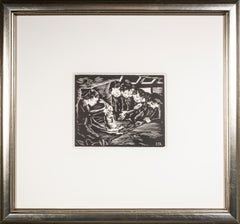
The Rabbit
original woodcut engraving by Clarice George Logan
Located in Milwaukee, WI
In 'The Rabbit,' Wisconsin artist Clarice George Logan presents the viewer with a multi-figural scene: under a wood-frame structure, four children crouch on the ground, gathered around a young woman who presents a rabbit. Under normal circumstances, such an image of children with a bunny would recall childhood storybooks. In this case, however, the image is more ambiguous and suggests the unfortunate economic circumstances many children suffered during the interwar years. Nonetheless, the group could also be interpreted as a nativity play, with the rabbit taking the place of the Christ child, shining light on the children like in a painting by the Italian Renaissance artist Correggio. The careful line-work of the woodblock engraving adds a sense of expressionism to the scene, leaving the figures looking distraught and dirty, though the image nonetheless falls into the Social Realist category that dominated American artists during the Great Depression.
This print was published in 1936 as part of the Wisconsin Artists' Calendar for the year 1937, which included 52 original, hand-made prints - one for each week of the year.
Clarice George Logan was born in Mayville, New York in 1909 but moved to Wisconsin in 1921. She attended the Milwaukee State Teachers College from 1927 to 1931 where she studied with Robert von...
Category
American Modern 1930s Animal Prints
Materials
Engraving, Woodcut
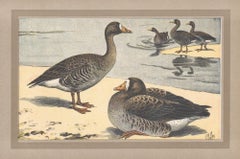
Great White Fronted Goose, French antique bird duck art illustration print
By P. Mahler
Located in Melbourne, Victoria
'Oie a Front Blanc'
(Great White-Fronted Goose)
French chromolithograph, published in 1931. Printed title lower right of sheet. Plate number top right. From a French series of illu...
Category
Art Deco 1930s Animal Prints
Materials
Lithograph
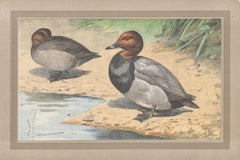
Common Pochard, French antique bird duck art illustration print
By P. Mahler
Located in Melbourne, Victoria
'Canard Milouin'
(Common Pochard)
French chromolithograph, published in 1931. Printed title lower right of sheet. Plate number top right. From a French series of illustrations of b...
Category
Art Deco 1930s Animal Prints
Materials
Lithograph
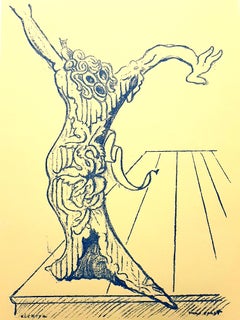
Max Ernst - Elektra - Lithograph
By Max Ernst
Located in Collonge Bellerive, Geneve, CH
Max Ernst - Elektra
Lithograph
1939
Dimensions: 32 x 24 cm
Signed in the plate
From XXe siècle
Unsigned and unumbered as issued
Category
Surrealist 1930s Animal Prints
Materials
Lithograph
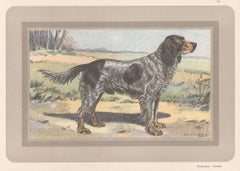
Picardy Spaniel, French hound dog chromolithograph print, 1931
Located in Melbourne, Victoria
French chromolithograph, published in 1931. Signed by artist in the plate. Printed title lower right of sheet. Plate number top right. From a French series of illustrations of sporti...
Category
Art Deco 1930s Animal Prints
Materials
Lithograph
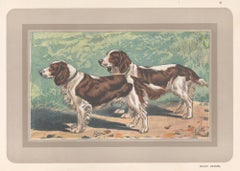
Welsh Spaniel, French hound dog chromolithograph print, 1930s
By P. Mahler
Located in Melbourne, Victoria
French chromolithograph, published in 1931. Signed by artist in the plate. Printed title lower right of sheet. Plate number top right. From a French series of illustrations of sporti...
Category
Art Deco 1930s Animal Prints
Materials
Lithograph
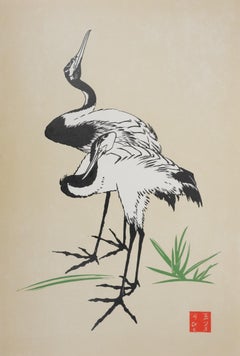
Japanese Print, Herons - Signed Woodcut
Located in Paris, IDF
Mokuchu URUSHIBARA
Herons, c. 1930
Woodcut after on an ink drawing
Signed with the artist's stamp
On paper 32.5 x 22 cm (c. 12.59 x 8.66 in)
INFORMATION : Engraving published by Mo...
Category
Modern 1930s Animal Prints
Materials
Woodcut
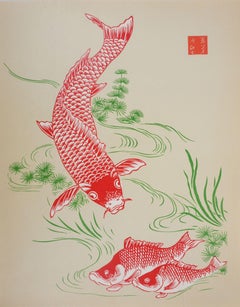
Japanese Print, Koi Carp - Signed Woodcut
Located in Paris, IDF
Mokuchu URUSHIBARA
Koi Carp, c. 1930
Woodcut after on an ink drawing
Signed with the artist's stamp
On paper 30 x 24 cm (c. 11.81 x 9.44 in)
INFORMATION : Engraving published by Mo...
Category
Modern 1930s Animal Prints
Materials
Woodcut
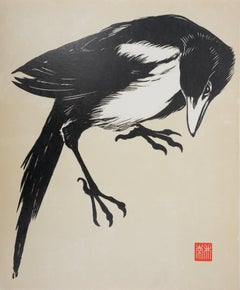
Japanese Print, White-billed Pie - Signed Woodcut
Located in Paris, IDF
Mokuchu URUSHIBARA
White-billed Pie, c. 1930
Woodcut after on an ink drawing
Signed with the artist's stamp
On paper 32 x 26.5 cm (c. 12.59 x 10.23 in)
INFORMATION : Engraving pub...
Category
Modern 1930s Animal Prints
Materials
Woodcut
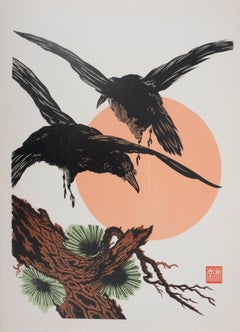
Japanese Print, The Flight of the Crows at Sunset - Signed Woodcut
Located in Paris, IDF
Mokuchu URUSHIBARA
The Flight of the Crows at Sunset, c. 1930
Woodcut after on an ink drawing
Signed with the artist's stamp
On paper 39.5 x 28 cm (c. 15,35 x 11.02 in)
INFORMATIO...
Category
Modern 1930s Animal Prints
Materials
Woodcut
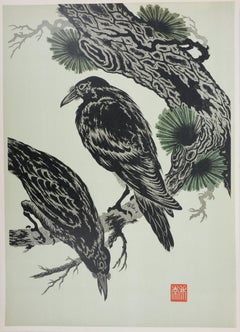
Japanese Print, Crows on a Branch - Signed Woodcut
Located in Paris, IDF
Mokuchu URUSHIBARA
Crows on a branch, c. 1930
Woodcut after on an ink drawing
Signed with the artist's stamp
On paper 38.5 x 28 cm (c. 15,15 x 11.02 in)
INFORMATION : Engraving pu...
Category
Modern 1930s Animal Prints
Materials
Woodcut
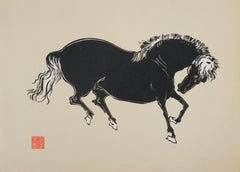
Japanese Print, Horse Bowing - Signed Woodcut
Located in Paris, IDF
Mokuchu URUSHIBARA
Horse bowing, c. 1930
Woodcut after on an ink drawing
Signed with the artist's stamp
On paper 26 x 35 cm (c. 10.2 x 13.7 in)
INFORMATION : Engraving published by...
Category
Modern 1930s Animal Prints
Materials
Woodcut
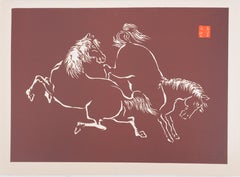
Japanese Print, Pair of horses playing (red) - Signed Woodcut
Located in Paris, IDF
Mokuchu URUSHIBARA
Pair of horses playing (red), c. 1930
Woodcut after on an ink drawing
Signed with the artist's stamp
On paper 28 x 39 cm (c. 11.02 x 15.35 in)
INFORMATION : Engr...
Category
Modern 1930s Animal Prints
Materials
Woodcut
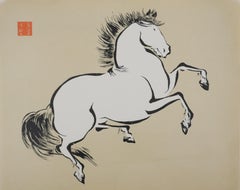
Japanese Print, Rearing Horse - Signed Woodcut
Located in Paris, IDF
Mokuchu URUSHIBARA
Rearing Horse, c. 1930
Woodcut after on an ink drawing
Signed with the artist's stamp
On paper 26 x 32 cm (c. 10,2 x 12.5 in)
INFORMATION : Engraving published b...
Category
Modern 1930s Animal Prints
Materials
Woodcut
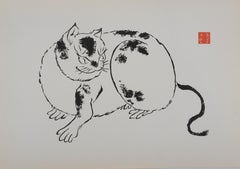
Japanese Print, The Cat - Signed Woodcut
Located in Paris, IDF
Mokuchu URUSHIBARA
The Cat, c. 1930
Woodcut after on an ink drawing
Signed with the artist's stamp
On paper 27 x 39 cm (c. 10,6 x 15,3 in)
INFORMATION : Engraving published by Moku...
Category
Modern 1930s Animal Prints
Materials
Woodcut
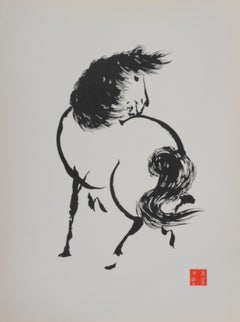
Japanese Print, Horse Turning Around - Signed Woodcut
Located in Paris, IDF
Mokuchu URUSHIBARA
Horse Turning Around, c. 1930
Woodcut after on an ink drawing
Signed with the artist's stamp
On paper 37 x 27 cm (c. 14,5 x 10,6 in)
INFORMATION : Engraving publ...
Category
Modern 1930s Animal Prints
Materials
Woodcut
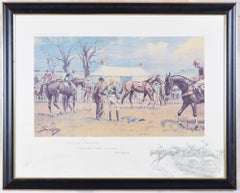
Oh to be in England
signed horse racing print by Snaffles
Located in London, GB
To see our other hunting prints and paintings, scroll down to "More from this Seller" and below it click on "See all from this Seller" and then search.
Charles "Snaffles" Johnson Payne (1884 - 1967)
"Oh! To Be In England Now That April's There"
Lithograph
51 x 67 cm
Signed in pencil lower left.
Snaffles was one of the foremost sporting artists of his era, publishing many popular prints such as these: hunting pictures...
Category
Impressionist 1930s Animal Prints
Materials
Lithograph
Eric Gill 1934 Woodblock Print
From the Books of Philip Hofer
Ex Libris
Lion
By Eric Gill
Located in London, GB
From a series of wood engravings by Eric Gill. To see them or our other Modern British Art, scroll down to "More from this Seller" and below it click on "See all from this Seller" - ...
Category
Modern 1930s Animal Prints
Materials
Woodcut

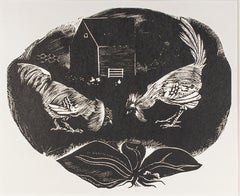
"Brahma vs. Leghorn, " Farm Scene Wood Engraving by Howard Thomas
Located in Milwaukee, WI
"Brahma vs. Leghorn" is an original wood engraving by Howard Thomas. In front of an understated farm house, Brahma and Leghorn face off, ready to battle. An unidentified plant sits on the center. Unsigned.
Image: 6" x 7.44"
Framed: 13.75" x 15.18
Thomas Howard (1899-1971) born a Quaker in Ohio, trained in the Midwest at Ohio State University and the Chicago Art Institute. He taught in the Art Department of the Milwaukee State Teachers College (now University of Wisconsin-Milwaukee) where he became good friends with Carl Holty, Edward Boerner, Robert von Neumann...
Category
American Modern 1930s Animal Prints
Materials
Woodcut
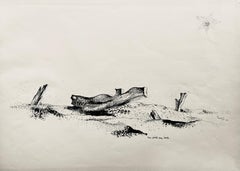
Jean Lurcat, A Star Without a Stable, from Eight Drawings, 1933 (after)
By Jean Lurçat
Located in Southampton, NY
This exquisite heliogravure after Jean Lurcat (1892–1966), titled Une Etoile Sans Etable (A Star Without a Stable), from the folio Jean Lurcat Huit Dessins (Jean Lurcat Eight Drawing...
Category
Surrealist 1930s Animal Prints
Materials
Lithograph
$716 Sale Price
20% Off
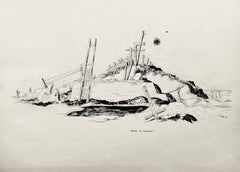
Jean Lurcat, After This We Start Again, from Eight Drawings, 1933 (after)
By Jean Lurçat
Located in Southampton, NY
This exquisite heliogravure after Jean Lurcat (1892–1966), titled Apresca On Recommence (After This We Start Again), from the folio Jean Lurcat Huit Dessins (Jean Lurcat Eight Drawin...
Category
Surrealist 1930s Animal Prints
Materials
Lithograph
$716 Sale Price
20% Off
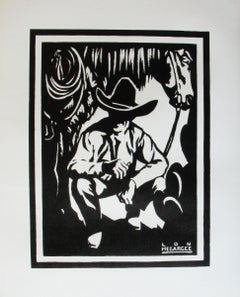
Longhorns by Lon Megargee
Located in Phoenix, AZ
Lon Megargee 1883-1960
"Self Portrait"
Wood block print
Signed in plate, lower right
Image size: 15.63 x 12 inches
Frame size xx x xx inches
Creator of S...
Category
American Impressionist 1930s Animal Prints
Materials
Screen
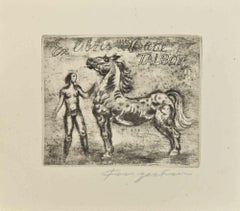
Ex Libris - Violette Talbot - Etching by Michel Fingesten - 1930s
Located in Roma, IT
Ex Libris - Violette Talbot is an Etching print created by Michel Fingesten.
Hand signed on the lower margin.
Good conditions.
Michel Fingesten (1884 - 1943) was a Czech painter ...
Category
Symbolist 1930s Animal Prints
Materials
Etching
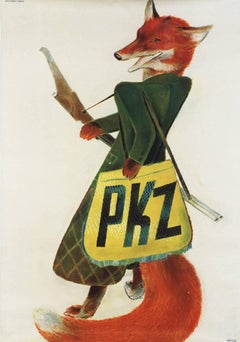
PKZ Fox
Located in New York, NY
1935. Color Lithograph.
Alois Carigiet was a Swiss graphic designer, painter, and illustrator. He may be known best for six children's picture books set in the Alps, A Bell for Ur...
Category
Art Deco 1930s Animal Prints
Materials
Lithograph
"White Horse, " Wood Engraving signed in Image by Howard Thomas
Located in Milwaukee, WI
"White Horse" is an original wood engraving by Howard Thomas, signed in plate. A white horse trots past the foreground of the image, spirals in it's eyes and spots on its hide. A bla...
Category
American Modern 1930s Animal Prints
Materials
Woodcut

A Jersey Vraic Cart
Located in New York, NY
Edmund Blampied (1886-1966), A Jersey Vraic Cart. 1939, etching, signed in ink lower margin [also signed and dated in the plate]. Reference: Appleby 183, the full sheet, on a J. Wh...
Category
Realist 1930s Animal Prints
Materials
Etching
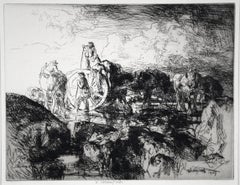
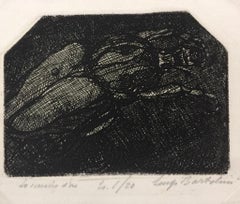
Lo Scarabeo D
Oro - Etching by Luigi Bartolini - 1936
Located in Roma, IT
Image dimensions: 11.3 x 15.2 cm.
Lo Scarabeo d'oro ("The Golden Beetle") is a beautiful etching realized by Luigi Bartolini in 1936.
Titled in pencil on the lower left: Lo scara...
Category
1930s Animal Prints
Materials
Etching
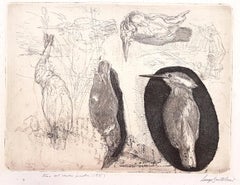
Storia del Martin Pescatore - Etching by Luigi Bartolini - 1935
Located in Roma, IT
Image dimensions: 25 x 33 cm.
Storia del Martin Pescatore is an original artwork realized by the Italian artist and engraver Luigi Bartolini in 1935.
Original etching applied on C...
Category
1930s Animal Prints
Materials
Etching
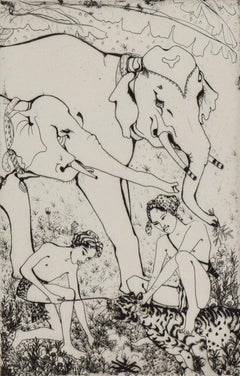
Laying the Ghost by Orovida Pissarro - Animal etching
Located in London, GB
Laying the Ghost by Orovida Pissarro (1893-1968)
Etching
39 x 26.3 cm (15 ⅜ x 10 ⅜ inches)
Signed and dated lower right Orovida 1932 Numbered lower left 1/9 and titled lower middle
...
Category
1930s Animal Prints
Materials
Etching
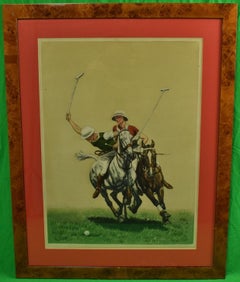
Two Polo Players
Located in Bristol, CT
Stylish equestrian image of two polo players attacking the ball
Hand-coloured lithograph
1930s
Art Sz: 23 3/4"H x 17 1/2"W
Frame Sz: 31"H x 24 3/4"W
w...
Category
1930s Animal Prints
Materials
Lithograph
$1,800
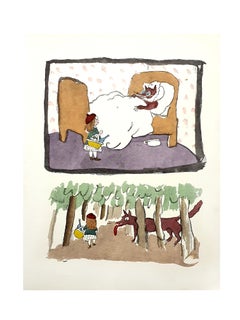
Jules Pascin - Little Red Riding Hood - Original Lithograph
By Jules Pascin
Located in Collonge Bellerive, Geneve, CH
Jules Pascin - Little Red Riding Hood - Original Lithograph
Conditions: excellent
32 x 24 cm
1938
From the art review XXe siècle, San Lazzaro
Un...
Category
Contemporary 1930s Animal Prints
Materials
Lithograph
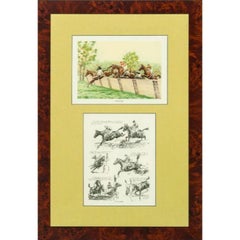
Millbrook Steeplechase 1930 by Paul Brown for The Derrydale Press
Located in Bristol, CT
Paul Desmond Brown (1893-1958) Millbrook Steeplechase proof-plate from The Derrydale Press book Gentlemen Up pub. 1930
Print Sz: 14 5/8"H x 8 1/4"W
F...
Category
1930s Animal Prints
Materials
Paper
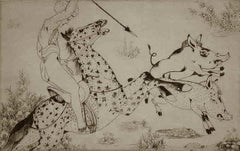
Pig Sticking by Orovida Pissarro, 1931 - Etching Print
Located in London, GB
SOLD UNFRAMED
Pig Sticking by Orovida Pissarro (1893 - 1968)
Etching
17.3 x 27.4 cm (6 ¾ x 10 ¾ inches)
Signed and dated lower right Orovida 1931 Numbered lower left 26/50 and titl...
Category
1930s Animal Prints
Materials
Etching
Still Thinking About These?
All Recently ViewedMore Ways To Browse
Penguin Lithograph
Peter Klucik
Pheasant Engraving
Picasso Dove Of Peace
Picasso Le Taureau
Picasso Rooster
Ronald Smith
Rooster Print Picasso
Salvador Dali Argus
Salvador Dali Unicorn
Sam Savitt
Shore Bird Print
Space Elephant Dali
Szabolcs Bozo
The Toad Picasso
Vintage Forest Service Posters
Vintage Posters Coppertone
Warhol Siberian Tiger