1950s Animal Prints
to
21
67
27
17
15
10
Overall Width
to
Overall Height
to
74
10
7
3
2
2
2
2
2
15
7
5
5
5
709
1,434
2,636
1,825
32
29
67
168
101
136
247
605
363
336
678
96
38
1
58
37
35
23
18
17
16
14
14
13
13
13
8
7
7
5
5
4
4
4
62
30
16
13
12
24
31
74
57
Period: 1950s
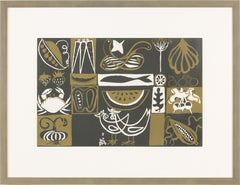
Smith Brothers Restaurant
Located in Milwaukee, WI
An original color silkscreen print by Ruth Grotenrath. A lovely assortment of different foods both vegetable and animal alike. The photos do not do this piece justice. The dark color...
Category
American Modern 1950s Animal Prints
Materials
Ink, Printer s Ink, Screen
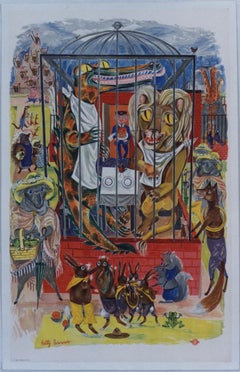
London Underground - Zoo
By Betty Swanwick
Located in New York, NY
Swanwick, Betty. London Underground - Wild and Savage - Zoo
. Color lithograph, On linen 39 1/2 x 25”. Excellent condition
Betty Swanwick was a ...
Category
Modern 1950s Animal Prints
Materials
Lithograph
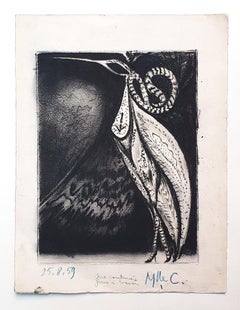
Bird - Original Etching by Marcel Guillard - 1959
Located in Roma, IT
Bird is an original etching artwork, realized in 1959 by Marcel Guillard ( 1896-?). Hand-signed and dated in blue color pencil on the lower.
The state of preservation is very good.
...
Category
Modern 1950s Animal Prints
Materials
Etching
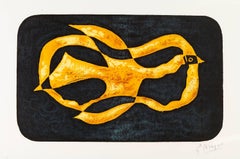
After Georges Braque - Antiborée - Lithograph
Located in Collonge Bellerive, Geneve, CH
Lithograph after Georges Braque.
Signed in the plate
Edition of 150
Dimensions: 76 x 117 cm
Bibliography:
« Les Métamorphoses de Braque» of Heger de Loewenfeld and Raphaël de Cuttoli , Editions FAC, Paris, 1989.
In 1961 Georges Braque decided with his laidary friend Heger de Loewenfeld to pick up certain of his works to in order to create artworks, this beautiful litograph is one of them.
Héméra in the Mythology:
In Greek mythology Hemera was the personification of day and one of the Greek primordial deities. She is the goddess of the daytime and, according to Hesiod, the daughter of Erebus and Nyx (the goddess of night). Hemera is remarked upon in Cicero's De Natura Deorum, where it is logically determined that Dies (Hemera) must be a god, if Uranus is a god. The poet Bacchylides states that Nyx and Chronos are the parents, but Hyginus in his preface to the Fabulae mentions Chaos as the mother/father and Nyx as her sister.
She was the female counterpart of her brother and consort, Aether (Light), but neither of them figured actively in myth or cult. Hyginus lists their children as Uranus, Gaia, and Thalassa (the primordial sea goddess), while Hesiod only lists Thalassa as their child.
The father of Cubism
Three Cubist that distinguishes art historian periods were initiated and developed by Georges Braque: The Cubist Cézanne (1907-1909), Executive (1909-1912) and synthetic (1912-1922).
Post-Impressionist and fawn, Braque no longer adheres to the contingency of a decorative way or the other. Cézanne’s paintings exhibited at the Grand Palais during the retrospective of 1907 are a revelation: Cézanne sought and invented a pictorial language. In his footsteps, Braque went to the South with the reasons of the Master. He returned with Estaque landscapes and surprising Ciotat it keeps Cezanne geometric model and retains the “passages” continuity from one surface to another to create the sensation of “turning around” of the object represented. But he wants to go after the consequences of the vision of Cezanne. In his paintings Houses in L’Estaque (1908) it simplifies the volumes of houses, neglects detail by removing doors and windows: the plastic rhythm that builds the table. Large Nude , a masterpiece of the period, can be considered the first work of Cézanne cubism .
Systematizing and deepening Braque discoveries open the door analytical cubism. In 1909, his painting became more cerebral than sensual. The pattern is recreated in the two-dimensionality of the canvas, leaving aside any illusionistic perspective. In Still Life with Violin, objects are analyzed facets according to their characteristic elements, each facet referring to a particular view of the object. There are so many facets of points selected view: Table reflects the knowledge of the object and the ubiquity of the eye. Moreover, Braque is looking for the essence of the objects in the world rather than their contingency, which explains the absence of light source and use of muted colors (gray, ocher), contingent aspects of the object . But formal logic has stepped facets, erased any anecdote to the object and ultimately led to his painting a hermetic more marked on the edge of abstraction (see the series of Castle Roche-Guyon ).
Braque, anxious to keep the concrete and refusing at all costs that the logic of Cubism takes the paintings to abstract, reintroduced signs of reality in his paintings in 1912 marks the beginning of Synthetic Cubism. Historians speak of “signs of real” rather than reality because what interests Braque, this is not to put reality into a table, but to create a painting which, by its language, refers to the real. To do this, he invented two major techniques XX th century inclusions and contributions. The inclusions consist of painting objects that have no real depth, materials (wallpaper in Nature morte aux playing cards faux wood is a pictorial inclusion) or letters (calligraphic inclusion in Portuguese ), made first brush and a few months later stencil. Contributions are defined in contrast with the collage on canvas of foreign materials: glued or sand paper, sawdust, etc.. Regarding the collages, Braque used for the first time in September 1912 a piece of adhesive paper imitating faux wood Compote...
Category
Cubist 1950s Animal Prints
Materials
Lithograph
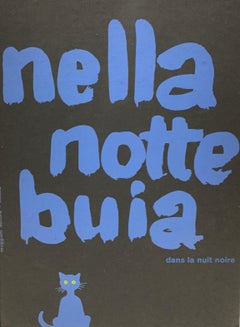
Nella Notte Buia / dans la nuit noire
By Bruno Munari
Located in Wilton, CT
Children’s book by Italian graphic designer and Futurist, Bruno Munari. Fun book features pochoir-colored pages with cut outs, wax pages with color illustrations, and tipped in secti...
Category
Futurist 1950s Animal Prints
Materials
Other Medium

$720 Sale Price
20% Off
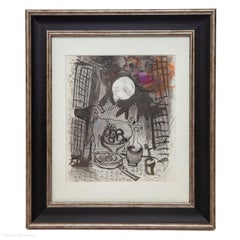
Marc Chagall Still Life with Fruits 1957 Original Lithograph Mourlot 205
By Marc Chagall
Located in Eversholt, Bedfordshire
Surrealist composition with a dog, figure, cockerel floating above the still life
In a cream mount, visible sheet length 19.50cm, height 22.50cm
Within a black and silvered moulded ...
Category
Modern 1950s Animal Prints
Materials
Lithograph
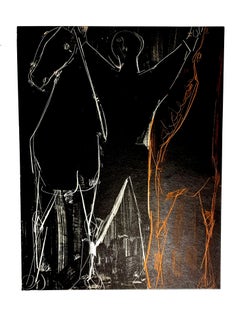
Marino Marini - Horses - Original Lithograph
Located in Collonge Bellerive, Geneve, CH
Marino Marini - Horses - Original Lithograph
1951
Dimensions: 32 x 24 cm
From the art review XXe siècle
Unsigned and unumbered as issued
Category
Surrealist 1950s Animal Prints
Materials
Lithograph
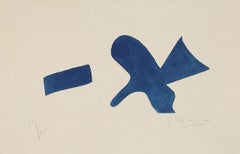
no title / "Oiseau bleu"
Located in Köln, DE
One of the main motifs in Georges Braques late printmaking oeuvre is the bird. By depicting the bird as itself or the flight of birds, Braque found what he called the "still life of ...
Category
Modern 1950s Animal Prints
Materials
Aquatint
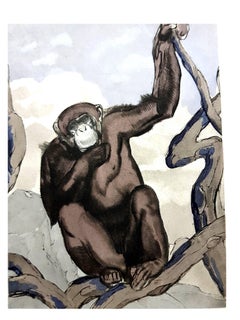
Paul Jouve - Chimpanzee - Original Engraving
By Paul Jouve
Located in Collonge Bellerive, Geneve, CH
Paul Jouve - Chimpanzee - Original Engraving
Editions Rombaldi, Paris, 1950.
Copy on velin creme de Rives
Artwork by Paul Jouve.
Original copper engraving ...
Category
Modern 1950s Animal Prints
Materials
Engraving
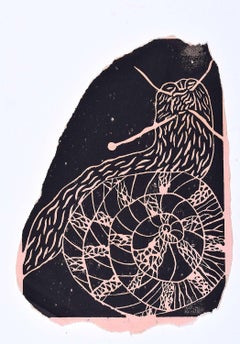
Rosemary Ellis Surreal Snail Linocut Modern British Art Wildlife Mid Century
Located in London, GB
From a series of paintings by Clifford and Rosemary Ellis. To see them or our other Modern British Art, scroll down to "More from this Seller" and below it click on "See all from thi...
Category
Realist 1950s Animal Prints
Materials
Linocut
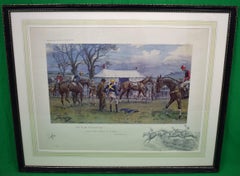
"Oh! To Be In England Now That April
s There" (Robert Browning) by "Snaffles"
Located in Bristol, CT
Charles "Snaffles" Johnson Payne (1884–1967) was an English painter known for his humorous work and for his outstanding draughtsmanship and depiction of the horse in action.
Pencil signed LL by the artist.
w/ black & white remarque LR
Print Sz: 19 1/2"H x 25 3/4"W
Frame Sz: 26 1/2"H x 33 1/4"W
circa 1950
In French mat and Hogarth frame
Published by Messrs Fores Ltd., 123 New Bond St. W1
w/ The Crossroads of Sport...
Category
1950s Animal Prints
Materials
Lithograph
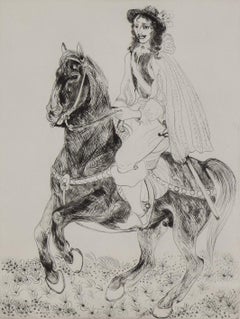
Rupert Rides by Orovida Pissarro - Animal etching
Located in London, GB
*UK BUYERS WILL PAY AN ADDITIONAL 20% VAT ON TOP OF THE ABOVE PRICE
Rupert Rides by Orovida Pissarro (1893-1968)
Etching
31 x 23.5 cm (12 ¼ x 9 ¼ inches)
Signed and dated lower righ...
Category
Post-Impressionist 1950s Animal Prints
Materials
Etching
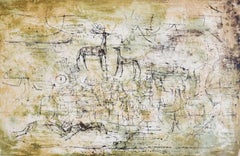
Deer Les cerfs - Chinese Abstract Animals Deers
By Zao Wou-Ki
Located in London, GB
This lithograph in colours is hand signed in pencil by the artist "Zao Wou-Ki" in Chinese and Pinyin at the lower left margin.
It is also hand numbered in pencil from the edition of ...
Category
Abstract 1950s Animal Prints
Materials
Lithograph
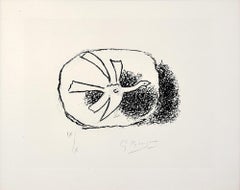
Oiseau dans son nid (Bird in its Nest) from Août (August)
Located in Palo Alto, CA
Braque Oiseau dans son nid (Bird in its Nest) from Août (August), 1958 is an exquisite work that revisits Braque’s beloved bird motif. Beautifully inspir...
Category
Modern 1950s Animal Prints
Materials
Aquatint, Etching
$7,500 Sale Price
28% Off
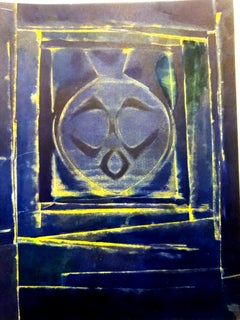
(after) Max Ernst - Blue Bird - Stencil
Located in Collonge Bellerive, Geneve, CH
Max Ernst (after) - Blue Bird - Stencil
Published in the deluxe art review, XXe Siecle, 1958
Dimensions: 32 x 25 cm
Publisher: G. di San Lazzaro.
Max Ernst was born in Bruhl, a place near Cologne, in Germany. He was raised in a strict Catholic family, and both of his parents were disciplinarians who were dedicated to training their children into God-fearing and talented individuals. Although his father was deaf, Ernst learned so much from him, particularly when it comes to painting. In fact, much of his early years were lived under the inspiration of his father who was also a teacher. He was the one who introduced painting to Ernst at an early age.
In 1914, Ernst attended the University of Bonn where he studied philosophy. However, he eventually dropped out of school because he was more interested in the arts. He claimed that his primary sources of interest included anything that had something to do with painting. Moreover, he became fascinated with psychology, among other subjects in school.
Primarily, Ernst's love for painting was the main reason why he became deeply interested with this craft and decided to pursue it later on in his life. During his early years, he became familiar with the works of some of the greatest artists of all time including Claude Monet, Paul Cezanne and Vincent van Gogh. He was also drawn to themes such as fantasy and dream imagery, which were among the common subjects of the works of Giorgio de Chirico.
During World War I, Ernst was forced to join the German Army, and he became a part of the artillery division that exposed him greatly to the drama of warfare. A soldier in the War, Ernst emerged deeply traumatized and highly critical of western culture. These charged sentiments directly fed into his vision of the modern world as irrational, an idea that became the basis of his artwork. Ernst's artistic vision, along with his humor and verve come through strongly in his Dada and Surrealists works; Ernst was a pioneer of both movements.
It was Ernst's memories of the war and his childhood that helps him create absurd, yet interesting scenes in his artworks. Soon, he took his passion for the arts seriously when he returned to Germany after the war. With Jean Arp, a poet and artist, Ernst formed a group for artists in Cologne. He also developed a close relationship with fellow artists in Paris who propagated Avant-Garde artworks.
In 1919, Ernst started creating some of his first collages, where he made use of various materials including illustrated catalogs and some manuals that produced a somewhat futuristic image. His unique masterpieces allowed Ernst to create his very own world of dreams and fantasy, which eventually helped heal his personal issues and trauma. In addition to painting and creating collages, Ernst also edited some journals. He also made a few sculptures that were rather queer in appearance.
In 1920s, influenced by the writings of psychologist Sigmund Freud, the literary, intellectual, and artistic movement called Surrealism sought a revolution against the constraints of the rational mind; and by extension, they saw the rules of a society as oppressive. Surrealism also embraces a Marxist ideology that demands an orthodox approach to history as a product of the material interaction of collective interests, and many renown Surrealism artists later on became 20th century Counterculture symbols such as Marxist Che Guevara. In 1922 Ernst moved to Paris, where the surrealists were gathering around Andre Breton. In 1923 Ernst finished Men Shall Know Nothing of This, known as the first Surrealist painting. Ernst was one of the first artists who apply The Interpretation of Dreams by Freud to investigate his deep psyche in order to explore the source of his own creativity. While turning inwards unto himself, Ernst was also tapping into the universal unconscious with its common dream imagery.
Despite his strange styles, Ernst gained quite a reputation that earned him some followers throughout his life. He even helped shape the trend of American art during the mid-century, thanks to his brilliant and extraordinary ideas that were unlike those of other artists during his time. Ernst also became friends with Peggy Guggenheim, which inspired him to develop close ties with the abstract expressionists.
When Ernst lived in Sedona, he became deeply fascinated with the Southwest Native American navajo art. In fact, the technique used in this artwork inspired him and paved the way for him to create paintings that depicted this style. Thus, Ernst became a main figure of this art technique, including the rituals and spiritual traditions included in this form of art. Pollock, aside from the other younger generations of abstract expressionists, was also inspired by sand painting of the Southwest...
Category
Surrealist 1950s Animal Prints
Materials
Stencil
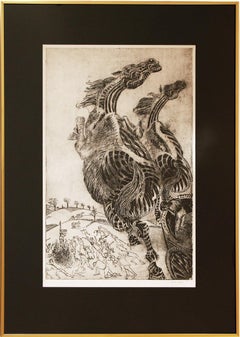
Death of Faithful - Horses from Pilgrim’s Progress
Located in London, GB
Striking first proof of Péri’s “Death of Faithful”, from his Pilgrim’s Progress etchings. Inscribed “first proof”.
Artist: Peter László Péri
Date: 1...
Category
Modern 1950s Animal Prints
Materials
Paper, Etching
Still Thinking About These?
All Recently ViewedMore Ways To Browse
Penguin Lithograph
Peter Klucik
Pheasant Engraving
Picasso Dove Of Peace
Picasso Le Taureau
Picasso Rooster
Ronald Smith
Rooster Print Picasso
Salvador Dali Argus
Salvador Dali Unicorn
Sam Savitt
Shore Bird Print
Space Elephant Dali
Szabolcs Bozo
The Toad Picasso
Vintage Forest Service Posters
Vintage Posters Coppertone
Warhol Siberian Tiger