Mid-19th Century Figurative Prints
to
39
2,940
552
27
13
3
Overall Width
to
Overall Height
to
3,003
53
36
21
7
2
1
1
98
95
87
82
34
3,665
7,760
25,343
6,692
287
587
1,470
1,206
1,098
2,063
3,053
5,189
3,144
1,614
3,112
1,838
1,678
19
2,560
1,243
993
927
681
482
352
349
241
187
178
177
157
144
143
134
122
115
111
100
2,618
683
364
150
104
67
2,824
2,101
190
Period: Mid-19th Century
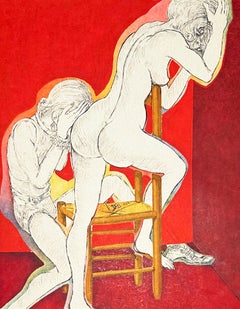
Without Hope, from The Marquis de Sade
Located in Washington, DC
Artist: Salvador Dali
Title: Without Hope, from The Marquis de Sade
Medium: Lithograph in colors on Japon paper
Date: 1969
Edition: 6/J
Frame Size: 31 5/8" x 25 1/8"
Sheet Size: 25 5...
Category
Surrealist Mid-19th Century Figurative Prints
Materials
Lithograph

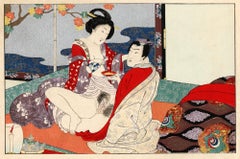
Seishi Ai-oi Genji – Set of 12 Shunga works together w/astrological commentary
Located in Middletown, NY
Set of 12 woodblock prints in colors on handmade, laid mulberry paper, 6 3/4 x 10 1/4 inches (170 x 258 mm), printed in Ka-ei 4 (1851). Each print with minor handling wear, otherwise in excellent condition with bright and fresh color, and with details printed in silver ink. The images themselves contain several illusive characters indicating the publisher which are obfuscated by figures, as intended. Presented loose, as issued. A fine set.
The astrological commentary print has a large and meandering blind stamp with a bird and palm frond motif. This print lists various phrases concerning the Twelve Zodiac Animals as historically counted in Japan, and appears to include erotic commentary on the traits of people born under each of the twelve signs.
These Shunga images were issued in books that paralleled (in an erotic fashion...
Category
Edo Mid-19th Century Figurative Prints
Materials
Ink, Handmade Paper, Woodcut
Hiver - Etching by Félix Bracquemond - 1865 ca.
Located in Roma, IT
Etching on laid paper
Sheet size: approx. 65 × 50 cm
Signed in plate lower left: F. Bracquemond
Published by Cadart
Luquet, Éditeurs, 79 Rue Richelieu, Paris
With the blinds...
Category
Modern Mid-19th Century Figurative Prints
Materials
Etching
Les Gitanos - Etching by Edouard Manet - 1862
Located in Roma, IT
Les Gitanos is a black and White etching realized by Edouard Manet in 1862.
Titled in the lower.
Second state and lifetime impression realized by Société des Aquafortistes, with f...
Category
Impressionist Mid-19th Century Figurative Prints
Materials
Etching
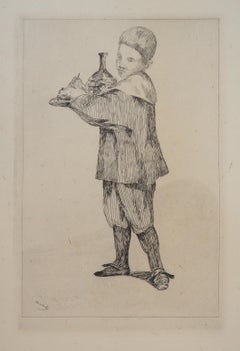
Child with a Tray (Pear and Bottle) - Original Etching (Guerin #15)
Located in Paris, IDF
Edouard MANET
Child with a Tray (Pear and Bottle), 1861
Original etching
Printed signature in the plate
On Japan paper 36 x 24 cm (c. 12 x 10 inch)
REFERENCES : Catalog raisonne Gu...
Category
Impressionist Mid-19th Century Figurative Prints
Materials
Etching
Kabuki Actor, Mid 19th Century Figurative Japanese Woodblock Print
Located in Soquel, CA
Beautiful mid 19th century figural Japanese woodblock print of a kabuki actor in blue by Utagawa Toyokuni III (Kunisada) (Japanese, 1786-1864/5). Artist's chop is in the upper left corner of the piece. Presented in a cream mat, with a black and red frame and plexiglas. Image size ~13.5"H x 9.5"W
During his lifetime Kunisada Utagawa...
Category
Edo Mid-19th Century Figurative Prints
Materials
Paper, Ink

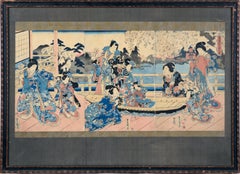
Elegant Amusements of Eastern Genji - Japanese Triptych Woodblock Print on Paper
Located in Soquel, CA
Elegant Amusements of Eastern Genji - Japanese Triptych Woodblock Print on Paper
Dynamic woodblock print with several elegantly dressed figures by Utag...
Category
Edo Mid-19th Century Figurative Prints
Materials
Paper, Ink, Woodcut
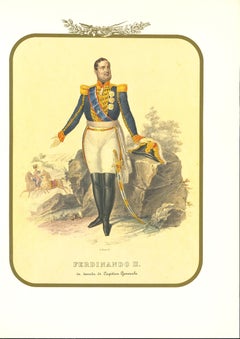
Portrait of Ferdinand II - Original Lithograph by A. Zezon - Mid 19th Century
Located in Roma, IT
Portrait of Ferdinand II is an original lithograph by Antonio Zezon.
Interesting colored lithograph which describes the arrival of Ferdinand II,...
Category
Modern Mid-19th Century Figurative Prints
Materials
Lithograph
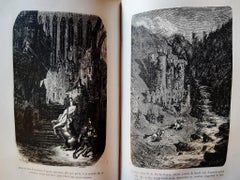
Les Contes Drolatiques - Rare Book Illustrated by G. Doré - 1861
By Gustave Doré
Located in Roma, IT
Les Contes Drolatiques is an original modern rare book written by Honoré de Balzac (1799 – 1850) and illustrated by Gustave Doré (Strasbourg, 1832 – 23 January 1883) in 1861.
Publis...
Category
Modern Mid-19th Century Figurative Prints
Materials
Paper, Etching
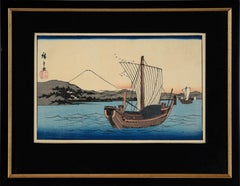
Kiyomi Barrier
Seiken Temple Near Okitsu- Japanese Woodcut Print on Rice Paper
Located in Soquel, CA
Kiyomi Barrier & Seiken Temple Near Okitsu - Japanese Woodcut Print on Rice Paper
Woodblock print of boats in a harbor by Utagawa Hiroshige (Japanese, 1797-1858). Originally publish...
Category
Impressionist Mid-19th Century Figurative Prints
Materials
Rice Paper, Woodcut
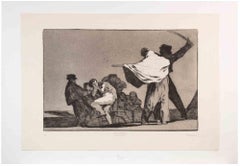
Que Guerrero! - Etching and and Aquatint by Francisco Goya - 1877 (1815)
Located in Roma, IT
Francisco Goya, Que Guerrero! Etching and Aquatint, from the Series "Los Proverbios, realized in 1815 and printed in 1877.
This copy belongs to the edition of "L'Art", 1877. With th...
Category
Modern Mid-19th Century Figurative Prints
Materials
Etching
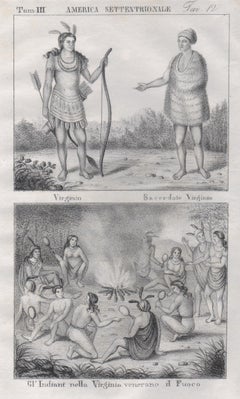
Indigenous People, Virginia, America, mid 19th century lithograph.
Located in Melbourne, Victoria
'Virginio - Sacerdote Virginio' / 'Gi' Indiant nella Virginia venerano il Fuoco''
Italian lithograph, c1841. Originally from 'Galleria universale di tutti i popoli del mondo' by Giu...
Category
Naturalistic Mid-19th Century Figurative Prints
Materials
Lithograph
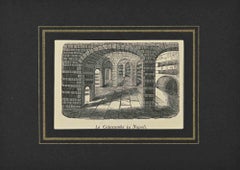
The Catacombs in Naples - Lithograph - 1862
Located in Roma, IT
Uses and Customs - The Catacombs in Naples is a lithograph on paper realized in 1862.
The artwork belongs to the Suite Uses and customs of all the peoples of the universe: " History...
Category
Modern Mid-19th Century Figurative Prints
Materials
Lithograph
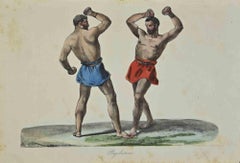
Uses and Customs - Boxers - Lithograph - 1862
Located in Roma, IT
Uses and Customs - Boxers is a lithograph on paper realized in 1862.
The artwork belongs to the Suite Uses and customs of all the peoples of the universe: " History of the governmen...
Category
Modern Mid-19th Century Figurative Prints
Materials
Lithograph
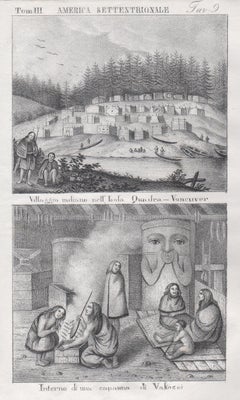
Quadra, Vancouver Island, Canada, North America, mid 19th century lithograph.
Located in Melbourne, Victoria
'Villagio indiano nell' Isola Quadra-Voncuver / Interno di Una capanna di Vakosei'
(Indian Village on Quadra Island, Vancouver / Interior of a Vakosei hut)
Italian lithograph, c184...
Category
Naturalistic Mid-19th Century Figurative Prints
Materials
Lithograph
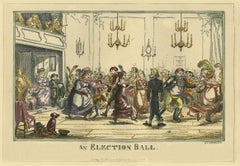
An Election Ball
Located in Middletown, NY
London: Thomas Mclean, 1835. Etching with hand coloring in watercolor on cream wove paper. 5 3/8 x 7 3/4 inches (135 x 195 mm), full margins. A lovely well inked impression with fres...
Category
Victorian Mid-19th Century Figurative Prints
Materials
Watercolor, Etching
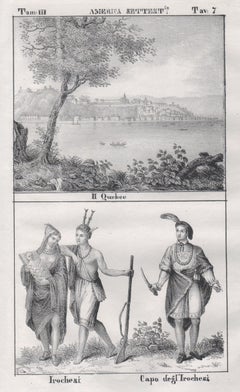
Quebec and Iroquois, Canada, North America, mid 19th century lithograph.
Located in Melbourne, Victoria
'Il Quebec / Irochesi - Capo degl' Irochesi''
Italian lithograph, c1841. Originally from 'Galleria universale di tutti i popoli del mondo' by Giuseppe Antonelli, published in Venice...
Category
Naturalistic Mid-19th Century Figurative Prints
Materials
Lithograph
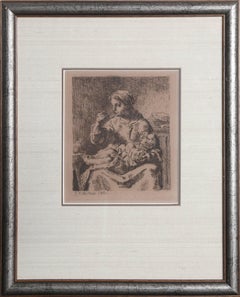
La Boullie (The Porridge), Old Masters Drypoint Etching by Jean Francois Millet
Located in Long Island City, NY
Etching printed in brownish black on light tan Chine collé, 1861. Image measures 6 x 5 inches, displayed in a 15.5 x 12.5 inch frame. Etched signature and date lower left. A very goo...
Category
Impressionist Mid-19th Century Figurative Prints
Materials
Drypoint, Etching, Intaglio
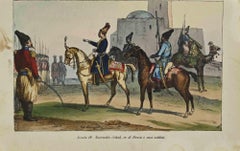
Nasereddin Shah, King of Persia and his Soldiers- Lithograph - 1862
Located in Roma, IT
Persian Cloth in 19th Century is a Hand-colored lithograph on paper realized in 1862.
The artwork belongs to the Suite Uses and customs of all the peoples of the universe: " History...
Category
Modern Mid-19th Century Figurative Prints
Materials
Lithograph
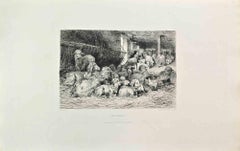
Une Bergerie - Etching by Albert Brendel - 1862
Located in Roma, IT
Une Bergerie is a black and White etching realized by Albert Brendel in 1862.
Titled in the lower
Image Size: 23x32
Very good impression.
Realized by Cadart for the "Société des...
Category
Impressionist Mid-19th Century Figurative Prints
Materials
Etching
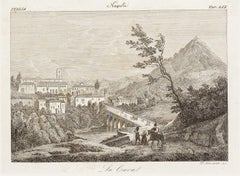
La Cava (The Cave) - Etching by Francesco Mochetti - 1843
Located in Roma, IT
Image dimensions: 14.7 x 19.8 cm.
La Cava is an original black and white etching on paper, printed in 1843 as a plate of the print suite "90 Views of the citi...
Category
Modern Mid-19th Century Figurative Prints
Materials
Etching
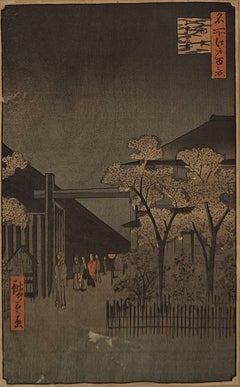
"Dawn Inside the Yoshiwara" Utagawa Hiroshige, Japanese Landscape, Ukiyo-e
Located in New York, NY
Utagawa Hiroshige
Dawn Inside the Yoshiwara, circa 1857
Woodblock print
11 x 7 inches
Utagawa Hiroshige is recognized as a master of the ukiyo-e woodblock printing tradition, havin...
Category
Naturalistic Mid-19th Century Figurative Prints
Materials
Paper, Ink, Woodcut
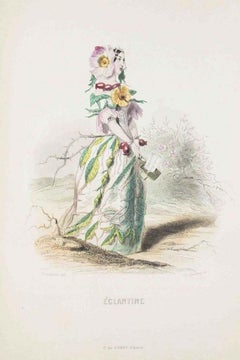
Eglantine - Les Fleurs Animées Vol.I - Litho by J.J. Grandville - 1847
Located in Roma, IT
Image dimensions: 24.3 x 17.5 cm.
Single sheet with passepartout.
"...The unhappy man had approached that mysterious spot where, amid a thousand aquatic plants, the Water-arrow grows." T. Delord.
Les Fleurs animées...
Category
Modern Mid-19th Century Figurative Prints
Materials
Lithograph
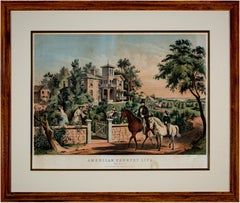
19th century color lithograph landscape figures horseback house scene trees sky
Located in Milwaukee, WI
The present print is one of several examples produced for Nathaniel Currier by his longtime collaborator Frances F. "Fanny" Palmer. Harry T. Peters wrote of her: "There is no more interesting and appealing character among the group of artists who worked for Currier & Ives than Fanny Palmer. In an age when women, well-bred women in particular, did not generally work for a living Fanny Palmer for years did exacting, full-time work in order to support a large and dependent family ... Her work ... had great charm, homeliness, and a conscientious attention to detail."
One of a series of four prints showing American country life in different seasons, the image presents the viewer with a picturesque view of a successful American farm. In the foreground, a gentleman rides a horse with a young boy before a respectable Italianate country house. Two women and a young girl pick flowers in the garden and several farm workers attend to their duties. Beyond are other homes and a city on the coast.
16.63 x 23.75 inches, artwork
28.13 x 33.38 inches, frame
Entitled bottom center "American Country Life - May Morning"
Signed in the stone, lower left "F.F. Palmer, Del."
Signed in the stone, lower right "Lith. by N. Currier"
Copyrighted lower center "Entered according to Act of Congress in the year 1855 by N. Currier in the Clerk's office of the Southern District of N.Y."
Inscribed bottom center "New York, Published by N. Currier 152 Nassau Street"
Framed to conservation standards using silk-lined 100 percent rag matting and Museum Glass with a gold gilded liner, all housed in a stained wood moulding.
Nathaniel Currier was a tall introspective man with a melancholy nature. He could captivate people with his piercing stare or charm them with his sparkling blue eyes. Nathaniel was born in Roxbury, Massachusetts on March 27th, 1813, the second of four children. His parents, Nathaniel and Hannah Currier, were distant cousins who lived a humble yet spartan life. When Nathaniel was eight years old, tragedy struck. Nathaniel’s father unexpectedly passed away leaving Nathaniel and his eleven-year-old brother Lorenzo to provide for the family. In addition to their mother, Nathaniel and Lorenzo had to care for six-year-old sister Elizabeth and two-year-old brother Charles. Nathaniel worked a series of odd jobs to support the family, and at fifteen, he started what would become a life-long career when he apprenticed in the Boston lithography shop of William and John Pendleton.
A Bavarian gentleman named Alois Senefelder invented lithography just 30 years prior to young Nat Currier’s apprenticeship. While under the employ of the brothers Pendleton, Nat was taught the art of lithography by the firm’s chief printer, a French national named Dubois, who brought the lithography trade to America.
Lithography involves grinding a piece of limestone flat and smooth then drawing in mirror image on the stone with a special grease pencil. After the image is completed, the stone is etched with a solution of aqua fortis leaving the greased areas in slight relief. Water is then used to wet the stone and greased-ink is rolled onto the raised areas. Since grease and water do not mix, the greased-ink is repelled by the moisture on the stone and clings to the original grease pencil lines. The stone is then placed in a press and used as a printing block to impart black on white images to paper.
In 1833, now twenty-years old and an accomplished lithographer, Nat Currier left Boston and moved to Philadelphia to do contract work for M.E.D. Brown, a noted engraver and printer. With the promise of good money, Currier hired on to help Brown prepare lithographic stones of scientific images for the American Journal of Sciences and Arts. When Nat completed the contract work in 1834, he traveled to New York City to work once again for his mentor John Pendleton, who was now operating his own shop located at 137 Broadway. Soon after the reunion, Pendleton expressed an interest in returning to Boston and offered to sell his print shop to Currier. Young Nat did not have the financial resources to buy the shop, but being the resourceful type he found another local printer by the name of Stodart. Together they bought Pendleton’s business.
The firm ‘Currier & Stodart’ specialized in "job" printing. They produced many different types of printed items, most notably music manuscripts for local publishers. By 1835, Stodart was frustrated that the business was not making enough money and he ended the partnership, taking his investment with him. With little more than some lithographic stones, and a talent for his trade, twenty-two year old Nat Currier set up shop in a temporary office at 1 Wall Street in New York City. He named his new enterprise ‘N. Currier, Lithographer’
Nathaniel continued as a job printer and duplicated everything from music sheets to architectural plans. He experimented with portraits, disaster scenes and memorial prints, and any thing that he could sell to the public from tables in front of his shop. During 1835 he produced a disaster print Ruins of the Planter's Hotel, New Orleans, which fell at two O’clock on the Morning of the 15th of May 1835, burying 50 persons, 40 of whom Escaped with their Lives. The public had a thirst for newsworthy events, and newspapers of the day did not include pictures. By producing this print, Nat gave the public a new way to “see” the news. The print sold reasonably well, an important fact that was not lost on Currier.
Nat met and married Eliza Farnsworth in 1840. He also produced a print that same year titled Awful Conflagration of the Steamboat Lexington in Long Island Sound on Monday Evening, January 18, 1840, by which melancholy occurrence over One Hundred Persons Perished. This print sold out very quickly, and Currier was approached by an enterprising publication who contracted him to print a single sheet addition of their paper, the New York Sun. This single page paper is presumed to be the first illustrated newspaper ever published.
The success of the Lexington print launched his career nationally and put him in a position to finally lift his family up. In 1841, Nat and Eliza had their first child, a son they named Edward West Currier. That same year Nat hired his twenty-one year old brother Charles and taught him the lithography trade, he also hired his artistically inclined brother Lorenzo to travel out west and make sketches of the new frontier as material for future prints. Charles worked for the firm on and off over the years, and invented a new type of lithographic crayon which he patented and named the Crayola. Lorenzo continued selling sketches to Nat for the next few years.
In 1843, Nat and Eliza had a daughter, Eliza West Currier, but tragedy struck in early 1847 when their young daughter died from a prolonged illness. Nat and Eliza were grief stricken, and Eliza, driven by despair, gave up on life and passed away just four months after her daughter’s death.
The subject of Nat Currier’s artwork changed following the death of his wife and daughter, and he produced many memorial prints and sentimental prints during the late 1840s. The memorial prints generally depicted grief stricken families posed by gravestones (the stones were left blank so the purchasers could fill in the names of the dearly departed). The sentimental prints usually depicted idealized portraits of women and children, titled with popular Christian names of the day.
Late in 1847, Nat Currier married Lura Ormsbee, a friend of the family. Lura was a self-sufficient woman, and she immediately set out to help Nat raise six-year-old Edward and get their house in order. In 1849, Lura delivered a son, Walter Black Currier, but fate dealt them a blow when young Walter died one year later. While Nat and Lura were grieving the loss of their new son, word came from San Francisco that Nat’s brother Lorenzo had also passed away from a brief illness. Nat sank deeper into his natural quiet melancholy. Friends stopped by to console the couple, and Lura began to set an extra place at their table for these unexpected guests. She continued this tradition throughout their lives.
In 1852, Charles introduced a friend, James Merritt Ives, to Nat and suggested he hire him as a bookkeeper. Jim Ives was a native New Yorker born in 1824 and raised on the grounds of Bellevue Hospital where his father was employed as superintendent. Jim was a self-trained artist and professional bookkeeper. He was also a plump and jovial man, presenting the exact opposite image of his new boss.
Jim Ives met Charles Currier through Caroline Clark, the object of Jim’s affection. Caroline’s sister Elizabeth was married to Charles, and Caroline was a close friend of the Currier family. Jim eventually proposed marriage to Caroline and solicited an introduction to Nat Currier, through Charles, in hopes of securing a more stable income to support his future wife.
Ives quickly set out to improve and modernize his new employer’s bookkeeping methods. He reorganized the firm’s sizable inventory, and used his artistic skills to streamline the firm’s production methods. By 1857, Nathaniel had become so dependent on Jims’ skills and initiative that he offered him a full partnership in the firm and appointed him general manager. The two men chose the name ‘Currier & Ives’ for the new partnership, and became close friends.
Currier & Ives produced their prints in a building at 33 Spruce Street where they occupied the third, fourth and fifth floors. The third floor was devoted to the hand operated printing presses that were built by Nat's cousin, Cyrus Currier, at his shop Cyrus Currier & Sons in Newark, NJ. The fourth floor found the artists, lithographers and the stone grinders at work. The fifth floor housed the coloring department, and was one of the earliest production lines in the country. The colorists were generally immigrant girls, mostly German, who came to America with some formal artistic training. Each colorist was responsible for adding a single color to a print. As a colorist finished applying their color, the print was passed down the line to the next colorist to add their color. The colorists worked from a master print displayed above their table, which showed where the proper colors were to be placed. At the end of the table was a touch up artist who checked the prints for quality, touching-in areas that may have been missed as it passed down the line. During the Civil War, demand for prints became so great that coloring stencils were developed to speed up production.
Although most Currier & Ives prints were colored in house, some were sent out to contract artists. The rate Currier & Ives paid these artists for coloring work was one dollar per one hundred small folios (a penny a print) and one dollar per one dozen large folios. Currier & Ives also offered uncolored prints to dealers, with instructions (included on the price list) on how to 'prepare the prints for coloring.' In addition, schools could order uncolored prints from the firm’s catalogue to use in their painting classes.
Nathaniel Currier and James Merritt Ives attracted a wide circle of friends during their years in business. Some of their more famous acquaintances included Horace Greeley, Phineas T. Barnum, and the outspoken abolitionists Rev. Henry Ward, and John Greenleaf Whittier (the latter being a cousin of Mr. Currier).
Nat Currier and Jim Ives described their business as "Publishers of Cheap and Popular Pictures" and produced many categories of prints. These included Disaster Scenes, Sentimental Images, Sports, Humor, Hunting Scenes, Politics, Religion, City and Rural Scenes, Trains, Ships, Fire Fighters, Famous Race Horses, Historical Portraits, and just about any other topic that satisfied the general public's taste. In all, the firm produced in excess of 7500 different titles, totaling over one million prints produced from 1835 to 1907.
Nat Currier retired in 1880, and signed over his share of the firm to his son Edward. Nat died eight years later at his summer home 'Lion’s Gate' in Amesbury, Massachusetts. Jim Ives remained active in the firm until his death in 1895, when his share of the firm passed to his eldest son, Chauncey.
In 1902, faced will failing health from the ravages of Tuberculosis, Edward Currier sold his share of the firm to Chauncey Ives...
Category
Romantic Mid-19th Century Figurative Prints
Materials
Watercolor, Lithograph
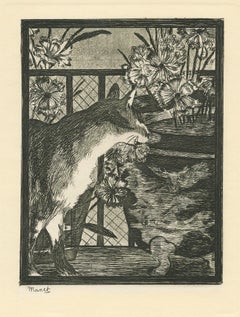
Le Chat et Les Fleurs
Located in Middletown, NY
Etching and aquatint on cream laid, watermarked Rives paper. 6 5/8 x 5 inches (167 x 126 mm). Sixth and final state, a posthumous impression. A fine, inky impression with full margin...
Category
Realist Mid-19th Century Figurative Prints
Materials
Etching, Aquatint
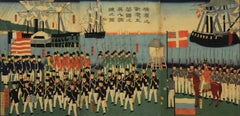
Foreign Soldiers from Five Countries at the Port of Yokohama
Located in Fairlawn, OH
Foreign Soldiers from Five Countries at the Port of Yokohama
Color woodcut triptych, c. 1860's
Signed in the block lower left corner Signed: "Ichimosai Yoshitora ga"
Condition: Mounted to a rose colored silk backing (stable)
Staining (visible) in the joining of the right and center sheets
Colors very slightly faded
Image size: 15 3/8 x 31 3/8 inches (triptysch sheets joined to make one print)
The 1854 Treaty of Kanagawa opened Japan to the West. Curiosity about the never-before-seen foreigners spurred a market in Yokohama-e (Yokohama prints), named for the area to which foreign dignitaries and merchants were confined. Yoshitora became one of the best known and most active artists of the Yokohama-e school.
Utagawa Yoshitora (歌川 芳虎) was a designer of ukiyo-e Japanese woodblock prints and an illustrator of books and newspapers who was active from about 1850 to about 1880. He was born in Edo (modern Tokyo), but neither his date of birth nor date of death is known. However, he was the oldest pupil of Utagawa Kuniyoshi who excelled in prints of warriors, kabuki actors, beautiful women, and foreigners (Yokohama-e). He may not have seen any of the foreign scenes he depicted.
Yoshitora was prolific: he produced over 60 print series and illustrated over 100 books. In 1849 he produced an irreverent print called Dōke musha: Miyo no wakamochi ("Funny Warriors—Our Ruler's New Year's Rice Cakes"), which depicts Oda Nobunaga, Akechi Mitsuhide, and Toyotomi Hideyoshi...
Category
Mid-19th Century Figurative Prints
Materials
Woodcut
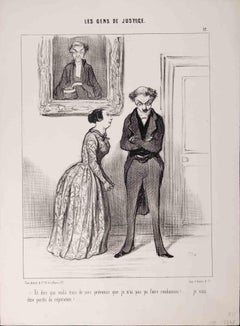
Les Gens de Justice - Lithograph by Honoré Daumier - 1845
Located in Roma, IT
Lithograph realized by Daumier in 1845, belonging to the Series "Les Gens de Justice"
Table no. 12 of the Series.
Very good condition.
Ref. Delteil 1348
Category
Modern Mid-19th Century Figurative Prints
Materials
Lithograph
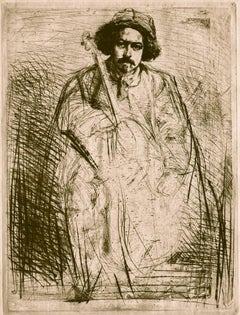
Becquet
Located in Plano, TX
J. Becquet, Sculptor (The Fiddler). 1859. Drypoint. Kennedy 52 state iv; Glasgow 62. state i. 10 1/8 x 7 1/2 (sheet 15 5/16 x 9 3/4). Series: "Sixteen Etchings or Scenes on the Thame...
Category
American Impressionist Mid-19th Century Figurative Prints
Materials
Drypoint, Etching
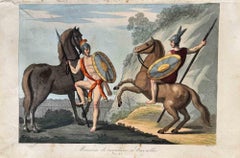
Uses and Customs - Horse Mounting Method - Lithograph - 1862
Located in Roma, IT
Uses and Customs - Horse Mounting Method is a lithograph on paper realized in 1862.
The artwork belongs to the Suite Uses and customs of all the peoples o...
Category
Modern Mid-19th Century Figurative Prints
Materials
Lithograph
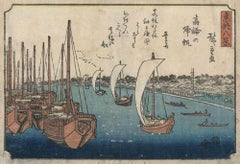
Takanawa no Kihan - Woodblock print by Utagawa Hiroshige - 1843-1847
Located in Roma, IT
Takanawa no kihan is a modern artwork realized between 1843 and 1847 after Utagawa Hiroshige.
Ukiyo-e color woodblock print from the Touto hakkei (The Eight Famous Views of the Capital of the East) series.
Mounted under passepartout.
The artwork depicts the port of Takanawa, a suburb of Minato in southern Tokyo, and is one of the very rare sheets by Utagawa Ando Hiroshige...
Category
Modern Mid-19th Century Figurative Prints
Materials
Woodcut
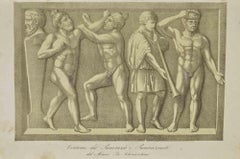
Pancratius - Lithograph - 1862
Located in Roma, IT
Pancratius is a lithograph on paper realized in 1862.
The artwork belongs to the Suite Uses and customs of all the peoples of the universe: " History of the government, of the laws,...
Category
Modern Mid-19th Century Figurative Prints
Materials
Lithograph
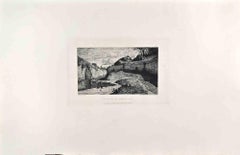
Le Village de Chanaz - Etching by Appian - 1860s
Located in Roma, IT
Le Village de Chanaz is a black and White etching realized by A. Appian in the 1860s.
Titled in the lower.
Image size: 16x23.
Very good impression with wide margins and a very fr...
Category
Modern Mid-19th Century Figurative Prints
Materials
Etching
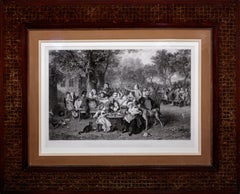
Kinderfest (Wie die Alten sungen, so zwitschern die Jungen)
Located in Milwaukee, WI
Framed 46 x 57.50 in13
Printed by L. Angerer. Engraved by Paul Sigmund Habelmann after the original oil painting by Ludwig Knaus.
The inscription "Wie die Alten sungen, so zwitschern...
Category
Mid-19th Century Figurative Prints
Materials
Engraving
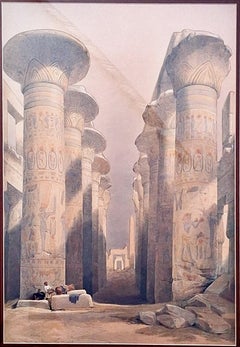
“Thebes, Great Hall at Karnak”
Located in San Francisco, CA
This lithograph titled "Thebes, Great Hall at Karnak" is a notable work by the Scottish painter David Roberts (1796-1864). This particular scene is part of Roberts' most famous colle...
Category
English School Mid-19th Century Figurative Prints
Materials
Paper, Lithograph
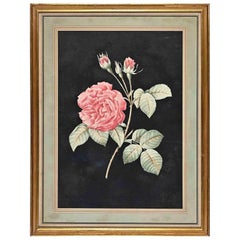
Roses - Original Etching by François Langlois - 19th Century
Located in Roma, IT
Roses is an original modern artwork realized by François Langlois in the 19th Century.
Mixed colored etching.
Includes passepartout and a frame in ...
Category
Modern Mid-19th Century Figurative Prints
Materials
Etching
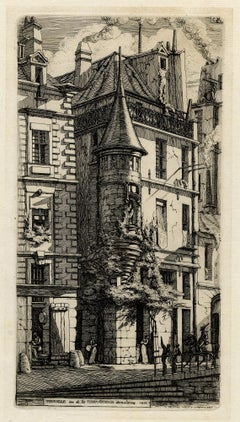
Tourelle, Rue de la Tixéranderie démolie en 1851
Located in Middletown, NY
Etching and drypoint on watermarked Hudelist laid paper, 9 5/8 x 5 inches (245 x 129mm) full margins. Second state (of five) after lettering. A superb condition with a pencil inscrip...
Category
French School Mid-19th Century Figurative Prints
Materials
Laid Paper, Etching, Drypoint
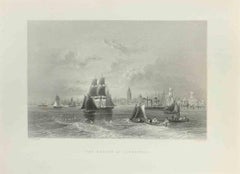
The Mersey at Liverpool - Etching by J.C. Armytage - 1845
Located in Roma, IT
The Mersey at Liverpool is an etching realized in 1845 by J.C.Armytage.
Signed in plate.
The artwork is realized in a well-balanced composition.
Category
Modern Mid-19th Century Figurative Prints
Materials
Etching
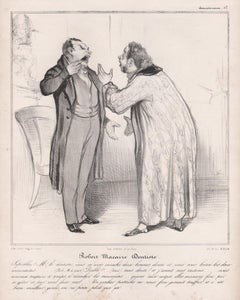
Robert Macaire Dentiste, French dentistry dentist caricature lithograph
Located in Melbourne, Victoria
'Robert Macaire Dentiste'
Lithograph by Honore Daumier after Charles Philipon. 1837. Plate 57 from the Robert Macaire 'Caricaturana' series.
Translation of the French text below th...
Category
French School Mid-19th Century Figurative Prints
Materials
Lithograph
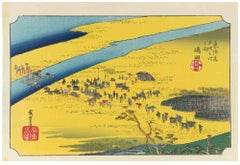
Shimada - Woodcut by Utagawa Hiroshige - 1833
Located in Roma, IT
Asagiri is a woodcut print realized by Utagawa Hiroshige in 1832.
It is part of the suite "The Fifty-three Stations of Tokaido".
Very good condition.
Category
Modern Mid-19th Century Figurative Prints
Materials
Woodcut
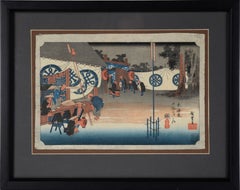
Stage 48 of the 53 Stages of the Tokaido - Japanese Woodblock on Rice Paper
Located in Soquel, CA
Stage 48 of the 53 Stages of the Tokaido - Japanese Woodblock on Rice Paper
Woodblock print of clothing vendors by Utagawa Hiroshige (Japanese, 1797-1858). Originally printed in 183...
Category
Impressionist Mid-19th Century Figurative Prints
Materials
Rice Paper, Woodcut
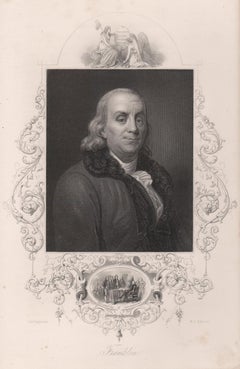
Benjamin Franklin, 19th century American political portrait engraving print
Located in Melbourne, Victoria
Benjamin Franklin
Steel-engraving by WJ Edwards after Joseph Siffred Duplessis. C1860. . Vignette below image titled 'Declaration of Independence'.
When Franklin arrived in France ...
Category
Naturalistic Mid-19th Century Figurative Prints
Materials
Engraving
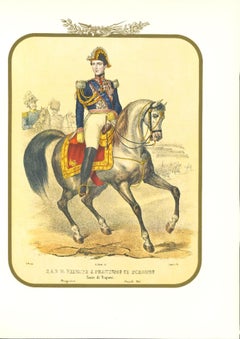
The Prince of Borbone - Original Lithograph by Antonio Zezon - 1851
Located in Roma, IT
The Prince of Borbone is an original lithograph by Antonio Zezon. Naples 1851.
Interesting colored lithograph which describes the Prince Francesco II di Borbone riding his horse, in...
Category
Modern Mid-19th Century Figurative Prints
Materials
Lithograph
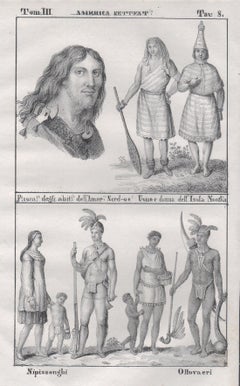
Indigenous People, North America, mid 19th century lithograph.
Located in Melbourne, Victoria
'Fisom degli abiti dell' America Nord-oe / Uomo donna dell' Isola Nootka' / 'Nipissonghi / Ottovaeri'
Italian lithograph, c1841. Originally from 'Galleria universale di tutti i popo...
Category
Naturalistic Mid-19th Century Figurative Prints
Materials
Lithograph
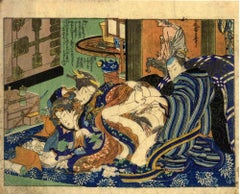
Shunga, Love Plays - Woodcut by Utagawa Kunisada - 1850s
Located in Roma, IT
Shunga, Love plays is an original artwork realized in the 1850s by Utagawa Kunisada (1786-1865).
Good print with gold. Backed, restored wormholes and missing oarts, glued at upper ...
Category
Modern Mid-19th Century Figurative Prints
Materials
Woodcut
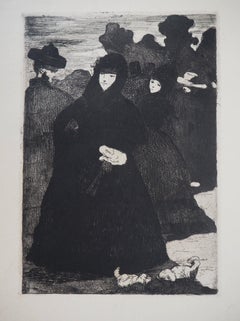
Spain : Women at Prado - Original Etching (Guerin #46
Fisher #47)
Located in Paris, IDF
Edouard MANET
Spain : Women at Prado, 1865
Original etching
Printed signature in the plate
On Japan paper 45 x 40 cm (c. 18 x 16 inch)
REFERENCES :
- Catalog raisonne Guerin #46
...
Category
Impressionist Mid-19th Century Figurative Prints
Materials
Etching
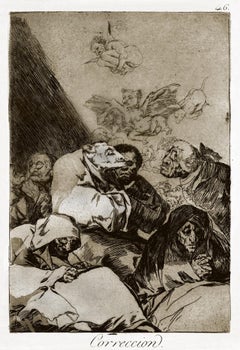
Correccion - Etching and Aquatint by Francisco Goya - 1868
Located in Roma, IT
Correccion is an original artwork realized by Francisco Goya and published for the first time in 1799.
Etching on wove paper.
This artwork belongs to the Third Edition published in...
Category
Old Masters Mid-19th Century Figurative Prints
Materials
Etching, Aquatint
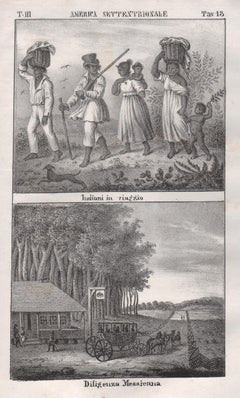
Indigenous People, Stage Coach, Mexico, America, mid 19th century lithograph.
Located in Melbourne, Victoria
'Indiani in viaggio' / 'Diligenza Messicana'
Italian lithograph, c1841. Originally from 'Galleria universale di tutti i popoli del mondo' by Giuseppe Antonelli, published in Venice,...
Category
Naturalistic Mid-19th Century Figurative Prints
Materials
Lithograph
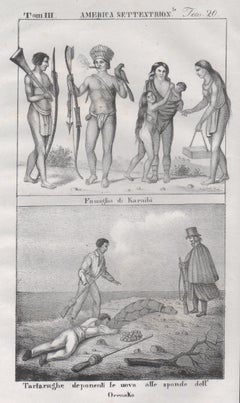
Caribbean Indigenous People / Orinoco, America, mid 19th century lithograph.
Located in Melbourne, Victoria
'Famiglia di Karaibi' / 'Tartarnughe deponenti le uova alle sponde dell' Orenoko''
Italian lithograph, c1841. Originally from 'Galleria universale di tutti i popoli del mondo' by Gi...
Category
Naturalistic Mid-19th Century Figurative Prints
Materials
Lithograph
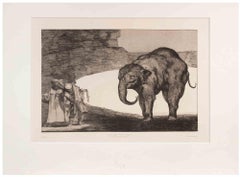
Otras Leyes por el Pueblo - Etching and and Aquatint by Francisco Goya - 1877
Located in Roma, IT
Otras Leyes por el Pueblo is a modern artwork realized by Francisco Goya.
Etching and Aquatint, from the Series "Los Proverbios", realized in 1815.
This copy belongs to the editio...
Category
Modern Mid-19th Century Figurative Prints
Materials
Etching
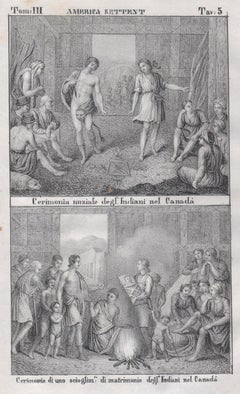
Wedding, Indigenous Peoples, Canada, North America, mid 19th century lithograph.
Located in Melbourne, Victoria
'Cerimonia nuziale degl' Indiani nel Canada' / 'Cerimonia di uno scioglim : di matrimonio degl' Indiani nel Canada'
Italian lithograph, c1841. Originally from 'Galleria universale d...
Category
Naturalistic Mid-19th Century Figurative Prints
Materials
Lithograph
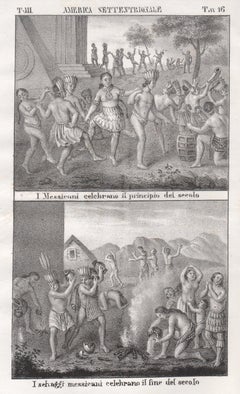
Indigenous Peoples celebrating, Mexico, America, mid 19th century lithograph.
Located in Melbourne, Victoria
'I Messicani celebrano il principio del secolo' / 'I selvaggi messicani celebrano il fine del secolo'
Italian lithograph, c1841. Originally from 'Galleria universale di tutti i popo...
Category
Naturalistic Mid-19th Century Figurative Prints
Materials
Lithograph
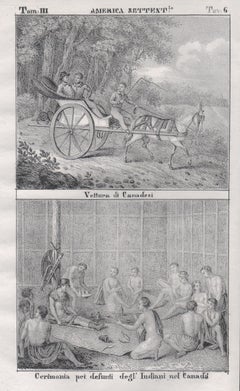
Funeral, Indigenous Peoples, Canada, North America, mid 19th century lithograph.
Located in Melbourne, Victoria
'Vettura di Candadesi' / 'Cerimonia per defunli degl' Indiani nel Canada'
Italian lithograph, c1841. Originally from 'Galleria universale di tutti i popoli del mondo' by Giuseppe An...
Category
Naturalistic Mid-19th Century Figurative Prints
Materials
Lithograph
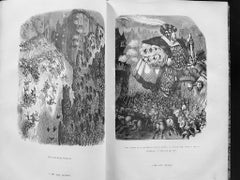
Gargantua - Rare Book Illustrated by Gustave Dorè - 1854
By Gustave Doré
Located in Roma, IT
Gargantua is an original modern rare book by François Rabelais illustrated for the first time by Gustave Doré (Strasbourg, 1832 – 23 January 1883) in 1854...
Category
Modern Mid-19th Century Figurative Prints
Materials
Woodcut
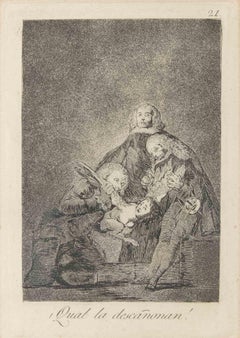
Qual la Descanonan! - Etching by Francisco Goya - 1855 ca
Located in Roma, IT
Etching and aquatint realized by Francisco Goya. Plate 21 from the Series "Los Caprichos".
Beautiful proof of 2nd Edition, printed in 1855 ca.
Includes a wooden frame cm. 38.5x32.
Category
Contemporary Mid-19th Century Figurative Prints
Materials
Etching
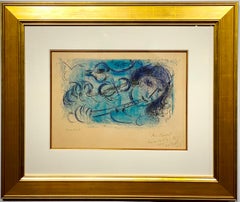
MARC CHAGALL "Le joueur de flûte"
By Marc Chagall
Located in Los Angeles, CA
MARC CHAGALL 1887 - 1985
"Le joueur de flûte"
1958
Colour lithograph
25.5x44 cm, illustration; 38.3x57.3 cm, sheet size
Signed lower right by the artist in ink "Marc Chagall" and dedicated "Pour Ursula et Gerd Hatje / "merci" / Marc Chagall / 1958". Inscribed lower left by the artist "Epreuve d'artiste".
This is an artist’s proof, aside from the edition of 90.
Catalogue Raisonné : Mourlot 197
Gerd Hatje (14 April 1915 – 24 July 2007) was a German publisher. The publishing house that he founded in 1945, named the Humanitas Verlag, renamed in 1947 as Verlag Gerd Hatje, is internationally known for contemporary art, photography and architecture. It merged in to Hatje Cantz in 1999. In the 1950s and 1960s, Hatje changed the focus to art, photography, and architecture.[1] He had contact with and was a friend of contemporary artists such as Hans Arp, Willi Baumeister, Joseph Beuys, Max Bill, Georges Braque, Marcel Breuer, Marc Chagall, Christo, Le Corbusier, Max Ernst, Alberto Giacometti, Walter Gropius, Joan Miró, Pablo Picasso, Ludwig Mies van der Rohe, and James Stirling...
Category
Impressionist Mid-19th Century Figurative Prints
Materials
Paper, Lithograph
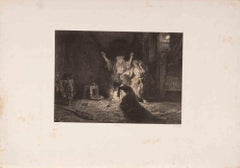
Les Sorcières de Mechlin (The Witches of Mechlin) - Lithograph - 1846
Located in Roma, IT
Lithograph after Alexandre-Gabriel Decamps (1803–1860).
This striking lithograph by Eugène Le Roux interprets a dramatic composition by Alexandre-Gabriel Decamps, one of the leading...
Category
Modern Mid-19th Century Figurative Prints
Materials
Lithograph
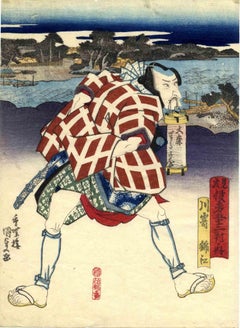
Kabukie - Woodcut by Utagawa Kunisada - 1840
Located in Roma, IT
Kabukie is an original artwork realized in 1840 by Utagawa Kunisada (1786-1865).
From the series "Mitate Yakusha gojusan tsui no uchi" (juxtaposition of actors and the 53 Tokaido s...
Category
Modern Mid-19th Century Figurative Prints
Materials
Woodcut
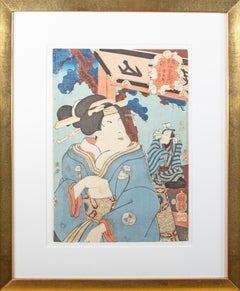
19th century color woodcut Japanese ukiyo-e print female geisha figure signed
Located in Milwaukee, WI
This print is from a highly regarded series by the Edo woodblock artist Utagawa Kuniyoshi: in the period, there were at times prohibitions in depicting a...
Category
Edo Mid-19th Century Figurative Prints
Materials
Paper, Pigment, Woodcut
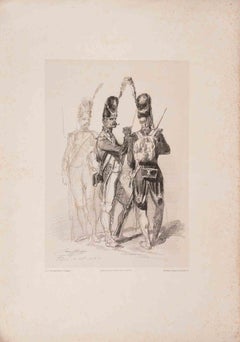
Study of Soldiers - Lithograph by Auguste Raffet - 1857
Located in Roma, IT
Lithograph on cream wove paper, signed and dated in the stone by August Raffet (“Raffet / Paris, 12 Oct. 1857”).
This work is a preparatory study showing French soldiers in detailed...
Category
Modern Mid-19th Century Figurative Prints
Materials
Lithograph
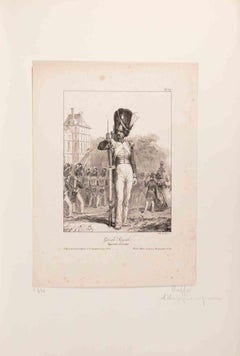
Garde Royale, Régiment Grenadier - Lithograph by Auguste Raffet - 1830s
Located in Roma, IT
Lithograph, c. 1830s.
Signed in the plate.
A finely detailed lithograph by Auguste Raffet, one of the most celebrated French lithographers of military subjects in the 19th century....
Category
Modern Mid-19th Century Figurative Prints
Materials
Lithograph
More Ways To Browse
Eduardo Roca
Edward B Gay
Edward Hopper Oil Painting
Edward Simmons
Edwin Lord Weeks
Elizabeth Enders
Elizabeth Horning
Emil Holzhauer
England Church Oil Painting
English Deer Painting
English Fox Hunt Painting
English Toy Terrier
Enrique Martinez Celaya
Eric Aho
Eritrea Art
Ernest Chateignon
Erotic Art Animal
Eugene Chigot