American Impressionist Figurative Prints
to
56
41
29
42
17
15
Overall Width
to
Overall Height
to
15,658
8,447
2,626
2,451
2,264
1,004
814
796
613
434
344
115
90
37
18
10
8
7
7
5
134
13
1
10
11
13
3
10
2
28
7
6
84
57
3
104
60
32
27
21
16
15
12
10
9
8
8
7
7
7
6
6
6
5
4
49
48
48
26
14
33
18
151
Style: American Impressionist
Skull
Located in San Francisco, CA
This artwork titled "Skull" c.1990 is an original color etching and aquatint by noted California artist Arnold A. Grossman, 1923-2016. It is hand signed in pencil by the artist. The ...
Category
Late 20th Century American Impressionist Figurative Prints
Materials
Aquatint

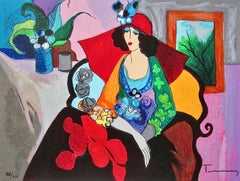
Red Hat, Itzchak Tarkay
Located in Fairfield, CT
Artist: Itzchak Tarkay (1935-2012)
Title: Red Hat
Year: Circa 2000
Medium: Silkscreen on wove paper
Size: 13.5 x 11.5 inches
Edition: 122/750, plus 100 Remarqu...
Category
Early 2000s American Impressionist Figurative Prints
Materials
Screen
$876 Sale Price
20% Off
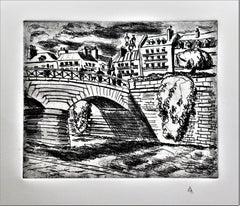
Paris, Le Pont Neuf
Located in San Francisco, CA
This artwork titled "Paris, Le Pont Neuf" c.1990 is an original etching by noted California artist Arnold A. Grossman, 1923-2016. It is signed with initia...
Category
Late 20th Century American Impressionist Figurative Prints
Materials
Etching
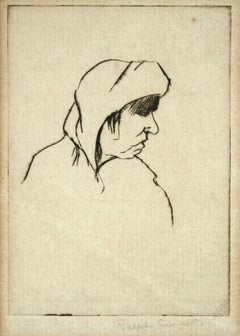
Early 20th Century Miniature Etching, Portrait of an Old Woman by Ralph Sweet
Located in Soquel, CA
Early 20th Century Miniature Etching, Portrait of an Old Woman by Ralph Sweet
Compelling early 20th century small-scale figurative etching of an old...
Category
Early 20th Century American Impressionist Figurative Prints
Materials
Paper, Etching

$656 Sale Price
25% Off
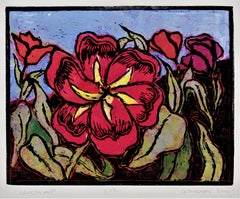
Keukenhof
Located in San Francisco, CA
This artwork titled "Keukenhof" 2000 is an original color wood block print by noted California artist Arnold A. Grossman, 1923-2016. It is signed, dated, titled and numbered 1/25 in...
Category
Late 20th Century American Impressionist Figurative Prints
Materials
Woodcut
Puerto Escondido
Located in San Francisco, CA
This artwork titled "Puerto Escondido" 1992 is an original color aquatint by noted California artist Arnold A. Grossman, 1923-2016. It is signed, dated, titled and numbered 1/20 in p...
Category
Late 20th Century American Impressionist Figurative Prints
Materials
Aquatint
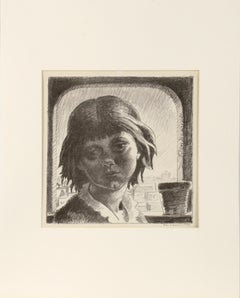
Young Girl by the Window, Mid-century Portrait
By Ben Messick
Located in Soquel, CA
Mid-century portrait of a young girl by a window by acclaimed California artist Ben Messick (American, 1891-1981). Signed "Ben Messick" in plate, and in pencil in the lower right corner, by the estate. Presented in an off-white mat. Unframed. Paper size: 12"H x 12"W
The following is submitted by Jim Lafferty whose sources include the autobiography of the artist:
William Washington Messick married Sarah A. Bristow January 2,1889 and from this marriage a son, Benjamin Newton Messick was born on January 9, 1891 on a farm near Strafford, Missouri. His art talent was apparent from the time he was a child and later recognized by his commanding officer in World War I. He completed his training in Los Angeles at Chouinard in the late-1920s and is well-known for his Regionalist scenes and Modernist paintings. He was an instructor at Chouinard through the 1950s & influenced a generation of LA Modernists.
Little is recorded in his autobiography about Messick's life from his teen years and service during the War. He enrolled at Chouinard Institute in the Fall of 1925, and was given a three-year scholarship by Mrs. Chouinard. In 1925 he won a cash award at the Los Angeles County Fair for a group of pen and charcoal drawings done in the parks and streets of Los Angeles. These works give the appearance of being spontaneous and fluid.
In 1930 Messick left Chouinard as a full-time student and rented an apartment on West Eighth Street to use as a studio and living quarters. He had his own ideas on what he was trying to accomplish in art. "If you should ask what is the message of my drawings, I should say that they may explain themselves or may be just a technical exercise."
By the mid 1940s, Messick's position in the art world had been well established as a teacher, painter, printmaker, writer and critic. Over his life time he had over 400 shows and exhibitions. Starting in 1939 he produced a number of stone lithographs that appear to the untrained eye as original drawings. To Messick the image was the most important aspect of his lithographs, and his signature in the plate was sufficient. Hand signing each lithograph did not seem necessary to him. He exhibited prints widely including the Albany Print Club and the Metropolitian Museum.
To further substantiate the authenticity of Messick's prints the Eclectic Gallery under the authority of the Messick family posthumously pencil signed each estate-acquired stone lithograph.
Messick had a childhood fascination with the circus and started drawing and painting the circus in 1935. His circus work, especially his clown studies, and his lithographs became his trademark work for in the 1940s and 1950s. A critic for ART REVIEW described his Big Top work this way: "His circus canvases...
Category
1940s American Impressionist Figurative Prints
Materials
Paper, Ink
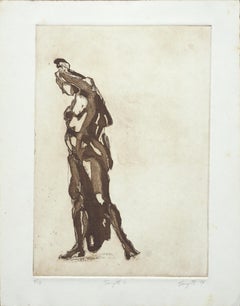
"Study 6" Figurative Abstract Lithograph
By Jim Smyth
Located in Soquel, CA
Graceful abstract figurative lithograph by Jim Smyth (American, b. 1938). Numbered, titled, signed and dated "5/12", "Study 2", "Smyth 74” along the bottom edge. Unframed.
Jim Smyth has studied at the Academia de Belle Arti in Fiorenza, Italy, Ecole des BeauxArts in Geneva, New York Academy, and the Art Students League. He is also a graduate of UC Berkeley with a degree in Fine Art.
Although academically trained, Smyth practices and teaches a more impressionistic style of painting, focusing on the Alla Prima technique.
He is particularly knowledgeable about drawing, perspective, color theory and the human figure, his passion. Smyth, with extensive academic knowledge, has a profound love of all human representations as illustrated by his humorous quick sketches from life. He also practices and teaches oil painting and pastels.
When not in Provence, or Southeastern France, Smyth teaches intensely in art schools, art centers and several colleges in the Bay Area. He is a beloved instructor and his classes fill in quickly as he is very knowledgeable.
On his return to the United States, he began studying with Mr. Alanson Appleton at the College of San Mateo, San Mateo, California. Smyth was a founding member of the Appletree Etchers, Inc., an etching print shop organized by Mr. Appleton and his students to develop and promote color intaglio. Smyth served as Master Printer at the studio for many years perfecting the techniques of intaglio and developing the color theories of Mr. Appleton as applied to the deeply etched plate.
Smyth received his degree from the University of California, Berkeley, in 1972 and holds the California Community College Certificate and an Adult Education Certificate. Smyth was invited to teach "Anatomy for Artists" at Foothill College, Los Altos Hills, California, as a result of his many years of dissection of the cadaver and developed the course of study of Perspective for the college. During this period, he began teaching Life Drawing at the Pacific Art League of Palo Alto, Palo Alto, California. During the following thirty years Smyth has taught an average of twelve classes per week at the Pacific Art League of Palo Alto, the Palo Alto Art Center and the Burlingame Recreation Department among others in all phases of drawing and painting. He has conducted many workshops for the California Academy of Painters in many aspects of drawing and painting. Currently, he is an Adjunct Professor of Drawing at the College of San Mateo, San Mateo, California. He is an authority on the materials of painting and drawing, techniques of traditional drawing and painting, color theory, perspective and anatomy for artists. In his career in Life Drawing, Smyth has made over two hundred thousand drawings from the model.
In addition to studies at Berkeley, Smyth has studied at the College of San Mateo, Foothill College, De Anza College, Mission College, and West Valley College, all in California. One of the pivotal points in his career was studying with Mr. Maynard Dixon Stewart at the University of San Jose, California. He spent a year at the New York Academy of Art where he was offered a full scholarship and at the Art Students League of New York. He concurrently attended classes at the National Academy of Design in New York. Among others, Smyth studied with M. Andrejivec, Ted Schmidt, Elliot Goldfinger, Gary Fagin, Ted Jacobs, Leo Neufeld, David Leffel, Jack Ferragasso, Jim Childs and Everett Raymond Kinstler and Kim English. Smyth has also studied with the noted painter and colorist, Ovanes Berberian...
Category
1970s American Impressionist Figurative Prints
Materials
Paper, Etching
$520 Sale Price
20% Off
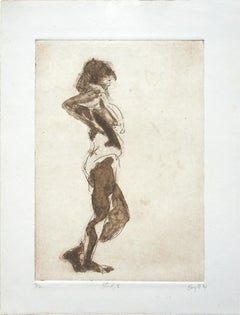
"Study 8" Figurative Lithograph
By Jim Smyth
Located in Soquel, CA
Lithograph of a figure of a woman by Jim Smyth (American, b. 1938). Numbered, titled, signed and dated "3/12", "Study 8", "Smyth 74” along the bottom edge. Unframed.
Jim Smyth has studied at the Academia de Belle Arti in Fiorenza, Italy, Ecole des BeauxArts in Geneva, New York Academy, and the Art Students League. He is also a graduate of UC Berkeley with a degree in Fine Art.
Although academically trained, Smyth practices and teaches a more impressionistic style of painting, focusing on the Alla Prima technique.
He is particularly knowledgeable about drawing, perspective, color theory and the human figure, his passion. Smyth, with extensive academic knowledge, has a profound love of all human representations as illustrated by his humorous quick sketches from life. He also practices and teaches oil painting and pastels.
When not in Provence, or Southeastern France, Smyth teaches intensely in art schools, art centers and several colleges in the Bay Area. He is a beloved instructor and his classes fill in quickly as he is very knowledgeable.
On his return to the United States, he began studying with Mr. Alanson Appleton at the College of San Mateo, San Mateo, California. Smyth was a founding member of the Appletree Etchers, Inc., an etching print shop organized by Mr. Appleton and his students to develop and promote color intaglio. Smyth served as Master Printer at the studio for many years perfecting the techniques of intaglio and developing the color theories of Mr. Appleton as applied to the deeply etched plate.
Smyth received his degree from the University of California, Berkeley, in 1972 and holds the California Community College Certificate and an Adult Education Certificate. Smyth was invited to teach "Anatomy for Artists" at Foothill College, Los Altos Hills, California, as a result of his many years of dissection of the cadaver and developed the course of study of Perspective for the college. During this period, he began teaching Life Drawing at the Pacific Art League of Palo Alto, Palo Alto, California. During the following thirty years Smyth has taught an average of twelve classes per week at the Pacific Art League of Palo Alto, the Palo Alto Art Center and the Burlingame Recreation Department among others in all phases of drawing and painting. He has conducted many workshops for the California Academy of Painters in many aspects of drawing and painting. Currently, he is an Adjunct Professor of Drawing at the College of San Mateo, San Mateo, California. He is an authority on the materials of painting and drawing, techniques of traditional drawing and painting, color theory, perspective and anatomy for artists. In his career in Life Drawing, Smyth has made over two hundred thousand drawings from the model.
In addition to studies at Berkeley, Smyth has studied at the College of San Mateo, Foothill College, De Anza College, Mission College, and West Valley College, all in California. One of the pivotal points in his career was studying with Mr. Maynard Dixon Stewart at the University of San Jose, California. He spent a year at the New York Academy of Art where he was offered a full scholarship and at the Art Students League of New York. He concurrently attended classes at the National Academy of Design in New York. Among others, Smyth studied with M. Andrejivec, Ted Schmidt, Elliot Goldfinger, Gary Fagin, Ted Jacobs, Leo Neufeld, David Leffel, Jack Ferragasso, Jim Childs and Everett Raymond Kinstler and Kim English. Smyth has also studied with the noted painter and colorist, Ovanes Berberian...
Category
1970s American Impressionist Figurative Prints
Materials
Paper, Etching
$520 Sale Price
20% Off
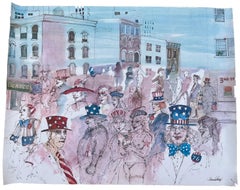
4th of July, American Impressionist Offsett Lithograph by Marcia Marx
By Marcia Marx
Located in Long Island City, NY
Marcia Marx (1931 - 2005) - 4th of July, Year: 1976, Medium: Offsett Lithograph, signed and numbered, Edition: 54/100, Size: 23 x 29.5 in. (58.42 x 74.93 cm)
Category
1970s American Impressionist Figurative Prints
Materials
Lithograph
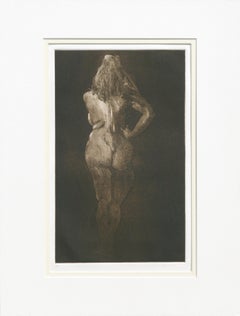
Nude Figure Posterior View, Figurative Drypoint Etching
By Jim Smyth
Located in Soquel, CA
Limited edition drypoint etching of a nude figure from a posterior view by Jim Smyth (American, b. 1938). Numbered and signed by hand "7/15 Jim Smyth" along the bottom edge. Presented in a new cream and off-white double mat. No frame. Image size: 14.75"H x 10.75"W
Jim Smyth (American, b. 1938) has studied at the Academia de Belle Arti in Fiorenza, Italy, Ecole des BeauxArts in Geneva, New York Academy and the Art Students league. He is also a graduate from UC Berkeley with a degree in Fine Art.
Although academically trained, Smyth practices and teaches a more impressionistic style of painting, focusing on Alla Prima technique. He is particularly knowledgeable about drawing, perspective, color theory and the human figure, his passion. Smyth, with an extensive academic knowledge, has a profound love of all human representations as illustrated by his humorous quick sketches from life. He also practices and teaches oil painting and pastels.
When not in Provence, or Southeastern France, Smyth teaches intensely in art schools, art centers and several colleges in the Bay Area. He is a beloved instructor and his classes fill in quickly as he is very knowledgeable.
On his return to the United States, he began studying with Mr. Alanson Appleton at the College of San Mateo, San Mateo, California. Smyth was a founding member of the Appletree Etchers, Inc., an etching print shop organized by Mr. Appleton and his students to develop and promote color intaglio. Smyth served as Master Printer at the studio for many years perfecting the techniques of intaglio and developing the color theories of Mr. Appleton as applied to the deep etched plate.
Smyth received his degree from the University of California, Berkeley, in 1972 and holds the California Community College Certificate and an Adult Education Certificate. Smyth was invited to teach "Anatomy for Artists" at Foothill College, Los Altos Hills, California, as a result of his many years of dissection of the cadaver and developed the course of study of Perspective for the college. During this period, he began teaching Life Drawing at the Pacific Art League of Palo Alto, Palo Alto, California. During the following thirty years Smyth has taught an average of twelve classes per week at the Pacific Art League of Palo Alto, the Palo Alto Art Center and the Burlingame Recreation Department among others in all phases of drawing and painting. He has conducted many workshops for the California Academy of Painters in many aspects of drawing and painting. Currently, he is an Adjunct Professor of Drawing at the College of San Mateo, San Mateo, California. He is an authority on the materials of painting and drawing, techniques of traditional drawing and painting, color theory, perspective and anatomy for artists. In his career in Life Drawing, Smyth has made over two hundred thousand drawings from the model.
In addition to studies at Berkeley, Smyth has studied at the College of San Mateo, Foothill College, De Anza College, Mission College and West Valley College, all in California. One of the pivotal points in his career was studying with Mr. Maynard Dixon Stewart at the University of San Jose, California. He spent a year at the New York Academy of Art where he was offered a full scholarship and at the Art Students League of New York. He concurrently attended classes at the National Academy of Design in New York. Among others, Smyth studied with M. Andrejivec, Ted Schmidt, Elliot Goldfinger, Gary Fagin, Ted Jacobs, Leo Neufeld, David Leffel, Jack Ferragasso, Jim Childs and Everett Raymond Kinstler and Kim English. Smyth has also studied with the noted painter and colorist, Ovanes Berberian. In 2002 Jim was invited to study at the Academy of Art in St. Petersburg, Russia, where he worked in Life Drawing and Life Painting.
Smyth is a popular lecturer, a sought after demonstrator and juror. He is the recipient of many awards for both his painting and his teaching. In 1988 and again in 2003, he received the Kenneth Washburn...
Category
Late 20th Century American Impressionist Figurative Prints
Materials
Paper, Ink, Drypoint
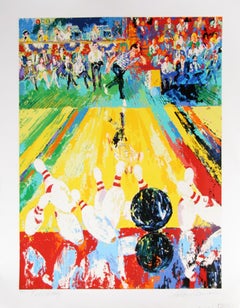
Million Dollar Strike, Pop Art Screenprint by LeRoy Neiman
By LeRoy Neiman
Located in Long Island City, NY
Artist: LeRoy Neiman, American (1921 - 2012)
Title: Million Dollar Strike (Earl Anthony)
Year: 1982
Medium: Serigraph, Signed by the artist and Earl Ant...
Category
1980s American Impressionist Figurative Prints
Materials
Screen
Gymkhana Umbrella Races Rockaway Hunting Club 1890 Sporting Incidents
Located in Paonia, CO
Gymkhana Umbrella Races Rockaway Hunting Club is from the portfolio entitled Sporting Incidents: Being a Collection of sixteen plates done in color..representing the most important events of the track...
Category
1890s American Impressionist Figurative Prints
Materials
Color

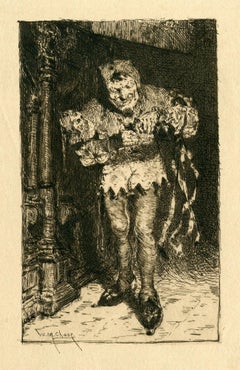
Keying Up - The Court Jester
Located in Fairlawn, OH
Keying Up - The Court Jester
Etching with drypoint, 1879
Signed in the plate lower left corner (see photos)
Proof before engraved title and engraved names
Printed on thin light golden Japanese tissue paper
In the final state, with engraved titled and typeface engraved artist’s signature below the image
Condition: excellent
Plate size: 6-5/8 x 4-1/4"
According to Pisano, this image was very popular during Chase’s life. It is based on his famous painting, Keying Up-The Court Jester, in the collection of the Pennsylvania Academy of Fine Arts. The painting was created in Munich during the artist’s studies there. It was exhibited in the 1876 Centennial Exhibition in Philadelphia where it won a Medal of Honor and helped establish the artist’s reputation as a leading American painter.
Chase, always conscious of self promotion, created the etching and had numerous impressions printed. He sold them for a modest price to increase his fame. The etching was later published in Sylvester R. Koehler, American Art Review, September 1878. It was for this American Art Review printing that the engraved titled and type face signature below the image were added to the plate.
This example was part of a group of impressions that came down in the Chase family via his daughter Dorothy Bremond Chase, his third daughter. They were acquired at auction in a single auction lot, housed in a paper board folder. The consignor was Associated American Artist’s as they were liquidating their stock prior to closing the gallery.
Dorothy was the subject of Chase’s painting, My Little Daughter Dorothy. C. 1894, in the collection of the Detroit Institute of Arts as well as numerous other portraits of her.
Reference: Pisano/Bake, Volume 1, Pr. 3, illustrates the rare 1st state, this being a 2nd state before any other the engraved title and Chase's name in the bottom margin which are found in the third state.
Artist bio in file (Chase)
In 1883 Chase was involved in the organization of an exhibition to help raise funds for a pedestal for the Statute of Liberty. The exhibition featured loans of three works by Manet and urban scenes by the Italian Impressionist Giuseppe de Nittis. Both artists influenced Chase's Impressionistic style that gave rise to a series of New York park scenes. It is also thought that he was influenced by John Singer Sargent's In the Luxembourg Gardens (1879) which was exhibited in New York at this time. Indeed, Chase had met Sargent in Europe in 1881, the two men becoming lifelong friends with Sargent painting Chase's portrait in 1902.
On another European trip in 1885, Chase met James McNeill Whistler in London. While Whistler had a reputation for being difficult, the two artists got along famously and agreed to paint one another's portrait. Eventually, however, Whistler's moods began to grate with Chase who wrote home stating "I really begin to feel that I never will get away from here". For his part, Whistler criticized Chase's finished portrait and, according to Hirshler, "complained about Chase for the rest of his life". While no record exists of Whistler's portrait of Chase; Chase's portrait of Whistler remains a well-known piece in his oeuvre.
In 1887 Chase married Alice Gerson, the daughter of the manager of a lithography company. Though some fifteen years his junior (Chase was 37), he had known Alice for some time through her family's devotion to the arts. The pair, who would enjoy a happy marriage with Alice in full support of her husband's career, settled initially in Brooklyn where their first child was born. The couple would parent six daughters and two sons and it was only his family that could rival his devotion to his art. Indeed, Chase often combined his two loves by painting several portraits of his wife and children in Brooklyn parks before the couple relocated to Manhattan.
Later Period
Between 1891 and 1902, Chase and his family spent their summers at a purpose-built home and studio in Shinnecock Hills, a close suburb of the upmarket town of Southampton on the south shore of Long Island (roughly 100 miles east of New York). Chase set up, and taught two days a week, at the nearby Shinnecock Hills Summer School of Art which benefitted from the financial backing of local art collectors. It was at Shinnecock that Chase, taken in by the region's striking natural surroundings, painted several Impressionistic landscapes. As Bettis put it, "There, among the dunes, in the bright sunlight and sea air his painterly impulse was given free sway, and he produced some of his freest and loveliest work". His passion for the area was so felt he even gave his daughter Hazel the middle name of Neamaug, in honor of the rich Native American history of Shinnecock. Chase was equally focused on the students that came to the School and who he encouraged to paint in the modern plein air style favored by the French Impressionists.
Although Chase was making a name for himself as an Impressionist, he never abandoned his commitment to the sombre tones and academic tropes he had learned in Munich, though these he reserved for his portraits, and for his series of striking still lifes featuring dead fish. Chase was in fact a successful society portraitist - he painted fashionable women for a fee of $2,000 - and would paint his students as "samples" which he then donated to leading art institutions (such as Lady in Black (1888) which he donated to the Metropolitan Museum in 1891).
In 1896, facing financial difficulties, Chase flirted with the idea of giving up his teaching in New York and traveled with his family to Madrid where he developed a passion for bullfighting. Chase returned however to Shinnecock in June to teach his yearly summer art class, and in the fall of that year, established his own art school in Manhattan: the Chase School which was modelled on the Académie Julian in Paris. Chase lacked business savvy, however, and the Chase School lasted only two years before it was placed under new management. It continued as the New York School of Art (changed to Parsons School of Design starting 1941) with Chase as head the School for eleven more years. Chase also taught during this period at the Pennsylvania Academy of Fine Arts.
In 1902, following the premature death of his friend John Twachtman, Chase was invited to join the Ten American Painters group (who included amongst its members, Frank Weston Benson, Thomas Wilmer Dewing...
Category
1870s American Impressionist Figurative Prints
Materials
Etching
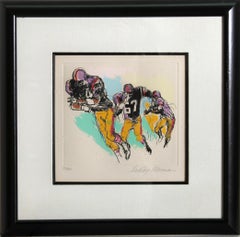
Interference, Football Color Etching by LeRoy Neiman 1972
By LeRoy Neiman
Located in Long Island City, NY
Artist: LeRoy Neiman, American (1921 - 2012)
Title: Interference
Year: 1972
Medium: Etching, signed and numbered in pencil
Edition: 54/150
Image Size: 7.5 x 8.4 inches
Size: 9 x 9.25...
Category
1970s American Impressionist Figurative Prints
Materials
Etching
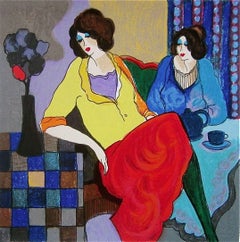
Sisters, Itzchak Tarkay
Located in Fairfield, CT
Artist: Itzchak Tarkay (1935-2012)
Title: Sisters
Year: Circa 2000
Medium: Silkscreen on wove paper
Size: 11.25 x 11.75 inches
Edition: 219/750, plus 100 Remarques
Condition: Excelle...
Category
Early 2000s American Impressionist Figurative Prints
Materials
Screen
$876 Sale Price
20% Off
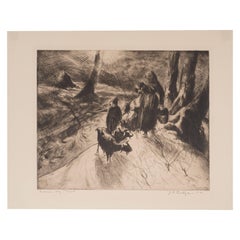
"Woman, Boy and Goats", Original Signed Etching by John E. Costigan
Located in New York, NY
This original, limited edition etching, was realized by the esteemed American artist John E. Costigan, who is represented in the collections of the Metropolitan Museum, the Philips Memorial Gallery in Washington and the Brooklyn Museum, to name only a few of the many institutions that feature his work. This print, with its highly considered composition and its loose style of figuration- deftly balances realism and abstraction- helps to explain his acclaim. This etching features a mother walking with her child and two goats in a forested glen. It is a Classic pastoral scene rendered in Costigan's inimitable style- somewhere between Theodore Rousseau and Thomas Hart Benton. These offer a beautiful glimpse of a bygone American pastoral...
Category
1930s American Impressionist Figurative Prints
Materials
Etching
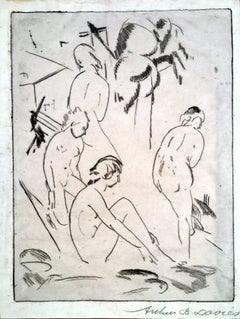
Round of Summer (aka Four Figures), First State Proof
Located in New York, NY
Arthur B. Davies (1862-1928), Round of Summer (aka Four Figures), soft ground etching, 1919, signed in pencil lower right. Reference: Czestochowski 91, first state (of 3), trial proo...
Category
1910s American Impressionist Figurative Prints
Materials
Etching
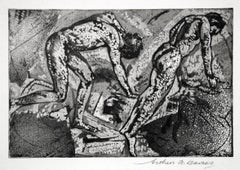
Tartessians
Located in New York, NY
Arthur B. Davies (1862-1928), Tartessians, soft ground etching with aquatint, 1919-20, signed in pencil lower right. Reference: Czestochowski 96, second state (of 2), total printing ...
Category
1910s American Impressionist Figurative Prints
Materials
Etching, Aquatint
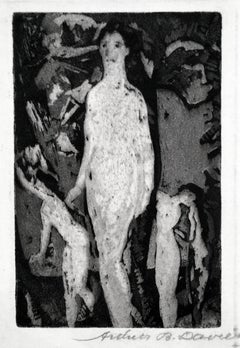
Up-Rising
Located in New York, NY
Arthur B. Davies, Up-Rising, soft ground etching and aquatint on a cream laid paper, 1919, signed in pencil lower right margin. Reference: Czestochowski 78, second state (of 3). In g...
Category
1910s American Impressionist Figurative Prints
Materials
Etching, Aquatint
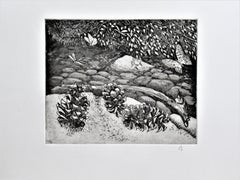
Pine Cones
Located in San Francisco, CA
This artwork titled "Pine Cones" c.1990 is an original etching by noted California artist Arnold A. Grossman, 1923-2016. It is signed with initials in pencil by the artist. The artwo...
Category
Late 20th Century American Impressionist Figurative Prints
Materials
Etching
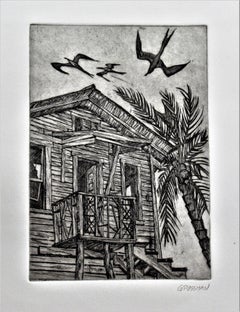
The Old House
Located in San Francisco, CA
This artwork titled "The Old House" c.1980 is an original etching by noted California artist Arnold A. Grossman, 1923-2016. It is hand signed in pencil by th...
Category
Late 20th Century American Impressionist Figurative Prints
Materials
Etching
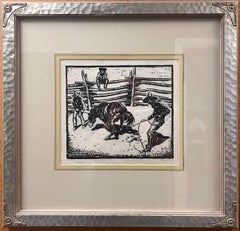
The Bronc by Lon Megargee
Located in Phoenix, AZ
Lon Megargee 1883-1960
"The Bronc"
Wood block print
Signed in plate, lower right
Image size: 9 x 10 inches
Frame size 21 x 21.5 inches
Creator of Stetson's hat logo "Last Drop from his Hat"
Lon Megargee
1883 - 1960
At age 13, Lon Megargee came to Phoenix in 1896 following the death of his father in Philadelphia. For several years he resided with relatives while working at an uncle’s dairy farm and at odd jobs. He returned to Philadelphia in 1898 – 1899 in order to attend drawing classes at the Pennsylvania Academy of the Fine Arts. Back in Phoenix in 1899, he decided at the age of 16 to try to make his living as a cowboy.
Lon moved to the cow country of Wickenburg, Arizona where he was hired by Tex Singleton’s Bull Ranch. He later joined the Three Bar R. . . and after a few years, was offered a job by Billy Cook of the T.T. Ranch near New River. By 1906, Megargee had learned his trade well enough to be made foreman of Cook’s outfit.
Never shy about taking risks, Lon soon left Cook to try his own hand at ranching. He partnered with a cowpuncher buddy, Tom Cavness, to start the El Rancho Cinco Uno at New River. Unfortunately, the young partners could not foresee a three-year drought that would parch Arizona, costing them their stock and then their hard-earned ranch.
Breaking with his romantic vision of cowboy life, Megargee finally turned to art full time. He again enrolled at the Pennsylvania Academy of Art and then the Los Angeles School of Art and Design during 1909 – 1910. The now well-trained student took his first trip to paint “en plein air” (outdoors) to the land of Hopi and Navajo peoples in northern Arizona. After entering paintings from this trip in the annual Territorial Fair at Phoenix, in 1911, he surprisingly sold his first oil painting to a major enterprise – the Santa Fe Railroad . . . Lon received $50 for “Navajos Watching the Santa Fe Train.” He soon sold the SFRR ten paintings over the next two years. For forty years the railroad was his most important client, purchasing its last painting from him in 1953.
In a major stroke of good fortune during his early plein-air period, Megargee had the opportunity to paint with premier artist, William R. Leigh (1866 – 1955). Leigh furnished needed tutoring and counseling, and his bright, impressionistic palette served to enhance the junior artist’s sense of color and paint application. In a remarkable display of unabashed confidence and personable salesmanship, Lon Megargee, at age 30, forever linked his name with Arizona art history. Despite the possibility of competition from better known and more senior artists, he persuaded Governor George Hunt and the Legislature in 1913 to approve 15 large, historic and iconic murals for the State Capitol Building in Phoenix. After completing the murals in 1914, he was paid the then princely sum of roughly $4000. His Arizona statehood commission would launch Lon to considerable prominence at a very early point in his art career.
Following a few years of art schooling in Los Angeles, and several stints as an art director with movie studios, including Paramount, Megargee turned in part to cover illustrations for popular Western story magazines in the 1920s.
In the 1920s, as well, Lon began making black and white prints of Western types and of genre scenes from woodblocks. These prints he generally signed and sold singly. In 1933, he published a limited edition, signed and hard-cover book (about 250 copies and today rare)containing a group of 28 woodblock images. Titled “The Cowboy Builds a Loop,” the prints are noteworthy for strong design, excellent draftsmanship, humanistic and narrative content, and quality. Subjects include Southwest Indians and cowboys, Hispanic men and women, cattle, horses, burros, pioneers, trappers, sheepherders, horse traders, squaw men and ranch polo players. Megargee had a very advanced design sense for simplicity and boldness which he demonstrated in how he used line and form. His strengths included outstanding gestural (action) art and strong figurative work. He was superb in design, originality and drawing, as a study of his prints in the Hays collection reveals.
In 1944, he published a second group of Western prints under the same title as the first. Reduced to 16 images from the original 28 subjects, and slightly smaller, Lon produced these prints in brown ink on a heavy, cream-colored stock. He designed a sturdy cardboard folio to hold each set. For the remainder of his life, Lon had success selling these portfolios to museum stores, art fairs and shows, and to the few galleries then selling Western art.
Drawing on real working and life experiences, Lon Megargee had a comprehensive knowledge, understanding and sensitivity for Southwestern subject matter. Noted American modernist, Lew Davis...
Category
Early 20th Century American Impressionist Figurative Prints
Materials
Woodcut
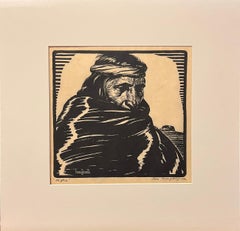
Hopi by Lon Megargee, Original Signed Block Print ca. 1920s
Located in Phoenix, AZ
Title: Hopi ca. 1920s
Artist: Lon Megargee
Medium: Block Print
Size: 11 x 11 inches (Sight Measurement)
SHIPPING CHARGES INCLUDE SHIPPING, PACKAGING & INSURANCE
Creator of Stetson's hat logo "Last Drop from his Hat"
Image of Lon Megargee not included in purchase.
Lon Megargee
1883 - 1960
At age 13, Lon Megargee came to Phoenix in 1896 following the death of his father in Philadelphia. For several years he resided with relatives while working at an uncle’s dairy farm and at odd jobs. He returned to Philadelphia in 1898 – 1899 in order to attend drawing classes at the Pennsylvania Academy of the Fine Arts. Back in Phoenix in 1899, he decided at the age of 16 to try to make his living as a cowboy.
Lon moved to the cow country of Wickenburg, Arizona where he was hired by Tex Singleton’s Bull Ranch. He later joined the Three Bar R. . . and after a few years, was offered a job by Billy Cook of the T.T. Ranch near New River. By 1906, Megargee had learned his trade well enough to be made foreman of Cook’s outfit.
Never shy about taking risks, Lon soon left Cook to try his own hand at ranching. He partnered with a cowpuncher buddy, Tom Cavness, to start the El Rancho Cinco Uno at New River. Unfortunately, the young partners could not foresee a three-year drought that would parch Arizona, costing them their stock and then their hard-earned ranch.
Breaking with his romantic vision of cowboy life, Megargee finally turned to art full time. He again enrolled at the Pennsylvania Academy of Art and then the Los Angeles School of Art and Design during 1909 – 1910. The now well-trained student took his first trip to paint “en plein air” (outdoors) to the land of Hopi and Navajo peoples in northern Arizona. After entering paintings from this trip in the annual Territorial Fair at Phoenix, in 1911, he surprisingly sold his first oil painting to a major enterprise – the Santa Fe Railroad . . . Lon received $50 for “Navajos Watching the Santa Fe Train.” He soon sold the SFRR ten paintings over the next two years. For forty years the railroad was his most important client, purchasing its last painting from him in 1953.
In a major stroke of good fortune during his early plein-air period, Megargee had the opportunity to paint with premier artist, William R. Leigh (1866 – 1955). Leigh furnished needed tutoring and counseling, and his bright, impressionistic palette served to enhance the junior artist’s sense of color and paint application. In a remarkable display of unabashed confidence and personable salesmanship, Lon Megargee, at age 30, forever linked his name with Arizona art history. Despite the possibility of competition from better known and more senior artists, he persuaded Governor George Hunt and the Legislature in 1913 to approve 15 large, historic and iconic murals for the State Capitol Building in Phoenix. After completing the murals in 1914, he was paid the then princely sum of roughly $4000. His Arizona statehood commission would launch Lon to considerable prominence at a very early point in his art career.
Following a few years of art schooling in Los Angeles, and several stints as an art director with movie studios, including Paramount, Megargee turned in part to cover illustrations for popular Western story magazines in the 1920s.
In the 1920s, as well, Lon began making black and white prints of Western types and of genre scenes from woodblocks. These prints he generally signed and sold singly. In 1933, he published a limited edition, signed and hard-cover book (about 250 copies and today rare)containing a group of 28 woodblock images. Titled “The Cowboy Builds a Loop,” the prints are noteworthy for strong design, excellent draftsmanship, humanistic and narrative content, and quality. Subjects include Southwest Indians and cowboys, Hispanic men and women, cattle, horses, burros, pioneers, trappers, sheepherders, horse traders, squaw men and ranch polo players. Megargee had a very advanced design sense for simplicity and boldness which he demonstrated in how he used line and form. His strengths included outstanding gestural (action) art and strong figurative work. He was superb in design, originality and drawing, as a study of his prints in the Hays collection reveals.
In 1944, he published a second group of Western prints under the same title as the first. Reduced to 16 images from the original 28 subjects, and slightly smaller, Lon produced these prints in brown ink on a heavy, cream-colored stock. He designed a sturdy cardboard folio to hold each set. For the remainder of his life, Lon had success selling these portfolios to museum stores, art fairs and shows, and to the few galleries then selling Western art.
Drawing on real working and life experiences, Lon Megargee had a comprehensive knowledge, understanding and sensitivity for Southwestern subject matter. Noted American modernist, Lew Davis...
Category
1920s American Impressionist Figurative Prints
Materials
Woodcut
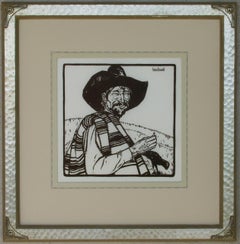
The Sheepherder by Lon Megargee
Located in Phoenix, AZ
Lon Megargee 1883-1960
"The Sheepherder"
Wood block print
Signed in plate, lower right
Image size: 10 x 10 inches
Frame size 22 x 22 inches
Creator of Stetson's hat logo "Last Drop from his Hat"
Lon Megargee
1883 - 1960
At age 13, Lon Megargee came to Phoenix in 1896 following the death of his father in Philadelphia. For several years he resided with relatives while working at an uncle’s dairy farm and at odd jobs. He returned to Philadelphia in 1898 – 1899 in order to attend drawing classes at the Pennsylvania Academy of the Fine Arts. Back in Phoenix in 1899, he decided at the age of 16 to try to make his living as a cowboy.
Lon moved to the cow country of Wickenburg, Arizona where he was hired by Tex Singleton’s Bull Ranch. He later joined the Three Bar R. . . and after a few years, was offered a job by Billy Cook of the T.T. Ranch near New River. By 1906, Megargee had learned his trade well enough to be made foreman of Cook’s outfit.
Never shy about taking risks, Lon soon left Cook to try his own hand at ranching. He partnered with a cowpuncher buddy, Tom Cavness, to start the El Rancho Cinco Uno at New River. Unfortunately, the young partners could not foresee a three-year drought that would parch Arizona, costing them their stock and then their hard-earned ranch.
Breaking with his romantic vision of cowboy life, Megargee finally turned to art full time. He again enrolled at the Pennsylvania Academy of Art and then the Los Angeles School of Art and Design during 1909 – 1910. The now well-trained student took his first trip to paint “en plein air” (outdoors) to the land of Hopi and Navajo peoples in northern Arizona. After entering paintings from this trip in the annual Territorial Fair at Phoenix, in 1911, he surprisingly sold his first oil painting to a major enterprise – the Santa Fe Railroad . . . Lon received $50 for “Navajos Watching the Santa Fe Train.” He soon sold the SFRR ten paintings over the next two years. For forty years the railroad was his most important client, purchasing its last painting from him in 1953.
In a major stroke of good fortune during his early plein-air period, Megargee had the opportunity to paint with premier artist, William R. Leigh (1866 – 1955). Leigh furnished needed tutoring and counseling, and his bright, impressionistic palette served to enhance the junior artist’s sense of color and paint application. In a remarkable display of unabashed confidence and personable salesmanship, Lon Megargee, at age 30, forever linked his name with Arizona art history. Despite the possibility of competition from better known and more senior artists, he persuaded Governor George Hunt and the Legislature in 1913 to approve 15 large, historic and iconic murals for the State Capitol Building in Phoenix. After completing the murals in 1914, he was paid the then princely sum of roughly $4000. His Arizona statehood commission would launch Lon to considerable prominence at a very early point in his art career.
Following a few years of art schooling in Los Angeles, and several stints as an art director with movie studios, including Paramount, Megargee turned in part to cover illustrations for popular Western story magazines in the 1920s.
In the 1920s, as well, Lon began making black and white prints of Western types and of genre scenes from woodblocks. These prints he generally signed and sold singly. In 1933, he published a limited edition, signed and hard-cover book (about 250 copies and today rare)containing a group of 28 woodblock images. Titled “The Cowboy Builds a Loop,” the prints are noteworthy for strong design, excellent draftsmanship, humanistic and narrative content, and quality. Subjects include Southwest Indians and cowboys, Hispanic men and women, cattle, horses, burros, pioneers, trappers, sheepherders, horse traders, squaw men and ranch polo players. Megargee had a very advanced design sense for simplicity and boldness which he demonstrated in how he used line and form. His strengths included outstanding gestural (action) art and strong figurative work. He was superb in design, originality and drawing, as a study of his prints in the Hays collection reveals.
In 1944, he published a second group of Western prints under the same title as the first. Reduced to 16 images from the original 28 subjects, and slightly smaller, Lon produced these prints in brown ink on a heavy, cream-colored stock. He designed a sturdy cardboard folio to hold each set. For the remainder of his life, Lon had success selling these portfolios to museum stores, art fairs and shows, and to the few galleries then selling Western art.
Drawing on real working and life experiences, Lon Megargee had a comprehensive knowledge, understanding and sensitivity for Southwestern subject matter. Noted American modernist, Lew Davis...
Category
Early 20th Century American Impressionist Figurative Prints
Materials
Woodcut
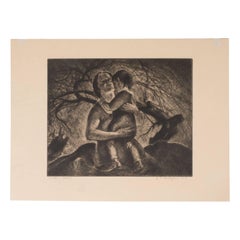
"Mother and Child" A Signed Limited Edition Etching by John E. Costigan
Located in New York, NY
This original, limited edition etching, was realized by the esteemed American artist John E. Costigan, circa 1930. He is represented in the collections of the Metropolitan Museum, th...
Category
1930s American Impressionist Figurative Prints
Materials
Etching
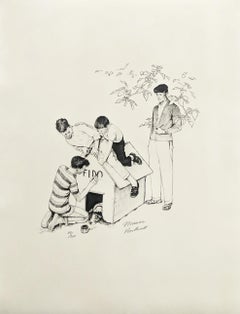
FIDO
S HOUSE
Located in Aventura, FL
From the 'American Family' portfolio. Hand signed and numbered by the artist. Lithograph on arches paper. Printed by Atelier Mourlot, Paris. Published by Raymond & Raymond, Inc. in ...
Category
1970s American Impressionist Figurative Prints
Materials
Paper, Lithograph
$1,960 Sale Price
30% Off
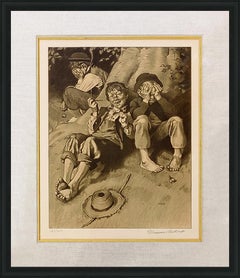
SMOKING (SEPIA)
Located in Aventura, FL
Hand signed and numbered by the artist. From Tom Sawyer Portfolio. Sheet size 25.5 x 19.5 inches. Image size approx 17 x 13 inches. Frame size approx 30 x 26 inches. From the editi...
Category
1970s American Impressionist Figurative Prints
Materials
Paper, Lithograph
$2,065 Sale Price
30% Off
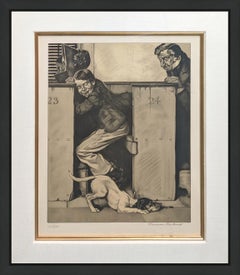
CHURCH (SEPIA)
Located in Aventura, FL
Hand signed and numbered by the artist. From Tom Sawyer Portfolio. Sheet size 25.5 x 19.5 inches. Image size approx 17 x 13 inches. Frame size approx 30 x 26 inches. From the editi...
Category
1970s American Impressionist Figurative Prints
Materials
Paper, Lithograph
$2,065 Sale Price
30% Off
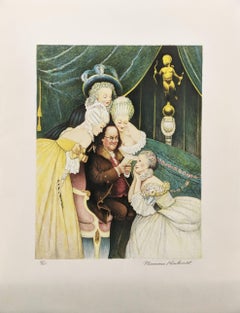
BEN
S BELLES
Located in Aventura, FL
From Poor Richard's Almanac portfolio. Hand signed and numbered by the artist. Lithograph on arches. Sheet size 25.5 x 19.5 inches. Image size approx 16.75 x 13.5 inches. From t...
Category
1970s American Impressionist Figurative Prints
Materials
Paper, Lithograph
$1,960 Sale Price
30% Off
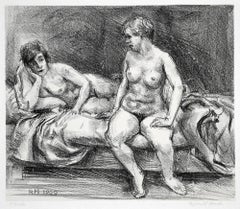
Two Models on a Bed
Located in New York, NY
Reginald Marsh (1898-1954), Two Models on a Bed, lithograph, 1928, signed and inscribed “15 proofs” [also initialed and dated in the plate]. Reference: Saso...
Category
1920s American Impressionist Figurative Prints
Materials
Lithograph
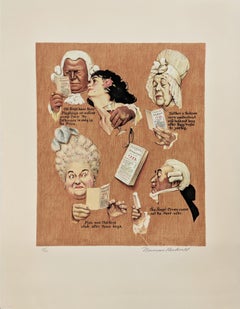
THE ROYAL CROWN
Located in Aventura, FL
From Poor Richard's Almanac portfolio. Hand signed and numbered by the artist. Lithograph on arches. Sheet size 25.5 x 19.5 inches. Image size approx 16.75 x 13.5 inches. From t...
Category
1970s American Impressionist Figurative Prints
Materials
Paper, Lithograph
$1,960 Sale Price
30% Off
American Impressionist figurative prints for sale on 1stDibs.
Find a wide variety of authentic American Impressionist figurative prints available for sale on 1stDibs. Works in this style were very popular during the 21st Century and Contemporary, but contemporary artists have continued to produce works inspired by this movement. If you’re looking to add figurative prints created in this style to introduce contrast in an otherwise neutral space in your home, the works available on 1stDibs include elements of blue, purple and other colors. Many Pop art paintings were created by popular artists on 1stDibs, including Norman Rockwell, Harold Altman, Itzchak Tarkay, and Arnold A. Grossman. Frequently made by artists working with Lithograph, and Etching and other materials, all of these pieces for sale are unique and have attracted attention over the years. Not every interior allows for large American Impressionist figurative prints, so small editions measuring 1 inches across are also available. Prices for figurative prints made by famous or emerging artists can differ depending on medium, time period and other attributes. On 1stDibs, the price for these items starts at $100 and tops out at $75,000, while the average work sells for $1,100.
More Ways To Browse
Eduardo Roca
Edward B Gay
Edward Hopper Oil Painting
Edward Simmons
Edwin Lord Weeks
Elizabeth Enders
Elizabeth Horning
Emil Holzhauer
England Church Oil Painting
English Deer Painting
English Fox Hunt Painting
English Toy Terrier
Enrique Martinez Celaya
Eric Aho
Eritrea Art
Ernest Chateignon
Erotic Art Animal
Eugene Chigot