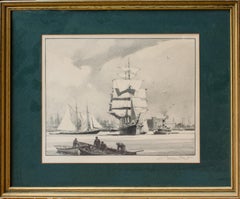
1940s Landscape Prints
to
254
293
71
33
20
11
Overall Width
to
Overall Height
to
231
53
37
7
7
5
2
1
1
15
13
11
8
6
1,013
2,176
9,784
4,025
117
113
718
495
430
1,011
1,434
1,633
1,397
694
655
268
158
2
275
180
147
100
87
51
49
41
40
37
33
32
30
24
24
23
22
15
14
13
253
85
31
30
24
24
45
365
53
Period: 1940s
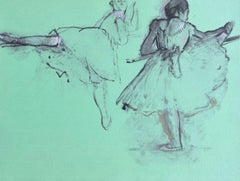
Edgar Degas, Dancer at the Barre, 1945 (after)
By Edgar Degas
Located in Southampton, NY
This exquisite lithograph after Edgar Degas (1834–1917), titled Danseur au bar (Dancer at the Barre), originates from the 1945 folio Degas, Ten Ballet Sketches. Published by The Studio Publications, Inc., New York, rendered and printed by Albert Carman, City Island, 1945, this work reflects Degas’s sensitive mastery of line, movement, and the intimate psychological nuances of the ballet studio.
Executed as a lithograph and pochoir on velin paper, this work measures 13 x 17 inches (33.02 x 43.18 cm). Signed in the plate and unnumbered as issued. Rendered and printed by Albert Carman, City Island.
Artwork Details:
Artist: After Edgar Degas (1834–1917)
Title: Danseur au bar (Dancer at the Barre), from Degas, Ten Ballet Sketches, 1945
Medium: Lithograph and pochoir on velin paper
Dimensions: 13 x 17 inches (33.02 x 43.18 cm)
Inscription: Signed in the plate and unnumbered as issued
Date: 1945
Publisher: The Studio Publications, Inc., New York
Printer: Albert Carman, City Island
Condition: Well preserved, consistent with age and medium
Provenance: From the 1945 folio Degas, Ten Ballet Sketches, published by The Studio Publications, Inc., New York
Notes:
Excerpted from the album, Born in Paris in 1834, Edgar Degas lived, and surely loved the life of that city during most of his years. These continued somewhat sadly beyond those of most of his friends— into the debacle of the first World War, during which he died in 1917. Judging by the frequency with which he used them as models, he must have had an especial admiration for the ballet girls who followed a profession that at the time brought none of the glory and prosperity which attend it today. New aspects of the human body, revealed in movement, fascinated him. But his occupation with the simply anatomical side of his subjects never resulted in a cold interpretation. On the contrary there is a warmth and sympathy that pervades all of his work. The drawings here represent the painter in one important phase of his multi-sensitive view of life; and permit an insight which a more ambitious work might not do-into the operation of the creative process, the artist's transformation of reality as it passes through the mesh of his sensibilities. The Edition of this Portfolio is limited to MMMD examples. Rendered by Albert Carman.
About the Publication:
Degas, Ten Ballet Sketches (1945) is one of the earliest and most significant American postwar fine art portfolios devoted to Edgar Degas’s intimate works on paper. Published by The Studio Publications, Inc., New York, and rendered and printed by Albert Carman at City Island, the album sought to faithfully reproduce a group of Degas’s ballet-related drawings through a combination of lithography and hand-applied pochoir coloring. This hybrid technique allowed the edition to preserve the immediacy, tonal subtlety, and gestural delicacy central to Degas’s draftsmanship. Conceived as a fine art publication rather than a commercial book, the portfolio provided American audiences unprecedented access to Degas’s private, spontaneous studies—images that reveal the artist’s fascination with movement, anatomy, and the psychological atmosphere of the rehearsal studio. The album exemplifies the mid-20th-century revival of pochoir as a means of recreating the texture and coloristic nuance of original works on paper, and it remains an important document of how Degas’s legacy was translated into high-quality printed form for collectors, museums, and connoisseurs.
About the Artist:
Edgar Degas (1834–1917) was a French painter, draughtsman, printmaker, and sculptor whose groundbreaking fusion of classical draftsmanship, modern experimentation, and psychological depth helped define the trajectory of Western art, positioning him as one of the most influential figures of the nineteenth and early twentieth centuries; renowned for his depictions of ballet dancers, racehorses, theater scenes, cafe life, domestic interiors, milliners, laundresses, and women at their toilette, Degas reimagined observational realism through radical compositional innovation—employing extreme cropping, asymmetrical framing, oblique viewpoints, and dramatic lighting that anticipated photographic and cinematic language long before these technologies shaped visual culture, and although associated with Impressionism, he rejected plein-air spontaneity in favor of studio-based discipline rooted in the linear precision of Jean-Auguste-Dominique Ingres, the expressive chromaticism of Eugene Delacroix, and the modernity of Edouard Manet while also drawing inspiration from Japanese ukiyo-e prints, classical sculpture, and early photography; his independent artistic philosophy resonated with and helped shape the innovations of Pablo Picasso, Alexander Calder, Alberto Giacometti, Salvador Dali, Joan Miro, Wassily Kandinsky, Marcel Duchamp, and Man Ray, whose explorations of movement, form, dream logic, abstraction, and conceptualism all find antecedents in Degas’s investigations into seriality, temporality, and the fragmented figure, and his pioneering use of pastel, monotype, and wax sculpture fundamentally transformed each medium, influencing artists from Henri Matisse, Francis Bacon, Lucian Freud, and Giacomo Manzu to Paula Rego, contemporary realists, experimental photographers, and choreographers; his works are held in nearly every major museum collection worldwide—including the Musee dOrsay, the Louvre, the Metropolitan Museum of Art, the National Gallery of Art, the Art Institute of Chicago, the Courtauld Institute, and the National Gallery, London—affirming his central place in the history of art, and the highest auction record for Degas was achieved at Sothebys London on February 3, 2015, when Danseuses en Bleu sold for 37,033,000 GBP, cementing his status as one of the most sought-after and enduringly significant artists of the Western canon.
Degas pochoir, Degas lithograph...
Category
Impressionist 1940s Landscape Prints
Materials
Lithograph

$796 Sale Price
20% Off
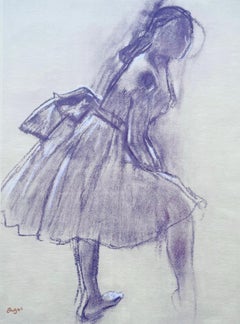
Edgar Degas, Dancer Standing in Profile, 1945 (after)
By Edgar Degas
Located in Southampton, NY
This exquisite lithograph after Edgar Degas (1834–1917), titled Danseur debout de profil (Dancer Standing in Profile), originates from the 1945 folio Degas, Ten Ballet Sketches. Published by The Studio Publications, Inc., New York, rendered and printed by Albert Carman, City Island, 1945, this work reflects Degas’s sensitive mastery of line, movement, and intimate observation, capturing the grace, poise, and psychological immediacy that define his iconic ballet imagery. In Danseur debout de profil (Dancer Standing in Profile), Degas reveals gesture and inner emotion through economical contour and lyrical nuance.
Executed as a lithograph and pochoir on velin paper, this work measures 17 x 13 inches (43.18 x 33.02 cm). Signed in the plate and unnumbered as issued. Rendered and printed by Albert Carman, City Island, one of the notable American ateliers specializing in fine art lithography during the mid-20th century.
Artwork Details:
Artist: After Edgar Degas (1834–1917)
Title: Danseur debout de profil (Dancer Standing in Profile), from Degas, Ten Ballet Sketches, 1945
Medium: Lithograph and pochoir on velin paper
Dimensions: 17 x 13 inches (43.18 x 33.02 cm)
Inscription: Signed in the plate and unnumbered as issued
Date: 1945
Publisher: The Studio Publications, Inc., New York
Printer: Albert Carman, City Island, 1945
Condition: Well preserved, consistent with age and medium
Provenance: From the 1945 folio Degas, Ten Ballet Sketches, published by The Studio Publications, Inc., New York
Notes:
Excerpted from the album, Born in Paris in 1834, Edgar Degas lived, and surely loved the life of that city during most of his years. These continued somewhat sadly beyond those of most of his friends— into the debacle of the first World War, during which he died in 1917. Judging by the frequency with which he used them as models, he must have had an especial admiration for the ballet girls who followed a profession that at the time brought none of the glory and prosperity which attend it today. New aspects of the human body, revealed in movement, fascinated him. But his occupation with the simply anatomical side of his subjects never resulted in a cold interpretation. On the contrary there is a warmth and sympathy that pervades all of his work. The drawings here represent the painter in one important phase of his multi-sensitive view of life; and permit an insight which a more ambitious work might not do-into the operation of the creative process, the artist's transformation of reality as it passes through the mesh of his sensibilities. The Edition of this Portfolio is limited to MMMD examples. Rendered by Albert Carman.
About the Publication:
Degas, Ten Ballet Sketches, published in 1945 by The Studio Publications, Inc., New York, stands as one of the most elegant and scholarly mid-century American fine art folios devoted to the ballet imagery of Edgar Degas. Conceived as a high-quality interpretive portfolio, the album presents a series of lithograph-and-pochoir renderings based on Degas’s original drawings, executed with exceptional attention to tonal subtlety, contour fidelity, and the emotional interiority that defines the artist’s draftsmanship. Rendered and printed by Albert Carman on City Island, the publication embodies an American postwar effort to restore and celebrate European masterworks through meticulous handcraft and artisanal color application, honoring Degas’s distinctive line and the atmospheric delicacy of his studio-based studies. Produced in a substantial edition of MMMD examples, the portfolio offered audiences rare access to Degas’s private working drawings—images rarely seen outside institutional collections—while exemplifying the technical refinement and interpretive care characteristic of Carman’s workshop. Today, Degas, Ten Ballet Sketches remains a sought-after historical publication, valued for its craft, fidelity to Degas’s aesthetic, and its role in preserving and disseminating the artist’s intimate ballet imagery in a beautifully executed mid-century fine art format.
About the Artist:
Edgar Degas (1834–1917) was a French painter, draughtsman, printmaker, and sculptor whose groundbreaking fusion of classical draftsmanship, modern experimentation, and psychological depth helped define the trajectory of Western art, positioning him as one of the most influential figures of the nineteenth and early twentieth centuries; renowned for his depictions of ballet dancers, racehorses, theater scenes, cafe life, domestic interiors, milliners, laundresses, and women at their toilette, Degas reimagined observational realism through radical compositional innovation—employing extreme cropping, asymmetrical framing, oblique viewpoints, and dramatic lighting that anticipated photographic and cinematic language long before these technologies shaped visual culture, and although associated with Impressionism, he rejected plein-air spontaneity in favor of studio-based discipline rooted in the linear precision of Jean-Auguste-Dominique Ingres, the expressive chromaticism of Eugene Delacroix, and the modernity of Edouard Manet while also drawing inspiration from Japanese ukiyo-e prints, classical sculpture, and early photography; his independent artistic philosophy resonated with and helped shape the innovations of Pablo Picasso, Alexander Calder, Alberto Giacometti, Salvador Dali, Joan Miro, Wassily Kandinsky, Marcel Duchamp, and Man Ray, whose explorations of movement, form, dream logic, abstraction, and conceptualism all find antecedents in Degas’s investigations into seriality, temporality, and the fragmented figure, and his pioneering use of pastel, monotype, and wax sculpture fundamentally transformed each medium, influencing artists from Henri Matisse, Francis Bacon, Lucian Freud, and Giacomo Manzu to Paula Rego, contemporary realists, experimental photographers, and choreographers; his works are held in nearly every major museum collection worldwide—including the Musee dOrsay, the Louvre, the Metropolitan Museum of Art, the National Gallery of Art, the Art Institute of Chicago, the Courtauld Institute, and the National Gallery, London—affirming his central place in the history of art, and the highest auction record for Degas was achieved at Sothebys London on February 3, 2015, when Danseuses en Bleu sold for 37,033,000 GBP, cementing his status as one of the most sought-after and enduringly significant artists of the Western canon.
Edgar Degas lithograph...
Category
Impressionist 1940s Landscape Prints
Materials
Lithograph
$796 Sale Price
20% Off
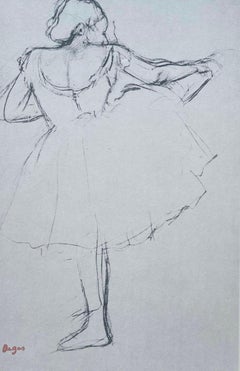
Edgar Degas, Dancer at the Barre, 1945 (after)
By Edgar Degas
Located in Southampton, NY
This exquisite lithograph after Edgar Degas (1834–1917), titled Danseur au bar (Dancer at the Barre), originates from the 1945 folio Degas, Ten Ballet Sketches. Published by The Studio Publications, Inc., New York, rendered and printed by Albert Carman, City Island, 1945, this work reflects Degas’s sensitive mastery of line, movement, and intimate observation, capturing the grace, poise, and psychological immediacy that define his iconic ballet imagery. In Danseur au bar (Dancer at the Barre), Degas reveals gesture and inner emotion through economical contour and lyrical nuance.
Executed as a lithograph and pochoir on velin paper, this work measures 17 x 13 inches (43.18 x 33.02 cm). Signed in the plate and unnumbered as issued. Rendered and printed by Albert Carman, City Island, one of the notable American ateliers specializing in fine art lithography during the mid-20th century.
Artwork Details:
Artist: After Edgar Degas (1834–1917)
Title: Danseur au bar (Dancer at the Barre), from Degas, Ten Ballet Sketches, 1945
Medium: Lithograph and pochoir on velin paper
Dimensions: 17 x 13 inches (43.18 x 33.02 cm)
Inscription: Signed in the plate and unnumbered as issued
Date: 1945
Publisher: The Studio Publications, Inc., New York
Printer: Albert Carman, City Island, 1945
Condition: Well preserved, consistent with age and medium
Provenance: From the 1945 folio Degas, Ten Ballet Sketches, published by The Studio Publications, Inc., New York
Notes:
Excerpted from the album, Born in Paris in 1834, Edgar Degas lived, and surely loved the life of that city during most of his years. These continued somewhat sadly beyond those of most of his friends— into the debacle of the first World War, during which he died in 1917. Judging by the frequency with which he used them as models, he must have had an especial admiration for the ballet girls who followed a profession that at the time brought none of the glory and prosperity which attend it today. New aspects of the human body, revealed in movement, fascinated him. But his occupation with the simply anatomical side of his subjects never resulted in a cold interpretation. On the contrary there is a warmth and sympathy that pervades all of his work. The drawings here represent the painter in one important phase of his multi-sensitive view of life; and permit an insight which a more ambitious work might not do-into the operation of the creative process, the artist's transformation of reality as it passes through the mesh of his sensibilities. The Edition of this Portfolio is limited to MMMD examples. Rendered by Albert Carman.
About the Publication:
Degas, Ten Ballet Sketches, published in 1945 by The Studio Publications, Inc., New York, stands as one of the most elegant and scholarly mid-century American fine art folios devoted to the ballet imagery of Edgar Degas. Conceived as a high-quality interpretive portfolio, the album presents a series of lithograph-and-pochoir renderings based on Degas’s original drawings, executed with exceptional attention to tonal subtlety, contour fidelity, and the emotional interiority that defines the artist’s draftsmanship. Rendered and printed by Albert Carman on City Island, the publication embodies an American postwar effort to restore and celebrate European masterworks through meticulous handcraft and artisanal color application, honoring Degas’s distinctive line and the atmospheric delicacy of his studio-based studies. Produced in a substantial edition of MMMD examples, the portfolio offered audiences rare access to Degas’s private working drawings—images rarely seen outside institutional collections—while exemplifying the technical refinement and interpretive care characteristic of Carman’s workshop. Today, Degas, Ten Ballet Sketches remains a sought-after historical publication, valued for its craft, fidelity to Degas’s aesthetic, and its role in preserving and disseminating the artist’s intimate ballet imagery in a beautifully executed mid-century fine art format.
About the Artist:
Edgar Degas (1834–1917) was a French painter, draughtsman, printmaker, and sculptor whose groundbreaking fusion of classical draftsmanship, modern experimentation, and psychological depth helped define the trajectory of Western art, positioning him as one of the most influential figures of the nineteenth and early twentieth centuries; renowned for his depictions of ballet dancers, racehorses, theater scenes, cafe life, domestic interiors, milliners, laundresses, and women at their toilette, Degas reimagined observational realism through radical compositional innovation—employing extreme cropping, asymmetrical framing, oblique viewpoints, and dramatic lighting that anticipated photographic and cinematic language long before these technologies shaped visual culture, and although associated with Impressionism, he rejected plein-air spontaneity in favor of studio-based discipline rooted in the linear precision of Jean-Auguste-Dominique Ingres, the expressive chromaticism of Eugene Delacroix, and the modernity of Edouard Manet while also drawing inspiration from Japanese ukiyo-e prints, classical sculpture, and early photography; his independent artistic philosophy resonated with and helped shape the innovations of Pablo Picasso, Alexander Calder, Alberto Giacometti, Salvador Dali, Joan Miro, Wassily Kandinsky, Marcel Duchamp, and Man Ray, whose explorations of movement, form, dream logic, abstraction, and conceptualism all find antecedents in Degas’s investigations into seriality, temporality, and the fragmented figure, and his pioneering use of pastel, monotype, and wax sculpture fundamentally transformed each medium, influencing artists from Henri Matisse, Francis Bacon, Lucian Freud, and Giacomo Manzu to Paula Rego, contemporary realists, experimental photographers, and choreographers; his works are held in nearly every major museum collection worldwide—including the Musee dOrsay, the Louvre, the Metropolitan Museum of Art, the National Gallery of Art, the Art Institute of Chicago, the Courtauld Institute, and the National Gallery, London—affirming his central place in the history of art, and the highest auction record for Degas was achieved at Sothebys London on February 3, 2015, when Danseuses en Bleu sold for 37,033,000 GBP, cementing his status as one of the most sought-after and enduringly significant artists of the Western canon.
Edgar Degas lithograph...
Category
Impressionist 1940s Landscape Prints
Materials
Lithograph
$796 Sale Price
20% Off
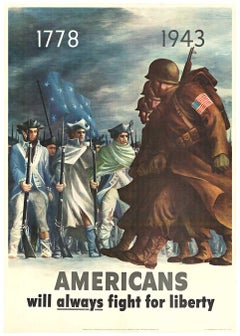
Original Americans will Always Fight for Liberty vintage WWII (1943) poster
Located in Spokane, WA
Title: Original 1943 WWII Propaganda Poster - "Americans Will Always Fight for Liberty" - Authentic U.S. Government Issue. Archival linen-backed with the original US Government-issue...
Category
American Modern 1940s Landscape Prints
Materials
Offset
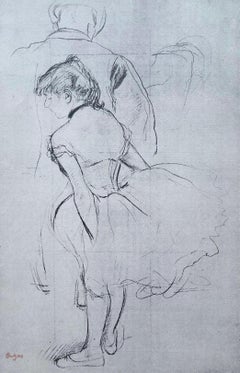
Edgar Degas, Dancer Arranging Her Dress, 1945 (after)
By Edgar Degas
Located in Southampton, NY
This exquisite lithograph after Edgar Degas (1834–1917), titled Danseuse arrangeant sa robe (Dancer Arranging Her Dress), originates from the 1945 folio Degas, Ten Ballet Sketches. Published by The Studio Publications, Inc., New York, rendered and printed by Albert Carman, City Island, 1945, this work reflects Degas’s sensitive mastery of line, movement, and intimate observation, capturing the grace, poise, and psychological immediacy that define his iconic ballet imagery. In Danseuse arrangeant sa robe (Dancer Arranging Her Dress), Degas reveals gesture and inner emotion through economical contour and lyrical nuance.
Executed as a lithograph and pochoir on velin paper, this work measures 17 x 13 inches (43.18 x 33.02 cm). Signed in the plate and unnumbered as issued. Rendered and printed by Albert Carman, City Island, one of the notable American ateliers specializing in fine art lithography during the mid-20th century.
Artwork Details:
Artist: After Edgar Degas (1834–1917)
Title: Danseuse arrangeant sa robe (Dancer Arranging Her Dress), from Degas, Ten Ballet Sketches, 1945
Medium: Lithograph and pochoir on velin paper
Dimensions: 17 x 13 inches (43.18 x 33.02 cm)
Inscription: Signed in the plate and unnumbered as issued
Date: 1945
Publisher: The Studio Publications, Inc., New York
Printer: Albert Carman, City Island, 1945
Condition: Well preserved, consistent with age and medium
Provenance: From the 1945 folio Degas, Ten Ballet Sketches, published by The Studio Publications, Inc., New York
Notes:
Excerpted from the album, Born in Paris in 1834, Edgar Degas lived, and surely loved the life of that city during most of his years. These continued somewhat sadly beyond those of most of his friends— into the debacle of the first World War, during which he died in 1917. Judging by the frequency with which he used them as models, he must have had an especial admiration for the ballet girls who followed a profession that at the time brought none of the glory and prosperity which attend it today. New aspects of the human body, revealed in movement, fascinated him. But his occupation with the simply anatomical side of his subjects never resulted in a cold interpretation. On the contrary there is a warmth and sympathy that pervades all of his work. The drawings here represent the painter in one important phase of his multi-sensitive view of life; and permit an insight which a more ambitious work might not do-into the operation of the creative process, the artist's transformation of reality as it passes through the mesh of his sensibilities. The Edition of this Portfolio is limited to MMMD examples. Rendered by Albert Carman.
About the Publication:
Degas, Ten Ballet Sketches, published in 1945 by The Studio Publications, Inc., New York, stands as one of the most elegant and scholarly mid-century American fine art folios devoted to the ballet imagery of Edgar Degas. Conceived as a high-quality interpretive portfolio, the album presents a series of lithograph-and-pochoir renderings based on Degas’s original drawings, executed with exceptional attention to tonal subtlety, contour fidelity, and the emotional interiority that defines the artist’s draftsmanship. Rendered and printed by Albert Carman on City Island, the publication embodies an American postwar effort to restore and celebrate European masterworks through meticulous handcraft and artisanal color application, honoring Degas’s distinctive line and the atmospheric delicacy of his studio-based studies. Produced in a substantial edition of MMMD examples, the portfolio offered audiences rare access to Degas’s private working drawings—images rarely seen outside institutional collections—while exemplifying the technical refinement and interpretive care characteristic of Carman’s workshop. Today, Degas, Ten Ballet Sketches remains a sought-after historical publication, valued for its craft, fidelity to Degas’s aesthetic, and its role in preserving and disseminating the artist’s intimate ballet imagery in a beautifully executed mid-century fine art format.
About the Artist:
Edgar Degas (1834–1917) was a French painter, draughtsman, printmaker, and sculptor whose groundbreaking fusion of classical draftsmanship, modern experimentation, and psychological depth helped define the trajectory of Western art, positioning him as one of the most influential figures of the nineteenth and early twentieth centuries; renowned for his depictions of ballet dancers, racehorses, theater scenes, cafe life, domestic interiors, milliners, laundresses, and women at their toilette, Degas reimagined observational realism through radical compositional innovation—employing extreme cropping, asymmetrical framing, oblique viewpoints, and dramatic lighting that anticipated photographic and cinematic language long before these technologies shaped visual culture, and although associated with Impressionism, he rejected plein-air spontaneity in favor of studio-based discipline rooted in the linear precision of Jean-Auguste-Dominique Ingres, the expressive chromaticism of Eugene Delacroix, and the modernity of Edouard Manet while also drawing inspiration from Japanese ukiyo-e prints, classical sculpture, and early photography; his independent artistic philosophy resonated with and helped shape the innovations of Pablo Picasso, Alexander Calder, Alberto Giacometti, Salvador Dali, Joan Miro, Wassily Kandinsky, Marcel Duchamp, and Man Ray, whose explorations of movement, form, dream logic, abstraction, and conceptualism all find antecedents in Degas’s investigations into seriality, temporality, and the fragmented figure, and his pioneering use of pastel, monotype, and wax sculpture fundamentally transformed each medium, influencing artists from Henri Matisse, Francis Bacon, Lucian Freud, and Giacomo Manzu to Paula Rego, contemporary realists, experimental photographers, and choreographers; his works are held in nearly every major museum collection worldwide—including the Musee dOrsay, the Louvre, the Metropolitan Museum of Art, the National Gallery of Art, the Art Institute of Chicago, the Courtauld Institute, and the National Gallery, London—affirming his central place in the history of art, and the highest auction record for Degas was achieved at Sothebys London on February 3, 2015, when Danseuses en Bleu sold for 37,033,000 GBP, cementing his status as one of the most sought-after and enduringly significant artists of the Western canon.
Edgar Degas lithograph...
Category
Impressionist 1940s Landscape Prints
Materials
Lithograph
$796 Sale Price
20% Off
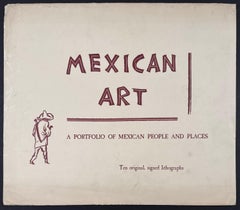
Mexican Art: A Portfolio of Mexican People and Places
Located in Palm Springs, CA
Ten lithographs in excellent condition, with portfolio cover. The ten artists included in the 1946 portfolio "Mexican Art: A Portfolio of Mexican People and Places" include: Ángel Bracho / Francisco Mora / Fernando Castro Pacheco / Raúl Anguiano / Alberto Beltrán...
Category
1940s Landscape Prints
Materials
Lithograph
$3,500 Sale Price
22% Off
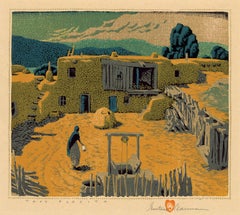
Taos Placita
— American Southwest Regionalist Masterwork
Located in Myrtle Beach, SC
Gustave Baumann, 'Taos Placita', color woodcut, 1947, edition 125. Baumann 132. Signed, titled, and numbered '20-125' in pencil; with the artist’s Hand-in-Heart chop. A superb, richly-inked impression, with fresh colors, on fibrous oatmeal wove paper; the full sheet with margins (2 to 3 1/8 inches); slight rippling at the left sheet edge, in excellent condition. Matted to museum standards, unframed.
Image size 9 5/8 x 11 1/4 inches (244 x 286 mm); sheet size 13 1/4 x 17 inches (337 x 432 mm).
Collections: Harwood Museum of Art, New Mexico Museum of Art, Phoenix Art Museum, Scottsdale Art Museum, Wichita Art Museum.
ABOUT THE ARTIST
Gustave Baumann (1881-1971) was a renowned printmaker and a leading figure of the American color woodcut revival whose exquisite craftsmanship and vibrant imagery captured the essence of the Southwest.
"A brilliant printmaker, Baumann brought to the medium a full mastery of the craft of woodworking that he acquired from his father, a German cabinetmaker. This craftsmanship was coupled with a strong artistic training that resulted in the handsome objects we see in the exhibition today. After discovering New Mexico in 1918, Baumann began to explore in his woodblock prints of this period the light. color, and architectural forms of that landscape. His prints of this period are among the most beautiful and poetic images of the American West."
—Lewis I. Sharp, Director, Denver Art Museum
Baumann, the son of a craftsman, immigrated to the United States from Germany with his family when he was ten, settling in Chicago. From 1897 to 1904, he studied in the evenings at the Art Institute of Chicago, working in a commercial printmaking shop during the day. In 1905, he returned to Germany to attend the Kunstwerbe Schule in Munich, where he decided on a career in printmaking. He returned to Chicago in 1906 and worked for a few years as a graphic designer of labels.
Baumann made his first prints in 1909 and exhibited them at the Art Institute of Chicago the following year. In 1910, he moved to the artists’ colony in Nashville, Indiana, where he explored the creative and commercial possibilities of a career as a printmaker. In 1915, he exhibited his color woodcuts at the Panama-Pacific International Exposition in San Francisco, winning the gold medal.
Among Baumann’s ongoing commercial activities was his work for the Packard Motor Car Company from 1914 to 1920 where he produced designs, illustrations, and color woodcuts until 1923.
In 1919, Baumann’s printmaking work dominated the important exhibition of American color woodcuts at the Detroit Institute of Arts. Twenty-six of his prints were included, far more than the works of any other artist. A set of his blocks, a preparatory drawing, and seven progressive proofs complemented the exhibition. That same year, Baumann worked in New York and, over the summer, in Provincetown, Massachusetts. His airy images of Cape Cod employed soft, pastel colors and occasionally showed the influence of the white-line woodcut technique.
Many of his Chicago artist friends had traveled to the southwest, and Baumann became intrigued by their paintings, souvenirs, and stories of an exotic place named Taos, New Mexico. In the summer of 1918, he spent the summer in Taos sketching and painting before visiting Santa Fe. Paul Walter, the director of the Museum of New Mexico, offered him a studio in the museum's basement. Inspired by the rugged beauty of the Southwest—the vibrant colors and dramatic landscapes of the region became a central theme in his work, influencing his artistic style and subject matter for the remainder of his career. Later in the decade, he traveled to the West Coast and made prints of California landscape.
Baumann's prints became synonymous with the Southwest, capturing the spirit of its place in America's identity with a unique sense of authenticity and reverence. His iconic images of desert vistas, pueblo villages, and indigenous cultures served as visual tributes to the region's rich cultural heritage, earning him a dedicated following among collectors and curators alike.
A true craftsman and artist, Baumann completed every step of the printmaking process himself, cutting each block, mixing the inks, and printing every impression on the handmade paper he selected. His dedication to true craftsmanship and his commitment to preserving the integrity of his artistic vision earned him widespread acclaim and recognition within the art world. About the vibrant colors he produced, Baumann stated, “A knowledge of color needs to be acquired since they don’t all behave the same way when ground or mixed...careful chemistry goes into the making of colors, with meticulous testing for permanence. While complicated formulae evolve new colors, those derived from Earth and metal bases are still the most reliable.”
In the 1930s, Baumann became interested in puppet theater. He designed and carved his own marionettes and established a little traveling company. From 1943 to 1945, the artist carved an altarpiece for the Episcopal Church of the Holy Faith in Santa Fe. In 1952, a retrospective exhibition of his prints was mounted at the New Mexico Museum of Fine Arts. Throughout his prolific career, Baumann executed nearly four hundred color woodcuts.
Baumann’s woodcuts...
Category
American Modern 1940s Landscape Prints
Materials
Woodcut
Chepstow Castle ( on a limestone cliff above the River Wye in Wales)
Located in New Orleans, LA
The magnificent printed works of the Yorkshire artist, Percival Gaskell have only been fully rediscovered in recent years. Percival Gaskell rose to prominence whilst working together with Sir Frank Short in the engraving school at the Royal College of Art in London during the first two decades of the 20th century. A true painter-printmaker, Percival Gaskell developed a sensitivity to atmospheric tone which is displayed in an air of timeless beauty throughout his printed works.
(sheet 24 x 20 1/2). A fine impression with tone printed in warm brown/black ink on chine appliqué mounted on white wove paper, and a backing board. Signed in pencil. Superb signed proof impression printed in warm-brownish-black ink. One of Gaskell's best large scale mezzotints.
The speed with which William the Conqueror committed to the creation of a castle at Chepstow is testament to its strategic importance. There is no evidence for a settlement there of any size before the Norman invasion of Wales, although it is possible that the castle site itself may have previously been a prehistoric or early...
Category
English School 1940s Landscape Prints
Materials
Mezzotint, Etching

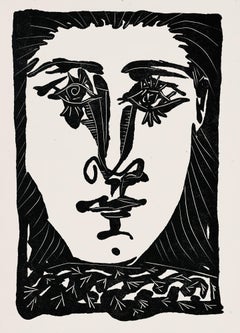
Composition (Cramer 36; Bloch 360; Horodisch A6), Non Vouloir, Pablo Picasso
Located in Southampton, NY
Zincograph on Vélin Bouffant paper. Unsigned and unnumbered, as issued. Good condition. Notes: From the volume, Non Vouloir, 1942. Published by Éditions Jeanne Bucher, Paris; printed...
Category
Cubist 1940s Landscape Prints
Materials
Etching
$1,596 Sale Price
20% Off
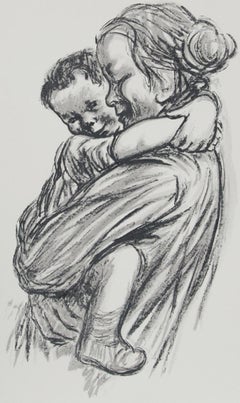
Kollwitz, Mother and Child (after)
Located in Southampton, NY
Lithograph on vélin paper. Inscription: Unsigned and unnumbered, as issued. Good condition. Notes: From the folio, Kathe Kollwitz, Ten Lithographs. Published by Henry C. Kleemann and...
Category
Modern 1940s Landscape Prints
Materials
Lithograph
$1,436 Sale Price
20% Off
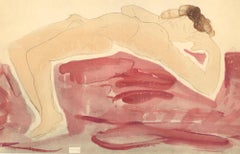
Francois Auguste Rene Rodin, Untitled, from The Varende, 1944 (after)
Located in Southampton, NY
This exquisite lithograph after Francois Auguste Rene Rodin (1840–1917), titled Sans titre (Untitled), from the folio La Varende, Rodin (La Varende, Rodin), originates from the 1944 ...
Category
Modern 1940s Landscape Prints
Materials
Lithograph, Stencil
$716 Sale Price
20% Off
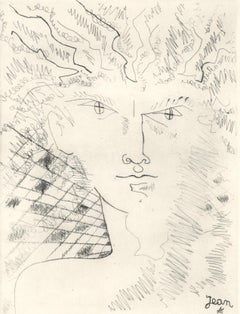
Jean Cocteau, Untitled, from Alternation, 1946
By Jean Cocteau
Located in Southampton, NY
This exquisite etching by Jean Cocteau (1889–1963), titled Sans titre (Untitled), from the album Alternance (Alternation), originates from the 1946 edition published by Le Gerbier, P...
Category
Modern 1940s Landscape Prints
Materials
Engraving
$1,436 Sale Price
20% Off
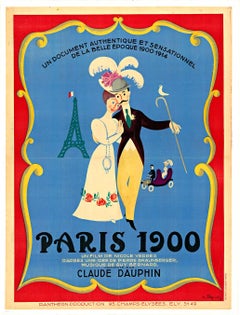
Original Paris 1900 de la Belle Epoque 1900-1914 vintage French movie poster
Located in Spokane, WA
Original 1947 Paris 1900 lithographic movie poster by the artist Raymond Peynet. The poster had originally been folded, and there is some wrinkling at the bottom edge of the poste...
Category
Art Nouveau 1940s Landscape Prints
Materials
Lithograph
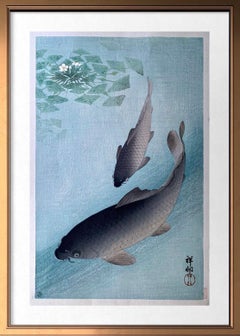
Authentic Life Time Edition Woodblock Print-Two Carps and Water Chestnut-Mint
By Ohara Koson
Located in London, GB
( Valentines-gift-guide Collection ) This is an authentic Japanese woodblock print by Ohara Koson (Shoson), titled Two (koi) Carp or Carp and Water Chestnut; originally created in th...
Category
Edo 1940s Landscape Prints
Materials
Ink, Washi Paper, Woodcut
Elwood W. Bartlett, Wisconsin Farm, about 1945, mid-century wood engraving
Located in New York, NY
Elwood Warren Bartlett is a Wisconsin native who also worked in Indiana.
Largely self taught as a printmaker, Bartlett worked in a style that once identified as his, immediately t...
Category
American Modern 1940s Landscape Prints
Materials
Woodcut

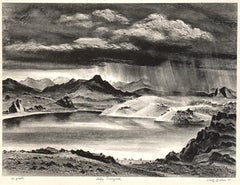
Adolf Dehn, Lake Tarryall, 1941 mid-century lithograph of Colorado mountain lake
By Adolf Dehn
Located in New York, NY
Lake Tarryall, a 1941 lithograph by Adolf Dehn (1895-1968) was made while he was teaching in Colorado. A native of Waterville, Minnesota, Dehn attended the Minneapolis School of Art ...
Category
American Modern 1940s Landscape Prints
Materials
Lithograph
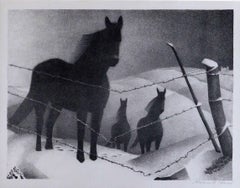
Grant Wood Original Pencil Signed Lithograph, 1940 - February
By Grant Wood
Located in Phoenix, AZ
Original pencil signed Grant Wood lithograph, "February," created 1940.
A fine impression and one of the most important of the 19 lithographs created by the painter of "American Goth...
Category
1940s Landscape Prints
Materials
Paper, Lithograph
Sundown, Stonington, Maine
— Artist-printed Exhibition Proof
Located in Myrtle Beach, SC
Lawrence Nelson Wilbur (1897-1988), 'Sundown, Stonington, Maine', wood engraving, artist's proof, edition not stated but small, 1969. Signed and titled in pencil. Signed in the block...
Category
American Modern 1940s Landscape Prints
Materials
Woodcut
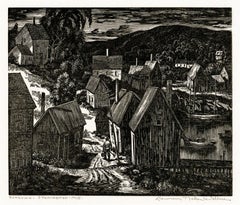
MANHATTAN
By Anton Schutz
Located in Santa Monica, CA
ANTON SCHUTZ
MANHATTAN c 1940
Etching, signed in pencil, edition 100, no. 15/100. On thin simili-japan paper. Very slight toning around plate mark. Remnants of old tape on verso, s...
Category
American Realist 1940s Landscape Prints
Materials
Etching
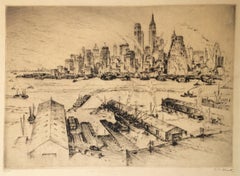
Hans Jean Arp, Composition on a Blue Background, from Derriere le miroir, 1949
Located in Southampton, NY
This exquisite lithograph by Hans Jean Arp (1886–1966), titled Composition sur fond bleu (Composition on a Blue Background), from the folio Derriere le miroir, L’art abstrait, No. 21...
Category
Modern 1940s Landscape Prints
Materials
Lithograph
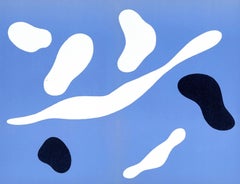
SLOW TRAIN THROUGH ARKANSAS
Located in Portland, ME
Benton, Thomas Hart (American, 1889-1975 SLOW TRAIN THROUGH ARKANSAS. Fath . Lithograph, 1941. Edition of 250 published by Associated American Artists (A.A.A.). 9 7/8 x 12 inches (im...
Category
1940s Landscape Prints
Materials
Lithograph
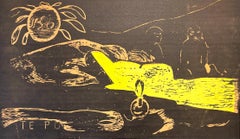
Gauguin, The Long Night (Te Po), Gauguin (after)
By Paul Gauguin
Located in Southampton, NY
Woodcut on vélin Utopian paper. Unsigned and unnumbered, as issued. Good Condition. Notes: From the folio, Gauguin, A portfolio of 12 color woodblocks, Paul Gauguin, French, 1848-1903 from the collection of the Museum Of Fine Arts, Boston, 1946. Rendered by Albert Carman (1899-1949); published the Museum Of Fine Arts, Boston and The Studio Publications, Inc., New York and London; printed by Holme Press Inc., New York, in an edition of MMMD. Excerpted from the folio, Paul Gauguin and Emil Bernard at Pont-Aven, Brittany, in 1888, each made a bas-relief, wooden panel to decorate a piece of furniture for a friend. In order to keep a record of their designs, a few inked impressions were made on paper. The illustration at left is a reproduction of a print which is possibly one of the above mentioned. It is further possible that this experiment later gave Gauguin the idea of making woodcuts. Just as his work in painting expressed a revolt against the overemphasis on factual representation of the nineteenth century in favor of decorative pattern and color, so also his woodcuts leaned strongly to the same side of the balance. Ten of the cuts reproduced (all excepting Soyez Amoureuses and Changement de Residence), which constitute the whole of his best known series, were made at Pont-Aven beginning in the fall of 1894, after Gauguin's return from his first trip to Tahiti and after he broke his ankle. They were at first roughly cut with a common carpenter's gouge, and the flat surfaces sandpapered and engraved with a sharp in-strument, perhaps an engraver's burin. A few trial proofs were printed in black ink only. Then the hollows were deepened with a woodcutter's gouge and highlights were added. An edition of thirty to fifty impressions of each subject, with the addition of color blocks (one, two or three), was made by Louis Roy...
Category
Post-Impressionist 1940s Landscape Prints
Materials
Woodcut
$716 Sale Price
20% Off
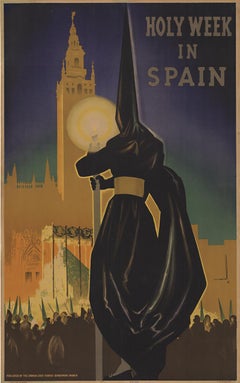
Original Holy Week in Spain original full lithograph vintage poster
Located in Spokane, WA
Original vintage travel poster Holy Week in Spain.
Original color lithograph in English HOLY WEEK IN SPAIN. Linen backed and in excellent condition, ready to frame. Spanish Nat...
Category
Gothic 1940s Landscape Prints
Materials
Lithograph
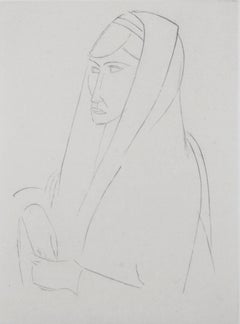
Derain, Figure, Du cubisme (after)
By André Derain
Located in Southampton, NY
Etching, Engraving on vélin du Lana Papiers Spéciaux pure rag paper. Unsigned and unnumbered, as issued. Good Condition. Notes: From the folio, Du Cubisme, 1947. Published by Compagn...
Category
Modern 1940s Landscape Prints
Materials
Etching, Engraving
$1,436 Sale Price
20% Off
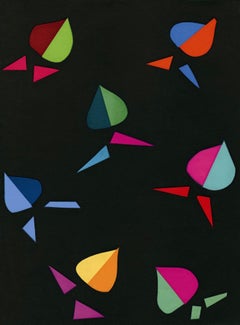
Henri Matisse, Chromatic Symphony, from Verve, Revue Artistique, 1940
Located in Southampton, NY
This exquisite lithograph by Henri Matisse (1869–1954), titled Symphonie chromatique (Chromatic Symphony), from Verve, Revue Artistique et Litteraire, Vol. II, No. 8, originates from...
Category
Fauvist 1940s Landscape Prints
Materials
Lithograph
$796 Sale Price
20% Off
DISCOVERY OF GOLD - Very Large Serigraph - WPA Artist - California Murals
Located in Santa Monica, CA
ANTON REFREGIER (1905 – 1979)
DISCOVERY OF GOLD, 1949. Color serigraph. Signed and numbered in pencil, edition of 90. Image 23 ¼ x 21 ¾" Large sheet, 29 3/4 x 25 ¼”. Printed title...
Category
American Modern 1940s Landscape Prints
Materials
Screen
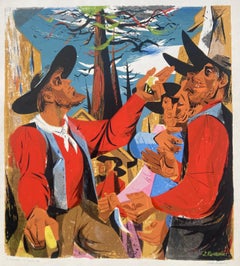
Edgar Degas, Sketch of Dancers, 1945 (after)
By Edgar Degas
Located in Southampton, NY
This exquisite lithograph after Edgar Degas (1834–1917), titled Croquis de danseurs (Sketch of Dancers), originates from the 1945 folio Degas, Ten Ballet Sketches. Published by The Studio Publications, Inc., New York, rendered and printed by Albert Carman, City Island, 1945, this work reflects Degas’s sensitive mastery of line, movement, and the intimate psychological nuances of the ballet studio.
Executed as a lithograph and pochoir on velin paper, this work measures 13 x 17 inches (33.02 x 43.18 cm). Signed in the plate and unnumbered as issued. Rendered and printed by Albert Carman, City Island.
Artwork Details:
Artist: After Edgar Degas (1834–1917)
Title: Croquis de danseurs (Sketch of Dancers), from Degas, Ten Ballet Sketches, 1945
Medium: Lithograph and pochoir on velin paper
Dimensions: 13 x 17 inches (33.02 x 43.18 cm)
Inscription: Signed in the plate and unnumbered as issued
Date: 1945
Publisher: The Studio Publications, Inc., New York
Printer: Albert Carman, City Island
Condition: Well preserved, consistent with age and medium
Provenance: From the 1945 folio Degas, Ten Ballet Sketches, published by The Studio Publications, Inc., New York
Notes:
Excerpted from the album, Born in Paris in 1834, Edgar Degas lived, and surely loved the life of that city during most of his years. These continued somewhat sadly beyond those of most of his friends— into the debacle of the first World War, during which he died in 1917. Judging by the frequency with which he used them as models, he must have had an especial admiration for the ballet girls who followed a profession that at the time brought none of the glory and prosperity which attend it today. New aspects of the human body, revealed in movement, fascinated him. But his occupation with the simply anatomical side of his subjects never resulted in a cold interpretation. On the contrary there is a warmth and sympathy that pervades all of his work. The drawings here represent the painter in one important phase of his multi-sensitive view of life; and permit an insight which a more ambitious work might not do-into the operation of the creative process, the artist's transformation of reality as it passes through the mesh of his sensibilities. The Edition of this Portfolio is limited to MMMD examples. Rendered by Albert Carman.
About the Publication:
Degas, Ten Ballet Sketches (1945) is one of the earliest and most significant American postwar fine art portfolios devoted to Edgar Degas’s intimate works on paper. Published by The Studio Publications, Inc., New York, and rendered and printed by Albert Carman at City Island, the album sought to faithfully reproduce a group of Degas’s ballet-related drawings through a combination of lithography and hand-applied pochoir coloring. This hybrid technique allowed the edition to preserve the immediacy, tonal subtlety, and gestural delicacy central to Degas’s draftsmanship. Conceived as a fine art publication rather than a commercial book, the portfolio provided American audiences unprecedented access to Degas’s private, spontaneous studies—images that reveal the artist’s fascination with movement, anatomy, and the psychological atmosphere of the rehearsal studio. The album exemplifies the mid-20th-century revival of pochoir as a means of recreating the texture and coloristic nuance of original works on paper, and it remains an important document of how Degas’s legacy was translated into high-quality printed form for collectors, museums, and connoisseurs.
About the Artist:
Edgar Degas (1834–1917) was a French painter, draughtsman, printmaker, and sculptor whose groundbreaking fusion of classical draftsmanship, modern experimentation, and psychological depth helped define the trajectory of Western art, positioning him as one of the most influential figures of the nineteenth and early twentieth centuries; renowned for his depictions of ballet dancers, racehorses, theater scenes, cafe life, domestic interiors, milliners, laundresses, and women at their toilette, Degas reimagined observational realism through radical compositional innovation—employing extreme cropping, asymmetrical framing, oblique viewpoints, and dramatic lighting that anticipated photographic and cinematic language long before these technologies shaped visual culture, and although associated with Impressionism, he rejected plein-air spontaneity in favor of studio-based discipline rooted in the linear precision of Jean-Auguste-Dominique Ingres, the expressive chromaticism of Eugene Delacroix, and the modernity of Edouard Manet while also drawing inspiration from Japanese ukiyo-e prints, classical sculpture, and early photography; his independent artistic philosophy resonated with and helped shape the innovations of Pablo Picasso, Alexander Calder, Alberto Giacometti, Salvador Dali, Joan Miro, Wassily Kandinsky, Marcel Duchamp, and Man Ray, whose explorations of movement, form, dream logic, abstraction, and conceptualism all find antecedents in Degas’s investigations into seriality, temporality, and the fragmented figure, and his pioneering use of pastel, monotype, and wax sculpture fundamentally transformed each medium, influencing artists from Henri Matisse, Francis Bacon, Lucian Freud, and Giacomo Manzu to Paula Rego, contemporary realists, experimental photographers, and choreographers; his works are held in nearly every major museum collection worldwide—including the Musee dOrsay, the Louvre, the Metropolitan Museum of Art, the National Gallery of Art, the Art Institute of Chicago, the Courtauld Institute, and the National Gallery, London—affirming his central place in the history of art, and the highest auction record for Degas was achieved at Sothebys London on February 3, 2015, when Danseuses en Bleu sold for 37,033,000 GBP, cementing his status as one of the most sought-after and enduringly significant artists of the Western canon.
Degas pochoir, Degas lithograph...
Category
Impressionist 1940s Landscape Prints
Materials
Lithograph
$796 Sale Price
20% Off
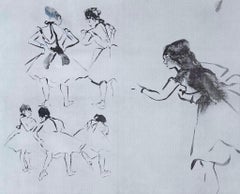
Elwood W. Bartlett, Water
s Edge (Wisconsin), about 1945, mid-century wood eng.
Located in New York, NY
Elwood Warren Bartlett is a Wisconsin native who also worked in Indiana.
Largely self taught as a printmaker, Bartlett worked in a style that once identified as his, immediately t...
Category
American Modern 1940s Landscape Prints
Materials
Woodcut
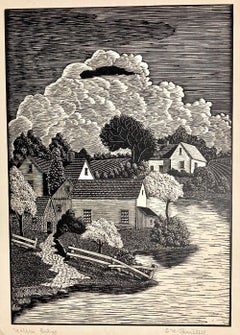
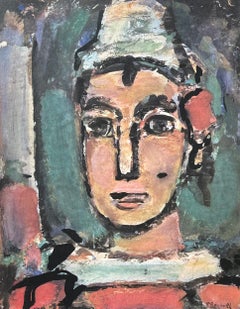
Georges Rouault, Jentie Bernard, from Divertissement, 1943
Located in Southampton, NY
This exquisite lithograph by Georges Rouault (1871–1958), titled Jentie Bernard (Jentie Bernard), from the album Georges Rouault, Divertissement, originates from the 1943 edition pub...
Category
Modern 1940s Landscape Prints
Materials
Lithograph
$716 Sale Price
20% Off
Original You buy
em We
ll fly
em! Defense Bonds vintage WW2 poster
Located in Spokane, WA
Original vintage poster: "You buy 'em We'll fly 'em!" Artists: J. Walter Wilkinson and his son Walter G. Wilkinson. (1917 - 1971). Linen backed with original WW2 U.S. military with original issued fold marks restored. Excellent condition. Touchup pinhole in the four corners. Excellent colors. Ready to frame.
A flying ace pilot smiles and gives the thumbs up to the viewer to promote war bonds, saying, "You Buy 'Em, We'll Fly' Em" in this 1942 WWII poster by J. Walter Wilkinson and his son Walter G. Wilkinson. The artwork features a squadron of Douglas SBD Dauntless, which the US Navy used as scout planes and dive bombers. The seal at the bottom of the poster reads, "The More Bonds You Buy- The More Planes Will Fly." This poster is one in a series of six created by the award-winning father-son team for the United States Treasury Department. J. Walter Wilkinson (1892-1988) and his son Walter G. Wilkinson (1917-1971) created several posters for the United States Department of Treasury during the Second World War. J. Walter Wilkinson was an academic painter who studied in Italy and worked for advertising agencies in Philadelphia. He specialized in outdoor landscapes and created many commercial artworks for advertising campaigns, including Ivory Soap, Pabst Beer...
Category
American Modern 1940s Landscape Prints
Materials
Offset

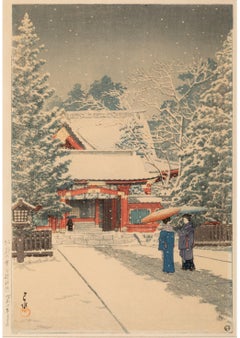
Kawase Hasui -- Snow at Hie Shrine, circa 1946 - 1957
By Kawase Hasui
Located in BRUCE, ACT
Kawase Hasui (Japanese, 1883-1957)
Snow at Hie Shrine, circa 1946 -1957 (dated in the publisher's seal)
Woodblock
Sheet size 37.5 x 26.0 cm (vertical oban)
Frame size 51.3 x 38.5 x 2...
Category
1940s Landscape Prints
Materials
Woodcut
$4,823 Sale Price
30% Off
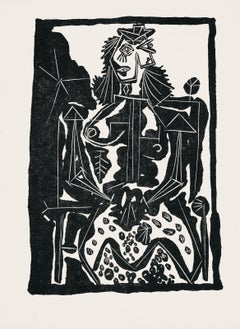
Composition (Cramer 36; Bloch 360; Horodisch A6), Non Vouloir, Pablo Picasso
Located in Southampton, NY
Zincograph on Vélin Bouffant paper. Unsigned and unnumbered, as issued. Good condition. Notes: From the volume, Non Vouloir, 1942. Published by Éditions Jeanne Bucher, Paris; printed...
Category
Cubist 1940s Landscape Prints
Materials
Etching
$1,596 Sale Price
20% Off
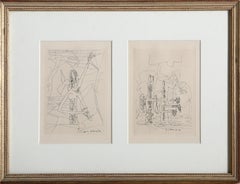
Les Manifestes du Surrealisme, Surrealist Two Etchings by Roberto Matta
Located in Long Island City, NY
Roberto Matta, Chilean (1911 -2002) - Les Manifestes du Surrealisme Diptych, Year: 1946, Medium: Two Etchings, titled in the plate, Edition: 58, Image Size: 5.5 x 4 inches, Size:...
Category
Surrealist 1940s Landscape Prints
Materials
Etching
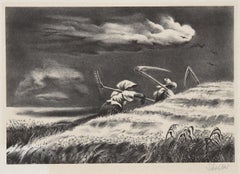
Going Home, Modern Black and White Lithograph by Georges Schreiber
Located in Long Island City, NY
Artist: Georges Schreiber, Belgian/American (1904 - 1977)
Title: Going Home
Year: circa 1945
Medium: Lithograph, signed and titled in pencil
Image Size: 9.25 x 13.25 inches
Size: 12 ...
Category
American Realist 1940s Landscape Prints
Materials
Lithograph
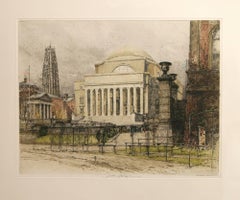
New York, Columbia University Color Etching by Luigi Kasimir
Located in Paonia, CO
The famous Austrian artist, Luigi Kasimir ( 1881- 1962 ) studied at the Vienna Academy of Art. He went on to develop the technique of color etching using multiple plates to creat a finished etching in color. Previously a colored etching had to have the color applied by hand. Kasimir was a very prolific artist famous for his scenes of Vienna...
Category
Realist 1940s Landscape Prints
Materials
Etching
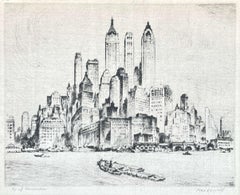
A ca. 1940 Etching Titled "Tip of Manhattan" by Artist Nat Lowell
By Nat Lowell
Located in Chicago, IL
A ca. 1940 etching of a view of the Manhattan skyline by artist Nat Lowell. Signed and titled in pencil, ca. 1940. Artworks size: 4 1/4" x 5 1/4". Arc...
Category
American Modern 1940s Landscape Prints
Materials
Etching, Paper
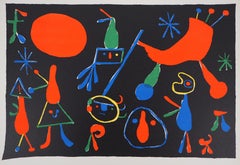
Joan Miro, Figures on a Black Background, from Cahiers d
Art, 1949 (after)
By Joan Miró
Located in Southampton, NY
This exquisite lithograph and pochoir after Joan Miro (1893–1983), titled Personnages sur un fond noir (Figures on a Black Background), from the album Cahiers dArt No. 24, 1949, orig...
Category
Modern 1940s Landscape Prints
Materials
Lithograph
$2,396 Sale Price
20% Off
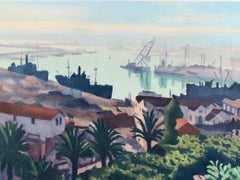
The Port of Algiers
Lithograph
Located in London, GB
'The Port of Algiers", original lithograph, by Albert Marquet (circa 1940s). Marquet spent five years in Algiers, between 1940-45. Due to his travelling, harbour scenes were an impor...
Category
Expressionist 1940s Landscape Prints
Materials
Lithograph
$650 Sale Price
50% Off
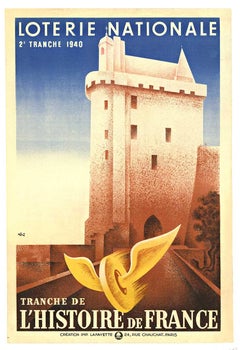
Original Loterie Nationale Tranche de L
Histoire de France vintage poster
Located in Spokane, WA
Original 1940 Loterie Nationale Vintage Poster. Tranche de l”Historie de France. Linen-backed in very good condition – excellent, ready to frame. The team of Eddgard Derouet and C...
Category
Art Deco 1940s Landscape Prints
Materials
Lithograph
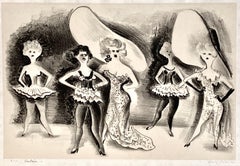
Adolf Dehn, Curtain (aka Flora Dora Girls), 1932, burlesque lithograph
By Adolf Dehn
Located in New York, NY
Adolf Dehn's, lithograph on chine collé, Curtain or The Flora Dora Girls, is an ode to burlesque with dancing girls and fabulous costumes. It comes on the heals of a 1930 pre-code mo...
Category
American Modern 1940s Landscape Prints
Materials
Lithograph
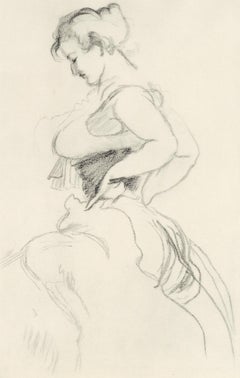
Toulouse-Lautrec, Composition, Henri de Toulouse-Lautrec, Dessinateur (after)
Located in Southampton, NY
Lithograph on vélin paper. Paper size: 12.25 x 9.25 inches. Inscription: Unsigned and unnumbered, as issued. Notes: From the album, Henri de Toulouse-Lautrec, Dessinateur, 1948. Publ...
Category
Post-Impressionist 1940s Landscape Prints
Materials
Lithograph
$716 Sale Price
20% Off
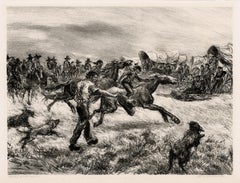
Navajo Horse Race
— Southwest Regionalism, Native American Subject
Located in Myrtle Beach, SC
Ira Moskowitz, 'Navajo Horse Race', lithograph, 1946, edition 30, Czestochowski 204. Signed and titled in pencil. Signed and dated in the stone, lower le...
Category
American Modern 1940s Landscape Prints
Materials
Lithograph
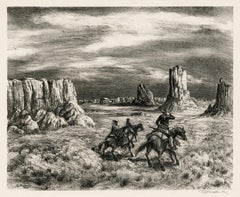
Navajo Country
— Southwest Regionalism, Native American Subject
Located in Myrtle Beach, SC
Ira Moskowitz, 'Navajo Reservation Landscape', lithograph, 1945, edition c. 30. Signed and titled in pencil. Signed and dated in the stone, lower left. A fine, richly-inked impressio...
Category
1940s Landscape Prints
Materials
Lithograph
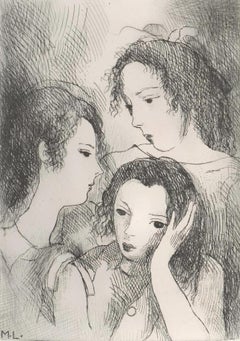
Marie Laurencin, Three Young Girls, from Antares, 1944
Located in Southampton, NY
This exquisite etching by Marie Laurencin (1883–1956), titled Trois jeunes filles (Three Young Girls), from the album Antares, eaux-fortes originales de Marie Laurencin (Antares, Ori...
Category
Modern 1940s Landscape Prints
Materials
Etching
$956 Sale Price
20% Off
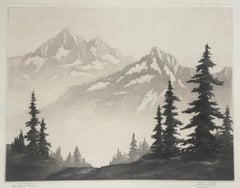
WESTERN PEAKS
Located in Santa Monica, CA
HAROLD LUKENS DOOLITTLE (1873 - 1974)
WESTERN PEAKS c. 1945
Aquatint signed and titled in pencil. 6 3/4 x 8 7/8 sheet 9 5/8 x 12 3/4.
Good condition save for just a hint of darkening within the window and small bits if tape on the sheet edge verso.
Doolittle was a renaissance man. His day job was as an engineer for the Edison Electric Co. But he produced an outstanding body of prints for 5 decades as well as photographs. His very rare arts and crafts furniture is highly sought after. He was a long time member and officer in the California Print...
Category
Realist 1940s Landscape Prints
Materials
Aquatint
$393 Sale Price
25% Off
Original "Our America, Transportation Creates New Wonders" 1943 vintage poster
Located in Spokane, WA
Original OUR AMERICA TRANSPORTATION #4, horizontal vintage WWII time frame Transportation creates new wonders. Professional acid-free archival linen backed mint condition. This #4 for Transportation has two variations produced by Coca-Cola to feature the future of modern air travel. This is a rare variation of the Coca-Cola Our America transportation series.
This poster #4 for transportation is the only Coca-Cola Our America poster that had two different versions.
This poster is in excellent condition. The initially issued fold narks were flattened, and the touch-up work is exceptionally well done. So well done, you would have to look to find them! As mint as this poster can be!
A futuristic plane design is shown as "transportation creates new wonders' as the double-decker plane with lower and upper passenger loading. You can stop and drop off passengers directly at the plane from your car! You can arrive by boat or water taxi or by using the new suspended freeways. The scene has semi-delivery trucks driving directly to the loading bays.
The airplane engines...
Category
American Modern 1940s Landscape Prints
Materials
Offset

$440 Sale Price
20% Off
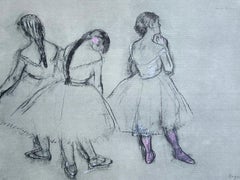
Edgar Degas, Three Dancers, 1945 (after)
By Edgar Degas
Located in Southampton, NY
This exquisite lithograph after Edgar Degas (1834–1917), titled Trois danseurs (Three Dancers), originates from the 1945 folio Degas, Ten Ballet Sketches. Published by The Studio Publications, Inc., New York, rendered and printed by Albert Carman, City Island, 1945, this work reflects Degas’s sensitive mastery of line, movement, and the intimate psychological nuances of the ballet studio.
Executed as a lithograph and pochoir on velin paper, this work measures 13 x 17 inches (33.02 x 43.18 cm). Signed in the plate and unnumbered as issued. Rendered and printed by Albert Carman, City Island.
Artwork Details:
Artist: After Edgar Degas (1834–1917)
Title: Trois danseurs (Three Dancers), from Degas, Ten Ballet Sketches, 1945
Medium: Lithograph and pochoir on velin paper
Dimensions: 13 x 17 inches (33.02 x 43.18 cm)
Inscription: Signed in the plate and unnumbered as issued
Date: 1945
Publisher: The Studio Publications, Inc., New York
Printer: Albert Carman, City Island
Condition: Well preserved, consistent with age and medium
Provenance: From the 1945 folio Degas, Ten Ballet Sketches, published by The Studio Publications, Inc., New York
Notes:
Excerpted from the album, Born in Paris in 1834, Edgar Degas lived, and surely loved the life of that city during most of his years. These continued somewhat sadly beyond those of most of his friends— into the debacle of the first World War, during which he died in 1917. Judging by the frequency with which he used them as models, he must have had an especial admiration for the ballet girls who followed a profession that at the time brought none of the glory and prosperity which attend it today. New aspects of the human body, revealed in movement, fascinated him. But his occupation with the simply anatomical side of his subjects never resulted in a cold interpretation. On the contrary there is a warmth and sympathy that pervades all of his work. The drawings here represent the painter in one important phase of his multi-sensitive view of life; and permit an insight which a more ambitious work might not do-into the operation of the creative process, the artist's transformation of reality as it passes through the mesh of his sensibilities. The Edition of this Portfolio is limited to MMMD examples. Rendered by Albert Carman.
About the Publication:
Degas, Ten Ballet Sketches (1945) is one of the earliest and most significant American postwar fine art portfolios devoted to Edgar Degas’s intimate works on paper. Published by The Studio Publications, Inc., New York, and rendered and printed by Albert Carman at City Island, the album sought to faithfully reproduce a group of Degas’s ballet-related drawings through a combination of lithography and hand-applied pochoir coloring. This hybrid technique allowed the edition to preserve the immediacy, tonal subtlety, and gestural delicacy central to Degas’s draftsmanship. Conceived as a fine art publication rather than a commercial book, the portfolio provided American audiences unprecedented access to Degas’s private, spontaneous studies—images that reveal the artist’s fascination with movement, anatomy, and the psychological atmosphere of the rehearsal studio. The album exemplifies the mid-20th-century revival of pochoir as a means of recreating the texture and coloristic nuance of original works on paper, and it remains an important document of how Degas’s legacy was translated into high-quality printed form for collectors, museums, and connoisseurs.
About the Artist:
Edgar Degas (1834–1917) was a French painter, draughtsman, printmaker, and sculptor whose groundbreaking fusion of classical draftsmanship, modern experimentation, and psychological depth helped define the trajectory of Western art, positioning him as one of the most influential figures of the nineteenth and early twentieth centuries; renowned for his depictions of ballet dancers, racehorses, theater scenes, cafe life, domestic interiors, milliners, laundresses, and women at their toilette, Degas reimagined observational realism through radical compositional innovation—employing extreme cropping, asymmetrical framing, oblique viewpoints, and dramatic lighting that anticipated photographic and cinematic language long before these technologies shaped visual culture, and although associated with Impressionism, he rejected plein-air spontaneity in favor of studio-based discipline rooted in the linear precision of Jean-Auguste-Dominique Ingres, the expressive chromaticism of Eugene Delacroix, and the modernity of Edouard Manet while also drawing inspiration from Japanese ukiyo-e prints, classical sculpture, and early photography; his independent artistic philosophy resonated with and helped shape the innovations of Pablo Picasso, Alexander Calder, Alberto Giacometti, Salvador Dali, Joan Miro, Wassily Kandinsky, Marcel Duchamp, and Man Ray, whose explorations of movement, form, dream logic, abstraction, and conceptualism all find antecedents in Degas’s investigations into seriality, temporality, and the fragmented figure, and his pioneering use of pastel, monotype, and wax sculpture fundamentally transformed each medium, influencing artists from Henri Matisse, Francis Bacon, Lucian Freud, and Giacomo Manzu to Paula Rego, contemporary realists, experimental photographers, and choreographers; his works are held in nearly every major museum collection worldwide—including the Musee dOrsay, the Louvre, the Metropolitan Museum of Art, the National Gallery of Art, the Art Institute of Chicago, the Courtauld Institute, and the National Gallery, London—affirming his central place in the history of art, and the highest auction record for Degas was achieved at Sothebys London on February 3, 2015, when Danseuses en Bleu sold for 37,033,000 GBP, cementing his status as one of the most sought-after and enduringly significant artists of the Western canon.
Degas pochoir, Degas lithograph...
Category
Impressionist 1940s Landscape Prints
Materials
Lithograph
$796 Sale Price
20% Off
Harry Shokler, Island Harbor
Located in New York, NY
Harry Shokler used serigraphy to great advantage in this landscape. It's colorful and detailed.
It is signed in the image at the lower left. When printmakers began making serigraphs...
Category
American Modern 1940s Landscape Prints
Materials
Screen
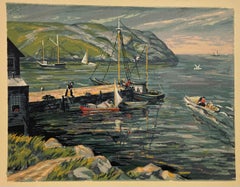
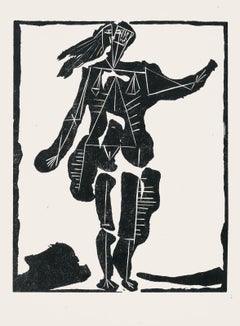
Composition (Cramer 36; Bloch 360; Horodisch A6), Non Vouloir, Pablo Picasso
Located in Southampton, NY
Zincograph on Vélin Bouffant paper. Unsigned and unnumbered, as issued. Good condition. Notes: From the volume, Non Vouloir, 1942. Published by Éditions Jeanne Bucher, Paris; printed...
Category
Cubist 1940s Landscape Prints
Materials
Etching
$1,596 Sale Price
20% Off
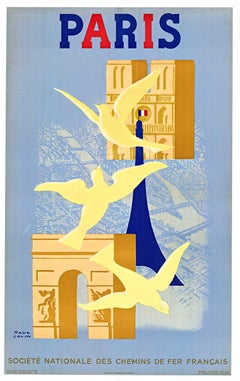
Original 1945 Paris (France) vintage travel poster travel by train
By Paul Colin
Located in Spokane, WA
Original PARIS linen-backed 1946 vintage travel poster, preservation linen-backed and ready to frame. Very good condition, Grade A-
Original 1946 Paul Colin Paris Vintage Poster ...
Category
American Modern 1940s Landscape Prints
Materials
Lithograph
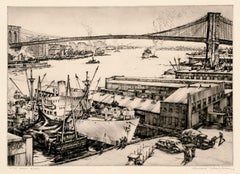
The East River
, Brooklyn Bridge — Mid-Century Realism, New York City
Located in Myrtle Beach, SC
Lawrence Nelson Wilbur (1897-1988), 'The East River', drypoint, edition 65, 1946. Signed, titled, and annotated 'A. Jones Proof 1946' in pencil. Signed and dated in the plate, lower ...
Category
American Modern 1940s Landscape Prints
Materials
Drypoint
Manet, Composition, Édouard Manet, Letters with Aquarelles (after)
Located in Southampton, NY
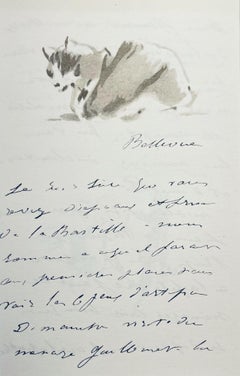
Lithograph and stencil on vélin Foreign Affairs paper mounted on Foreign Affairs museum board, as issued . Unsigned and unnumbered, as issued. Good Condition. Notes: From the folio, Édouard Manet, Letters with Aquarelles, 1944. Published by Pantheon Books, New York; rendered and printed by Raymond and...
Category
Impressionist 1940s Landscape Prints
Materials
Lithograph
$716 Sale Price
20% Off
Manet, Composition, Édouard Manet, Letters with Aquarelles (after)
Located in Southampton, NY
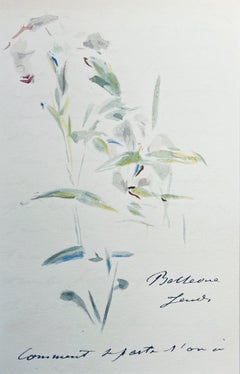
Lithograph and stencil on vélin Foreign Affairs paper mounted on Foreign Affairs museum board, as issued . Unsigned and unnumbered, as issued. Good Condition. Notes: From the folio, ...
Category
Impressionist 1940s Landscape Prints
Materials
Lithograph
$716 Sale Price
20% Off
Metzinger, Femme à sa Toilette (Metzinger, AM-18-013), Du cubisme (after)
Located in Southampton, NY
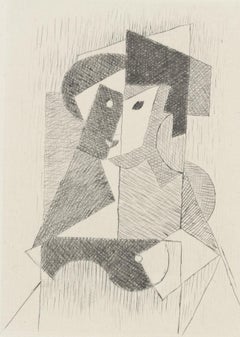
Drypoint on vélin du Lana Papiers Spéciaux pure rag paper. Unsigned and unnumbered, as issued. Good Condition. Notes: From the folio, Du Cubisme, 1947. Published by Compagnie Françai...
Category
Modern 1940s Landscape Prints
Materials
Drypoint
$6,716 Sale Price
20% Off
Andre Derain, The Bathers, from Verve, Revue Artistique et Litteraire, 1940
By André Derain
Located in Southampton, NY
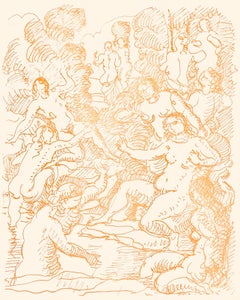
This exquisite lithograph by Andre Derain (1880–1954), titled Les Baigneuses (The Bathers), from Verve, Revue Artistique et Litteraire, Vol. II, No. 8, originates from the 1940 issue...
Category
Modern 1940s Landscape Prints
Materials
Lithograph
CALLE EX CONVENTO, TASCO.
Located in Portland, ME
Pappe, Carl. CALLE EX CONVENTO, TASCO. Woodcut, c.1940s-60s. Edition unstated. This print is one of a series of 16 images, all of scenes in Taxco, distinguished by the strength of the carving and the richness of the blacks. 12 x 14 1/4 inches (image), 13 1/2 x 15 3/4 (sheet). Titled and signed in pencil. In excellent condition.
Carl Pappe...
Category
1940s Landscape Prints
Materials
Woodcut
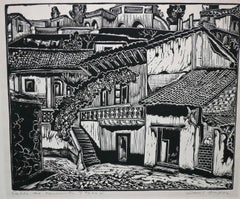
LIGHT AND SHADE TAXCO - J. T. Arms Mexican Masterpiece with Striking Detail
Located in Santa Monica, CA
JOHN TAYLOR ARMS (1887 – 1953)
LIGHT AND SHADE TAXCO, 1946 (F. 394: (#2 from the Mexican series.)
Etching and aquatint signed and dated in pencil. Image 10 ½ x 13 5/8, sheet 14 1/...
Category
American Realist 1940s Landscape Prints
Materials
Etching
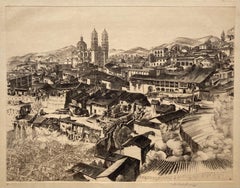
Edgar Degas, Melina Darde, 1945 (after)
By Edgar Degas
Located in Southampton, NY
This exquisite lithograph after Edgar Degas (1834–1917), titled Melina Darde, originates from the 1945 folio Degas, Ten Ballet Sketches. Published by The Studio Publications, Inc., New York, rendered and printed by Albert Carman, City Island, 1945, this work reflects Degas’s sensitive mastery of line, movement, and the intimate psychological nuances of the ballet studio.
Executed as a lithograph and pochoir on velin paper, this work measures 17 x 13 inches (43.18 x 33.02 cm). Signed in the plate and unnumbered as issued. Rendered and printed by Albert Carman, City Island.
Artwork Details:
Artist: Edgar Degas (1834–1917)
Title: Melina Darde, from Degas, Ten Ballet Sketches, 1945
Medium: Lithograph and pochoir on velin paper
Dimensions: 17 x 13 inches (43.18 x 33.02 cm)
Inscription: Signed in the plate and unnumbered as issued
Date: 1945
Publisher: The Studio Publications, Inc., New York
Printer: Albert Carman, City Island
Condition: Well preserved, consistent with age and medium
Provenance: From the 1945 folio Degas, Ten Ballet Sketches, published by The Studio Publications, Inc., New York
Notes:
Excerpted from the album, Born in Paris in 1834, Edgar Degas lived, and surely loved the life of that city during most of his years. These continued somewhat sadly beyond those of most of his friends— into the debacle of the first World War, during which he died in 1917. Judging by the frequency with which he used them as models, he must have had an especial admiration for the ballet girls who followed a profession that at the time brought none of the glory and prosperity which attend it today. New aspects of the human body, revealed in movement, fascinated him. But his occupation with the simply anatomical side of his subjects never resulted in a cold interpretation. On the contrary there is a warmth and sympathy that pervades all of his work. The drawings here represent the painter in one important phase of his multi-sensitive view of life; and permit an insight which a more ambitious work might not do-into the operation of the creative process, the artist's transformation of reality as it passes through the mesh of his sensibilities. The Edition of this Portfolio is limited to MMMD examples. Rendered by Albert Carman.
About the Publication:
Degas, Ten Ballet Sketches (1945) is one of the earliest and most significant American postwar fine art portfolios devoted to Edgar Degas’s intimate works on paper. Published by The Studio Publications, Inc., New York, and rendered and printed by Albert Carman at City Island, the album sought to faithfully reproduce a group of Degas’s ballet-related drawings through a combination of lithography and hand-applied pochoir coloring. This hybrid technique allowed the edition to preserve the immediacy, tonal subtlety, and gestural delicacy central to Degas’s draftsmanship. Conceived as a fine art publication rather than a commercial book, the portfolio provided American audiences unprecedented access to Degas’s private, spontaneous studies—images that reveal the artist’s fascination with movement, anatomy, and the psychological atmosphere of the rehearsal studio. The album exemplifies the mid-20th-century revival of pochoir as a means of recreating the texture and coloristic nuance of original works on paper, and it remains an important document of how Degas’s legacy was translated into high-quality printed form for collectors, museums, and connoisseurs.
About the Artist:
Edgar Degas (1834–1917) was a French painter, draughtsman, printmaker, and sculptor whose groundbreaking fusion of classical draftsmanship, modern experimentation, and psychological depth helped define the trajectory of Western art, positioning him as one of the most influential figures of the nineteenth and early twentieth centuries; renowned for his depictions of ballet dancers, racehorses, theater scenes, cafe life, domestic interiors, milliners, laundresses, and women at their toilette, Degas reimagined observational realism through radical compositional innovation—employing extreme cropping, asymmetrical framing, oblique viewpoints, and dramatic lighting that anticipated photographic and cinematic language long before these technologies shaped visual culture, and although associated with Impressionism, he rejected plein-air spontaneity in favor of studio-based discipline rooted in the linear precision of Jean-Auguste-Dominique Ingres, the expressive chromaticism of Eugene Delacroix, and the modernity of Edouard Manet while also drawing inspiration from Japanese ukiyo-e prints, classical sculpture, and early photography; his independent artistic philosophy resonated with and helped shape the innovations of Pablo Picasso, Alexander Calder, Alberto Giacometti, Salvador Dali, Joan Miro, Wassily Kandinsky, Marcel Duchamp, and Man Ray, whose explorations of movement, form, dream logic, abstraction, and conceptualism all find antecedents in Degas’s investigations into seriality, temporality, and the fragmented figure, and his pioneering use of pastel, monotype, and wax sculpture fundamentally transformed each medium, influencing artists from Henri Matisse, Francis Bacon, Lucian Freud, and Giacomo Manzu to Paula Rego, contemporary realists, experimental photographers, and choreographers; his works are held in nearly every major museum collection worldwide—including the Musee dOrsay, the Louvre, the Metropolitan Museum of Art, the National Gallery of Art, the Art Institute of Chicago, the Courtauld Institute, and the National Gallery, London—affirming his central place in the history of art, and the highest auction record for Degas was achieved at Sothebys London on February 3, 2015, when Danseuses en Bleu sold for 37,033,000 GBP, cementing his status as one of the most sought-after and enduringly significant artists of the Western canon.
Degas pochoir, Degas lithograph...
Category
Impressionist 1940s Landscape Prints
Materials
Lithograph

$796 Sale Price
20% Off
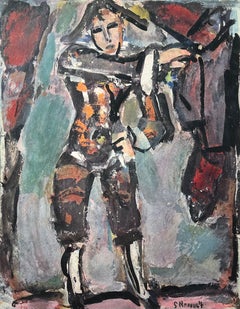
Georges Rouault, Harlequin, from Divertissement, 1943
Located in Southampton, NY
This exquisite lithograph by Georges Rouault (1871–1958), titled Arlequin (Harlequin), from the album Georges Rouault, Divertissement, originates from the 1943 edition published by E...
Category
Modern 1940s Landscape Prints
Materials
Lithograph
$716 Sale Price
20% Off
Gordon Grant Sail Boat Lithograph "Salt Bark - Gloucester"
By Gordon Grant
Located in New York, NY
Gordon Grant (American, 1875-1962)
The Salt Bark - Gloucester, c. 1947
Lithograph
Sight: 10 x 12 1/2 in.
Framed: 15 x 19 x 3/4 in.
Signed lower right in pencil
Published in edition ...
Category
American Modern 1940s Landscape Prints
Materials
Lithograph