1940s Landscape Prints
to
418
455
76
28
21
10
Overall Width
to
Overall Height
to
227
137
88
7
6
5
2
1
1
15
13
11
7
6
1,009
2,152
9,931
4,046
117
114
693
514
592
1,138
1,458
1,650
1,307
621
657
385
203
2
434
271
262
145
142
110
71
55
53
46
34
31
28
28
24
24
23
16
16
13
380
83
71
30
21
24
41
531
49
Period: 1940s
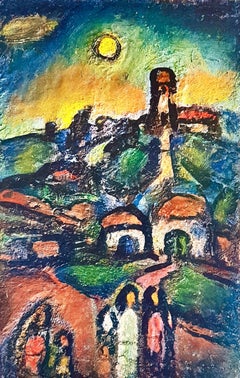
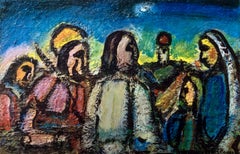
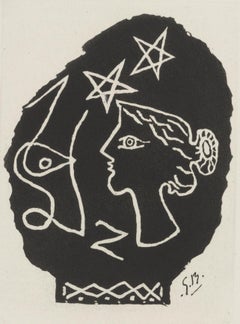
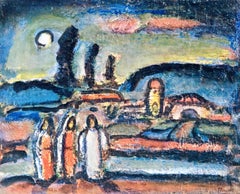
Georges Rouault, Black Pierrot, from Divertissement, 1943
Located in Southampton, NY
This exquisite lithograph by Georges Rouault (1871–1958), titled Pierrot Noir (Black Pierrot), from the album Georges Rouault, Divertissement, originates from the 1943 edition publis...
Category
Modern 1940s Landscape Prints
Materials
Lithograph
$716 Sale Price
20% Off
Adolf Dehn, Commodore Peak, 1940-42, mid-century lithograph of Colorado mountain
By Adolf Dehn
Located in New York, NY
Adolf Dehn (1895-1968) was an American painter, printmaker and draftsman. A native of Waterville, Minnesota, he attended the Minneapolis School of Art where he met colleague Wanda Ga...
Category
American Modern 1940s Landscape Prints
Materials
Lithograph
Manet, Composition, Édouard Manet, Letters with Aquarelles (after)
Located in Southampton, NY
Lithograph and stencil on vélin Foreign Affairs paper mounted on Foreign Affairs museum board, as issued . Unsigned and unnumbered, as issued. Good Condition. Notes: From the folio, Édouard Manet, Letters with Aquarelles, 1944. Published by Pantheon Books, New York; rendered and printed by Raymond and...
Category
Impressionist 1940s Landscape Prints
Materials
Lithograph
$716 Sale Price
20% Off
Manet, Composition, Édouard Manet, Letters with Aquarelles (after)
Located in Southampton, NY
Lithograph and stencil on vélin Foreign Affairs paper mounted on Foreign Affairs museum board, as issued . Unsigned and unnumbered, as issued. Good Condition. Notes: From the folio, Édouard Manet, Letters with Aquarelles, 1944. Published by Pantheon Books, New York; rendered and printed by Raymond and...
Category
Impressionist 1940s Landscape Prints
Materials
Lithograph
$716 Sale Price
20% Off
Original Eriac Cyclomoteurs Paris to Tokio vintage French motorcycle poster
Located in Spokane, WA
Original Vintage Poster: Eria Cyclomoteurs - Paris to Tokyo 18,000 km. Endurance Race, Archival linen-backed and ready to frame. Printer: Rocher Studio.
Creator: Unknown (attribu...
Category
Art Deco 1940s Landscape Prints
Materials
Lithograph
Toulouse-Lautrec, Composition, Images de Lautrec (after)
Located in Fairfield, CT
Medium: Lithograph and stencil on vélin Polifilo paper
Year: 1947
Paper Size: 13.78 x 10.24 inches
Inscription: Signed in the plate and unnumbered, as issued
Notes: From the folio, I...
Category
Post-Impressionist 1940s Landscape Prints
Materials
Lithograph
$716 Sale Price
20% Off
Degas, La Pianiste et le Chanteur, E. Degas Monotypes (after)
By Edgar Degas
Located in Fairfield, CT
Medium: Engraving on vélin du Marais paper
Year: 1948
Paper Size: 12.25 x 9.125 inches; image size: 6.75 x 5 inches
Inscription: Unsigned and unnumbered, as issued
Notes: From the vo...
Category
Impressionist 1940s Landscape Prints
Materials
Engraving
$956 Sale Price
20% Off
Vuillard, Intérieur a la suspension, L
œuvre gravé de Vuillard (after)
Located in Fairfield, CT
Medium: Lithograph on grand vélin Renage paper
Year: 1948
Paper Size: 12.375 x 9.5 inches; image size: 12.2 x 9.45 inches
Inscription: Unsigned and unnumbered, as issued
Notes: From ...
Category
Post-Impressionist 1940s Landscape Prints
Materials
Lithograph
$716 Sale Price
20% Off
Francois Auguste Rene Rodin, Untitled, from The Varende, 1944 (after)
Located in Southampton, NY
This exquisite lithograph after Francois Auguste Rene Rodin (1840–1917), titled Sans titre (Untitled), from the folio La Varende, Rodin (La Varende, Rodin), originates from the 1944 ...
Category
Modern 1940s Landscape Prints
Materials
Lithograph, Stencil
$716 Sale Price
20% Off
Manet, Composition, Édouard Manet, Letters with Aquarelles (after)
Located in Southampton, NY
Lithograph and stencil on vélin Foreign Affairs paper mounted on Foreign Affairs museum board, as issued . Unsigned and unnumbered, as issued. Good Condition. Notes: From the folio, ...
Category
Impressionist 1940s Landscape Prints
Materials
Lithograph
$716 Sale Price
20% Off
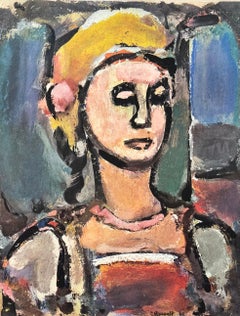
Georges Rouault, Madame Yxe, from Divertissement, 1943
Located in Southampton, NY
This exquisite lithograph by Georges Rouault (1871–1958), titled Madame Yxe (Madame Yxe), from the album Georges Rouault, Divertissement, originates from the 1943 edition published b...
Category
Modern 1940s Landscape Prints
Materials
Lithograph
$716 Sale Price
20% Off
"Skiing Near Holy Hill, " Original Silkscreen Landscape by Schomer Lichtner
Located in Milwaukee, WI
"Skiing Near Holy Hill" is an original silkscreen print by Schomer Lichtner. The artist initials are lower right, and the title is along the lower edge. This print depicts people skiing near Holy Hill, Wisconsin. The artist used a muted blue, a deep and dark purple, and accents of red to create this piece.
4 7/8" x 6 7/8" art
11 7/8" x 13 7/8" frame
Milwaukee artist, Schomer Lichtner passed away on May 9, 2006 at the age of 101. He continued to amaze and create with his whimsical paintings of ballerinas and cows. He and his late wife Ruth Grotenrath, both well-known Wisconsin artists, began their prolific careers as muralists for WPA projects, primarily post offices.
Schomer Lichtner was well known for his whimsical cows and ballerinas, such as his "Ballerina Dancing on Cow" sculpture below. The late James Auer, art critic for the Milwaukee Journal Sentinel referred to Lichtner as the artist laureate of Milwaukee, Wisconsin. He was the official artist of the Milwaukee Ballet.
Lichtner also painted murals for industry and private clients. Schomer was a printmaker and produced block prints, lithographs, and serigraph prints. His casein (paint made from dairy products) and acrylic paintings are of the rural Wisconsin landscape and farm animals. He became interested in cows when he and Ruth spent summers near Holy Hill in Washington County.
According to David Gordon, director of the Milwaukee Art Museum, Schomer Lichtner had a tremendous joie de vivre, " joy of life," and expressed it in his art.
Schomer Lichtner was nationally known for his whimsical paintings and sculptures of black- and white-patterned Holstein cows and elegant ballerina dancers. Lichtner also painted all sorts of combinations of beautiful women, flowers and country landscapes. James Auer, former Milwaukee Journal Sentinel art critic, said that his art eventually "exploded into expressionistic design elements with bold, flat areas of color and high energy that anticipated Pop Art." Auer went on to describe Lichtner’s work as full of "wit, vigor and virtuosity."
As early as 1930, Lichtner’s work was shown at the prestigious Carnegie International Exhibition in New York and at museums throughout the Midwest. As a student, he was a protégé of another icon of 20th century American art, Gustave Moeller...
Category
American Modern 1940s Landscape Prints
Materials
Screen
Seurat, L
échafaudage, Seurat (after)
Located in Fairfield, CT
Medium: Lithograph on vélin du Canson & Montgolfier Vidalon-Les-Annonay paper
Year: 1948
Paper Size: 12.5 x 9.75 inches
Inscription: Unsigned and unnumbered, as issued
Notes: From th...
Category
Post-Impressionist 1940s Landscape Prints
Materials
Lithograph
$876 Sale Price
20% Off
Toulouse-Lautrec, Composition, Images de Lautrec (after)
Located in Fairfield, CT
Medium: Lithograph and stencil on vélin Polifilo paper
Year: 1947
Paper Size: 10.24 x 13.78 inches
Inscription: Signed in the plate and unnumbered, as issued
Notes: From the folio, I...
Category
Post-Impressionist 1940s Landscape Prints
Materials
Lithograph
$716 Sale Price
20% Off
Toulouse-Lautrec, Composition, Images de Lautrec (after)
Located in Fairfield, CT
Medium: Lithograph and stencil on vélin Polifilo paper
Year: 1947
Paper Size: 13.78 x 10.24 inches
Inscription: Signed in the plate and unnumbered, as issued
Notes: From the folio, I...
Category
Post-Impressionist 1940s Landscape Prints
Materials
Lithograph
$716 Sale Price
20% Off
Toulouse-Lautrec, Composition, TLautrec (after)
Located in Fairfield, CT
Medium: Lithograph and stencil on vélin paper
Year: 1946
Paper Size: 17 x 13 inches
Inscription: Signed in the plate and unnumbered, as issued
Notes: From the folio, TLautrec, 1946. ...
Category
Post-Impressionist 1940s Landscape Prints
Materials
Lithograph
$716 Sale Price
20% Off
Degas, Famille Cardinal, E. Degas Monotypes (after)
By Edgar Degas
Located in Fairfield, CT
Medium: Engraving on vélin du Marais paper
Year: 1948
Paper Size: 12.25 x 9.125 inches; image size: 8.5 x 6.25 inches
Inscription: Unsigned and unnumbered, as issued
Notes: From the ...
Category
Impressionist 1940s Landscape Prints
Materials
Engraving
$956 Sale Price
20% Off
Edgar Degas, Dancer Touching Her Earring, 1945 (after)
By Edgar Degas
Located in Southampton, NY
This exquisite lithograph after Edgar Degas (1834–1917), titled Danseuse touchant sa boucle d’oreille (Dancer Touching Her Earring), originates from the 1945 folio Degas, Ten Ballet Sketches. Published by The Studio Publications, Inc., New York, rendered and printed by Albert Carman, City Island, 1945, this work reflects Degas’s sensitive mastery of line, movement, and intimate observation, capturing the grace, poise, and psychological immediacy that define his iconic ballet imagery. In Danseuse touchant sa boucle d’oreille (Dancer Touching Her Earring), Degas reveals gesture and inner emotion through economical contour and lyrical nuance.
Executed as a lithograph and pochoir on velin paper, this work measures 17 x 13 inches (43.18 x 33.02 cm). Signed in the plate and unnumbered as issued. Rendered and printed by Albert Carman, City Island, one of the notable American ateliers specializing in fine art lithography during the mid-20th century.
Artwork Details:
Artist: After Edgar Degas (1834–1917)
Title: Danseuse touchant sa boucle d’oreille (Dancer Touching Her Earring), from Degas, Ten Ballet Sketches, 1945
Medium: Lithograph and pochoir on velin paper
Dimensions: 17 x 13 inches (43.18 x 33.02 cm)
Inscription: Signed in the plate and unnumbered as issued
Date: 1945
Publisher: The Studio Publications, Inc., New York
Printer: Albert Carman, City Island, 1945
Condition: Well preserved, consistent with age and medium
Provenance: From the 1945 folio Degas, Ten Ballet Sketches, published by The Studio Publications, Inc., New York
Notes:
Excerpted from the album, Born in Paris in 1834, Edgar Degas lived, and surely loved the life of that city during most of his years. These continued somewhat sadly beyond those of most of his friends— into the debacle of the first World War, during which he died in 1917. Judging by the frequency with which he used them as models, he must have had an especial admiration for the ballet girls who followed a profession that at the time brought none of the glory and prosperity which attend it today. New aspects of the human body, revealed in movement, fascinated him. But his occupation with the simply anatomical side of his subjects never resulted in a cold interpretation. On the contrary there is a warmth and sympathy that pervades all of his work. The drawings here represent the painter in one important phase of his multi-sensitive view of life; and permit an insight which a more ambitious work might not do-into the operation of the creative process, the artist's transformation of reality as it passes through the mesh of his sensibilities. The Edition of this Portfolio is limited to MMMD examples. Rendered by Albert Carman.
About the Publication:
Degas, Ten Ballet Sketches, published in 1945 by The Studio Publications, Inc., New York, stands as one of the most elegant and scholarly mid-century American fine art folios devoted to the ballet imagery of Edgar Degas. Conceived as a high-quality interpretive portfolio, the album presents a series of lithograph-and-pochoir renderings based on Degas’s original drawings, executed with exceptional attention to tonal subtlety, contour fidelity, and the emotional interiority that defines the artist’s draftsmanship. Rendered and printed by Albert Carman on City Island, the publication embodies an American postwar effort to restore and celebrate European masterworks through meticulous handcraft and artisanal color application, honoring Degas’s distinctive line and the atmospheric delicacy of his studio-based studies. Produced in a substantial edition of MMMD examples, the portfolio offered audiences rare access to Degas’s private working drawings—images rarely seen outside institutional collections—while exemplifying the technical refinement and interpretive care characteristic of Carman’s workshop. Today, Degas, Ten Ballet Sketches remains a sought-after historical publication, valued for its craft, fidelity to Degas’s aesthetic, and its role in preserving and disseminating the artist’s intimate ballet imagery in a beautifully executed mid-century fine art format.
About the Artist:
Edgar Degas (1834–1917) was a French painter, draughtsman, printmaker, and sculptor whose groundbreaking fusion of classical draftsmanship, modern experimentation, and psychological depth helped define the trajectory of Western art, positioning him as one of the most influential figures of the nineteenth and early twentieth centuries; renowned for his depictions of ballet dancers, racehorses, theater scenes, cafe life, domestic interiors, milliners, laundresses, and women at their toilette, Degas reimagined observational realism through radical compositional innovation—employing extreme cropping, asymmetrical framing, oblique viewpoints, and dramatic lighting that anticipated photographic and cinematic language long before these technologies shaped visual culture, and although associated with Impressionism, he rejected plein-air spontaneity in favor of studio-based discipline rooted in the linear precision of Jean-Auguste-Dominique Ingres, the expressive chromaticism of Eugene Delacroix, and the modernity of Edouard Manet while also drawing inspiration from Japanese ukiyo-e prints, classical sculpture, and early photography; his independent artistic philosophy resonated with and helped shape the innovations of Pablo Picasso, Alexander Calder, Alberto Giacometti, Salvador Dali, Joan Miro, Wassily Kandinsky, Marcel Duchamp, and Man Ray, whose explorations of movement, form, dream logic, abstraction, and conceptualism all find antecedents in Degas’s investigations into seriality, temporality, and the fragmented figure, and his pioneering use of pastel, monotype, and wax sculpture fundamentally transformed each medium, influencing artists from Henri Matisse, Francis Bacon, Lucian Freud, and Giacomo Manzu to Paula Rego, contemporary realists, experimental photographers, and choreographers; his works are held in nearly every major museum collection worldwide—including the Musee dOrsay, the Louvre, the Metropolitan Museum of Art, the National Gallery of Art, the Art Institute of Chicago, the Courtauld Institute, and the National Gallery, London—affirming his central place in the history of art, and the highest auction record for Degas was achieved at Sothebys London on February 3, 2015, when Danseuses en Bleu sold for 37,033,000 GBP, cementing his status as one of the most sought-after and enduringly significant artists of the Western canon.
Edgar Degas lithograph...
Category
Impressionist 1940s Landscape Prints
Materials
Lithograph
$796 Sale Price
20% Off
Edgar Degas, Dancer at the Barre, 1945 (after)
By Edgar Degas
Located in Southampton, NY
This exquisite lithograph after Edgar Degas (1834–1917), titled Danseur au bar (Dancer at the Barre), originates from the 1945 folio Degas, Ten Ballet Sketches. Published by The Studio Publications, Inc., New York, rendered and printed by Albert Carman, City Island, 1945, this work reflects Degas’s sensitive mastery of line, movement, and intimate observation, capturing the grace, poise, and psychological immediacy that define his iconic ballet imagery. In Danseur au bar (Dancer at the Barre), Degas reveals gesture and inner emotion through economical contour and lyrical nuance.
Executed as a lithograph and pochoir on velin paper, this work measures 17 x 13 inches (43.18 x 33.02 cm). Signed in the plate and unnumbered as issued. Rendered and printed by Albert Carman, City Island, one of the notable American ateliers specializing in fine art lithography during the mid-20th century.
Artwork Details:
Artist: After Edgar Degas (1834–1917)
Title: Danseur au bar (Dancer at the Barre), from Degas, Ten Ballet Sketches, 1945
Medium: Lithograph and pochoir on velin paper
Dimensions: 17 x 13 inches (43.18 x 33.02 cm)
Inscription: Signed in the plate and unnumbered as issued
Date: 1945
Publisher: The Studio Publications, Inc., New York
Printer: Albert Carman, City Island, 1945
Condition: Well preserved, consistent with age and medium
Provenance: From the 1945 folio Degas, Ten Ballet Sketches, published by The Studio Publications, Inc., New York
Notes:
Excerpted from the album, Born in Paris in 1834, Edgar Degas lived, and surely loved the life of that city during most of his years. These continued somewhat sadly beyond those of most of his friends— into the debacle of the first World War, during which he died in 1917. Judging by the frequency with which he used them as models, he must have had an especial admiration for the ballet girls who followed a profession that at the time brought none of the glory and prosperity which attend it today. New aspects of the human body, revealed in movement, fascinated him. But his occupation with the simply anatomical side of his subjects never resulted in a cold interpretation. On the contrary there is a warmth and sympathy that pervades all of his work. The drawings here represent the painter in one important phase of his multi-sensitive view of life; and permit an insight which a more ambitious work might not do-into the operation of the creative process, the artist's transformation of reality as it passes through the mesh of his sensibilities. The Edition of this Portfolio is limited to MMMD examples. Rendered by Albert Carman.
About the Publication:
Degas, Ten Ballet Sketches, published in 1945 by The Studio Publications, Inc., New York, stands as one of the most elegant and scholarly mid-century American fine art folios devoted to the ballet imagery of Edgar Degas. Conceived as a high-quality interpretive portfolio, the album presents a series of lithograph-and-pochoir renderings based on Degas’s original drawings, executed with exceptional attention to tonal subtlety, contour fidelity, and the emotional interiority that defines the artist’s draftsmanship. Rendered and printed by Albert Carman on City Island, the publication embodies an American postwar effort to restore and celebrate European masterworks through meticulous handcraft and artisanal color application, honoring Degas’s distinctive line and the atmospheric delicacy of his studio-based studies. Produced in a substantial edition of MMMD examples, the portfolio offered audiences rare access to Degas’s private working drawings—images rarely seen outside institutional collections—while exemplifying the technical refinement and interpretive care characteristic of Carman’s workshop. Today, Degas, Ten Ballet Sketches remains a sought-after historical publication, valued for its craft, fidelity to Degas’s aesthetic, and its role in preserving and disseminating the artist’s intimate ballet imagery in a beautifully executed mid-century fine art format.
About the Artist:
Edgar Degas (1834–1917) was a French painter, draughtsman, printmaker, and sculptor whose groundbreaking fusion of classical draftsmanship, modern experimentation, and psychological depth helped define the trajectory of Western art, positioning him as one of the most influential figures of the nineteenth and early twentieth centuries; renowned for his depictions of ballet dancers, racehorses, theater scenes, cafe life, domestic interiors, milliners, laundresses, and women at their toilette, Degas reimagined observational realism through radical compositional innovation—employing extreme cropping, asymmetrical framing, oblique viewpoints, and dramatic lighting that anticipated photographic and cinematic language long before these technologies shaped visual culture, and although associated with Impressionism, he rejected plein-air spontaneity in favor of studio-based discipline rooted in the linear precision of Jean-Auguste-Dominique Ingres, the expressive chromaticism of Eugene Delacroix, and the modernity of Edouard Manet while also drawing inspiration from Japanese ukiyo-e prints, classical sculpture, and early photography; his independent artistic philosophy resonated with and helped shape the innovations of Pablo Picasso, Alexander Calder, Alberto Giacometti, Salvador Dali, Joan Miro, Wassily Kandinsky, Marcel Duchamp, and Man Ray, whose explorations of movement, form, dream logic, abstraction, and conceptualism all find antecedents in Degas’s investigations into seriality, temporality, and the fragmented figure, and his pioneering use of pastel, monotype, and wax sculpture fundamentally transformed each medium, influencing artists from Henri Matisse, Francis Bacon, Lucian Freud, and Giacomo Manzu to Paula Rego, contemporary realists, experimental photographers, and choreographers; his works are held in nearly every major museum collection worldwide—including the Musee dOrsay, the Louvre, the Metropolitan Museum of Art, the National Gallery of Art, the Art Institute of Chicago, the Courtauld Institute, and the National Gallery, London—affirming his central place in the history of art, and the highest auction record for Degas was achieved at Sothebys London on February 3, 2015, when Danseuses en Bleu sold for 37,033,000 GBP, cementing his status as one of the most sought-after and enduringly significant artists of the Western canon.
Edgar Degas lithograph...
Category
Impressionist 1940s Landscape Prints
Materials
Lithograph
$796 Sale Price
20% Off
Edgar Degas, Four Sketches of a Little Dancer, 1945 (after)
By Edgar Degas
Located in Southampton, NY
This exquisite lithograph after Edgar Degas (1834–1917), titled Quatre croquis d’un petit danseur (Four Sketches of a Little Dancer), originates from the 1945 folio Degas, Ten Ballet Sketches. Published by The Studio Publications, Inc., New York, rendered and printed by Albert Carman, City Island, 1945, this work reflects Degas’s sensitive mastery of line, movement, and intimate observation, capturing the grace, poise, and psychological immediacy that define his iconic ballet imagery. In Quatre croquis d’un petit danseur (Four Sketches of a Little Dancer), Degas reveals gesture and inner emotion through economical contour and lyrical nuance.
Executed as a lithograph and pochoir on velin paper, this work measures 17 x 13 inches (43.18 x 33.02 cm). Signed in the plate and unnumbered as issued. Rendered and printed by Albert Carman, City Island, one of the notable American ateliers specializing in fine art lithography during the mid-20th century.
Artwork Details:
Artist: After Edgar Degas (1834–1917)
Title: Quatre croquis d’un petit danseur (Four Sketches of a Little Dancer), from Degas, Ten Ballet Sketches, 1945
Medium: Lithograph and pochoir on velin paper
Dimensions: 17 x 13 inches (43.18 x 33.02 cm)
Inscription: Signed in the plate and unnumbered as issued
Date: 1945
Publisher: The Studio Publications, Inc., New York
Printer: Albert Carman, City Island, 1945
Condition: Well preserved, consistent with age and medium
Provenance: From the 1945 folio Degas, Ten Ballet Sketches, published by The Studio Publications, Inc., New York
Notes:
Excerpted from the album, Born in Paris in 1834, Edgar Degas lived, and surely loved the life of that city during most of his years. These continued somewhat sadly beyond those of most of his friends— into the debacle of the first World War, during which he died in 1917. Judging by the frequency with which he used them as models, he must have had an especial admiration for the ballet girls who followed a profession that at the time brought none of the glory and prosperity which attend it today. New aspects of the human body, revealed in movement, fascinated him. But his occupation with the simply anatomical side of his subjects never resulted in a cold interpretation. On the contrary there is a warmth and sympathy that pervades all of his work. The drawings here represent the painter in one important phase of his multi-sensitive view of life; and permit an insight which a more ambitious work might not do-into the operation of the creative process, the artist's transformation of reality as it passes through the mesh of his sensibilities. The Edition of this Portfolio is limited to MMMD examples. Rendered by Albert Carman.
About the Publication:
Degas, Ten Ballet Sketches, published in 1945 by The Studio Publications, Inc., New York, stands as one of the most elegant and scholarly mid-century American fine art folios devoted to the ballet imagery of Edgar Degas. Conceived as a high-quality interpretive portfolio, the album presents a series of lithograph-and-pochoir renderings based on Degas’s original drawings, executed with exceptional attention to tonal subtlety, contour fidelity, and the emotional interiority that defines the artist’s draftsmanship. Rendered and printed by Albert Carman on City Island, the publication embodies an American postwar effort to restore and celebrate European masterworks through meticulous handcraft and artisanal color application, honoring Degas’s distinctive line and the atmospheric delicacy of his studio-based studies. Produced in a substantial edition of MMMD examples, the portfolio offered audiences rare access to Degas’s private working drawings—images rarely seen outside institutional collections—while exemplifying the technical refinement and interpretive care characteristic of Carman’s workshop. Today, Degas, Ten Ballet Sketches remains a sought-after historical publication, valued for its craft, fidelity to Degas’s aesthetic, and its role in preserving and disseminating the artist’s intimate ballet imagery in a beautifully executed mid-century fine art format.
About the Artist:
Edgar Degas (1834–1917) was a French painter, draughtsman, printmaker, and sculptor whose groundbreaking fusion of classical draftsmanship, modern experimentation, and psychological depth helped define the trajectory of Western art, positioning him as one of the most influential figures of the nineteenth and early twentieth centuries; renowned for his depictions of ballet dancers, racehorses, theater scenes, cafe life, domestic interiors, milliners, laundresses, and women at their toilette, Degas reimagined observational realism through radical compositional innovation—employing extreme cropping, asymmetrical framing, oblique viewpoints, and dramatic lighting that anticipated photographic and cinematic language long before these technologies shaped visual culture, and although associated with Impressionism, he rejected plein-air spontaneity in favor of studio-based discipline rooted in the linear precision of Jean-Auguste-Dominique Ingres, the expressive chromaticism of Eugene Delacroix, and the modernity of Edouard Manet while also drawing inspiration from Japanese ukiyo-e prints, classical sculpture, and early photography; his independent artistic philosophy resonated with and helped shape the innovations of Pablo Picasso, Alexander Calder, Alberto Giacometti, Salvador Dali, Joan Miro, Wassily Kandinsky, Marcel Duchamp, and Man Ray, whose explorations of movement, form, dream logic, abstraction, and conceptualism all find antecedents in Degas’s investigations into seriality, temporality, and the fragmented figure, and his pioneering use of pastel, monotype, and wax sculpture fundamentally transformed each medium, influencing artists from Henri Matisse, Francis Bacon, Lucian Freud, and Giacomo Manzu to Paula Rego, contemporary realists, experimental photographers, and choreographers; his works are held in nearly every major museum collection worldwide—including the Musee dOrsay, the Louvre, the Metropolitan Museum of Art, the National Gallery of Art, the Art Institute of Chicago, the Courtauld Institute, and the National Gallery, London—affirming his central place in the history of art, and the highest auction record for Degas was achieved at Sothebys London on February 3, 2015, when Danseuses en Bleu sold for 37,033,000 GBP, cementing his status as one of the most sought-after and enduringly significant artists of the Western canon.
Edgar Degas lithograph...
Category
Impressionist 1940s Landscape Prints
Materials
Lithograph
$796 Sale Price
20% Off
TEN O
CLOCK in TAXCO - Large etching with Incredible Detail. One of a Pair
Located in Santa Monica, CA
REYNOLD WEIDENAAR (1915 - 1985)
TEN O'CLOCK IN TAXCO 1946 Etching and aquatint on paper Edition: An artist proof (#2) apart from an edition of unknown size Signed and titled in pencil. Image: 17" x 13"; Sheet: 19.75" x 15.75”. One of a pair of large format Mexican etchings...
Category
American Realist 1940s Landscape Prints
Materials
Etching
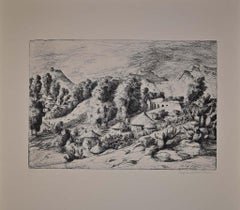
"Windy Hill" Lawrence Beall Smith, Mid-Century Realist Scene, American Life
Located in New York, NY
Lawrence Beall Smith
Windy Hill, 1948
Signed in pencil lower right margin
Lithograph on wove paper
Image 10 3/8 x 13 1/16 inches
Sheet 11 15/16 x 16 inches
From the edition of 250
...
Category
American Realist 1940s Landscape Prints
Materials
Paper, Lithograph
WESTERN GRANDEUR
Located in Santa Monica, CA
HAROLD LUKENS DOOLTTLE (1883 - 1974)
WESTERN GRANDEUR c. 1945
Aquatint, signed titled and dedicated. Image 9 ¾ x 13 5/8 inches. Large full sheet with deckle edges 15 ½ x 19 inches...
Category
American Realist 1940s Landscape Prints
Materials
Aquatint
Elwood W. Bartlett, Water
s Edge (Wisconsin), about 1945, mid-century wood eng.
Located in New York, NY
Elwood Warren Bartlett is a Wisconsin native who also worked in Indiana.
Largely self taught as a printmaker, Bartlett worked in a style that once identified as his, immediately t...
Category
American Modern 1940s Landscape Prints
Materials
Woodcut
Elwood W. Bartlett, Turtle Creek (Wisconsin), about 1945, mid-century wood eng.
Located in New York, NY
Elwood Warren Bartlett is a Wisconsin native who also worked in Indiana. Turtle Creek (named of course for its many turtles,) is in the southeastern part of the Wisconsin. It is now ...
Category
American Modern 1940s Landscape Prints
Materials
Woodcut
Stony Pasture, Romantic Etching by Luigi Lucioni
Located in Long Island City, NY
Luigi Lucioni, American (1900 - 1988) - Stony Pasture, Year: 1943, Medium: Etching, signed in pencil, Image Size: 7.75 x 11 inches, Frame Size: 15.75 x 18.5 inches
Category
Romantic 1940s Landscape Prints
Materials
Etching
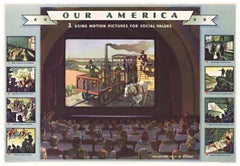
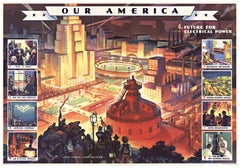
Original Coca Cola "Our America #3 Motion Pictures vintage 1943 poster
Located in Spokane, WA
Original. “OUR AMERICA, #3 USING MOTION PICTURES FOR SOCIAL VALUE.” vintage poster.
Presented by the Coca-Cola Bottling Company. This poster displays the benefits of American Motion Picture making on society as a whole and is number three in the series of Our America, Motion Pictures. From leisure, as in entertainment, to the practical, like legal documentation and recording important events, are displayed in this poster. These benefits are shown in eight small windows along either side of a large ninth window, which is all brought into harmony by the use of green tones, and that the windows are set upon a mint green background. Presenting Facts of History.
Our America Motion Pictures # 3.
Using Motion Pictures for Social Values.
1. Using cartoons for amusement. 2. Reporting an important event. 3. Making biography dramatic. 4. Reporting athletic events. 5. Dramatizing a famous book. 6. Showing places of natural beauty. Y. Using motion pictures in legal cases. 8. Making pictures true to facts.
We Can All Do Our Part!
In 1943, during World War II, Coca-Cola created the “Our America” series of vintage motion picture posters...
Category
American Modern 1940s Landscape Prints
Materials
Offset
$280 Sale Price
20% Off
Alongside
Located in Missouri, MO
Alongside, 1941
Tod Lindenmuth (American, 1885-1976)
Color Woodblock Print
9 x 7 inches
19.75 x 14.5 inches with frame
Signed Lower Right
Titled and Dated Lower Left
A founder of the Provincetown Art Association and one of the original Provincetown Printers, Tod Lindenmuth was a semi-abstract painter and graphic artist who did much to promote modernist styles. Although he was much influenced by Abstract Expressionism, his subject matter was realistic enough to be recognizable. He did linoleum cuts and was one of the first to work with that medium, and towards the end of his life, he experimented with collage. In the 1930s, he had commissions for the Public Works of Art Project and the Works Progress Administration.
Lindenmuth was born in Allentown, Pennsylvania. He studied with Robert Henri at the New York School of Art in Manhattan, and in Provincetown with E. Ambrose Webster and George Elmer Browne.
He first exhibited in Provincetown in 1915, and between 1917 and 1928 served on the jury for the Provincetown Art Association's 'First Modernistic Exhibition". He exhibited regularly with the Society of Independent Artists in New York.
He married artist and illustrator Elizabeth Boardman Warren...
Category
American Modern 1940s Landscape Prints
Materials
Color
Navajo Trading Post
— Southwest Regionalism, American Indian
Located in Myrtle Beach, SC
Ira Moskowitz, 'Navajo Trading Post', lithograph, 1946, edition 30, Czestochowski 161. Signed and dated in the stone, lower left. A fine, richly-inked impression, on cream wove paper, with full margins (1 1/2 to 3 1/8 inches). Pale mat line, otherwise in excellent condition. Matted to museum standards, unframed.
Image size 11 11/16 x 15 1/2 inches (297 x 395 mm); sheet size 16 5/16 x 191/8 inches (414 x 486 mm).
ABOUT THE ARTIST
Ira Moskowitz was born in Galicia, Poland, in 1912, emigrating with his family to New York in 1927. He enrolled at the Art Student's League and studied there from 1928-31. In 1935, Moskowitz traveled to Paris and then lived until 1937 in what is now Israel. He returned to the United States in 1938 to marry artist Anna Barry in New York. The couple soon visited Taos and Santa Fe in New Mexico, returning for extended periods until 1944, when they moved there permanently, staying until 1949. During this especially productive New Mexico period, Moskowitz received a Guggenheim fellowship. His work was inspired by the New Mexico landscape and the state’s three cultures (American Southwest, Native American, and Mexican). He focused on Pueblo and Navajo life, producing an extensive oeuvre of authentic American Indian imagery. He and Anna also visited and sketched across the border in Old Mexico. While in the Southwest, Moskowitz flourished as a printmaker while continuing to produce oils and watercolors. Over 100 of Moskowitz’s works depicting Native American ceremonies were used to illustrate the book American Indian Ceremonial Dances by John Collier, Crown Publishers, New York, 1972.
After leaving the Southwest, printmaking remained an essential medium for the artist while his focus changed to subject matter celebrating Judaic religious life and customs. These works were well received early on, and Moskowitz was content to stay with them the rest of his life. From 1963 until 1966, Moskowitz lived in Paris, returning to New York City in 1967, where he made his permanent home until he died in 2001.
Shortly before his death, Zaplin-Lampert Gallery of Santa Fe staged an exhibition of the artist's works, December 2000 - January 2001. Other one-person shows included the 8th Street Playhouse, New York, 1934; Houston Museum, 1941; and the San Antonio Museum, 1941. The artist’s work was included in exhibitions at the Art Students League, Art Institute of Chicago, Philadelphia Print Club, College Art Association (promotes excellence in scholarship and teaching), and the International Exhibition of Graphic Arts (shown at MOMA, 1955).
Moskowitz’s lithographs of American Indian...
Category
American Modern 1940s Landscape Prints
Materials
Lithograph
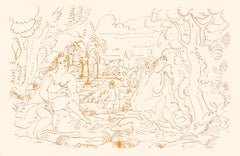
Japanese Pagoda Woodblock Landscape
Located in Douglas Manor, NY
3722 Japanese Woodblock on paper set in a vintage wood frame
Image size 9x10.5"
Category
1940s Landscape Prints
Materials
Ink
Original 1940 Washington
Oregon Pictorial Map vintage poster
Located in Spokane, WA
Map of historical landmarks, American Indian territories, rivers, mountains, dams, colleges, federal grazing districts, cities, agriculture, and other activities that were present in...
Category
American Realist 1940s Landscape Prints
Materials
Offset
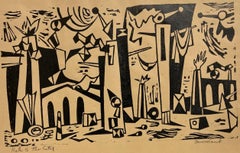
Tobias Musicant, Gates to the City
Located in New York, NY
Any work by Tobias Musicant is terrific. These New Jersey-made, mid-century near abstractions are generally scarce. The pieces I know are master works of American Modernism. Cubist c...
Category
American Modern 1940s Landscape Prints
Materials
Linocut
$1,600 Sale Price
20% Off
Georges Rouault, Acrobat, from Divertissement, 1943
Located in Southampton, NY
This exquisite lithograph by Georges Rouault (1871–1958), titled Acrobate (Acrobat), from the album Georges Rouault, Divertissement, originates from the 1943 edition published by Edi...
Category
Modern 1940s Landscape Prints
Materials
Lithograph
$716 Sale Price
20% Off
Georges Rouault, The Mocking One, from Divertissement, 1943
Located in Southampton, NY
This exquisite lithograph by Georges Rouault (1871–1958), titled Le Moqueur (The Mocking One), from the album Georges Rouault, Divertissement, originates from the 1943 edition publis...
Category
Modern 1940s Landscape Prints
Materials
Lithograph
$716 Sale Price
20% Off
Composition (Cramer 36; Bloch 360; Horodisch A6), Non Vouloir, Pablo Picasso
Located in Southampton, NY
Zincograph on Vélin Bouffant paper. Unsigned and unnumbered, as issued. Good condition. Notes: From the volume, Non Vouloir, 1942. Published by Éditions Jeanne Bucher, Paris; printed...
Category
Cubist 1940s Landscape Prints
Materials
Etching
$1,596 Sale Price
20% Off
Vermont Quarry
, Kansas City Art Institute, New York, Art Students League, WPA
Located in Santa Cruz, CA
Signed lower right, 'Guy Maccoy' (American, 1904-1981), dated 1941 and titled, lower left, 'Vermont Quarry'.
Serigrapher, muralist and teacher, Guy Maccoy began his art studies at the Kansas City Art Institute and continued with Ernest Lawson in Colorado Springs. Upon moving to New York City, he studied at the Art Students League and at Columbia University. In 1932 he began producing silk screen prints in New York City with his wife, Geno Pettit...
Category
1940s Landscape Prints
Materials
Paint, Paper, Screen
Cavendish Church
Located in Middletown, NY
A magnificent impression from the collection of the artist's sister, with a dedication in Arms's hand.
Etching on antique grayish-blue laid paper, 9 1/2 x 5 1/2 inches (242 x 140 mm...
Category
American Modern 1940s Landscape Prints
Materials
Handmade Paper, Etching
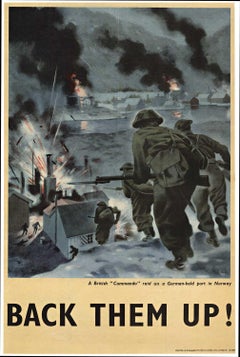
Original "Back Them Up!" vintage British WWII poster
Located in Spokane, WA
Original WWII poster: A British "Commando" raid on a German-held port in Norway. Back Them Up! Linen backed and ready to frame. Printed in England...
Category
American Modern 1940s Landscape Prints
Materials
Lithograph
$1,480 Sale Price
20% Off
THE BURRO STATION - Large Etching with Incredible Detail. One of a Pair
Located in Santa Monica, CA
REYNOLD WEIDENAAR (1915 - 1985)
THE BURRO STATION, 1946, Etching and drypoint on paper, Signed and titled in pencil from an edition of unknown size. Plate: 17" x 13": Sheet: 20.75" x 15.75". One of a pair of large format Mexican etchings...
Category
American Realist 1940s Landscape Prints
Materials
Etching
Georges Rouault, Out of the Depths, from Evening Star, 1947 (after)
Located in Southampton, NY
This exquisite heliogravure after Georges Rouault (1871–1958), titled De Profundis (Out of the Depths), from the album Georges Rouault, Stella Vespertina (Evening Star), originates f...
Category
Modern 1940s Landscape Prints
Materials
Lithograph
$716 Sale Price
20% Off
Edgar Degas, Three Dancers, 1945 (after)
By Edgar Degas
Located in Southampton, NY
This exquisite lithograph after Edgar Degas (1834–1917), titled Trois danseurs (Three Dancers), originates from the 1945 folio Degas, Ten Ballet Sketches. Published by The Studio Publications, Inc., New York, rendered and printed by Albert Carman, City Island, 1945, this work reflects Degas’s sensitive mastery of line, movement, and the intimate psychological nuances of the ballet studio.
Executed as a lithograph and pochoir on velin paper, this work measures 13 x 17 inches (33.02 x 43.18 cm). Signed in the plate and unnumbered as issued. Rendered and printed by Albert Carman, City Island.
Artwork Details:
Artist: After Edgar Degas (1834–1917)
Title: Trois danseurs (Three Dancers), from Degas, Ten Ballet Sketches, 1945
Medium: Lithograph and pochoir on velin paper
Dimensions: 13 x 17 inches (33.02 x 43.18 cm)
Inscription: Signed in the plate and unnumbered as issued
Date: 1945
Publisher: The Studio Publications, Inc., New York
Printer: Albert Carman, City Island
Condition: Well preserved, consistent with age and medium
Provenance: From the 1945 folio Degas, Ten Ballet Sketches, published by The Studio Publications, Inc., New York
Notes:
Excerpted from the album, Born in Paris in 1834, Edgar Degas lived, and surely loved the life of that city during most of his years. These continued somewhat sadly beyond those of most of his friends— into the debacle of the first World War, during which he died in 1917. Judging by the frequency with which he used them as models, he must have had an especial admiration for the ballet girls who followed a profession that at the time brought none of the glory and prosperity which attend it today. New aspects of the human body, revealed in movement, fascinated him. But his occupation with the simply anatomical side of his subjects never resulted in a cold interpretation. On the contrary there is a warmth and sympathy that pervades all of his work. The drawings here represent the painter in one important phase of his multi-sensitive view of life; and permit an insight which a more ambitious work might not do-into the operation of the creative process, the artist's transformation of reality as it passes through the mesh of his sensibilities. The Edition of this Portfolio is limited to MMMD examples. Rendered by Albert Carman.
About the Publication:
Degas, Ten Ballet Sketches (1945) is one of the earliest and most significant American postwar fine art portfolios devoted to Edgar Degas’s intimate works on paper. Published by The Studio Publications, Inc., New York, and rendered and printed by Albert Carman at City Island, the album sought to faithfully reproduce a group of Degas’s ballet-related drawings through a combination of lithography and hand-applied pochoir coloring. This hybrid technique allowed the edition to preserve the immediacy, tonal subtlety, and gestural delicacy central to Degas’s draftsmanship. Conceived as a fine art publication rather than a commercial book, the portfolio provided American audiences unprecedented access to Degas’s private, spontaneous studies—images that reveal the artist’s fascination with movement, anatomy, and the psychological atmosphere of the rehearsal studio. The album exemplifies the mid-20th-century revival of pochoir as a means of recreating the texture and coloristic nuance of original works on paper, and it remains an important document of how Degas’s legacy was translated into high-quality printed form for collectors, museums, and connoisseurs.
About the Artist:
Edgar Degas (1834–1917) was a French painter, draughtsman, printmaker, and sculptor whose groundbreaking fusion of classical draftsmanship, modern experimentation, and psychological depth helped define the trajectory of Western art, positioning him as one of the most influential figures of the nineteenth and early twentieth centuries; renowned for his depictions of ballet dancers, racehorses, theater scenes, cafe life, domestic interiors, milliners, laundresses, and women at their toilette, Degas reimagined observational realism through radical compositional innovation—employing extreme cropping, asymmetrical framing, oblique viewpoints, and dramatic lighting that anticipated photographic and cinematic language long before these technologies shaped visual culture, and although associated with Impressionism, he rejected plein-air spontaneity in favor of studio-based discipline rooted in the linear precision of Jean-Auguste-Dominique Ingres, the expressive chromaticism of Eugene Delacroix, and the modernity of Edouard Manet while also drawing inspiration from Japanese ukiyo-e prints, classical sculpture, and early photography; his independent artistic philosophy resonated with and helped shape the innovations of Pablo Picasso, Alexander Calder, Alberto Giacometti, Salvador Dali, Joan Miro, Wassily Kandinsky, Marcel Duchamp, and Man Ray, whose explorations of movement, form, dream logic, abstraction, and conceptualism all find antecedents in Degas’s investigations into seriality, temporality, and the fragmented figure, and his pioneering use of pastel, monotype, and wax sculpture fundamentally transformed each medium, influencing artists from Henri Matisse, Francis Bacon, Lucian Freud, and Giacomo Manzu to Paula Rego, contemporary realists, experimental photographers, and choreographers; his works are held in nearly every major museum collection worldwide—including the Musee dOrsay, the Louvre, the Metropolitan Museum of Art, the National Gallery of Art, the Art Institute of Chicago, the Courtauld Institute, and the National Gallery, London—affirming his central place in the history of art, and the highest auction record for Degas was achieved at Sothebys London on February 3, 2015, when Danseuses en Bleu sold for 37,033,000 GBP, cementing his status as one of the most sought-after and enduringly significant artists of the Western canon.
Degas pochoir, Degas lithograph...
Category
Impressionist 1940s Landscape Prints
Materials
Lithograph
$796 Sale Price
20% Off
Georges Rouault, Christian Pastoral, from Evening Star, 1947 (after)
Located in Southampton, NY
This exquisite heliogravure after Georges Rouault (1871–1958), titled Pastorale Chretienne (Christian Pastoral), from the album Georges Rouault, Stella Vespertina (Evening Star), ori...
Category
Modern 1940s Landscape Prints
Materials
Lithograph
$716 Sale Price
20% Off
Original "Doing all you can, brother? Buy War Bonds" large format vintage poster
Located in Spokane, WA
Original 1943 Linen-Backed Vintage Poster — “Doing all you can, brother? Buy War Bonds”. In excellent condition, with the best restoration of the original fold lines. You won’t fin...
Category
American Realist 1940s Landscape Prints
Materials
Offset

Original Normandie 1935 cruise line vintage poster
Located in Spokane, WA
Original French Line Normandie horizontal cruise line shipping lithograph. Artist Albert Sebillle with signature in the plate, lower right corner. Arch...
Category
American Realist 1940s Landscape Prints
Materials
Offset
$620 Sale Price
20% Off
Navajo Medicine Ceremony of the Night Chant
— Southwest Regionalism
Located in Myrtle Beach, SC
Ira Moskowitz, 'The Three Gods of Healing (Navajo Medicine Ceremony of the Night Chant)', lithograph, 1945, edition 30, Czestochowski 148. Signed and titled in pencil. Signed and dated in the stone, lower right. A fine, richly-inked impression, on cream wove paper, with full margins (2 1/4 to 2 3/4 inches), in excellent condition. Matted to museum standards, unframed.
Image size 12 1/4 x 15 13/16 inches (311 x 402 mm); sheet size 17 1/8 x 20 7/8 inches (435 x 530 mm).
ABOUT THIS WORK
The nine-night ceremony known as the Night Chant or Nightway is believed to date from around 1000 B.C.E. when it was first performed by the Indians who lived in Canyon de Chelly (now eastern Arizona). It is considered the most sacred of all Navajo ceremonies and one of the most difficult and demanding to learn, as it encompasses hundreds of songs, dozens of prayers, and several highly complex sand paintings. And yet the demand for Night Chants is so great that as many as fifty such ceremonies might be held during a single winter season, which lasts eighteen to twenty weeks.
The Night Chant is designed both to cure people who are ill and to restore the order and balance of human and non-human relationships within the Navajo universe. Led by a trained medicine man who has served a long apprenticeship and learned the intricate and detailed practices that are essential to the chant, the ceremony itself is capable of scaring off sickness and ugliness through techniques that shock or arouse. Once the disorder has been removed, order and balance are restored through song, prayer, sand painting, and other aspects of the ceremony.
The medicine men who supervise the Night Chant ensure that everything—each dot and line in every sand painting, each verse in every song, each feather on each mask is arranged precisely, or it will not bring about the desired result. There are probably as many active Night Chant medicine men today as at any time in Navajo history due to the general increase in the Navajo population, the popularity of the ceremony, and the central role it plays in Navajo life and health.
ABOUT THE ARTIST
Ira Moskowitz was born in Galicia, Poland, in 1912, emigrating with his family to New York in 1927. He enrolled at the Art Student's League and studied there from 1928-31. In 1935, Moskowitz traveled to Paris and then lived until 1937 in what is now Israel. He returned to the United States in 1938 to marry artist Anna Barry in New York. The couple soon visited Taos and Santa Fe in New Mexico, returning for extended periods until 1944, when they moved there permanently, staying until 1949. During this especially productive New Mexico period, Moskowitz received a Guggenheim fellowship. His work was inspired by the New Mexico landscape and the state’s three cultures (American Southwest, Native American, and Mexican). He focused on Pueblo and Navajo life, producing an extensive oeuvre of authentic American Indian imagery. He and Anna also visited and sketched across the border in Old Mexico. While in the Southwest, Moskowitz flourished as a printmaker while continuing to produce oils and watercolors. Over 100 of Moskowitz’s works depicting Native American ceremonies were used to illustrate the book American Indian Ceremonial Dances by John Collier, Crown Publishers, New York, 1972.
After leaving the Southwest, printmaking remained an essential medium for the artist while his focus changed to subject matter celebrating Judaic religious life and customs. These works were well received early on, and Moskowitz was content to stay with them the rest of his life. From 1963 until 1966, Moskowitz lived in Paris, returning to New York City in 1967, where he made his permanent home until he died in 2001.
Shortly before his death, Zaplin-Lampert Gallery of Santa Fe staged an exhibition of the artist's works, December 2000 - January 2001. Other one-person shows included the 8th Street Playhouse, New York, 1934; Houston Museum, 1941; and the San Antonio Museum, 1941. The artist’s work was included in exhibitions at the Art Students League, Art Institute of Chicago, Philadelphia Print Club, College Art Association (promotes excellence in scholarship and teaching), and the International Exhibition of Graphic Arts (shown at MOMA, 1955).
Moskowitz’s lithographs of...
Category
American Modern 1940s Landscape Prints
Materials
Lithograph
Dufza - Paris - Le Pont Neuf - Original Handsigned Etching
Located in Collonge Bellerive, Geneve, CH
Dufza - Paris - Le Pont Neuf - Original Handsigned Etching
Circa 1940
Handsigned in pencil
Dimensions: 20 x 25 cm
Unumbered as issued
Category
Modern 1940s Landscape Prints
Materials
Etching
Henri Matisse, Chromatic Symphony, from Verve, Revue Artistique, 1940
Located in Southampton, NY
This exquisite lithograph by Henri Matisse (1869–1954), titled Symphonie chromatique (Chromatic Symphony), from Verve, Revue Artistique et Litteraire, Vol. II, No. 8, originates from...
Category
Fauvist 1940s Landscape Prints
Materials
Lithograph
$796 Sale Price
20% Off
Composition (Ginestet/Pouillon 65-72), Jacques Villon, Huit lithographies
Located in Southampton, NY
Lithograph on vélin d’Arches paper. Signed in pencil and unnumbered, as issued. Good condition. Notes: From the folio, Jacques Villon, Huit Lithographies Originales, 1962. Published ...
Category
Modern 1940s Landscape Prints
Materials
Lithograph
$5,196 Sale Price
20% Off
"Spring Valley Willows"
Located in Lambertville, NJ
Jim’s of Lambertville Fine Art Gallery is proud to present this piece by Daniel Garber (1880 - 1958).
One of the two most important and, so far, the most valuable of the New Hope School Painters, Daniel Garber was born on April 11, 1880, in North Manchester, Indiana. At the age of seventeen, he studied at the Art Academy of Cincinnati with Vincent Nowottny. Moving to Philadelphia in 1899, he first attended classes at the "Darby School," near Fort Washington; a summer school run by Academy instructors Anshutz and Breckenridge. Later that year, he enrolled at the Pennsylvania Academy of the Fine Arts. His instructors at the Academy included Thomas Anshutz, William Merritt Chase and Cecilia Beaux. There Garber met fellow artist Mary Franklin while she was posing as a model for the portrait class of Hugh Breckenridge. After a two year courtship, Garber married Mary Franklin on June 21, 1901.
In May 1905, Garber was awarded the William Emlen Cresson Scholarship from the Pennsylvania Academy, which enabled him to spend two years for independent studies in England, Italy and France. He painted frequently while in Europe, creating a powerful body of colorful impressionist landscapes depicting various rural villages and farms scenes; exhibiting several of these works in the Paris Salon.
Upon his return, Garber began to teach Life and Antique Drawing classes at the Philadelphia School of Design for Women in 1907. In the summer of that same year, Garber and family settled in Lumbertville, Pennsylvania, a small town just north of New Hope. Their new home would come to be known as the "Cuttalossa," named after the creek which occupied part of the land. The family would divide the year, living six months in Philadelphia at the Green Street townhouse while he taught, and the rest of the time in Lambertville. Soon Garber’s career would take off as he began to receive a multitude of prestigious awards for his masterful Pennsylvania landscapes. During the fall of 1909, he was offered a position to teach at the Pennsylvania Academy as an assistant to Thomas Anshutz. Garber became an important instructor at the Academy, where he taught for forty-one years.
Daniel Garber painted masterful landscapes depicting the Pennsylvania and New Jersey countryside surrounding New Hope. Unlike his contemporary, Edward Redfield, Garber painted with a delicate technique using a thin application of paint. His paintings are filled with color and light projecting a feeling of endless depth. Although Like Redfield, Garber painted large exhibition size canvases with the intent of winning medals, and was extremely successful doing so, he was also very adept at painting small gem like paintings. He was also a fine draftsman creating a relatively large body of works on paper, mostly in charcoal, and a rare few works in pastel. Another of Garber’s many talents was etching. He created a series of approximately fifty different scenes, most of which are run in editions of fifty or less etchings per plate.
Throughout his distinguished career, Daniel Garber was awarded some of the highest honors bestowed upon an American artist. Some of his accolades include the First Hallgarten Prize from the National Academy in 1909, the Bronze Medal at the International Exposition in Buenos Aires in 1910, the Walter Lippincott Prize from the Pennsylvania Academy and the Potter Gold Medal at the Art Institute of Chicago in 1911, the Second Clark Prize and the Silver Medal from the Corcoran Gallery of Art for “Wilderness” in 1912, the Gold Medal from the Panama-Pacific Exposition in San Francisco of 1915, the Second Altman Prize in1915, the Shaw prize in 1916, the First Altman Prize in 1917, the Edward Stotesbury Prize in1918, the Temple Gold Medal, in 1919, the First William A...
Category
American Impressionist 1940s Landscape Prints
Materials
Etching
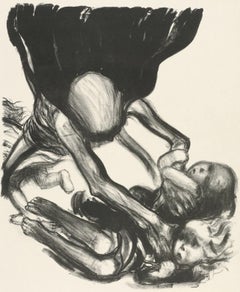
Kollwitz, Death seizes the Children (after)
Located in Southampton, NY
Lithograph on vélin paper. Inscription: Unsigned and unnumbered, as issued. Good condition. Notes: From the folio, Kathe Kollwitz, Ten Lithographs. Published by Henry C. Kleemann and...
Category
Modern 1940s Landscape Prints
Materials
Lithograph
$1,436 Sale Price
20% Off
The Vallery of the Three Moons - Woodcut Print by Luigi Spacal - 1940s
Located in Roma, IT
The Vallery of the Three Moons is an original contemporary artwork realized by Luigi Spacal (Trieste, 1907 - Trieste, 2000) in the 1940s.
Original Black and White woodcut print on c...
Category
1940s Landscape Prints
Materials
Woodcut
Promised Land - Original Lithograph By P. Fazzini and G. Ungaretti - 1945
Located in Roma, IT
Fragments for the promised land is an original modern artwork realized by Pericle Fazzini on a text by Giuseppe Ungaretti
Good conditions except for some folds, foxings and yellowin...
Category
Modern 1940s Landscape Prints
Materials
Lithograph
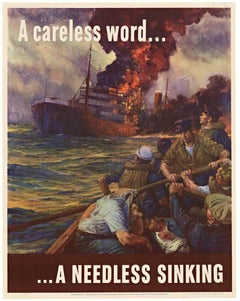
A Careless World ...A Needless Sinking original 1942 vintage World War 2 poster
Located in Spokane, WA
Original vintage World War 2 poster: A Careless Word … A Needless Sinking.
A Careless Word ... A Needless Sinking. Linen backed origin...
Category
American Realist 1940s Landscape Prints
Materials
Offset
Francois Auguste Rene Rodin, Untitled, from The Varende, 1944 (after)
Located in Southampton, NY
This exquisite lithograph after Francois Auguste Rene Rodin (1840–1917), titled Sans titre (Untitled), from the folio La Varende, Rodin (La Varende, Rodin), originates from the 1944 ...
Category
Modern 1940s Landscape Prints
Materials
Lithograph, Stencil
$716 Sale Price
20% Off
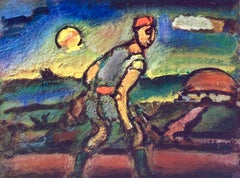
Georges Rouault, Eat Everything, from Divertissement, 1943
Located in Southampton, NY
This exquisite lithograph by Georges Rouault (1871–1958), titled Mange Tout (Eat Everything), from the album Georges Rouault, Divertissement, originates from the 1943 edition publish...
Category
Modern 1940s Landscape Prints
Materials
Lithograph
$716 Sale Price
20% Off
Adolf Dehn, The Artist and The Bull, 1940, self-portrait lithograph, Colorado
By Adolf Dehn
Located in New York, NY
Adolf Dehn, The Artist and The Bull, is from Dehn's period of teaching in Colorado at both the Broadmoor Art Academy and the Colorado Springs Fine Arts Center. In this humous self-p...
Category
American Modern 1940s Landscape Prints
Materials
Lithograph
Henri Matisse, Mask of a Young Boy, from Alternation, 1946
Located in Southampton, NY
This exquisite etching by Henri Matisse (1869–1954), titled Masque de jeune garcon (Mask of a Young Boy), from the album Alternance (Alternation), originates from the 1946 edition pu...
Category
Modern 1940s Landscape Prints
Materials
Engraving
$2,796 Sale Price
20% Off
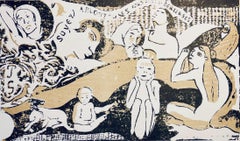
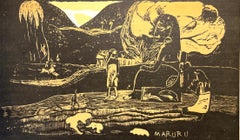
Gauguin, Fragrant, Fragrant (Noa Noa), Gauguin (after)
By Paul Gauguin
Located in Southampton, NY
Woodcut on vélin Utopian paper. Unsigned and unnumbered, as issued. Good Condition. Notes: From the folio, Gauguin, A portfolio of 12 color woodblocks, Paul Gauguin, French, 1848-1903 from the collection of the Museum Of Fine Arts, Boston, 1946. Rendered by Albert Carman (1899-1949); published the Museum Of Fine Arts, Boston and The Studio Publications, Inc., New York and London; printed by Holme Press Inc., New York, in an edition of MMMD. Excerpted from the folio, Paul Gauguin and Emil Bernard at Pont-Aven, Brittany, in 1888, each made a bas-relief, wooden panel to decorate a piece of furniture for a friend. In order to keep a record of their designs, a few inked impressions were made on paper. The illustration at left is a reproduction of a print which is possibly one of the above mentioned. It is further possible that this experiment later gave Gauguin the idea of making woodcuts. Just as his work in painting expressed a revolt against the overemphasis on factual representation of the nineteenth century in favor of decorative pattern and color, so also his woodcuts leaned strongly to the same side of the balance. Ten of the cuts reproduced (all excepting Soyez Amoureuses and Changement de Residence), which constitute the whole of his best known series, were made at Pont-Aven beginning in the fall of 1894, after Gauguin's return from his first trip to Tahiti and after he broke his ankle. They were at first roughly cut with a common carpenter's gouge, and the flat surfaces sandpapered and engraved with a sharp in-strument, perhaps an engraver's burin. A few trial proofs were printed in black ink only. Then the hollows were deepened with a woodcutter's gouge and highlights were added. An edition of thirty to fifty impressions of each subject, with the addition of color blocks (one, two or three), was made by Louis Roy...
Category
Post-Impressionist 1940s Landscape Prints
Materials
Woodcut
$716 Sale Price
20% Off
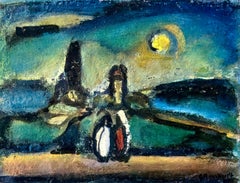
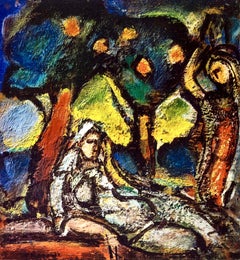
Georges Rouault, Sunset, from Evening Star, 1947 (after)
Located in Southampton, NY
This exquisite heliogravure after Georges Rouault (1871–1958), titled Coucher de soleil (Sunset), from the album Georges Rouault, Stella Vespertina (Evening Star), originates from th...
Category
Modern 1940s Landscape Prints
Materials
Lithograph
$716 Sale Price
20% Off
Taos Pueblo
By Anna Barry
Located in Fairlawn, OH
Taos Pueblo
Screen print in colors, c. 1945
Signed and titled in pencil by the artist
Printed in Taos
Taos is the oldest continually inhabited city/village in North America.
How old ...
Category
American Modern 1940s Landscape Prints
Materials
Screen