Monotype Prints and Multiples

to
199
210
213
215
170
121
Overall Width
to
Overall Height
to
363
275
52
23
19
13
11
8
8
4
3
3
1
93
36
29
24
24
1
342
586
1
3
7
2
2
26
26
18
101
81
534
312
82
150
101
77
77
74
67
50
41
35
33
33
32
29
28
27
24
20
16
16
16
1,317
35,282
19,635
17,692
10,518
138
74
721
186
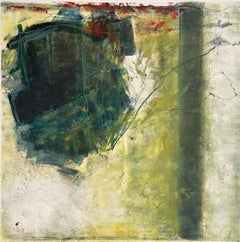
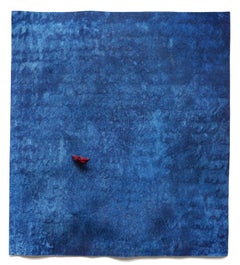
Medium: Monotype
Monotype print and collage on paper: I will meet you there series.
Located in New York, NY
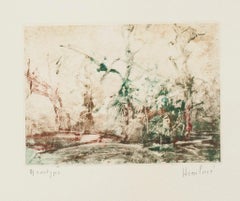
Colors have long been known to have psychological and emotional effects, and in the past months, using the calming color blue has been a therapeutic self-treatment. Blue is the color...
Category

2010s Contemporary Monotype Prints and Multiples

Materials

Paper, Monotype

"The Old Heiau, City of Refuge"
Located in Lyons, CO
The artist has made prints and monotypes at Shark’s since 1981. She has exhibited her work widely and is represented in the collections of The Whitney Museum of American Art, The San...
Category

1990s Contemporary Monotype Prints and Multiples

Materials

Monotype

Summer Rain, by Santa Fe artist Robert Roach
Located in Palm Springs, CA
Unique monotype, signed and numbered 1/1. Artist Robert Roach lived in Santa Fe, New Mexico. His one-of-a-kind, abstract monoprints were inspired by the landscape, climate and ligh...
Category

2010s Abstract Monotype Prints and Multiples

Materials

Monotype

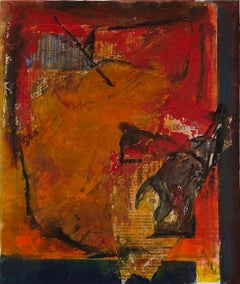
Firestorm, by Robert Roach
Located in Palm Springs, CA
Unique monotype with collage. signed and numbered on the front, titled on verso. Artist Robert Roach lived in Santa Fe, New Mexico. His one-of-a-kind, abstract monoprints are inspi...
Category

2010s Abstract Monotype Prints and Multiples

Materials

Monotype

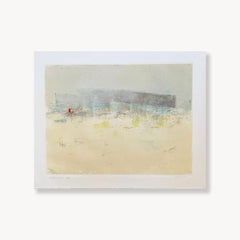
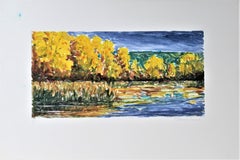
Coulee Waters Edge, Abstract Marshland Landscape Monotype Print, 2024
Located in SEATTLE, WA
This atmospheric landscape monotype print by Kris Ekstrand, depicts shoreline in the Pacific Northwest. Matted and signed by the artist, 1/1 original. Kris' perspective on the natur...
Category

2010s Monotype Prints and Multiples

Materials

Monotype

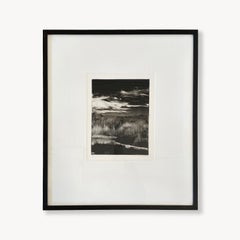
Homeground Suite #11, Wetlands Landscape, Black and White, Framed Montotype, 1/1
Located in SEATTLE, WA
This atmospheric landscape framed monotype print by Kris Ekstrand, depicts marshland, mountains and sky in the Pacific Northwest. Preserved in a custom frame with archival matte, sig...
Category

2010s Monotype Prints and Multiples

Materials

Monotype

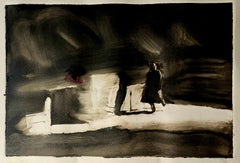
Ghosts of Philadelphia 7, mysterious monochromatic suggestive of narrative
Located in Brooklyn, NY
Monotype Dramatic imagery from Tom Bennett’s series of black and white monotypes, blending surrealistic mindscapes with stark realism About Tom Bennett: With quick brushstrokes, Tom...
Category

2010s Contemporary Monotype Prints and Multiples

Materials

Monotype

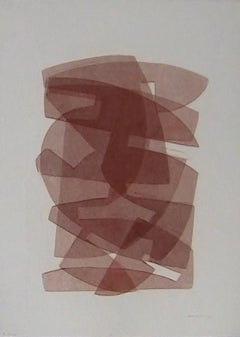
Estate No. 082050
Located in New Orleans, LA
Otto Neumann (1895-1975) was a German Expressionist painter and printmaker. His monotypes evolved from sharp, angular, black and whites to late abstract prints in a variety of colors. Neumann lived through revolutionary changes in the art world of prewar and postwar Germany. He was a prolific artist in Germany during a time of the country’s unprecedented academic and intellectual growth. His early work shows the influence of both French masters like Cezanne and the contemporary style that was then being developed by German Expressionists like Kirchner. A master printmaker, Neumann was also inspired by the works of Albrecht Durer, whose allegorical subject-matter and unmatched drawing technique Neumann would emulate throughout his career. A lifetime preoccupation with the human figure informs his work, with frieze-like human figures recalling ancient Greek art...
Category

1960s Expressionist Monotype Prints and Multiples

Materials

Monotype

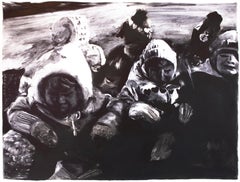
Children, Michele Zalopany black white Christmas holiday winter scene children
Located in New York, NY
Tender, black and white scene of children bundled up in sweaters and hats for snow. Evoking the chilly weather and the spirit of winter holidays, this painterly monotype is ready to ...
Category

1990s Contemporary Monotype Prints and Multiples

Materials

Monotype

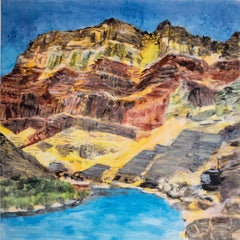
On the Map: Large scale color monotype, Western mountain landscape with blue sky
Located in New York, NY
Large scale color monotype of a Western landscape with sapphire blue sky, green trees, river, yellow and orange hills, and red clay cliffs, to enliven minimalist, modern, and contemp...
Category

1980s Contemporary Monotype Prints and Multiples

Materials

Monotype

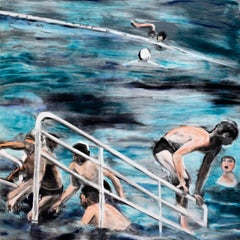
Temptation to Exist: waterscape Monotype painting of swimmers city landscape
Located in New York, NY
Color cityscape and landscape with swimmers bathing with friends in a large sapphire blue pool or body of water. This monotype -- a unique painting in ink -- presents an atmospheric scene of European leisure and sports. Turquoise water contrasts with the swimmer's bodies, painted with shades of peach, with black outlines. Paper 35 x 26 in. / 90 x 66 cm. Monotype on white MBM Ingres d'Arches paper. Signed by the artist, annotated "IIC", and dated 1990 lower right in pencil. This large, multi-color monotype depicts a group of young men swimming...
Category

1990s Contemporary Monotype Prints and Multiples

Materials

Monotype

Monotype: Love Letters
Located in New York, NY
Voyaging among humanity words and thoughts of affection and care which fill the air, leaving traces of love. Can you feel them? Angelica’s multi-layered works are informed by her on...
Category

2010s Contemporary Monotype Prints and Multiples

Materials

Monotype

Removed from Time and Place
By Donna Howell-Sickles
Located in Colorado Springs, CO
Original monotype print signed by the Artist on lower right.
Category

21st Century and Contemporary Contemporary Monotype Prints and Multiples

Materials

Monotype

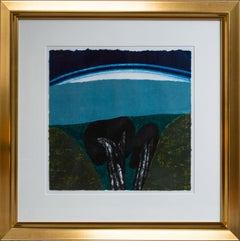
"Arroyo, " Woodcut and Monotype Landscape signed by Carol Summers
Located in Milwaukee, WI
"Arroyo" is a woodcut and monotype signed by Carol Summers. The print is a break from the usual bright coloring of Summers' images, though is rendered in his typical style and fields of unmodeled color. A pair of trees stand front and center before an arroyo, a Spanish term for an intermittently dry creek, running out to the ocean. A white sunrise glows in the distance beyond the sea. The playfulness of the image is enhanced by Summers' signature printmaking technique, which allows the ink from the woodblock to seep through the paper, blurring the edges of each form. 14.25 x 14 inches, artwork Numbered from the edition of 120 This print was commissioned by the Madison Print Club, Madison, WI Carol Summers (1925-2016) worked as an artist throughout the second half of the 20th century and into the first years of the next, outliving most of his mid-century modernist peers. Initially trained as a painter, Summers was drawn to color woodcuts around 1950 and it became his specialty thereafter. Over the years he has developed a process and style that is both innovative and readily recognizable. His art is known for its large scale, saturated fields of bold color, semi-abstract treatment of landscapes from around the world, and a luminescent quality achieved through a printmaking process he invented. In a career that has extended over half a century, Summers has hand-pulled approximately 245 woodcuts in editions that have typically run from 25 to 100 in number. His talent was both inherited and learned. Born in 1925 in Kingston, a small town in upstate New York, Summers was raised in nearby Woodstock with his older sister, Mary. His parents were both artists who had met in art school in St. Louis. During the Great Depression, when Carol was growing up, his father supported the family as a medical illustrator until he could return to painting. His mother was a watercolorist and also quite knowledgeable about the different kinds of papers used for various kinds of painting. Many years later, Summers would paint or print on thinly textured paper originally collected by his mother. From 1948 to 1951, Carol Summers trained in the classical fine and studio arts at Bard College and at the Art Students League of New York. He studied painting with Steven Hirsh and printmaking with Louis Schanker. He admired the shapes and colors favored by early modernists Paul Klee (Sw: 1879-1940) and Matt Phillips (Am: b.1927- ). After graduating, Summers quit working as a part-time carpenter and cabinetmaker (which had supported his schooling and living expenses) to focus fulltime on art. That same year, an early abstract, Bridge No. 1 was selected for a Purchase Prize in a competition sponsored by the Brooklyn Museum. In 1952, his work (Cathedral, Construction, and Icarus) was shown for the first time at the Museum of Modern Art in New York City in an exhibition of American woodcuts. In 1954, Summers received a grant from the Italian government to study for a year in Italy. Woodcuts completed soon after his arrival there were almost all editions of only 8 to 25 prints, small in size, architectural in content, and black and white in color. The most well-known are Siennese Landscape and Little Landscape, which depicted the area near where he resided. Summers extended this trip three more years, a decision that would have a significant impact on choices of subject matter and color in the coming decade. After returning from Europe, Summers’ images continued to feature historical landmarks and events from Italy as well as from France, Spain, and Greece. However, as evidenced in Aetna’s Dream, Worldwind, and Arch of Triumph...
Category

1980s Contemporary Monotype Prints and Multiples

Materials

Monotype, Woodcut

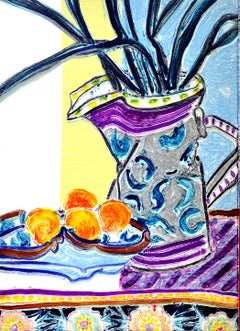
Pitcher and Peaches III
Located in Lyons, CO
Color monotype with collage. Kushner recently completed a series of monotypes, many with collaged decorative papers. He worked from still-lives of flowers, fruits, pitchers and Bett...
Category

2010s Contemporary Monotype Prints and Multiples

Materials

Monotype

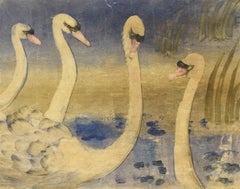
Les cygnes by Georges Manzana Pissarro - Animal themed monotype
Located in London, GB
Les cygnes by Georges Manzana Pissarro (1871-1961) Watercolour monotype 49 x 63 cm (19 ¹/₄ x 24 ³/₄ inches) Signed lower left, manzana Executed circa 1920 Provenance: Private collec...
Category

1920s Art Deco Monotype Prints and Multiples

Materials

Watercolor, Monotype

Landscape #I
Located in San Francisco, CA
This artwork "Landscape #I' c.2000 is an original color monotype by American artist Thomas (Tom) Monaghan, b. 1961. It is hand signed and numbered 1/1 in pencil by the artist. The im...
Category

21st Century and Contemporary American Impressionist Monotype Prints and Multiples

Materials

Monotype

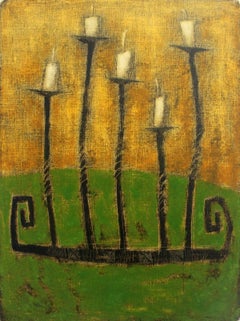
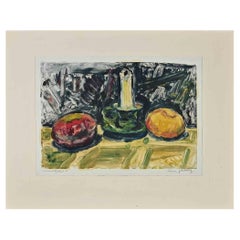
Candlestick - Contemporary Figurative Monotype Print, Warm tones, Still life
Located in Warsaw, PL
Siergiej Timochow, a Belorussian artist, born in 1960. He studied at an art school in Minsk in 1979 before continuing to study at the Fine Arts Academy in Belarus. His acrylic and ...
Category

Early 2000s Contemporary Monotype Prints and Multiples

Materials

Cardboard, Monotype

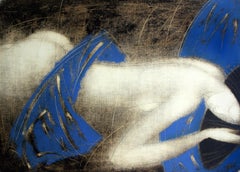
Nude - XXI Century, Contemporary Figurative Monotype Print, Blue grey
Located in Warsaw, PL
Siergiej Timochow, a Belorussian artist, born in 1960. He studied at an art school in Minsk in 1979 before continuing to study at the Fine Arts Academy in Belarus. His acrylic and ...
Category

Early 2000s Contemporary Monotype Prints and Multiples

Materials

Cardboard, Monoprint, Monotype

Nude - XXI Century, Contemporary Figurative Monotype Print, Monochromatic
Located in Warsaw, PL
Siergiej Timochow, a Belorussian artist, born in 1960. He studied at an art school in Minsk in 1979 before continuing to study at the Fine Arts Academy in Belarus. His acrylic and ...
Category

Early 2000s Contemporary Monotype Prints and Multiples

Materials

Cardboard, Monotype

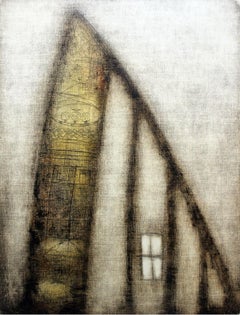
A window - XXI Century, Contemporary Abstract Monotype Print, Monochromatic
Located in Warsaw, PL
Siergiej Timochow, a Belorussian artist, born in 1960. He studied at an art school in Minsk in 1979 before continuing to study at the Fine Arts Academy in Belarus. His acrylic and ...
Category

Early 2000s Contemporary Monotype Prints and Multiples

Materials

Cardboard, Monotype

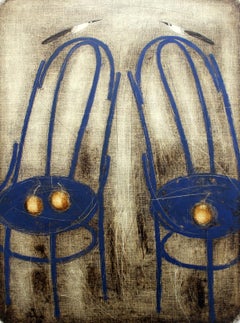
Still life with two chairs - XXI Century, Figurative Monotype Print, Birds
Located in Warsaw, PL
Siergiej Timochow, a Belorussian artist, born in 1960. He studied at an art school in Minsk in 1979 before continuing to study at the Fine Arts Academy in Belarus. His acrylic and ...
Category

Early 2000s Contemporary Monotype Prints and Multiples

Materials

Monotype, Cardboard

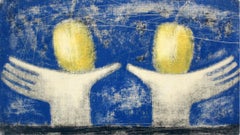
Still life with hands and apples - XXI Century, Figurative Monotype Print
Located in Warsaw, PL
Siergiej Timochow, a Belorussian artist, born in 1960. He studied at an art school in Minsk in 1979 before continuing to study at the Fine Arts Academy in Belarus. His acrylic and ...
Category

Early 2000s Contemporary Monotype Prints and Multiples

Materials

Cardboard, Monotype

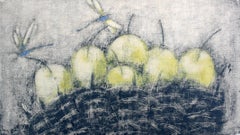
Yellow apples - XXI Century, Contemporary Still life Monotype Print, Figurative
Located in Warsaw, PL
Siergiej Timochow, a Belorussian artist, born in 1960. He studied at an art school in Minsk in 1979 before continuing to study at the Fine Arts Academy in Belarus. His acrylic and ...
Category

Early 2000s Contemporary Monotype Prints and Multiples

Materials

Cardboard, Monotype

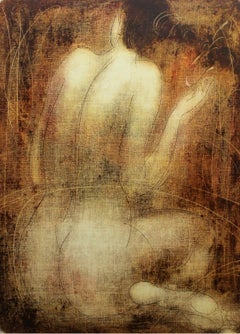
Nude - XXI Century, Contemporary Figurative Monotype Print
Located in Warsaw, PL
Siergiej Timochow, a Belorussian artist, born in 1960. He studied at an art school in Minsk in 1979 before continuing to study at the Fine Arts Academy in Belarus. His acrylic and ...
Category

Early 2000s Contemporary Monotype Prints and Multiples

Materials

Cardboard, Monotype

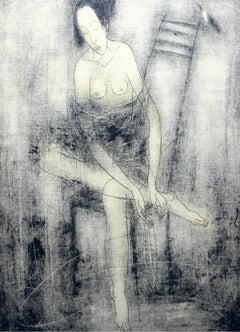
Nude on a chair - XXI Century, Contemporary Figurative Monotype Print
Located in Warsaw, PL
Siergiej Timochow, a Belorussian artist, born in 1960. He studied at an art school in Minsk in 1979 before continuing to study at the Fine Arts Academy in Belarus. His acrylic and ...
Category

Early 2000s Contemporary Monotype Prints and Multiples

Materials

Cardboard, Monotype

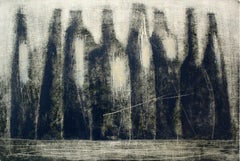
Still life with bottles - XXI Century, Contemporary Monotype Print, Dark colors
Located in Warsaw, PL
Siergiej Timochow, a Belorussian artist, born in 1960. He studied at an art school in Minsk in 1979 before continuing to study at the Fine Arts Academy in Belarus. His acrylic and ...
Category

Early 2000s Contemporary Monotype Prints and Multiples

Materials

Cardboard, Monotype

Aerial V
Located in San Francisco, CA
This artwork, titled "Aerial V" c.1980 is a monotype with chine colle and embossing on heavy paper by noted Canadian artist Janet Jones b.1952. It is hand signed and titled in pencil by the artist. It is numbered “1/1-2”. I believe this indicates the artist did 2 impressions of the monotype, and that they are not identical. There are three levels of paper. The printed part with a plate that measures 8 x 8 inches (9x9 inches the sheet) is on thin Japon paper. It is mounted to another thin pastel colored sheet measuring 12 x 12 inches. This, in turn, is mounted to heavy paper similar to Arches measuring 22.25 x 18 inches It is in very good condition with some faint rippling on the left and right edges, and has never been framed. About the artist: Janet Jones was born in Montreal, Quebec in 1952. She received her BFA in painting and photography from Concordia University - studying painting with Guido Molinari and Yves Gaucher, and photography with the experimental photographer Suzanne Swibold. Janet Jones is currently a Toronto based painter whose work has been exhibited across Canada, in Los Angeles, New York, England, Germany, France and China. Her recent projects include; the solo exhibition, The Dream Machine at Patrick Mikhail Gallery, Montréal (2017), two solo exhibitions, Playtimes (2015) and Joyride (2012) both at Katzman Contemporary Toronto, a national touring exhibition of her paintings, DaDa Delirium, with an accompanying catalogue (2011) with essays by Stuart Reid, Nell Tenhaaf and an interview with the artist by Georgiana Uhlyarik, and participation in the Empire of Dreams exhibition, MOCCA (Summer 2010) curated by David Liss. Jones has been a visiting artist in France, England, Russia, China, the Netherlands, and Cuba. Jones received her MFA from York University and her PhD from New York University in the area of art theory and criticism. Her dissertation titled: Clement Greenberg and the Artist /Critic Relationship, included interviews with Clement Greenberg, Jules Olitski, and other members of the ‘Greenberg Group’ and research gained through accompanying Greenberg on numerous studio visits. A Professor in the Department of Visual Arts, York University, Toronto, where she teaches painting, she has been Chair of the Department of Visual Arts and Director of the MFA Program in Visual Arts. Professor of Painting, Department of Visual Arts and Art History, AMPD, York University. EDUCATION 1988 Ph.D. New York University, New York, NY. Dissertation Title: Clement Greenberg & the Artist/Critic Relationship. 1979 M.F.A. York University, Toronto, Ontario. Samuel Sarick Award 1977 B.F.A. Honours, with Distinction, Concordia University SOLO EXHIBITIONS 2017 The Dream Machine, Patrick Mikhail Gallery, Montréal, Quebec, October - December, 2017 2016 Recent Acquisitions from DaDa Delirium, MacLaren Art Gallery, Barrie, ON. March – July 2015 Playtimes, Katzman Contemporary, Toronto, March-April 2015. 2013 DaDa Delirium, MacIntosh Gallery, University of Western ON. 2012 Joy Ride, Katzman Kamen Gallery, Toronto, ON September, 2012. 2012 DaDa Delirium, Art Gallery of Northumberland, Coburg, ON, April-May 2010 DaDa Delirium, MacLaren Art Centre, Barrie, ON. 2009 A Las Vegas State of Mind, Peak Gallery, Toronto, ON. 2009 DaDa Delirium, Curated by Stuart Reid, Tom Thompson Art...
Category

Late 20th Century Modern Monotype Prints and Multiples

Materials

Mixed Media, Monotype

Aerial IV
Located in San Francisco, CA
This artwork, titled "Aerial IV" c.1980 is a monotype with chine colle and embossing on heavy paper by noted Canadian artist Janet Jones b.1952. It is hand signed and titled in pencil by the artist. It is numbered “1/1-20”. I believe this indicates the artist did 20 impressions of the monotype, and that no two are alike. There are three levels of paper. The printed part with a plate that measures 8 x 8 inches (9x9 inches the sheet) is on thin Japon paper. It is mounted to another thin pastel colored sheet measuring 12 x 12 inches. This, in turn, is mounted to heavy paper similar to Arches measuring 22.25 x 18 inches It is in very good condition with some faint rippling on the left and right edges, and has never been framed. About the artist: Janet Jones was born in Montreal, Quebec in 1952. She received her BFA in painting and photography from Concordia University - studying painting with Guido Molinari and Yves Gaucher, and photography with the experimental photographer Suzanne Swibold. Janet Jones is currently a Toronto based painter whose work has been exhibited across Canada, in Los Angeles, New York, England, Germany, France and China. Her recent projects include; the solo exhibition, The Dream Machine at Patrick Mikhail Gallery, Montréal (2017), two solo exhibitions, Playtimes (2015) and Joyride (2012) both at Katzman Contemporary Toronto, a national touring exhibition of her paintings, DaDa Delirium, with an accompanying catalogue (2011) with essays by Stuart Reid, Nell Tenhaaf and an interview with the artist by Georgiana Uhlyarik, and participation in the Empire of Dreams exhibition, MOCCA (Summer 2010) curated by David Liss. Jones has been a visiting artist in France, England, Russia, China, the Netherlands, and Cuba. Jones received her MFA from York University and her PhD from New York University in the area of art theory and criticism. Her dissertation titled: Clement Greenberg and the Artist /Critic Relationship, included interviews with Clement Greenberg, Jules Olitski, and other members of the ‘Greenberg Group’ and research gained through accompanying Greenberg on numerous studio visits. A Professor in the Department of Visual Arts, York University, Toronto, where she teaches painting, she has been Chair of the Department of Visual Arts and Director of the MFA Program in Visual Arts. Professor of Painting, Department of Visual Arts and Art History, AMPD, York University. EDUCATION 1988 Ph.D. New York University, New York, NY. Dissertation Title: Clement Greenberg & the Artist/Critic Relationship. 1979 M.F.A. York University, Toronto, Ontario. Samuel Sarick Award 1977 B.F.A. Honours, with Distinction, Concordia University SOLO EXHIBITIONS 2017 The Dream Machine, Patrick Mikhail Gallery, Montréal, Quebec, October - December, 2017 2016 Recent Acquisitions from DaDa Delirium, MacLaren Art Gallery, Barrie, ON. March – July 2015 Playtimes, Katzman Contemporary, Toronto, March-April 2015. 2013 DaDa Delirium, MacIntosh Gallery, University of Western ON. 2012 Joy Ride, Katzman Kamen Gallery, Toronto, ON September, 2012. 2012 DaDa Delirium, Art Gallery of Northumberland, Coburg, ON, April-May 2010 DaDa Delirium, MacLaren Art Centre, Barrie, ON. 2009 A Las Vegas State of Mind, Peak Gallery, Toronto, ON. 2009 DaDa Delirium, Curated by Stuart Reid, Tom Thompson Art...
Category

Late 20th Century Modern Monotype Prints and Multiples

Materials

Mixed Media, Monotype

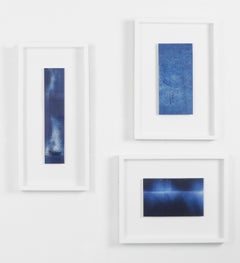
Narcissus Braziliana original woodcut monotype signed by Carol Summers
Located in Milwaukee, WI
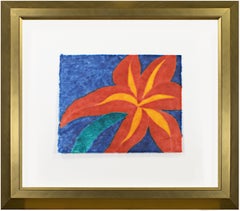
The present artwork is a vibrant and colorful example of the woodcut prints of Carol Summers. The image is dominated by the form of a red tropical flower, closely cropped around the petals like in the photographs of Imogen Cunningham and the paintings of Georgia O'Keeffe. The playfulness of the image is enhanced by Summers' signature printmaking technique, which allows the ink from the woodblock to seep through the paper, blurring the edges of each form. 9.63 x 11.63 inches, artwork 21 x 23 inches, frame Edition 16/50 in pencil, lower right Titled in pencil, lower right Signed in pencil, lower center Framed to conservation standards using archival materials including 100 percent rag matting, Museum Glass to inhibit fading, and housed in a modern profile gold gilded wood moulding. Carol Summers (1925-2016) has worked as an artist throughout the second half of the 20th century and into the first years of the next, outliving most of his mid-century modernist peers. Initially trained as a painter, Summers was drawn to color woodcuts around 1950 and it became his specialty thereafter. Over the years he has developed a process and style that is both innovative and readily recognizable. His art is known for it’s large scale, saturated fields of bold color, semi-abstract treatment of landscapes from around the world and a luminescent quality achieved through a printmaking process he invented. In a career that has extended over half a century, Summers has hand-pulled approximately 245 woodcuts in editions that have typically run from 25 to 100 in number. His talent was both inherited and learned. Born in 1925 in Kingston, a small town in upstate New York, Summers was raised in nearby Woodstock with his older sister, Mary. His parents were both artists who had met in art school in St. Louis. During the Great Depression, when Carol was growing up, his father supported the family as a medical illustrator until he could return to painting. His mother was a watercolorist and also quite knowledgeable about the different kinds of papers used for various kinds of painting. Many years later, Summers would paint or print on thinly textured paper originally collected by his mother. From 1948 to 1951, Carol Summers trained in the classical fine and studio arts at Bard College and at the Art Students League of New York. He studied painting with Steven Hirsh and printmaking with Louis Schanker. He admired the shapes and colors favored by early modernists Paul Klee (Sw: 1879-1940) and Matt Phillips (Am: b.1927- ). After graduating, Summers quit working as a part-time carpenter and cabinetmaker (which had supported his schooling and living expenses) to focus fulltime on art. That same year, an early abstract, Bridge No. 1 was selected for a Purchase Prize in a competition sponsored by the Brooklyn Museum. In 1952, his work (Cathedral, Construction and Icarus) was shown the first time at the Museum of Modern Art in New York City in an exhibition of American woodcuts. In 1954, Summers received a grant from the Italian government to study for a year in Italy. Woodcuts completed soon after his arrival there were almost all editions of only 8 to 25 prints, small in size, architectural in content and black and white in color. The most well-known are Siennese Landscape and Little Landscape, which depicted the area near where he resided. Summers extended this trip three more years, a decision which would have significant impact on choices of subject matter and color in the coming decade. After returning from Europe, Summers’ images continued to feature historical landmarks and events from Italy as well as from France, Spain and Greece. However, as evidenced in Aetna’s Dream, Worldwind and Arch of Triumph, a new look prevailed. These woodcuts were larger in size and in color. Some incorporated metal leaf in the creation of a collage and Summers even experimented with silkscreening. Editions were now between 20 and 50 prints in number. Most importantly, Summers employed his rubbing technique for the first time in the creation of Fantastic Garden in late 1957. Dark Vision of Xerxes, a benchmark for Summers, was the first woodcut where Summers experimented using mineral spirits as part of his printmaking process. A Fulbright Grant as well as Fellowships from the Louis Comfort Tiffany Foundation and the Guggenheim Foundation followed soon thereafter, as did faculty positions at colleges and universities primarily in New York and Pennsylvania. During this period he married a dancer named Elaine Smithers with whom he had one son, Kyle. Around this same time, along with fellow artist Leonard Baskin, Summers pioneered what is now referred to as the “monumental” woodcut. This term was coined in the early 1960s to denote woodcuts that were dramatically bigger than those previously created in earlier years, ones that were limited in size mostly by the size of small hand-presses. While Baskin chose figurative subject matter, serious in nature and rendered with thick, striated lines, Summers rendered much less somber images preferring to emphasize shape and color; his subject matter approached abstraction but was always firmly rooted in the landscape. In addition to working in this new, larger scale, Summers simultaneously refined a printmaking process which would eventually be called the “Carol Summers Method” or the “ Carol Summers Technique”. Summers produces his woodcuts by hand, usually from one or more blocks of quarter-inch pine, using oil-based printing inks and porous mulberry papers. His woodcuts reveal a sensitivity to wood especially its absorptive qualities and the subtleties of the grain. In several of his woodcuts throughout his career he has used the undulating, grainy patterns of a large wood plank to portray a flowing river or tumbling waterfall. The best examples of this are Dream, done in 1965 and the later Flash Flood Escalante, in 2003. In the majority of his woodcuts, Summers makes the blocks slightly larger than the paper so the image and color will bleed off the edge. Before printing, he centers a dry sheet of paper over the top of the cut wood block or blocks, securing it with giant clips. Then he rolls the ink directly on the front of the sheet of paper and pressing down onto the dry wood block or reassembled group of blocks. Summers is technically very proficient; the inks are thoroughly saturated onto the surface of the paper but they do not run into each other. The precision of the color inking in Constantine’s Dream in 1969 and Rainbow Glacier in 1970 has been referred to in various studio handbooks. Summers refers to his own printing technique as “rubbing”. In traditional woodcut printing, including the Japanese method, the ink is applied directly onto the block. However, by following his own method, Summers has avoided the mirror-reversed image of a conventional print and it has given him the control over the precise amount of ink that he wants on the paper. After the ink is applied to the front of the paper, Summers sprays it with mineral spirits, which act as a thinning agent. The absorptive fibers of the paper draw the thinned ink away from the surface softening the shapes and diffusing and muting the colors. This produces a unique glow that is a hallmark of the Summers printmaking technique. Unlike the works of other color field artists or modernists of the time, this new technique made Summers’ extreme simplification and flat color areas anything but hard-edged or coldly impersonal. By the 1960s, Summers had developed a personal way of coloring and printing and was not afraid of hard work, doing the cutting, inking and pulling himself. In 1964, at the age of 38, Summers’ work was exhibited for a second time at the Museum of Modern Art. This time his work was featured in a one-man show and then as one of MoMA’s two-year traveling exhibitions which toured throughout the United States. In subsequent years, Summers’ works would be exhibited and acquired for the permanent collections of multiple museums throughout the United States, Europe and Asia. Summers’ familiarity with landscapes throughout the world is firsthand. As a navigator-bombardier in the Marines in World War II, he toured the South Pacific and Asia. Following college, travel in Europe and subsequent teaching positions, in 1972, after 47 years on the East Coast, Carol Summers moved permanently to Bonny Doon in the Santa Cruz Mountains in Northern California. There met his second wife, Joan Ward Toth, a textile artist who died in 1998; and it was here his second son, Ethan was born. During the years that followed this relocation, Summers’ choice of subject matter became more diverse although it retained the positive, mostly life-affirming quality that had existed from the beginning. Images now included moons, comets, both sunny and starry skies, hearts and flowers, all of which, in one way or another, remained tied to the landscape. In the 1980s, from his home and studio in the Santa Cruz mountains, Summers continued to work as an artist supplementing his income by conducting classes and workshops at universities in California and Oregon as well as throughout the Mid and Southwest. He also traveled extensively during this period hiking and camping, often for weeks at a time, throughout the western United States and Canada. Throughout the decade it was not unusual for Summers to backpack alone or with a fellow artist into mountains or back country for six weeks or more at a time. Not surprisingly, the artwork created during this period rarely departed from images of the land, sea and sky. Summers rendered these landscapes in a more representational style than before, however he always kept them somewhat abstract by mixing geometric shapes with organic shapes, irregular in outline. Some of his most critically acknowledged work was created during this period including First Rain, 1985 and The Rolling Sea, 1989. Summers received an honorary doctorate from his alma mater, Bard College in 1979 and was selected by the United States Information Agency to spend a year conducting painting and printmaking workshops at universities throughout India. Since that original sabbatical, he has returned every year, spending four to eight weeks traveling throughout that country. In the 1990s, interspersed with these journeys to India have been additional treks to the back roads and high country areas of Mexico, Central America, Nepal, China and Japan. Travel to these exotic and faraway places had a profound influence on Summers’ art. Subject matter became more worldly and non-western as with From Humla to Dolpo, 1991 or A Former Life of Budha, 1996, for example. Architectural images, such as The Pillars of Hercules, 1990 or The Raja’s Aviary, 1992 became more common. Still life images made a reappearance with Jungle Bouquet in 1997. This was also a period when Summers began using odd-sized paper to further the impact of an image. The 1996 Night, a view of the earth and horizon as it might be seen by an astronaut, is over six feet long and only slightly more than a foot-and-a-half high. From 1999, Revuelta A Vida (Spanish for “Return to Life”) is pie-shaped and covers nearly 18 cubic feet. It was also at this juncture that Summers began to experiment with a somewhat different palette although he retained his love of saturated colors. The 2003 Far Side of Time is a superb example of the new direction taken by this colorist. At the turn of the millennium in 1999, “Carol Summers Woodcuts...
Category

Early 2000s Contemporary Monotype Prints and Multiples

Materials

Monotype, Woodcut

Untitled
Located in San Francisco, CA
This artwork "Untitled" is a monotype on paper by noted artist Tracey Adams, born 1954. It is hand signed and dated 98 in pencil at the lower right corner by the artist. The image si...
Category

Late 20th Century Abstract Expressionist Monotype Prints and Multiples

Materials

Monotype

Ghosts of New York 5, mysterious, monochromatic cityscape
Located in Brooklyn, NY
One of a series of oil based monotypes on fine printmaking paper, subtle color design, symbolic and atmospheric figure/figures in cityscape
Category

2010s Expressionist Monotype Prints and Multiples

Materials

Monotype, Archival Paper

Untitled, 1981, Sam Francis Monotype
Located in Los Angeles, CA
Untitled, 1981, unique embossed monotype print on handmade paper. Created at the Institute of Experimental Printmaking by lauded American artist, Sam Francis (1923-1994). The Sam Fra...
Category

1980s Monotype Prints and Multiples

Materials

Ink, Oil, Watercolor, Handmade Paper, Pigment, Monotype

Abstract Monotype - Inside XV
Located in San Francisco, CA
This beautiful monotype by Kirsten Stolle (1967-) is a simple, yet elegant composition with beautiful, harmonious colors. There is a wonderful warmth and richness to the surface; var...
Category

Early 2000s Abstract Monotype Prints and Multiples

Materials

Monotype

Abstract Monotype - Elipse VI
Located in San Francisco, CA
This beautiful monotype by Kirsten Stolle (1967-) is a simple, yet elegant composition with beautiful, harmonious colors. There is a wonderful warmth and richness to the surface; var...
Category

Early 2000s Abstract Monotype Prints and Multiples

Materials

Monotype

Abstract Monotype - Elipse III
Located in San Francisco, CA
This beautiful monotype by Kirsten Stolle (1967-) is a simple, yet elegant composition with beautiful, harmonious colors. There is a wonderful warmth and richness to the surface; var...
Category

Early 2000s Abstract Monotype Prints and Multiples

Materials

Monotype

Untitled V
Located in San Francisco, CA
This artwork "Untitled V" is a monotype on paper by noted artist Tracey Adams, born 1954. It is hand signed, dated 1995 in pencil at the lower right corner by the artist and numbered...
Category

Late 20th Century Abstract Expressionist Monotype Prints and Multiples

Materials

Monotype

Untitled #7
Located in San Francisco, CA
Artist: Richard Attilio Moquin (American, born 1934) Title: Untitled #7 Year: 1992 Medium: Monotype Paper: B.F.K Rives Image size: 13.75 x 9.75 inches paper size: 22 x 1...
Category

Late 20th Century Abstract Monotype Prints and Multiples

Materials

Monotype

Untitled #4
Located in San Francisco, CA
Artist: Richard Attilio Moquin (American, born 1934) Title: Untitled #4 Year: 1992 Medium: Monotype Paper: B.F.K Rives Image size: 13.75 x 9.75 inches paper size: 20.5 x...
Category

Late 20th Century Abstract Monotype Prints and Multiples

Materials

Monotype

Untitled #2
Located in San Francisco, CA
Artist: Richard Attilio Moquin (American, born 1934) Title: Untitled #2 Year: 1992 Medium: Monotype Paper: B.F.K Rives Image size: 13.75 x 9.75 inches paper size: 20.5 x...
Category

Late 20th Century Abstract Monotype Prints and Multiples

Materials

Monotype

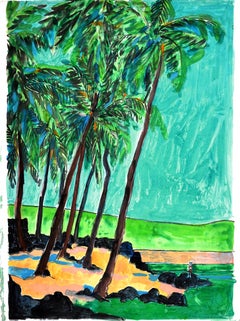
"Paricutin (Volcano in Michoacan, Mexico)" Woodcut Monotype signed by Summers
Located in Milwaukee, WI
"Paricutin (Volcano in Michoacan, Mexico)" is a woodcut and monotype signed by Carol Summers. In the image, an abstracted volcano erupts in a joyous burst of purples and oranges. The playfulness of the image is enhanced by Summers' signature printmaking technique, which allows the ink from the woodblock to seep through the paper, blurring the edges of each form. Art: 8 x 11 in Frame: 17 x 19 in Carol Summers (1925-2016) has worked as an artist throughout the second half of the 20th century and into the first years of the next, outliving most of his mid-century modernist peers. Initially trained as a painter, Summers was drawn to color woodcuts around 1950 and it became his specialty thereafter. Over the years he has developed a process and style that is both innovative and readily recognizable. His art is known for it’s large scale, saturated fields of bold color, semi-abstract treatment of landscapes from around the world and a luminescent quality achieved through a printmaking process he invented. In a career that has extended over half a century, Summers has hand-pulled approximately 245 woodcuts in editions that have typically run from 25 to 100 in number. His talent was both inherited and learned. Born in 1925 in Kingston, a small town in upstate New York, Summers was raised in nearby Woodstock with his older sister, Mary. His parents were both artists who had met in art school in St. Louis. During the Great Depression, when Carol was growing up, his father supported the family as a medical illustrator until he could return to painting. His mother was a watercolorist and also quite knowledgeable about the different kinds of papers used for various kinds of painting. Many years later, Summers would paint or print on thinly textured paper originally collected by his mother. From 1948 to 1951, Carol Summers trained in the classical fine and studio arts at Bard College and at the Art Students League of New York. He studied painting with Steven Hirsh and printmaking with Louis Schanker. He admired the shapes and colors favored by early modernists Paul Klee (Sw: 1879-1940) and Matt Phillips (Am: b.1927- ). After graduating, Summers quit working as a part-time carpenter and cabinetmaker (which had supported his schooling and living expenses) to focus fulltime on art. That same year, an early abstract, Bridge No. 1 was selected for a Purchase Prize in a competition sponsored by the Brooklyn Museum. In 1952, his work (Cathedral, Construction and Icarus) was shown the first time at the Museum of Modern Art in New York City in an exhibition of American woodcuts. In 1954, Summers received a grant from the Italian government to study for a year in Italy. Woodcuts completed soon after his arrival there were almost all editions of only 8 to 25 prints, small in size, architectural in content and black and white in color. The most well-known are Siennese Landscape and Little Landscape, which depicted the area near where he resided. Summers extended this trip three more years, a decision which would have significant impact on choices of subject matter and color in the coming decade. After returning from Europe, Summers’ images continued to feature historical landmarks and events from Italy as well as from France, Spain and Greece. However, as evidenced in Aetna’s Dream, Worldwind and Arch of Triumph, a new look prevailed. These woodcuts were larger in size and in color. Some incorporated metal leaf in the creation of a collage and Summers even experimented with silkscreening. Editions were now between 20 and 50 prints in number. Most importantly, Summers employed his rubbing technique for the first time in the creation of Fantastic Garden in late 1957. Dark Vision of Xerxes, a benchmark for Summers, was the first woodcut where Summers experimented using mineral spirits as part of his printmaking process. A Fulbright Grant as well as Fellowships from the Louis Comfort Tiffany Foundation and the Guggenheim Foundation followed soon thereafter, as did faculty positions at colleges and universities primarily in New York and Pennsylvania. During this period he married a dancer named Elaine Smithers with whom he had one son, Kyle. Around this same time, along with fellow artist Leonard Baskin, Summers pioneered what is now referred to as the “monumental” woodcut. This term was coined in the early 1960s to denote woodcuts that were dramatically bigger than those previously created in earlier years, ones that were limited in size mostly by the size of small hand-presses. While Baskin chose figurative subject matter, serious in nature and rendered with thick, striated lines, Summers rendered much less somber images preferring to emphasize shape and color; his subject matter approached abstraction but was always firmly rooted in the landscape. In addition to working in this new, larger scale, Summers simultaneously refined a printmaking process which would eventually be called the “Carol Summers Method” or the “ Carol Summers Technique”. Summers produces his woodcuts by hand, usually from one or more blocks of quarter-inch pine, using oil-based printing inks and porous mulberry papers. His woodcuts reveal a sensitivity to wood especially its absorptive qualities and the subtleties of the grain. In several of his woodcuts throughout his career he has used the undulating, grainy patterns of a large wood plank to portray a flowing river or tumbling waterfall. The best examples of this are Dream, done in 1965 and the later Flash Flood Escalante, in 2003. In the majority of his woodcuts, Summers makes the blocks slightly larger than the paper so the image and color will bleed off the edge. Before printing, he centers a dry sheet of paper over the top of the cut wood block or blocks, securing it with giant clips. Then he rolls the ink directly on the front of the sheet of paper and pressing down onto the dry wood block or reassembled group of blocks. Summers is technically very proficient; the inks are thoroughly saturated onto the surface of the paper but they do not run into each other. The precision of the color inking in Constantine’s Dream in 1969 and Rainbow Glacier in 1970 has been referred to in various studio handbooks. Summers refers to his own printing technique as “rubbing”. In traditional woodcut printing, including the Japanese method, the ink is applied directly onto the block. However, by following his own method, Summers has avoided the mirror-reversed image of a conventional print and it has given him the control over the precise amount of ink that he wants on the paper. After the ink is applied to the front of the paper, Summers sprays it with mineral spirits, which act as a thinning agent. The absorptive fibers of the paper draw the thinned ink away from the surface softening the shapes and diffusing and muting the colors. This produces a unique glow that is a hallmark of the Summers printmaking technique. Unlike the works of other color field artists or modernists of the time, this new technique made Summers’ extreme simplification and flat color areas anything but hard-edged or coldly impersonal. By the 1960s, Summers had developed a personal way of coloring and printing and was not afraid of hard work, doing the cutting, inking and pulling himself. In 1964, at the age of 38, Summers’ work was exhibited for a second time at the Museum of Modern Art. This time his work was featured in a one-man show and then as one of MoMA’s two-year traveling exhibitions which toured throughout the United States. In subsequent years, Summers’ works would be exhibited and acquired for the permanent collections of multiple museums throughout the United States, Europe and Asia. Summers’ familiarity with landscapes throughout the world is firsthand. As a navigator-bombardier in the Marines in World War II, he toured the South Pacific and Asia. Following college, travel in Europe and subsequent teaching positions, in 1972, after 47 years on the East Coast, Carol Summers moved permanently to Bonny Doon in the Santa Cruz Mountains in Northern California. There met his second wife, Joan Ward Toth, a textile artist who died in 1998; and it was here his second son, Ethan was born. During the years that followed this relocation, Summers’ choice of subject matter became more diverse although it retained the positive, mostly life-affirming quality that had existed from the beginning. Images now included moons, comets, both sunny and starry skies, hearts and flowers, all of which, in one way or another, remained tied to the landscape. In the 1980s, from his home and studio in the Santa Cruz mountains, Summers continued to work as an artist supplementing his income by conducting classes and workshops at universities in California and Oregon as well as throughout the Mid and Southwest. He also traveled extensively during this period hiking and camping, often for weeks at a time, throughout the western United States and Canada. Throughout the decade it was not unusual for Summers to backpack alone or with a fellow artist into mountains or back country for six weeks or more at a time. Not surprisingly, the artwork created during this period rarely departed from images of the land, sea and sky. Summers rendered these landscapes in a more representational style than before, however he always kept them somewhat abstract by mixing geometric shapes with organic shapes, irregular in outline. Some of his most critically acknowledged work was created during this period including First Rain, 1985 and The Rolling Sea, 1989. Summers received an honorary doctorate from his alma mater, Bard College in 1979 and was selected by the United States Information Agency to spend a year conducting painting and printmaking workshops at universities throughout India. Since that original sabbatical, he has returned every year, spending four to eight weeks traveling throughout that country. In the 1990s, interspersed with these journeys to India have been additional treks to the back roads and high country areas of Mexico, Central America, Nepal, China and Japan. Travel to these exotic and faraway places had a profound influence on Summers’ art. Subject matter became more worldly and non-western as with From Humla to Dolpo, 1991 or A Former Life of Budha, 1996, for example. Architectural images, such as The Pillars of Hercules, 1990 or The Raja’s Aviary, 1992 became more common. Still life images made a reappearance with Jungle Bouquet in 1997. This was also a period when Summers began using odd-sized paper to further the impact of an image. The 1996 Night, a view of the earth and horizon as it might be seen by an astronaut, is over six feet long and only slightly more than a foot-and-a-half high. From 1999, Revuelta A Vida (Spanish for “Return to Life”) is pie-shaped and covers nearly 18 cubic feet. It was also at this juncture that Summers began to experiment with a somewhat different palette although he retained his love of saturated colors. The 2003 Far Side of Time is a superb example of the new direction taken by this colorist. At the turn of the millennium in 1999, “Carol Summers Woodcuts...
Category

Early 2000s Contemporary Monotype Prints and Multiples

Materials

Monotype, Woodcut

Chinese Pleasures III
Located in Lyons, CO
Color monotype Since 1985, Woodman has collaborated with Master printer Bud Shark to produce monotypes, woodcuts and lithographs with the same inventiveness and exuberance of her ...
Category

Early 2000s Contemporary Monotype Prints and Multiples

Materials

Monotype

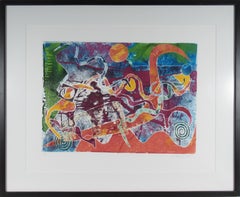
Approaching Slains Castle #8, black/white monotype, architecture ruin
Located in Brooklyn, NY
Monotype Ms. Murray is notable for capturing the crystalline quality of northern light. She has an extensive exhibition history and she is represented in both private and public co...
Category

2010s Photorealist Monotype Prints and Multiples

Materials

Monotype, Archival Ink, Archival Paper

The Awakening, abstract monotype, earth tones
Located in Brooklyn, NY
Statement-The emphasis in the work is on color ,motion and emotion. I make paintings that are inspired by aspects of life thus transforming color and movement into their own visual ...
Category

Early 2000s Abstract Expressionist Monotype Prints and Multiples

Materials

Archival Ink, Archival Paper, Monotype

Pink Plumeria IV
Located in Lyons, CO
Color monotype with collaged antique paper. Robert Kushner is a painter and a sculptor. He gained attention in the early seventies as a performance ar...
Category

2010s Contemporary Monotype Prints and Multiples

Materials

Monotype

Still Life With Glove - Monotype by Simon Goldberg - Mid-20th Century
Located in Roma, IT
Still Life With Glove is a Monotype print realized by Simon Goldberg (1916-2002). Good condition on a yellowed paper, included a cardboard passpartout ...
Category

Mid-20th Century Modern Monotype Prints and Multiples

Materials

Monotype

Fließen 8
Located in Wien, 9
Barbara Szüts was born in Bad Bleiberg in Carinthia (AUSTRIA) in 1952. She studied painting with Carl Unger at the University of Applied Arts in Vienna from 1974 to 1980. From 1986 ...
Category

2010s Contemporary Monotype Prints and Multiples

Materials

Varnish, Pencil, Monotype

Still Life - Original Monotype by Simon Goldberg - Mid-20th Century
Located in Roma, IT
Still Life is an Original Monotype realized by Simon Goldberg (1916-2002). Good condition on a yellowed paper, included a cardboard passpartout (31x39 ...
Category

Mid-20th Century Modern Monotype Prints and Multiples

Materials

Monotype

Night Walk, abstract
Located in Brooklyn, NY
Monotype Charbonnel Ink Archival paper
Category

2010s Abstract Expressionist Monotype Prints and Multiples

Materials

Archival Ink, Archival Paper, Monotype

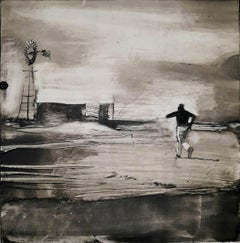
Dust Bowl, monotype, black and white, wpa style
Located in Brooklyn, NY
Dramatic imagery from FILM NOIR series of black and white monotypes, blending surrealistic mindscapes with stark realism About Tom Bennett: With quick brushstrokes, Tom Bennett crea...
Category

2010s American Realist Monotype Prints and Multiples

Materials

Archival Paper, Monotype

Kiss Me Deadly 2, night, sea, boat, black and white, surrealist noir
Located in Brooklyn, NY
Dramatic imagery from FILM NOIR series of black and white monotypes, blending surrealistic mindscapes with stark realism About Tom Bennett: With quick brushstrokes, Tom Bennett crea...
Category

2010s Surrealist Monotype Prints and Multiples

Materials

Archival Paper, Monotype

"Cowboy s Delight IV"
Located in Lyons, CO
Color monotype Juarez’s most recent prints are four groups of monoprints Cowboy’s Delight II, Copper Mallow, Yucca Bloom and Flowers and Pearls. Juarez gathered wild flowers from ar...
Category

2010s Contemporary Monotype Prints and Multiples

Materials

Monotype

Flamenco , Paris, Louvre, Salon d Automne, Academie Chaumière, LACMA, SFAA
Located in Santa Cruz, CA
Stamped, verso, with estate stamp for Victor Di Gesu (American, 1914-1988) and created circa 1955. A Post-Impressionist figural monotype showing a woman standing beneath a tree in t...
Category

1950s Monotype Prints and Multiples

Materials

Paper, Monotype

Taos II – Earth-Toned Abstract 20th Century Monotype by Wilma Fiori, Framed
Located in Denver, CO
Experience the quiet power of the American Southwest through “Taos II,” a stunning original abstract monotype print by celebrated artist Wilma Fiori (1929–2019). Rendered in an evoca...
Category

Late 20th Century Abstract Monotype Prints and Multiples

Materials

Monotype

Untitled (Head of a Woman)
Located in Rancho Santa Fe, CA
Inscribed, signed, and dated lower center: "Monoprint H Lee-Smith '69" Provenance: The Waintrob Project for the Visual Arts (Foundation); Sidney and Abraham Waintrob This item is i...
Category

1960s Post-War Monotype Prints and Multiples

Materials

Paper, Monotype

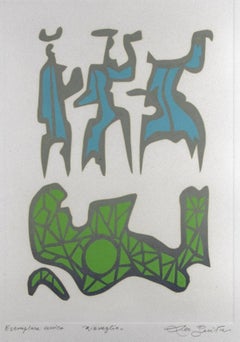
Awake - Original Lithograph by Leo Guida - 1985
Located in Roma, IT
Awake is an original lithograph realized in 1985 by the italian Contemporary artist Leo Guida (1992 - 2017). Titled and Hand-signed in pencil on the lower margin: Esemplare unico "R...
Category

1990s Abstract Monotype Prints and Multiples

Materials

Lithograph, Monotype

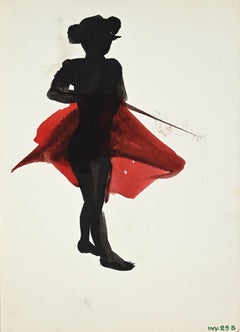
Matador - Monotype Lithograph - Late 20th century
Located in Roma, IT
Matador is an original Contemporary artwork realized by Leo Guida in 1970s. Original Two Colors Monotype Lithograph (unique copy) on paper. Mint conditions. Torero is an excellen...
Category

Late 20th Century Contemporary Monotype Prints and Multiples

Materials

Lithograph, Monotype

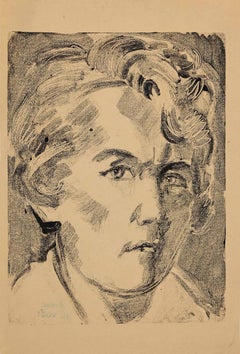
Figure of Woman - Original Monotype by Helen Vogt - 1929
Located in Roma, IT
Figure of Woman is an original monotype realized by Helen Vogt, in 1929. The state of preservation is very good. Not signed. Stamp of the artist on th...
Category

1920s Modern Monotype Prints and Multiples

Materials

Monotype

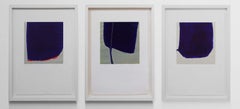
Modern Minimalist Abstracts in Blue, Gray, White Red – 3 Framed Monotypes
Located in Denver, CO
This striking set of three original abstract monotypes by acclaimed Denver modernist Wilma Fiori (1929–2019) showcases her signature use of color and form. Rendered in a refined pale...
Category

20th Century Abstract Monotype Prints and Multiples

Materials

Monotype

Composition - Original Monotype - 20th Century
Located in Roma, IT
Composition is a beautiful monotype realized by an artist of the XX century. In very good condition. Hand signed (illegible signature) on the lower right margin of the plate. On the...
Category

20th Century Monotype Prints and Multiples

Materials

Monotype

Monotype prints and multiples for sale on 1stDibs.

Find a wide variety of authentic Monotype prints and multiples available on 1stDibs. While artists have worked in this medium across a range of time periods, art made with this material during the 21st Century is especially popular. If you’re looking to add prints and multiples created with this material to introduce a provocative pop of color and texture to an otherwise neutral space in your home, the works available on 1stDibs include elements of blue, orange, yellow, purple and other colors. There are many well-known artists whose body of work includes ceramic sculptures. Popular artists on 1stDibs associated with pieces like this include Kind of Cyan, David Collins, Anna Kunz, and Kim Frohsin. Frequently made by artists working in the Contemporary, Abstract, all of these pieces for sale are unique and many will draw the attention of guests in your home. Not every interior allows for large Monotype prints and multiples, so small editions measuring 0.01 inches across are also available

Recently Viewed

View All