Men Portrait Prints

to
769
1,227
504
450
261
159
Overall Width
to
Overall Height
to
873
460
154
141
52
50
46
42
36
23
17
7
4
1
111
56
36
25
19
149
673
1,285
506
22
57
88
59
60
75
160
216
128
83
117
2,021
477
98
6,438
3,526
3,040
2,614
1,869
1,514
1,210
1,109
902
777
730
442
390
386
249
213
199
194
173
173
1,011
675
428
208
138
343
1,207
1,212
893
Art Subject: Men
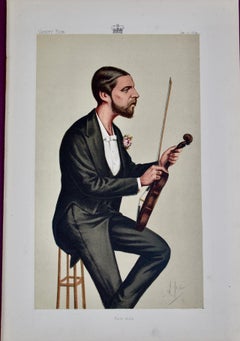
Whitelaw Reid, New York Tribune, Vanity Fair American caricature portrait, 1897
Located in Melbourne, Victoria
'New York Tribune' Chromolithograph. 1902. Vanity Fair portrait of Whitelaw Reid who was a US politician and newspaper editor. 395mm by 265mm (sheet)
Category

Early 20th Century Victorian Figurative Prints

Materials

Lithograph

Bandstand I, Eastbourne, UK - Black and White Vintage Photography
Located in Cambridge, GB
'Bandstand', captured on a visit to his grandparents at the British seaside in Eastbourne, this collection by Samuel Field is a beautiful reminder of days gone by. This artwork is a...
Category

1980s Post-War Black and White Photography

Materials

Photographic Paper, Black and White, C Print, Silver Gelatin

Original Switzerland mid-century modern vintage travel poster
Located in Spokane, WA
Original “Switzerland” vintage travel poster. Archival linen backed in excellent condition, Grade A, ready to frame. The images shown...
Category

1960s American Modern Figurative Prints

Materials

Lithograph

VOTE BIDEN, signed Lt Ed screenprint based upon Warhol s portrait of McGovern
Located in New York, NY
Dread Scott VOTE BIDEN, 2020 Screenprint on wove paper Signed, dated and numbered 24/100 in graphite pencil on the back 26 × 26 inches Unframed The screenprint, which references And...
Category

2010s Contemporary Portrait Prints

Materials

Screen

Sir August Friedrich Manns, composer, Vanity Fair caricature portrait, 1895
Located in Melbourne, Victoria
'Crystal Palace' Chromolithograph. 1895. Vanity Fair portrait of Sir August Friedrich Manns (1825-1907) who was a German-born conductor who made his career in England. After servi...
Category

Late 19th Century Victorian Figurative Prints

Materials

Lithograph

Impromptu , Mark Hambourg, Vanity Fair musician caricature portrait, 1908
Located in Melbourne, Victoria
'Impromptu' Chromolithograph. 1908. Vanity Fair portrait of Mark Hambourg (1879-1960) who was a distinguished Russian-British concert pianist, among the most famous of his age. ...
Category

Early 20th Century Victorian Figurative Prints

Materials

Lithograph

Ira D Sankey, Vanity Fair singer and composer portrait chromolithograph, 1884
Located in Melbourne, Victoria
'Praise and Prayer' Chromolithograph, 1874, after Ape (Carlo Pellegrini 1839-1889) Vanity Fair portrait of Ira D. Sankey (1840 -1908), known as The Sweet Singer of Methodism, who w...
Category

Late 19th Century Victorian Portrait Prints

Materials

Lithograph

Finger Prints , Sir Edward Richard Henry, Vanity Fair caricature portrait, 1895
Located in Melbourne, Victoria
'Finger Prints' Chromolithograph. 1905. Vanity Fair portrait of Sir Edward Richard Henry, 1st Baronet GCVO KCB CSI KPM (1850-1931) who was the Commissioner of Police of the Metropo...
Category

Early 20th Century Victorian Figurative Prints

Materials

Lithograph

"1993 in Review" Broadway, Movies, Dance, Film, Opera, Nureyev, Bette Middler
Located in New York, NY
"1993 in Review" Broadway, Movies, Dance, Film, Opera, Nureyev, Bette Middler Al Hirschfeld (1903-2003) "1993 in Review" Lithograph on heavy paper Sight: 22 x 16 inches Signed lower...
Category

1990s Performance Figurative Prints

Materials

Paper, Etching, Lithograph

Prince Light leak
Located in Norwich, GB
Paper size 35 x 24”, Image size 25 x 20" Limited Edition of 10 Working on a freelance basis for The Sun, Koppel was despatched to Regent Street's Tower Records in 1987 to photograph...
Category

21st Century and Contemporary Contemporary Photography

Materials

Digital

Teruta-hime - Woodcut by Utagawa Kuniyoshi - 1842/43
Located in Roma, IT
Teruta-hime is a woodcut print realized by Utagawa Kuniyoshi in 1842/43. Lifetime impression of chuban tate-e, it depicts Teruta-hime carrying a bucket of water through the snow, wi...
Category

Mid-19th Century Modern Figurative Prints

Materials

Woodcut

Save Freedom of Worship original 1943 Four Freedoms vintage poster
Located in Spokane, WA
Original poster: Save Freedom of Worship (S) Artist: Normal Rockwell. Archival linen backed. Original fold marks touched up at the time of b...
Category

1940s American Realist Portrait Prints

Materials

Offset

Napoleon - Etching by Pierre François Tardieu - 1837
Located in Roma, IT
Napoleon is an Etching realized by P.Bellange in 1837 by Pierre-François Tardieu. Good conditions. The artwork is realized in a well-balanced composition. the artwork and belongs t...
Category

1830s Modern Figurative Prints

Materials

Etching

The Discobolus, British Museum Roman antiquity Classical sculpture photogravure
Located in Melbourne, Victoria
'The Discobolus' Photogravure after Donald Macbeth. Donald Macbeth was a commercial photographer who seems to have held a quasi-official position at the British Museum, where he reg...
Category

1910s Other Art Style Portrait Prints

Materials

Photogravure

Marx Brothers "Animal Crackers" Movie Comedy Groucho, Harpo, Chico, Zeppo
Located in New York, NY
Marx Brothers "Animal Crackers" Movie Comedy Groucho, Harpo, Chico, Zeppo Caricature Al Hirschfeld (1903-2003) Marx Brothers in "Animal Crackers" Sight: 12 x 15 1/2 inches Paper Si...
Category

1970s Performance Figurative Prints

Materials

Paper, Etching

Court wrestlers of the Sultan of Turkey-dressed for outdoors, resting and fighti
Located in Middletown, NY
Bruyn, Abraham de (after). Court wrestlers of the Sultan of Turkey-dressed for outdoors, resting and fighting. 1577. Engraving on hand made laid paper, 10 5/8 x 6 7/8 inches (268 x 1...
Category

16th Century Old Masters Portrait Prints

Materials

Handmade Paper, Laid Paper, Engraving

The Holy Family
By Fra Bonaventura Bisi
Located in Chicago, IL
The Holy Family, 1634 Etching after Parmigianino (Parma 1503 - 1540 Casal Maggiore) 305 x 230 mm.; 12 x 9 inches References: Nagler Monogrammisten II...
Category

17th Century Old Masters Portrait Prints

Materials

Etching

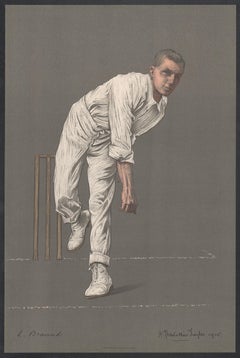
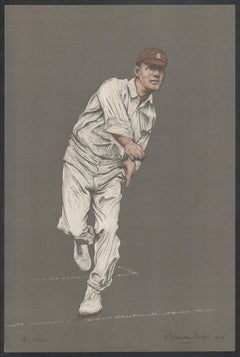
Walter Lees, Empire Cricketeer, English cricket portrait lithograph, 1905
Located in Melbourne, Victoria
Walter Lees was a bowler for Surrey and England. Tayler was an English artist who was a member of the Royal Academy of Painters. He was a cricketer himsel...
Category

Early 20th Century Victorian Portrait Prints

Materials

Lithograph

Halo Freedom - Grateful Dead more. original concert poster
Located in Spokane, WA
Halo Freedom - Rick Griffin original 1966 poster. Benefit for Haight Ashbury Legal Organization, an On-scene summer long guarantee of your Freedom. Indian Agent Excellent / mint condition. The image is to resemble a distressed old photograph, but this poster is meint as stated. No damage, no pinholes, no bent corners… just very fine indeed! PERFORMERS: Grateful Dead, Jefferson Airplane, Big Brother and the Holding Company, Quicksilver Messenger Service, Charlatans Haight Ashbury Legal Organization. Winterland Concert HALO (Haight Ashbury Legal Organization) Original First Printing, not a reproduction. Concert featuring: The Jefferson Airplane, Janis Joplin with Big Brother & The Holding Company, Quicksilver Messenger Service, The Charlatans...
Category

1960s Pop Art Portrait Prints

Materials

Offset

DANCING II, Signed Lithograph, Men Women Dance Portrait, Black Culture
Located in Union City, NJ
DANCING II is an original limited edition lithograph printed in black ink on white archival printmaking paper, 100% acid free, using hand lithography tec...
Category

Early 2000s Contemporary Figurative Prints

Materials

Lithograph

Lionel Charles Palairet, Vanity Fair cricket portrait chromolithograph, 1903
Located in Melbourne, Victoria
'Repton, Oxford & Somerset' Vanity Fair portrait of Lionel Charles Hamilton Palairet (1870-1933) who was an English amateur cricketer who played for Somerset and Oxford University....
Category

Early 20th Century Victorian Portrait Prints

Materials

Lithograph

"The Volunteer - Civil War" Historical Portrait, 742/1500
Located in Soquel, CA
Limited edition offset print of the original photorealistic painting, a portrait that portrays a historical reenactment of a civil war volunteer by James Bama...
Category

1980s American Realist Figurative Prints

Materials

Paper, Ink, Offset

Andy Warhol, Für die Grünen - Screenprint from 1980, Pop Art
Located in Hamburg, DE
Andy Warhol (1928-1987) Andy Warhol für die Grünen, 1980 Medium: Screenprint on paper (election poster) Dimensions: 101 x 77 cm Edition size unknown: Not signed, not numbered Publish...
Category

20th Century Pop Art Portrait Prints

Materials

Screen

TOM SAWYER LEMME SEE HIM, HUCK. MY, HE S PRETTY STIFF
Located in Aventura, FL
Collotype in colors on paper. Unsigned. Title and copyright info in typeset lower margin. Artwork is in excellent condition. All reasonable offers will be considered.
Category

1970s American Impressionist Portrait Prints

Materials

Paper

Guillaume Apollinaire
Located in Collonge Bellerive, Geneve, CH
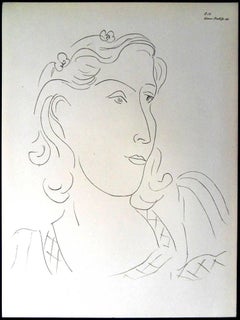
Original Lithograph - Henri Matisse - Portrait of Guillaume Apollinaire From the book by André Rouveyre, "Apollinaire " (Paris: Raisons d'Etre, 1952) Artist : Henri MATISSE 13 x 10 inches Edition: 151/330 References : Duthuit-Matisse Catalogue raisonné 31 MATISSE'S BIOGRAPHY YOUTH AND EARLY EDUCATION Henri Emile Benoît Matisse was born in a tiny, tumbledown weaver's cottage on the rue du Chêne Arnaud in the textile town of Le Cateau-Cambrésis at eight o'clock in the evening on the last night of the year, 31 December 1869 (Le Cateau-Cambrésis is in the extreme north of France near the Belgian border). The house had two rooms, a beaten earth floor and a leaky roof. Matisse said long afterwards that rain fell through a hole above the bed in which he was born. Matisse’s ancestors had lived in the area for centuries before the convulsive social and industrial upheavals of the nineteenth century. Matisse grew up in a world that was still detaching itself from a way of life in some ways unchanged since Roman times. The coming of the railway had put Bohain on the industrial map, but people still traveled everywhere on foot or horseback. Matisse’s father, Émile Hippolyte Matisse, was a grain merchant whose family were weavers. His mother, Anna Heloise Gerard, was a daughter of a long line of well-to-do tanners. Warmhearted, outgoing, capable and energetic, she was small and sturdily built with the fashionable figure of the period: full breasts and hips, narrow waist, neat ankles and elegant small feet. She had fair skin, broad cheekbones and a wide smile. "My mother had a face with generous features," said her son Henri, who always spoke of her with particular tenderness of the sensitivity. Throughout the forty years of her marriage, she provided unwavering, rocklike support to her husband and her sons. Matisse later said: "My mother loved everything I did." He grew up in nearby Bohain-en-Vermandois, an industrial textile center, until the age of ten, when his father sent him to St. Quentin for lycée. Anna Heloise worked hard. She ran the section of her husband's shop that sold housepaints, making up the customers' orders and advising on color schemes. The colors evidently left a lasting impression on Henri. The artist himself later said he got his color sense from his mother, who was herself an accomplished painter on porcelain, a fashionable art form at the time. Henri was the couple’s first son. The young Matisse was an awkward youth who seemed ill-adapted to the rigors of the North; in particular, he hated the gelid winters. He was a pensive child and by his own account he was a dreamy, frail and not outstandingly bright. In later life he never lost his feeling for his native soil, for seeds and growing things he had encountered in his youth. The fancy pigeons he kept in Nice more than half a century after he left home recalled the weavers' pigeon-lofts tucked away behind even the humblest house in Bohain. Matisse's childhood memories were of a stern upbringing. "Be quick!" "Look out!" "Run along!" "Get cracking!" were the refrains that rang in his ears as a boy. In later years when survival itself depended on habits of thrift and self-denial, the artist prided himself on being a man of the North. When Matisse in turn had children of his own to bring up, he chided himself for any lapse in discipline or open display of tenderness as weakness on his part. In 1887 he went to Paris to study law, working as a court administrator in Le Cateau-Cambrésis after gaining his qualification. Although he considered law as tedious, he nonetheless passed the bar in 1888 with distinction and began his practice begrudgingly. Once Matisse finished school, his father, a much more practical man, arranged for his son to obtain a clerking position at a law office. PAINTING: BEGINNINGS Matisse’s discovery of his true profession came about in an unusual manner. Following an attack of appendicitis, he began to paint in 1889, when his mother had brought him art supplies during the period of convalescence. He said later, “From the moment I held the box of colors in my hands, I knew this was my life. I threw myself into it like a beast that plunges towards the thing it loves.” Matisse’s mother was the first to advise her son not to adhere to the “rules” of art, but rather listen to his own emotions. Matisse was so committed to his art that he later extended a warning to his fiancée, Amélie Parayre, whom he later married: “I love you dearly, mademoiselle; but I shall always love painting more.” Matisse had discovered "a kind of paradise" as he later described it. His drastic change of profession deeply disappointed his father. Two years later in 1891 Matisse returned to Paris to study art at the Académie Julian and became a student of William-Adolphe Bouguereau. After a discouraging year at the Académie Julian, he left in disgust at the overly perfectionist style of teaching there. Afterwards he trained with Gustave Moreau, an artist who nurtured more progressive leanings. In both studios, as was usual, students drew endless figure studies from life. From Bouguereau, he learned the fundamental lessons of classical painting. His one art-schooled technical standby, almost a fetish, was the plumb line. No matter how odd the angles in any Matisse, the verticals are usually dead true. Moreau was a painter who despised the "art du salon", so Matisse was destined, in a certain sense, to remain an "outcast" of the art world. He initially failed his drawing exam for admission to the École des Beaux-Arts, but persisted and was finally accepted. Matisse began painting still-lives and landscapes in the traditional Flemish style, at which he achieved reasonable proficiency. Most of his early works employ a dark palette and tend to be gloomy. Chardin was one of Matisse's most admired painters having made four the French still-life master paintings in the Louvre. Although he executed numerous copies after the old masters he also studied contemporary art. His first experimentations earned him a reputation as the rebellious member of his studio classes. In 1896, Matisse was elected as an associate member of the Société Nationale, which meant that each year he could show paintings at the Salon de la Société without having to submit them for review. In the same year he exhibited 5 paintings in the salon of the Société Nationale des Beaux-Arts, and the state bought two of his paintings. This was the first and almost only recognition he received in his native country during his lifetime. In 1897 and 1898, he visited the painter John Peter Russell on the island Belle Île off the coast of Brittany. Russell introduced him to Impressionism and to the work of Van Gogh who had been a good friend of Russell but was completely unknown at the time. Matisse's style changed completely, and he would later say "Russell was my teacher, and Russell explained color theory to me." Matisse also observed Russell's and other artists' stable marriages. This probably influenced him to find in Amélie Noellie Parayre, his future wife, his anchor. The Dinner Table (1897) was Matisse’s first masterpiece, and he had spent the entire winter working on the oeuvre. Though the Salon displayed the piece, they hung the work in a poor location, disgusted by what they considered its radical, Impressionist aspects. Caroline Joblaud was Matisse's early lover for four years during his initial struggles to affirm his artistic direction and professional career. Caroline (also called Camille) gave Matisse his first daughter Marguerite in 1894, who after Matisse's marriage to Amélie Noellie Parayre was warmly accepted contrary to conventional hostility such arrangements provoked. Caroline posed various times for the artist’s compositions while Marguerite served many times as a model for Matisse throughout his life. MARRIAGE WITH AMÉLIE NOELLIE PARAYRE The Matisses of Bohain and the Parayres of Beauzelle had outwardly nothing in common, and there was no reason why Matisse and Amélie should ever have met. But in October 1897 Matisse went to a wedding in Paris and happened to sit next to her at the uproarious banquet that followed. There had been no banal flirtation between them, even when the wine flowed, each recognized the other as true metal, and when they got up from the table she held out her hand to Henri Matisse in a way that he never forgot. Matisse at that time was not yet the professorial figure of legend. He was known as a prankster, as a ribald and anti-clerical songster, and as someone who had once broken up a café concert performance just for the hell of it. Amélie's relatives operated at that time within a social, intellectual, and political context of which Matisse had had no previous experience. They stood for free thinking, for the separation of church and state, and for the secularization of the French educational system. Her family, better off that that of Matisse, provided the support he needed for the budding artist. When Matisse married Amélie in January 1898, they had been introduced only three months after. Amélie's Aunt Noélie and two of her brothers ran a successful women's shop called the Grande Maison des Modes. Before her marriage, Amélie had shown a gift for designing, making, and modeling hats for a fashionable clientele. In June 1899, she found a partner and opened a shop of her own on the rue de Châteaudun. This allowed Henri and herself to live, with Marguerite, in a tiny two-room apartment on the same street. Madame Matisse, fervently loyal, would play a fundamental role in the life and career of the artist for more than 40 years. Marguerite was to become her father's lifetime mainstay In 1902 disaster struck. Amélie’s parents were disgraced and financially ruined in a spectacular scandal of national scope, as the unsuspecting employees of a woman whose financial empire was based on fraud. Thanks to his early years in a lawyer's office, Matisse was able to busy himself to great effect in the organization of his father-in-law's defense. When all about him lost their heads, burst into tears, and felt more than sorry for themselves, Henri Matisse dealt with their problems one by one. The ordeal had taken its toll, in more than one way. His doctors ordered Matisse to go to Bohain and take two months' complete rest. Amélie had lost both her hat shop and the apartment on the rue de Châteaudun. For the first time, Henri, Amélie and the three children were united in Bohain, having nowhere else to go. Hillary Spurling, one of Matisse’s biographers, asserts that Amélie’s memories of that public disgrace nurtured a “suspicion of the outside world” that would always mark the Matisse family. The Matisse family formed a kind of hermetic unit which revolved around the artist’s work and profession. They fitted their activities according his breaks and work sessions. Silence was essential. Even during the years when Matisse lived mostly alone in Nice, an annual ritual of unpacking, stretching, framing and hanging ended with the whole family settling down to respond to the paintings. The conference might last several days. Then the dealers were admitted. Matisse and his wife had had two sons, Jean (born 1899) and Pierre (born 1900). He was not always in peace with his family. He wrote that their views were not always in accord “which disturbs me considerably in my work, for which I require the most complete calm and from those how surround me, a serenity that I cannot find here. I intend to move to a village a few league away.” Pierre, his brother, Jean, and Marguerite remained close to their father through every vicissitude, and Matisse, in his last invalid years, was devoted to his several grandchildren. In 1899, at a time when his paintings displayed rebellious talent but not much clear direction, Matisse began attending classes in clay modeling and sculpture. Assigned to copy one of the sculptural masterpieces in the Louvre, he selected Jaguar Devouring a Hare a violently precise work by Antoine-Louis Barye. Later, whenever his paintings seemed stuck, he turned to sculpture to organize his thoughts and sensations. Influenced by the works of the post-Impressionists Paul Cézanne, Gauguin, Van Gogh and Paul Signac, and also by Japanese art, Matisse made color a crucial element of his paintings. Matisse said, "In modern art, it is indubitably to Cézanne that I owe the most." By studying Cézanne’s fragmented planes -- which stretched the idea of the still life to a forced contemplation of color surfaces themselves -- Matisse was able to reconstruct his own philosophy of the still life. Many of his paintings from 1899 to 1905 make use of a pointillist technique adopted from Signac. In 1898, he went to London to study the paintings of J. M. W. Turner and then went on a trip to Corsica. After years in poverty, Matisse went through his "dark period" (1902-03), moved briefly to naturalism, went back to a dark palette and told friends in 1903 that he had lost all desire to paint and had almost decided to give up. Fortunately, Matisse was able to earn some money painting a frieze for the World Fair at the Grand Palais in Paris. He also traveled extensively in the early 1900s when tourism was still a new idea. Brought on by railroad, steamships, and other forms of transportation that appeared during the industrial revolution, travel became a popular pursuit. As a cultured tourist, he developed his art with regular doses of travel. FAUVISM Matisse's career can be divided into several periods that changed stylistically, but his underlying aim always remained the same: to discover "the essential character of things" and to produce an art "of balance, purity, and serenity," as he himself put it. The changing studio environments seemed always to have had a significant effect on the style of his work. In these first years of struggle Matisse set his revolutionary artistic agenda. He disregarded perspective, abolished shadows, repudiating the academic distinction between line and color. He was attempting to overturn a way of seeing evolved and accepted by the Western world for centuries by substituting a conscious subjectivity in the place of the traditional illusion of objectivity . Matisse hit his stride in the avant-garde art world in the first years of the new decade. He explored the modern art scene through frequent visits to galleries such as Durand-Ruel and Vollard, where he was exposed to work by Paul Cézanne, Paul Gauguin, and Vincent van Gogh. Matisse’s first solo exhibition took place in 1904, without much success. In 16 May 1905 he arrived in the charming Catalan port of Collioure, in the south of France. He soon invited the painter André Derain (1880-1954), 11 years his junior, to join him. By 1905, Matisse was considered spearhead the Fauve movement in France, characterized by its spontaneity and roughness of execution as well as use of raw color straight from the palette to the canvas. Matisse combined pointillist color and Cézanne’s way of structuring pictorial space stroke by stroke to develop Fauvism - a way less of seeing the world than of feeling it with one’s eyes. When the Fauve summer drew to an end, Derain left Collioure with 30 paintings, 20 drawings and some 50 sketches, never to return, while Matisse departed some days later bringing back to Paris 15 finished paintings, 40 aquarelles, over 100 drawings. He returned Collioure in the summers of 1906, 1907, 1911 and 1914. The lure of the sun would prove always to have powers of restoration to the artist throughout his life particularly after periods of great emotional exertion. When Fauvist works were first exhibited Salon d'Automne in Paris they created a scandal. Eyewitness accounts tell of laughter emanating from room VII where they were displayed. Gertrud Stein, one of Matisse's most important future supporters, reported that people scratched at the canvases in derision. "A pot of paint has been flung in the face of the public" was the reaction by the critic Camille Mauclair. Louis Vauxcelles described the work with the historic phrase "Donatello au milieu des fauves!" (Donatello among the wild beasts), referring to a Renaissance-type sculpture that shared the room with them. His comment was printed on 17 October 1905 in Gil Blas, a daily newspaper, and passed into popular usage. Derain himself later called the Fauves' color "sticks of dynamite." The painting that was singled out for attacks was Matisse's Woman with a Hat, a portrait of Madame Matisse. This picture was bought be was bought by Gertrude and Leo Stein, a fact which had a very positive effect on Matisse who was suffering demoralization from the bad reception of his work. Matisse continued his experiments in Collioure, visible in the painting The Open Window and the View of Collioure , also a characteristic work of Fauvism in its raw color and disregard for details. Both of these works of the landscape in the French Mediterranean present a distinct development towards the spontaneous and uninhibited style. Other than André Derain, Georges Braque, Raoul Dufy and Maurice Vlaminck were also members of the Fauve movement. However, Matisse’s intimate friends among artists were mostly easygoing minor painters, such as Albert Marquet. Matisse’s temperamental aloneness made him prey to vertiginous depressions. He later recalled a breakdown that he underwent in Spain, in 1910: “My bed shook, and from my throat came a little high-pitched cry that I could not stop.” From the onset of is career women were from one of the cardinal motifs of the artist's production. His Joy of Life (1906) draws us into the world of hallucinatory vividness composed of nymphs set in an idyllic open fields dressed in pure color and sensual outline. Two women lounge in the sunlight while two more chat on the edge of the forest. One crouches to pick some flowers while her companion weaves a chain of them into her hair. A couple embraces each other while another group engages in a lively round-dance in the distance. In this way, Joy of Life depicts woodland nymphs engaging in a celebration of their life, their womanhood, and their sexuality. Due to the recurrent incidence of nude women and intensely sensual interpretation many observers have assumed that as a man Matisse must have been a hedonist. On the contrary, historic examination demonstrates that in reality, he was rather a self-abnegating Northerner who lived only to work, and did so in chronic anguish, recurrent panic, and amid periodic breakdowns. While Picasso recompensed himself, as he went along, with gratifications of intellectual and erotic play Matisse did not. In an age of ideologies, Matisse dodged all ideas except perhaps one: that art is life by other means. Matisse’s uninhibited celebration of women is often believed to have initiated from Cézanne’s painting Three Bathers (1882) (which he had acquired for himself along with a Van Gogh and a Gauguin). However, Matisse depicts women as nurturing, welcoming, and unlike the forbidding, massive clay-like presence of those of Paul Cézanne. FAME The decline of the Fauvist movement, after 1906, did nothing to deter the rise of Matisse. From 1906 -1917 he lived in Paris and established his home, studio, and school at Hôtel Biron. Among his neighbors is sculptor Auguste Rodin, writer Jean Cocteau, and dancer Isadora Duncan. Many of his finest works were created in this period, when he was an active part of the great gathering of artistic talent in Montparnasse, even though he did not quite fit in with his conservative appearance and strict bourgeois work habits. In fact, the aim of Matisse’s art was something less than revolutionary. In 1908, in a famous statement drawn from “Notes of a Painter,” Matisse declared as his ideal an art “for every mental worker, for the businessman as well as the man of letters, for example, a soothing, calming influence on the mind, something like a good armchair which provides relaxation from physical fatigue.” Matisse's personal habits were incredibly regular. On a typical day rose early and worked all morning with a second work session after lunch, followed by violin practice, a simple supper (vegetable soup, two hard-boiled eggs, salad and a glass of wine) and an early bedtime. In 1906, he created a series of 12 lithographs, all variations on the theme of a seated nude. He chose to share his graphic work with the public almost immediately. The lithographs were exhibited at the Druet Gallery in Paris the same year that they were produced, and the woodcuts were shown at the Salon des Independants in the spring of 1907. In 1907 Appolinaire, commenting about Matisse in an article published in La Falange, said, "We are not here in the presence of an extravagant or an extremist undertaking: Matisse's art is eminently reasonable." Notwithstanding newly-won fame, Matisse's work continued to encounter vehement criticism and it was difficult for him to provide for his family. His controversial 1907 painting Blue Nude was burned in effigy at the Armory Show in Chicago in 1913. Contrary to the fate of the Impressionists, Matisse and other Fauves were able to exhibit in art galleries. In 1908 Paul Cassirer, the German art dealer and editor who played a significant role in the promotion of the work the French Impressionists and Post-Impressionists, staged an exhibit of Matisse’s works in Berlin. In the same year the American photographer Alfred Stieglitz in New York organized him one-man show in his tiny Manhattan gallery called 291 which effectively introduced Matisse the powerful American art market. In the first decade of his notoriety as the leader of the Fauves, Matisse was more admired by foreigners than by the French. It was, after all, the Russians and the Americans who acquired significant collections of his early work almost as quickly as it was created. The great Matisses we see in the Paris museums today were mostly acquired after the artist's death in lieu of death duties. It took the French a good deal longer to understand Matisse's greatness-longer, certainly, than the international cadre of aspiring talents that flocked to his classes when he was still one of the most controversial figures in the Paris avant-garde. In the summer of 1907, Matisse and his wife went on a long trip to italy "for work and Pleasure," visiting Venice and Padua, where they admired Giotto's frescos. In Florence the were the guests of the Steins in their villa in Fiesole. From this base matisse visited Arezzo, to study Piero della Francesca, and Siena, attracted by the early Sienese painters, especially, Duccio. PICASSO, GERTRUDE STEIN AND THE CONE SISTERS During the first decade of the 20th century Americans in Paris Gertrude Stein, her brothers Leo Stein, Michael Stein and Michael's wife Sarah took keen interest in Matisse's art. In addition, Gertrude Stein's two friends from Baltimore. Clarabel and Etta Cone, became major patrons of Matisse and Picasso, collecting hundreds of their works.The Cone Sisters acquired their first Matisse in 1906 and, during the next four decades, went on to form one of the world's great collections of his art. The Cone Collection not only contains major works from every phase of Matisse's long career but reflects the sisters' special interest in his Nice period, when a new complexity of form and psychology entered the ever intense surface allure of his paintings. In April of 1906 during a gathering at the house of the legendary Gertrude Stein, Matisse was introduced to Pablo Picasso who was 11 years younger. Picasso and Matisse were poles apart aesthetically and their life styles were no less so. Matisse was markedly taller and more polished than the stocky, cocky Catalan, was then ruler of the turbulent Paris avant-garde art scene. The two were said to have always been looking over their shoulders at each other. It is well-known that after their rivalry grew, sides were taken. Picasso later said: "No one has ever looked at Matisse's paintings more carefully than I; and no one has looked at mine more carefully than he." One key difference between their pictorial concepts was that Matisse drew and painted from nature, while Picasso was much more inclined to work from imagination. The subjects painted most frequently by both artists were women and still lives, with Matisse more likely to place his figures in fully realized interiors. Gertrude Stein, who loved stirring things up, wrote, "the feeling between the Picassoites and the Matisse-ites became bitter." Although Matisse dryly noted that "our disputes were always friendly," it should be pointed out that Picasso and his friends threw suction-cupped darts at Matisse's 1906 Portrait of Marguerite (which Picasso had obtained in a trade for his own Pitcher, Bowl and Lemon, from 1907). While the rift between the two artists eventually healed, the one between their supporters remained. ACADEMIE MATISSE IN PARIS & SERGEI SHCHUKIN In 1909, with the Matisse family lived in a former convent on the Boulevard des Invalides, in Paris, where the artist conducted a painting school. His immense notoriety, which had been confirmed in 1905-06 by Joy of Life, a work which seemed to trash every possible norm of pictorial order and painterly finesse.His friends organized and financed the Académie Matisse in Paris, a private and non-commercial school in which Matisse instructed young artists. It operated from 1911 until 1917. Hans Purrmann and Sarah Stein were several of his most loyal students. Although it lasted for only three years (1908-11), and yet, during its brief existence the Académie Matisse became one of the principal crossroads of modern painting for a number of gifted European and American artists. Given the reputation Matisse had acquired as the"wild man" of modernist color, it must have come as a shock to some of his early students that the program of instruction he offered was remarkably conservative. As Jean Heiberg, the first Norwegian to enroll in the Académie, later wrote in a memoir: "The school had, at Matisse's suggestion, acquired a copy of two antique sculptures from the Louvre, Mars and an archaic sculpture, which he often used to demonstrate. Every now and then he got completely rid of the life model and we only drew from the plaster casts, and his critiques then were no less profitable." Among Matisse’s students was Olga Meerson, a Russian Jew who had studied with Wassily Kandinsky in Munich and, already possessed of an elegant style, sought to remake herself under Matisse’s tutelage. Amélie suspected the worst. Perhaps a combination of Amélie’s jealousy and Meerson’s neediness caused a Matisse to end the connection, with bad feeling all around. Meerson moved to Munich, where she married the musician Heinz Pringsheim, a brother-in-law of Thomas Mann. Never having fulfilled her promise as a painter, she committed suicide in Berlin, in 1929. One of Matisse's biographers, with access to much of the artist's correspondence, contends that the artist, after his marriage, rarely, if ever, had sex with models, despite his apparent feelings for many. Two Russian art collectors stood out at the beginning of the 20th century: the cloth merchant Sergei Shchukin (1854–1936) and the textile manufacturer Ivan Morozov (1871–1921). Both acquired modern French art, developed a sensibility for spotting new trends, and publicized them in Russia. In this period, Matisse had initiated his fecund association with the Russian textile magnate and visionary collector, Sergei Shchukin. The artist created one of his major works La Danse specially for Shchukin as part of a two painting commission. Inspired by a circular dance-- perhaps a sardana - performed by fishermen at Collioure, this painting embodies the clash between the sacred and reality. Human hands link together, but they form a divine spirit. Moreover, Matisse all but abandoned perspective The work ’s flatness emphasizes the idea, colors, and material, a notion that made Matisse a model for Modernists. The other painting commissioned was Music, 1909. Shchukin was considered by some almost as a co-producer of some of the artist’s greatest works and was strongly commuted to the French painter’s work. Concerning the violent attacks on his friend, the Russian wrote to the artist: “The public is against you, but the future is yours.” By 1914 Shchukin’s house in Moscow contained thirty-seven Matisses. “He always picked the best,” the artist said. During the political revolution Lenin expropriated Shchukin collection in person but allowed Shchukin to remain, in servants’ quarters, as caretaker and guide. He died in Paris, in 1936. The collection is now in the Hermitage and Pushkin Museums From about 1911 to 1915, Matisse struggled with the ideas of Cubism, an experiment he felt he was "not participating in" because it did not "speak to [his] deeply sensory nature." MOROCCO Like many avant-garde artists in Paris, Matisse was receptive to a broad range of influences. He is one of the first painters to take an interest in various forms of “primitive” art. His art was profoundly influenced by Easter art as well. Matisse first flirted with the idea of visiting Morocco after a trip to the Moorish part of Spain in the winter of 1910. This taste of the Moors incited a flame of hope that there would be greater inspiration to paint in Morocco. Furthermore, well aware of the exotic subjects in Morocco that had engendered a wealth of inspiration for the famous French painter Delacroix when he visited the country over eighty years before, Matisse felt Morocco would stimulate his painting genius in ways Europe could not. He strove for neither the picturesque nor the pornographic. In Morocco, Matisse seems to have had difficulties finding models who would pose for him, particularly women because of the law of the veil. Only Jewesses and prostitutes were exempt. Luckily, Matisse to have found the prostitute Zorah for the purpose although he did not paint her as a prostitute. Instead, in his first picture of her, Zorah en Jaune, sexual themes are most conspicuously absent from the canvas. As a prostitute used to exposing and flaunting her body, Zorah could have easily been painted nude or with less clothing to show herself off, but instead Matisse chooses to keep her clothed and posed with prudence. Unlike the primitive, nude Western women in the Fauve Joy of Life. Moroccan Zorah is clothed with respect and detail to her finer characteristics. He is developing his ability to paint with awareness of the non-sexual qualities of his subject, a movement away from Fauve women. Many of Matisse's Moroccan paintings are covered only in the thinnest washes of pigment, as if he wanted the texture of the unpainted canvas to show through so that it would add rawness to the browns and grays. Matisse's odalisques have been described as "elaborate fictions" in which the artist re-created the image of the Islamic harem using French models posed in his Nice apartment. The fabrics, screens, carpets, furnishings and costuming recalled the exoticism of the "Orient" and provided a theme for Matisse's preoccupation with the figure and elaborate patterns of exotic fabrics. Although Matisse's interest in textiles are evident in his compositions made during his 1906 trip to Morocco, it didn't begin as a typical European attraction to the exotic. It was already present to him as a descendent of generations of weavers, who was raised among weavers in Bohain-en-Vermandois, which in the 1880's and 90's was a center of production of fancy silks for the Parisian fashion houses. Like virtually all his northern compatriots, he had an inborn appreciation of their texture and design. He understood the properties of weight and hang, he knew how to use pins and paper patterns, and he was supremely confident with scissors. Matisse was known to be an avid collector of fabrics, from his days as a poor art student in Paris to the latter years of his life, when his Nice studio overflowed with Persian carpets, delicate Arab embroideries, richly hued African wall hangings, and any number of colorful cushions, curtains, costumes, patterned screens, and backcloths. Textiles soon became the springboard for his radical experiments with perspective and an art based on decorative patterning and pure harmonies of color and line. When he moved house, he also moved his fabrics, describing them as "my working library." He added to the collection all his life, from markets in Algeria, Morocco and Tahiti to the end-of-season sales of Parisian haute couture. The revitalizing spirit of Morocco would live on in the artist's imagination until the cutouts of the artist's last years. AFTER PARIS Matisse continued to evolve in unexpected directions even though never became an abstract painter (though some of his most adventurous works, such as the View of Notre Dame of 1914 or the Yellow Curtain of 1916 come close). His motifs were always recognizable, and the tension between the subject and the formal aspects of the painting was a central concept of his artistic ideal. Matisse moved to Nice in 1917 to distance himself from wartime activity, where bright, warm colors showed him "simpler venues which won’t stifle the spirit." His spirit became loyal to the "silver clarity of light" in Nice, and he returned to Paris only for a few months each summer. The years 1917–30 are known as his early Nice period, when his principal subject remained the female figure or an odalisque dressed in oriental costume or in various stages of undress, depicted as standing, seated, or reclining in a luxurious, exotic interior of Matisse's own creation. These paintings are infused with southern light, bright colors, and a profusion of decorative patterns. They emanate the atmosphere suggestive of a harem. In 1929, Matisse temporarily suspended easel painting and traveled to America to sit on the jury of the 29th Carnegie International and, in 1930, spent some time in Tahiti and New York as well as Baltimore, Maryland and Merion, Pennsylvania.He was especially thrilled with New York. An important collector of modern art, and owner of the largest Matisse holdings in America, Dr. Albert Barnes of Merion, commissioned the artist to paint a large mural for the two-story picture gallery of his mansion. Matisse chose the subject of the dance, a theme that had preoccupied him since his early Fauve masterpiece Joy of Life. Americans were prominent among Matisse's patrons throughout his career, beginning with the Steins (Leo Stein bought Joy of Life right out of the Salon in 1906) and including the Cone sisters of Baltimore and the notoriously cantankerous Barnes. The foundational Matisse monograph was written during his lifetime by another American, Alfred Barr. Also important in promoting Matisse's presence before the transatlantic public was the Manhattan gallery founded in 1931 by the artist's son, Pierre, who remained a prominent figure in the New York art world for almost six decades. In addition to his father, he represented Balthus, Calder, Dubuffet, Giacometti, Miro, Tanguy and others, many of them also friends. Throughout his long and productive career, Matisse periodically refreshed his creative energies by turning from painting to drawing, sculpture and other forms of artistic expression. In his lifetime he also produced 12 illustrated books which were known as “livre d’artiste” (artist’s book), a specific type of illustrated book that became common in France around the turn of the century. These books were deluxe, limited editions, meant to be collected and admired as works of art, as well as, read. This process began when Swiss publisher Albert Skira first approached the modern master in 1930 to illustrate the work, Poesies, by 19th century French symbolist poet Stéphane Mallarmé . Matisse responded to Skira’s invitation with great enthusiasm and that summer, devoted most of his attention to the commission while he was residing in Paris. The result was a collection of 29 beautiful etchings, of which the Museum will display 16. The subject matter, like the poems themselves, varies considerably, although many of the images reflect the artist’s vacation to the South Pacific. Matisse’s etchings of Mallarmé’s poems are considered among his greatest works in the print medium. In 1941, again for Skira, Matisse began one of his most complicated and successful printmaking projects, Florilege des Amours de Ronsard, illustrating the love poems of 16th century French Renaissance poet Pierre de Ronsard. Ronsard’s subject and strong imagery lent themselves gracefully to Matisse’s favored themes of fruits, flowers, the female form and portraits. The artist selected the poems himself and translated the work from Renaissance French to contemporary French for the publication of the anthology DIVORCE & LATE FAMILY RELATIONSHIPS For all his long-lasting friendships with other artists, famous and obscure, Matisse's days and nights were absorbed by solitary labor. Playing the violin seemed a more intimate consolation for decades of critical abuse than the affections of his wife and children. Although their marriage was still somewhat fragile, the Matisses had decided to stay on in Nice when their lease expired at Place Charles-Félix in the summer of 1938. Matisse and his wife were separated in 1939 after 41 years when Amélie tried to dismiss the coolly efficient young Lydia Delectorskaya, an orphan refugee from Siberia, who had been hired as Amélie’s companion. However, the Matisses’ marriage ran afoul not of any romantic rival but for the artist’s wish to stand on his own. The first climax came years before in 1913, when Amélie sat more than a hundred times for the Portrait of Madame Matisse. A friend’s diary reported at the time. “Crazy! weeping! By night he recites the Lord’s Prayer! By day he quarrels with his wife!” The portrait, which was the last work to enter Shchukin’s collection, caused Matisse “palpitations, high blood pressure and a constant drumming in his ears.” Such frenzy was not rare when Matisse had difficulty with a painting. He referred to the painting years later in a letter to her as “the one that made you cry, but in which you look so pretty.” Amélie ceded routine leadership of the family to Marguerite. The 1913 portrait was his last painting of her. Matisse and his wife met the last time to discuss details of their legal separation, in July 1939. One of its key provisions was that everything would be divided equally between the couple. The meeting took place in Paris at the Gare St. Lazare and lasted thirty minutes, during which Amélie Matisse kept up a flow of small talk while her husband."My wife never looked at me, but I didn't take my eyes off her...," Matisse wrote on the night of that final encounter: "I couldn't get a word out.... I remained as if carved out of wood, swearing never to be caught that way again." "I'm going to try to isolate myself as if I were still absent,'' Matisse announced on his first return to Paris since the official separation from his wife, 'rarely leaving his apartment except for visits to the cinema (his first color film, starring Danny Kaye...
Category

1930s Modern Portrait Prints

Materials

Lithograph

Original Rim and Rom (Musical Satrics) vintage Soviet stone lithograph poster
Located in Spokane, WA
Original Rim and Rom (translated: (Musical Satrics) vintage Soviet poster. Original circa 1925 Russian antique poster that is linen-backed. Printed in Leningrad. Stone lithograph, horizontal format. Year: c. 1925 edition was 1000 pieces (This is the only document copy of this poster we have ever found.) Rare horizontal Soviet bloc antique stone lithograph. Note: This is an Original Soviet stone lithograph vintage Poster, not a reprint or reproduction of any kind! Original Posters are printed in limited quantities. Most are intended for display in theaters, hold their value longer, and may be considered collectors' items in the future. Due to Russia's stringent laws protecting cultural property, including art, historical documents, and other significant artifacts, old posters like this are incredibly rare and difficult to find or own. You are about to acquire a truly unique piece of history. This is an Original Lithograph Vintage Poster; it is not a reproduction. orldwide, helping them with their original vintage poster collections...
Category

1920s Constructivist Portrait Prints

Materials

Lithograph

Digby Jephson, Vanity Fair cricket portrait chromolithograph, 1902
Located in Melbourne, Victoria
'The Lobster' Vanity Fair cricket portrait of Digby Jephson. Jephson was an all-rounder for Surrey who is best remembered for his lob bowling, a style he cultivated after employing...
Category

Early 20th Century Victorian Portrait Prints

Materials

Lithograph

Astaphos
Located in Kansas City, MO
Title : Astaphos Materials : 310 gsm Premium Paper Date : 2020 Dimensions: 40 x 30 inch Edition of 50 Agent X is an emerging artist who creates experimental multimedia collages ...
Category

2010s Street Art Prints and Multiples

Materials

Paper, Digital, Digital Pigment

Original "Stocks Americains" vintage French poster horizontal format
Located in Spokane, WA
Original “Stocks Americans” vintage poster. Linen backed in very good condition, ready to frame. No paper loss, no fold marks, clean and bright. Distress on one letter “S” in A...
Category

Mid-20th Century American Impressionist Portrait Prints

Materials

Lithograph

HONKY TONK Signed Lithograph, Black Musician, Collage Portrait, Blues Guitar
Located in Union City, NJ
HONKY TONK is an original hand drawn, limited edition lithograph by the African American artist James Denmark printed using traditional hand lithography techniques on archival Somerset paper, 100% acid free. HONKY TONK is a colorful collage portrait depicting a seated black musician - a male guitar player wearing blue jeans and a brown slouchy cap playing his blues guitar. HONKY TONK is a warm interior scene printed in vivid shades of red orange, red, dark blue, light yellows, cream, tan, browns, and black creating an inviting honky-tonk music setting. Print size - 38 x 23 inches, unframed, mint condition, hand signed and numbered by James Denmark, Certificate of Authenticity included Image size - 31 x 17 in. Edition size - 250, plus proofs Year published - 1996 Publisher - Mojo Portfolio...
Category

1990s Contemporary Portrait Prints

Materials

Lithograph

Robert Abel, Vanity Fair cricket portrait chromolithograph, 1902
Located in Melbourne, Victoria
'Bobby' Vanity Fair cricket portrait of Robert Abel. Abel was a right hand batsman and bowler for Surrey and England. 390mm by 265mm (image)
Category

Late 19th Century Victorian Portrait Prints

Materials

Lithograph

Oval Head of a Woman with Piercing Eyes (Plate XXI), from Carmen
Located in Washington, DC
Artist: Pablo Picasso Title: Oval Head of a Woman with Piercing Eyes (Plate XXI) Portfolio: Carmen Medium: Etching on Montval wove paper Year: 1949 Edition: 289 Frame Size: 21" x 18"...
Category

1940s Cubist Portrait Prints

Materials

Etching

Erotic Scene - Etching by Chas Laborde - 1920s
Located in Roma, IT
Erotic is an etching by Chas Laborde in the 1920s. This original print is hand-colored in watercolor. In very good condition, including white cardboard Passepartout, 52 x 37cm. This artwork belongs to the erotic series of Chas Laborde in which you recognize his authentic style of illustration. Chas Laborde (Buenos Aires, 1886 - Paris, 1941) Charles Laborde...
Category

1920s Figurative Prints

Materials

Etching

Sadness - Etching by Albert Besnard - 1909
Located in Roma, IT
Sadness is an etching realized by Albert Besnard in 1909. Etching ex. 6/30. Slab dimension cm. 15 x 9,5. paper cm. 25 x 18. Pencil signature and date in the lower right part, date in the left part. Good conditions. Paul Albert Besnard (Parigi 1849 - 1934)born in Paris, was the son of an artist; his father, Louis Adolphe, was a painter and his mother, Louise Pauline Vaillant, was an esteemed miniaturist, a pupil of Lizinska de Mirbel. Besnard first studied drawing and painting with Jean-François Brémond and at 17 entered the École des Beaux-Arts, where he was taught by Alexandre Cabanel. In 1874 he won the Prix de Rome with the canvas "Death of Timofane, tyrant of Corinth", and during his stay at Villa Medici he had the opportunity to meet Franz Liszt and his pupil André Worsmer, whose portrait he painted in 1877. his stay in Italy and, in 1879he married the sculptor Charlotte Dubray, daughter of the sculptor Gabriel-Vital Dubray, with whom he moved to England for three years, until 1884, exhibiting at the Royal Academy of Arts in London. At the Paris Salon of 1886 his "Portrait of Madame Roger Jourdain...
Category

Early 1900s Modern Figurative Prints

Materials

Etching

Sergeant Cribb 1980-
Located in Brooklyn, NY
"Sergeant Cribb" is a British television series set in Victorian London, focusing on Detective Sergeant Cribb of Scotland Yard's newly formed Criminal Investigation Department. The s...
Category

1980s Contemporary Portrait Prints

Materials

Offset


Sergeant Cribb
 1980-

Sergeant Cribb
 1980-
$200 Sale Price
20% Off
Original "I Summon You to the Comradeship" vintage poster 1918
Located in Spokane, WA
Original: I summon you to the comradeship, Woodrow Wilson vintage poster from 1918, issued by the Red Cross. The poster has been archivally mounted on...
Category

1910s American Realist Portrait Prints

Materials

Lithograph

Original U.S. Marines, He Did His Duty, George Dewey vintage linen backed poster
Located in Spokane, WA
This original and visually striking artifact from the First World War is a vintage U.S. Marine Corps recruiting poster titled ‘He Did His Duty.' It stands as a testament to the power...
Category

1910s American Realist Portrait Prints

Materials

Lithograph

Luxury Redefined, Richi Rich, Painting, Pop Art, Street Art
Located in München, BY
Edition 5 Richi Rich keeps toilet paper in his vault. JAY-C – the pseudonym of this innovative young artist known for his subversive use of familiar figures and symbols. Using a distinct and fine British sense of humour,
he addresses stereotypes of modern society and his work, both playful and profound, stimulates us to question conventional social conceptions. JAY-C is a barometer responding to the world around us. Having had his first solo exhibition in 2018, in the same year he did a collaboration with BoConcept on their iconic Imola chair...
Category

2010s Pop Art Portrait Paintings

Materials

Mixed Media, Pigment, Archival Pigment

Original One Days Pay - United War Work Campaign vintage World War One poster
Located in Spokane, WA
Original U.S. Post WWI United War Work Campaign “New York Will Give One Day’s Pay” Fundraising vintage poster. Linen backed in fine to mint condition, ready to frame. This is an...
Category

1910s American Realist Portrait Prints

Materials

Lithograph

CRUSADERS FOR JUSTICE Signed Linocut, Thurgood Marshall Portrait, Civil Rights
Located in Union City, NJ
CRUSADERS FOR JUSTICE is a hand pulled original limited edition relief print created using linocut printmaking techniques on white archival heavyweight paper, 100% acid free. Pencil signed by Ms. Catlett on the lower margin, embossed with printers chop mark lower left, print documentation provided. CRUSADERS FOR JUSTICE was created as a tribute to Thurgood Marshall...
Category

Early 2000s Contemporary Portrait Prints

Materials

Linocut

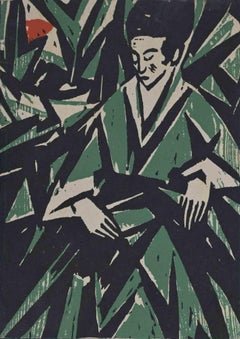
Woman in Green - Woodcut by Otto Lange - 1916
By Otto Lange b.1879
Located in Roma, IT
Woman in Green is a Colored print on paper, realized by Otto Lange in 1916  Woodcut on paper. Good conditions.
Category

1910s Modern Portrait Prints

Materials

Woodcut

Y se le quema la casa - Etching by Francisco Goya - 1799
Located in Roma, IT
Y se le quema la casa is plate n. 18 (of 80) of the series Los Caprichos by Goya. This etching is an excellent proof of the first edition of 1799, before the bevels. Plate 17,9x12,...
Category

1850s Contemporary Figurative Prints

Materials

Etching

Sir Francis Drake: 18th C. Portrait of 16th C. Navigator, Privateer, Politician
Located in Alamo, CA
This an 18th century copper plate engraved portrait of Sir Francis Drake by Jacobus Houbraken, after a painting by Sir Godfrey Kneller, from "The Hea...
Category

1740s Portrait Prints

Materials

Engraving

The Smell of Us (Hand signed poster)
Located in New York, NY
Larry Clark The Smell of Us (Hand signed poster), 2015 Offset lithograph poster Pencil signed by Larry Clark on the back 10 1/2 × 15 1/2 inches Unframed Limited edition poster; hand ...
Category

2010s Realist Portrait Prints

Materials

Lithograph, Offset

CRUSADERS FOR JUSTICE Commemorative Art Poster, Thurgood Marshall, Civil Rights
Located in Union City, NJ
CRUSADERS FOR JUSTICE is a rare commemorative fine art poster designed by the renown woman artist, Elizabeth Catlett featuring a portrait of the iconic 20th century civil rights advo...
Category

Early 2000s Contemporary Portrait Prints

Materials

Linocut

Me - May 2019
Located in Bristol, GB
2 colour lithograph on Somerset Velvet Warm White 400gsm Edition 31 of 50 55.5 x 45.5 cm (21.8 x 17.9 in) Signed, numbered and dated on the front Mint
Category

21st Century and Contemporary Contemporary Nude Prints

Materials

Lithograph

Original "Keep em Flying!" vintage poster, 1941
By Cecil Calvert Beall
Located in Spokane, WA
Keep 'em Flying!, artist: C. C. Beall: original linen-backed, excellent condition, World War Two vintage poster. The poster of Uncle Sam is constructed with several vignettes of workers, soldiers, scientists, the U. S. flag, and more. I have provided several details of this fabulous and uniquely designed vintage poster. The 1941 U.S. World War II (WWII) Home Front poster ("Keep 'em flying-Airplanes-flags-Machines-production-Nothing lags. Put your shoulder To the wheel; Courage staunch With nerves of steel. Greet each day, Or pledge a toast-"Keep 'em flying" is our boast. Here's a slogan For us all-An answer to Our country's call. Keep 'em flying; Keep 'em clear. The time is ripe, The time is HERE To pull together-One bold front-Each one prepared To do his stunt. Workers and The men who hire-Housewives-children-All aspire To help and work With little pause-One mind, one heart, One goal, one cause. So-'KEEP 'EM FLYING!' - Jack Childs"; "Presented by the United States Army Recruiting Service") featuring collage art of soldiers and other personnel overlaid with an image of Uncle Sam by Cecil Calvert Beall. Incredible design with the military, red cross nurse, American Flag, chemist, pilots, farmer, steel worker, and Navy guns...
Category

1940s American Modern Portrait Prints

Materials

Offset

Elmo the Mighty, the great Elmo Lincoln original lobby cartd
Located in Spokane, WA
ELMO THE MIGHTY, original 1919 lobby card, not signed. Protected in a 16" x 20" acid-free presentation mat suitable for framing. This lobby card is over 100 years old. Original,...
Category

1910s American Realist Figurative Prints

Materials

Offset

"A Great Man on The Turf": A 19th Century James Gillray Hand-colored Etching
Located in Alamo, CA
This framed hand-colored etching and aquatint entitled "A Great Man on The Turf or Sir Solomon in all his Glory" by James Gillray was published in London by Hanna Humphrey, 27 St. James Street on July 7th 1803. The print is signed in the plate in the lower right. It depicts a man, possibly a caricature of the racehorse breeder Sir Solomon. However, there has been some controversy about the identity of the central figure on the mound. Traditionally the man has been thought to represent John Russell, 6th Duke of Bedford...
Category

Early 1800s Portrait Prints

Materials

Etching

The Chase - Third Day, by Jos Sances
Located in Palm Springs, CA
A double image, with multiple narratives. The title and main imagery depict the third day of Captain Ahab's fateful chase of Moby Dick (chapter 135). In the lower image the whale is ...
Category

2010s Contemporary Portrait Prints

Materials

Screen

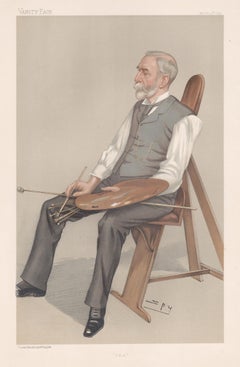
Edward Poynter, painter, Vanity Fair artist portrait chromolithograph, 1897
Located in Melbourne, Victoria
'PRA' (President of the Royal Academy) Vanity Fair portrait of Sir Edward John Poynter, 1st Baronet, PRA, who was an English painter, designer, ...
Category

Late 19th Century Victorian Portrait Prints

Materials

Lithograph
Tears4 2Pac - signed limited edition Oversize print Tupac Shakur
Located in London, GB
Tupac by BATIK Pop art print of a mugshot of rapper music artist Tupac Shakur originally taken August 3, 1995. On September 7, 1996, Shakur was shot four times by an unidentified assailant in a drive-by shooting in Las Vegas; he died six days later. Artwork 40x30" inches paper size (approximately 39 x 20" inches image size) signed and numbered by the artist on front Limited to only 10 this size unframed Note other sizes and framing available on request. Ships securely from London. BATIK is an increasingly collectable pop artist currently living and working in London. The artist is purposely elusive with their true identity, sex and age not actually known – preferring the works to take centre stage. All pieces are limited edition, signed and numbered. About Tupac : Tupac Amaru Shakur born Lesane Parish Crooks, June 16, 1971 – September 13, 1996, also known by his stage names 2Pac and Makaveli, was an American rapper and actor. He is widely considered one of the most influential rappers of all time. Shakur is among the best-selling music artists, having sold more than 75 million records worldwide. Much of Shakur's music has been noted for addressing contemporary social issues that plagued inner cities, and he is considered a symbol of activism against inequality. Shakur was born in New York City to parents who were both political activists and Black Panther Party members. Raised by his mother, Afeni Shakur, he relocated to Baltimore in 1984 and to the San Francisco Bay Area in 1988. With the release of his debut album 2Pacalypse Now in 1991, he became a central figure in West Coast hip hop for his conscious rap lyrics. Shakur achieved further critical and commercial success with his follow-up albums Strictly 4 My N.I.G.G.A.Z... (1993) and Me Against the World (1995) His Diamond certified album All Eyez on Me (1996), the first double-length album in hip-hop history, abandoned his introspective lyrics for volatile gangsta rap. In addition to his music career, Shakur also found considerable success as an actor, with his starring roles in Juice (1992), Poetic Justice...
Category

1990s Pop Art Figurative Prints

Materials

Color, Archival Pigment

Army Of Me II - Oversize signed limited edition - Pop Art - Muhammad Ali
Located in London, GB
Army Of Me II - Oversize limited edition - Pop Art - Muhammad Ali by the London based contemporary pop art image creator and artist, BATIK. Measures 40 x 30" inches / 101 x 76 cm ...
Category

2010s Pop Art Portrait Prints

Materials

Color, Archival Pigment

Luke Fildes, painter, Vanity Fair artist portrait chromolithograph, 1892
Located in Melbourne, Victoria
'He painted '"he Doctor"' Vanity Fair portrait of Sir Samuel Luke Fildes, KCVO, RA (1843-1927) who was an English painter and illustrator born at Liverpo...
Category

Late 19th Century Victorian Portrait Prints

Materials

Lithograph

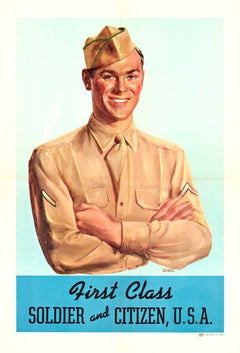
Original "First Class Soldier and Citizen, USA" vintage American poster
Located in Spokane, WA
Linen backed original post-World War II military poster "First Class Soldier and Citizen, U.S.A." Original fold marks have been restored during linen backing. The poster features a smiling Army soldier in his khaki uniform. A rare original military poster to find today. (The poster was documented as being printed in a larger size.). R-224-RPB-2-1-47 A military recruitment poster for young men to join the military post World War 2. The poster features a clean-cut, handsome man in his military uniform with crossed arms smiling at you. Artist: Glass. No known biography of this artist. This is an original 1947 vintage American poster...
Category

1940s American Realist Portrait Prints

Materials

Offset
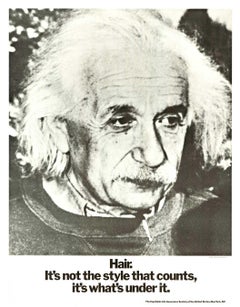
Original Einstein "Hair. It s not the style that counts" vintage poster
Located in Spokane, WA
Original Einstein vintage poster. “Hair. It’s not the style that counts, it’s what’s under it.” A black and white image of Einstein with his hair messed me. Linen-backed in excellent condition, ready to frame. From a series of portraits with inspirational quotes from The Equitable Life Assurance Society of the United States. Photo from Bettmann Archive. The poster is a variation of the original photo with the quote “It’s not the style that counts, it’s what’s under it”. This quote is a play on words emphasizing substance's importance over style. The poster reminds us that actual value lies in what is inside a person rather than their outward appearance. About Equitable Life. After closing to new business in 2000, parts of the business were sold off, and the remainder of the company became a subsidiary of Utmost Life and Pensions in January 2020. The Equitable Life Assurance Society (Equitable Life), founded in 1762, is a life insurance...
Category

Late 20th Century American Realist Portrait Prints

Materials

Offset

SERENATA DE GUITARRA Signed Lithograph, Cubist Style Woman, Music, Latin Art
Located in Union City, NJ
SERENATA DE GUITARRA by the South American artist Jorge Dumas(1928-1985), is an original hand drawn lithograph hand proofed and printed using traditional lithography techniques on ar...
Category

1970s Cubist Portrait Prints

Materials

Lithograph

Bob Marley 40th I (Soul Rebel) Dennis Morris
Located in Toronto, ON
19.5" x 16" Unframed Limited Edition Letterpress on Deckled Edge Paper of 450 Edition number is 312/450 Hand Signed by Shepard Fairey 2021
Category

2010s Portrait Prints

Materials

Screen

The Conversation - Original Lithograph by Paul Gavarni - 1881
Located in Roma, IT
The conversation is an original lithograph on ivory-colored paper, realized by the French draftsman Paul Gavarni (after) (alias Guillaume Sulpice Chevalier Gavarni, 1804-1866) in Par...
Category

1880s Modern Figurative Prints

Materials

Paper, Lithograph

William Higgs, jockey, Vanity Fair horse racing portrait chromolithograph, 1906
Located in Melbourne, Victoria
'Top of the List' Vanity Fair portrait of William Higgs (1880-1958). Higgs was a Irish jockey who was Champion Jockey on two occasions He won the 2000 Guineas on Slieve Gallion. ...
Category

Early 20th Century Victorian Portrait Prints

Materials

Lithograph
Recently Viewed

View All