18th Century and Earlier Still-life Prints

to
62
110
81
17
3
Overall Width
to
Overall Height
to
73
7
1
1
36
22
9
9
7
277
2,320
1,662
11
19
33
29
91
229
321
482
535
221
182
169
41
1
111
74
61
43
36
26
18
18
16
16
15
13
12
11
10
10
10
10
8
7
121
87
39
30
30
35
119
132
71
Period: 18th Century and Earlier
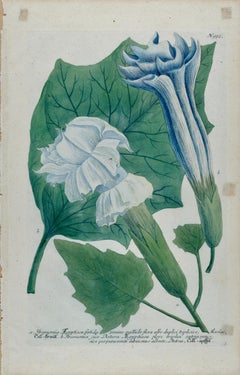
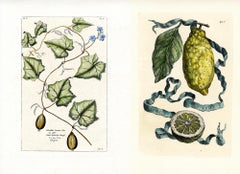
Flowering Trumpet Plant: 18th C. Hand-colored Botanical Engraving by Weinmann
Located in Alamo, CA
This hand-colored botanical mezzotint and line engraving by Johann Wilhelm Weinmann (1683-1741) is entitled "Stramonia Aegyptiaca foetida semine pallido flore albo duplici triplicive...
Category

Naturalistic 18th Century and Earlier Still-life Prints

Materials

Engraving, Mezzotint

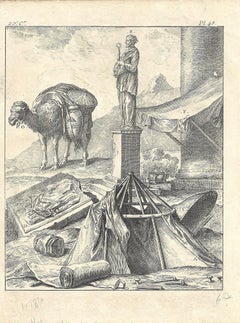
A Hebrew nomadic camp – English School, 18th century
Located in Middletown, NY
Engraving on light weight laid paper with an small indiscernible, alphabetic watermark, 9 x 7 1/2 (230 x 188 mm); sheet 11 1/4 x 8 1/2 inches (284 x 215 mm), wide margins. In very go...
Category

Old Masters 18th Century and Earlier Still-life Prints

Materials

Ink, Handmade Paper, Laid Paper, Woodcut
4 plates from The Wondrous Transformation of Caterpillars their Strange Diet..
Located in Middletown, NY
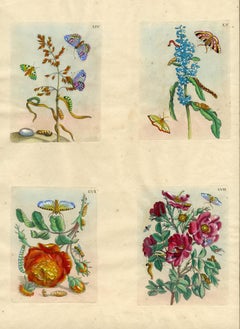
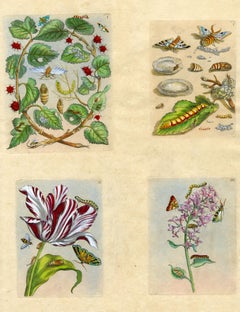
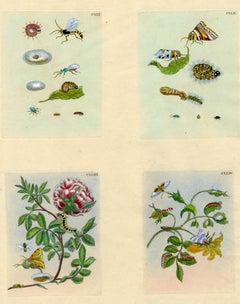
Four plates from The Wondrous Transformation of Caterpillars and their Strange Diet of Flowers. “Wolfsmelk Rupsen;" “Wolfsmilch, Raupe und Schmetterling" Amsterdam: J F Bernard, 1730. Each an engraving with hand coloring in watercolor and gouache printed on one sheet of watermarked Honig cream laid paper, each measures 6 1/4 x 5 inches (157 x 121 mm), sheet measures 20 5/8 x 14 inches (522 x 355 mm), full margins. With handling creases in the lower right sheet quadrant, as well as minor, loose cockling, otherwise in very good condition. The colors are superb with exceptionally fresh and bright saturation. Engraved between 1679 and 1683, printed 1730. Plates included: LIV, LV, LVI, & LVII. MARIA SIBYLLA MERIAN was one of the most highly respected entomologists of the 17th century, and remains today one of the field's most significant figures. A German-born naturalist and scientific illustrator, she reared herself on the study of caterpillars, and made tremendous contributions to the knowledge of the life cycles of numerous species. Until her detailed and careful study of the process of metamorphosis it was thought that insects were "born of mud," through spontaneous generation. Trained as a miniature painter by her stepfather, she published her first book of illustrations in 1675, at the age of 28. In 1679, Merian published the first volume of the two-volume series on caterpillars, The Wondrous Transformation of Caterpillars and their Strange Diet of Flowers; the second volume followed in 1683. Each volume contained 50 plates that she engraved and etched. In 1699, Merian traveled to Dutch Guiana...
Category

Naturalistic 18th Century and Earlier Still-life Prints

Materials

Watercolor, Engraving

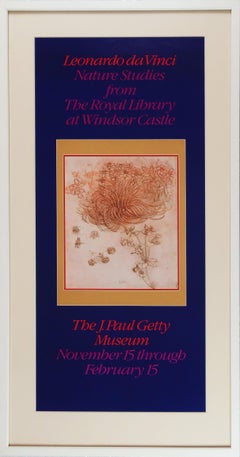
Nature Studies from the Royal Library at Windsor Castle
By Leonardo da Vinci
Located in New York, NY
Leonardo da Vinci "Nature Studies from the Royal Library at Windsor Castle" The J. Paul Getty Museum, November 15, 1980 - February 15, 1981 Exhibition Poste...
Category

Renaissance 18th Century and Earlier Still-life Prints

Materials

Offset

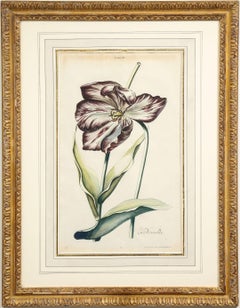
"La Nouvelle" Tulip Hand-Colored Engraving
By Christoph Jacob Trew
Located in New York, NY
"La Nouvelle" is from Christoph Trew's Hortus Nitidissimis omnem per annum superbiens Floribus ... Der das ganze Jahr hindurch im schönsten Flor stehende B...
Category

18th Century and Earlier Still-life Prints

Materials

Laid Paper, Engraving

Two botanical prints after Cornelisi Bloemaert Vincenzo Leonardi
Located in Middletown, NY
Two botanical prints after Cornelis Bloemaert & Vincenzo Leonardi "Lemon", from Hesperides. Reproductive print on thick C.M. Fabriano cotton wove paper; and Pierre Joseph Buchot (17...
Category

French School 18th Century and Earlier Still-life Prints

Materials

Watercolor, Engraving

Amolago (Aglaonema) Plant: 17th Century Botanical Engraving by H. van Rheede
Located in Alamo, CA
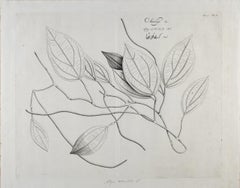
This is a rare 17th century engraving of a plant entitled "Amolago" by the Dutch botanist Hendrik van Rheede tot Drakenstein, plate 16 from his 'Hortus Indicus Malabaricus' (Garden of Malabar), published in Amsterdam in 1686 by Johann van Someren. The engraving depicts the Amolago plant, a large leafed plant, possibly corresponding to the present day aglaonema plant. Rheede's 19th century publication featured illustrations of exotic plants and fruits labelled with script in the upper right corner in Latin, Malay, Arabic, and Sanskrit. Hortus Indicus Malabaricus is believed to be the earliest comprehensive published work on the flora of Asia and the tropics. The 17th century treatise featured important illustrations of 740 plants of the region, including Indian medicinal plants. The engraving is printed on 17th century laid, chain-linked paper. The sheet measures 14.75" high by 17.25" wide. There is a central fold, as issued. There are a few tiny spots and there is minimal irregularity of the left edge of the paper where the print was previously bound in the 17th century publication. The print is otherwise in very good condition. There are additional Rheede botanical engravings from his 'Hortus Indicus Malabaricus' publication that are listed on my 1stdibs storefront and online website. These would make for an impressive display grouping. A discount is available for purchase of two or more of the prints. Hendrik Adriaan van...
Category

Naturalistic 18th Century and Earlier Still-life Prints

Materials

Engraving

Cactus Rose of Jericho Plants: A Besler Hand-colored Botanical Engraving
Located in Alamo, CA
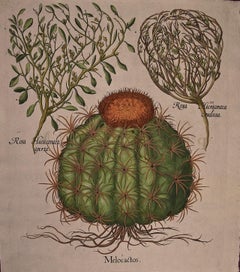
A hand-colored copper plate engraving depicting flowering "Melocactos" (Turk's Cap Cactus or Mother-in-law's Cushion), "Rosa Hiericontea aperta" (Rose of Jericho Unfolded), "Rosa Hie...
Category

Academic 18th Century and Earlier Still-life Prints

Materials

Engraving

Citamerdu (Amrita) Plant: 17th Century Botanical Engraving by Hendrik van Rheede
Located in Alamo, CA
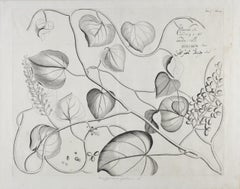
This is a rare 17th century engraving of a plant entitled "Citamerdu" by the Dutch botanist Hendrik van Rheede tot Drakenstein, plate 21 from his 'Hortus Indicus Malabaricus' (Garden of Malabar), published in Amsterdam in 1686 by Johann van Someren. The engraving depicts the Citamerdu plant, also known as Tinospora cordifolia plant or Amrita and Guduchi. It is a deciduous plant with heart-shaped leaves, greenish flowers, and pea-shaped fruits. Rheede's 19th century publication featured illustrations of exotic plants and fruits labelled with script in the upper right corner in Latin, Malay, Arabic, and Sanskrit. Hortus Indicus Malabaricus is believed to be the earliest comprehensive published work on the flora of Asia and the tropics. The 17th century treatise featured important illustrations of 740 plants of the region, including Indian medicinal plants. The engraving is printed on 17th century laid, chain-linked paper, watermarked with an elaborate crown design. The sheet measures 15.75" high by 18.75" wide. There is a central fold, as issued. There are a few small spots, but the print is otherwise in excellent condition. There are additional Rheede botanical engravings from his 'Hortus Indicus Malabaricus' publication that are listed on my 1stdibs storefront and online website. These would make for an impressive display grouping. A discount is available for purchase of two or more of the prints. Hendrik Adriaan van...
Category

Naturalistic 18th Century and Earlier Still-life Prints

Materials

Engraving

4 plates from The Wondrous Transformation of Caterpillars their Strange Diet..
Located in Middletown, NY
Four plates from The Wondrous Transformation of Caterpillars and their Strange Diet of Flowers. “Wolfsmelk Rupsen;" “Wolfsmilch, Raupe und Schmetterling" Amsterdam: J F Bernard, 1730. Each an engraving with hand coloring in watercolor and gouache printed on one sheet of watermarked Honig cream laid paper, each measures 6 1/4 x 5 inches (157 x 121 mm), sheet measures 20 5/8 x 14 inches (522 x 355 mm), full margins. With handling creases in the lower right sheet quadrant, as well as minor, loose cockling, otherwise in very good condition. The colors are superb with exceptionally fresh and bright saturation. Engraved between 1679 and 1683, printed 1730. Plates included: No.1:I; No. 2:1; II & III. MARIA SIBYLLA MERIAN was one of the most highly respected entomologists of the 17th century, and remains today one of the field's most significant figures. A German-born naturalist and scientific illustrator, she reared herself on the study of caterpillars, and made tremendous contributions to the knowledge of the life cycles of numerous species. Until her detailed and careful study of the process of metamorphosis it was thought that insects were "born of mud," through spontaneous generation. Trained as a miniature painter by her stepfather, she published her first book of illustrations in 1675, at the age of 28. In 1679, Merian published the first volume of the two-volume series on caterpillars, The Wondrous Transformation of Caterpillars and their Strange Diet of Flowers; the second volume followed in 1683. Each volume contained 50 plates that she engraved and etched. In 1699, Merian traveled to Dutch Guiana...
Category

Naturalistic 18th Century and Earlier Still-life Prints

Materials

Watercolor, Engraving

A Sledge of Kamtschatka – An image of a relic from Captain Cook s third voyage
Located in Middletown, NY
London: Scatcherd & Whitaker, 1784. Etching with hand coloring in watercolor on cream wove paper, 7 1/2 x 10 (190 x 255); sheet 16 1/4 x 22 (414 x 560 mm), full margins. In good cond...
Category

English School 18th Century and Earlier Still-life Prints

Materials

Watercolor, Handmade Paper, Etching

4 plates from The Wondrous Transformation of Caterpillars their Strange Diet..
Located in Middletown, NY
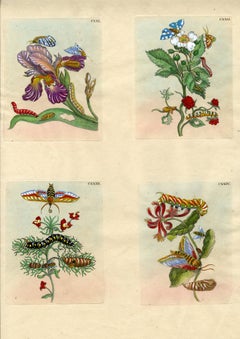
Four plates from The Wondrous Transformation of Caterpillars and their Strange Diet of Flowers. “Wolfsmelk Rupsen;" “Wolfsmilch, Raupe und Schmetterling" Amsterdam: J F Bernard, 1730. Each an engraving with hand coloring in watercolor and gouache printed on one sheet of watermarked Honig cream laid paper, each measures 6 1/4 x 5 inches (157 x 121 mm), sheet measures 20 5/8 x 14 inches (522 x 355 mm), full margins. With one 1.5 inch inch tear across the area of the top-left corner, well outside of image area. Handling creases in the lower right sheet quadrant, as well as minor, loose cockling, otherwise in very good condition. The colors are superb with exceptionally fresh and bright saturation. Engraved between 1679 and 1683, printed 1730. Plates included: CXXI, CXXII, CXXIII, & CXXIV. MARIA SIBYLLA MERIAN was one of the most highly respected entomologists of the 17th century, and remains today one of the field's most significant figures. A German-born naturalist and scientific illustrator, she reared herself on the study of caterpillars, and made tremendous contributions to the knowledge of the life cycles of numerous species. Until her detailed and careful study of the process of metamorphosis it was thought that insects were "born of mud," through spontaneous generation. Trained as a miniature painter by her stepfather, she published her first book of illustrations in 1675, at the age of 28. In 1679, Merian published the first volume of the two-volume series on caterpillars, The Wondrous Transformation of Caterpillars and their Strange Diet of Flowers; the second volume followed in 1683. Each volume contained 50 plates that she engraved and etched. In 1699, Merian traveled to Dutch Guiana...
Category

Naturalistic 18th Century and Earlier Still-life Prints

Materials

Watercolor, Engraving

Besler Autumn Snowflake and Meadow Saffron Flowers: 17th C. Botanical Engraving
Located in Alamo, CA
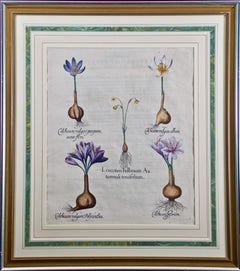
A hand-colored copperplate engraving entitled "Leucoium bulbosum autumnale tenufolium (Autumn Snowflake); Colchicum vulgare Polyanthos; Colchicum biflorum; Colchicum vulgare album; C...
Category

Old Masters 18th Century and Earlier Still-life Prints

Materials

Engraving

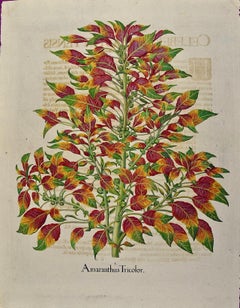
Amaranthus tricolor: A 17th-18th C. Besler Hand-colored Botanical Engraving
Located in Alamo, CA
This is a hand-colored copper plate engraving entitled "Amaranthus Tricolor", depicting a flowering Amaranthus Tricolor plant from Basilius Besler's landmark work, Hortus Eystettensis (Garden at Eichstatt), first published in 1613 in Eichstatt, Germany near Nuremberg and later in 1640 and 1713. Amaranthus tricolor, known as edible amaranth, is a species of flowering plant in the genus Amaranthus. The plant is often cultivated for ornamental and culinary purposes. Cultivars have a striking yellow, red, and green foliage. It is known as Joseph's coat in some areas, after the biblical figure Joseph, who is said to have worn a coat of many colors. Amaranthus tricolor is one of several species of amaranth cultivated in warm regions across the world. This beautiful colorful engraving is printed on thin laid chain-linked paper with very wide margins. There is a short crease in the upper right corner, mild irregularity of the left, right and lower edges and some bleed-through of text from the verso. The print is otherwise in excellent condition with striking hand-coloring. The sheet measures 22.13" high and 17.13" wide. Basilius Besler (1561–1629) was an apothecary and botanist. He was curator of the Willibaldsburg Castle garden of Johann Konrad von Gemmingen, prince bishop...
Category

Academic 18th Century and Earlier Still-life Prints

Materials

Engraving

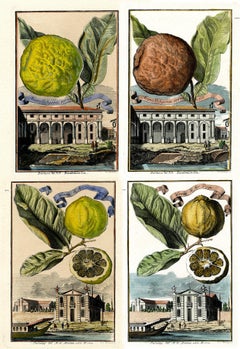
Aranzo Gigante Verrucoso Limon di Fior Doppio, 4 prints
Located in Middletown, NY
Joseph de Montalegre (after) Aranzo Gigante Verrucoso & Limon di Fior Doppio, 4 prints 1702-1725. Four (4) reproductive prints with handcoloring on thick C.M. Fabriano cotton wove ...
Category

French School 18th Century and Earlier Still-life Prints

Materials

Watercolor, Handmade Paper

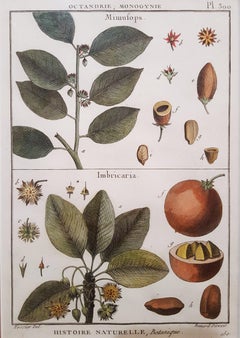
Mimufops (Mimusops); Ibricaria (Shingle Oak) /// Botanical Botany Plants Buffon
Located in Saint Augustine, FL
Artist: Georges-Louis Leclerc, Comte de Buffon (French, 1707-1788) Title: "Mimufops (Mimusops); Ibricaria (Shingle Oak)" (Octandreie, Monogynie, Plate 300) Portfolio: Histoire Nature...
Category

Old Masters 18th Century and Earlier Still-life Prints

Materials

Watercolor, Laid Paper, Engraving, Intaglio
Bronze Urns with Citrus Trees, 2 prints
Located in Middletown, NY
Pair of reproductive prints after Jean le Pautre’s engravings after Claude Ballin, 1670s, heightened with gouache and gold, on Fabriano wove paper, a deckle edge at bottom. 22 x 14 3...
Category

French School 18th Century and Earlier Still-life Prints

Materials

Watercolor, Handmade Paper

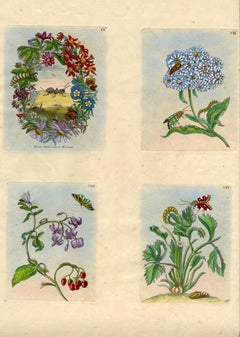
4 plates from The Wondrous Transformation of Caterpillars their Strange Diet..
Located in Middletown, NY
Four plates from The Wondrous Transformation of Caterpillars and their Strange Diet of Flowers. “Wolfsmelk Rupsen;" “Wolfsmilch, Raupe und Schmetterling" Amsterdam: J F Bernard, 1730. Each an engraving with hand coloring in watercolor and gouache printed on one sheet of watermarked Honig cream laid paper, each measures 6 1/4 x 5 inches (157 x 121 mm), sheet measures 20 5/8 x 14 inches (522 x 355 mm), full margins. With handling creases in the lower right sheet quadrant, as well as minor, loose cockling, otherwise in very good condition. The colors are superb with exceptionally fresh and bright saturation. Engraved between 1679 and 1683, printed 1730. Plates included: CI; CII; CIII & CIV. MARIA SIBYLLA MERIAN was one of the most highly respected entomologists of the 17th century, and remains today one of the field's most significant figures. A German-born naturalist and scientific illustrator, she reared herself on the study of caterpillars, and made tremendous contributions to the knowledge of the life cycles of numerous species. Until her detailed and careful study of the process of metamorphosis it was thought that insects were "born of mud," through spontaneous generation. Trained as a miniature painter by her stepfather, she published her first book of illustrations in 1675, at the age of 28. In 1679, Merian published the first volume of the two-volume series on caterpillars, The Wondrous Transformation of Caterpillars and their Strange Diet of Flowers; the second volume followed in 1683. Each volume contained 50 plates that she engraved and etched. In 1699, Merian traveled to Dutch Guiana...
Category

Naturalistic 18th Century and Earlier Still-life Prints

Materials

Watercolor, Engraving

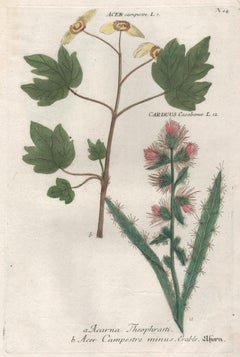
Acer Carduus - 18th century Weinmann botanical plant flower engraving
Located in Melbourne, Victoria
'Acarna Theophrasti' and 'Acer Campestre minus' Mezzotint printed in colours. Circa 1740. From Johann W Weinmann's Phytanthoza Iconographia, published in Regensburg 1737-45. The fi...
Category

Naturalistic 18th Century and Earlier Still-life Prints

Materials

Engraving

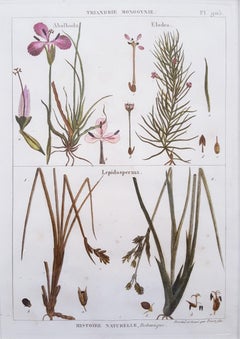
Abolboda; Elodea (Waterweeds); Lepidosperma (Hoary Rapier-Sedge) /// Botanical
Located in Saint Augustine, FL
Artist: Georges-Louis Leclerc, Comte de Buffon (French, 1707-1788) Title: "Abolboda; Elodea (Waterweeds); Lepidosperma (Hoary Rapier-Sedge)" (Triandrie Monogynie, Plate 905) Portfoli...
Category

Old Masters 18th Century and Earlier Still-life Prints

Materials

Watercolor, Laid Paper, Engraving, Intaglio
Peach varieties, fruit engraving with later hand-colouring, circa 1770
By HL Duhamel Du Monceau
Located in Melbourne, Victoria
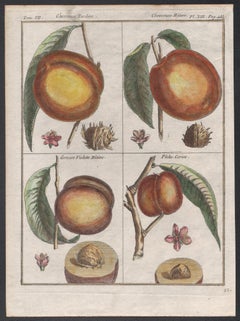
Peaches, Copper-line engraving with later hand-colouring, from Duhamel du Monceau’s 'Traité des Arbres Fruitiers', circa 1770. Duhamel du Monceau (1700-1782) was one of outstanding ...
Category

Naturalistic 18th Century and Earlier Still-life Prints

Materials

Engraving

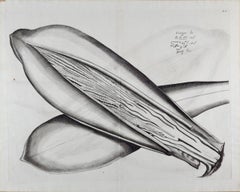
Banana Plants: An 18th Century Hand-colored Botanical Engraving by J. Weinmann
Located in Alamo, CA
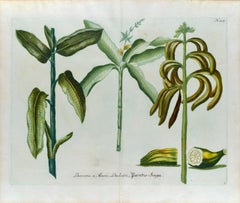
This is a striking original antique colored botanical mezzotint and line double page engraving of banana plants, which is finished with hand-coloring. It is entitled "Banana 1. Musa,...
Category

Naturalistic 18th Century and Earlier Still-life Prints

Materials

Engraving, Mezzotint

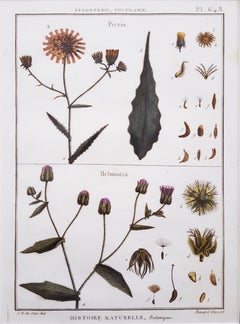
Picris (Sunflower); Helmintia (Bristly Oxtongue) /// Botanical Botany Plants Art
Located in Saint Augustine, FL
Artist: Georges-Louis Leclerc, Comte de Buffon (French, 1707-1788) Title: "Picris (Sunflower); Helmintia (Bristly Oxtongue)" (Syngenesie; Polygamie, Plate 648) Portfolio: Histoire Na...
Category

Old Masters 18th Century and Earlier Still-life Prints

Materials

Watercolor, Laid Paper, Engraving, Intaglio
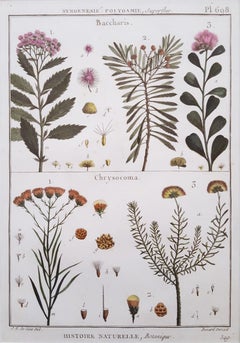
Baccharis (Baccharises); Chrysocoma (Golden Bitter Bush) /// Botanical Botany
Located in Saint Augustine, FL
Artist: Georges-Louis Leclerc, Comte de Buffon (French, 1707-1788) Title: "Baccharis (Baccharises); Chrysocoma (Golden Bitter Bush)" (Syngenesie; Polygamie, Plate 698) Portfolio: His...
Category

Old Masters 18th Century and Earlier Still-life Prints

Materials

Watercolor, Laid Paper, Engraving, Intaglio
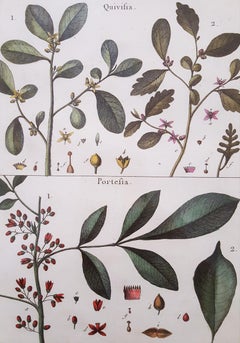
Quivisia; Portesia /// Antique Botanical Botany Plants Science Engraving Buffon
Located in Saint Augustine, FL
Artist: Georges-Louis Leclerc, Comte de Buffon (French, 1707-1788) Title: "Quivisia; Portesia" (Octandreie, Monogynie, Plate 302) Portfolio: Histoire Naturelle Year: 1749-1789 Medium...
Category

Old Masters 18th Century and Earlier Still-life Prints

Materials

Watercolor, Laid Paper, Engraving, Intaglio
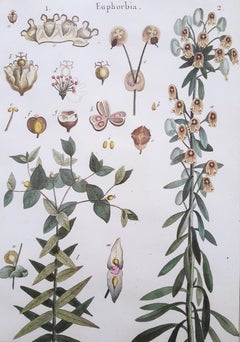
Euphorbia (Spurge) /// Antique Botanical Botany Plants Engraving Buffon Science
Located in Saint Augustine, FL
Artist: Georges-Louis Leclerc, Comte de Buffon (French, 1707-1788) Title: "Euphorbia (Spurge)" (Dodecandrie, Trigynie, Plate 411) Portfolio: Histoire Naturelle Year: 1749-1789 Medium...
Category

Old Masters 18th Century and Earlier Still-life Prints

Materials

Watercolor, Laid Paper, Engraving, Intaglio
3 plates from The Wondrous Transformation of Caterpillars their Strange Diet..
Located in Middletown, NY
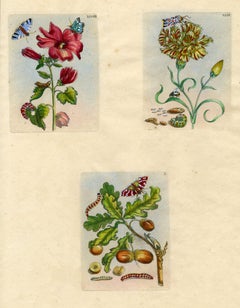
Three plates from The Wondrous Transformation of Caterpillars and their Strange Diet of Flowers. “Wolfsmelk Rupsen;" “Wolfsmilch, Raupe und Schmetterling" Amsterdam: J F Bernard, 1730. Each an engraving with hand coloring in watercolor and gouache printed on one sheet of watermarked Honig cream laid paper, each measures 6 1/4 x 5 inches (157 x 121 mm), sheet measures 20 5/8 x 14 inches (522 x 355 mm), full margins. With handling creases in the lower right sheet quadrant, as well as minor, loose cockling, otherwise in very good condition. The colors are superb with exceptionally fresh and bright saturation. Engraved between 1679 and 1683, printed 1730. Plates included: XLVIII; XLIX & L. MARIA SIBYLLA MERIAN was one of the most highly respected entomologists of the 17th century, and remains today one of the field's most significant figures. A German-born naturalist and scientific illustrator, she reared herself on the study of caterpillars, and made tremendous contributions to the knowledge of the life cycles of numerous species. Until her detailed and careful study of the process of metamorphosis it was thought that insects were "born of mud," through spontaneous generation. Trained as a miniature painter by her stepfather, she published her first book of illustrations in 1675, at the age of 28. In 1679, Merian published the first volume of the two-volume series on caterpillars, The Wondrous Transformation of Caterpillars and their Strange Diet of Flowers; the second volume followed in 1683. Each volume contained 50 plates that she engraved and etched. In 1699, Merian traveled to Dutch Guiana...
Category

Naturalistic 18th Century and Earlier Still-life Prints

Materials

Watercolor, Engraving

Citrus (Cedar Flower): An Early 18th C. Volckamer Hand-colored Engraving
Located in Alamo, CA
This is an early 18th century hand-colored copperplate engraving of the anatomy of a Cedar Flower citrus fruit by Johann Christoph Volkhamer, entitled "Cedro di fiore e Sugo doppia (...
Category

Naturalistic 18th Century and Earlier Still-life Prints

Materials

Engraving

4 plates from The Wondrous Transformation of Caterpillars their Strange Diet..
Located in Middletown, NY
Four plates from The Wondrous Transformation of Caterpillars and their Strange Diet of Flowers. “Wolfsmelk Rupsen;" “Wolfsmilch, Raupe und Schmetterling" Amsterdam: JF Bernard, 1730. Each an engraving with hand coloring in watercolor and gouache printed on one sheet of watermarked Honig cream laid paper, each measures 6 1/4 x 5 inches (157 x 121 mm), sheet measures 20 5/8 x 14 inches (522 x 355 mm), full margins. With handling creases in the lower right sheet quadrant, as well as minor, loose cockling, otherwise in very good condition. The colors are superb with exceptionally fresh and bright saturation. Engraved between 1679 and 1683, printed 1730. Plates included: CXLI, CXLII, CXIII & CXLIV. MARIA SIBYLLA MERIAN was one of the most highly respected entomologists of the 17th century, and remains today one of the field's most significant figures. A German-born naturalist and scientific illustrator, she reared herself on the study of caterpillars, and made tremendous contributions to the knowledge of the life cycles of numerous species. Until her detailed and careful study of the process of metamorphosis it was thought that insects were "born of mud," through spontaneous generation. Trained as a miniature painter by her stepfather, she published her first book of illustrations in 1675, at the age of 28. In 1679, Merian published the first volume of the two-volume series on caterpillars, The Wondrous Transformation of Caterpillars and their Strange Diet of Flowers; the second volume followed in 1683. Each volume contained 50 plates that she engraved and etched. In 1699, Merian traveled to Dutch Guiana...
Category

Naturalistic 18th Century and Earlier Still-life Prints

Materials

Watercolor, Engraving

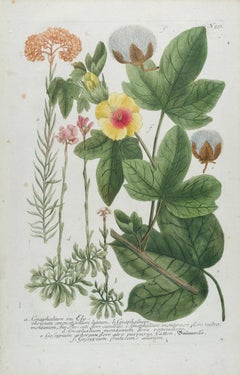
Flowering Cotton Plant: 18th Century Hand-colored Weinmann Botanical Engraving
Located in Alamo, CA
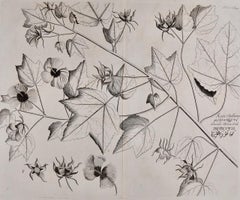
This striking hand-colored botanical mezzotint and line engraving is entitled "Gnaphalium, Gossypium (Cotton Plant)". It is plate 551 in Johann Weinmann's monumental publication "Phy...
Category

Naturalistic 18th Century and Earlier Still-life Prints

Materials

Engraving, Mezzotint

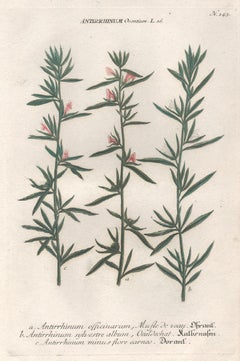
Antirrhinum Orontium - 18th century Weinmann botanical plant flower engraving
Located in Melbourne, Victoria
'Antirrhinum Orontium' Mezzotint printed in colours. Circa 1740. From Johann W Weinmann's Phytanthoza Iconographia, published in Regensburg 1737-45. The first botanical series to u...
Category

Naturalistic 18th Century and Earlier Still-life Prints

Materials

Engraving

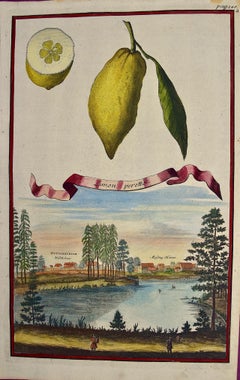
Lemons "Limon Peretto": An Early 18th Century Volckamer Hand-colored Engraving
Located in Alamo, CA
This is an early 18th century hand-colored copperplate engraving of the anatomy of lemons by Johann Christoph Volkhamer, entitled "Limon Peretto" from his publication "Nurmbergische ...
Category

Naturalistic 18th Century and Earlier Still-life Prints

Materials

Engraving

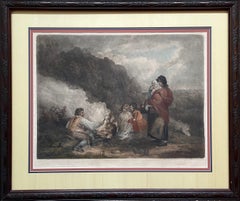
"The Fern Gatherers" 18th Century Antique Mezzotint Engraving by John R. Smith
Located in Carmel, CA
"The Fern Gatherers" After a painting by George Morland. 1763-1804. - Mezzotint engraving by John Raphael Smith. 1752-1812. Print: 20.75" x 26" - With Frame: 28" x 33.5" Published:...
Category

Realist 18th Century and Earlier Still-life Prints

Materials

Engraving, Mezzotint

Flowering Cactus: A Framed 18th C. Hand-colored Engraving by Redoute
Located in Alamo, CA
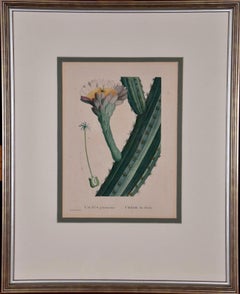
This framed hand-colored stipple engraving entitled "Cactus Peruvianus Cierge du Pérou" by Pierre-Joseph Redouté, Plate 58 from his illustrated publication 'Plantarum Historia Succulentarum ou Histoire des Plantes Grasses', published in Paris in 1799. It depicts a branching limb of a cactus with a beautiful flower. There is a separate detail of the anatomy of a seed with early growth. Redoute was a pioneer of the stipple engraving technique, which he used to create this image. It involves utilizing a series of small dots worked into a copper plate rather than the more common lines. These dots can be made smaller or thicker depending on the degree of opacity the artist intends for various areas of the print. When inked and applied to paper, this allows for a greater portion of the paper to be seen, which accentuates the appearance of luminosity of the subject the artist is creating. Different color inks are used in the printing process, a time consuming technique known as "a la poupee". The engraving is then finished with watercolor to further enhance the beauty and realism of the print subject. This engraving of a flowering cactus is presented in silver-colored ribbed wood frame and a double mat; cream-colored outer mat and heather green inner mat. The frame measures 21.25" high by 17.25" wide by 1.13" deep. The sheet measures 19.88" high by 14" wide. There are wide margins with a few short tears and chips along the the left, right and upper edges, which are all covered by the mat. There are small spots predominantly in the margins, with a few present in the image area. The print is otherwise in very good condition. There is another Redoute flowering cactus listed on 1stdibs, LU117326853392, which is framed and matted identically to this one. The pair would make an attractive display grouping. Pierre-Joseph Redouté (1759-1840), was a painter and botanist originally from Belgium, who pursued his extremely successful artistic career in France. He is well known for his watercolor paintings of roses, lilies and other flowers and their subsequent folio-sized, color stipple engravings. Some believe him to be the greatest botanical illustrator of all time. Redouté was a favorite of the French royal court at the time and of the post French...
Category

Naturalistic 18th Century and Earlier Still-life Prints

Materials

Engraving

Flowering Livid Amaranth: 18th Century Hand-colored Weinmann Botanical Engraving
Located in Alamo, CA
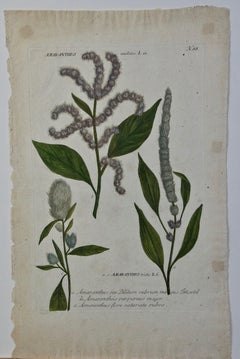
An 18th century color printed in addition to hand colored botanical mezzotint and line engraving by Johann Wilhelm Weinmann (1683-1741) depicting the following flowering amaranthus p...
Category

Naturalistic 18th Century and Earlier Still-life Prints

Materials

Engraving, Mezzotint

Ancient Roman Architectural Frieze: An 18th C. Piranesi Etching
Located in Alamo, CA
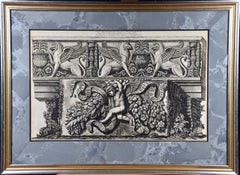
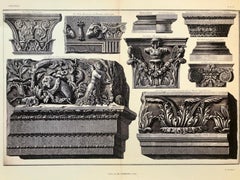
This framed original 18th century etching is entitled "Fregio antico di marmo con Ippogrifi, nel cortile del palazzo della Valle" (Ancient Marble Frieze with Hippogriffs in the Courtyard of The Palace of the Valley). The etching is by Giovanni Battista Piranesi, published in Rome in 1778. It is from Piranesi's monumental work "Vasi, Candelabri, Cippi, Sarcofagi, Tripodi, Lucerne, Ed Ornamenti Antichi", (Vases, candelabra, grave stones...
Category

Old Masters 18th Century and Earlier Still-life Prints

Materials

Etching

Pee-amerdu Plant: A Rare 17th Century Botanical Engraving by H. van Rheede
Located in Alamo, CA
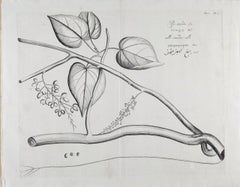
This is a rare 17th century engraving of a plant entitled "Pee-amerdu" by the Dutch botanist Hendrik van Rheede tot Drakenstein, plate 19 from his 'Hortus Indicus Malabaricus' (Garden of Malabar), published in Amsterdam in 1686 by Johann van Someren. The engraving depicts the Pee-amerdu plant, a large leafed plant climbing plant off the Malabar Coast in India. The plant is noted for its medicinal uses. It may be related to Tinospora species. Rheede's 19th century publication featured illustrations of exotic plants and fruits labelled with script in the upper right corner in Latin, Malay, Arabic, and Sanskrit. Hortus Indicus Malabaricus is believed to be the earliest comprehensive published work on the flora of Asia and the tropics. The 17th century treatise featured important illustrations of 740 plants of the region, including Indian medicinal plants. The engraving is printed on 17th century laid, chain-linked watermarked paper. The sheet measures 14.88" high by 18.75" wide. There is a central fold, as issued. There are a few faint smudges, a spot in the upper margin and there is minimal irregularity of the left edge of the paper where the print was previously bound in the 17th century publication. The print is otherwise in very good condition. There are additional Rheede botanical engravings from his 'Hortus Indicus Malabaricus' publication that are listed on my 1stdibs storefront and online website. These would make for an impressive display grouping. A discount is available for purchase of two or more of the prints. Hendrik Adriaan van Rheede tot Drakenstein...
Category

Naturalistic 18th Century and Earlier Still-life Prints

Materials

Engraving

Flowering Digitalis Plants: An Original 17th C. Botanical Engraving by E. Sweert
By Emanuel Sweert
Located in Alamo, CA
This beautiful and extremely rare early 17th century hand-colored copperplate engraving of four flowering Digitalis plants by the Dutch artist and botanist Emanuel Sweert is plate 6 ...
Category

Naturalistic 18th Century and Earlier Still-life Prints

Materials

Engraving

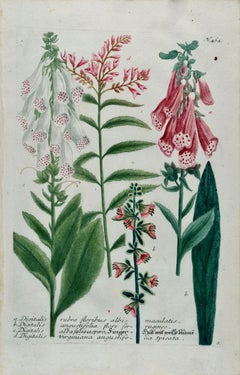
Flowering Digitalis Plant: 18th C. Hand-colored Botanical Engraving by Weinmann
Located in Alamo, CA
This hand-colored botanical mezzotint and line engraving by Johann Wilhelm Weinmann (1683-1741) is entitled "Digitalis rubra floribus albis maculatis. Digitalis angustifolia flore fe...
Category

Naturalistic 18th Century and Earlier Still-life Prints

Materials

Engraving, Mezzotint

THORNTON. Group of Carnations
Located in London, GB
Magnificent print by Robert John Thornton; aquatint and mezzotint, printed in colour and finished by hand, heightened with gum arabic, from The Temple of Flora. [London 1799] First state. Thornton was a prolific medical author and became a Doctor of Medicine at St Andrews University and licentiate of the Royal College of Physicians. However, he is best remembered for this great botanical publication The Temple of Flora, which formed a part of the larger work - New Illustration of the sexual system of Linnaeus. In 1797, he also began advertising for subscribers to his planned natural history publishing venture, which eventually comprised of 30 folio botanical plates. For these remarkable illustrations, he engaged the services of the leading artists and engravers of his day: Sir William Beechey, James Opie, Henry Raeburn, John Russell, Philip Reinagle...
Category

Naturalistic 18th Century and Earlier Still-life Prints

Materials

Mezzotint, Aquatint, Handmade Paper, Engraving
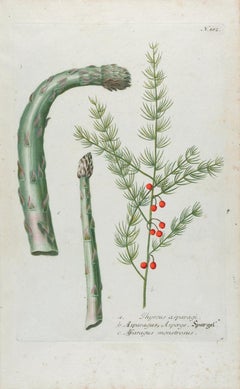
Asparagus Plant: An 18th Century Hand-colored Botanical Engraving by J. Weinmann
Located in Alamo, CA
This colored botanical mezzotint and line engraving finished with hand coloring by Johann Wilhelm Weinmann (1683-1741) is entitled a. Thyrsus asparagi. b. Asparagus, Asperge. c. Aspa...
Category

Naturalistic 18th Century and Earlier Still-life Prints

Materials

Engraving, Mezzotint

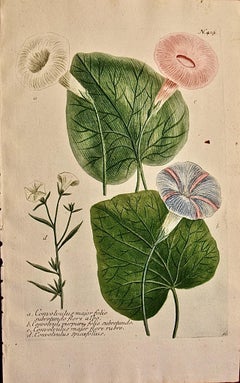
Flowering Morning Glory: 18th Century Hand-colored Weinmann Botanical Engraving
Located in Alamo, CA
This hand-colored botanical mezzotint and line engraving by Johann Wilhelm Weinmann (1683-1741) is entitled "A. Convolvulus Major Folio Subrotundo Purpureg Albo, B. Convolvulus Major...
Category

Naturalistic 18th Century and Earlier Still-life Prints

Materials

Engraving, Mezzotint

Caunga Cucumber Plant: A 17th Century Botanical Engraving by Hendrik van Rheede
Located in Alamo, CA
This is a rare 17th century engraving of a plant entitled "Caunga" by the Dutch botanist Hendrik van Rheede tot Drakenstein, plate 6 from his 'Hortus Indicus Malabaricus' (Garden of Malabar), published in Amsterdam in 1686 by Johann van Someren. The engraving depicts the caunga plant, also known as Inca cucumber or horned squash, which is a climbing vine that produces edible, cucumber-like fruits. Rheede's 19th century publication featured illustrations of exotic plants and fruits labelled with script in the upper right corner in Latin, Malay, Arabic, and Sanskrit. Hortus Indicus Malabaricus is believed to be the earliest comprehensive published work on the flora of Asia and the tropics. The 17th century treatise featured important illustrations of 740 plants of the region, including Indian medicinal plants. The engraving is printed on 17th century laid, chain-linked paper, watermarked with an elaborate crown design. The sheet measures 15.25" high by 18.88" wide. There is a central fold, as issued. There is a small dark spot on the left which appears to represent a paper inclusion which occurred when the hand-made paper was produced. The print is otherwise in excellent condition. There are additional Rheede botanical engravings from his 'Hortus Indicus Malabaricus' publication that are listed on my 1stdibs storefront and online website. These would make for an impressive display grouping. A discount is available for purchase of two or more of the prints. Hendrik Adriaan van Rheede tot Drakenstein...
Category

Naturalistic 18th Century and Earlier Still-life Prints

Materials

Engraving

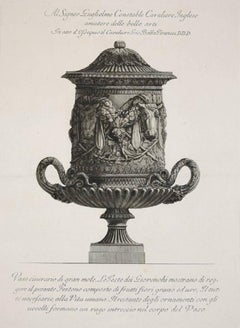
Vaso Cinerario di Gran Mole, etching from "Vases, Candelabras, Grave, Stones..."
Located in Roma, IT
Well-knowned as an architect and an archaeologist, undoubtedly Giovanni Battista Piranesi, is the most important engraver of the 18th century: the leading artist in this field in the...
Category

18th Century and Earlier Still-life Prints

Materials

Engraving, Etching

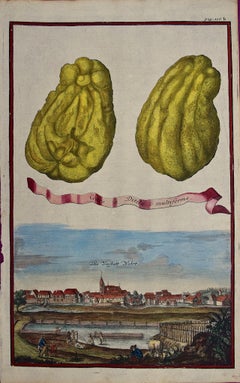
Lemons "Cedro Ditela Multiforme": An 18th C. Volckamer Hand-colored Engraving
Located in Alamo, CA
This is an early 18th century hand-colored copperplate engraving of lemons by Johann Christoph Volkhamer entitled "Cedro a Ditela o Multiforme" from his publication "Nurmbergische He...
Category

Naturalistic 18th Century and Earlier Still-life Prints

Materials

Engraving

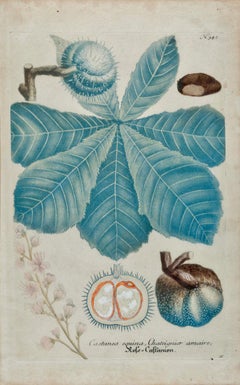
Flowering Chestnut Plant: 18th C. Hand-colored Botanical Engraving by Weinmann
Located in Alamo, CA
This hand-colored botanical mezzotint and line engraving by Johann Wilhelm Weinmann (1683-1741) is entitled "Castanea Equina, Chateignier amaire (Horse Chestnut)". It is plate 342 in...
Category

Naturalistic 18th Century and Earlier Still-life Prints

Materials

Engraving, Mezzotint

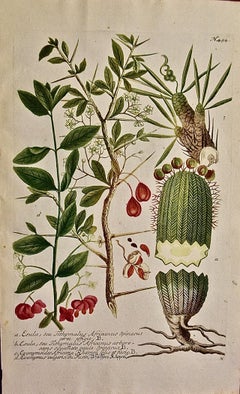
Flowering Spurge: 18th Century Hand-colored Botanical Engraving by J. Weinmann
Located in Alamo, CA
This hand-colored botanical mezzotint and line engraving by Johann Wilhelm Weinmann (1683-1741) is entitled "A. Esula seu Tithyinalus Africanus SpinosusCera Effigie, B. Esula seu Ti...
Category

Naturalistic 18th Century and Earlier Still-life Prints

Materials

Engraving, Mezzotint

Piranesi VI.
Located in Slovak Republic, SK
Fine Art Print Hahnemuehle, edition, Giovanni Battista Piranesi print in Verlag von Ad Lehmann in Wien, end of 19 Century.
Category

Italian School 18th Century and Earlier Still-life Prints

Materials

Black and White, Archival Pigment

Corn, Maize: An 18th Century Hand-colored Botanical Engraving by J. Weinmann
Located in Alamo, CA
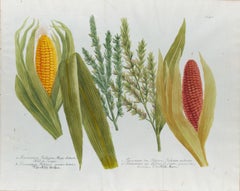
This is a striking original antique colored botanical mezzotint and line engraving of two varieties of corn or maize, which is finished with hand-coloring. It is entitled "Frumentum ...
Category

Naturalistic 18th Century and Earlier Still-life Prints

Materials

Engraving, Mezzotint

Vincent de Paul Portrait: 17th C. Engraving by Edelinck in Perrault s Les Hommes
Located in Alamo, CA
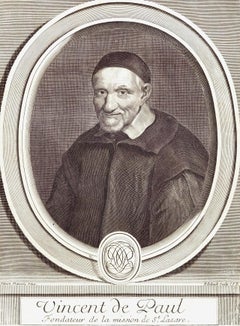
This is a 17th century portrait engraving of Saint Vincent de Paul by Gerard Edelinck (1640-1707) after a painting by Simon Francois (1606-1671), published in Charles Perrault's 'Les Hommes Illustres' in Paris in 1696. Vincent de Paul (1581-1660) was a French Catholic...
Category

Old Masters 18th Century and Earlier Still-life Prints

Materials

Engraving

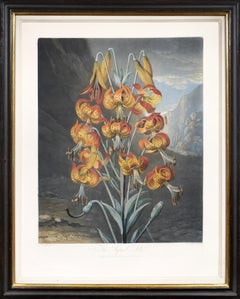
THORNTON. The Superb Lily.
Located in London, GB
A magnificent print by Robert John Thornton; aquatint and mezzotint, printed in colour and finished by hand, heightened with gum arabic, from The Temple of Flora...
Category

Naturalistic 18th Century and Earlier Still-life Prints

Materials

Mezzotint, Aquatint, Handmade Paper, Engraving
Oil Lamp - Etching by Giovanni Battista Casanova - 18th Century
Located in Roma, IT
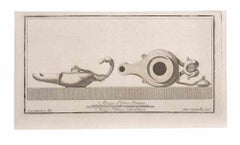
Oil Lamp is an Etching realized by Giovanni Battista Casanova (1735-1810). The etching belongs to the print suite “Antiquities of Herculaneum Exposed” (original title: “Le Antichit...
Category

Old Masters 18th Century and Earlier Still-life Prints

Materials

Etching

Red Roses: A Framed 17th C. Hand-colored Botanical Engraving by Basilius Besler
Located in Alamo, CA
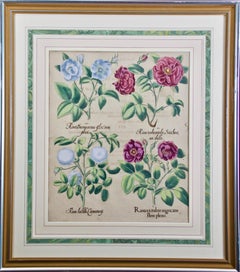
"Rosa ex rubro nigricans" (Red Roses); a hand-colored copper engraving from Basilius Besler's landmark work, Hortus Eystettensis (Garden at Eichstatt), first published in 1613 in Eichstatt, Germany near Nuremberg and later in 1640 and 1713. This engraving is presented in a glossy silver and matte gold-colored wood frame with a green edge and an elaborate double cream-colored French mats with light mauve bands; each accented by a broad decorative marbleized green band. It is glazed with plexiglass. There is text offset and a very small crease in the left margin, but the print is otherwise in excellent condition. Provenance: W. Graham Arader Gallery...
Category

Old Masters 18th Century and Earlier Still-life Prints

Materials

Engraving

Ancient Roman Statues in the Vatican: A Grouping of Three 18th C. Engravings
By Vincenzo Dolcibene
Located in Alamo, CA
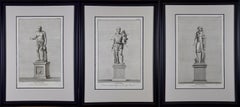
This is a set of three framed 18th century engravings depicting statues found in the Vatican, including: "Pescatore" (Fisherman), "Pastore" (Shepherd) and "Istrione" (Actor), "Gia ne...
Category

Old Masters 18th Century and Earlier Still-life Prints

Materials

Engraving

"Katu-Belluren": A 17th Century Botanical Engraving by Hendrik van Rheede
Located in Alamo, CA
This is a 17th century engraving of a vine spinach plant entitled "Katu-Belluren" by Hendrik van Rheede tot Drakenstein, plate 46 from his 'Hortus Indicus M...
Category

Naturalistic 18th Century and Earlier Still-life Prints

Materials

Engraving

Jean Racine Portrait: 17th C. Engraving by Edelinck in Perrault s Les Hommes
Located in Alamo, CA
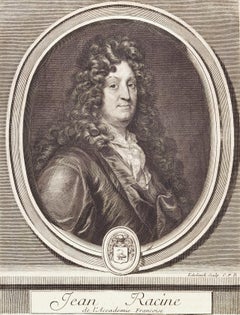
This is a 17th century portrait engraving of Jean-Baptiste Racine by Gerard Edelinck (1640-1707), published in Charles Perrault's 'Les Hommes Illustres' in Paris in 1696. Jean Racine (1639-1699) was a French dramatist, one of the three great playwrights of 17th-century France, along with Molière and Corneille. Racine's works were primarily tragedies. He wrote Phèdre, Andromaque, and Athalie. He did write one comedy, Les Plaideurs, and a muted tragedy, Esther for young readers. His writing is renowned for its elegance, purity, speed, and fury. The American poet Robert Lowell described his style as a "diamond-edge" and the "glory of its hard, electric rage". Racine's works often displayed his psychological insight, the passion of his characters, and the stark reality of his plots and stage descriptions. In 1672, he was elected to the Académie Française, and two years later he achieved the title of "treasurer of France", and later the honorary title of an "ordinary gentleman of the king" to King Louis XIV, and subsequently a secretary of the king . This beautiful engraved portrait is printed on chain-linked, laid paper with wide margins. The sheet measures 17.13" high by 10.75" wide. There is a small spot in the lower margin and a few tiny faint spots in the margins, but the print is otherwise in very good condition. The original descriptive text pages, 81 & 82, are included. Provenance: This engraving was owned by Arthur Pomeroy, 1st Baron Harberton and the Viscount Harberton (1723-1798). He was an Irish politician, who represented County Kildare in the Irish House...
Category

Old Masters 18th Century and Earlier Still-life Prints

Materials

Engraving

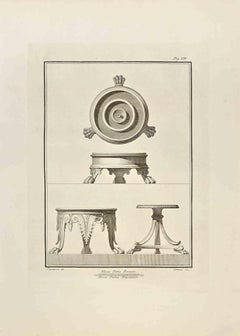
Still Life - Etching by Carlo Cataneo - 18th Century
Located in Roma, IT
Still Life from "Antiquities of Herculaneum" is an etching on paper realized by Carlo Cataneo in the 18th Century. Signed on the plate. Good conditions with folding, due to the tim...
Category

Old Masters 18th Century and Earlier Still-life Prints

Materials

Etching

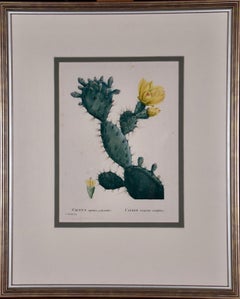
Flowering Prickly Pear Cactus: Framed 18th C. Hand-colored Engraving by Redoute
Located in Alamo, CA
This is a hand-colored stipple engraving entitled "Cactus Opuntia Polyanthos, Cierge Raquette Multiflore" (Prickly Pear Cactus) by Pierre-Joseph Redouté, Plate 59 from his illustrated publication 'Plantarum Historia Succulentarum ou Histoire des Plantes Grasses', published in Paris in 1799. Redoute was a pioneer of the stipple engraving technique, which he used to create this image. It involves utilizing a series of small dots worked into a copper plate rather than the more common lines. These dots can be made smaller or thicker depending on the degree of opacity the artist intends for various areas of the print. When inked and applied to paper, this allows for a greater portion of the paper to be seen, which accentuates the appearance of luminosity of the subject the artist is creating. Different color inks are used in the printing process, a time consuming technique known as "a la poupee". The engraving is then finished with watercolor to further enhance the beauty and realism of the print subject. This engraving of a flowering cactus is presented in a double mat; white outer mat and heather green inner mat.The mat measures 20" x 16" and the sheet measures 19.5" x 13.38". There are wide margins with a few short tears and chips along the the right and upper edges, which are all covered by the mat. There are small spots predominantly in the margins, but a few are present in the image area, but the print is otherwise in very good condition. There is another Redoute flowering cactus listed on 1stdibs, LU117326854582. The pair would make an attractive display grouping. Pierre-Joseph Redouté (1759-1840), was a painter and botanist originally from Belgium, who pursued his extremely successful artistic career in France. He is well known for his watercolor paintings of roses, lilies and other flowers and their subsequent folio-sized, color stipple engravings. Some believe him to be the greatest botanical illustrator of all time. Redouté was a favorite of the French royal court at the time and of the post French...
Category

Naturalistic 18th Century and Earlier Still-life Prints

Materials

Engraving

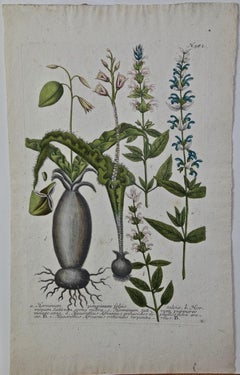
Flowering Dragonmouth: 18th Century Hand-colored Weinmann Botanical Engraving
Located in Alamo, CA
An 18th century hand colored botanical engraving by Johann Wilhelm Weinmann (1683-1741) depicting the following flowering sage plants:...
Category

Naturalistic 18th Century and Earlier Still-life Prints

Materials

Engraving, Mezzotint

Fever Nut Plant "Ban Caretti": A 17th Century Engraving by Hendrik van Rheede
Located in Alamo, CA
This is a 17th century engraving of a fever or bonduc nut plant entitled "Ban Caretti" by Hendrik van Rheede tot Drakenstein, plate 20 from his 'Hortus Indi...
Category

Naturalistic 18th Century and Earlier Still-life Prints

Materials

Engraving

Still Thinking About These?

All Recently Viewed