Modern Art Prints and Multiples

to
1,975
2,275
1,450
2,604
1,086
587
Overall Width
to
Overall Height
to
2,031
1,634
655
621
501
276
194
129
112
82
9
9
8
5
293
212
122
101
86
10
47
5,969
1,980
15
39
96
89
138
510
989
1,598
1,072
473
7
5,087
2,482
420
39,475
20,696
13,913
12,821
11,277
9,142
5,879
4,388
3,875
3,698
3,638
3,561
3,524
3,285
3,255
2,841
2,756
2,663
2,461
3,635
1,319
1,134
989
480
1,216
2,736
4,596
2,744
Art Subject: Modern Art
Red Poppies, Donald Sultan
Located in Fairfield, CT
Artist: Donald Sultan (1951) Title: Red Poppies Year: 2012 Medium: Silkscreen with Tar & Flocking on Museum Board Edition: 10/75, plus proofs Size: 23 x 39 inches Condition: Excellen...
Category

2010s Pop Art Still-life Prints

Materials

Tar, Screen

Peasant - Russian French Peasant
Located in London, GB
This original lithograph in colours is hand signed in pencil by the artist ‘Marc Chagall’ at the lower right margin. It is also numbered 5 from the edition of 75, at the lower left ...
Category

1960s Surrealist Figurative Prints

Materials

Lithograph

Portrait of a Woman, 1951 - Original lithograph
Located in Paris, IDF
Françoise GILOT (1921) Portrait of a woman, 1951 Original lithograph On Marais vellum 28 x 22.5 cm (c. 11 x 9 inches) REFERENCES : Catalog raisonne "Stone Echoes, Original Prints b...
Category

Late 20th Century Modern Portrait Prints

Materials

Lithograph

Dufy, Composition, Les Côtes Normandes (after)
Located in Southampton, NY
Lithograph on grand vélin d'Arches spécial paper. Unsigned and unnumbered, as issued. Good condition with centerfold, as issued. Notes: From the folio, Les Côtes Normandes 1961. Publ...
Category

1960s Modern Landscape Prints

Materials

Lithograph

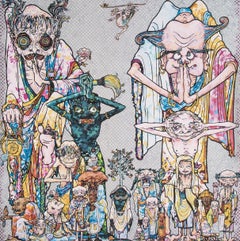
Takashi Murakami -- 12 Arhats
Located in BRUCE, ACT
Takashi Murakami 12 Arhats, 2016 Offset lithograph with silver Signed and numbered (56/300) in ink lower right Sheet size 68 x 68 cm Frame size 86 x 86 x 2.5 cm Publisher: Kaik...
Category

2010s Prints and Multiples

Materials

Offset

Marc Chagall, The Dance, from Derriere le miroir, 1964
Located in Southampton, NY
This exquisite lithograph by Marc Chagall (1887–1985), titled La Danse (The Dance), from the folio Derriere le miroir, No. 147, originates from the 1964 edition published by Maeght E...
Category

1960s Expressionist Figurative Prints

Materials

Lithograph

"Machu Pichu" - Black and Grey Lithograph #10/200
Located in Soquel, CA
"Machu Pichu" - Black and Grey Lithograph #10/200 Bold black and grey lithograph by David Alfaro Sequeiros (Mexican, 1896-1974). This piece is a high contrast, abstracted landscape....
Category

1940s Contemporary Figurative Prints

Materials

Paper, Lithograph

Alex Katz from A Tremor in the Morning signed, limited edition woodcut print
Located in San Rafael, CA
Alex Katz (b. 1927) Untitled, from the portfolio 'A Tremor in the Morning', 1986 Woodcut on wove paper Edition 32/45 Signed and numbered in pencil lower left Sheet: 20 x 19.75 inches...
Category

1980s Contemporary Figurative Prints

Materials

Lithograph, Woodcut

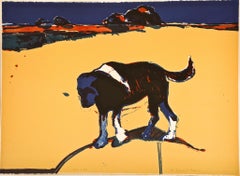
Fritz Scholder, "Walking Dog" Lithograph, 1977
Located in Los Angeles, CA
Fritz Scholder (1937 2005) Walking Dog 1977 Lithograph, Edition 80/100 Hand signed "Scholder" lower right, numbered lower left. Full sheet size, 22 inches x 30 inches. Printer: Tam...
Category

Late 20th Century Contemporary Prints and Multiples

Materials

Lithograph

David Hockney, Letter M, from Hockney s Alphabet, 1991
Located in Southampton, NY
This exquisite lithograph by David Hockney (born 1937), titled Letter M, from the folio Hockney's Alphabet, Drawings by David Hockney, originates from the 1991 edition published by A...
Category

1990s Contemporary Figurative Prints

Materials

Lithograph

Marc Chagall - Homage to Marc Chagall - Original Lithograph
Located in Collonge Bellerive, Geneve, CH
Marc Chagall Original Lithograph 1969 From the revue XXe Siecle, edition of 12,000 Unsigned, as issued Dimensions: 32 x 24 Condition : Excellent Reference: Mourlot 572 Marc Chagall (born in 1887) Marc Chagall was born in Belarus in 1887 and developed an early interest in art. After studying painting, in 1907 he left Russia for Paris, where he lived in an artist colony on the city’s outskirts. Fusing his own personal, dreamlike imagery with hints of the fauvism and cubism popular in France at the time, Chagall created his most lasting work—including I and the Village (1911)—some of which would be featured in the Salon des Indépendants exhibitions. After returning to Vitebsk for a visit in 1914, the outbreak of WWI trapped Chagall in Russia. He returned to France in 1923 but was forced to flee the country and Nazi persecution during WWII. Finding asylum in the U.S., Chagall became involved in set and costume design before returning to France in 1948. In his later years, he experimented with new art forms and was commissioned to produce numerous large-scale works. Chagall died in St.-Paul-de-Vence in 1985. The Village Marc Chagall was born in a small Hassidic community on the outskirts of Vitebsk, Belarus, on July 7, 1887. His father was a fishmonger, and his mother ran a small sundries shop in the village. As a child, Chagall attended the Jewish elementary school, where he studied Hebrew and the Bible, before later attending the Russian public school. He began to learn the fundamentals of drawing during this time, but perhaps more importantly, he absorbed the world around him, storing away the imagery and themes that would feature largely in most of his later work. At age 19 Chagall enrolled at a private, all-Jewish art school and began his formal education in painting, studying briefly with portrait artist Yehuda Pen. However, he left the school after several months, moving to St. Petersburg in 1907 to study at the Imperial Society for the Protection of Fine Arts. The following year, he enrolled at the Svanseva School, studying with set designer Léon Bakst, whose work had been featured in Sergei Diaghilev's Ballets Russes. This early experience would prove important to Chagall’s later career as well. Despite this formal instruction, and the widespread popularity of realism in Russia at the time, Chagall was already establishing his own personal style, which featured a more dreamlike unreality and the people, places and imagery that were close to his heart. Some examples from this period are his Window Vitebsk (1908) and My Fianceé with Black Gloves (1909), which pictured Bella Rosenfeld, to whom he had recently become engaged. The Beehive Despite his romance with Bella, in 1911 an allowance from Russian parliament member and art patron Maxim Binaver enabled Chagall to move to Paris, France. After settling briefly in the Montparnasse neighborhood, Chagall moved further afield to an artist colony known as La Ruche (“The Beehive”), where he began to work side by side with abstract painters such as Amedeo Modigliani and Fernand Léger as well as the avant-garde poet Guillaume Apollinaire. At their urging, and under the influence of the wildly popular fauvism and cubism, Chagall lightened his palette and pushed his style ever further from reality. I and the Village (1911) and Homage to Apollinaire (1912) are among his early Parisian works, widely considered to be his most successful and representative period. Though his work stood stylistically apart from his cubist contemporaries, from 1912 to 1914 Chagall exhibited several paintings at the annual Salon des Indépendants exhibition, where works by the likes of Juan Gris, Marcel Duchamp and Robert Delaunay were causing a stir in the Paris art world. Chagall’s popularity began to spread beyond La Ruche, and in May 1914 he traveled to Berlin to help organize his first solo exhibition, at Der Sturm Gallery. Chagall remained in the city until the highly acclaimed show opened that June. He then returned to Vitebsk, unaware of the fateful events to come. War, Peace and Revolution In August 1914 the outbreak of World War I precluded Chagall’s plans to return to Paris. The conflict did little to stem the flow of his creative output, however, instead merely giving him direct access to the childhood scenes so essential to his work, as seen in paintings such as Jew in Green (1914) and Over Vitebsk (1914). His paintings from this period also occasionally featured images of the war’s impact on the region, as with Wounded Soldier (1914) and Marching (1915). But despite the hardships of life during wartime, this would also prove to be a joyful period for Chagall. In July 1915 he married Bella, and she gave birth to a daughter, Ida, the following year. Their appearance in works such as Birthday (1915), Bella and Ida by the Window (1917) and several of his “Lovers” paintings give a glimpse of the island of domestic bliss that was Chagall’s amidst the chaos. To avoid military service and stay with his new family, Chagall took a position as a clerk in the Ministry of War Economy in St. Petersburg. While there he began work on his autobiography and also immersed himself in the local art scene, befriending novelist Boris Pasternak, among others. He also exhibited his work in the city and soon gained considerable recognition. That notoriety would prove important in the aftermath of the 1917 Russian Revolution when he was appointed as the Commissar of Fine Arts in Vitebsk. In his new post, Chagall undertook various projects in the region, including the 1919 founding of the Academy of the Arts. Despite these endeavors, differences among his colleagues eventually disillusioned Chagall. In 1920 he relinquished his position and moved his family to Moscow, the post-revolution capital of Russia. In Moscow, Chagall was soon commissioned to create sets and costumes for various productions at the Moscow State Yiddish Theater, where he would paint a series of murals titled Introduction to the Jewish Theater as well. In 1921, Chagall also found work as a teacher at a school for war orphans. By 1922, however, Chagall found that his art had fallen out of favor, and seeking new horizons he left Russia for good. Flight After a brief stay in Berlin, where he unsuccessfully sought to recover the work exhibited at Der Sturm before the war, Chagall moved his family to Paris in September 1923. Shortly after their arrival, he was commissioned by art dealer and publisher Ambroise Vollard to produce a series of etchings for a new edition of Nikolai Gogol's 1842 novel Dead Souls. Two years later Chagall began work on an illustrated edition of Jean de la Fontaine’s Fables, and in 1930 he created etchings for an illustrated edition of the Old Testament, for which he traveled to Palestine to conduct research. Chagall’s work during this period brought him new success as an artist and enabled him to travel throughout Europe in the 1930s. He also published his autobiography, My Life (1931), and in 1933 received a retrospective at the Kunsthalle in Basel, Switzerland. But at the same time that Chagall’s popularity was spreading, so, too, was the threat of Fascism and Nazism. Singled out during the cultural "cleansing" undertaken by the Nazis in Germany, Chagall’s work was ordered removed from museums throughout the country. Several pieces were subsequently burned, and others were featured in a 1937 exhibition of “degenerate art” held in Munich. Chagall’s angst regarding these troubling events and the persecution of Jews in general can be seen in his 1938 painting White Crucifixion. With the eruption of World War II, Chagall and his family moved to the Loire region before moving farther south to Marseilles following the invasion of France. They found a more certain refuge when, in 1941, Chagall’s name was added by the director of the Museum of Modern Art (MOMA) in New York City to a list of artists and intellectuals deemed most at risk from the Nazis’ anti-Jewish campaign. Chagall and his family would be among the more than 2,000 who received visas and escaped this way. Haunted Harbors Arriving in New York City in June 1941, Chagall discovered that he was already a well-known artist there and, despite a language barrier, soon became a part of the exiled European artist community. The following year he was commissioned by choreographer Léonide Massine to design sets and costumes for the ballet Aleko, based on Alexander Pushkin’s “The Gypsies” and set to the music of Pyotr Ilyich Tchaikovsky. But even as he settled into the safety of his temporary home, Chagall’s thoughts were frequently consumed by the fate befalling the Jews of Europe and the destruction of Russia, as paintings such as The Yellow Crucifixion...
Category

1960s Surrealist Figurative Prints

Materials

Lithograph

Composition, Poems of Léopold Sédar Senghor, Lois Mailou Jones
Located in Southampton, NY
Silkscreen on vélin paper. Paper Size: 22 x 17 inches. Inscription: Unsigned and unnumbered, as issued. Notes: From the album, Poems of Léopold Sédar Senghor, 1996. Published by The Limited Editions Club, New York; printed by Studio Heinrici, Ltd., New York, under the direction of Alexander Heinrici, New York, 1996. Excerpted from the album, CC examples of this album have been printed by Daniel Keleher at Wild Carrot Letterpress. This edition was designed and set in Bodoni types by Dan Cart and Julia Ferrari at Golgonooza Letter Foundry. The silkscreen prints were made by Alexander Heinrici at Studio Heinrici. LOIS MAILOU JONES (1905-1998) was an African American artist and educator, often associated with the Harlem Renaissance. Jones was raised in Boston by working-class parents who emphasized the importance of education and hard work. After graduating from Boston’s School of the Museum of Fine Arts, Jones began designing textiles for several New York firms. She left in 1928 to take a teaching position at Palmer Memorial Institute in North Carolina. At Palmer, Jones founded the art department, coached basketball, taught folk dancing, and played the piano for Sunday services. Two years later, she was recruited by Howard University in Washington, D.C., to join its art department. From 1930–77, Jones trained several generations of African American artists, including David Driskell, Elizabeth Catlett, and Sylvia Snowden...
Category

1990s Expressionist Figurative Prints

Materials

Screen

Portrait Imaginare 1981 Signed Limited Edition Lithograph
Located in Rochester Hills, MI
Guillaume Corneille Portrait Imaginare 1981 Print, Signed Lithograph on wove paper 25.5 x 19.5 " inches Signed in pencil and dated and marked 200/200 As a co-founder of the famed ...
Category

1980s Abstract Nude Prints

Materials

Lithograph

Petit traite de Morale, Surrealist Nude Etching by Hans Bellmer
Located in Long Island City, NY
Artist: Hans Bellmer, German Title: Petit traite de Morale Year: 1968 Medium: Color Etching, signed in pencil Image Size: 10.5 x 8.5 inches Frame Size: 20 x 16 inches
Category

1960s Surrealist Nude Prints

Materials

Etching

"The Gambler"
Located in Edinburgh, GB
A compelling example of Bellany’s expressive and emotionally charged visual language, The Gambler captures the existential tension and symbolic complexity characteristic of the artis...
Category

20th Century Impressionist Figurative Prints

Materials

Paper, Screen

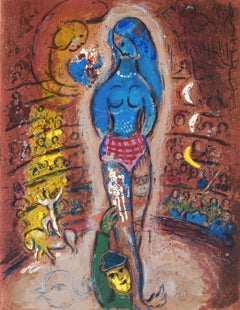
Composition XXXIV, from: Circus - Paris French Russian Circus
Located in London, GB
This original lithograph in colours is hand signed in pencil by the artist "Marc Chagall" at the lower right margin. It is also numbered 14 in pencil from the edition of 24, at the l...
Category

1960s Surrealist Figurative Prints

Materials

Lithograph

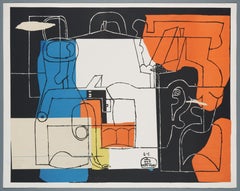
Portrait by Le Corbusier
Located in New York, NY
Artist: Le Corbusier Medium: Lithograph, 1960 Dimensions: 30 x 25.5 in, 76.2 x 64.8 cm Velin d'Arches - Very Good Condition A Le Corbusier was a visio...
Category

1960s Prints and Multiples

Materials

Lithograph

Joan Miro Painting (Escargot femme fleur etoile) 2010- Offset Lithograph
Located in Brooklyn, NY
Paper Size: 19.75 x 17 inches ( 50.165 x 43.18 cm ) Image Size: 19.75 x 17 inches ( 50.165 x 43.18 cm ) Framed: Yes Frame Size: H: 20.75 x W: 18 x D: .75 in. Condition: A: Mint ...
Category

2010s Prints and Multiples

Materials

Offset

In the Stretch
Located in Philadelphia, PA
LeRoy Neiman's art style is a blend of impressionism, expressionism, and realism, with elements of Pop Art is a great addition to any art collection.
Category

1970s American Impressionist Prints and Multiples

Materials

Screen

Royal Palm With Turkish Design, by David Smith-Harrison
Located in Palm Springs, CA
Signed, titled artist proof. Edition of 135. Like much of his work, Royal Palm has atmosphere of the Mediterranean, but all of the elements are rooted in the artist's neighborhood. ...
Category

Early 2000s Contemporary Landscape Prints

Materials

Aquatint, Etching

Colorful Happiness Equality (Limited Edition Print)
Located in LOS ANGELES, CA
**FALL SUPER SALE UNTIL OCT. 13TH - TAKE ADVANTAGE OF IT** **IMPORTANT: This is a limited edition of only 30 prints on canvas: signed and numbered by the artist. The print will arri...
Category

21st Century and Contemporary Abstract Figurative Prints

Materials

Canvas, Cotton Canvas

Horses - Lithograph, Ltd 100 copies
Located in Paris, IDF
Jean Marais (1913 - 1998) Horses Original lithograph Signed with the stamp of the artist (Also bears printed signature in the plate) Numbered / 100 copies On vellum 50 x 65 cm (c. ...
Category

Late 20th Century Modern Animal Prints

Materials

Lithograph

Adam and Eve Banished from the Paradise - Lithograph by Marc Chagall - 1960
Located in Roma, IT
Color lithograph realized by Marc Chagall in 1960 to illustrate "The Bible".  Edition of 6500, published by Tériade in no. 33 and 34 of the Art Magazine Verve. Printed by Mourlot a...
Category

1960s Surrealist Figurative Prints

Materials

Lithograph

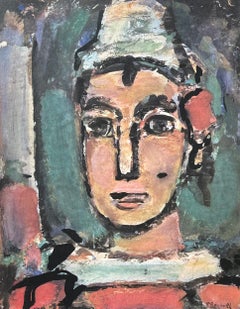
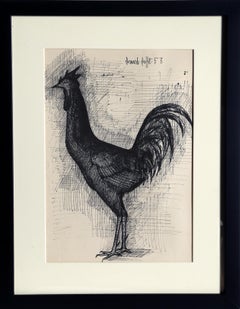
Clown sur Fond Bleu
Located in San Francisco, CA
This artwork, titled "Clown sur Fond Bleu" from the suite "Clowns" 1985, is an original color lithograph on Arches watermarked paper by renown French artist Bernard Buffet, 1928-1999...
Category

Late 20th Century Expressionist Figurative Prints

Materials

Lithograph

William Dunas Dance 4 - Pamela, Framed Lithograph by Alex Katz
Located in Long Island City, NY
Fourth Pose from the Night: William Dunas Dance suite by Alex Katz. The piece is framed in an exquisite hand-carved white gold leaf museum frame. Artist: Alex Katz, American (192...
Category

1970s American Realist Figurative Prints

Materials

Lithograph

Andy Warhol, Marilyn Monroe Print, Invitation to the Leo Castelli Gallery, 1981
Located in Beverly Hills, CA
An invitation to "Andy Warhol: A Print Retrospective 1963-1981" held at the Leo Castelli Gallery in New York City, printed with the iconic image of Marilyn Monroe. Published by Caste...
Category

1980s Pop Art Portrait Prints

Materials

Lithograph, Offset

GERHARD RICHTER Victoria II, 2003 Limited Edition
Located in Brooklyn, NY
Published in 2003, as a gift for the employees of the Victoria-Versicherung Insurance company. This is an offset lithograph of “Victoria II” printed on heavy stock paper. Listed in c...
Category

Early 2000s Contemporary Prints and Multiples

Materials

Offset

Bearden-Mecklenburg Morning: Sunrise for China Lamp Serigraph
By (after) Romare Bearden
Located in Brooklyn, NY
This vibrant recreation of Romare Bearden's work, titled Mecklenburg Morning: Sunrise for China Lamp, was published by American Vision Gallery Inc. and reproduced with the consent of...
Category

1990s Contemporary Interior Prints

Materials

Screen

Harlequin and the Horse trainer - Lithograph (Mourlot)
Located in Paris, IDF
Pablo PICASSO (1881-1973), Harlequin and the Horse Trainer, 1954 Lithograph (Mourlot workshop) Unsigned Printed date in the plate On paper 26 .5 x 35.5 cm (c. 10,2 x 13.7 in) INFO...
Category

Mid-20th Century Modern Figurative Prints

Materials

Lithograph

VICTOR VASARELY - OEUVRES PROFONDES CINETIQUES VIII - 1973
Located in Pembroke Pines, FL
Artist: Victor Vasarely Title: Profound Works VIII Year: 1973 Not signed or numbered, as published Dimensions: 12 in. by 12 in. Framed Edition: From the Rare Limited Edition Publisher: Editions du Griffon Neuchatel Suite: Profound Works Medium: 3D, Serigraph on Acitate Over Serigraph on Paper Condition: Excellent Victor Vasarely (French/Hungarian, 1906–1997) is known as the father of the Op Art movement. As a painter, he created intricate abstractions that suggested depth and dimensionality using a variety of optical illusions, with surfaces seeming to bulge out of the canvas. His works present color, form, and pattern as a single interconnected element—a concept that was critical to the foundation of the Op Art movement and the focus of his mature works. Vasarely initially studied medicine at the Budapest University in his early 20s, only to abandon his medical studies to attend to the Muhely Academy, the center of the Bauhaus movement in Budapest. While there, he was profoundly influenced by the work of color theorist and artist Josef Albers, as well as the Constructivist methods promoted by artists such as Wassily Kandinsky. While Vasarely’s earlier work was concerned more with color theory, during the 1950s and 1960s his work became more focused on the optical potential of the two-dimensional surface. He began to use complex and colorful patterns to actively engage the viewer’s eye, and to convey a sense of kinetic energy across the two-dimensional surface. Vasarely’s work was heavily influenced by his time spent at Breton Beach of Belle Isle...
Category

1990s Op Art Interior Prints

Materials

Screen

"Lendas Africanas Da Bahia" from the suite.
Located in San Francisco, CA
This artwork titled " Lendas Africanas Da Bahia" from the suite, 1978, is an original colors woodcut by renown Brazilian/Argentinian artist Hector Julio Paride Barnabo Carybe, 1911-1997. It is hand signed and numbered 83/200 in pencil by the artist. The Wood block mark (image) is 23.65 x 15.75 inches, sheet size is 26.75 x 19 inches. It is in excellent condition, has never been framed. It will be shipped in a 8 inches diameter heavy duty tube. About the artist: Héctor Julio Páride Bernabó (7 February 1911 – 2 October 1997) was an Argentine-Brazilian artist, researcher, writer, historian and journalist. His nickname and artistic name, Carybé, a type of piranha, comes from his time in the scouts. He died of heart failure after the meeting of a candomblé community's lay board of directors, the Cruz Santa Opô Afonjá Society, of which he was a member. Quick Facts Born, Died ... Carybé Born Héctor Julio Páride Bernabó 7 February 1911 Lanús, Argentina Died 2 October 1997 (aged 86) Salvador, Bahia, Brazil Nationality Brazilian Known for Painter, engraver, draughtsman, illustrator, potter, sculptor, mural painter, researcher, historian and journalist Close He produced thousands of works, including paintings, drawings, sculptures and sketches. He was an Obá de Xangô, an honorary position at Ilê Axé Opô Afonjá. Orixá Panels in the Afro-Brazilian Museum in Salvador Some of Carybé's work can be found in the Afro-Brazilian Museum in Salvador: 27 cedar panels representing different orixás or divinities of the Afro-Brazilian religion candomblé. Each panel shows a divinity with their associated implements and animal. The work was commissioned by the former Banco da Bahia S.A., now Banco BBM S.A., which originally installed them in its branch on Avenida Sete de Setembro in 1968. Murals at Miami International Airport American Airlines, Odebrecht and the Miami-Dade Aviation Department partnered to install two of Carybé's murals at Miami International Airport. They have been displayed in the American Airlines terminal at John F. Kennedy International Airport in New York since 1960. The 16.5 x 53-foot murals were accredited when Carybé won the first and the second prize in a contest of public art pieces for JFK airport. As its terminal at that airport was due for demolition, American Airlines donated the murals to Miami-Dade County, and Odebrecht invested in a project to remove, restore, transport and install the murals at Miami International Airport. The mural "Rejoicing and Festival of the Americas" portrays colorful scenes from popular festivals throughout the Americas, and "Discovery and Settlement of the West" depicts the pioneers’ journey into the American West. Carybé's Woodcuts in Gabriel García Márquez's Books Carybé illustrated four books by the Colombian writer Gabriel García Márquez, including One Hundred Years of Solitude, The Autumn of the Patriarch, Chronicle of a Death Foretold, and Love in the Time of Cholera "Carybé: um mestre da cultura baiana". ArqBahia Arquitetura, design, arte e lifestyle (in Brazilian Portuguese). 26 April 2023.. In particular, the woodcuts in One Hundred Years of Solitude are well-known for providing a visual image of the fictional town of Macondo, where the story takes place. The illustrations depict the colorful and winding houses, the railway bridge, and the hot and humid climate of the region, contributing to the reader's immersion in the story. Carybé's woodcuts are, therefore, an important part of Gabriel García Márquez's literary legacy, bringing a visual dimension to his stories that further enriches the reader's experience. Timeline 1911 — Birth in Lanús, Argentina. 1919 — Moved to Brazil. 1921 — The name Carybé is first given to him by the Clube do Flamengo scouts group, in Rio de Janeiro. 1925 — Beginning of his artistic endeavours, going to the pottery workshop of his elder brother, Arnaldo Bernabó, in Rio de Janeiro. 1927–1929 — Studies at the National School of Fine Arts, in Rio de Janeiro. 1930 — Worked for the newspaper Noticias Gráficas, in Buenos Aires, Argentina. 1935–1936 — Works with the writer Julio Cortázar and as a draughtsman for the El Diario newspaper. 1938 — Sent to Salvador by newspaper Prégon. 1939 — First collective exhibition, with the artist Clemente Moreau, at the Buenos Aires City Museum of Fine Arts, Argentina; illustrates the book Macumba, Relatos de la Tierra Verde, by Bernardo Kardon, published by Tiempo Nuestro. 1940 — Illustrates the book Macunaíma, by Mário de Andrade. 1941 — Draws the Esso Almanach, the payment for which allows him to set on a long journey through Uruguay, Brazil, Bolivia, and Argentina. 1941–1942 — Study trip around several South American countries. 1942 — Illustration for the book La Carreta by Henrique Amorim, published by El Ateneo (Buenos Aires, Argentina). 1943 — Together with Raul Brié, translates the book Macunaíma, by Mário de Andrade, into Spanish; produces the illustrations for the works Maracatu, Motivos Típicos y Carnavalescos, by Newton Freitas, published by Pigmaleon, Luna Muerta, by Manoel Castilla, published by Schapire, and Amores de Juventud, by Casanova Callabero; also publishes and illustrates Me voy al Norte, for the quarterly magazine Libertad Creadora; awarded First Prize by the Cámara Argentina del Libro (Argentine Book Council) for the illustration of the book Juvenília, by Miguel Cané (Buenos Aires, Argentina). 1944 — Illustrates the books The Complete Poetry of Walt Whitmann and A Cabana do Pai Tomás, both published by Schapire ; as well as and Los Quatro Gigantes del Alma by Mira y Lopez, Salvador BA; attends capoeira classes, visits candomblé meetings and makes drawings and paintings. 1945 — Does the illustrations for Daniel Defoe's Robinson Crusoe, for the Viau publishing house. 1946 — Helps in setting up the Tribuna da Imprensa newspaper, in Rio de Janeiro. 1947 — Works for the O Diário Carioca newspaper, in Rio de Janeiro. 1948 — Produces texts and illustrations for the book Ajtuss, Ediciones Botella al Mar (Buenos Aires, Argentina). 1949–1950 — Invited by Carlos Lacerda to work at the Tribuna da Imprensa, in Rio de Janeiro. 1950 — Invited by the Education Secretary Anísio Teixeira, moves to Bahia, and produces two panels for the Carneiro Ribeiro Education Center (Park School), in Salvador, Bahia. 1950–1997 — Settles in Salvador, Bahia. 1950–1960 — Actively participate in the plastic arts renewal movement, alongside Mário Cravo Júnior, Genaro de Carvalho, and Jenner Augusto. 1951 — Produces texts and illustrations for the works of the Coleção Recôncavo, published by Tipografia Beneditina and illustrations for the book, Bahia, Imagens da Terra e do Povo, by Odorico Tavares, published by José Olímpio in Rio de Janeiro; for the latter work he receives the gold medal at the 1st Biennial of Books and Graphic Arts. 1952 — Makes roughly 1,600 drawings for the scenes of the movie O Cangaceiro, by Lima Barreto; also works as the art director and as an extra on the film (São Paulo, SP). 1953 — Illustrations for the book A Borboleta Amarela, by Rubem Braga, published by José Olímpio (Rio de Janeiro, RJ). 1955 — Illustrates the work O Torso da Baiana, edited by the Modern Art Museum of Bahia. 1957 — Produces etchings, with original designs, for the special edition of Mário de Andrade's Macunaíma, published by the Sociedade dos 100 Bibliófilos do Brasil. 1958 — Makes an oil painting mural for the Petrobras Office in New York, USA; illustrates the book As Três Mulheres de Xangô, by Zora Seljan, published by Editora G. R. D. (Rio de Janeiro, RJ); Receives a scholarship grant in New York, USA. 1959 — Takes part in the competition for the New York International Airport panels project, in New York, USA, winning first and second prizes. 1961 — Illustrates the book Jubiabá, by Jorge Amado, published by Martins Fontes (São Paulo, SP). 1963 — Awarded the title of Honorary Citizen of Salvador, Bahia. 1965 — Illustrates A Muito Leal e Heróica Cidade de São Sebastião do Rio de Janeiro, published by Raymundo Castro Maya (Rio de Janeiro, RJ). 1966 — With Jorge Amado, co-authors Bahia, Boa Terra Bahia, published by Image (Rio de Janeiro, RJ); writes and illustrates the book Olha o Boi, published by Cultrix (São Paulo, SP). 1967 — Receives the Odorico Tavares Prize – Best Plastic Artist of 1967, in a competition ran by the state government to stimulate the development of plastic arts in Bahia; makes the Orixás Panels for the Banco da Bahia (currently at the UFBA Afro-Brazilian Museum) (Salvador, BA). 1968 — Illustrates the books Carta de Pero Vaz de Caminha ao Rei Dom Manuel, published by Sabiá (Rio de Janeiro) and Capoeira Angolana, by Waldeloir Rego, published by Itapoã (Bahia). 1969 — Produces the illustrations for the book Ninguém Escreve ao Coronel, by Gabriel Garcia Marquez, published by Sabiá (Rio de Janeiro, RJ). 1970 — Illustrates the books O Enterro do Diabo and Os Funerais de Mamãe Grande, published by Sabiá (Rio de Janeiro, RJ), Agotimé her Legend, by Judith Gleason, published by Grossman Publishers (New York, USA). 1971 — Illustrates the books One Hundred Years of Solitude, by Gabriel Garcia Marquez and A Casa Verde by Mario Vargas Llosa, both published by Sabiá (Rio de Janeiro, RJ); produces texts and illustrations for the book Candomblé da Bahia, published by Brunner (São Paulo, SP). 1973 — Illustrations for Gabriel Garcia Marquez's A Incrível e Triste História de Cândida Erendira e sua Avó Desalmada (Rio de Janeiro, RJ); paints the mural for the Legislative Assembly and the panel for the Bahia State Secretary of the Treasury. 1974 — Produces woodcuts for the book Visitações da Bahia, published by Onile. 1976 — Illustrates the book O Gato Malhado e a Andorinha Sinhá: uma história de amor, by Jorge Amado (Salvador, BA); receives the title of Knight of the Order of Merit of Bahia. 1977 — Certified with the Honor for Afro-Brazilian Cult Spiritual Merit, Xangô das Pedrinhas ao Obá de Xangô Carybé (Magé, RJ). 1978 — Makes the concrete sculpture Oxóssi, in the Catacumba Park; illustrates the book A Morte e a Morte de Quincas Berro D´Água, by Jorge Amado, published by Edições Alumbramento (Rio de Janeiro, RJ). 1979 — Produces woodcuts for the book Sete Lendas Africanas da Bahia, published by Onile. 1980 — Designs the costumes and scenery for the ballet Quincas Berro D´Água, at the Teatro Municipal in Rio de Janeiro. 1981 — Publication of the book Iconografia dos Deuses Africanos no Candomblé da Bahia (Ed. Raízes), following thirty years of research. 1982 — Receives the title of Honorary Doctor of the Federal University of Bahia. 1983 — Makes the panel for the Brazilian Embassy in Lagos, Nigeria. 1984 — Receives the Jerônimo Monteiro Commendation – Level of Knight (Espírito Santo); receives the Castro Alves Medal of Merit, granted by the UFBA Academy of Arts and Letters; makes the bronze sculpture Homenagem à mulher baiana (Homage to the Bahian woman), at the Iguatemi Shopping Center (Salvador, BA). 1985 — Designs the costumes and sets for the spectacle La Bohème, at the Castro Alves Theater; illustrates the book Lendas Africanas dos Orixás, by Pierre Verger, published by Currupio. 1992 — Illustrates the book O sumiço da santa: uma história de feitiçaria, by Jorge Amado (Rio de Janeiro, RJ). 1995 — Illustration of the book O uso das plantas na sociedade iorubá, by Pierre Verger (São Paulo, SP). 1996 — Making of the short film Capeta Carybé, by Agnaldo Siri Azevedo, adapted from the book O Capeta Carybé, by Jorge Amado, about the artist Carybé, who was born in Argentina and became the most Bahian of all Brazilians. 1997 — Illustration of the book Poesias de Castro Alves. Exhibitions ммIndividual Exhibitions: 1943 — Buenos Aires (Argentina) — First individual exhibition, at the Nordiska Gallery 1944 — Salta (Argentina) — at the Consejo General de Educacion 1945 — Salta (Argentina) — Amigos del Arte, Buenos Aires (Argentina) — Motivos de América, at the Amauta Gallery, Rio de Janeiro RJ — individual exhibition at the IAB/RJ 1947 — Salta (Argentina) — Agrupación Cultural Femenina 1950 — Salvador BA — First individual exhibit in Bahia, at the Bar Anjo Azul; São Paulo SP — MASP. 1952 — São Paulo SP — MAM/SP 1954 — Salvador BA — Oxumaré Gallery 1957 — New York (USA) — Bodley Gallery; Buenos Aires (Argentina) — Bonino Gallery * 1958 - New York (USA) — Bodley Gallery 1962 — Salvador BA - MAM/BA 1963 — Rio de Janeiro RJ — Bonino Gallery 1965 — Rio de Janeiro RJ — Bonino Gallery 1966 — São Paulo SP — Astrea Gallery 1967 — Rio de Janeiro RJ — Santa Rosa Gallery 1969 — London (England) — Varig Airlines 1970 — Rio de Janeiro RJ — Galeria da Praça 1971 — Rio de Janeiro RJ — MAM/RJ, São Paulo SP — A Galeria; Belo Horizonte MG, Brasília DF, Curitiba PR, Florianopolis SC, Porto Alegre RS, Rio de Janeiro RJ and São Paulo SP — The Orixás Panel (exhibition tour), at the Casa da Cultura in Belo Horizonte, MAM/DF, the Public Library of Paraná, the Legislative Assembly of Santa Catarina State, the Legislative Assembly of Rio Grande do Sul, MAM/RJ and MAM/SP 1972 — The Orixás Panel in Fortaleza CE — at the Ceará Federal University Art Museum, and in Recife PE — at the Santa Isabel Theater 1973 — São Paulo SP — A Galeria 1976 — Salvador BA — at the Church of the Nossa Senhora do Carmo Convent 1980 — São Paulo SP — A Galeria 1981 — Lisbon (Portugal) — Cassino Estoril 1982 — São Paulo SP — Renot Art Gallery, São Paulo SP — A Galeria 1983 — New York (USA) — Iconografia dos Deuses Africanos no Candomblé da Bahia, The Caribbean Cultural Center 1984 — Philadelphia (USA) — Art Institute of Philadelphia; Mexico — Museo Nacional de Las Culturas; São Paulo SP — Galeria de Arte André 1986 — Lisbon (Portugal) — Cassino Estoril; Salvador BA — As Artes de Carybé, Núcleo de Artes Desenbanco 1989 — Lisbon (Portugal) — Cassino Estoril; São Paulo SP — MASP 1995 — São Paulo SP — Documenta Galeria de Arte, São Paulo SP — Casa das Artes Galeria, Campinas SP — Galeria Croqui, Curitiba PR — Galeria de Arte Fraletti e Rubbo, Belo Horizonte MG — Nuance Galeria de Arte, Foz do Iguaçu PR — Ita Galeria de Arte, Porto Alegre RS — Bublitz Decaedro Galeria de Artes, Cuiabá MT — Só Vi Arte Galeria, Goiânia GO — Época Galeria de Arte, São Paulo SP — Artebela Galeria Arte Molduras, Fortaleza CE — Galeria Casa D'Arte, Salvador BA — Oxum Casa de Arte Collective Exhibitions: 1939 — Buenos Aires (Argentina) — Carybé and Clemente Moreau Exhibition, at the Museo Municipal de Belas Artes 1943 — Buenos Aires (Argentina) — 29th Salon de Acuarelistas y Grabadores — first prize 1946 — Buenos Aires (Argentina) — Drawings by Argentine Artists, at the Kraft Gallery 1948 — Washington (USA) — Artists of Argentina, at the Pan American Union Gallery 1949 — Buenos Aires (Argentina) — Carybé and Gertrudis Chale, at the Viau Gallery; Salvador BA — Bahian Showroom of Fine Arts, at the Hotel Bahia 1950 — Salvador BA — 2nd Bahian Showroom of Fine Arts; São Paulo SP — MAM/SP 1951 — São Paulo SP — 1st São Paulo Art Biennial, Trianon Pavilion. 1952 — Salvador BA — 3rd Bahian Showroom of Fine Arts, at Belvedere da Sé; São Paulo SP — MAM/SP 1953 — Recife PE — Mario Cravo Júnior and Carybé, at the Santa Isabel Theater; São Paulo SP — 2nd São Paulo Art Biennial, at MAM/SP 1954 — Salvador BA — 4th Bahian Showroom of Fine Arts, at the Hotel Bahia. — Bronze medal 1955 — São Paulo SP — 3rd São Paulo Art Biennial, at MAM/SP — first prize for drawing 1956 — Salvador BA — Modern Artists of Bahia, at the Oxumaré Gallery; Venice (Italy) — 28th Venice Biennial 1957 — Rio de Janeiro RJ — 6th National Modern Art Show — exemption from the jury; São Paulo SP — Artists from Bahia, at the MAM/SP 1958 — San Francisco (USA) — Works by Brazilian Artists, at the Fine Arts Museums of San Francisco, Washington and New York (USA) — Works by Brazilian Artists, at the Pan American Union and the MoMA 1959 — Seattle (USA) — 30th International Exhibition, at the Seattle Art Museum; Salvador BA — Modern Artists of Bahia, at the Dentistry School. 1961 — São Paulo SP — 6th São Paulo Art Biennial, at MAM/SP — special room 1963 — Lagos (Nigeria) — Brazilian Contemporary Artists, at the Nigerian Museum; São Paulo SP — 7th São Paulo Art Biennial Bienal, at the Fundação Bienal 1964 — Salvador BA — Christmas Exhibition, at the Galeria Querino 1966 — Baghdad (Iraq) — collective exhibition sponsored by the Calouste Gulbenkian Foundation; Madrid (Spain) — Artists of Bahia, at the Hispanic Culture Institute; Rome (Italy) — Piero Cartona Palace; Salvador BA — 1st National Biennial of Plastic Arts (Bienal da Bahia) — special room; Salvador BA — Draughtsmen of Bahia, at the Convivium Gallery 1967 — Salvador BA — Christmas Exhibition at the Panorama Art Gallery; São Paulo SP — Artists of Bahia, at the A Gallery 1968 — São Paulo SP — Bahian Artists, at the A Gallery 1969 — London (England) — Tryon Gallery; São Paulo SP — 1st Panorama of Current Brazilian Art at the MAM/SP; São Paulo SP — Carybé, Carlos Bastos...
Category

Late 20th Century Modern Figurative Prints

Materials

Woodcut

Passing/Posing Paintings Faux Chapel, suite of 18 prints Signed on bespoke box
Located in New York, NY
Kehinde Wiley Passing/Posing, Paintings & Faux Chapel (suite of 18 separate prints), 2004 Portfolio of 18 Separate Color offset lithographs in original black paste board portfolio bo...
Category

Early 2000s Contemporary Portrait Prints

Materials

Ink, Mixed Media, Board, Laid Paper, Lithograph, Offset

Henry Moore, Reclining Figure, from San Lazzaro et ses Amis, 1975
Located in Southampton, NY
This exquisite lithograph by Henry Moore (1898–1986), titled Reclining Figure, from the album San Lazzaro et ses Amis, Hommage au fondateur de la revue XXe siecle (San Lazzaro and His Friends, Tribute to the Founder of the Journal XXe Siecle), originates from the 1975 edition published by XXe siecle, Paris, and printed by Curwen Studio, London, October 1975. Reclining Figure embodies Moore’s lifelong fascination with the human form in repose—a theme that became central to his sculptural and graphic work. Through elegant contours and balanced abstraction, the composition captures the harmony between body, landscape, and spirit that defined Moore’s artistic vision. Executed as a lithograph on velin d'Arches paper, this work measures 10.5 x 14 inches (26.67 x 35.56 cm). Unsigned and unnumbered as issued. The edition exemplifies the exceptional craftsmanship of the Curwen Studio in London, a distinguished atelier celebrated for its collaborations with the leading modern artists of the postwar period. Artwork Details: Artist: Henry Moore (1898–1986) Title: Reclining Figure, from San Lazzaro et ses Amis, Hommage au fondateur de la revue XXe siecle, 1975 Medium: Lithograph on velin d'Arches paper Dimensions: 10.5 x 14 inches (26.67 x 35.56 cm) Inscription: Unsigned and unnumbered as issued Date: 1975 Publisher: XXe siecle, Paris Printer: Curwen Studio, London Catalogue raisonne references: Moore, Henry, et al. Henry Moore, Catalogue of Graphic Work. Gerald Cramer, 1986, illustration 366. Condition: Well preserved, consistent with age and medium Provenance: From the album San Lazzaro et ses Amis, Hommage au fondateur de la revue XXe siecle, published by XXe siecle, Paris, October 1975 Notes: Excerpted from the folio (translated from French), Finished printing in Paris in October 1975. This album has been printed on velin d'Arches in DLXXV numbered examples. The LXXV original examples include a series of VIII original lithographs, signed and numbered by the artists. In addition, LV examples were printed for artists, authors, friends and collaborators of XXe siecle. The typography is from l'Imprimerie Union in Paris; the lithographs of Max Bill, Marc Chagall, Hans Hartung, Braque, Fontana, Magnelli, Picasso, Magritte and Poliakoff were printed by Fernand Mourlot in Paris; those of Alexander Calder and Joan Miro by l'imprimerie Arte in Paris; that of Max Ernst by Pierre Chave in Vence; that of Zao Wou-Ki by ateliers Bellin in Paris; and that of Henry Moore by the Curwen Studio in London. About the Publication: San Lazzaro et ses Amis, Hommage au fondateur de la revue XXe siecle (San Lazzaro and His Friends, Tribute to the Founder of the Journal XXe Siecle), published in 1975 by XXe siecle, Paris, represents one of the most significant collaborative tributes in modern art publishing. Created in honor of Gualtieri di San Lazzaro, the visionary editor and founder of the journal XXe Siecle, the folio unites original lithographs by the greatest modern masters—Picasso, Chagall, Miro, Calder, Hartung, Moore, and others. Printed by premier ateliers such as Mourlot, Arte, Bellin, and Curwen, the portfolio celebrates the spirit of artistic collaboration and innovation that defined mid-20th-century modernism. About the Artist: Henry Moore (1898–1986) was a British sculptor, draftsman, and modernist pioneer whose monumental bronzes and organic abstractions revolutionized 20th-century sculpture and made him one of the most influential artists of his time. Renowned for his reclining figures, mother-and-child compositions, and pierced biomorphic forms inspired by nature, Moore transformed traditional carving into a universal language of rhythm, balance, and humanity. Born in Castleford, Yorkshire, he studied at the Leeds School of Art and the Royal College of Art in London, absorbing the influences of classical sculpture, African and Pre-Columbian art, and the radical innovations of the European avant-garde. Inspired by Pablo Picasso’s Cubist fragmentation of form, Joan Miro’s lyrical biomorphism, Wassily Kandinsky’s spiritual abstraction, and Constantin Brancusi’s purity of shape, Moore developed a style rooted in the harmony between mass and void, structure and space. During the interwar years, he became part of an international circle that included Alexander Calder, Alberto Giacometti, Salvador Dali, Marcel Duchamp, and Man Ray—artists who, like Moore, expanded art’s boundaries through abstraction, surrealism, and conceptual experimentation. Like Calder, Moore explored balance and movement; like Giacometti, he sought the spiritual essence of humanity; and like Dali and Duchamp, he challenged perception and redefined modern form. His sculptures, carved in stone or cast in bronze, evoke both ancient and modern sensibilities—forms that appear to breathe with natural vitality while engaging directly with their surrounding landscapes. Moore’s “Shelter Drawings” (1940–41), created during the London Blitz, revealed his deep empathy for the human condition, marking a pivotal moment in his exploration of resilience and vulnerability. By the mid-20th century, Moore’s monumental bronzes had become landmarks around the world, from the Lincoln Center in New York to the UNESCO headquarters in Paris, embodying timeless symbols of endurance, renewal, and unity. His synthesis of organic abstraction and humanism influenced generations of sculptors including Barbara Hepworth, Isamu Noguchi, Eduardo Paolozzi, Antony Gormley, Anish Kapoor, and Rachel Whiteread. Like Kandinsky and Miro, he believed abstraction could transcend culture and time, while like Duchamp and Man Ray, he embraced experimentation as a pathway to new truths. Moore’s works, housed in major collections including the Museum of Modern Art in New York, the Tate in London, the Guggenheim Museum, and the Art Institute of Chicago, continue to define the landscape of modern sculpture for their elegance, power, and emotional depth. Standing alongside Pablo Picasso, Alexander Calder, Alberto Giacometti, Salvador Dali, Joan Miro, Wassily Kandinsky, Marcel Duchamp, and Man Ray, Henry Moore remains a cornerstone of modern art—a sculptor whose vision united nature, form, and spirit into a universal language of beauty and meaning. His highest auction record was achieved by Reclining Figure: Festival (1951), which sold for $33.1 million USD at Christie’s, London, on June 30, 2016, reaffirming Henry Moore’s enduring legacy as one of the most visionary, influential, and collectible sculptors in the history of modern art. Henry Moore Reclining Figure...
Category

1970s Surrealist Figurative Prints

Materials

Lithograph

Pablo Picasso (1881-1973)–Picador et Taureau–Linocut in colors on Arches paper
Located in Varese, IT
Linocut in colors on Arches paper, edited in 1959 Limited edition 21 of 50 copies signed in pencil by artist in lower right corner and numbered 21/50 in lower left image size: 64.5 x 53.5 cm Paper size: 72,9 x 59,5 cm Framed size: 98.5 x 85.5 cm very good conditions Publications / Catalogue Raisonnée : This work is fully documented and referenced in the official Catalogue: - Baer 1229, Bloch 907 Framed to museum standards in a handmade frame , the background is made ph neutral for proper preservation of the work over the years , to avoid oxidation. We offer professional packaging and tracked shipping with DHL Express courier , ( shipping time: 24 hours for European countries and 4 to 6 days for America and other non-eu countries )  Shipping costs are included Notes: Pablo Picasso Picador et Taureau...
Category

1950s Abstract Animal Prints

Materials

Linocut

wood engraving for Mille Nuits
Located in Henderson, NV
Medium: wood engraving (after the watercolor). Printed in Paris in 1955 at the atelier Coulouma for "Mille nuits et une nuit" (1001 Nights) which was the last major portfolio by Kees...
Category

1950s Prints and Multiples

Materials

Engraving, Woodcut

James Jean Adrift IV Signed Numbered Embellished Print
Located in Draper, UT
Print: 25" x 19" Giclée print with intricate holographic, foil, sculptural glass-like details and enhancements. Signed by James Jean and numbered
Category

2010s Figurative Prints

Materials

Giclée

Baden Baden, Casino
Located in San Francisco, CA
This artwork titled "Baden Baden, Casino" 1988 is an original color serigraph by noted American artist LeRoy Neiman, 1921-2012. It is hand signed and numbered 261/375 in pencil by the artist. The image size is 36 x 42 inches, sheet size is 42 x 48 inches. With the blind stamp of the printer Styria Studio at the lower left corner margin. It is in excellent condition, three small pieces of hanging tape remain on the back. About the artist: Mr. Neiman's kinetic, quickly executed paintings and drawings, many of them published in Playboy, offered his fans gaudily colored visual reports on heavyweight boxing matches, Super Bowl games and Olympic contests, as well as social panoramas like the horse races at Deauville, France, and the Cannes Film Festival. Quite consciously, he cast himself in the mold of French Impressionists like Toulouse-Lautrec, Renoir and Degas, chroniclers of public life who found rich social material at racetracks, dance halls and cafes. Mr. Neiman often painted or sketched on live television. With the camera recording his progress at the sketchpad or easel, he interpreted the drama of Olympic Games and Super Bowls for an audience of millions. When Bobby Fischer and Boris Spassky faced off in Reykjavik, Iceland, to decide the world chess championship, Mr. Neiman was there, sketching. He was on hand to capture Federico Fellini directing "8 ½" and the Kirov Ballet performing in the Soviet Union. In popularity, Mr. Neiman rivaled American favorites like Norman Rockwell, Grandma Moses and Andrew Wyeth. A prolific one-man industry, he generated hundreds of paintings, drawings, watercolors, limited-edition serigraph prints and coffee-table books yearly, earning gross annual revenue in the tens of millions of dollars. Although he exhibited constantly and his work was included in the collections of dozens of museums around the world, critical respect eluded him. Mainstream art critics either ignored him completely or, if forced to consider his work, dismissed it with contempt as garish and superficial — magazine illustration with pretensions. Mr. Neiman professed not to care. Maybe the critics are right," he told American Artist magazine in 1995. "But what am I supposed to do about it — stop painting, change my work completely? I go back into the studio, and there I am at the easel again. I enjoy what I'm doing and feel good working. Other thoughts are just crowded out." His image suggested an artist well beyond the reach of criticism. A dandy and bon vivant, he cut an arresting figure with his luxuriant ear-to-ear mustache, white suits, flashy hats and Cuban cigars. "He quite intentionally invented himself as a flamboyant artist not unlike Salvador Dalí, in much the same way that I became Mr. Playboy in the late '50s," Hugh Hefner told Cigar Aficionado magazine in 1995. LeRoy Runquist was born on June 8, 1921, in St. Paul. His father, a railroad worker, deserted the family when LeRoy was quite young, and the boy took the surname of his stepfather. He showed a flair for art at an early age. While attending a local Roman Catholic school, he impressed schoolmates by drawing ink tattoos on their arms during recess. As a teenager, he earned money doing illustrations for local grocery stores. "I'd sketch a turkey, a cow, a fish, with the prices," he told Cigar Aficionado. "And then I had the good sense to draw the guy who owned the store. This gave me tremendous power as a kid." After being drafted into the Army in 1942, he served as a cook in the European theater but in his spare time painted risqué murals on the walls of kitchens and mess halls. The Army's Special Services Division, recognizing his talent, put him to work painting stage sets for Red Cross shows when he was stationed in Germany after the war. On leaving the military, he studied briefly at the St. Paul School of Art (now the Minnesota Museum of American Art) before enrolling in the School of the Art Institute of Chicago, where, after four years of study, he taught figure drawing and fashion illustration throughout the 1950s. When the janitor of the apartment building next door to his threw out half-empty cans of enamel house paint, Mr. Neiman found his métier. Experimenting with the new medium, he embraced a rapid style of applying paint to canvas imposed by the free-flowing quality of the house paint. While doing freelance fashion illustration for the Carson Pirie Scott department store in Chicago in the early 1950s, he became friendly with Mr. Hefner, a copywriter there who was on the verge of publishing the first issue of a men's magazine. In 1954, after five issues of Playboy had appeared, Mr. Neiman ran into Mr. Hefner and invited him to his apartment to see his paintings of boxers, strip clubs and restaurants. Mr. Hefner, impressed, showed the work to Playboy's art director, Art Paul, who commissioned an illustration for "Black Country," a story by Charles Beaumont about a jazz musician. Thus began a relationship that endured for more than half a century and established Mr. Neiman's reputation. In 1955, when Mr. Hefner decided that the party-jokes page needed visual interest, Mr. Neiman came up with the Femlin, a curvaceous brunette who cavorted across the page in thigh-high stockings, high-heeled shoes, opera gloves and nothing else. She appeared in every issue of the magazine thereafter. Three years later, Mr. Neiman devised a running feature, "Man at His Leisure." For the next 15 years, he went on assignment to glamour spots around the world, sending back visual reports on subjects as varied as the races at Royal Ascot, the dining room of the Tour d'Argent in Paris, the nude beaches of the Dalmatian coast, the running of the bulls at Pamplona and Carnaby Street in swinging London. He later produced more than 100 paintings and 2 murals for 18 of the Playboy clubs that opened around the world. "Playboy made the good life a reality for me and made it the subject matter of my paintings — not affluence and luxury as such, but joie de vivre itself," Mr. Neiman told V.I.P. magazine in 1962. Working in the same copywriting department at Carson Pirie Scott as Mr. Hefner was Janet Byrne, a student at the Art Institute. She and Mr. Neiman married in 1957. She survives him. A prolific artist, he generated dozens of paintings each year that routinely commanded five-figure prices. When Christie's auctioned off the Playboy archives in 2003, his 1969 painting Man at His Leisure: Le Mans sold for $107,550. Sales of the signed, limited-edition print versions of his paintings, published in editions of 250 to 500, became a lucrative business in itself after Knoedler Publishing, a wholesale operation, was created in 1975 to publish and distribute his serigraphs, etchings, books and posters. Mr. Neiman's most famous images came from the world of sports. His long association with the Olympics began with the Winter Games in Squaw Valley in 1960, and he went on to cover the games, on live television, in Munich in 1972, Montreal in 1976, Lake Placid in 1980, and Sarajevo and Los Angeles in 1984, using watercolor, ink or felt-tip marker to produce images with the dispatch of a courtroom sketch artist. At the 1978 and 1979 Super Bowls, he used a computerized electronic pen to portray the action for CBS. Although he was best known for scenes filled with people and incident, he also painted many portraits. Athletes predominated, with Muhammad Ali and Joe Namath among his more famous subjects, but he also painted Leonard Bernstein, the ballet dancer Suzanne Farrell...
Category

21st Century and Contemporary American Modern Figurative Prints

Materials

Screen

Salvador Dali -- Space Elephant, 1971
Located in BRUCE, ACT
Salvador Dali Space Elephant from Memories of Surrealism, 1971 Lithograph with etching in colors on Arches paper Hand signed lower right Numbered F 16/175 Reference Field 71-15 D
Category

1970s Prints and Multiples

Materials

Etching, Lithograph

Women, 2006, by Yayoi Kusama, limited edition print, signed, and numbered
Located in Hong Kong, HK
Women, Edition 6/120. Screenprint. Image: 76 x 60 cm. Sheet: 76 x 60 cm. Published in 2006 by Ishida Ryoichi. A print of the same edition is represented in plate 353, page 201 of the...
Category

Early 2000s Prints and Multiples

Materials

Screen

Hand Painted Aluminium Limited Edition#1-Dahlias-Briitish Awarded Artist
Located in London, GB
Shizico painted plein air ; this painting is a part of Summer Bloom Series, it is Shizico Yi's ongoing project in every summer at her garden. She began gardening in 2015 to create a ...
Category

2010s Abstract Impressionist Landscape Prints

Materials

Metal

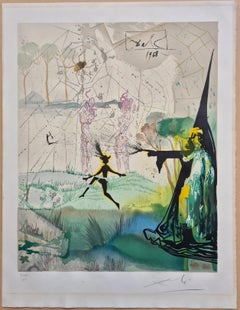
Pilgrim s Jo0urney
Located in Hollywood, FL
ARTIST: Salvador Dali TITLE: Pilgrim's Journey MEDIUM: Lithograph SIGNED: Hand Signed by Salvador Dali EDITION NUMBER: 301/400 MEASUREMENTS: 22.75" x 17" YEAR: 1978 FRAMED: No...
Category

1970s Surrealist Figurative Prints

Materials

Lithograph

Icart, Sans titre, Le Sopha (after)
Located in Southampton, NY
La pointe sèche etching on vélin de Rives filigrané à notre nom paper. Paper size: 9.5 x 7.5 inches; image size: 6.5 x 4.5 inches. Inscription: unsigned and unnumbered, as issued. No...
Category

1930s Modern Figurative Prints

Materials

Drypoint, Etching

Ailho
Located in OPOLE, PL
Victor Vasarely (1906-1997) - Ailho Lithograph from 1971. Dimensions of work: 48 x 40 cm. Reference: Catalogue Raisonné Vol I par Pedro Benavides n°185. The work is in Excellent ...
Category

1970s Op Art Prints and Multiples

Materials

Lithograph

Quartet No. 1
By Eugene Larkin
Located in Kansas City, MO
Eugene Larkin Quartet No. 1 Woodcut in two colors Signed and titled by hand Size: 20 x 29.5 inches COA provided Eugene Larkin (1921-2010) The late Eugene Larkin was an artist who worked in the Twin Cities area for many years and needs little introduction. His works have been shown, collected and appreciated by numerous galleries, museums and collectors throughout the United States. Larkin was influential both as an artist and as a teacher. He taught at the Minneapolis College of Art and Design between 1954 and 1969, where he was head of printmaking and Chairman of the Division of Fine Arts. From 1969-1991 he was a professor in the Design Department at the University of Minnesota. Eugene Larkin, a lithographer, teacher and artist who left behind scores of works, some of them in the permanent collections of the Library of Congress and the Museum of Modern Art. He was considered an early promoter of lithography education, Larkin introduced it into arts programs while teaching at the Minneapolis College of Art and Design and the University of Minnesota. He held a prominent place in the art world through decades of working and teaching in Minneapolis. His work depicted a wide range of subjects, from musicians to nature, including a series of woodcuts based on William Blake's ""Songs of Innocence and Experience." Larkin also wrote a textbook, ""Design: The Search for Unity."" It was his work with lithography, an 18th-century printmaking process, for which he was best known. His last local exhibit was a retrospective at The University of Minnesota Weisman Museum in 2005. ""Sometimes I start the artistic process from a literary source - Adam and Eve, the Egyptian nature gods, or classical Greek themes but sometimes I start from nature. Trees have always been a favorite subject. I see trees as people, as vertical objects...
Category

15th Century and Earlier Modern Prints and Multiples

Materials

Woodcut

André Brasilier -- AUTOMNE FINLANDAIS
Located in BRUCE, ACT
ANDRÉ BRASILIER (1908-1992) AUTOMNE FINLANDAIS, 1977 Lithograph on wove paper Annotated "épreuve d'artiste" low left Singed low right Image 46 x 64 cm Frame 76 x 92 x3 cm Y. Le Pi...
Category

1970s Landscape Prints

Materials

Lithograph

Salvador Dalí­ -- Sagittarius from Signs of the Zodiac
Located in BRUCE, ACT
Salvador Dalí­ Sagittarius from Signs of the Zodiac, 1967 Lithograph Hand signed lower right Numbered 144/250 lower left Image size: 64 x 48 cm Sheet size: 73 x 52 cm Printed by Mo...
Category

1960s Prints and Multiples

Materials

Lithograph

Florals Narcissus (Phones) Andalou
Located in Hollywood, FL
ARTIST: Salvador Dali TITLE: Florals Narcissus (Phones) Andalou MEDIUM: Etching SIGNED: Hand Signed EDITION NUMBER: 1/350 MEASUREMENTS: 21.75" x 29.5" YEAR: 1972 FRAMED: No...
Category

1970s Surrealist Still-life Prints

Materials

Etching

The city, The train station - Original lithograph, HANDSIGNED, 1959
Located in Paris, IDF
Fernand Léger The train station, 1959 Original lithograph (Atelier Mourlot) Signed with the artist's stamp Limited to 180 copies (Here numbered 160) On Arches vellum 66 x 50.5 cm (...
Category

1950s Modern Landscape Prints

Materials

Lithograph

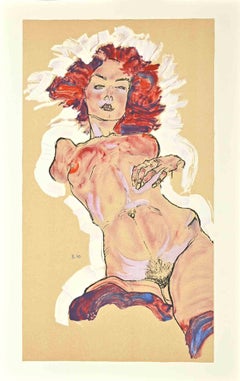
Kneeling Male Nude in Profile - Original Lithograph after E. Schiele
Located in Roma, IT
Kneeling Male Nude in Profile is a beautiful and original colored lithograph from the portfolio "Erotica" by Egon Schiele. It is a reproduction of the homonym artwork realized in gou...
Category

Early 2000s Modern Nude Prints

Materials

Lithograph

Andy Warhol, Lion - Signed Print, Pop Art
Located in Hamburg, DE
Andy Warhol (American, 1928-1987) Lion, 1975 Medium: Offset lithograph on wove paper Print dimensions: 28 × 20 cm (11 × 7 9/10 in) Frame dimensions: 32.8 x 25.8 x 2.9 cm (13 x 10 x 1...
Category

20th Century Pop Art Figurative Prints

Materials

Offset

Alchimie des Philosophes L Immortalite
Located in Hollywood, FL
ARTIST: Salvador Dali TITLE: Alchimie des Philosophes L'Immortalite MEDIUM: Etching on Parchment Paper SIGNED: Hand Signed PUBLISHER: Ar...
Category

1970s Surrealist Figurative Prints

Materials

Etching

Fernand Leger, Woman with a Vase, 1929 (after)
Located in Southampton, NY
This exquisite lithograph and pochoir after Fernand Leger (1881–1955), titled La Femme au Vase (Woman with a Vase), from the album L'Art Cubiste, Theories et Realisations, Etude Crit...
Category

1920s Cubist Still-life Prints

Materials

Lithograph, Stencil

Salvador Dalí­ -- Bullfight #4
Located in BRUCE, ACT
SALVADOR DALÍ Bullfight #4., 1965 Color lithograph Hand signed and numbered 190/300 in pencil, lower margin Sheet size: 64 x 52.5 cm Published by Sydney Z. Lucas, Paris, with the ink...
Category

1960s Prints and Multiples

Materials

Lithograph

French Gothic, Modern Lithograph by Lloyd Lozes Goff
Located in Long Island City, NY
Lloyd Lozes Goff, American (1918 - 1982) - French Gothic, Year: 1979, Medium: Lithograph, signed and numbered in pencil, Edition: 250, AP 30, Image Size: 24 x 18 inches, Size: 2...
Category

1970s Modern Landscape Prints

Materials

Lithograph

Rust Iris 1979 Signed Limited Edition Screen Print
Located in Rochester Hills, MI
Lowell Nesbitt Rust Iris - 1979 Screen print on Arches archival paper    29'' x 29'' inches Edition: Signed in pencil, dated and marked 151/175 Lowell Nesbitt emerged as one of the ...
Category

1970s Pop Art Still-life Prints

Materials

Screen

"Ceramiques" original lithograph
Located in Henderson, NV
Medium: original lithograph. Printed in 1973 and published by Maeght for the "Sculptures de Miro ceramiques de Miro et Artigas" catalogue. Sheet size: 8 x 7 3/4 inches (202 x 198 mm)...
Category

1970s Abstract Prints and Multiples

Materials

Lithograph

Heart Series I, Peter Max
Located in Fairfield, CT
Artist: Peter Max (1937) Title: Heart Series I Year: 1998 Edition: 130/300, plus proofs Medium: Lithograph on Coventry Smooth paper Size: 5 x 4 inches Condition: Excellent Inscriptio...
Category

1990s Pop Art Figurative Prints

Materials

Lithograph

Delicate Flowers - Etching by Georges Vial - Mid 1900
By Georges Vial
Located in Roma, IT
Delicate Flowers is an original artwork realized by Georges Vial in the XX Century. Hand-signed in pencil on the lower right corner. Numbered in penc...
Category

Mid-20th Century Modern Still-life Prints

Materials

Etching

LES ENCHANTEURS (MOURLOT 569)
Located in Aventura, FL
Lithograph in colors on Arches paper. Hand signed and numbered by Marc Chagall. Mourlot 569 Edition 43/50 (there were also 25 artist's proofs). Image size 22 x 14.5 inches. Sheet size 29.75 x 20.75 inches. Frame size approx 35 x 27 inches. Artwork is in excellent condition. All reasonable offers will be considered. About the Artist: Marc Chagall (French/Russian, 1887–1985) was an artist whose work anticipated the dream-like imagery of Surrealism. Over the course of his career, Chagall developed the poetic, amorphous, and deeply personal visual language evident in paintings like I and the Village...
Category

1960s Surrealist Figurative Prints

Materials

Paper, Lithograph

Grenade (Cramer 51; Kornfeld 121), Paroles peintes I, Marc Chagall
Located in Southampton, NY
Etching on vélin Johannot d’Arches paper. Inscription: Unsigned and unnumbered, as issued. Good condition. Notes: From the album, Paroles peintes I, 1962. Published by Éditions O. La...
Category

1960s Modern Landscape Prints

Materials

Etching

Recently Viewed

View All