Figurine Figurative Sculptures
to
157
1,232
448
358
151
165
Overall Width
to
Overall Height
to
84
327
657
1,283
40
27
49
56
25
11
20
35
59
68
25
916
148
76
62
39
25
22
18
7
6
3
1
4,031
2,355
2,285
1,662
1,651
1,318
790
751
684
519
404
356
355
293
282
276
270
253
200
174
1,580
1,461
303
287
197
30
30
28
27
24
1
7
1,258
899
Art Subject: Figurine
Deers, Art Deco figurine. Porcelain, hand painted. Riga Porcelain factory
Located in Riga, LV
Vintage Soviet period figurine from Riga of the 60's. Hand painted.
Category
1960s Art Deco Figurative Sculptures
Materials
Porcelain

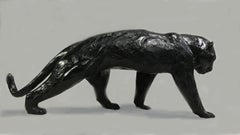
Panthère marchand
By Jorge Borras
Located in Pasadena, CA
After completing his studies at the Royal Catalan Academy of Fine Arts in Sant Jordi, Barcelona, Jorge Borrás moved to France1.
His works, especially his bronzes, are sold in major auctions mainly in France (Versailles, Drouot, Saint Germain En Laye, Enghien Les Bains, etc. June 30, 1992, two bronzes were sold at Christie's in London) 2. They are exhibited in Parisian salons such as the Salon d'automne3, the Salon des artistes français, the Salon des Independents the exhibitions of the National Society of Fine Arts, the Salon de l'école française [ref. necessary].
He received the Arts-Sciences-Lettresn 1 Medal and is a member of the International Association of Visual Arts (affiliated with UNESCO).
In addition, he produced a series of medals and sculptures for the Monnaie de Paris, and various achievements such as the bust of Dr. Coll Colomé, a monument erected in Benicarlo (Spain) and publishing covers including the novel by Jean-Marc Roberts Vincent's friend.
The work of Jorge Borrás is a tribute to the woman [ref. necessary]. Her favorite themes are ballerinas and bathers as well as women in everyday attitudes. Wild animals, some endangered, are also very present in the work of Jorge Borrás, especially in recent years where he takes great pleasure in capturing the wild moment of his attitudes.
Passionate about drawing, he began painting at the age of ten and made his first exhibition at the age of twenty.
At the School of Fine Arts in Barcelona, he discovered sculpture with Luisa Granero and studied painting and sculpture.
The students the drawing section, of the great master of Spanish painting and portrait painter Francisco Ribera Gomez...
Category
2010s Contemporary Figurative Sculptures
Materials
Bronze

$7,200 Sale Price
20% Off
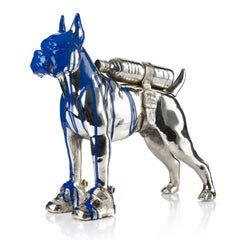
Cloned Bulldog with pet bottle
Located in Malmo, SE
Original sculpture 6/8 ex.
2011 - 2020.
Silver plated bronze.
Acquired directly from the artist.
Free shipment worldwide.
William Sweetlove, born in Ostend, Belgium, in 1949, unites...
Category
2010s Pop Art Figurative Sculptures
Materials
Silver, Bronze
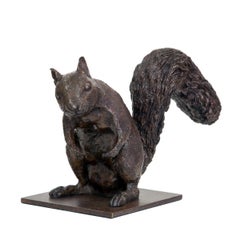
Squirrel II with Base
Located in Somerset West, WC
Squirrel II is a limited edition bronze sculpture.
Created with the lost wax casting process.
Category
21st Century and Contemporary Figurative Sculptures
Materials
Bronze
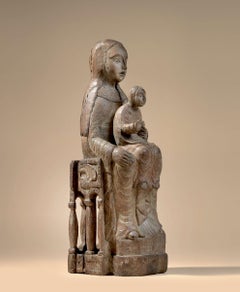
Romanesque Madonna - 1175/80
Located in Wien, Wien
ROMAN MADONNA
“Sedes Sapientiae”
Auvergne
Around 1175/80
Pine wood
Polychrome remains
Height 40 cm
This depiction of the Madonna is a masterfully carved, extremely early figure made...
Category
15th Century and Earlier Gothic Figurative Sculptures
Materials
Wood
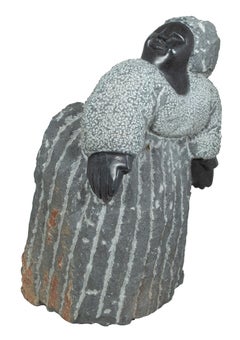
Grandmother
original Shona stone sculpture signed by Colleen Madamombe
Located in Milwaukee, WI
'Grandmother' is an original black serpentine sculpture by the celebrated second-generation Shona artist Colleen Madamombe. The sculpture presents a character common to Madamombe's w...
Category
Early 2000s Contemporary Figurative Sculptures
Materials
Stone
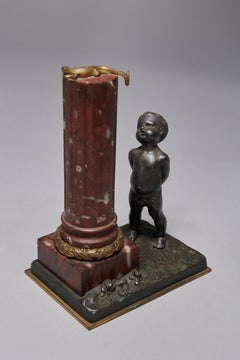
19th Century Bronze
Marble of Boy w/ Lizard and Column
Located in Beachwood, OH
Louis Kley (French, 1833-1911)
The Lizard, 19th Century
Gilt bronze and marble
Signed to base
6.25 x 4.5 x 3 inches
In Greco-Roman times, the lizard represented good fortune and reg...
Category
19th Century Figurative Sculptures
Materials
Marble, Bronze
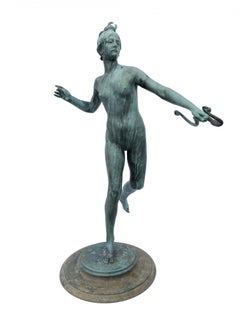
Diana the Huntress, 1890 Classical Bronze Sculpture of Nude Woman
Located in Beachwood, OH
Frederick William MacMonnies (American, 1863-1937)
Diana, 1890
Bronze with green verdigris patina
Signed and dated
Copyright 1894 with Jaboeuf & Rouard, Paris foundry mark
31 x 21 x 17 inches
A sculptor of classical figures, American-born Frederick MacMonnies...
Category
1890s Figurative Sculptures
Materials
Bronze
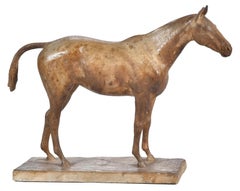
Finely rendered Equestrian Model Sculpture
Located in Greenwich, CT
a very fine Model Sculpture of a standing horse , finely rendered in patinated plaster, signed ‘MMM’ and dated 30 , w. rich burnished patina.
Its quality and elegance are reminiscent...
Category
Early 20th Century Figurative Sculptures
Materials
Plaster
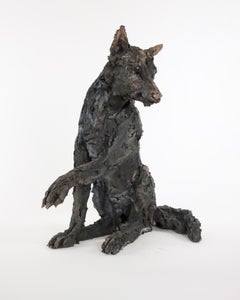
She-Wolf by Cécile Raynal - sandstone sculpture, animal art
Located in Paris, FR
She-Wolf is a unique smoke-fired sandstone sculpture by French contemporary artist Cécile Raynal, dimensions are 63 × 58 × 52 cm (24.8 × 22.8 × 20.5 in).
This sculpture is unique an...
Category
2010s Contemporary Figurative Sculptures
Materials
Sandstone
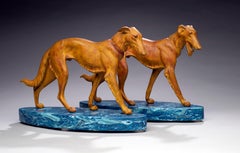
Antique Pair of Russian Wolf Hound/Borzoi Dog Portrait Sculptures circa 1930
s
Located in SANTA FE, NM
Antique Pair of Russian Wolfhounds/Borzois Dog Portrait Sculptures
by Scalini (aka Scali; Italian, 20th century)
circa 1930's
Patinated spelter
9 x 14 inches (on bases)
Though rath...
Category
1920s Art Deco Figurative Sculptures
Materials
Cast Stone, Bronze
$2,310 Sale Price
40% Off
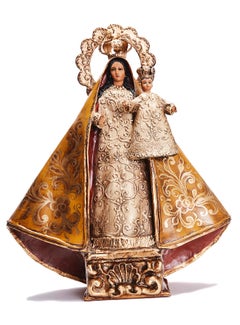
Virgen de la Caridad del Cobre - Crafts - Mexican Folk Art Paper
Located in Jesus del Monte, MX
MASTERPIECE
Piece made of cardboard, delicately hand painted by the most expert artisans of Guadalajara Jalisco, México.
LISTING
===================================
1 Cardboard handpainted Virgin
===================================
DIMENSIONS
===================================
24" x 24" x 8" in or 60 x 60 x 20 cm
===================================
DETAILS
===================================
Time of Preparation: 2 months
Made: Guadalajara, Jalisco, México.
Artisan: Danilo Lopez Ochoa...
Category
2010s Folk Art Figurative Sculptures
Materials
Cardboard
Moeder Studie 1 Mother Study 1 Bronze Woman Modern Sculpture Stone new In Stock
Located in Utrecht, NL
Jits Bakker (1937–2014) was a Dutch visual artist deeply inspired by classical mythology and Renaissance ideals. Though best known internationally as a sculptor, his artistic talents...
Category
21st Century and Contemporary Contemporary Figurative Sculptures
Materials
Stone, Bronze
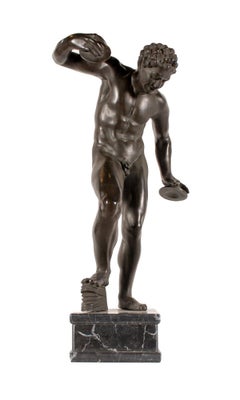
Satyr with Cymbals and Kroupezion, Grand Tour after the Antique, 19th century
Located in Beachwood, OH
19TH CENTURY CONTINENTAL SCHOOL
Satyr with Cymbals and Kroupezion, Grand Tour after the Antique
Bronze with marble base
26 in. h. x 15 in. w. x 10 in. d.
This dancing faun is now mo...
Category
19th Century Figurative Sculptures
Materials
Marble, Bronze
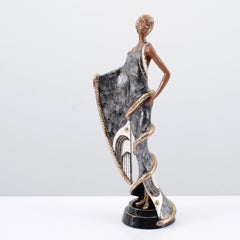
Erte CHINCHILLA Sculpture, 21.5"H
Located in Lake Worth Beach, FL
Artist/Designer; Manufacturer: Erte (Romain de Tirtoff) (Russian/ French, 1892-1990)
Marking(s); notes: signed; ed. 270/375; 1990
Materials: bronze
Dimensions (H, W, D): 21.5"h, 9.25...
Category
20th Century Art Deco Figurative Sculptures
Materials
Bronze
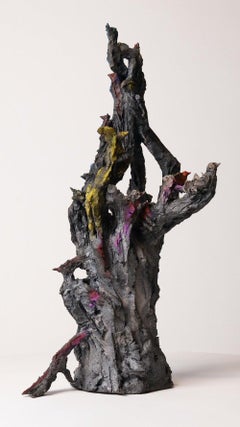
Arbre-monde III by Cécile Raynal - sandstone sculpture, pigments, birds, tree
Located in Paris, FR
Arbre-monde III is a unique smoke-fired sandstone sculpture by French contemporary artist Cécile Raynal, dimensions are 85 × 44 × 25 cm (33.4 × 17.3 × 9.8 in).
This sculpture is a unique piece signed by the artist and comes with a certificate of authenticity.
This highly narrative sculpture depicts a tree inhabited by various symbolic elements perched among its branches—birds, a wolf, a hare, and even a human hand. In recent years, animals have become increasingly prominent in Cécile Raynal’s artistic universe:
"All kinds of beasts and hybrid forms populate my work. Chimeras, constructed by elective affinities between animal figures and human," she writes in Memories of Embers (Éditions Privat, 2018).
More recently, however, the vegetal world has found a place in her sculptures, through representations of trees or the “vegetalization” of human and animal forms with branching elements. This evolution plays a central role in the present work.
“The title of this series naturally echoes the novel by Richard Powers...
Category
2010s Contemporary Figurative Sculptures
Materials
Sandstone
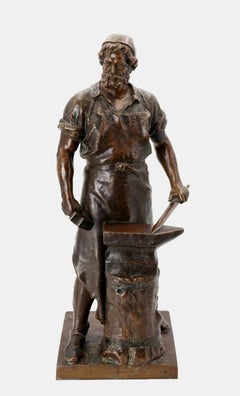
The Blacksmith of Solingen / - The Double-edged Sword -
Located in Berlin, DE
Wilhelm Albermann (1835 Werden an der Ruhr - 1913 Cologne), The Blacksmith of Solingen, after 1895. Bronze-color patinated zinc cast on plinth, 47 cm (height) x 20 cm (width) x 16 cm (depth), weight 5.5 kg. Signed “Albermann.” on the plinth and identified as a cast by “AKT.[TIEN] GES.[ELLSCHAFT] GLADENBECK BERLIN”. Dedication on the front: “Mr. Ing. F. Kuhlmann to the wedding. Management and officials of the Hannoversche Waggonfabrik. Aircraft construction department".
- The zinc showing through in spots, the patina somewhat stained, the right upper arm under the sleeve retouched in black.
- The Double-edged Sword -
The figure is a reduction of Wilhelm Albermann's 1895 fountain figure of the armourer of Solingen, who has always been identified with the historical blacksmith Peter Hahn. In 1839, Karl Simrock wrote the poem “The Blacksmith of Solingen" and thus coined the legendary figure. The first and penultimate verses read:
A blacksmith spoke to Solingen
With every bayonet,
That came to his diligence:
"Oh, that Fritz had it!"
The war took its course,
Many battles were fought,
Which often made him fearful and anxious
In his soul.
The blacksmith had given up his trade to fight for Frederick the Great. Not least because of his strength and will to fight, the battles were won. With his fountain sculpture, Albermann has given the legendary blacksmith a figurative form and at the same time created a landmark for the city of Solingen, which was once famous for the art of sword forging and today still stands for the production of high-quality knives. During the bombing raid in November 1944, the fountain was destroyed along with the entire old town of Solingen. Only the head remained.
The broad-shouldered blacksmith stands securely behind his anvil, his leather apron tied around him, and has just finished a sword blade with his own "weapon" - the blacksmith's hammer. His entire body shows the strength with which he wields the hammer, but also the strain of this activity, as evidenced by the wide open shirt, the somewhat 'untidy' apron, and especially the furrowed face.
However, the blacksmith does not look at the finished work, but resolutely and at the same time thoughtfully into the distance, in line with the quoted verse from Simrock's poem that the battles "often made him fearful and anxious in his soul". There is certainly something melancholy in his gaze, fed by the knowledge of the necessity of forging swords and taking up arms and their deadly use - experiences Albermann had to make during his own war missions. The flowing full beard gives his gaze into the distance an almost prophetic character.
In keeping with the craft of the perfectly formed art of blacksmithing, the detailed casting reproduces the respective materials depicted in perfect form: the leather apron convincingly conveys the impression of leather and lies - also in the back view - like a second formed layer over the body, while the shirt and trousers illustrate their own textile qualities.
Due to its masterful execution and profound content, the “Blacksmith of Solingen”, which has survived in its cast reproductions, remains Albermann's most famous work to this day.
About the artist
The son of a carpenter, Wilhelm Albermann began an apprenticeship as a joiner, but then followed his artistic calling and trained as a sculptor in Elberfeld. In 1855, at the age of twenty, he was drafted into the army in Berlin, where he served until 1857. Albermann attended the Berlin Art Academy on the side and began regular studies after his service. While still a student, he completed commissioned works for his teachers August Fischer and Hugo Hagen. His first independent commissions followed, enabling him to establish a flourishing sculpture studio in Cologne in 1865. His artistic activities were repeatedly interrupted by military service, and he took part in the German-Danish War in 1864, the war against Austria in 1866, and the Franco-Prussian War in 1870/71. After his last war service, Albermann, already a respected artist, founded a commercial drawing school at the request of the city government, where he taught the modeling class and served as director until 1896. In 1890 he also worked for the "Society for the Promotion of Sculpture in the Rhineland and Westphalia".
Albermann was one of the most prolific sculptors in Cologne in the second half of the 19th century. He created numerous monuments, fountains, tomb sculptures, architectural ornaments, and domestic statues. At its peak, his workshop employed up to thirty sculptors and stonemasons at a time.
GERMAN VERSION
Wilhelm Albermann (1835 Werden an der Ruhr - 1913 Köln), Der Schmied von Solingen, nach 1895. Bronzefarben patinierter Zinkguss auf gegossener Plinthe, 47 cm (Höhe) x 20 cm (Breite) x 16 cm (Tiefe), Gewicht 5,5 kg. Auf der Plinthe mit „Albermann.“ signiert und als Guss der „AKT.[TIEN] GES.[ELLSCHAFT] GLADENBECK BERLIN“ ausgewiesen. Schauseitige Widmung: „Herrn Ing. F. Kuhlmann zur Vermählung. Direktion und Beamte der Hannoverschen Waggonfabrik. Abt. Flugzeugbau“.
- Punktuelles Durchscheinen des Zinks, Patina etwas fleckig, der rechte Oberarm unter dem Ärmel schwarz retuschiert.
- Die Zweischneidigkeit des Schwertes -
Die Figur ist eine Reduktion von Wilhelm Albermanns 1895 geschaffener Brunnenfigur des Waffenschmieds von Solingen, der seit jeher mit dem historischen Schmied Peter Hahn identifiziert wurde. 1839 hatte Karl Simrock das Gedicht „Der Schmied von Solingen“ verfasst und damit die legendäre Figur geprägt. Die erste und die vorletzte Strophe lauten:
Zu Solingen sprach ein Schmied
Bei jedem Bajonette,
Das seinem Fleiß geriet:
»Ach, daß der Fritz es hätte!«
Der Krieg ging seinen Gang,
Man schlug noch viele Schlachten,
Die oft ihm angst und bang'
In seiner Seele machten.
Der Schmied hatte sein Handwerk ruhen lassen, um selbst für Friedrich den Großen zu kämpfen. Nicht zuletzt durch seine Kraft und seinen Kampfeswillen verliefen die Schlachten siegreich. Dem legendären Schmied verlieht Albermann mit seiner Brunnenskulptur eine bildliche Gestalt und schuf damit zugleich ein Wahrzeichen der Stadt Solingen, die einst für die Kunst des Schwerterschmiedens berühmt war und bis heute für die Herstellung qualitätvoller Messer einsteht. Beim Bombenangriff im November 1944 wurde mit der gesamten Solinger Altstadt auch der Brunnen zerstört. Einzig der Kopf blieb erhalten.
Mit sicherem Stand und umgebundener Lederschürze steht der breitschultrige Schmied hinter seinem Amboss und hat gerade mit seiner eigenen ‚Waffe‘ – dem Schmiedehammer – eine Schwertklinge fertiggestellt. Seinem gesamten Körper ist die Kraft abzulesen, mit der er den Hammer führt, aber auch die Anstrengung dieser Tätigkeit, wovon das weit geöffnete Hemd, die etwas ‚unordentlich‘ arrangierte Schürze und vor allem das zerfurchte Gesicht zeugen.
Der Schmied schaut aber nicht auf das vollendete Werk, sondern entschlossen und zugleich sinnierend in die Ferne, entsprechend der zitierten Zeile von Simrocks Gedicht, dass die Schlachten „oft ihm angst und bang‘ in seiner Seele machten“. Der Blick hat durchaus etwas Melancholisches, dass sich aus dem Wissen um die Notwendigkeit, Schwerter zu schmieden und zu den Waffen zu greifen und deren tödlichem Einsatz speist – Erfahrungen, die Albermann bei seinen eigenen Kriegseinsätze machen musste. Der wallende Vollbart verleiht dem in die Ferne schauenden Blick einen beinahe prophetischen Charakter.
Dem Handwerk der formvollendenden Schmiedekunst entsprechend, gibt der detaillierte Guss die jeweils dargestellten Materialien in vollendeter Ausformung wieder: Die Lederschürze vermittelt überzeugend den Eindruck des Leders und liegt – auch in der Rückenansicht – wie eine zweite ausgeformte Schicht über dem Körper, während das Hemd und die Hose...
Category
1890s Realist Figurative Sculptures
Materials
Metal
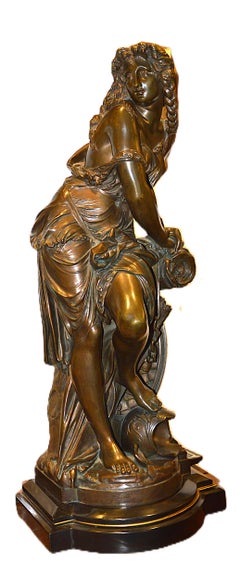
Amazone
Located in Berlin, DE
ALBERT-ERNEST CARRIER-BELLEUSE
French
1824 - 1887
signed: A. CARRIER
Bronze Marmor
Albert-Ernest Carrier-Belleuse (1824–1887) was a prominent French sculptor of the 19th centur...
Category
1870s Art Nouveau Figurative Sculptures
Materials
Bronze
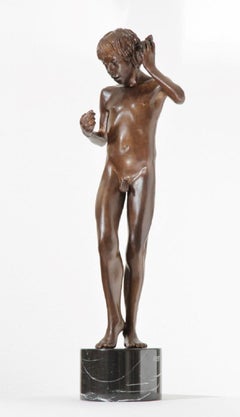
Aestus Bronze Sculpture Marble Stone Nude Boy Contemporary
Located in Utrecht, NL
Aestus Bronze Sculpture Marble Stone Nude Boy Contemporary
Wim van der Kant (1949, Kampen) is a selftaught artist. Next to his busy profession as a teacher ...
Category
21st Century and Contemporary Contemporary Nude Sculptures
Materials
Marble, Bronze
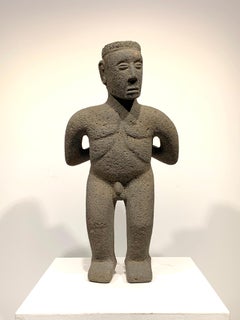
Costa Rican pre-Columbian sculptural figure ca. 1000-1500
Located in Wilton Manors, FL
Magnificent standing figure, Costa Rica, ca. 1000-1500. Carved volcanic stone. Measures 16.5 x 9 x 5.5 inches. Outstanding condition with no damage.
The figure represents a captured...
Category
15th Century and Earlier Figurative Sculptures
Materials
Stone
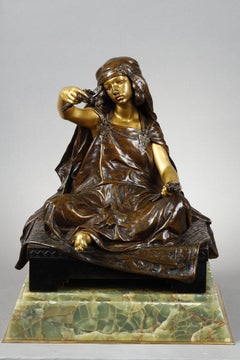
Young girl from Bou-Saada
Located in PARIS, FR
Young girl from Bou-Saada
by Louis-Ernest BARRIAS (1841-1905)
Rare bronze sculpture with a triple, dark brown, nuanced brown and gilded patina
Signed on the base " E. Barrias "
Cast...
Category
Early 1900s French School Figurative Sculptures
Materials
Bronze
Duco Lineam Bronze Sculpture Boy Male Nude Figure Marble
Located in Utrecht, NL
Duco Lineam Bronze Sculpture Boy Male Nude Figure Marble
Duco Lineam is a bronze male nude figure, a sculpture on a marble foot, from a boy bending and wri...
Category
21st Century and Contemporary Contemporary Figurative Sculptures
Materials
Bronze
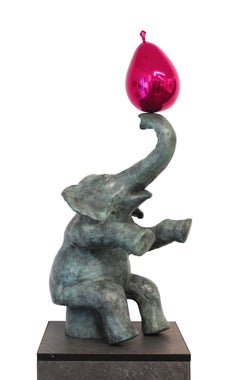
Eléphant et son ballon rose
Located in PARIS, FR
Elephant and Pink Balloon" by Philippe Berry is a contemporary work that blends humour and poetry through the depiction of an elephant carrying a pink balloon. The artist, known for ...
Category
21st Century and Contemporary Pop Art Figurative Sculptures
Materials
Silver, Bronze
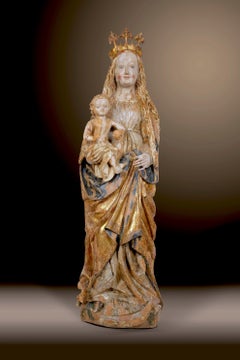
CRESCENT MOON MADONNA
Located in Wien, Wien
Master in the circle of Michael Pacher
(Mühlen ca. 1435 - 1498 Salzburg)
Salzburg
Around 1480
Carved limewood
Old polychrome version
Height 118 cm
This Madonna is an outstanding ex...
Category
15th Century and Earlier Gothic Figurative Sculptures
Materials
Wood
$168,000
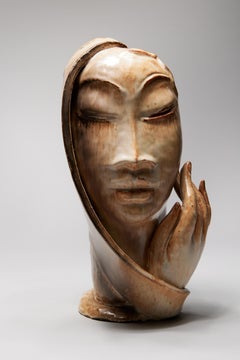
Bust of Josephine Baker, Mid-Century Ceramic Female Face
By Vally Wieselthier
Located in Beachwood, OH
Attributed to Vally Wieselthier (Austrian-American, 1895-1945)
Bust of Josephine Baker, c. 1930
Ceramic
Stamped on base
11.5 x 5.5 x 5.5 inches
Vally Wieselthier (1895 Vienna--1945 ...
Category
1930s Figurative Sculptures
Materials
Ceramic
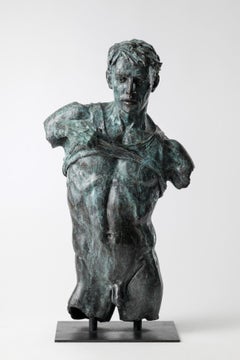
Demian Undressing
Located in London, GB
Bronze
Numbered 1/10
66cm × 26cm × 36cm (incl. base)
Ian Rank-Broadley is one of the foremost sculptors working today. His effigy of the late Queen Elizabeth II appears on all UK an...
Category
2010s English School Figurative Sculptures
Materials
Bronze
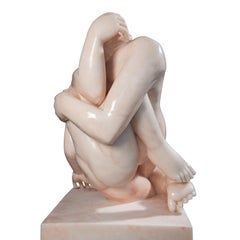
Bacio (Kiss) - hand carved Italian contemporary figurative rose marble sculpture
Located in San Francisco, CA
Bacio (Kiss) by Lorenzo Vignoli
striking hand carved marble sculpture of rare Portuguese rosa marble by contemporary Italian sculptor Lorenzo Vignoli, incorporating classical refere...
Category
21st Century and Contemporary Contemporary Figurative Sculptures
Materials
Stone, Marble, Carrara Marble
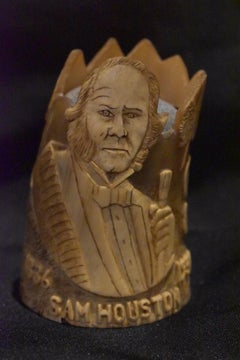
"SAM HOUSTON" HORN CARVING 1936 TEXAS CENTENNIAL AMAZING WORK
Located in San Antonio, TX
Dan Super "SAM HOUSTON"
(1873-1953)
Houston Artist
Image Size: 3 3/4 inches tall
Medium: Carved Horn of Sam Houston to celebrate the Texas Centennial.
Texas Centennial 1936
"Sam Houston Pin Cushion Holder"
Biography
Dan Super (1873-1953)
Dan E. Super, Jr. (1873 – 1953) Dan Super had the eye of a sculptor, envisioning and then creating hundreds of objects from the elongated form of a Texas Longhorn’s tusk. At the age of six, Dan Super carved his first drawing into a piece of the horn of a Texas Longhorn. Over the next 56 years, he made utilitarian pieces like pencil cups, pin cushions, and backscratchers, realistic replicas of animals and birds, and imaginative carvings of elegant nudes. While these carvings resemble the traditional art of scrimshaw, carvings from whale bone, we’ve not been able to identify another carver who used the Texas Longhorn as his material. “My work is done with an ordinary pocketknife, hacksaw file and rasp,” Super wrote in 1937. He used the horn in every way conceivable; whole, allowing the shape to define the object he was making, flattened to make mosaic or inlay work. He incised and pierced it and carved in the round. His own hands polished the horn to a sheen. Daniel Super, Jr. was born in Houston on August 22, 1873. His father owned stock years, D. Super and Brothers Co., providing the young Super with ready access to his raw material. Throughout his life, he worked in the businesses key to the identity and success of young, booming Houston, cattle, oil, real estate and rail. In 1896 he married Lula, and took over the family business, expanding it to include a grocery. He closed the company in 1912 and got into the oil business...
Category
1930s Realist Figurative Sculptures
Materials
Other Medium
When the Lights Go On Again, Mid Century Cast Stone, Cleveland School Artist
Located in Beachwood, OH
Walter Sinz (American, 1881-1966)
When the Lights Go On Again, 1943
Cast Stone
10 x 4.5 x 8 inches
Walter A. Sinz was an American sculptor born in Cleveland, Ohio on July 13, 1881. ...
Category
1940s Figurative Sculptures
Materials
Cast Stone
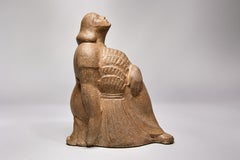
Magnificent Marble Sculpture of Roman Mythological Subject Minerva 1780
Located in Rome, IT
Finely carved mythological roman subject of Minerva in Marble Travertino . Excellent condition from an estate of Veneto.
Measurements: Statue cm 180 .
Minerva (Pallas Athena in Greek...
Category
Late 18th Century Academic Figurative Sculptures
Materials
Marble
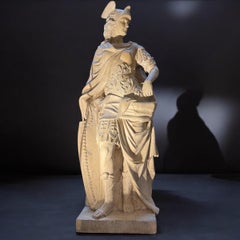
Ferdinand Preiss Hoop Girl And Sonny Boy Painted Bronze Figures
Located in Dallas, TX
Ferdinand Preiss (German, 1882 - 1943) Hoop Girl & Sonny Boy Cold-painted bronze
Circa 1930, Art Deco Period
Dimensions: 8.18 Inches Tall x 4.65 Inches wide x 2.75 inches deep.
...
Category
1930s Art Deco Figurative Sculptures
Materials
Marble, Bronze
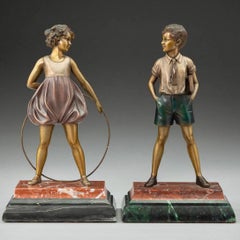
Opvliegende Uil no. 9 Flying Owl Bronze Sculpture Animal Bird Wild Life In Stock
Located in Utrecht, NL
Vliegende Uil no. 9 Flying Owl Bronze Sculpture Animal Bird Wild Life In Stock
Evert den Hartog (born in Groot-Ammers, The Netherlands in 1949) followed his education to be a sculpt...
Category
21st Century and Contemporary Contemporary Figurative Sculptures
Materials
Bronze
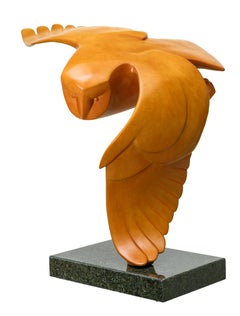
Albert Ernest Carrier-Belleuse A Figural Bronze Sculpture Melodie
Located in New York, NY
Albert-Ernest Carrier-Belleuse (1824 - 1887)
Female Figural Bronze Sculpture Melodie (Melody)
A young lady with a lyre in bronze with a dark green patina
19th Century
31" H x ...
Category
19th Century Figurative Sculptures
Materials
Bronze
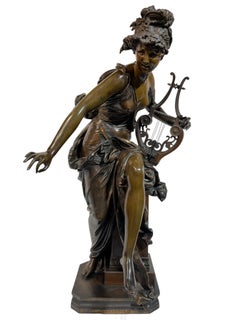
French antique bronze sculpture by Eutrope Bouret
Located in Berlin, DE
This is an outstanding bronze statue of Eutrope Bouret, signed on the base, by the very well-known French artist Eutrope Bouret (1833-1906).
French antique bronze sculpture by Eutro...
Category
19th Century Art Nouveau Figurative Sculptures
Materials
Bronze
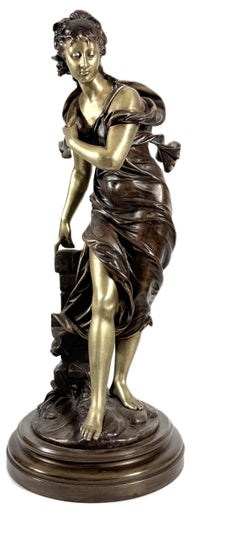
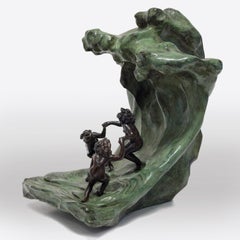
La Vague (The Wave)
Located in Palm Desert, CA
"La Vague (The Wave)" is a figurative abstract bronze sculpture created by Camillle Claudel. The artwork is 24 1/4 x 19 x 24 inches, weighing less than 50 lbs. It is signed "C. Claud...
Category
19th Century Impressionist Figurative Sculptures
Materials
Bronze
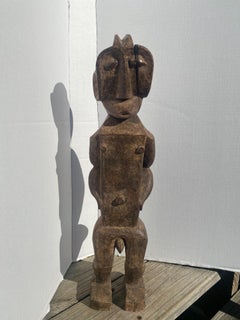
MUMUYE FIGURE
Located in Three Oaks, MI
Within Nigeria's Benue River Valley region, such representations have been associated with a range of functions, including reinforcement of the status of male elders and used by heal...
Category
Early 20th Century Tribal Figurative Sculptures
Materials
Wood
$760 Sale Price
36% Off
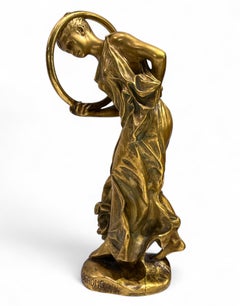
Jean-Léon Gérôme La Danseuse au Cerceau - Gilt Bronze Statue of a Hoop Dancer
Located in New York, NY
Jean-Léon Gérôme
French
1824 - 1904
La Joueuse De Cerceau - The Hoop Dancer
A mini gilt bronze female figural statue of a young hoop dancer inspired by a trove of ancient terraco...
Category
19th Century Academic Figurative Sculptures
Materials
Bronze
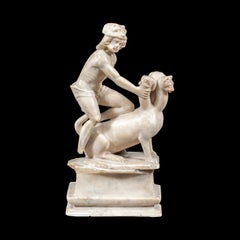
Baroque Roman sculptor - 17th century alabaster sculpture - Hercules Cerberus
Located in Varmo, IT
Alabaster sculpture - Hercules and Cerberus. Rome, 17th century.
18 x 9.5 x h 37 cm.
Made entirely of carved alabaster. Separate alabaster base, missing left foot and arm, and othe...
Category
Mid-17th Century Baroque Figurative Sculptures
Materials
Alabaster
$2,373 Sale Price
28% Off
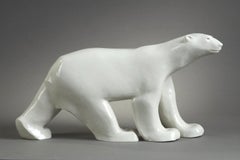
Polar Bear
Located in PARIS, FR
Polar Bear
by François POMPON (1855-1933)
An original edition sculpture made in white enameled porcelain biscuit.
Stamped in the paste "S 1927 DN" (S for "Sèvres" – dated 1927 – DN...
Category
1920s Art Deco Figurative Sculptures
Materials
Ceramic
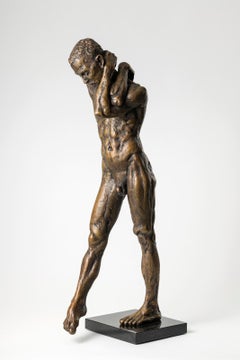
Folded Arms Study (Full Figure)
Located in London, GB
Bronze
Numbered 5/9
87cm × 44cm × 21cm (incl. base)
Pratley is a Sculptor working from life models in his West London studio. His inspirations range from ancient Greek masterpieces ...
Category
2010s English School Nude Sculptures
Materials
Bronze
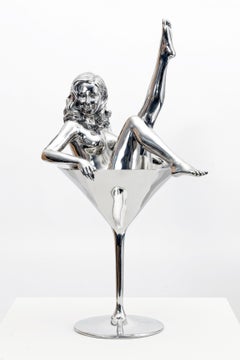
Modern Pop Art Dita Mel Ramos Stainless Steel Nude Sculpture
By Mel Ramos
Located in Zug, CH
MEL RAMOS (1935-2018)
Dita
2017
Cast and polished stainless steel
58 x 33 x 26 cm
22.83 x 12.99 x 10.24 inches
Number 29 of 60,
Edition of 60 + 6 A.P.
Cast signature and number on b...
Category
20th Century Pop Art Nude Sculptures
Materials
Stainless Steel
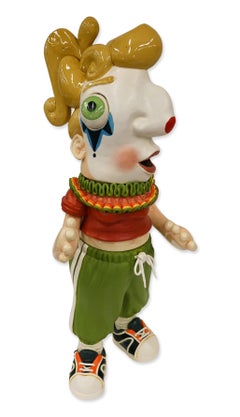
$24,032 Sale Price
22% Off
I am a clown (~38% OFF LIST PRICE - LIMITED TIME ONLY)
Located in Kansas City, MO
Hannah Schelb
I am a clown (When are you going to start treating me like a joke?)
2025
Ceramic, Glaze, Cone 5 Oxidation, Aluminum Wire, Kanthal Wire
34 x 12 x 14.5 inches (86.4 x 30....
Category
2010s Contemporary Figurative Sculptures
Materials
Wire
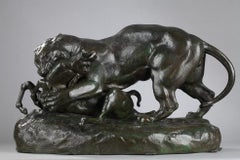
$6,777 Sale Price
38% Off
Tiger surprising an antelope
Located in PARIS, FR
Antoine-Louis BARYE (1796-1875)
Tiger surprising an antelope
Bronze with nuanced dark greenish brown patina
Signed on the base " Barye "
Cast by Barye's own workshop (conducted in t...
Category
1870s French School Figurative Sculptures
Materials
Bronze
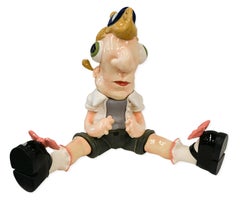
This is Me (~35% OFF LIST PRICE - LIMITED TIME ONLY)
Located in Kansas City, MO
Hannah Schelb
This is Me
2025
Ceramic, Glaze, Cone 5 Oxidation, Aluminum Wire, Kanthal Wire
26 x 24 x 38 inches (66 x 63.5 x 96.5 cm)
Signed
COA provided
*Assembly required. Instruc...
Category
2010s Contemporary Figurative Sculptures
Materials
Wire
$6,777 Sale Price
38% Off
Female Figure
Located in New York, NY
It is marvelous to find discoveries such as Lorrie Goulet's female form, one of our few American women sculptors who direct carved in marble. Goulet has an attractive technique of u...
Category
1960s American Modern Figurative Sculptures
Materials
Marble
Lion and snake
Located in PARIS, FR
Lion and snake n°3
by Antoine-Louis Barye (1796-1875)
Bronze sculpture with a nuanced dark greenish brown patina
signed "Barye" on the base
old edition cast – probably from the Bary...
Category
1860s French School Figurative Sculptures
Materials
Bronze
Francisco Zuniga Bronze Sculpture, 1964, "Desnudo Acostada"
Located in Phoenix, AZ
Francisco Zuniga bronze sculpture, Nude Lying Down. Edition: 3.
#377 in the Zuniga catalog raisonne. Titled: "Desnudo Acostado".
Measures: 6 7/8" H x 18" L x 19" W not including the...
Category
1960s Figurative Sculptures
Materials
Bronze
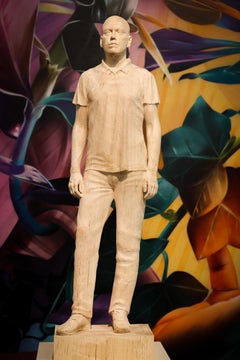
Man Standing, 21st Century Contemporary Wooden Sculpture by Pedro Quesada Sierra
Located in Nuenen, Noord Brabant
This ceramic buste is made by Spanish artist Pedro Quesada Sierra. The Spanish sculptor, despite his only 39 years, is already a lot of laureate artist. In March 2018 he received, ...
Category
2010s Contemporary Figurative Sculptures
Materials
Wood
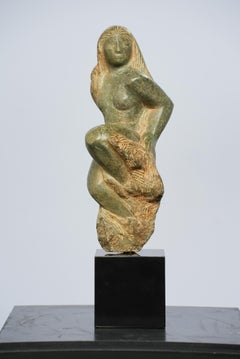
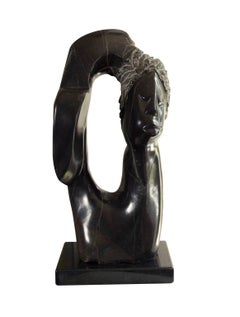
"Mermaid, " Carved Springstone by Farai Darare
By Farai Darare
Located in Milwaukee, WI
"Mermaid" is a unique springstone sculpture by the Shona artist Farai Darare. It depicts a woman's face and an abstracted body that loops around to frame an oval of negative space. This piece is expertly carved to showcase two textures from the same stone. This sculpture weighs 30 pounds (approximately 13.6 kg).
16 3/4" x 8" x 5 1/4" art
30 lbs
Farai Walter Darare started working as a washer and polisher for his father's sculptures when he was seven years old. He worked and studied under the renowned Shona sculptors Chikumbirike, Runyanga, Muropa, and his father Casper Darare...
Category
Early 2000s Figurative Sculptures
Materials
Stone
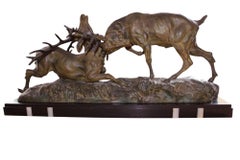
Deer battle
By Thomas Francois-Cartier
Located in Riga, LV
Deer battle
France, bronze, marble, h 29.5 x 66.5 x 18 cm
base size 64x20 cm
Category
1940s Realist Figurative Sculptures
Materials
Marble, Bronze
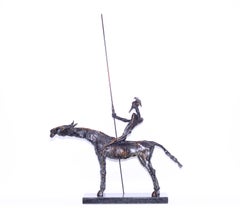
$3,133 Sale Price
20% Off
Don Quixote - Bronze Sculpture
Located in Winterswijk, NL
Sculpture Don Quixote (on horseback, holding spear); Unique original work, handcrafted, carved, chiseled, patinated, polished, and mounted on a pedestal by the artist.
Artist state...
Category
21st Century and Contemporary Contemporary Figurative Sculptures
Materials
Granite, Bronze
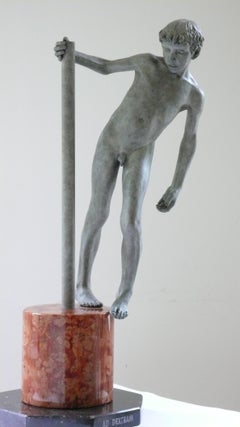
Ad Dextram Bronze Sculpture Nude Boy Male Figure Marble Stone
Located in Utrecht, NL
Ad Dextram Bronze Sculpture Nude Boy Male Figure Marble Stone
Wim van der Kant (1949, Kampen) is a selftaught artist. Nex...
Category
21st Century and Contemporary Contemporary Nude Sculptures
Materials
Marble, Bronze
Antique French Art Nouveau Bronze Figure Statue Sculpture "Prise de Corsaire"
Located in Portland, OR
A fine antique large French Art Nouveau Bronze Figural Sculpture, titled "Prise de Corsaire" by Emmanuel Villanis (1858-1914), circa 1900.
This very...
Category
Early 1900s Art Nouveau Figurative Sculptures
Materials
Bronze
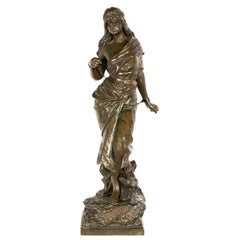
Early 20th Century Ceramic Sculpture of a Polo Player and Horse
By Waylande Gregory
Located in Beachwood, OH
Waylande Gregory (American, 1905-1971)
Polo Player, c. 1930s
Ceramic
Inscribed signature on bottom
11 x 8.5 inches
Waylande Gregory was considered a major American sculptor during the 1930's, although he worked in ceramics, rather than in the more traditional bronze or marble. Exhibiting his ceramic works at such significant American venues for sculpture as the Whitney Museum of American Art in New York City and at the venerable Pennsylvania Academy of the Fine Arts in Philadelphia, he also showed his ceramic sculptures at leading New York City galleries. Gregory was the first modern ceramist to create large scale ceramic sculptures, some measuring more than 70 inches in height. Similar to the technique developed by the ancient Etruscans, he fired his monumental ceramic sculptures only once.
Gregory was born in 1905 in Baxter Springs, Kansas and was something of a prodigy. Growing up on a ranch near a Cherokee reservation, Gregory first became interested in ceramics as a child during a native American burial that he had witnessed. He was also musically inclined. In fact, his mother had been a concert pianist and had given her son lessons. At eleven, he was enrolled as a student at the Kansas State Teacher's College, where he studied carpentry and crafts, including ceramics.
Gregory's early development as a sculptor was shaped by the encouragement and instruction of Lorado Taft, who was considered both a major American sculptor as well as a leading American sculpture instructor. In fact, Taft's earlier students included such significant sculptors as Bessie Potter Vonnoh and Janet Scudder. But, Taft and his students had primarily worked in bronze or stone, not in clay; and, Gregory's earliest sculptural works were also not in ceramics. In 1924, Gregory moved to Chicago where he caught the attention of Taft. Gregory was invited by Taft to study with him privately for 18 months and to live and work with him at his famed "Midway Studios." The elegant studio was a complex of 13 rooms that overlooked a courtyard. Taft may have been responsible for getting the young man interested in creating large scale sculpture. However, by the 1920's, Taft's brand of academic sculpture was no longer considered progressive. Instead, Gregory was attracted to the latest trends appearing in the United States and Europe. In 1928 he visited Europe with Taft and other students.
"Kid Gregory," as he was called, was soon hired by Guy Cowan, the founder of the Cowan Pottery in Cleveland, Ohio, to become the company's only full time employee. From 1928 to 1932, Gregory served as the chief designer and sculptor at the Cowan Pottery. Just as Gregory learned about the process of creating sculpture from Taft, he literally learned about ceramics from Cowan. Cowan was one of the first graduates of Alfred, the New York School of Clayworking and Ceramics. Alfred had one of the first programs in production pottery. Cowan may have known about pottery production, but he had limited sculptural skills, as he was lacking training in sculpture. The focus of the Cowan Pottery would be on limited edition, table top or mantle sculptures. Two of the most successful of these were Gregory's "Nautch Dancer," (fig. 1) and his "Burlesque Dancer," (fig. 2). He based both sculptures on the dancing of Gilda Gray, a Ziegfield Follies girl.
Gilda Gray was of Polish origin and came to the United States as a child. By 1922, she would become one of the most popular stars in the Follies. After losing her assets in the stock market crash of 1929, she accepted other bookings outside of New York, including Cleveland, which was where Gregory first saw her onstage. She allowed Gregory to make sketches of her performances from the wings of the theatre. She explained to Gregory, "I'm too restless to pose." Gray became noted for her nautch dance, an East Indian folk dance. A nautch is a tight, fitted dress that would curl at the bottom and act like a hoop. This sculpture does not focus on Gray's face at all, but is more of a portrait of her nautch dance. It is very curvilinear, really made of a series of arches that connect in a most feminine way.
Gregory created his "Burlesque Dancer" at about the same time as "Nautch Dancer." As with the "Nautch Dancer," he focused on the movements of the body rather than on a facial portrait of Gray. Although Gregory never revealed the identity of his model for "Burlesque Dancer," a clue to her identity is revealed in the sculpture's earlier title, "Shimmy Dance." The dancer who was credited for creating the shimmy dance was also Gilda Gray. According to dance legend, Gray introduced the shimmy when she sang the "Star Spangled Banner" and forgot some of the lyrics, so, in her embarrassment, started shaking her shoulders and hips but she did not move her legs. Such movement seems to relate to the "Burlesque Dancer" sculpture, where repeated triangular forms extend from the upper torso and hips. This rapid movement suggests the influence of Italian Futurism, as well as the planar motion of Alexander Archipenko, a sculptor whom Gregory much admired.
The Cowan Pottery was a victim of the great depression, and in 1932, Gregory changed careers as a sculptor in the ceramics industry to that of an instructor at the Cranbrook Academy in Bloomfield Hills, Michigan. Cranbrook was perhaps the most prestigious place to study modern design in America. Its faculty included the architect Eliel Saarinen and sculptor Carl Milles.
Although Gregory was only at Cranbrook for one and one half years, he created some of his finest works there, including his "Kansas Madonna" (fig. 3). But, after arriving at Cranbrook, the Gregory's had to face emerging financial pressures. Although Gregory and his wife were provided with complimentary lodgings, all other income had to stem from the sale of artworks and tuition from students that he, himself, had to solicit. Gregory had many people assisting him with production methods at the Cowan Pottery, but now worked largely by himself. And although he still used molds, especially in creating porcelain works, many of his major new sculptures would be unique and sculpted by hand, as is true of "Kansas Madonna." The scale of Gregory's works were getting notably larger at Cranbrook than at Cowan.
Gregory left the surface of "Kansas Madonna" totally unglazed. Although some might object to using a religious title to depict a horse nursing its colt, it was considered one of Gregory's most successful works. In fact, it had a whole color page illustration in an article about ceramic sculpture titled, "The Art with the Inferiority Complex," Fortune Magazine, December, 1937. The article notes the sculpture was romantic and expressive and the sculpture was priced at $1,500.00; the most expensive sculpture in the article. Gregory was from Kansas, and "Kansas Madonna" should be considered a major sculptural document of Regionalism.
Gregory and his wife Yolande moved to New Jersey in the summer of 1933. And the artist began construction on his new home in the Watchung Mountains of Bound Brook (Warren today) in 1938. His enormous, custom kiln was probably constructed at the start of 1938. Gregory's new sculptures were the largest ceramic sculptures in western art, in modern times. To create these works of ceramic virtuosity, the artist developed a "honeycomb" technique, in which an infrastructure of compartments was covered by a ceramic "skin."
Science and atomic energy were a theme in Gregory's most significant work, the "Fountain of the Atom" (fig. 4), at the 1939 New York's World Fair. This major work included twelve monumental ceramic figures at the fairground entrance from the newly constructed railway entrance, giving the work great visibility and prominence. The framework of the fountain itself was of steel and glass bricks. It consisted of a bluish green pool which was sixty five feet in diameter. Above it were two concentric circular tiers, or terraces, as Gregory called them; the first wider than the second. On the first terrace were eight "Electrons," comprised of four male and four female terra cotta figures, each approximately 48 inches high. These relate to the valance shell of the atom. Above them on a narrower terrace, were the much larger and heavier terra cotta figures depicting the four elements, each averaging about 78 inches in height and weighing about a ton and a half. Of the four, "Water" and "Air" were male, while "Earth" and "Fire" were female. This terrace represents the nucleus of the atom. In the center of the fountain, above the "Elements," was a central shaft comprised of sixteen glass tubes from which water tumbled down from tier to tier. At the top, a colorful flame burned constantly. The glass block tiers were lit from within, the whole creating a glowing and gurgling effect. Since the fair was temporary, the figures could be removed after its closing. But the credit for the design of the structure of the fountain belongs to collaborator Nembhard Culin, who was responsible for several other structures on the fair grounds as well.
Although Gregory created a figure of "Fire" for the "Fountain of the Atom," he also executed a second, slightly smaller but more defined version which he exhibited at various locations (including Cranbrook, Baltimore Museum, etc.) in 1940-1941, during the second year of the fair (fig.5). Measuring 61 inches in height, "Fire" may be a metaphor for sexual energy, as well as atomic energy. Gregory stated, "Fire is represented by an aquiline female figure being consumed in endless arabesques of flame."
Portraiture was also a significant focus of Gregory's sculpture. Gregory produced many commissioned portraits of local people as well as celebrities. He created Albert Einstein's portrait from life (fig. 6, ca. 1940) after Einstein had seen Gregory's "Fountain of the Atom." He also sculpted some of the leading figures in entertainment, including 2 sculptures of Henry Fonda, who became a personal friend.
Gregory also sculpted a series of idealized female heads, both in terra cotta and in porcelain. These include "Girl with Olive" (ca. 1932) and "Cretan Girl;"(ca. 1937) both are very reductive and almost abstract works that call to mind Constantine Brancusi's "Mademoiselle Pogany" (1912, Philadelphia Museum of Art). But perhaps one of his most original female heads is "Head of a Child" (fig. 7, ca. 1933), a sensitive white glazed terra cotta portrayal with elaborately crafted braded hair, was originally created as one of a pair.
Gregory also produced sculptural works for the Works Progress Administration. The WPA was a work relief project that greatly helped artists during the great depression. Founded by the Federal Government in 1935, an estimated 2500 murals were produced. Among these public works were the iconic post office murals. But, among the painted murals were also sculptural relief murals including Gregory's "R.F.D.," 1938, for the Columbus, Kansas Post Office. But, Gregory's largest WPA relief...
Category
1930s Figurative Sculptures
Materials
Ceramic
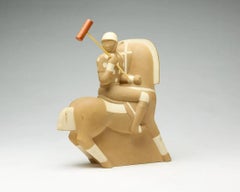
Limestone figure of Virgin and child, Lorraine, 14th century, French Gothic
Located in PARIS, FR
Virgin and Child with Goldfinch
Workshops of Metz, Lorraine, circa 1330
Limestone carved in the round with remains of polychromy
Height: 61 cm
The sculpture of the Virgin and Child ...
Category
15th Century and Earlier Gothic Figurative Sculptures
Materials
Limestone
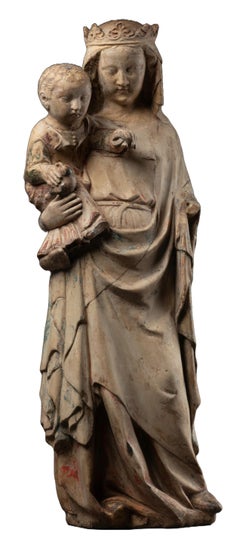
Orientalist African Hunter Leaning on His Shield 19th cent. Black Forest, German
Located in SANTA FE, NM
Orientalist African Hunter Leaning on His Shield
Black Forest, School Switzerland 19th century
Carved Wood
21 inches
This is an exceptionally beautifu...
Category
19th Century Academic Figurative Sculptures
Materials
Wood
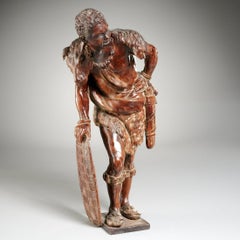
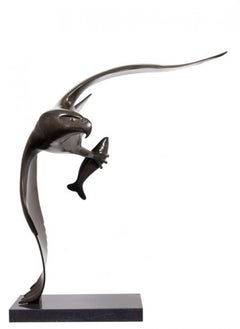
Roofvogel met vis no. 2 Bird of Prey with Fish Bronze Sculpture Animal
Located in Utrecht, NL
Roofvogel met vis no. 2 Bird of Prey with Fish Bronze Sculpture Animal
Evert den Hartog (born in Groot-Ammers, The Netherlands in 1949) followed his education to be a sculptor at th...
Category
21st Century and Contemporary Contemporary Figurative Sculptures
Materials
Bronze
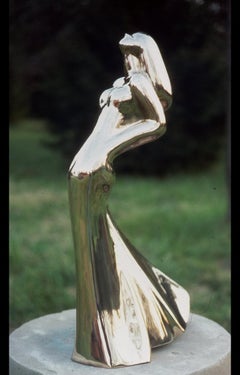
David Hostetler Dancer Gold Shiny Flowing Female Woman Figure By Commission
Located in Nantucket, MA
Now available by commission. Dancing Lady in polished bronze is sealed with Glasurit- it never needs to be polished. She is cast from a wood carving of Dancing Lady- an iconic Hostet...
Category
1980s Contemporary Figurative Sculptures
Materials
Bronze
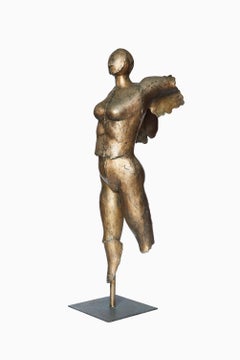
Large Nike Torso-Bronze Sculpture Ed. 1/6
Located in Zug, CH
Hermann Rastorfer was a draftsman, painter, sculptor, illustrator, ceramist, designer, poster artist, developer of advertising concepts and communication campaigns, inventor, and architect. He began as a typesetter in Salzburg. In the mid-1950s, he moved to Germany, where he soon founded his own studio for graphic design and advertising. His goal was always to give each product a distinctive, highly recognizable appearance. He designed his own design line for the German pharmaceutical company Boehringer Ingelheim, artistic cover images for numerous paperbacks from renowned publishers, and packaging for well-known products such as Ferrero Küsschen, Mon Chéri, Martell cognac...
Category
21st Century and Contemporary Modern Figurative Sculptures
Materials
Bronze
Saltationus Casus Bronze Contemporary Sculpture Nude Boy Marble Stone
Located in Utrecht, NL
Saltationus Casus Bronze Contemporary Sculpture Nude Boy Marble Stone
Wim van der Kant (1949, Kampen) is a selftaught artist. Next to his busy profession as a teacher at a high school, he intensively practises his profession as a sculptor. Only when his work would measure up to his own standards, he decided to present it to the rest of the world...
Category
21st Century and Contemporary Contemporary Nude Sculptures
Materials
Marble, Bronze