Mid-20th Century Sculptures

to
120
558
156
113
37
82
Overall Width
to
Overall Height
to
225
662
3,943
17,402
83
46
126
139
69
173
270
383
561
528
79
251
97
79
37
30
23
18
18
5
4
2
276
199
178
135
129
107
74
60
52
51
50
46
43
38
26
23
18
18
18
18
401
267
258
167
94
135
17
13
12
12
1
6
631
299
Period: Mid-20th Century
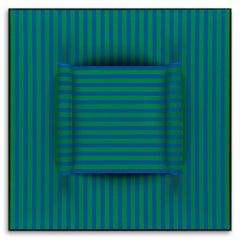
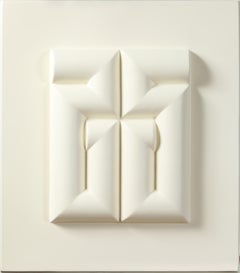
Acid-Wave
Located in New York, NY
Striking 3-dimensional acrylic and wood on canvas sculpture by renowned Colombian painter an sculptor, Omar Rayo. Signed, titled, inscribed "New Yo...
Category

Op Art Mid-20th Century Sculptures

Materials

Canvas, Wood, Acrylic

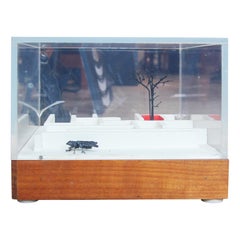
Modern Surrealist Mixed Media Fly Tree Maze Sculpture with Lucite Case
Located in Houston, TX
Modern surrealist mixed media sculpture by Houston artist Bob Fowler. The work features a pair of metal fly and tree sculptures arranged within a white and r...
Category

Modern Mid-20th Century Sculptures

Materials

Mixed Media

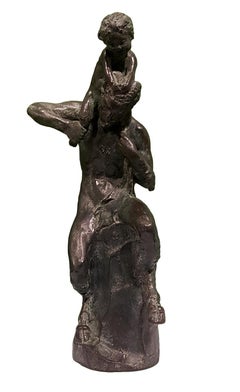
Satyr with Young Faun on his Shoulders - Bronze Sculpture by Aurelio Mistruzzi
Located in Roma, IT
Numbered and signed. Limited edition of 100 pieces. Excellent conditions. Aurelio Mistruzzi was an Italian sculptor and medalist. He attended the Udine School of Art with professor ...
Category

Mid-20th Century Sculptures

Materials

Bronze

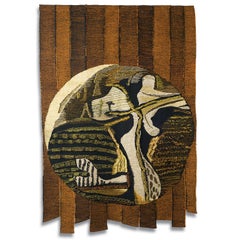
Circle, Mid-Century Abstract Woven Tapestry, Textile Wall Sculpture
Located in Wilton, CT
Circle, Mid-Century Abstract Woven Tapestry, Textile Wall Sculpture, Hand dyed wool, 87" x 63" (1976) by Czech textile artist, Jan Jladik, (192...
Category

Abstract Mid-20th Century Sculptures

Materials

Fabric, Textile, Tapestry, Wool, Dye

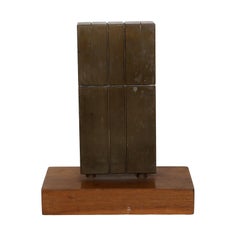
High Rise, Bronze Sculpture by Jules Engel
Located in Long Island City, NY
Date: circa 1965 Bronze sculpture, wooden base Size: 10 x 8 x 3.75 in. (25.4 x 20.32 x 9.53 cm)
Category

Modern Mid-20th Century Sculptures

Materials

Bronze

Soaring Eagle / - With eagle eyes -
Located in Berlin, DE
Anonymous, Soaring Eagle, mid-20th century Patinated cast metal mounted on quartz block. 24 cm (total height) x 29 cm (width) x 12 cm (depth). - Patina heavily rubbed in places, screw connections between sculpture and stone...
Category

Realist Mid-20th Century Sculptures

Materials

Metal

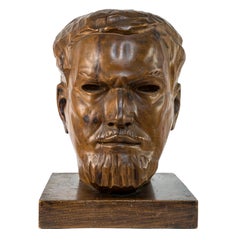
Portrait of Italo Balbo - Original Wooden Sculpture by Marco Novati - 1930s
Located in Roma, IT
Signed lower right: Marco Novati Italo Balbo was one of the key figures of Italian fascism, being among the four quadrumvirs of the March toward Rome whic...
Category

Mid-20th Century Sculptures

Materials

Wood

"Senufo Mask of Ceremonies (from Republic Ivory Coast), " Painted Carved Wood
Located in Milwaukee, WI
"Senufo Mask of Ceremonies (from Republic Ivory Coast)" is an carved wood artifact from the Senufo people of Africa, in the northeastern cote d'Ivoire. The...
Category

Tribal Mid-20th Century Sculptures

Materials

Wood, Paint

Silver Composition - Silvered Bronze Sculpture by N. Franchina - 1960
Located in Roma, IT
Silver Composition is an original decorative object realized by Nino Franchina in 1960. Original sculpture realized in silvered bronze. Bronze patinated silver sculpture. Signed a...
Category

Contemporary Mid-20th Century Sculptures

Materials

Bronze

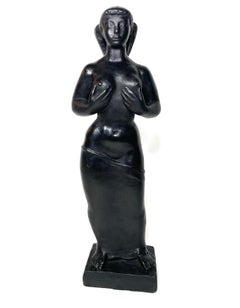
Egee debout h cm 50
Located in Villafranca Di Verona, IT
Numbered and limited to 8 copies Artwork signed Authenticity: Sold with certificate of Authenticity Invoice from the gallery Sculpture: bronze, metal, bronze patina Display: The sc...
Category

Other Art Style Mid-20th Century Sculptures

Materials

Metal, Bronze

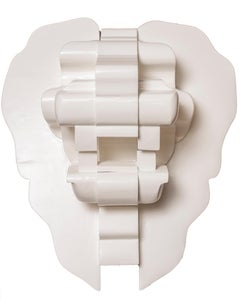
Mane (Lion) - Wooden Sculpture by Anne and Patrick Poirier - 1968
Located in Roma, IT
Lion is a wonderful contemporary wooden sculpture realized in 1968 by Anne and Patrick Poirier. Signed on the back. Includes authenticity certificate. The passage of time, the trac...
Category

Contemporary Mid-20th Century Sculptures

Materials

Wood

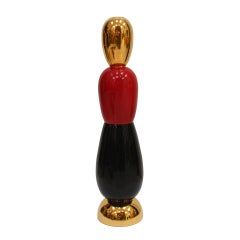
Ceramic Totem Sculpture Designed by Alessandro Mendini, Italy, Limited Edition
Located in Madrid, MD
Elegant totem sculpture designed by Alessandro Mendini (Italian, 1931–2019), crafted in glazed ceramic. This collectible piece is signed and numbered 23/50 on the base, forming part ...
Category

Post-Modern Mid-20th Century Sculptures

Materials

Porcelain

Art Deco Babbitt metal Elephant Black Sculpture France After Irénée Rochard
Located in Valladolid, ES
Sculpture Elephant in metal Babbitt, Art Deco, pps. s. XX - France - After Irénée Rochard Wonderful Art Deco elephant made of babbitt, original metal used at the time, beginning of ...
Category

Art Deco Mid-20th Century Sculptures

Materials

Metal

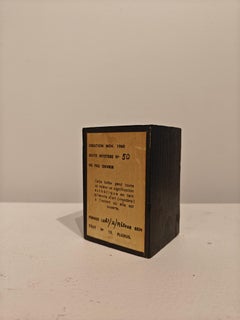
"Mystery Box (Boîte mystère)" Ben Vautier, Fluxus Movement Conceptual Sculpture
Located in New York, NY
Ben Vautier Mystery Box (Boîte mystère), 1965 Painted wood with letterpress label 3 13/16 × 2 3/4 × 2 7/16 inches Ben Vautier was a French artist known for his text-based paintings...
Category

Conceptual Mid-20th Century Sculptures

Materials

Wood, Paper

Egèe assise h cm 140
Located in Villafranca Di Verona, IT
Numbered and limited to 8 copies Artwork signed Authenticity: Sold with certificate of Authenticity Invoice from the gallery Sculpture: bronze, metal, bronze patina Display: The sc...
Category

Mid-20th Century Sculptures

Materials

Metal, Bronze

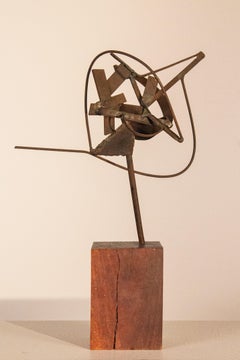
"Untitled" Sidney Gordin, Abstract Metal Steel Sculpture
Located in New York, NY
Sidney Gordin Untitled, 1958 Incised with initials Welded Steel 15 x 10 1/2 x 6 inches Provenance: Eric Firestone Gallery, New York On October 24, 1918, Sidney Gordin was born in Chelyabinsk, Russia. He spent his early years in Shanghai, China. At the age of four, he moved with his family to New York. Gordin’s nephew, Eliot Nemzer recalls that when Gordin was a child he attended “a dinner party with his parents. Someone showed him a book of pictures that when thumbed through quickly made the image appear to move. This person then gave him a wad of blank papers and something to write with. Sid created a similar type of moving image with his materials. All the adults at the party became quite excited [and] praised his efforts. Sid told me he thought this was a pivotal experience in guiding him towards his vocation.” During his formative years at Brooklyn Technical High School, he briefly contemplated the idea of becoming an architect; yet, by the time he enrolled at Cooper Union, he was determined to become a professional artist. There, he studied under Morris Kantor (1896-1974) and Leo Katz...
Category

Abstract Mid-20th Century Sculptures

Materials

Steel

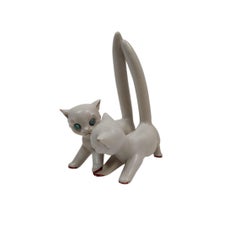
Ceramic kittens by Tarcisio Tosin, Italy, 1940
Located in Vicenza, VI
Pottery depicting two white kittens made by a Vicentine ceramist, Tarcisio Tosin. Executed circa 1940 with measurements 35x29x18 cm. He attended the Art Institute in Nove and worked ...
Category

Other Art Style Mid-20th Century Sculptures

Materials

Ceramic

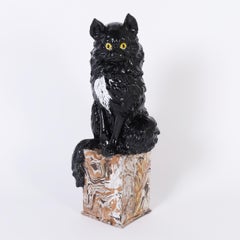
Vintage Italian Glazed Terra Cotta Cat Sculpture
Located in Palm Beach, FL
Charming whimsical mid century Italian black cat sculpture crafted in terra cotta, hand decorated and glazed, and sitting on a faux marble pedestal...
Category

Other Art Style Mid-20th Century Sculptures

Materials

Terracotta, Glaze

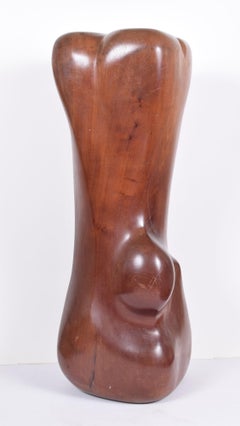
Metamorphosis abstract nude 1960s sculpture by John Robert Murray McCheyne
Located in London, GB
To see our other Modern British Art, scroll down to "More from this Seller" and below it click on "See all from this Seller" - or send us a message if you cannot find the artist you ...
Category

Abstract Mid-20th Century Sculptures

Materials

Wood

Paolo Soleri Original Bronze Sculpture - Winged Angel Form
Located in Phoenix, AZ
Bronze angel sculpture by architect and artist Paolo Soleri (1910-2013). Soleri is well-known for his experimental Community, Arcosanti, just n...
Category

Mid-20th Century Sculptures

Materials

Bronze

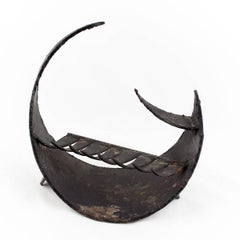
Brutalist Forged Iron Circular Menorah Sculpture Israeli Master David Palombo
Located in Surfside, FL
Hand Forged Iron Candelabra Holocaust Memorial Judaic Menorah Sculpture David Palombo was an Israeli sculptor and painter. He was born in Turkey to a traditional family and immigrated to the Land of Israel with his parents in 1923. They lived in the Nahalat Shiva neighborhood of Jerusalem. In 1940 he began his studies at Bezalel Academy of Arts and Design, and from 1942 was a student of sculptor Ze’ev Ben-Zvi. For a period of time, Palombo was an assistant at Ben-Zvi’s studio and also taught at Bezalel. During this period he was also a member of the “Histadrut HaNoar HaOved VeHaLomed” (The General Federation of Students and Young Workers in Israel). In the 1940s he took art lessons at night. In 1948 he went to Paris, where he visited the studio of the sculptor Constantin Brancusi whose work influenced him. Around 1958 he married the artist Shulamit Sirota. In 1960 he quit his job to devote himself to art. In 1964 he married for the second time to the artist Yona Palombo. The two of them went to live in an abandoned home on Mount Zion in Jerusalem. In 1966 he was killed when the motorcycle on which he was riding ran into a chain stretched across the street to prevent the desecration of Shabbat. His widow opened a museum in their home that was active until the year 2000. Work by Palombo is included in the Judaic collection of the Jewish Museum (a well known Hanukkah menora). Palombo executed the impressive metal gates of the Tent of Remembrance at the Yad Vashem, the memorial to the martyrs of the holocaust, as well as the gates to the Knesset Building the United Nations Educational Scientific and Cultural Organization (Unesco award) awarded him a scholarship for study in Japan. He worked in marble, granite, bronze, iron and steel. as well as with glass mosaic tiles. Palombo’s early works, in the 1950s, were influenced by modernist sculptors such as Brancusi. These works were composed of abstract images from nature and were carved out of stone or wood. At the end of the 1950s he began making metal sculptors, using the technique of welding. His work took on a more abstract and expressive character. Education 1940 Painting with Isidor Ascheim, New Bezalel School for Arts and Crafts, Jerusalem 1942 Sculpture with Zeev Ben Zvi, Jerusalem 1956 Mosaic, Ravenna, Italy 1958 Welding Course Awards And Prizes 1966 UNESCO Award Exhibitions: Sculpture in Israel, 1948-1958 Mishkan Museum of Art, Kibbutz Ein Harod Artists: Zvi Aldouby, Yitzhak Danziger, Arieh Merzer, Dov Feigin, Aaron Priver, David Palumbo, Menashe Kadishman, Kosso Eloul, Yehiel Shemi, Zahara Schatz. The Spring Exhibition of Jerusalem Artists, Artists' House, Jerusalem Artists: Palombo, David Bezalel Schatz, Mordechai Levanon, Fima, Ludwig Blum 12 Artists, The Bezalel National Museum, Jerusalem Avraham Ofek, Aviva Uri, Avigdor Arikha, Yosl Bergner, Lea Nikel, Palombo, Ruth Zarfati, General Exhibition, Art in Israel 1960 Tel Aviv Museum of Art Artists: Naftali Bezem, Nachum Gutman, Shraga Weil, Shraga, Marcel Janco, Ruth Schloss
Category

Arte Povera Mid-20th Century Sculptures

Materials

Iron

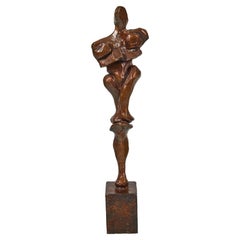
Abstracted Figure in Bronze by Sanford Sandy Decker
Located in Palm Desert, CA
This is a wonderful abstract figure in bronze by well known sculpture, Sanford (Sandy) Decker. The patina is a beautiful shade of chocolate brown. It has aged well, bronze highlights...
Category

Mid-20th Century Sculptures

Materials

Bronze

Modern Totem &#1
Located in Carmel, CA
Mid fire ceramic totem designed for an interior desktop. The style is mid-century modern with line and color shapes. Featured colors are white ,blue ,pumpkin and purple. The base is ...
Category

American Modern Mid-20th Century Sculptures

Materials

Ceramic

Modern Totem &#1
Modern Totem &#1
$1,440 Sale Price
20% Off
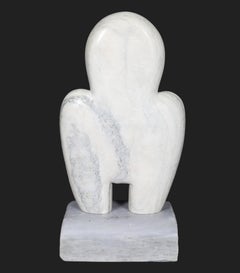
Girl Torso, Modern Marble Sculpture by Antonovici
Located in Long Island City, NY
An original carved marble sculpture by Constantin Antonovici from his Torso Series. Referenced in "Constantin Antonovici: Sculptor of Owls", pg 79 Antonovici was born in Neamt, Romania on February 18, 1911, and graduated from the Fine Arts Academy in Iasi, Romania, in 1939. In 1940, Antonovici studied in Zagreb with the famous Croatian sculptor Ivan Mestrovici, until his arrest by Italian fascists. Antonovici himself survived imprisonment in Germany for his refusal to fight on the side of the Nazis. After the war, he continued his studies in Vienna, under the tutelage of Professor Fritz Behn...
Category

Modern Mid-20th Century Sculptures

Materials

Marble

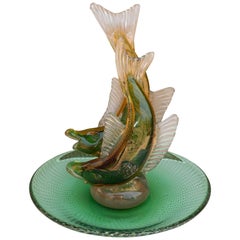
Alfredo Barbini Monumental Italian Glass Double Fish Centerpiece with Bowl
Located in Phoenix, AZ
Alfredo Barbini beautiful bullicante Murano glass double fish figurine with bowl. This sculptural centerpiece is 24 inches tall and features a double Sommerso amber and green layer with hundreds of controlled glass bubbles throughout. It sits on a controlled bubble green charger...
Category

Mid-20th Century Sculptures

Materials

Glass

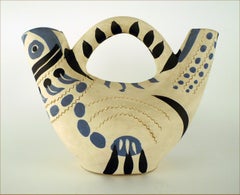
Pichet espagnol (A.R. 245), Picasso Ceramic
Located in Madrid, ES
PABLO PICASSO (1881-1973) Pichet espagnol (A.R. 245) stamped, marked and numbered 'Edition Picasso / Madoura Plein Feu / Edition Picasso / 62/200 / Mad...
Category

Modern Mid-20th Century Sculptures

Materials

Ceramic

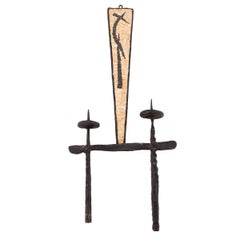
Brutalist Hand Forged Iron Mosaic Sculpture Wall Sconce Israeli David Palombo
Located in Surfside, FL
Hand Forged Iron Stone Mosaic Pricket Sconce Candelabra Holocaust Memorial Judaic Wall Sconce Sculpture David Palombo was an Israeli sculptor and painter. He was born in Turkey to a traditional family and immigrated to the Land of Israel with his parents in 1923. They lived in the Nahalat Shiva neighborhood of Jerusalem. In 1940 he began his studies at Bezalel Academy of Arts and Design, and from 1942 was a student of sculptor Ze’ev Ben-Zvi. For a period of time, Palombo was an assistant at Ben-Zvi’s studio and also taught at Bezalel. During this period he was also a member of the “Histadrut HaNoar HaOved VeHaLomed” (The General Federation of Students and Young Workers in Israel). In the 1940s he took art lessons at night. In 1948 he went to Paris, where he visited the studio of the sculptor Constantin Brancusi whose work influenced him. Around 1958 he married the artist Shulamit Sirota. In 1960 he quit his job to devote himself to art. In 1964 he married for the second time to the artist Yona Palombo. The two of them went to live in an abandoned home on Mount Zion in Jerusalem. In 1966 he was killed when the motorcycle on which he was riding ran into a chain stretched across the street to prevent the desecration of Shabbat. His widow opened a museum in their home that was active until the year 2000. Work by Palombo is included in the Judaic collection of the Jewish Museum (a well known Hanukkah menora). Palombo executed the impressive metal gates of the Tent of Remembrance at the Yad Vashem, the memorial to the martyrs of the holocaust, as well as the gates to the Knesset Building the United Nations Educational Scientific and Cultural Organization (Unesco award) awarded him a scholarship for study in Japan. He worked in marble, granite, bronze, iron and steel. as well as with glass mosaic tiles. Palombo’s early works, in the 1950s, were influenced by modernist sculptors such as Brancusi. These works were composed of abstract images from nature and were carved out of stone or wood. At the end of the 1950s he began making metal sculptors, using the technique of welding. His work took on a more abstract and expressive character. Education 1940 Painting with Isidor Ascheim, New Bezalel School for Arts and Crafts, Jerusalem 1942 Sculpture with Zeev Ben Zvi, Jerusalem 1956 Mosaic, Ravenna, Italy 1958 Welding Course Awards And Prizes 1966 UNESCO Award Exhibitions: Sculpture in Israel, 1948-1958 Mishkan Museum of Art, Kibbutz Ein Harod Artists: Zvi Aldouby, Yitzhak Danziger, Arieh Merzer, Dov Feigin, Aaron Priver, David Palumbo, Menashe Kadishman, Kosso Eloul, Yehiel Shemi, Zahara Schatz. The Spring Exhibition of Jerusalem Artists, Artists' House, Jerusalem Artists: Palombo, David Bezalel Schatz, Mordechai Levanon, Fima, Ludwig Blum 12 Artists, The Bezalel National Museum, Jerusalem Avraham Ofek, Aviva Uri, Avigdor Arikha, Yosl Bergner, Lea Nikel, Palombo, Ruth Zarfati, General Exhibition, Art in Israel 1960 Tel Aviv Museum of Art Artists: Naftali Bezem, Nachum Gutman, Shraga Weil, Shraga, Marcel Janco, Ruth Schloss
Category

Arte Povera Mid-20th Century Sculptures

Materials

Iron

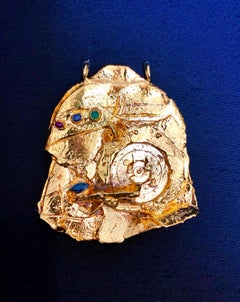
Gilt Bronze Sculpture Brooch Wearable Art Israeli Tumarkin Abstract Surrealist
Located in Surfside, FL
Measures about 3.75 X 3.5 inches. Box is 11 X 11 inches. (Piece is in excellent condition. box frame has some minor wear and piece might need to be remounted, it has been removed and...
Category

Surrealist Mid-20th Century Sculptures

Materials

Gold, Bronze

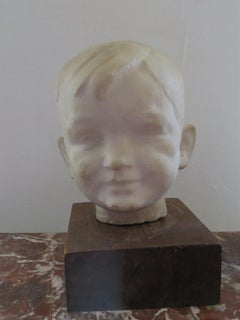
Portrait boy
Located in Pasadena, CA
Marble portrait of a boy in 1930 not signed
Category

Modern Mid-20th Century Sculptures

Materials

Marble

Portrait boy
Portrait boy
$2,000 Sale Price
20% Off
Haitian Folk Art Outsider Art Steel Drum Metal Work Sculpture Murat Brierre
Located in Surfside, FL
Murat Brierre or Murat Briere (1938–1988) was one of Haiti's principal metal sculptors. He was influenced by George Liautaud, but his work acquired its own, highly experimental style, often focusing on multi-faceted and conjoined figures, fantastically personified elements, and unborn babies visible within larger creatures. He sculpted works that reflected both Christian and Haitian Vodou themes. Murat BRIERRE was born in Mirebalais in 1938. He first worked as a builder, cabinetmaker and blacksmith before being introduced to Le Centre d’Art in 1966. After trying painting with DeWitt Peters, he realized that metal sculpture was best suited for him and studied under Georges Liautaud in order to learn the métier. He also made very beautiful linocuts. Francine Murat quickly recognized his talent and considered Brierre to be one of the best Haitian sculptors. He passed away in 1988 at the age of 50. Brierre’s works have been exhibited in France, the United States, Switzerland, Germany, Israel, Mexico and Jamaica, in such places as the Abbaye de Daoulas, the Grand Palais, the Brooklyn Museum, the Modern Art Museum of Mexico and the Musée du Montparnasse. His work is part of the permanent collections at the Waterloo Museum, the Davenport Museum, the Milwaukee Art Museum, Le Centre d’Art, the Musée d’art Haïtien du Collège Saint-Pierre and the Musée de Panthéon National Haïtien. References Phyllis Kind...
Category

Outsider Art Mid-20th Century Sculptures

Materials

Iron

Friedrich Gräsel, Geometric Composition 1968, Plastic Relief, Signed
Located in Eltville am Rhein, DE
Friedrich Gräsel Bochum 1927 - 2013 Osnabrück Untitled, 1968 PVC Monogrammed and dated "68" on the reverse 68 x 59 cm Catalogue raisonné 534 Authenticity guaranteed in writing. The ...
Category

Abstract Geometric Mid-20th Century Sculptures

Materials

Plastic, PVC

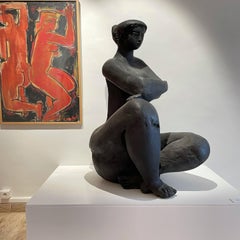
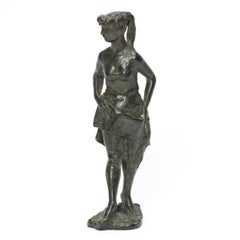
Standing Bather with Ponytail
Located in New York, NY
Bronze sculpture. Incised with the artist's signature, upper part of the base.
Category

Modern Mid-20th Century Sculptures

Materials

Bronze

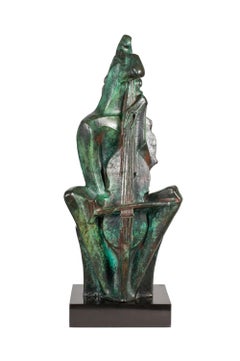
Cello Player (Tribute to Pablo Casals)
Located in New York, NY
Albert Wein is one of America's great sculptors of the modernist period. Like Paul Manship he won the Prix de Rome and he traveled there to study. His early works were in the WPA a...
Category

Abstract Mid-20th Century Sculptures

Materials

Bronze

Fishmonger
By Sally Grosz Bodkin
Located in Indianapolis, IN
Signed above base.
Category

Mid-20th Century Sculptures

Materials

Ceramic, Wood

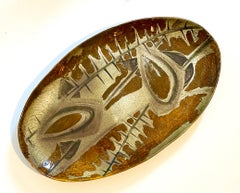
Large Hand Painted Abstract Ceramic Platter Stamped Madoura Plein Feu Brutalist
Located in Surfside, FL
Large Madoura Pottery Ceramic Platter Stamped "MADOURA PLEIN FEU" This is not marked Picasso. It is an early piece. i am uncertain who the artist is. It appears to be an abstract fi...
Category

Modern Mid-20th Century Sculptures

Materials

Enamel

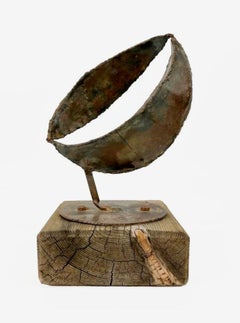
1965 Canadian Israeli Art Brutalist Abstract Welded Steel Sculpture Eli Ilan
Located in Surfside, FL
Eli Ilan (אלי אילן), 1928-1982 was an Israeli sculptor. Abstract organic pod shape. in either steel or iron mounted on a wooden plinth. Ilan was born in Winnipeg, Manitoba. He enrolled in a premedical curriculum at the University of British Columbia in Vancouver and emigrated to Israel in 1948. He then studied prehistoric archaeology and physical anthropology at the Hebrew University of Jerusalem. In 1956, he returned to Canada to study sculpture at the Ontario College of Art & Design. He lived in Kibbutz Sasa from 1959 to 1963. He died in 1982 in Caesarea, Israel. Education 1955 Hebrew University, Jerusalem, pre-historic archaeology and physical anthropology 1956 Ontario College of Art, Toronto, Canada, sculpture under Thomas Bowie 1959 Training College, Ottawa, criminal identification techniques 1969 Art Festival, Painting & Sculpture in Israel. Ganei Hataarucha, Tel Aviv Artists: Chana Orloff, Eli Ilan, Zvi Aldouby, Jacob El Hanani, Ludwig Blum, Aharon Bezalel, Koki Doktori, Israel Hadany, Marcel Janco, Dov Feigin, Abel Pann, Esther Peretz Arad, Reuven Rubin, Ivan Schwebel, Jakob Steinhardt, Boris Schatz, Bezalel (Lilik) Schatz, Louise Schatz...
Category

Abstract Mid-20th Century Sculptures

Materials

Stainless Steel

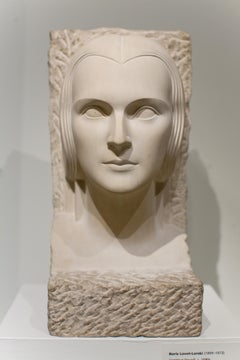
Boris Lovet-Lorski Limestone Art Deco Head, circa 1930
Located in New York, NY
White stone head in the art deco style. Born in Lithuania at the end of the nineteenth century, Boris Lovet-Lorski studied art at the Imperial Academy of Art in St. Petersburg before working briefly as an architect. He immigrated to New York in 1920 and became an American citizen five years later. His sculptures epitomize the ideals of the Art Deco decades: comprised of sleek lines and smooth surfaces, the streamlined compositions reflect the new technological forms of the machine age. Despite their modernist treatment, Lovet-Lorski’s elegant, stylized figures reference both ancient and classical sources and are characterized by a universal and serene sensibility. Concentrating on figural busts, familial groups, and standing female nudes as his subject matter, the artist rendered them in a variety of media. The materials range from the traditional bronze and marble to exotic woods and unusual stones; each is carefully selected so that its surface texture and color contribute to the emotive aura of the work. Carved out of a block of limestone, Untitled (Head) depicts a female visage nearly androgynous in its idealization. The delicate features of her face, the long, straight nose, thin pursed lips and high cheekbones, are made even more diminutive by the massive bulk of the stone that serves as their backdrop. The prominent widow’s peak of her hairline and the strong arch of her brow, two of Lovet-Lorski’s most distinctive characteristics, are elongated to accentuate the linear rhythms of the composition. The layers of her hair are delineated by stepped striations reminiscent of archaic precedents, which meld into structural columns and connect the form architecturally to the stone’s mass. Unlike the majority of Lovet-Lorski’s sculptures, in which the heads of the figures are tilted to the side or downward to convey a pensive mood, the woman in Untitled (Head) looks straight ahead. Her frontal positioning gives the composition a nearly perfect symmetry, in turn endowing the work with a still, eternal sensibility. The notched surface of the surrounding limestone stands in sharp contrast to the smoothness of her skin. In the twenties, the artist tended to finish his sculptures to a highly polished degree of refinement, but in the thirties he began to experiment with contrasts of texture and the aesthetic of the fragment. In this respect, the work is vaguely evocative of Egyptian funerary sculptures, in which the figures were carved with an eye for three-dimensionality but were left intact in a larger piece of stone to give them physical durability and permanence. Embodying classical ideals of stoicism and universal beauty, the sculpture ultimately exudes a surface allure that is difficult to resist. A similar example of this approach can be seen in the 1937 sculpture Diana, which resides in the permanent collection of the Hirshhorn Museum and Sculpture Garden, Washington D.C. Carved from a piece of black Belgian marble, the work is a stylized bust of the Greek goddess Diana...
Category

Mid-20th Century Sculptures

Materials

Limestone

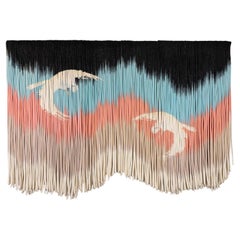
Monumental Fiber Art Textile Wall Sculpture "Flight" by Barbara Barron, 1982
Located in Dallas, TX
Temporary End of Summer Sale. This phenomenal wall-mounted mid-century-modern sculpture is titled "Flight" and was created by internationally recognized textile artist Barbara Barr...
Category

Mid-20th Century Sculptures

Materials

Wool, Thread

Modernist Hand Forged Iron Mosaic Sculpture Animal Ram Israeli David Palombo
Located in Surfside, FL
Heavy Hand Forged Brutalist Iron Ram or Goat Sculpture David Palombo was an Israeli sculptor and painter. He was born in Turkey to a traditional family and immigrated to the Land of Israel with his parents in 1923. They lived in the Nahalat Shiva neighborhood of Jerusalem. In 1940 he began his studies at Bezalel Academy of Arts and Design, and from 1942 was a student of sculptor Ze’ev Ben-Zvi. For a period of time, Palombo was an assistant at Ben-Zvi’s studio and also taught at Bezalel. During this period he was also a member of the “Histadrut HaNoar HaOved VeHaLomed” (The General Federation of Students and Young Workers in Israel). In the 1940s he took art lessons at night. In 1948 he went to Paris, where he visited the studio of the sculptor Constantin Brancusi whose work influenced him. Around 1958 he married the artist Shulamit Sirota. In 1960 he quit his job to devote himself to art. In 1964 he married for the second time to the artist Yona Palombo. The two of them went to live in an abandoned home on Mount Zion in Jerusalem. In 1966 he was killed when the motorcycle on which he was riding ran into a chain stretched across the street to prevent the desecration of Shabbat. His widow opened a museum in their home that was active until the year 2000. Work by Palombo is included in the Judaic collection of the Jewish Museum (a well known Hanukkah menora). Palombo executed the impressive metal gates of the Tent of Remembrance at the Yad Vashem, the memorial to the martyrs of the holocaust, as well as the gates to the Knesset Building the United Nations Educational Scientific and Cultural Organization (Unesco award) awarded him a scholarship for study in Japan. He worked in marble, granite, bronze, iron and steel. as well as with glass mosaic tiles. Palombo’s early works, in the 1950s, were influenced by modernist sculptors such as Brancusi. These works were composed of abstract images from nature and were carved out of stone or wood. At the end of the 1950s he began making metal sculptors, using the technique of welding. His work took on a more abstract and expressive character. Education 1940 Painting with Isidor Ascheim, New Bezalel School for Arts and Crafts, Jerusalem 1942 Sculpture with Zeev Ben Zvi, Jerusalem 1956 Mosaic, Ravenna, Italy 1958 Welding Course Awards And Prizes 1966 UNESCO Award Exhibitions: Sculpture in Israel, 1948-1958 Mishkan Museum of Art, Kibbutz Ein Harod Artists: Zvi Aldouby, Yitzhak Danziger, Arieh Merzer, Dov Feigin, Aaron Priver, David Palumbo, Menashe Kadishman, Kosso Eloul, Yehiel Shemi, Zahara Schatz. The Spring Exhibition of Jerusalem Artists, Artists' House, Jerusalem Artists: Palombo, David Bezalel Schatz, Mordechai Levanon, Fima, Ludwig Blum 12 Artists, The Bezalel National Museum, Jerusalem Avraham Ofek, Aviva Uri, Avigdor Arikha, Yosl Bergner, Lea Nikel, Palombo, Ruth Zarfati, General Exhibition, Art in Israel 1960 Tel Aviv Museum of Art Artists: Naftali Bezem, Nachum Gutman, Shraga Weil, Shraga, Marcel Janco, Ruth Schloss
Category

Arte Povera Mid-20th Century Sculptures

Materials

Iron

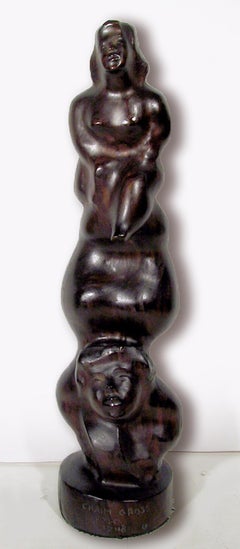
Acrobats, Wood Sculpture by Chaim Gross 1948
Located in Long Island City, NY
Artist: Chaim Gross, Austrian (1904 - 1991) Title: Acrobats Year: 1948 Medium: Hand-carved wood sculpture, signature and date inscribed Size: 21 in. (53.34 cm) tall
Category

Mid-20th Century Sculptures

Materials

Wood

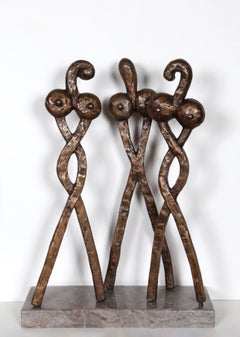
Three Graces, Bronze Sculpture by Constantin Antonovici
Located in Long Island City, NY
The three graces are described in Greek Mythology as the deification of beauty. These three sisters' role was to attend to the Olympians during feasts and other celebrations. Atonovi...
Category

Art Deco Mid-20th Century Sculptures

Materials

Bronze

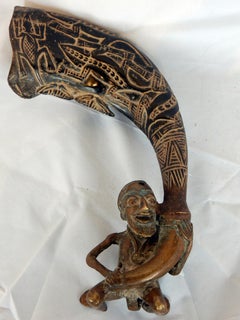
AFRICAN BRONZE AND HORN BAMILEKE SCULPTURE
Located in Three Oaks, MI
A beautiful African cast bronze and carved horn sculpture with a patina. Horns were used by the Bamileke tribe of Cameroon as status symbols for ...
Category

Mid-20th Century Sculptures

Materials

Bronze

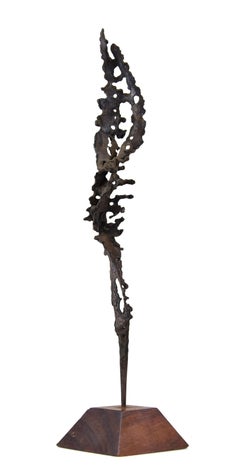
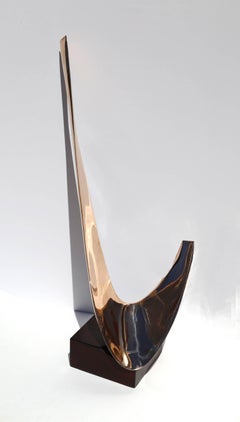
Swoosh, Large Bronze Sculpture on Wood Base by Leonardo Nierman
Located in Long Island City, NY
Artist: Leonardo Nierman Title: Untitled (Sculpture A) Year: circa 1968 Medium: Bronze Sculpture, raised on Wood Base, signed Size: 41.25 x 14 x 15 inches (including base)
Category

Modern Mid-20th Century Sculptures

Materials

Bronze

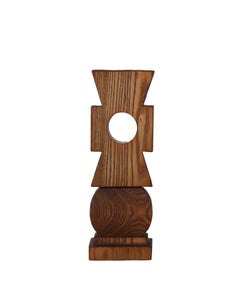
Modern Cross, Hand-Carved Wooden Sculpture by Antonovici c1950
Located in Long Island City, NY
Romania-born Antonovici is best-known as Constantin Brancusi’s protege. He worked closely with the master sculptor in his studio until he emigrated to the USA in 1953. Modern Cross,...
Category

Modern Mid-20th Century Sculptures

Materials

Wood

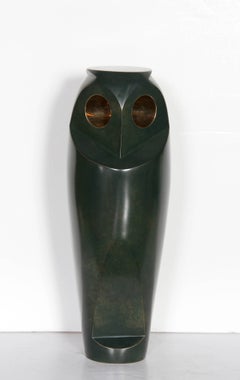
Owl III, Patinated Bronze Sculpture by Antonovici
Located in Long Island City, NY
Antonovici was born in Neamt, Romania on February 18, 1911, and graduated from the Fine Arts Academy in Iasi, Romania, in 1939. In 1940, Antonovici studied in Zagreb with the famous Croatian sculptor Ivan Mestrovici, until his arrest by Italian fascists...
Category

Modern Mid-20th Century Sculptures

Materials

Bronze

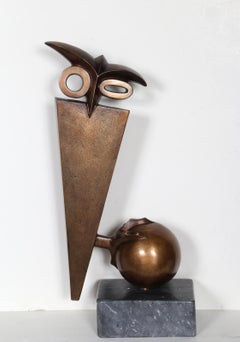
Owl Perched on Ball, Bronze Sculpture by Constantin Antonovici
Located in Long Island City, NY
An original bronze sculpture by Constantin Antonovici from his Owl Series. Referenced in "Constantin Antonovici: Sculptor of Owls", pg 43 Owl Perched on Ball Constantin Antonovici, ...
Category

Mid-20th Century Sculptures

Materials

Bronze

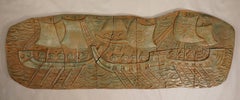
La Galère, 1950 - ceramic, 46x132x5
Located in Nice, FR
Very Big Ceramic from "Les Argonautes" Vallauris Workshop "Les Argonautes", Vallauris: Isabelle Ferlay (1917-?) And Frédérique Bourguet (1925-1997) Isabelle Ferlay and Frédérique Bourguet founded their ceramic workshop in Vallauris in 1953, which they named "Les Argonautes", in reference to the famous Greek epic. Isabelle studied painting at the Fine Arts school of Lyon in 1940, then she attended the Fine Arts in Marseille. Finally, she finished her artistic training in Montpellier, at the Fontcarade national school, where she learned ceramics. Françoise dit Frédérique Bourguet studied at the Beaux-Arts in Montpellier until 1945 and it was in Sèvres, in Françoise Bizette's studio, that she trained in the art of ceramics. She created her first workshop in Paris in 1945, which she shared with Valentine Schlegel until 1951. The two women ceramicists then practiced modeling technique. It was in 1953 that she met Isabelle Ferlay and together, they decided to set up a workshop in Vallauris. They produce shaped pieces, sometimes molded, made of earthenware, enamelled in bright colors. In the 1970s they made stoneware cooked over a wood fire. Some ceramists frequented their workshop, notably the very talented Jacques Innocenti and François Raty.
Category

Modern Mid-20th Century Sculptures

Materials

Ceramic

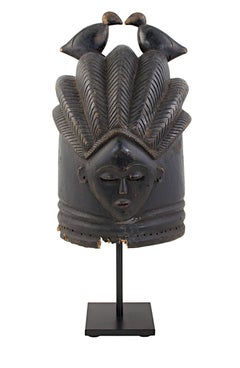
"Mende Mask, " Carved Wooden Mask created in Sierra Leone c. 1930
Located in Milwaukee, WI
This mask was hand-carved by an unknown artist from the Mende tribe in Sierra Leone, Africa. It depicts a face with its eyes downcast, hair in rows, and two birds on the top. 16" x 10" x 10 1/2" The Mende people (also spelled Mendi) are one of the two largest ethnic groups in Sierra Leone. The Mende are mostly farmers and hunters. Much Mandé art is in the form of jewelry and carvings. The masks associated with the fraternal and sorority associations of the Marka and the Mendé are probably the best-known, and finely crafted in the region. The Mandé also produce beautifully woven fabrics which are popular throughout western Africa, and gold and silver necklaces, bracelets, armlets, and earrings. Masks are the collective Mind of Mende community; viewed as one body, they are the Spirit of the Mende people. The Mende mask...
Category

Mid-20th Century Sculptures

Materials

Wood

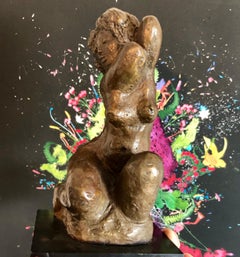
Bronze Female Nude Sculpture Modernist, WPA, New York Chelsea Hotel Artist
By Eugenie Gershoy
Located in Surfside, FL
Eugenie Gershoy (January 1, 1901 – May 8, 1986) was an American sculptor and watercolorist. Eugenie Gershoy was born in Krivoy Rog, Russia (Krivoi Rog, Ukraine) and emigrated to New York City in the United States as a child in 1903. Considered somewhat of a child prodigy, Gershoy was copying Old Master drawings at the age of 5. Her interest and talent in art was encouraged from a very young age. Aided by scholarships, she studied at the Art Students League under Alexander Stirling Calder, Leo Lentelli, Kenneth Hayes Miller, and Boardman Robinson. Around this time, she created a group of portrait figurines of her fellow artists, including Arnold Blanch, Lucile Blanch, Raphael Soyer, William Zorach, Concetta Scaravaglione, and Emil Ganso, which were exhibited as a group at the Whitney Museum of American Art. At age 17, she was awarded the Saint-Gaudens Medal for fine draughtsmanship. Early in her career she became an active member of the Woodstock art colony. In Woodstock she experimented by sculpting in the profusion of indigenous materials that she found. Working with fieldstone, oak and chestnut, Gershoy created works based on classic formulae. As she became more interested in the dynamism of everyday life, she found that these materials and her idiom were too restrictive. By the time Gershoy came to Woodstock in 1921 her own individual artistic style was already evident in her sculptures. Eugenie Gershoy worked in stone, bronze, terracotta, plaster and papier-mache. Gershoy’s sculptures were mainly figurative in nature and many of her artist peers such as Carl Walters, Raphael and Moses Soyer, William Zorach and Lucille Blanch, became her subjects. Eugenie Gershoy’s works on paper should not be overlooked. She was the winner of the Gaudens Medal for Fine Draughtsmanship at the tender age of 17. Gershoy married Jewish Romanian-born artist Harry Gottlieb. In the late 1920s and early 1930s, the pair kept a studio in Woodstock, New York. There, Gershoy was influenced by sculptor John Flanagan, who lived and worked nearby. From 1936 to 1939, Gershoy worked for the WPA Federal Art Project. She collaborated with Max Spivak on murals for the children's recreation room of the Queens Borough Public Library in Astoria, New York. She developed a mixture of wheat paste, plaster, and egg tempera, which she used in polychrome papier-mâché sculptures; she was the only New York sculptor to work in polychrome at this time. She also designed cement and mosaic sculptures of animals and figures to be placed in New York City playgrounds. Alongside others employed by the FAP, she participated in a sit-down strike in Washington, DC, to advocate for better pay and improved working conditions for the projects' artists. Gershoy's first solo exhibition was held at the Robinson Gallery in New York in 1940. She moved to San Francisco in 1942, and began teaching ceramics at the California School of Fine Arts in 1946. In 1950, she studied at the artists' colony at Yaddo. Gershoy traveled extensively throughout her life. She visited England and France in the early 1930s, and worked in Paris in 1951. She traveled to Mexico and Guatemala in the late 1940s, and also toured Africa, India, and the Orient in 1955. In 1977, Gershoy dedicated a sculpture to Audrey McMahon, who was actively involved in the creation of the Federal Art Project and served as its regional director in New York, in recognition of the work McMahon provided struggling artists in the 1930s. Gershoy's work is in the collections of the Whitney Museum of American Art, the Metropolitan Museum of Art, and the Smithsonian American Art Museum. Her papers are held at Syracuse University Grant Arnold introduced her to lithography in 1930 and Gershoy depicted many scenes of Woodstock artists and their daily activities through this medium. From 1942 to 1966 Gershoy lived and painted in San Francisco where she taught at the San Francisco Art Institute. She traveled extensively, filling sketchbooks with scenes of Mexico, France, Spain, Africa and India. During her later years Eugenie Gershoy returned to New York City and concentrated on numerous well received exhibitions. Her last exhibition in at Sid Deutsch Gallery included many of the sculptures that were later exhibited in the Fletcher Gallery. John Russell, former chief critic of fine arts for the New York Times, writes about the 1986 Sid Deutsch exhibition: “As Eugenie Gershoy won the Saint-Gaudens Medal for fine draftsmanship as long ago as 1914 and since 1967 has had 15 papier-mache portrait figures suspended from the ceiling of the lobby of the Hotel Chelsea, she must be ranked as a veteran of the New York scene. Her present exhibition includes not only the high-spirited papier-mache sculptures for which she is best known but a group of small portraits of artists, mostly dating from the 30’s, that is strongly evocative.” Eugenie Gershoy is an artist to take note of for several reasons. She was a woman who received great awards and recognition during a time when most female artists were struggling to hold their own against their male counterparts. As a young girl she won a scholarship to the Arts Student League where she met Hannah Small...
Category

American Modern Mid-20th Century Sculptures

Materials

Bronze

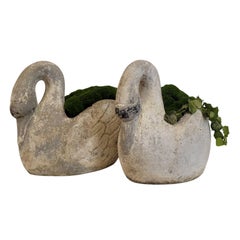
Pair of Antique Concrete Swan Planters, France.
Located in Valladolid, ES
A pair of planters in the shape of beautiful swans, made of concrete, from the first quarter of the 20th century. The pieces exhibit a beautiful patina typical of the period and thei...
Category

Art Nouveau Mid-20th Century Sculptures

Materials

Concrete

Etrurie " Exemplaire d auteur "
Located in CANNES, FR
Jean Cocteau ( 1889 - 1963 ) " Etrurie " . circa 1958 . coupe en terre blanche Dimension: 36cm " Exemplaire d'auteur " . Edition originale de Jean Cocteau Atelier Madeline -Jolly ...
Category

Art Deco Mid-20th Century Sculptures

Materials

Ceramic

Modernist Sculpture Figural Portrait Bust Brutalist Wire Work
Located in Surfside, FL
This piece is unsigned. Irving Lehman (1900-1983) was an American Jewish painter, sculptor, engraver, and designer. Born in Kiev in then Russia, Lehman studied at the Art Students Le...
Category

Modern Mid-20th Century Sculptures

Materials

Steel

American Modernist Abstract Expressionist Oil Painting Carving William Pellicone
Located in Surfside, FL
William Pellicone (American 1915-2004) Mixed media, pyrography, oil on wood carving painting. Dated 1958 Title - Enthymeme #14. Oil painting on carved and burnt distressed wood panel. Inscribed verso Enthymeme Wm. Pellicone #14, 9-4-58. Label on reverse with a typed definition for Enthymeme. Dimensions: 27 inches high, 42.5 inches wide. Metal wrap frame. Provenance: from a Shelter Island NY home that was designed by architect Henry J. Gazon - A.I.A. built in 1959. William Pellicone (1915-2004) was an American painter known for his abstract compositions and use of vibrant colors. He was born in New York City and studied at the Art Students League and the Brooklyn Museum Art School. Pellicone's early work was influenced by the Social Realist movement of the 1930s and 1940s, with his paintings often featuring realistic depictions of urban scenes and working-class people. However, in the 1950s he shifted towards abstraction, exploring the interplay of color and form. Pellicone's mature style was characterized by his use of vibrant, saturated colors, often applied in thick layers of paint. His paintings often featured geometric shapes and organic forms, with a strong sense of movement and energy. In addition to his painting, Pellicone was also a respected teacher and arts administrator. He taught at the New York Institute of Technology and the State University of New York, and served as the director of the Islip Art Museum on Long Island. Pellicone's artwork was exhibited widely during his lifetime, and he was the recipient of numerous awards and honors, including a National Endowment for the Arts grant in 1977. Today, his paintings can be found in the collections of museums and galleries around the world, including the Smithsonian American Art Museum in Washington, D.C. and the Metropolitan Museum of Art in New York. William Pellicone (Born 1915) is active/lives in New York. William Pellicone is known for Abstract expressionist, landscape and non-objective art. An American artist, sculptor, architect. He exhibited at Pennsylvania Academy Fine Arts...
Category

Abstract Expressionist Mid-20th Century Sculptures

Materials

Wood, Oil

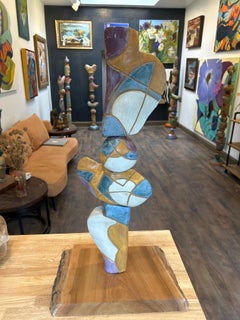
Blue Tone Tower : Modernist Vibrant Blues Cubist Sculpture by Bill Low
Located in Hudson, NY
Cubist style abstract mixed-media sculpture titled 'Blue Tone Tower' was created using various materials including wood, papier-mache, and paint by Bill Low ...
Category

Cubist Mid-20th Century Sculptures

Materials

Wood, Paint, Paper

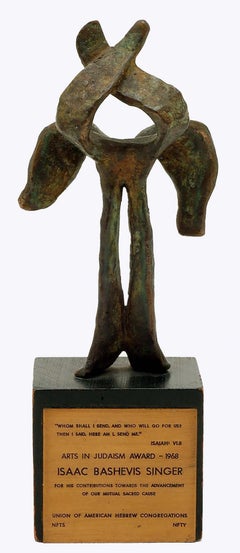
Nathaniel Kaz - Sculpture for Isaac Bashevis Singer Arts in Judaism Award Signed
By Nathaniel Kaz
Located in New York, NY
Nathaniel Kaz Bronze Sculpture to Isaac Bashevis Singer for Arts in Judaism Award, 1966 Bronze, Square wooden base, Metal tag Signed and dated "66" to back of bronze portion of the w...
Category

Abstract Expressionist Mid-20th Century Sculptures

Materials

Metal, Bronze

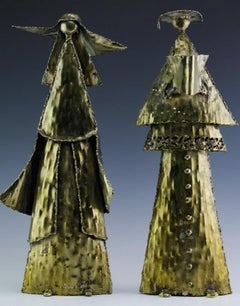
Marcello Fantoni Firenze Raymor Pair Figures Welded Brutalist Italian Sculpture
Located in Surfside, FL
Marcello Fantoni brutalist welded torch cut metal figurines. Signed on base. Metal label reads "Fantoni Firenze Italy Raymor". Italian Mid century modern Sculptural pair of students. Marcello Fantoni (1915-2011) sculptor, ceramicist, metalworker, multimedia artist and designer Born in Florence in 1915, Marcello Fantoni began studying ceramic art at age 12 at the Art Institute of Florence with ceramicist Carlo Guerrini, artistic director of the famed Cantagalli Factory. He continued years of training in ceramics and the arts, including sculpture with Libero Andreotti and Bruno Innocenti, and figurative art with Gianni Vagnetti, graduating as a maestro of art in 1934. After a stint as art director for a ceramics factory in Perugia, in 1936 he opened the Fantoni Ceramic Studio in Florence. Here he produced ceramic series as well as unique mod pieces, sculptures and furnishings. In 1937 Fantoni’s pieces were exhibited in the Florence National Arts and Crafts Exhibit where their unique combination of rustic forms decorated with African and marine motifs and painted figures garnered considerable acclaim. By the start of World War II Fantoni’s melding of ancient Italian pottery techniques with decidedly Modernist elements had won him artistic and commercial success both in Italy and abroad. Having participated in the resistance, after the War Fantoni worked for the 500-year old Maiolica factory in Deruta, Umbria, renowned for its signature tin-glazed pottery. In the 1950s he refocused on his Florence studio, dedicating himself to larger sculptural pieces and working on many collaborations. He also expanded his experimenting with materials, forms, drawing from varied influences – Primitivism, Novecento style, Cubism and Abstract Expressionism. Fantoni gave special emphasis to ancient Etruscan ceramic techniques, glazes and colors, heightening the timeless appeal of his pieces. As well as clay, he also worked in metals to great effect. Whether created as a series or as a unique piece, every Fantoni piece was ultimately rendered unique by his hand-painting it. The extraordinary diversity of shapes and textures notwithstanding, one the most identifiable qualities of his creations was his painting style. Through the 50s and 60s he made many cubist-inspired vases and ewers painted in colors bordered by sgraffito lines scratched through the paint in a manner evoking Picasso and Braque. Along with figurative and abstract works, the 60s also saw Fantoni creating brutalist pieces with edgy, angular shapes, while in later life, his work took a minimalist turn. In 1970 Fantoni founded the International School of Ceramic Art, dedicated to teaching ceramic arts and experimentation. (Many of his students and employees would go on to become noteworthy artisans and artists in their own right.) Maintaining great versatility throughout his career, Fantoni completed projects for public and private buildings, churches, schools, theaters, cinemas, and ships. His works, meanwhile, were collected by important museums worldwide. When Marcello Fantoni died in Florence in 2011 at the age of 95, his obituary in the Italian newspaper La Nazione hailed him “The master of beauty.” Museums and Exhibitions MoMA New York, Metropolitan Museum of Art of New York, Brooklyn Museum, Museum of Fine Art of Boston, Victoria and Albert Museum of London, Royal Scottish Museum of Edinburg, Museums of Modern Art of Tokyo and Kyoto, International Museum of Ceramics in Faenza, National Bargello Museum and Gabinetto Disegni e Stampe of the Uffizi in Florence. “Materia e colore, l’arte di Marcello Fantoni”, Loggia della Limonaia di Palazzo Medici Riccardi di Firenze, 2015 "Marcello Fantoni, A Beautiful Form with Beautiful Color", Archaeological Museum of Fiesole, 2005 "Ceramics as Art, Marcello Fantoni Ceramist and Sculptor", Salone delle Regie Poste, Florence, Marcello Fantoni’s work fused painting, Primitivism, tradition, Modern art, the revival of craft, and the base material of clay itself. Some aspects of Marcello Fantoni’s ceramics – their spikey and angular shapes, with their forms reduced to multiple flat planes of colour bordered by inscribed sgraffito lines – suggest inspiration from Cubist painters Pablo Picasso and Georges Braque. Publications Marcello Fantoni: Ceramista in Firenze Dal 1929 by Antonio Paolucci, Edizioni della Bezuga, 1999 Marcello Fantoni, Ceramica come Arte, Published by Octavo, 2000 Marcello Fantoni Mostra al Museo Archeologico di Fiesole Select Fairs where his work has been exhibited: 2017 Maison Gerard at The Salon Art + Design 2017, Maison Gerard 2016 Patrick Parrish Gallery at The Salon Art + Design 2016, Patrick Parrish Gallery 2015 Galleria Rossella...
Category

Modern Mid-20th Century Sculptures

Materials

Metal

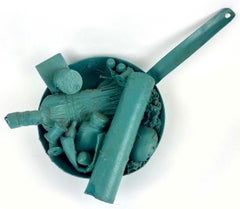
1967 Pop Art, May Wilson, Surrealist Feminist Junk Assemblage Painted Sculpture
By May Wilson
Located in Surfside, FL
May Wilson (1905–1986) was an American artist and figure in the 1960s New York City avant-garde art world. A pioneer of the feminist and mail art movement, she is best known for her Surrealist junk assemblages and her "Ridiculous Portrait" photo collages. Wilson was born in Baltimore, Maryland, into an underprivileged family. Her father died when she was young. She was reared by her Irish Catholic mother, who sewed piecework at home. Wilson left school after the ninth grade to become a stenographer/secretary to help support her family. When she turned 20, she married a young lawyer, William S. Wilson, Jr., and give birth to her first child. She continued to work until the birth of her second child, after which she devoted her energies primarily to mothering and homemaking. In 1942, the couple had prospered enough to move to Towson, Maryland, where she began to take correspondence courses in art and art history from several schools, including the University of Chicago. In 1948, after the marriage of their daughter, the couple moved to a gentleman's farm north of Towson, where she pursued painting and gave private art lessons to neighbors. She exhibited her paintings, scenes of everyday life painted in a flat, purposefully primitive manner in local galleries and restaurants. In 1952 and 1958, she won awards for work submitted to juried exhibitions at the Baltimore Museum of Art. In 1956, her son, the writer Williams S. Wilson, gave to Ray Johnson, the founder of the New York Correspondence School, his mother's address. This began a friendship and artistic collaboration between Johnson and Wilson, which would last the remainder of her life. Wilson became an integral part of Johnson's mail art circle and was initiated into the New York avant-garde through letters and small works that she exchanged with Robert Watts, George Brecht, Ad Reinhardt, Leonard Cohen, Arman, and many others. When her marriage dissolved, she moved to New York City in the spring of 1966, aged 61, taking up residence first in the Chelsea Hotel and then in a studio next door, where she threw legendary soirées and became known as the "Grandma Moses of the Underground". By the time she arrived, Wilson was already working with photomontage collage techniques. Encouraged by Johnson, who had sent her magazines through the mail, she scissored patterns into images of pin-up girls and muscle men until they resembled doilies or snowflakes, as Wilson called them. She decorated her hotel room and later her studio on West 23rd Street with these and other manipulated, found object images. Around this time, she also began her series of neo Dada "Ridiculous Portraits", for which she would ride the subway to Times Square, where she made exaggerated faces in photo booths. She then would cut and paste her photo-booth face onto postcards, along with Old Master reproductions, fashion shoots, and softcore Playboy magazine pornography. Long before artists such as Cindy Sherman and Yasumasa Morimura embarked on similar critical projects, Wilson's "Ridiculous Portraits" sent up the ubiquitous sexism and ageism that exists in popular and fine-art images of women. At the age of 70, she converted a nude photograph of herself into a stamp that she pasted on envelopes. Her collages and humorous self-portraits were made as gifts and mail-art items for her friends and were not widely known until after her death. Her work was contemporaneous with the Arte Povera artists Jannis Kounellis and ‎Michelangelo Pistoletto. She was also an innovator of junk art assemblages that incorporated real objects, such as high-heel shoes, bed sheets, sauce pans, toasters, liquor bottles, ice trays, and wrapped baby dolls. Her sculptures were inspired by Surrealist and Dada practices and are similar in spirit to Yayoi Kusama's contemporary accumulations. Wilson was the subject of a 1969 experimental documentary by Amalie R. Rothschild, "Woo Hoo? May Wilson". Since her death, May Wilson's work has been featured in numerous exhibitions and retrospectives at the Baltimore Museum of Art, Maryland; Gracie Mansion Gallery, New York; the Morris Museum, Morristown, N.J.; the Pavel Zoubok Gallery, New York City; and The University of the Arts, Philadelphia. Selected Exhibitions 2010 "Seductive Subversion: Women Pop Artists, 1958-1968", University of the Arts, Philadelphia (traveling exhibition) 2008 "1968/2008: The Culture of Collage", Pavel Zoubok Gallery, New York, City 2008 "Ridiculous Portrait: The Art of May Wilson", Morris Museum, Morristown, New Jersey 2008 "Woo Who? May Wilson", Pavel Zoubok Gallery, New York City 1995 [Retrospective], The Baltimore Museum of Art, Maryland 2001 "May Wilson: Ridiculous Portraits and Snowflakes", Gracie Mansion Gallery, New York, City 2001 "Inside Out: Outside In-The Correspondence of Ray Johnson and May Wilson", Sonoma Museum of Visual Art, California 1991 "May Wilson: The New York Years", Gracie Mansion Gallery, New York City 1973 "Sneakers", Kornblee Gallery, New York City 1973 "Small Works: Selections from the Richard Brown Baker Collection of Contemporary Art", RISD Museum, Providence, Rhode Island 1971 Corcoran Gallery of Art, Washington, D.C. 1970 "Sculpture Annual 1970", Whitney Museum of American Art, New York City 1965 The Baltimore Museum of Art, Baltimore, Maryland 1962 The Johns Hopkins University, Baltimore, Maryland 1957 Bookshop Gallery, Baltimore, Maryland Public collections Whitney Museum of American Art (New York City) The Baltimore Museum of Art (Baltimore, Maryland) Brooklyn Museum (Brooklyn, New York) References William S. Wilson, "May Wilson: Constructing Woman (1905-1986)", in Ann Aptaker, ed., Ridiculous Portrait: The Art of May Wilson, ed. Ann Aptaker, Morristown, N.J.: Morris Museum, Camhi, Leslie, "Late Bloomer", Village Voice, December 18, 2001 Giles, Gretchen, "Cosmic Litterers: Artists Ray Johnson and May Wilson: Taking the Cake", "Northern California Bohemian," June 14–20, 2001 McCarthy, Gerard, "May Wilson: Homespun Rebel", Art in America, vol. 96, no. 8, September 2008, pp. 142–47 Sachs, Sid and Kalliopi Minioudaki, Seductive Subversion: Women Pop Artists, 1958-1968. Philadelphia: The University of the Arts, 2010, ISBN 978-0789210654 Wilson, William S. Art is a Jealous Lover: May Wilson: 1905-1986, andy warhol...
Category

Surrealist Mid-20th Century Sculptures

Materials

Metal

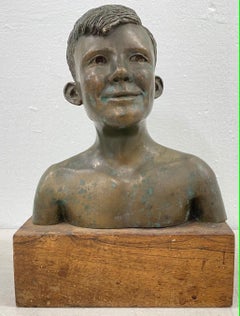
Rex Dietderich "Frank, Age 14" Original Bronze Sculpture c.1970
Located in San Francisco, CA
Rex Dietderich (American, 20th C.) "Frank, Age 14" Original Bronze Sculpture C.1970s The walnut base measures 7" wide x 3.5" deep x 2.5" high The bronze bust measures 7" wide x 4" ...
Category

Impressionist Mid-20th Century Sculptures

Materials

Bronze

Polo (Wall Plaque)
Located in Fairlawn, OH
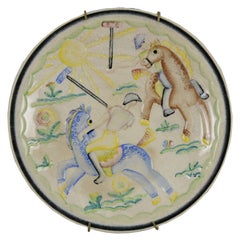
Polo (Wall Plaque) Polychromed ceramic, c. 1930-1931 Signed with the artist's initials: VS recto Cowan Pottery stamp verso References And Exhibitions: Designed by the artist while working for Cowan Pottery in 1930. One of Cowan's clients, an interior designer, requested plates decorated with different outdoor activities. Others in the series included "Swimming," "Tennis," "Golf," and "The Hunt." Condition: with the usual craquelure Size: 11 1/4 inches in diameter Industrial design democratizes high style, and Mr. Schreckengost was widely considered among the most democratic industrial designers. He made, quite literally, the stuff of life — things found routinely in homes, backyards and garages in this country and around the world. He designed bicycles for Sears and everyday china for American Limoges. He designed children’s toys and pedal cars; flashlights, furniture and fans; lawn chairs, lawn mowers...
Category

American Modern Mid-20th Century Sculptures

Materials

Ceramic

Kusama Plush Pumpkin (Kusama yellow black pumpkin)
Located in NEW YORK, NY
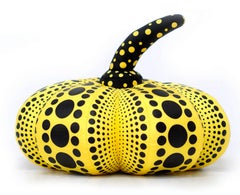
Yayoi Kusama Yellow & Black Pumpkin (plush): An iconic, vibrantly colored pop art piece - this large Kusama plush pumpkin features the universal polka dot patterns and bold colors fo...
Category

Contemporary Mid-20th Century Sculptures

Materials

Nylon

Read More

At Hosfelt Gallery, Bertoia Masterworks Complement Dynamic Contemporary Art

For nearly three decades, San Francisco–based Todd Hosfelt has curated against the grain — with a show on the legendary modernist Harry Bertoia the latest case in point.

This Weathered-Steel Sculpture Distills a Form of Protest into a Minimalist Monument

Part of Alejandro Vega Beuvrin’s “Barricada” series, the work is a subversive tribute to the street smarts of citizen activists.

How the Chunky, Funky Ceramics of 5 Mid-Century American Artists Balanced Out Slick Modernism

Get to know the innovators behind the pottery countercultural revolution.

Art Brings the Drama in These Intriguing 1stDibs 50 Spaces

The world’s top designers explain how they display art to elicit the natural (and supernatural) energy of home interiors.

Chryssa’s 1962 Neon Sculpture Was Way ahead of the Art-World Curve

By working with lettering, neon and Pop imagery, Chryssa pioneered several postmodern themes at a time when most male artists detested commercial mediums.

How to Spot a Fake KAWS Figure

KAWS art toys have developed an avid audience in recent decades, and as in any robust collectible market, counterfeiters have followed the mania. Of course, you don’t have to worry about that on 1stDibs, where all our sellers are highly vetted.

A Giant Wedding Cake Has Us Looking at Portuguese Tiles in a New Light

At Waddesdon Manor, artist Joana Vasconcelos has installed a three-tiered patisserie inspired by the narrative tile work of her homeland. We take a look at the cake sculpture and how Portuguese tiles have been used in architecture from the 17th century to today.

These Soft Sculptures Are Childhood Imaginary Friends Come to Life

Miami artist and designer Gabriela Noelle’s fantastical creations appeal to the Peter Pan in all of us.