Ars Antiqua Furniture
to
131
131
2
1
1
88
34
9
1
1
74
74
21
12
11
104
87
6
3
3
131
131
131
1
1
1
1
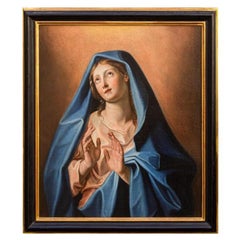
Early 17th Century Roman School Praying Madonna Painting Oil on Canvas
Located in Milan, IT
Roman school, late 16th-early 17th century Praying Madonna
Oil on canvas, 81 x 69 cm
Frame 83 x 95.5 cm
A divine whiteness reverberates with vibrant luster on the maphorion of the present Virgin. The palpable iridescence that structures the thin rosaceous garment, woven with the same fresh light, produces a slight rustle when she takes her hands off. The Madonna in fact takes a prayerful pose, opening her palms to underline her fervent ecstatic intention; the white neck is rendered with perishable fullness of pigments, like the hands, perfectly alive, and the very shiny eyes. With fine shrewdness the artist of the present styles the Virgin's hair with thin white ribbons, exacerbating the purity. An evocative light falls gently on the bust, a materialized sign of divine glory.
The present can be traced back to the late Mannerist climate that prevailed in the capital after the emanation of the Tridentine council (1545-1563). The late Mannerist licenses that can still be seen there, such as the intense lyricism in the stylistic code adopted by the artist, are innervated in the new basic catechetical intent, which at the end of the century produced a certain figurative rigorism. The present, however, still responds to that extraordinary Roman dynamism that raised the capital to a bulwark for the entire mannerist lesson, matched only by a second artistic center, the Florentine one. The engaging carriage of the Virgin reflects the contemporary examples of Giuseppe Valeriano (1542-1596), a Jesuit painter, returning in the Marriage of the Virgin of the Roman Church of Jesus, as well as in the Madonna of Sorrows in the Recanati Altarpiece, equal ardor. But it is in the Assumption of the Virgin painted in four hands with Scipione Pulzone...
Category
Antique Early 17th Century Italian Paintings
Materials
Canvas

17th Century St. Joseph Painting Oil on Canvas by Circle of Cantarini
By Simone Cantarini
Located in Milan, IT
Circle of Simone Cantarini known as the Pesarese (Pesaro, 1612 - Verona, 1648) St. Joseph
Oil on canvas, 62 x 48 cm
Frame 80 x 64 cm
The sty...
Category
Antique 17th Century Italian Paintings
Materials
Canvas

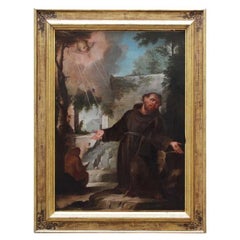
18th Century St. Francis Receives the Stigmata Painting Oil on Canvas
Located in Milan, IT
XVIII century St. Francis receives the stigmata
Oil on canvas, 97 x 75.5 cm.
Category
Antique 18th Century Italian Paintings
Materials
Canvas
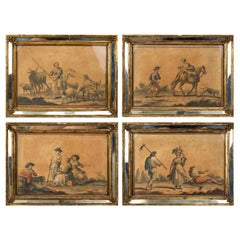
18th Century Four Rural Scenes Painting Tempera on Paper
Located in Milan, IT
XVIII century Rural scenes
(4) Tempera on paper, 20 x 31 cm
With 18th century Venetian mirrored frame, 31 x 39 cm.
Category
Antique 18th Century Italian Paintings
Materials
Paper
16th Century Adoration of the Shepherds Painting Oil on Copper by Carnevale
By Carnevale Studio
Located in Milan, IT
Domenico Carnevale (Sassuolo, 1524 - Modena, 1579) Adoration of the Shepherds
Oil on copper, 42 x 28 cm
Frame 54 x 36 cm
Expert opinion of Prof. Emilio Negro
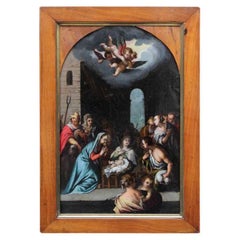
The painting represents the Adoration of the Shepherds, the Child in the center, next to the Madonna kneeling in prayer and an angel behind her; towards him in the foreground a woman with a child in her arms, a shepherd with a sheep on the right, a bagpiper on the left and various other male and female characters turn to him. The architectures of the background, between which a glimpse of the landscape can be glimpsed, are hidden in the upper part by the clouds, where a "celestial glory" encamps with three flying angels.
The painting shows mannerist characters that can be traced back to the second half of the sixteenth century, and can be traced back to an author from the Modena area, with stylistic references to the Bolognese Samacchini (1532 - 1577) and Passerotti (1529 - 1592). More precisely, it can be attributed to Domenico Carnevale (1524-1579), one of the most important masters of the sixteenth century active in the local area. The Carnival was formed in Emilia, his homeland, where he worked for many years. However, his works also show a clear Roman influence, dictated by a long experience in the city, during which he also dedicated himself to the restoration of the Sistine Chapel. Trained in the late-mannerist environment of Modena, he is also linked to the Parmesan Corrorese and Ferrarese Dossesque tradition; Carnival also always maintains a slight archaic sentiment in his work,
The main stylistic reference must be identified in a work similar in subject and iconographic setting, coming from the church of the Pio Istituto Orfanelle di San Geminiano di Modena, currently part of the Art Collection of the Province, attributed to the same influence as the Carnival. Another interesting comparison should be identified with A Presentation of Jesus in the Temple...
Category
Antique 16th Century Italian Paintings
Materials
Copper
18th Century Concert scene Painting Oil on Canvas by Daniel Nikolaus Chodowiecki
Located in Milan, IT
Daniel Nikolaus Chodowiecki (Danzig, 1726 - Berlin, 1801)
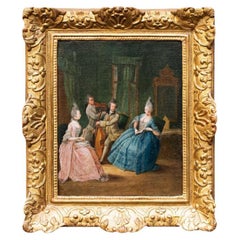
Interior scene with concert
Oil on canvas, 42 X 34 cm
With frame 57 x 49 x 6 cm
Already attributed to Pietro Longhi, the ...
Category
Antique Mid-18th Century German Paintings
Materials
Canvas
16th Century Animals Painting Oil on Canvas by Crivellino
Located in Milan, IT
Giovanni Crivelli known as Crivellino (Milan,? - Parma, 1760) Fight between dogs and bison
Oil on canvas, 84 x 111 cm
With frame 112 x 139 cm
Thanks to the comparison with h...
Category
Antique 16th Century Italian Paintings
Materials
Canvas

20th Century Milan View Porta Venezia Charcoal Pastel and White Lead Cardboard
Located in Milan, IT
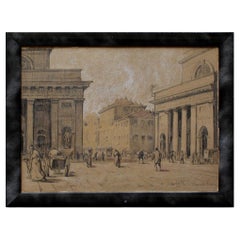
Aldo Conti (Milan, 1890 - there, 1988). Porta Venezia
Charcoal, pastel and white lead drawing on cardboard, 29 x 38 cm
Signed and titled lower right.
Category
20th Century Italian Paintings
Materials
Paper
Peace Depicting the Crucifixion in Dark Patina Bronze 18th Century
Located in Milan, IT
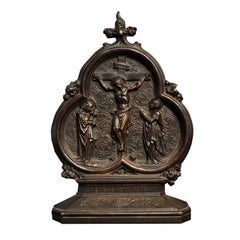
18th Century. Peace depicting the Crucifixion
Dark patina bronze, 21 x 14.5 cm
The bronze examined is an ancient peace (in Latin osculum pacis or table pacis), the object of th...
Category
Antique 18th Century Italian Religious Items
Materials
Bronze
19th Century Florence View Painting Pallmann Oil Paint
Located in Milan, IT
Peter Götz Pallmann (Berlin, 1908 - 1966)
Santa Trìnita bridge in Florence
Oil on canvas applied to wood, 35 x 40 cm
Frame 45.5 x 50.5 cm
Signe...
Category
Antique 19th Century German Paintings
Materials
Canvas
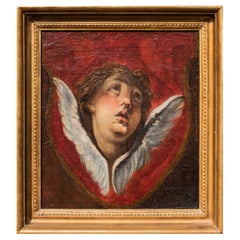
18th Century Cherub Head Sketch Painting Oil on Canvas
Located in Milan, IT
Venetian school, 18th century
Study with the head of a cherub
Measures: Oil on canvas, 45.5 x 41 cm - with frame 54.5 x 49.5 cm
The present qualifies as a study or preparatory sketch by virtue of the structural and figural layout; by reason of formal and substantial evidence, it can be traced back to the mature neo-Venetian style, which in the eighteenth century had begun to produce figurations of extreme typological pathetism and formal expressionism. The contemporary painting experience of Tiepolo commanded the Venetian art scene, once the lesson of Pier Francesco Mola (1612-1666) was overruled.
The delicate putto head offered here, in which a cherub is recognizable due to the happy iconographic solution of the wings placed under the angel's face, is outlined with a vigorous vitalism. A foreshortened point of view illuminates his face in a grazing way, probing his features with strong shadows and with a youthful blush that orange his cheeks. The veristic perfection with which the artist arranges the semblant is of marvelous expressiveness. The eyes are swollen with intensity, and together with the general setting of the head they denounce a conscious reflection on the physiognomy, peculiar within the emerging context of Venetian painting.
The painting in question is affected by the large-scale productions, both monumental and perspective, at the time in vogue in the territory of the Serenissima. Conceived through a vision from below, the portrait reveals from the Venetian Rococo that particular predilection for the open and clear, airy ways, denounced in the first instance by Tiepolo. The conscious detachment from the Cortona-style decorativism and from the repeated layout solutions then in vogue allow us to approach the present to the production of Francesco Fontebasso...
Category
Antique 18th Century Italian Rococo Paintings
Materials
Canvas