Ashville Fine Arts Decorative Objects
to
172
2
9
38
125
2
73
33
17
27
12
31
8
4
6
13
7
6
3
37
30
15
14
2
1
1
1
93
64
39
30
21
174
75
58
55
46
39
Height
to
Width
to
174
174
174
4
3
2
2
2
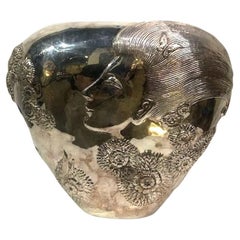
Erte, "She Loves Me", Silvered Bronze Vase, 1987
Located in New York, NY
ERTE
a/k/a/ Romain de Tirtoff
“She Loves Me"
Vase
Silvered Bronze Vase
1987
DIMENSIONS
Height: 9.5 inches
Width: 12.5 inches
De...
Category
Vintage 1980s French Art Deco Vases
Materials
Bronze

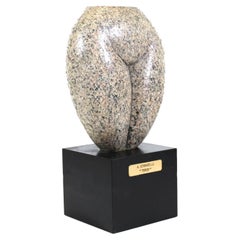
Amedeo Gennarelli, Torso, Art Deco Carved Granite Sculpture, ca. 1940
Located in New York, NY
Amedeo Gennarelli
Torso
Carved Granite
Art Deco
Circa 1940
DIMENSIONS
Height: 15.5 inches (39.37 cm)
Width: 8 inches (20.32 cm)
Depth: 6 inches (15.24 cm)
ABOUT
This expressive hand-carved and highly polished grey-and-pink granite sculpture is mounted on a square black stone base with the incised signature atop, ‘A. Gennarelli’.
AMEDEO GENNARELLI (Italian/French, 1881–1943) a/k/a Jean Ortis was a French/Italian sculptor. He was born in 1881 in Naples, Italy, but immigrated to Paris in 1913 and worked there; exhibiting at numerous Salons of the Societe des Artistes Francais through the years to come. He is known for his work in the art deco style and for his depictions of the female nudes; working in bronze, stone, terra-cotta and wood. Amedeo Gennarelli died in Paris...
Category
Vintage 1940s French Art Deco Figurative Sculptures
Materials
Granite, Stone
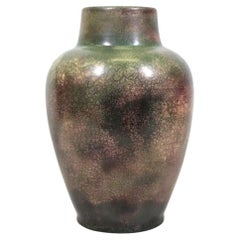
Arts
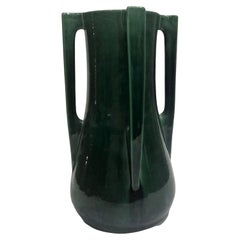
Crafts Chinese-Form Ceramic Vase, ca. 1900
By Roseville Pottery
Located in New York, NY
American Arts & Crafts
Chinese-Form Pauleo Pattern Glazed Ceramic Vase
In Manner of Roseville for Tiffany
Circa 1900
DIMENSIONS
Height: 15.75 inches (40.01 cm)
Diameter: 10.5 inch...
Category
Antique Early 1900s American Art Nouveau Vases
Materials
Ceramic
Brutalist Abstract Cast Aluminum
Marble Sculpture by D. Calvi, ca. 1970’s
Located in New York, NY
Abstract Brutalism
D. Calvi
Cast & Partially Polished Aluminum, Marble
ca. 1970’s
DIMENSIONS
Height: 22 inches (w/ base)
Width: 9.5 inches
Depth: 4 inches
Base: 11 x 6 x 3 inches
A...
Category
Vintage 1970s American Brutalist Abstract Sculptures
Materials
Marble, Aluminum
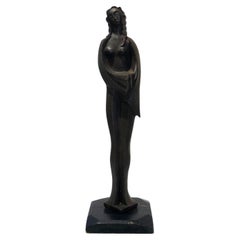
American Art Deco Wrought Iron Sculpture of Nude Female, ca. 1920’s
Located in New York, NY
American Art Deco
Nude Female
Wrought Iron Sculpture
ca. 1920’s
DIMENSIONS
Height: 13 inches
Width: 4 inches
Depth: 4 inches
ABOUT
Designed in...
Category
Vintage 1920s American Art Deco Figurative Sculptures
Materials
Wrought Iron
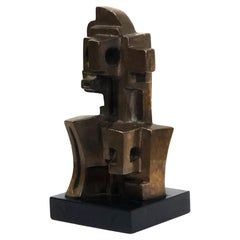
Abstract Cubist Bronze Sculpture Signed DN, XX Century
Located in New York, NY
Vintage
Abstract Cubist Sculpture
Bronze Granite
XX Century
DIMENSIONS
Height: 7 inches Width: 3-3/8 inches Depth: 3-3/8 inches
ABOUT
This is a brillia...
Category
20th Century American Brutalist Abstract Sculptures
Materials
Bronze
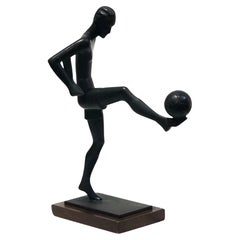
Soccer Player, German Art Deco Patinated Bronze Sculpture, ca. 1930’s
Located in New York, NY
Art Deco
Soccer Player
Patinated Bronze Sculpture
Germany, ca. 1930’s
DIMENSIONS
Height: 9.5 inches Width: 6.75 inches Depth: 2.75 inches
ABOUT
A rare, laconi...
Category
Vintage 1930s German Art Deco Figurative Sculptures
Materials
Bronze
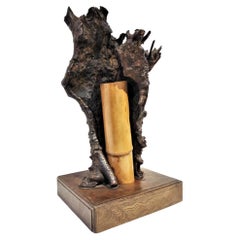
Atique Japanese Rootwood
Bamboo Ikebana Vase, XIX Century
Located in New York, NY
Atique
Rootwood & Bamboo
Ikebana Vase
Japan, XIX Century
DIMENSIONS
Height: 19.25vinches
Width: 10.13 inches
Depth: 9.5 inches
ABOUT
This absolutely unique ikebana vase consists of...
Category
Antique Late 19th Century Japanese Japonisme Planters, Cachepots and Jar...
Materials
Bamboo, Wood
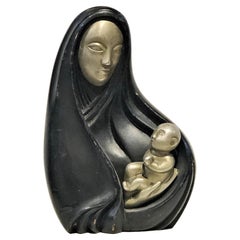
Rena Rosenthal, Madonna
Child, Art Deco Wood
Metal Sculpture, ca. 1920’s
By Rena Rosenthal
Located in New York, NY
Austrian Art Deco
(for Rena Rosenthal possibly, by Hagenauer)
Madonna and Child
Carved Ebonized Wood & Silvered Metal
ca. 1920’s
MATERIALS
Ebonized wood and silvered metal.
MARKINGS
Stamped with “Made in Austria” and "RENA" marks.
DIMENSIONS
Height: 6.25 inches
Width: 4.25 inches
Depth: 2.5 inches
ABOUT SCULPTURE
Quite extraordinary in its design, craftsmanship and selection of materials, this outstanding Art Deco tabletop sculpture of the Madonna and Child was most likely made in the Vienna studio...
Category
Vintage 1920s Austrian Art Deco Figurative Sculptures
Materials
Metal
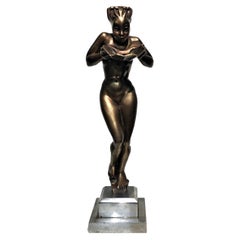
American Art Deco Bronze Sculpture of a Nude Woman w/ Sea Shell, ca. 1920s
Located in New York, NY
ABOUT
A light, graceful female figure, as if floating in the air, with hair fluttering in the wind, trying not to spill, carefully carries in front of her a large sea shell filled wi...
Category
Vintage 1920s American Art Deco Figurative Sculptures
Materials
Bronze
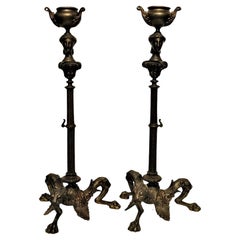
A Pair of Bronze Neoclassical Grand Tour Candelabras, Late 19th Century
Located in New York, NY
Grand Tour
Pair of Bronze Candelabras
Late 19th Century
DIMENSIONS
Height: 10.33 inches
Width: 4.75 inches
Depth: 4.75 inches
ABOUT
We present to your attention a pair of stunning...
Category
Antique 1890s English Grand Tour Candelabras
Materials
Bronze
Austrian Art Deco Bronze and Green Agate Vide-Poche, ca. 1920s
Located in New York, NY
Austrian Art Deco
Vide-Poche
Bronze and Green Agate
ca. 1920s
ABOUT
Vide Poche (meaning 'empty pocket' in French) is intended to be a trinket tray used for holding the contents of ...
Category
Vintage 1920s Austrian Art Deco Decorative Dishes and Vide-Poche
Materials
Agate, Bronze
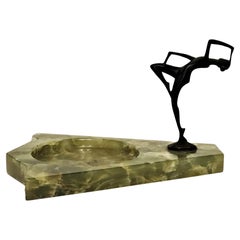
Auguste Rodin, Age of Bronze, Male Nude Patinated Bronze Statue Re-Cast, XX C.
By Auguste Rodin
Located in New York, NY
Auguste Rodin
Age of Bronze
Patinated Bronze Sculpture Re-Cast
XX Century
ABOUT THE ARTWORK
Rodin's breakout sculpture, The Age of Bronze (L'Age d'airain) caused a critical scandal ...
Category
20th Century French Belle Époque Figurative Sculptures
Materials
Bronze
Japanese Art Nouveau Awaji Ware Art Studio Pottery Flower Vase, ca. 1900s
Located in New York, NY
Japanese Art Nouveau
Flower Vase
Awaji Ware Art Studio Pottery
ca. 1900s
ABOUT AWAJI WARE ART STUDIO POTTERY
Awaji pottery was made on the Japanese island of the same name between...
Category
Antique Early 1900s Japanese Art Nouveau Vases
Materials
Pottery
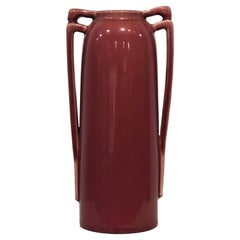
American Art Deco Anodized
Painted Metal Planter, ca. 1920s
Located in New York, NY
American Art Deco
Planter with Geometrical Design
Anodized & Painted Metal
ca. 1920s
DIMENSIONS
Height: 13.5 inches
Width: 14.5 inches
Depth: 8.25 inches
Category
Vintage 1920s American Art Deco Planters, Cachepots and Jardinières
Materials
Metal
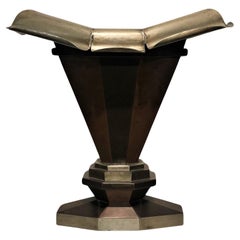
Japanese Art Deco Ikebana Chromed Metal Basket, ca. 1930s
Located in New York, NY
Art Deco
Ikebana Basket
Chromed Metal
Japan, ca. 1930s
ABOUT
Ikebana is the Japanese art of of beautifully arranging cut stems, leaves, and flowers in vases and other containers t...
Category
Vintage 1930s Japanese Art Deco Planters, Cachepots and Jardinières
Materials
Metal
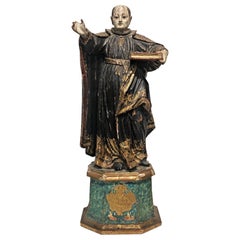
After Francisco Ruiz Gijon, St. Francis, Spanish Baroque Wood Sculpture, 17th C.
Located in New York, NY
Baroque
After Francisco Ruiz Gijon
Saint Francis of Assisi
Polychrome and Parcel Gilt Carved Wood, Insert Glass Eyes
Spain, Late 17th Century
Francisc...
Category
Antique 17th Century Spanish Baroque Figurative Sculptures
Materials
Glass, Wood
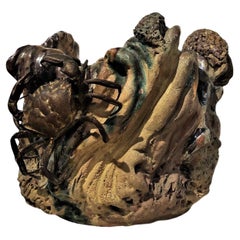
French Art Nouveau Iridescent Stoneware
Bronze Vase or Cachepot, ca. 1900s
Located in New York, NY
French Art Nouveau
Ocean Life Theme
Vase Cachepot
Iridescent Stoneware & Patinated Bronze Crab Appliqué
ca. 1900s
ABOUT
We present here a most unusual and utterly decorative Fren...
Category
Antique Early 1900s French Art Nouveau Vases
Materials
Stoneware
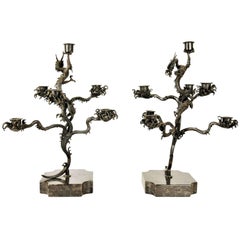
Pair of Japanese Patinated Bronze Candelabras, Meiji Period, ca. 1900
Located in New York, NY
This most unusual pair of original 18th century Japanese patinated bronze candelabras, uniquely designed as branches of mountain flowers entangled by a dragon, are mounted on the con...
Category
Antique Late 19th Century Japanese Japonisme Candelabras
Materials
Bronze
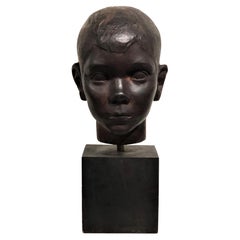
American Art Deco Carved Ebonized Wood Head Bust of a Young Boy, ca. 1940s
Located in New York, NY
ABOUT SCULPTURE
This wonderful sculptural and portrait work was certainly created by a master sculptor, although not signed by the author. The face of this typical all-American boy, ...
Category
Vintage 1940s American Art Deco Figurative Sculptures
Materials
Wood
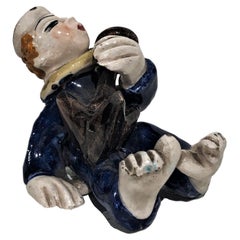
Vally Wiethelthier, Drunken Sailor, Art Deco Art Ceramic Figurine, ca. 1925
Located in New York, NY
ABOUT
This funny, humorous tabletop ceramic figurine depicts a drunken sailor lying on his back. Around his neck is a metal ring with an anchor on it.
MARKINGS
Signed on the left buttock: "Italy".
DIMENSIONS:
Height: 2.5 inches
Width: 2 inches
Depth: 3.5 inches
VALERIE “VALLY” WIESELTHIER (Austrian-American, 1895 – 1945) was an outstanding ceramic artist. She was born to a Jewish family in Vienna, Austria. Her father, Wilhelm Wieselthier was a lawyer. Valluy attended theWiener Frauenacademie in Vienna from 1912 to 1914 and studied at the Vienna School of Applied Arts with Rosalinda Rothhansl, Kolo Moser, Jodef Hoffmann and Michael Powolny from 1914 to 1920. In addition, she worked as an auxiliary nurse during the First World War.
From 1917 to 1922, she worked for the Wiener Werkstatte. From 1922 to 1927, she ran her own ceramic workshop in cooperation with the Augarten porcelain factory, which was newly founded in 1923, but also with other companies such as Friedrich Goldschider, Gmundner Keramik and Lobmeyr.
Her expressive and humorous porcelain figures attracted attention at the Exposition Internationale des Arts Décoratifs et industriels modern in Paris in 1925 and are considered typical examples of the Art Deco style style. From 1928, the artist increasingly moved her center of life to the United States. She went to the International Exhibition of Ceramic Art in New York City in October 1928. In 1933, she moved to Chicago with Paul Lester Wiener...
Category
Vintage 1920s Italian Art Deco Figurative Sculptures
Materials
Ceramic
Hendrik Scholter, Capitalist
Proletarian, Dutch Art Deco Bronze, ca. 1930s
By Hendrik Scholter
Located in New York, NY
DIMENSIONS
Height: 9.5 inches
Width: 6.5 inches
Depth: 3.75 inches
MARKINGS
Brown-patinated bronze, inscribed on base: H. Scholter
Category
Vintage 1930s Dutch Art Deco Figurative Sculptures
Materials
Bronze

Carl Kauba, Frightened by the Frog, Viennese Bronze Sculpture, circa 1915
By Carl Kauba
Located in New York, NY
Dimensions
Total Height: 7.5 inches
Base Height: 2 inches
Width: 2.75 inches
Depth: 2.75 inches
ABOUT
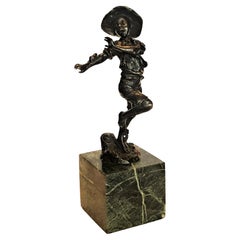
This charming desk figurine in dark brown patinated Viennese bronze by the famous Austrian sculptor Karl Kaub stands out for the originality and humor of its subject matter. The author depicted with amazing subtlety a boy who jumped on one leg in fright, suddenly seeing a frog sitting on his arm.
CARL KAUBA (Austrian, 1865-1922) was born August 13, 1865 in Vienna, Austria. The son of a shoemaker, Kauba chose to follow his calling into the world of art. Collectors now rank him in a class with Remington and Russell as one of the great portrayers of American Western. His subjects were typically American Indians, calvarymen, cowboys, and roughriders. In addition to his American bronzes, Kauba produced a lifetime’s worth of Austrian statuary. His work became fully appreciated on both sides of the Atlantic.
Carl studied at the Academy of Fine Arts in Vienna under professor Laufenberg. Later he would study at the academies under Carl Waschmann and Stefan Schwartz. Next, he went to Paris in 1886 to further study before he set off for the U.S. In fact, some debate still remains as to whether Kauba ever visited the U.S.
Kauba’s fascination with the West was fired by the stories of the German writer, Carl May, whose tales of Western adventure were well known throughout Europe. Most authorities feel that he was about twenty-five years old when he traveled widely throughout the American West. He then returned to Austria with voluminous notes, sketches, and several models of Western sculpture...
Category
Vintage 1910s Austrian Jugendstil Figurative Sculptures
Materials
Bronze
Franz Xavier Bergmann, Sculptural Bud Vase, Vienna Bronze, circa 1900
By Franz Bergmann
Located in New York, NY
Dimensions
Height: 7.25 inches
Width: 5.25 inches
Depth: 4.5 inches.
Markings
Fully marked on the bottom with a "B" in an urn-shaped cartouche (for “Bergmann”), and “GESHUTZED” (German: “PROTECTED).
ABOUT
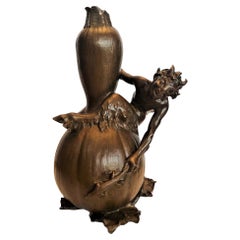
What distinguishes this unique bud vase from others is a perfect synthesis of a utilitarian object and a Fine sculpture. It is not only the amazing subtlety and taste of the author’s artist skills, but an extraordinary design and an absolutely outstanding original plot. Designed for a single flower only, it is nonetheless a very complex and multifaceted composition filled with warm humor and fantasy. Sitting on a vessel shaped as a gourd, clasping its goat legs with hooves and holding on to the neck with one hand in order not to fall of it; a playful and mischievous faun holds by the tail a fleeing lizard with the other hand.
FRANZ XAVIER BERGMANN (Austrian, 1861–1936) was the owner of a Viennese foundry who produced numerous patinated and cold-painted bronze oriental, erotic and animal figures, the latter often humanized or whimsical, humorous objects d'art. Cold painted bronze refers to pieces cast in Vienna and then decorated in several layers with so-called dust paint; the expertise for the mix of this kind of paint has been lost. The color was not fired hence "cold painted". Mainly women working...
Category
Antique Early 1900s Austrian Jugendstil Vases
Materials
Bronze
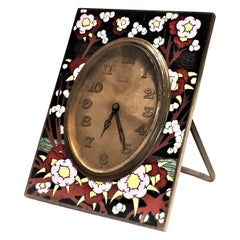
Zenith Watch Co., Swiss Art Deco Metal Dore and Cloisonne Enamel Clock, 1920s
Located in New York, NY
Zenith SA is a Swiss luxury watchmaker. The company was started in 1865 by Georges Favre-Jacot at the age of 22, in Le Locle in the canton of Neuchâtel. Zenith w...
Category
Vintage 1920s Swiss Art Deco Table Clocks and Desk Clocks
Materials
Metal
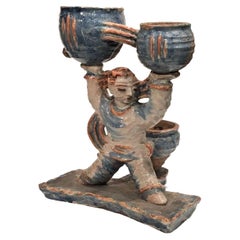
Expressionist Ceramic Sculptural Vase Attributed to Vally Wieselthier, c. 1920
By Vally Wieselthier
Located in New York, NY
Although unsigned, this magnificent Austrian expressionist art ceramic sculptural vase with three receptacles is attributed to Vally Wieselthier for Wiener Werkstatte, ca. 1920.
Valerie "Vally" Wieselthier (Austrian-American, 1895 – 1945) was an outstanding ceramic artist. She was born to a Jewish family in Vienna, Austria. Her father, Wilhelm Wieselthier was a lawyer. Valluy attended theWiener Frauenacademie in Vienna from 1912 to 1914 and studied at the Vienna School of Applied Arts with Rosalinda Rothhansl, Kolo Moser, Jodef Hoffmann and Michael Powolny from 1914 to 1920. In addition, she worked as an auxiliary nurse during the First World War.
From 1917 to 1922, she worked for the Wiener Werkstatte. From 1922 to 1927, she ran her own ceramic workshop in cooperation with the Augarten porcelain factory, which was newly founded in 1923, but also with other companies such as Friedrich Goldschider, Gmundner Keramik and Lobmeyr.
Her expressive and humorous porcelain figures attracted attention at the Exposition Internationale des Arts Décoratifs et industriels modern in Paris in 1925 and are considered typical examples of the Art Deco style style. From 1928, the artist increasingly moved her center of life to the United States. She went to the International Exhibition of Ceramic Art in New York City in October 1928. In 1933, she moved to Chicago with Paul Lester Wiener...
Category
Vintage 1920s Austrian Expressionist Vases
Materials
Ceramic
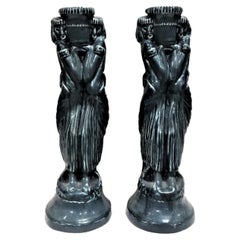
A Pair of Art Deco Ceramic Candle Holders by Roockwood Pottery, ca. 1920
By Rookwood Pottery Co.
Located in New York, NY
MARKINGS
Each candle holder is fully marked on the bottom, including date XX (ca. 1920) and model number (2304).
ROOCKWOOD POTTERY
Roockwood is the synonym of the American Art Pottery. Founded on Thanksgiving Day in 1880 by Maria Longworth Storer, Rookwood made history – the first large manufacturing enterprise founded and owned by a woman in the United States and launching the art pottery movement in America. Within a decade, Rookwood pottery gained international acclaim, rivaling European and Asian firms that had been in existence for hundreds or thousands of years.
Maria Longworth Nicholas, was the daughter of a wealthy art collector, she was inspired by Japanese pottery. When she discussed her desire to create fine pottery with her father, he provided the means and environment that allowed her to pursue her creative passions. And although it may have started as a hobby, the talented Maria quickly managed to establish Rookwood pottery as a quality producer of fine ceramic art potter.
She setup the Rookwood company, hired artists like Japanese artist Kataro Shirayamadani who came to work for the company in 1887, and talented art students and encouraged them to use their creativity to experiment and create unique pottery pieces. Almost every piece designed by these artists sold for hundreds of dollars, and today they are regarded as highly collectible. A Rookwood piece by Japanese artist Kataro Shirayamadani sold for $198,000 in 1991. He was a Rookwood artist from 1887 until 1948.
The Rookwood airbrush, called the mouth atomizer, was developed by Rookwood to apply glazes in an innovative way. The technique helped the company develop its own individual look. The atomizer helped add the beautiful layers of color Rookwood is known for, and the technique is still used at the Rookwood pottery today.
More well-known pottery manufacturers and recognized artists doubted this female led company would have what it takes to succeed, but much to their surprise Rookwood turned out to be one of the best. By combining extraordinary attention to detail and innovative design Maria Longworth Nicholas made Rookwood the standard for ceramic pottery manufacturers to aim for.
Today antique and vintage Rookwood Pottery...
Category
Vintage 1920s American Art Deco Candlesticks
Materials
Ceramic
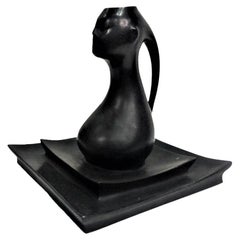
Alfonso Canciani, Viennese Secession Orientalist Bronze Vase, c. 1910
By Alfonso Canciani
Located in New York, NY
Alfonso Canciani (Italian-Austrian, 1863-1955) was a famous Italian-Austrian sculptor of the period of accession to the Viennese Secession. Son of a stonemason, after a realist period he managed to establish himself as a leading sculptor of the Viennese Secession. In fact, he worked in Vienna, where he had enrolled in 1886 at the Academy of Fine Arts, then at the Higher School of Sculpture and finally at the Special School, where he obtained the Rome prize for the sketch for Dante's Monument.
He developed a notable business obtaining important prizes and numerous commissions. First among the sculptors of the Viennese capital, he was invited to join the Association of the Viennese Secession, of which Klimt was magna pars, after the exhibition of Dante's group in 1900 at the Secession exhibition, and obtained the most important Austrian artistic prize, the Kunstlerlpreis.
This same work, presented in 1910 in Berlin, at the Great Art Exhibition, also received an important recognition here. He obtained the Rome prize in 1896, exhibited successfully in Munich and in 1899 at the III International Art Exhibition in Venice.
In that period he made some statues of saints for the cathedral of Santo Stefano in Vienna, the monument to Wagner, the bust of Nietzsche for the University, the scepter and the gold chain of the University Rector, figures of Italian poets ( Petrarch, Boccaccio, Tasso, Ariosto).
He submitted a sketch for the official monument to Empress Elizabeth, which was then built in Austrisn Gföhl and Pula. At the time of his accession to the Secession, he dedicated himself to decorating the facade of the Artaria house in Vienna in collaboration with the architect Max Fabiani.
He later abandoned the symbolist decorativism of the Jugendstil for a more concentrated and vigorous style, approaching the Belgian sculptor Constantin Meunier for the theme of work, and preferring to exhibit at the Künstlerhaus.
In Vienna, he was generous with advice and help with the Italians and in particular with his fellow citizens (such as the Brazzanese Luigi Visintin, then a university student).
After the First World War, he returned to Italy and lived in Friuli, penalized by the fact that the Habsburg Empire had by now disappeared. Instead of large-scale public monuments, he then devoted himself to engraving medals (e.g. for Benedict XV and for the Italian mission in Vienna in 1919) and to designing funeral monuments (examples in Mali Lošinj and Trieste) and portrait busts (of Generals Carlo Caneva and Antonio Baldissera in Udine, sculptures of the War Memorial of Corno di Rosazzo). After all, he had already executed the Bab grave monument in the Döblinger cemetery in Vienna in 1909.
He taught in Trieste from 1920 until 1935, at the local school of industrial art, where he had Marcello Mascherini...
Category
Vintage 1910s Austrian Jugendstil Vases
Materials
Bronze
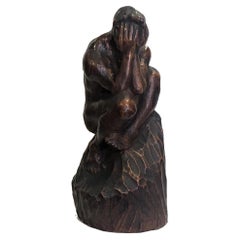
After The Thinker, Modern Carved Wood Sculpture, ca. 1960s
Located in New York, NY
Permanently exhibited at the Musee Rodin in Paris, ‘The Thinker’ (French: Le Penseur), the original Auguste Rodin’s bronze sculpture of...
Category
Vintage 1960s American Mid-Century Modern Figurative Sculptures
Materials
Wood
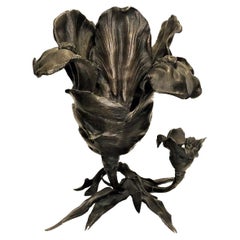
French Art Nouveau Patinated Bronze Sculptural Iris Vase, ca. 1900
Located in New York, NY
ABOUT IRIS
The iris is a special and mysterious flower. Not only because of its striking appearance, but also from an artistic and historical point of view. It is also like a work of art, as though created by Mother Nature. The unique leaves of this plant not only create wonderful shadow casts, but also look as if they were painted by hand. It's no wonder that iris acts as the muse for countless artists, and can be seen in many famous works of art.
The iris was first spotted in the time of Pharaoh Thutmose, in 1504 BC. He had the iris inscribed into the wall reliefs of a temple as a sign of his power, as well as decorating his sceptre with motifs of the flower. Since then, the iris has been a symbol of victory in Egypt. But the symbolism of the iris goes further than that. In Japan, the flower represents courage and is the symbol of the boys' festival. In Islamic cultures, the iris is a symbol of prosperity. In Europe, the flower was a popular weapon symbol in the Middle Ages and stood for chivalry. And in Christianity, the iris was seen as a symbol of the trinity because of its three-part flowers. With more than 300 varieties, the iris is now the most popular flower among growers and gardeners following the rose.
Countless artists use the iris in their works and the flower is present in all eras. You can see the flower on furniture, vases, jewelry, fabrics, sculptures, coats of arms and much more. Did you know that the iris is also called the sword lily? It's not a coincidence that it used to symbolize physical and emotional pain and suffering caused by a weapon. We also see the flower in religious art, where it's often associated with Mary and Jesus. The iris is also associated with the Greek goddess Iris, where the flower symbolizes reconciliation and divine messages. This is also reflected in many paintings.
Finally, the iris is also visible in Dutch and Flemish still-life paintings. This can be in a religious form, incorporated into an object or as a decorative flower.
In the Art Nouveau art movement, the iris (along with other plants, such as the birch) was often used as an expression of feminine beauty. With its almost otherworldly appearance, the iris is perfectly suited to the Art Nouveau aesthetic and is featured in many well-known works of art. The poet of that era, Hermann Hesse...
Category
Antique Early 1900s French Art Nouveau Planters, Cachepots and Jardinières
Materials
Bronze
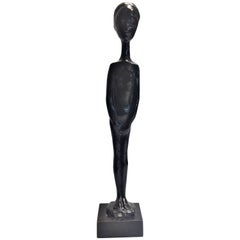
Sébastien Tamari, Femme Nu, French Modernist Patinated Bronze Sculpture, 1960s
By Sebastien Tamari
Located in New York, NY
Sébastien Tamari (French, 1900-1991)
1900 Birth in Baku of Sébastien Tamari (Russian Empire).
1920 He left his hometown due to political events. He travelled through the Caucas...
Category
Vintage 1960s French Modern Figurative Sculptures
Materials
Bronze
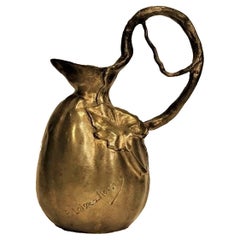
Paul Loiseau-Rousseau, French Art Nouveau Gilt Bronze Jug, Ca. 1900
By Paul Loiseau-Rousseau 1
Located in New York, NY
Paul Louis Emile Loiseau-Rousseau (French, 1861-1927) was a famous French sculptor. In his youth, he planned to devote himself to etching, was a student of Antoine-Louis Barye at the...
Category
Antique Early 1900s French Art Nouveau Vases
Materials
Bronze
Austrian Jugenstil Patinated Bronze Sculpture of Fawn Youth, Ca. 1900
Located in New York, NY
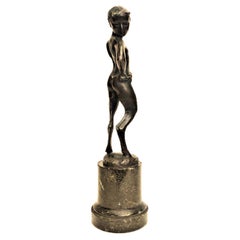
Probably Austrian, this lovely Jugenstil desk-sized black-patinated bronze figurine on its original marble pedestal depicts a fawn youth, checking the size of his tail to see how muc...
Category
Antique Early 1900s Austrian Jugendstil Figurative Sculptures
Materials
Marble, Bronze
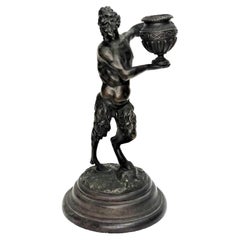
Antique Continental Patinated Bronze Fawn Candlestick, 19th Century
Located in New York, NY
Probably Italian, 19th Century patinated bronze candlestick in form of a dancing Fawn holding a candle-vessel in his hands, on its original wood base.
Category
Antique 1880s Italian Belle Époque Figurative Sculptures
Materials
Bronze
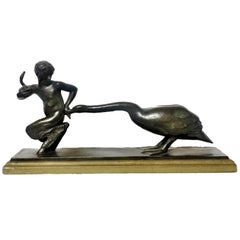
Paul Silvestre, Faun
Goose, French Art Deco Bronze Sculpture, ca. 1920
s
By Paul Silvestre
Located in New York, NY
Signed on the plinth “Silvestre”
Original wooden base.
Dimensions
Height: 11.75 inches (29.37cm)
Width: 23.25 inches (58.12cm)
Depth: 6 inches (15cm)
PAUL SILVESTRE (French...
Category
Vintage 1920s French Art Deco Figurative Sculptures
Materials
Bronze
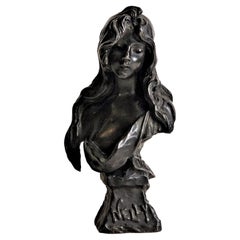
Emmanuel Villdnis, ‘Nelly’, French Art Nouveau Patinated Bronze Bust, ca. 1890
By Emmanuel Villdnis
Located in New York, NY
DETAILS
Signed and foundry mark on back.
DIMENSIONS
Height: 4-15/16 inches
Width: 2-5/16 inches
Depth: 2.25 inches
ABOUT THE SCULPTURE
This portrait bust is of Nelly Faner, famous burlesque dancer at the turn of the XX Century Paris.
ABOUT THE SCULPTORE
Emmanuel Villdnis (French, 1858 – 1914) was born to Italian parents in France, in 1858. He moved with the family to Piedmont, Italy, in March 1861; after the proclamation of the Kingdom of Italy.
Known in Italy as Villani, he studied at the Academy of Fine Arts Albertina in Turin from 1871 to 1880 alongside master-sculptor Odoardo Tabacchi. When Villanis graduated, he exhibited his first works in cities across Italy, notably his bust ‘Alda’ in Milan, in 1881.
Villanis returned to France in 1885, living and working in the Montmartre district of Paris and didn’t leave Montmartre until his death on August 28th 1914.
Villanis specialised in female bronze busts...
Category
Antique 1890s French Art Nouveau Busts
Materials
Bronze
Japanese Art Nouveau, Awaji Ware Art Studio Pottery Flower Vase, Ca. 1900
By Awaji Pottery
Located in New York, NY
DIMENSIONS:
Height: 12.5 inches
Width: 6.75 inches
Depth: 6.75 inches
ABOUT AWAJI POTTERY
Awaji pottery was made on the Japanese island of the same name between 1830 and 19...
Category
Antique Early 1900s Japanese Art Nouveau Vases
Materials
Ceramic
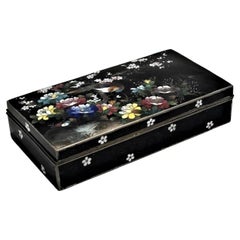
Chinese Art Deco, Bird
Flower Motif Cloisonné Enamel Trinket Box, Ca. 1920
Located in New York, NY
Chinese Art Deco
Bird & Flower Motif
Cloisonné enamel trinket box
ca. 1920
DIMENSIONS:
Height: 1.75 inches
Width: 6.75inches
Depth: 3.75...
Category
Vintage 1920s Chinese Art Deco Jewelry Boxes
Materials
Metal
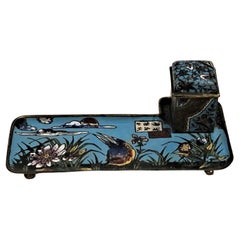
Chinese Art Deco Enameled Bronze Inkwell w/ Bird and Flower Motif, ca. 1920
Located in New York, NY
Chinese Art Deco
Enameled Bronze Inkwell
w/ Bird and Flower Motif
ca. 1920
Dimensions:
Height: 2.5 inches.
Width: 6.75 inches.
Depth: 3.5 inches.
Category
Vintage 1920s Chinese Art Deco Inkwells
Materials
Brass
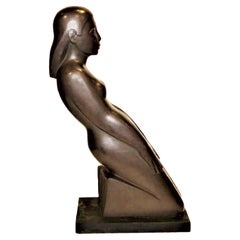
American Art Deco Carved Slate Nude Kneeling Woman Sculpture, ca. 1920
Located in New York, NY
American Art Deco
Nude Kneeling Woman
Carved Slate Sculpture
ca. 1920
DETAILS
Mounted on original marble base.
Apparently unsigned.
DIMENSIONS
Hei...
Category
Vintage 1920s American Art Deco Figurative Sculptures
Materials
Slate
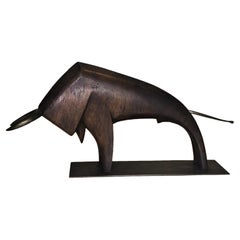
Sier Kunst, Bull, Austrian Art Deco Wood
Brass Sculpture, ca. 1930
Located in New York, NY
Austrian Art Deco
Sier Kunst
Bull
Wood & Brass Sculpture in Haguenauer Manner
ca. 1930
DETAILS
Marked ‘SK’ in a triangle for Sier Kunst and ‘Made In Aus...
Category
Vintage 1930s Austrian Art Deco Animal Sculptures
Materials
Brass
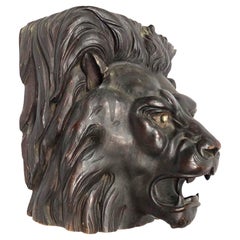
Antique Carved Wood Lion’s Head from a Manhattan Bar, ca. 1880s-1890s
Located in New York, NY
Dimension:
Height: 14 inches
Width: 13 inches
Depth: 12 inches.
About the object:
This elaborately carved wood lion's head was an integral decorative piece of a bar counter or shelf unit in a Manhattan bar...
Category
Antique 1880s American American Classical Animal Sculptures
Materials
Wood
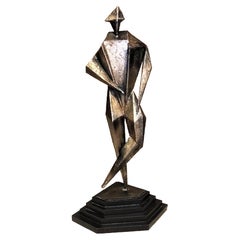
Harlequin, American Cubist Modernist Welded Metal Sculpture, ca. 1970s
Located in New York, NY
About sculpture
This figurative sculpture of a Harlequin standing in a relaxed pose is unusual not only in the choice of materials; but, most importantly, due to the unusual combina...
Category
Vintage 1970s American Brutalist Abstract Sculptures
Materials
Metal
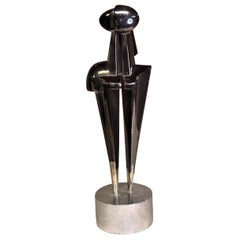
Giorgio A. Roccamonte, Robot, Abstract Modern Chromed Metal Sculpture, Ca. 1960
By Giorgio Amelio Roccamonte
Located in New York, NY
ABOUT ARTIST
Giorgio Amelio Roccamonte a/k/a Elio Roccamonte (Argentine/Italian, Buenos Aires, 1927 - Rome, 1980) was a renown Italian sculp...
Category
Vintage 1960s Argentine Modern Abstract Sculptures
Materials
Metal
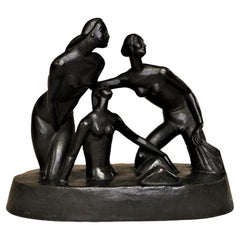
Richard Bauroth, Bathers, German Jugenstil Patinated Bronze Sculpture, Ca. 1919
Located in New York, NY
ABOUT ARTIST
Richard Bauroth (German, 1884-?) was active/lived in Germany. German sculptor, Richard Bauroth studied in Munich et al. under Adolf von Hildebrand.
DIMENSIONS
Heigh...
Category
Vintage 1910s German Jugendstil Figurative Sculptures
Materials
Bronze
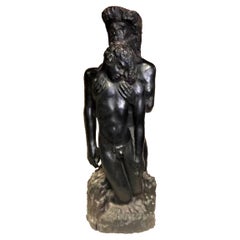
American Modernism, a Pair of Nude Males, Hand-Carved Wood Sculpture, ca. 1940s
Located in New York, NY
About Sculpture
This homoerotic ebonized hand-carved wood sculpture of a pair of nude males, the older one supporting the falling down body of the youth, was created by an anonymous...
Category
Vintage 1940s American Modern Figurative Sculptures
Materials
Wood
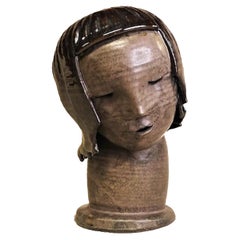
Linn Lovejoy Phelan, Head of a Woman, Modernist Ceramic Sculpture, 1953
By Linn Lovejoy Phelan
Located in New York, NY
LINN LOVEJOY PHELAN, LINN PHELAN (American, 1906-1992), one of the most famous New York based artist-potter worked with earthenware clay that was coated wi...
Category
Vintage 1950s American Mid-Century Modern Busts
Materials
Ceramic
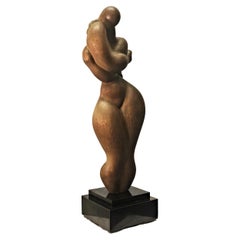
Self-Embrace, Mid-Century American Modern Wood Sculpture by Needle, Ca. 1960
Located in New York, NY
ABOUT SCULPTURE
Crafted with great taste and skill by an unidentified sculptor (signed 'Needle'), this stunningly shaped and proportioned remarkable modernist sculpture looks exquis...
Category
Vintage 1960s American Mid-Century Modern Figurative Sculptures
Materials
Mahogany
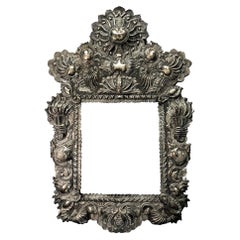
Spanish Baroque Repoussé Silver Mirror/Picture Frame, XVII C.
Located in New York, NY
ABOUT FRAME
Handmade during 17th century, this frame is a grandiose piece of master craft by an extraordinary Spanish silversmith. Exceptionally complex, not only in its exquisite an...
Category
Antique 1670s Spanish Baroque Picture Frames
Materials
Silver
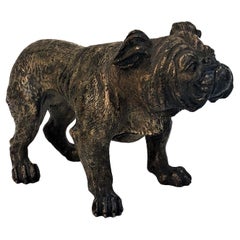
Franz Xavier Bergmann, English Bulldog, Vienna Bronze Sculpture, Ca. 1900
By Franz Bergmann
Located in New York, NY
ABOUT SCULPTURE
This great Austrian Jugenstil desk-size cold-painted and patinated bronze sculpture of English bulldog has all the necessary qualities to be loved by a new owner – it absolutely life-like and has very expressive eyes.
DIMENSIONS
Height 3.25 inches
Width 2 7/16 inches
Depth 5.5 inches
MARKINGS
Noted for his detailed and colorful work, Bergman was signing his creations with either a "B" in an urn-shaped cartouche, or "Nam Greb" - for "Bergman" in reverse (these marks used to disguise his identity on the erotic works). They are also often inscribed ‘Geschutzt’, which refers to the model/design being ‘registered’ or copyrighted; or not marked at all, especially if the pieces are miniatures.
ABOUT ARTIST
Franz Xavier Bergmann...
Category
Antique Early 1900s Austrian Jugendstil Animal Sculptures
Materials
Bronze
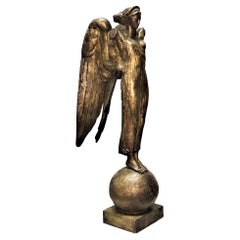
Henri Louis Bouchard, The Victory of Bogota, Art Deco Bronze Sculpture, ca. 1925
By Henri Louis Bouchard
Located in New York, NY
About ‘VICTORY OF BOGOTA
Henri Louis Bouchard was an important French Romantic sculptor, known for works commemorating heroic moments in the hist...
Category
Vintage 1920s French Art Deco Figurative Sculptures
Materials
Bronze
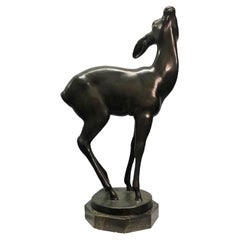
Bernhard Johannes Karl Butzke, Fawn, Jugenstil Bronze Sculpture, ca. 1930
By Bernhard Johannes Karl Butzke
Located in New York, NY
MARKINGS & DETAILS Signed ‘B. Butzke’ on integral base. Original black veined marble plinth.
DIMENSIONS Height: 24 inches
Width: 15.5 inches
Depth: 9 inches
Base height: 1.5 i...
Category
Vintage 1930s German Art Deco Animal Sculptures
Materials
Bronze
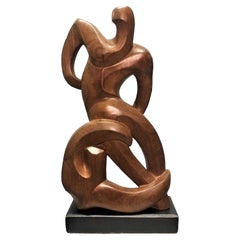
Enid Bell Palanchian, Tackle, Modernist Carved Mahogany Sculpture, ca. 1953
By Enid Bell Palanchian
Located in New York, NY
DIMENSIONS height: 23 inches width; 12 inches depth: 6 inches
MARKINGS Signed at the bottom in back.
DETAILS Original hand-crafted black-painted wood plinth.
REFERENCES Originally, sold to Papillon Gallery of Los Angeles.
CONDITION Excellent antique condition, wear consistent with age and use.
Enid Bell Palanchian (American, 1904 – 1994) a/k/a Mrs. E. B. Palanchian, Mrs. Enid Bell Palanchian and Mrs. Missak Palanchian was an important American sculptor, author, illustrator and professor who was primarily active in the New York/New Jersey area, but who established a respected body of work recognized throughout Europe and the United States as reflected by awards received in Paris, New Jersey, New York, New Mexico and Florida. Her achievements included numerous public works projects (e.g., the design of the Congressional Gold Medal) on display at public institutions and museums around the country, private commissions and sales throughout the world, group and solo exhibitions, generous donations of art and compilations, and the passing on of her knowledge and skills to 24 years of art students of the Newark School of Industrial and Fine Arts.
Enid Bell was born in London, England, and later studied at the Glasgow School of Art and then at the St. John’s Wood Art School; as well as studying with fellow Scot Sir William Reid Dick in London. Then, after moving to the United States, she taught at the Art Student League in New York City at Miss Chapen’s School. Essentially a figurative, direct carving in wood artist, she was based in New Jersey where she became the head of the sculpture program of the Fedral Art Project for that state and was herself the creator of several FAP commissions. In 1932, she married Armenian/American businessman and artist, Missalk Palanchian athough she retained her name “Bell” for professional purposes. Following the end of the Federal Art Project in 1944, she taught as instructor of sculpture and Head of the Sculpture Department of the Newark School of Fine and Industrial Art until 1968, and was active was a member of the National Sculpture Society. Enid Bell died in 1994 in Englewood, New Jersey.
WORK
• Birds, Leonia Public Library in Leonia New Jersey (installed 1981)
• Untitled, Boonton Post Office in Boonton, New Jersey (1938)
• Boonton Post Office, Boonton, New Jersey
• Colonizing America, Center for Youth Education, Newark, New Jersey, (1934)
• Little Indian Dancer, Englewood Public Library, Englewood, New Jersey
• Alexander Hamilton Troy Public Library in Troy, New York
• bird bath, Music, Science, Union City...
Category
Vintage 1950s American Mid-Century Modern Abstract Sculptures
Materials
Mahogany
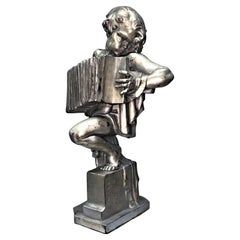
Edgardo Simone, Accordion Player, Art Deco Silvered Plaster Sculpture, ca. 1925
By Edgardo Simone
Located in New York, NY
Edgardo Simone, (Italian/American, 1890-1948)
Classically trained in Italy at the Beaux Arts Academy in Rome from 1906 to 1913, Edgardo Simone became a famous sculptor in Italy and the United States using mediums of terracotta, ceramic, bronze, and plaster. He earned a Doctorate of Design and Sculpture at the Academy and then emigrated to the United States where he worked in New York, Chicago and southern California. His style was influenced by Art Nouveau, Art Deco and other modernist influences.
In Italy, he had received three times the Croix de Guerre and was decorated by King Victor Emmanuel II and Queen Margherita. Before moving to America, he had much recognition in Italy. He had created war and city monuments, and tombstones in twenty-six Italian cities. When he arrived in New York City, one of the newspapers carried a headline: "Italy's greatest Sculptor Arrives in New York."
In New York, Simone became prominent in society and did many portrait busts including such of Thomas Edison, John J. Pershing, Henry Ford and Louis Brandeis. Sally Rand, the famous fan dancer of Chicago's World's Fair in 1933-1934, sat as a model in his studio as did President Franklin Roosevelt and author Theodore...
Category
Vintage 1920s American Art Deco Figurative Sculptures
Materials
Plaster
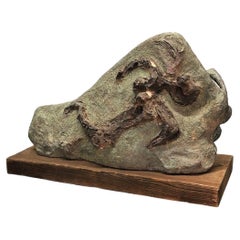
Stanley Stangren, Abduction of Europa, Modernist Terracotta Sculpture, ca. 1950
By Stanley R. Stangren
Located in New York, NY
Dimensions
Total height: 12.5 inches
Width: 19 inches
Depth: 7.5 inches
Base height: 1.5 inches
DETAILS Unsigned, original wood base.
CONDITION Excellent vintage condition, wear consistent with age and use.
Stanley R. Stangren (American, 1928–2014) was an outstanding American jeweler, artist, sculptor and ceramist, residing in New York City. He worked in different styles and in different materials, including oils, watercolor, ceramic and stone sculptures; and fine jewelry. Stangren’s painting styles varied tremendously – from complete abstract works to Holocaust themes in the style of Georges Rouault and Hieronymus Bosch to portraits in the style of Moses and Raphael Soyer. He was also a passionate lover of the performing arts, and, as a young man, spent time studying dance at both the School of American Ballet and with Martha Graham.
Although he worked with dance pioneers like Ms. Graham, Anna Sokolow and Charles Weidman, an injury prevented him from pursuing dance as a career. But he found other outlets for his artistic pursuits. In his youth, Stangrem attended the Brooklyn Museum School of Art, and graduated from the High School of Music and Art in New York City. He later studied at the Boston Museum of Fine Arts, the Art Students League, Bard Colledge and in Europe.
Stangren studied jewelry design in Europe, attending Staatlische Kunst Werkschule in Pforzheim, Germany and Kunstgewerbeschule der Stadt in Zurich, Switzerland. His jewelry and designs were received with great success. His combination of precious and semi-precious stones, high-karat gold and sterling silver, and exotic materials executed with outstanding workmanship in the abstract modernist style gave a unique aspect to his designs, the metalwork usually electroformed, cast, or fused in varying textures. After returning to New York in the later 1950’s, Stangren opened and maintained a ceramic business in Trenton, New Jersey.
Very few pieces of his work remain from this period. When he retired from the ceramics business, he spent much of his time enjoying the arts. He frequently attended Juilliard performances, including most of the opera and drama presentations at the School, and was especially fond of the dance concerts. The last 40 years of his life, he taught painting in the New York area and worked with Metropolitan Museum of Arts in developing annuities, for future acquisitions.
In addition, Stangren left annuities for MoMa in support of educational programs and left, in his will or through his executors, art supplies for the Harlem School of Art and benefits for the Urban Assembly organization. Mr. Stangren's love for the arts and for the performances he was seeing at Juilliard inspired him to take his participation a step further and to establish charitable gift annuities with the School. "I realized what Juilliard offered me, being a passionate music lover, and I decided to give something back" he said.
"What Juilliard achieves is remarkable. When I think of the prominent actors, dancers and musicians that have been educated there, I am always staggered. It is deeply financially satisfying to be able to give back to the School, while benefitting from it at the same time." The Juilliard School is not the only organization that Stanley Stangren...
Category
Vintage 1950s American Mid-Century Modern Abstract Sculptures
Materials
Terracotta
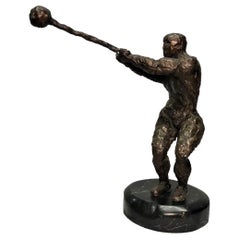
Cannonball Thrower, American Modernist Patinated Bronze Sculpture, ca. 1960
Located in New York, NY
Definitely created by a master sculptor, this small but very dynamic modernist sculpture depicts a cannonball thrower in the moment of forceful rotation before the actual throw of th...
Category
Mid-20th Century American Mid-Century Modern Abstract Sculptures
Materials
Bronze
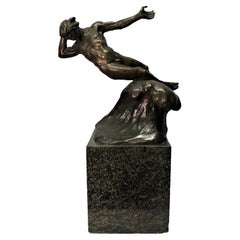
Jacobus Nicolaus Sandig, Icarus Falling, Dutch Art Deco Bronze Sculpture, 1925
By Jacobus Nicolaus Sandig
Located in New York, NY
ABOUT ARTIST
Regretfully, there is only a limited amount of biographical information available on the author of this wonderful sculpture - Jacobus Nicolaus Sandig (Dutch, 1876 - 193...
Category
Vintage 1920s Dutch Romantic Figurative Sculptures
Materials
Bronze
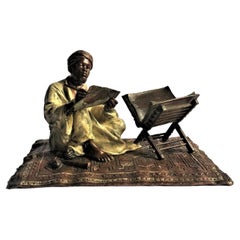
Franz Xaver Bergmann, Koran Scribe, Vienna Bronze Sculpture, Ca. 1900
By Franz Xaver Bergman (Bergmann)
Located in New York, NY
This wonderful life-like sculpture depicts a Koran scriber, who, bending his legs under him, holds sheets of paper in his hands, on which he transcribes verses from the Koran lying i...
Category
Antique 1890s Austrian Art Nouveau Figurative Sculptures
Materials
Bronze
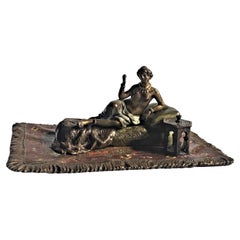
Franz Xaver Bergmann, Odalisque, Vienna Bronze Sculpture, Ca. 1900
By Franz Xaver Bergman (Bergmann)
Located in New York, NY
This wonderful life-like sculpture depicts a half-naked odalisque reclining in a lazy pose on silk pillows on an ottoman, covered with a lion's skin. With bare breasts, only a small ...
Category
Antique 1890s Austrian Art Nouveau Figurative Sculptures
Materials
Bronze
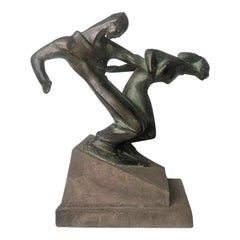
Anton Pavlos, Couple of Skiers Racing Down Mountainside, ca. 1930s
By Anton Pavlos 1
Located in New York, NY
A Streamline Moderne style sculpture by Ukrainian artist Anton Pavlos (1905-1954), produced circa 1930s.
It depicts a couple of male and fem...
Category
Vintage 1930s American Art Deco Figurative Sculptures
Materials
Plaster