Classicartworks Stockholm AB Figurative Paintings
to
33
63
32
39
13
17
Overall Width
to
Overall Height
to
20
69
75
13
18
13
7
5
1
6
37
23
19
2
1
82
80
96
42
37
34
29
20
17
17
15
14
12
12
10
10
10
8
8
7
5
4
160
158
99
99
31
2
1
1
1
1
158
164
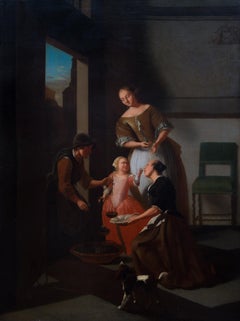
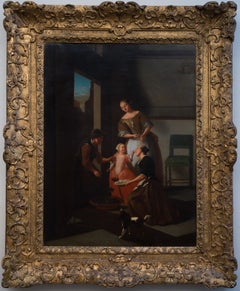
The Grape Seller - Workshop of Jacob Ochtervelt
Located in Stockholm, SE
Jacob Ochtervelt (Workshop)
The Grape Seller
oil on canvas
unframed: 80.7 x 61 cm.; 31 ¾ x 24 in.
framed: 109.5 x 89 cm.; 43 1/8 x 35 in.
Essay:
This captivating piece, originating from the studio of the revered Dutch artist Jacob Ochtervelt, mirrors the composition of a signed and dated 1669 canvas by Ochtervelt that is presently housed in the Hermitage museum. Its subject, "The Grape Seller" immerses us in a typical 17th-century interior, replete with characters from various strata of society.
At the center, a fruit vendor is depicted bending over to weigh grapes for the buyer. A child hands some of the grapes to her mother to taste, their attentive maid standing by. The backdrop showcases typical Ochtervelt details: a hint of the city visible through the doorway, light filtering in through an overhead window, and a playful dog at their side.
The exquisite quality of the piece is evident in the minutiae, such as the intricate detailing of the mother's earring, which in reality spans only a few millimeters yet boasts impressive attention to detail. Initially, Sotheby's considered this work to be an autograph piece by Ochtervelt. But due to some uncertainty, it was auctioned as Workshop of Jacob Ochtervelt. On the other hand, the esteemed Cabinet Turquin in Paris leans toward attributing the piece directly to Jacob Ochtervelt himself.
The painting is framed in an authentic period frame, which has been delicately restored by Stockholm's Förgyllning och Bildhuggeri. The frame retains its age-old patina and, while in used condition, has minor imperfections adding to its charm.
Another interesting thing worth to mention is the painting's provenance. It was once owned by the 1st Viscount Rothermere (1868-1940), the founder of the Daily Mail and Daily Mirror...
Category
17th Century Old Masters Interior Paintings
Materials
Canvas, Oil
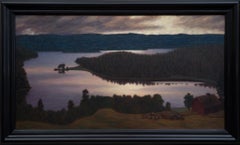
Hilding Werner (1880-1944) - Moonlight Over Krokvattnet (near Glafsfjorden)
Located in Stockholm, SE
Hilding Werner (1880-1944) was a Swedish artist known for his portraits, romantic landscape paintings of Värmland, and caricature drawings. We are privi...
Category
Early 20th Century Romantic Landscape Paintings
Materials
Canvas, Oil
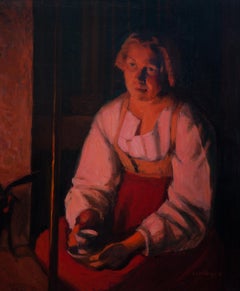
Moments of Reflection Depicting a Woman Sitting by the Fire, Original Oil Paint
By Sam Uhrdin
Located in Stockholm, SE
We are pleased to present a captivating painting by the artist Sam Uhrdin (1886-1964). This beautiful artwork depicts a woman from Dalarna, sitting in front of a warm, glowing fire. The entire painting is bathed in a soft, radiant light, particularly illuminating her face and traditional white/red attire. The woman appears contemplative, lost in thought, perhaps thinking of someone dear to her heart. She is depicted in a kitchen, taking a moment to relax after a day's chores in her home.
Sam Uhrdin's artistic journey began in the early 1900s, he traveled to Stockholm in 1903 to further continue his studies in painting. He worked as a painter during the day and attended various evening schools in the evenings. In 1906, he journeyed to America to work as a sign painter, but he mainly ended up working as an upholsterer. Returning to Leksand in 1909 via London and Paris, his artistic talent gained recognition, and with the help of some patrons, he began studying at the Royal Academy of Fine Arts in 1911, occasionally attending Althin's painting school in Stockholm. Financial circumstances cut his study time short, and his skill as a portrait painter earned him numerous portrait commissions, which further occupied his time.
In 1921, Uhrdin received a scholarship from the Royal Academy, enabling him to embark on a study trip in 1922 to the Netherlands, Belgium, and France, which he had to cut short due to his wife's illness. He later visited places like Spain and Portugal.
Uhrdin's breakthrough came with his portrait of the former Prime Minister Nils Edén, which he executed in 1919. In 1921, he portrayed the participants of the Swedish Academy. Among other representatives of official Sweden captured by Uhrdin were Gustav V, Manne Siegbahn, Ludvig Stavenow, and bishops Gottfrid and Einar Billing. In 1932, he held a solo exhibition at Konstnärshuset in Stockholm, and he participated in various exhibitions, including the Swedish Artists' Association in Stockholm in 1917, Swedish Art at Valand-Chalmers in Gothenburg in 1923, Dalarna Artists displayed at Liljevalchs Konsthall in 1936, and the National Museum's traveling exhibition "Barnet i konsten" (Children in Art...
Category
1940s Realist Portrait Paintings
Materials
Canvas, Oil
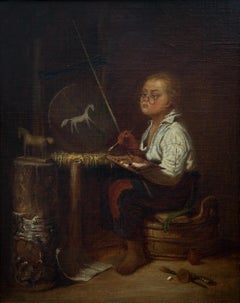
Oil Painting Called "The Young Artist" by Swedish Johan Christoffer Boklund
Located in Stockholm, SE
Introducing a captivating oil painting by Johan Christoffer Boklund (1817-1880). The artwork depicts a young boy practicing his painting skills. Seated beside him is a wooden horse t...
Category
19th Century Realist Interior Paintings
Materials
Canvas, Oil, Board
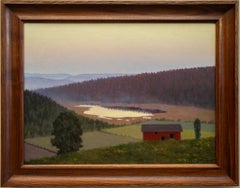
Swedish Värmland Landscape With a Red Barn by Hilding Werner, Oil Painting
Located in Stockholm, SE
Hilding Werner, A Värmland artist, was a distinguished Swedish painter and draftsman. Born to landowner Anders Andersson and Inga Maria Johannesdotter, ...
Category
Early 20th Century Romantic Landscape Paintings
Materials
Masonite, Oil
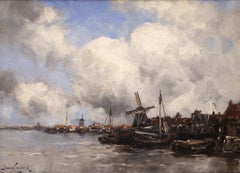
View of a Dutch Town by Jan van Couver (Hermanus Koekkoek Jr.) Impressionism
By Jan Van Couver
Located in Stockholm, SE
Hermanus Koekkoek the Younger was a member of the renowned Koekkoek artist family. He was the grandson of Johannes Hermanus Koekkoek, the nephew of the landscape painter Barend Cornelis Koekkoek...
Category
Late 19th Century Impressionist Landscape Paintings
Materials
Canvas, Oil
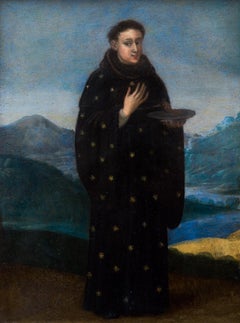
Old Master Painting, Flemish School from 1600s, Saint Nicholas of Tolentino
Located in Stockholm, SE
This small Flemish painting, measuring only 24.5 x 18.5 cm and executed on a copper plate, depicts Saint Nicholas of Tolentino. Created in the 17th century, the artist remains unknow...
Category
17th Century Old Masters Landscape Paintings
Materials
Copper

$4,053 Sale Price
25% Off
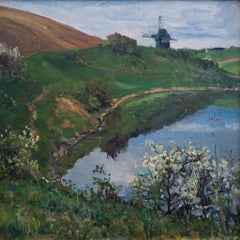
German Autumn Landscape With Windmill, 1903
Located in Stockholm, SE
Reinhold Grohmann (1877-1915) was a German painter who studied at the Académie Julian in Paris, a renowned art school that attracted students from all over the world.
Grohmann's wo...
Category
Early 1900s Post-Impressionist Landscape Paintings
Materials
Canvas, Oil
$2,596 Sale Price
20% Off
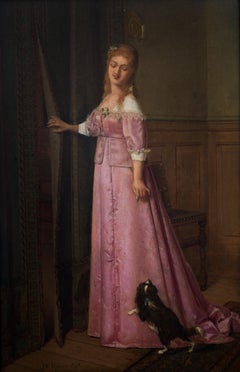
A Young Woman With Her Dog by Victor Ravet
Located in Stockholm, SE
In this exquisite painting by Victor Ravet, we are transported to an elegant interior setting reminiscent of the grandeur of high-class homes. The focal point is a woman adorned in a shimmering pink gown, radiating grace and sophistication. Bathed in gentle light, her dress catches the glimmer, accentuating her beauty.
She holds a treat for a dog in her hand, enticing the furry companion who stands on its hind legs in eager anticipation. The canine's eyes fixated on the delicious morsel, capturing a moment of playful interaction between the woman and her loyal companion.
The scene takes on a narrative quality as the young woman's other hand delicately lifts a curtain, hinting at another room beyond. This subtle gesture adds depth to the composition, suggesting a world of hidden secrets and intriguing possibilities within the opulent surroundings.
Victor Ravet took inspiration from the Dutch Golden Age painters of the 17th century, such as Vermeer, Jacob Ochtervelt, and Gerrit Dou. This homage to their style and subject matter pays tribute to the timeless allure of domestic scenes, capturing a slice of life in a bygone era.
With meticulous attention to detail, Ravet masterfully recreates the textures and fabrics, immersing the viewer in the sumptuousness of the period. The soft play...
Category
1870s Realist Interior Paintings
Materials
Oil, Panel
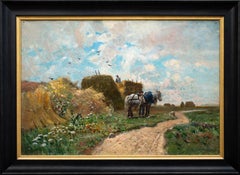
Harvest Time by Hjalmar Sandberg, Swedish Artist, Oil on Canvas, Signed, 1876
Located in Stockholm, SE
Hjalmar Sandberg (1847-1888) Sweden
Harvest Time, 1876
oil on canvas
canvas size 14.96 x 18.11 inches (38 x 46 cm)
frame 18.70 x 25.59 inches (47.5 ...
Category
1870s Impressionist Landscape Paintings
Materials
Canvas, Oil
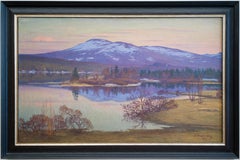
Mountain View from Hålland, Åre by Swedish Artist Ante Karlsson-Stig, From 1932
Located in Stockholm, SE
The painting we are selling is a breathtaking mountain view from Hålland in Jämtland, Sweden, created by Ante Karlsson-Stig in 1932. Ante Karlsson-Stig (1885-1967) was a Swedish pain...
Category
1930s Naturalistic Landscape Paintings
Materials
Canvas, Oil
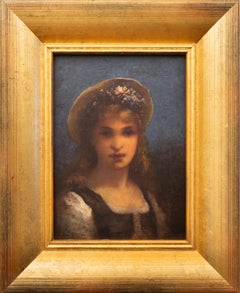
French Girl with Flowered Hat with Impressive Sfumato Technic by Leon Richet
By Leon Richet
Located in Stockholm, SE
Introducing a stunning portrait by renowned French artist Léon Richet (1847-1907), depicting a young girl adorned with a beautiful floral wreath and a hat perched atop her head. This...
Category
Late 19th Century Barbizon School Portrait Paintings
Materials
Oil, Panel
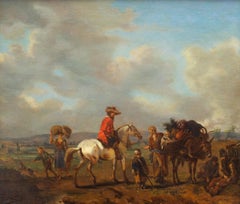
Landscape with Gentleman on Horseback and Peasant Woman Receiving Alms
By Philips Wouwerman
Located in Stockholm, SE
Workshop / Circle of Philips Wouwerman (1619-1668)
Landscape with Gentleman on Horseback and Peasant Woman Receiving Alms
oil on oak panel
12.40 x 14.17 inches (31.5 x 36 cm)
wit...
Category
17th Century Old Masters Landscape Paintings
Materials
Oak, Oil, Wood Panel
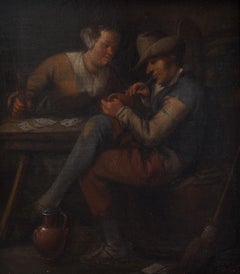
The Card Players by a Flemish 1600s Artist
By Flemish School, 17th Century
Located in Stockholm, SE
Flemish 1600s School
The Card Players
oil on oak panel
panel dimensions 22.5 x 20 cm
frame included
Provenance:
From a Swedish private collection.
Condition:
Flat and stabl...
Category
17th Century Old Masters Figurative Paintings
Materials
Oak, Oil, Panel
Landscape from the North of Sweden by Swedish Artist Otto Lindberg, 1926
Located in Stockholm, SE
Otto Lindberg was a Swedish artist born in Söderhamn in 1880. Lindberg was known for his landscapes and marine paintings. He studied at the Royal Academy of Fine Arts in Stockholm an...
Category
1920s Post-Impressionist Landscape Paintings
Materials
Canvas, Oil
$2,788 Sale Price
20% Off
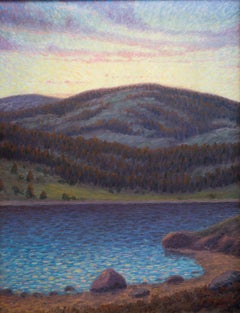
Landscape from Nordingrå, 1935 by Ultramarine Johansson
Located in Stockholm, SE
Carl Johansson, also known as "Ultramarin Johansson," was a Swedish artist born in 1863 and known for his distinctive blue-toned paintings. His work often depicted landscapes, seascapes, and cityscapes, capturing the beauty and essence of Sweden's natural landscapes.
We are proud to offer one of his late works from 1935 for sale. This painting depicts a beautiful landscape from Nordingrå, a small village situated on the High coast of Sweden. The beauty of Nordingrå has captured many artists in the 19th-century, inspiring many famous painters, including Helmer Osslund...
Category
1930s Post-Impressionist Landscape Paintings
Materials
Canvas, Oil
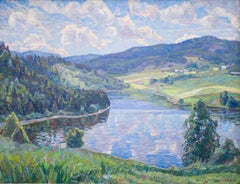
Post-Impressionist Painting The Church in Taormina, Sicily, 1914
Located in Stockholm, SE
Dick Beer (b. London 1893 - d. Stockholm 1938)
The Church in Taormina, Sicily (Kyrkan i Taormina)
oil on canvas
canvas dimensions 54 x 47 cm
signed and dated Dick Beer 1914
painted 1914
Exhibited:
Varias Konstsalong, Stockholm, 1916;
Millesgården – Dick Beer – Impressionist & Kubist, 2012
Provenance:
Within the family Beer until today
Dick Beer (1893-1938)
Dick Beer was born in London in 1893. His father, John Beer (1853-1906), was a Swedish painter from Stockholm who had a career mainly as a watercolour painter with motifs of horses from racetracks and fox hunts from the countryside.
Barely fifteen years old, Dick Beer became an orphan and came to Sweden in 1907. Already in 1908-1909, he started at Althin's painting school in Stockholm. And later, at the Royal Academy of Arts from 1910-1912. His teachers were, among others, Gustaf Cederström, Oscar Björk and Alfred Bergström...
Category
1910s Post-Impressionist Landscape Paintings
Materials
Canvas, Oil
$8,653 Sale Price
20% Off
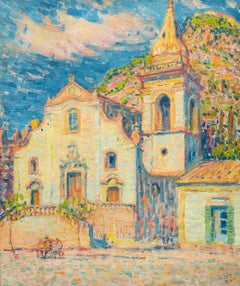
Popular Dance at Corsica, I. By Swedish Artist Dick Beer, c.1924
Located in Stockholm, SE
Dick Beer (b. London 1893 - d. Stockholm 1938)
Folkliv på Korsika, I (Popular Dance at Corsica, I)
oil on canvas
signed Dick Beer
c. 1924
canvas dimensions 88 x 100 cm
Exhibited:
The Royal Academy Stockholm 1973;
Millesgården – Dick Beer – Impressionist & Kubist, 2012
Dick Beer was born in 1893 in London as Richard Beer, the youngest of five brothers. His father, John Beer (1853-1906), was a watercolourist who was born in Stockholm and left Sweden at the age of 17. John Beer instructed his sons in drawing and painting, among other things. A number of sketchbooks bear testimony to the boys’ talent.
Dick Beer’s parents died in 1906 and 1907. Barely 15 years old, Beer arrived in Sweden as an orphan. First he lived with relatives and finally he ended up at Reverend Laurell in Västergötland.
Dick Beer began his artistic studies at the Althin School of Painting in Stockholm in 1908 and continued at the Royal Academy of Arts in the autumn of 1910, but in September 1912 he broke off his studies and travelled to Paris. He rented a studio and enrolled at the Colarossi and Grande Chaumière academies.
In the summer of 1913, Dick Beer travelled to Pont-Aven in Bretagne in order to paint. In September the same year, he held his first solo exhibition in Stockholm which he gave the French title Exposition des tableaux de Bretagne et autour de Paris. The exhibition proved a success. Many of the paintings were executed in a light palette in a style inspired by the impressionists.
In 1914, Dick Beer undertook an extensive study trip to Italy, Tunis, Morocco and Spain, which resulted in canvases overflowing with colours and light. When the French army mobilised, he volunteered and was enlisted in the French Foreign Legion. In 1915 Dick Beer sustained severe head injuries in a grenade attack, which resulted in deafness and a nervous condition that would plague him for the rest of his life. Two of his brothers died the following year, fighting for the English army.
Dick Beer was hospitalised and convalesced at Château de Rochefort. Here he started painting again, in an impressionist style, a painting dominated by blue and green hues.
In 1918, Dick Beer married Ruth Öhrling, a dentist, and their son John was born later in the year. During this time, Beer began experimenting with cubist painting and created several large compositions, including the painting “The Arab Café”.
In the years that followed, Dick Beer was based in Paris, where he often moved house. He was instructed by André Lhote, who encouraged his students to work freely in the studio and provided them with individual critique. Beer often travelled to Bretagne or Provence. His artist friends came from all over Europe and included Amedeo Modigliani. Dick Beer exhibited fairly regularly in Paris between 1919 and 1934 and made a name for himself in French artist circles.
In the summers, Ruth regularly rented a house in the countryside, often at Lake Mälaren. She kept a large house with many models and friends and there was a lot of painting and discussions. In 1933, the couple divorced but Ruth still loved Dick...
Category
1920s Post-Impressionist Figurative Paintings
Materials
Canvas, Oil
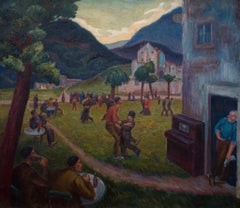
Two Paintings in One, Art Nouveau Landscape And Winter Landscape. Oak Frame
Located in Stockholm, SE
Alfred Ekstam, a renowned artist from Mangskog, Sweden, is known for his exquisite landscape paintings. We are excited to present this painting by Ekstam, which is extra special because it is painted on both sides, offering two beautiful landscapes in one, with a reversible frame that can be turned over without having to take it down from the wall.
On one side, you will be mesmerized by a stunning Art Nouveau landscape with a purple tone, featuring a mountain in the background, a lake, and trees in the foreground with shades of yellow, red, and green. On the other side, you will see a winter landscape with five red houses, likely to be Ekstam's own farm in Knaggen. The winter scene showcases sun rays shining down on the houses...
Category
1910s Art Nouveau Landscape Paintings
Materials
Canvas, Oil
$21,153 Sale Price
20% Off
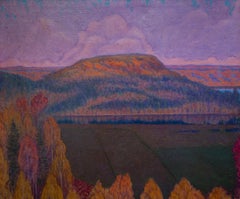
Vast Autumn Landscape With Blue Mountains by Swedish Artist Carl Johansson, 1913
Located in Stockholm, SE
Carl Johansson (1863-1944), also known as "Ultramarin Johansson," was a highly skilled Swedish landscape painter who is known for his ability to capture...
Category
1910s Post-Impressionist Landscape Paintings
Materials
Canvas, Oil
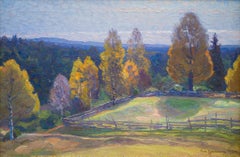
Post-Impressionistic Painting From Saint Cloud, Paris, 1912 by Dick Beer
Located in Stockholm, SE
Dick Beer (b. London 1893 - d. Stockholm 1938)
Saint Cloud, 1912
oil on board
board dimensions 40.5 x 32.5 cm
frame 51.5 x 43.5 cm
signed Dick Beer
painted 1912
Exhibited:
The Swedish-French Art Gallery, Memorial Exhibition, Catalog nr 5, 1942
Provenance:
A private collection, Sweden
Dick Beer (1893-1938)
Dick Beer was born in London in 1893. His father, John Beer (1853-1906), was a Swedish painter from Stockholm who had a career mainly as a watercolour painter with motifs of horses from racetracks and fox hunts from the countryside.
Barely fifteen years old, Dick Beer became an orphan and came to Sweden in 1907. Already in 1908-1909, he started at Althin's painting school in Stockholm. And later, at the Royal Academy of Arts from 1910-1912. His teachers were, among others, Gustaf Cederström, Oscar Björk and Alfred Bergström...
Category
1910s Post-Impressionist Landscape Paintings
Materials
Oil, Board
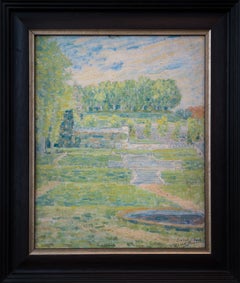
Cubist Portrait of Gabriele Varese (in Italian uniform), 1919
Located in Stockholm, SE
Dick Beer (b. London 1893 - d. Stockholm 1938)
Portrait of Gabriele Varese (in Italian uniform), 1919
oil on canvas mounted on panel
116 x 90 cm
stamp signature
Exhibited:
Solo exhibition, Stockholm, Nov-Dec 1917;
The Royal Academy Stockholm 1973;
Åmells Konsthandel – En internationell kubist, Stockholm & London 2008
Hälsinglands Museum 2011
Millesgården – Dick Beer – Impressionist & Kubist, 2012
Provenance:
Within the family Beer until today
Dick Beer was born in 1893 in London as Richard Beer, the youngest of five brothers. His father, John Beer (1853-1906), was a watercolourist who was born in Stockholm and had left Sweden at the age of 17. John Beer instructed his sons in drawing and painting, among other things. A number of sketchbooks bear testimony to the boys’ talent.
Dick Beer’s parents died in 1906 and 1907. Barely 15 years old, Beer arrived in Sweden as an orphan. First he lived with relatives and finally he ended up at Reverend Laurell in Västergötland.
Dick Beer began his artistic studies at the Althin School of Painting in Stockholm in 1908 and continued at the Royal Academy of Arts in the autumn of 1910, but in September 1912 he broke off his studies and travelled to Paris. He rented a studio and enrolled at the Colarossi and Grande Chaumière academies.
In the summer of 1913, Dick Beer travelled to Pont-Aven in Bretagne in order to paint. In September the same year, he held his first solo exhibition in Stockholm which he gave the French title Exposition des tableaux de Bretagne et autour de Paris. The exhibition proved a success. Many of the paintings were executed in a light palette in a style inspired by the impressionists.
In 1914, Dick Beer undertook an extensive study trip to Italy, Tunis, Morocco and Spain, which resulted in canvases overflowing with colours and light. When the French army mobilised, he volunteered and was enlisted in the French Foreign Legion. In 1915 Dick Beer sustained severe head injuries in a grenade attack, which resulted in deafness and a nervous condition that would plague him for the rest of his life. Two of his brothers died the following year, fighting for the English army.
Dick Beer was hospitalised and convalesced at Château de Rochefort. Here he started painting again, in an impressionist style, a painting dominated by blue and green hues.
In 1918, Dick Beer married Ruth Öhrling, a dentist, and their son John was born later in the year. During this time, Beer began experimenting with cubist painting and created several large compositions, including the painting “The Arab Café”.
In the years that followed, Dick Beer was based in Paris, where he often moved house. He was instructed by André Lhote, who encouraged his students to work freely in the studio and provided them with individual critique. Beer often travelled to Bretagne or Provence. His artist friends came from all over Europe and included Amedeo Modigliani. Dick Beer exhibited fairly regularly in Paris between 1919 and 1934 and made a name for himself in French artist circles.
In the summers, Ruth regularly rented a house in the countryside, often at Lake Mälaren. She kept a large house with many models and friends and there was a lot of painting and discussions. In 1933, the couple divorced but Ruth still loved Dick and continued to support him financially for the rest of his life.
Dick Beer also exhibited in Sweden, albeit irregularly due to his failing health. In the 1920s and 1930s, Beer continued to pursue an expressionist painting with intense colours and unexpected perspectives, but eventually he veered towards more naturalistic forms, including a large number of nudes. He also painted several portraits of artists, politicians and writers.
In 1938, Dick Beer sojourned in Arles. The budding photographer Christer Strömholm...
Category
1910s Cubist Portrait Paintings
Materials
Canvas, Oil, Panel
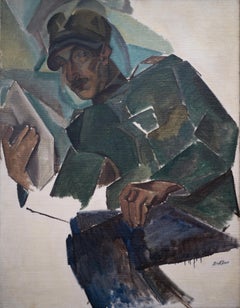
$13,461 Sale Price
20% Off
Post-Impressionist Painting By Dick Beer, Stormy Weather in St.Arnoult, 1917
Located in Stockholm, SE
Dick Beer (b. London 1893 - d. Stockholm 1938)
Title: Stormy Weather in St.Arnoult
Dick Beer was born in London in 1893. His father, John Beer (1853-1906), was a Swedish painter from Stockholm who had a career mainly as a watercolour painter with motifs of horses from racetracks and fox hunts from the countryside.
Barely fifteen years old, Dick Beer became an orphan and came to Sweden in 1907. Already in 1908-1909, he started at Althin's painting school in Stockholm. And later, at the Royal Academy of Arts from 1910-1912. His teachers were, among others, Gustaf Cederström, Oscar Björk and Alfred...
Category
1910s Post-Impressionist Landscape Paintings
Materials
Canvas, Oil
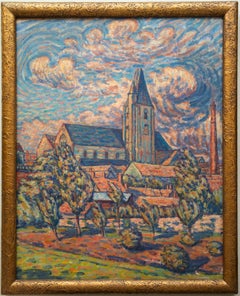
$23,076 Sale Price
20% Off
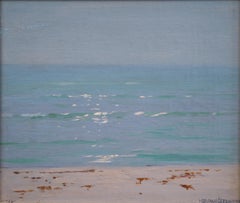
Ocean View from the West Coast by Swedish Artist Herman Österlund, 1916
Located in Stockholm, SE
Herman Österlund (1873-1964) Sweden
Ocean View from the West Coast, 1916
oil on canvas
signed and dated Herman Österlund 1916
canvas dimensions 14.37 x 16.73 inches (36.5 x 42.5 cm...
Category
1910s Naturalistic Landscape Paintings
Materials
Canvas, Oil
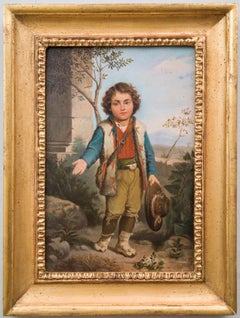
Portrait of a Young Boy With Hat, Possibly Painted by Gustaf Brandelius
Located in Stockholm, SE
Unknown Artist, Possibly Gustaf Brandelius (1833-1884)
Portrait of a Young Boy With Hat
oil on tree panel
painted c.1850-70
panel 9.05 x 5.90 inches ...
Category
1860s Portrait Paintings
Materials
Oil, Wood Panel
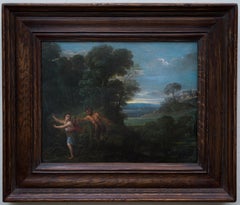
Landscape With Pan and Syrinx, Flemish School From the 1600s, Oil on Copper
Located in Stockholm, SE
Flemish School, 1600s
Landscape With Pan and Syrinx
painted around the 1600s
oil on copper
19 x 23.5 cm
frame 29 x 34 cm
Hand-made oak frame by Swedish frame maker Christer Björkma...
Category
17th Century Old Masters Landscape Paintings
Materials
Copper
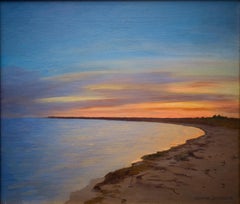
Beach Curve in the Evening Light by Swedish Artist Herman Österlund, 1920s
Located in Stockholm, SE
Herman Österlund was a Swedish artist best known for his beautiful depictions of the west coast of Sweden.
He moved to Stockholm in 1896 and passed the test for entering the Royal A...
Category
1920s Realist Landscape Paintings
Materials
Canvas, Oil
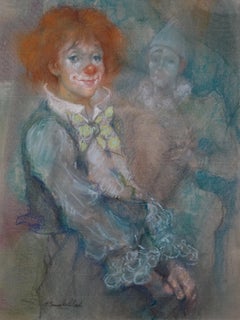
The Two Clowns (Les Deux Clowns) by Antonio Gonzalez Collado
By Antonio Gonzalez Collado
Located in Stockholm, SE
Artist: Antonio Gonzalez Collado
The Two Clowns (Les Deux Clowns)
mixed media on paper
signed
artist studio stamp on the back
dimensions (motif) 15...
Category
Late 20th Century Modern Portrait Drawings and Watercolors
Materials
Paper, Mixed Media
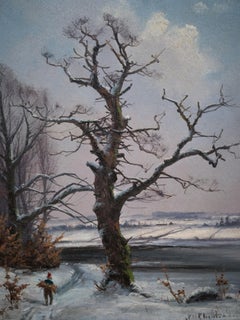
Winter Landscape With an Old Tree By Danish Artist Nils Hans Christiansen
By Nils Hans Christiansen
Located in Stockholm, SE
Nils Hans Christiansen (1850-1929) Denmark
Winter Landscape With an Old Tree
oil on canvas
late 19th century
signed
canvas dimensions 15.94 x 12.79 inches (40.5 x 32.5 cm)
frame 2...
Category
1890s Impressionist Landscape Paintings
Materials
Canvas, Oil
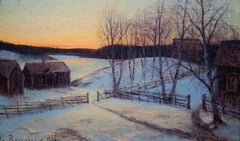
Sunset in the Village by Swedish Artist Edward Rosenberg, 1915, Oil on Canvas
Located in Stockholm, SE
Edward Rosenberg is best known for his landscape paintings with winter motifs around Lake Mälaren. He studied at the Art Academy in Stockholm 1879–1882. And he had his first success in 1882 when he received the Royal Medal...
Category
1910s Realist Landscape Paintings
Materials
Canvas, Oil, Board
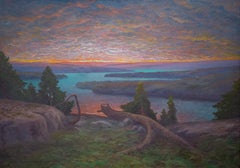
A Scandinavian Landscape View by Swedish Artist Oscar Lycke, Large Size Painting
Located in Stockholm, SE
Oscar Lycke was a Swedish artist from Sundsvall. He is best known for his impressive colourful landscape paintings in a national romantic and realism styl...
Category
1920s Romantic Landscape Paintings
Materials
Canvas, Oil
$3,332 Sale Price
25% Off
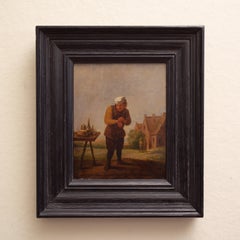
A Peasant Removing a Plaster: The Sense of Touch. By a Follower of David Teniers
By David Teniers the Younger
Located in Stockholm, SE
David Teniers the Younger (1610-1690) Follower of
A Peasant Removing a Plaster: The Sense of Touch
signed T on the table
oil on panel
panel size 7,20 x 5,55 inches (18,3 x 14,4 cm)...
Category
Early 18th Century Old Masters Figurative Paintings
Materials
Oil, Panel
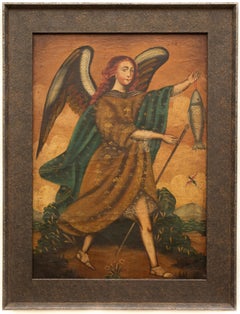
Cuzco School - A Portrait of Archangel Raphael With Fish, 1800s, Oil on Canvas
Located in Stockholm, SE
Anonymous, Cuzco School
A Portrait of Archangel Raphael With Fish
oil on canvas
1800s
canvas dimensions 22.24 x 15.74 inches (56.5 x 40 cm)
frame ...
Category
19th Century Figurative Paintings
Materials
Canvas, Oil
$4,711 Sale Price
20% Off
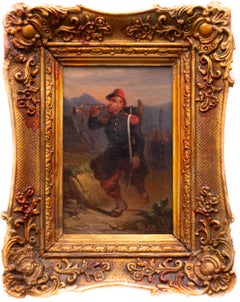
A Soldier Blowing the Trumpet by French Artist Charles Bouchez, Oil on Canvas
Located in Stockholm, SE
Charles Bouchez (1811-1882) French
A Soldier Blowing the Trumpet
oil on canvas
signed and dated ch. Bouchez 1842
canvas dimensions 6.29 x 4.13 inches (16 x 10.5 cm)
frame 10.23 x 7...
Category
1840s French School Figurative Paintings
Materials
Canvas, Oil
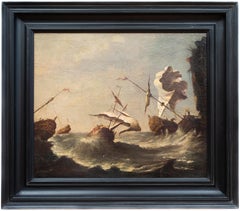
Shipping in Stormy Waters, Attributed to Italian Artist Francesco Guardi
By Francesco Guardi
Located in Stockholm, SE
The splendour of the tragic sea
Francesco Guardi and maritime painting in Venetian art
No Venetian painter was a stranger to the sea. After all, Venice was not only one of the most prominent ports of the Mediterranean, but indeed a city literally submerged in the ocean from time to time. Curiously however, the famous Venetian school of painting showed little interest in maritime motifs, favouring scenes from the iconic architecture of the city rather than seascapes. That is why this painting is a particularly interesting window into not only the painter Francesco Guardi himself – but to the significance of the element of water in art history, in absence as well as in the centre of attention.
Whether it be calm, sunny days with stunning views of the palaces alongside the canals of Venice or – more rarely – stormy shipwrecking tragedies at sea, water as a unifying element is integral to the works of painter Francesco Guardi (1712–1793). During his lifetime, Venetian art saw many of its greatest triumphs with names like Tiepolo or Canaletto gaining international recognition and firmly establishing Venice as one of the most vibrant artistic communities of Europe. While the city itself already in the 18th century was something of an early tourist spot where aristocrats and high society visited on their grand tour or travels, the artists too contributed to the fame and their work spread the image of Venice as the city of romance and leisure to an international audience, many of whom could never visit in person.
Still today, the iconic image of Venice with its whimsical array of palaces, churches and other historic buildings is much influenced by these artists, many of whom have stood the test of time like very well and remain some of the most beloved in all of art history. It was not primarily subtility, intellectual meanings or moral ideals that the Venetian art tried to capture; instead it was the sheer vibrancy of life and the fast-paced city with crumbling palaces and festive people that made this atmosphere so special. Of course, Venice could count painters in most genres among its residents, from portraiture to religious motifs, history painting and much else. Still, it is the Vedutas and views of the city that seems to have etched itself into our memory more than anything else, not least in the tradition of Canaletto who was perhaps the undisputed master of all Venetian painters.
Born into his profession, Francesco lived and breathed painting all his life. His father, the painter Domenico Guardi (1678–1716) died when Francesco was just a small child, yet both he and his brothers Niccolò and Gian Antonio continued in their fathers’ footsteps. The Guardi family belonged to the nobility and originated from the mountainous area of Trentino, not far from the Alps. The brothers worked together on more challenging commissions and supported each other in the manner typical of family workshops or networks of artists. Their sister Maria Cecilia married no other than the artist Giovanni Battista Tiepolo himself, linking the family to the most renowned Venetian name of the time. During almost a decade, Guardi worked in the studio of Michele Giovanni Marieschi, sometimes simply known as Michiel, a painted similar in both style and motif. Canaletto is, however, the artist Guardi is most often compared to since they shared a mutual fascination for depicting the architecture and cityscape of Venice.
During the course of his career, Guardi tried his hand in many different genres. He was as swift in painting landscapes, Vedutas of Venice, sacred motifs, interiors and architectural compositions as he was in a number of other motifs. His style is typical of the Venetian school but also distinct and personal once we look a little closer. There is an absolute certainty in the composition, the choice of which sometimes feels like that of a carefully calculated photograph – yet it is also very painterly, in the best sense of the word: fluid, bold, sensitive and full of character. The brushwork is rapid, intense, seemingly careless and extraordinarily minute at the same time; fresh and planned in a very enjoyable mixture. His interiors often capture the breath-taking spacious glamour of the palaces and all their exquisite decor. He usually constructed the motif through remarkably simple, almost spontaneous yet intuitively precise strokes and shapes. The result was a festive, high-spirited atmospheric quality, far away from the sterile and exact likeness that other painters fell victim to when trying to copy Canaletto.
The painting here has nothing of the city of Venice in it. On the contrary, we seem to be transported far away into the solitary ocean, with no architecture, nothing to hold on to – only the roaring sea and the dangerous cliffs upon which the ships are just moments away from being crushed upon. It is a maritime composition evoking both Flemish and Italian precursors, in the proud tradition of maritime painting that for centuries formed a crucial part of our visual culture.
This genre of painting is today curiously overlooked, compared to how esteemed and meaningful it was when our relationship to the sea was far more natural than it is today. When both people and goods travelled by water, and many nations and cities – Venice among them – depended entirely on sea fare, the existential connection to the ocean was much more natural and integrated into the imagination. The schools and traditions of maritime art are as manifold as there are countries connected to the sea, and all reflect the need to process the dangers and wonders of the ocean.
It could symbolize opportunity, the exciting prospects of a new countries and adventures, prospering trade, beautiful scenery as well as war and tragedy, loss of life, danger and doom. To say that water is ambivalent in nature is an understatement, and these many layers were something that artists explored in the most wondrous ways. Perhaps it takes a bit more time for the modern eye to identify the different nuances and qualities of historic maritime paintings, they may on first impression seem hard to differentiate from each other. But when allowing these motifs to unfold and tell stories of the sea in both fiction and reality – or somewhere in between – we are awarded with an understanding of how the oceans truly built our world.
In Guardi’s interpretation, we see an almost theatrically arranged shipwrecking scene. No less than five ships are depicted right in the moment of utter disaster. Caught in a violent storm, the waves have driven them to a shore of sharp cliffs and if not swallowed by the waves, crushing against the cliffs seems to be the only outcome. The large wooden ships are impressively decorated with elaborate sculpture, and in fact relics already during Guardi’s lifetime. They are in fact typical of Dutch and Flemish 17th century ships, giving us a clue to where he got the inspiration from. Guardi must have seen examples of Flemish maritime art, that made him curious about these particular motifs. One is reminded of Flemish painters like Willem van de Velde and Ludolf Backhuysen, and this very painting has indeed been mistakenly attributed to Matthieu van Plattenberg...
Category
18th Century Old Masters Landscape Paintings
Materials
Canvas, Oil
The Grape Seller by Jacob Ochtervelt (Workshop), Oil on Canvas, Period Frame
Located in Stockholm, SE
Jacob Ochtervelt (Workshop)
The Grape Seller
oil on canvas
unframed: 80.7 x 61 cm.; 31 ¾ x 24 in.
framed: 109.5 x 89 cm.; 43 1/8 x 35 in.
Essay:
Th...
Category
1660s Dutch School Interior Paintings
Materials
Canvas, Oil
$33,627 Sale Price
20% Off
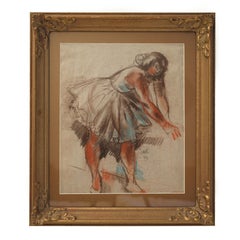
Ballet Dancer by Jules Schyl, Pastel on paper, Similarities with Degas
By Jules Schyl
Located in Stockholm, SE
Jules Schyl (Sweden, 1893-1977)
Title: Ballet Dancers
A Ballet Dancer painting is a rare find for an artist mostly known for his oeuvre with Cubism and Expressionist paintings. The current painting has many similarities with Degas sketches...
Category
1940s Impressionist Figurative Drawings and Watercolors
Materials
Paper, Crayon, Pastel
$1,342 Sale Price
55% Off
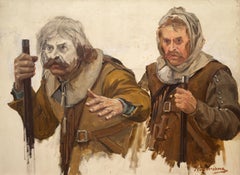
Oil Sketch for the Painting "Gustavus II Adolphus before the Battle of Lützen"
Located in Stockholm, SE
This is an oil sketch for the famous painting "Gustavus II Adolphus before the Battle of Lützen" today in the Göteborgs Konstmuseum's collection.
There is something special with an ...
Category
1890s Portrait Paintings
Materials
Canvas, Oil
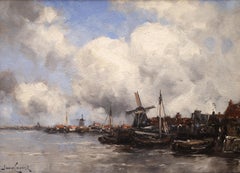
View of a Dutch Town by Jan van Couver (Hermanus Koekkoek Jr.) Impressionism
By Jan Van Couver
Located in Stockholm, SE
Hermanus Koekkoek the Younger was part of the famous Koekkoek artist family: grandson of Johannes Hermanus Koekkoek, nephew of the landscape painter, Barend Cornelis Koekkoek...
Category
Late 19th Century Impressionist Landscape Paintings
Materials
Canvas, Oil
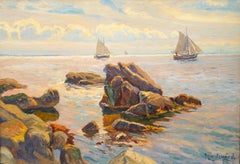
Sailboats in the Swedish Archipelago Painting by Justus Lundegård, Oil on Canvas
Located in Stockholm, SE
Justus Lundegård grew up in the Swedish village Hörby.
He started his art studies at the Royal Swedish Academy of Fine Arts 1880–84 and later in Munich and Paris where he switched to an Impressionist style.
In this painting, we can see his later talent for painting white light...
Category
Early 20th Century Impressionist Landscape Paintings
Materials
Canvas, Oil
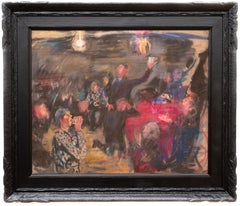
Party Time by Swedish Artist Eric Hallström, Pastel on Paper
Located in Stockholm, SE
Eric Hallström (1893-1946) Swedish
Party Time
pastel on paper
signed Eric Hallström
image dimensions approx 19.29 x 23.22 inches (49 x 59 cm)
frame 26.37 x 30.70 inches (67 x 78 cm...
Category
1920s Figurative Paintings
Materials
Paper, Pastel
$2,734 Sale Price
35% Off
Peasants in a Cornfield (Boer in het veld) by David Teniers the Younger
By David Teniers the Younger
Located in Stockholm, SE
Remembering the magic of everyday life moments in the art of David Teniers:
The art of David Teniers the Younger (1610–1690) coincided with the heyday of the Flemish Baroque and captured a great variety of motifs of his time. In this painting of a seemingly simple peasant scene lies keys to understanding both the imaginative mind of Teniers as well as why this time period produced some of the most iconic works in all of art history.
As indicated by the name, Teniers was more or less born into his profession. As the son of David Teniers the elder, himself a painter who studied under Rubens, the younger David received training in art from a very young age and had no less than three brothers who also became painters. Because of his father’s frequent financial failures that even at times saw him imprisoned, David the younger helped to rescue the family from ruin through painting copies of old masters. Essentially, the young Teniers was confronted with painting as both a passion and creative expression as well as a necessity during difficult times, an experience that would shape much of his capacity and sensitivity in his coming life.
Despite the hardships, the talent and determination of Teniers was recognized and quickly expanded his possibilities. He had already spent time in France and possibly also England when he was hired by his father’s former teacher Rubens to help with a prestigious commission with mythological paintings, now considered lost, for Philip IV the king Spain. In 1644–54 Teniers was appointed dean of the Antwerp Guild of Saint Luke, manifesting his esteemed position within the artistic community. A few years afterwards he took an important step when relocating to Brussels, where Teniers yet again found new career opportunities that would prove to be very successful.
As the keeper of the collections of Archduke Leopold Wilhelm, a role similar to what we now refer to as an art advisor, Teniers purchased hundreds of important artworks that manifested the prominent status of the Archduke’s collection while at the same time providing an unusual access to inspiration and knowledge for Teniers himself. Since he kept on painting during the same time, his creative scope must have seemed almost bewildering in the great variety of images and stories that he surrounded himself with.
Regardless of how glamorous and culturally stimulating the career of Teniers was, he was as open to the charm and existential importance of everyday life as he was to works of great masters and luxurious collectibles. In his impressive repertoire of genres with everything from exquisite royal portraits, interiors, landscapes and history paintings he always added something new and inventive, highlighting the possibilities of art and importance of an experimental and intuitive mind. It is difficult to single out one aspect or genre to summarize his legacy, since it lies much more in the broad virtuosity across many motifs, although he is particularly remembered for farm scenes and meticulously depicted interiors where other paintings and artworks are captured with an astonishing precision. However, the fact that he is still today one of the most known and celebrated names of the Dutch Golden Age is a proof to the magic of his work, which continues to spark dialogue and wonder in the contemporary viewer of his works.
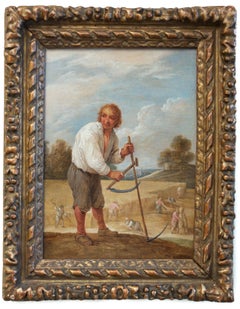
The farm boy in the field in this painting, which likely dates to the mature part of his career, is a wonderful entry into the mind of Teniers. In the tightly cropped motif, we see him standing right in the middle of the busy harvest when men, women and everyone capable were sent out in the field to collect the crop that formed the very core of their diet and survival. In the background we see a fresh blue sky interspersed with skillfully painted clouds, some trees reaching their autumnal colours and in the far distance the glimpse of a small church and village. The presence of a church in a landscape, so typical of Dutch art, served both a symbolic and visual function as a representation of faith while at the same time defining scale and distance.
In the field, the work is in full action with the farmers spread out in various positions, all in the midst of hard and sweaty labour. While they are portrayed as having nothing else than the work on their mind, our farm boy seems to have his attention directed elsewhere. Standing there with his white, half open shirt, flowy curls and strong, sturdy body; his gaze is directed away, out of the picture and the scythes in his hands. He looks almost smirking, expressed with tremendous subtlety in the slight smile of his lips and big eyes, being just in the middle of losing focus on the work. What is it that steals his attention? What has he seen, or realized, or felt – to break him free of the arduous task of harvesting, if but for a moment?
Here starts the wondering and the questions that are the hallmark of a great piece of art. Instead of explicitly locking in the motif in overly clear symbolism Teniers has chosen an open ended, subtle yet striking moment for us to consider. While it of course can be related to numerous other farm scene depictions of this time, and clever usages of gazes and real-life scenes to underscore various moral or symbolic meanings, the painting can be much more of a contemplation than an explanation or illustration. The ordinary nature and understated yet emotionally textured composition of the motif gives greater space for our own reactions and thoughts. Has he seen a pretty farm girl just passing by? Is he fed up with the farm life, joyously dreaming away for a minute, imagining another future? Or is he simply in need of distraction, looking away and ready for anything that can steal his attention?
One quality that never seem to have escaped Teniers was that of curiosity. During all of his career he constantly investigated, expanded and experimented with not only the style and technique of painting, but with the vision of art itself. Being credited with more or less introducing farm motifs for a broader audience not only tells us of his ability to understand the demand for different motifs, but the sensitivity to transform seemingly ordinary parts of life into deep aesthetic experiences, far beyond their expected reach. The farm boy in this painting is, of course, exactly that. But with the help of one smirk the entire picture is charged with a different energy, awakening many contrasts and relationships between the calm landscape, the hard work and his own breach of effectivity, holding sharp scythes while thinking or seeing something else.
It is no wonder Teniers chose to work with farm scenes as a way of investigating these intricate and delicate plays on expectations and surprises, clarity and ambivalence. It invites us to an appreciation of human everyday life that connects us with the people of 17th century...
Category
Late 17th Century Old Masters Landscape Paintings
Materials
Canvas, Oil
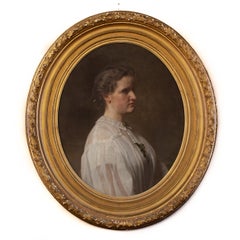
Portrait of Alice Ritter by Ferdinand Fagerlin. Oil on Canvas
Located in Stockholm, SE
Ferdinand Fagerlin (1825-1907) Sweden
Portrait of Alice Ritter, The Artists Wife
oil on canvas
signed with monogram
painted 1862
canvas size 27.95...
Category
1860s Portrait Paintings
Materials
Canvas, Oil
$4,326 Sale Price
20% Off
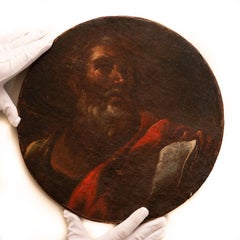
An Apostle Painted in the Circle of Peter Paul Rubens, Oil on Canvas
Located in Stockholm, SE
Peter Paul Rubens (circle of)
An Apostle
circular 15.15 inches (38.5 cm)
oil on canvas
Provenance: Bukowskis Auctions, lot 725149, as "Peter Paul Rubens, circle of".
Category
17th Century Portrait Paintings
Materials
Canvas, Oil