David Barnett Gallery Figurative Prints
to
72
123
43
71
43
Overall Width
to
Overall Height
to
56
35
21
20
18
7
6
4
3
2
1
1
34
25
18
16
9
20
84
235
13
14
6
18
22
12
8
30
65
29
20
5
218
130
4
270
184
90
85
66
51
42
38
37
36
32
31
24
24
21
18
17
10
7
7
227
60
26
18
17
139
85
352
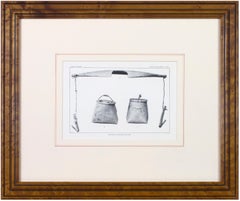
Birchbark Sap Buckets and Yoke
original halftone print, Bureau of Ethnology
Located in Milwaukee, WI
This halftone print was included in the 1898 report of the Bureau of Ethnology to the Smithsonain Institution. The sap buckets and yoke are from the Menomin...
Category
1890s Victorian Figurative Prints
Materials
Lithograph

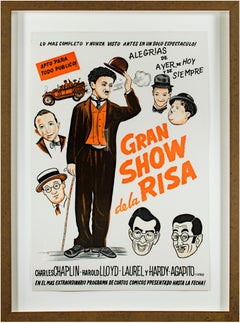
Poster for "Gran Show de la Risa" with Charlie Chaplin, Harold Lloyd, and others
Located in Milwaukee, WI
This original color lithograph poster features some of the most iconic and beloved comedians of the early 20th century: The image is dominated by the figure of Charlie Chaplin, holding his iconic bowler hat over his head. Surrounding him are portraits of Harold Lloyd...
Category
Mid-20th Century Modern Figurative Prints
Materials
Lithograph
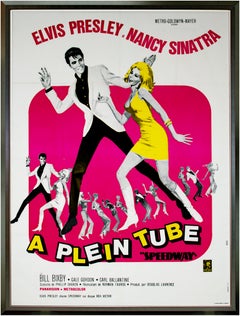
"Speedway" large French movie poster with Elvis Presley, Nancy Sinatra
Located in Milwaukee, WI
This poster for the 1968 film Speedway is an energetic and playful work of graphic design. The poster is dominated by vibrant magenta and yellow, making the image of Elvis Presley an...
Category
1960s Modern Figurative Prints
Materials
Lithograph
Self Portrait 1974
original etching signed by Sandra Sweeney
By Sandra Sweeney
Located in Milwaukee, WI
Following in line with artists before her, like Rembrandt and van Gogh, Sandra Sweeny here presents a self portrait. The image is both direct and subtle not only in its handling of m...
Category
1970s Contemporary Portrait Prints
Materials
Paper, Etching

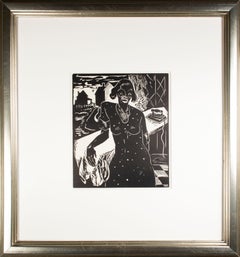
Monday in Wick Haven
original linoleum cut print by Howard Thomas
By Howard Thomas
Located in Milwaukee, WI
In this image, Howard Thomas presents the viewer with a domestic interior. The image is dominated by the figure of a black woman, resting her arm on an ironing board. To the right, the tool of her task dangles a chord above a checker tiled floor. Beyond, though a window, neighboring homes fill the landscape. The careful line-work of the linocut adds a sense of expressionism to the scene, but the image nonetheless falls into the Social Realism that captivated most American artists during the Great Depression.
This print was published in 1936 as part of the Wisconsin Artists' Calendar for the year 1937, which included 52 original, hand-made prints – one for each week of the year.
6 x 5 inches, image
10 x 7.13 inches, sheet
12.37 x 12.43 inches, frame
Entitled "Monday in Wick Haven" lower left (covered by matting)
Inscribed "Linoleum Cut" lower center (covered by matting)
Artist name "Howard Thomas" lower right (covered by matting)
Framed to conservation standards using 100 percent rag matting and museum glass, all housed in a silver gilded moulding.
Quaker-born in Ohio, Thomas trained in the Midwest at Ohio State University and the Chicago Art Institute. He taught in the Art Department of the Milwaukee State Teachers College (now University of Wisconsin-Milwaukee) where he became good friends with Carl Holty, Edward Boerner, Robert von Neumann...
Category
1930s American Modern Figurative Prints
Materials
Linocut
Camp Red River Hunters
original lithograph by John Mix Stanley
By John Mix Stanley
Located in Milwaukee, WI
In the mid-nineteenth century, the United States government set out to survey and document its newly acquired lands and territories west of the Mississippi. The goals of these surveys were manifold: to produce topographical maps, to document flora and fauna, and to document natural resources to build the emerging US economy. These surveys, and the images from them, also functioned to build the new sense of American identity with the landscape, condensing vistas into the 'picturesque' tradition of European image making. Thus, the entire span of US territory could be seen as a single, cohesive whole.
This lithograph comes from one of six surveys commissioned by the Army's Topographic Bureau in 1853, which sought to find the best route to construct a transcontinental railroad. The result was a thirteen-volume report including maps, lithographs, and technical data entitled 'Explorations and Surveys to ascertain the most practicable and economical route for a Railroad from the Mississippi river to the Pacific Ocean.' In particular, the print comes from the northern survey, commanded by Isaac Stevens, which explored the regions between the 47th and 49th parallels.
In this image, Stanley shows an encampment of the people known as the Red River of the North hunters. They were generations of European and mixed-race trappers who lived on the frontier and had Indian wives and mixed-race children. They had come to the area for bison hunting, as the herds were still vast on the prairies. In the image, the figures and their encampment are dwarfed by the vast landscape around them, indicating the sublimity of these new American territories.
5.75 x 8.75 inches, image
6.5 x 9.25 inches, stone
17 x 20 inches, frame
Artist 'Stanley Del.' lower left
Entitled 'Camp Red River Hunters' lower center margin
Publisher 'Sarony, Major & Knapp. Lith.s 449 Broadway N.Y.' lower right
Inscribed 'U.S.P.R.R. EXP. & SURVEYS — 47th & 49th PARALLELS' upper left
Inscribed 'GENERAL REPORT — PLATE XII' upper right
Framed to conservation standards using 100 percent rag matting with French accents; glazed with UV5 Plexiglas to inhibit fading; housed in a gold reverse ogee moulding.
Print in overall good condition; some localized foxing and discoloration; minor surface abrasions to frame.
John Mix Stanley...
Category
1850s Romantic Landscape Prints
Materials
Lithograph
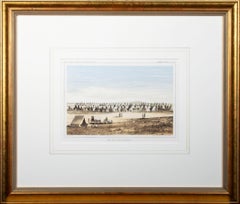
Distribution of Goods to the Assiniboines
original John Mix Stanley lithograph
By John Mix Stanley
Located in Milwaukee, WI
In the mid-nineteenth century, the United States government set out to survey and document its newly acquired lands and territories west of the Mississippi. The goals of these surveys were manifold: to produce topographical maps, to document flora and fauna, and to document natural resources to build the emerging US economy. These surveys, and the images from them, also functioned to build the new sense of American identity with the landscape, condensing vistas into the 'picturesque' tradition of European image making. Thus, the entire span of US territory could be seen as a single, cohesive whole.
This lithograph comes from one of six surveys commissioned by the Army's Topographic Bureau in 1853, which sought to find the best route to construct a transcontinental railroad. The result was a thirteen-volume report including maps, lithographs, and technical data entitled 'Explorations and Surveys to ascertain the most practicable and economical route for a Railroad from the Mississippi river to the Pacific Ocean.'
When it came to depicting the Assiniboine people, as seen in the present print, Stanley chose to juxtapose their encampment, marked by tipis in the distance, with the encampment of the Isaac Stevens survey party. In the foreground, commemorating this moment, Isaac Stevens can be seen presenting trade goods, which are known to include thirty two dressed skins and two robes. The survey leader Isaac Stevens noted being grateful for the generosity of the Assiniboine, commenting: "I felt very grateful indeed to those Indians, for their kindness to my men, their proffer of kind feeling and hospitality to myself and the survey." This description and this image, however, are arguably depicted through rose-colored glasses: to the Assiniboine people, this meeting may well have included stressful diplomatic relationships and have indicated a threat to the sovereignty over the territories agreed to be theirs by the 1851 Treaty of Fort Laramie.
5.75 x 8.75 inches, image
6.5 x 9.25 inches, stone
17 x 19.75 inches, frame
Artist 'Stanley Del.' lower left
Entitled 'Distribution of Goods to the Assiniboines' lower center margin
Publisher 'Sarony, Major & Knapp. Lith.s 449 Broadway N.Y.' lower right
Inscribed 'U.S.P.R.R. EXP. & SURVEYS — 47th & 49th PARALLELS' upper left
Inscribed 'GENERAL REPORT — PLATE XIV' upper right
Framed to conservation standards using 100 percent rag matting with French accents; glazed with UV5 Plexiglas to inhibit fading; housed in a gold reverse ogee moulding.
Print in overall good condition; some localized foxing and discoloration; frame in excellent condition.
John Mix Stanley...
Category
1850s Romantic Landscape Prints
Materials
Lithograph
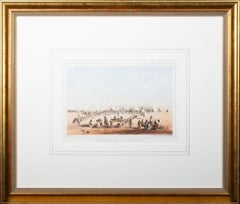
Distribution of Goods to the Gros Ventres
lithograph by John Mix Stanley
By John Mix Stanley
Located in Milwaukee, WI
In the mid-nineteenth century, the United States government set out to survey and document its newly acquired lands and territories west of the Mississippi. The goals of these surveys were manifold: to produce topographical maps, to document flora and fauna, and to document natural resources to build the emerging US economy. These surveys, and the images from them, also functioned to build the new sense of American identity with the landscape, condensing vistas into the 'picturesque' tradition of European image making. Thus, the entire span of US territory could be seen as a single, cohesive whole.
This lithograph comes from one of six surveys commissioned by the Army's Topographic Bureau in 1853, which sought to find the best route to construct a transcontinental railroad. The result was a thirteen-volume report including maps, lithographs, and technical data entitled 'Explorations and Surveys to ascertain the most practicable and economical route for a Railroad from the Mississippi river to the Pacific Ocean.' In particular, the print comes from the northern survey, commanded by Isaac Stevens, which explored the regions between the 47th and 49th parallels.
In this image, Stanley documented the encounter with the Gros Ventre people at Milk River. The explorers were invited to the Gros Ventres camp and the two groups exchanged gifts in friendship. The Stevens Party provided "... blankets, shirts, calico, knives, beads, paint, powder, shot, tobacco, hard bread, etc." The image likewise alludes to how, in 1855, Isaac Stevens, concluded a treaty (Stat., L., XI, 657) to provide peace between the United States and the Blackfoot, Flathead and Nez Perce tribes. The Gros Ventres signed the treaty as part of the Blackfoot Confederacy, whose territory near the Three Fork area became a common hunting ground for the Flathead, Nez Perce, Kootenai, and Crow Indians.
5.75 x 8.75 inches, image
6.5 x 9.25 inches, stone
17 x 20 inches, frame
Artist 'Stanley Del.' lower left
Entitled 'Distribution of Goods to the Gros Ventres' lower center margin
Publisher 'Sarony, Major & Knapp. Lith.s 449 Broadway N.Y.' lower right
Inscribed 'U.S.P.R.R. EXP. & SURVEYS — 47th & 49th PARALLELS' upper left
Inscribed 'GENERAL REPORT — PLATE XXI' upper right
Framed to conservation standards using 100 percent rag matting with French accents; glazed with UV5 Plexiglas to inhibit fading; housed in a gold reverse ogee moulding.
Print in overall good condition; some localized foxing and discoloration; minor surface abrasions to frame.
John Mix...
Category
1850s Romantic Landscape Prints
Materials
Lithograph
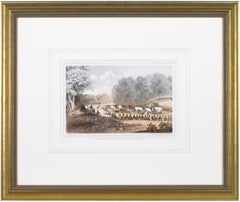
Victor
s Camp - Hell Gate Ronde
original John Mix Stanley lithograph
By John Mix Stanley
Located in Milwaukee, WI
In the mid-nineteenth century, the United States government set out to survey and document its newly acquired lands and territories west of the Mississippi. The goals of these surveys were manifold: to produce topographical maps, to document flora and fauna, and to document natural resources to build the emerging US economy. These surveys, and the images from them, also functioned to build the new sense of American identity with the landscape, condensing vistas into the 'picturesque' tradition of European image making. Thus, the entire span of US territory could be seen as a single, cohesive whole.
This lithograph comes from one of six surveys commissioned by the Army's Topographic Bureau in 1853, which sought to find the best route to construct a transcontinental railroad. The result was a thirteen-volume report including maps, lithographs, and technical data entitled 'Explorations and Surveys to ascertain the most practicable and economical route for a Railroad from the Mississippi river to the Pacific Ocean.' In particular, the print comes from the northern survey, commanded by Isaac Stevens, which explored the regions between the 47th and 49th parallels.
Stanley shows here the stop the Stanley Party made at the junction of the Bitterroot and Hell Gate, in present day Montana. While there, the Party met with the Flathead Chief by the name Victor, as is shown in the image. The figures and their encampment are dwarfed by the vast landscape around them, indicating the sublimity of these new American territories.
5.75 x 8.75 inches, image
6.5 x 9.25 inches, stone
17 x 20 inches, frame
Artist 'Stanley Del.' lower left
Entitled 'Victor's Camp - Hell Gate Ronde' lower center margin
Publisher 'Sarony, Major & Knapp. Lith.s 449 Broadway N.Y.' lower right
Inscribed 'U.S.P.R.R. EXP. & SURVEYS — 47th & 49th PARALLELS' upper left
Inscribed 'GENERAL REPORT — PLATE XXXI' upper right
Framed to conservation standards using 100 percent rag matting with French accents; glazed with UV5 Plexiglas to inhibit fading; housed in a gold reverse ogee moulding.
Print in overall good condition; some localized foxing and discoloration; minor surface abrasions to frame.
John Mix Stanley...
Category
1850s Romantic Landscape Prints
Materials
Lithograph
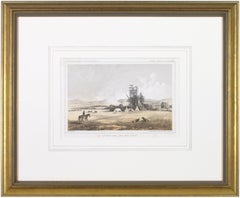
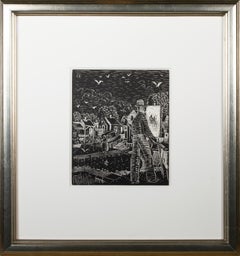
Jones Island
original woodcut engraving by Gerrit Sinclair
By Gerrit Sinclair
Located in Milwaukee, WI
The print 'Jones Island' is something of a self portrait. In the image, an artist stands before and easel, depicting the docks and buildings on the coast. The title indicates that this is Jones Island in Milwaukee, the peninsula along Lake Michigan that today is home to largely industrial buildings. The buildings and figures in the print suggest that this might be a view of the last of the Kashubian or German immigrant settlements on the peninsula before they were evicted in the 1940s to make way for the development of the harbor. The artist in the image thus acts as a documentarian of these peoples. The careful line-work of the woodblock engraving adds a sense of expressionism to the scene, leaving the figures and buildings looking distraught and dirty, though the image nonetheless falls into the Social Realist category that dominated American artists during the Great Depression.
This print was published in 1936 as part of the Wisconsin Artists' Calendar for the year 1937, which included 52 original, hand-made prints – one for each week of the year.
6 x 5 inches, image
10 x 7.13 inches, sheet
13.43 x 12.43 inches, frame
Signed "GS" in the print block,upper left
Entitled "Jones Island" lower left (covered by matting)
Inscribed "Wood Engraving" lower center (covered by matting)
Artist name "Gerrit V. Sinclair" lower right (covered by matting)
Framed to conservation standards using 100 percent rag matting and museum glass, all housed in a silver gilded moulding.
Gerrit Sinclair studied at the Art Institute of Chicago from 1910 - 1915, under Vanderpoel, Norton, and Walcott. In World War I, he served in the Army Ambulance Corps and later recorded his experiences in a series of oil paintings. He taught in Minneapolis before arriving in Milwaukee in 1920 to become a member of the original faculty of the Layton School of Art. He was also a member of the Wisconsin Painters & Sculptors.
Sinclair's paintings and drawings were executed in a lyrical, representational style, usually expressing a mood rather than a narrative. His paintings reveal a great sensitivity for color and atmosphere. His subject matter focused on cityscapes, industrial valleys, and working-class neighborhoods, captured from eye-level. A decade before the popularity of Regionalism, Sinclair's strong interest in the community was reflected not only in his paintings, but also in his encouragement to students to return to their communities as artists and teachers. Joseph Friebert...
Category
1930s American Modern Figurative Prints
Materials
Engraving, Woodcut
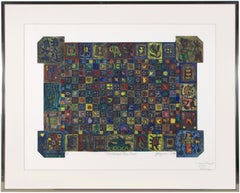
Floorboard Plus Four
original collagraph signed by Joseph Rozman
By Joseph Rozman
Located in Milwaukee, WI
The present unique collagraph is an excellent example of Joseph Rozman's pictographic style. The composition is organized like a tiled floor, each square containing an abstracted ima...
Category
1960s Abstract Expressionist Figurative Prints
Materials
Paper, Ink, Watercolor
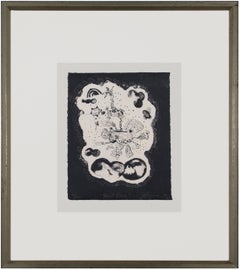
Mad Dash
original lithograph signed by Joseph Rozman
By Joseph Rozman
Located in Milwaukee, WI
'Mad Dash' is a print that exemplifies the work of Joseph Rozman during the 1970s, moving beyond the playful pictographs of the previous decade and morphing into an increasingly surr...
Category
1970s Surrealist Figurative Prints
Materials
Lithograph
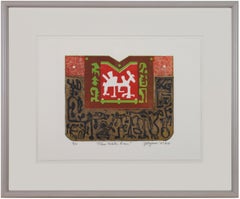
Plus White Deer
collagraph by Joseph Rozman from
Los Animales
portfolio
By Joseph Rozman
Located in Milwaukee, WI
The present color collagraph, from the portfolio 'Los Animales,' is an excellent example of Joseph Rozman's pictographic style. Rozman's work often looks to ancient and non-western a...
Category
1960s Abstract Expressionist Figurative Prints
Materials
Paper
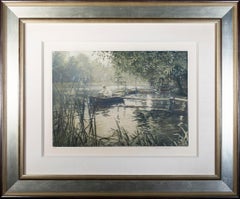
Early 20th century aquatint landscape figure boat water trees lake print signed
By Manuel Robbe
Located in Milwaukee, WI
'Le Pecheur' is an excelletn example of the aquatints of Manuel Robbe, a French artists working during the turn of the 20th century. The image draws upon th...
Category
Early 1900s Impressionist Figurative Prints
Materials
Aquatint
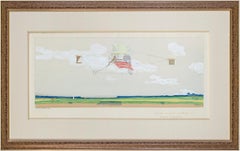
Coupe Gordon Bennett 1909
original lithograph by Marguerite "Gamy" Montaut
By Marguerite Montaut
Located in Milwaukee, WI
"Coupe Gordon Bennett 1909 — Curtiss le Gagnant" is an original Lithograph with Pochoir created by Marguerite Montaut (GAMY). Gamy presents the viewer w...
Category
Early 1900s American Realist Landscape Prints
Materials
Lithograph, Ink
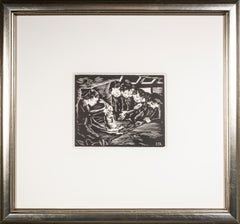
The Rabbit
original woodcut engraving by Clarice George Logan
By Clarice George Logan
Located in Milwaukee, WI
In 'The Rabbit,' Wisconsin artist Clarice George Logan presents the viewer with a multi-figural scene: under a wood-frame structure, four children crouch on the ground, gathered around a young woman who presents a rabbit. Under normal circumstances, such an image of children with a bunny would recall childhood storybooks. In this case, however, the image is more ambiguous and suggests the unfortunate economic circumstances many children suffered during the interwar years. Nonetheless, the group could also be interpreted as a nativity play, with the rabbit taking the place of the Christ child, shining light on the children like in a painting by the Italian Renaissance artist Correggio. The careful line-work of the woodblock engraving adds a sense of expressionism to the scene, leaving the figures looking distraught and dirty, though the image nonetheless falls into the Social Realist category that dominated American artists during the Great Depression.
This print was published in 1936 as part of the Wisconsin Artists' Calendar for the year 1937, which included 52 original, hand-made prints - one for each week of the year.
Clarice George Logan was born in Mayville, New York in 1909 but moved to Wisconsin in 1921. She attended the Milwaukee State Teachers College from 1927 to 1931 where she studied with Robert von...
Category
1930s American Modern Figurative Prints
Materials
Engraving, Woodcut
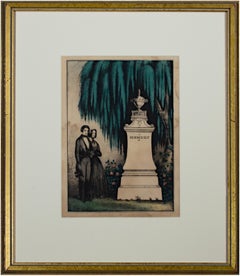
In Memory of (66)
original Kellogg
Comstock hand-colored mourning lithograph
Located in Milwaukee, WI
The present hand-colored lithograph was produced as part of the funeral and mourning culture in the United States during the 19th century. Before the printmaking boom of the 1830s, however, such inexpensive memorial images were not widely available. These prints became popular as ways of remembering loved ones, an alternative to portraiture of the deceased or to meticulous hand-embroidered memorials often made by female academy students. In the image, the urn-topped monument contains a space where a family could inscribe the name and death dates of a deceased loved one, though this example was never used. In the variations of this image type produced by the Kellogg...
Category
Mid-19th Century Romantic Figurative Prints
Materials
Watercolor, Lithograph
Hyde Park
original woodcut engraving signed by Auguste Louis Lepère
By Auguste Louis Lepère
Located in Milwaukee, WI
The present artwork is an excellent example of the woodcut engravings of Auguste-Louis Lepère (1849 - 1918). He was the son of the sculptor Francois Lepère, a...
Category
1860s Realist Figurative Prints
Materials
Engraving, Woodcut
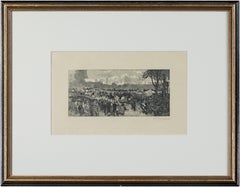
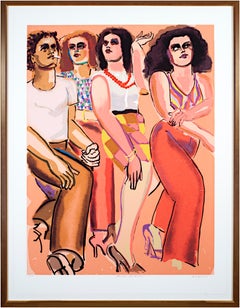
Street Scene With Building #2
original silkscreen signed by Lester Johnson
By Lester Johnson
Located in Milwaukee, WI
The present work is an original screen print signed by Lester Johnson, from his 'Street Scene Portfolio.' It features four figures, all wearing fashionable street clothing emblematic...
Category
1970s Contemporary Figurative Prints
Materials
Screen
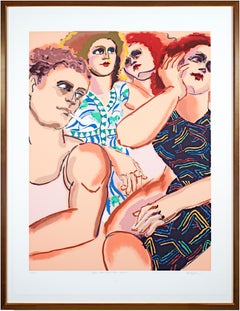
Street Scene With Man
Women
original silkscreen signed by Lester Johnson
By Lester Johnson
Located in Milwaukee, WI
The present work is an original screen print signed by Lester Johnson, from his 'Street Scene Portfolio.' It features four figures, all wearing fashionable street clothing emblematic...
Category
1970s Contemporary Figurative Prints
Materials
Screen
19th century woodcut engraving print figurative American forest trees scene
By Winslow Homer
Located in Milwaukee, WI
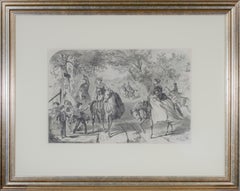
The present woodcut engraving is an original print designed by Winslow Homer, originally published in Harper's Weekly on April 30, 1859. It is an excellent example of the many prints Homer produced of fashionable people engaged in leisurely activities, in this case along a picturesque countryside lane. The sign reading 'Belmont' on the left indicates this is probably near his home in Belmont Massachusetts. The image presents multiple figures, both men and women, riding horseback: Some in the distance gallop away, toward a town marked by a church steeple beyond. Three others in the foreground, including two equestrian women, gather around a group of children who have been gathering flowers and trapping birds...
Category
1850s Victorian Figurative Prints
Materials
Engraving, Woodcut
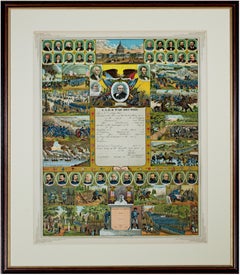
Government Accounts Registry
War Record
original chromolithograph
By J.M. Vickroy
Co.
Located in Milwaukee, WI
The present lithograph, a certificate of Government Accounts Registry and War Record, was produced by the publishing company owned and operated by James M. Vickroy. The certificate was never used and has not been filled with the information of a veteran. Surrounding the text are various vignettes, arranged chronologically, of important moments of the Civil War, including the Battles of Gettysburg, Fort Sumter, Shiloh, as well as the Surrender of General Lee...
Category
1890s Other Art Style Figurative Prints
Materials
Lithograph
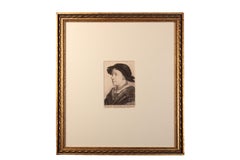
Portrait of Henrico van der Borcht,
original W. Hollar engraving after Holbei
By Wenceslaus Hollar
Located in Milwaukee, WI
In this print, Wenceslaus Hollar presents a portrait of D. Henrico van der Borcht, copying a painting or drawing by Hans Holbein. Copying works of famous masters was a common task of...
Category
17th Century Old Masters Portrait Prints
Materials
Engraving
19th century color lithograph landscape figures horseback house scene trees sky
By Nathaniel Currier
Located in Milwaukee, WI
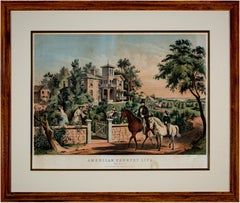
The present print is one of several examples produced for Nathaniel Currier by his longtime collaborator Frances F. "Fanny" Palmer. Harry T. Peters wrote of her: "There is no more interesting and appealing character among the group of artists who worked for Currier & Ives than Fanny Palmer. In an age when women, well-bred women in particular, did not generally work for a living Fanny Palmer for years did exacting, full-time work in order to support a large and dependent family ... Her work ... had great charm, homeliness, and a conscientious attention to detail."
One of a series of four prints showing American country life in different seasons, the image presents the viewer with a picturesque view of a successful American farm. In the foreground, a gentleman rides a horse with a young boy before a respectable Italianate country house. Two women and a young girl pick flowers in the garden and several farm workers attend to their duties. Beyond are other homes and a city on the coast.
16.63 x 23.75 inches, artwork
28.13 x 33.38 inches, frame
Entitled bottom center "American Country Life - May Morning"
Signed in the stone, lower left "F.F. Palmer, Del."
Signed in the stone, lower right "Lith. by N. Currier"
Copyrighted lower center "Entered according to Act of Congress in the year 1855 by N. Currier in the Clerk's office of the Southern District of N.Y."
Inscribed bottom center "New York, Published by N. Currier 152 Nassau Street"
Framed to conservation standards using silk-lined 100 percent rag matting and Museum Glass with a gold gilded liner, all housed in a stained wood moulding.
Nathaniel Currier was a tall introspective man with a melancholy nature. He could captivate people with his piercing stare or charm them with his sparkling blue eyes. Nathaniel was born in Roxbury, Massachusetts on March 27th, 1813, the second of four children. His parents, Nathaniel and Hannah Currier, were distant cousins who lived a humble yet spartan life. When Nathaniel was eight years old, tragedy struck. Nathaniel’s father unexpectedly passed away leaving Nathaniel and his eleven-year-old brother Lorenzo to provide for the family. In addition to their mother, Nathaniel and Lorenzo had to care for six-year-old sister Elizabeth and two-year-old brother Charles. Nathaniel worked a series of odd jobs to support the family, and at fifteen, he started what would become a life-long career when he apprenticed in the Boston lithography shop of William and John Pendleton.
A Bavarian gentleman named Alois Senefelder invented lithography just 30 years prior to young Nat Currier’s apprenticeship. While under the employ of the brothers Pendleton, Nat was taught the art of lithography by the firm’s chief printer, a French national named Dubois, who brought the lithography trade to America.
Lithography involves grinding a piece of limestone flat and smooth then drawing in mirror image on the stone with a special grease pencil. After the image is completed, the stone is etched with a solution of aqua fortis leaving the greased areas in slight relief. Water is then used to wet the stone and greased-ink is rolled onto the raised areas. Since grease and water do not mix, the greased-ink is repelled by the moisture on the stone and clings to the original grease pencil lines. The stone is then placed in a press and used as a printing block to impart black on white images to paper.
In 1833, now twenty-years old and an accomplished lithographer, Nat Currier left Boston and moved to Philadelphia to do contract work for M.E.D. Brown, a noted engraver and printer. With the promise of good money, Currier hired on to help Brown prepare lithographic stones of scientific images for the American Journal of Sciences and Arts. When Nat completed the contract work in 1834, he traveled to New York City to work once again for his mentor John Pendleton, who was now operating his own shop located at 137 Broadway. Soon after the reunion, Pendleton expressed an interest in returning to Boston and offered to sell his print shop to Currier. Young Nat did not have the financial resources to buy the shop, but being the resourceful type he found another local printer by the name of Stodart. Together they bought Pendleton’s business.
The firm ‘Currier & Stodart’ specialized in "job" printing. They produced many different types of printed items, most notably music manuscripts for local publishers. By 1835, Stodart was frustrated that the business was not making enough money and he ended the partnership, taking his investment with him. With little more than some lithographic stones, and a talent for his trade, twenty-two year old Nat Currier set up shop in a temporary office at 1 Wall Street in New York City. He named his new enterprise ‘N. Currier, Lithographer’
Nathaniel continued as a job printer and duplicated everything from music sheets to architectural plans. He experimented with portraits, disaster scenes and memorial prints, and any thing that he could sell to the public from tables in front of his shop. During 1835 he produced a disaster print Ruins of the Planter's Hotel, New Orleans, which fell at two O’clock on the Morning of the 15th of May 1835, burying 50 persons, 40 of whom Escaped with their Lives. The public had a thirst for newsworthy events, and newspapers of the day did not include pictures. By producing this print, Nat gave the public a new way to “see” the news. The print sold reasonably well, an important fact that was not lost on Currier.
Nat met and married Eliza Farnsworth in 1840. He also produced a print that same year titled Awful Conflagration of the Steamboat Lexington in Long Island Sound on Monday Evening, January 18, 1840, by which melancholy occurrence over One Hundred Persons Perished. This print sold out very quickly, and Currier was approached by an enterprising publication who contracted him to print a single sheet addition of their paper, the New York Sun. This single page paper is presumed to be the first illustrated newspaper ever published.
The success of the Lexington print launched his career nationally and put him in a position to finally lift his family up. In 1841, Nat and Eliza had their first child, a son they named Edward West Currier. That same year Nat hired his twenty-one year old brother Charles and taught him the lithography trade, he also hired his artistically inclined brother Lorenzo to travel out west and make sketches of the new frontier as material for future prints. Charles worked for the firm on and off over the years, and invented a new type of lithographic crayon which he patented and named the Crayola. Lorenzo continued selling sketches to Nat for the next few years.
In 1843, Nat and Eliza had a daughter, Eliza West Currier, but tragedy struck in early 1847 when their young daughter died from a prolonged illness. Nat and Eliza were grief stricken, and Eliza, driven by despair, gave up on life and passed away just four months after her daughter’s death.
The subject of Nat Currier’s artwork changed following the death of his wife and daughter, and he produced many memorial prints and sentimental prints during the late 1840s. The memorial prints generally depicted grief stricken families posed by gravestones (the stones were left blank so the purchasers could fill in the names of the dearly departed). The sentimental prints usually depicted idealized portraits of women and children, titled with popular Christian names of the day.
Late in 1847, Nat Currier married Lura Ormsbee, a friend of the family. Lura was a self-sufficient woman, and she immediately set out to help Nat raise six-year-old Edward and get their house in order. In 1849, Lura delivered a son, Walter Black Currier, but fate dealt them a blow when young Walter died one year later. While Nat and Lura were grieving the loss of their new son, word came from San Francisco that Nat’s brother Lorenzo had also passed away from a brief illness. Nat sank deeper into his natural quiet melancholy. Friends stopped by to console the couple, and Lura began to set an extra place at their table for these unexpected guests. She continued this tradition throughout their lives.
In 1852, Charles introduced a friend, James Merritt Ives, to Nat and suggested he hire him as a bookkeeper. Jim Ives was a native New Yorker born in 1824 and raised on the grounds of Bellevue Hospital where his father was employed as superintendent. Jim was a self-trained artist and professional bookkeeper. He was also a plump and jovial man, presenting the exact opposite image of his new boss.
Jim Ives met Charles Currier through Caroline Clark, the object of Jim’s affection. Caroline’s sister Elizabeth was married to Charles, and Caroline was a close friend of the Currier family. Jim eventually proposed marriage to Caroline and solicited an introduction to Nat Currier, through Charles, in hopes of securing a more stable income to support his future wife.
Ives quickly set out to improve and modernize his new employer’s bookkeeping methods. He reorganized the firm’s sizable inventory, and used his artistic skills to streamline the firm’s production methods. By 1857, Nathaniel had become so dependent on Jims’ skills and initiative that he offered him a full partnership in the firm and appointed him general manager. The two men chose the name ‘Currier & Ives’ for the new partnership, and became close friends.
Currier & Ives produced their prints in a building at 33 Spruce Street where they occupied the third, fourth and fifth floors. The third floor was devoted to the hand operated printing presses that were built by Nat's cousin, Cyrus Currier, at his shop Cyrus Currier & Sons in Newark, NJ. The fourth floor found the artists, lithographers and the stone grinders at work. The fifth floor housed the coloring department, and was one of the earliest production lines in the country. The colorists were generally immigrant girls, mostly German, who came to America with some formal artistic training. Each colorist was responsible for adding a single color to a print. As a colorist finished applying their color, the print was passed down the line to the next colorist to add their color. The colorists worked from a master print displayed above their table, which showed where the proper colors were to be placed. At the end of the table was a touch up artist who checked the prints for quality, touching-in areas that may have been missed as it passed down the line. During the Civil War, demand for prints became so great that coloring stencils were developed to speed up production.
Although most Currier & Ives prints were colored in house, some were sent out to contract artists. The rate Currier & Ives paid these artists for coloring work was one dollar per one hundred small folios (a penny a print) and one dollar per one dozen large folios. Currier & Ives also offered uncolored prints to dealers, with instructions (included on the price list) on how to 'prepare the prints for coloring.' In addition, schools could order uncolored prints from the firm’s catalogue to use in their painting classes.
Nathaniel Currier and James Merritt Ives attracted a wide circle of friends during their years in business. Some of their more famous acquaintances included Horace Greeley, Phineas T. Barnum, and the outspoken abolitionists Rev. Henry Ward, and John Greenleaf Whittier (the latter being a cousin of Mr. Currier).
Nat Currier and Jim Ives described their business as "Publishers of Cheap and Popular Pictures" and produced many categories of prints. These included Disaster Scenes, Sentimental Images, Sports, Humor, Hunting Scenes, Politics, Religion, City and Rural Scenes, Trains, Ships, Fire Fighters, Famous Race Horses, Historical Portraits, and just about any other topic that satisfied the general public's taste. In all, the firm produced in excess of 7500 different titles, totaling over one million prints produced from 1835 to 1907.
Nat Currier retired in 1880, and signed over his share of the firm to his son Edward. Nat died eight years later at his summer home 'Lion’s Gate' in Amesbury, Massachusetts. Jim Ives remained active in the firm until his death in 1895, when his share of the firm passed to his eldest son, Chauncey.
In 1902, faced will failing health from the ravages of Tuberculosis, Edward Currier sold his share of the firm to Chauncey Ives...
Category
Mid-19th Century Romantic Figurative Prints
Materials
Watercolor, Lithograph
19th century color lithograph watercolor landscape figurative animal print
By Nathaniel Currier
Located in Milwaukee, WI
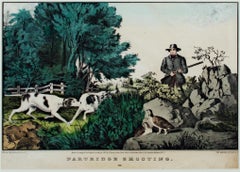
The present hand-colored lithograph presents the viewer with a hunting scene in a picturesque landscape. In the foreground, a man approaches two partridges as his two pointers prepare to flush them out. Beyond, a white fence draws our eyes to the homestead in the distance. Images like this one show how people in the United States were trying to identify themselves as a new nation in the North American landscape - as separate from their European counterparts but with similar similar and specific wildlife and magesties of nature. It also identifies hunting in this landscape as an American pastime.
9.25 x 12.5 inches, artwork
18.38 x 22 inches, frame
Entitled bottom center "Partridge Shooting...
Category
Mid-19th Century Romantic Figurative Prints
Materials
Watercolor, Lithograph
19th century color lithograph figures cemetery willow tree memorial headstone
By Nathaniel Currier
Located in Milwaukee, WI
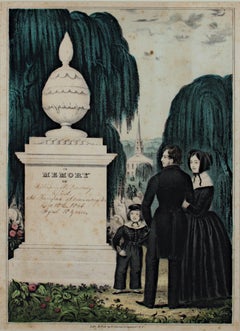
The present hand-colored lithograph was produced as part of the funeral and mourning culture in the United States during the 19th century. Images like this were popular as ways of remembering loved ones, an alternative to portraiture of the deceased. This lithograph shows a man, woman and child in morning clothes next to an urn-topped stone monument. Behind are additional putto-topped headstones beneath weeping willows, with a steepled church beyond. The monument contains a space where a family could inscribe the name and death dates of a deceased loved one. In this case, it has been inscribed to a young Civil War soldier:
William W. Peabody
Died at Fairfax Seminary, VA
December 18th, 1864
Aged 18 years
The young Mr. Peabody probably died in service for the Union during the American Civil War. Farifax Seminary was a Union hospital and military headquarters in Alexandria, Virginia. The hospital served nearly two thousand soldiers during the war time. Five hundred were also buried on the Seminary's grounds.
13.75 x 9.5 inches, artwork
23 x 19 inches, frame
Published before 1864
Inscribed bottom center "Lith. & Pub. by N. Currier. 2 Spruce St. N.Y."
Framed to conservation standards using 100 percent rag matting and TruVue Conservation Clear glass, housed in a gold gilded moulding.
Nathaniel Currier was a tall introspective man with a melancholy nature. He could captivate people with his piercing stare or charm them with his sparkling blue eyes. Nathaniel was born in Roxbury, Massachusetts on March 27th, 1813, the second of four children. His parents, Nathaniel and Hannah Currier, were distant cousins who lived a humble yet spartan life. When Nathaniel was eight years old, tragedy struck. Nathaniel’s father unexpectedly passed away leaving Nathaniel and his eleven-year-old brother Lorenzo to provide for the family. In addition to their mother, Nathaniel and Lorenzo had to care for six-year-old sister Elizabeth and two-year-old brother Charles. Nathaniel worked a series of odd jobs to support the family, and at fifteen, he started what would become a life-long career when he apprenticed in the Boston lithography shop of William and John Pendleton.
A Bavarian gentleman named Alois Senefelder invented lithography just 30 years prior to young Nat Currier’s apprenticeship. While under the employ of the brothers Pendleton, Nat was taught the art of lithography by the firm’s chief printer, a French national named Dubois, who brought the lithography trade to America.
Lithography involves grinding a piece of limestone flat and smooth then drawing in mirror image on the stone with a special grease pencil. After the image is completed, the stone is etched with a solution of aqua fortis leaving the greased areas in slight relief. Water is then used to wet the stone and greased-ink is rolled onto the raised areas. Since grease and water do not mix, the greased-ink is repelled by the moisture on the stone and clings to the original grease pencil lines. The stone is then placed in a press and used as a printing block to impart black on white images to paper.
In 1833, now twenty-years old and an accomplished lithographer, Nat Currier left Boston and moved to Philadelphia to do contract work for M.E.D. Brown, a noted engraver and printer. With the promise of good money, Currier hired on to help Brown prepare lithographic stones of scientific images for the American Journal of Sciences and Arts. When Nat completed the contract work in 1834, he traveled to New York City to work once again for his mentor John Pendleton, who was now operating his own shop located at 137 Broadway. Soon after the reunion, Pendleton expressed an interest in returning to Boston and offered to sell his print shop to Currier. Young Nat did not have the financial resources to buy the shop, but being the resourceful type he found another local printer by the name of Stodart. Together they bought Pendleton’s business.
The firm ‘Currier & Stodart’ specialized in "job" printing. They produced many different types of printed items, most notably music manuscripts for local publishers. By 1835, Stodart was frustrated that the business was not making enough money and he ended the partnership, taking his investment with him. With little more than some lithographic stones, and a talent for his trade, twenty-two year old Nat Currier set up shop in a temporary office at 1 Wall Street in New York City. He named his new enterprise ‘N. Currier, Lithographer’
Nathaniel continued as a job printer and duplicated everything from music sheets to architectural plans. He experimented with portraits, disaster scenes and memorial prints, and any thing that he could sell to the public from tables in front of his shop. During 1835 he produced a disaster print Ruins of the Planter's Hotel, New Orleans, which fell at two O’clock on the Morning of the 15th of May 1835, burying 50 persons, 40 of whom Escaped with their Lives. The public had a thirst for newsworthy events, and newspapers of the day did not include pictures. By producing this print, Nat gave the public a new way to “see” the news. The print sold reasonably well, an important fact that was not lost on Currier.
Nat met and married Eliza Farnsworth in 1840. He also produced a print that same year titled Awful Conflagration of the Steamboat Lexington in Long Island Sound on Monday Evening, January 18, 1840, by which melancholy occurrence over One Hundred Persons Perished. This print sold out very quickly, and Currier was approached by an enterprising publication who contracted him to print a single sheet addition of their paper, the New York Sun. This single page paper is presumed to be the first illustrated newspaper ever published.
The success of the Lexington print launched his career nationally and put him in a position to finally lift his family up. In 1841, Nat and Eliza had their first child, a son they named Edward West Currier. That same year Nat hired his twenty-one year old brother Charles and taught him the lithography trade, he also hired his artistically inclined brother Lorenzo to travel out west and make sketches of the new frontier as material for future prints. Charles worked for the firm on and off over the years, and invented a new type of lithographic crayon which he patented and named the Crayola. Lorenzo continued selling sketches to Nat for the next few years.
In 1843, Nat and Eliza had a daughter, Eliza West Currier, but tragedy struck in early 1847 when their young daughter died from a prolonged illness. Nat and Eliza were grief stricken, and Eliza, driven by despair, gave up on life and passed away just four months after her daughter’s death.
The subject of Nat Currier’s artwork changed following the death of his wife and daughter, and he produced many memorial prints and sentimental prints during the late 1840s. The memorial prints generally depicted grief stricken families posed by gravestones (the stones were left blank so the purchasers could fill in the names of the dearly departed). The sentimental prints usually depicted idealized portraits of women and children, titled with popular Christian names of the day.
Late in 1847, Nat Currier married Lura Ormsbee, a friend of the family. Lura was a self-sufficient woman, and she immediately set out to help Nat raise six-year-old Edward and get their house in order. In 1849, Lura delivered a son, Walter Black Currier, but fate dealt them a blow when young Walter died one year later. While Nat and Lura were grieving the loss of their new son, word came from San Francisco that Nat’s brother Lorenzo had also passed away from a brief illness. Nat sank deeper into his natural quiet melancholy. Friends stopped by to console the couple, and Lura began to set an extra place at their table for these unexpected guests. She continued this tradition throughout their lives.
In 1852, Charles introduced a friend, James Merritt Ives, to Nat and suggested he hire him as a bookkeeper. Jim Ives was a native New Yorker born in 1824 and raised on the grounds of Bellevue Hospital where his father was employed as superintendent. Jim was a self-trained artist and professional bookkeeper. He was also a plump and jovial man, presenting the exact opposite image of his new boss.
Jim Ives met Charles Currier through Caroline Clark, the object of Jim’s affection. Caroline’s sister Elizabeth was married to Charles, and Caroline was a close friend of the Currier family. Jim eventually proposed marriage to Caroline and solicited an introduction to Nat Currier, through Charles, in hopes of securing a more stable income to support his future wife.
Ives quickly set out to improve and modernize his new employer’s bookkeeping methods. He reorganized the firm’s sizable inventory, and used his artistic skills to streamline the firm’s production methods. By 1857, Nathaniel had become so dependent on Jims’ skills and initiative that he offered him a full partnership in the firm and appointed him general manager. The two men chose the name ‘Currier & Ives’ for the new partnership, and became close friends.
Currier & Ives produced their prints in a building at 33 Spruce Street where they occupied the third, fourth and fifth floors. The third floor was devoted to the hand operated printing presses that were built by Nat's cousin, Cyrus Currier, at his shop Cyrus Currier & Sons in Newark, NJ. The fourth floor found the artists, lithographers and the stone grinders at work. The fifth floor housed the coloring department, and was one of the earliest production lines in the country. The colorists were generally immigrant girls, mostly German, who came to America with some formal artistic training. Each colorist was responsible for adding a single color to a print. As a colorist finished applying their color, the print was passed down the line to the next colorist to add their color. The colorists worked from a master print displayed above their table, which showed where the proper colors were to be placed. At the end of the table was a touch up artist who checked the prints for quality, touching-in areas that may have been missed as it passed down the line. During the Civil War, demand for prints became so great that coloring stencils were developed to speed up production.
Although most Currier & Ives prints were colored in house, some were sent out to contract artists. The rate Currier & Ives paid these artists for coloring work was one dollar per one hundred small folios (a penny a print) and one dollar per one dozen large folios. Currier & Ives also offered uncolored prints to dealers, with instructions (included on the price list) on how to 'prepare the prints for coloring.' In addition, schools could order uncolored prints from the firm’s catalogue to use in their painting classes.
Nathaniel Currier and James Merritt Ives attracted a wide circle of friends during their years in business. Some of their more famous acquaintances included Horace Greeley, Phineas T. Barnum, and the outspoken abolitionists Rev. Henry Ward, and John Greenleaf Whittier (the latter being a cousin of Mr. Currier).
Nat Currier and Jim Ives described their business as "Publishers of Cheap and Popular Pictures" and produced many categories of prints. These included Disaster Scenes, Sentimental Images, Sports, Humor, Hunting Scenes, Politics, Religion, City and Rural Scenes, Trains, Ships, Fire Fighters, Famous Race Horses, Historical Portraits, and just about any other topic that satisfied the general public's taste. In all, the firm produced in excess of 7500 different titles, totaling over one million prints produced from 1835 to 1907.
Nat Currier retired in 1880, and signed over his share of the firm to his son Edward. Nat died eight years later at his summer home 'Lion’s Gate' in Amesbury, Massachusetts. Jim Ives remained active in the firm until his death in 1895, when his share of the firm passed to his eldest son, Chauncey.
In 1902, faced will failing health from the ravages of Tuberculosis, Edward Currier sold his share of the firm to Chauncey Ives...
Category
Mid-19th Century Romantic Figurative Prints
Materials
Watercolor, Lithograph
19th century color lithograph still life vase flowers
By Nathaniel Currier
Located in Milwaukee, WI
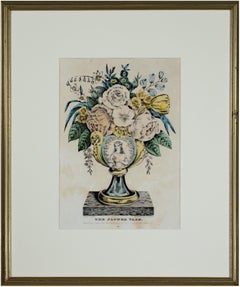
The present hand-colored lithograph is one of several decorative images of flower-filled vases published by Nathaniel Currier. This example contains roses, tulips, forget-me-nots, and others all within a vase with gold eagle head handles and an image of a beautiful young woman the belly.
16 x 11 inches, artwork
22.5 x 18.25 inches, frame
Entitled bottom center
Signed in the stone, lower left "Lith. and Pub. by N. Currier"
Inscribed lower right "152 Nassau St. Cor. of Spruce N.Y."
Copyrighted bottom center "Entered according to Act of Congress in the year 1848 by N. Currier in the Clerk's office of the Southern District of N.Y." with the number 249
Framed to conservation standards using 100 percent rag matting, housed in a lemon gold moulding.
Nathaniel Currier was a tall introspective man with a melancholy nature. He could captivate people with his piercing stare or charm them with his sparkling blue eyes. Nathaniel was born in Roxbury, Massachusetts on March 27th, 1813, the second of four children. His parents, Nathaniel and Hannah Currier, were distant cousins who lived a humble yet spartan life. When Nathaniel was eight years old, tragedy struck. Nathaniel’s father unexpectedly passed away leaving Nathaniel and his eleven-year-old brother Lorenzo to provide for the family. In addition to their mother, Nathaniel and Lorenzo had to care for six-year-old sister Elizabeth and two-year-old brother Charles. Nathaniel worked a series of odd jobs to support the family, and at fifteen, he started what would become a life-long career when he apprenticed in the Boston lithography shop of William and John Pendleton.
A Bavarian gentleman named Alois Senefelder invented lithography just 30 years prior to young Nat Currier’s apprenticeship. While under the employ of the brothers Pendleton, Nat was taught the art of lithography by the firm’s chief printer, a French national named Dubois, who brought the lithography trade to America.
Lithography involves grinding a piece of limestone flat and smooth then drawing in mirror image on the stone with a special grease pencil. After the image is completed, the stone is etched with a solution of aqua fortis leaving the greased areas in slight relief. Water is then used to wet the stone and greased-ink is rolled onto the raised areas. Since grease and water do not mix, the greased-ink is repelled by the moisture on the stone and clings to the original grease pencil lines. The stone is then placed in a press and used as a printing block to impart black on white images to paper.
In 1833, now twenty-years old and an accomplished lithographer, Nat Currier left Boston and moved to Philadelphia to do contract work for M.E.D. Brown, a noted engraver and printer. With the promise of good money, Currier hired on to help Brown prepare lithographic stones of scientific images for the American Journal of Sciences and Arts. When Nat completed the contract work in 1834, he traveled to New York City to work once again for his mentor John Pendleton, who was now operating his own shop located at 137 Broadway. Soon after the reunion, Pendleton expressed an interest in returning to Boston and offered to sell his print shop to Currier. Young Nat did not have the financial resources to buy the shop, but being the resourceful type he found another local printer by the name of Stodart. Together they bought Pendleton’s business.
The firm ‘Currier & Stodart’ specialized in "job" printing. They produced many different types of printed items, most notably music manuscripts for local publishers. By 1835, Stodart was frustrated that the business was not making enough money and he ended the partnership, taking his investment with him. With little more than some lithographic stones, and a talent for his trade, twenty-two year old Nat Currier set up shop in a temporary office at 1 Wall Street in New York City. He named his new enterprise ‘N. Currier, Lithographer’
Nathaniel continued as a job printer and duplicated everything from music sheets to architectural plans. He experimented with portraits, disaster scenes and memorial prints, and any thing that he could sell to the public from tables in front of his shop. During 1835 he produced a disaster print Ruins of the Planter's Hotel, New Orleans, which fell at two O’clock on the Morning of the 15th of May 1835, burying 50 persons, 40 of whom Escaped with their Lives. The public had a thirst for newsworthy events, and newspapers of the day did not include pictures. By producing this print, Nat gave the public a new way to “see” the news. The print sold reasonably well, an important fact that was not lost on Currier.
Nat met and married Eliza Farnsworth in 1840. He also produced a print that same year titled Awful Conflagration of the Steamboat Lexington in Long Island Sound on Monday Evening, January 18, 1840, by which melancholy occurrence over One Hundred Persons Perished. This print sold out very quickly, and Currier was approached by an enterprising publication who contracted him to print a single sheet addition of their paper, the New York Sun. This single page paper is presumed to be the first illustrated newspaper ever published.
The success of the Lexington print launched his career nationally and put him in a position to finally lift his family up. In 1841, Nat and Eliza had their first child, a son they named Edward West Currier. That same year Nat hired his twenty-one year old brother Charles and taught him the lithography trade, he also hired his artistically inclined brother Lorenzo to travel out west and make sketches of the new frontier as material for future prints. Charles worked for the firm on and off over the years, and invented a new type of lithographic crayon which he patented and named the Crayola. Lorenzo continued selling sketches to Nat for the next few years.
In 1843, Nat and Eliza had a daughter, Eliza West Currier, but tragedy struck in early 1847 when their young daughter died from a prolonged illness. Nat and Eliza were grief stricken, and Eliza, driven by despair, gave up on life and passed away just four months after her daughter’s death.
The subject of Nat Currier’s artwork changed following the death of his wife and daughter, and he produced many memorial prints and sentimental prints during the late 1840s. The memorial prints generally depicted grief stricken families posed by gravestones (the stones were left blank so the purchasers could fill in the names of the dearly departed). The sentimental prints usually depicted idealized portraits of women and children, titled with popular Christian names of the day.
Late in 1847, Nat Currier married Lura Ormsbee, a friend of the family. Lura was a self-sufficient woman, and she immediately set out to help Nat raise six-year-old Edward and get their house in order. In 1849, Lura delivered a son, Walter Black Currier, but fate dealt them a blow when young Walter died one year later. While Nat and Lura were grieving the loss of their new son, word came from San Francisco that Nat’s brother Lorenzo had also passed away from a brief illness. Nat sank deeper into his natural quiet melancholy. Friends stopped by to console the couple, and Lura began to set an extra place at their table for these unexpected guests. She continued this tradition throughout their lives.
In 1852, Charles introduced a friend, James Merritt Ives, to Nat and suggested he hire him as a bookkeeper. Jim Ives was a native New Yorker born in 1824 and raised on the grounds of Bellevue Hospital where his father was employed as superintendent. Jim was a self-trained artist and professional bookkeeper. He was also a plump and jovial man, presenting the exact opposite image of his new boss.
Jim Ives met Charles Currier through Caroline Clark, the object of Jim’s affection. Caroline’s sister Elizabeth was married to Charles, and Caroline was a close friend of the Currier family. Jim eventually proposed marriage to Caroline and solicited an introduction to Nat Currier, through Charles, in hopes of securing a more stable income to support his future wife.
Ives quickly set out to improve and modernize his new employer’s bookkeeping methods. He reorganized the firm’s sizable inventory, and used his artistic skills to streamline the firm’s production methods. By 1857, Nathaniel had become so dependent on Jims’ skills and initiative that he offered him a full partnership in the firm and appointed him general manager. The two men chose the name ‘Currier & Ives’ for the new partnership, and became close friends.
Currier & Ives produced their prints in a building at 33 Spruce Street where they occupied the third, fourth and fifth floors. The third floor was devoted to the hand operated printing presses that were built by Nat's cousin, Cyrus Currier, at his shop Cyrus Currier & Sons in Newark, NJ. The fourth floor found the artists, lithographers and the stone grinders at work. The fifth floor housed the coloring department, and was one of the earliest production lines in the country. The colorists were generally immigrant girls, mostly German, who came to America with some formal artistic training. Each colorist was responsible for adding a single color to a print. As a colorist finished applying their color, the print was passed down the line to the next colorist to add their color. The colorists worked from a master print displayed above their table, which showed where the proper colors were to be placed. At the end of the table was a touch up artist who checked the prints for quality, touching-in areas that may have been missed as it passed down the line. During the Civil War, demand for prints became so great that coloring stencils were developed to speed up production.
Although most Currier & Ives prints were colored in house, some were sent out to contract artists. The rate Currier & Ives paid these artists for coloring work was one dollar per one hundred small folios (a penny a print) and one dollar per one dozen large folios. Currier & Ives also offered uncolored prints to dealers, with instructions (included on the price list) on how to 'prepare the prints for coloring.' In addition, schools could order uncolored prints from the firm’s catalogue to use in their painting classes.
Nathaniel Currier and James Merritt Ives attracted a wide circle of friends during their years in business. Some of their more famous acquaintances included Horace Greeley, Phineas T. Barnum, and the outspoken abolitionists Rev. Henry Ward, and John Greenleaf Whittier (the latter being a cousin of Mr. Currier).
Nat Currier and Jim Ives described their business as "Publishers of Cheap and Popular Pictures" and produced many categories of prints. These included Disaster Scenes, Sentimental Images, Sports, Humor, Hunting Scenes, Politics, Religion, City and Rural Scenes, Trains, Ships, Fire Fighters, Famous Race Horses, Historical Portraits, and just about any other topic that satisfied the general public's taste. In all, the firm produced in excess of 7500 different titles, totaling over one million prints produced from 1835 to 1907.
Nat Currier retired in 1880, and signed over his share of the firm to his son Edward. Nat died eight years later at his summer home 'Lion’s Gate' in Amesbury, Massachusetts. Jim Ives remained active in the firm until his death in 1895, when his share of the firm passed to his eldest son, Chauncey.
In 1902, faced will failing health from the ravages of Tuberculosis, Edward Currier sold his share of the firm to Chauncey Ives...
Category
1840s Romantic Still-life Prints
Materials
Watercolor, Lithograph
"Erotica III Marginala, " from the Mask of the Red Death series signed Castellon
By Federico Castellon
Located in Milwaukee, WI
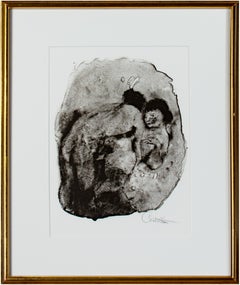
This lithograph was one of sixteen Federico Castellón produced in 1968, published by Aquarius Press, to illustrate Edgar Allan Poe's 1832 story 'The Mask of the Red Death.' The image...
Category
1960s Surrealist Figurative Prints
Materials
Lithograph
Two Women
Man With Band T-Shirt
original screenprint by Lester Johnson
By Lester Johnson
Located in Milwaukee, WI
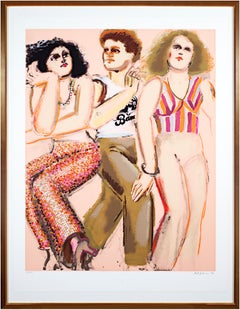
The present work is an original screen print signed by Lester Johnson, from his 'Street Scene Portfolio.' It features three figures, all wearing fashionable street clothing emblemati...
Category
1980s Contemporary Figurative Prints
Materials
Screen
"Three Seated Men" original etching signed by Lester Johnson
By Lester Johnson
Located in Milwaukee, WI
The present aquatint is an excellent example of the multifigural works of Lester Johnson. The print presents the viewer with three seated figures, their...
Category
1970s Contemporary Figurative Prints
Materials
Etching, Aquatint
"Victoria" original lithograph signed by Malvin Marr "Zsissly" Albright
By Malvin Marr Albright
Located in Milwaukee, WI
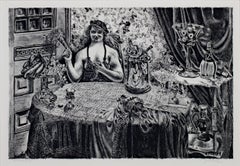
The present print, "Victoria," is the most iconic example of the printmaking of Malvin Marr Albright, called Zsissly. The composition for the image comes from Albright's painting from about 1935, done while he was studying at the Art Institute of Chicago. We can see clearly in the image how he possesses the same skill for unsettling, magic realist images as his more famous twin brother Ivan Le Lorraine: The lady Victoria sits at a dining room table, surrounded by luxurious still-life objects. All the textures and surfaces of the image express a horror vacui as seen in his painted works, such as "The Trail of Time is Dust" at the Pennsylvania Academy of Fine Art. The door in this print recalls one of the more famous works by his brother, "That Which I Should Have Done I Did Not Do (The Door)" at the Art Institute of Chicago.
1947, after ca. 1935 original painting
8 1/2 x 13 inches, image
12 x 16 inches, sheet
16 1/4 x 20 1/2 frame
Signed in pencil, lower right
Title in pencil, lower left
Published by Associated American Artists Inc.
Unnumbered from the edition of 250
A painter and sculptor, Malvin Albright was born in Chicago, one of twin sons of Adam Emory Albright, famous Chicago figure painter of juvenile subjects, who often used Malvin and his brother Ivan Le Lorraine as models.
Malvin's middle name, Marr, was after Wisconsin artist Carl von Marr...
Category
1940s American Modern Figurative Prints
Materials
Lithograph
17th century etching baroque portrait male subject hat realistic print
By Giovanni Benedetto Castiglione
Located in Milwaukee, WI
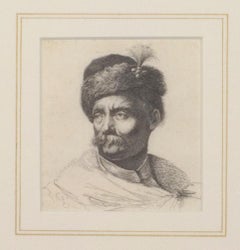
This is an excellent example of the kind of portraiture produced by Castiglione during the early part of the 17th century. In the image, we see the visage of a man with a mustache, wearing a fur-lined hat topped with a feathery decoration. The image is reminiscent of the work of Rembrandt van Rijn, himself known for his portraits in the form of etchings.
4 x 3.5 inches, image
15.25 x 13.25 inches, frame
Inscribed "GC" in the plate, lower left
This impression is from the edition ca. 1825 from the original plate of ca. 1635.
Unlike many Italian artists, Giovanni Benedetto Castiglione was profoundly influenced by foreigners. He first studied with local artists in his native Genoa, absorbing not only Tuscan Mannerism and Caravaggism but also the style of Peter Paul Rubens, who had worked in Genoa. From 1621 Castiglione also worked in Anthony van Dyck's Genoa studio. Early on, he was attracted to Flemish animal...
Category
17th Century Baroque Figurative Prints
Materials
Etching
"Eve Incurs God
s Displeasure (M. 236), " Original Lithograph by Marc Chagall
By Marc Chagall
Located in Milwaukee, WI
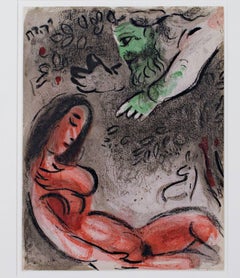
"Eve Incurs God's Displeasure" is an original double sided lithograph by Marc Chagall. On recto the print features the biblical story of Eve being scolded by God for her sin in the G...
Category
1960s Expressionist Figurative Prints
Materials
Lithograph
"Sierra Madre, " Original Color Woodblock Nude signed by Carol Summers
By Carol Summers
Located in Milwaukee, WI
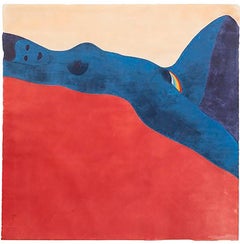
"Sierra Madre" is a color woodblock signed by Carol Summers. As suggested by the title, the print teeters the line between Summers' fanciful landscapes an...
Category
1970s Abstract Expressionist Figurative Prints
Materials
Woodcut
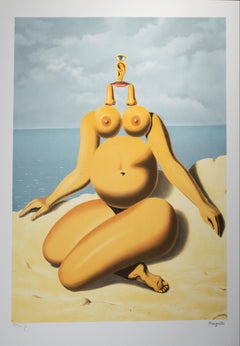
"La race blanche (The White Race), " Lithograph after Painting by Rene Magritte
By René Magritte
Located in Milwaukee, WI
"La race blanche (The White Race)" is a color lithograph after the original 1937 painting by Rene Magritte. A female figure is made out of a mix of body parts. An eye sits on top of an ear, which is on top of a mouth, then two noses. Two breasts lying on a stomach; two arms come from the breasts. Legs are tucked under the stomach. This figure is on a sand dune next to the ocean.
Art: 26.5 x 19.63 in
Frame: 40.88 x 33.88 in
René-François-Ghislain Magritte was born November 21, 1898, in Lessines, Belgium and died on August 15, 1967 in Brussels. He is one of the most important surrealist artists. Through his art, Magritte creates humor and mystery with juxtapositions and shocking irregularities. Some of his hallmark motifs include the bourgeois “little man,” bowler hats, apples, hidden faces, and contradictory texts.
René Magritte’s father was a tailor and his mother was a miller. Tragedy struck Magritte’s life when his mother committed suicide when he was only fourteen. Magritte and his two brothers were thereafter raised by their grandmother.
Magritte studied at the Brussels Academy of Fine Arts from 1916 to 1918. After graduating he worked as a wallpaper designer and in advertisement. It was during this period that he married Georgette Berger, whom he had known since they were teenagers.
In 1926, René Magritte signed...
Category
Early 2000s Surrealist Figurative Prints
Materials
Lithograph
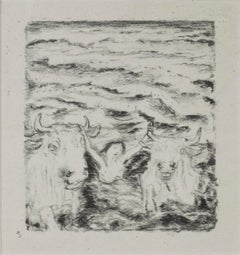
"Daphnis et Chloe (Two Bulls
Person in Water), " Lithograph signed by Bonnard
By Pierre Bonnard
Located in Milwaukee, WI
"Daphnis et Chloe (Two Bulls & Person in Water)" is an original lithograph by Pierre Bonnard, signed in lower left. It is a black and white work ...
Category
Early 1900s Post-Impressionist Figurative Prints
Materials
Lithograph
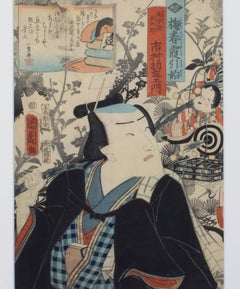
19th century color woodcut Japanese ukiyo-e print samurai figure
By Toyoharu Kunichika
Located in Milwaukee, WI
"Ichimura Hazaemon as Hatsuyumeya Mitsujiro" is a woodcut print by Toyoharu Kunichika in red, blue, and black.
14" x 9 1/2" art
20 3/4" x 16 3/4" framed
From the series “First Per...
Category
1860s Edo Figurative Prints
Materials
Woodcut
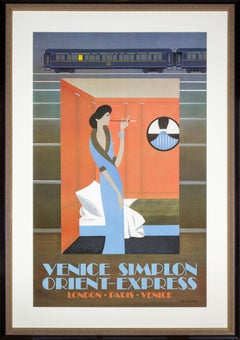
"Orient Express, " Lithograph Poster by Pierre Fix-Masseau
By Pierre Fix-Masseau
Located in Milwaukee, WI
"Orient Express" is a lithograph poster by Pierre Fix-Masseau. The artist signed his name in the lower right of the image. This piece depicts a fashionable woman smoking in one of the rooms of the Venice Simplon...
Category
1980s Art Deco Figurative Prints
Materials
Lithograph
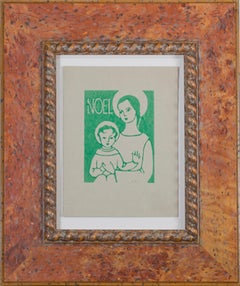
"Noel, " Relief Print signed by Sylviz Spicuzza
By Sylvia Spicuzza
Located in Milwaukee, WI
"Noel" is an original relief print by Sylvia Spicuzza. A holiday themed print, this features the image of the virgin Mary and baby Jesus.
Image: 4" x 3"
...
Category
Late 20th Century American Modern Figurative Prints
Materials
Linocut
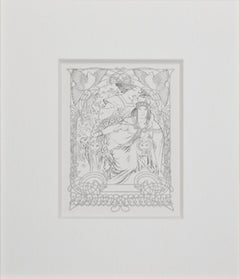
Late 19th century lithograph art nouveau ornate bookplate figures birds floral
By Alphonse Mucha
Located in Milwaukee, WI
"From: Ilsée, Princess of Tripoli "Princess Ilsee's Oasis Throne" is an original lithograph by Alphonse Mucha. From "Ilsee, Princesse de Tripoli," a rare illustrated book.
Image: ...
Category
1890s Art Nouveau Figurative Prints
Materials
Lithograph
Late 19th century lithograph art nouveau ornate bookplate figures floral
By Alphonse Mucha
Located in Milwaukee, WI
"From: Ilsee, Princesse de Tripoli "Ilsee and Jaufre" is an original lithograph by Alphonse Mucha. From "Ilsee, Princesse de Tripoli," a rare illustrated book.
Image: 8.12" x 6"
F...
Category
1890s Art Nouveau Figurative Prints
Materials
Lithograph
Late 19th century color lithograph art nouveau floral ornate bookplate verso
By Alphonse Mucha
Located in Milwaukee, WI
"From: Ilsée, Princess of Tripoli Recto: "Jaufre's Entrance" Verso: "Father Scolds Son" is an original color lithograph by Alphonse Mucha. Exquisite double-sided color lithographs f...
Category
1890s Art Nouveau Figurative Prints
Materials
Lithograph
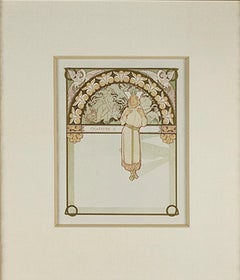
Late 19th century color lithograph art nouveau ornate bookplate verso
By Alphonse Mucha
Located in Milwaukee, WI
"From: Ilsée, Princess of Tripoli Recto: "Oasis Beetles" Verso: "Visiting Ilsee's Palace" is an original color lithograph by Alphonse Mucha. Exquisite double-sided color lithographs ...
Category
1890s Art Nouveau Figurative Prints
Materials
Lithograph
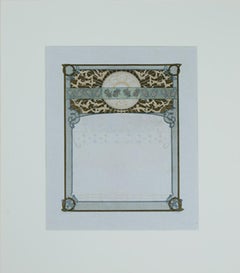
L
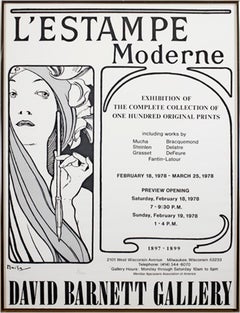
Estampe Moderne - David Barnett Gallery Exhibition, Feb. 18, 1978 - Mar. 25,
Located in Milwaukee, WI
"L'Estampe Moderne - David Barnett Gallery Exhibition, Feb. 18, 1978 - Mar. 25, 1978" is an offset poster limited edition, ed. 1/500. The poster...
Category
1970s Art Nouveau Figurative Prints
Materials
Offset
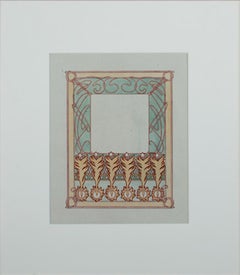
Late 19th century color lithograph art nouveau floral ornate bookplate verso
By Alphonse Mucha
Located in Milwaukee, WI
"From: Ilsée, Princess of Tripoli Recto: "Writing Verse" Verso: "Love's Lyre" is an original color lithograph by Alphonse Mucha. Exquisite double-sided color lithographs from "Ilsee...
Category
1890s Art Nouveau Figurative Prints
Materials
Lithograph
Late 19th century color lithograph art nouveau floral figure bookplate
By Alphonse Mucha
Located in Milwaukee, WI
"From: Ilsée, Princesse de Tripoli Recto: "Flood" Verso: "Trials of the Pilgrimage" is an original color lithograph by Alphonse Mucha. Exquisite double-sided color lithographs from ...
Category
1890s Art Nouveau Figurative Prints
Materials
Lithograph

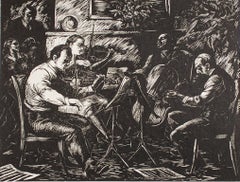
20th century woodcut ink black and white figures musical instruments dramatic
By Robert Franz Von Neumann
Located in Milwaukee, WI
"Chamber Music" is an original wood engraving by Robert Franz von Neumann. It features a room full of men in the thralls of creating music together. A small audience stands outside their circle.
Image: 5.5" x 7"
Framed: 14" x 15.56"
1888 - 1976 Born in Rostock, Mecklenburg, Germany, Robert von Neumann...
Category
1930s American Modern Figurative Prints
Materials
Woodcut
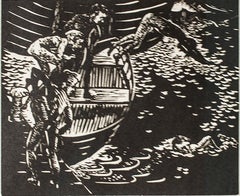
"Swimmers, " Seascape Linoleum Cut by Clarice George Logan
By Clarice George Logan
Located in Milwaukee, WI
"Swimmers" is an original linoleum print by Clarice George Logan. It features five figures enjoying a swim, jumping off from a small boat.
Image: 4.94" x 6"
Framed: 13.87" x 14.87"
Clarice George Logan was born in Mayville, New York in 1909 but moved to Wisconsin in 1921. She attended the Milwaukee State Teachers College from 1927 to 1931 where she studied with Robert von Neumann...
Category
1930s American Modern Figurative Prints
Materials
Linocut
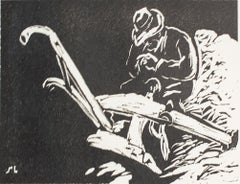
"Rest, " Farmer leaning on Work Tool Linoleum Cut signed by Schomer Lichtner
By Schomer Lichtner
Located in Milwaukee, WI
"Rest" is an original linoleum print by Schomer Lichtner, signed in the lower right hand corner. It features a man in the act of resting on a stick in the middle of work.
Image: 5.6...
Category
1930s American Modern Figurative Prints
Materials
Linocut
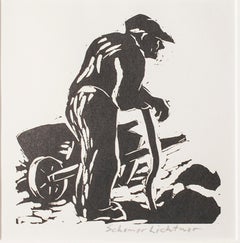
"Meditation, " Figure
Farm Tool Linoleum Cut signed by Schomer Lichtner
By Schomer Lichtner
Located in Milwaukee, WI
"Meditation" is an original linoleum print by Schomer Lichtner, signed in the lower right hand corner. It features a man in the middle of a project, in quiet meditation.
Image: 6" x 8"
Framed: 14.5" x 14.37"
Lichtner and his wife, Ruth Grotenrath (1912-1988), are celebrated as Milwaukee’s first couple of painting and are regarded as major Wisconsin artists. Lichtner’s impressive production, perseverance, longevity, and positive approach to his life and art made him and his work distinctive and much loved by his many admirers. His work is currently represented in collections at the Milwaukee Art Museum, the John Michael Kohler Art Center, the West Bend Museum, and in the collections of many individuals. Books on the lives and art work of both Lichtner and Grotenrath are in progress and it is anticipated that they will be published next year. Recipient of the 2006 Wisconsin Visual Artist Lifetime Achievement Award The late Milwaukee artists, Schomer Lichtner and Ruth Grotenrath, created original silkscreen prints as a part of their Christmas celebration starting in the 1940's. The subjects and colors varied from year to year but they laboriously printed these little gems themselves. Ruth Grotenrath, 1912-1988, and her husband, Schomer Lichtner, (1905-2006), are celebrated as Milwaukee’s first couple of painting and are regarded as major Wisconsin artists. From the outset, Lichtner and Grotenrath were determined to become full-time artists. Ruth Grotenrath and Schomer Lichtner began their careers by creating numerous murals for the WPA (Work Projects Administration), primarily post offices. A wonderful example can be seen in the Sheboygan, Wisconsin post office. Even during the Great Depression they worked producing Post Office murals under the Treasury Department's Section of Fine Arts (SFA). According to James Auer, former Milwaukee Journal Sentinel art critic, "As art and economic trends evolved, the couple’s palettes brightened and warmed. Both fell under the spell of the Mexican social realists, notably Diego Rivera, and modernists such as Matisse and Dufy. The couple’s perspective changed further after they became friends with philosopher Alan Watts...
Category
1930s American Modern Figurative Prints
Materials
Linocut
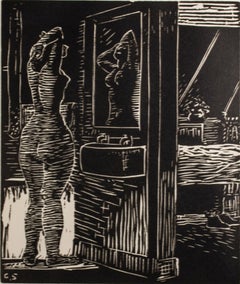
"Figure, " Nude Portrait Linoleum Cut by Gerrit Sinclair
By Gerrit Sinclair
Located in Milwaukee, WI
"Figure" is an original linoleum print by Gerrit Sinclair, signed in plate the lower left corner. It features a woman fixing her hair in front of a mirror, her nude body visible to the viewer from the back and front reflecting in the mirror.
Image: 6" x 5"
Framed: 13.37" x 12.43"
Gerrit Sinclair brought the charming style of American Regionalism painting...
Category
1930s American Realist Figurative Prints
Materials
Linocut
"Hotel Lobby, " Linoleum Cut by Alexander Tillotson
Located in Milwaukee, WI
"Hotel Lobby" is a linoleum print by Alexander Tillotson. It features the view of a hotel lobby from the viewpoint of the back of two men. Thick lines and minimal negative space give...
Category
1930s American Modern Figurative Prints
Materials
Linocut
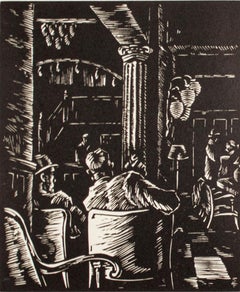
Late 19th century color lithograph art nouveau bookplate figure ornate text
By Alphonse Mucha
Located in Milwaukee, WI
"From: Ilsée, Princess of Tripoli Ilsee's Vision" is an original color lithograph by Alphonse Mucha. Exquisite double-sided color lithographs from "Ilsee, Princesse de Tripoli," a ra...
Category
1890s Art Nouveau Figurative Prints
Materials
Lithograph
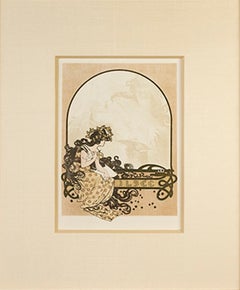
Late 19th century color lithograph art nouveau ornate bookplate figures floral
By Alphonse Mucha
Located in Milwaukee, WI
From: Ilsée, Princesse de Tripoli "Ilsee and Jaufre" is an original color lithograph by Alphonse Mucha. Exquisite double-sided color lithographs from "Ilsee, Princesse de Tripoli," ...
Category
1890s Art Nouveau Figurative Prints
Materials
Lithograph
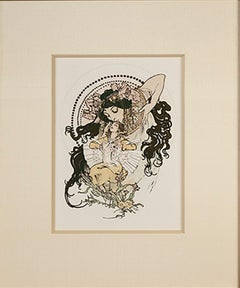
"Horse Wrangler, " Original Black
White Lithograph by Lawrence Barrett
By Lawrence Barrett
Located in Milwaukee, WI
"Horse Wrangler" is an original lithograph by the artist Lawrence Barrett signed in the lower right hand corner. Four beautifully drawn horses use a moment of commotion to escape a corral. Low hills and an expansive sky serve as a background.
Image: 8.75" x 12.25"
Framed: 11.9" x 16.5"
Lawrence Barrett was an etcher, lithographer, teacher, illustrator, sculptor, writer, and painter. Born in Guthrie, Oklahoma, Barrett was a student at the Broadmoor Academy...
Category
Early 20th Century Realist Figurative Prints
Materials
Lithograph
20th century color lithograph French scene female figures river umbrellas
By Francois Batet
Located in Milwaukee, WI
"Sur les Ponts de Paris" (Bridges of Paris) is an original color lithograph by Francois Batet, signed on the lower right corner. Three women in stylish 20's fashion cruise by in the ...
Category
1980s Post-Modern Figurative Prints
Materials
Lithograph

20th century color lithograph French winter scene female figures trees leaves
By Francois Batet
Located in Milwaukee, WI
"Promenade sous les Arbres (Walk under the Trees)" is an original color lithograph by Francois Batet, signed in the lower right and numbered in the lower left. At the center of the p...
Category
1980s Post-Modern Figurative Prints
Materials
Lithograph
"Dolly (I Love you!), " Original Color Lithograph Poster by the Clérice Frères
By Clerice Frères
Located in Milwaukee, WI
"Dolly" is an original color lithograph poster by The Clérice Frères (The Clérice Brothers), signed within the composition on the lower left edge, just ...
Category
1920s Art Deco Figurative Prints
Materials
Lithograph
"Présure Guillien, Dijon Cow, " Original Color Lithograph Poster by L. Serre
Located in Milwaukee, WI
"Présure Guillien, Dijon Cow" is an original color lithograph poster. The artist's name is printed in the lower left, and the name of the printing company, Havas, is printed in the lower right. The poster advertises rennet, a product used to curdle milk and make cheese, featuring a milk maid with a red kerchief tied around her head in front of a white cow. She holds a golden bucket...
Category
1920s Modern Figurative Prints
Materials
Lithograph
20th century aquatint etching figurative portrait ink unfinished female subject
By Moishe Smith
Located in Milwaukee, WI
"Maria (Artist's Wife)" is an original etching by Moishe Smith, signed in the bottom right corner and numbered in the bottom left. The piece depicts a seated woman from the waist up,...
Category
1960s Post-Modern Figurative Prints
Materials
Paper, Etching, Aquatint
