Keith Sheridan, LLC Art
to
52
368
35
3
3
Overall Width
to
Overall Height
to
10
15
383
1
7
15
80
90
88
20
13
14
7
3
6
178
24
22
20
20
13
8
7
1
224
177
2
194
96
94
68
55
49
33
27
23
19
19
18
17
17
14
14
13
13
12
11
105
86
72
49
40
16
13
12
12
9
1
409
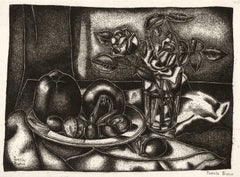
Fruit Piece
— American Modernism, Woman Artist
Located in Myrtle Beach, SC
Pamela Bianco, 'Fruit Piece', lithograph, c. 1925. Signed and titled in pencil. Signed in the stone, lower left. Annotated 'No. 8' in pencil, upper right...
Category
1920s American Modern Figurative Prints
Materials
Lithograph
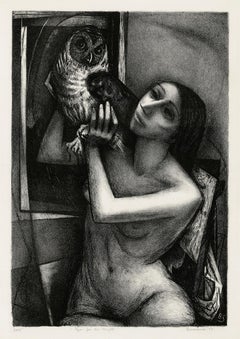
Eyes for the Night
— Mid-century American Surrealism
By Benton Murdoch Spruance
Located in Myrtle Beach, SC
Benton Spruance, 'Eyes for the Night', lithograph, 1947, edition 35, Fine and Looney 260. Signed, dated, titled, and annotated 'Ed 35' in pencil. A fine impression, on heavy, cream ...
Category
1940s American Modern Figurative Prints
Materials
Lithograph

$720 Sale Price
20% Off
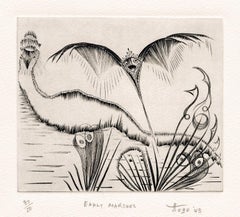
Early Marshes
— Mid-Century Surrealism, Atelier 17
Located in Myrtle Beach, SC
Ian Hugo, 'Early Marshes', from the portfolio 'Ten Engravings'. engraving, 1943, edition 50. Signed, dated, titled, and numbered '37/50' in pencil. A fine impression, with delicate overall plate tone, on cream wove paper, the full sheet with margins (2 5/8 to 7 inches), in excellent condition.
With the blind stamp 'madeleine-claude jobrack EDITIONS', in the bottom right margin. Matted to museum standards, unframed.
Image size 5 x 5 7/8 inches (127 x 149 mm); sheet size 15 x 11 inches (381 x 279 mm).
Ian Hugo originally created "Ten Engravings" in 1945 and the portfolio included a foreword by his partner and collaborator, Anais Nin. In 1978, Hugo republished the portfolio with Madeleine-Claude Jobrack, an American master printmaker who studied under Stanley William Hayter at Atelier 17, Paris, and with Johnny Friedlaender. When Jobrack returned to the States she managed the Robert Blackburn Printmaking Studio in New York before opening her own printing studio, Madeleine-Claude Jobrak Editions.
“The sign of the true artist is one who creates a complete universe, invents new plants, new animals, new figures to transfer to us a new vision of the universe in which dream and reality fuse. Ian Hugo's plants have eyes, the birds have the delicacy of dragonflies, their feathers have the shape of fans. Humor is apparent in every gesture. He uses a fine spider web to give a feeling of flight, speed, lightness. The body of a woman reveals the structure of a leaf, a plant. Wings are moving in a world unified by mythological themes. This is an animated world, humorous and levitating, elusive and decorative, which by its unique forms and shapes gives us the sensation of a rebirth, a liberation from the usual, the familiar, a visit to a new planet.”
—Anais Nin, from the forward to the portfolio ‘Ten Engravings’
ABOUT THE ARTIST
Ian Hugo was born Hugh Parker Guiler in Boston, Massachusetts, on February 15, 1898. His childhood was spent in Puerto Rico—a "tropical paradise," the memory of which stayed with him and surfaced in both his engravings and his films. He attended school in Scotland and graduated from Columbia University where he studied economics and literature.
Hugo was working with the National City Bank when he met and married author Anais Nin in 1923. The couple moved to Paris the following year, where Nin's diary and Guiler's artistic aspirations flowered. Guiler feared his business associates would not understand his interests in art and music, let alone those of his wife, so he began a second, creative life as Ian Hugo. Ian and Anais moved to New York in 1939. The following year he took up engraving and etching, working at Stanley William Hayter’s experimental printmaking workshop Atelier 17, established at the New School for Social Research.
Hugo began producing surreal images often used to illustrate Nin's books. For Nin, his unwavering love and financial support were indispensable—Hugo was the "fixed center, core... my home, my refuge" (Sept. 16, 1937, Nearer the Moon, The Unexpurgated Diary of Anais Nin, 1937-!939). Fictionalized portraits of Higo and Nin appear in Philip Kaufman's 1990 film drama of a literary love triangle, Henry & June.
Inspired by comments that viewers saw motion in his engravings, Hugo took up filmmaking. He asked the avant-garde filmmaker Sasha Hammid for instruction but was told, "Use the camera yourself, make your own mistakes, make your own style." Hugo embarked on an exploration of the film medium as a vehicle to delve into his dreams, his unconscious, and his memories. Without a specific plan, He would collect resonant images, then reorder or superimpose them, seeking a sense of self-connection through the poetic juxtapositions he created. These intuitive explorations resembled the mystical evocations of his engravings, which he described in 1946 as "hieroglyphs of a language in which our unconscious is trying to convey important, urgent messages."
In the underwater world of his film ‘Bells of Atlantis,’ the light originates from the world above the surface; it is otherworldly, out of place, yet essential. In ‘Jazz of Lights,’ the street lights of Times Square become in Nin's words, "an ephemeral flow of sensations." This flow that she also calls "phantasmagorical" had a crucial impact on Stan Brakhage, who said that without Jazz of Lights (1954), "there would have been no Anticipation of the Night" his autobiographical film which ushered in a new era of experimental modernist filmmaking.
Hugo lived the last two decades of his life in a New York apartment high above street level. In the evenings, surrounded by an electrically illuminated man...
Category
1940s Surrealist Figurative Prints
Materials
Engraving
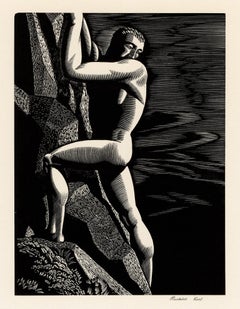
Mountain Climber
— American Modernism
By Rockwell Kent
Located in Myrtle Beach, SC
Rockwell Kent, 'Mountain Climber', wood engraving, 1933, edition 250, Burne Jones 93. Signed in pencil. A brilliant, black impression, on cream, wove Japan paper; the full sheet with margins (2 9/16 to 3 5/8 inches); slight skinning at the top sheet edge verso, where previously hinged; otherwise, in excellent condition. Archivally matted to museum standards, unframed.
Image size 7 7/8 x 5 7/8 inches (200 x 149 mm); sheet size 14 x 11 1/8 inches (356 x 283 mm).
Printed by Pynson Printers, New York. Distributed by The Print Club of Cleveland, Publication No. 11, 1933.
Literature: 'Rockwellkentiana,' Harcourt, Brace and Company, New York, 1933. '101 of The World’s Greatest Books', edited by Spencer Armstrong, 1950.
Impressions of this work are held in the following museum collections: Akron Art Institute, Burne Jones Collection, IL; Cincinnati Art Museum; Cleveland Museum of Art; Columbus Gallery of Fine Arts; Crystal Bridges Museum of American Art; Davis Museum at Wellesley College; Fine Art Museums of San Francisco; H. M. de Young Museum; Hermitage Museum; Kent Collection, NY; Library of Congress; Memorial Art Gallery, University of Rochester; Metropolitan Museum of Art; New York Public Library; Philadelphia Museum of Art; Princeton University Library; Smithsonian American Art Museum, Spector Collection, NY; SUNY, Plattsburg.
ABOUT THE ARTIST
Rockwell Kent (1882-1971), though best known as a painter, graphic artist, and illustrator, pursued many careers throughout his life, including architect, carpenter, explorer, writer, dairy farmer, and political activist. Born in Tarrytown, New York, Kent was interested in art from a young age. These ambitions were encouraged by his aunt Jo Holgate, an accomplished ceramicist. Jo came to live with the family after Kent’s father passed away in 1887 and took him to Europe as a teenager, undoubtedly kindling his interest in exploring the world.
Kent attended the Horace Mann School in New York City, where he excelled at mechanical drawing. His family’s financial circumstances prevented him from pursuing a career in the fine arts; however, after graduating from Horace Mann in 1900, Kent decided to study architecture at Columbia University.
Before matriculating at Columbia, Kent spent the first of three consecutive summers studying painting at William Merritt Chase’s art school in Shinnecock Hills, Long Island. There he found a community of mentors and fellow students who encouraged him to pursue his interest in art. At the end of Kent’s third summer at Shinnecock, Chase offered him a full scholarship to the New York School of Art, where he was a teacher. Kent began taking night classes at the art school in addition to his architecture studies but soon left Columbia to study painting full-time. In addition to Chase, Kent took classes with Robert Henri and Kenneth Hayes Miller, where his classmates included the artists George Bellows and Edward Hopper.
Kent spent the summer of 1903 assisting the eccentric painter Abbott Handerson Thayer at his studio in Dublin, New Hampshire—a position he secured through the recommendation of his Aunt Jo. Thayer’s naturalist lifestyle and almost mystical appreciation for natural phenomena greatly influenced Kent; he returned to Dublin for many years to visit Thayer and his family. Thayer gave the young artist time to pursue his work, and that summer Kent painted several views of the New Hampshire landscape, including Mount Monadnock. In 1905 Kent moved from New York to Monhegan Island in Maine, home to a summer art colony, where he continued to find inspiration in nature. Kent soon found success exhibiting and selling his paintings in New York, and in 1907, he was given his first solo show at Claussen Galleries. The following year he married his first wife, Kathleen Whiting (Thayer’s niece), with whom he had five children. The couple divorced in 1924, and Kent married Frances Lee the following year. They divorced after 15 years of marriage, and the artist married Sally Johnstone.
For the next several decades, Kent lived a peripatetic lifestyle, settling in several locations in Connecticut, Maine, and New York. During this time he took several extended voyages to remote, often ice-filled, corners of the globe, including Newfoundland, Alaska, Tierra del Fuego, and Greenland, to which he made three separate trips. For Kent, exploration and artistic production were twinned endeavors, and his travels to these rugged, elemental locations inspired his visual art and his writings. He developed a stark, realist landscape style in his paintings and drawings that revealed both nature’s harshness and its sublimity. Kent’s human figures, which appear sparingly in his work, often allude to the mythic themes of isolation, individualism, heroism, and the quest for self-connection. Important exhibitions of works from these travels include the Knoedler Gallery’s shows in 1919 and 1920, featuring Kent’s Alaska drawings...
Category
1930s American Modern Nude Prints
Materials
Woodcut
Diptych
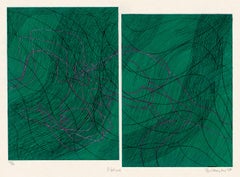
— Modernist Abstraction, Atelier 17
By Stanley William Hayter
Located in Myrtle Beach, SC
Stanley William Hayter, 'Diptych', color engraving and scorper, 1967, edition 50, Black & Moorhead 314. Signed, titled, dated, and numbered '10/50' in pencil. A superb, richly-inked impression, with fresh, vibrant colors on antique-white wove BFK Rives paper; the full sheet with margins (2 1/2 to 3 1/4 inches). Minor skinning and tape residue on the top and bottom sheet edges, verso, otherwise in excellent condition. Matted to museum standards, unframed.
Image size 13 7/8 x 19 1/2 inches (146 x 108 mm); sheet size 19 7/8 x 25 3/8 inches (394 x 292 mm).
Hayter created this work using engraving and scorper on 2 plates, printed side by side. He used alkali blue, printed intaglio, and a phthalo green with a hard roller on the surface. The proofing was in three states, the first with engraving (a single proof); the second adding further engraving and scorper (a single proof); the third added further engraving and editioned: color trial proofs, 5 artist's proofs, edition of 50. The edition was completed in three printings: 8 in 1967; then Hector Saunier printed numbers 9 through 18 in 1968, and numbers 19 through 50 in 1969. This impression is from the Saunier 1968 printing.
Note: the online image cannot accurately convey the vibrancy of the printed alkali blue/phthalo green.
An impression of this work is held in the collection of the National Gallery of Art.
ABOUT THE ARTIST
Stanley William Hayter (1901-1988) was a British painter and printmaker associated in the 1930s with Surrealism and from 1940 onward with Abstract Expressionism. Regarded as one of the most significant printmakers of the 20th century, Hayter founded the legendary Atelier 17 studio in Paris, now known as Atelier Contrepoint. Among the artists he is credited with influencing are Pablo Picasso, Alberto Giacometti, Joan Miró, Alexander Calder, and Marc Chagall.
The hallmark of the workshop was its egalitarian structure, breaking sharply with the traditional French engraving studios by insisting on a cooperative approach to labor and technical discoveries. In 1929 Hayter was introduced to Surrealism by Yves Tanguy and André Masson, who, with other Surrealists, worked with Hayter at Atelier 17. The often violent imagery of Hayter’s Surrealist period was stimulated in part by his passionate response to the Spanish Civil War and the rise of Fascism. He organized portfolios of graphic works to raise funds for the Spanish cause, including Solidarité (Paris, 1938), a portfolio of seven prints, one of them by Picasso. Hayter frequently exhibited with the Surrealists during the 1930s but left the movement when Paul Eluard was expelled. Eluard’s poem Facile Proie (1939) was written in response to a set of Hayter’s engravings. Other writers with whom Hayter collaborated in this way included Samuel Beckett and Georges Hugnet.
Hayter joined the exile of the Parisian avant-garde in 1939, moving with his second wife, the American sculptor Helen...
Category
1960s Modern Abstract Prints
Materials
Engraving
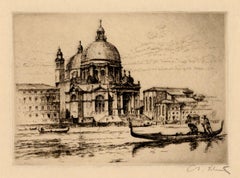
Venice, Maria della Salute
— Serenissima Impressionism
By Anton Schutz
Located in Myrtle Beach, SC
Anton Schutz, 'Venice, Maria della Salute', etching, c. 1930. Signed and titled in pencil. A superb, richly-inked impression, with skillfully wiped plate tone, on cream wove paper, ...
Category
1930s Realist Figurative Prints
Materials
Etching
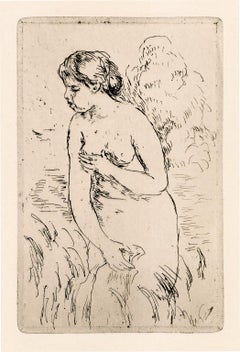
Baigneuse Debout, à Mi-Jambes
— French Impressionism
By Pierre-Auguste Renoir
Located in Myrtle Beach, SC
Pierre Auguste Renoir, 'Baigneuse Debout, à Mi-Jambes (Woman Bathing, Standing Up to Her Knees in Water)', 1910, etching, edition not stated, Delteil 23. Unsigned as published. A fin...
Category
1910s Impressionist Nude Prints
Materials
Etching
$600 Sale Price
20% Off
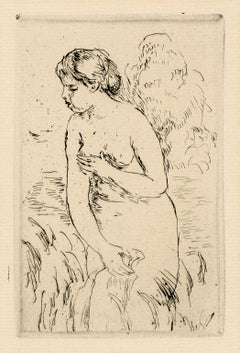
Baigneuse Debout, à Mi-Jambes — French Impressionism
By Pierre-Auguste Renoir
Located in Myrtle Beach, SC
Pierre Auguste Renoir, 'Baigneuse Debout, à Mi-Jambes (Woman Bathing, Standing Up to Her Knees in Water)', 1910, etching, edition not stated, Delteil 23. Unsigned as published. A fin...
Category
1910s Impressionist Nude Prints
Materials
Etching
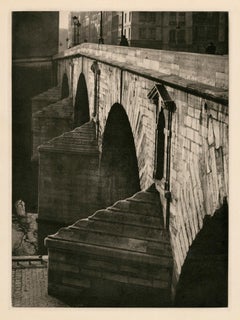
Pont Marie, Paris — Mid-Century Photogravure
Located in Myrtle Beach, SC
Rémy Duval, 'Pont Marie, Paris', photogravure, 1946. A fine, richly-inked impression in warm black ink, on cream wove B.F.K. Rives paper; the sheet with dec...
Category
1940s Modern Figurative Photography
Materials
Photogravure
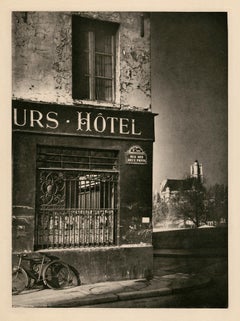
Street Corner, L
Ile Saint Louis, Paris — Mid-Century Photogravure
Located in Myrtle Beach, SC
Rémy Duval, 'Street Corner, L'ile Saint Louis, Paris', photogravure, 1946. A fine, richly-inked impression in warm black ink, on cream wove B.F.K. Rives pap...
Category
1940s Modern Figurative Photography
Materials
Photogravure
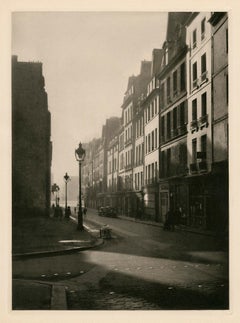
Street Scene, L
Ile Saint Louis, Paris — Mid-Century Photogravure
Located in Myrtle Beach, SC
Rémy Duval, 'Street Scene, L'ile Saint Louis, Paris', photogravure, 1946. A fine, richly-inked impression in warm black ink, on cream wove B.F.K. Rives pape...
Category
1940s Modern Figurative Photography
Materials
Photogravure
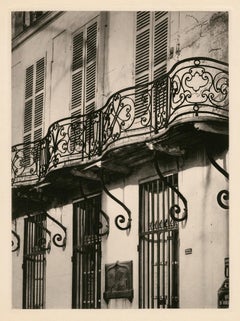
Parisian Balcony — Mid-Century Photogravure
Located in Myrtle Beach, SC
Rémy Duval, 'Parisian Balcony', photogravure, 1946. A fine, richly-inked impression in warm black ink, on cream wove B.F.K. Rives paper; the sheet with deck...
Category
1940s Modern Figurative Photography
Materials
Photogravure
School Children, L
Ile Saint Louis, Paris — Mid-Century Photogravure
Located in Myrtle Beach, SC
Rémy Duval, 'School Children, L'ile Saint Louis, Paris', photogravure, 1946. A fine, richly-inked impression in warm black ink, on cream wove B.F.K. Rives p...
Category
1940s Modern Figurative Photography
Materials
Photogravure
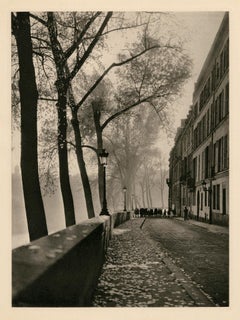
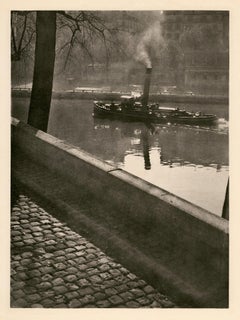
Tugboat, River Seine, Paris — Mid-Century Photogravure
Located in Myrtle Beach, SC
Rémy Duval, 'Tugboat, River Seine, Paris', photogravure, 1946. A fine, richly-inked impression in warm black ink, on cream wove B.F.K. Rives paper; the shee...
Category
1940s Modern Figurative Photography
Materials
Photogravure
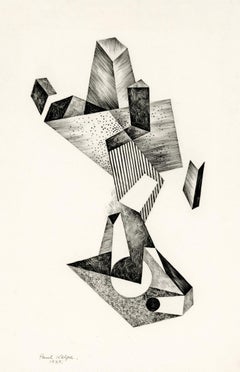
Constructivist Abstraction — Precisionism / Spatial Illusionism
By Paul Kelpe
Located in Myrtle Beach, SC
Paul Kelpe, Untitled (Abstract Composition), lithograph, 1937, edition unknown but small. Signed and dated in pencil. A fine, richly-inked impression, with all the nuanced texture an...
Category
1930s Abstract Geometric Abstract Prints
Materials
Lithograph
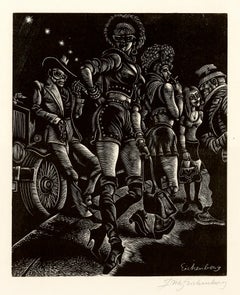
The Pimp
— Graphic Modernism
By Fritz Eichenberg
Located in Myrtle Beach, SC
Fritz Eichenberg, 'The Pimp', wood engraving, 1980, artist's proof before the edition. Signed in pencil. Signed in the block, lower right. A fine, richly-inked impression, on cream wove paper, with full margins (2 3/16 to 3 1/2 inches), in excellent condition. Archivally sleeved, unmatted.
Image size 12 x 9 3/4 inches (305 x 248 mm); sheet size 18 x 14 inches (457 x 356 mm).
ABOUT THE ARTIST
Fritz Eichenberg (1901–1990) was a German-American illustrator and arts educator who worked primarily in wood engraving. His best-known works were concerned with religion, social justice, and nonviolence.
Eichenberg was born to a Jewish family in Cologne, Germany, where the destruction of World War I helped to shape his anti-war sentiments. He worked as a printer's apprentice and studied at the Municipal School of Applied Arts in Cologne and the Academy of Graphic Arts in Leipzig, where he studied under Hugo Steiner-Prag. In 1923 he moved to Berlin to begin his career as an artist, producing illustrations for books and newspapers. In his newspaper and magazine work, Eichenberg was politically outspoken and sometimes wrote and illustrated his reporting.
In 1933, the rise of Adolf Hitler drove Eichenberg, who was a public critic of the Nazis, to emigrate with his wife and children to the United States. He settled in New York City, where he lived most of his life. He worked in the WPA Federal Arts Project and was a member of the Society of American Graphic Artists.
In his prolific career as a book illustrator, Eichenberg portrayed many forms of literature but specialized in works with elements of extreme spiritual and emotional conflict, fantasy, or social satire. Over his long career, Eichenberg was commissioned to illustrate more than 100 classics by publishers in the United States and abroad, including works by renowned authors Dostoyevsky, Tolstoy, Charlotte and Emily Brontë, Poe, Swift, and Grimmelshausen. He also wrote and illustrated books of folklore and children's stories.
Eichenberg was a long-time contributor to the progressive magazine The Nation, his illustrations appearing between 1930 and 1980. Eichenberg’s work has been featured by such esteemed publishers as The Heritage Club, Random House, Book of the Month Club, The Limited Editions Club, Kingsport Press, Aquarius Press, and Doubleday.
Raised in a non-religious family, Eichenberg had been attracted to Taoism as a child. Following his wife's unexpected death in 1937, he turned briefly to Zen Buddhist meditation, then joined the Religious Society of Friends in 1940. Though he remained a Quaker until his death, Eichenberg was also associated with Catholic charity work through his friendship with Dorothy Day...
Category
1980s American Modern Figurative Prints
Materials
Woodcut
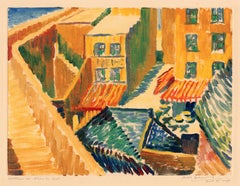
Hostellerie des Chiens du Guet
— British Impressionism
By Sybil Andrews
Located in Myrtle Beach, SC
Sybil Andrews, 'Hostellerie des Chiens du Guet', color monotype, c. 1925; edition 2, proof 1. Signed 'Sybil Andrews pinx et imp' and titled in pencil. A superb, painterly impression, with fresh colors, on heavy cream wove paper; the full sheet with margins (5/8 to 1 3/4 inches). Printed by the artist. The artist’s original archival mounting tape remains in the four sheet corners, recto (well away from the image), in excellent condition. Matted to museum standards, unframed. A unique impression.
Image size 8 15/16 x 11 15/16 inches (227 x 303 mm); sheet size 12 1/4 x 15 1/2 inches (311 x 394 mm).
ABOUT THIS WORK
In addition to her almost 80 celebrated modernist color linocuts, Sybil Andrews also worked in the monotype technique. She typically produced two or three impressions (or pulls) from each hand-painted plate, each proof unique in its qualities of color values and vibrancy.
In 1933, Sybil Andrews and Cyril Power had an exhibition of their color monotypes and linocuts at the Redfern Gallery. Most of Andrews' monotypes were destroyed by a fire in an Ottawa gallery in 1959, and they now rarely come to the market.
ABOUT THE IMAGE
The Hostellerie des Chiens du Guet is a small hotel at the edge of...
Category
1920s Post-Impressionist Figurative Prints
Materials
Monotype
$4,320 Sale Price
20% Off
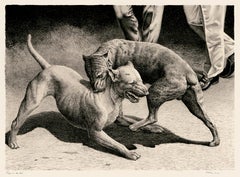
Pups in the Pit
— American Realism
Located in Myrtle Beach, SC
William Wind McKim, 'Pups in the Pit', lithograph, 1967, edition c. 50. Signed and titled in pencil. A fine, richly-inked impression, on cream wove paper, with full margins (1 1/8 to...
Category
1940s American Realist Animal Prints
Materials
Lithograph
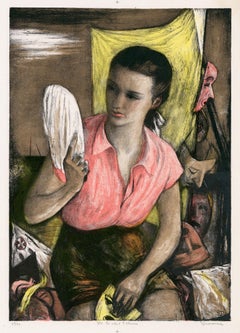
I
ll Be What I Choose
— Mid-century American Surrealism
By Benton Murdoch Spruance
Located in Myrtle Beach, SC
'I'll Be What I Choose: Vanity of Ambition', color lithograph, 1949, edition 40, Fine and Looney 281. Signed, titled, and numbered '23/40' in pencil. Initialed in the stone, lower ri...
Category
1940s American Modern Figurative Prints
Materials
Lithograph
$960 Sale Price
20% Off
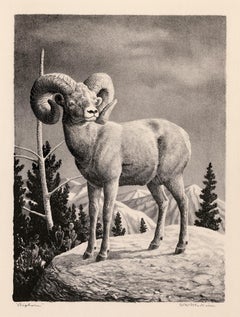
Bighorn
— Mid-Century American Regionalism
Located in Myrtle Beach, SC
William Wind McKim, 'Bighorn', lithograph, 1940, edition c. 25. Signed and titled in pencil. A fine, richly-inked impression, on cream wove paper, the full sheet with margins (2 to 4...
Category
1940s American Realist Animal Prints
Materials
Lithograph
$600 Sale Price
20% Off
Bird Dog
— Mid-century American Surrealism, Chicago Avant-garde
By Robert Vale Faro
Located in Myrtle Beach, SC
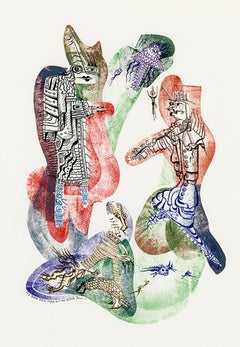
Robert Vale Faro, 'Bird Dog', color lithograph with relief collagraph, 1946, edition 14. Signed, dated, titled, and numbered '123' (the artist's inventory number) and '12/14' in pen. A fine impression, with fresh colors, on heavy, cream, wove paper; the full sheet with margins(1 3/4 to 3 1/2 inches), in excellent condition. Scarce. Matted to museum standards, unframed.
Image size 10 1/8 x 6 7/8 inches (257 x 174 mm); sheet size 17 x 11 7/16 inches (432 x 291 mm).
A collagraph is a relief print made from a collage of various materials adhered to a metal, plastic, hardboard, or other type of ground plate. In this work, the artist appears to have combined a lithograph with a collagraph to achieve the intricately textured image.
ABOUT THE ARTIST
Robert Vale Faro (1902-1988) was a well-known modernist architect and artist associated with the Chicago Bauhaus. He received his degree in architecture and design from the Armour Institute in Chicago and worked at L'Ecole des Beaux-Arts, Paris, from 1924-27, where he was influenced by Harry Kurt Bieg and Le Corbusier. Upon his return to Chicago, Faro worked with the important modernist Chicago architects George and William Keck under Louis Sullivan.
Faro founded the avant-garde printmaking group Vanguard in 1945. The group counted Atelier 17 artists Stanley William Hayter, Sue Fuller, and Anne Ryan as New York members and Francine Felsenthal of Chicago. The Brooklyn Museum mounted a show of Vanguard artists' work in 1946, which subsequently toured several other institutions in the United States.
Faro's visionary graphics from the 1940s are a sophisticated blend of Abstract Expressionism, Surrealism, and Indian Space...
Category
1940s Surrealist Abstract Prints
Materials
Lithograph
$600 Sale Price
20% Off
Kindergarten
— Mid-century American Surrealism, Chicago Avant-garde
By Robert Vale Faro
Located in Myrtle Beach, SC
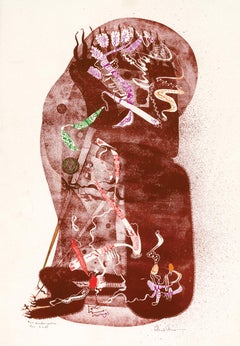
Robert Vale Faro, 'Kindergarten', color lithograph, 1945, edition 12. Signed, dated, titled, and numbered '99' and '5/12' in pen. A fine, richly-inked impression, with fresh colors, on heavy, coated off-white wove paper; the full sheet with margins (1/2 to 1 1/2 inch), in excellent condition. Scarce. Matted to museum standards, unframed.
Image size 13 1/2 x 7 9/16 inches (343 x 192 mm); sheet size 17 x 12 1/4 inches (432 x 311 mm).
ABOUT THE ARTIST
Robert Vale Faro (1902-1988) was a well-known modernist architect and artist associated with the Chicago Bauhaus. He received his degree in architecture and design from the Armour Institute in Chicago and worked at L'Ecole des Beaux-Arts, Paris, from 1924-27, where he was influenced by Harry Kurt Bieg and Le Corbusier. Upon his return to Chicago, Faro worked with the important modernist Chicago architects George and William Keck under Louis Sullivan.
Faro founded the avant-garde printmaking group Vanguard in 1945. The group counted Atelier 17 artists Stanley William Hayter, Sue Fuller, and Anne Ryan as New York members and Francine Felsenthal of Chicago. The Brooklyn Museum mounted a show of Vanguard artists' work in 1946, which subsequently toured several other institutions in the United States.
Faro's visionary graphics from the 1940s are a sophisticated blend of Abstract Expressionism, Surrealism, and Indian Space...
Category
1940s Surrealist Abstract Prints
Materials
Lithograph
Hold that Tiger
— Mid-century American Surrealism, Chicago Avant-garde
By Robert Vale Faro
Located in Myrtle Beach, SC
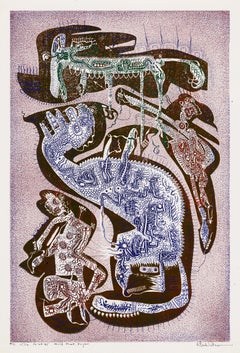
Robert Vale Faro, 'Hold that Tiger', color lithograph, 1945, edition 16. Signed, dated, titled, and numbered '91' and '15/16' in pen. A fine impression, with fresh colors, on heavy, coated, off-white wove paper; the full sheet with margins (13/16 to 1 1/2 inches), in excellent condition. Scarce. Matted to museum standards, unframed.
Image size 14 x 9 3/8 inches (356 x 239 mm); sheet size 17 x 11 1/4 inches (432 x 285 mm).
ABOUT THE ARTIST
Robert Vale Faro (1902-1988) was a well-known modernist architect and artist associated with the Chicago Bauhaus. He received his degree in architecture and design from the Armour Institute in Chicago and worked at L'Ecole des Beaux-Arts, Paris, from 1924-27, where he was influenced by Harry Kurt Bieg and Le Corbusier. Upon his return to Chicago, Faro worked with the important modernist Chicago architects George and William Keck under Louis Sullivan.
Faro founded the avant-garde printmaking group Vanguard in 1945. The group counted Atelier 17 artists Stanley William Hayter, Sue Fuller, and Anne Ryan as New York members and Francine Felsenthal of Chicago. The Brooklyn Museum mounted a show of Vanguard artists' work in 1946, which subsequently toured several other institutions in the United States.
Faro's visionary graphics from the 1940s are a sophisticated blend of Abstract Expressionism, Surrealism, and Indian Space...
Category
1940s Surrealist Abstract Prints
Materials
Lithograph
Clown
— WPA American Expressionism
By Leon Bibel
Located in Myrtle Beach, SC
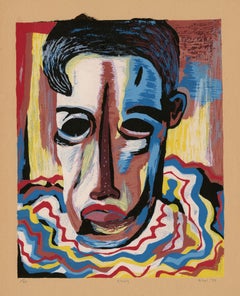
Leon Bibel, 'Clown', color serigraph, 1939, edition 20. Signed, dated, titled, and numbered '/20' in pencil. A fine, richly-inked, painterly impression, with fresh colors, on buff la...
Category
1930s American Modern Figurative Prints
Materials
Screen
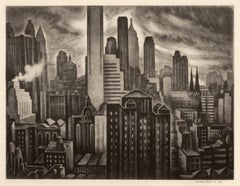
Soaring New York
— 1930s American Modernism, New York City
By Howard Norton Cook
Located in Myrtle Beach, SC
Howard Cook, 'Soaring New York', aquatint, soft-ground etching, roulette, 1931-32, edition 25, Duffy 165. Signed, dated, and annotated 'imp' in pencil. A superb, richly-inked, atmosp...
Category
1930s American Modern Figurative Prints
Materials
Etching, Aquatint
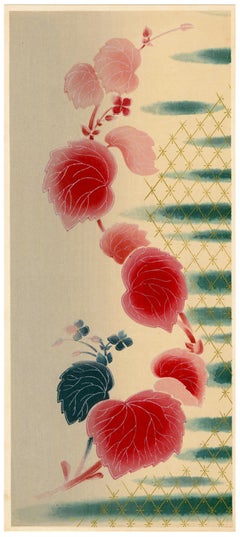
Japanese Kimono Fabric Design — Vintage Color Woodblock Print
Located in Myrtle Beach, SC
Anonymous, Japanese Kimono Fabric Design, color woodcut, c. 1930. A superb impression, with fresh colors, fine graduations, and metallic gold motifs, on ...
Category
Early 1900s Showa Figurative Prints
Materials
Woodcut
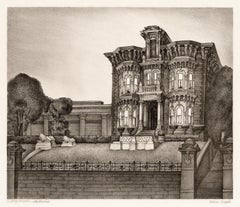
de Young Mansion
– San Francisco
— California WPA, Woman Artist
Located in Myrtle Beach, SC
Marguerite Redman Dorgeloh, 'de Young Mansion – San Francisco', lithograph, c. 1937, edition 25. Signed and titled in pencil. A fine, richly-inked impr...
Category
1930s American Modern Figurative Prints
Materials
Lithograph
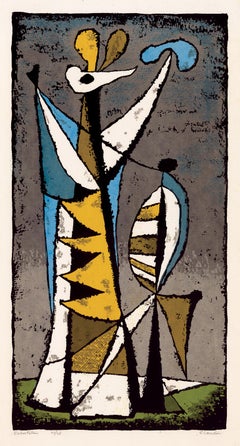
Exhortation
(Priest) — Mid-Century Modernism
By Edward August Landon
Located in Myrtle Beach, SC
Edward Landon 'Exhortation (Priest)', color serigraph, 1957, edition 28, Ryan 72. Signed, titled, and numbered '21/28' in pencil. A superb, richly-inked impression, with strong color...
Category
Mid-20th Century American Modern Abstract Prints
Materials
Screen
Chinoiserie
— Mid-Century Modernism
By Edward August Landon
Located in Myrtle Beach, SC
Edward Landon 'Chinoiserie', color serigraph, 1947, edition 50, Ryan 36. Signed in pencil in the image, lower right. Titled, dated, and annotated '4 COLORS – EDITION 50' in the scree...
Category
Mid-20th Century American Modern Abstract Prints
Materials
Screen
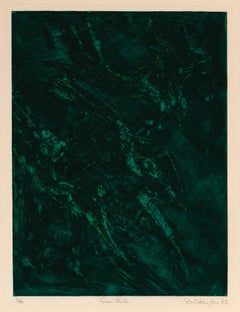
Green Shade
— Mid-century Modernism, Abstract Expressionism, Atelier 17
By Stanley William Hayter
Located in Myrtle Beach, SC
Stanley William Hayter, 'Green Shade', color etching and scraper, 1963, edition 50, (only 39 printed), B&M 278. Signed, titled, dated, and numbered '1/50' in pencil. A superb, richly-inked, luminous impression, with fresh, vivid colors, on Barcham Green textured cream wove paper; the full sheet with margins (2 3/16 to 3 1/4 inches), in excellent condition. Printed: intaglio black-green, contact lumogen yellow, soft roller phthalo green. Scarce.
Image size 15 7/16 x 11 5/8 inches (392 x 295 mm); sheet size 21 1/8 x 16 inches (537 x 406 mm). Matted to museum standards (unframed).
Collection: The British Museum
ABOUT THE ARTIST
Stanley William Hayter (1901-1988) was a British painter and printmaker associated in the 1930s with Surrealism and from 1940 onward with Abstract Expressionism. Regarded as one of the most significant printmakers of the 20th century, Hayter founded the legendary Atelier 17...
Category
1960s Abstract Expressionist Abstract Prints
Materials
Etching
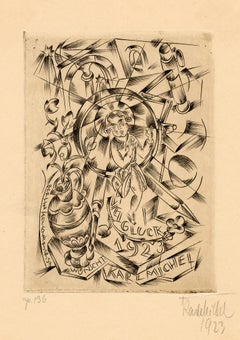
Viel Gluck 1923
— New Year
s Greeting - German Expressionism
By Karl Michel
Located in Myrtle Beach, SC
Karl Michel, 'Viel Gluck 1923 Wunscht Karl Michel', etching, 1923, edition not stated but small. Signed, dated, and numbered 'op. 136' in pencil. Signed in the image, lower right. A...
Category
1920s Expressionist Figurative Prints
Materials
Etching
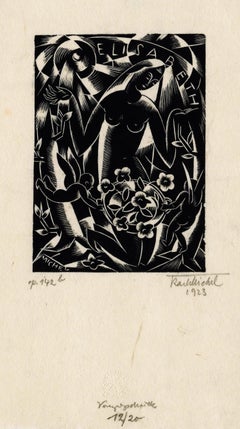
Elisabeth
— German Expressionism
By Karl Michel
Located in Myrtle Beach, SC
Karl Michel, 'Elisabeth', woodcut, edition 20, 1923. Signed, dated, and numbered 'op.142b' and '12/20' in pencil. Signed in the block, lower left. Annotated 'Vorgesdruck' [artist’s proof] in pencil.
A fine impression, on heavy fibrous Japan paper, with full margins (1 3/16 to 3 1/2 inches),
in good condition. Printed by the artist, With the artist’s blindstamp in the bottom center margin. Scarce. Matted to museum standards, unframed.
Image size 4 15/16 x 6 inches (131 x 152 mm); sheet size 10 x 6 inches (254 x 152 mm).
ABOUT THE ARTIST
Karl Michel (1889-1984) was a noted graphic designer and expressionist printmaker during Germany's pre-Nazi Weimar Republic (1919-1933). Michel’s work was the subject of a feature article in the influential German graphic design magazine Das Plakat (The Poster) in 1920. An anti-war advocate, Michel created a suite of 12 wood engravings depicting his impressions of the humanitarian toll of WWII entitled ‘Humanitas’ (Humanity). The German publishing house Greifenverlag published the series in a reduced folio of unsigned prints.
Michel’s graphic work is held in the permanent collections of the Auckland War Memorial Museum (New Zealand), Frederikshavn Kunstmuseum & Exlibrissamling (Denmark), Museum of Applied Arts (Budapest), The Robert Gore Rifkind Center for German Expressionist Studies at the Los Angeles County Museum of Art, and the German Expressionism...
Category
1920s Expressionist Figurative Prints
Materials
Woodcut
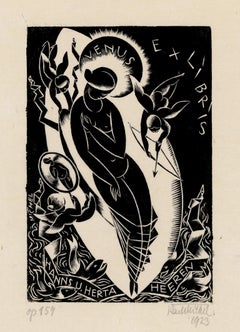
Venus
— German Expressionism
By Karl Michel
Located in Myrtle Beach, SC
Karl Michel, 'Venus, Ex Libris - Hanns U. Herta Heeren', woodcut, 1923, edition not stated but small. Signed, dated, and numbered 'op.154' in pencil. Signed in the block, lower left. A fine impression, on cream Japan paper, with full margins (15/16 to 2 11/16 inches), in good condition. Printed by the artist. Matted to museum standards (unframed).
.
Translation: Venus Ex Libris for Hanns and Herta Heeren.
Image size 5 15/16 x 4 inches (156 x 102 mm); sheet size 9 5/8 x 6 inches (245 x 152 mm).
ABOUT THE ARTIST
Karl Michel (1889-1984) was a noted graphic designer and expressionist printmaker during Germany's pre-Nazi Weimar Republic (1919-1933). Michel’s work was the subject of a feature article in the influential German graphic design magazine Das Plakat (The Poster) in 1920. An anti-war advocate, Michel created a suite of 12 wood engravings depicting his impressions of the humanitarian toll of WWII entitled ‘Humanitas’ (Humanity). The German publishing house Greifenverlag published the series in a reduced folio of unsigned prints.
Michel’s graphic work is held in the permanent collections of the Auckland War Memorial Museum (New Zealand), Frederikshavn Kunstmuseum & Exlibrissamling (Denmark), Museum of Applied Arts (Budapest), The Robert Gore Rifkind Center for German Expressionist Studies at the Los Angeles County Museum of Art, and the German Expressionism...
Category
1920s Expressionist Figurative Prints
Materials
Woodcut
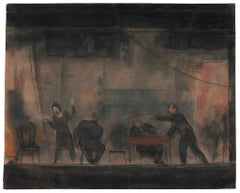
Rehearsal, "Long Day
s Journey Into Night" — Mid-Century American Impressionism
By Robert Philipp
Located in Myrtle Beach, SC
Robert Philipp, 'Rehearsal, "Long Day's Journey Into Night" ', color pastel, c. 1957. Unsigned. A fine, atmospheric rendering, on warm gray charcoal paper; a reinforced crease (1/2 inch) across the bottom left sheet corner; otherwise in very good condition. Image and sheet size 17 1/2 x 21 3/4 inches. Matted to museum standards, unframed.
Provenance: Art Students League, from the artist’s personal portfolio.
ABOUT THE ARTIST
Robert Philipp (1895–1981) was a celebrated American Post-Impressionist painter known for his nudes, still lifes, and portraits. Noted art critic Henry McBride named Philipp one of America's top six painters of his generation. Philipp was an instructor of painting at the Art Students League, New York, for 33 years. Philipp was Secretary of the National Academy of Design, a National Academician, and a Benjamin Franklin Fellow at the Royal Society of Arts in London. His composition and painting style has been compared to the art of Edgar Degas and Pierre Auguste Renoir.
In 1940, Philipp was invited to Los Angeles by Hollywood producer Louis B. Mayer to paint portraits of Metro-Goldwyn-Mayer movie stars. The same year, Walter Wanger, producer of ‘The Long Voyage Home’, directed by John Ford and based on plays by Eugene O'Neill, contracted with Reeves Lewenthal, head of the Associated American Artists gallery in Manhattan, to bring nine well-known artists to the set and paint scenes from the movie and portraits of the actors in character. The artists included Robert Philipp, Thomas Hart Benton, Grant Wood, Ernest Fiene, George Schreiber, Luis Quintanilla...
Category
1950s American Impressionist Figurative Drawings and Watercolors
Materials
Pastel
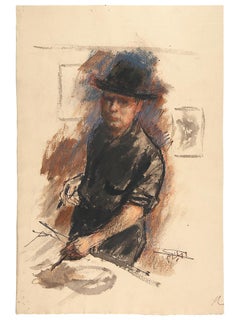
Self-Portrait with Black Hat
— Mid-Century American Impressionism
By Robert Philipp
Located in Myrtle Beach, SC
Robert Philipp, 'Self-Portrait with Black Hat', ink and color pastel, c. 1945. Signed in ink, lower right. A fine, spontaneous drawing, on heavy, buff wove paper; the artist's tack holes in the top and bottom left sheet corners, minor rippling in the bottom sheet edge; otherwise in good condition. Image size 16 1/4 x 11 1/4 inches; sheet size 19 1/4 x 12 3/4 inches. Matted to museum standards, unframed.
Provenance: Art Students League, from the artist’s personal portfolio.
ABOUT THE ARTIST
Robert Philipp (1895–1981) was a celebrated American Post-Impressionist painter known for his nudes, still lifes, and portraits. Noted art critic Henry McBride named Philipp one of America's top six painters of his generation. Philipp was an instructor of painting at the Art Students League, New York, for 33 years. Philipp was Secretary of the National Academy of Design, a National Academician, and a Benjamin Franklin Fellow at the Royal Society of Arts in London. His composition and painting style has been compared to the art of Edgar Degas and Pierre Auguste Renoir.
In 1940, Philipp was invited to Los Angeles by Hollywood producer Louis B. Mayer to paint portraits of Metro-Goldwyn-Mayer movie stars. The same year, Walter Wanger, producer of ‘The Long Voyage Home’, directed by John Ford and based on plays by Eugene O'Neill, contracted with Reeves Lewenthal, head of the Associated American Artists gallery in Manhattan, to bring nine well-known artists to the set and paint scenes from the movie and portraits of the actors in character. The artists included Robert Philipp, Thomas Hart Benton, Grant Wood, Ernest Fiene, George Schreiber, Luis...
Category
1940s American Modern Portrait Drawings and Watercolors
Materials
Pastel, Ink
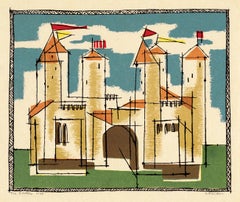
The Castle
— Mid-Century Modernist Children
s Fantasy
By Edward August Landon
Located in Myrtle Beach, SC
Edward Landon 'The Castle', color serigraph, 1953, edition 35, Ryan 33. Signed, titled, and numbered '11/35' in pencil. A fine impression, with fresh colors, on cream Japan paper. Th...
Category
Mid-20th Century American Modern Figurative Prints
Materials
Screen
Salient in February
— Mid 20th-Century Surrealism
By Edward August Landon
Located in Myrtle Beach, SC
Edward Landon 'Salient in February', color serigraph, 1945, edition 40, Ryan 166. Signed in pencil. Titled, dated, and annotated 'ED. 40' in pencil. A fine impression, with fresh col...
Category
Mid-20th Century Surrealist Abstract Prints
Materials
Screen
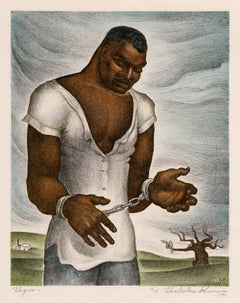
Negro
— California WPA Social Realism – Slavery
Located in Myrtle Beach, SC
Nicholas Panesis, 'Negro', 1934, color lithograph, edition 18. Signed, dated, titled, and numbered 8/28 in pencil. Initialed in the stone, lower right. A fine impression, with fresh colors, on buff wove paper, with margins (1 1/8 to 2 3/8 inches). Minor glue staining at the extreme sheet edges verso, where previously taped (not visible recto), otherwise in excellent condition. Very scarce.
Matted to museum standards, unframed.
Image size 10 5/8 x 8 1/2 inches; (270 x 216 mm); sheet size 14 13/16 x 10 15/16 inches (376 x 278 mm).
Created for the California Works Progress Administration, Federal Art Project (WPA).
Impressions of this work are held in the public collections of La Salle University Art Museum (Philadelphia), U.S. General Services Administration, and Weisman Art Museum (University of Minnesota).
ABOUT THE ARTIST
Born in Massachusetts, Nicholas Panesis (1913-1967) studied art at Syracuse University, NY, and went on to teach ceramics at Alfred University, NY.
Panesis moved to San Francisco in the early 1930s shortly before settling in Los Angeles, where he worked for different animation studios...
Category
1930s American Realist Figurative Prints
Materials
Lithograph
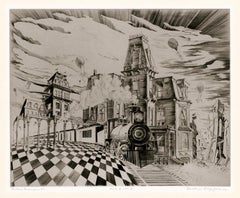
Fantasia Americana, 1880
— Mid-Century American Surrealism
By Lawrence Kupferman
Located in Myrtle Beach, SC
Lawrence Kupferman, 'Fantasia Americana – 1880', drypoint etching with sandground, 1943. Signed, titled, and annotated 'Series A, 1971 2/6' in pencil. A superb, richly-inked impression, on heavy, cream wove paper, with full margins (2 1/2 to 3 1/2 inches); the paper slightly lightened within the original mat opening, otherwise in excellent condition. One of only 6 impressions printed in 1971, with the added sandground grey background tint. Archivally matted to museum standards, unframed.
Image size 11 13/16 x 14 3/4 inches; sheet size 18 x 20 1/4 inches.
Collections: National Gallery of Art, Zimmerli Art Museum (Rutgers University).
ABOUT THE ARTIST
Lawrence Kupferman (1909 - 1982) was born in the Dorchester neighborhood of Boston and grew up in a working-class family. He attended the Boston Latin School and participated in the high school art program at the Museum of Fine Arts, Boston. In the late 1920s, he studied drawing under Philip Leslie Hale at the Museum School—an experience he called 'stultifying and repressive'. In 1932 he transferred to the Massachusetts College of Art, where he first met his wife, the artist Ruth Cobb. He returned briefly to the Museum School in 1946 to study with the influential expressionist German-American painter Karl Zerbe.
Kupferman held various jobs while pursuing his artistic career, including two years as a security guard at the Museum of Fine Arts, Boston. During the 1930s he worked as a drypoint etcher for the Federal Art Project, creating architectural drawings in a formally realistic style—these works are held in the collections of the Fogg Museum and the Smithsonian American Art Museum. In the 1940s he began incorporating more expressionistic forms into his paintings as he became progressively more concerned with abstraction. In 1946 he began spending summers in Provincetown, Massachusetts, where he met and was influenced by Mark Rothko, Hans Hofmann, Jackson Pollock, and other abstract painters. At about the same time he began exhibiting his work at the Boris Mirski Gallery in Boston.
In 1948, Kupferman was at the center of a controversy involving hundreds of Boston-area artists. In February of that year, the Boston Institute of Modern Art issued a manifesto titled 'Modern Art and the American Public' decrying 'the excesses of modern art,' and announced that it was changing its name to the Institute of Contemporary Art (ICA). The poorly conceived statement, intended to distinguish Boston's art scene from that of New York, was widely perceived as an attack on modernism. In protest, Boston artists such as Karl Zerbe, Jack Levine, and David Aronson formed the 'Modern Artists Group' and organized a mass meeting. On March 21, 300 artists, students, and other supporters met at the Old South Meeting House and demanded that the ICA retract its statement. Kupferman chaired the meeting and read this statement to the press:
“The recent manifesto of the Institute is a fatuous declaration which misinforms and misleads the public concerning the integrity and intention of the modern artist. By arrogating to itself the privilege of telling the artists what art should be, the Institute runs counter to the original purposes of this organization whose function was to encourage and to assimilate contemporary innovation.”
The other speakers were Karl Knaths...
Category
1940s Surrealist Figurative Prints
Materials
Drypoint, Etching
$680 Sale Price
20% Off
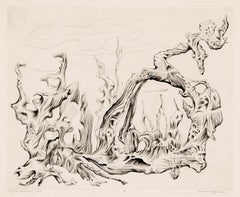
European Landscape
—Mid-century American Surrealism
By Lawrence Kupferman
Located in Myrtle Beach, SC
Lawrence Kupferman, 'European Landscape', drypoint, edition 50, 1942. Signed, dated, titled, and numbered '7/50' in pencil. A superb, finely nuanced impression, on cream wove paper; the full sheet with margins (1 to 1 3/4 inches); in excellent condition.
Image size 10 7/8 x 13 3/8 inches; sheet size 13 1/8 x 16 1/2 inches. Archivally matted to museum standards, unframed.
An impression of this work is included in the permanent collection of the Syracuse University Art Museum.
ABOUT THE ARTIST
Lawrence Kupferman (1909 - 1982) was born in the Dorchester neighborhood of Boston and grew up in a working-class family. He attended the Boston Latin School and participated in the high school art program at the Museum of Fine Arts, Boston. In the late 1920s, he studied drawing under Philip Leslie Hale at the Museum School—an experience he called 'stultifying and repressive'. In 1932 he transferred to the Massachusetts College of Art, where he first met his wife, the artist Ruth Cobb. He returned briefly to the Museum School in 1946 to study with the influential expressionist German-American painter Karl Zerbe.
Kupferman held various jobs while pursuing his artistic career, including two years as a security guard at the Museum of Fine Arts, Boston. During the 1930s he worked as a drypoint etcher for the Federal Art Project, creating architectural drawings in a formally realistic style—these works are held in the collections of the Fogg Museum and the Smithsonian American Art Museum. In the 1940s he began incorporating more expressionistic forms into his paintings as he became progressively more concerned with abstraction. In 1946 he began spending summers in Provincetown, Massachusetts, where he met and was influenced by Mark Rothko, Hans Hofmann, Jackson Pollock, and other abstract painters. At about the same time he began exhibiting his work at the Boris Mirski Gallery in Boston.
In 1948, Kupferman was at the center of a controversy involving hundreds of Boston-area artists. In February of that year, the Boston Institute of Modern Art issued a manifesto titled 'Modern Art and the American Public' decrying 'the excesses of modern art,' and announced that it was changing its name to the Institute of Contemporary Art (ICA). The poorly conceived statement, intended to distinguish Boston's art scene from that of New York, was widely perceived as an attack on modernism. In protest, Boston artists such as Karl Zerbe, Jack Levine, and David Aronson formed the 'Modern Artists Group' and organized a mass meeting. On March 21, 300 artists, students, and other supporters met at the Old South Meeting House and demanded that the ICA retract its statement. Kupferman chaired the meeting and read this statement to the press:
“The recent manifesto of the Institute is a fatuous declaration which misinforms and misleads the public concerning the integrity and intention of the modern artist. By arrogating to itself the privilege of telling the artists what art should be, the Institute runs counter to the original purposes of this organization whose function was to encourage and to assimilate contemporary innovation.”
The other speakers were Karl Knaths...
Category
1940s Surrealist Abstract Prints
Materials
Drypoint
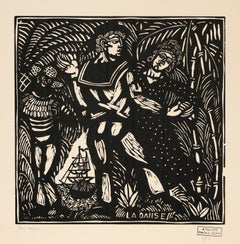
La Danse
(Dance) — French Cubist Woodcut
By Raoul Dufy
Located in Myrtle Beach, SC
Raoul Dufy, 'La Danse' (Dance), woodcut, 1910. A proof impression before the second edition of 220 in 1953; with the estate stamp 'ATELIER RAOUL DUFY' in the lower right margin; the blind stamp 'GG' in the lower left sheet corner. Annotated 'E/Z' in pencil, beneath the estate stamp; and 'bois original' in the margin, lower left. Titled in the block, lower right. A superb, richly-inked impression, on heavy, cream wove paper; the full sheet with wide margins (3 1/2 to 6 3/4 inches); slight toning at the bottom and right sheet edges, well away from the image, otherwise in excellent condition. Archivally sleeved, unmatted.
Image size 12 5/16 x 12 1/2 inches (313 x 318 mm); sheet size 19 3/4 x 25 3/4 inches (502 x 654 mm).
Collections: Art Gallery of New South Wales (Australia), Brooklyn Museum, Cleveland Art Museum, Fine Arts Museums of San Francisco, Minneapolis Institute of Art, Museum of Fine Arts, Boston, The Nelson-Atkins Museum of Art, Nasher Museum of Art (Duke University), Toledo Art Museum.
From the suite of four woodcuts entitled 'Les Plaisirs de la Paix' (The Pleasures of Peace), published by Éditions de La Sirène, Paris in 1926. The other three works in the series are 'La Peche' (Fishing), 'La Chase' (The Hunt), and 'L'amore' (Love). See our other listings for 'La Peche' and 'L'amore'.
Collections: Brooklyn Museum, Art Gallery of New South Wales, Cleveland Museum of Art, Dallas Museum of Art, Fine Arts Museums of San Francisco, Minneapolis Art...
Category
1910s Cubist Figurative Prints
Materials
Woodcut
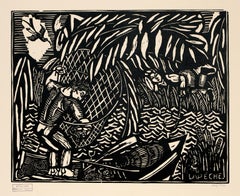
La Pêche
(Fishing) — French Cubist Woodcut
By Raoul Dufy
Located in Myrtle Beach, SC
Raoul Dufy, 'La Pêche' (Fishing), woodcut, 1910, from the second edition of 220 printed in 1953. With the estate stamp 'ATELIER RAOUL DUFY' in the lower left margin. Numbered '106/220' in pencil, lower right. Titled in the block, lower right. A superb, richly-inked impression, on heavy, cream wove paper, the full sheet with wide margins (3 to 5 inches), slight toning at the sheet edges, well away from the image; otherwise in excellent condition. Archivally sleeved, unmatted.
Image size 12 1/2 x 15 13/16 inches (318 x 402 mm); sheet size 19 9/16 x 25 3/4 inches (497 x 654 mm).
From the suite of four woodcuts entitled 'Les Plaisirs de la Paix' (The Pleasures of Peace), originally published by Éditions de La Sirène, Paris in 1926. The other three works in the series are 'La Danse' (The Dance), 'La Chase' (The Hunt), and 'L'amore' (Love). See our other listings for 'La Danse' and 'L'amore'.
Collections: Cleveland Museum of Art, Minneapolis Art...
Category
1910s Cubist Figurative Prints
Materials
Woodcut
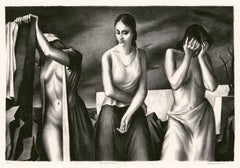
The Lamentation
— Mid-century Modernism, WWII
By Benton Murdoch Spruance
Located in Myrtle Beach, SC
'The Lamentation', lithograph, 1941, edition 35, Fine and Looney 198. Signed, titled, and annotated 'Ed 35' in pencil. Initialed in the stone, lower ri...
Category
1940s American Modern Figurative Prints
Materials
Lithograph
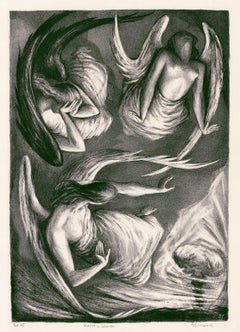
Havoc in Heaven
— Mid-Century Modernism
By Benton Murdoch Spruance
Located in Myrtle Beach, SC
Benton Spruance, 'Havoc in Heaven', lithograph, 1948, edition 30-35, Fine and Looney 270. Signed, titled, and numbered 'Ed 35' in pencil. Initialed in the stone, lower right. A fine,...
Category
1940s American Modern Figurative Prints
Materials
Lithograph
Counterpoint
— Mid-Century Modernist Abstraction
By Edward August Landon
Located in Myrtle Beach, SC
Edward Landon, 'Counterpoint', color serigraph, 1942, edition 25, Ryan 45. Signed, titled, and annotated 'Edition 25' in pencil. A fine impression, with fresh colors, on cream, wove paper; the full sheet with margins (7/8 to 2 1/2 inches). A 1 1/2 inch crease across the top left sheet corner, well away from the image, otherwise in excellent condition. Scarce.
Image size 13 9/16 x 14 5/16 inches (344 x 364 mm); sheet size 14 15/16 x 17 inches (379 x 432 mm). Matted to museum standards, unframed.
Literature:
'A Spectrum of Innovation: Color in American Printmaking', David Acton, New York, London, 1990.
'American Screenprints', Reba and Dave Williams, New York, 1987.
'The American Scene: Prints from Hopper to Pollock', Stephen Coppel, The British Museum, 2008.
Impressions of this work are held in the following museum collections: Albright-Knox Art Gallery, National Gallery of Art, Smithsonian American Art Museum.
ABOUT THE ARTIST
Born in Hartford, Connecticut, Edward Landon dropped out of high school to study art at the Hartford Art School. In 1930 and 1931 he was a student of Jean Charlot at the Art Students League in New York, after which he traveled to Mexico to study privately for a year with Carlos Merida. In 1933 he settled near Springfield, Massachusetts, painted murals in the local trade school, and exhibited with the Springfield Art League. His painting 'Memorial Day' won first prize at the fifteenth annual exhibition of the League at the Springfield Museum of Fine Arts. Landon became an active member of the Artists Union of Western Massachusetts, serving as president from 1934-1938.
Landon acquired Anthony Velonis’s instructional pamphlet on the technique of serigraphy in the late 1930s. With colleagues Phillip Hicken, Donald Reichert, and Pauline Stiriss, he began experimenting with screen printing techniques. The artists' groundbreaking work in screen printing as a fine art medium was the subject of the group’s landmark exhibition at the Springfield Museum of Fine Arts in 1940.
Landon became one of the founding members of the National Serigraph Society and served as editor of its publication, 'Serigraph Quarterly,' in the late 1940s and as its president in 1952 and 1953. The Norlyst Gallery in Manhattan held a one-person show of his prints in 1945. Awarded a Fulbright Fellowship in 1950, Landon traveled to Norway, where he researched the history of local artistic traditions and produced the book 'Scandinavian Design: Picture and Rune Stones...
Category
Mid-20th Century American Modern Abstract Prints
Materials
Screen
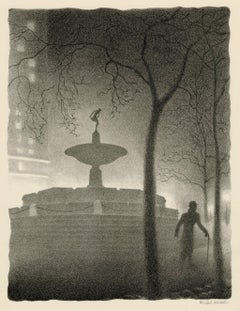
Pulitzer Fountain, Evening" — 1940s American Modernism, New York City
By Ellison Hoover
Located in Myrtle Beach, SC
Ellison Hoover, 'Pulitzer Fountain, Evening', lithograph, circa 1940, edition c. 40. Signed in pencil. A fine, atmospheric impression, on cream wove paper; the full sheet with margins (1 1/2 to 4 5/16 inches), in excellent condition. Archivally matted to museum standards, unframed.
Image size 12 1/2 x 9 5/8 inches (318 x 244 mm); sheet size 16 1/4 x 12 1/4 inches (413 x 311 mm).
ABOUT THE SUBJECT
The Pulitzer fountain was commissioned as a bequest by Joseph Pulitzer, newspaper publisher and founder of the Columbia School of Journalism. Designed by Austrian sculptor Karl Bitter...
Category
Mid-20th Century American Modern Landscape Prints
Materials
Lithograph
Nude Dancer — 1920s Modernism
By Boris Lovet-Lorski
Located in Myrtle Beach, SC
Boris Lovet-Lorski, Untitled (Nude Dancer in Modernist Stage-setting), lithograph, edition 250, 1929. Signed and numbered 20 in pencil. Number 20 of Volume ...
Category
1920s Art Deco Nude Prints
Materials
Lithograph

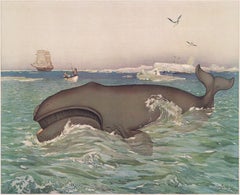
Whaling – Vintage Monumental Zoology Lithograph
Located in Myrtle Beach, SC
Joseph Fleischmann, 'Whaling' (Hartingers Wandtafeln: Zoologie T. XXXII), monumental vintage color lithograph, 1900. Signed in the matrix, lower right. A superb, beautifully nuanced impression, on cream wove paper, the full sheet with margins (1 1/2 to 2 3/16 inches), in very good condition. Sheet size 28 x 38 1/2 inches (711 x 978 mm). The full sheet, unmounted and unmatted—shipped carefully rolled and protected.
Rendering by A. Berger after Joseph Fleischmann. Published by Carl Gerold’s Son, Vienna, 1900.
This Artic whaling scene depicts a Greenland whale in the foreground pursued by whalers. A whaling ship is seen in the background and at right, another whale among icebergs with seagulls overhead. The print by Albert Berger...
Category
Early 1900s Naturalistic Animal Prints
Materials
Lithograph
$1,125 Sale Price
25% Off
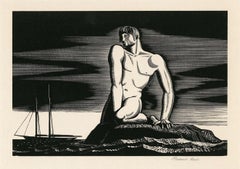
The Bather
— Iconic American Modernism
By Rockwell Kent
Located in Myrtle Beach, SC
Rockwell Kent, 'The Bather', wood engraving, 1931, edition 120, Burne Jones 63. Signed in pencil. A brilliant, black impression, on cream, wove Japan paper; the full sheet with margins (2 1/2 to 3 1/4 inches); slight skinning at the top sheet edge, verso, otherwise in excellent condition. Archivally matted to museum standards, unframed.
Image size 5 3/8 x 7 7/8 inches (137 x 200 mm); sheet size 11 1/8 x 14 1/2 inches (283 x 368 mm).
Impressions of this work are held in the following public collections: Burne Jones Collection (Illinois), Chazen Museum of Art, Chegodaev Collection (Moscow), Kent Collection (New York), National Gallery of Art, Philadelphia Museum of Art; SUNY Plattsburg Art Museum, Princeton University Library, Pushkin Museum (Moscow), Smithsonian American Art Museum, Spector Collection (New York), University of Illinois.
ABOUT THE ARTIST
Rockwell Kent (1882-1971), though best known as a painter, graphic artist, and illustrator, pursued many careers throughout his life, including architect, carpenter, explorer, writer, dairy farmer, and political activist. Born in Tarrytown, New York, Kent was interested in art from a young age. These ambitions were encouraged by his aunt Jo Holgate, an accomplished ceramicist. Jo came to live with the family after Kent’s father passed away in 1887 and took him to Europe as a teenager, undoubtedly kindling his interest in exploring the world.
Kent attended the Horace Mann School in New York City, where he excelled at mechanical drawing. His family’s financial circumstances prevented him from pursuing a career in the fine arts; however, after graduating from Horace Mann in 1900, Kent decided to study architecture at Columbia University.
Before matriculating at Columbia, Kent spent the first of three consecutive summers studying painting at William Merritt Chase’s art school in Shinnecock Hills, Long Island. There he found a community of mentors and fellow students who encouraged him to pursue his interest in art. At the end of Kent’s third summer at Shinnecock, Chase offered him a full scholarship to the New York School of Art, where he was a teacher. Kent began taking night classes at the art school in addition to his architecture studies but soon left Columbia to study painting full-time. In addition to Chase, Kent took classes with Robert Henri and Kenneth Hayes Miller, where his classmates included the artists George Bellows and Edward Hopper.
Kent spent the summer of 1903 assisting the eccentric painter Abbott Handerson Thayer at his studio in Dublin, New Hampshire—a position he secured through the recommendation of his Aunt Jo. Thayer’s naturalist lifestyle and almost mystical appreciation for natural phenomena greatly influenced Kent; he returned to Dublin for many years to visit Thayer and his family. Thayer gave the young artist time to pursue his work, and that summer Kent painted several views of the New Hampshire landscape, including Mount Monadnock...
Category
1930s American Modern Nude Prints
Materials
Woodcut
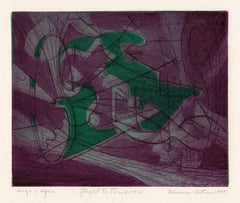
Flight to Tomorrow
— Mid-Century American Modernism — Atelier 17
By Minna Citron
Located in Myrtle Beach, SC
Minna Citron, 'Flight to Tomorrow', aquatint and engraving, edition unknown but small, 1948. Signed, titled, dated, and annotated 'engr & aqua' in pencil. A superb, richly-inked impression with selectively wiped plate tone, on heavy cream wove paper, the full sheet with margins (1 3/4 to 3 1/2 inches), in excellent condition. Image size 6 7/8 x 8 7/16 inches (175 x 214 mm); sheet size 11 1/8 x 14 7/8 inches (283 x 378 mm). Matted to museum standards, unframed.
Literature: The Women of Atelier 17, Modernist Printmaking in MidCentury New York, Christina Weyl, Yale University Press, 2019, p. 186.
Collections: Davis Museum (Wellesley), Five Colleges and Historic Deerfield Museum Consortium, Harvard Art Museums, Museum of Fine Arts, Boston, Palmer Museum of Art (Penn State...
Category
1940s Abstract Expressionist Abstract Prints
Materials
Engraving, Aquatint
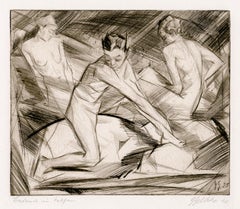
Women Bathing — German Expressionism, Nudes, 1920
Located in Myrtle Beach, SC
Georg Gelbke, Untitled (Women Bathing), etching, 1920. Signed and dated in pencil. Initialed and dated in the plate, lower right. A fine, richly-inked im...
Category
1920s Expressionist Nude Prints
Materials
Etching
$520 Sale Price
20% Off
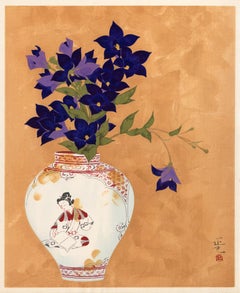
Flowers and Ko-Imari
— Taisho/Showa Shin Hanga Woodblock Print
Located in Myrtle Beach, SC
Masami Iwata, 'Flowers and Ko-Imari', color woodblock print, c. 1960, edition 250. Signed, and with the artist’s seal, lower right. A superb, painterly impression, with fresh colors,...
Category
1960s Modern Still-life Prints
Materials
Woodcut
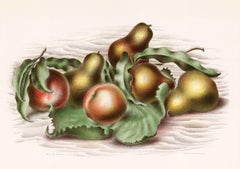
Fruit Forms
— American Modernism
By Albert Heckman
Located in Myrtle Beach, SC
Albert Heckman, 'Fruit Forms', color lithograph, edition not stated, c. 1935. Signed and titled in pencil. A fine, richly-inked impression, with fresh colo...
Category
1930s American Modern Still-life Prints
Materials
Lithograph
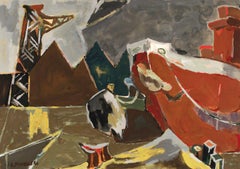
Dockside
— Mid-Century Modernism
By Alex Minewski
Located in Myrtle Beach, SC
Alex Minewski, 'Dockside', gouache on paper, 1953. Signed in the image, lower left. Annotated 'April 1953, Minewski, ‘Dock Side’, verso. A fine, modernist re...
Category
1950s American Modern Figurative Paintings
Materials
Gouache
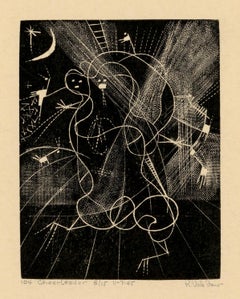
Cheerleader
— Mid-century American Surrealism, Chicago Avant-garde
By Robert Vale Faro
Located in Myrtle Beach, SC
Robert Vale Faro, 'Cheerleader', wood engraving, 1945, edition 15. Signed, dated, titled, and numbered '104' (the artist's inventory number) and '8/15' in pencil. A fine, black impression, with full margins (1 1/2 inches), on heavy, cream wove paper, in excellent condition. Scarce. Matted to museum standards, unframed.
ABOUT THE ARTIST
Robert Vale Faro (1902-1988) was a well-known modernist architect and artist associated with the Chicago Bauhaus...
Category
1940s Surrealist Abstract Prints
Materials
Woodcut
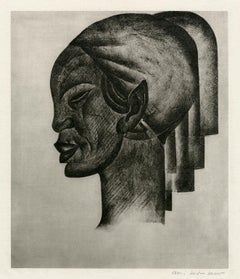
Untitled (Profile of an African Woman) — 1920s Modernism
By Boris Lovet-Lorski
Located in Myrtle Beach, SC
Boris Lovet-Lorski, 'Untitled (Profile of a Black Woman)', lithograph, edition 250, 1929. Signed and numbered 14 in pencil. Number 14 of Volume 2, a series of 10 lithographs publishe...
Category
1920s Art Deco Figurative Prints
Materials
Lithograph
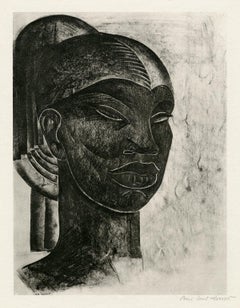
Portrait of an African Woman — 1920s Modernism
By Boris Lovet-Lorski
Located in Myrtle Beach, SC
Boris Lovet-Lorski, Untitled (Portrait of an African Woman), lithograph, edition 250, 1929. Signed and numbered 13 in pencil. Number 13 of Volume 2, a series of 10 lithographs publis...
Category
1920s Art Deco Figurative Prints
Materials
Lithograph
Untitled (Black Woman Crouching) — 1920s Modernism
By Boris Lovet-Lorski
Located in Myrtle Beach, SC
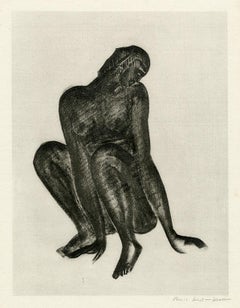
Boris Lovet-Lorski, 'Untitled (Black Woman Crouching)', lithograph, edition 250, 1929. Signed and numbered 16 in pencil. Number 16 of Volume 2, a series of...
Category
1920s Art Deco Nude Prints
Materials
Lithograph
Profile of an African Woman — 1920s Modernism
By Boris Lovet-Lorski
Located in Myrtle Beach, SC
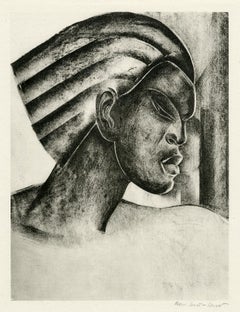
Boris Lovet-Lorski, Untitled (Profile of an African Woman), lithograph, edition 250, 1929. Signed and numbered 15 in pencil. Number 15 of Volume 2, a series of 10 lithographs publish...
Category
1920s American Modern Figurative Prints
Materials
Lithograph
Grand Central Station
— New York City Landmark
By Otto Kuhler
Located in Myrtle Beach, SC
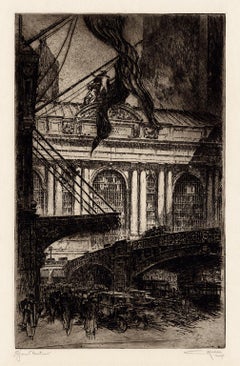
Otto Kuhler, 'Grand Central Station', etching and drypoint, 1927, edition c. 50, Kennedy 27. Signed and titled in pencil. A superb, richly-inked impression, in brown/black ink, with ...
Category
1920s American Impressionist Figurative Prints
Materials
Drypoint, Etching
$2,080 Sale Price
20% Off