Keith Sheridan, LLC Prints and Multiples
to
43
320
25
3
Overall Width
to
Overall Height
to
151
24
18
16
13
11
7
6
1
16
13
12
12
9
10
15
322
1
4
13
75
86
75
11
11
14
5
2
6
188
152
2
169
87
81
62
46
45
25
23
22
16
16
15
14
11
10
9
9
9
8
8
105
86
72
49
28
1
348
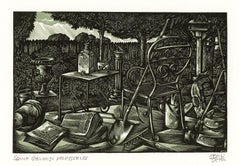
Some Garden Accessories
By John DePol
Located in Myrtle Beach, SC
John DePol, 'Some Garden Accessories', chiaroscuro wood engraving, 1979, proofs only from the block created in 1979, edition 200, 1983. Signed, dated, and titled in pencil. Signed in...
Category
Mid-20th Century American Modern Figurative Prints
Materials
Woodcut
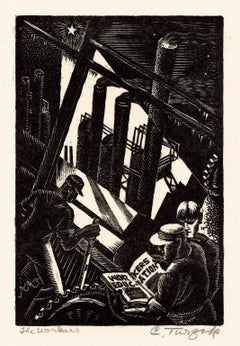
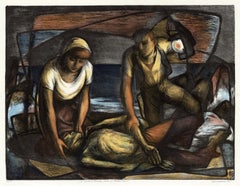
The Workers (No. 1)
— 1930s WPA Modernist Woodcut
By Charles Turzak
Located in Myrtle Beach, SC
Charles Turzak, 'The Workers (No. 1)', woodcut, edition c. 50, c. 1935. Signed and titled in pencil. Signed in the block, lower right. A fine, richly-inked impression, on cream wove...
Category
1930s American Modern Figurative Prints
Materials
Woodcut
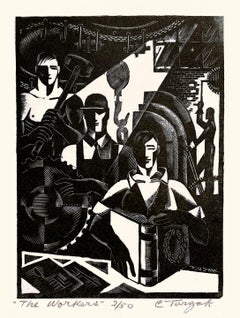
The Workers (No. 2)
— 1930s WPA Modernist Woodcut
By Charles Turzak
Located in Myrtle Beach, SC
Charles Turzak, 'The Workers (No. 2)', woodcut, edition 50, c. 1935. Signed and numbered 2/50 in pencil. A fine, richly-inked impression, on cream wove Japan paper, with full margin...
Category
1930s American Modern Figurative Prints
Materials
Woodcut
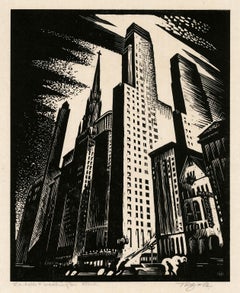
La Salle and Washington Street (Chicago, Illinois)
— WPA American Modernism
By Charles Turzak
Located in Myrtle Beach, SC
Charles Turzak, 'La Salle and Washington Street (Chicago, Illinois)', woodcut, c. 1935, edition c. 25. Signed and titled in pencil. A fine, richly-inked impre...
Category
1930s American Modern Figurative Prints
Materials
Woodcut
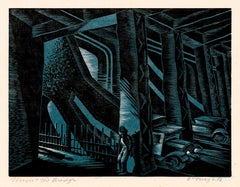
Under the Bridge
— 1930s Chicago, Modernist Color Woodcut
By Charles Turzak
Located in Myrtle Beach, SC
Charles Turzak, 'Under the Bridge', color woodcut, edition c. 50, 1934. Signed and titled in pencil. A fine, richly-inked impression, with fresh colors, on cream wove Japan paper; th...
Category
1930s American Modern Figurative Prints
Materials
Woodcut
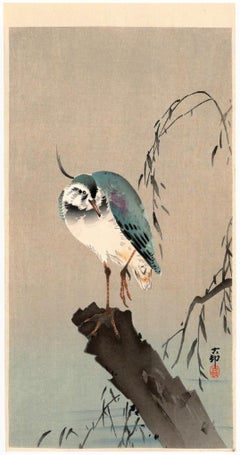
Lapwing on a Tree Stump
— Japanese Woodblock kachō-ga
By Ohara Koson
Located in Myrtle Beach, SC
Ohara Koson, 'Lapwing on a Tree Stump', color woodblock, c. 1920s. Signed 'Koson' in black ink with the artist’s red seal beneath, lower right. A superb, skillfully-inked impression,...
Category
Early 1900s Showa Animal Prints
Materials
Woodcut
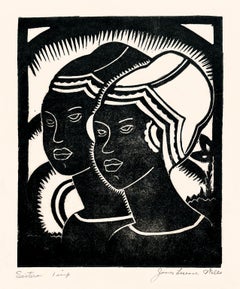
Sisters
— Renowned Black American, Harlem Renaissance Artist
Located in Myrtle Beach, SC
James Lesesne Wells, 'Sisters', linocut, edition not stated but small, 1928. Signed, titled, and annotated 'imp' in pencil. A fine impression on off-white wove Japan paper, with wide margins (1 7/8 to 3 3/4 inches), in excellent condition. Printed by the artist. Very scarce. Matted to museum standards, unframed.
Image size 8 3/16 x 6 3/4 inches (208 x 171 mm); sheet size 13 1/2 x 10 3/4 inches (343 x 273 mm).
Exhibition and Literature: 'Narratives of African American Art and Identity: The David C. Driskell Collection,' The Art Gallery at the University of Maryland, extensive touring exhibition, 1998-2000.
Collections: Pennsylvania Academy of the Fine Arts, Smithsonian Institution (Anacostia Community Museum).
ABOUT THE ARTIST
“Wells is more than an artist with a deep concern for his fellow man. He carries many of his themes a step further into an apocalyptic world, a world of revelation and shifting lights. … He works on large blocks in a bold free style. … His work has a vigor, therefore, that is not often used in the medium today.”
—Jacob Kainen (painter, critic, and collector) from Richard J. Powell’s 1986 essay Phoenix Ascending: The Art of James Lesesne Wells.
James Lesesne Wells was an American painter, printmaker, educator, and pioneering figure of the Harlem Renaissance, whose work established a vital connection between African heritage, modernist form, and African American cultural identity. Known for his innovative use of linoleum and woodblock printing, Wells played a key role in shaping 20th-century African American art and inspired countless students throughout his lengthy career as a teacher at Howard University.
Born in Atlanta, Georgia, Wells' early exposure to the arts came through church and community, where African American cultural traditions were central. He pursued formal artistic training at Lincoln University in Pennsylvania (earning a B.A. in 1924), followed by studies at the Pennsylvania Academy of the Fine Arts and the Barnes Foundation, where he encountered European modernists as well as traditional African sculpture, which profoundly influenced his style.
Wells moved to New York in the late 1920s, swiftly immersing himself in the lively artistic and intellectual scene of Harlem. There, he became associated with artists, writers, and thinkers of the Harlem Renaissance, contributing to the growth of Black cultural identity. Considered a mentor to many famed artists of the Harlem Renaissance, Wells served as director of a summer art workshop in Harlem where his assistants included Charles Alston, Jacob Lawrence, and Palmer Hayden...
Category
1920s American Modern Figurative Prints
Materials
Linocut
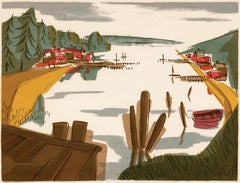
River View
— Mid-Century American Modernism
By Edward August Landon
Located in Myrtle Beach, SC
Edward Landon 'River View, color serigraph, 1942, edition 50, Ryan 159. Signed in pencil in the image, lower right. Titled, dated, and annotated '9 COLORS – 50 PRINTS' in the screen,...
Category
1940s American Modern Abstract Prints
Materials
Screen
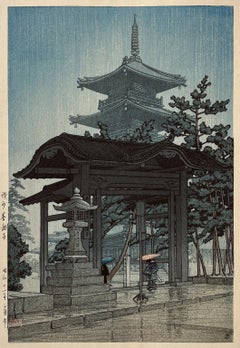
Zentsuji Temple in the Rain — from the series Collected Views of Japan II
By Kawase Hasui
Located in Myrtle Beach, SC
Kawase Hasui, 'Zentsuji Temple in the Rain' from the seres 'Collected Views of Japan II', color woodblock print, 1937. Signed Hasui in black ink, with the artist’s red seal Kawase, ...
Category
1930s Showa Landscape Prints
Materials
Woodcut
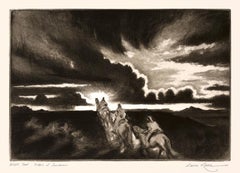
Riders at Sundown
— Mid-Century Southwest Regionalism
By Gene Kloss
Located in Myrtle Beach, SC
'Riders at Sundown', aquatint and drypoint, edition 75, 1953, Kloss 451. Signed, titled, and annotated 'Artist's Proof' in pencil. A superb, richly-inked, atmospheric impression, in ...
Category
1950s American Modern Landscape Prints
Materials
Drypoint, Aquatint
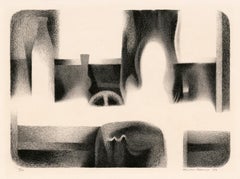
September Still Life
— Mid-Century Modernism
By Clinton Adams
Located in Myrtle Beach, SC
Clinton Adams, 'September Still Life', lithograph, 1956, edition 20. A superb impression, on cream wove paper, with full margins (1 1/2 to 3 1/8 inches);...
Category
1950s American Modern Still-life Prints
Materials
Lithograph
A Wind Is Rising and the Rivers Flow
— Mid-Century American Modernism
By Benton Murdoch Spruance
Located in Myrtle Beach, SC
Benton Spruance, 'A Wind is Rising and the Rivers Flow', color lithograph, 1945, edition 40, Fine and Looney 242. Signed, dated, and titled, and annotated 'Ed 40' in pencil. A fine ...
Category
1940s American Modern Figurative Prints
Materials
Lithograph
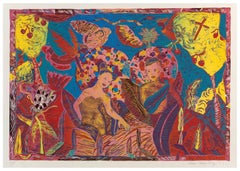
The Garden
— Celebrated Contemporary African American Artist
By Margo Humphrey
Located in Myrtle Beach, SC
Margo Humphrey, 'The Garden (Adam and Eve)', reductive color woodcut, 1989. Signed, dated, and annotated 'A/P' in pencil. Signed and dated in the image, lower right. A fine, richly-inked, artist's proof impression, with fresh, vivid colors, on BFK Rives, heavy, off-white wove paper; the full sheet with margins (1 to 1 3/8 inches), in excellent condition. Archivally sleeved, unmatted. Scarce.
Image size 27 1/4 x 39 1/8 inches (692 x 994 mm); sheet size 29 1/2 x 42 inches (749 x 1,067 mm).
ABOUT THIS WORK
"Humphrey continued to reinterpret stories from the Bible with African American figures. In 1989 she published the woodcut print 'The Garden' at Magnolia Editions in Oakland, CA. For this rare foray into relief printmaking, she employed the reductive method, which uses only one block that is successively carved for each color segment, reducing the block with each cutting. Technically challenging, this lush and elaborate print is a testament to Humphrey’s skills as a printmaker. A youthful Adam and Eve are depicted in a luxuriant tropical landscape. Here, Humphrey chooses not to include the traditional symbols of humanity’s downfall but instead portrays them as being protected by angels in an atmosphere of idyllic bounty. ...Although Humphrey challenges traditional representation of Christian themes, her images are not iconoclastic but present a broader, more inclusive engagement with religious spirituality."
— Adrienne L. Childs, 'Margo Humphrey, The David C. Driskell Series of African American Art: Volume VII,' Pomegranate Communications, Inc., 2009, page 71.
ABOUT THE ARTIST
American printmaker, illustrator, and art teacher Margo Humphrey was born in Oakland, California, in 1942. She earned a BFA in Painting and Printmaking from the California College of Arts and Crafts and a Master of Fine Arts degree in Printmaking from Stanford University.
Humphrey began teaching in 1973 at the University of California Santa Cruz and has since taught at the University of Texas at San Antonio, the San Francisco Art Institute, and the School of the Art Institute of Chicago. She has also taught at the University of the South Pacific in Suva, Fiji; Yaba Technological Institute of Fine Art, Ekoi Island, Nigeria; the University of Benin in Benin City, Nigeria; the Margaret Trowell School of Fine Art in Kampala, Uganda, and the Fine Art School of the National Gallery of Art, Harare, Zimbabwe. In 1989, she was appointed Department Head of Printmaking at the University of Maryland in College Park.
Humphrey has worked in lithography, monoprint, and woodcut with significant printmaking ateliers, including the Rutgers Center for Innovative Print and Paper, the Bob Blackburn Printmaking Workshop, and the Tamarind Institute in New Mexico. She was one of the earliest African-American woman artists to distinguish herself as a lithographer in a highly technical, male-dominated profession and was the first to have her prints published by Tamarind in 1974.
Humphrey’s imagery combines historical perspective, autobiography, and fantasy to illuminate her experience as an African American woman. Bold, saturated color, animated figures, and syncopated rhythmic arrangements are hallmarks of Humphrey's oeuvre. Though Humphrey labels her distinctive style "sophisticated naive," the narrative complexity and technical skill of her works attest to her artistic virtuosity. Joyful, expressive, and at times humorous, her works offer engaging commentary on the presumptions of American culture and myth while embracing her personal vision of authenticity and spirituality.
She developed her 1987 work The Last Bar-B-Que, a vividly colored transformation of the Last Supper, following a three-year period during which she examined portrayals of the iconic subject by artists from Pietro Lorenzetti to Emil Nolde. Her narrative work The Garden, a monumentally scaled reductive woodcut, is a further example of an archetypal subject—Adam and Eve in the Garden of Eden—debunked and rendered with fresh, life-affirming vibrancy.
Since her first solo exhibition in 1965, Humphrey’s works have been exhibited internationally. They are held in major institutions, including the Museum of Modern Art, The Smithsonian American Art Museum, the Philadelphia Museum of Art, the Hampton University Museum, the Victoria and Albert Museum (London), the Museum of Modern Art, Rio de Janeiro, and the National Gallery of Modern Art, Lagos. In 1996, she was invited to be part of the World Printmaking Survey at the Museum of Modern Art, New York.
In 2011, Hampton University Museum mounted a 45-year retrospective of Humphrey’s work Her Story: Margo Humphrey Lithographs and Works on Paper, jointly curated by Robert E. Steele, executive director of the David Driskell...
Category
1980s Expressionist Figurative Prints
Materials
Woodcut
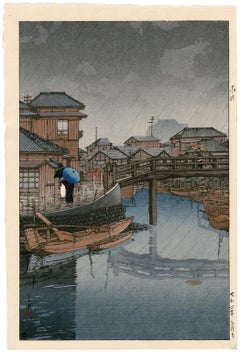
Rain at Shinagawa, Ryoshimachi
— Showa-era Woodblock Print
By Kawase Hasui
Located in Myrtle Beach, SC
Kawase Hasui, 'Rain at Shinagawa, Ryoshimachi' from the series 'Selection of Views of the Tokaido', woodblock print, 1931. A very fine, atmospheric impression, with fresh colors; the...
Category
1930s Showa Figurative Prints
Materials
Woodcut
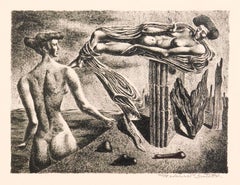
Body and Soul
— Mid-20th Century Surrealism
By Federico Castellon
Located in Myrtle Beach, SC
Federico Castellon, 'Body and Soul', 1938, lithograph, edition 30, Freundlich 3. Signed in pencil. Signed in the stone, lower left. A fine, richly-inked, atmospheric impression on cr...
Category
1940s Surrealist Figurative Prints
Materials
Lithograph
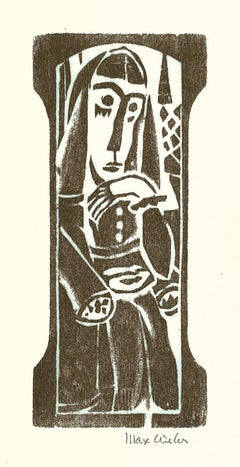
Seated Figure
— American Expressionism
By Max Weber
Located in Myrtle Beach, SC
Max Weber, 'Seated Figure", woodcut, edition not stated, 1919-20, Rubenstein 17. Signed in pencil. A fine impression on cream Japan paper; the full sheet with margins (2 to 3 1/8 in...
Category
1920s Expressionist Figurative Prints
Materials
Woodcut
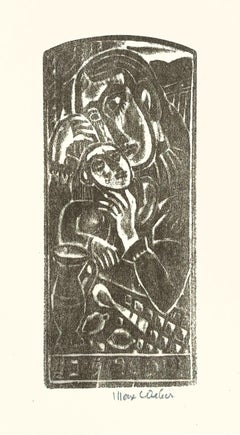
Mother Love (Madonna and Child) — American Expressionism
By Max Weber
Located in Myrtle Beach, SC
Max Weber, 'Mother Love' (Madonna and Child), woodcut, 1920, edition not stated, Rubenstein 35. Signed in pencil. A fine impression, on cream wove Japan paper, with full margins (1 5...
Category
1920s Expressionist Figurative Prints
Materials
Woodcut
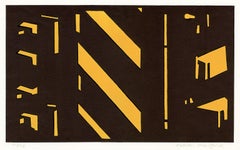
Third Avenue Elevated #1
— Mid-century Precisionist Abstraction
By Ralston Crawford
Located in Myrtle Beach, SC
Ralston Crawford, 'Third Avenue Elevated #1', lithograph, 1951, edition 55. Freeman L51.4. Signed, titled and numbered '48/55' in pencil. A fine, richly-inked impression, with rich ...
Category
1950s Abstract Abstract Prints
Materials
Lithograph
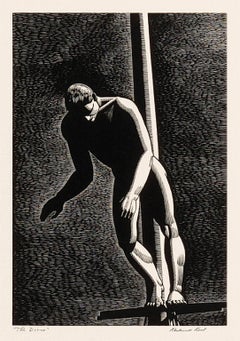
Diver
— 1930s American Modernism
By Rockwell Kent
Located in Myrtle Beach, SC
Rockwell Kent, 'Diver', wood engraving, 1931, edition 150, Burne Jones 88. Signed, and titled 'The Diver' in pencil.. A brilliant, black impression, on cream, wove Japan paper; the f...
Category
1930s American Modern Nude Prints
Materials
Woodcut
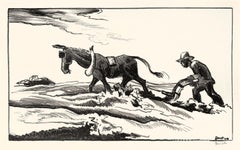
Plowing It Under
— WPA Era American Regionalism
By Thomas Hart Benton
Located in Myrtle Beach, SC
Thomas Hart Benton, 'Goin' Home', lithograph, 1937, edition 250, Fath 14. Signed in pencil. Signed in the stone, lower right. A fine, richly-inked impression, on off-white, wove pape...
Category
1930s American Realist Figurative Prints
Materials
Lithograph
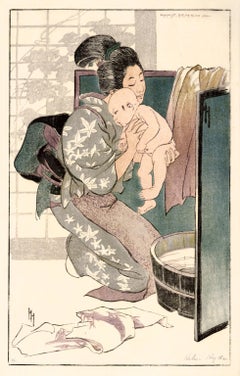
The Bath
— Meji Era Cross-Cultural Woman Artist
By Helen Hyde
Located in Myrtle Beach, SC
Helen Hyde, 'The Bath', color woodblock print, edition not stated, 1905, Mason & Mason 59. Signed in pencil in the image, lower right. Numbered '96' in pencil in the image, lower left. The artist's monogram in the block, lower left, and 'Copyright, 1905, by Helen Hyde.' upper right. A superb impression with fresh colors on tissue-thin cream Japanese paper; the full sheet with margins (7/16 to 1 5/8 inches), in excellent condition. Matted to museum standards, unframed.
Image size 16 1⁄4 x 10 1⁄8 in. (413 x 260 mm); sheet size: 19 1⁄4 x 11 1⁄8 in. (489 x 283 mm).
Literature and Exhibition: Back cover illustration of the catalog of the artist’s prints, 'Helen Hyde', Smithsonian Institution Press, 1990; 'The International Block Print Renaissance, Then And Now, Block Prints In Wichita, Kansas, A Centennial Celebration — 1922-2022', Barbara J. Thompson, Wichita Art Museum, 2022 (back cover).
Impressions of this work are held in the following collections: Achenbach Foundation for Graphic Arts, Art Institute of Chicago, Fine Arts Museums of San Francisco (De Young), Harvard Art Museums, Library of Congress, Metropolitan Museum of Art, New York Public Library, Smithsonian American Art Museum, Terra Foundation for American Art, University of Oregon Museum of Art.
ABOUT THE ARTIST
Helen Hyde (1868-1919) was a pioneer American artist best known for advancing Japanese woodblock printmaking in the United States and for bridging Western and Japanese artistic traditions. Hyde was born in Lima, New York, but after her father died in 1872, her family relocated to Oakland, California, where she spent much of her youth.
Hyde pursued formal art education in the United States and Europe. She enrolled in the San Francisco School of Design, where she took classes from the Impressionist painter Emil Carlsen; two years later, she transferred to the Art Students League in New York, studying there with Kenyon Cox. Eager to expand her artistic repertoire, Hyde traveled to Europe, studying under Franz Skarbina in Berlin and Raphael Collin in Paris. While in Paris, she first encountered Japanese ukiyo-e prints, sparking a lifelong fascination with Japanese aesthetics. After ten years of study, Hyde returned to San Francisco, where she continued to paint and began to exhibit her work.
Hyde learned to etch from her friend Josephine Hyde in about 1885. Her first plates, which she etched herself but had professionally printed, represented children. On sketching expeditions, she sought out quaint subjects for her etchings and watercolors. In 1897, Hyde made her first color etchings—inked á la poupée (applying different ink colors to a single printing plate)—which became the basis for her early reputation. She also enjoyed success as a book illustrator, and her images sometimes depicted the children of Chinatown.
After her mother died in 1899, Hyde sailed to Japan, accompanied by her friend Josephine, where she would reside, with only brief interruptions, until 1914. For over three years, she studied classical Japanese ink painting with the ninth and last master of the great Kano school of painters, Kano Tomonobu. She also studied with Emil Orlik, an Austrian artist working in Tokyo. Orlik sought to renew the old ukiyo-e tradition in what became the shin hanga “new woodcut prints” art movement. She immersed herself in the study of traditional Japanese printmaking techniques, apprenticing with master printer Kanō Tomonobu. Hyde adopted Japanese tools, materials, and techniques, choosing to employ the traditional Japanese system of using craftsmen to cut the multiple blocks and execute the exacting color printing of the images she created. Her lyrical works often depicted scenes of family domesticity, particularly focusing on women and children, rendered in delicate lines and muted colors.
Through her distinctive fusion of East and West, Hyde’s contributions to Western printmaking were groundbreaking. At a time when few Western women ventured to Japan, she mastered its artistic traditions and emerged as a significant figure in the international art scene.
Suffering from poor health, she returned to the United States in 1914, moving to Chicago. Having found restored health and new inspiration during an extended trip to Mexico in 1911, Hyde continued to seek out warmer climates and new subject matter. During the winter of 1916, Hyde was a houseguest at Chicora Wood, the Georgetown, South Carolina, plantation illustrated by Alice Ravenel Huger Smith in Elizabeth Allston Pringle’s 1914 book A Woman Rice Planter. The Lowcountry was a revelation for Hyde. She temporarily put aside her woodcuts and began creating sketches and intaglio etchings of Southern genre scenes and African Americans at work. During her stay, Hyde encouraged Smith’s burgeoning interest in Japanese printmaking and later helped facilitate an exhibition of Smith’s prints at the Art Institute of Chicago.
During World War I, Hyde designed posters for the Red Cross and produced color prints extolling the virtues of home-front diligence.
In ill health, Hyde traveled to be near her sister in Pasadena a few weeks before her death on May 13, 1919. She was buried in the family plot near Oakland, California.
Throughout her career, Hyde enjoyed substantial support from galleries and collectors in the States and in London. She exhibited works at the St. Louis Exposition in 1897, the Pan-American Exhibition in Buffalo in 1901, the Tokyo Exhibition for Native Art (where she won first prize for an ink drawing) in 1901, the Alaska-Yukon-Pacific Exhibition in Seattle in 1909 (received a gold medal for a print), the Newark Museum in 1913, a solo show at the Chicago Art Institute in 1916, and a memorial exhibition in 1920, Detroit Institute of Arts, Color Woodcut Exhibition in 1919, New York Public Library, American Woodblock Prints...
Category
Early 1900s Showa Figurative Prints
Materials
Woodcut
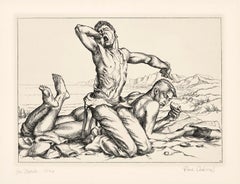
Two Boys On A Beach, No. 1
— Erotic Realism
By Paul Cadmus
Located in Myrtle Beach, SC
Paul Cadmus, 'Two Boys On A Beach, No. 1', etching, 1938, edition 75, Johnson & Miller 85. Signed in pencil and initialed in the plate in the lower right image corner. Annotated by t...
Category
1930s American Realist Figurative Prints
Materials
Etching
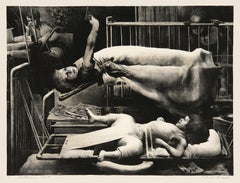
Children
s Ward
— Socially-Conscious Realism
By Robert Riggs
Located in Myrtle Beach, SC
Robert Riggs, 'Children's Ward', 2-color lithograph, c. 1940, edition c. 50, Beall 11, Bassham 76. Signed, titled, and numbered '14' in pencil. Signed in the stone, lower right. A su...
Category
1940s Realist Figurative Prints
Materials
Lithograph
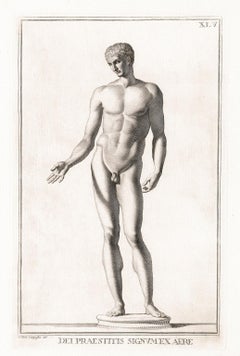
Dei Praestitis Signumexaere
— 18th Century Classical Italian Realism
Located in Myrtle Beach, SC
Giovanni Domenico Campiglia, 'Dei Praestitis Signumexaere' (God's Providence Signumexaere), engraving, 1734, edition unknown. Signed 'Dom. Campiglia del.' in the plate, lower left. E...
Category
1730s Realist Nude Prints
Materials
Engraving
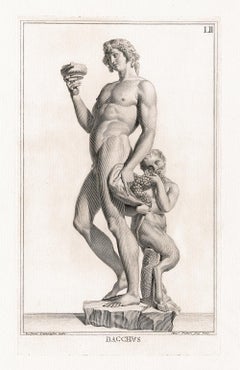
Bacchus
— 18th Century Classical Italian Realism
Located in Myrtle Beach, SC
Giovanni Domenico Campiglia, 'Bacchus', engraving, 1734, edition unknown. Signed 'Dom. Campiglia del.' in the plate, lower left. Engraving by Gabbugiani, after the original by Giovan...
Category
1730s Realist Nude Prints
Materials
Engraving
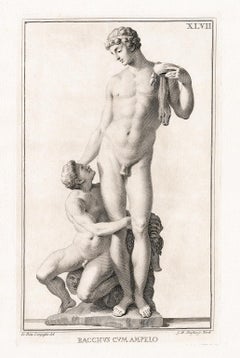
Bacchus Cumampelo
— 18th Century Classical Italian Realism
Located in Myrtle Beach, SC
Giovanni Domenico Campiglia, 'Bacchus Cumampelo', engraving, 1734, edition unknown. Signed 'Dom. Campiglia del.' in the plate, lower left. Engraving by Gabbugiani, after the original...
Category
1730s Realist Nude Prints
Materials
Engraving
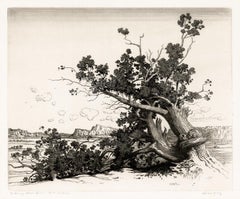
Old Cedars
– Early New Mexico Landscape, Southwest Regionalism
By George Elbert Burr
Located in Myrtle Beach, SC
George Elbert Burr, 'Old Cedars – New Mexico', etching, 1920, edition 40, Seeber 218. Signed and annotated '(c) George Elbert Burr Del. et Imp.' in pencil. ...
Category
1920s Realist Landscape Prints
Materials
Etching
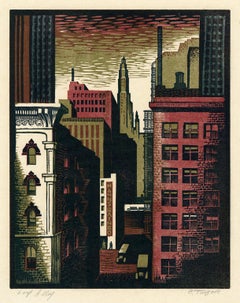
Loop Alley
— Modernist Chicago Cityscape, WPA
By Charles Turzak
Located in Myrtle Beach, SC
Charles Turzak, 'Loop Alley (Chicago)', color woodcut, edition c. 25, c. 1935. Signed and titled in pencil. A fine, richly-inked impression, with fresh colors, on cream wove Japan pa...
Category
1930s American Modern Figurative Prints
Materials
Woodcut
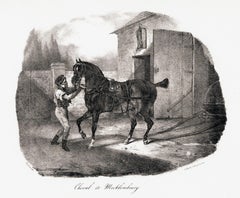
Cheval de Mecklembourg
— 19th-Century French Romanticism
By Jean Louis Andre Theodore Gericault
Located in Myrtle Beach, SC
Théodore Géricault 'Cheval de Mecklembourg' (Mecklembourg Horse), lithograph, 1822, 2nd state of 4, Delteil 47. Signed in the matrix 'Gericault', lower left. Published by Godefroy En...
Category
1820s Romantic Animal Prints
Materials
Lithograph
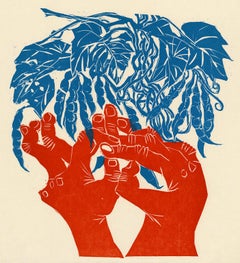
Drop of Life
— from
Solitude
for Henry David Thoreau
s
Walden
Located in Myrtle Beach, SC
Naoko Matsubara, 'Drop of Life' for the portfolio 'Solitude', color woodcut, 1971. A fine impression with fresh, vivid colors, on cream laid Japan paper, the full sheet with margins,...
Category
1970s Modern Figurative Prints
Materials
Woodcut
Winter Serenity
—from
Solitude
for Henry David Thoreau
s
Walden
Located in Myrtle Beach, SC
Naoko Matsubara, 'Winter Serenity' for the portfolio 'Solitude', woodcut, 1971, edition 100. Signed and numbered '58/100' in pencil. A fine, richly-inked impression, on cream laid J...
Category
1970s Modern Figurative Prints
Materials
Woodcut
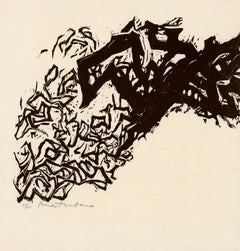
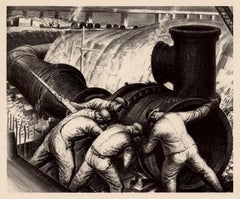
Pipe and Brawn
— WPA Era American Realism
By James Allen
Located in Myrtle Beach, SC
James Allen, 'Pipe and Brawn,' 1937, lithograph, edition 40. Signed and annotated 'Ed/40' in pencil. A superb, richly inked impression on cream wove paper, the full sheet with margin...
Category
1930s American Realist Figurative Prints
Materials
Lithograph
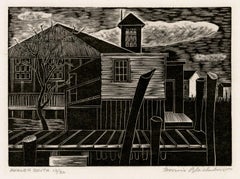
Avalon South
—— Mid-Century Modernism
Located in Myrtle Beach, SC
Morris Blackburn, 'Avalon South', wood engraving, 1951, edition 30. Signed, titled, and numbered '12/30' in pencil. A fine black impression on cream wove Japan paper, with wide margins (1 3/8 to 2 1/4 inches), in excellent condition. Archivally sleeved, unmatted.
Image size 5 x 7 inches (127 x 178 mm); sheet size 8 5/8 x 10 7/8 inches (219 x 276 mm).
ABOUT THE ARTIST
Morris Blackburn was a prominent painter, printmaker, and graphic artist, as well as a respected teacher at the Philadelphia Museum School of Industrial Art and the Pennsylvania Academy of Fine Arts.
Born in Philadelphia, where he spent most of his career, Blackburn was a descendant of the notable colonial portrait artist Joseph J. Blackburn (c. 1700–1780). He developed an interest in art early on and studied architectural drawing at the Philadelphia Trade School. In 1922, he took classes at the Graphic Sketch Club and later attended the School of Industrial Art. While working for the well-known Philadelphia furniture designer Oscar Mertz, he studied at the Pennsylvania Academy of the Fine Arts from 1925 to 1929. During his studies, he learned painting from Henry Bainbridge McCarter...
Category
1950s Modern Figurative Prints
Materials
Woodcut
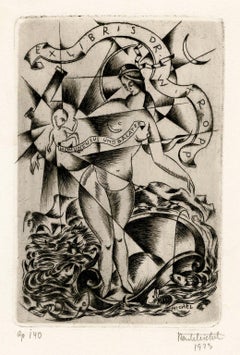
Ex Libris Dr. Witropp
— German Expressionism
By Karl Michel
Located in Myrtle Beach, SC
Karl Michel, 'Ex Libris Dr. Witropp - Homunculus und Galatee', etching, 1923, edition not stated. Signed, dated, and numbered 'Op. 140' (the artist's inventory number) in pencil. Si...
Category
1920s Expressionist Figurative Prints
Materials
Etching
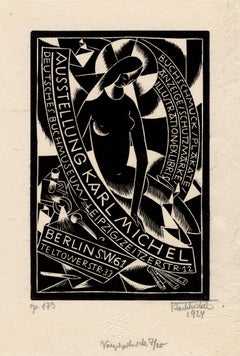
Karl Michel Exhibition
— German Expressionism
By Karl Michel
Located in Myrtle Beach, SC
Karl Michel, 'Austellung Karl Michel', woodcut, 1924, edition 20. Signed, dated, numbered 'op. 173' (the artist's inventory number) and '7/20' (the impression number/edition size) and annotated 'Vorgesdruck' (artist's proof) in pencil.
A fine, richly-inked impression on hand-made cream, wove paper, with full margins (1 1/16 to 1 1/2 inches); toning to the right sheet edge deckle, otherwise in good condition. With the artist's blind stamp in the bottom center margin. Designed and printed by the artist. Very scarce. Matted to museum standards (unframed).
An elegantly designed, dynamic exhibition announcement with the German copy in the block: 'Austellung Karl Michel – Deutsches Buchmuseum Leipzig/Zeitzer str 12, Berlin S.W. 61 Teltower str 33 / Buchschmuck/ Plakate/ Anzeige/ Schultzmarke/ Illustrations/ Ex Libris'. English translation: 'Karl Michel Exhibition – German Book Museum, Leipzig Zeitzer Street 12, Berlin, S.W. 61 Teltower St. 33. / Book Decoration / Posters / Announcements / Illustrations / Ex Libris.'
Image size 6 x 4 inches (152 x 102 mm); sheet size 8 1/16 x 5 1/2 inches (205 x 140 mm).
ABOUT THE ARTIST
Karl Michel (1889-1984) was a noted graphic designer and expressionist printmaker during Germany's pre-Nazi Weimar Republic (1919-1933). Michel’s work was the subject of a feature article in the influential German graphic design magazine 'Das Plakat' (The Poster) in 1920. An anti-war advocate, Michel created a suite of 12 wood engravings depicting his impressions of the humanitarian toll of WWII entitled ‘Humanitas’ (Humanity). The German publishing house Greifenverlag published the series in a folio of unsigned prints.
Michel’s graphic work is held in the permanent collections of the Auckland War Memorial Museum (New Zealand), Frederikshavn Kunstmuseum & Exlibrissamling (Denmark), Museum of Applied Arts (Budapest), The Robert Gore Rifkind Center for German Expressionist Studies at the Los Angeles County Museum of Art, and the German Expressionism...
Category
1920s Expressionist Figurative Prints
Materials
Woodcut
Little Girl
— American Modernism
By Milton Avery
Located in Myrtle Beach, SC
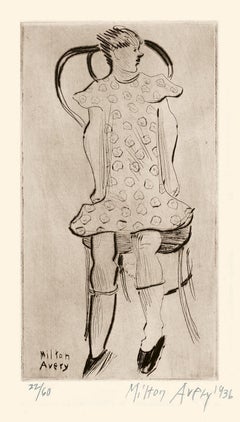
Milton Avery, 'Little Girl', drypoint, 1936, edition 60, Lunn 11. Signed, dated, and numbered '22/60' in pencil. A superb impression, in warm black ink with delicate overall plate tone, on off-white wove paper, with wide margins (2 5/8 to 4 1/8 inches); hinge stains on the top sheet edge, verso, otherwise in excellent condition. Matted to museum standards, unframed.
Image size 8 3/4 x 4 3/4 inches (222 x 121 mm); sheet size 14 7/8 x 13 1/8 inches (378 x 333 mm).
Collections: Cantor Arts Center, National Gallery of Art.
ABOUT THE ARTIST
"I never have any rules to follow; I follow myself."
"I paint not by sight but by faith. Faith gives you sight."
—Milton Avery
'His is the poetry of sheer loveliness.'
—Mark Rothko in his 1965 eulogy to Avery.
Milton Avery (1885-1965) is recognized as one of America's foremost modernist artists, renowned for his uniquely expressive style, evocative use of color, and captivating compositions.
Growing up in a working-class family in Altmar, New York, Avery's early life was marked by the struggles and realities of rural New York. Despite lacking formal artistic training, he displayed an innate talent for drawing from an early age. In 1905, his family relocated to Hartford, Connecticut, where he worked various odd jobs while developing his artistic skills through self-study and experimentation. In 1915, he enrolled at the Connecticut League of Art Students, where he received formal instruction and began to refine his distinctive style.
In 1918, Avery transferred to the School of the Art Society of Hartford and worked in the evenings so that he could paint during the day. He became a member of the Connecticut Academy of Fine Arts in 1924. That summer in Gloucester, Massachusetts, he met the artist Sally Michael...
Category
1930s American Modern Figurative Prints
Materials
Drypoint

$3,520 Sale Price
20% Off
Sundown, Stonington, Maine
— Artist-printed Exhibition Proof
By Lawrence Wilbur
Located in Myrtle Beach, SC
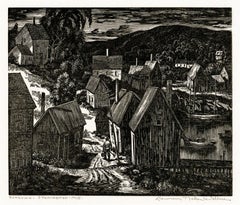
Lawrence Nelson Wilbur (1897-1988), 'Sundown, Stonington, Maine', wood engraving, artist's proof, edition not stated but small, 1969. Signed and titled in pencil. Signed in the block...
Category
1940s American Modern Landscape Prints
Materials
Woodcut
Tenant Farmers
— Depression Era, WPA
By Lou Barlow
Located in Myrtle Beach, SC
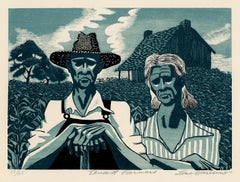
Lou Barlow (Louis Breslow), 'Tenant Farmers', color wood engraving, 1936, edition 25. Signed, titled, and numbered '15/25' in pencil. A superb, richly-inked impression, with fresh c...
Category
1930s American Modern Figurative Prints
Materials
Woodcut
Poppy
— Art Deco Pochoir from the acclaimed portfolio
RELAIS
By Edouard Benedictus
Located in Myrtle Beach, SC
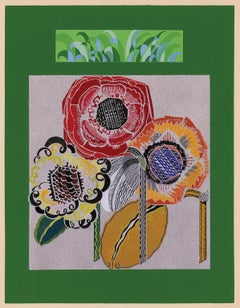
Edouard Benedictus, 'Poppy' from the portfolio 'Relais', plate 14, color pochoir, 1930. Signed in the matrix, in the center bottom margin. A superb, richly-inked impression, with fresh, vibrant colors, including metallic gold and silver inks, on heavy, cream wove paper; the full sheet with margins (1 3/8 inches), in excellent condition. Published by Éditions Vincent, Fréal et Cie, Paris. The pochoir production is by Jean Saudé, the French printmaker known for his mastery of the technique and the author of the first how-to book on the pochoir process. Matted to museum standards, unframed.
Image size 14 3/8 x 11 inches (365 x 279 mm); sheet size 17 1/4 x 13 7/8 inches (438 x 352 mm).
Impressions of this work are held in the following museum collections: Cooper-Hewitt National Design Museum Library (Smithsonian), Metropolitan Museum of Art, Minneapolis Institute of Art, New York Public Library, Toledo Museum of Art, Victoria and Albert Museum (London), Virginia Museum of Fine Arts.
ABOUT THIS WORK
The Pochoir process is a refined stencil-based technique employed to create multiples or to add color to prints produced in other mediums. Characterized by its crisp lines and rich color, the print-making process was most popular from the late 19th century through the 1930s, with its center of activity in Paris. The pochoir process began with the analysis of an image’s composition, including color tones and densities. The numerous stencils (made of aluminum, copper, or zinc) necessary to create a complete image were then designed and hand-cut by the 'découpeur.' The 'coloristes' applied watercolor or gouache pigments through the stencils, skillfully employing a variety of different brushes and methods of paint application to achieve the desired depth of color and textural and tonal nuance. The pochoir process, by virtue of its handcrafted methodology, resulted in the finished work producing the effect of an original painting, and in fact, each print was unique.
ABOUT THE ARTIST
Edouard Benedictus (1878 -1930), artist, designer, composer, and chemist, was born and died in Paris. A highly-regarded designer and art critic of the Art Nouveau era, Benedictus gained renown as a colorist and creator of Art Deco-inspired geometric and floral motifs. His work had a significant influence on international fashions in clothing, home furnishings, graphic design, and decorative objects of the period, earning him commissions from leading European design firms. In 1925 he was invited to represent Art Deco textile design...
Category
1930s Art Nouveau Figurative Prints
Materials
Stencil
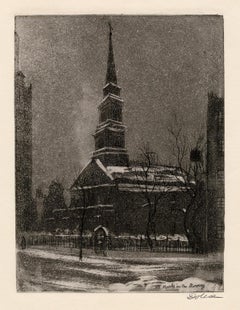
St. Marks on the Bowery
- Famed New York City Landmark
By Leon Dolice
Located in Myrtle Beach, SC
'St. Mark's Church on the Bowery', aquatint with etching, edition not stated but small, 1932. Signed in pencil. Signed in the plate lower left and titled in the plate lower right. A superb, atmospheric impression, on cream wove paper, with full margins (1 1/8 to 2 inches), in excellent condition. Matted to museum standards, unframed.
Image size 9 3/4 x 7 3/8 inches (248 x 187 mm); sheet size 13 1/8 x 10 inches (333 x 254 mm).
Impressions of this work are held in the collections of the Princeton University Art Museum and the Five College Museums.
ABOUT THE ARTIST
Born in Vienna, Leon Dolice left a secure position in the family business to pursue his artistic interests. He began his art education in his teens and early twenties when he traveled through Europe to study the works of the Old Masters. He immigrated to America in 1920 and made his home in Manhattan. As a printmaker, he chose as his subjects the architecture, back streets, dock scenes, and other aspects of New York City life that were being overtaken by the modern world.
In 1950, learning of the coming demolition of the Third Avenue El, Dolice created a series of Third Avenue and other New York City landmarks that were threatened with extinction. His images from that period provide a record of a New York that has passed into history.
During his lifetime, Dolice exhibited throughout Europe and the United States. Retrospectives of his work include a one-man show of his graphic work at Tribeca Gallery, New York; the traveling exhibition ‘Vintage New York’ with the New Rochelle Council on the Arts; and the Hofstra Museum, Hempstead.
Dolice's works are in the permanent collections of the Museum of the City of New York, the National Gallery of Art, the New York Historical Society, Georgetown University, the Philadelphia Print Club, and the New York Public Library, as well as private and corporate collections.
ABOUT ST. MARKS CHURCH
St. Mark's Church in-the-Bowery is a parish of the Episcopal Church located at 131 East 10th Street, at the intersection of Stuyvesant Street and Second Avenue in the East Village neighborhood of Manhattan in New York City. The property has been the site of continuous Christian worship since the mid-17th century, making it New York City's oldest site of continuous religious practice. The structure is the second-oldest church building in Manhattan.
In 1651, Petrus Stuyvesant, Director General of New Netherland, purchased land for a bowery or farm from the Dutch West India Company and, by 1660, built a family chapel at the present-day site of St. Mark's Church. Stuyvesant died in 1672 and was interred in a vault under the chapel.
Stuyvesant's great-grandson, Petrus "Peter" Stuyvesant, sold the chapel property to the Episcopal Church for $1 in 1793, stipulating that a new chapel be erected to serve Bowery Village, the community which had coalesced around the Stuyvesant family chapel. In 1795, the cornerstone of the present-day St. Mark's Church was laid, and the fieldstone Georgian-style church, built by the architect and mason John McComb Jr., was completed and consecrated on May 9, 1799.[4] Alexander Hamilton provided legal aid in incorporating St. Mark's Church as the first Episcopal parish independent of Trinity Church in New York City. By 1807, the church had as many as two hundred worshipers at its summer services, with 70 during the winter.
While the 19th century saw St. Mark's Church grow through its many construction projects, the 20th century was marked by community service and cultural expansion. Today, the rectory houses the Neighborhood Preservation Center, the Greenwich Village Society for Historic Preservation, and the Historic Districts Council, as well as other preservation and community organizations such as the Poetry Project, the Millennium Film Workshop, and the Danspace Project.
St Mark's has supported an active artistic community since the 19th century. In 1919, poet Kahlil Gibran was appointed a member of the St. Mark's Arts Committee, and the next year, the two prominent Indian statues, "Aspiration" and "Inspiration" by sculptor Solon Borglum...
Category
1930s American Modern Landscape Prints
Materials
Etching, Aquatint
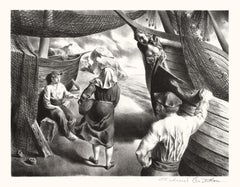
By the Arks
— Mid-20th Century Surrealism
By Federico Castellon
Located in Myrtle Beach, SC
Federico Castellon, 'By the Arks', 1941, lithograph, edition 250, Freundlich 10D. Signed in pencil. Signed in the stone, lower left. A fine, atmospheric impression on cream, wove pap...
Category
1940s Surrealist Figurative Prints
Materials
Lithograph
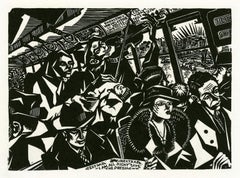
Modern Music
— WPA Modernism, New York City El
Located in Myrtle Beach, SC
Albert Potter, 'Modern Music' also Twilight Melodies', linocut, c. 1935, from the posthumous edition of 20, printed in 1977, authorized by the artist’s widow. Estate authenticated in...
Category
1930s American Modern Figurative Prints
Materials
Linocut
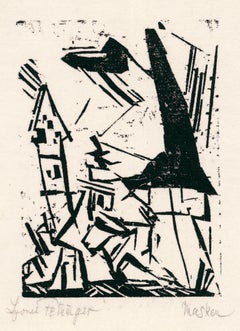
Masken (Masks)
— German Expressionism, Bauhaus
By Lyonel Feininger
Located in Myrtle Beach, SC
Lyonel Feininger, 'Masken (Masks)' also 'Carnival Masks', woodcut, 1920, proofs only. Prasse W193. Signed and titled in pencil. Annotated '1973', the artist’s inventory number. A fin...
Category
1920s Bauhaus Abstract Prints
Materials
Woodcut
Da - Da I
— German Expressionism, Rare
By Lyonel Feininger
Located in Myrtle Beach, SC
Lyonel Feininger, 'Da-Da I' also titled by the artist 'Der Abgott' (The Idol), woodcut, 1918, a proof impression. Prasse W91. Signed in pencil and annotated '1876', the artist’s inv...
Category
1920s Bauhaus Abstract Prints
Materials
Woodcut
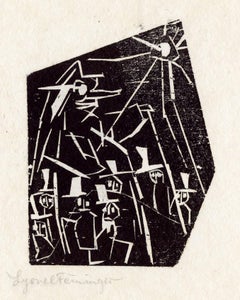
#3 — Modernist Abstraction — African American Artist
Located in Myrtle Beach, SC
Hilliard Reynolds Dean, '#3', color lithograph, 1970, edition not stated but small. Signed and titled in pencil. A fine impression, with fresh colors, on Arches, heavy, cream wove pa...
Category
1970s American Modern Abstract Prints
Materials
Lithograph
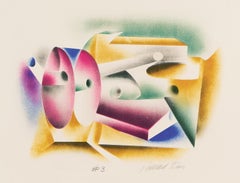
Sailor and His Girl
—Mid-Century Modernism, WWII
By Bernard Brussel-Smith
Located in Myrtle Beach, SC
Bernard Brussel-Smith, 'Sailor and His Girl', wood engraving, 1941, edition 35. Signed, titled, and numbered '21/35' in pencil. Signed in the block, lower right. A superb, richly-in...
Category
1940s American Modern Figurative Prints
Materials
Woodcut
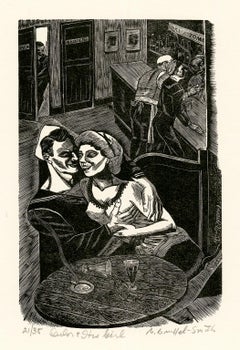
Chicago Harbor
— Urban Realism
By Anton Schutz
Located in Myrtle Beach, SC
Anton Schutz, 'Chicago Harbor', etching, edition 100, c. 1927. Signed and numbered '87/100' in pencil. Annotated '580 Chicago Harbor', in another hand, in the bottom left margin. A f...
Category
1920s American Realist Landscape Prints
Materials
Etching
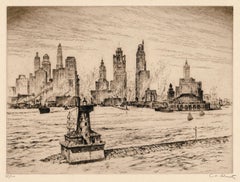
Spirit of Buffalo
— Urban Realism
By Anton Schutz
Located in Myrtle Beach, SC
Anton Schutz, 'Spirit of Buffalo', etching, edition not stated, c. 1927. Signed in pencil. Annotated 'Spirit of Buffalo 522', in another hand, in the bottom right margin. A fine, richly-inked impression, with skillfully-controlled plate tone, on cream wove Japan paper; the full sheet with margins (1 5/8 to 2 inches), in excellent condition. Matted to museum standards, unframed.
Image size 8 7/8 x 11 7/8 inches; sheet size 12 1/4 x 15 7/8 inches.
ABOUT THE ARTIST
Etcher, painter, and architect, Anton Schutz was born in Germany in 1894. He studied at the University of Munich, earning a double degree in mechanical engineering...
Category
1920s American Realist Landscape Prints
Materials
Etching
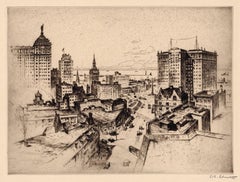
U.S. Chamber of Commerce
— 1920s Realism, Washington D.C.
By Anton Schutz
Located in Myrtle Beach, SC
Anton Schutz, 'U.S. Chamber of Commerce', etching, edition not stated, 1928. Signed in pencil. Annotated 'U.S. Chamber of Commerce S/516', in another hand, in the bottom right margin. A fine, richly-inked impression, with skillfully-controlled plate tone, on cream wove Japan paper; the full sheet with margins (1 3/4 to 2 3/8 inches), in excellent condition. Image size 9 7/8 x 7 7/8 inches; sheet size 14 1/8 x 11 5/8 inches. Matted to museum standards, unframed.
ABOUT THE ARTIST
Etcher, painter, and architect, Anton Schutz was born in Germany in 1894. He studied at the University of Munich, earning a double degree in mechanical engineering...
Category
1920s American Realist Landscape Prints
Materials
Etching
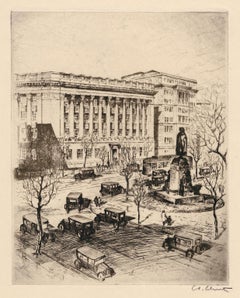
The White House
— Vintage Washington D.C.
By Anton Schutz
Located in Myrtle Beach, SC
Anton Schutz, 'White House', etching, edition not stated, c. 1928. Signed in pencil. A fine, richly-inked impression, with skillfully-controlled plate tone, on cream wove Japan paper; the full sheet with margins (1 to 2 1/8 inches), in excellent condition. Matted to museum standards, unframed.
Image size 8 7/8 x 11 7/8 inches; sheet size 11 1/4 x 15 3/8 inches.
ABOUT THE ARTIST
Etcher, painter, and architect Anton Schutz was born in Germany in 1894. He studied at the University of Munich, earning a double degree in mechanical engineering...
Category
1920s American Realist Landscape Prints
Materials
Etching
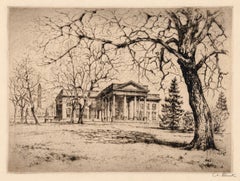
Taos Placita
— American Southwest Regionalist Masterwork
By Gustave Baumann
Located in Myrtle Beach, SC
Gustave Baumann, 'Taos Placita', color woodcut, 1947, edition 125. Baumann 132. Signed, titled, and numbered '20-125' in pencil; with the artist’s Hand-in-Heart chop. A superb, richly-inked impression, with fresh colors, on fibrous oatmeal wove paper; the full sheet with margins (2 to 3 1/8 inches); slight rippling at the left sheet edge, in excellent condition. Matted to museum standards, unframed.
Image size 9 5/8 x 11 1/4 inches (244 x 286 mm); sheet size 13 1/4 x 17 inches (337 x 432 mm).
Collections: Harwood Museum of Art, New Mexico Museum of Art, Phoenix Art Museum, Scottsdale Art Museum, Wichita Art Museum.
ABOUT THE ARTIST
Gustave Baumann (1881-1971) was a renowned printmaker and a leading figure of the American color woodcut revival whose exquisite craftsmanship and vibrant imagery captured the essence of the Southwest.
"A brilliant printmaker, Baumann brought to the medium a full mastery of the craft of woodworking that he acquired from his father, a German cabinetmaker. This craftsmanship was coupled with a strong artistic training that resulted in the handsome objects we see in the exhibition today. After discovering New Mexico in 1918, Baumann began to explore in his woodblock prints of this period the light. color, and architectural forms of that landscape. His prints of this period are among the most beautiful and poetic images of the American West."
—Lewis I. Sharp, Director, Denver Art Museum
Baumann, the son of a craftsman, immigrated to the United States from Germany with his family when he was ten, settling in Chicago. From 1897 to 1904, he studied in the evenings at the Art Institute of Chicago, working in a commercial printmaking shop during the day. In 1905, he returned to Germany to attend the Kunstwerbe Schule in Munich, where he decided on a career in printmaking. He returned to Chicago in 1906 and worked for a few years as a graphic designer of labels.
Baumann made his first prints in 1909 and exhibited them at the Art Institute of Chicago the following year. In 1910, he moved to the artists’ colony in Nashville, Indiana, where he explored the creative and commercial possibilities of a career as a printmaker. In 1915, he exhibited his color woodcuts at the Panama-Pacific International Exposition in San Francisco, winning the gold medal.
Among Baumann’s ongoing commercial activities was his work for the Packard Motor Car Company from 1914 to 1920 where he produced designs, illustrations, and color woodcuts until 1923.
In 1919, Baumann’s printmaking work dominated the important exhibition of American color woodcuts at the Detroit Institute of Arts. Twenty-six of his prints were included, far more than the works of any other artist. A set of his blocks, a preparatory drawing, and seven progressive proofs complemented the exhibition. That same year, Baumann worked in New York and, over the summer, in Provincetown, Massachusetts. His airy images of Cape Cod employed soft, pastel colors and occasionally showed the influence of the white-line woodcut technique.
Many of his Chicago artist friends had traveled to the southwest, and Baumann became intrigued by their paintings, souvenirs, and stories of an exotic place named Taos, New Mexico. In the summer of 1918, he spent the summer in Taos sketching and painting before visiting Santa Fe. Paul Walter, the director of the Museum of New Mexico, offered him a studio in the museum's basement. Inspired by the rugged beauty of the Southwest—the vibrant colors and dramatic landscapes of the region became a central theme in his work, influencing his artistic style and subject matter for the remainder of his career. Later in the decade, he traveled to the West Coast and made prints of California landscape.
Baumann's prints became synonymous with the Southwest, capturing the spirit of its place in America's identity with a unique sense of authenticity and reverence. His iconic images of desert vistas, pueblo villages, and indigenous cultures served as visual tributes to the region's rich cultural heritage, earning him a dedicated following among collectors and curators alike.
A true craftsman and artist, Baumann completed every step of the printmaking process himself, cutting each block, mixing the inks, and printing every impression on the handmade paper he selected. His dedication to true craftsmanship and his commitment to preserving the integrity of his artistic vision earned him widespread acclaim and recognition within the art world. About the vibrant colors he produced, Baumann stated, “A knowledge of color needs to be acquired since they don’t all behave the same way when ground or mixed...careful chemistry goes into the making of colors, with meticulous testing for permanence. While complicated formulae evolve new colors, those derived from Earth and metal bases are still the most reliable.”
In the 1930s, Baumann became interested in puppet theater. He designed and carved his own marionettes and established a little traveling company. From 1943 to 1945, the artist carved an altarpiece for the Episcopal Church of the Holy Faith in Santa Fe. In 1952, a retrospective exhibition of his prints was mounted at the New Mexico Museum of Fine Arts. Throughout his prolific career, Baumann executed nearly four hundred color woodcuts.
Baumann’s woodcuts...
Category
1940s American Modern Landscape Prints
Materials
Woodcut
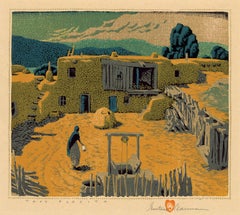
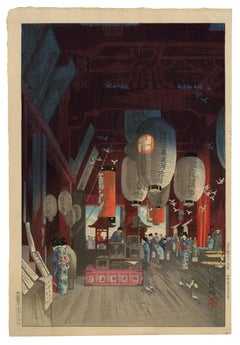
Interior of the Kannon Temple at Asakusa
— Tokyo Landmark, Early Edition
Located in Myrtle Beach, SC
NARAZAKI EISHO (1864-1936), 'Asakusa Kannon-do no naido' (Interior of the Kannon Temple at Asakusa), color woodblock print, 1932. Signed Eisho lower right, with the artist’s red seal beneath. A fine impression with fresh colors; the full sheet with slight overall age toning, a drying tack...
Category
1930s Interior Prints
Materials
Woodcut
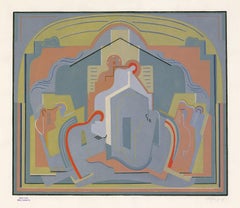
Descente de Croix
(Descent from the Cross) — 1920s French Cubism
By Albert Gleizes
Located in Myrtle Beach, SC
Albert Gleizes, 'Descente de Croix', color pochoir, 1928, edition c. 50. Signed and dated in pencil. A fine, painterly impression, with fresh colors, on heavy, cream wove paper; the full sheet with margins (3 to 4 inches), in very good condition. The publisher's ink stamp 'EDITIONS MOLY-SABATA' beneath the image, lower left. Matted to museum standards, unframed.
Image size 12 x 14 inches (305 x 356 mm); sheet size 18 x 22 inches (457 x 559 mm).
ABOUT THE IMAGE
After the 1927 painting 'Descente de Croix', one of three religious-themed works that Gleizes developed as preliminaries for murals at the church at Serrières, France, the project was terminated at its final phase, and Gleizes commissioned master printer Robert Pouyaud to create prints of the paintings, closely overseeing the production.
ABOUT THE MEDIUM
Pochoir is a refined stencil-based technique employed to create multiples or to add color to prints produced in other mediums. Characterized by its crisp lines and rich color, the print-making process was most popular from the late 19th century through the 1930s, with its center of activity in Paris. The pochoir process began with the analysis of an image’s composition, including color tones and densities. The numerous stencils (made of aluminum, copper, or zinc) necessary to create a complete image were then designed and hand-cut by the 'découpeur.' The 'coloristes' applied watercolor or gouache pigments through the stencils, skillfully employing a variety of different brushes and methods of paint application to achieve the desired depth of color and textural and tonal nuance. The pochoir process, by its handcrafted methodology, resulted in the finished work producing the effect of an original painting, and in fact, each print was unique.
ABOUT THE ARTIST
Albert Gleizes (1881-1953), born in Paris, France, was a pioneering figure in the development of abstract art and one of the leading proponents of Cubism. His contributions to the art world extended beyond his paintings; he was also a prolific writer and theoretician, advocating for a new approach to art that emphasized the geometric abstraction of form and a departure from representational traditions.
Gleizes initially studied painting at the Académie Julian and the École des Beaux-Arts in Paris, where he was exposed to the academic conventions of the time. However, his artistic vision was profoundly influenced by encounters with avant-garde movements, including Fauvism and the work of Paul Cézanne. These influences led Gleizes to experiment with form and color, gradually moving away from traditional representation toward a more abstract and geometric style.
After completing his secondary schooling, Gleizes spent four years in the French army and then began pursuing a career as a painter, primarily doing landscapes. Initially influenced by the Impressionists, he was only twenty-one years of age when his work titled ‘La Seine à Asnières’ was exhibited at the Société Nationale des Beaux-Arts in 1902. The following year, he was part of the first Salon d'Automne and soon came under the influence of Fernand Léger, Robert Delaunay, Jean Metzinger, and Henri Le Fauconnier. In 1907, Gleizes and some of his friends pursued the idea of creating a self-supporting community of artists that would allow them to develop their art free of any commercial concerns. For nearly a year, Gleizes , with other painters, poets, musicians, and writers, lived at a large house in Créteil, but a lack of funds forced them to give up their facility in early 1908, and Gleizes moved temporarily into La Ruche, the artist commune in the Montparnasse Quarter of Paris.
In the early 1910s, Gleizes became associated with the Cubist movement, which was spearheaded by artists such as Pablo Picasso and Georges Braque...
Category
1920s Cubist Abstract Prints
Materials
Stencil
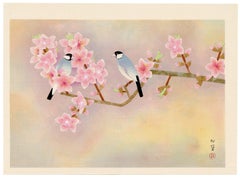
Inside the Flowers
(Java Sparrow and Peach Blossoms) — Mid-Century Japanese
Located in Myrtle Beach, SC
Shoko Uemura, 'Inside the Flowers (Java Sparrow and Peach Blossoms)', color woodcut, c. 1950s, edition 300. Signed in ink with the artist’s red seal beneath. A superb impression, with fresh, delicate colors, on cream wove Japan paper; the full sheet with margins (9/16 to 1 3/8 inches), in excellent condition. Archivally sleeved, unmatted.
Image size 12 3/4 x 18 1/2 inches (324 x 470 mm); sheet size 14 3/4 x 20 3/16 inches (375 x 513 mm).
Published by The Momose Print Company of Tokyo.
ABOUT THE ARTIST
Uemura Shoko (1902-2001) was the son of the famous shin-hanga artist Uemura Shoen...
Category
1950s Showa Animal Prints
Materials
Woodcut
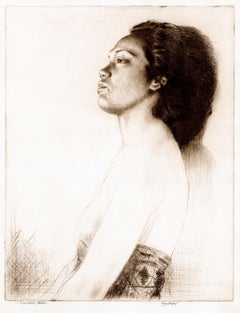
Mokihana (Hawaii)
— Classic Polynesian Portrait
Located in Myrtle Beach, SC
John Melville Kelly, 'Mokihana (Hawaii)', drypoint, 1946. Signed, titled, and annotated 'No 5' in pencil. A superb, finely nuanced impression, in dark brown ink, on cream wove Japan ...
Category
1940s American Modern Nude Prints
Materials
Drypoint
Sailing
— Modernism, New York City WPA
Located in Myrtle Beach, SC
Fred Becker, 'Sailing', wood engraving, c. 1935, edition c. 25. Signed and titled in pencil. A fine, richly-inked impression, on off-white wove paper; with full margins (1 to 2 15/16...
Category
1930s Modern Figurative Prints
Materials
Woodcut
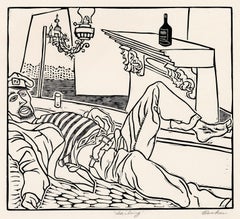
$720 Sale Price
20% Off
Delaware River Bridge
— Mid-Atlantic Regionalism
By Anton Schutz
Located in Myrtle Beach, SC
Anton Schutz, 'Delaware Bridge' (Delaware, New Jersey), etching, c. 1927. Signed in pencil. A superb, richly-inked impression, with skillfully wiped plate tone, on BFK Rives, cream wove paper, the full sheet with margins (1 1/2 to 2 1/8 inches), in excellent condition. Archivally matted to museum standards, unframed.
Image size 11 7/8 x 8 7/8 inches (302 x 225 mm); sheet size 15 7/8 x 12 1/4 inches (403 x 311 mm).
ABOUT THIS IMAGE
The Benjamin Franklin Bridge, originally named the Delaware River...
Category
1920s Realist Figurative Prints
Materials
Etching
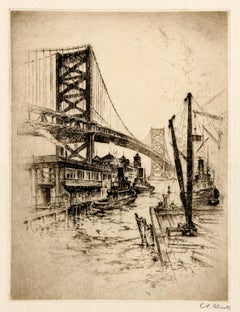
African Idol
— American Modernism, Chicago Avant-garde
By Robert Vale Faro
Located in Myrtle Beach, SC
Robert Vale Faro, untitled (African Idol), serigraph, c. 1940, edition 6. Signed in pencil. A fine impression, with fresh colors, on buff wove paper; the full sheet with margins(5/8 to 1 3/8 inches), in excellent condition. Very rare.
Matted to museum standards, unframed.
Image size 8 3/4 x 6 inches (222 x 152 mm); sheet size 11 x 7 1/2 inches (279 x 192 mm).
ABOUT THE ARTIST
Robert Vale Faro (1902-1988) was a well-known modernist architect and artist associated with the Chicago Bauhaus. He received his degree in architecture and design from the Armour Institute in Chicago and worked at L'Ecole des Beaux-Arts, Paris, from 1924-27, where he was influenced by Harry Kurt Bieg and Le Corbusier. Upon his return to Chicago, Faro worked with the important modernist Chicago architects George and William Keck under Louis Sullivan.
Faro founded the avant-garde printmaking group Vanguard in 1945. The group counted Atelier 17 artists Stanley William Hayter, Sue Fuller, and Anne Ryan as New York members and Francine...
Category
1940s American Modern Abstract Prints
Materials
Screen
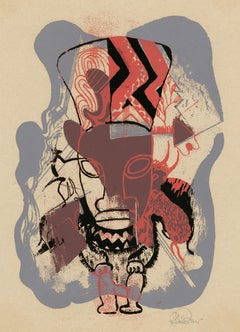
Bertoia — Mid-Century Visionary Abstraction, Unique
By Harry Bertoia
Located in Myrtle Beach, SC
Harry Bertoia, Untitled (Abstraction), monotype, c. 1960, a unique impression. Signed 'HB' in pencil, lower right sheet corner, verso. Inscribed '1852' (the artist’s inventory number) in pencil, lower right sheet corner, recto. A superb, painterly impression, on cream wove Japan paper, the full sheet, in excellent condition. Unmatted, unframed.
Sheet size 12 x 39 inches (30 x 99 cm).
Provenance: Val Bertoia; Private Collection; Rago Auctions, Lambertville, NJ.
Literature: 'Harry Bertoia: Monoprints,' Nancy N. Schiffer, Schiffer Publishing LTD, 2011; pg. 253.
This work is included in the Harry Bertoia Foundation digital resource, Harry Bertoia Catalogue Raisonné, number TD.MO.1584.
ABOUT THE ARTIST
Harry Bertoia (1915-1978) was a visionary Italian-American artist, sculptor, and designer. Born in San Lorenzo, Italy, Bertoia immigrated to the United States with his family at age fifteen, settling in Detroit, Michigan.
From an early age, Bertoia demonstrated a keen interest in art and design, studying painting and drawing at the Cass Technical High School in Detroit. Later, he attended the Cranbrook Academy of Art in Bloomfield Hills, Michigan, where he studied under renowned designers Eliel Saarinen and Charles Eames. At Cranbrook, Bertoia first began to explore the possibilities of working with metal, a medium that would come to define his artistic career.
In the 1940s, Bertoia moved to California to work for Charles and Ray Eames, contributing to the development of innovative molded plywood furniture. However, his experimentation with metal wire sculpture would ultimately catapult him to international acclaim. Bertoia's iconic "Sonambient" sculptures, consisting of delicate metal rods arranged in various configurations, created ethereal sounds when touched or moved, transforming the act of sculpture into a multisensory experience.
Bertoia's talent and innovation caught the attention of Florence Knoll, the founder of Knoll Associates, a leading furniture design company. In 1950, Bertoia began collaborating with Knoll, producing a series of iconic wire chairs that became emblematic of mid-century modern design. His "Diamond Chair," with its geometric form and airy construction, remains a classic of modern furniture design.
Bertoia continued to explore sculpture as a means of artistic expression, experimenting with new forms and materials. His work was characterized by organicism and fluidity, with forms that evoked natural phenomena such as waves, leaves, and clouds.
A decade before Harry Bertoia began creating three-dimensional sculpture, he dedicated his creative efforts to producing experimental prints at the Cranbrook Academy in Bloomfield Hills, Michigan, pursuing a passion that would continue for the rest of his life. With these spontaneous works, he worked intuitively, testing different tools and techniques to achieve his desired effects. Rather than using a traditional mechanical pressing process, he would apply ink to a glass or smooth Masonite plate with a sheet of paper laid directly on top. Then, tools such as brayers, dog hair brushes, styluses, and different parts of his hands were employed to draw or “press” the images on the back of the sheet. Rice paper was typically used due to its semi-translucent nature, offering Bertoia limited visibility of the effects of his experimentation, but ultimately, the unpredictable nature of the process was an integral aspect of the results, which never ceased to delight him. Each work was a singular composition with abstract imagery ranging from linear, structural compositions to fantastic surrealistic forms to poetic tonal landscapes. He received little input from other artists, developing his unique vision with rare purity and a deep personal resonance.
From his first year of printmaking in 1940, Bertoia quickly amassed an extensive collection of unique works. The compositions were strongly tied to the non-objective movement, which, while popular in Europe, was still in its nascent stages in the US. There were few proponents of this new art form to be found in the 1940s, and it was Hilla Rebay, then Director of the Guggenheim Museum of Non-Objective Art, who gave Bertoia the encouragement and promotion he needed. In 1943, Bertoia sent approximately 100 monotypes to Rebay for review. After receiving the prints, she responded with a surprising offer to buy them all. Rebay then began including them in the museum’s exhibitions.
The Guggenheim shows succeeded in putting Bertoia’s name out into the world. He began exhibiting his works regularly at the Neierndorf Gallery in New York and was provided a stipend to ensure a steady supply of prints until Karl Neierndorf died in 1947. By the 1950s...
Category
1960s American Modern Abstract Prints
Materials
Monotype
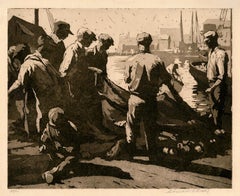
Mending Nets
— Cape Ann Regionalism, Rockport
Located in Myrtle Beach, SC
Christian Dull, 'Mending Nets', aquatint, c. 1930, edition 50. Signed and numbered '50/-' in pencil. A fine impression, on cream laid paper, the full sheet with margins (1/2 to 1 1/2...
Category
1920s American Modern Figurative Prints
Materials
Aquatint