Leighton Fine Art Ltd
to
1
182
132
47
39
38
37
29
28
21
15
12
9
8
8
6
4
2
2
1
1
1
10
9
7
6
5
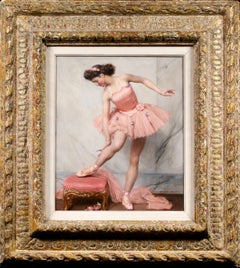
Une Ballerine - Realist Figurative Oil Painting by Auguste Leroux
Located in Marlow, Buckinghamshire
Signed oil on canvas figure in interior circa 1930 by French realist painter Jules Marie Auguste Leroux. The work depicts a brunette ballerina wearing a pink tutu and pointe shoes st...
Category
1930s Realist Figurative Paintings
Materials
Canvas, Oil

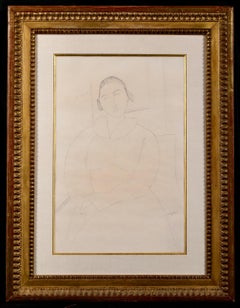
Portrait of Berthe Lipchitz - Modern Portrait Pencil Drawing - Amedeo Modigliani
By Amedeo Modigliani
Located in Marlow, Buckinghamshire
Signed pencil on paper portrait drawing by Italian artist Amedeo Clemente Modigliani. The portrait is of Berthe Lipchitz who was the wife of Modigliani's friend, the sculptor Jacques Lipchitz. This work is a study for "Portrait of Jacques & Berthe Lipchitz" which hangs in the Art Institute of Chicago.
Signature:
Signed lower right
Dimensions:
Framed: 26.75"x18.25"
Unframed: 18.75"x12.25"
Provenance:
The collection of Leopold Survage
The collection of Dimitri Snegaroff
The collection of Leopold Zborowski
Galerie Charpentier - Paris 1958
Private french collection
Galerie Pierre Levy - Paris
Private collection - United Kingdom
Exhibited:
Galerie Charpentier - Cent Tableaux de Modigliani - Paris, 1958
Les Peintres de Zborowski - ~Foundation L'Hermitage, Lausanne 1994
Amedeo Modigliani Exhibition - Museo d'Arte Moderna, Lugano 1999
Amedeo Modigliani was born into a middle-class Jewish family and was the brother of Eugenio Modigliani, who later became the leader of the Italian socialist workers’ party prior to the rise of fascism. Modigliani suffered from poor health as a child and contracted pleurisy in 1895, followed in 1898 by typhus with pulmonary complications, which culminated in tuberculosis in 1901. He moved to Livorno to study under Guglielmo Micheli, who had himself been a pupil of Giovanni Fattori, one of the Macchiaioli group of painters who worked in strong colour patches (macchie) to achieve vivid light and colour effects; their approach came as a reaction against academic art in Italy and, in much the same way as the French Impressionists, they advocated painting from nature rather than aspiring to communicate any particular message or ideology. In 1902, Modigliani enrolled at the academy of fine arts in Florence. He travelled to Rome and Venice in 1903, where he devoted the bulk of his day to visiting museums. At around this time he started to read Dante, dreaming no doubt of the Vita Nuova; he also devoured the works of Leopardi, Carducci, d’Annunzio, Spinoza and Nietzsche.
In 1906, Modigliani moved to Paris, lodging at the Rue Caulaincourt. At that juncture, nothing about him appeared to presage the brilliant career that was to follow. His arrival in the artists’ quarter, then known colloquially as the maquis - the labyrinthine tangle of narrow streets around today’s Avenue Junot in Montmartre - went virtually unnoticed by the artists already living and working there, including Picasso, Braque and Derain. Modigliani’s painting made next to no immediate impact and he was recognised primarily on account of his frail constitution, flashing eyes, innate elegance and intellectual prowess. He was accepted in the community that was Montmartre but never belonged to any particular ‘set’ or circle, and there is no record of his ever having been invited to Pablo Picasso’s studio, the famous ‘wash house’.
The literate and highly articulate Modigliani opted instead for the companionship of Maurice Utrillo, an instinctual painter of whom it could charitably have been said that his conversation was, at best, limited. Nonetheless, Modigliani and ‘Litrillo’ (as Utrillo was commonly known to the street urchins - the ‘p’tits poulbots’) began to frequent the cabarets and dance halls of the Butte de Montmartre, and the nefarious hashish dens - post-Baudelaire ‘institutions’, frequented in the main by out-of-work writers and talentless artists. Modigliani developed an addiction, which, compounded by his alcoholism, took its toll. It also transformed him from an artist of limited ability into one devoid of bourgeois scruples.
In his monograph, Modigliani: Sa Vie et Son Oeuvre, written in 1926 shortly after Modigliani’s death, André Salmon hinted at a ‘pact with the devil’. While somewhat overstating the case, this rather unpromising painter from Livorno metamorphosed virtually overnight into an artist of rare ability and sensitivity. The turning-point came in 1907, when Modigliani met Paul Alexandre, a doctor who befriended him, took him under his wing and purchased some of his work. The banal paintings he had turned out in Montmartre were suddenly superseded by exceptional works, produced first in Montmartre ( Cellist, 1909), and then in Montparnasse.
In Montparnasse, Modigliani started to move in artistic circles, meeting Chaim Soutine, Marc Chagall, Jules Pascin and others, all of whom lived and worked in the building in the Rue Vaugirard known as ‘La Ruche’ (‘the beehive’). Then, in the Cité Falguière, he met the Romanian-born sculptor Constantin Brancusi, who encouraged him to take up sculpture, which he did, between 1909 and 1913. In 1914, several dealers, including the erstwhile poet Léopold Zborowski and the collector Paul Guillaume, tried with little success to market Modigliani’s paintings. From 1914 to 1916, Modigliani was caught up in a tempestuous affair with the English poet and journalist Beatrice Hastings. In 1917, however, he met Jeanne Hébuterne at the Colarossi Academy, who became his constant companion and model, and who gave birth to their daughter Jeanne in 1918. In 1918 and 1919, Modigliani and Jeanne spent time in Nice on the Côte d’Azur but by 1920 he was suffering from tubercular meningitis. His friends, Kisling and the Chilean Ortiz de Zarate, brought him and a pregnant Jeanne back to Paris, where he died on January 20 1920 in the Hôpital de la Charité. His last words were reputed to be: ‘Cara Italia’. Modigliani’s brother, by this time a socialist member of parliament, telegrammed instructions to ‘bury him as befits a prince’. Jeanne Hébuterne, a budding twenty-year-old painter, killed herself and her unborn child on the day of Modigliani’s funeral by jumping to her death from a fifth-floor window.
Modigliani’s first paintings were undistinguished portraits in the Impressionist manner. After moving to Paris in 1907, his early work was influenced by the Swiss-born lithographer Théophile Alexandre Steinlen, Henri de Toulouse-Lautrec and Pablo Picasso, the latter then in his ‘blue’ period. From the onset, Modigliani’s principal preoccupation was the human figure. After the artistic (and literal) limbo of Montmartre, when his output was confined to a few Expressionist-like paintings of street life, the theatre and the circus, Modigliani suddenly erupted on the scene in 1909 with Cellist, a robust, well-constructed and vividly coloured canvas that utterly exceeded all prior expectations. He had not taken part in the protracted debates that took place nightly in Picasso’s studio, but he had superficially assimilated the Cubist ideas developed by Picasso and Georges Braque. Above all, Modigliani had been influenced by African art, which was a key feature of the Cubist movement. He succeeded in treading a fine line between the coolly analytical Cubist approach and the all-too-common European perception of African art as a succession of exaggerated facial grimaces.
It would appear that Modigliani had always been attracted to sculpture as a discipline. The friendly encouragement he received as of 1909 from Brancusi no doubt intensified his interest and reinforced his attempts to achieve a sustained simplicity of line and form. In 1910, he befriended the Russian artists Alexander Archipenko and Jacques Lipchitz, both of whom recorded Modigliani’s distaste for modelling in clay (which he referred to as ‘mud’), on the grounds that it degraded the art of sculpture. Like Brancusi, Modigliani believed in working directly, carving from wood in the case of two extant pieces, and from (sand)stone in others, with the exception of a few bronzes which were, presumably, modelled in clay before being cast into bronze. His sculpture was influenced by archaic and non-western cultures - early Graeco-Roman, African and Khmer - as well as heads carved on columns adorning the façades of Romanesque and Gothic cathedrals (Modigliani rarely sculpted a rear view of his figures). Up to approximately 1912, his sculptures take the form of tall cylinders, usually with elongated heads and shallow relief indentations or projections to indicate the hairline, facial features and neck. He departed from this style only infrequently, most notably in a small number of pieces believed to have been sculpted in 1913, which are characterised by a compressed, cubistic format and shallower and less distinct features. Modigliani eventually abandoned sculpture, presumably because of his general health and circumstances, and possibly due to the fact that his sculptures sold for even less than his paintings. During the years that he devoted to sculpture, Modigliani is recorded as producing only thirty canvases, although after 1913 his sculpture became reflected in his painting.
Following his Montmartre days, Modigliani’s work developed in both quantitative and qualitative terms, presumably helped by the relative stability of his relationship with Jeanne Hébuterne. The first paintings after his short-lived sculptural phase saw him revert briefly to Neo-Impressionist pointillism, followed by a episode marked by Cubism, which was mainly evident in portraits of friends and fellow artists living and working in Montparnasse: Henri Laurens; Juan Gris (1915); Jacques Lipchitz and his Wife; Chaim Soutine; Léopold Sauvage; Paul Guillaume; Max Jacob; Béatrice Hastings con Capello (all 1916); Mlle Modigliani (1917); Léon Bakst; Léopold Zborowski; Concierge’s Son; Adolescent (1918); Mademoiselle Lunia Czechowska; Madame Zborowska; Portrait of the Artist’s Wife (1919). A large number of other portraits exist among his drawings, most of which were executed impromptu in the street or cafés. These quickly drawn portraits often exhibit an urgency and surprising lucidity. Examples include Portrait of the Gypsy Painter Fabiano de Castro; André Salmon (1918); Portrait of the Artist’s Wife (1919); and Lada, Author; Mario, Composer (1920).
Whatever his shortcomings, Amedeo Modigliani ranks as one of the 20th-century’s greatest painters of the female form. The bulk of his painted nudes were produced in 1915-1916 (prior to that date they were predominantly drawings), and are taken from every walk of life, such as a regular at a Montparnasse café, or a waitress at the soup kitchen where he ate his meagre meals. In each instance, he invested his models with an almost aristocratic hauteur. This is exemplified in a number of paintings (usually based on numerous prior drawings): Flower Girl; Blonde Lady; Sleeping Nude (1917); Blonde Nude; Young Woman; Maria (1918); Pink Nude; Reclining Nude; Nude on a Divan; Woman with a Fan (1919); and Young Woman in a Chemise; Reclining Nude (1920). Modigliani painted his subjects in elongated, elliptic ovals: the swell of a breast, the pronounced curve of the pelvis, the fullness of the thigh, the symmetrically oval face and the graceful arabesque of the body. Facial features are reduced to a bare minimum, with the eyes typically empty, like those of a statue. He employed colour as a constructive material in much the same way as stone in sculpture, juxtaposing muted pinks, ochres and pale browns against discreet background tones supplied by décor and garments. The overall effect is to yield a flat image devoid of chiaroscuro but which captures the essence of a subject. It has often been remarked that his women, with their elongated heads and long, graceful necks, generally tilted to one side, possess a melancholy beauty akin to that of the Siena Madonnas (reproductions of which Modigliani kept pinned on his studio wall), which accounts for Modigliani’s soubriquet as the ‘painter of sorrows’. From 1917, the majority of his nudes, characterised by a more pronounced elongation of the female body and lighter palette, were modelled by Jeanne Hébuterne and Luna Czechowska.
Very few artists have been the subject of so many monographs and biographies as Modigliani; the selection appended to this entry indicates only some of the more important of these. Too much, perhaps, has been made of his life as an artiste maudit, of his ‘accursed’ yet colourful life rather than the quality of his work. Some critics have detected in him an artist of great and persistent intellectual curiosity; others emphasise that he was a ‘gentleman to the end’ and stress his physical frailty, ignoring the fact that this was an integral component of his creativity. More seriously, his posthumous fame amongst the public at large acts both for and against him, as if his subsequent popularity has become a yardstick of his artistic ability. The mannerism of his style ensures that a ‘Modigliani’ is instantly recognisable, but his success in adapting Cubism and African art to a language and palette that are entirely his own places him squarely at the heart of the modern movement.
Amedeo Modigliani’s work has featured in numerous group exhibitions, including: Paris in 1908, when he showed his Jewess and three other canvases; the Salon des Indépendants in 1910; and the Salon d’Automne in 1912, where he exhibited examples of his sculpture. His posthumous inclusion in the 1922 Venice Biennale was regarded in Italy as a complete fiasco, prompting the critic Giovanni Scheiwiller to paraphrase Charles Baudelaire’s remark to the effect that, ‘we know that precious few will understand us, but that shall be sufficient’. In 1917-1918, the Berthe Weill Gallery organised a one-man show at the instigation of Zborowski but, on the order of the then chief of police, some of Modigliani’s sensual nudes were withdrawn on account of alleged indecency. On 20 December 1918, the Paul Guillaume Gallery exhibited several paintings by Modigliani alongside others by Matisse, Picasso and Derain.
All other exhibitions of Modigliani’s work have been held since his death. They include those at the Bernheim-Jeune Gallery in Paris (1922); Galerie Bing (Paris, 1925 and 1927); Marcel Benhelm Gallery (Paris, 1931); Palais des Beaux-Arts (Brussels, 1933); Kunsthalle Basel (1934); American-British Art Center (New York, 1944); Galerie de France (Paris, 1945 and 1949); Gimpels Fils Gallery (London, 1947); Cleveland Museum of Art (1951); Museum of Modern Art (New York, 1951); Cantini Museum (Marseilles, 1958); Palazzo Reale (Milan, 1958); Galerie Charpentier (Paris, 1958); Chicago Arts Club (1959); Cincinnati Art Museum (1959); Galleria Nazionale d’Arte Moderna (Rome, 1959); Boston Museum of Fine Arts (1961); Perls Galleries (New York, 1963 and 1966); Kyoto National Museum of Modern Art (1968); Musée Jacquemart-André (Paris, 1970); Musée St-Georges (Liège, 1980); Tokyo Arts Centre (1980); Musée de l’Art Moderne de la Ville de Paris (1970; a comprehensive exhibition of Modigliani’s sculptures...
Category
1910s Modern Portrait Drawings and Watercolors
Materials
Paper, Pencil
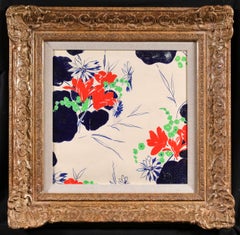
Projet de Tissus - Fauvist Flowers Watercolor
Gouache by Raoul Dufy
By Raoul Dufy
Located in Marlow, Buckinghamshire
Botanical watercolour and gouache on paper circa 1920 by French fauvist painter Raoul Dufy. The work depicts flowers in red, blue and green. This work was executed by Dufy as a fabric design.
Dimensions:
Framed: 19.5"x19.5"
Unframed: 12"x12"
Provenance:
Private collection of works by Raoul Dufy for Bianchini Ferier
Bianchini Ferrier Collection - Christie's London - July 2001
SF Fall Show
Raoul Dufy was one of a family of nine children, including five sisters and a younger brother, Jean Dufy, also destined to become a painter. Their father was an accountant in the employ of a major company in Le Havre. The Dufy family was musically gifted: his father was an organist, as was his brother Léon, and his youngest brother Gaston was an accomplished flautist who later worked as a music critic in Paris. Raoul Dufy's studies were interrupted at the age of 14, when he had to contribute to the family income. He took a job with an importer of Brazilian coffee, but still found time from 1892 to attend evening courses in drawing and composition at the local college of fine arts under Charles Marie Lhullier, former teacher of Othon Friesz and Georges Braque. He spent his free time in museums, admiring the paintings of Eugène Boudin in Le Havre and The Justice of Trajan in Rouen. A municipal scholarship enabled him to leave for Paris in 1900, where he lodged initially with Othon Friesz. He was accepted by the École des Beaux-Arts, where he studied under Léon Bonnat, whose innate conservatism prompted Dufy to remark later that it was 'good to be at the Beaux-Arts providing one knew one could leave'.
And leave he did, four years later, embarking with friends and fellow students on the rounds of the major Paris galleries - Ambroise Vollard, Durand-Ruel, Eugène Blot and Berheim-Jeune. For Dufy and his contemporaries, Impressionism represented a rejection of sterile academism in favour of the open-air canvases of Manet, the light and bright colours of the Impressionists, and, beyond them, the daringly innovative work of Gauguin and Van Gogh, Seurat, Cézanne, Toulouse-Lautrec and others. Dufy was an out-and-out individualist, however, and was not tempted to imitate any of these artists. He produced, between 1935 and 1937, Fée Electricité (Spirit of Electricity), the emblem for the French utilities company Electricité de France (EDF).
Dufy visited the USA for the first time in 1937, as a member of the Carnegie Prize jury. In 1940, the outbreak of war (and his increasingly rheumatic condition) persuaded him to settle in Nice. When he eventually returned to Paris 10 years later, his rheumatism had become so debilitating that he immediately left for Boston to follow a course of pioneering anti-cortisone treatment. He continued working, however, spending time first in Harvard and then in New York City before moving to the drier climate of Tucson, Arizona. The cortisone treatment was by and large unsuccessful, although he did recover the use of his fingers. He returned to Paris in 1951 and decided to settle in Forcalquier, where the climate was more clement. Within a short time, however, he was wheelchair-bound. He died in Forcalquier in March 1953 and was buried in Cimiez.
Between 1895 and 1898, Raoul Dufy painted watercolours of landscapes near his native Le Havre and around Honfleur and Falaise. By the turn of the century, however, he was already painting certain subjects that were to become hallmarks of his work - flag-decked Parisian cityscapes, Normandy beaches teeming with visitors, regattas and the like, including one of his better-known early works, Landing Stage at Ste-Adresse. By 1905-1906 Friesz, Braque, Matisse, Derain, Vlaminck, Van Dongen and Rouault were described collectively as Fauves (the wild beasts). What they had in common was a desire to innovate, but they felt constrained nonetheless to meet formally to set out the guiding principles of what promised to be a new 'movement'. Dufy quickly established that those principles were acceptable; moreover, he was most impressed by one particular painting by Henri Matisse ( Luxury, Calm and Voluptuousness) which, to Dufy, embodied both novelty and a sense of artistic freedom. Dufy promptly aligned himself with the Fauves. Together with Albert Marquet in particular, he spent his time travelling the Normandy coast and painting views similar...
Category
1920s Fauvist Still-life Drawings and Watercolors
Materials
Paper, Watercolor, Gouache
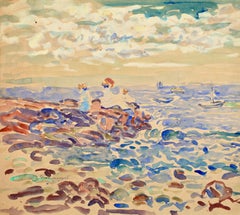
Saint Malo - Post Impressionist Seascape Watercolor by Maurice Prendergast
Located in Marlow, Buckinghamshire
Signed watercolour on paper landscape by American post impressionist painter Maurice Brazil Prendergast. The work depicts children playing on the beach in Saint Malo, France as boats sail in the blue sea and white clouds role through the sky overhead. This work has remained in the Prendergast family for 3 generations and depicts a rare view of Saint-Malo executed during Prendergast's visit to the french coastal town in 1907
Signature:
Signed lower left
Dimensions:
Framed: 21"x22"
Unframed: 13'x14"
Proveance:
The collection of Charles Prendergast (1863-1948)
The collection of Eugénie Prendergast-Van Kemmel (1895-1994) -wife and inheritor of the estate of Charles Prendergast
The collection of Henri Van Kemmel (Lille, 1903-1963) - cousin of Eugenie Prendergast
- Madame Henri Van Kemmel
Maurice Prendergast came with his family to Boston in 1861. Working in a textile store, Maurice Prendergast was at first self-taught in painting, making souvenir cards and shop signs. He went to Britain in 1886, then to Paris in 1891 and registered at the Académie Julian with Jean-Paul Laurens, Benjamin-Constant, and Charles Blanc as teachers, working also with Gustave Courtois at the Académie Colarossi. More importantly he saw the Impressionists’ paintings and the Nabis at the Galerie Durand-Ruel. He returned to the United States in 1895, settling in Winchester (Massachusetts) and went frequently to New York. In 1898 he again went to Europe where he stayed until 1900, visiting Paris, Florence, Siena, Rome, Capri, and Venice, where he spent six months. Between 1907 and the beginning of World War I he went again four times to Europe but never returned there after the war. In New York where he finally settled, with William Glackens, Robert Henri, and John Sloan among others, Prendergast was one of the members ofThe Eight, gathered by Robert Henri to counter the pervading academicism. The group exhibited in 1908 at the Macbeth Galleries and took part in the Armory Show of 1913. After that Prendergast did not exhibit again with the group. In 1914 he left Boston definitively for New York.
Prendergast was in his thirties before he began to devote himself to painting. In his late beginnings he painted in the open air as the Impressionists did, mainly in watercolours with clear brushstrokes and an elegant virtuosity recalling his then admiration for James Whistler and Claude Monet. Between 1892 and 1905 he carried out two hundred monotypes, a technique of which he was the undisputed master in America at that time and which expressed the influence of Japanisme. During his stays in France he painted views of Paris, but also Brittany and Normandy. In this period, in 1896, he was chosen to illustrate My Lady Nicotine by Matthew Barrie. During his third stay in Europe, from 1898 to 1900, he painted in Paris, at Saint-Malo, and mainly in Venice, where, influenced by Vittore Carpaccio he introduced brightly coloured banners into his animated compositions. In oils he painted slowly, touching up his paintings by superimposed brushstrokes, sometimes over several years. He chose to use the divided stroke in an early period, a technique which had similarities with Post-Impressionism. After his travels in Europe and his discovery of Paul Cézanne, he evolved in the direction of the neo-Impressionism of Georges Seurat, placing little dots of colours with a knife, then of the Nabis and even later Fauvism, painting large brushed surfaces in bright colours. After 1899, his Ponte della Paglia in Venice freed itself from strict divisionism, adopting the dense composition in vertically superimposed planes of the Nabis. Like the members of the group of eight, he took his subjects from the daily life of ordinary people, in scenes in the parks or on the beaches of New England, picnics or sometimes circuses. Nevertheless the happy vision that he had of the world separated him strongly from the evolution that led his companions to paint the most miserable and populous milieus, which gave them the name of The Ashcan School. His compositions are arranged in surfaces superimposed vertically, without depth; while the Impressionists and Post-Impressionists were influenced by the layout of Japanese prints, Prendergast was inspired more by Persian miniatures. The decorative elements and the build-up of characters in crowds are placed frontally, like garlands on a tapestry, particularly as he seeks a texture effect, covered entirely by the subject without any empty spaces. His attraction to colours caused him to research all the motifs that he introduced into these compositions: umbrellas, parasols, balloons, draperies. In 1911–1912, he experimented with pastel and treated new subjects, nudes and still-lifes. After 1913, in sympathy with the Symbolists, he put nude figures and everyday characters side by side in the same composition. In his last years, and above all in the watercolours, he discarded the divided stroke and applied larger brushstrokes, similar to the technique of Henri Matisse. Fidelity to the leisurely settings and elegant grooming of the period gave his works, apart from their artistic value, a charming sociological aspect. Singular, almost marginal in his time, his paintings stand out by the density of their composition, in form and colouring, characterised by the accumulation of detail, minutiae of scenery, the serried ranks of people that animate them, the chromatic polyphony of elegance, umbrellas, parasols, and flags. He is a complete painter, particularly generous, who would never be happy to provide only samples of his art. Following Whistler and Mary Cassatt, Maurice Prendergast is one of the most interesting and original Post-Impressionist American painters, and perhaps marks exactly the boundary between the 19th and the 20th centuries.
He was considered to be an ‘old master’ from 1920 on, and his works appeared in very many exhibitions of modern American painting. He had his first solo exhibition in 1897 at the Chase Gallery of Boston, where his works were noticed by Madame Montgomery Sears, who made a collection, taking the advice of Mary Cassatt. In 1915 six paintings and watercolours exhibited at the Carroll Gallery of New York established his success and drew the great collectors to him, among whom were Albert Barnes and John Quinn.
Group Exhibitions
1974, Ten Americans, Andrew Crispo Gallery, New York
1976, Art of Impulse and Color, University of Maryland Art Gallery, College Park (Maryland)
1982, American Impressionists, Smithsonian Institution, Washington, DC (also presented at the Musée du Petit Palais, Paris)
1999, Town and Country: American Artists, 1870–1920 (Ville et campagne: les artistes américains, 1870–1920), Musée d’Art Américain, Giverny
2002, Japonisme in America: Works on Paper, 1880–1930 (Le Japonisme en Amérique: œuvres sur papier, 1880–1930), Musée d’Art Américain/Terra Foundation for the Arts, Giverny
2007, American Impressionists: Painters of Light and the Modern Landscape, Phillips Collection, Washington, DC
2008, Coming of Age: American Art 1850–1950, Paintings from the Addison Gallery of American Art, Massachusetts, Dulwich Picture Gallery, London
2008, Portrait of a Lady: Paintings and Photographs of American Women in France 1870–1915, Musée des Beaux-Arts, Bordeaux
Solo Exhibitions
1934, Maurice Prendergast Memorial Exhibition, Whitney Museum of American Art, New York
1938, Retrospective Exhibition of the Work of Maurice and Charles Prendergast, Addison Gallery of American Art, Andover, MA
1960, Maurice Prendergast, 1859–1924, Museum of Fine Arts, Boston
1990, Art Institute of Chicago
2009, Prendergast in Italy, Peggy Guggenheim Collection, Venice
Museum and Gallery Holdings
Andover, MA (Addison Gal. of American Art): At the Shore, St. Malo No. 1 and 2 (c. 1907, watercolour and graphite on wove paper, 2 works); Along the Cove (1910–1913, oil on canvas); seven sketches of Paris (1893, oil on wood)
Chicago (AI): In the Park (1918–1919)
Chicago (Terra Foundation for American Art Collection): Festa del redentore (c. 1899, monotype); The Opera Cloak...
Category
Early 1900s Post-Impressionist Landscape Paintings
Materials
Paper, Watercolor
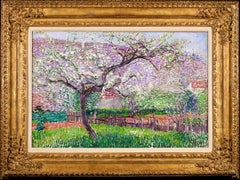
Pommiers en Fleurs - Post Impressionist Divisionist Landscape Oil by Leon Detroy
By Leon Detroy
Located in Marlow, Buckinghamshire
Signed oil on canvas landscape circa 1920 by French post impressionist painter Leon Detroy. The piece is painted in a divisionist style and depicts blossoming apple trees in an orcha...
Category
1920s Post-Impressionist Landscape Paintings
Materials
Canvas, Oil
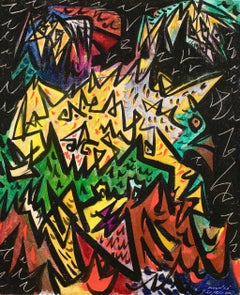
Les Insectes - Cubist Oil Painting by Andre Masson
By André Masson
Located in Marlow, Buckinghamshire
Signed, titled and dated cubist oil on canvas by French painter Andre Masson. The work depicts colourful insects.
Signature:
Signed lower right and titled and dated 1946 verso
Dim...
Category
1940s Cubist Animal Paintings
Materials
Canvas, Oil
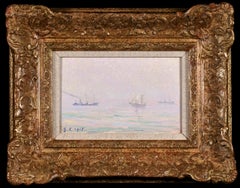
Rade de Saint-Milo - Post Impressionist Seascape Oil Painting by Gustave Cariot
By Gustave Camille Gaston Cariot
Located in Marlow, Buckinghamshire
Signed and dated oil on panel seascape by French post impressionist painter Gustave Cariot. The work depicts a view of sail boats and steam boats out at sea in the bay of Saint-Malo ...
Category
1910s Post-Impressionist Landscape Paintings
Materials
Oil, Panel
Soir D
Orage - Impressionist Seascape Oil Painting by Maxime Maufra
By Maxime Maufra
Located in Marlow, Buckinghamshire
Signed and dated oil on canvas seascape painting by French impressionist painter Maxime Maufra. The piece depicts a ship sailing on the horizon in a stormy sea at evening time.
Sign...
Category
1890s Impressionist Landscape Paintings
Materials
Canvas, Oil
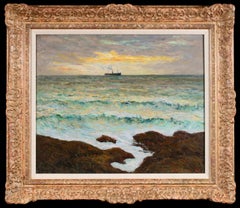
Au Verger - Post Impressionist Landscape Oil By Hugues Claude Pissarro
Located in Marlow, Buckinghamshire
Signed and titled oil on canvas circa 1990 by French painter Hugues Claude Pissarro. The piece depicts a woman in a red dress collecting apples in an orchard.
Signature:
Signed lowe...
Category
1990s Post-Impressionist Landscape Paintings
Materials
Canvas, Oil
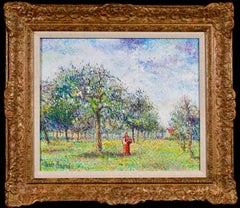
Vase de fleurs - Impressionist Still Life Oil Painting by Leon Detroy
By Leon Detroy
Located in Marlow, Buckinghamshire
Signed still life oil on canvas circa 1920 by French impressionist painter Leon Detroy. The work depicts a ceramic vase filled with flowers in reds, pinks and yellows and set agains...
Category
1920s Impressionist Still-life Paintings
Materials
Canvas, Oil
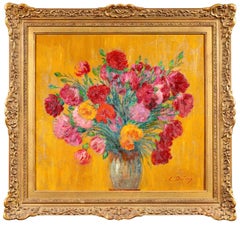
Marché à Prizren - Post Impressionist Figurative Oil by Jacques Martin-Ferrieres
By Jacques Martin-Ferrières
Located in Marlow, Buckinghamshire
Signed figurative oil on panel circa 1938 by post impressionist painter Jacques Martin-Ferrieres. This wonderful piece depicts people marching to Prizen in the former Yugoslavia. Mar...
Category
1930s Post-Impressionist Figurative Paintings
Materials
Oil, Panel
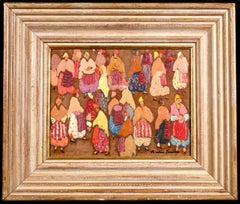
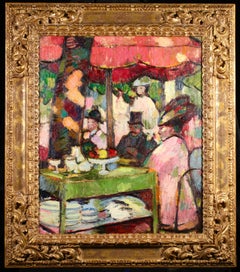
Tea at Chateau de Madrid - Modernist Figurative Oil by Anne Estelle Rice
By Anne Estelle Rice
Located in Marlow, Buckinghamshire
Signed and titled oil on panel figures in landscape by American painter Anne Estelle Rice. This beautiful and colourful piece depicts groups of elegantly dressed people enjoying tea ...
Category
1910s Expressionist Figurative Paintings
Materials
Oil, Panel
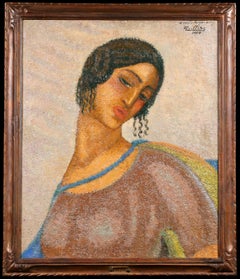
Portrait de Femme - Modernist Portrait Oil Painting by Alfredo Guttero
Located in Marlow, Buckinghamshire
Signed oil on canvas portrait painting by Argentine modernist painter Alfredo Guttero. The work is a head and shoulders portrait of a woman with black hair and wearing a shawl.
Sign...
Category
1910s Modern Portrait Paintings
Materials
Canvas, Oil
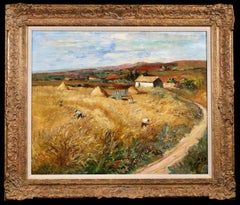
Le Moisson - Provence - Post Impressionist Landscape Oil by Marcel Dyf
By Marcel Dyf
Located in Marlow, Buckinghamshire
Signed oil on canvas figures in landscape circa 1950 by French post impressionist painter Marcel Dyf. The work depicts doing a late summer harvest in Provence, France.
Signature:
Si...
Category
1950s Post-Impressionist Landscape Paintings
Materials
Canvas, Oil
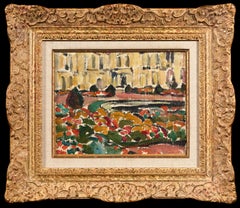
L
Orangerie de Versailles - Fauvist Landscape Oil Painting by Louis Valtat
By Louis Valtat
Located in Marlow, Buckinghamshire
Signed fauvist oil on canvas landscape by French painter Louis Valtat. The work depicts the floral gardens in front of the Orangery at the Chateau de Versailles.
Signature:
Signed l...
Category
1910s Fauvist Landscape Paintings
Materials
Canvas, Oil
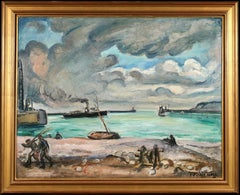
Port of Le Havre
Sainte-Adrese- Post Impressionist Seascape Oil - Othon Friesz
By Achille-Émile Othon Friesz
Located in Marlow, Buckinghamshire
Signed and dated oil on canvas seascape by French post impressionist painter Achille-Emile Othon Friesz. The piece depicts a view of Le Havre, a port city in Normandy, France, locate...
Category
1920s Post-Impressionist Landscape Paintings
Materials
Canvas, Oil
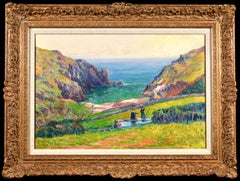
Porte La Motte - Brittany - Post Impressionist Landscape Oil by Jules Le Ray
Located in Marlow, Buckinghamshire
Signed, titled and dated oil on canvas figures in landscape by post-impressionist painter Jules Le Ray. The piece depicts two women on a top of a cliff overlooking the port of La Mor...
Category
1920s Post-Impressionist Landscape Paintings
Materials
Canvas, Oil
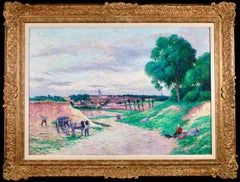
L
entree du village - Impressionist Figures in Landscape Oil by Maximillien Luce
By Maximilien Luce
Located in Marlow, Buckinghamshire
Signed and dated figures in landscape oil on canvas by French impressionist painter Maximilien Luce. The piece depicts a view of the road leading into the village of Mereville in Ess...
Category
Early 1900s Impressionist Figurative Paintings
Materials
Canvas, Oil
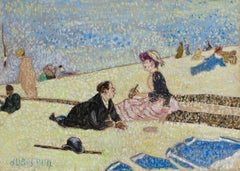
Picnic by the Seine - Impressionist Figurative Oil by Albert Dubois-Pillet
Located in Marlow, Buckinghamshire
Signed oil on paper laid on board figures in landscape circa 1890 by French Neo-Impressionist painter Albert Dubois-Pillet. This pointillist piece depicts and elegant couple enjoying...
Category
1890s Pointillist Figurative Paintings
Materials
Oil, Board, Laid Paper
Lavandieres - Barbizon Figurative Landscape Pastel by Leon Lhermitte
By Léon Augustin Lhermitte
Located in Marlow, Buckinghamshire
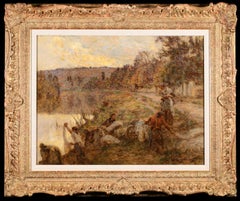
Signed figures in riverscape oil on canvas by French Barbizon painter Leon Augustin Lhermitte. The piece depicts a rural landscape with washerwomen in traditional Breton clothing was...
Category
1920s Barbizon School Figurative Paintings
Materials
Canvas, Oil
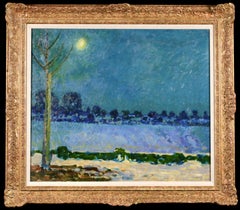
Winter Moonlight - Signed Landscape Oil Painting by Max Clarenbach
Located in Marlow, Buckinghamshire
Signed oil on canvas landscape circa 1930 by German post impressionist painter Max Clarenbach. The work depicts a winter scene, with snow laying thick on the ground. To the foregroun...
Category
1930s Post-Impressionist Landscape Paintings
Materials
Canvas, Oil
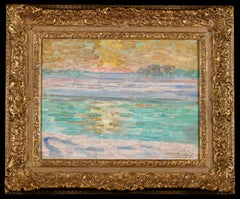
Winter Sunset - The Lys - Neo-Impressionist Landscape Oil by Jenny Montigny
Located in Marlow, Buckinghamshire
Signed oil on artist's board riverscape circa 1910 by Belgian neo-impressionist painter Jenny Montigny. The piece depicts a view of the River Lys in winter as the sun sets. The river...
Category
1910s Post-Impressionist Landscape Paintings
Materials
Oil, Board
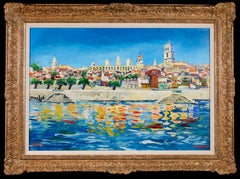
Arles - Post Impressionist Landscape Oil Painting by Elisee Maclet
By Élisée Maclet
Located in Marlow, Buckinghamshire
Signed oil on canvas landscape circa 1920 by French post impressionist painter Elisee Maclet. The work depicts a view of the coastal city of Arles in the South of France from the wat...
Category
1920s Post-Impressionist Landscape Paintings
Materials
Canvas, Oil
Sunrise - The Valley of Mexico - Impressionist Landscape Oil - C Wise Chapman
By Conrad Wise Chapman
Located in Marlow, Buckinghamshire
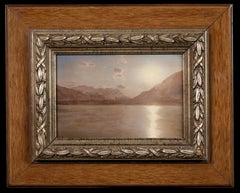
Signed, dedicated and dated oil on panel landscape by American Impressionist painter Conrad Wise Chapman. The work depicts a lakeside view of the sun rising above the mountains in th...
Category
1890s Impressionist Landscape Paintings
Materials
Oil, Panel
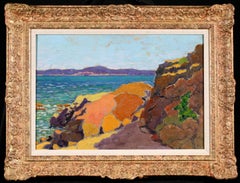
Rochers sur la cote - Nabis School (1890-1896) Seascape Oil
Located in Marlow, Buckinghamshire
Indistinctly monogrammed Nabis school oil on canvas circa 1915. The work depicts a rocky shoreline with the blue ocean beyond and a clear sky overhead.
Signature:
Indistinctly monog...
Category
1910s Post-Impressionist Landscape Paintings
Materials
Canvas, Oil
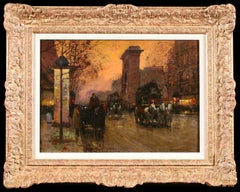
Port Saint-Denis - Le Soir - Impressionist Cityscape Oil by Edouard Cortes
By Édouard Leon Cortès
Located in Marlow, Buckinghamshire
Signed oil on canvas figures in landscape circa 1920 by sought after French impressionist painter Edouard Cortes. The work depicts an autumnal scene of the the Porte Saint-Denis (St ...
Category
1920s Impressionist Figurative Paintings
Materials
Canvas, Oil
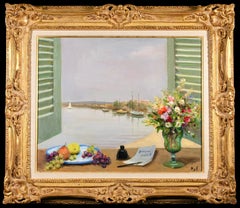
Pourquoi partir? - Post Impressionist Still Life Landscape Oil by Marcel Dyf
By Marcel Dyf
Located in Marlow, Buckinghamshire
Signed oil on canvas still life in landscape circa 1980 by sought after French post impressionist painter Marcel Dyf. The work depicts a view of a harbour from beyond the open green ...
Category
1980s Post-Impressionist Landscape Paintings
Materials
Canvas, Oil
Soleil Couchant - Honfleur - Impressionist Seascape Oil by Maximillien Luce
By Maximilien Luce
Located in Marlow, Buckinghamshire
Signed and dated seascape oil on paper laid on canvas by French impressionist painter Maximilien Luce. The piece depicts a view of the sea at Honfleur, a commune in the Calvados depa...
Category
1920s Impressionist Landscape Paintings
Materials
Canvas, Oil, Laid Paper
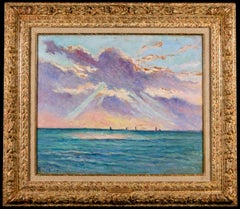
The Fairground at Benodet - Post Impressionist Figurative Oil - Victor Charreton
By Victor Charreton
Located in Marlow, Buckinghamshire
Signed oil on board figures in landscape by popular French post impressionist painter Victor Charreton. The work depicts a mother holding her small child's hand as they walk towards ...
Category
1920s Post-Impressionist Figurative Paintings
Materials
Oil, Board
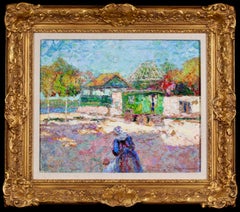
La Conciergerie - Neo Impressionist Pointillist Riverscape Oil by Yvonne Canu
By Yvonne Canu
Located in Marlow, Buckinghamshire
Signed pointillist oil on canvas landscape by French Neo-Impressionist painter Yvonne Canu. The work depicts a view of revellers on a boat travelling along the River Seine in Paris, ...
Category
1980s Impressionist Landscape Paintings
Materials
Canvas, Oil
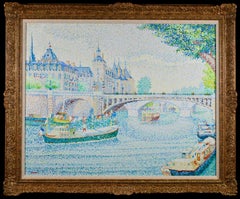
Les Vacances - Post Impressionist Figures in Landscape Oil by Pierre Montezin
By Pierre Eugène Montezin
Located in Marlow, Buckinghamshire
Signed oil on canvas figures in riverscape circa 1910 by sought after French impressionist painter Pierre Eugene Montezin. The work depicts women dressed in summer dresses and sunhat...
Category
1910s Impressionist Figurative Paintings
Materials
Canvas, Oil
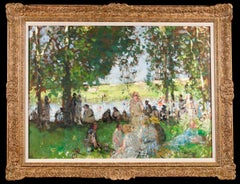
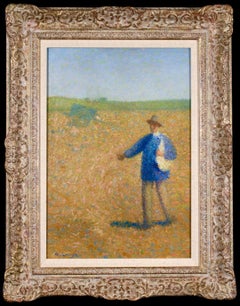
Les Semailles - Neo Impressionist Figurative Oil Painting by Achille Lauge
By Achille Laugé
Located in Marlow, Buckinghamshire
Signed figurative oil on canvas circa 1915 by French neo-impressionist painter Achille Lauge. The piece depicts a view of a farmer sowing seeds in field on a bright spring day.
Sign...
Category
1910s Impressionist Figurative Paintings
Materials
Canvas, Oil
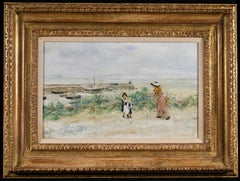
Mother
Children - Impressionist Figurative Oil by Jean-Francois Raffaelli
By Jean-Francois Raffaelli
Located in Marlow, Buckinghamshire
Signed oil on canvas figures in landscape by French impressionist painter Jean-Francois Raffaelli. The work depicts two young girls with their mother in a landscape overlooking boats...
Category
Early 1900s Impressionist Figurative Paintings
Materials
Oil, Canvas
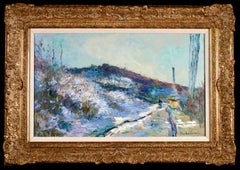
Le Route d
Hondouville - Post Impressionist Landscape Oil by Albert Lebourg
Located in Marlow, Buckinghamshire
Signed oil on canvas landscape circa 1890 by French post impressionist painter Albert Charles Lebourg. The work depicts a view of a road to Hondouville, a commune in nothern France, ...
Category
1890s Post-Impressionist Landscape Paintings
Materials
Canvas, Oil
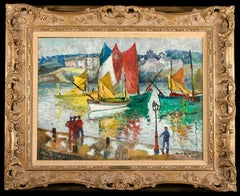
Harbour at St Ives - Impressionist Figures Seascape Oil by Richard Hayley Lever
By Richard Hayley Lever
Located in Marlow, Buckinghamshire
Signed figures in landscape oil on board by Australian-American impressionist painter Richard Hayley Lever. The work depicts brightly coloured sailing boats in the harbour of St Ives...
Category
Early 1900s Impressionist Figurative Paintings
Materials
Oil, Canvas
Unloading the catch - Impressionist Figures Seascape Oil by Richard Hayley Lever
By Richard Hayley Lever
Located in Marlow, Buckinghamshire
Signed figures in landscape oil on board circa 1905 by Australian-American impressionist painter Richard Hayley Lever. The work depicts fishing vessels docked in the harbour in Douar...
Category
Early 1900s Impressionist Figurative Paintings
Materials
Oil, Board
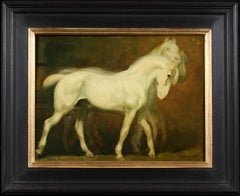
Les Trois Chevaux - Modernist Animal Oil Painting by Louis Anquetin
By Louis Anquetin
Located in Marlow, Buckinghamshire
Signed oil on panel circa 1895 by French modernist painter Louis Anquetin. The piece depicts three white horses.
Signature:
Signed lower right
Dimensions:
Framed: 16.5"x20"
Unframe...
Category
1890s Modern Animal Paintings
Materials
Oil, Panel
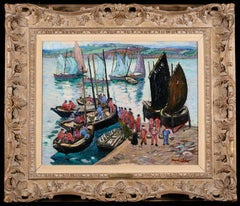
Fishing Boats at Doelan - Post Impressionist Landscape Oil by Paul Madeline
By Paul Madeline
Located in Marlow, Buckinghamshire
Signed and dated oil on board landscape by French post impressionist painter Paul Madeline. This beautiful work depicts a view of the picturesque port of Doelan in Britanny, France. ...
Category
Early 1900s Post-Impressionist Landscape Paintings
Materials
Oil, Board
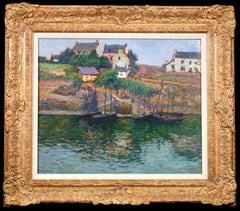
Paysage de l
Oise - Impressionist Landscape Oil Painting by Victor Vignon
By Victor Alfred Paul Vignon
Located in Marlow, Buckinghamshire
Signed and dated oil on canvas landscape by French impressionist painter Victor Alfred Paul Vignon. The piece depicts a view of scenery in Oise, a department in the north of France, ...
Category
1880s Impressionist Landscape Paintings
Materials
Oil, Canvas
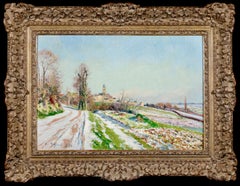
Gloucester Harbour - American Impressionist Landscape Oil by Abram Molarsky
Located in Marlow, Buckinghamshire
Signed oil on canvas laid on board landscape by American Impressionist painter Abram Molarsky. The work, painted in mostly pastel shades of green, blue and purple depicts a view of b...
Category
1920s American Impressionist Landscape Paintings
Materials
Canvas, Oil, Board
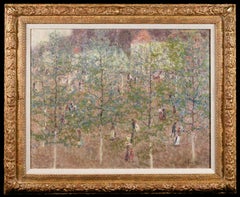
La Grande Parc a Oudenaarde - Post Impressionist Landscape Oil by Modest Huys
Located in Marlow, Buckinghamshire
Signed oil on canvas landscape by Belgian post impressionist painter Modest Huys. This stunning piece depicts a view of The Great Park in Oudenaarde, Belgium. Couples can be seen enjoying the park through gaps in the tall trees. A wonderful piece in the artist's unique style.
Signature:
Signed lower right and inscribed verso
Dimensions:
Framed: 28.5"x35"
Unframed: 21.5"x28"
Provenance:
Exhibited : The Royal Scottish Academy under the section for "Distinguished Foreigners" in 1914 (original acceptance letter verso)
Modest Huys (25 October 1874, in Zulte – 30 January 1932, in Zulte) was a Flemish impressionist and luminist painter, who is regarded as one of the greatest Belgian painters of the 20th century.
From a young age, Modest Huys worked in his father's painting and decorating business and later studied at the "Gentse Nijverheidschool" (Ghent Industrial School). In 1891 or 1892, he came into contact with Emile Claus, who encouraged his artistic inclinations. In 1900, he enrolled at the Royal Academy of Fine Arts where his teachers were Eugène Joors and Frans Van Leemputten but he never completed his studies. It was about this time that he became lifelong friends with the author Stijn Streuvels.
In 1902, he debuted at the Sint-Lucasgilde in Kortrijk and began to exhibit more widely. He spent time in Meetjesland, painting landscapes. From 1905, he participated in the exhibitions of Vie et Lumière...
Category
1910s Post-Impressionist Landscape Paintings
Materials
Canvas, Oil
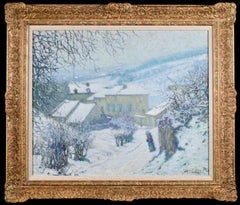
Charrette sous la neige - Post Impressionist Landscape Oil by Raymond Thibesart
By Raymond Thibesart
Located in Marlow, Buckinghamshire
Signed oil on canvas landscape circa 1910 by French post impressionist painter Raymond Thibesart. The piece depicts a view of a small rural village deep in winter. The roof tops and ...
Category
1910s Post-Impressionist Landscape Paintings
Materials
Canvas, Oil
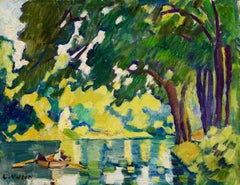
Lac du Bois de Boulogne - Fauvist Landscape Oil Painting by Louis Valtat
By Louis Valtat
Located in Marlow, Buckinghamshire
Signed fauvist oil on canvas laid on panel riverscape circa 1925 by French painter Louis Valtat. The work depicts a boat being rowed on the Bois de Boulogne lake in Paris, France. It...
Category
1920s Fauvist Landscape Paintings
Materials
Canvas, Oil, Panel
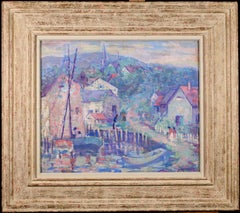
Auribeau-sur-Siagne - Post Impressionist Landscape Oil by J Martin-Ferrieres
By Jacques Martin-Ferrières
Located in Marlow, Buckinghamshire
Signed and dated oil on panel landscape by sought after French post impressionist painter Jacques Martin-Ferrieres. This beautiful piece depicts a view of Auribeau-sur-Siagne, is a c...
Category
1930s Post-Impressionist Landscape Paintings
Materials
Oil, Panel
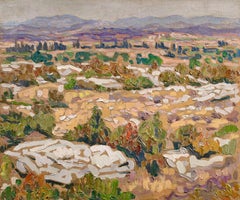
Barques au Bois de Boulogne - Fauvist Landscape Oil Painting by Louis Valtat
By Louis Valtat
Located in Marlow, Buckinghamshire
Signed fauvist oil on canvas laid on panel riverscape circa 1925 by French painter Louis Valtat. The work depicts several boats being rowed on River Seine in Bois de Boulogne - a for...
Category
1920s Fauvist Landscape Paintings
Materials
Oil, Panel, Canvas
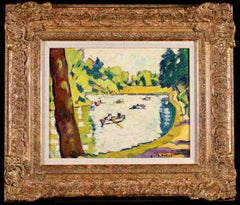
Le Pont Neuf - Impressionist Figures in Landscape Oil by Amedee Marcel-Clement
By Amedee Julien Marcel-Clement
Located in Marlow, Buckinghamshire
Signed and dated figures in cityscape oil on panel by French impressionist painter Amedee Marcel-Clement. The work depicts a view of the Pont Neuf bridge that runs over the River Sei...
Category
1910s Impressionist Figurative Paintings
Materials
Oil, Panel
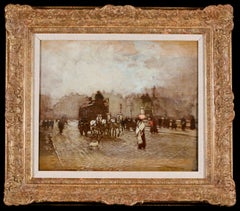
Dans les champs - Neo Impressionist Riverscape Oil by Leo Marie Gausson
By Léo Gausson
Located in Marlow, Buckinghamshire
Signed and dated neo-impressionist landscape oil on canvas by French painter Leo Marie Gausson. Gausson painted this picturesque view of then fields above Triel-sur-Seine, a small to...
Category
1890s Post-Impressionist Landscape Paintings
Materials
Canvas, Oil
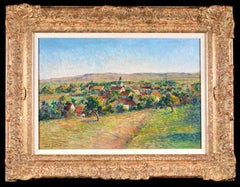
Reflections - Post Impressionist Landscape Oil Painting by Raymond Thibesart
By Raymond Thibesart
Located in Marlow, Buckinghamshire
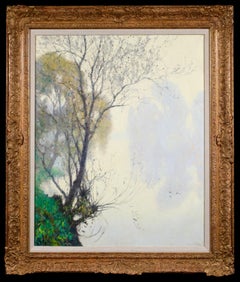
Signed oil on canvas landscape circa 1940 by French post impressionist painter Raymond Thibesart. The piece depicts a lake on a grey misty day. There is a bare tree in the front of t...
Category
1940s Post-Impressionist Landscape Paintings
Materials
Canvas, Oil
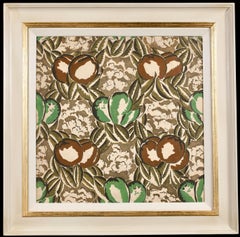
Projet de Tissus - Fauvist Still Life Study Gouache by Raoul Dufy
By Raoul Dufy
Located in Marlow, Buckinghamshire
Botanical gouache on paper circa 1920 by French fauvist painter Raoul Dufy. The work depicts a study of apples and pears. This work was executed by Dufy as a fabric design.
Dimensio...
Category
1920s Fauvist Still-life Drawings and Watercolors
Materials
Paper, Gouache
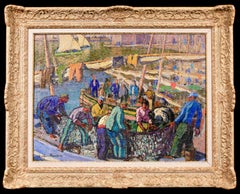
Collioure - Retour des Pecheurs - Post Impressionist Oil by J Martin-Ferrieres
By Jacques Martin-Ferrières
Located in Marlow, Buckinghamshire
Signed figures in landscape oil on canvas c.1920 by French post-impressionist painter Jacques Martin-Ferrieres. The piece depicts a harbour at Collioure, a commune in the southern Fr...
Category
1920s Post-Impressionist Figurative Paintings
Materials
Canvas, Oil
Vue de Dordogne - Post Impressionist Landscape Oil Painting by Charles Robin
By Georges Charles Robin
Located in Marlow, Buckinghamshire
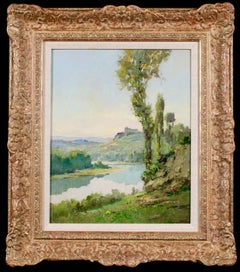
Signed oil on board riverscape circa 1950 by French Post Impressionist painter Georges Charles Robin. The work depicts a view of the Dordogne riv...
Category
1950s Post-Impressionist Landscape Paintings
Materials
Oil, Board
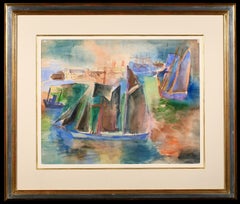
Le Port due Havre - Post Impressionist Landscape Watercolor by Jean Dufy
By Jean Dufy
Located in Marlow, Buckinghamshire
Signed and dated post impressionist watercolor on paper seascape by French painter Jean Dufy. This colourful piece depicts sail boats at the port of Le Havre in France - a commercial...
Category
1920s Post-Impressionist Landscape Paintings
Materials
Paper, Watercolor
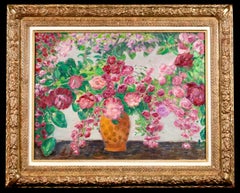
Arrangement de fleurs - Impressionist Still Life Painting Oil by Leon Detroy
By Leon Detroy
Located in Marlow, Buckinghamshire
Signed still life oil on canvas circa 1930 by French impressionist painter Leon Detroy. The work depicts a vase filled with roses and peonies in deep reds and pinks.
Signature:
Sign...
Category
1930s Impressionist Still-life Paintings
Materials
Canvas, Oil
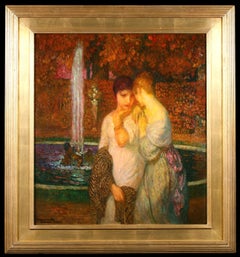
Le Secret - Art Nouveau Figures in Landscape Oil Painting by Michel Simonidy
By Michel Simonidy
Located in Marlow, Buckinghamshire
Signed and dated Art Nouveau oil on board figures in landscape by Romanian painter Michel Simonidy. The piece depicts an autumnal scene with two women standing beside a fountain at n...
Category
1910s Art Nouveau Figurative Paintings
Materials
Oil, Board
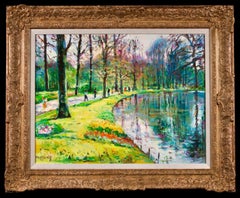
L
Etang - Post Impressionist Figures in Landscape Oil by Max Agostini
By Max Michel Agostini
Located in Marlow, Buckinghamshire
Signed post impressionist figures in landscape oil circa 1980 by French painter Max Michel Agostini. The work depicts park-goers on a path beside a lake on a sunny spring day. There ...
Category
1980s Post-Impressionist Landscape Paintings
Materials
Canvas, Oil
Une Jardin Hollandaise - Post Impressionist Landscape Oil by Max Agostini
By Max Michel Agostini
Located in Marlow, Buckinghamshire
Signed and titled post impressionist figures in landscape oil circa 1980 by French painter Max Michel Agostini. The work depicts park-goers on a path beside a lake on a sunny spring ...
Category
1980s Post-Impressionist Landscape Paintings
Materials
Canvas, Oil
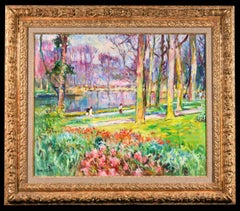
La Chapelle - Post Impressionist Figurative Oil by Ferdinand du Puigaudeau
By Ferdinand du Puigaudeau
Located in Marlow, Buckinghamshire
Signed and dated post impressionist figurative oil on canvas by French painter Ferdinand du Puigaudeau. This beautiful and large work depicts dozens of churchgoers in traditional Bre...
Category
1910s Post-Impressionist Figurative Paintings
Materials
Canvas, Oil
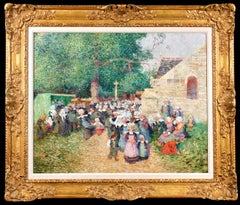
Bord de Riviere - Post Impressionist Figure in Landscape Watercolor by Jean Dufy
By Jean Dufy
Located in Marlow, Buckinghamshire
Signed and dated post impressionist figure in landscape watercolour on paper by French painter Jean Dufy. The work depicts a view of a grand house behind a wall with a large gated en...
Category
1920s Post-Impressionist Landscape Paintings
Materials
Paper, Watercolor
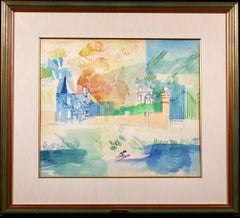
Le Chef de Gare - Neo Impressionist Portrait Oil Painting by Achille Lauge
By Achille Laugé
Located in Marlow, Buckinghamshire
Signed portrait oil on canvas circa 1898 by French neo-impressionist painter Achille Lauge. The piece is a beautifully textured with impasto and is a portrait of a French station mas...
Category
1890s Impressionist Portrait Paintings
Materials
Canvas, Oil
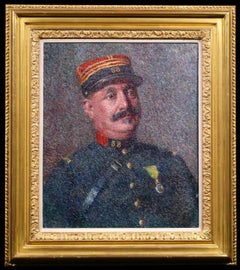
Les Puiseuses d
Eau - Barbizon Figurative Landscape Pastel by Leon Lhermitte
By Léon Augustin Lhermitte
Located in Marlow, Buckinghamshire
Signed figures in landscape pastel on canvas circa 1910 by French Barbizon painter Leon Augustin Lhermitte. The piece depicts a rural landscape with two women in traditional Breton c...
Category
1910s Barbizon School Landscape Paintings
Materials
Canvas, Pastel