Leighton Fine Art Ltd
to
1
19
48
79
55
10
Overall Width
to
Overall Height
to
29
182
39
47
37
15
9
8
4
2
8
2
117
69
5
3
1
161
46
2
98
37
17
14
14
12
10
9
8
8
5
5
4
4
4
4
4
3
3
3
208
199
136
136
35
10
9
7
6
5
209
211
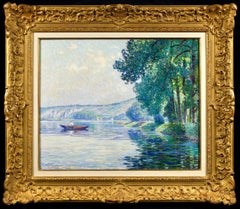
Fishing on the Seine - Impressionist Landscape Oil Painting by Alexandre Jacob
By Alexandre Louis Jacob
Located in Marlow, Buckinghamshire
Signed oil on panel landscape circa 1940 by popular French impressionist painter Alexandre Louis Jacob. The work depicts a man fishing on the bank of the River Seine in France on a c...
Category
Mid-20th Century Impressionist Landscape Paintings
Materials
Oil, Panel
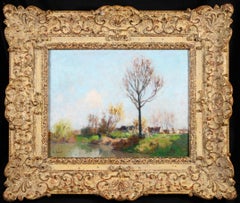

Summer on the Meuse
By Rodolphe Wytsman
Located in Marlow, Buckinghamshire
An outstanding example of the new-impressionist work of Rodolphe Wytsman . This large canvas depicts a tranquil summer day on the Meuse river near the town of Dave. Wytsman painted a number of landscapes in this area between 1910 and 1911 at the height of his artistic career. The use of colour and neo-impressionist execution are testament to his position as one of the finest Belgian painters of this period alongside Van Rysselberghe, Claus, Montigny and Georges Morren...
Category
1910s Post-Impressionist Landscape Paintings
Materials
Oil
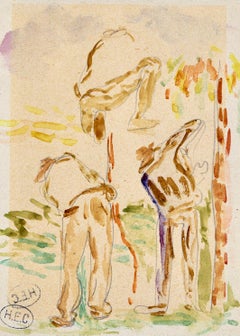
Etude de travailleurs - Impressionist Figurative Watercolor by Henri Cross
By Henri Edmond Cross
Located in Marlow, Buckinghamshire
Impressionist watercolour on paper circa 1890 by French Neo-Impressionist painter Henri Edmond Cross. The work is a rear view study of three workers in standing and kneeling position...
Category
1890s Impressionist Figurative Paintings
Materials
Paper, Watercolor
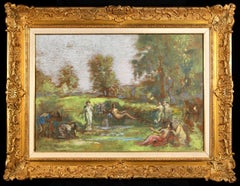
Fete Champetre - Symbolist Figurative Oil Painting by Ker Xavier Roussel
By Ker Xavier Roussel
Located in Marlow, Buckinghamshire
Signed symbolist oil on panel circa 1910 by French Les Nabis painter Ker-Xavier Roussel. This beautiful painting depicts nudes and figures dressed in robes in a wooded landscape.
Signature:
Signed lower left
Dimensions:
Framed: 31"x40"
Unframed: 23"x32"
Provenance:
JPL Fine Arts - London c. 1985
Ker-Xavier Roussel met Édouard Vuillard at the Lycée Condorcet, which they both attended. Together they visited Eugène Ulysse Napoléon Maillard's studio, where Roussel became acquainted with Charles Cottet, going on to study at the Académie Julian under Bouguereau and Jules Lefebvre. There, he became interested in the Synthetism promoted by Sérusier, following Sérusier's heeding of the line Gauguin had adopted in Pont-Aven. He joined the Nabis group. He and his friends form a link between the Impressionists - he knew Cézanne, Degas, Renoir and Monet - and the Fauves and Cubists.
In his earliest paintings, Roussel adopted a dark palette for Realist still-lifes. Later, his work bore the influence of Gauguin, Sérusier, the Nabis and Cézanne, in Intimist scenes painted in flat tints not yet clearly delineated. Their dull, saturated tones are reminiscent of Cézanne. In about 1900 he started painting mythological scenes full of nymphs and fauns and set in his home region of Île-de-France. After a bicycle trip in Provence with Maurice Denis, during which he met Cézanne, he lightened his palette, much taken by the cloudless skies below which he would now set the mythological and idyllic compositions which link him to Poussin and Corot. This wondrous, unreal world found its way into large-scale works, including the stage curtain of the Champs-Élysées theatre in 1913, a large Pax Nutrix for the Palais des Nations in Geneva and Dance for the Palais de Chaillot in 1937. He is best remembered for: Silenius' Triumph, Polyphemus, Diana, The Abduction of the Daughters of Leucippus. The nymphs and fauns of a mythology quite his own appear in clearings and woods from the outskirts of Paris, but the sun they rejoice in is Mediterranean. To capture the vibration of bright colours under a permanent sun, he later turned to pastels. He was more a Symbolist than a Nabi and signed himself K.-X. Roussel. He also produced lithographs.
He took part in exhibitions from 1891 with the Groupe des Vingt at le Barc de Bouteville's gallery in Brussels. Then he exhibited in Revue Blanche Painters ( Les Peintres de la revue blanche) in Paris; with the Nabis at Café Volponi in Paris; before World War I with Free Aesthetics in Brussels; from 1901 at the Salon des Indépendants and the Salon d'Automne; in the 1930s in Revue Blanche Painters ( Les Peintres de la Revue blanche) hosted in Paris by designer Bolette Natanson, the daughter of the Revue Blanche's owner. He took part in The Masters of Contemporary Art ( Les Maîtres de l'art contemporain) at the Musée du Petit Palais in Paris, and at the 1938 Venice Biennale and 1939 New York World Fair. He featured posthumously in Toulouse-Lautrec and the Nabis ( Toulouse-Lautrec et les Nabis) at Bern Kunsthalle; From the Revue Blanche ( Autour de la revue blanche) in the Galerie Maeght, Paris, and in Tokyo and Brussels. He had one-man shows in Paris before his death in 1944. Retrospectives were mounted in the 1960s in London and Bremen.
Museum and Gallery Holdings:
Geneva (Petit Palais): Haystacks on the Seaside
Paris (BNF): Training the Dog; Landscapes (engraving); Nymph and Faun (c. 1895, etching)
Paris (Louvre): Poject for a Screen (drawing)
Paris (MNAM-CCI): The Road (c. 1905); The Cyclops (1908); Venus and Cupid on the Seafront (1908); The Abduction of Leucippus' Daughters (1911); Pastorale (1920); Diana at Rest (1923); Portrait of Vuillard (1934)
Paris (Mus. d'Orsay): The Gate (pastel); Woman in Profile with Green Hat; In Bed; Félix Valloton...
Category
Early 20th Century Symbolist Figurative Paintings
Materials
Oil, Panel
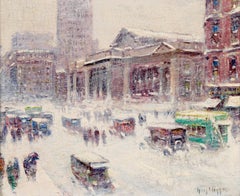
Fifth Avenue
42nd Street - American Impressionist Cityscape Oil by Guy Wiggins
By Guy Carleton Wiggins
Located in Marlow, Buckinghamshire
Signed and titled figures in cityscape oil on panel circa 1920 by American impressionist painter Guy Carleton Wiggins. This wonderful piece depicts a view of the New York Public Library in the United States of America during a winter snowstorm. Several cars and pedestrians can be seen passing along Fifth Avenue. A fantastic work in the artist's distinctive style.
Dimensions:
Framed: 16"x18"
Unframed: 8"x10"
Provenance:
Roughton Galleries - Texas. This work is included in the catalogue raisonne under reference number GW00179
Guy Carleton Wiggins was the son of Carleton Wiggins, a painter of landscapes and animals. Wiggins first studied at his father's Art School in Connecticut and later enrolled in the National Academy of Design where he trained with William Merritt Chase and Robert Henri, after a brief spell studying architecture at the Polytechnic Institute in Brooklyn. At the age of 20 he was already well known and was the youngest American artist to have a work accepted for the permanent collection of the Metropolitan Museum in New York. Prior to the onset of World War I, Wiggins travelled to Europe and painted the English countryside. In England he met his future wife Dorothy Stuart Johnson. The couple returned to the US and set up home in Connecticut. He established a year-round art school, the Guy Wiggins Art School, in Essex. He liked to spend his winters in New York and summers in Connecticut. Wiggins' paintings reflect the influence of American Impressionism, a style of painting he would have encountered during his summers in Old Lyme. He is known for his snowy New York...
Category
Early 20th Century American Impressionist Figurative Paintings
Materials
Oil, Panel
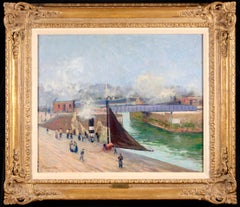
Dieppe-Le Pont Tournant - Impressionist Landscape Oil Painting by Paul Madeline
By Paul Madeline
Located in Marlow, Buckinghamshire
Signed and dated oil on canvas landscape by French post impressionist painter Paul Madeline. This beautiful work depicts the Tournant bridge over the River Arques at the seaport in D...
Category
Early 1900s Post-Impressionist Landscape Paintings
Materials
Canvas, Oil
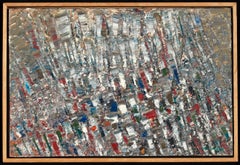
Composition - French Abstract Oil Painting by Jacques Germain
By Jacques Germain
Located in Marlow, Buckinghamshire
Signed and dated abstract oil on canvas by French painter Jacques Germain. The piece is composed in swathes of thick impasto, particularly in red, blue, green and white. A truly interesting and unique work that would compliment a modern setting.
Signature:
Signed lower right/ further signed and dated verso
Dimensions:
Framed: 11"x16"
Unframed: 10"x15"
Provenance:
Private French collection
Jacques Germain was born in Paris in 1915. In 1931, on the advice of Blaise Cendrars, he became a pupil of Fernand Léger and Amédée Ozenfant at the Académie Moderne, Paris. He soon left for the Bauhaus in Dessau, where Jean...
Category
1970s Abstract Abstract Paintings
Materials
Canvas, Oil
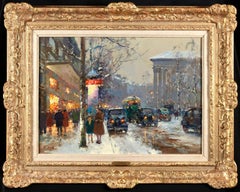
La Madeleine – Le Soir Impressionist Cityscape Oil Painting by Edouard Cortes
By Édouard Leon Cortès
Located in Marlow, Buckinghamshire
Signed figures in landscape circa 1950 by French impressionist painter Eduoard Cortes. The work depicts a view of La Madaleine, a Catholic parish church situated on Place de la Madel...
Category
Mid-20th Century Impressionist Landscape Paintings
Materials
Oil, Canvas
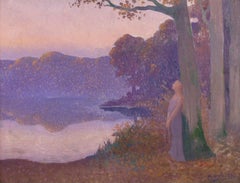
La Muse Du Lac - Symbolist Figure in Landscape Oil Painting by Alphonse Osbert
Located in Marlow, Buckinghamshire
Signed and dated symbolist figure in landscape oil on board by French painter Alphonse Osbert. The piece depicts a blonde woman in a full length purple...
Category
Early 20th Century Symbolist Figurative Paintings
Materials
Board, Oil
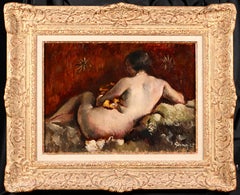
Nu Allonge - Post Impressionist Nude Oil Painting by Paul Elie Gernez
Located in Marlow, Buckinghamshire
Signed and dated nude oil on panel by French post impressionist painter Paul Elie Gernez. The work depicts a brunette nude relaxing on a fur rug, her ...
Category
Early 20th Century Post-Impressionist Nude Paintings
Materials
Panel, Oil
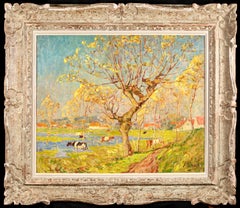
Radiant Autumn -Wakken - Post Impressionist Oil, Cows in Landscape - Modest Huys
Located in Marlow, Buckinghamshire
Signed and dated divisionist landscape oil on canvas by Belgian post impressionist painter Modest Huys. This stunning piece is titled "Radiant Autumn - Wak...
Category
Early 20th Century Post-Impressionist Landscape Paintings
Materials
Canvas, Oil
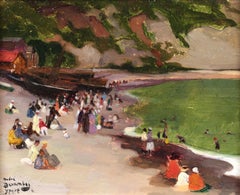
Figures on the Beach - Impressionist Oil, Coastal Landscape by Andre Devambez
By André Devambez
Located in Marlow, Buckinghamshire
Signed and titled oil on panel figures in landscape circa 1920 by French impressionist painter Andre Devambez. The piece depicts couples and families en...
Category
Early 20th Century Impressionist Figurative Paintings
Materials
Panel, Oil
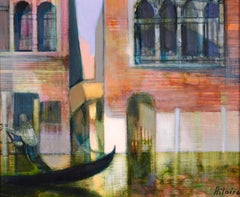
Vieux palais sur la canal - Venice - Cubist Landscape Oil by Camille Hilaire
By Camille Hilaire
Located in Marlow, Buckinghamshire
Signed and titled cubist oil on canvas circa 1980 by French painter Camille Hilaire. This wonderful and colourful piece depicts a gondola on the Grand Canal, Venice with old palace behind.
Signature:
Signed lower right and titled verso
Dimensions:
Framed size: 21"x24" (53.3cm x 61.0cm)
Size: 15"x18" (38.1cm x 45.7cm)
Provenance:
Private French collection
Camille Hilaire was a pupil at the École des Beaux-Arts in Paris. He also worked in the free academies, including that of André Lhote, whose teaching had a major influence on his work.
He executed numerous mural decorations...
Category
1980s Cubist Landscape Paintings
Materials
Canvas, Oil
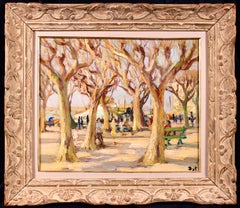
Cannes et le vieux port - Post Impressionist Oil, Landscape by Marcel Dyf
By Marcel Dyf
Located in Marlow, Buckinghamshire
Signed figures in landscape oil on canvas circa 1940 by sought after French post impressionist painter Marcel Dyf. The piece depicts people enjoying a sunny winter's day at the port ...
Category
1940s Post-Impressionist Landscape Paintings
Materials
Canvas, Oil
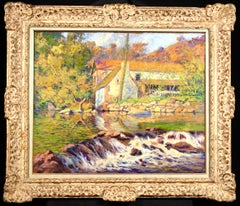
Le Moulin de la Folie a Crozant - Impressionist Landscape Oil by Paul Madeline
By Paul Madeline
Located in Marlow, Buckinghamshire
Signed and dated oil on original canvas by French post impressionist painter Paul Madeline. This beautiful work depicts a mill on the bank of a river - water cascading over the rocks...
Category
Early 1900s Post-Impressionist Landscape Paintings
Materials
Canvas, Oil
Les Collines du Dauphine - Post Impressionist Oil, Landscape by Victor Charreton
By Victor Charreton
Located in Marlow, Buckinghamshire
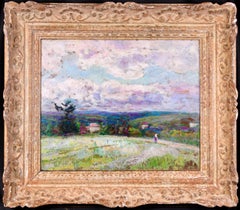
Beautiful signed oil on board landscape circa 1920 by sought after post impressionist painter Victor Charreton. The piece depicts a figure walking through green rolling fields with h...
Category
1920s Post-Impressionist Landscape Paintings
Materials
Oil, Board
Dam at Genetin - Impressionist Oil, Winter Riverscape by Armand Guillaumin
By Jean Baptiste-Armand Guillaumin
Located in Marlow, Buckinghamshire
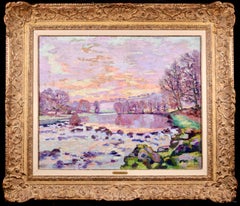
Signed and dated impressionist landscape oil on canvas by French painter Jean Baptiste Armand Guillaumin. This simply stunning piece de...
Category
Early 1900s Impressionist Landscape Paintings
Materials
Canvas, Oil
Romeo de Ravenne - Cubist Oil, Figure
Boat on Landscape by Camille Hilaire
By Camille Hilaire
Located in Marlow, Buckinghamshire
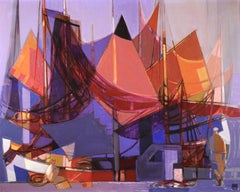
Signed and titled oil on canvas by French cubist painter Camile Hilaire. The piece beautifully depicts a man at a port beside boats coloured in reds, blues and oranges. A wonderfully...
Category
1960s Cubist Abstract Paintings
Materials
Canvas, Oil
Nu avec des fleurs - Post-Impressionist Oil, Nude
Flowers - Georges D
Espagnat
By Georges d
Espagnat
Located in Marlow, Buckinghamshire
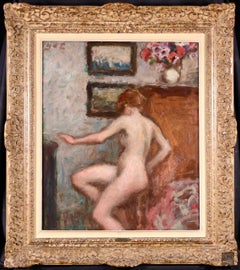
Signed nude oil on original canvas circa 1910 by French post impressionist painter Georges D'espagnat. The work depict a nude woman seated on a stall turned away from the artist. Paintings hang on the wall and there's a vase filled with pink and red flowers on the wooden mantlepiece beside her.
Signature:
Signed upper left
Dimensions:
Framed: 30"x26"
Unframed: 22"x18"
Provenance:
Private French collection.
Exhibition stamp verso
From the beginning of his career, it was a constant concern of Georges d'Espagnet to assert his originality. His studies at the École des Arts Décoratifs, Paris, did not last very long, for he wanted immediate independence and decided to follow courses in the private academies of Montparnasse. In about 1900, he became acquainted with Maurice Denis, Bonnard and Vuillard, and his collaboration with Denis led to a renewal of religious art in France.
In 1903, d'Espagnet was one of the founders of the Salon d'Automne, and was appointed professor in charge of studios at the École des Beaux-Arts, Paris, in 1934. He illustrated a number of books: Rémy de Gourmont's Evil Prayers ( Oraisons mauvaises) (1896), The Saints of Paradise ( Les Saintes du paradis) (1898), Simone (1907), Sistine ( Sixtine) (1922); Alphonse Daudet's The Immortal ( L'Immortel) (1930); André Gide's The Pastoral Symphony ( La Symphonie pastorale); Francis Jammes' Clearings in the Sky ( Chairières dans le ciel) (1948).
D'Espagnet belongs to the group of artists who made the Courrier Français so successful. The drawings of his which are published in it are strongly expressive and some bear comparison with the designs of the great Renaissance masters. He also contributed to L'Image. He often placed cheerful nudes in a landscape, reminding us that, though he moved away from the Fauves, he retained their freedom of colour and arabesque. He painted many portraits, including those of Albert André, André Barbier...
Category
1910s Post-Impressionist Nude Paintings
Materials
Canvas, Oil
L
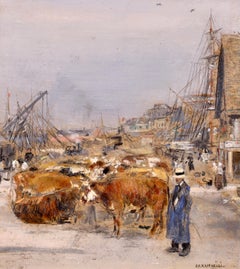
embarquement de boeufs - Impressionist Oil, Cattle by Jean Francois Raffaelli
By Jean-Francois Raffaelli
Located in Marlow, Buckinghamshire
Wonderful signed oil on panel cattle and figures in landscape by French impressionist painter Jean-Francois Raffaelli. The work depicts oxen being loaded onto ships in Honfleur, France en route to England.
Signature:
Signed lower right
Dimensions:
Framed: 18"x16"
Unframed: 9"x8"
Provenance:
Exhibition Jean Francois Raffaélli held at Galerie Simonson, 19 Rue Caumartin Paris - October 1929 (number 44)
Jean-François Raffaëlli's father was a failed Italian businessman and Raffaëlli himself was, among other things, a church chorister, actor and theatre singer. He then studied under Gérôme at the École des Beaux-Arts in Paris. He travelled to Italy, Spain and Algeria and on his return to France settled in Asnières.
In 1876, on a trip to Brittany, he first saw the potential of realist subject matter, if treated seriously. He became involved in meetings of artists at the Café Guerbois, where the Impressionist painters used to gather. As a result, Degas, contrary to the advice of the group, introduced Raffaëlli to the Impressionist exhibitions - according to one uncertain source as early as the very first exhibition, at the home of Nadar, and certainly to those of 1880 and 1881.
In 1904, Raffaëlli founded the Society for Original Colour Engraving. He first exhibited at the Salon de Paris in 1870 and continued to exhibit there until he joined the Salon des Artistes Français in 1881, where he earned a commendation in 1885, was made Chevalier of the Légion d'Honneur in 1889 and in the same year was awarded a gold medal at the Exposition Universelle. In 1906 he was made Officier of the Légion d'Honneur. He was also a member of the Société Nationale des Beaux-Arts. In 1884, a private exhibition of his work cemented his reputation.
He contributed to several newspapers such as The Black Cat (Le Chat Noir) in 1885 and The French Mail (Le Courrier Français) in 1886 and 1887. He published a collection entitled Parisian Characters, which captured his favourite themes of the street, the neighbourhood and local people going about their lives. In 1880 he participated, with Forain, on the illustration of Joris Karl Huysmans' Parisian Sketches (Croquis Parisiens). He also illustrated Huysman's Works. As well as working as an illustrator, he also made etchings and coloured dry-points.
His early attempts at painting were genre scenes, but once he was settled in Asnières he started to paint picturesque views of Parisian suburbs. From 1879 onwards, his subject matter drew on the lives of local people. These popular themes, which he treated with humanity and a social conscience, brought him to the attention of the social realist writers of the time such as Émile Zola. In addition to his realist style, Raffaëlli's dark palette, which ran contrary to the Impressionist aesthethic, helped to explain the opposition of those painters to his participation in their exhibitions. More concerned with drawing than colour, he used black and white for most of his paintings. Towards the end of his life, he lightened his palette, but without adopting any other principles of the Impressionist technique.
After painting several portraits, including Edmond de Goncourt and Georges Clémenceau, he returned to genre painting, particularly scenes of bourgeois life. Later in his career, he painted mainly Breton-inspired sailors and views of Venice. His views of the Paris slums and the fortifications, sites which have almost completely disappeared, went some way towards establishing a genre in themselves and perpetuated the memory of the area: The Slums, Rag-and-Bone Man, Vagabond, Sandpit, In St-Denis, Area of Fortifications. His realistic and witty portrayal of typical Parisian townscapes accounts for his enduring appeal.
Born in Paris, he was of Tuscan descent through his paternal grandparents. He showed an interest in music and theatre before becoming a painter in 1870. One of his landscape paintings was accepted for exhibition at the Salon in that same year. In October 1871 he began three months of study under Jean-Léon Gérôme at the École des Beaux-Arts in Paris; he had no other formal training.
Raffaëlli produced primarily costume pictures until 1876, when he began to depict the people of his time—particularly peasants, workers, and ragpickers seen in the suburbs of Paris—in a realistic style. His new work was championed by influential critics such as J.-K. Huysmans, as well as by Edgar Degas.
The ragpicker became for Raffaëlli a symbol of the alienation of the individual in modern society. Art historian Barbara S. Fields has written of Raffaëlli's interest in the positivist philosophy of Hippolyte-Adolphe Taine, which led him to articulate a theory of realism that he christened caractérisme. He hoped to set himself apart from those unthinking, so-called realist artists whose art provided the viewer with only a literal depiction of nature. His careful observation of man in his milieu paralleled the anti-aesthetic, anti-romantic approach of the literary Naturalists, such as Zola and Huysmans.
Degas invited Raffaëlli to participate in the Impressionist exhibitions of 1880 and 1881, an action that bitterly divided the group; not only was Raffaëlli not an Impressionist, but he threatened to dominate the 1880 exhibition with his outsized display of 37 works. Monet, resentful of Degas's insistence on expanding the Impressionist exhibitions by including several realists, chose not to exhibit, complaining, "The little chapel has become a commonplace school which opens its doors to the first dauber to come along."An example of Raffaëlli's work from this period is Les buveurs d'absinthe (1881, in the California Palace of Legion of Honor Art Museum in San Francisco). Originally titled Les déclassés, the painting was widely praised at the 1881 exhibit.
After winning the Légion d'honneur in 1889, Raffaëlli shifted his attention from the suburbs of Paris to city itself, and the street scenes that resulted were well received by the public and the critics. He made a number of sculptures, but these are known today only through photographs.[2] His work was also part of the painting event in the art competition at the 1912 Summer Olympics. In the later years of his life, he concentrated on color printmaking. Raffaëlli died in Paris on February 11, 1924
Museum and Gallery Holdings:
Béziers: Peasants Going to Town
Bordeaux: Bohemians at a Café
Boston: Notre-Dame; Return from the Market
Brussels: Chevet of Notre-Dame; pastel
Bucharest (Muz. National de Arta al României): Market at Antibes; Pied-à-terre
Copenhagen: Fishermen on the Beach
Douai: Return from the Market; Blacksmiths
Liège: Absinthe Drinker...
Category
1880s Impressionist Animal Paintings
Materials
Oil, Panel
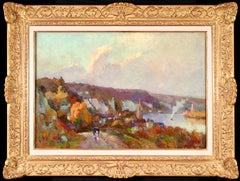
Duclair - La Seine - Post Impressionist Oil, River Landscape by Robert Pinchon
By Robert Antoine Pinchon
Located in Marlow, Buckinghamshire
Fauvist signed oil on canvas riverscape circa 1920 by French post impressionist painter Robert Antoine Pinchon. The work depicts a view of the R...
Category
1920s Post-Impressionist Landscape Paintings
Materials
Canvas, Oil
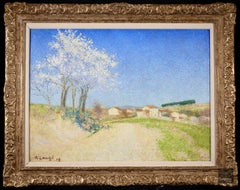
Belveze du Razes - Neo-Impressionist Pointillist Oil, Landscape by Achille Lauge
By Achille Laugé
Located in Marlow, Buckinghamshire
Stunning pointillist landscape oil on panel by French neo-impressionist painter Achille Lauge. The work depicts a path leading to the small village of Belveze du Razes in the South of France on a bright spring day. To the left are white blossom trees in bloom and the houses of the village can be seen in the distance.
Signature:
Signed and dated 1909 lower left
Dimensions:
Framed: 28"x36"
Unframed: 21"x29"
Provenance:
We kindly thank Mme. Nicole Tamburini for allowing us to state that the work is included in the Catalogue Raisonne of the artist which she is currently preparing.
A certificate of authenticity from Mme. Tamburini is available upon request.
Achille Laugé...
Category
Early 1900s Pointillist Landscape Paintings
Materials
Oil, Canvas
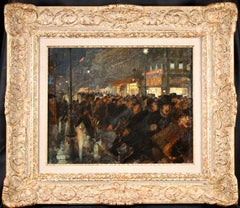
Demonstrators - Impressionist Oil, Figures in City Landscape by Andre Devambez
By André Devambez
Located in Marlow, Buckinghamshire
Wonderful figures in night landscape oil on canvas circa 1904 by French impressionist painter and illustrator Andre Devambez. The piece depicts demonstr...
Category
Early 1900s Impressionist Figurative Paintings
Materials
Canvas, Oil
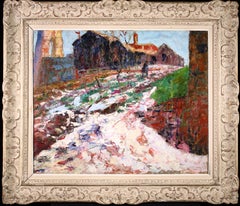
Woman in Snow - Post Impressionist Oil, Figure in Landscape by Victor Charreton
By Victor Charreton
Located in Marlow, Buckinghamshire
Large signed landscape oil on canvas circa 1920 by sought after French post impressionist painter Victor Charreton, who was known as the painter of colours. The work depicts a woman walking through a snowy village in winter. The piece is beautifully coloured.
Signature:
Signed lower right
Dimensions:
Framed: 33"x38"
Unframed: 24"x29"
Provenance:
Private collection - Portugal
Ader - Paris
Charreton was a landscape artist in the Lyons tradition with a love of sensual impasto. In his works he seeks to capture fleeting, momentary effects, like those achieved by the Impressionists: effects at different times of day and in different seasons, such as dusk and snow. As a young man he painted the environs of Bourgoin. Skilled in capturing minute changes in the weather, he was also adept at capturing the spirit of new places. Beside his native Dauphiné and his adopted Auvergne, he was also charmed by the landscapes of the Île-de-France and Paris - Montmartre, the Jardin du Luxembourg and the Parc Montsouris...
Category
1920s Post-Impressionist Landscape Paintings
Materials
Oil, Canvas
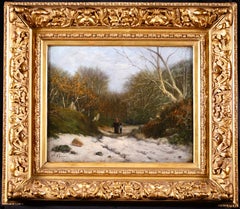
Winter - Fontainbleau Forest - Impressionist Oil, Landscape by Victor Vignon
By Victor Alfred Paul Vignon
Located in Marlow, Buckinghamshire
Signed figures in a landscape oil on canvas circa 1870 by French impressionist painter Victor Alfred Paul Vignon. The work depicts a woman carrying a basket with a young child beside her walking along a snowy path in a Fontainebleau Forest. This early work by Vignon was painted whilst he was under the tutelage of Camille Corot in the period between 1869 and 1870 . The work shows a mother and child in the forest at Fontainebleau in winter. Many painters in Vignon's circle such as Monet, Renoir, Sisley and Bazille visited this area to paint in the late 1860's and the early 1870's.
Signature:
Signed lower left
Dimensions:
Framed: 23"x25.5"
Unframed: 13.5"x16"
Provenance:
Galerie Commeter - Hamburg c. 1920
French exhibition customs stamps verso
His mother has been incorrectly identified as the writer Claude Vignon...
Category
1870s Impressionist Landscape Paintings
Materials
Canvas, Oil
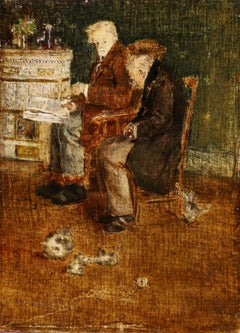
Deux vieillards aux chatons - Impressionist Figurative Oil by J F Raffaelli
By Jean-Francois Raffaelli
Located in Marlow, Buckinghamshire
Signed figures in interior oil on panel by French impressionist painter Jean-Francois Raffaelli. The piece depicts two old men seated in an interior. One is reading his paper as the other naps and there are several kittens on the floor. Painted in the artist's distinctive style.
Signature:
Signed lower left
Dimensions:
Framed: 9.5"x8"
Unframed: 5.5"x4"
Provenance:
Brame & Lorenceau have confirmed the authenticity of this work and it will be included in the digital catalogue raisonne of the painter which is under preparation
A certificate of authenticity fromBrame & Lorenceau accompanies this painting
Private collection - United States
Original artists label verso
Jean-François Raffaëlli's father was a failed Italian businessman and Raffaëlli himself was, among other things, a church chorister, actor and theatre singer. He then studied under Gérôme at the École des Beaux-Arts in Paris. He travelled to Italy, Spain and Algeria and on his return to France settled in Asnières.
In 1876, on a trip to Brittany, he first saw the potential of realist subject matter, if treated seriously. He became involved in meetings of artists at the Café Guerbois, where the Impressionist painters used to gather. As a result, Degas, contrary to the advice of the group, introduced Raffaëlli to the Impressionist exhibitions - according to one uncertain source as early as the very first exhibition, at the home of Nadar, and certainly to those of 1880 and 1881.
In 1904, Raffaëlli founded the Society for Original Colour Engraving. He first exhibited at the Salon de Paris in 1870 and continued to exhibit there until he joined the Salon des Artistes Français in 1881, where he earned a commendation in 1885, was made Chevalier of the Légion d'Honneur in 1889 and in the same year was awarded a gold medal at the Exposition Universelle. In 1906 he was made Officier of the Légion d'Honneur. He was also a member of the Société Nationale des Beaux-Arts. In 1884, a private exhibition of his work cemented his reputation.
He contributed to several newspapers such as The Black Cat (Le Chat Noir) in 1885 and The French Mail (Le Courrier Français) in 1886 and 1887. He published a collection entitled Parisian Characters, which captured his favourite themes of the street, the neighbourhood and local people going about their lives. In 1880 he participated, with Forain, on the illustration of Joris Karl Huysmans' Parisian Sketches (Croquis Parisiens). He also illustrated Huysman's Works. As well as working as an illustrator, he also made etchings and coloured dry-points.
His early attempts at painting were genre scenes, but once he was settled in Asnières he started to paint picturesque views of Parisian suburbs. From 1879 onwards, his subject matter drew on the lives of local people. These popular themes, which he treated with humanity and a social conscience, brought him to the attention of the social realist writers of the time such as Émile Zola. In addition to his realist style, Raffaëlli's dark palette, which ran contrary to the Impressionist aesthethic, helped to explain the opposition of those painters to his participation in their exhibitions. More concerned with drawing than colour, he used black and white for most of his paintings. Towards the end of his life, he lightened his palette, but without adopting any other principles of the Impressionist technique.
After painting several portraits, including Edmond de Goncourt and Georges Clémenceau, he returned to genre painting, particularly scenes of bourgeois life. Later in his career, he painted mainly Breton-inspired sailors and views of Venice. His views of the Paris slums and the fortifications, sites which have almost completely disappeared, went some way towards establishing a genre in themselves and perpetuated the memory of the area: The Slums, Rag-and-Bone Man, Vagabond, Sandpit, In St-Denis, Area of Fortifications. His realistic and witty portrayal of typical Parisian townscapes accounts for his enduring appeal.
Born in Paris, he was of Tuscan descent through his paternal grandparents. He showed an interest in music and theatre before becoming a painter in 1870. One of his landscape paintings was accepted for exhibition at the Salon in that same year. In October 1871 he began three months of study under Jean-Léon Gérôme at the École des Beaux-Arts in Paris; he had no other formal training.
Raffaëlli produced primarily costume pictures until 1876, when he began to depict the people of his time—particularly peasants, workers, and ragpickers seen in the suburbs of Paris—in a realistic style. His new work was championed by influential critics such as J.-K. Huysmans, as well as by Edgar Degas.
The ragpicker became for Raffaëlli a symbol of the alienation of the individual in modern society. Art historian Barbara S. Fields has written of Raffaëlli's interest in the positivist philosophy of Hippolyte-Adolphe Taine, which led him to articulate a theory of realism that he christened caractérisme. He hoped to set himself apart from those unthinking, so-called realist artists whose art provided the viewer with only a literal depiction of nature. His careful observation of man in his milieu paralleled the anti-aesthetic, anti-romantic approach of the literary Naturalists, such as Zola and Huysmans.
Degas invited Raffaëlli to participate in the Impressionist exhibitions of 1880 and 1881, an action that bitterly divided the group; not only was Raffaëlli not an Impressionist, but he threatened to dominate the 1880 exhibition with his outsized display of 37 works. Monet, resentful of Degas's insistence on expanding the Impressionist exhibitions by including several realists, chose not to exhibit, complaining, "The little chapel has become a commonplace school which opens its doors to the first dauber to come along."An example of Raffaëlli's work from this period is Les buveurs d'absinthe (1881, in the California Palace of Legion of Honor Art Museum in San Francisco). Originally titled Les déclassés, the painting was widely praised at the 1881 exhibit.
After winning the Légion d'honneur in 1889, Raffaëlli shifted his attention from the suburbs of Paris to city itself, and the street scenes that resulted were well received by the public and the critics. He made a number of sculptures, but these are known today only through photographs.[2] His work was also part of the painting event in the art competition at the 1912 Summer Olympics. In the later years of his life, he concentrated on color printmaking. Raffaëlli died in Paris on February 11, 1924
Museum and Gallery Holdings:
Béziers: Peasants Going to Town
Bordeaux: Bohemians at a Café
Boston: Notre-Dame; Return from the Market
Brussels: Chevet of Notre-Dame; pastel
Bucharest (Muz. National de Arta al României): Market at Antibes; Pied-à-terre
Copenhagen: Fishermen on the Beach
Douai: Return from the Market; Blacksmiths
Liège: Absinthe Drinker...
Category
1890s Impressionist Figurative Paintings
Materials
Oil, Panel
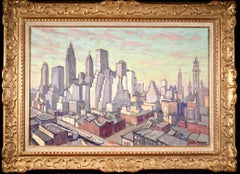
View of New York - Post Impressionist Oil, Cityscape by Jacques Martin-Ferrieres
By Jacques Martin-Ferrières
Located in Marlow, Buckinghamshire
A stunning oil on canvas urban landscape by sought after French post-impressionist painter Jacques Martin-Ferrieres. The piece depicts a very rare view of the Manhattan skyline - pai...
Category
1940s Post-Impressionist Landscape Paintings
Materials
Canvas, Oil
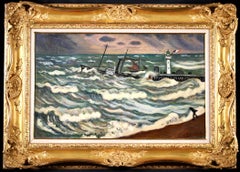
Stormy Weather - Honfleur - Post Impressionist Oil, Seascape by H de Saint-Delis
Located in Marlow, Buckinghamshire
A wonderful oil on canvas circa 1908 by French post impressionist painter Henri Liénard de Saint-Délis depicting a boat docked at the harbour in the harb...
Category
Early 1900s Post-Impressionist Landscape Paintings
Materials
Oil, Canvas
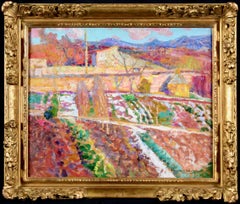
Allotments - La Sargne - Post-Impressionist Oil, Landscape by Victor Charreton
By Victor Charreton
Located in Marlow, Buckinghamshire
A charming oil on board circa 1910 by sought after Post-Impressionist painter Victor Charreton. Charreton was said to be the painter of colours and this piece, which depicts an allot...
Category
1910s Post-Impressionist Landscape Paintings
Materials
Oil, Board
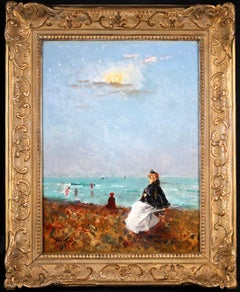
Sur la Plage - Impressionist Oil, Figures in Coastal Landscape by Alfred Stevens
By Alfred Émile Léopold Stevens
Located in Marlow, Buckinghamshire
Signed and dated figures in seascape oil on panel by Belgian impressionist painter Alfred Emile Leopold Stevens. The work depicts an elega...
Category
1890s Impressionist Figurative Paintings
Materials
Oil, Panel
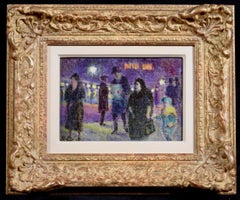
Evening in Paris - 20th Century Oil, Figures in Cityscape at Night - Louis Hayet
By Louis Hayet
Located in Marlow, Buckinghamshire
A wonderful oil on canvas by Louis Hayet depicting figures in a cityscape at evening time. Signed and dated 1932 lower left.
Louis Hayet had a difficult and itinerant childhood, due to the instability of his father, an amateur artist. He began to draw and produce watercolours from the age of 12. By the age of 20 he produced works with great skill, as demonstrated by his pen drawing Boulevard, Evening, Paris. He made a living in Paris doing various jobs more or less to do with painting. He associated with Camille and Lucien Pissaro...
Category
1930s Post-Impressionist Figurative Paintings
Materials
Canvas, Oil, Board