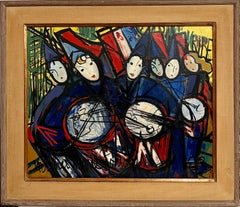
Lions Gallery Portrait Paintings
to
31
28
32
27
11
Overall Width
to
Overall Height
to
124
5
1
3
4
1
9
7
5
2
49
15
7
5
5
3
2
1
101
22
5
17
14
6
6
5
4
4
2
2
1
1
1
1
1
1
1
1
1
1
126
96
59
58
29
9
7
5
4
3
9
129
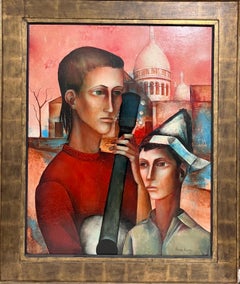
Large Surrealist French Expressionist Oil Painting Moody Boys Pierre Henry
Located in Surfside, FL
Pierre Henry (1924 - 2015)
Hand signed lower right.
Dimensions: (Frame) H 39" x W 33" ; (Painting) H 31.5" x W 25.5"
Oil on board painting depicting two people, a man holding a gu...
Category
20th Century Portrait Paintings
Materials
Oil, Board

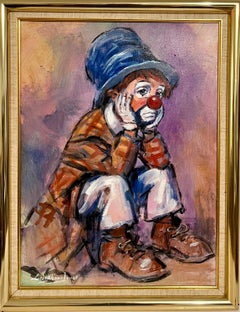
British Sad Clown Boy Oil Painting on Canvas Barry Leighton Jones Circus Scene
By Barry Leighton-Jones
Located in Surfside, FL
Frame: 27 X 21
Image: 23.5 X 17.5
Barry Leighton-Jones was born in London, England in 1932 and is a direct descendant of the Victorian artist and President of the Royal Academy, Lor...
Category
20th Century Contemporary Portrait Paintings
Materials
Canvas, Oil
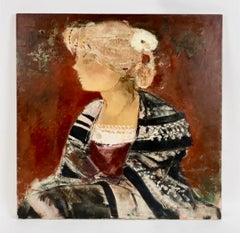
20th Century Abstract Portrait of Lady "La Dame a la Fleur Blanche" Michel Rodde
By Michel Rodde
Located in Surfside, FL
Michel Rodde (1913-2009)
Oil on Canvas Painting
Portrait of a woman: "La Dame a la Fleur Blanche"
Hand signed lower right.
Provenance: Findlay Galleries, New York with gallery stamp...
Category
20th Century Abstract Portrait Paintings
Materials
Canvas, Oil
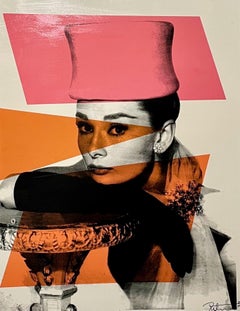
Pop Art Peter Tunney Hand Pulled Silkscreen with Hand Coloring Painting Brando
By Peter Tunney
Located in Surfside, FL
Peter Tunney (b. 1961)
Audrey Hepburn
2015
Acrylic paint
Hand-pulled silkscreen with hand coloring on archival museum board.
40 x 32-1/4 inches (101.6 x 81.9 cm) (sheet)
Hand signed and dated in ink lower right
This is from a series titled The movie stars. Each is a unique silkscreen based on a licensed photograph of a movie actor. Each is unique due to the colors and patterns created by the artist on the photo image.
Audrey is a unique, hand-pulled silkscreen on hand painted archival museum board
Peter Tunney (b. 1961) is a legitimate force of nature with boundless creative energy, spreading his positive messages in unconventional ways and delivering works of art to a worldwide collector base. He creates in almost every medium: paint, collage, wood, photography, found objects, and discarded materials.
Peter Tunney is an American visual artist, publisher, art dealer, socialite and former Wall Street executive. He currently lives and works between New York City and Miami, Florida.
Tunney first made his fortune investing in biotechnology stocks on Wall Street. He then went onto found for the now closed SoHo gallery "The time is Always Now" where for nine years he showed a vast collection of work by the famed wildlife and fashion photographer Peter Beard, some of which was created on site. In 1994 Tunney was featured on Lifestyles of the Rich and Famous, as profiled by Robin Leach, and mentioned as one of the worlds most eligible bachelors. Later Beard and Tunney had a dramatic falling out. A tumultuous period followed leading to Tunney's living in the nightclub Crobar while doing a performance piece and eventually to rehab.
Today Tunney is a visual artist who works in the genre of neo-pop and whose work has been compared to that of Mel Bochner and Christopher Wool. Tunney is also known for his "Tunney Money" a system of art given in place of cash relinquished. one of his more high profile works so far was a billboard he did in the New York City borough of the Bronx alongside the Major Deegan Expressway which spelled out "GRATTITUDE" (in all capital letters with an extra T added on for emphasis) a word which Tunney has articulated frequently in his visual works. Tunney is also known for his surfboards which he turns into artworks often with his sayings such as "City of Dreams" or the aforementioned "GRATTITUDE" embellished onto them rendering the pieces of sports equipment works of art. In 2009 Tunney was commissioned by now Senior advisor to the President of the United States Jared Kushner (for whom Tunney had previously created a stencil overlay taken from his work "Don't Panic" for Kushner's newspaper The New York Observer) to establish an immersive work called "The Experiment" in the lobby of Kushner's fifth avenue sky scraper 666 Fifth Avenue.
In the Wynwood section of Miami he opened a gallery dedicated to his work called the "Peter Tunney Experience". Now forthcoming with the kickoff of the new NFL season at Hard Rock Stadium, home of the Miami Dolphins in Miami Gardens, Florida, is a large scale multiple mural project mostly of bright colorful abstract works some with a tip of the hat to Football, a project which arose out of a dialogue between Tunney, Jessica Goldman Srebnick (CEO of Goldman Global Arts and daughter of the late famed real estate developer, preservationist and arts visionary Tony Goldman) and the Dolphins. Among the artists whose efforts are included in the body of work are; Assume Vivid Astro Focus...
Category
2010s Contemporary Mixed Media
Materials
Paint, Screen
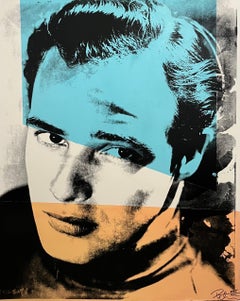
Pop Art Peter Tunney Hand Pulled Silkscreen with Hand Coloring Painting Brando
By Peter Tunney
Located in Surfside, FL
Peter Tunney (b. 1961)
Marlon Brando
2015
Acrylic paint
Hand-pulled silkscreen with hand coloring on archival museum board.
40 x 32-1/4 inches (101.6 x 81.9 cm) (sheet)
Hand signed and dated in ink lower right
This is from a series titled The movie stars. Each is a unique silkscreen based on a licensed photograph of a movie actor. Each is unique due to the colors and patterns created by the artist on the photo image.
Brando is a unique, hand-pulled silkscreen on hand painted archival museum board
Peter Tunney (b. 1961) is a legitimate force of nature with boundless creative energy, spreading his positive messages in unconventional ways and delivering works of art to a worldwide collector base. He creates in almost every medium: paint, collage, wood, photography, found objects, and discarded materials.
Peter Tunney is an American visual artist, publisher, art dealer, socialite and former Wall Street executive. He currently lives and works between New York City and Miami, Florida.
Tunney first made his fortune investing in biotechnology stocks on Wall Street. He then went onto found for the now closed SoHo gallery "The time is Always Now" where for nine years he showed a vast collection of work by the famed wildlife and fashion photographer Peter Beard, some of which was created on site. In 1994 Tunney was featured on Lifestyles of the Rich and Famous, as profiled by Robin Leach, and mentioned as one of the worlds most eligible bachelors. Later Beard and Tunney had a dramatic falling out. A tumultuous period followed leading to Tunney's living in the nightclub Crobar while doing a performance piece and eventually to rehab.
Today Tunney is a visual artist who works in the genre of neo-pop and whose work has been compared to that of Mel Bochner and Christopher Wool. Tunney is also known for his "Tunney Money" a system of art given in place of cash relinquished. one of his more high profile works so far was a billboard he did in the New York City borough of the Bronx alongside the Major Deegan Expressway which spelled out "GRATTITUDE" (in all capital letters with an extra T added on for emphasis) a word which Tunney has articulated frequently in his visual works. Tunney is also known for his surfboards which he turns into artworks often with his sayings such as "City of Dreams" or the aforementioned "GRATTITUDE" embellished onto them rendering the pieces of sports equipment works of art. In 2009 Tunney was commissioned by now Senior advisor to the President of the United States Jared Kushner (for whom Tunney had previously created a stencil overlay taken from his work "Don't Panic" for Kushner's newspaper The New York Observer) to establish an immersive work called "The Experiment" in the lobby of Kushner's fifth avenue sky scraper 666 Fifth Avenue.
In the Wynwood section of Miami he opened a gallery dedicated to his work called the "Peter Tunney Experience". Now forthcoming with the kickoff of the new NFL season at Hard Rock Stadium, home of the Miami Dolphins in Miami Gardens, Florida, is a large scale multiple mural project mostly of bright colorful abstract works some with a tip of the hat to Football, a project which arose out of a dialogue between Tunney, Jessica Goldman Srebnick (CEO of Goldman Global Arts and daughter of the late famed real estate developer, preservationist and arts visionary Tony Goldman) and the Dolphins. Among the artists whose efforts are included in the body of work are; Assume Vivid Astro Focus...
Category
2010s Contemporary Mixed Media
Materials
Paint, Screen
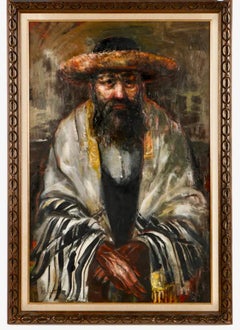
Large Judaica Oil Painting Rabbi Rediscovered NY Artist Simchat Torah
By Jonah Kinigstein
Located in Surfside, FL
"Simchat Torah" by Jonah Kinigstein
Large Oil on Board Painting of Rabbi
Frame: 46 X 32
Image: 39 X 25.5
Jonah Kinigstein (b. 1923) is an American Postwar & Contemporary painter. H...
Category
20th Century Expressionist Portrait Paintings
Materials
Oil, Board
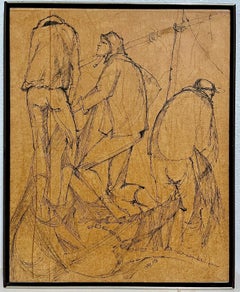
Modernist Israeli Soldiers Judaica Mixed Media Painting IDF Pilots Moshe Katz
By Moshe Katz
Located in Surfside, FL
IDF Tzahal Fighter Pilots
Dimensions: framed 31 X 25.25 canvas 30 X 24 inches
Moshe Katz ( Romanian, Israeli ) Moshe Katz was born March 2 1937 in
Bucharest, Romania. With his pa...
Category
20th Century Modern Portrait Paintings
Materials
Canvas, Mixed Media, Acrylic
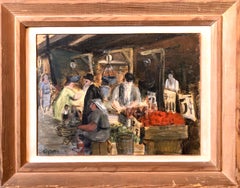
Judaica Market Scene, Shuk, European Hasidic Rabbi Oil Painting
Located in Surfside, FL
framed sight size 10 x 13.5 inches painting, framed to 15 x 19.
Impressionistic Realistic portrait of an older rabbi visiting the marketplace. Children playing. Here the artist conveys a sense of quiet grandeur through the eyes of his subject and the way it's rendered. following a distinguished lineage of Jewish genre...
Category
Early 20th Century Realist Portrait Paintings
Materials
Oil
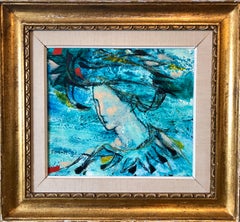
Italian Modernist Surrealist Lady With a Hat Oil Painting, Signora dal Cappello
By Lazzaro Donati
Located in Surfside, FL
Lazzaro Donati (Italian, 1926-1977), "Signora dal Cappello," oil on panel, signed lower left, signed, titled and dated verso, overall (with frame): 22.5"h x 24.5"w
Lazzaro Donati wa...
Category
1960s Surrealist Figurative Paintings
Materials
Oil, Panel
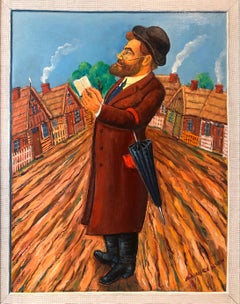
Whimsical Judaica Shtetl Shadchan Matchmaker Oil Painting WPA Jewish Folk Artist
By Maurice Kish
Located in Surfside, FL
Genre: Modern
Subject: Fiddler on the roof, Shtetl matchmaker
Medium: Oil
Surface: Board, size includes artist decorated frame
Country: United States
The imagery of Maurice Kish (18...
Category
Mid-20th Century Folk Art Figurative Paintings
Materials
Oil, Board
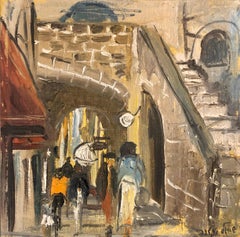
Israeli Judaica Oil Painting, Street Scene Jerusalem or Safed
By Shaul Victor
Located in Surfside, FL
Shaul Victor, (1947-2016), Russian American Israeli artist, paints vivid Judaica/Israel scenes and portraits.
Shaul Victor, painter. Born in Russia in 1947, immigrated to Israel in ...
Category
20th Century Impressionist Portrait Paintings
Materials
Canvas, Oil
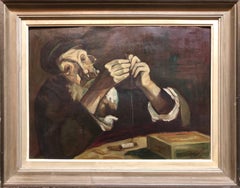
Polish Judaica Portrait of Hasidic Rabbi Shtetl Tailor Oil Painting
Located in Surfside, FL
Older, realistic portrait of an older Jewish shtetl tailor by Polish artist. Here the artist conveys a sense of quiet grandeur through the eyes of his subject and the way it's rendered. Part of a distinguished European lineage of Jewish genre...
Category
20th Century Realist Portrait Paintings
Materials
Canvas, Oil, Board
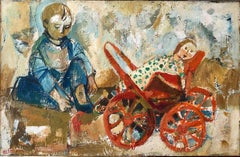
Israeli Oil Painting Ruth Schloss Child, Doll, Wagon, Kibbutz Social Realist Art
By Ruth Schloss
Located in Surfside, FL
Large magnificent colorful Ruth Schloss oil painting of a child with a wagon with a doll or a baby in a carriage stroller.. Signed in Hebrew
size measures 31x43 with frame , 23x35.25 without the frame. (this is being sold unframed).
Ruth Schloss (22 November 1922 – 2013) was an Israeli painter and illustrator who mainly depicted neglected scenes such as Arabs, transition camps, children and women at eye-level as egalitarian, socialist view via social realism style painting and drawing.
Schloss became Israeli painting’s sensitive, conscious, remembering eye.
Ruth Schloss was born on 22 November 1922, in Nuremberg, Germany, to Ludwig and Dian Schloss, as the second of three daughters of bourgeois assimilationist Jewish family well-integrated into German culture. As the Nazis came into power in 1933, her family immigrated to Israel in 1937, and settled in Kfar Shmaryahu, then an agricultural settlement. Schloss studied at the Department of Schloss graphic design at "Bezalel" from 1938 to 1942 alongside Friedel Stern and Joseph Hirsch. She was a realistic painter who focused on disadvantaged people in the society and social matters as an egalitarian. Her realism was thus an “inevitable realism,” motivated by an inner necessity: the need to observe reality as it is.
Her painting repeatedly addressed the door pulled from its frame, employing drawing’s unique ability to stop time and prolong the image’s persistence in the retina, she repeatedly committed to paper - in a matter-of-fact, non-evasive manner devoid of mystery – man’s tendency to generate chaos, suffering and pain.
Throughout her life, Schloss remained minimalist. Painting about human fate was the main subject of her artworks. Her natural inclination was to describe the darker aspect of human existence.
1930s
The Schloss household was characterized by open, liberal spirit, in keeping with the parents’ progressive views. It deeply influenced Ruth’s mental development, as she learned to tie culture and art with sensitivity towards the weak and underprivileged.
In Jerusalem, she joined a commune of Hashomer Hatzair in which she shaped her socialist views, which she maintained throughout her long career.
1940s
In this period she mainly depicted landscapes of kibbutz and wretched women living hard life, children in huger, older people, refugees. After completing her art studies, Schloss joined a training group at Kibbutz Merhavia in 1942, and after two years moved to Karkur region, the nucleus established Kibutz Lehavot Habashan in the Upper Galilee. Through this time, she fell in love with the surroundings and drew landscapes. They are simple and direct with fresh, lucid lines. These paintings were selected as the main works of her first exhibition in 1949.
In early 1945, Schloss started to draw illustrations in the children’s magazine Mishmar Leyeladim, and designed the logo of Al Hamishmar, the paper’s new name in 1948. In 1948, upon the founding of Mapam (United Workers’ Party), she designed her party’s emblem, which became a well-known icon. She kept working as an illustrator for Mishmar Layeladim until 1949.
"Mor the Monkey" project yielded financial profits and this income was used for a study trip to Paris for two years. She was succesfull as illustrator however, she had inner conflicts of her identity as witnessed painter toward neglected class in Israeli society.
First Exhibition at Mikra-Studio Gallery, 1949
She presented forty drawings on paper in her first solo exhibition, representing a selection of the themes of kibbutz landscape, its lifestyle. Schloss confidently proposed her direction through simplicity without using colors in her drawings.
1950s
Between 1949 and 1951, she studied at the Académie de la Grande Chaumière in Paris.
She began working in oils, with which she continued throughout the 1960s.
The exhibition “Back from Paris” opened in November 1951 at Mikra-Studio Gallery .
In 1951 she married Benjamin Cohen, who served as chairman of the national leadership of Hashomer Hatzair Workers Party in Tel Aviv. He was a theoretician and a man of principle, highly esteemed by its leaders who became a professor of history at Tel Aviv University. In 1953, following the Mordechai Oren affair and the publication of Moshe Sneh 's followers from Kibbutz Artzi, she and her husband left the kibbutz and moved to the agricultural farm, Kfar Shmaryahu, where she lived until her death.
At a certain point in Israeli history, segments of the socialist movement felt that Israel should become part of the Communist bloc, rather than seek the support of the western world. Because the Schloss couple support of Moshe Sneh’s left-wing party, they had to leave the kibbutz.
She loved to depict ordinary women as figurative on her painting without hiding or making up anything. The poet Natan Zach wrote about her works in 1955: “Her motto remains that which has been all these years: life as it is, without bluffing."
Schloss’s “Pietà” (1953) became a universal cry expressing the pain of mothers on either side of the divide. In the late 1950s, she was the mother of two daughters. When she drew her daughters, unlike the universal babies she depicted, naked and with clenched fists, the painting of her children employed babyish sweetness to the full in a quiet, peaceful and heart-stirring filling rather than urgency. She also painted children in the transition camp and Jaffa in the 1950s and 1960s.
1960s-1980s – The period of Studio in Jaffa
Schloss painted at a studio in Jaffa from 1962 till 1983. In this time, she turned her interest to people around her more than kibbutz – the children, mothers, and poor workers, the alleys and houses. She opened the space to the street and its dwellings, built interactions around it, and was nurtured by the presence of the outside in her work.
1960s Schloss familiarized to an Arab woman, Nabava, lived in poor. Schloss returned to painting images of old people later, and she called her painting figurative elderly people in the old age homes “waiting”.
In the late 1960s, Ruth discovered acrylic paint and never turn back to oil painting.
In 1965 Schloss devoted a series “Area 9 (1965)”, dedicated to the demolition of Israeli-Arab houses and the expropriation of the land, and carried a definite socio-political messages. The series was exhibited at Beit Zvi, Ramat Gan, in 1966. She was the only artist who addressed the result of the Six-Day War immediately afterward. In 1968, Schloss and Gansser-Markus presented “Drawing of War” in Zurich gallery. She expressed the war as an ultimate expression of destruction and ruin, regardless of victors and vanquished.
1970s In late 1970s Schloss began printing the selected photograph directly on the canvas, posterior reworking it in acrylic. She decided to print her work at Har-El Printers in Jaffa, and these became the surface of her painting. This technique was mainly adopted in two large series: Anne Frank (1979-1980) and Borders (1982). Through this technique she placed the figure of elder Frank next to that of the famous young Frank, and released it at the exhibition at Bet Ariela Cultural Center, Tel Aviv, in 1981. The series touched upon the Nazi Holocaust.
1980s The Lebanon War raised the question of “The Good Fence” and the effect of the war. She dedicated a large series Boarders, one of the most powerful image linked to the series is the figure of Yemenite woman raising her hand. She was the first to raise the Black Panthers demonstration to the level of a social icon. In the 1980s and again in 2000, the Intifada uprisings also led Schloss to the easel to render a good number of representational and symbolic works that in their way denounced Israel's political and military actions.
1990s – 2000s Ruth Schloss never had an exhibition in a major Israeli museum. Her works were presented in private galleries and small museums. The main museums, the Tel Aviv Museum of Art and the Israel Museum, included her works only in group exhibitions, and only in 1991 was her retrospective exhibited at the Herzliya Museum.
In the 2000s, Schloss’s metaphors turned into animal kingdom and Bedouins in the south. A huge rhinoceros, birds of prey, and other "bad animals," as Cohen Evron, daughter of Ruth, calls them and "I connected this to the Nazis," said Schloss. Schloss' work after she didn't find human expression able to transmit the endless cruelty she saw in Israel's political mentality.
Schloss also continued to follow and collect documentary photographs of destructions of houses from the war, the Intifada, the sequence of her work about ruin from 1949 to 2005, was a cumulative testimony about the painful history of Israel and Palestine.
In 2006, a large retrospective exhibition of her work was presented at the Museum of Art in Ein Harod, curated by Tali Tamir.
Education
1938-41 Bezalel Art Academy, Jerusalem, with Mordecai Ardon
1946 painting course for Kibbutz Artzi artists with Yohanan Simon and Marcel Janco
1949-51 Académie de la Grande Chaumière, Paris
Awards and recognition
1965 Silver Medal, International exhibition in Leipzig, Germany
1977 Artist-in-Residence, The Cité Internationale Universitaire de Paris
Selected solo exhibitions
2004 “Micha...
Category
Mid-20th Century Realist Figurative Paintings
Materials
Canvas, Oil
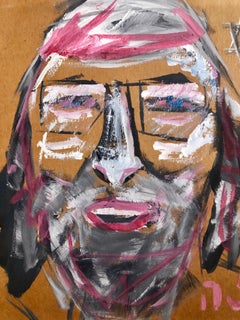
Outsider Folk Art Expressionist Rabbi Israeli Painting Signed Hebrew Jewish Star
Located in Surfside, FL
This is a signed portrait painting done in an outsider, folk art, expressionist style. This one looks like a Chassidic Breslov Hasidic man. it is signed in Hebrew, also marked with a Jewish star. this is from a collection of works by the same hand. they are all signed. Some have markings to the back of the paper. they have some age to them. They bear similarities to artists as dissimilar as Moshe Tamir, Mane Katz and an Israeli version of Purvis Young. In this piece the artist choice of colors is muted yet powerful.
Israel has had a Vibrant Folk Art, Naive art scene for a long time now, artists like Yisrael Paldi, Nahum Guttman, Reuven Rubin and even Yefim Ladyzhensky...
Category
20th Century Outsider Art Portrait Paintings
Materials
Gouache
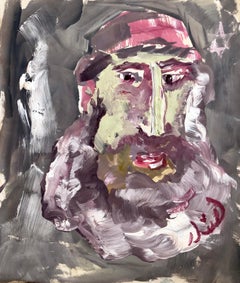
Outsider Folk Art Expressionist Rabbi Israeli Painting Signed Hebrew Jewish Star
Located in Surfside, FL
This is a signed portrait painting done in an outsider, folk art, expressionist style. it is signed in Hebrew, also marked with a Jewish star. this is from a collection of works by the same hand. they are all signed. Some have markings to the back of the paper. they have some age to them. They bear similarities to artists as dissimilar as Moshe Tamir, Mane Katz and an Israeli version of Purvis Young. In this piece the artist choice of colors is muted yet powerful.
Israel has had a Vibrant Folk Art, Naive art scene for a long time now, artists like Yisrael Paldi, Nahum Guttman, Reuven Rubin and even Yefim Ladyzhensky had naive periods. The most well know of the strict naive artists are Shalom of Safed, Irene Awret, Gabriel Cohen, Natan Heber, Michael Falk and Kopel Gurwin.
Naïve art is any form of visual art that is created by a person who lacks the formal education and training that a professional artist undergoes (in anatomy, art history, technique, perspective, ways of seeing). Unlike folk art, naïve art does not necessarily evince a distinct cultural context or tradition. Naïve art is recognized, and often imitated, for its childlike simplicity and frankness. Paintings of this kind typically have a flat rendering style with a rudimentary expression of perspective.
One particularly influential painter of "naïve art" was Henri Rousseau (1844–1910), a French Post-Impressionist who was discovered by Pablo Picasso.
Naïve art is often seen as outsider art that is by someone without formal (or little) training or degree. While this was true before the twentieth century, there are now academies for naïve art. Naïve art is now a fully recognized art genre, represented in art galleries worldwide.
Museums devoted to naïve art now exist in Kecskemét, Hungary; Riga, Latvia; Jaen, Spain; Rio de Janeiro, Brasil; Vicq France and Paris. "Primitive art" is another term often applied to art by those without formal training, but is historically more often applied to work from certain cultures that have been judged socially or technologically "primitive" by Western academia, such as Native American, sub saharan African or Pacific Island art (see Tribal art). This is distinguished from the self-conscious, "primitive" inspired movement primitivism. Another term related to (but not completely synonymous with) naïve art is folk art.
There also exist the terms "naïvism" and "primitivism" which are usually applied to professional painters working in the style of naïve art (like Paul Gauguin, Mikhail Larionov, Paul Klee).
At all events, naive art can be regarded as having occupied an "official" position in the annals of twentieth-century art since - at the very latest - the publication of the Der Blaue Reiter, an almanac in 1912. Wassily Kandinsky and Franz Marc, who brought out the almanac, presented 6 reproductions of paintings by le Douanier' Rousseau (Henri Rousseau), comparing them with other pictorial examples. However, most experts agree that the year that naive art was "discovered" was 1885, when the painter Paul Signac became aware of the talents of Henri Rousseau and set about organizing exhibitions of his work in a number of prestigious galleries.
The Earth Group (Grupa Zemlja) were Croatian artists, architects and intellectuals active in Zagreb from 1929 to 1935. The group included the painters Krsto Hegedušić, Edo Kovačević, Omer Mujadžić, Kamilo Ružička, Ivan Tabaković, and Oton Postružnik, the sculptors Antun Augustinčić, Frano Kršinić, and the architect Drago Ibler. Art brut, primitive art, primitive, art naïf, naïve art. Outsider art. A term applied to Yugoslav (Croatian) naive painters working in or around the village of Hlebine, near the Hungarian border, from about 1930. Some of the best known naive artists are Dragan Gaži, Ivan Generalić, Josip Generalić, Krsto Hegedušić, Mijo Kovačić, Ivan Lacković-Croata, Franjo Mraz, Ivan Večenaj and Mirko Virius.
Camille Bombois (1883–1970) Ferdinand Cheval, known as 'le facteur Cheval' (1836–1924)
Henry Darger (1892–1973) L. S. Lowry (1887–1976) Grandma Moses, Anna Mary Robertson (1860–1961) Nikifor (1895–1968) Poland, Horace Pippin (1888–1946) Jon Serl (1894-1993) United States
Alfred Wallis (1855–1942) Scottie Wilson (1890–1972) Gesner Abelard (b. 1922) Jan Balet (1913–2009) Michel Delacroix (b. 1933) France Howard Finster (1916–2001) Ivan Rabuzin (1921–2008)
Spontaneous Art Museum in Brussels
Art en Marge Museum in Brussels
MADmusée in Liege
International Museum of Naive Art of Brazil in Cosme Velho, Rio de Janeiro
Gallery Jacques Ardies in São Paulo
Musée international d'art naïf de Magog in Magog
Croatian Museum of Naïve Art in Zagreb
Gallery of Croatian Naïve Art...
Category
20th Century Outsider Art Portrait Paintings
Materials
Gouache
Outsider Folk Art Expressionist Rabbi Israeli Painting Signed Hebrew Jewish Star
Located in Surfside, FL
This is a signed portrait painting done in an outsider, folk art, expressionist style. it is signed in Hebrew, also marked with a Jewish star. this is from a collection of works by the same hand. they are all signed. Some have markings to the back of the paper. they have some age to them. They bear similarities to artists as dissimilar as Moshe Tamir, Mane Katz and an Israeli version of Purvis Young. In this piece the artist choice of colors is muted yet powerful.
Israel has had a Vibrant Folk Art, Naive art scene for a long time now, artists like Yisrael Paldi, Nahum Guttman, Reuven Rubin and even Yefim...
Category
20th Century Outsider Art Portrait Paintings
Materials
Gouache
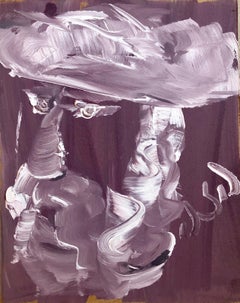
Outsider Folk Art Expressionist Rabbi Israeli Painting Signed Hebrew Jewish Star
Located in Surfside, FL
This is a signed portrait painting done in an outsider, folk art, expressionist style. it is signed in Hebrew, also marked with a Jewish star. this is from a collection of works by the same hand. they are all signed. Some have markings to the back of the paper. they have some age to them. They bear similarities to artists as dissimilar as Moshe Tamir, Mane Katz and an Israeli version of Purvis Young. In this piece the artist choice of colors is muted yet powerful.
Israel has had a Vibrant Folk Art, Naive art scene for a long time now, artists like Yisrael Paldi, Nahum Guttman, Reuven Rubin and even Yefim Ladyzhensky had naive periods. The most well know of the strict naive artists are Shalom of Safed, Irene Awret, Gabriel Cohen, Natan Heber, Michael Falk and Kopel Gurwin.
Naïve art is any form of visual art that is created by a person who lacks the formal education and training that a professional artist undergoes (in anatomy, art history, technique, perspective, ways of seeing). Unlike folk art, naïve art does not necessarily evince a distinct cultural context or tradition. Naïve art is recognized, and often imitated, for its childlike simplicity and frankness. Paintings of this kind typically have a flat rendering style with a rudimentary expression of perspective.
One particularly influential painter of "naïve art" was Henri Rousseau (1844–1910), a French Post-Impressionist who was discovered by Pablo Picasso.
Naïve art is often seen as outsider art that is by someone without formal (or little) training or degree. While this was true before the twentieth century, there are now academies for naïve art. Naïve art is now a fully recognized art genre, represented in art galleries worldwide.
Museums devoted to naïve art now exist in Kecskemét, Hungary; Riga, Latvia; Jaen, Spain; Rio de Janeiro, Brasil; Vicq France and Paris. "Primitive art" is another term often applied to art by those without formal training, but is historically more often applied to work from certain cultures that have been judged socially or technologically "primitive" by Western academia, such as Native American, sub saharan African or Pacific Island art (see Tribal art). This is distinguished from the self-conscious, "primitive" inspired movement primitivism. Another term related to (but not completely synonymous with) naïve art is folk art.
There also exist the terms "naïvism" and "primitivism" which are usually applied to professional painters working in the style of naïve art (like Paul Gauguin, Mikhail Larionov, Paul Klee).
At all events, naive art can be regarded as having occupied an "official" position in the annals of twentieth-century art since - at the very latest - the publication of the Der Blaue Reiter, an almanac in 1912. Wassily Kandinsky and Franz Marc, who brought out the almanac, presented 6 reproductions of paintings by le Douanier' Rousseau (Henri Rousseau), comparing them with other pictorial examples. However, most experts agree that the year that naive art was "discovered" was 1885, when the painter Paul Signac became aware of the talents of Henri Rousseau and set about organizing exhibitions of his work in a number of prestigious galleries.
The Earth Group (Grupa Zemlja) were Croatian artists, architects and intellectuals active in Zagreb from 1929 to 1935. The group included the painters Krsto Hegedušić, Edo Kovačević, Omer Mujadžić, Kamilo Ružička, Ivan Tabaković, and Oton Postružnik, the sculptors Antun Augustinčić, Frano Kršinić, and the architect Drago Ibler. Art brut, primitive art, primitive, art naïf, naïve art. Outsider art. A term applied to Yugoslav (Croatian) naive painters working in or around the village of Hlebine, near the Hungarian border, from about 1930. Some of the best known naive artists are Dragan Gaži, Ivan Generalić, Josip Generalić, Krsto Hegedušić, Mijo Kovačić, Ivan Lacković-Croata, Franjo Mraz, Ivan Večenaj and Mirko Virius.
Camille Bombois (1883–1970) Ferdinand Cheval, known as 'le facteur Cheval' (1836–1924)
Henry Darger (1892–1973) L. S. Lowry (1887–1976) Grandma Moses, Anna Mary Robertson (1860–1961) Nikifor (1895–1968) Poland, Horace Pippin (1888–1946) Jon Serl (1894-1993) United States
Alfred Wallis (1855–1942) Scottie Wilson (1890–1972) Gesner Abelard (b. 1922) Jan Balet (1913–2009) Michel Delacroix (b. 1933) France Howard Finster (1916–2001) Ivan Rabuzin (1921–2008)
Spontaneous Art Museum in Brussels
Art en Marge Museum in Brussels
MADmusée in Liege
International Museum of Naive Art of Brazil in Cosme Velho, Rio de Janeiro
Gallery Jacques Ardies in São Paulo
Musée international d'art naïf de Magog in Magog
Croatian Museum of Naïve Art in Zagreb
Gallery of Croatian Naïve Art...
Category
20th Century Outsider Art Portrait Paintings
Materials
Gouache
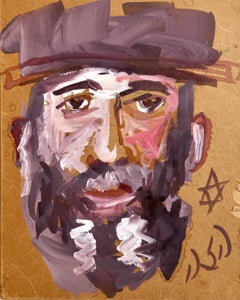
Outsider Folk Art Expressionist Rabbi Israeli Painting Signed Hebrew Jewish Star
Located in Surfside, FL
This is a signed portrait painting done in an outsider, folk art, expressionist style. it is signed in Hebrew, also marked with a Jewish star. this is from a collection of works by the same hand. they are all signed. Some have markings to the back of the paper. they have some age to them. They bear similarities to artists as dissimilar as Moshe Tamir, Mane Katz and an Israeli version of Purvis Young. In this piece the artist choice of colors is muted yet powerful.
Israel has had a Vibrant Folk Art, Naive art scene for a long time now, artists like Yisrael Paldi, Nahum Guttman, Reuven Rubin and even Yefim Ladyzhensky had naive periods. The most well know of the strict naive artists are Shalom of Safed, Irene Awret, Gabriel Cohen, Natan Heber, Michael Falk and Kopel Gurwin.
Naïve art is any form of visual art that is created by a person who lacks the formal education and training that a professional artist undergoes (in anatomy, art history, technique, perspective, ways of seeing). Unlike folk art, naïve art does not necessarily evince a distinct cultural context or tradition. Naïve art is recognized, and often imitated, for its childlike simplicity and frankness. Paintings of this kind typically have a flat rendering style with a rudimentary expression of perspective.
One particularly influential painter of "naïve art" was Henri Rousseau (1844–1910), a French Post-Impressionist who was discovered by Pablo Picasso.
Naïve art is often seen as outsider art that is by someone without formal (or little) training or degree. While this was true before the twentieth century, there are now academies for naïve art. Naïve art is now a fully recognized art genre, represented in art galleries worldwide.
Museums devoted to naïve art now exist in Kecskemét, Hungary; Riga, Latvia; Jaen, Spain; Rio de Janeiro, Brasil; Vicq France and Paris. "Primitive art" is another term often applied to art by those without formal training, but is historically more often applied to work from certain cultures that have been judged socially or technologically "primitive" by Western academia, such as Native American, sub saharan African or Pacific Island art (see Tribal art). This is distinguished from the self-conscious, "primitive" inspired movement primitivism. Another term related to (but not completely synonymous with) naïve art is folk art.
There also exist the terms "naïvism" and "primitivism" which are usually applied to professional painters working in the style of naïve art (like Paul Gauguin, Mikhail Larionov, Paul Klee).
At all events, naive art can be regarded as having occupied an "official" position in the annals of twentieth-century art since - at the very latest - the publication of the Der Blaue Reiter, an almanac in 1912. Wassily Kandinsky and Franz Marc, who brought out the almanac, presented 6 reproductions of paintings by le Douanier' Rousseau (Henri Rousseau), comparing them with other pictorial examples. However, most experts agree that the year that naive art was "discovered" was 1885, when the painter Paul Signac became aware of the talents of Henri Rousseau and set about organizing exhibitions of his work in a number of prestigious galleries.
The Earth Group (Grupa Zemlja) were Croatian artists, architects and intellectuals active in Zagreb from 1929 to 1935. The group included the painters Krsto Hegedušić, Edo Kovačević, Omer Mujadžić, Kamilo Ružička, Ivan Tabaković, and Oton Postružnik, the sculptors Antun Augustinčić, Frano Kršinić, and the architect Drago Ibler. Art brut, primitive art, primitive, art naïf, naïve art. Outsider art. A term applied to Yugoslav (Croatian) naive painters working in or around the village of Hlebine, near the Hungarian border, from about 1930. Some of the best known naive artists are Dragan Gaži, Ivan Generalić, Josip Generalić, Krsto Hegedušić, Mijo Kovačić, Ivan Lacković-Croata, Franjo Mraz, Ivan Večenaj and Mirko Virius.
Camille Bombois (1883–1970) Ferdinand Cheval, known as 'le facteur Cheval' (1836–1924)
Henry Darger (1892–1973) L. S. Lowry (1887–1976) Grandma Moses, Anna Mary Robertson (1860–1961) Nikifor (1895–1968) Poland, Horace Pippin (1888–1946) Jon Serl (1894-1993) United States
Alfred Wallis (1855–1942) Scottie Wilson (1890–1972) Gesner Abelard (b. 1922) Jan Balet (1913–2009) Michel Delacroix (b. 1933) France Howard Finster (1916–2001) Ivan Rabuzin (1921–2008)
Spontaneous Art Museum in Brussels
Art en Marge Museum in Brussels
MADmusée in Liege
International Museum of Naive Art of Brazil in Cosme Velho, Rio de Janeiro
Gallery Jacques Ardies in São Paulo
Musée international d'art naïf de Magog in Magog
Croatian Museum of Naïve Art in Zagreb
Gallery of Croatian Naïve Art...
Category
20th Century Outsider Art Portrait Paintings
Materials
Gouache
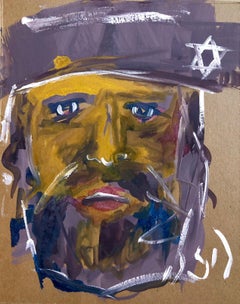
Outsider Folk Art Expressionist Rabbi Israeli Painting Signed Hebrew Jewish Star
Located in Surfside, FL
This is a signed portrait painting done in an outsider, folk art, expressionist style. it is signed in Hebrew, also marked with a Jewish star. this is from a collection of works by the same hand. they are all signed. Some have markings to the back of the paper. they have some age to them. They bear similarities to artists as dissimilar as Moshe Tamir, Mane Katz and an Israeli version of Purvis Young. In this piece the artist choice of colors is muted yet powerful.
Israel has had a Vibrant Folk Art, Naive art scene for a long time now, artists like Yisrael Paldi, Nahum Guttman, Reuven Rubin and even Yefim Ladyzhensky had naive periods. The most well know of the strict naive artists are Shalom of Safed, Irene Awret, Gabriel Cohen, Natan Heber, Michael Falk and Kopel Gurwin.
Naïve art is any form of visual art that is created by a person who lacks the formal education and training that a professional artist undergoes (in anatomy, art history, technique, perspective, ways of seeing). Unlike folk art, naïve art does not necessarily evince a distinct cultural context or tradition. Naïve art is recognized, and often imitated, for its childlike simplicity and frankness. Paintings of this kind typically have a flat rendering style with a rudimentary expression of perspective.
One particularly influential painter of "naïve art" was Henri Rousseau (1844–1910), a French Post-Impressionist who was discovered by Pablo Picasso.
Naïve art is often seen as outsider art that is by someone without formal (or little) training or degree. While this was true before the twentieth century, there are now academies for naïve art. Naïve art is now a fully recognized art genre, represented in art galleries worldwide.
Museums devoted to naïve art now exist in Kecskemét, Hungary; Riga, Latvia; Jaen, Spain; Rio de Janeiro, Brasil; Vicq France and Paris. "Primitive art" is another term often applied to art by those without formal training, but is historically more often applied to work from certain cultures that have been judged socially or technologically "primitive" by Western academia, such as Native American, sub saharan African or Pacific Island art (see Tribal art). This is distinguished from the self-conscious, "primitive" inspired movement primitivism. Another term related to (but not completely synonymous with) naïve art is folk art.
There also exist the terms "naïvism" and "primitivism" which are usually applied to professional painters working in the style of naïve art (like Paul Gauguin, Mikhail Larionov, Paul Klee).
At all events, naive art can be regarded as having occupied an "official" position in the annals of twentieth-century art since - at the very latest - the publication of the Der Blaue Reiter, an almanac in 1912. Wassily Kandinsky and Franz Marc, who brought out the almanac, presented 6 reproductions of paintings by le Douanier' Rousseau (Henri Rousseau), comparing them with other pictorial examples. However, most experts agree that the year that naive art was "discovered" was 1885, when the painter Paul Signac became aware of the talents of Henri Rousseau and set about organizing exhibitions of his work in a number of prestigious galleries.
The Earth Group (Grupa Zemlja) were Croatian artists, architects and intellectuals active in Zagreb from 1929 to 1935. The group included the painters Krsto Hegedušić, Edo Kovačević, Omer Mujadžić, Kamilo Ružička, Ivan Tabaković, and Oton Postružnik, the sculptors Antun Augustinčić, Frano Kršinić, and the architect Drago Ibler. Art brut, primitive art, primitive, art naïf, naïve art. Outsider art. A term applied to Yugoslav (Croatian) naive painters working in or around the village of Hlebine, near the Hungarian border, from about 1930. Some of the best known naive artists are Dragan Gaži, Ivan Generalić, Josip Generalić, Krsto Hegedušić, Mijo Kovačić, Ivan Lacković-Croata, Franjo Mraz, Ivan Večenaj and Mirko Virius.
Camille Bombois (1883–1970) Ferdinand Cheval, known as 'le facteur Cheval' (1836–1924)
Henry Darger (1892–1973) L. S. Lowry (1887–1976) Grandma Moses, Anna Mary Robertson (1860–1961) Nikifor (1895–1968) Poland, Horace Pippin (1888–1946) Jon Serl (1894-1993) United States
Alfred Wallis (1855–1942) Scottie Wilson (1890–1972) Gesner Abelard (b. 1922) Jan Balet (1913–2009) Michel Delacroix (b. 1933) France Howard Finster (1916–2001) Ivan Rabuzin (1921–2008)
Spontaneous Art Museum in Brussels
Art en Marge Museum in Brussels
MADmusée in Liege
International Museum of Naive Art of Brazil in Cosme Velho, Rio de Janeiro
Gallery Jacques Ardies in São Paulo
Musée international d'art naïf de Magog in Magog
Croatian Museum of Naïve Art in Zagreb
Gallery of Croatian Naïve Art...
Category
20th Century Outsider Art Portrait Paintings
Materials
Gouache
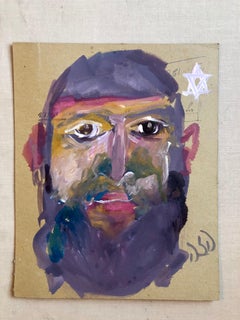
Outsider Folk Art Expressionist Rabbi Israeli Painting Signed Hebrew Jewish Star
Located in Surfside, FL
This is a signed portrait painting done in an outsider, folk art, expressionist style. it is signed in Hebrew, also marked with a Jewish star. this is from a collection of works by the same hand. they are all signed. Some have markings to the back of the paper. they have some age to them. They bear similarities to artists as dissimilar as Moshe tamir, Mane Katz and an Israeli version of Purvis Young. In this piece the artist choice of colors is muted yet powerful.
Israel has had a Vibrant Folk Art, Naive art scene for a long time now, artists like Yisrael Paldi, Nahum Guttman, Reuven Rubin and even Yefim Ladyzhensky had naive periods. The most well know of the strict naive artists are Shalom of Safed, Irene Awret, Gabriel Cohen, Natan Heber, Michael Falk and Kopel Gurwin.
Naïve art is any form of visual art that is created by a person who lacks the formal education and training that a professional artist undergoes (in anatomy, art history, technique, perspective, ways of seeing). Unlike folk art, naïve art does not necessarily evince a distinct cultural context or tradition. Naïve art is recognized, and often imitated, for its childlike simplicity and frankness. Paintings of this kind typically have a flat rendering style with a rudimentary expression of perspective.
One particularly influential painter of "naïve art" was Henri Rousseau (1844–1910), a French Post-Impressionist who was discovered by Pablo Picasso.
Naïve art is often seen as outsider art that is by someone without formal (or little) training or degree. While this was true before the twentieth century, there are now academies for naïve art. Naïve art is now a fully recognized art genre, represented in art galleries worldwide.
Museums devoted to naïve art now exist in Kecskemét, Hungary; Riga, Latvia; Jaen, Spain; Rio de Janeiro, Brasil; Vicq France and Paris. "Primitive art" is another term often applied to art by those without formal training, but is historically more often applied to work from certain cultures that have been judged socially or technologically "primitive" by Western academia, such as Native American, sub saharan African or Pacific Island art (see Tribal art). This is distinguished from the self-conscious, "primitive" inspired movement primitivism. Another term related to (but not completely synonymous with) naïve art is folk art.
There also exist the terms "naïvism" and "primitivism" which are usually applied to professional painters working in the style of naïve art (like Paul Gauguin, Mikhail Larionov, Paul Klee).
At all events, naive art can be regarded as having occupied an "official" position in the annals of twentieth-century art since - at the very latest - the publication of the Der Blaue Reiter, an almanac in 1912. Wassily Kandinsky and Franz Marc, who brought out the almanac, presented 6 reproductions of paintings by le Douanier' Rousseau (Henri Rousseau), comparing them with other pictorial examples. However, most experts agree that the year that naive art was "discovered" was 1885, when the painter Paul Signac became aware of the talents of Henri Rousseau and set about organizing exhibitions of his work in a number of prestigious galleries.
The Earth Group (Grupa Zemlja) were Croatian artists, architects and intellectuals active in Zagreb from 1929 to 1935. The group included the painters Krsto Hegedušić, Edo Kovačević, Omer Mujadžić, Kamilo Ružička, Ivan Tabaković, and Oton Postružnik, the sculptors Antun Augustinčić, Frano Kršinić, and the architect Drago Ibler. Art brut, primitive art, primitive, art naïf, naïve art. Outsider art. A term applied to Yugoslav (Croatian) naive painters working in or around the village of Hlebine, near the Hungarian border, from about 1930. Some of the best known naive artists are Dragan Gaži, Ivan Generalić, Josip Generalić, Krsto Hegedušić, Mijo Kovačić, Ivan Lacković-Croata, Franjo Mraz, Ivan Večenaj and Mirko Virius.
Camille Bombois (1883–1970) Ferdinand Cheval, known as 'le facteur Cheval' (1836–1924)
Henry Darger (1892–1973) L. S. Lowry (1887–1976) Grandma Moses, Anna Mary Robertson (1860–1961) Nikifor (1895–1968) Poland, Horace Pippin (1888–1946) Jon Serl (1894-1993) United States
Alfred Wallis (1855–1942) Scottie Wilson (1890–1972) Gesner Abelard (b. 1922) Jan Balet (1913–2009) Michel Delacroix (b. 1933) France Howard Finster (1916–2001) Ivan Rabuzin (1921–2008)
Spontaneous Art Museum in Brussels
Art en Marge Museum in Brussels
MADmusée in Liege
International Museum of Naive Art of Brazil in Cosme Velho, Rio de Janeiro
Gallery Jacques Ardies in São Paulo
Musée international d'art naïf de Magog in Magog
Croatian Museum of Naïve Art in Zagreb
Gallery of Croatian Naïve Art...
Category
20th Century Outsider Art Portrait Paintings
Materials
Gouache
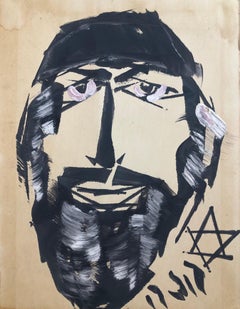
Itzhak Holtz (Judaica Master) Oil Painting Portrait John Sloan Ashcan Artist WPA
By Itshak Holtz
Located in Surfside, FL
Oil Painting Portrait of Ashcan Artist John Sloan. Signed I. Holtz.
The youngest of four children, Holtz was born and spent his early childhood in Skierniewice, Poland, a small town near Warsaw. His father was a hat maker and a furrier. In 1935, prior to World War II, when Holtz was ten years old, his family moved to Jerusalem, Israel, where they settled in the Geula neighborhood near Meah Shearim.
Itzhak Holtz's passion for art began early. When he was five years old, in Poland, his father first drew a picture of a horse and sled in the snow for him. The young Holtz looked at the drawing and studied it in wonderment. From that moment on, Holtz remembers, he constantly begged his father to draw for him. His enthusiasm for art grew and Holtz longed to study art. In 1945, he enrolled at the Bezalel Academy of Art and Design in Jerusalem, where he primarily studied lettering and poster work in a program geared toward commercial art Holtz became interested in painting, prompting him to move to New York City in 1950 to study at the Art Students League of New York under Robert Brackman and Harry Sternberg, and then at the National Academy of Design under Robert Philipp.
Holtz has stated that his artwork, which primarily but not exclusively, depict scenes of Jewish spirituality and tradition, is driven by his Orthodox Jewish beliefs: "You have to live that religious life to fully capture it on canvas." He has been classified in the school of genre painting, often depicting street scenes of ordinary people in everyday Jewish life in the back alleys and markets of Jerusalem neighborhoods such as Me'ah Shearim and Geula; and in New York neighborhoods and hamlets such as Monsey, Boro Park and Williamsburg. Along with street scenes, his work includes portraits of scribes, tailors, cobblers and fishmongers, and images such as shtetls, lighthouses, and wedding scenes. He started out painting mostly portraits in order to support his family, before expanding to include street scenes. His beloved subject matter is painting scenes of Jewish life, his childhood memories when his mother took him along shopping for the Sabbath to the markets of Meah Shearim, has left a deep impression on him and influenced many of his works. Holtz has experimented in the abstract, but then reverted to representational and figurative art to which he devoted himself exclusively. His Israeli street scenes are said to combine “an affectionate recollection of the past with the brilliance of the color of modern Israel.”
Holtz has stated that he struggled at first when he arrived to the USA because of financial reasons and because he only knew Polish, Yiddish and Hebrew, but then made good ties with his instructor who greatly influenced him Robert Philipp who helped him make friends and referred him to paint portraits.
Examples of Holtz's work throughout the years include: Yerusalem Wedding (2010), depicting a Chuppa in Jerusalem on early evening, oil on canvas; The Funeral(1966), depicting five stoic Hasidim carrying a body on a bier over to a gravesite, with the people behind them crying, in charcoal on paper and oil on canvas; Rejoicing (1974), an image of religious men dancing, in felt pen and marker on paper; and the oil painting Shamash Learning in Shul (2003), a portrait of a pious Jew studying the Talmud inside a claustrophobic synagogue scene.
Throughout the years Holtz has created hundreds of works in many art mediums, including, genre scenes, portraits, still lifes and landscape scenery, his works are sought after by art collectors worldwide, and he has been called the greatest living Jewish artist. It is said that no artist ever explored the Jewish subject like Holtz. Today some of his oil paintings have been commanding over $100,000.
Holtz creates his scenes after researching locations, and often uses locals as models. He paints slowly and with great care, but with a swift Impressionistic style. The people in his portraits and scenes are generally more cheerful and optimistic than standard portraits of Hassidic individuals. He paints oils and watercolors, and also does felt pen, pastel, marker, ink and charcoal drawings, as well as woodcuts. His oil paintings typically have a brown hue, while his work with felt pen is often in sepia tones, and on some of his works he used very bright colors, with a strong emphasis on the interplay of light and shadow. He is heavily influenced by the ancient staircases and alleyways of Jerusalem, with its modest religious population, which has made a strong impression on him in his youth, the streets of Tzfat, and the works of Rembrandt, Johannes Vermeer and Peter Bruegel, as well as Jewish artists Moritz Daniel Oppenheim...
Category
1940s Realist Portrait Paintings
Materials
Canvas, Oil
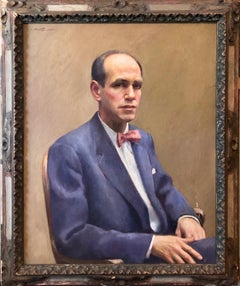
Modernist Orchestra Musical Gouache Painting Boston Expressionist
By David Aronson
Located in Surfside, FL
Very vibrant, dynamic orchestra scene reminiscent of the work of Mopp (Max Oppenheim)
David Aronson, (1923-2015) son of a rabbi, was born in Lithuania in 1923 and immigrated to America at the age of five. He settled in Boston, Massachusetts where he studied at the school of the Museum of Fine Arts under Karl Zerbe, a German painter well known in the early 1900s. Aronson later taught at the school of the Museum of Fine Arts for fourteen years and founded the School of Fine Art at Boston University where he is today a professor emeritus. An internationally renowned sculptor & painter, Aronson has won acclaim for his interpretation of themes from the Hebrew Talmud and Kabala. His best known works include bronze castings, encaustic paintings, and pastels. His work is included in many important public and private collections, and has been shown in several museum retrospectives around the country. He is considered to be one of the most important 20th century American artists.
At twenty-two David Aronson had his first one-man show at New York's Niveau Gallery. The next year, six of his Christological paintings were included in the Fourteen Americans exhibition at Manhattan's Museum of Modern Art where Aronson’s work was included alongside abstract expressionists Arshile Gorky, Robert Motherwell and Isamu Noguchi. In the 1950s, Aronson turned more toward his Jewish heritage for the inspiration for his art. Folklore as well as Kabalistic and other transcendental writings influenced his work greatly. The Golem (a legendary figure, brought to life by the Maharal of Prague out of clay to protect the Jewish community during times of persecution) and the Dybbuk (an evil spirit that lodges itself in the soul of a living person until exorcised) frequently appear in his work.
In the sixties, Aronson turned to sculpture. His work during this period is best exemplified by a magnificent 8’ x 4’ bronze door which now stands at the entrance to Frank Lloyd Wright's Johnson Foundation Conference Center for the Arts in Racine, Wisconsin. In the seventies and eighties, Aronson continued his work in pastel drawings, paintings, and sculptures, often exploring religion and the frailties of man's nature. During this time, in addition to a traveling retrospective exhibition and many one-man shows in New York, Los Angeles, Chicago, and Boston at the Pucker-Safrai Gallery on Newbury Street, Aronson won many awards and became a member of the National Academy of Design in New York. Two years ago he retired from teaching to work full-time in his studio in Sudbury, Massachusetts.
included in the catalog
Contemporary Religious Imagery in American Art
Catalog for an exhibition held at the Ringling Museum of Art, March 1-31, 1974.
Artists represented: David Aronson, Leonard Baskin, Max Beckmann, Hyman Bloom, Fernando Botero, Paul Cadmus, Marvin Cherney, Arthur G. Dove, Philip Evergood, Adolph Gottlieb, Jonah Kinigstein, Rico Lebrun, Jack Levine, Louise Nevelson, Barnett Newman, Abraham Rattner, Ben Shahn, Mark Tobey, Max Weber, William Zorach and others.
Selected Awards
1990, Certificate of Merit, National Academy of Design
1976, Purchase Prize, National Academy of Design
1976, Joseph Isidore Gold Medal, National Academy of Design
1976, Purchase Prize in Drawing, Albrecht Art Museum
1975, Isaac N. Maynard Prize for Painting, National Academy of Design
1973, Samuel F. B. Morse Gold Medal, National Academy of Design
1967, Purchase Prize, National Academy of Fine Arts
1967, Adolph and Clara Obrig Prize, National Academy of Design
1963, Gold Medal, Art Directors Club of Philadelphia
1961, 62, 63, Purchase Prize, National Institute of Arts and Letters
1960, John Siimon Guggenheim Fellowship
1958, Grant in Art, National Institute of Arts and Letters
1954, First Prize, Tupperware Annual Art Fund Award
1954, Grand Prize, Third Annual Boston Arts Festival
1953, Second Prize, Second Annual Boston Arts Festival
1952, Grand Prize, First Annual Boston Arts Festival
1946, Traveling Fellowship, School of the Museum of Fine Arts
1946, Purchase Prize, Virginia Museum of Fine Arts
1944, First Popular Prize, Institute of Contemporary Art
1944, First Judge's Prize, Institute of Contemporary Art
Selected Public Collections
Art Institute of Chicago
Virginia Museum of Fine Arts
Bryn Mawr College
Brandeis University
Tupperware Museum, Orlando, Florida
DeCordova Museum
Museum of Modern Art Print Collection, New York
Atlanta University
Atlanta Art...
Category
20th Century Expressionist Figurative Paintings
Materials
Gouache, Board
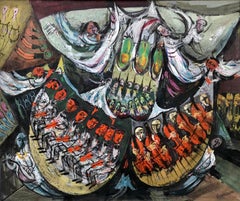
Large Gouache Original Painting Mother
Daughter Sandu Liberman Israeli Judaica
By Sandu Liberman
Located in Surfside, FL
framed 36 X 28 board 30 X 21.75
Sandu Liberman (Romanian-Israeli) was born in Yasi, Romania in 1923. between 1946 and 1953 he took part in the state art shows in Bucharest. in 1952 ...
Category
20th Century Modern Figurative Paintings
Materials
Paper, Gouache
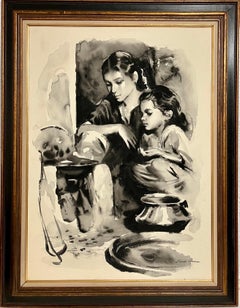
Rare Hungarian Jewish Rabbi Judaica Oil Painting Portrait
By Lajos Polczer
Located in Surfside, FL
Rare Pre World War II (Pre Holocaust) Judaica Art. European Judaic art from this period is exceedingly rare.
Polczer was an Hungarian artist, his foundations of painting were taught by a painter Bertalan Karlovszky. His works were exhibited in the National Salon and the Art Hall from 1928. His works are held by the Hungarian National Gallery. In his later years he worked in the United States, he was working in New Orleans, Louisiana in the late 1960s. Known for his Jewish genre scenes, Chess scenes and other early 20th Century salon style nude paintings. In the tradition of Moritz Oppenheim...
Category
Mid-20th Century Post-Impressionist Figurative Paintings
Materials
Oil
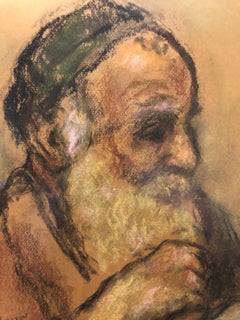
Judaica Pastel Portrait Rabbi Painting WPA Era Artist, Social Realist
By Bernard Gussow
Located in Surfside, FL
Bernard Gussow 1881 -1957
Bernard Gussow was active/lived in New York, New Jersey / Russian Federation. Bernard Gussow is known for genre, landscape, figure, interior paintings.
Ber...
Category
1940s American Realist Portrait Drawings and Watercolors
Materials
Oil Pastel
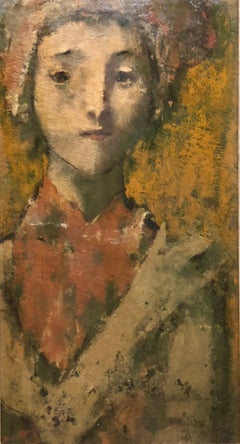
Modernist Encaustic Painting Portrait Boston Expressionist
By David Aronson
Located in Surfside, FL
Bears old label verso from Raydon Gallery in New York city.
Aronson, David 1923-
David Aronson, son of a rabbi, was born in Lithuania in 1923 and immigrated to America at the age of ...
Category
20th Century Expressionist Figurative Paintings
Materials
Encaustic
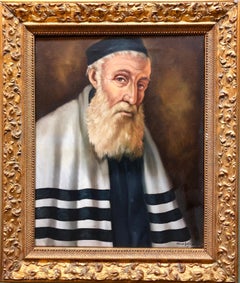
Polish Judaica Portrait of Hasidic Rabbi with Tallit Synagogue Oil Painting
Located in Surfside, FL
Realistic portrait of an old Jewish shtetl type pulpit rabbi by a Polish artist. Here the artist conveys a sense of quiet grandeur through the eyes of his subject and the way it's rendered. Part of a distinguished European lineage of Jewish genre...
Category
20th Century Realist Portrait Paintings
Materials
Canvas, Oil, Board
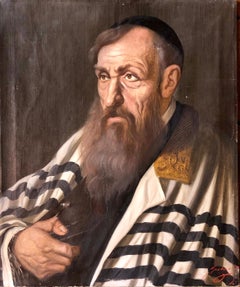
Holocaust Memorial Oil Painting Judaica Rabbi Composed of Figures Artists Frame
By Maurice Newman
Located in Surfside, FL
Maurice Newman was active/lived in Massachusetts / Lithuania. Maurice Newman is known for sculpture-abstraction, impressionist landscape painting, diorama.
Born in Lithuania, Mauric...
Category
1960s American Modern Portrait Paintings
Materials
Oil
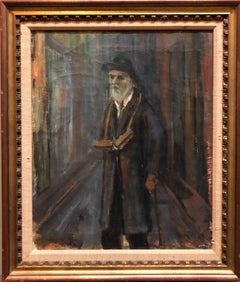
Judaica Oil Painting 1945 Palestine Old Jewish Man Polish Israeli Artist
By Ozer Shabat
Located in Surfside, FL
Ozer Shabat 1978-1901
Ozer Shabbat was an Israeli painter, a resident of Haifa. Belonged to the Palestine Expressionist group of the late 1920s and early 1930s.
Shabbat was born in Wolbrom, Poland. At the end of the First World War he went to Holland for agricultural training in the framework of the HeChalutz movement, prior to his immigration to Palestine. In 1920 he immigrated to Eretz Israel and joined the Hulda group. Later he joined the Merhavia group and there he began painting. Because of his desire to study drawing, he left the group and moved to Jerusalem. In 1921, he wrote articles in the newspaper "HaSadeh" on the subject of agriculture and Dutch cheese.
Ozer Shabath won the first prize in a competition for the design of the Dutch Consulate's Garden in Jerusalem, enabling him to travel to Paris in 1923 to study painting. Until 1925 he studied painting at the Grande Chaumiere Academy in Paris. This year he returned to Eretz Israel and settled in Haifa, where he lived until his death.
In 1928 he participated for the first time in an exhibition of Eretz Israel artists at the Tower of David. Since then he has participated in all the general exhibitions of Israeli artists. In 1934, together with painters Menachem Shemi, Avraham Mohar, Zvi Meirovitch and others, he founded the Haifa Artists' Group. In 1935-36 he toured Europe and visited Italy, France and England. During his visit, he maintained contacts with artists from the Jewish school of Paris.
He has exhibited in several solo exhibitions, represented Israel in exhibitions in Europe and participated in international exhibitions in New York, Johannesburg and Zurich. In 1958 he represented Israel in the Venice Biennale. In 1960, Shabat, together with Elchanan Halpern he represented the Israeli Painters Association at the International Congress of Plastic Arts held in Vienna, Austria . In the 40s and 50s he focused on landscape pictures. However, despite the focus on the Israeli landscape, the approach is universal in the framework of the post-Impressionist painting school. In the 1960s, his approach changed and he turned more to abstraction. The abstract direction gradually evolved. The point of departure of the abstract approach is the architectural landscape, but this view loses its real character and becomes only imaginary: the buildings lose their real character and turn into exclusive geometric areas that are usually set against a dark background. Over time, architecture captured the lion's share of his paintings. Cities like Safed, Jaffa and Jerusalem are the subject of many pictures.
He taught painting and art at the schools of the kibbutzim in Ramat Yochanan and Kfar Yehoshua, in high schools in Haifa and in the IDF and Gordon seminars.
His paintings were purchased and are in the permanent collection of the Bezalel National Museum (now the Israel Museum), Haifa Museum of Art, Haifa Maritime Museum, Acre Municipal Museum.
Select Solo exhibitions
1936 - Nadler Gallery, Haifa.
1943 - The Tel Aviv Museum of Art.
1952 - Artists House, Haifa.
1953 - Bezalel House, Jerusalem.
1955 - Gallery in Geneva, Switzerland.
1955 - The Writers' Club, Haifa.
1959 - Artists House, Haifa.
1960 - Museum of Modern Art, Haifa.
1962 - Museum of Modern Art, Haifa.
1963 - Gallery 220, Tel Aviv.
1968 - The Municipal Museum of Beit Emanuel, Ramat Gan.
1979 - Memorial exhibition marking the first anniversary...
Category
1940s Post-Impressionist Figurative Paintings
Materials
Canvas, Oil
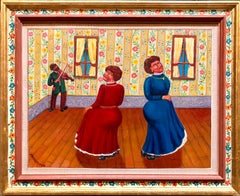
Dance of the In laws Wedding Scene Judaica Shtetl Oil Painting WPA Jewish Artist
By Maurice Kish
Located in Surfside, FL
Genre: Modern
Subject: Jewish Wedding Mechutanim
Medium: Oil
Surface: Board, size includes artist decorated frame
Country: United States
The imagery of Maurice Kish (1895-1987), whe...
Category
Mid-20th Century Modern Figurative Paintings
Materials
Oil
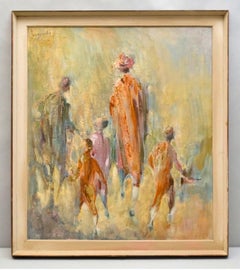
Large Judaica Oil Painting Samuel Grodensky Hasidic Rabbi, Children in Jerusalem
Located in Surfside, FL
Samuel Grodensky (1894-1974)
"Hassidim"
Hand signed and dated "Grodensky '62" u.l.,
Titled verso in pencil on stretcher
31" x 27" canvas , 35 1/2" x 31 1/2" framed.
Large Fauvist Expressionist Jewish Family Oil Painting
This is done in an Expressionist style in Fauvist colors. Influenced by the Judaic artists of the early Israeli...
Category
1960s Expressionist Figurative Paintings
Materials
Canvas, Oil
Pre World War II Austrian Judaica Oil Painting Hasidic Rabbi Portrait
By Rudolf Klinsbogl Klingsberg
Located in Surfside, FL
Rudolf KLINGSBÖGL Austrian Viennese painter and teacher. Chassidic rebbe with Shtreimel.
Klingsbogl was active in Vienna and is known for his typical portraits and paintings of interiors - workshops, pubs and cellars. His style is very distinctive. rare to find good jewish work that survived the holocaust as so much of it was destroyed.
Other works by Rudolf Klingsbogl (sometimes known as Klingsberg}: Rabbis Studying Around a Table, The Huntsman, The Pet Bird, Blacksmith Interior Scene, Three Men with Chat and Drink, The Sailors, The Old Drinker, Debating the News, Sunday Afternoon, Man Looking at Pocket Watch. Game of Cards in a Tavern, Wolfgang Amadeus Mozart as a Child, Franz Schubert at the Piano, Johann Strauss (The Younger).
Realistic portrait of an older rabbi visiting and blessing a child in a European marketplace...
Category
Early 20th Century Academic Portrait Paintings
Materials
Oil
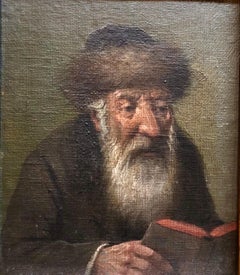
Oil Painting by Well Known Cartoonist and Illustrator Upper East Side, Manhattan
By Sandy Huffaker
Located in Surfside, FL
An Upper East Side of Manhattan New York city scene of bald guy reading newspaper on bench with East River and tugboat in background.
The 1970s were the “glory days,” Huffaker says, for himself and a stable of talented illustrators whose work routinely found itself on the covers of the nation’s premier newsmagazines and in the pages of The New York Times. For the better part of that decade, Huffaker was among an elite breed of commercial artists—his hero and fellow Southerner Jack Davis, the legendary Mad Magazine illustrator, among them—working during a remarkable period when art directors routinely turned to illustration to give comic relief to the country’s deeply serious and dark problems. From civil rights and the women’s movement to Vietnam and Watergate, the gas crisis and inflation to the rise of Jimmy Carter, Huffaker mined a deep well of material ripe for his brand of visual wit and caustic satire. He sent his portfolio to children's book illustrator Maurice Sendak, the legendary “Where The Wild Things Are” illustrator to gauge his prospects, and when Sendak replied, “C’mon up, you’ll do all right,”
SELECT HONORS:
2 Page-One Awards (from the New York Newspaper Guild), for work in Fortune Magazine and Sports Illustrated.
Nominated 3 times for Cartoonist-of-the-Year by the National Cartoonists Society (illustration category).
Desi Award of Excellence (Graphic Design Magazine).
20 Award of Merit citations from the Society of Illustrators.
One-man show, Society of Illustrators.
Illustrators 22 - annual national exhibition for the Society of Illustrators.
SELECT MAGAZINE COVERS
Time Magazine (6),
Sports Illustrated (2),
Business Week (12),
Forbes,
Saturday Review,
New York Times Sunday Magazine,
The New Republic,
Family Weekly,
Madison Avenue,
New York Daily News Sunday Magazine (2),
Junior Scholastic,
ACLU,
The Nation , and more
EDUCATION BA, University of Alabama. Attended Pratt Graphic Center and The Art Students League, New York City.
BOOKS WRITTEN AND ILLUSTRATED The Dispensible Man (M. Evans and Co.) and The Bald Book (M. Evans and Co.) BOOKS ILLUSTRATED White Is (Grove Press), The Begatting of a President (Ballantine Books), The Biggest Sneeze (Harper-Collins), H. Phillip Birdsong's ESP (Young Scott Books), Kids Letters to President Reagan (M. Evans), The Worlds Greatest Left-Handers (M. Evans), Does My Room Come Alive at Night (HarperCollins), The Man With Big Ears (HarperCollins), Jake Snake's Race (HarperCollins), and more
POLITICAL CARTOONING Political cartoonist at The News and Obsever in Raleigh, NC and syndicated during the early 70's. Today, syndicated in 750 publications 3-times a week with Cagle Cartoons.
FINE ART SHOWS Allied Artists of America, Salmagundi Club, Phillips Mill Annual (honorable mention), New Hope Shad Festival (grand Prize), Hunter Museum in Chattanooga ( one -man career retrospective), Santa Fe public library (one--man), Rosenfeld Gallery (Philadelphia), Potter...
Category
20th Century American Modern Figurative Paintings
Materials
Canvas, Oil

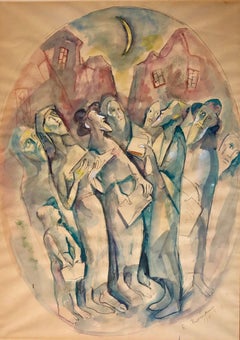
Modernist Watercolor Painting Judaica Kiddush Levana Blessing New Moon
By Emanuel Glicenstein Romano
Located in Surfside, FL
Genre: Judaic prayer scene
Subject: Landscape
Medium: watercolor
Surface: Paper
Country: United States
EMANUEL ROMANO
Rome, Italy, b. 1897, d. 1984
Emanuel Glicenstein Romano was born in Rome, September 23, 1897.
His father Henryk Glicenstein was a sculptor and was living in Rome with his wife Helena (born Hirszenberg) when Emanuel was born his father obtained Italian citizenship and adopted the name Enrico. Emanuel was brought up in Italy, Switzerland, Germany, England and Poland.
In 1926 Emanuel and his father sailed for New York. They briefly visited Chicago. Romano's sister, Beatrice, and mother only joined them in New York years later.
Romano changed his name on his arrival to America and some have erroneously speculated that this was to avoid antisemitic anti Jewish discrimination. In truth, as the son of a highly-regarded artist, Romano changed his name to ensure that any success or recognition he would later attain, would be the result of nothing other than his own merit as an artist, and not on account of his father's fame.
In 1936 Romano was worked for the Federal Art Project creating murals. During and immediately after World War II, Romano created a series of allegorical works depicting graphic holocaust images that were held closely by the family until after his passing. One of these works is now on permanent display in the Florida Holocaust Museum in St. Petersburg Florida.
Emanuel's father died in 1942 in a car accident before they could realize their shared dream of visiting Israel.
In 1944 Romano, having completed his degree at the Pennsylvania Academy of Fine Arts and the Art Institute of Chicago, began teaching at the City College of New York.
Romano moved to Safed, Israel in 1953 and established an art museum in his father's memory, the Glicentein Museum.
COLLECTIONS
Indianapolis Museum of Art
Metropolitan Museum of Art
Boston Fine Arts Museum
Fogg Museum
Musée Nacional de France
Recently his work has been added to the Florida Holocaust Museum collection. His notable works include his holocaust themed allegorical paintings as well as portraits of Marianne Moore, his father and William Carlos Williams...
Category
20th Century American Modern Figurative Paintings
Materials
Paper, Watercolor
Modernist Oil Painting 1940s, Judaica Hasidic Rabbi in Jerusalem
By Emanuel Glicenstein Romano
Located in Surfside, FL
Genre: Portrait
Subject: Landscape
Medium: Oil
Surface: Board
Country: United States
EMANUEL ROMANO
Rome, Italy, b. 1897, d. 1984
Emanuel Glicenstein Romano was born in Rome, September 23, 1897.
His father Henryk Glicenstein was a sculptor and was living in Rome with his wife Helena (born Hirszenberg) when Emanuel was born. His father obtained Italian citizenship and adopted the name Enrico. Emanuel was brought up in Italy, Switzerland, Germany, England and Poland.
In 1926 Emanuel and his father sailed for New York. They briefly visited Chicago. Romano's sister, Beatrice, and mother only joined them in New York years later.
Romano changed his name on his arrival to America and some have erroneously speculated that this was to avoid antisemitic discrimination. In truth, as the son of a highly-regarded artist, Romano changed his name to ensure that any success or recognition he would later attain, would be the result of nothing other than his own merit as an artist, and not on account of his father's fame.
In 1936 Romano was worked for the Federal Art Project creating murals. During and immediately after World War II, Romano created a series of allegorical works depicting graphic holocaust images that were held closely by the family until after his passing. One of these works is now on permanent display in the Florida Holocaust Museum in St. Petersburg Florida.
Emanuel's father died in 1942 in a car accident before they could realize their shared dream of visiting Israel.
In 1944 Romano, having completed his degree at the Pennsylvania Academy of Fine Arts and the Art Institute of Chicago, began teaching at the City College of New York.
Romano moved to Safed, Israel in 1953 and established an art museum in his father's memory, the Glicentein Museum.
COLLECTIONS
Indianapolis Museum of Art
Metropolitan Museum of Art
Boston Fine Arts Museum
Fogg Museum
Musée Nacional de France
Recently his work has been added to the Florida Holocaust Museum collection. His notable works include his holocaust themed allegorical paintings as well as portraits of Marianne Moore, his father and William Carlos Williams...
Category
1970s American Modern Figurative Paintings
Materials
Oil, Board
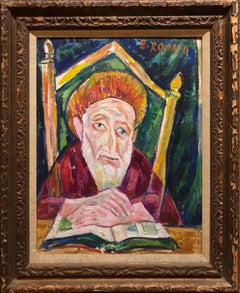
Oil Painting "The Rabbi" Sensitive Judaica Portrait by Italian American master
By Roberto Lupetti
Located in Surfside, FL
Born in Milan, Italy Lupetti studied at the Royal Academy in Rome where he received classical training and was apprenticed to the school of restoration at the Vatican. At the age of fourteen he was accepted to attend Brera Liceo Artistico, one of the most prestigious art academies in Italy, graduating at age eighteen and then went on to win honors from the Royal Academy of Fine Arts in Rome eventually receiving the degree of Professor of Fine Arts. In Milan, he helped restore the famed La Scala Opera House, and in Rome he earned the right to help in the restoration of the Masters' Works in the Vatican's Sistine Chapel. Following service in WWII, Roberto came to America sponsored by the famous conductor Arturo Toscanini. A painting he did of the maestro was purchased by the San Francisco Art Commission. He moved to San Francisco where he taught at the Art Institute.
As well as decorating churches throughout the U.S., he also painted portraits of such celebrities as Ingrid Bergman, Barbara Stanwyck, and General George Marshall. Roberto Lupetti earned five degrees at the Royal Academy of Fine Arts. Roberto was married to fellow artist Lynn Lupetti...
Category
20th Century Realist Portrait Paintings
Materials
Canvas, Oil

Judaica "The Rebbe
" European Hasidic Rabbi Portrait Oil Painting
By Charles Hannaford
Located in Surfside, FL
Signed with monogrammed initials and has his name written on verso.
Realistic portrait of an older rabbi.
CHARLES E. HANNAFORD, English; 1863-1955, Hannaford was a British waterco...
Category
20th Century Realist Portrait Paintings
Materials
Canvas, Oil
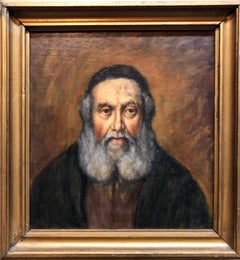
Judaica "The Rebbe
" European Hasidic Rabbi Oil Painting
Located in Surfside, FL
Realistic portrait of an older rabbi visiting and blessing a child in a European marketplace. Here the artist conveys a sense of quiet grandeur th...
Category
20th Century Realist Portrait Paintings
Materials
Canvas, Oil
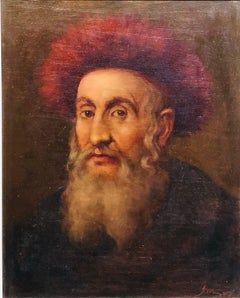
Lithuanian French Ecole de Paris Judaica Oil Painting Refugee Family
By Jacques Koslowsky
Located in Surfside, FL
Expressionist Realistic portrait of a Jewish refugee family World War II era by Lithuanian French Jewish artist. Here the artist conveys a sense of quiet grandeur through the eyes of...
Category
20th Century Realist Portrait Paintings
Materials
Oil, Board
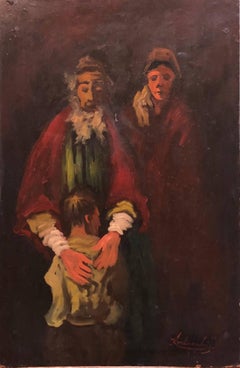
1947 Expressionist Oil Painting Flute Player Musician Boris Deutsch WPA Artist
By Boris Deutsch
Located in Surfside, FL
Boris Deutsch (American Lithuanian Russian, 1892-1978)
"The Flute Player," 1947
Oil paint on canvas,
Hand signed and dated upper left,
Provenance: gallery label (Pasadena Art Museu...
Category
1920s Modern Figurative Paintings
Materials
Canvas, Oil
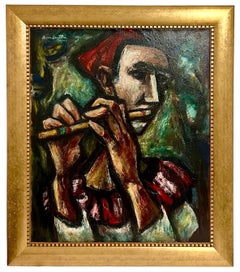
Chassidic Rabbi with Shtreimel, Rare Judaica Oil Painting Signed in Hebrew
Located in Surfside, FL
Rare Judaica Art. Jewish genre scene. In the tradition of Moritz Oppenheim, Isidor Kauffman and Maurycy Gottlieb and later of Tully Filmus, Zalman Kle...
Category
Mid-20th Century Post-Impressionist Figurative Paintings
Materials
Oil
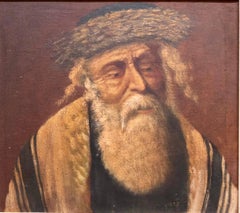
The Preacher Rabbi "Der Maggid" Judaica Oil Painting WPA Jewish artist
By Maurice Kish
Located in Surfside, FL
Genre: Modern
Subject: Hasidic Rabbi preaching in Synagogue
Medium: Oil
Surface: Board, size includes artist decorated frame
Country: United States
The imagery of Maurice Kish (189...
Category
Mid-20th Century Modern Figurative Paintings
Materials
Oil, Board
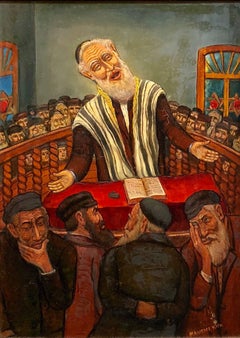
Modernist Israeli Judaica Mixed Media Painting Rabbis Walking In Jerusalem
By Moshe Katz
Located in Surfside, FL
Moshe Katz (Romanian Israeli), 1937- an Israeli citizen, studied art at the Bezalel Academy of Art in Jerusalem, as well as at the Chicago Academy of Fine Arts.
Although not an exponent of one dominating technique of painting, Moshe has been fascinated in recent months with the textures and expressions he is able to obtain with the pallette knife.
Picasso, Cezanne and Gaugin are his idols, and the power of Mexican art has a deep fascination for him. With elements of Folk Art combined with a sophisticated technique.
He enjoys working in clay but finds painting in oil his greatest outlet for the stories he has to tell through his pictures. In addition to an outstanding collection of books featuring the works of the great masters, his shelves are lined with texts about hypnosis. Studying about the art of hypnotizing provides him with a mental exercise far removed from his highly developed art of expressing himself on canvas. He has exhibited with the Painters and Sculptors Association in Israel, Haifa and the North along with artists: Yaacov Agam, Sela (Blaustein), Emanuel Pinhassi, Pasternak, Anna, Chaltiel, Joseph Schwartz, Nira Shemer, Aviva, Fadel, Mohamed Bishara, Sana, Menashe Kadishman, Menashe Shalhevet, Yitzchak Frumin, Moshe Rosen, Maureen
Moshe was born March 2, 1937 in Bucherest, Romania with his parents, he fled from the Nazis and after stops in many countries, reached Israel. His paintings have been displayed by Arts International...
Category
20th Century Modern Portrait Paintings
Materials
Canvas, Mixed Media, Acrylic
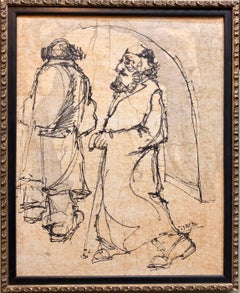
Hungarian Rabbi Judaica Oil Painting Hasidic Rabbi with Shtreimel
Located in Surfside, FL
20th century Jewish Chassidic Rabbi with fur hat portrait, Judaica Oil Painting
Category
20th Century Realist Portrait Paintings
Materials
Canvas, Oil
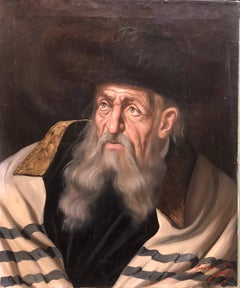
British Modernist Portrait of Chaim Weizmann President of Israel Oil Painting
By Alfred Aaron Wolmark
Located in Surfside, FL
Alfred Aaron Wolmark (1877 – 1961) was a painter and decorative artist. He was a Post Impressionist and a pioneer of the New Movement in Art.
He was born Aaron Wolmark into a Jewish family in Warsaw, Poland who were amongst the many subsequently fleeing the pogroms of Eastern Europe. The family moved to Devon when he was six before moving to Spitalfields, East London, there along with many other Jewish immigrant émigré families. He became a British citizen in 1894.
He studied at the Royal Academy Schools and exhibited there from 1901-1936. (1895-8 (1st Silver Medallist for Drawing). There he took the name Alfred Wolmark, by which he is known.
Returning briefly to Poland in 1903, he painted works based his Jewish identity and faith, refraining from depicting the persecution and anti-Semitism his family witnessed on the continent and idealising the peaceful and contemplative elements of his religion. His first one-man exhibition was held at the Bruton Galleries in 1905.
In July 1911, after an artistic epiphany on honeymoon in Concarneau, Brittany, he became influenced by modern French painting, his colour palette and style became post impressionist, and Wolmark jettisoned his early methods in favour of the pioneering 'colourist' path that he followed for the next two decades of his working life. He was a British fauvist and pitched his tonal divisions to a higher key than any of his contemporaries. Wolmark kept to traditional genre, and transformed his subjects through the use of flattened forms, built up with a heavy impasto. His daring use of bright colour on some paintings such as "An Arrangement: Group of Nudes" demonstrate a skillset akin to Andy Warhol and earned him the title of ‘The Colour King’. the early colourist, Alfred Wolmark, the so-called father of the ‘Whitechapel Boys’. This group includes painters David Bomberg, Mark Gertler and Jacob Kramer, as well as (by association) the sculptor Jacob Epstein, First World War poet-painter, Isaac Rosenberg, and the only ‘Whitechapel Girl’ Clare Winsten...
Category
Early 20th Century Modern Portrait Paintings
Materials
Canvas, Oil
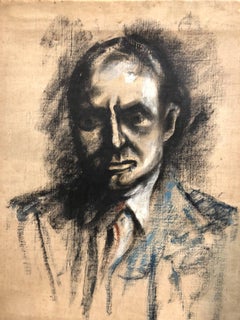
Pop Art Acrylic Painting
Detectives
from the Tintin Comic books
By Fernando Fer Sucre
Located in Surfside, FL
These are the detectives of the Belgian comic book Tintin created by Herge. FER SUCRE is a Venezuelan-born artist now in Wynwood Miami, Florida. He studied graphic design and paintin...
Category
1990s Pop Art Portrait Paintings
Materials
Canvas, Plastic, Acrylic
1970s Big Eyed Waif Sad Child with Scarf Oil Painting
By Erbert Mule
Located in Surfside, FL
1970s Italian (based on the inscription, the artist's name sounds German or Austrian) big eyed waif crying little boy painting. from the era of Jea...
Category
1970s Modern Portrait Paintings
Materials
Canvas, Oil
Organ Grinder with Parrot Modern Judaica Oil Painting WPA Jewish artist
By Maurice Kish
Located in Surfside, FL
Genre: Modern
Subject: Organ grinder with parrot
Medium: Oil
Surface: Board, size includes artist decorated frame
Country: United States
The imagery of Maurice Kish (1895-1987), wh...
Category
Mid-20th Century Modern Figurative Paintings
Materials
Oil
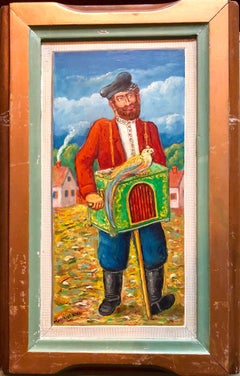
Clown, Modernist Oil Painting on Board WPA Artist
By Maurice Kish
Located in Surfside, FL
This portrait of a clown by Maurice Kish is part from a series of carnival figures, circus clowns and carousel horses and riders that he did in the 30s and 40s. The artist uses a vib...
Category
Early 20th Century Modern Portrait Paintings
Materials
Oil, Board
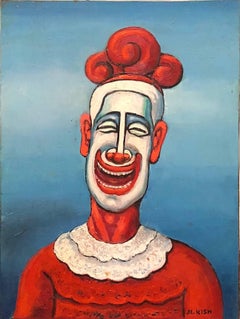
Oil Painting Israeli Bronze Menorah Tallit Judaica Still Life Bar Mitzvah Scene
By Roberto Lupetti
Located in Surfside, FL
Frame is 23 X 27, Canvas is 16 X 20
Born in Milan, Italy Lupetti studied at the Royal Academy in Rome where he received classical training and was apprenticed to the school of restoration at the Vatican. At the age of fourteen he was accepted to attend Brera Liceo Artistico, one of the most prestigious art academies in Italy, graduating at age eighteen and then went on to win honors from the Royal Academy of Fine Arts in Rome eventually receiving the degree of Professor of Fine Arts. In Milan, he helped restore the famed La Scala Opera House, and in Rome he earned the right to help in the restoration of the Masters' Works in the Vatican's Sistine Chapel. Following service in WWII, Roberto came to America sponsored by the famous conductor Arturo Toscanini. A painting he did of the maestro was purchased by the San Francisco Art Commission. He moved to San Francisco where he taught at the Art Institute.
Roberto Lupetti (1918 - 1997) was active/lived in California / Italy. Roberto Lupetti is known for Figure, ship, still life painting. Particularly judaic rabbi paintings and Jewish genre scenes. Lupetti earned five degrees from the Italian Royal Academy of Fine Arts, was a team member for the refurbishment of the Vatican's Sistine Chapel, and immigrated to the U.S after World War II. Known for his Renaissance art and large murals, he created a few western genre pieces, including a Day in the Life of A Cowboy (5) 5'x10' murals were painted oil on masonite in 1959.
He was born in 1917. He painted very few seascapes, preferring to paint scenes of fishermen on ships, usually in a storm setting. He lived all his life in America on the west coast, mostly in Carmel and Carmel Valley, California.
As well as decorating churches throughout the U.S., he also painted portraits of such celebrities as Ingrid Bergman, Barbara Stanwyck, and General George Marshall. Roberto Lupetti earned five degrees at the Royal Academy of Fine Arts. Roberto was married to fellow artist Lynn Lupetti...
Category
20th Century Realist Portrait Paintings
Materials
Canvas, Oil
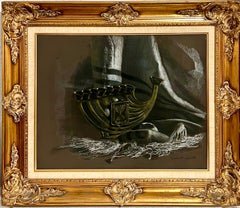
Proud Chimney Sweep Modern Judaica Shtetl Oil Painting WPA Jewish artist
By Maurice Kish
Located in Surfside, FL
Genre: Modern
Subject: Klezmer Musicians
Medium: Oil
Surface: Board, size includes artist decorated frame
Country: United States
The imagery of Maurice Kish (1895-1987), whether fa...
Category
Mid-20th Century Modern Figurative Paintings
Materials
Oil
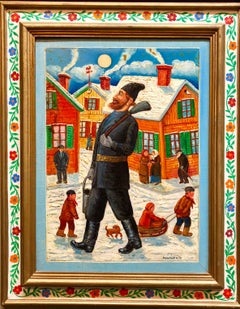
Three Klezmer Musicians Modern Judaica Shtetl Oil Painting WPA Jewish artist
By Maurice Kish
Located in Surfside, FL
Genre: Modern
Subject: Klezmer Musicians
Medium: Oil
Surface: Board, size includes artist decorated frame without frame 16X12
Country: United States
The imagery of Maurice Kish (189...
Category
Mid-20th Century Modern Figurative Paintings
Materials
Oil
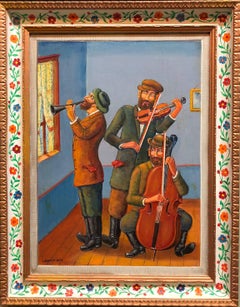
Modernist Israeli Rabbis Dancing in Jerusalem, Judaica, Mixed Media Painting
By Moshe Katz
Located in Surfside, FL
Moshe Katz (Romanian Israeli), 1937- an Israeli citizen, studied art at the Bezalel Academy of Art in Jerusalem, as well as at the Chicago Academy of Fine Arts.
Although not an expo...
Category
20th Century Modern Portrait Paintings
Materials
Canvas, Mixed Media, Acrylic
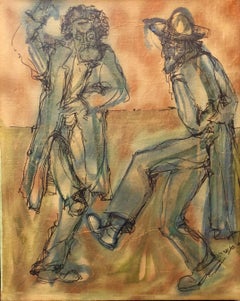
Israeli Rabbis Dancing in Jerusalem, Judaica, Mixed Media Painting
By Moshe Katz
Located in Surfside, FL
Moshe Katz (Romanian Israeli), 1937- an Israeli citizen, studied art at the Bezalel Academy of Art in Jerusalem, as well as at the Chicago Academy of Fine Arts.
Although not an expo...
Category
20th Century Modern Portrait Paintings
Materials
Canvas, Mixed Media, Acrylic
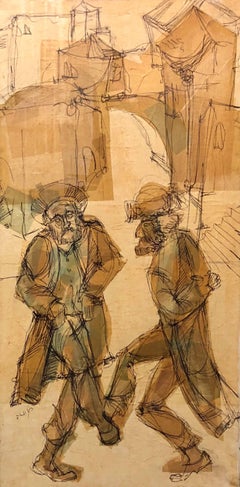
Polish Jewish Art, The Rabbi, Judaica Oil Painting
By Konstanty Szewczenko
Located in Surfside, FL
Konstanty Swewczenko (1910-1991), signed oil Judaica Oil Painting, Polish.
Konstantin Shevchenko studied at the Institute of Fine Arts in Warsaw in the years 1927 - 1928. Then, in 19...
Category
Mid-20th Century Modern Portrait Paintings
Materials
Canvas, Oil
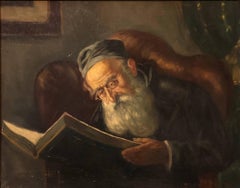
Rare Modernist Judaica Scholar Rabbi in Synagogue Oil Painting Signed Mora
Located in Surfside, FL
a mid century Judaica painting of a Rabbi wearing a Tallit prayer shawl. In the Modernist manner of Maurice Kish, Tully filmus or William Gropper. ...
Category
20th Century Folk Art Portrait Paintings
Materials
Oil
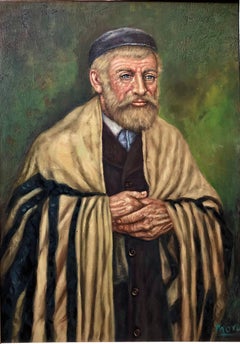
Yesterday
s, Surrealist Horse Rider, Architectural Ruins Modernist Oil Painting
By Samuel Brecher
Located in Surfside, FL
American artist Samuel Brecher (active NY, 1897-1982) Oil on Canvas, Signed lower right ‘S. Brecher’ titled "and all our yesterdays" it depicts a Horseback rider (carousel horse?) amidst architecure ruins.
Brecher was a very accomplished painter who won over forty prestigious prizes and awards during his career, and had numerous one-man exhibitions. Brecher’s works are included in many important private collections as well as the Metropolitan Museum of Art, the Walker Art Museum, the Smithsonian and the Newark Museum of Art. He is listed in Who’s Who in American Art and is a member of the Salmugundi Club* and the National Academy of Art
Samuel Brecher was born in Boryslaw, Austria, a town near the Carpathian Mountains, now a part of Poland. His family came to New York in 1910, where Samuel graduated from Cooper Union* in 1921. He studied Art at the National Academy of Design* from 1921-1924, and continued studies under Charles W. Hawthorne in Provincetown, Massachusetts.
Brecher was represented by several well known New York City galleries in the 1940’s and 1950’s including the Kraushaar Gallery, the ACA Gallery, the Hudson Walker Gallery and the Merrill Gallery. During his career he won over forty prestigious prizes and awards and had numerous one-man shows.
Some of Brechers’s contemporary artist friends were Walt Kuhn, Reginald Marsh, Richard Haley...
Category
Mid-20th Century Modern Portrait Paintings
Materials
Canvas, Oil
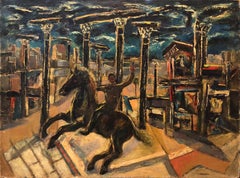
Mixed Media Large Pop Art Painting Drawing Brian Kenny NYC Street Art 2015
Located in Surfside, FL
Brian Kenny, (German-American, 1982-)
MIxed Media Painting with Drawing, Oil or Acrylic on Canvas.
Hand signed On Verso and Dated 2015, NYC
Dimensions: Sight- 30" x 24", Frame- 36" x 30"
Brian Kenny (born 1982, Heidelberg, Germany) is a NYC-based American multidisciplinary artist exhibited in galleries, museums, theaters and alternative venues in the US, Canada, Russia, Israel and across Europe. In 2004 Brian began an ongoing collaboration with artist Slava Mogutin as SUPERM, and in 2016 with writer Rich Juzwiak as BOYFRIEND HOUSE. Using an array of mediums including drawing, painting, sculpture, textile, video and performance, Brian’s artwork is bright and vividly expressionistic; often autobiographical and reflective of his current states of mind which include themes of his queer identity, shifting societal perceptions about gender, sexuality and politics, urban living and free-associative wanderings of thought and creative experimentation.
New York-based artist Brian Kenny’s work is a visually striking exploration of gender, sexuality, and politics in contemporary North America. Known for his experimental and expressionistic practice, Brian mixes mediums such as painting, illustration, collage, sculpture, and textiles – oftentimes all at once. Brian’s foundation in drawing is evident across his portfolio, with nearly every piece incorporating some signature scribblings from the artist. He has experimented with drawing, collage, photography, performance and, more recently, painting. “All the other mediums I’m exploring like, painting, textile art, and animation all branch out from drawing,” he explains. This focus is what makes Brian’s vast collection of work all feel so cohesive.
"Both of my parents were in the US military and we moved around a lot in the US. But most of the places I lived were rural, far from big cities and art museums, so I had no idea who Andy Warhol, Mark Rothko, Chuck Close, David Hockney or Damien Hirst were. The few small art museums I visited as a child were full of old-school oil paintings; all life-like portraits, rural landscapes and historical recreations. It wasn’t until I met Slava Mogutin and moved to New York that I began to meet artists, see exhibitions at art galleries of living artists near my age, and tour lot of contemporary art museums like MoMA and begin learning about contemporary art history". Brian says. “I’m definitely not a minimalist and lean toward more narrative and figurative artwork than abstraction or decoration”. Minimalist, he is not: Brian’s work pops with vibrant colours, characters and shapes, evoking a Warholian play on pop art culture.
Kenny’s signature line drawing style is reminiscent of Keith Haring and LA Ortiz and evokes comparisons to early Jean Michel Basquiat. Brian's commercial and fashion work includes art and design commissions and collaborations with Onitsuka Tiger (Japan...
Category
2010s Contemporary Abstract Paintings
Materials
Canvas, Mixed Media, Oil, Acrylic, Permanent Marker
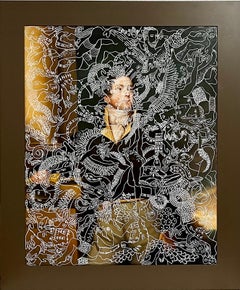
Elderly Rabbi 20th Century Judaica Portrait
Located in Surfside, FL
The artist depicts the portrait of an older Rabbi from a profile view in the manner of Samuel Rothbort. The artist's brush work is expressive, while the subject matter has a high deg...
Category
20th Century Expressionist Portrait Paintings
Materials
Canvas, Oil
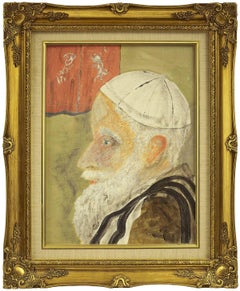
Large Colorful French Mid Century Oil Painting Michel Marie Poulan Marching Band
Located in Surfside, FL
Michel Marie Poulain (1906-1991)
French Musicians.
Oil on canvas. Signed lower left.
Provenance: Greenwich, CT estate.
Dimensions: 21" h x 25.5...
Category
Mid-20th Century Modern Figurative Paintings
Materials
Canvas, Oil