Lions Gallery Landscape Prints
to
23
35
35
16
2
Overall Width
to
Overall Height
to
22
14
11
10
5
3
1
1
23
5
5
4
4
111
7
2
1
9
14
11
9
68
43
4
4
2
2
2
1
1
1
1
1
1
1
1
1
1
1
1
1
1
50
39
18
6
6
10
111
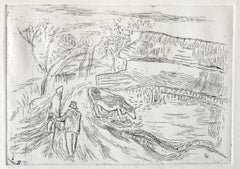
Vintage Art Etching Farm with Cow and Farmer, Famed Children
s Book Illustrator
By Tibor Gergely
Located in Surfside, FL
Medium: Etching
Surface: paper
Country: United States
Signed in plate with initial G.
Black and white illustration of a landscape with farm, farmer and cow.
TIBOR GERGELY
Budapes...
Category
Mid-20th Century American Modern Landscape Prints
Materials
Etching

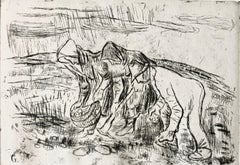
Farmers Gardening Etching, (After Vincent Van Gogh) Famed Children
s Book Author
By Tibor Gergely
Located in Surfside, FL
Medium: Etching
Surface: paper
Country: United States
signed in plate with initial G.
Black and white illustration of a landscape with farmhouse (old barn).
TIBOR GERGELY
Budapes...
Category
Mid-20th Century American Modern Landscape Prints
Materials
Etching
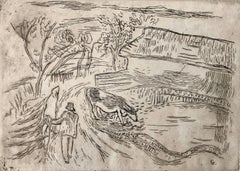
Vintage Art Etching Farm with Cow and Farmer, Famed Children
s Book Illustrator
By Tibor Gergely
Located in Surfside, FL
Medium: etching
Surface: paper
Country: United States
Signed in plate with initial G.
Black and white illustration of a landscape with farmhouse (old barn).
TIBOR GERGELY
Budapes...
Category
Mid-20th Century American Modern Landscape Prints
Materials
Etching
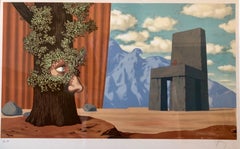
Surrealist Dream Lithograph Belgian Master Magritte Pencil Signed by Mourlot
By (after) René Magritte
Located in Surfside, FL
Artist: Rene Magritte (after), Belgian (1898 - 1967)
Title: (from les Enfants Trouvés) Les Claires-Voies d'un Jeune Regard Embaument La Fête d'un Vieil Arbre
Year of original paintin...
Category
1960s Surrealist Landscape Prints
Materials
Lithograph
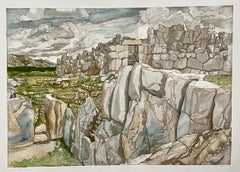
American Modernist Sacsahuaman Landscape Aquatint Etching Philip Pearlstein
By Philip Pearlstein
Located in Surfside, FL
Philip Pearlstein (American, 1924-)
Large Sacsahuaman Landscape Etching Aquatint, 1979
From the series Ruins and Landscapes.
Sugar-lift, aquatint and roulette on ivory wove paper.
Sacsayhuamán, often spelled Sacsahuaman or Saqsaywaman (from Quechua Saqsaywaman (pukara) '(fortress) of the royal falcon or hawk') is a citadel on the northern outskirts of the city of Cusco, Peru, the historic capital of the Inca Empire. The site is at an altitude of 3,701 m (12,142 ft).
The complex was built by the Incas in the 15th century, particularly under Sapa Incan Pachacuti and his successors. Dry stone walls constructed of huge stones were built on the site, with the workers carefully cutting the boulders to fit them together tightly without mortar.
In 1983, Cusco and Sacsayhuamán together were designated as sites on the UNESCO World Heritage List, for international recognition and protection.
Philip Pearlstein is an influential American painter best known for Modernist Realism nudes. Cited by critics as the preeminent figure painter of the 1960s to 2000s, he led a revival in realist art. He is a Distinguished Professor Emeritus with paintings in the collections of over 70 public art museums.
Philip M. Pearlstein was born on May 24, 1924 in Pittsburgh, PA. He attended Saturday morning classes at Pittsburgh's Carnegie Museum of Art. In 1942, at the age of 18, two of his paintings won a national competition sponsored by Scholastic Magazine, and were reproduced in color in Life magazine. In 1942, he enrolled at Carnegie Institute of Technology's art school, in Pittsburgh, where he painted two portraits of his parents now held by the Carnegie Museum of Art, but after one year he was drafted by the US Army to serve during World War II. He was initially assigned to the Training Aids Unit at Camp Blanding, Florida, where he produced charts, weapon assembly diagrams and signs. In this role, he learned printmaking and the screenprinting process, and subsequently was stationed in Italy making road signs. While in Italy, he took in as much renaissance art as was accessible in Rome, Florence, Venice and Milan, and also produced numerous drawings depicting life in the Army.
In 1946, sponsored by the GI Bill, he returned to Carnegie Institute, and first met Andy Warhol, who was attracted to Pearlstein because of his notoriety in the school, having been featured in Life magazine. During the summer of 1947, the three rented a barn as a summer studio. Immediately after graduating in June 1949 with a BFA, Pearlstein and Warhol moved to New York City, at first sharing an eighth-floor walkup tenement apartment on St. Mark's Place at Avenue A. He was eventually hired by Czech designer Ladislav Sutnar, mainly doing industrial catalog...
Category
1970s American Modern Landscape Prints
Materials
Paper, Aquatint
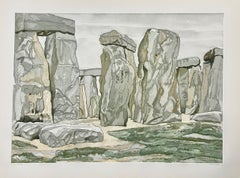
Large American Modern Stonehenge Landscape Aquatint Etching Philip Pearlstein
By Philip Pearlstein
Located in Surfside, FL
Philip Pearlstein (American, 1924-2022)
Stonehenge Landscape Sugar Lift Aquatint Etching with Roulette on Rives BFK Paper, 1979
Series: Ruins and Landscapes
Printer: Orlando Condesso
Printer: Nancy Brokopp
Medium: Sugar-lift aquatint with roulette
Philip Pearlstein is an influential American painter best known for Modernist Realism nudes. Cited by critics as the preeminent figure painter of the 1960s to 2000s, he led a revival in realist art. He is a Distinguished Professor Emeritus with paintings in the collections of over 70 public art museums.
Philip M. Pearlstein was born on May 24, 1924 in Pittsburgh, PA. He attended Saturday morning classes at Pittsburgh's Carnegie Museum of Art. In 1942, at the age of 18, two of his paintings won a national competition sponsored by Scholastic Magazine, and were reproduced in color in Life magazine. In 1942, he enrolled at Carnegie Institute of Technology's art school, in Pittsburgh, where he painted two portraits of his parents now held by the Carnegie Museum of Art, but after one year he was drafted by the US Army to serve during World War II. He was initially assigned to the Training Aids Unit at Camp Blanding, Florida, where he produced charts, weapon assembly diagrams and signs. In this role, he learned printmaking and the screenprinting process, and subsequently was stationed in Italy making road signs. While in Italy, he took in as much renaissance art as was accessible in Rome, Florence, Venice and Milan, and also produced numerous drawings depicting life in the Army.
In 1946, sponsored by the GI Bill, he returned to Carnegie Institute, and first met Andy Warhol, who was attracted to Pearlstein because of his notoriety in the school, having been featured in Life magazine. During the summer of 1947, the three rented a barn as a summer studio. Immediately after graduating in June 1949 with a BFA, Pearlstein and Warhol moved to New York City, at first sharing an eighth-floor walkup tenement apartment on St. Mark's Place at Avenue A. He was eventually hired by Czech designer Ladislav Sutnar, mainly doing industrial catalog...
Category
1970s American Realist Landscape Prints
Materials
Paper, Aquatint
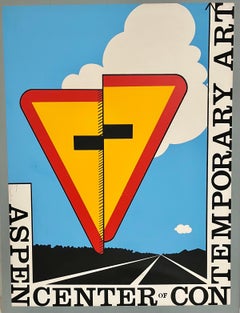
Pop Art Aspen Road Sign D
arcangelo Silkscreen Chiron Press Vintage Art Poster
Located in Surfside, FL
Allan D'Arcangelo (American/New York, 1930-1998),
"Aspen Center of Contemporary Art",
1967
silkscreen, hand signed in pencil, dated, numbered "45/200" and blind stamped "Chiron Press, New York, NY"
32 in. x 24 in.
Allan D'Arcangelo (1930-1998) was an American artist and printmaker, best known for his paintings of highways and road signs that border on pop art and minimalism, precisionism, Abstract illusionism and hard-edge painting, and also surrealism. His subject matter is distinctly American and evokes, at times, a cautious outlook on the future of this country. Allan D'Arcangelo was the son of Italian immigrants. He studied at the University of Buffalo from 1948–1953, where he got his bachelor's degree in history. After college, he moved to Manhattan and picked up his studies again at the New School of Social Research and the City University of New York, City College. At this time, he encountered Abstract Expressionist painters who were in vogue at the moment. After joining the army in the mid 1950s, he used the GI Bill to study painting at Mexico City College from 1957–59, driving there over 12 days in an old bakery truck retrofitted as a camper. However, he returned to New York in 1959, in search of the unique American experience. It was at this time that his painting took on a cool sensibility reminiscent of Roy Lichtenstein and Andy Warhol. His interests engaged with the environment, anti-Vietnam War protests, and the commodification and objectification of female sexuality. D'Arcangelo first achieved recognition in 1962, when he was invited to contribute an etching to The International Anthology of Contemporary Engraving: America Discovered; his first solo exhibition came the next year, at the Thiebaud Gallery in New York City. In 1965 he contributed three screenprints to Original Edition's 11 Pop Artists portfolio. By the 1970s, D'Arcangelo had received significant recognition in the art world. He was well known for his paintings of quintessentially American highways and infrastructure, and in 1971 was commissioned by the Department of the Interior to paint the Grand Coulee Dam in Washington state. However, his sense of morality always trumped his interest in art world fame. In 1975, he decided to quit the gallery that had been representing him for years, Marlborough Gallery, because of the way they handled Mark Rothko legacy.
D'Arcangelo rejected Abstract Expressionism, though his early work has a painterly and somewhat expressive feel. He quickly turned to a style of art that seemed to border on Pop Art and Minimalism, Precisionism and Hard-Edge painting. Evidently, he didn't fit neatly in the category of Pop Art, though he shared subjects (women, signs, Superman) and techniques (stencil, assemblage) with these artists.He turned to expansive, if detached scenes of the American highway. These paintings are reminiscent of Giorgio de Chirico-though perhaps not as interested in isolation-and Salvador Dali-though there is a stronger interest in the present and disinterest in the past. These paintings also have a sharp quality that is reminiscent of the precisionist style, or more specifically, Charles Sheeler. 1950s, Before D'Arcangelo returned to New York, his style was roughly figurative and reminiscent of folk art. During the early 1960s, Allan D'Arcangelo was linked with Pop Art. "Marilyn" (1962) depicts an illustrative head and shoulders on which the facial features are marked by lettered slits to be "fitted" with the eyebrows, eyes, nose and mouth which appear off to the right in the composition. In "Madonna and Child," (1963) the featureless faces of Jackie Kennedy and Caroline are ringed with haloes, enough to make their status as contemporary icons perfectly clear.
Select Exhibitions:
Fischbach Gallery, New York,
Ileana Sonnabend Gallery, Paris,
Gallery Müller, Stuttgart, Germany
Hans Neuendorf Gallery, Hamburg, Germany
Dwan Gallery...
Category
1960s Pop Art Abstract Prints
Materials
Lithograph, Screen
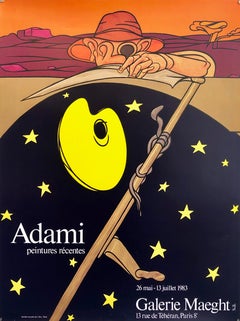
Italian Post Modern Pop Art Lithograph Vintage Poster Memphis Galerie Maeght
By Valerio Adami
Located in Surfside, FL
Vintage gallery exhibition poster. Navy blue and bold yellow stars with vibrant orange. Surrealist man in hat with scythe or fishing rod.
The Galerie Maeght is a gallery of modern ar...
Category
1980s Pop Art Landscape Prints
Materials
Lithograph, Offset
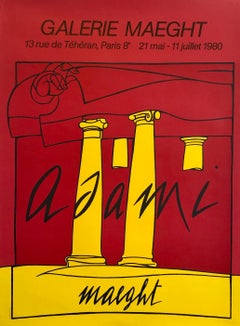
Italian Post Modern Pop Art Lithograph Vintage Poster Memphis Galerie Maeght
By Valerio Adami
Located in Surfside, FL
Vintage gallery exhibition poster. Bright vivid red and bold yellow.
The Galerie Maeght is a gallery of modern art in Paris, France, and Barcelona, Catalonia, Spain. The gallery was...
Category
1980s Pop Art Landscape Prints
Materials
Lithograph, Offset
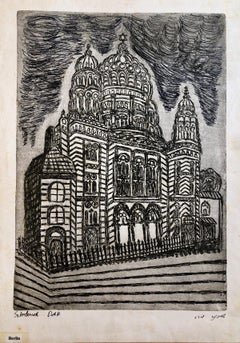
Berlin Germany Jewish Memorial Etching Destroyed Synagogue Folk Art Judaica
By Dora Szampanier
Located in Surfside, FL
Cracow Poland Etching of Polish Synagogue, Jewish temple. From very rare small edition. Most are signed in Hebrew and /or English. some are marked AP some are numbered. please see ph...
Category
20th Century Folk Art Landscape Prints
Materials
Etching
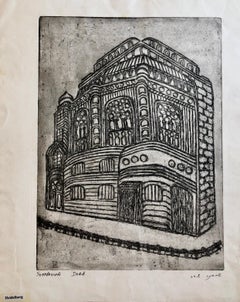
Heidelberg Germany Jewish Memorial Etching Destroyed Synagogue Folk Art Judaica
By Dora Szampanier
Located in Surfside, FL
Heidelberg Germany Etching of Synagogue, Jewish temple. From very rare small edition. Most are signed in Hebrew and /or English. some are marked AP some are numbered. please see phot...
Category
20th Century Folk Art Landscape Prints
Materials
Etching
Budapest Hungary Jewish Memorial Etching Destroyed Synagogue Folk Art Judaica
By Dora Szampanier
Located in Surfside, FL
Óbuda was a city in Hungary that was merged with Buda and Pest on 17 November 1873; it now forms part of District III-Obuda-Békásmegyer of Budapest. The name means Old Buda in Hungar...
Category
20th Century Folk Art Landscape Prints
Materials
Etching
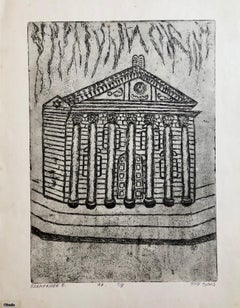
Bucharest Romania Jewish Memorial Etching Destroyed Synagogue Folk Art Judaica
By Dora Szampanier
Located in Surfside, FL
Etching of Synagogue, Jewish temple. From very rare small edition. Most are signed in Hebrew and /or English. some are marked AP some are numbered. please see photos.
Dora Szampanier...
Category
20th Century Folk Art Landscape Prints
Materials
Etching
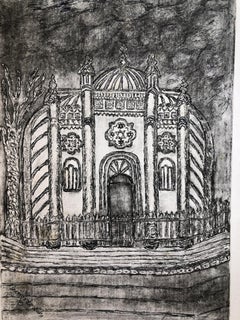
Tarnopol, Ukraine Jewish Memorial Etching Destroyed Synagogue Folk Art Judaica
By Dora Szampanier
Located in Surfside, FL
TARNOPOL (Rus. Ternopol), city in Ukraine, formerly in the province of Lvov, Poland. The city of Tarnopol was at times part of Poland, Russia, Galitzia, Austria, and the Western Ukra...
Category
20th Century Folk Art Landscape Prints
Materials
Etching
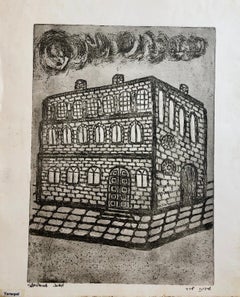
Vienna Austria Jewish Memorial Etching Destroyed Synagogue Folk Art Judaica
By Dora Szampanier
Located in Surfside, FL
Wien, Österreich, Etching of Synagogue, Jewish temple. From very rare small edition. Most are signed in Hebrew and /or English. some are marked AP some are numbered. please see photo...
Category
20th Century Folk Art Landscape Prints
Materials
Etching
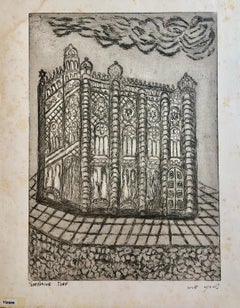
Regensburg Germany Jewish Memorial Etching Destroyed Synagogue Folk Art Judaica
By Dora Szampanier
Located in Surfside, FL
Etching of Synagogue, Jewish temple. From very rare small edition. Most are signed in Hebrew and /or English. some are marked AP some are numbered. please see photos.
Dora Szampanier...
Category
20th Century Folk Art Landscape Prints
Materials
Etching
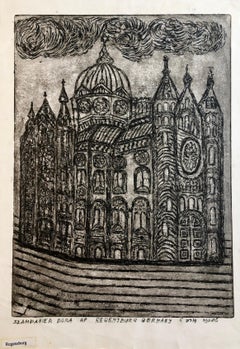
Michael Gross Israeli Minimalist Conceptual Art, Abstract Jerusalem Silkscreen
By Michael Gross
Located in Surfside, FL
Michael Gross (Hebrew: מיכאל גרוס; 1920 – 4 November 2004) was an Israeli painter, sculptor and conceptual artist.
Michael Gross was born in Tiberias in the British-administered Palestine in 1920. He grew up in the farming village of Migdal. In 1939-1940, he left to study at the Teachers’ Training College in Jerusalem. In 1939, while he was away, his father was murdered by Arabs, and the family farm and home were destroyed. This event impacted on his work as an artist.
From 1943 to 1945, he studied architecture at Technion – Israel Institute of Technology in Haifa. From 1951 to 1954, he studied art at the École nationale supérieure des Beaux-Arts in Paris. He returned to Israel in 1954 and settled in the artists’ village of Ein Hod.
Gross's works are imbued with the light and spirit. They are minimalist, but never pure abstraction, always tied to natural form and laden with feeling. In his early paintings, Gross simplified form in order to concentrate on proportion, broad areas of color, and the size and placement of each element. This reductive process was also notable in his sculptures, whether in painted iron or other materials such as white concrete. In later paintings, he often juxtaposed large off-white panels with patches of tone, adding textured materials such as wooden beams, burlap and rope. Gross’s rough, freely-brushed surfaces, along with the use of soft pastel coloring, conjure up images of the Israeli landscape.
Education
1936-1940 Teachers Seminary, Jerusalem
1943-1945, Technion, Haifa, architecture, studied sculpture with Moshe Ziffer.
1951-1954 Beaux Arts, Paris with Michel Guimond
Teaching
1954 - 1954 Higher School of Education, Haifa.
1957-1960 Bezalel Academy of Arts and Design, Jerusalem
1960-1980 Oranim Art Institute, Tivon
Awards
1964: Hermann Struck Prize
1967: Dizengoff Prize
1971...
Category
1970s Modern Landscape Prints
Materials
Lithograph, Screen
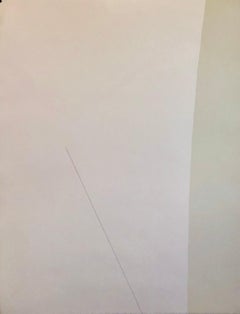
Israeli Modernist Silkscreen Print Kotel Wall Jerusalem Kadishman Lithograph
By Menashe Kadishman
Located in Surfside, FL
On BFK Rives French art paper. This is a Photograph silkscreen print of the Kotel, Western Wall in Jerusalem overlaid with Kadishman drawing.
Menashe Kadishman was born in Tel-Aviv ...
Category
1970s Pop Art Landscape Prints
Materials
Lithograph
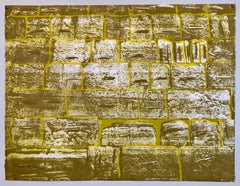
1970 Silencio, Direccion Unica, One Way Spanish Political Etching Pop Art Print
By Juan Genoves
Located in Surfside, FL
Juan Genovés Candel (Spanish, 1930-)
Painter, illustrator, and graphic printmaker engraver. He painted 'El abrazo' ('the embrace'), which became an emblematic poster during the Spanish political transition. He was born in Valencia in 1930. The son of Juan Genovés Cubells, an artisan whose family was close to the labor movement. His mother Maria Candel Muñoz came from a family of practicing Catholics. In 1946 Genovés studied at the Escuela de Bellas Artes de San Carlos in Valencia and then settled in Madrid. He set up the 'Los Siete' group together with other artists in 1949, and the following year he travelled to Madrid, where he was influenced by the works by Fra Angélico and Hieronymus Bosch in the Prado Museum. In 1957 he had his first solo exhibitions in the gallery Alfil, Madrid and in the Museo d'Arte Moderna, Havana. He is considered the most important representative of modern Spanish painting. His images, executed in a politically engaged, critical realism...
Category
1970s Pop Art Figurative Prints
Materials
Lithograph
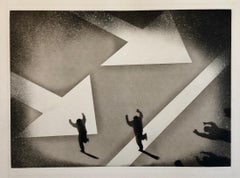
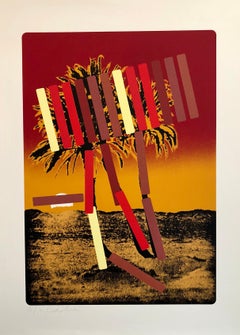
Israeli Modern Pop Art Photo Silkscreen Serigraph Palm Trees Kadishman
By Menashe Kadishman
Located in Surfside, FL
Menashe Kadishman was born in Tel-Aviv in 1932. He is a Graduate of St. Martin's School of Art, University of London Studies with Anthony Caro, Reg Butler. From 1947 to 1950, Kadish...
Category
1970s Abstract Geometric Landscape Prints
Materials
Etching, Aquatint, Lithograph
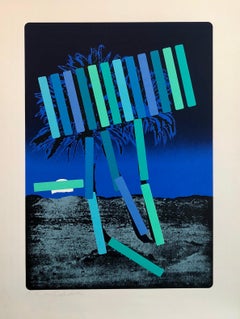
Israeli Modern Pop Art Photo Silkscreen Serigraph Palm Trees Kadishman
By Menashe Kadishman
Located in Surfside, FL
Menashe Kadishman was born in Tel-Aviv in 1932. He is a Graduate of St. Martin's School of Art, University of London Studies with Anthony Caro, Reg Butler. From 1947 to 1950, Kadish...
Category
1970s Abstract Geometric Landscape Prints
Materials
Etching, Aquatint, Lithograph
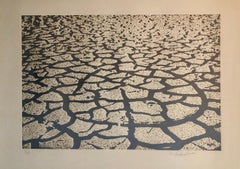
Israeli Modern Pop Art Aquatint Etching Cracked Earth Art Kadishman Lithograph
By Menashe Kadishman
Located in Surfside, FL
This one is a metallic silver gray color.
Menashe Kadishman was born in Tel-Aviv in 1932. He is a Graduate of St. Martin's School of Art, University of London Studies with Anthony Ca...
Category
1970s Abstract Geometric Landscape Prints
Materials
Etching, Aquatint, Lithograph
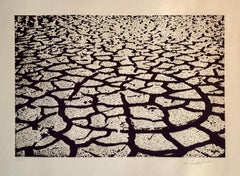
Israeli Modern Pop Art Aquatint Etching Cracked Earth Art Kadishman Lithograph
By Menashe Kadishman
Located in Surfside, FL
This one is a dark burgundy or purple color.
Menashe Kadishman was born in Tel-Aviv in 1932. He is a Graduate of St. Martin's School of Art, University of London Studies with Anthony...
Category
1970s Abstract Geometric Landscape Prints
Materials
Etching, Aquatint, Lithograph
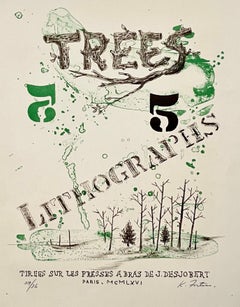
Lithograph Belgian American Surrealism WPA Modernist Karl Fortess Surrealist Art
Located in Surfside, FL
Karl Eugene Fortess (1907-1993)
Original color lithographs on BFK Rives paper,
1966, Hand signed and numbered 29/36 in pencil,
Sheet size 20.5 x 15 inches.
Karl E. Fortess (1907-1993) was a painter, printmaker and teacher, of Boston, Massachusetts and Woodstock, N.Y. Fortess was born in Antwerp, Belgium on October 13, 1907, and became an American citizen in 1923. He studied at the Art Institute of Chicago, the Art Students League in New York, and the Woodstock School of Painting with Yasuo Kuniyoshi. In 1937 the Works Progress Administration sent him and several other artists to Alaska to document the towns, villages, and remote wilderness landscapes (Pemberton, “Alaska art museum collects WPA’s Depression works from the territory,” Columbia Daily Tribune, November 9, 2003). Trains, trucks, and industrial buildings were what Karl Fortess envisioned when the Public Works of Art Project suggested that he depict “the American Scene.” His work bears the influence of Surrealism, Russsian Constructivist art and Cubism. He was part of a circle of left leaning artists loosley involved with the WPA which included Sol Wilson, Isaac Soyer, Louis Lozowick, Abraham Harriton, Ben Shahn, William Gropper, Nahum Tschacbasov, Morris Shulman, Yasuo Kuniyoshi, Louis Slobodkin, Adolf Dehn, Le Corbusier and Louis Schanker.
Karl Fortress taught at the Art Students League, Brooklyn Museum Art School, Louisiana State University, Fort Wright College, and Boston University School of Fine and Applied Arts. He was a member of the Artists Equity Association, Society of American Graphic Artists, American Association of University Professors, and the British Film Institute. He was awarded the Guggenheim Fellowship in 1946, was named an Associate of the National Academy of Design in 1960 and elected to full Academician in 1971. Fortess taught at many different schools, including Boston University School of Fine Art, where he also created an archive of interviews with more than two hundred and fifty contemporary American painters, sculptors, and graphic artists including many with with artists associated with the Woodstock, N.Y. art community.
Among the interviewees are Kenneth Armitage, Will Barnet, Romare Bearden, George Biddle, James Brooks, Adolph Dehn, Jane Freilicher, Julian Levi, Alice Neel, Larry Rivers, Moses Soyer, Dorothy Varian...
Category
Mid-20th Century Surrealist Landscape Prints
Materials
Lithograph
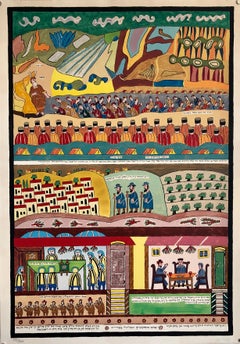
Israeli Folk Art Hebrew Naive Judaica Lithograph Jewish Holiday Shavuot
By Shalom Moskovitz
Located in Surfside, FL
Vintage pencil signed and numbered limited edition lithograph on deckle edged Arches paper.
Shalom of Sefad (Shulem der Zeigermacher in Yiddish Shalom Moskowitz) Shalom of Tzfat lived for over seventeen years in his native town of Safed in the hills of the Galilee. There he worked as a watchmaker, stonemason and silversmith, during the 50's. Since then this self-taught artist has achieved an international reputation. Shalom is a naive painter, but not a rustic one, he expresses a very elaborate way of thinking in his own way. While belonging to Hasidism, Shalom of Safed uses his artistic talents positively. 'I don't paint', he explains, 'to tell the story of the Bible in color and lines. His works have been exhibited in prominent museums and galleries in Europe and the United States, and are included in the collections of the Museums of Modern Art in Paris and New York, the Israel Museum in Jerusalem, the Stedelijk Museum in Amsterdam, the Modern Museum in Stockholm and the Jewish Museum in New York
He has exhibited alongside all of the Israeli great artists. Israel has had a Vibrant Folk Art, Naive art scene for a long time now artists like Yisrael Paldi, Nahum Guttman, Reuven Rubin and even Yefim Ladizhinsky had naive periods. The most well know if the strict naive artists are Shalom of Safed, Irene Awret...
Category
20th Century Folk Art Figurative Prints
Materials
Lithograph
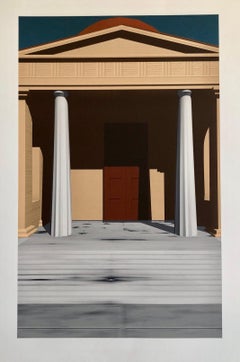
Location Proposal Iris Print Ed. 12 Architectural Study LA CAlifornia Modernist
By Cindy Bernard
Located in Surfside, FL
Cindy Bernard’s career spans nearly three decades and she is best known for photographs and projections that explore the relationship between cinema, memory, and landscape including the widely exhibited series Ask the Dust (1988-92), now in the collections of the Museum of Contemporary Art, Los Angeles (21 part set), the Pompidou, MOMA and the Whitney Museum of American Art. She is a recipient of grants and fellowships from the J. Paul Getty Trust Fund for the Visual Arts, California Arts Council, Creative Capital, Anonymous Was a Woman, the Harpo Foundation, California Community Foundation, the John Simon Guggenheim Memorial Foundation and the MacDowell Colony. Her work has been exhibited in museums and galleries in the US, Canada, Mexico, Europe, and Japan, and was included in the Whitney and Lyon Biennials.
In addition to her visual practice, Bernard takes an active interest in the spaces and production of social exchange. She was a director and advisor to Foundation for Art Resources from 1985 to 1990, a founding director of the Coalition for Freedom of Expression, and co-founder of MOCA Mobilization. Bernard is also the founder and director of The Society for the Activation of Social Space through Art and Sound (SASSAS), an organization she began in response to the need for a flexible and sustainable association dedicated to experimental music in Los Angeles. She has curated and produced more than 50 concerts for SASSAS including Welcome Inn Time Machine for Pacific Standard Time in 2012.
Her interest in sound has spurred several projects including a series of photographs of municipal band shells which Bernard sees as an architecture of public exchange and The Inquisitive Musician, an adaptation of a 17th century German satire, Musicus Curiosus, or Battalus, the Inquisitive Musician; the Struggle for Precedence between the Kunst Pfeifer and the Common Players. The Inquisitive Musician pits itinerant “beer fiddlers” against the city sanctioned “Kunstpfeifer” in an argument over who has the right to perform and be compensated. Presented as a staged reading incorporating video and live music, The Inquisitive Musician has been performed in New York, in Los Angeles at the LA County Museum of Art, and most recently at the Stedelijk Museum in Amsterdam in June 2013.
Current projects include Vinland, a meditation on the complex and continually shifting relationships between spaces, social and economic structures, and personal and collective histories and, more recently, an “episodic” series based on the history of social nudism: Your Personal View of (Social) Nudism.
Bernard is a Adjunct Professor of Graduate Fine Art at Art Center College of Art and Design and was appointed the inaugural Ruffin Distinguished Artist-In-Residence at the University of Virginia for the academic year 2013/2014. She was a 2016 National Endowment for the Arts Fellow at the MacDowell Colony and will be in residence at the UCross Foundation in 2017.
Muse X Editions. An (now defunct) LA based innovative publisher of limited-edition prints, Muse X has launched its first group of prints and is just beginning to make itself known to artists, curators, dealers and collectors. Among works just off the press are otherworldly landscapes by Barbara Kasten and Oliver Wasow, a sizzling sunset by Peter Alexander, abstract compositions by Pauline Stella Sanchez and Jennifer Steinkamp, text and photo combinations by Bill Barminski and Nancy Dwyer...
Category
1990s American Modern Landscape Prints
Materials
Color
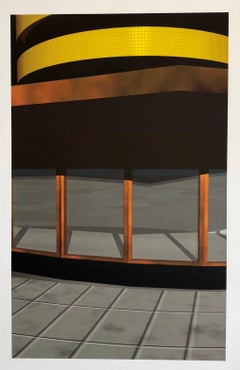
Location Proposal Iris Print Ed. 12 Hand Signed Architectural Study
By Cindy Bernard
Located in Surfside, FL
Cindy Bernard’s career spans nearly three decades and she is best known for photographs and projections that explore the relationship between cinema, memory, and landscape including the widely exhibited series Ask the Dust (1988-92), now in the collections of the Museum of Contemporary Art, Los Angeles (21 part set), the Pompidou, MOMA and the Whitney Museum of American Art. She is a recipient of grants and fellowships from the J. Paul Getty Trust Fund for the Visual Arts, California Arts Council, Creative Capital, Anonymous Was a Woman, the Harpo Foundation, California Community Foundation, the John Simon Guggenheim Memorial Foundation and the MacDowell Colony. Her work has been exhibited in museums and galleries in the US, Canada, Mexico, Europe, and Japan, and was included in the Whitney and Lyon Biennials.
In addition to her visual practice, Bernard takes an active interest in the spaces and production of social exchange. She was a director and advisor to Foundation for Art Resources from 1985 to 1990, a founding director of the Coalition for Freedom of Expression, and co-founder of MOCA Mobilization. Bernard is also the founder and director of The Society for the Activation of Social Space through Art and Sound (SASSAS), an organization she began in response to the need for a flexible and sustainable association dedicated to experimental music in Los Angeles. She has curated and produced more than 50 concerts for SASSAS including Welcome Inn Time Machine for Pacific Standard Time in 2012.
Her interest in sound has spurred several projects including a series of photographs of municipal band shells which Bernard sees as an architecture of public exchange and The Inquisitive Musician, an adaptation of a 17th century German satire, Musicus Curiosus, or Battalus, the Inquisitive Musician; the Struggle for Precedence between the Kunst Pfeifer and the Common Players. The Inquisitive Musician pits itinerant “beer fiddlers” against the city sanctioned “Kunstpfeifer” in an argument over who has the right to perform and be compensated. Presented as a staged reading incorporating video and live music, The Inquisitive Musician has been performed in New York, in Los Angeles at the LA County Museum of Art, and most recently at the Stedelijk Museum in Amsterdam in June 2013.
Current projects include Vinland, a meditation on the complex and continually shifting relationships between spaces, social and economic structures, and personal and collective histories and, more recently, an “episodic” series based on the history of social nudism: Your Personal View of (Social) Nudism.
Bernard is a Adjunct Professor of Graduate Fine Art at Art Center College of Art and Design and was appointed the inaugural Ruffin Distinguished Artist-In-Residence at the University of Virginia for the academic year 2013/2014. She was a 2016 National Endowment for the Arts Fellow at the MacDowell Colony and will be in residence at the UCross Foundation in 2017.
Muse X Editions. An (now defunct) LA based innovative publisher of limited-edition prints, Muse X has launched its first group of prints and is just beginning to make itself known to artists, curators, dealers and collectors. Among works just off the press are otherworldly landscapes by Barbara Kasten and Oliver Wasow, a sizzling sunset by Peter Alexander, abstract compositions by Pauline Stella Sanchez and Jennifer Steinkamp, text and photo combinations by Bill Barminski and Nancy Dwyer...
Category
1990s American Modern Landscape Prints
Materials
Color
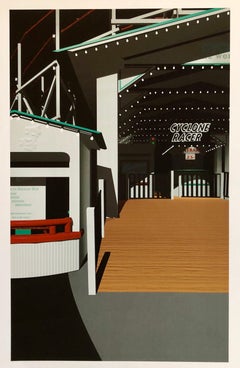
Location Proposal Iris Print Ed. 12 Hand Signed Cyclone Racer (Coney Island, NY)
By Cindy Bernard
Located in Surfside, FL
Cindy Bernard’s career spans nearly three decades and she is best known for photographs and projections that explore the relationship between cinema, memory, and landscape including ...
Category
1990s American Modern Landscape Prints
Materials
Color
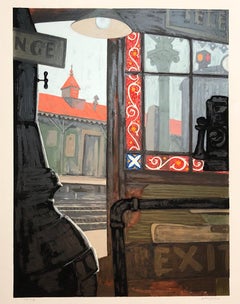
Modernist Silkscreen Screenprint
El Station, Interior
NYC Subway, WPA Artist
By Anthony Velonis
Located in Surfside, FL
screenprint printed in color ink on wove paper. New York City subway station interior.
Anthony Velonis (1911 – 1997) was an American painter and designer born in New York City who helped introduce the public to silkscreen printing in the early 20th century.
While employed under the federal Works Progress Administration, WPA during the Great Depression, Velonis brought the use of silkscreen printing as a fine art form, referred to as the "serigraph," into the mainstream. By his own request, he was not publicly credited for coining the term.
He experimented and mastered techniques to print on a wide variety of materials, such as glass, plastics, and metal, thereby expanding the field. In the mid to late 20th century, the silkscreen technique became popular among other artists such as Robert Rauschenberg and Andy Warhol.
Velonis was born into a relatively poor background of a Greek immigrant family and grew up in the tenements of New York City. Early on, he took creative inspiration from figures in his life such as his grandfather, an immigrant from the mountains in Greece, who was "an ecclesiastical painter, on Byzantine style." Velonis attended James Monroe High School in The Bronx, where he took on minor artistic roles such as the illustration of his high school yearbook. He eventually received a scholarship to the NYU College of Fine Arts, into which he was both surprised and ecstatic to have been admitted. Around this time he took to painting, watercolor, and sculpture, as well as various other art forms, hoping to find a niche that fit. He attended NYU until 1929, when the Great Depression started in the United States after the stock market crash.
Around the year 1932, Velonis became interested in silk screen, together with fellow artist Fritz Brosius, and decided to investigate the practice. Working in his brother's sign shop, Velonis was able to master the silkscreen process. He reminisced in an interview three decades later that doing so was "plenty of fun," and that a lot of technology can be discovered through hard work, more so if it is worked on "little by little."
Velonis was hired by Mayor LaGuardia in 1934 to promote the work of New York's city government via posters publicizing city projects. One such project required him to go on a commercial fishing trip to locations including New Bedford and Nantucket for a fortnight, where he primarily took photographs and notes, and made sketches. Afterward, for a period of roughly six months, he was occupied with creating paintings from these records. During this trip, Velonis developed true respect and affinity for the fishermen with whom he traveled, "the relatively uneducated person," in his words.
Following this, Velonis began work with the Public Works of Art Project (PWAP), an offshoot of the Civil Works Administration (CWA), where he was assigned to serve the different city departments of New York. After the formation of the federal Works Progress Administration, which hired artists and sponsored projects in the arts, he also worked in theater.
Velonis began working for the federal WPA in 1935. He kept this position until 1936 or 1938, at which point he began working in the graphic art division of the Federal Art Project, which he ultimately led. Under various elements of the WPA program, many young artists, writers and actors gained employment that helped them survive during the Depression, as well as contributing works that created an artistic legacy for the country.
When interviewed in December 1994 by the Library of Congress about his time in the WPA, Velonis reflected that he had greatly enjoyed that period, saying that he liked the "excitement" and "meeting all the other artists with different points of view." He also said in a later interview that "the contact and the dialogue with all those artists and the work that took place was just invaluable." Among the young artists he hired was Edmond Casarella, who later developed an innovative technique using layered cardboard for woodcuts.
Velonis introduced silkscreen printing to the Poster Division of the WPA. As he recalled in a 1965 interview: "I suggested that the Poster division would be a lot more productive and useful if they had an auxiliary screen printing project that worked along with them. And apparently this was very favorably received..."
As a member of the Federal Art Project, a subdivision of the WPA, Velonis later approached the Public Use of Arts Committee (PUAC) for help in "propagandizing for art in the parks, in the subways, et cetera." Since the Federal Art Project could not be "self-promoting," an outside organization was required to advertise their art more extensively. During his employment with the Federal Art Project, Velonis created nine silkscreen posters for the federal government.
Around 1937-1939 Velonis wrote a pamphlet titled "Technical Problems of the Artist: Technique of the Silkscreen Process," which was distributed to art centers run by the WPA around the country. It was considered very influential in encouraging artists to try this relatively inexpensive technique and stimulated printmaking across the country.
In 1939, Velonis founded the Creative Printmakers Group, along with three others, including Hyman Warsager. They printed both their own works and those of other artists in their facility. This was considered the most important silkscreen shop of the period.
The next year, Velonis founded the National Serigraph Society. It started out with relatively small commercial projects, such as "rather fancy" Christmas cards that were sold to many of the upscale Fifth Avenue shops...
Category
1980s American Modern Figurative Prints
Materials
Screen
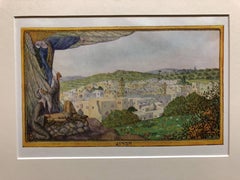
Rare Judaica Chevron Bezalel Zeev Raban Chromolithograph (made in Palestine)
By Zeev Raban
Located in Surfside, FL
Jerusalem's Bezalel School
The Bezalel Academy of Arts and Design, was founded in 1906 by Boris Schatz. In 1903, Schatz met Theodore Herzl and became an ardent Zionist. At the Zionis...
Category
Early 20th Century Art Nouveau More Art
Materials
Lithograph
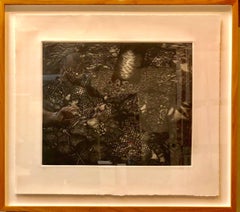
Mezzotint Etching Botanical Print
Mantle
Signed AP Jungle Image
By Richard Hricko
Located in Surfside, FL
Richard Hricko has exhibited internationally in museums, galleries and juried competitions, including the National Academy Museum in New York, Glynn Vivian Art Museum in Wales, and G...
Category
20th Century Contemporary Landscape Prints
Materials
Mezzotint, Etching
Rare 1923 Cubist Reuven Rubin Woodcut Woodblock Fisherman Print Israeli Judaica
By Reuven Rubin
Located in Surfside, FL
This is from the original first edition 1923 printing. there was a much later edition done after these originals.
These are individually hand signed in pencil by artist as issued.
This listing is for the one print. the other documentation is included here for provenance and is not included in this listing.
The various images inspired by the Jewish Mysticism and rabbis and mystics of jerusalem and Kabbalah is holy, dramatic and optimistic Rubin succeeded to evoke the spirit of life in Israel in those early days.
They are done in a modern art style influenced by German Expressionism, particularly, Ernst Barlach, Ernst Ludwig Kirchner, and Franz Marc, as introduced to Israel by Jakob Steinhardt, Hermann Struck and Joseph Budko.
Reuven Rubin 1893 -1974 was a Romanian-born Israeli painter and Israel's first ambassador to Romania.
Rubin Zelicovich (later Reuven Rubin) was born in Galati to a poor Romanian Jewish Hasidic family. He was the eighth of 13 children. In 1912, he left for Ottoman-ruled Palestine to study art at Bezalel Academy of Art and Design in Jerusalem. Finding himself at odds with the artistic views of the Academy's teachers, he left for Paris, France, in 1913 to pursue his studies at the École Nationale Supérieure des Beaux-Arts. He was of the well known Jewish artists in Paris along with Marc Chagall and Chaim Soutine,
At the outbreak of World War I, he was returned to Romania, where he spent the war years.
In 1921, he traveled to the United States with his friend and fellow artist, Arthur Kolnik. In New York City, the two met artist Alfred Stieglitz, who was instrumental in organizing their first American show at the Anderson Gallery. Following the exhibition, in 1922, they both returned to Europe. In 1923, Rubin emigrated to Mandate Palestine.
Rubin met his wife, Esther, in 1928, aboard a passenger ship to Palestine on his return from a show in New York. She was a Bronx girl who had won a trip to Palestine in a Young Judaea competition. He died in 1974.
Part of the early generation of artists in Israel, Joseph Zaritsky, Arieh Lubin, Reuven Rubin, Sionah Tagger, Pinchas Litvinovsky, Mordecai Ardon, Yitzhak Katz, and Baruch Agadati; These painters depicted the country’s landscapes in the 1920s rebelled against the Bezalel school of Boris Schatz. They sought current styles in Europe that would help portray their own country’s landscape, in keeping with the spirit of the time. Rubin’s Cezannesque landscapes from the 1920s were defined by both a modern and a naive style, portraying the landscape and inhabitants of Israel in a sensitive fashion. His landscape paintings in particular paid special detail to a spiritual, translucent light. His early work bore the influences of Futurism, Vorticism, Cubism and Surrealism.
In Palestine, he became one of the founders of the new Eretz-Yisrael style. Recurring themes in his work were the bible, the prophet, the biblical landscape, folklore and folk art, people, including Yemenite, Hasidic Jews and Arabs. Many of his paintings are sun-bathed depictions of Jerusalem and the Galilee. Rubin might have been influenced by the work of Henri Rousseau whose naice style combined with Eastern nuances, as well as with the neo-Byzantine art to which Rubin had been exposed in his native Romania. In accordance with his integrative style, he signed his works with his first name in Hebrew and his surname in Roman letters.
In 1924, he was the first artist to hold a solo exhibition at the Tower of David, in Jerusalem (later exhibited in Tel Aviv at Gymnasia Herzliya). That year he was elected chairman of the Association of Painters and Sculptors of Palestine. From the 1930s onwards, Rubin designed backdrops for Habima Theater, the Ohel Theater and other theaters.
His biography, published in 1969, is titled My Life - My Art. He died in Tel Aviv in October 1974, after having bequeathed his home on 14 Bialik Street and a core collection of his paintings to the city of Tel Aviv. The Rubin Museum opened in 1983. The director and curator of the museum is his daughter-in-law, Carmela Rubin. Rubin's paintings are now increasingly sought after. At a Sotheby's auction in New York in 2007, his work accounted for six of the ten top lots. Along with Yaacov Agam and Menashe Kadishman he is among Israel's best known artists internationally. Education
1912 Bezalel Academy of Arts and Design, Jerusalem
1913-14 École des Beaux Arts, Paris and Académie Colarossi, Paris
Select Group Exhibitions
Eged - Palestine Painters Group Eged - Palestine Painters Group, Allenby Street, Tel Aviv 1929
Artists: Chana Orloff, Abraham Melnikoff, Rubin, Reuven Nahum Gutman, Sionah Tagger,Arieh Allweil,
Jewish Artists Association, Levant Fair, Tel Aviv, 1929
Artists: Ludwig Blum,Eliyahu Sigad, Shmuel Ovadyahu, Itzhak Frenel Frenkel,Ozer Shabat, Menahem Shemi,
First Exhibition of ''Hever Omanim'' First Exhibition of ''Hever Omanim''
Steimatzky Gallery, Jerusalem
1936
Artists:
Gutman, Nachum Holzman, Shimshon Mokady, Moshe Sima, Miron Rubin, Reuven Steinhardt, Jakob Ben Zvi, Zeev Ziffer, Moshe Allweil, Arieh
Group Exhibition Group Exhibition
Katz Art Gallery, Tel Aviv
1939
Artists:
Avni, Aharon Holzman, Shimshon Gliksberg, Haim Gutman, Nachum Ovadyahu, Shmuel Shorr, Zvi Schwartz, Chaya Streichman, Yehezkel Tagger, Sionah Rubin, Reuven
A Collection of Works by Artists of the Land of Israel A Collection of Works by Artists of the Land of Israel
The Bezalel National Museum, Jerusalem
1940
Artists:
Shemi, Menahem Rubin, Reuven Avni, Aharon Mokady, Moshe Jonas, Ludwig Steinhardt, Jakob Ticho, Anna Krakauer, Leopold Gutman, Nachum Budko, Joseph Ardon, Mordecai Sima, Miron Castel, Moshe Pann, Abel Struck, Hermann Gur Arie, Meir Ben Zvi, Zeev Litvinovsky, Pinchas
Artists in Israel for the Defense, Tel Aviv Museum of Art, Helena Rubinstein Pavilion, Tel Aviv 1967
Artists: Avraham Binder, Motke Blum, (Mordechai) Samuel Bak, Yosl Bergner, Nahum Gilboa, Jean David, Marcel Janco, Lea Nikel, Jacob Pins, Esther Peretz...
Category
1920s Abstract Figurative Prints
Materials
Woodcut
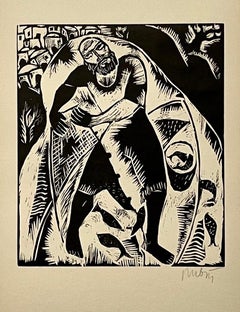
Rare 1923 Cubist Reuven Rubin Woodcut Woodblock Kabbalah Print Israeli Judaica
By Reuven Rubin
Located in Surfside, FL
This is from the original first edition 1923 printing. there was a much later edition done after these originals.
These are individually hand signed in pencil by artist as issued.
This listing is for the one print. the other documentation is included here for provenance and is not included in this listing.
The various images inspired by the Jewish Mysticism and rabbis and mystics of jerusalem and Kabbalah is holy, dramatic and optimistic Rubin succeeded to evoke the spirit of life in Israel in those early days.
They are done in a modern art style influenced by German Expressionism, particularly, Ernst Barlach, Ernst Ludwig Kirchner, and Franz Marc, as introduced to Israel by Jakob Steinhardt, Hermann Struck and Joseph Budko.
Reuven Rubin 1893 -1974 was a Romanian-born Israeli painter and Israel's first ambassador to Romania.
Rubin Zelicovich (later Reuven Rubin) was born in Galati to a poor Romanian Jewish Hasidic family. He was the eighth of 13 children. In 1912, he left for Ottoman-ruled Palestine to study art at Bezalel Academy of Art and Design in Jerusalem. Finding himself at odds with the artistic views of the Academy's teachers, he left for Paris, France, in 1913 to pursue his studies at the École Nationale Supérieure des Beaux-Arts. He was of the well known Jewish artists in Paris along with Marc Chagall and Chaim Soutine,
At the outbreak of World War I, he was returned to Romania, where he spent the war years.
In 1921, he traveled to the United States with his friend and fellow artist, Arthur Kolnik. In New York City, the two met artist Alfred Stieglitz, who was instrumental in organizing their first American show at the Anderson Gallery. Following the exhibition, in 1922, they both returned to Europe. In 1923, Rubin emigrated to Mandate Palestine.
Rubin met his wife, Esther, in 1928, aboard a passenger ship to Palestine on his return from a show in New York. She was a Bronx girl who had won a trip to Palestine in a Young Judaea competition. He died in 1974.
Part of the early generation of artists in Israel, Joseph Zaritsky, Arieh Lubin, Reuven Rubin, Sionah Tagger, Pinchas Litvinovsky, Mordecai Ardon, Yitzhak Katz, and Baruch Agadati; These painters depicted the country’s landscapes in the 1920s rebelled against the Bezalel school of Boris Schatz. They sought current styles in Europe that would help portray their own country’s landscape, in keeping with the spirit of the time. Rubin’s Cezannesque landscapes from the 1920s were defined by both a modern and a naive style, portraying the landscape and inhabitants of Israel in a sensitive fashion. His landscape paintings in particular paid special detail to a spiritual, translucent light. His early work bore the influences of Futurism, Vorticism, Cubism and Surrealism.
In Palestine, he became one of the founders of the new Eretz-Yisrael style. Recurring themes in his work were the bible, the prophet, the biblical landscape, folklore and folk art, people, including Yemenite, Hasidic Jews and Arabs. Many of his paintings are sun-bathed depictions of Jerusalem and the Galilee. Rubin might have been influenced by the work of Henri Rousseau whose naice style combined with Eastern nuances, as well as with the neo-Byzantine art to which Rubin had been exposed in his native Romania. In accordance with his integrative style, he signed his works with his first name in Hebrew and his surname in Roman letters.
In 1924, he was the first artist to hold a solo exhibition at the Tower of David, in Jerusalem (later exhibited in Tel Aviv at Gymnasia Herzliya). That year he was elected chairman of the Association of Painters and Sculptors of Palestine. From the 1930s onwards, Rubin designed backdrops for Habima Theater, the Ohel Theater and other theaters.
His biography, published in 1969, is titled My Life - My Art. He died in Tel Aviv in October 1974, after having bequeathed his home on 14 Bialik Street and a core collection of his paintings to the city of Tel Aviv. The Rubin Museum opened in 1983. The director and curator of the museum is his daughter-in-law, Carmela Rubin. Rubin's paintings are now increasingly sought after. At a Sotheby's auction in New York in 2007, his work accounted for six of the ten top lots. Along with Yaacov Agam and Menashe Kadishman he is among Israel's best known artists internationally. Education
1912 Bezalel Academy of Arts and Design, Jerusalem
1913-14 École des Beaux Arts, Paris and Académie Colarossi, Paris
Select Group Exhibitions
Eged - Palestine Painters Group Eged - Palestine Painters Group, Allenby Street, Tel Aviv 1929
Artists: Chana Orloff, Abraham Melnikoff, Rubin, Reuven Nahum Gutman, Sionah Tagger,Arieh Allweil,
Jewish Artists Association, Levant Fair, Tel Aviv, 1929
Artists: Ludwig Blum,Eliyahu Sigad, Shmuel Ovadyahu, Itzhak Frenel Frenkel,Ozer Shabat, Menahem Shemi...
Category
1920s Abstract Figurative Prints
Materials
Woodcut
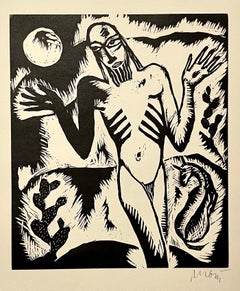
Rare 1923 Cubist Reuven Rubin Woodcut Woodblock Print Israeli Hasidic Judaica
By Reuven Rubin
Located in Surfside, FL
This is from the original first edition 1923 printing. there was a much later edition done after these originals.
These are individually hand signed in pencil by artist as issued.
This listing is for the one print. the other documentation is included here for provenance and is not included in this listing.
The various images inspired by the Jewish Mysticism and rabbis and mystics of jerusalem and Kabbalah is holy, dramatic and optimistic Rubin succeeded to evoke the spirit of life in Israel in those early days.
They are done in a modern art style influenced by German Expressionism, particularly, Ernst Barlach, Ernst Ludwig Kirchner, and Franz Marc, as introduced to Israel by Jakob Steinhardt, Hermann Struck and Joseph Budko.
Reuven Rubin 1893 -1974 was a Romanian-born Israeli painter and Israel's first ambassador to Romania.
Rubin Zelicovich (later Reuven Rubin) was born in Galati to a poor Romanian Jewish Hasidic family. He was the eighth of 13 children. In 1912, he left for Ottoman-ruled Palestine to study art at Bezalel Academy of Art and Design in Jerusalem. Finding himself at odds with the artistic views of the Academy's teachers, he left for Paris, France, in 1913 to pursue his studies at the École Nationale Supérieure des Beaux-Arts. He was of the well known Jewish artists in Paris along with Marc Chagall and Chaim Soutine,
At the outbreak of World War I, he was returned to Romania, where he spent the war years.
In 1921, he traveled to the United States with his friend and fellow artist, Arthur Kolnik. In New York City, the two met artist Alfred Stieglitz, who was instrumental in organizing their first American show at the Anderson Gallery. Following the exhibition, in 1922, they both returned to Europe. In 1923, Rubin emigrated to Mandate Palestine.
Rubin met his wife, Esther, in 1928, aboard a passenger ship to Palestine on his return from a show in New York. She was a Bronx girl who had won a trip to Palestine in a Young Judaea competition. He died in 1974.
Part of the early generation of artists in Israel, Joseph Zaritsky, Arieh Lubin, Reuven Rubin, Sionah Tagger, Pinchas Litvinovsky, Mordecai Ardon, Yitzhak Katz, and Baruch Agadati; These painters depicted the country’s landscapes in the 1920s rebelled against the Bezalel school of Boris Schatz. They sought current styles in Europe that would help portray their own country’s landscape, in keeping with the spirit of the time. Rubin’s Cezannesque landscapes from the 1920s were defined by both a modern and a naive style, portraying the landscape and inhabitants of Israel in a sensitive fashion. His landscape paintings in particular paid special detail to a spiritual, translucent light. His early work bore the influences of Futurism, Vorticism, Cubism and Surrealism.
In Palestine, he became one of the founders of the new Eretz-Yisrael style. Recurring themes in his work were the bible, the prophet, the biblical landscape, folklore and folk art, people, including Yemenite, Hasidic Jews and Arabs. Many of his paintings are sun-bathed depictions of Jerusalem and the Galilee. Rubin might have been influenced by the work of Henri Rousseau whose naice style combined with Eastern nuances, as well as with the neo-Byzantine art to which Rubin had been exposed in his native Romania. In accordance with his integrative style, he signed his works with his first name in Hebrew and his surname in Roman letters.
In 1924, he was the first artist to hold a solo exhibition at the Tower of David, in Jerusalem (later exhibited in Tel Aviv at Gymnasia Herzliya). That year he was elected chairman of the Association of Painters and Sculptors of Palestine. From the 1930s onwards, Rubin designed backdrops for Habima Theater, the Ohel Theater and other theaters.
His biography, published in 1969, is titled My Life - My Art. He died in Tel Aviv in October 1974, after having bequeathed his home on 14 Bialik Street and a core collection of his paintings to the city of Tel Aviv. The Rubin Museum opened in 1983. The director and curator of the museum is his daughter-in-law, Carmela Rubin. Rubin's paintings are now increasingly sought after. At a Sotheby's auction in New York in 2007, his work accounted for six of the ten top lots. Along with Yaacov Agam and Menashe Kadishman he is among Israel's best known artists internationally. Education
1912 Bezalel Academy of Arts and Design, Jerusalem
1913-14 École des Beaux Arts, Paris and Académie Colarossi, Paris
Select Group Exhibitions
Eged - Palestine Painters Group Eged - Palestine Painters Group, Allenby Street, Tel Aviv 1929
Artists: Chana Orloff, Abraham Melnikoff, Rubin, Reuven Nahum Gutman, Sionah Tagger,Arieh Allweil,
Jewish Artists Association, Levant Fair, Tel Aviv, 1929
Artists: Ludwig Blum,Eliyahu Sigad, Shmuel Ovadyahu, Itzhak Frenel Frenkel,Ozer Shabat, Menahem Shemi...
Category
1920s Abstract Figurative Prints
Materials
Woodcut
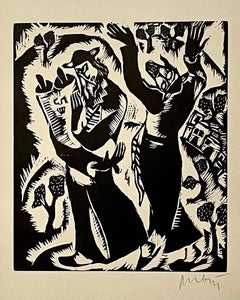
Rare 1923 Cubist Reuven Rubin Woodcut Woodblock Print Israeli Hasidic Judaica
By Reuven Rubin
Located in Surfside, FL
This is from the original first edition 1923 printing. there was a much later edition done after these originals.
These are individually hand signed in pencil by artist as issued.
This listing is for the one print. the other documentation is included here for provenance and is not included in this listing.
The various images inspired by the Jewish Mysticism and rabbis and mystics of jerusalem and Kabbalah is holy, dramatic and optimistic Rubin succeeded to evoke the spirit of life in Israel in those early days.
They are done in a modern art style influenced by German Expressionism, particularly, Ernst Barlach, Ernst Ludwig Kirchner, and Franz Marc, as introduced to Israel by Jakob Steinhardt, Hermann Struck and Joseph Budko.
Reuven Rubin 1893 -1974 was a Romanian-born Israeli painter and Israel's first ambassador to Romania.
Rubin Zelicovich (later Reuven Rubin) was born in Galati to a poor Romanian Jewish Hasidic family. He was the eighth of 13 children. In 1912, he left for Ottoman-ruled Palestine to study art at Bezalel Academy of Art and Design in Jerusalem. Finding himself at odds with the artistic views of the Academy's teachers, he left for Paris, France, in 1913 to pursue his studies at the École Nationale Supérieure des Beaux-Arts. He was of the well known Jewish artists in Paris along with Marc Chagall and Chaim Soutine,
At the outbreak of World War I, he was returned to Romania, where he spent the war years.
In 1921, he traveled to the United States with his friend and fellow artist, Arthur Kolnik. In New York City, the two met artist Alfred Stieglitz, who was instrumental in organizing their first American show at the Anderson Gallery. Following the exhibition, in 1922, they both returned to Europe. In 1923, Rubin emigrated to Mandate Palestine.
Rubin met his wife, Esther, in 1928, aboard a passenger ship to Palestine on his return from a show in New York. She was a Bronx girl who had won a trip to Palestine in a Young Judaea competition. He died in 1974.
Part of the early generation of artists in Israel, Joseph Zaritsky, Arieh Lubin, Reuven Rubin, Sionah Tagger, Pinchas Litvinovsky, Mordecai Ardon, Yitzhak Katz, and Baruch Agadati; These painters depicted the country’s landscapes in the 1920s rebelled against the Bezalel school of Boris Schatz. They sought current styles in Europe that would help portray their own country’s landscape, in keeping with the spirit of the time. Rubin’s Cezannesque landscapes from the 1920s were defined by both a modern and a naive style, portraying the landscape and inhabitants of Israel in a sensitive fashion. His landscape paintings in particular paid special detail to a spiritual, translucent light. His early work bore the influences of Futurism, Vorticism, Cubism and Surrealism.
In Palestine, he became one of the founders of the new Eretz-Yisrael style. Recurring themes in his work were the bible, the prophet, the biblical landscape, folklore and folk art, people, including Yemenite, Hasidic Jews and Arabs. Many of his paintings are sun-bathed depictions of Jerusalem and the Galilee. Rubin might have been influenced by the work of Henri Rousseau whose naice style combined with Eastern nuances, as well as with the neo-Byzantine art to which Rubin had been exposed in his native Romania. In accordance with his integrative style, he signed his works with his first name in Hebrew and his surname in Roman letters.
In 1924, he was the first artist to hold a solo exhibition at the Tower of David, in Jerusalem (later exhibited in Tel Aviv at Gymnasia Herzliya). That year he was elected chairman of the Association of Painters and Sculptors of Palestine. From the 1930s onwards, Rubin designed backdrops for Habima Theater, the Ohel Theater and other theaters.
His biography, published in 1969, is titled My Life - My Art. He died in Tel Aviv in October 1974, after having bequeathed his home on 14 Bialik Street and a core collection of his paintings to the city of Tel Aviv. The Rubin Museum opened in 1983. The director and curator of the museum is his daughter-in-law, Carmela Rubin. Rubin's paintings are now increasingly sought after. At a Sotheby's auction in New York in 2007, his work accounted for six of the ten top lots. Along with Yaacov Agam and Menashe Kadishman he is among Israel's best known artists internationally. Education
1912 Bezalel Academy of Arts and Design, Jerusalem
1913-14 École des Beaux Arts, Paris and Académie Colarossi, Paris
Select Group Exhibitions
Eged - Palestine Painters Group Eged - Palestine Painters Group, Allenby Street, Tel Aviv 1929
Artists: Chana Orloff, Abraham Melnikoff, Rubin, Reuven Nahum Gutman, Sionah Tagger,Arieh Allweil,
Jewish Artists Association, Levant Fair, Tel Aviv, 1929
Artists: Ludwig Blum,Eliyahu Sigad, Shmuel Ovadyahu, Itzhak Frenel Frenkel,Ozer Shabat, Menahem Shemi,
First Exhibition of ''Hever Omanim'' First Exhibition of ''Hever Omanim''
Steimatzky Gallery, Jerusalem
1936
Artists:
Gutman, Nachum Holzman, Shimshon Mokady, Moshe Sima, Miron Rubin, Reuven Steinhardt, Jakob Ben Zvi, Zeev Ziffer, Moshe Allweil, Arieh
Group Exhibition Group Exhibition
Katz Art Gallery, Tel Aviv
1939
Artists:
Avni, Aharon Holzman, Shimshon Gliksberg, Haim Gutman, Nachum Ovadyahu, Shmuel Shorr, Zvi Schwartz, Chaya Streichman, Yehezkel Tagger, Sionah Rubin, Reuven
A Collection of Works by Artists of the Land of Israel A Collection of Works by Artists of the Land of Israel
The Bezalel National Museum, Jerusalem
1940
Artists:
Shemi, Menahem Rubin, Reuven Avni, Aharon Mokady, Moshe Jonas, Ludwig Steinhardt, Jakob Ticho, Anna Krakauer, Leopold Gutman, Nachum Budko, Joseph Ardon, Mordecai Sima, Miron Castel, Moshe Pann, Abel Struck, Hermann Gur Arie, Meir Ben Zvi, Zeev Litvinovsky, Pinchas
Artists in Israel for the Defense, Tel Aviv Museum of Art, Helena Rubinstein Pavilion, Tel Aviv 1967
Artists: Avraham Binder, Motke Blum, (Mordechai) Samuel Bak, Yosl Bergner, Nahum Gilboa, Jean David, Marcel Janco, Lea Nikel, Jacob Pins, Esther Peretz...
Category
1920s Abstract Figurative Prints
Materials
Woodcut
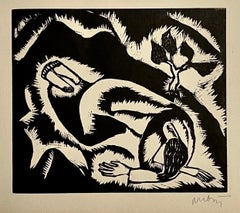
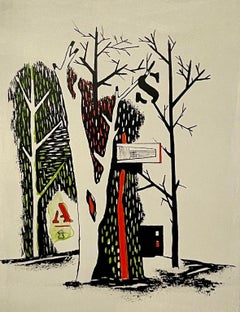
Lithograph Belgian American Surrealism WPA Modernist Karl Fortess Surrealist Art
Located in Surfside, FL
Karl Eugene Fortess (1907-1993)
Original color lithographs on BFK Rives paper,
1966, Hand signed and numbered 29/36 in pencil,
Sheet size 20.5 x 15 inches.
Karl E. Fortess (1907-1993) was a painter, printmaker and teacher, of Boston, Massachusetts and Woodstock, N.Y. Fortess was born in Antwerp, Belgium on October 13, 1907, and became an American citizen in 1923. He studied at the Art Institute of Chicago, the Art Students League in New York, and the Woodstock School of Painting with Yasuo Kuniyoshi. In 1937 the Works Progress Administration sent him and several other artists to Alaska to document the towns, villages, and remote wilderness landscapes (Pemberton, “Alaska art museum collects WPA’s Depression works from the territory,” Columbia Daily Tribune, November 9, 2003). Trains, trucks, and industrial buildings were what Karl Fortess envisioned when the Public Works of Art Project suggested that he depict “the American Scene.” His work bears the influence of Surrealism, Russsian Constructivist art and Cubism. He was part of a circle of left leaning artists loosley involved with the WPA which included Sol Wilson, Isaac Soyer, Louis Lozowick, Abraham Harriton, Ben Shahn, William Gropper, Nahum Tschacbasov, Morris Shulman, Yasuo Kuniyoshi, Louis Slobodkin, Adolf Dehn, Le Corbusier and Louis Schanker.
Karl Fortress taught at the Art Students League, Brooklyn Museum Art School, Louisiana State University, Fort Wright College, and Boston University School of Fine and Applied Arts. He was a member of the Artists Equity Association, Society of American Graphic Artists, American Association of University Professors, and the British Film Institute. He was awarded the Guggenheim Fellowship in 1946, was named an Associate of the National Academy of Design in 1960 and elected to full Academician in 1971. Fortess taught at many different schools, including Boston University School of Fine Art, where he also created an archive of interviews with more than two hundred and fifty contemporary American painters, sculptors, and graphic artists including many with with artists associated with the Woodstock, N.Y. art community.
Among the interviewees are Kenneth Armitage, Will Barnet, Romare Bearden, George Biddle, James Brooks, Adolph Dehn, Jane Freilicher, Julian Levi, Alice Neel, Larry Rivers, Moses Soyer, Dorothy Varian...
Category
Mid-20th Century Surrealist Landscape Prints
Materials
Lithograph
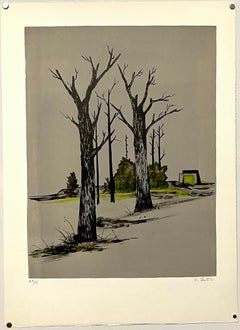
Lithograph Belgian American Surrealism WPA Modernist Karl Fortess Surrealist Art
Located in Surfside, FL
Karl Eugene Fortess (1907-1993)
Original color lithographs on BFK Rives paper,
1966, Hand signed and numbered 29/36 in pencil,
Sheet size 20.5 x 15 inches.
Karl E. Fortess (1907-1993) was a painter, printmaker and teacher, of Boston, Massachusetts and Woodstock, N.Y. Fortess was born in Antwerp, Belgium on October 13, 1907, and became an American citizen in 1923. He studied at the Art Institute of Chicago, the Art Students League in New York, and the Woodstock School of Painting with Yasuo Kuniyoshi. In 1937 the Works Progress Administration sent him and several other artists to Alaska to document the towns, villages, and remote wilderness landscapes (Pemberton, “Alaska art museum collects WPA’s Depression works from the territory,” Columbia Daily Tribune, November 9, 2003). Trains, trucks, and industrial buildings were what Karl Fortess envisioned when the Public Works of Art Project suggested that he depict “the American Scene.” His work bears the influence of Surrealism, Russsian Constructivist art and Cubism. He was part of a circle of left leaning artists loosley involved with the WPA which included Sol Wilson, Isaac Soyer, Louis Lozowick, Abraham Harriton, Ben Shahn, William Gropper, Nahum Tschacbasov, Morris Shulman, Yasuo Kuniyoshi, Louis Slobodkin, Adolf Dehn, Le Corbusier and Louis Schanker.
Karl Fortress taught at the Art Students League, Brooklyn Museum Art School, Louisiana State University, Fort Wright College, and Boston University School of Fine and Applied Arts. He was a member of the Artists Equity Association, Society of American Graphic Artists, American Association of University Professors, and the British Film Institute. He was awarded the Guggenheim Fellowship in 1946, was named an Associate of the National Academy of Design in 1960 and elected to full Academician in 1971. Fortess taught at many different schools, including Boston University School of Fine Art, where he also created an archive of interviews with more than two hundred and fifty contemporary American painters, sculptors, and graphic artists including many with with artists associated with the Woodstock, N.Y. art community.
Among the interviewees are Kenneth Armitage, Will Barnet, Romare Bearden, George Biddle, James Brooks, Adolph Dehn, Jane Freilicher, Julian Levi, Alice Neel, Larry Rivers, Moses Soyer, Dorothy Varian...
Category
Mid-20th Century Surrealist Landscape Prints
Materials
Lithograph
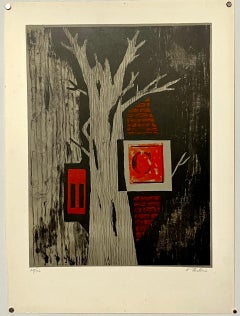
Lithograph Belgian American Surrealism WPA Modernist Karl Fortess Surrealist Art
Located in Surfside, FL
Karl Eugene Fortess (1907-1993)
Original color lithographs on BFK Rives paper,
1966, Hand signed and numbered 29/36 in pencil,
Sheet size 20.5 x 15 inches.
Karl E. Fortess (1907-1993) was a painter, printmaker and teacher, of Boston, Massachusetts and Woodstock, N.Y. Fortess was born in Antwerp, Belgium on October 13, 1907, and became an American citizen in 1923. He studied at the Art Institute of Chicago, the Art Students League in New York, and the Woodstock School of Painting with Yasuo Kuniyoshi. In 1937 the Works Progress Administration sent him and several other artists to Alaska to document the towns, villages, and remote wilderness landscapes (Pemberton, “Alaska art museum collects WPA’s Depression works from the territory,” Columbia Daily Tribune, November 9, 2003). Trains, trucks, and industrial buildings were what Karl Fortess envisioned when the Public Works of Art Project suggested that he depict “the American Scene.” His work bears the influence of Surrealism, Russsian Constructivist art and Cubism. He was part of a circle of left leaning artists loosley involved with the WPA which included Sol Wilson, Isaac Soyer, Louis Lozowick, Abraham Harriton, Ben Shahn, William Gropper, Nahum Tschacbasov, Morris Shulman, Yasuo Kuniyoshi, Louis Slobodkin, Adolf Dehn, Le Corbusier and Louis Schanker.
Karl Fortress taught at the Art Students League, Brooklyn Museum Art School, Louisiana State University, Fort Wright College, and Boston University School of Fine and Applied Arts. He was a member of the Artists Equity Association, Society of American Graphic Artists, American Association of University Professors, and the British Film Institute. He was awarded the Guggenheim Fellowship in 1946, was named an Associate of the National Academy of Design in 1960 and elected to full Academician in 1971. Fortess taught at many different schools, including Boston University School of Fine Art, where he also created an archive of interviews with more than two hundred and fifty contemporary American painters, sculptors, and graphic artists including many with with artists associated with the Woodstock, N.Y. art community.
Among the interviewees are Kenneth Armitage, Will Barnet, Romare Bearden, George Biddle, James Brooks, Adolph Dehn, Jane Freilicher, Julian Levi, Alice Neel, Larry Rivers, Moses Soyer, Dorothy Varian...
Category
Mid-20th Century Surrealist Landscape Prints
Materials
Lithograph
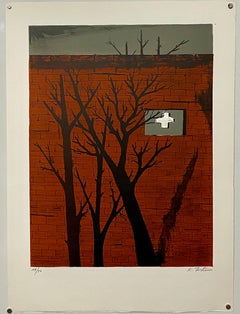
Lithograph Belgian American Surrealism WPA Modernist Karl Fortess Surrealist Art
Located in Surfside, FL
Karl Eugene Fortess (1907-1993)
Original color lithographs on BFK Rives paper,
1966, Hand signed and numbered 29/36 in pencil,
Sheet size 20.5 x 15 inches.
Karl E. Fortess (1907-1993) was a painter, printmaker and teacher, of Boston, Massachusetts and Woodstock, N.Y. Fortess was born in Antwerp, Belgium on October 13, 1907, and became an American citizen in 1923. He studied at the Art Institute of Chicago, the Art Students League in New York, and the Woodstock School of Painting with Yasuo Kuniyoshi. In 1937 the Works Progress Administration sent him and several other artists to Alaska to document the towns, villages, and remote wilderness landscapes (Pemberton, “Alaska art museum collects WPA’s Depression works from the territory,” Columbia Daily Tribune, November 9, 2003). Trains, trucks, and industrial buildings were what Karl Fortess envisioned when the Public Works of Art Project suggested that he depict “the American Scene.” His work bears the influence of Surrealism, Russsian Constructivist art and Cubism. He was part of a circle of left leaning artists loosley involved with the WPA which included Sol Wilson, Isaac Soyer, Louis Lozowick, Abraham Harriton, Ben Shahn, William Gropper, Nahum Tschacbasov, Morris Shulman, Yasuo Kuniyoshi, Louis Slobodkin, Adolf Dehn, Le Corbusier and Louis Schanker.
Karl Fortress taught at the Art Students League, Brooklyn Museum Art School, Louisiana State University, Fort Wright College, and Boston University School of Fine and Applied Arts. He was a member of the Artists Equity Association, Society of American Graphic Artists, American Association of University Professors, and the British Film Institute. He was awarded the Guggenheim Fellowship in 1946, was named an Associate of the National Academy of Design in 1960 and elected to full Academician in 1971. Fortess taught at many different schools, including Boston University School of Fine Art, where he also created an archive of interviews with more than two hundred and fifty contemporary American painters, sculptors, and graphic artists including many with with artists associated with the Woodstock, N.Y. art community.
Among the interviewees are Kenneth Armitage, Will Barnet, Romare Bearden, George Biddle, James Brooks, Adolph Dehn, Jane Freilicher, Julian Levi, Alice Neel, Larry Rivers, Moses Soyer, Dorothy Varian...
Category
Mid-20th Century Surrealist Landscape Prints
Materials
Lithograph
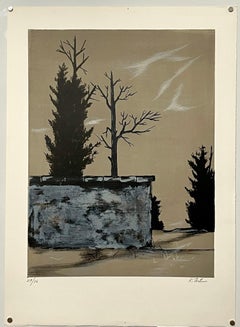
Lithograph Belgian American Surrealism WPA Modernist Karl Fortess Surrealist Art
Located in Surfside, FL
Karl Eugene Fortess (1907-1993)
Original color lithographs on BFK Rives paper,
1966, Hand signed and numbered 29/36 in pencil,
Sheet size 20.5 x 15 inches.
Karl E. Fortess (1907-1993) was a painter, printmaker and teacher, of Boston, Massachusetts and Woodstock, N.Y. Fortess was born in Antwerp, Belgium on October 13, 1907, and became an American citizen in 1923. He studied at the Art Institute of Chicago, the Art Students League in New York, and the Woodstock School of Painting with Yasuo Kuniyoshi. In 1937 the Works Progress Administration sent him and several other artists to Alaska to document the towns, villages, and remote wilderness landscapes (Pemberton, “Alaska art museum collects WPA’s Depression works from the territory,” Columbia Daily Tribune, November 9, 2003). Trains, trucks, and industrial buildings were what Karl Fortess envisioned when the Public Works of Art Project suggested that he depict “the American Scene.” His work bears the influence of Surrealism, Russsian Constructivist art and Cubism. He was part of a circle of left leaning artists loosley involved with the WPA which included Sol Wilson, Isaac Soyer, Louis Lozowick, Abraham Harriton, Ben Shahn, William Gropper, Nahum Tschacbasov, Morris Shulman, Yasuo Kuniyoshi, Louis Slobodkin, Adolf Dehn, Le Corbusier and Louis Schanker.
Karl Fortress taught at the Art Students League, Brooklyn Museum Art School, Louisiana State University, Fort Wright College, and Boston University School of Fine and Applied Arts. He was a member of the Artists Equity Association, Society of American Graphic Artists, American Association of University Professors, and the British Film Institute. He was awarded the Guggenheim Fellowship in 1946, was named an Associate of the National Academy of Design in 1960 and elected to full Academician in 1971. Fortess taught at many different schools, including Boston University School of Fine Art, where he also created an archive of interviews with more than two hundred and fifty contemporary American painters, sculptors, and graphic artists including many with with artists associated with the Woodstock, N.Y. art community.
Among the interviewees are Kenneth Armitage, Will Barnet, Romare Bearden, George Biddle, James Brooks, Adolph Dehn, Jane Freilicher, Julian Levi, Alice Neel, Larry Rivers, Moses Soyer, Dorothy Varian...
Category
Mid-20th Century Surrealist Landscape Prints
Materials
Lithograph
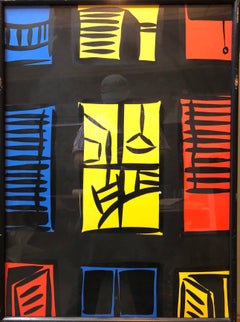
New York Night, Vintage Large Modernist Pop Art Sllkscreen
By Tom Slaughter
Located in Surfside, FL
5-color silkscreen on 2-ply museum board. edition of 60 hand signed and numbered.
American, 1955-2014
Born in 1955, Tom Slaughter’s career began in 1983 with his first exhibition at the Drawing Center in New York City. Since, he has had more than 20 solo shows in cities including San Francisco, Miami, London, Vancouver, Cologne and Fukuoka, Japan. Slaughter had worked extensively with master printer, Jean Russell at Durham Press, creating numerous limited edition prints using his signature bold primary colors. He worked as a printmaker in collaboration with Durham Press for 25 years, and his editions are included in the permanent collections of MoMA and the Whitney Museum of American Art.
He illustrated twelve children’s books, including “Boat Works,” “Do You Know Which Ones will Grow? ” – a 2011 Notable American Library Association book of the year – and collaborations with Marthe Jocelyn such as “ABC x 3,” “Same Same,” and “123.” These books have been translated into six languages. Slaughter also worked for the last ten seasons as the Art Director for the New Victory Theater. As a designer, he created everything from t-shirts to skateboard decks, beach towels as well as a line of wallpaper for Cavern Home. Tom Slaughter, an artist, designer, and illustrator, passed away on October 24, 2014. In his Pop-inflected prints, drawings, illustrations, paintings, and design work Tom Slaughter exudes a love of life. He makes few distinctions between his various artistic endeavors; “I paint, draw, cut paper, use a computer, and even an iPhone—it’s all the same hand,” he says. In a 2001 print...
Category
1990s Pop Art Figurative Prints
Materials
Screen
Lunar Landscape Abstract Signed Numbered Screenprint Black
By Len Gittleman
Located in Surfside, FL
Handsigned edition of 250. Gittleman’s Lunar Transformation is a series of ten vividly colored serigraphs created from black and white photographs taken during the Apollo 15 mission to the moon in 1971. Gittleman uses bright color to transform the craters and crevices of the lunar surface into vibrant abstractions which recall Abstract Expressionist painting. The strong graphic prints reflect the awe-inspiring nature of their source material. photographer, film maker, video producer, graphic designer, multimedia developer, clock maker and teacher. Guggenheim fellowship (graphics), Cannes Film festival, Academy Award Nomination. Work in permanent collections: MFA Boston, MOMA NY, Smithsonian Institution and Fogg Museum, Harvard. He exhibited with Gyorgi Kepes
Solo shows:
Lunar Transformations: 10 Serigraphs by Len Gittleman - Institute of Contemporary Arts, London
Group shows:
Integrated Vision: Science, Nature, and Abstraction in the Art of Len Gittleman and György Kepes - DeCordova Sculpture Park and Museum, Lincoln, MA
Abstract Photography in the Permanent Collection - DeCordova Sculpture Park and Museum, Lincoln, MA
Photography in Boston - 1955-1985 - DeCordova Sculpture Park and Museum, Lincoln, MA
Some Photographic Use of Color: Fred Berman...
Category
1970s Pop Art Abstract Prints
Materials
Screen
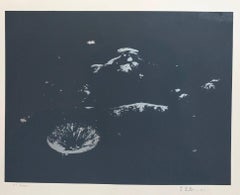
Lunar Landscape Abstract Signed Numbered Screenprint Yellow
By Len Gittleman
Located in Surfside, FL
Handsigned edition of 250. Gittleman’s Lunar Transformation is a series of ten vividly colored serigraphs created from black and white photographs taken during the Apollo 15 mission to the moon in 1971. Gittleman uses bright color to transform the craters and crevices of the lunar surface into vibrant abstractions which recall Abstract Expressionist painting. The strong graphic prints reflect the awe-inspiring nature of their source material. photographer, film maker, video producer, graphic designer, multimedia developer, clock maker and teacher. Guggenheim fellowship (graphics), Cannes Film festival, Academy Award Nomination. Work in permanent collections: MFA Boston, MOMA NY, Smithsonian Institution and Fogg Museum, Harvard. He exhibited with Gyorgi Kepes
Solo shows:
Lunar Transformations: 10 Serigraphs by Len Gittleman - Institute of Contemporary Arts, London
Group shows:
Integrated Vision: Science, Nature, and Abstraction in the Art of Len Gittleman and György Kepes - DeCordova Sculpture Park and Museum, Lincoln, MA
Abstract Photography in the Permanent Collection - DeCordova Sculpture Park and Museum, Lincoln, MA
Photography in Boston - 1955-1985 - DeCordova Sculpture Park and Museum, Lincoln, MA
Some Photographic Use of Color: Fred Berman...
Category
1970s Pop Art Abstract Prints
Materials
Screen
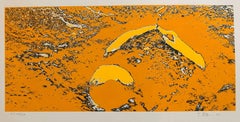
Lunar Landscape Abstract Signed Numbered Screenprint Orange
By Len Gittleman
Located in Surfside, FL
Handsigned edition of 250. Gittleman’s Lunar Transformation is a series of ten vividly colored serigraphs created from black and white photographs taken during the Apollo 15 mission to the moon in 1971. Gittleman uses bright color to transform the craters and crevices of the lunar surface into vibrant abstractions which recall Abstract Expressionist painting. The strong graphic prints reflect the awe-inspiring nature of their source material. photographer, film maker, video producer, graphic designer, multimedia developer, clock maker and teacher. Guggenheim fellowship (graphics), Cannes Film festival, Academy Award Nomination. Work in permanent collections: MFA Boston, MOMA NY, Smithsonian Institution and Fogg Museum, Harvard. He exhibited with Gyorgi Kepes
Solo shows:
Lunar Transformations: 10 Serigraphs by Len Gittleman - Institute of Contemporary Arts, London
Group shows:
Integrated Vision: Science, Nature, and Abstraction in the Art of Len Gittleman and György Kepes - DeCordova Sculpture Park and Museum, Lincoln, MA
Abstract Photography in the Permanent Collection - DeCordova Sculpture Park and Museum, Lincoln, MA
Photography in Boston - 1955-1985 - DeCordova Sculpture Park and Museum, Lincoln, MA
Some Photographic Use of Color: Fred Berman...
Category
1970s Pop Art Abstract Prints
Materials
Screen
Lunar Landscape Abstract Signed Numbered Screenprint Blue
By Len Gittleman
Located in Surfside, FL
Gittleman’s Lunar Transformation is a series of ten vividly colored serigraphs created from black and white photographs taken during the Apollo 15 mission to the moon in 1971. Gittleman uses bright color to transform the craters and crevices of the lunar surface into vibrant abstractions which recall Abstract Expressionist painting. The strong graphic prints reflect the awe-inspiring nature of their source material. photographer, film maker, video producer, graphic designer, multimedia developer, clock maker and teacher. Guggenheim fellowship (graphics), Cannes Film festival, Academy Award Nomination. Work in permanent collections: MFA Boston, MOMA NY, Smithsonian Institution and Fogg Museum, Harvard. He exhibited with Gyorgi Kepes
Solo shows:
Lunar Transformations: 10 Serigraphs by Len Gittleman - Institute of Contemporary Arts, London
Group shows:
Integrated Vision: Science, Nature, and Abstraction in the Art of Len Gittleman and György Kepes - DeCordova Sculpture Park and Museum, Lincoln, MA
Abstract Photography in the Permanent Collection - DeCordova Sculpture Park and Museum, Lincoln, MA
Photography in Boston - 1955-1985 - DeCordova Sculpture Park and Museum, Lincoln, MA
Some Photographic Use of Color: Fred Berman...
Category
1970s Pop Art Abstract Prints
Materials
Screen
Singapore Singapour Original Modernist Lithograph on Arches vellum
By Joan Gardy Artigas
Located in Surfside, FL
Original lithograph, handsigned and numbered HC
On Arches vellum ragpaper
Dimensions : 69 x 54,5 cm (27.2 x 21.5 inches)
Joan Gardy Artigas (born 1938) is a Catalan ceramist, artist...
Category
20th Century Modern Abstract Prints
Materials
Lithograph
Sandscapes #4 Florida Artist Abstract Modernist Signed Print
By Kathy Stark
Located in Surfside, FL
Fine piece of Florida abstract Landscape art. With a French Art Deco feel to it.
Category
1990s American Modern Abstract Prints
Materials
Lithograph
Monoprint Monotype American Modernist Gregory Amenoff Abstract Expressionist
By Gregory Amenoff
Located in Surfside, FL
Gregory Amenoff (Contemporary American abstract painter, b. 1948),
Monotype Monoprint (1990)
Hand signed in pencil lower right
plate: 16 x 16 inches
frame dimensions: 35 1/8 x 29 1/8 x 1 5/8 inches, wood frame with glazing
Provenance: Corporate Collection of Bank BNP Paribas
Gregory Amenoff is a painter who lives in New York City and Ulster County, New York. He is the recipient of numerous awards from organizations including the American Academy of Arts and Letters, National Endowment for the Arts, New York State Council on the Arts and the Tiffany Foundation. He has had over fifty one-person painting exhibitions in museums and galleries throughout the United States and Europe. His work is in the permanent collections of more than thirty museums, including the Whitney Museum of American Art, the Museum of Fine Arts in Boston, the Museum of Modern Art in New York and the Metropolitan Museum of Art. His work has the influence of both Abstract Expressionism and Pop Art in it, biomorphic forms in rich hues and thick textures with heightened colors and abstracted, organic forms, late American Modernism. He moved to New York in 1979, the artist rose to critical acclaim in the 1980s alongside Terry Winters, Bill Jensen, and Katherine Porter. The artist lives and works between New York, NY and his Hudson Valley residence. He works in woodcut, lithograph and monoprint techniques.
He was a collaborating artist illustrating Bradford Morrow, Bestiary along with Joe Andoe, James Brown, Vija Celmins, Louisa Chase, Eric Fischl, Jan Hashey, Michael Hurson, Mel Kendrick, James Nares, Ellen Phelan, Joel Shapiro,
Kiki Smith, David Storey, Michelle Stuart, Richard Tuttle, Trevor Winkfield, Robin Winters. Linoleum cuts with
pochoir and woodcuts for the Grenfell Press, New York. Amenoff served as President of the National Academy of Design from 2001-2005. He is a founding board member of the CUE Art Foundation in New York City and serves as the CUE Art Foundation's Curator Governor. Amenoff has taught at Columbia for the last eighteen years, where he holds the Eve and Herman Gelman Chair of Visual Arts and is currently the Chair of the Visual Arts Division in the School of the Arts. He is currently the Vice-President of the National Academy.
In 2011 he received the John Solomon Guggenheim Fellowship.
Museum Collections
Albright-Knox Art Gallery; Buffalo, NY
Art Institute of Chicago; IL
Baltimore Museum of Art;
Brooklyn Museum of Art; Brooklyn, NY
Butler Institute of American Art; Youngstown, OH
Cleveland Museum of Art; Cleveland, OH
Currier Gallery of Art; Manchester, NH
Frances and Sidney Lewis Foundation; Richmond, VA
Hood Museum of Art; Hanover, NH
Honolulu Academy of Art; Honolulu, HW
Kemper Museum of Contemporary Art; Kansas City, MO
Maier Museum of Art; Lynchburg, VA
Metropolitan Museum of Art; New York, NY
Milwaukee Museum of Art; Milwaukee, WI
Minneapolis Institute of Art; MN
Muscarelle Museum of Art, College of William and Mary; Williamsburg, VA
Museum of Fine Arts; Boston, MA
Museum of Modern Art; New York, NY
National Museum of American Art; Washington, DC
Neuberger Museum, State University of New York at Purchase; NY
New York Public Library, Spencer Collection...
Category
1980s American Modern Abstract Prints
Materials
Lithograph, Monoprint, Monotype
Monoprint Lithograph American Modernist Gregory Amenoff Abstract Expressionist
By Gregory Amenoff
Located in Surfside, FL
Gregory Amenoff (Contemporary American abstract painter, b. 1948),
Monotype Monoprint (1990)
Hand signed in pencil lower right
plate: 16 x 16 inches
frame dimensions: 35 1/8 x 29 1/8 x 1 5/8 inches, wood frame with glazing
Provenance: Corporate Collection of Bank BNP Paribas
Gregory Amenoff is a painter who lives in New York City and Ulster County, New York. He is the recipient of numerous awards from organizations including the American Academy of Arts and Letters, National Endowment for the Arts, New York State Council on the Arts and the Tiffany Foundation. He has had over fifty one-person painting exhibitions in museums and galleries throughout the United States and Europe. His work is in the permanent collections of more than thirty museums, including the Whitney Museum of American Art, the Museum of Fine Arts in Boston, the Museum of Modern Art in New York and the Metropolitan Museum of Art. His work has the influence of both Abstract Expressionism and Pop Art in it, biomorphic forms in rich hues and thick textures with heightened colors and abstracted, organic forms, late American Modernism. He moved to New York in 1979, the artist rose to critical acclaim in the 1980s alongside Terry Winters, Bill Jensen, and Katherine Porter. The artist lives and works between New York, NY and his Hudson Valley residence.
He was a collaborating artist illustrating Bradford Morrow, Bestiary along with Joe Andoe, James Brown, Vija Celmins, Louisa Chase, Eric Fischl, Jan Hashey, Michael Hurson, Mel Kendrick, James Nares, Ellen Phelan, Joel Shapiro,
Kiki Smith, David Storey, Michelle Stuart, Richard Tuttle, Trevor Winkfield, Robin Winters. Linoleum cuts with
pochoir and woodcuts for the Grenfell Press, New York. Amenoff served as President of the National Academy of Design from 2001-2005. He is a founding board member of the CUE Art Foundation in New York City and serves as the CUE Art Foundation's Curator Governor. Amenoff has taught at Columbia for the last eighteen years, where he holds the Eve and Herman Gelman Chair of Visual Arts and is currently the Chair of the Visual Arts Division in the School of the Arts. He is currently the Vice-President of the National Academy.
In 2011 he received the John Solomon Guggenheim Fellowship.
Museum Collections
Albright-Knox Art Gallery; Buffalo, NY
Art Institute of Chicago; IL
Baltimore Museum of Art;
Brooklyn Museum of Art; Brooklyn, NY
Butler Institute of American Art; Youngstown, OH
Cleveland Museum of Art; Cleveland, OH
Currier Gallery of Art; Manchester, NH
Frances and Sidney Lewis Foundation; Richmond, VA
Hood Museum of Art; Hanover, NH
Honolulu Academy of Art; Honolulu, HW
Kemper Museum of Contemporary Art; Kansas City, MO
Maier Museum of Art; Lynchburg, VA
Metropolitan Museum of Art; New York, NY
Milwaukee Museum of Art; Milwaukee, WI
Minneapolis Institute of Art; MN
Muscarelle Museum of Art, College of William and Mary; Williamsburg, VA
Museum of Fine Arts; Boston, MA
Museum of Modern Art; New York, NY
National Museum of American Art; Washington, DC
Neuberger Museum, State University of New York at Purchase; NY
New York Public Library, Spencer Collection...
Category
1980s American Modern Abstract Prints
Materials
Lithograph, Monoprint, Monotype
Los Angeles Contemporary Digital Collage Fine Art Iris Print Signed ltd ed.
By Anne Marie Karlsen
Located in Surfside, FL
GATEKEEPER, 1996, color Iris print, signed in pencil, from the numbered edition 35,
This is 5/35 (the picture shows 3/35)
image 9 x 7 ½", full margins, printed & published by Muse X, Los Angeles.
Botanical/Erotic print in the manner of Judy Chicago. A modern feminist take on the female anatomy.
ANNE MARIE KARLSEN received a B.F.A. from Michigan State University and an M.F.A. from the University of Wisconsin. Her work has been featured in exhibitions throughout the United States including the Museum of Fine Arts in Boston, the UCLA Armand Hammer Museum in Los Angeles, the Brooklyn Museum in New York, and the Carnegie Institute Museum of Art in Pittsburgh. Karlsen has completed numerous commissions for libraries, transit stations, cruise lines and municipal buildings. Her public art projects have been recognized as some of the most successful in the United States by the Americans for the Arts Year in Review. Karlsen received the Westside Prize by the Westside Urban Forum for her work on the Santa Monica Boulevard Master Plan for the City of West Hollywood. She teaches at Santa Monica College.
Muse X Editions. An (now defunct) LA based innovative publisher of limited-edition prints, Muse X has launched its first group of prints and is just beginning to make itself known to artists, curators, dealers and collectors. Among works just off the press are otherworldly landscapes by Barbara Kasten...
Category
1990s Contemporary Landscape Prints
Materials
Color
1966 Woodcut "Fleet" Modernist Print
By Roger Martin
Located in Surfside, FL
Genre: Modern
Subject: Landscape
Medium: Print, Woodcut
Surface: Paper
Dimensions w/Frame: 31" x 15 1/2"
Roger was born in the Addison Gilbert Hospital in Gloucester, MA, the son of Capt. Roger Martin and Ellie Emilia Oker, in 1925. His father was born in Rockport, of Portuguese heritage, and his mother was born in Finland. He graduated from Rockport Highschool in 1942. While in high school Roger prepared lobsters for tourists at the Roy Moore Lobster Company on Bearskin Neck and sang and played harmonica with Tony Torissi’s hillbilly band.
Roger enlisted in the U.S. Coast Guard in 1942 and mustered out in 1946, ending his military career as a member of the USCG canine corps only two weeks from going to the Pacific with a Marine detachment. After having lived on both coasts (Manhattan and Los Angeles) he returned to his home town from the West Coast, vowing to never leave again, and he hasn’t. When he returned to Cape Ann he entered the School of the Museum of Fine Arts in Boston where he majored in book design and illustration, graduating with honors.
He illustrated a number of textbooks for D.C. Heath, Beacon Press, and other Boston publishers, as well as provided illustrations for the New York Sunday Times, the New Yorker magazine, the Atlantic Monthly magazine, and a book for the United Church of Christ.
Roger also designed, carved and gold-leafed pipe shades for a number of C. B. Fisk pipe organs, builders of tracker action pipe organs, including those at Harvard and Stanford Universities.
He began his teaching career in Rockport, teaching elementary grade art, following that with four years teaching at the New England School of Art in Boston. Roger became a founding faculty member of the Montserrat College of Art in Beverly, MA, where he taught for twenty years, retiring to make paintings. He was also elected Rockport’s Poet Laureate in the 1990s and in addition wrote and published three books about Rockport.
Roger Martin has exhibited his work throughout New England and beyond. He has shown his work in Portland, ME; New York City; Andover’s Addison Gallery; the Boston ICA; galleries on Newbury Street in Boston; the Rockport Art Association; the Cape Ann Historical Museum (where he is part of the permanent collection); and many others. His work is represented in many private collections, including those of John...
Category
1960s Modern Landscape Prints
Materials
Woodcut