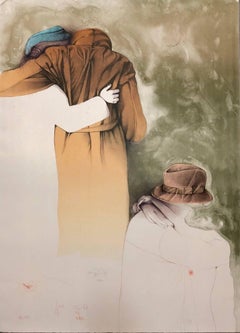
Lions Gallery Nude Prints
to
53
21
4
3
2
Overall Width
to
Overall Height
to
30
23
4
3
2
1
1
23
20
9
7
4
82
1
4
2
23
4
9
50
25
8
40
27
23
9
8
83
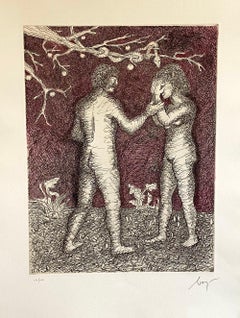
Italian Surrealist Aquatint Etching Enrico Baj Pop Art with Watercolor Painting
By Enrico Baj
Located in Surfside, FL
Enrico Baj (1924-2003) Italian, limited edition print.
Hand signed and numbered in pencil from limited edition of 100
Aquatint etching with the addition of hand watercolor painting ...
Category
20th Century Surrealist Figurative Prints
Materials
Watercolor, Etching, Aquatint

Italian Surrealist Aquatint Etching Enrico Baj Pop Art with Watercolor Painting
By Enrico Baj
Located in Surfside, FL
Enrico Baj (1924-2003) Italian, limited edition print.
Hand signed and numbered in pencil from limited edition of 100
Aquatint etching with the addition of hand watercolor painting ...
Category
20th Century Surrealist Figurative Prints
Materials
Watercolor, Etching, Aquatint
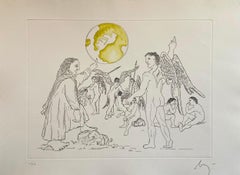
Italian Surrealist Aquatint Etching Enrico Baj Pop Art Nude Mod Cherubs Angels
By Enrico Baj
Located in Surfside, FL
Enrico Baj (1924-2003) Italian, limited edition print.
Hand signed and numbered in pencil from limited edition of 100
Aquatint etching
Image size: cm 39.5 x 29.5, sheet cm 53 x 39
...
Category
20th Century Surrealist Figurative Prints
Materials
Etching, Aquatint
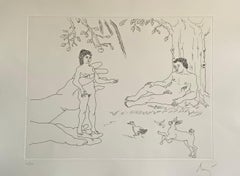
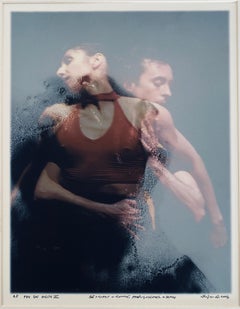
Silkscreen Surrealist Pop Art Print "Pas De Deux"
By Michael Knigin
Located in Surfside, FL
Print without matte is 19" X 13".
Michael Knigin was born in 1942 in Brooklyn, NY. He attended and graduated from Tyler School of Art, Temple University. He received a Ford Founda...
Category
21st Century and Contemporary 85 New Wave Abstract Prints
Materials
Screen
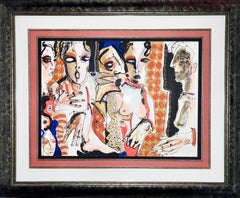
Large Mexican Figurative Expressionist Lithograph Women Juan Sebastian Barbera
Located in Surfside, FL
Juan Sebastian Barbera (Spanish, Born 1964 )
Litho on Guarro Paper
Titled : La Comision (from the Los Conjuros Suite)
Circa, 1994.
Hand signed in pencil lower right with edition size number 62 / 75.
Frame: 38" X 46"
Image: 22" X 30"
Juan Sebastián Barberá Durón Plastic artist Cd. de México 1964 Son of the great musical artist Luisa Duron, Mexican harpsichordist, daughter of pianists Jesús Durón Ruiz and Julia Crespo considered a pioneer of the movement and musical flourishing of the Renaissance and Baroque periods and the initiator of the harpsichord school in Mexico .he grew up in an almost Renaissance environment, among artists and under the main protection of the baroque music of Bach and Hotteterre, Couperin and Scarlatti , among others. Since a very young age, he had a great talent for drawing, painting and sculpture and at the age of ten he won the National School contest of art. From there on, he studied painting and engraving with significant teachers, and was dedicated in a very clear way to the plastic arts from the age of 17 years, after a mystical trip to India. He continued his studies at the academy of San Carlos...
Category
20th Century Abstract Expressionist Figurative Prints
Materials
Lithograph
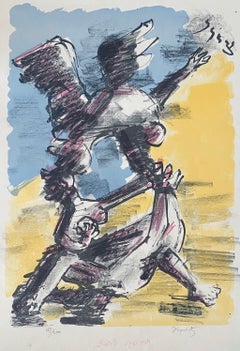
Jacques Lipchitz French Cubist Modernist Lithograph Hebrew Judaica ZIon
By Jacques Lipchitz
Located in Surfside, FL
Hand signed and numbered.
with Hebrew calligraphy "Zion"
Chaim Jacob Lipchitz, 1891-1973, was born in Lithuania and came of age in Paris during the early 20th century, where he was...
Category
1960s Modern Figurative Prints
Materials
Lithograph
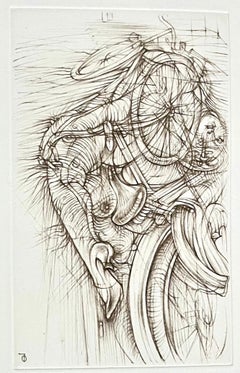
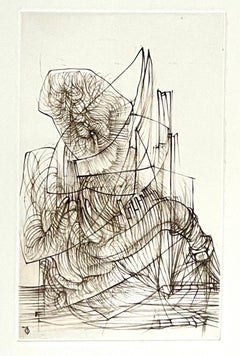
German Surrealist Hans Bellmer Etching Engraving Print Cecile Reims Surrealism
By Hans Bellmer
Located in Surfside, FL
After Hans Bellmer (German, 1902-1975)
Surrealist engraving, etching
after drawings from a 1942 notebook,
engraved in 1974-75 by Cecile Reims
Printed by L'Atelier de Chalcographie du Louvre, Paris,
Having printed monogram lower left in plate, pencil notations verso Editioned from a very small edition of #7/10
'Musee du Louvre' blindstamp.
Dimensions: Sheet 11 X 7.5, Plate size 6.5 X 4
Hans Bellmer ( 1902 – 1975) was a Polish born German artist, best known for his drawings, etchings that illustrates the 1940 edition of Histoire de l’œil, and the life-sized female sculpture mannequin dolls he produced in the mid-1930s. Historians of art and photography also consider him a Surrealist photographer.
Bellmer was born in the city of Kattowitz, then part of the German Empire (now Katowice, Poland). Up until 1926, he worked as a draftsman for his own advertising company.
Bellmer is most famous for the creation of a series of dolls as well as photographs of them. He was influenced in his choice of art form in part by reading the published letters of Oskar Kokoschka (Der Fetisch, 1925) and Surrealism. Bellmer's puppet doll project is also said to have been catalysed by a series of events in his personal life.
Hans Bellmer takes credit for provoking a physical crisis in his father and brings his own artistic creativity into association with childhood insubordination and resentment toward a severe and humorless paternal authority. Perhaps this is one reason for the nearly universal, unquestioning acceptance in the literature of Bellmer's promotion of his art as a struggle against his father, the police, and ultimately, fascism and the state. Events of his personal life also including meeting a beautiful teenage cousin in 1932 (and perhaps other unattainable beauties), attending a performance of Jacques Offenbach's Tales of Hoffmann (in which a man falls tragically in love with an automaton), and receiving a box of his old toys. After these events, he began to actually construct his first dolls. In his works, Bellmer explicitly sexualized the doll as a young girl (his work bears connection to the works of Bathus). Hirschfeld has claimed (without further argumentation) that Bellmer initiated his doll project to oppose the fascism of the Nazi Party by declaring that he would make no work that would support the new German state. Represented by mutated forms and unconventional poses, his dolls (according to this view) were directed specifically at the cult of the perfect body then prominent in Germany.
He visited Paris in 1935 and made contacts there, such as Paul Éluard, but returned to Berlin because his wife Margarete was dying of tuberculosis. He was part of the circle of Surrealist luminaries such as Man Ray, Marcel Duchamp, Max Ernst, Joan Miro, André Masson, René Magritte, Alberto Giacometti and Salvador Dali as well as women artists—such as Frida Kahlo, Dorothea Tanning and Leonora Carrington.
Bellmer produced the first doll in Berlin in 1933. Long since lost, the assemblage can nevertheless be correctly described thanks to approximately two dozen photographs Bellmer took at the time of its construction. Standing about fifty-six inches tall, the doll consisted of a modeled torso made of flax fiber, glue, and plaster; a mask-like head of the same material with glass eyes and a long, unkempt wig; and a pair of legs made from broomsticks or dowel rods. One of these legs terminated in a wooden, club-like foot; the other was encased in a more naturalistic plaster shell, jointed at the knee and ankle. As the project progressed, Bellmer made a second set of hollow plaster legs, with wooden ball joints for the doll's hips and knees. There were no arms to the first sculpture, but Bellmer did fashion or find a single wooden hand, which appears among the assortment of doll parts the artist documented in an untitled photograph of 1934, as well as in several photographs of later work.
Bellmer's 1934 anonymous book, The Doll (Die Puppe), produced and published privately in Germany, contains 10 black-and-white photographs of Bellmer's first doll arranged in a series of "tableaux vivants" (living pictures). The book was not credited to him, as he worked in isolation, and his photographs remained almost unknown in Germany. Yet Bellmer's work was eventually declared "degenerate" (entartete kunst) by the Nazi Party, and he was forced to flee Germany to France in 1938, where Bellmer's work was welcomed by the Surrealists around Andre Breton.
He aided the French Resistance during the war by making fake passports. He was imprisoned in the Camp des Milles prison at Aix-en-Provence, a brickworks camp for German nationals, from September 1939 until the end of the Phoney War in May 1940.
After the war, Bellmer lived the rest of his life in Paris. Bellmer gave up doll-making and spent the following decades creating erotic drawings, etchings, sexually explicit photographs, paintings, and prints of pubescent girls. In 1954, he met Unica Zürn...
Category
20th Century Abstract Prints
Materials
Etching
German Surrealist Hans Bellmer Etching Engraving Print Cecile Reims Surrealism
By Hans Bellmer
Located in Surfside, FL
After Hans Bellmer (German, 1902-1975)
Surrealist engraving, etching
after drawings from a 1942 notebook,
engraved in 1974-75 by Cecile Reims
Printed by L'Atelier de Chalcographie du Louvre, Paris,
Having printed monogram lower left in plate, pencil notations verso Editioned from a very small edition of #7/10
'Musee du Louvre' blindstamp.
Dimensions: Sheet 11 X 7.5, Plate size 6.5 X 4
Hans Bellmer ( 1902 – 1975) was a Polish born German artist, best known for his drawings, etchings that illustrates the 1940 edition of Histoire de l’œil, and the life-sized female sculpture mannequin dolls he produced in the mid-1930s. Historians of art and photography also consider him a Surrealist photographer.
Bellmer was born in the city of Kattowitz, then part of the German Empire (now Katowice, Poland). Up until 1926, he worked as a draftsman for his own advertising company.
Bellmer is most famous for the creation of a series of dolls as well as photographs of them. He was influenced in his choice of art form in part by reading the published letters of Oskar Kokoschka (Der Fetisch, 1925) and Surrealism. Bellmer's puppet doll project is also said to have been catalysed by a series of events in his personal life.
Hans Bellmer takes credit for provoking a physical crisis in his father and brings his own artistic creativity into association with childhood insubordination and resentment toward a severe and humorless paternal authority. Perhaps this is one reason for the nearly universal, unquestioning acceptance in the literature of Bellmer's promotion of his art as a struggle against his father, the police, and ultimately, fascism and the state. Events of his personal life also including meeting a beautiful teenage cousin in 1932 (and perhaps other unattainable beauties), attending a performance of Jacques Offenbach's Tales of Hoffmann (in which a man falls tragically in love with an automaton), and receiving a box of his old toys. After these events, he began to actually construct his first dolls. In his works, Bellmer explicitly sexualized the doll as a young girl (his work bears connection to the works of Bathus). Hirschfeld has claimed (without further argumentation) that Bellmer initiated his doll project to oppose the fascism of the Nazi Party by declaring that he would make no work that would support the new German state. Represented by mutated forms and unconventional poses, his dolls (according to this view) were directed specifically at the cult of the perfect body then prominent in Germany.
He visited Paris in 1935 and made contacts there, such as Paul Éluard, but returned to Berlin because his wife Margarete was dying of tuberculosis. He was part of the circle of Surrealist luminaries such as Man Ray, Marcel Duchamp, Max Ernst, Joan Miro, André Masson, René Magritte, Alberto Giacometti and Salvador Dali as well as women artists—such as Frida Kahlo, Dorothea Tanning and Leonora Carrington.
Bellmer produced the first doll in Berlin in 1933. Long since lost, the assemblage can nevertheless be correctly described thanks to approximately two dozen photographs Bellmer took at the time of its construction. Standing about fifty-six inches tall, the doll consisted of a modeled torso made of flax fiber, glue, and plaster; a mask-like head of the same material with glass eyes and a long, unkempt wig; and a pair of legs made from broomsticks or dowel rods. One of these legs terminated in a wooden, club-like foot; the other was encased in a more naturalistic plaster shell, jointed at the knee and ankle. As the project progressed, Bellmer made a second set of hollow plaster legs, with wooden ball joints for the doll's hips and knees. There were no arms to the first sculpture, but Bellmer did fashion or find a single wooden hand, which appears among the assortment of doll parts the artist documented in an untitled photograph of 1934, as well as in several photographs of later work.
Bellmer's 1934 anonymous book, The Doll (Die Puppe), produced and published privately in Germany, contains 10 black-and-white photographs of Bellmer's first doll arranged in a series of "tableaux vivants" (living pictures). The book was not credited to him, as he worked in isolation, and his photographs remained almost unknown in Germany. Yet Bellmer's work was eventually declared "degenerate" (entartete kunst) by the Nazi Party, and he was forced to flee Germany to France in 1938, where Bellmer's work was welcomed by the Surrealists around Andre Breton.
He aided the French Resistance during the war by making fake passports. He was imprisoned in the Camp des Milles prison at Aix-en-Provence, a brickworks camp for German nationals, from September 1939 until the end of the Phoney War in May 1940.
After the war, Bellmer lived the rest of his life in Paris. Bellmer gave up doll-making and spent the following decades creating erotic drawings, etchings, sexually explicit photographs, paintings, and prints of pubescent girls. In 1954, he met Unica Zürn...
Category
20th Century Abstract Prints
Materials
Etching
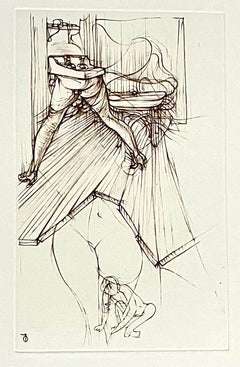
German Surrealist Hans Bellmer Etching Engraving Print Cecile Reims Surrealism
By Hans Bellmer
Located in Surfside, FL
After Hans Bellmer (German, 1902-1975)
Surrealist engraving, etching
after drawings from a 1942 notebook,
engraved in 1974-75 by Cecile Reims
Printed by L'Atelier de Chalcographie du Louvre, Paris,
Having printed monogram lower left in plate, pencil notations verso Editioned from a very small edition of #7/10
'Musee du Louvre' blindstamp.
Dimensions: Sheet 11 X 7.5, Plate size 6.5 X 4
Hans Bellmer ( 1902 – 1975) was a Polish born German artist, best known for his drawings, etchings that illustrates the 1940 edition of Histoire de l’œil, and the life-sized female sculpture mannequin dolls he produced in the mid-1930s. Historians of art and photography also consider him a Surrealist photographer.
Bellmer was born in the city of Kattowitz, then part of the German Empire (now Katowice, Poland). Up until 1926, he worked as a draftsman for his own advertising company.
Bellmer is most famous for the creation of a series of dolls as well as photographs of them. He was influenced in his choice of art form in part by reading the published letters of Oskar Kokoschka (Der Fetisch, 1925) and Surrealism. Bellmer's puppet doll project is also said to have been catalysed by a series of events in his personal life.
Hans Bellmer takes credit for provoking a physical crisis in his father and brings his own artistic creativity into association with childhood insubordination and resentment toward a severe and humorless paternal authority. Perhaps this is one reason for the nearly universal, unquestioning acceptance in the literature of Bellmer's promotion of his art as a struggle against his father, the police, and ultimately, fascism and the state. Events of his personal life also including meeting a beautiful teenage cousin in 1932 (and perhaps other unattainable beauties), attending a performance of Jacques Offenbach's Tales of Hoffmann (in which a man falls tragically in love with an automaton), and receiving a box of his old toys. After these events, he began to actually construct his first dolls. In his works, Bellmer explicitly sexualized the doll as a young girl (his work bears connection to the works of Bathus). Hirschfeld has claimed (without further argumentation) that Bellmer initiated his doll project to oppose the fascism of the Nazi Party by declaring that he would make no work that would support the new German state. Represented by mutated forms and unconventional poses, his dolls (according to this view) were directed specifically at the cult of the perfect body then prominent in Germany.
He visited Paris in 1935 and made contacts there, such as Paul Éluard, but returned to Berlin because his wife Margarete was dying of tuberculosis. He was part of the circle of Surrealist luminaries such as Man Ray, Marcel Duchamp, Max Ernst, Joan Miro, André Masson, René Magritte, Alberto Giacometti and Salvador Dali as well as women artists—such as Frida Kahlo, Dorothea Tanning and Leonora Carrington.
Bellmer produced the first doll in Berlin in 1933. Long since lost, the assemblage can nevertheless be correctly described thanks to approximately two dozen photographs Bellmer took at the time of its construction. Standing about fifty-six inches tall, the doll consisted of a modeled torso made of flax fiber, glue, and plaster; a mask-like head of the same material with glass eyes and a long, unkempt wig; and a pair of legs made from broomsticks or dowel rods. One of these legs terminated in a wooden, club-like foot; the other was encased in a more naturalistic plaster shell, jointed at the knee and ankle. As the project progressed, Bellmer made a second set of hollow plaster legs, with wooden ball joints for the doll's hips and knees. There were no arms to the first sculpture, but Bellmer did fashion or find a single wooden hand, which appears among the assortment of doll parts the artist documented in an untitled photograph of 1934, as well as in several photographs of later work.
Bellmer's 1934 anonymous book, The Doll (Die Puppe), produced and published privately in Germany, contains 10 black-and-white photographs of Bellmer's first doll arranged in a series of "tableaux vivants" (living pictures). The book was not credited to him, as he worked in isolation, and his photographs remained almost unknown in Germany. Yet Bellmer's work was eventually declared "degenerate" (entartete kunst) by the Nazi Party, and he was forced to flee Germany to France in 1938, where Bellmer's work was welcomed by the Surrealists around Andre Breton.
He aided the French Resistance during the war by making fake passports. He was imprisoned in the Camp des Milles prison at Aix-en-Provence, a brickworks camp for German nationals, from September 1939 until the end of the Phoney War in May 1940.
After the war, Bellmer lived the rest of his life in Paris. Bellmer gave up doll-making and spent the following decades creating erotic drawings, etchings, sexually explicit photographs, paintings, and prints of pubescent girls. In 1954, he met Unica Zürn...
Category
20th Century Abstract Prints
Materials
Etching
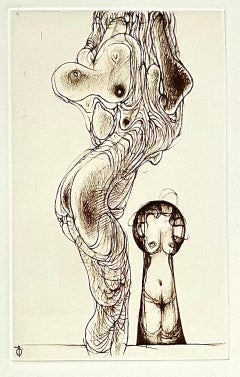
German Surrealist Hans Bellmer Etching Engraving Print Cecile Reims Surrealism
By Hans Bellmer
Located in Surfside, FL
After Hans Bellmer (German, 1902-1975)
Surrealist engraving, etching
after drawings from a 1942 notebook,
engraved in 1974-75 by Cecile Reims
Printed by L'Atelier de Chalcographie du Louvre, Paris,
Having printed monogram lower left in plate, pencil notations verso Editioned from a very small edition of #7/10
'Musee du Louvre' blindstamp.
Dimensions: Sheet 11 X 7.5, Plate size 6.5 X 4
Hans Bellmer ( 1902 – 1975) was a Polish born German artist, best known for his drawings, etchings that illustrates the 1940 edition of Histoire de l’œil, and the life-sized female sculpture mannequin dolls he produced in the mid-1930s. Historians of art and photography also consider him a Surrealist photographer.
Bellmer was born in the city of Kattowitz, then part of the German Empire (now Katowice, Poland). Up until 1926, he worked as a draftsman for his own advertising company.
Bellmer is most famous for the creation of a series of dolls as well as photographs of them. He was influenced in his choice of art form in part by reading the published letters of Oskar Kokoschka (Der Fetisch, 1925) and Surrealism. Bellmer's puppet doll project is also said to have been catalysed by a series of events in his personal life.
Hans Bellmer takes credit for provoking a physical crisis in his father and brings his own artistic creativity into association with childhood insubordination and resentment toward a severe and humorless paternal authority. Perhaps this is one reason for the nearly universal, unquestioning acceptance in the literature of Bellmer's promotion of his art as a struggle against his father, the police, and ultimately, fascism and the state. Events of his personal life also including meeting a beautiful teenage cousin in 1932 (and perhaps other unattainable beauties), attending a performance of Jacques Offenbach's Tales of Hoffmann (in which a man falls tragically in love with an automaton), and receiving a box of his old toys. After these events, he began to actually construct his first dolls. In his works, Bellmer explicitly sexualized the doll as a young girl (his work bears connection to the works of Bathus). Hirschfeld has claimed (without further argumentation) that Bellmer initiated his doll project to oppose the fascism of the Nazi Party by declaring that he would make no work that would support the new German state. Represented by mutated forms and unconventional poses, his dolls (according to this view) were directed specifically at the cult of the perfect body then prominent in Germany.
He visited Paris in 1935 and made contacts there, such as Paul Éluard, but returned to Berlin because his wife Margarete was dying of tuberculosis. He was part of the circle of Surrealist luminaries such as Man Ray, Marcel Duchamp, Max Ernst, Joan Miro, André Masson, René Magritte, Alberto Giacometti and Salvador Dali as well as women artists—such as Frida Kahlo, Dorothea Tanning and Leonora Carrington.
Bellmer produced the first doll in Berlin in 1933. Long since lost, the assemblage can nevertheless be correctly described thanks to approximately two dozen photographs Bellmer took at the time of its construction. Standing about fifty-six inches tall, the doll consisted of a modeled torso made of flax fiber, glue, and plaster; a mask-like head of the same material with glass eyes and a long, unkempt wig; and a pair of legs made from broomsticks or dowel rods. One of these legs terminated in a wooden, club-like foot; the other was encased in a more naturalistic plaster shell, jointed at the knee and ankle. As the project progressed, Bellmer made a second set of hollow plaster legs, with wooden ball joints for the doll's hips and knees. There were no arms to the first sculpture, but Bellmer did fashion or find a single wooden hand, which appears among the assortment of doll parts the artist documented in an untitled photograph of 1934, as well as in several photographs of later work.
Bellmer's 1934 anonymous book, The Doll (Die Puppe), produced and published privately in Germany, contains 10 black-and-white photographs of Bellmer's first doll arranged in a series of "tableaux vivants" (living pictures). The book was not credited to him, as he worked in isolation, and his photographs remained almost unknown in Germany. Yet Bellmer's work was eventually declared "degenerate" (entartete kunst) by the Nazi Party, and he was forced to flee Germany to France in 1938, where Bellmer's work was welcomed by the Surrealists around Andre Breton.
He aided the French Resistance during the war by making fake passports. He was imprisoned in the Camp des Milles prison at Aix-en-Provence, a brickworks camp for German nationals, from September 1939 until the end of the Phoney War in May 1940.
After the war, Bellmer lived the rest of his life in Paris. Bellmer gave up doll-making and spent the following decades creating erotic drawings, etchings, sexually explicit photographs, paintings, and prints of pubescent girls. In 1954, he met Unica Zürn...
Category
20th Century Abstract Prints
Materials
Etching
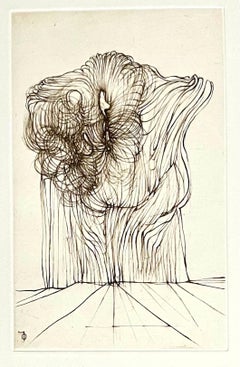
German Surrealist Hans Bellmer Etching Engraving Print Cecile Reims Surrealism
By Hans Bellmer
Located in Surfside, FL
After Hans Bellmer (German, 1902-1975)
Surrealist engraving, etching
after drawings from a 1942 notebook,
engraved in 1974-75 by Cecile Reims
Printed by L'Atelier de Chalcographie du Louvre, Paris,
Having printed monogram lower left in plate, pencil notations verso Editioned from a very small edition of #7/10 and 'Musee du Louvre' blindstamp.
Dimensions: Sheet 11 X 7.5, Plate size 6.5 X 4
Hans Bellmer ( 1902 – 1975) was a Polish born German artist, best known for his drawings, etchings that illustrates the 1940 edition of Histoire de l’œil, and the life-sized female sculpture mannequin dolls he produced in the mid-1930s. Historians of art and photography also consider him a Surrealist photographer.
Bellmer was born in the city of Kattowitz, then part of the German Empire (now Katowice, Poland). Up until 1926, he worked as a draftsman for his own advertising company.
Bellmer is most famous for the creation of a series of dolls as well as photographs of them. He was influenced in his choice of art form in part by reading the published letters of Oskar Kokoschka (Der Fetisch, 1925) and Surrealism. Bellmer's puppet doll project is also said to have been catalysed by a series of events in his personal life.
Hans Bellmer takes credit for provoking a physical crisis in his father and brings his own artistic creativity into association with childhood insubordination and resentment toward a severe and humorless paternal authority. Perhaps this is one reason for the nearly universal, unquestioning acceptance in the literature of Bellmer's promotion of his art as a struggle against his father, the police, and ultimately, fascism and the state. Events of his personal life also including meeting a beautiful teenage cousin in 1932 (and perhaps other unattainable beauties), attending a performance of Jacques Offenbach's Tales of Hoffmann (in which a man falls tragically in love with an automaton), and receiving a box of his old toys. After these events, he began to actually construct his first dolls. In his works, Bellmer explicitly sexualized the doll as a young girl (his work bears connection to the works of Bathus). Hirschfeld has claimed (without further argumentation) that Bellmer initiated his doll project to oppose the fascism of the Nazi Party by declaring that he would make no work that would support the new German state. Represented by mutated forms and unconventional poses, his dolls (according to this view) were directed specifically at the cult of the perfect body then prominent in Germany.
He visited Paris in 1935 and made contacts there, such as Paul Éluard, but returned to Berlin because his wife Margarete was dying of tuberculosis. He was part of the circle of Surrealist luminaries such as Man Ray, Marcel Duchamp, Max Ernst, Joan Miro, André Masson, René Magritte, Alberto Giacometti and Salvador Dali as well as women artists—such as Frida Kahlo, Dorothea Tanning and Leonora Carrington.
Bellmer produced the first doll in Berlin in 1933. Long since lost, the assemblage can nevertheless be correctly described thanks to approximately two dozen photographs Bellmer took at the time of its construction. Standing about fifty-six inches tall, the doll consisted of a modeled torso made of flax fiber, glue, and plaster; a mask-like head of the same material with glass eyes and a long, unkempt wig; and a pair of legs made from broomsticks or dowel rods. One of these legs terminated in a wooden, club-like foot; the other was encased in a more naturalistic plaster shell, jointed at the knee and ankle. As the project progressed, Bellmer made a second set of hollow plaster legs, with wooden ball joints for the doll's hips and knees. There were no arms to the first sculpture, but Bellmer did fashion or find a single wooden hand, which appears among the assortment of doll parts the artist documented in an untitled photograph of 1934, as well as in several photographs of later work.
Bellmer's 1934 anonymous book, The Doll (Die Puppe), produced and published privately in Germany, contains 10 black-and-white photographs of Bellmer's first doll arranged in a series of "tableaux vivants" (living pictures). The book was not credited to him, as he worked in isolation, and his photographs remained almost unknown in Germany. Yet Bellmer's work was eventually declared "degenerate" (entartete kunst) by the Nazi Party, and he was forced to flee Germany to France in 1938, where Bellmer's work was welcomed by the Surrealists around Andre Breton.
He aided the French Resistance during the war by making fake passports. He was imprisoned in the Camp des Milles prison at Aix-en-Provence, a brickworks camp for German nationals, from September 1939 until the end of the Phoney War in May 1940.
After the war, Bellmer lived the rest of his life in Paris. Bellmer gave up doll-making and spent the following decades creating erotic drawings, etchings, sexually explicit photographs, paintings, and prints of pubescent girls. In 1954, he met Unica Zürn...
Category
20th Century Abstract Prints
Materials
Etching
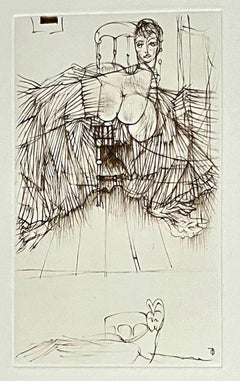
German Surrealist Hans Bellmer Etching Engraving Print Cecile Reims Surrealism
By Hans Bellmer
Located in Surfside, FL
After Hans Bellmer (German, 1902-1975)
Surrealist engraving, etching
after drawings from a 1942 notebook,
engraved in 1974-75 by Cecile Reims
Printed by L'Atelier de Chalcographie du Louvre, Paris,
Having printed monogram lower left in plate, pencil notations and #7/10 and 'Musee du Louvre' blindstamp verso
Dimensions: Sheet 11 X 7.5, Plate size 6.5 X 4
Hans Bellmer ( 1902 – 1975) was a Polish born German artist, best known for his drawings, etchings that illustrates the 1940 edition of Histoire de l’œil, and the life-sized female sculpture mannequin dolls he produced in the mid-1930s. Historians of art and photography also consider him a Surrealist photographer.
Bellmer was born in the city of Kattowitz, then part of the German Empire (now Katowice, Poland). Up until 1926, he worked as a draftsman for his own advertising company.
Bellmer is most famous for the creation of a series of dolls as well as photographs of them. He was influenced in his choice of art form in part by reading the published letters of Oskar Kokoschka (Der Fetisch, 1925) and Surrealism. Bellmer's puppet doll project is also said to have been catalysed by a series of events in his personal life.
Hans Bellmer takes credit for provoking a physical crisis in his father and brings his own artistic creativity into association with childhood insubordination and resentment toward a severe and humorless paternal authority. Perhaps this is one reason for the nearly universal, unquestioning acceptance in the literature of Bellmer's promotion of his art as a struggle against his father, the police, and ultimately, fascism and the state. Events of his personal life also including meeting a beautiful teenage cousin in 1932 (and perhaps other unattainable beauties), attending a performance of Jacques Offenbach's Tales of Hoffmann (in which a man falls tragically in love with an automaton), and receiving a box of his old toys. After these events, he began to actually construct his first dolls. In his works, Bellmer explicitly sexualized the doll as a young girl (his work bears connection to the works of Bathus). Hirschfeld has claimed (without further argumentation) that Bellmer initiated his doll project to oppose the fascism of the Nazi Party by declaring that he would make no work that would support the new German state. Represented by mutated forms and unconventional poses, his dolls (according to this view) were directed specifically at the cult of the perfect body then prominent in Germany.
He visited Paris in 1935 and made contacts there, such as Paul Éluard, but returned to Berlin because his wife Margarete was dying of tuberculosis. He was part of the circle of Surrealist luminaries such as Man Ray, Marcel Duchamp, Max Ernst, Joan Miro, André Masson, René Magritte, Alberto Giacometti and Salvador Dali as well as women artists—such as Frida Kahlo, Dorothea Tanning and Leonora Carrington.
Bellmer produced the first doll in Berlin in 1933. Long since lost, the assemblage can nevertheless be correctly described thanks to approximately two dozen photographs Bellmer took at the time of its construction. Standing about fifty-six inches tall, the doll consisted of a modeled torso made of flax fiber, glue, and plaster; a mask-like head of the same material with glass eyes and a long, unkempt wig; and a pair of legs made from broomsticks or dowel rods. One of these legs terminated in a wooden, club-like foot; the other was encased in a more naturalistic plaster shell, jointed at the knee and ankle. As the project progressed, Bellmer made a second set of hollow plaster legs, with wooden ball joints for the doll's hips and knees. There were no arms to the first sculpture, but Bellmer did fashion or find a single wooden hand, which appears among the assortment of doll parts the artist documented in an untitled photograph of 1934, as well as in several photographs of later work.
Bellmer's 1934 anonymous book, The Doll (Die Puppe), produced and published privately in Germany, contains 10 black-and-white photographs of Bellmer's first doll arranged in a series of "tableaux vivants" (living pictures). The book was not credited to him, as he worked in isolation, and his photographs remained almost unknown in Germany. Yet Bellmer's work was eventually declared "degenerate" (entartete kunst) by the Nazi Party, and he was forced to flee Germany to France in 1938, where Bellmer's work was welcomed by the Surrealists around Andre Breton.
He aided the French Resistance during the war by making fake passports. He was imprisoned in the Camp des Milles prison at Aix-en-Provence, a brickworks camp for German nationals, from September 1939 until the end of the Phoney War in May 1940.
After the war, Bellmer lived the rest of his life in Paris. Bellmer gave up doll-making and spent the following decades creating erotic drawings, etchings, sexually explicit photographs, paintings, and prints of pubescent girls. In 1954, he met Unica Zürn...
Category
20th Century Abstract Prints
Materials
Etching
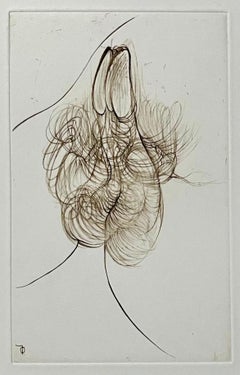
German Surrealist Hans Bellmer Etching Engraving Print Cecile Reims Surrealism
By Hans Bellmer
Located in Surfside, FL
After Hans Bellmer (German, 1902-1975)
Surrealist engraving, etching
after drawings from a 1942 notebook,
engraved in 1974-75 by Cecile Reims
Printed by L'Atelier de Chalcographie du Louvre, Paris,
Having printed monogram lower left in plate, pencil notations and #7/10 and 'Musee du Louvre' blindstamp verso
Dimensions: Sheet 11 X 7.5, Plate size 6.5 X 4
Hans Bellmer ( 1902 – 1975) was a Polish born German artist, best known for his drawings, etchings that illustrates the 1940 edition of Histoire de l’œil, and the life-sized female sculpture mannequin dolls he produced in the mid-1930s. Historians of art and photography also consider him a Surrealist photographer.
Bellmer was born in the city of Kattowitz, then part of the German Empire (now Katowice, Poland). Up until 1926, he worked as a draftsman for his own advertising company.
Bellmer is most famous for the creation of a series of dolls as well as photographs of them. He was influenced in his choice of art form in part by reading the published letters of Oskar Kokoschka (Der Fetisch, 1925) and Surrealism. Bellmer's puppet doll project is also said to have been catalysed by a series of events in his personal life.
Hans Bellmer takes credit for provoking a physical crisis in his father and brings his own artistic creativity into association with childhood insubordination and resentment toward a severe and humorless paternal authority. Perhaps this is one reason for the nearly universal, unquestioning acceptance in the literature of Bellmer's promotion of his art as a struggle against his father, the police, and ultimately, fascism and the state. Events of his personal life also including meeting a beautiful teenage cousin in 1932 (and perhaps other unattainable beauties), attending a performance of Jacques Offenbach's Tales of Hoffmann (in which a man falls tragically in love with an automaton), and receiving a box of his old toys. After these events, he began to actually construct his first dolls. In his works, Bellmer explicitly sexualized the doll as a young girl (his work bears connection to the works of Bathus). Hirschfeld has claimed (without further argumentation) that Bellmer initiated his doll project to oppose the fascism of the Nazi Party by declaring that he would make no work that would support the new German state. Represented by mutated forms and unconventional poses, his dolls (according to this view) were directed specifically at the cult of the perfect body then prominent in Germany.
He visited Paris in 1935 and made contacts there, such as Paul Éluard, but returned to Berlin because his wife Margarete was dying of tuberculosis. He was part of the circle of Surrealist luminaries such as Man Ray, Marcel Duchamp, Max Ernst, Joan Miro, André Masson, René Magritte, Alberto Giacometti and Salvador Dali as well as women artists—such as Frida Kahlo, Dorothea Tanning and Leonora Carrington.
Bellmer produced the first doll in Berlin in 1933. Long since lost, the assemblage can nevertheless be correctly described thanks to approximately two dozen photographs Bellmer took at the time of its construction. Standing about fifty-six inches tall, the doll consisted of a modeled torso made of flax fiber, glue, and plaster; a mask-like head of the same material with glass eyes and a long, unkempt wig; and a pair of legs made from broomsticks or dowel rods. One of these legs terminated in a wooden, club-like foot; the other was encased in a more naturalistic plaster shell, jointed at the knee and ankle. As the project progressed, Bellmer made a second set of hollow plaster legs, with wooden ball joints for the doll's hips and knees. There were no arms to the first sculpture, but Bellmer did fashion or find a single wooden hand, which appears among the assortment of doll parts the artist documented in an untitled photograph of 1934, as well as in several photographs of later work.
Bellmer's 1934 anonymous book, The Doll (Die Puppe), produced and published privately in Germany, contains 10 black-and-white photographs of Bellmer's first doll arranged in a series of "tableaux vivants" (living pictures). The book was not credited to him, as he worked in isolation, and his photographs remained almost unknown in Germany. Yet Bellmer's work was eventually declared "degenerate" (entartete kunst) by the Nazi Party, and he was forced to flee Germany to France in 1938, where Bellmer's work was welcomed by the Surrealists around Andre Breton.
He aided the French Resistance during the war by making fake passports. He was imprisoned in the Camp des Milles prison at Aix-en-Provence, a brickworks camp for German nationals, from September 1939 until the end of the Phoney War in May 1940.
After the war, Bellmer lived the rest of his life in Paris. Bellmer gave up doll-making and spent the following decades creating erotic drawings, etchings, sexually explicit photographs, paintings, and prints of pubescent girls. In 1954, he met Unica Zürn...
Category
20th Century Abstract Prints
Materials
Etching
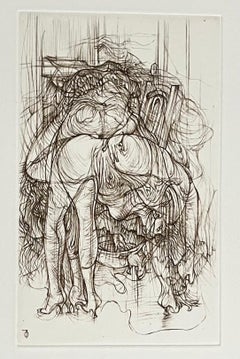
German Surrealist Hans Bellmer Etching Engraving Print Cecile Reims Surrealism
By Hans Bellmer
Located in Surfside, FL
After Hans Bellmer (German, 1902-1975)
Surrealist engraving, etching
after drawings from a 1942 notebook,
engraved in 1974-75 by Cecile Reims
Printed by L'Atelier de Chalcographie du Louvre, Paris,
Having printed monogram lower left in plate, pencil notations and #7/10 and 'Musee du Louvre' blindstamp verso
Dimensions: Sheet 11 X 7.5, Plate size 6.5 X 4
Hans Bellmer ( 1902 – 1975) was a Polish born German artist, best known for his drawings, etchings that illustrates the 1940 edition of Histoire de l’œil, and the life-sized female sculpture mannequin dolls he produced in the mid-1930s. Historians of art and photography also consider him a Surrealist photographer.
Bellmer was born in the city of Kattowitz, then part of the German Empire (now Katowice, Poland). Up until 1926, he worked as a draftsman for his own advertising company.
Bellmer is most famous for the creation of a series of dolls as well as photographs of them. He was influenced in his choice of art form in part by reading the published letters of Oskar Kokoschka (Der Fetisch, 1925) and Surrealism. Bellmer's puppet doll project is also said to have been catalysed by a series of events in his personal life.
Hans Bellmer takes credit for provoking a physical crisis in his father and brings his own artistic creativity into association with childhood insubordination and resentment toward a severe and humorless paternal authority. Perhaps this is one reason for the nearly universal, unquestioning acceptance in the literature of Bellmer's promotion of his art as a struggle against his father, the police, and ultimately, fascism and the state. Events of his personal life also including meeting a beautiful teenage cousin in 1932 (and perhaps other unattainable beauties), attending a performance of Jacques Offenbach's Tales of Hoffmann (in which a man falls tragically in love with an automaton), and receiving a box of his old toys. After these events, he began to actually construct his first dolls. In his works, Bellmer explicitly sexualized the doll as a young girl (his work bears connection to the works of Bathus). Hirschfeld has claimed (without further argumentation) that Bellmer initiated his doll project to oppose the fascism of the Nazi Party by declaring that he would make no work that would support the new German state. Represented by mutated forms and unconventional poses, his dolls (according to this view) were directed specifically at the cult of the perfect body then prominent in Germany.
He visited Paris in 1935 and made contacts there, such as Paul Éluard, but returned to Berlin because his wife Margarete was dying of tuberculosis. He was part of the circle of Surrealist luminaries such as Man Ray, Marcel Duchamp, Max Ernst, Joan Miro, André Masson, René Magritte, Alberto Giacometti and Salvador Dali as well as women artists—such as Frida Kahlo, Dorothea Tanning and Leonora Carrington.
Bellmer produced the first doll in Berlin in 1933. Long since lost, the assemblage can nevertheless be correctly described thanks to approximately two dozen photographs Bellmer took at the time of its construction. Standing about fifty-six inches tall, the doll consisted of a modeled torso made of flax fiber, glue, and plaster; a mask-like head of the same material with glass eyes and a long, unkempt wig; and a pair of legs made from broomsticks or dowel rods. One of these legs terminated in a wooden, club-like foot; the other was encased in a more naturalistic plaster shell, jointed at the knee and ankle. As the project progressed, Bellmer made a second set of hollow plaster legs, with wooden ball joints for the doll's hips and knees. There were no arms to the first sculpture, but Bellmer did fashion or find a single wooden hand, which appears among the assortment of doll parts the artist documented in an untitled photograph of 1934, as well as in several photographs of later work.
Bellmer's 1934 anonymous book, The Doll (Die Puppe), produced and published privately in Germany, contains 10 black-and-white photographs of Bellmer's first doll arranged in a series of "tableaux vivants" (living pictures). The book was not credited to him, as he worked in isolation, and his photographs remained almost unknown in Germany. Yet Bellmer's work was eventually declared "degenerate" (entartete kunst) by the Nazi Party, and he was forced to flee Germany to France in 1938, where Bellmer's work was welcomed by the Surrealists around Andre Breton.
He aided the French Resistance during the war by making fake passports. He was imprisoned in the Camp des Milles prison at Aix-en-Provence, a brickworks camp for German nationals, from September 1939 until the end of the Phoney War in May 1940.
After the war, Bellmer lived the rest of his life in Paris. Bellmer gave up doll-making and spent the following decades creating erotic drawings, etchings, sexually explicit photographs, paintings, and prints of pubescent girls. In 1954, he met Unica Zürn...
Category
20th Century Abstract Prints
Materials
Etching
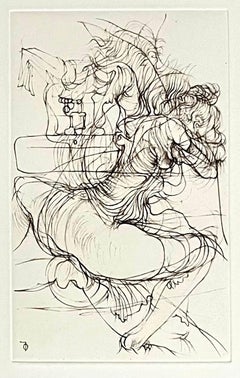
German Surrealist Hans Bellmer Etching Engraving Print Cecile Reims Surrealism
By Hans Bellmer
Located in Surfside, FL
After Hans Bellmer (German, 1902-1975)
Surrealist engraving, etching
after drawings from a 1942 notebook,
engraved in 1974-75 by Cecile Reims
Printed by L'Atelier de Chalcographie du Louvre, Paris,
Having printed monogram lower left in plate, pencil notations and #7/10 and 'Musee du Louvre' blindstamp verso
Dimensions: Sheet 11 X 7.5, Plate size 6.5 X 4
Hans Bellmer ( 1902 – 1975) was a Polish born German artist, best known for his drawings, etchings that illustrates the 1940 edition of Histoire de l’œil, and the life-sized female sculpture mannequin dolls he produced in the mid-1930s. Historians of art and photography also consider him a Surrealist photographer.
Bellmer was born in the city of Kattowitz, then part of the German Empire (now Katowice, Poland). Up until 1926, he worked as a draftsman for his own advertising company.
Bellmer is most famous for the creation of a series of dolls as well as photographs of them. He was influenced in his choice of art form in part by reading the published letters of Oskar Kokoschka (Der Fetisch, 1925) and Surrealism. Bellmer's puppet doll project is also said to have been catalysed by a series of events in his personal life.
Hans Bellmer takes credit for provoking a physical crisis in his father and brings his own artistic creativity into association with childhood insubordination and resentment toward a severe and humorless paternal authority. Perhaps this is one reason for the nearly universal, unquestioning acceptance in the literature of Bellmer's promotion of his art as a struggle against his father, the police, and ultimately, fascism and the state. Events of his personal life also including meeting a beautiful teenage cousin in 1932 (and perhaps other unattainable beauties), attending a performance of Jacques Offenbach's Tales of Hoffmann (in which a man falls tragically in love with an automaton), and receiving a box of his old toys. After these events, he began to actually construct his first dolls. In his works, Bellmer explicitly sexualized the doll as a young girl (his work bears connection to the works of Bathus). Hirschfeld has claimed (without further argumentation) that Bellmer initiated his doll project to oppose the fascism of the Nazi Party by declaring that he would make no work that would support the new German state. Represented by mutated forms and unconventional poses, his dolls (according to this view) were directed specifically at the cult of the perfect body then prominent in Germany.
He visited Paris in 1935 and made contacts there, such as Paul Éluard, but returned to Berlin because his wife Margarete was dying of tuberculosis. He was part of the circle of Surrealist luminaries such as Man Ray, Marcel Duchamp, Max Ernst, Joan Miro, André Masson, René Magritte, Alberto Giacometti and Salvador Dali as well as women artists—such as Frida Kahlo, Dorothea Tanning and Leonora Carrington.
Bellmer produced the first doll in Berlin in 1933. Long since lost, the assemblage can nevertheless be correctly described thanks to approximately two dozen photographs Bellmer took at the time of its construction. Standing about fifty-six inches tall, the doll consisted of a modeled torso made of flax fiber, glue, and plaster; a mask-like head of the same material with glass eyes and a long, unkempt wig; and a pair of legs made from broomsticks or dowel rods. One of these legs terminated in a wooden, club-like foot; the other was encased in a more naturalistic plaster shell, jointed at the knee and ankle. As the project progressed, Bellmer made a second set of hollow plaster legs, with wooden ball joints for the doll's hips and knees. There were no arms to the first sculpture, but Bellmer did fashion or find a single wooden hand, which appears among the assortment of doll parts the artist documented in an untitled photograph of 1934, as well as in several photographs of later work.
Bellmer's 1934 anonymous book, The Doll (Die Puppe), produced and published privately in Germany, contains 10 black-and-white photographs of Bellmer's first doll arranged in a series of "tableaux vivants" (living pictures). The book was not credited to him, as he worked in isolation, and his photographs remained almost unknown in Germany. Yet Bellmer's work was eventually declared "degenerate" (entartete kunst) by the Nazi Party, and he was forced to flee Germany to France in 1938, where Bellmer's work was welcomed by the Surrealists around Andre Breton.
He aided the French Resistance during the war by making fake passports. He was imprisoned in the Camp des Milles prison at Aix-en-Provence, a brickworks camp for German nationals, from September 1939 until the end of the Phoney War in May 1940.
After the war, Bellmer lived the rest of his life in Paris. Bellmer gave up doll-making and spent the following decades creating erotic drawings, etchings, sexually explicit photographs, paintings, and prints of pubescent girls. In 1954, he met Unica Zürn...
Category
20th Century Abstract Prints
Materials
Etching
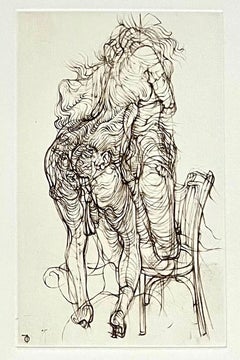
German Surrealist Hans Bellmer Etching Engraving Print Cecile Reims Surrealism
By Hans Bellmer
Located in Surfside, FL
After Hans Bellmer (German, 1902-1975)
Surrealist engraving, etching
after drawings from a 1942 notebook,
engraved in 1974-75 by Cecile Reims
Printed by L'Atelier de Chalcographie du Louvre, Paris,
Having printed monogram lower left in plate, pencil notations and #7/10 and 'Musee du Louvre' blindstamp verso
Dimensions: Sheet 11 X 7.5, Plate size 6.5 X 4
Hans Bellmer ( 1902 – 1975) was a Polish born German artist, best known for his drawings, etchings that illustrates the 1940 edition of Histoire de l’œil, and the life-sized female sculpture mannequin dolls he produced in the mid-1930s. Historians of art and photography also consider him a Surrealist photographer.
Bellmer was born in the city of Kattowitz, then part of the German Empire (now Katowice, Poland). Up until 1926, he worked as a draftsman for his own advertising company.
Bellmer is most famous for the creation of a series of dolls as well as photographs of them. He was influenced in his choice of art form in part by reading the published letters of Oskar Kokoschka (Der Fetisch, 1925) and Surrealism. Bellmer's puppet doll project is also said to have been catalysed by a series of events in his personal life.
Hans Bellmer takes credit for provoking a physical crisis in his father and brings his own artistic creativity into association with childhood insubordination and resentment toward a severe and humorless paternal authority. Perhaps this is one reason for the nearly universal, unquestioning acceptance in the literature of Bellmer's promotion of his art as a struggle against his father, the police, and ultimately, fascism and the state. Events of his personal life also including meeting a beautiful teenage cousin in 1932 (and perhaps other unattainable beauties), attending a performance of Jacques Offenbach's Tales of Hoffmann (in which a man falls tragically in love with an automaton), and receiving a box of his old toys. After these events, he began to actually construct his first dolls. In his works, Bellmer explicitly sexualized the doll as a young girl (his work bears connection to the works of Bathus). Hirschfeld has claimed (without further argumentation) that Bellmer initiated his doll project to oppose the fascism of the Nazi Party by declaring that he would make no work that would support the new German state. Represented by mutated forms and unconventional poses, his dolls (according to this view) were directed specifically at the cult of the perfect body then prominent in Germany.
He visited Paris in 1935 and made contacts there, such as Paul Éluard, but returned to Berlin because his wife Margarete was dying of tuberculosis. He was part of the circle of Surrealist luminaries such as Man Ray, Marcel Duchamp, Max Ernst, Joan Miro, André Masson, René Magritte, Alberto Giacometti and Salvador Dali as well as women artists—such as Frida Kahlo, Dorothea Tanning and Leonora Carrington.
Bellmer produced the first doll in Berlin in 1933. Long since lost, the assemblage can nevertheless be correctly described thanks to approximately two dozen photographs Bellmer took at the time of its construction. Standing about fifty-six inches tall, the doll consisted of a modeled torso made of flax fiber, glue, and plaster; a mask-like head of the same material with glass eyes and a long, unkempt wig; and a pair of legs made from broomsticks or dowel rods. One of these legs terminated in a wooden, club-like foot; the other was encased in a more naturalistic plaster shell, jointed at the knee and ankle. As the project progressed, Bellmer made a second set of hollow plaster legs, with wooden ball joints for the doll's hips and knees. There were no arms to the first sculpture, but Bellmer did fashion or find a single wooden hand, which appears among the assortment of doll parts the artist documented in an untitled photograph of 1934, as well as in several photographs of later work.
Bellmer's 1934 anonymous book, The Doll (Die Puppe), produced and published privately in Germany, contains 10 black-and-white photographs of Bellmer's first doll arranged in a series of "tableaux vivants" (living pictures). The book was not credited to him, as he worked in isolation, and his photographs remained almost unknown in Germany. Yet Bellmer's work was eventually declared "degenerate" (entartete kunst) by the Nazi Party, and he was forced to flee Germany to France in 1938, where Bellmer's work was welcomed by the Surrealists around Andre Breton.
He aided the French Resistance during the war by making fake passports. He was imprisoned in the Camp des Milles prison at Aix-en-Provence, a brickworks camp for German nationals, from September 1939 until the end of the Phoney War in May 1940.
After the war, Bellmer lived the rest of his life in Paris. Bellmer gave up doll-making and spent the following decades creating erotic drawings, etchings, sexually explicit photographs, paintings, and prints of pubescent girls. In 1954, he met Unica Zürn...
Category
20th Century Abstract Prints
Materials
Etching
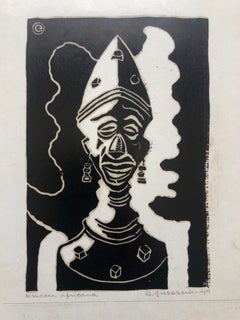
1945 Brazilian Master, Art Deco Clown Serigraph Woodcut
By Odetto Guersoni
Located in Surfside, FL
Genre: Brazilian Art Deco, African Diaspora
Bahian Carnival
Subject: harlequin clown
Medium: Print
Surface: Paper
Country: Brazil
Dimensions of overall paper are listed.
This is from a series of work he did in the 1940's, we sold one called Ritmo Negro, they are about Afro-Brazilian jazz, dance and music.
Odetto Guersoni was born in the city of Jaboticabal, State of São Paulo, in 1924. From 1936 to 1941 he attended the Liceu de Artes de Ofícios in São Paulo, beginning his artistic career in 1945, when he exhibited paintings in the Hall of the Plastic Artists Union . Two years later he was part of the collective group of 19, alongside Aldemir, Charoux, Otavio Araújo, Grassmann, Maria Leontina and several other artists that time would make famous. He then practiced a figurative painting of accentuated Expressionist lauds, characterized by deformation and coloring, raw and Satirical- as, moreover, so many of his fellow exhibitors at the time. As a French government scholar, Odette Guerzoni went to Paris in 1947 and the following year took part in the Peintres et Graveurs Etrangers and Art Libre exhibitions. Student of engraving by Renê Cottet, gradually transformed this expressive medium into his favorite, to the detriment of painting, which he practically abandoned soon after.
In 1947, he participated in the 19 Painters exhibition at the Prestes Maia Gallery together with Lothar Charoux, Maria Leontina,Grassmann, Aldemir Martins, Luiz Sacilotto and hiró. Guersoni was awarded a scholarship by the French government, and traveled to Paris, where he began work in engraving. Back in Brazil, in 1951, he founded the Art Workshop, in São Paulo. In 1954, he returned to Europe for a year, financed by the International Labor Organization (ILO). In Geneva, he studied engraving with René Cottet (1902 - 1992) and worked in Stanley william Hayter's studio, Atelier 17, in Paris (1901 - 1988). From 1956 to 1957, he became director of the Union of Plastic Artists of São Paulo. From 1960, he attended, as a trainee, some art schools in the United States and Japan such as The New York School of Printing and Osaka University. In 1971, also in Japan, he attended the workshop of I. Jokuriti. Two years later, he was voted Best Recorder of the Year by the Paulista Association of Art Critics - APCA. He took part in a special room at the Ibero-American Biennial in Montevideo in 1983. The Pinacoteca do Estado de São Paulo - Pesp presents a retrospective of his work in 1994.
Odetto Guersoni explores the wide spectrum of possibilities of the engraving. In addition to using techniques such as metal etching, lithograph, serigraph, linocut and, especially, woodcut he developed, in the 1950s, the philigraphy, in which the forms he developed gained points of embroidery made by Bonadei (1906 - 1974) . And, in the 1960s, the plastigraphy, in which he makes engravings on pasty surfaces, obtained from gypsum or other soft material. In the 1970s, technical investigations were associated with pictographic, ideographic, archaic symbol searches, Brazilian cave paintings and plant forms. The drawings are reduced to stylized, geometric shapes and transformed into abstract graphic elements. The artist works with few matrices, which, organized in rectangles, squares or circles, become modules to be combined. Guersoni juxtaposes them, adds, changes colors, and thereby composes colorful mandalas and structural geometries. Based on concise compositions, it produces color vibrations through optical illusions. In many of his woodcut works of the 1980s he uses smooth wood, knives, saws, gouges, punches, avoiding the natural textures of wood. In printing, it leaves the vibrant color and employs dosed inks with colorless masses, obtaining transparencies by superpositions. New journeys of study and specialization in engraving techniques took him in 1954 to Switzerland, 1960 to the United States, and in 1966 to Germany and Austria. Today, after having performed more than 40 individuals including 16 abroad and having participated in more than 50 collectives in several countries, Guersoni is considered one of the most notable Brazilian engravers. Conquered awards in several shows.
CHRONOLOGY
Individual exhibitions
1946 - Sao Paulo SP - 10th Salon of the Artists' Union, at the Prestes Maia Gallery
1947 - São Paulo SP - 19 Painters, at the Prestes Maia Gallery
1948 - Paris France - Peintres et Graveurs Etrangers at the École des Beaux-Arts
1949 - São Paulo SP - 13th Salon of the Artists' Union, at the Prestes Maia Gallery
1951 - São Paulo SP - 1st Paulista Salon of Modern Art, at Prestes Maia Gallery - silver medal
1953 - São Paulo SP - 2nd International Biennial of São Paulo, at MAM / SP
1954 - São Paulo SP - 3rd Paulista Salon of Modern Art, in the Prestes Maia Gallery
1955 - Rio de Janeiro RJ - 4th National Salon of Modern Art
1955 - Salvador BA - 5th Baiano Salon of Fine Arts, in Belvedere da Sé - honorable mention
1962 - São Paulo SP - Leirner Prize for Contemporary Art at the Folha Art Gallery - 1st printing award
1963 - Curitiba PR - 20th Salão Paranaense de Belas Artes, at the Public Library of Paraná
1963 - Rio de Janeiro RJ - Individual, no MAM / RJ
1968 - Bradford England - First International Print Biennale
1970 - São Paulo SP - Antonio Henrique Amaral, Odetto Guersoni, Tomie Ohtake, Pedro Tort and Gerda Brentani, in the Alberto Bonfiglioli Gallery
1971 - São Paulo SP - 11th International Biennial of São Paulo, at the Biennial Foundation - acquisition award
1973 - Punta del Este Uruguay - 1st Engraving Meeting of the Prata Basin Countries - International Prize
1977 - São Paulo SP - The Groups: the 40's, at the Lasar Segall Museum
1982 - São Paulo SP - Ismenia Coaracy, Odetto Guersoni and Alice Brill...
Category
1940s Art Deco Nude Prints
Materials
Woodcut
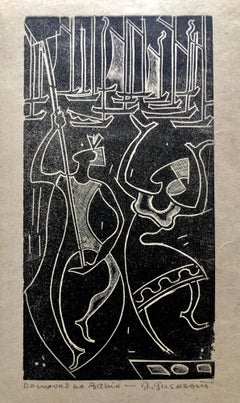
1945 Brazilian Master, Art Deco Nudes Serigraph Woodcut Carnaval Bahia
By Odetto Guersoni
Located in Surfside, FL
Genre: Brazilian Art Deco, African Diaspora
Bahian Carnival
Subject: Abstract
Medium: Print
Surface: Paper
Country: Brazil
Dimensions of overall paper are listed.
This is from a series of work he did in the 1940's, we sold one called Ritmo Negro, they are about Afro-Brazilian jazz, dance and music.
Odetto Guersoni was born in the city of Jaboticabal, State of São Paulo, in 1924. From 1936 to 1941 he attended the Liceu de Artes de Ofícios in São Paulo, beginning his artistic career in 1945, when he exhibited paintings in the Hall of the Plastic Artists Union . Two years later he was part of the collective group of 19, alongside Aldemir, Charoux, Otavio Araújo, Grassmann, Maria Leontina and several other artists that time would make famous. He then practiced a figurative painting of accentuated Expressionist lauds, characterized by deformation and coloring, raw and Satirical- as, moreover, so many of his fellow exhibitors at the time. As a French government scholar, Odette Guerzoni went to Paris in 1947 and the following year took part in the Peintres et Graveurs Etrangers and Art Libre exhibitions. Student of engraving by Renê Cottet, gradually transformed this expressive medium into his favorite, to the detriment of painting, which he practically abandoned soon after.
In 1947, he participated in the 19 Painters exhibition at the Prestes Maia Gallery together with Lothar Charoux, Maria Leontina,Grassmann, Aldemir Martins, Luiz Sacilotto and hiró. Guersoni was awarded a scholarship by the French government, and traveled to Paris, where he began work in engraving. Back in Brazil, in 1951, he founded the Art Workshop, in São Paulo. In 1954, he returned to Europe for a year, financed by the International Labor Organization (ILO). In Geneva, he studied engraving with René Cottet (1902 - 1992) and worked in Stanley william Hayter's studio, Atelier 17, in Paris (1901 - 1988). From 1956 to 1957, he became director of the Union of Plastic Artists of São Paulo. From 1960, he attended, as a trainee, some art schools in the United States and Japan such as The New York School of Printing and Osaka University. In 1971, also in Japan, he attended the workshop of I. Jokuriti. Two years later, he was voted Best Recorder of the Year by the Paulista Association of Art Critics - APCA. He took part in a special room at the Ibero-American Biennial in Montevideo in 1983. The Pinacoteca do Estado de São Paulo - Pesp presents a retrospective of his work in 1994.
Odetto Guersoni explores the wide spectrum of possibilities of the engraving. In addition to using techniques such as metal etching, lithograph, serigraph, linocut and, especially, woodcut he developed, in the 1950s, the philigraphy, in which the forms he developed gained points of embroidery made by Bonadei (1906 - 1974) . And, in the 1960s, the plastigraphy, in which he makes engravings on pasty surfaces, obtained from gypsum or other soft material. In the 1970s, technical investigations were associated with pictographic, ideographic, archaic symbol searches, Brazilian cave paintings and plant forms. The drawings are reduced to stylized, geometric shapes and transformed into abstract graphic elements. The artist works with few matrices, which, organized in rectangles, squares or circles, become modules to be combined. Guersoni juxtaposes them, adds, changes colors, and thereby composes colorful mandalas and structural geometries. Based on concise compositions, it produces color vibrations through optical illusions. In many of his woodcut works of the 1980s he uses smooth wood, knives, saws, gouges, punches, avoiding the natural textures of wood. In printing, it leaves the vibrant color and employs dosed inks with colorless masses, obtaining transparencies by superpositions. New journeys of study and specialization in engraving techniques took him in 1954 to Switzerland, 1960 to the United States, and in 1966 to Germany and Austria. Today, after having performed more than 40 individuals including 16 abroad and having participated in more than 50 collectives in several countries, Guersoni is considered one of the most notable Brazilian engravers. Conquered awards in several shows.
CHRONOLOGY
Individual exhibitions
1946 - Sao Paulo SP - 10th Salon of the Artists' Union, at the Prestes Maia Gallery
1947 - São Paulo SP - 19 Painters, at the Prestes Maia Gallery
1948 - Paris France - Peintres et Graveurs Etrangers at the École des Beaux-Arts
1949 - São Paulo SP - 13th Salon of the Artists' Union, at the Prestes Maia Gallery
1951 - São Paulo SP - 1st Paulista Salon of Modern Art, at Prestes Maia Gallery - silver medal
1953 - São Paulo SP - 2nd International Biennial of São Paulo, at MAM / SP
1954 - São Paulo SP - 3rd Paulista Salon of Modern Art, in the Prestes Maia Gallery
1955 - Rio de Janeiro RJ - 4th National Salon of Modern Art
1955 - Salvador BA - 5th Baiano Salon of Fine Arts, in Belvedere da Sé - honorable mention
1962 - São Paulo SP - Leirner Prize for Contemporary Art at the Folha Art Gallery - 1st printing award
1963 - Curitiba PR - 20th Salão Paranaense de Belas Artes, at the Public Library of Paraná
1963 - Rio de Janeiro RJ - Individual, no MAM / RJ
1968 - Bradford England - First International Print Biennale
1970 - São Paulo SP - Antonio Henrique Amaral, Odetto Guersoni, Tomie Ohtake, Pedro Tort and Gerda Brentani, in the Alberto Bonfiglioli Gallery
1971 - São Paulo SP - 11th International Biennial of São Paulo, at the Biennial Foundation - acquisition award
1973 - Punta del Este Uruguay - 1st Engraving Meeting of the Prata Basin Countries - International Prize
1977 - São Paulo SP - The Groups: the 40's, at the Lasar Segall Museum
1982 - São Paulo SP - Ismenia Coaracy, Odetto Guersoni and Alice Brill...
Category
1940s Art Deco Nude Prints
Materials
Woodcut
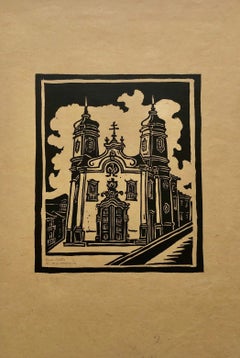
1945 Brazilian Master, Art Deco Serigraph Woodcut Colonial Architecture Mission
By Odetto Guersoni
Located in Surfside, FL
Genre: Brazilian Art Deco, African Diaspora
Bahian Carnival
Subject: Abstract
Medium: Print
Surface: Paper
Country: Brazil
Dimensions of overall paper are listed.
This is from a series of work he did in the 1940's, we sold one called Ritmo Negro, they are about Afro-Brazilian jazz, dance and music.
Odetto Guersoni was born in the city of Jaboticabal, State of São Paulo, in 1924. From 1936 to 1941 he attended the Liceu de Artes de Ofícios in São Paulo, beginning his artistic career in 1945, when he exhibited paintings in the Hall of the Plastic Artists Union . Two years later he was part of the collective group of 19, alongside Aldemir, Charoux, Otavio Araújo, Grassmann, Maria Leontina and several other artists that time would make famous. He then practiced a figurative painting of accentuated Expressionist lauds, characterized by deformation and coloring, raw and Satirical- as, moreover, so many of his fellow exhibitors at the time. As a French government scholar, Odette Guerzoni went to Paris in 1947 and the following year took part in the Peintres et Graveurs Etrangers and Art Libre exhibitions. Student of engraving by Renê Cottet, gradually transformed this expressive medium into his favorite, to the detriment of painting, which he practically abandoned soon after.
In 1947, he participated in the 19 Painters exhibition at the Prestes Maia Gallery together with Lothar Charoux, Maria Leontina,Grassmann, Aldemir Martins, Luiz Sacilotto and hiró. Guersoni was awarded a scholarship by the French government, and traveled to Paris, where he began work in engraving. Back in Brazil, in 1951, he founded the Art Workshop, in São Paulo. In 1954, he returned to Europe for a year, financed by the International Labor Organization (ILO). In Geneva, he studied engraving with René Cottet (1902 - 1992) and worked in Stanley william Hayter's studio, Atelier 17, in Paris (1901 - 1988). From 1956 to 1957, he became director of the Union of Plastic Artists of São Paulo. From 1960, he attended, as a trainee, some art schools in the United States and Japan such as The New York School of Printing and Osaka University. In 1971, also in Japan, he attended the workshop of I. Jokuriti. Two years later, he was voted Best Recorder of the Year by the Paulista Association of Art Critics - APCA. He took part in a special room at the Ibero-American Biennial in Montevideo in 1983. The Pinacoteca do Estado de São Paulo - Pesp presents a retrospective of his work in 1994.
Odetto Guersoni explores the wide spectrum of possibilities of the engraving. In addition to using techniques such as metal etching, lithograph, serigraph, linocut and, especially, woodcut he developed, in the 1950s, the philigraphy, in which the forms he developed gained points of embroidery made by Bonadei (1906 - 1974) . And, in the 1960s, the plastigraphy, in which he makes engravings on pasty surfaces, obtained from gypsum or other soft material. In the 1970s, technical investigations were associated with pictographic, ideographic, archaic symbol searches, Brazilian cave paintings and plant forms. The drawings are reduced to stylized, geometric shapes and transformed into abstract graphic elements. The artist works with few matrices, which, organized in rectangles, squares or circles, become modules to be combined. Guersoni juxtaposes them, adds, changes colors, and thereby composes colorful mandalas and structural geometries. Based on concise compositions, it produces color vibrations through optical illusions. In many of his woodcut works of the 1980s he uses smooth wood, knives, saws, gouges, punches, avoiding the natural textures of wood. In printing, it leaves the vibrant color and employs dosed inks with colorless masses, obtaining transparencies by superpositions. New journeys of study and specialization in engraving techniques took him in 1954 to Switzerland, 1960 to the United States, and in 1966 to Germany and Austria. Today, after having performed more than 40 individuals including 16 abroad and having participated in more than 50 collectives in several countries, Guersoni is considered one of the most notable Brazilian engravers. Conquered awards in several shows.
CHRONOLOGY
Individual exhibitions
1946 - Sao Paulo SP - 10th Salon of the Artists' Union, at the Prestes Maia Gallery
1947 - São Paulo SP - 19 Painters, at the Prestes Maia Gallery
1948 - Paris France - Peintres et Graveurs Etrangers at the École des Beaux-Arts
1949 - São Paulo SP - 13th Salon of the Artists' Union, at the Prestes Maia Gallery
1951 - São Paulo SP - 1st Paulista Salon of Modern Art, at Prestes Maia Gallery - silver medal
1953 - São Paulo SP - 2nd International Biennial of São Paulo, at MAM / SP
1954 - São Paulo SP - 3rd Paulista Salon of Modern Art, in the Prestes Maia Gallery
1955 - Rio de Janeiro RJ - 4th National Salon of Modern Art
1955 - Salvador BA - 5th Baiano Salon of Fine Arts, in Belvedere da Sé - honorable mention
1962 - São Paulo SP - Leirner Prize for Contemporary Art at the Folha Art Gallery - 1st printing award
1963 - Curitiba PR - 20th Salão Paranaense de Belas Artes, at the Public Library of Paraná
1963 - Rio de Janeiro RJ - Individual, no MAM / RJ
1968 - Bradford England - First International Print Biennale
1970 - São Paulo SP - Antonio Henrique Amaral, Odetto Guersoni, Tomie Ohtake, Pedro Tort and Gerda Brentani, in the Alberto Bonfiglioli Gallery
1971 - São Paulo SP - 11th International Biennial of São Paulo, at the Biennial Foundation - acquisition award
1973 - Punta del Este Uruguay - 1st Engraving Meeting of the Prata Basin Countries - International Prize
1977 - São Paulo SP - The Groups: the 40's, at the Lasar Segall Museum
1982 - São Paulo SP - Ismenia Coaracy, Odetto Guersoni and Alice Brill...
Category
1940s Art Deco Nude Prints
Materials
Woodcut
1945 Brazilian Master, Art Deco Nudes Serigraph Woodcut Carnaval Bahia
By Odetto Guersoni
Located in Surfside, FL
Genre: Brazilian Art Deco, African Diaspora
Bahian Carnival
Subject: Abstract
Medium: Print
Surface: Paper
Country: Brazil
Dimensions of overall paper are listed.
This is from a series of work he did in the 1940's, we sold one called Ritmo Negro, they are about Afro-Brazilian jazz, dance and music.
Odetto Guersoni was born in the city of Jaboticabal, State of São Paulo, in 1924. From 1936 to 1941 he attended the Liceu de Artes de Ofícios in São Paulo, beginning his artistic career in 1945, when he exhibited paintings in the Hall of the Plastic Artists Union . Two years later he was part of the collective group of 19, alongside Aldemir, Charoux, Otavio Araújo, Grassmann, Maria Leontina and several other artists that time would make famous. He then practiced a figurative painting of accentuated Expressionist lauds, characterized by deformation and coloring, raw and Satirical- as, moreover, so many of his fellow exhibitors at the time. As a French government scholar, Odette Guerzoni went to Paris in 1947 and the following year took part in the Peintres et Graveurs Etrangers and Art Libre exhibitions. Student of engraving by Renê Cottet, gradually transformed this expressive medium into his favorite, to the detriment of painting, which he practically abandoned soon after.
In 1947, he participated in the 19 Painters exhibition at the Prestes Maia Gallery together with Lothar Charoux, Maria Leontina,Grassmann, Aldemir Martins, Luiz Sacilotto and hiró. Guersoni was awarded a scholarship by the French government, and traveled to Paris, where he began work in engraving. Back in Brazil, in 1951, he founded the Art Workshop, in São Paulo. In 1954, he returned to Europe for a year, financed by the International Labor Organization (ILO). In Geneva, he studied engraving with René Cottet (1902 - 1992) and worked in Stanley william Hayter's studio, Atelier 17, in Paris (1901 - 1988). From 1956 to 1957, he became director of the Union of Plastic Artists of São Paulo. From 1960, he attended, as a trainee, some art schools in the United States and Japan such as The New York School of Printing and Osaka University. In 1971, also in Japan, he attended the workshop of I. Jokuriti. Two years later, he was voted Best Recorder of the Year by the Paulista Association of Art Critics - APCA. He took part in a special room at the Ibero-American Biennial in Montevideo in 1983. The Pinacoteca do Estado de São Paulo - Pesp presents a retrospective of his work in 1994.
Odetto Guersoni explores the wide spectrum of possibilities of the engraving. In addition to using techniques such as metal etching, lithograph, serigraph, linocut and, especially, woodcut he developed, in the 1950s, the philigraphy, in which the forms he developed gained points of embroidery made by Bonadei (1906 - 1974) . And, in the 1960s, the plastigraphy, in which he makes engravings on pasty surfaces, obtained from gypsum or other soft material. In the 1970s, technical investigations were associated with pictographic, ideographic, archaic symbol searches, Brazilian cave paintings and plant forms. The drawings are reduced to stylized, geometric shapes and transformed into abstract graphic elements. The artist works with few matrices, which, organized in rectangles, squares or circles, become modules to be combined. Guersoni juxtaposes them, adds, changes colors, and thereby composes colorful mandalas and structural geometries. Based on concise compositions, it produces color vibrations through optical illusions. In many of his woodcut works of the 1980s he uses smooth wood, knives, saws, gouges, punches, avoiding the natural textures of wood. In printing, it leaves the vibrant color and employs dosed inks with colorless masses, obtaining transparencies by superpositions. New journeys of study and specialization in engraving techniques took him in 1954 to Switzerland, 1960 to the United States, and in 1966 to Germany and Austria. Today, after having performed more than 40 individuals including 16 abroad and having participated in more than 50 collectives in several countries, Guersoni is considered one of the most notable Brazilian engravers. Conquered awards in several shows.
CHRONOLOGY
Individual exhibitions
1946 - Sao Paulo SP - 10th Salon of the Artists' Union, at the Prestes Maia Gallery
1947 - São Paulo SP - 19 Painters, at the Prestes Maia Gallery
1948 - Paris France - Peintres et Graveurs Etrangers at the École des Beaux-Arts
1949 - São Paulo SP - 13th Salon of the Artists' Union, at the Prestes Maia Gallery
1951 - São Paulo SP - 1st Paulista Salon of Modern Art, at Prestes Maia Gallery - silver medal
1953 - São Paulo SP - 2nd International Biennial of São Paulo, at MAM / SP
1954 - São Paulo SP - 3rd Paulista Salon of Modern Art, in the Prestes Maia Gallery
1955 - Rio de Janeiro RJ - 4th National Salon of Modern Art
1955 - Salvador BA - 5th Baiano Salon of Fine Arts, in Belvedere da Sé - honorable mention
1962 - São Paulo SP - Leirner Prize for Contemporary Art at the Folha Art Gallery - 1st printing award
1963 - Curitiba PR - 20th Salão Paranaense de Belas Artes, at the Public Library of Paraná
1963 - Rio de Janeiro RJ - Individual, no MAM / RJ
1968 - Bradford England - First International Print Biennale
1970 - São Paulo SP - Antonio Henrique Amaral, Odetto Guersoni, Tomie Ohtake, Pedro Tort and Gerda Brentani, in the Alberto Bonfiglioli Gallery
1971 - São Paulo SP - 11th International Biennial of São Paulo, at the Biennial Foundation - acquisition award
1973 - Punta del Este Uruguay - 1st Engraving Meeting of the Prata Basin Countries - International Prize
1977 - São Paulo SP - The Groups: the 40's, at the Lasar Segall Museum
1982 - São Paulo SP - Ismenia Coaracy, Odetto Guersoni and Alice Brill...
Category
1940s Art Deco Nude Prints
Materials
Woodcut
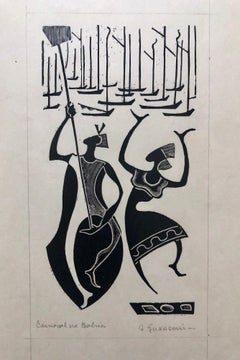
New Years 1988, Keith Haring Pop Art Nude Color Silkscreen Print Invitation
By Keith Haring
Located in Surfside, FL
Artist: Keith Haring, American (1958 - 1990)
Title: New Year's Invitation 1988
Year: 1988
Medium: Silkscreen on Paper
Image Size: 11 x 8 inches
This bears a printed signature. It is not hand signed as issued.
Keith Allen Haring (May 4, 1958 – February 16, 1990) was an American artist and social activist whose work responded to the New York City street culture of the 1980s by expressing concepts of birth, death, sexuality, and war.
Haring's work was often heavily political and his imagery has become a widely recognized visual language of the 20th century.
Keith Haring was born in Reading, Pennsylvania, on May 4, 1958. He was raised in Kutztown, Pennsylvania, by his mother Joan Haring, and father Allen Haring, an engineer and amateur cartoonist. He had three younger sisters, Kay, Karen and Kristen. Haring became interested in art at a very early age spending time with his father producing creative drawings. His early influences included Walt Disney cartoons, Dr. Seuss, Charles Schulz, and the Looney Tunes characters in The Bugs Bunny Show. In Haring's teenage years, he left his religious background behind and hitchhiked across the country, selling vintage t-shirts and experimenting with drugs. He studied commercial art from 1976 to 1978 at Pittsburgh's Ivy School of Professional Art but lost interest in it. He made the decision to leave after having read Robert Henri's The Art Spirit (1923) which inspired him to concentrate on his own art.
Haring had a maintenance job at the Pittsburgh Center for the Arts and was able to explore the art of Jean Dubuffet, Jackson Pollock, and Mark Tobey. His most critical influences at this time were a 1977 retrospective of the work of Pierre Alechinsky and a lecture by the sculptor Christo in 1978. Alechinsky's work, connected to the international Expressionist group CoBrA, gave Haring confidence to create larger paintings of calligraphic images. Christo introduced him to the possibilities of involving the public with his art. Haring's first important one-man exhibition was in Pittsburgh at the Center for the Arts in 1978.
He moved to New York to study painting at the School of Visual Arts. He studied semiotics with Bill Beckley as well as exploring the possibilities of video and performance art. Profoundly influenced at this time by the writings of William Burroughs, he was inspired to experiment with the cross-referencing and interconnection of images.
He first received public attention with his public art in subways. Starting in 1980, he organized exhibitions at Club 57, which were filmed by the photographer Tseng Kwong Chi. Around this time, "The Radiant Baby" became his symbol. His bold lines, vivid colors, and active figures carry strong messages of life and unity. He participated in the Times Square Exhibition and drew animals and human faces for the first time. That same year, he photocopied and pasted provocative collages made from cut-up and recombined New York Post headlines around the city. In 1981, he sketched his first chalk drawings on black paper and painted plastic, metal, and found objects.
By 1982, Haring had established friendships with fellow emerging artists Futura 2000, Kenny Scharf, Madonna and Jean-Michel Basquiat. He created more than 50 public works between 1982 and 1989 in dozens of cities around the world. His "Crack is Wack" mural, created in 1986, is visible from New York's FDR Drive. He got to know Andy Warhol, who was the theme of several of Haring's pieces, including "Andy Mouse". His friendship with Warhol would prove to be a decisive element in his eventual success.
In December 2007, an area of the American Textile Building in the TriBeCa neighborhood of New York City was discovered to contain a painting of Haring's from 1979.
In 1984, Haring visited Australia and painted wall murals in Melbourne (such as the 1984 'Detail-Mural at Collingwood College, Victoria') and Sydney and received a commission from the National Gallery of Victoria and the Australian Centre for Contemporary Art to create a mural which temporarily replaced the water curtain at the National Gallery. He also visited and painted in Rio de Janeiro, the Musée d'Art Moderne de la Ville de Paris, Minneapolis and Manhattan.[9] He became politically active, designing a Free South Africa poster...
Category
20th Century Contemporary Nude Prints
Materials
Mixed Media, Screen
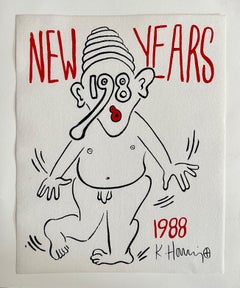
Lithuanian French Cubist Modernist Lithograph "Flight" Refugees
By Jacques Lipchitz
Located in Surfside, FL
Actual sheet is 25 X 20 size includes frame. Hand signed and numbered.
The Flight exhibition comes from a portfolio of prints organized by Varian Fry in 1964 and completed in 1971. B...
Category
1960s Modern Figurative Prints
Materials
Lithograph
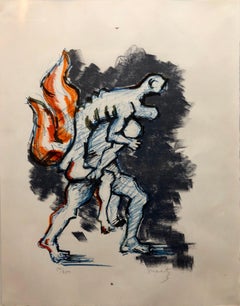
Al Quattro Large Surrealist Modernist Lithograph Embracing Couple
By Bruno Bruni
Located in Surfside, FL
Bruno Bruni senior (born 22 November 1935, in Gradara) is an Italian lithographer, graphic artist, painter and sculptor. He became commercially successful in the 1970s. In 1977, he won the International Senefeld award for Lithography. He has since become one of the most successful Italian artists in Germany and one of Germany's best known lithographers.
Born in Gradara, in the Province of Pesaro and Urbino on the Adriatic Coast in 1935, the son of a railway attendant, Bruni started painting as a young boy. He was initially a pupil of [Giuliano Vanghi] ; from 1953 to 1959 he attended the Art Institute in Pesaro. He then moved to London, where he became interested in pop art. In 1960, after an exhibit of his work at London's John Whibley Gallery, and after meeting a girl from Hamburg, he moved there to live with her and enrolled at the Hochschule für bildende Künste Hamburg. He has lived in the city ever since and visits his hometown regularly. In 1961-1966 took a course at the Hamburg College of Fine Arts, where at that time taught artists Georg Gresko, Paul Wunderlich, Horst Janssen, Arnolfo Hausner, and art critic Hans Theodor Flemming. One of his teachers called Bruni Renato Guttuso. He studied in Milan. Along with several young authors Bruni founded in Hamburg group "COOP" - against the commercialization of art. In the 1970s, Bruno Bruni made a name for himself as a draftsman, lithographer, painter and sculptor in the international art world. Bearing stylistic similarities to the surrealist work of Michael Parkes and Leonor Fini. In 1977, he won the International Senefeld Competition for Lithography. He is influenced primarily by German expressionists like Otto Dix, George Grosz etc. and the Italian old masters . In particular, he is noted as one of the few lithographic artists "who paint all work directly onto the stone". He is especially known for his erotic female forms. He has said, "I cannot paint an abstract picture. If I had gone along with the trends I'd have disappeared long ago". He resides in a converted swimming pool, more than a century old, which serves as apartment, workplace and gallery. He sells his art through his wife's gallery in Hanover and is reputedly one of Germany's top earning artists. He is also a keen cook of Italian cuisine, and is a boxing fan and a close friend of former boxing champion Dariusz Michalczewski, for whom he used to cook for before matches. He has also cooked for Gerhard Schröder and has published a cooking book...
Category
1980s Surrealist Figurative Prints
Materials
Lithograph