M.S. Rau
to
396
370
168
109
76
66
58
23
18
10
5
5
2
2
1
1
1
1
1
29
18
16
12
11
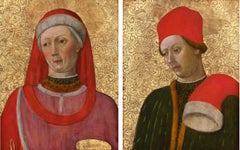
Saint Cosmas And Saint Damian Attributed To Bonifacio Bembo
By Bonifacio Bembo
Located in New Orleans, LA
Attributed to Bonifacio Bembo
c.1444-1477 Italy
Saint Cosmas and Saint Damian
Tempera on panel
These exceptionally rare early Renaissance panels of Saint Cosmas and Saint Damian are an extraordinary new discovery. Based on the research of art historians Marco Tanzi and Andrea de Marchi, it is believed that these represent the missing panels from the famed polyptych formerly displayed on the altar of the Chapel of San Nicola da Tolentino in the Church of Sant’Agostino in Cremona, Italy. To find two matching early Renaissance panels outside of a museum or church, particularly in such remarkable condition, is an extraordinary rarity.
The central and left-sided panels of the original five-part polyptych are currently in the collection of the Museo Civico Ala Ponzone in Cremona. These panels have luckily remained intact, and respectively portray the Madonna and Child Enthroned with Angels and Donor, Saint Nicholas of Tolentino (the chapel’s namesake) and Saint George.
While the present panels have since been reduced, that they belong to the Cremonese altarpiece is confirmed by a number of stylistic elements. All five panels contain the same rich decorative arabesque pattern on their stamped gold background, while the figures’ knurled haloes are identical in both their fineness of line and use of perspective. The proportions of the figures coincide perfectly; Saints Cosmas and Damian would have originally also been depicted as full-length figures, fitting into the vertical, Gothic style of the altarpiece.
According to the Christian religion, Saint Cosmas and Saint Damian were 3rd century physicians born in Arabia. Little is known about their lives except that they were reputedly twin brothers and that they were martyred in Syria during the persecution of Emperor Diocletian. It was believed that the saints were skilled in healing, and when their medicines failed, their faith and prayers could always perform miracles. Thus, the saints are often depicted with their medical equipment while wearing the traditional medieval doctor’s garb of crimson robes and distinctive round red hats.
The saints are similarly depicted in the present panels, though considering the manner in which they have been cut, their medical tools are not immediately evident. The saints were highly popular as patrons of wealthy families during the Gothic and Renaissance eras, particularly the Medici, and thus they occur frequently in art from the era. The twins, for instance, are found in the famed San Marco Altarpiece by Fra Angelico in the San Marco Museum (Florence), as well as in a set of Medici panels crafted by Filippo Lippi...
Category
15th Century and Earlier Renaissance Portrait Paintings
Materials
Tempera, Panel
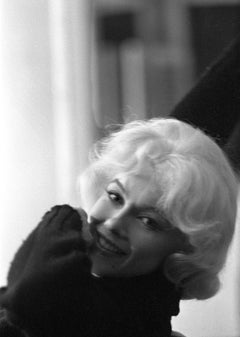
Marilyn Monroe Photograph in Black Sweater by Lawrence Schiller, 32/75
By Lawrence Schiller
Located in New Orleans, LA
Marilyn Monroe’s status as an enduring figure of glamour made her one of the most famous figures in American history. Of all the images shot of the incomparable movie star, the most ...
Category
20th Century Other Art Style Black and White Photography
Materials
Black and White
Les deux soeurs by Federico Zandomeneghi
By Federico Zandomeneghi
Located in New Orleans, LA
Federico Zandomeneghi
1841-1917 Italian
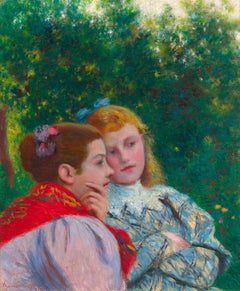
Les deux soeurs
(The two sisters)
Signed and dated "Zandomeneghi 95" (lower left)
Oil on canvas
Two sisters enjoy a quiet moment in a rich green landscape in this intimate oil on canvas from Federico Zandomeneghi. An Italian painter by birth who became a fixture in the Parisian Impressionist scene, Zandomeneghi is best remembered for his sentimental and affectionate scenes of women in both domestic and public spheres.
Zandomeneghi’s creative and technical prowess in composition is highlighted in this painting. The artist deftly frames the young pair in the lower register of the canvas, imbuing the work with a remarkably observational feel. The girls pensively gaze off to the right, lost in thought; Zandomeneghi allows the viewer to witness a natural moment of discussion and contemplation shared among the sisters. The soft palette employed by the artist gives the whole scene an atmospheric glow, with dappled rays of sunshine breaking through the lush foliage. Though the girls remain in the shaded areas of the landscape, Zandomeneghi’s skillful application of paint allows a brightness to remain nevertheless.
Federico Zandomeneghi was born in Venice to a long line of neoclassical sculptors. As if created to be an artist, Zandomeneghi began his artistic education early, enrolling in the Accademia di Belle Arti in Venice at just 15 years old before transferring to the Academy of Fine Arts in Milan. By 1862, the artist had arrived in Florence, where he became fast acquaintances with several Italian artists dedicated to executing landscape paintings en plein air. Zandomeneghi embraced the spontaneity, seeking to bring unparalleled luminosity to his works.
When Zandomeneghi arrived in Paris in 1874, he found kindred spirits...
Category
19th Century Impressionist Figurative Paintings
Materials
Canvas, Oil
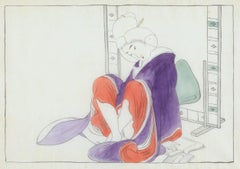
Japanese Shunga, Sitting Woman
Located in New Orleans, LA
A beautiful example of the Japanese art form known as shunga, this sensual work depicts woman exploring her sexuality. Hand-painted on paper with splashes of vivid gouache color, the...
Category
Early 20th Century Other Art Style Nude Drawings and Watercolors
Materials
Paint, Paper, Gouache
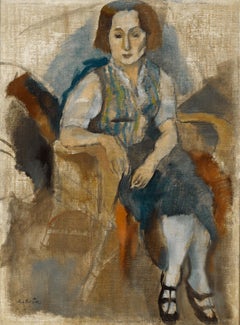
Femme aux Souliers Noir (Woman in Black Shoes)
By Jules Pascin
Located in New Orleans, LA
This intimate portrait was composed by the Bulgarian-born French Expressionist painter Jules Pascin. Known as the "Prince of Montparnasse," Pascin made a name for himself throughout ...
Category
Early 20th Century Modern Portrait Paintings
Materials
Canvas, Oil
Marilyn Monroe Photograph Putting on a Robe, 24/75
By Lawrence Schiller
Located in New Orleans, LA
Marilyn Monroe’s status as an enduring figure of glamour made her one of the most famous figures in American history. Of all the images shot of the incomparable movie star, the most ...
Category
20th Century Other Art Style Portrait Photography
Materials
Silver Gelatin

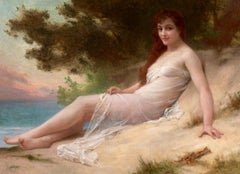
Solitude
By Guillaume Seignac
Located in New Orleans, LA
Signed “G-Seignac” (lower right)
Oil on canvas
French Academic painter Guillaume Seignac was renowned for his masterful treatment of the idealized nude. His languishing female subje...
Category
19th Century Academic Nude Paintings
Materials
Canvas, Oil
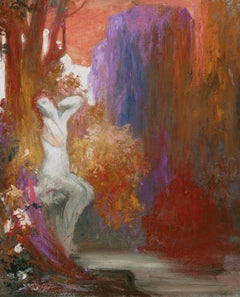
Ondine
By Pierre Marcel-Béronneau
Located in New Orleans, LA
Mystical and mysterious, a mythological Ondine rests beside an ethereal forest pond in this majestic, original oil on canvas by French Symbolist Pierre-Amédée Marcel-Béronneau. A stu...
Category
20th Century Symbolist Nude Paintings
Materials
Canvas, Oil
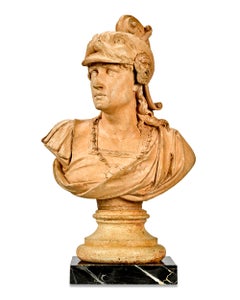
Perseus
Located in New Orleans, LA
The legendary Greek god Perseus is the subject of this elegant half-bust by Ubaldo Gandolfi, a major painter and sculptor from Bologna. The son of Zeus and Danaë, Perseus was the le...
Category
Mid-18th Century Other Art Style Figurative Sculptures
Materials
Terracotta
Italian Panel with Satyr and Nymphs
Located in New Orleans, LA
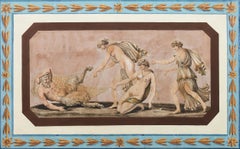
This extraordinary Italian gouache and oil on canvas brings two of the most popular characters from Greek mythology vividly the life - the nymph and the satyr. Both creatures are famed for their carefree natures and lascivious temperaments, and tales abound of satyrs pursing nubile nymphs in order to rape or seduce them, usually with little success. One such narrative humorously unfolds in the present piece, which depicts an indignant satyr captured by three nymphs with a golden net.
The relationship between these two mythological creatures was a popular one for artists throughout the 18th and 19th centuries, though its origins stretch back to antiquity. Both satyrs and nymphs...
Category
Early 19th Century Other Art Style Figurative Paintings
Materials
Canvas, Oil, Gouache

Price Upon Request
Marilyn Monroe Photograph Undressed Poolside by Lawrence Schiller, 19/75
By Lawrence Schiller
Located in New Orleans, LA
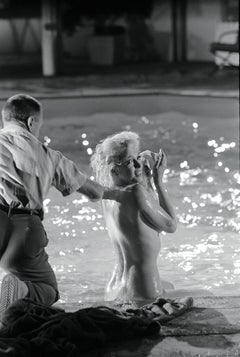
Marilyn Monroe’s status as an enduring figure of glamour made her one of the most famous figures in American history. Of all the images shot of the incomparable movie star, the most iconic were those taken by famed photographer, director and author, Lawrence Schiller. This example is among the best and most famous of his Marilyn tribues, capturing a topless Monroe filming a pool scene...
Category
20th Century Other Art Style Nude Photography
Materials
Silver Gelatin
Bust of Pope Innocent XI Odescalchi by Domenico Guidi
Located in New Orleans, LA
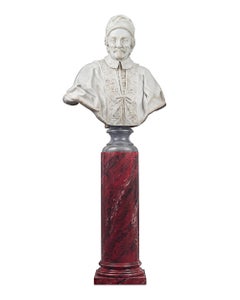
This monumental bust is a museum-quality example of Roman Baroque sculpture. Crafted by the legendary Domenico Guidi and carved from Carrara marble, the impressive portrait captures the visage of Pope Innocent XI, Benedetto Odescalchi (1611-1689). It presents a larger-than-life example of Guidi’s remarkable skill as a sculptor, which ultimately made his workshop one of the most important in Rome during his age. Today, his works are rarely found on the market, particularly his extraordinary works in marble.
Pope Innocent XI was born Benedetto Odescalchi into an Italian noble family of prominent bankers. Spending his early years in banking, he eventually turned to the law, earning his doctorate in 1639. His background would serve him well in his service to the papacy, and he became known as a frugal and devout member of the Church. In 1676, he was unanimously elected Pop after the death of Clement X. During his nearly 13-year reign, he instilled his own personal ideals of austerity and frugality onto the Church, with a deep commitment to reform and piety.
He is captured here by Guidi in his traditional Pope’s mozzetta and camauro cap. A wide stole is draped over his shoulders, ornamented by acanthus leaves and the coat of arms of the Odescalchi family. It displays Guidi’s mastery over the chiaroscuro effect, particularly in the high level of contrast in his cheeks and his eyes, which Guidi achieved through various methods of high polish.
A very similar portrait sculpture of Pope Innocent XI by Guidi can be found in the collection of the Royal Castle in Warsaw. The Warsaw bust belongs to a series of portraits of popes which the Odescalchi family commissioned from Domenico Guidi in the 1690s. Compared to that example, the present bust is far more dramatic, with deeper cut lines and a more precise expression. It is likely that the present piece was seen by the Odescalchi family, who ordered a similar one to be made. The piece was almost certainly intended to be displayed in a niche, given its dramatic cutting and its roughly carved back.
Others of Guidi’s busts can be found in important collections throughout Italy, England and the United States, though many of these are lesser bronze repetitions. A bronze bust of the Pope Alexander VIII by Guidi is currently in the collection of the Victoria & Albert Museum (London), while a terracotta version of the same is in the Los Angeles County Museum. A bronze of Pope Alexander VIII can be found in the Princely Collection of Lichtenstein, and his impressive marble papal bust of Clement IX graces the pope’s tomb in Santa Maria Maggiore. The present bust of Pope...
Category
17th Century Baroque Figurative Sculptures
Materials
Marble
Emprunt 6% Souscrivez (War Loan 6% Subscribe) by Raoul Dufy
By Raoul Dufy
Located in New Orleans, LA
Emprunt 6% Souscrivez
(War Loan 6% Subscribe)
Signed "Raoul Dufy" (lower right)
Gouache on paper
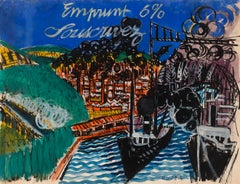
This vibrant gouache on paper by the renowned Raoul Dufy is not only a work of exceptional artistry, but also represents an important period in world history. The piece was a special commission ordered by the French government, who sought to encourage the French people to join in the post-war reconstruction efforts. Following World War I, the French government was destitute. The cost of the Great War had been tremendous not only in lives lost, but also in terms of infrastructure and finances. In order to reclaim its place as a great power on the world stage, France needed funds to reconstruct its key industries, and quickly. Thus, the government turned to one of the most famous French artists of the day - Raoul Dufy - to create this gouache on paper as an advertisement for the country's war bonds.
The extraordinary work represents Dufy's own sense of patriotic duty. Entirely unique in his oeuvre, it is clear that Dufy wished to create something truly special to help his war-torn country. The artist deftly captures the industry of France in the colorful composition, showcasing bridges, buildings, ships and other key elements of the country's infrastructure in order to evoke the viewers' pride, patriotism and willingness to help. The words Emprunt 6% Souscrivez (War Loan 6% Subscribe) are boldly written across the top, seeking subscribers to a 6% interest loan to help rebuild the country - a very healthy return for the age.
The powerful painting represents one of the most effective and extensive patriotic campaigns of all time. France relied heavily on the willingness of its citizens to lend money...
Category
20th Century Post-Impressionist Landscape Paintings
Materials
Paper, Gouache
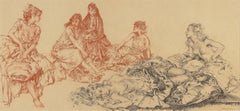
A Study of Two Models by Sir William Russell Flint
By William Russell Flint
Located in New Orleans, LA
Sir William Russell Flint, R.A., P.R.W.S.1880-1969 Scottish
A Study of Two Models
Signed "WRussell Flint" (bottom right)
Ethereal and sen...
Category
20th Century Figurative Drawings and Watercolors
Materials
Paper, Chalk
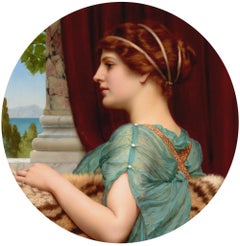
A Pompeian Lady
By John William Godward
Located in New Orleans, LA
John William Godward
1861-1922 British
A Pompeian Lady
Signed and dated "J.W. Godward 1904" (lower right, partially covered by frame)
Oil on canvas
One of the last and greatest Victorian neoclassical painters, John William Godward is celebrated for his flawlessly executed images of graceful women posed in idealized ancient settings. In this work, entitled A Pompeian Lady, a classical beauty is caught idling in a moment of quiet, solitary reflection. Godward's elegant subjects are depicted with a degree of technical mastery that remains unsurpassed, and the work's dramatic palette, luxurious fabrics and classical vision are all characteristics of his unique take on the neoclassical style.
Godward was unmatched in terms of his technical skill and attention to detail. A master of contrasting textures, he paints a diaphanous gown draping against the model’s smooth, milky white skin, which sits against the painstakingly rendered individual hairs of a tiger’s pel. Scintillating color permeates the canvas as well, energizing the otherwise static scene. Each element is given careful attention, and the overall effect is one of both immaculate technique and sensual tactility.
Along with his contemporary and mentor, Sir Lawrence Alma-Tadema, Godward set the tone for the Victorian neoclassicist movement. He built his career upon creating images of idealized feminine beauty infused with a Greco-Roman-inspired style. Though greatly influenced by Alma-Tadema, Godward distinguished himself through his predilection for the solitary female figure. His fame rose dramatically in the first few years of the 20th century, when the present work was completed, due to the burgeoning strength of the British Empire and the Victorian society’s preoccupation with ancient Rome. To many of the newly affluent, Roman society was, as Iain Gale writes, “a flawless mirror of their own immaculate world.” The sensuality and mystery of Godward’s maidens, combined with his impressive antique backdrops...
Category
Early 20th Century Academic Portrait Paintings
Materials
Canvas, Oil
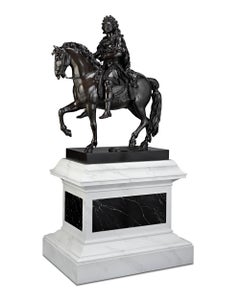
Girardon’s Equestrian Portrait of Louis XIV
Located in New Orleans, LA
King Louis XIV, one of France's greatest monarchs, sits confidently astride a prancing steed in this bronze equestrian statue. The extraordinary work is a reduction of the portrait of the Sun King by François Girardon, one of the most noted and influential sculptors of the period. Looking back to the great masterpieces of antiquity, Girardon took his inspiration from the seminal ancient Roman marble of Marcus Aurelius, now in the Musei Capitoline (Rome). Louis XIV is thus portrayed here as a conquering Roman hero, his costume adorned with many neoclassical motifs, hand outstretched in a gesture of command. The result is an imposing royal portrait of power and absolute authority that pays homage to one of the most important sovereigns in French history.
It was in 1685, at the very height of his rule, when Louis XIV commissioned the monumental bronze of himself from the great Girardon. As sculptor to the king, Girardon was a key figure in the decoration of the gardens at the Château de Versailles, and he was later commissioned to complete several important royal...
Category
19th Century Other Art Style Figurative Sculptures
Materials
Bronze
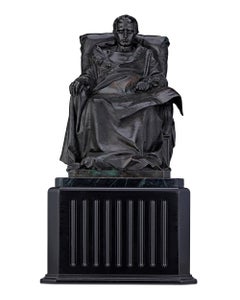
THE LAST DAYS OF NAPOLÉON BY
Located in New Orleans, LA
This highly evocative bronze by Vincenzo Vela captures the deposed Emperor Napoléon on his deathbed, holding a map of Europe and lost in thought about what might have been. Remarkable among most portrayals of the exiled leader, this highly detailed sculpture depicts Napoléon at his most vulnerable. Nonetheless, Vela perfectly captures his still-heroic bearing, which imparts to this work a monumental quality and quiet dignity. The mate to this figure is the colossal marble at the Musée du Château de Malmaison, which was shown at the Paris Salon of 1867.
The founder of the verismo movement in Italy, Vela was one of the great exponents of realism in sculpture. Born in Ligornetto, Switzerland in 1820, he studied under celebrated sculptor, Benedetto Cacciatori. He was also influenced both by the work of Tuscan sculptor Lorenzo Bartolini, who seamlessly combined neoclassicism with naturalism and the romantic painting of Francesco Hayez...
Category
19th Century Realist Figurative Sculptures
Materials
Marble, Bronze
Marilyn Monroe Photograph on Movie Set, 32/75
By Lawrence Schiller
Located in New Orleans, LA
Marilyn Monroe’s status as an enduring figure of glamour made her one of the most famous figures in American history. Of all the images shot of the incomparable movie star, the most ...
Category
20th Century Modern Black and White Photography
Materials
Silver Gelatin

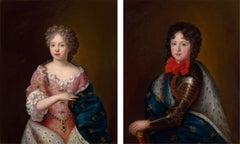
Pair of Royal Portraits of the Duke and Duchess of Burgundy
By Pierre Gobert
Located in New Orleans, LA
Follower of Pierre Gobert
18th century French
The Duke and Duchess of Burgundy
Oil on canvas
Refinement and intricacy characterize these royal portra...
Category
18th Century Portrait Paintings
Materials
Canvas, Oil
Blackstone Cigars
By Norman Rockwell
Located in New Orleans, LA
A charming relic of a bygone era, this rare oil is the work of the inimitable American illustrator, Norman Rockwell. The iconic artist’s ability to render the details and nuances of ...
Category
Early 20th Century Other Art Style Figurative Paintings
Materials
Canvas, Oil

Bali by A. E. Herrmann
By A. E. Herrmann
Located in New Orleans, LA
A.E. Herrmann
Active in the 1920s Dutch
Bali
Signed "A.E. Herrmann 1932" (in lower right hand corner)
Oil on canvas
This enchanting work by Dutch artist, A.E. Herrmann depicts an exotic scene in Bali. In this magnificent painting depicting four Balinese women packing baskets, a vivid background is painted so that it is vibrant with the tropical colors of Indonesia. The stunning melon-hued temple becomes a focus in the painting and evokes a serene and mesmerizing scene of a faraway land.
Indonesia and in particular Bali and Java was an extremely important...
Category
20th Century Figurative Paintings
Materials
Oil

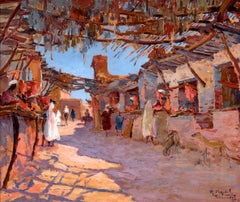
Taroudant
Located in New Orleans, LA
Signed, inscribed and dated "R. Pinatel / Taroudant / 1926" (lower right)
Oil on panel
A stunning ode to the Moroccan landscape, this oil on panel was composed by the French Orientalist painter Raphaël Pinatel, whose lively works adeptly translated the romanticism of the East for a Western audience. The present work, which captures a market in Taroudant, a city in southeastern Morocco, exemplifies the artist’s distinctive approach as he brilliantly translates the energy and atmosphere of the desert city. Pinatel’s style is impressionistic in his brushwork and handling of light and atmosphere. In the present work, he brilliantly captures the effects of the direct desert sun...
Category
Early 20th Century Impressionist Landscape Paintings
Materials
Oil, Panel
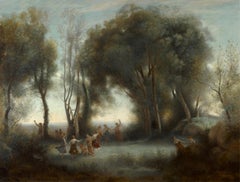
Dance of the Nymphs
By Paul Desire Trouillebert
Located in New Orleans, LA
This lyrical landscape entitled Dance of the Nymphs was composed by the French Barbizon painter Paul Désiré Trouillebert. A joyful scene of nymphs dancing the morning fog, the work closely resembles an important work by the great Camille Corot, which is now housed at the Musée d'Orsay (Paris). Renowned for his unique individuality that toed the line between the traditional and modern, Corot and his landscapes helped pave the way for an entire generation of Impressionists who followed him. Trouillebert perfectly captures the poetic atmosphere of Corot’s groundbreaking works, while also imbuing this scene with a freshness and character that is all his own.
Trouillebert's oil on canvas is exemplary of the tradition of historical painting. The work perfectly combines a realistic depiction of the natural world with a spirited romanticism as his idealized nymph figures frolic playfully beneath a crisp morning sky. As a whole, it is a lovely composition executed with a level of skill and artistry that proves Trouillebert's exceptional talent in the arts.
Born in Paris in 1831, Paul Désiré Trouillebert was a student of the academic painters Ernest Hébert...
Category
19th Century Academic Landscape Paintings
Materials
Canvas, Oil
Read More
Paul Revere Crafted This Silver Coffee Pot 250 Years Ago
Perhaps best known as a Revolutionary War hero, Revere was also an accomplished silversmith, and this pot is now available on 1stDibs.
Degas Portrayed These Exuberant Ukrainian Dancers with ‘Orgies of Color’
Discovered in Parisian cabarets, the performers reenergized the artist’s practice.
Wear Louis Comfort Tiffany’s Genius on Your Finger with This Vivid Ring
In his jewelry making, the designer rarely used diamonds — this rare example has two.
You Won’t Find a More Handsome Stopwatch Than This 1890s Pocket Chronograph
A Grand Complication from the golden era of pocket watches, the Marius Lecoultre pocket watch does everything but uncork your wine.